
Tech
Putin’s awkward online voting video features a Dell PC and an “Activate Windows” watermark


Facepalm: Russia might have spent more than a decade trying to drop US technology in favor of home-grown alternatives, but it appears that even President Vladimir Putin is happy to use a Dell PC and Windows for a video showing him casting his vote. It also seems that the Kremlin didn’t want to pay Microsoft the $139 activation key: Putin was using an unactivated copy of the OS, and looked about as comfortable using the computer as most 73-year-olds would.
In the clip, the Russian president was casting his vote online in the country’s State Duma elections, which were held between September 18 and 20 to elect members of the lower house.
But the video is getting a lot of attention for reasons unlikely to please the Russian president. Firstly, there’s no attempt to hide that the PC being used in this case is a US-made Dell, likely a Dell U3011, running Windows.
It looks as if Moscow isn’t in a hurry to hand over any more money to Microsoft. A magnified section of the video appears to show the Activate Windows watermark. This indicates that Windows is unactivated, though not necessarily unlicensed: a legitimately licensed installation can also display the warning if activation fails.
– Visegrád 24 (@visegrad24) September 18, 2026
Not using something like Astra Linux, which has a 74% share of the Russian-made OS market, for the shoot is something of a surprise.
There could be reasons why this Windows copy is unactivated. Maybe it was set up only for this clip, so registering a fresh copy of the OS was deemed unnecessary. Or perhaps Russia thought it was mocking Microsoft and the US?
Or maybe it was all a ploy to distract from Putin’s computer skills. He looks far from at ease when casting his vote, as the president squints at the screen, takes long pauses, and occasionally resembles the dog from the old “I have no idea what I’m doing” meme. His exclamation that “You can’t go wrong” sounds more like he’s trying to convince himself.

Putin has never come across as technically inclined. It was reported in July 2026 that he still doesn’t own a smartphone, though his spokesperson claims this is due to security and privacy concerns. He’s also said to be wary of the internet and modern communications, but then maybe we all should be.


There’s at least 15 author-driven lawsuits underway against AI companies, while publishers have filed roughly 10 more coordinated suits of their own, notes Publisher’s Weekly.
Yet “While the lawsuits play out, some publishers are building bridges.”
Google recently announced a partnership with Bloomsbury, De Gruyter Brill, Johns Hopkins University Press, Macmillan, O’Reilly Media, and Penguin Random House to enhance e-books from its Google Play store with AI, allowing readers to interact with the text of the books directly, ask questions and get answers, and develop tools such as quizzes and slideshows… [The CEO of the Author’s Guild called the partnership “a positive step forward in the legitimized use of books in the AI ecosystem to the benefit of readers, publishers, and authors alike.”]
Of even more significance is the growing number of licensing deals publishers are striking with AI companies. In 2024, HarperCollins became the first of the Big Five to publicly reveal that it had signed a deal to license its content for AI training. The three-year agreement paid $5,000 per participating title, split equally between HarperCollins and the authors. Wiley announced its first AI licensing deal in 2024 and has since made several more. For fiscal year 2026, it reported earning $49 million in revenue from the deals. The company also has a number of strategic collaborations with companies including Amazon Web Services, Microsoft, Anthropic, Perplexity, IQVIA, OpenEvidence, and others.
And publishers are even building in-house AI tools for producing royalty statements, proofreading, and providing customer service:
In its 2025 Salary and Jobs Report, Publisher’s Weekly reported that 63% of industry professionals surveyed said their organizations were using AI… Keith Riegert, president of the Stable Book Group and CEO of Perfect Bound, has been a vocal advocate for the use of AI in publishing — despite calling himself a “hardcore techno-pessimist.” He tells PW, “I do this because you use AI or you die at this point….” Like many in the industry, he maintains any use of AI must “start with a human and end with a human,” and he draws a clear line, avoiding AI for core creative work, such as selecting titles, designing covers, or creating illustrations — reserving it for developmental editing, formatting, and admin instead… What is known is that each of the Big Five is developing proprietary AI systems for internal use, as proven by the numerous AI-related job openings the companies have posted… [And the parent company of Penguin Random House said in 2025 they used AI for marketing and to forecast demand.]
There’ve been a few high-profile controversies about prominent authors accused of using AI. But Princeton University Press CEO Christie Henry “is less concerned about authors secretly using AI to write than about the time spent policing the situation.”
“It pulls us away from having focused time to think,” she says. Princeton University Press is currently vetting companies that promise to be able to certify that a given book was written by a human, including Created by Humans, Human Authored, and Verify My Writing. Henry adds that the proliferation of plagiarized, copycat, and pirated books online, now supercharged by AI agents mass producing and reproducing content, is further draining resources, as it demands constant vigilance and takedown requests sent to Amazon, YouTube, and others.


Read more of this story at Slashdot.
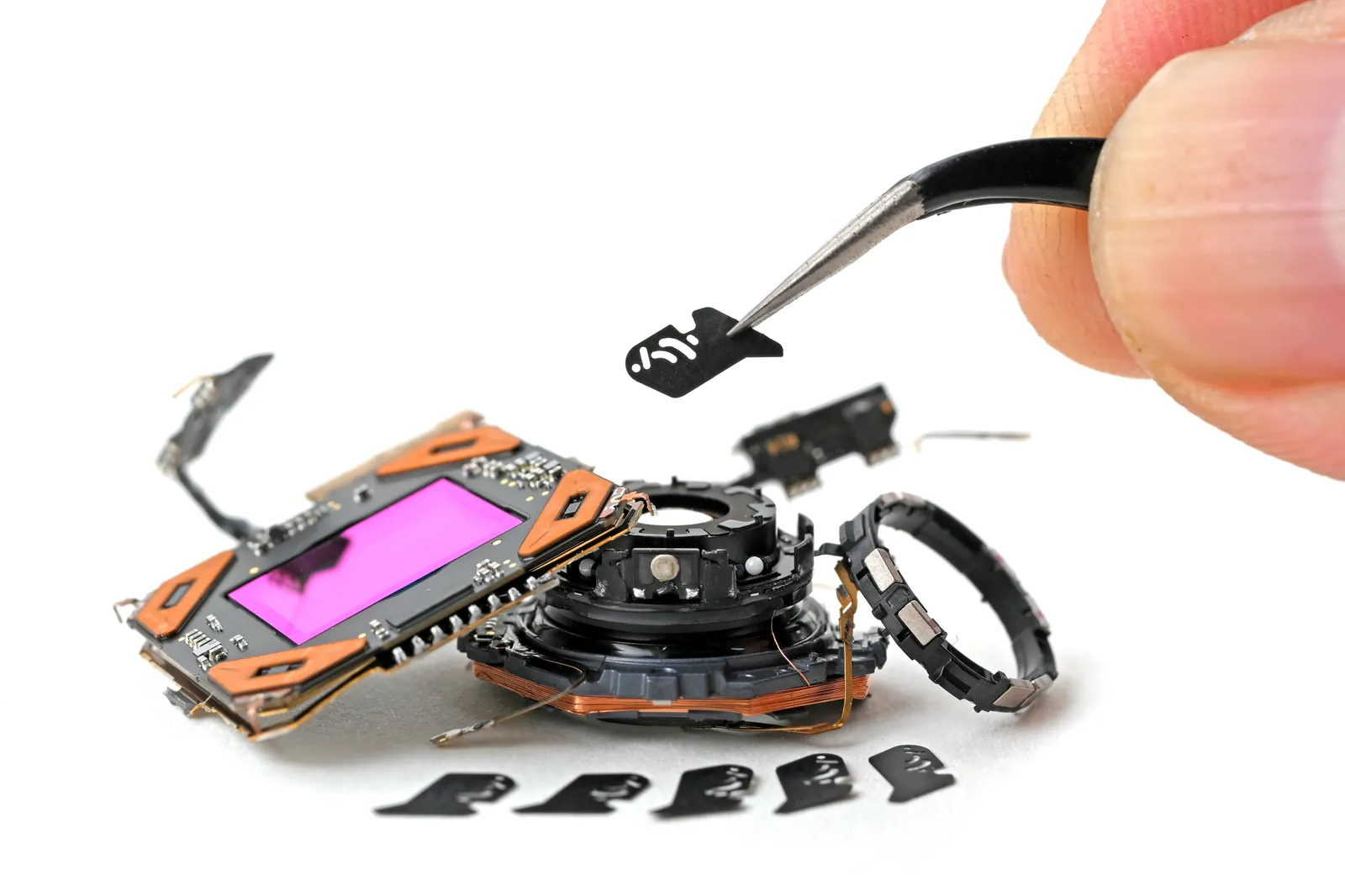
iFixit, the company known for completely tearing apart just about every product and device it can, has fully disassembled a brand new iPhone 18 Pro. The goal is to understand how all the parts fit together and find ways to fix anything that might break.
In the company’s post and teardown video, iFixit showed off how it took apart the latest iPhone, and what people who may someday need to fix theirs should look out for.
It gave the iPhone 18 Pro a repair rating of 7/10, citing easy-to-remove camera and battery assemblies. This matches the rating it gave the iPhone 17 Pro in 2025. That doesn’t mean the iPhone repair process is simple.
The Achilles heel of the iPhone 18 Pro may be a new feature: a variable aperture lens in the phone’s main 48-megapixel camera. It is the first variable aperture in an iPhone (though not the first in a smartphone). It uses six rotating aperture blades the width of a human hair to allow for different apertures for photo and video.

Courtesy of iFixit
The problem with the aperture is that Apple is introducing moving parts—therefore more parts that might need repair. Given the size and intricacy of how the blades are positioned, iFixit called trying to fix the individual blades an almost-impossible task. That means if the camera does break, you’d probably have to replace the full camera assembly. That will undoubtedly be pricier than paying for individual pieces. Luckily, the assembly itself proved easy enough to remove.
A stickier situation is repairing the iPhone 18 Pro’s battery, which requires prying open the glued-on screen. Once that is removed, though, the battery isn’t glued down but secured by screws, so it’s simpler to extract.
All in all, the iPhone 18 Pro is about as straightforward to repair as it has been for a few years—not a totally easy fix, but one with some tangible improvements. This comes after Apple’s long, contentious relationship with repair advocates, which made it a target of European Union legislation to make its products easier to fix.
Apple introduced a self-repair program in 2021. It got off to a bumpy start as the company withheld or made it difficult to access certain tools. After pressure from US state lawmakers, Apple made it slightly easier to repair its phones and eventually introduced a repair assistant to help guide users through the repair process. Still, just this year, the ownership advocacy group PIRG gave the iPhone 17 a D- rating for its repairability.

China is taking a firm stance on AI companions, proposing rules that would prevent platforms from offering virtual intimacy services to anyone under 18. According to a SCMP report, the proposal could set a precedent for governments drawing boundaries around AI relationships.
What would the new rules change?
China’s internet watchdog, the Cyberspace Administration of China, would ban “virtual relatives or companions” for minors. It would also prohibit services that encourage addiction or seriously affect their health. Social networking with strangers would also be banned, except for users over 16 who rely on their own wages.
Games, social platforms, and AI services that could affect cognition for users under 16 would need minors’ mode activated. Additionally, platforms would need better systems for identifying minors, and algorithms cannot encourage emotional dependence, addiction, or excessive spending. AI services found in violation could face a fine up to 10 times the platform’s income when it exceeds 1 million yuan, or about $149,000, and authorities can confiscate it.
Why this matters for AI companies worldwide?
Users aged six to 19 made up 18% of China’s internet users, totaling 112.5 million people, at the end of 2025. Lawyer He Qianggao says regulators will examine whether services simulate family or partner relationships through character settings and emotional guidance. However, ordinary AI chats and functional role-playing would generally fall outside the rules, but dependence-fostering services could face scrutiny.

The challenge is deciding what identified minors can access, which could increase product, infrastructure, and compliance costs. The proposal comes two months after China’s first dedicated humanlike AI rules took effect in July. Those rules target systems that encourage dependence and damage real-world relationships.
The debate is already spreading beyond China, from probes into the risks posed by popular AI chatbots like ChatGPT and Gemini to children to restrictions on AI use in schools. The concerns are not limited to regulators, as parents are increasingly worried about children becoming too dependent on AI.
These rules are still proposals, with public comments open until October 17. China is clearly treating emotional dependence on artificial intelligence as a youth safety issue. If these rules are adopted, it would set a precedent for how governments around the world regulate AI companions.
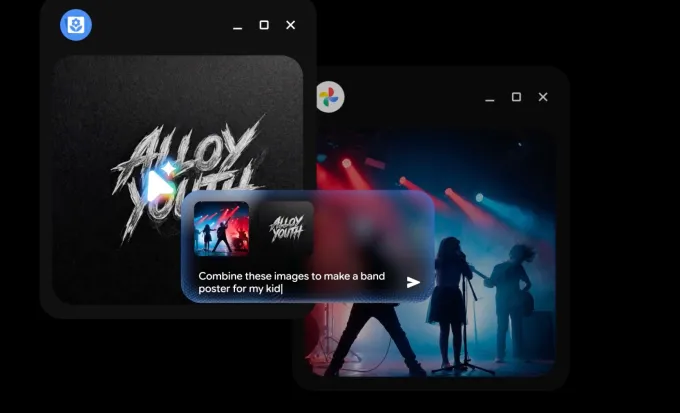
After first unveiling its new AI-powered laptop, dubbed Googlebook, in May, Google on Monday said the new device is now available for pre-order for $899.
Meant to offer a step up from traditional Chromebooks, Googlebooks run on Android OS with a desktop version of the Chrome browser and other familiar ChromeOS elements. However, the real pull for the new devices is that they’ll prominently feature Gemini’s latest capabilities in a new format: the laptop.
Google is trying to offer a laptop with unique features like an AI-powered cursor, vibe-coded widgets, and support for AI-enhanced dictation. The latter is a feature called Rambler, which cleans up messy, rambling brain dumps into readable text.
The move is a bet that AI, specifically Google’s Gemini, could be enough of a draw to get people to buy a new laptop that bakes in AI instead of running them via desktop apps you install or access through the browser. In addition, the devices could eventually replace Chromebooks, bringing millions of former Chromebook customers to Gemini AI.
On the Googlebook, Google is trying to reinvent the “point-and-click” experience of desktop computing to now include an AI element: the cursor serves as a conduit to Gemini. The company suggests various ways this could be used, like highlighting content on a webpage for Gemini to work with, asking Gemini to see if an email you’ve hovered your cursor over is suspicious, or selecting images and then asking Gemini to visualize them together.

In practice, this feature isn’t very different from Android’s “Circle to Search,” which allows smartphone owners to use gestures like circling, highlighting, or tapping to connect with Google Search, which of course, also includes AI. While it’s a clever way to take advantage of the ways people use their phones, Circle to Search on its own didn’t inspire a mass exodus to Android.
Similarly, Magic Cursor, as the AI pointer is called, won’t likely be a main selling point for the Googlebook, especially now that we have AI agents that can take over your computer and browser to do tasks for you.
Google’s Rambler, however, may be one of the best of the AI features in this upgrade, as it meets a surprisingly useful need. However, this, too, isn’t enough reason to buy a new device, as it feels more like a feature that’s nice to have than a necessity.

Vibe-coding widgets are a minor addition, as well. Other Googlebook features, like Gemini Spark and Gemini Live, also don’t require special, new hardware.
What’s more interesting about the Googlebook is how it’s seemingly part of Google’s longer-term plan to capture a large part of the K-12 market that currently relies on Chromebooks, and push them towards the company’s Gemini AI. There are somewhere around 50 million Chromebooks in schools, used by students and educators, Google has said.
In May, the company told TechCrunch that its current Chromebooks would continue to be supported, though many would become eligible to transition to the new Googlebook experience in the future.

The $899 device will include 12 months of Google AI Pro, which gives you 5TB of cloud storage, Gemini Advanced tools, and 3 months of YouTube Premium, Adobe Photoshop and more. The devices will receive regular updates for up to 10 years, Google said.
Googlebook pre-orders are open now on the Google Store, Best Buy, and other retailers. Devices will hit shelves on October 4 in the U.S., and October 5 in Canada, the U.K., Ireland, France, Germany, and Australia.
Flagship devices in the new range are being built by Acer, ASUS, Dell, HP and Lenovo, with materials like aluminum, magnesium alloy and carbon fiber. They feature up to 2.8K OLED displays, haptic glass trackpads, and backlit keyboards. Under the hood, they’ll run on processors from Intel and Qualcomm paired with dedicated NPUs. Google says the device will offer up to 14 hours of battery life.
When you purchase through links in our articles, we may earn a small commission. This doesn’t affect our editorial independence.
from the dysfunction-junction dept
I’ve written a lot about how Elon Musk and Jeff Bezos convinced Republicans to redirect billions in taxpayer money away from future-proof fiber optic upgrades, and toward their low-Earth orbit (LEO) satellite broadband networks they’d already planned to deploy. Curious behavior for two extremely-rich gentlemen who both repeatedly claim to loathe subsidies and corporate welfare.
The short version: the billionaires convinced Republicans to retool the $42.5 billion Broadband, Equity, Access, and Deployment (BEAD) program (created by the 2021 infrastructure bill) in a way that weakened oversight standards, eliminated enforcement of stuff like broadband affordability, speed, and equitable deployment, and shoveled taxpayers toward more expensive, slower, less reliable satellite service.
After doing billionaires a giant favor, Republicans proudly claimed they’d “saved taxpayers around $21 billion” in “non-deployment funds.” The problem: Congress specifically earmarked this money for broadband deployment, so states were understandably annoyed at the missed opportunity.
For much of the last year, states and scattered lawmakers have been begging the Trump NTIA to offer guidance on what is going to happen to this $21 billion. Initially I think they hoped they could just pocket or repurpose that money. When they realized they couldn’t get away with it, they announced last week they’d vaguely be opening additional BEAD funding rounds to try and put the money to work.
Former FCC official Gigi Sohn, illustrated how stupid this all is over at a post at LinkedIn:
“After proudly cutting back on BEAD-eligible locations in its “Benefit of the Bargain” and “Best and Final” bidding rounds, the National Telecommunications and Information Administration (NTIA) has now decided that part of the money it allegedly “saved” will go back to deploy broadband in the places that it nixed previously.”
But there’s still no meaningful guidance on what any of this means (which is required by law). And the BEAD standards have been so altered and twisted, there’s nothing saying this doesn’t just result in billions more money being funneled to Elon Musk and Jeff Bezos for substandard LEO satellite service that’s expensive and increasingly congested (because it wasn’t designed to be a mainstream option).
The bipartisan infrastructure law that created BEAD says that any extra BEAD money left over after physically connecting people must be used to improve broadband maps (which telecoms hate because it highlights market failure), install low-cost connectivity in multiple dwelling units like low income apartment complexes, or support broadband adoption programs. All of which the Trump administration claim are “woke.”
Sohn notes that under the law the Trump NTIA needs to provide clear guidance for the funds. Just ambiguously stating that money can still be maybe used for broadband doesn’t cut it:
“NTIA Administrator Roth promised a Subcommittee of the House Energy and Commerce Committee that she would issue non-deployment guidance this summer. This partial guidance should not serve as a promise kept. The last day of summer is September 22. Tick Tock.”
The annoyance at the Trump NTIA is increasingly bipartisan, as politicians in states like Texas realize this whole program was mired with all sorts of billionaire favoritism, delays, and weird new bureaucratic obstacles that significantly eroded what could have been a once-in-a-lifetime opportunity to expand affordable, fast broadband.
I think this hasn’t been a bigger scandal (yet) in part because states don’t want to speak out and risk not getting billions in funds. So a lot of folks I see in telecom policy are privately furious or disgusted, but publicly pretending that any of this still makes any coherent sense.
It’s important to remember that Republicans spent all last election season complaining that this BEAD program was a bureaucratic hellscape they were going to immediately fix once in office.
Instead the Trump admin redirected billions to billionaires, eliminated any provisions requiring the broadband be equitably deployed and affordable, hijacked $21. billion for what they clearly hoped would be their own personal use, and created years of additional delays due to corruption and bureaucracy.
Folks like Ezra Klein, who helped Republicans parrot BEAD concerns in 2024, have been nowhere to be found since. In fact none of the “abundance” folks have made a single solitary peep about how badly the opportunity to build much-needed affordable broadband infrastructure has been bungled by Trump Incorporated.
Filed Under: bead, broadband, corruption, digital divide, elon musk, fiber, high speed internet, infrastructure bill, satellite


Europe’s data centers are to be graded on how much energy and water they use, under a rating scheme proposed on Monday by the European Commission.
Any individual site drawing more than 500 kW is covered. What the rating measures is not only consumption but what a data center puts back: heat recovered and reused, clean generation it adds, and how far it can flex its own demand when the grid is under strain.
The argument for taking the time to recover the heat is based on one figure: if about half of the heat that Europe’s data centers currently waste were recovered, it would meet the heating needs of four million households.
“Tripling our data center capacity cannot mean tripling the pressure on our grids, our water and our energy bills,” said Teresa Ribera, the Commission’s executive vice-president for clean, just and competitive transition.
Tripling is not merely hypothetical; it is the stated plan: the EU aims to have three times its current capacity within five to seven years, a goal it frames as a matter of technological independence rather than as part of an energy policy.
In 2024, European data centers used about 68 terawatt-hours of electricity, and the International Energy Agency forecasts this to rise to 114 TWh by 2030 due to AI, at which point the sector will account for more than 3% of all electricity consumed in the region.
It is a delegated regulation and determines what takes place afterward; Parliament and the Council now have two months in which to examine it, and although they can object to the entire regulation, they cannot alter a single line of it.
If it survives that stage, the individual data centers will have their labels applied in 2027, and a review of whether any of it is working will be completed by the end of 2028.
The fact is that having a rating does not mean that requirements are being imposed, since the Commission has separately put forward minimum performance standards for consultation, and it is precisely from that process that a real floor would arise; the deadline for this is 14 December.
The Commission is also carrying out work on a tripartite agreement with the operators, the grid operators and the energy suppliers later this year, after the declaration of intent made in June.
At the moment, the proposal makes data centers visible rather than smaller.
“Digital sovereignty must go hand in hand with energy responsibility,” said energy commissioner Dan Jørgensen.
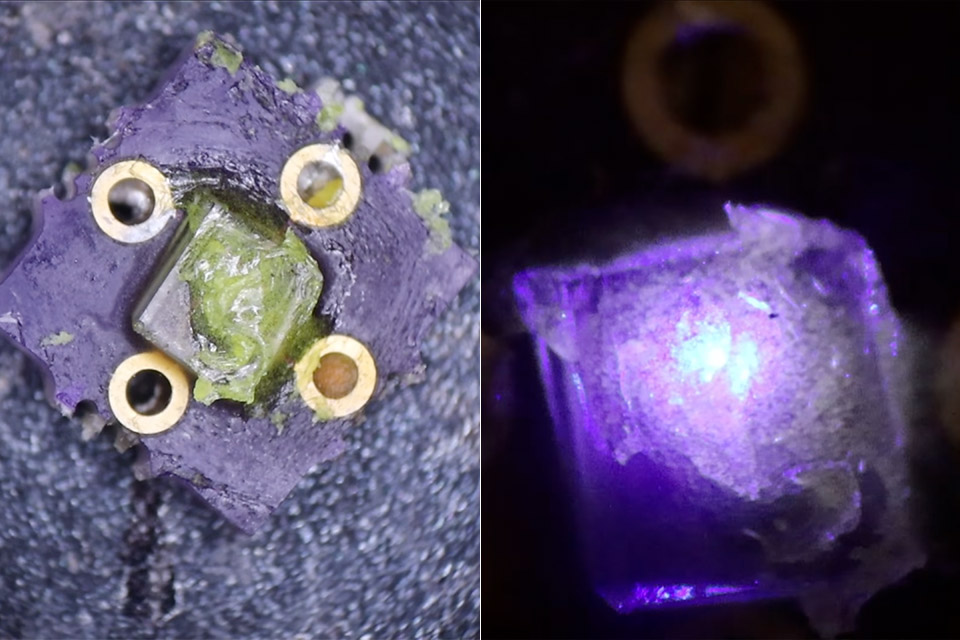
Dr Semiconductor already had working DRAM cells from a class 100 cleanroom built inside a home backyard shed. Packaging those silicon chips onto a circuit board was the next problem, because silicon is opaque and lining up pads by eye is a guessing game. Gallium nitride grown on sapphire is transparent, already contains the layers that make blue light, and happens to be the same material used in commercial LEDs. A two-inch epiwafer costs about $160 and lasts a long time once you dice it.
An LED epiwafer is essentially a thin layer of crystal on a sapphire disk. Underneath is an n-type gallium nitride layer that emits electrons, a thin indium gallium nitride ‘quantum well’ in the middle is where the magic happens, and a p-type gallium nitride layer on top delivers positive charges. When those two combine in the well, you get blue light, which is a really simple process.
Sale

Govee RGBIC Floor Lamp Basic, 1000lm LED Corner Lamp, Black
- Note: This floor lamp is 53.7 inches tall and offers a maximum brightness of 1,000 lumens, making it best suited for corners and small spaces. The…
- Dynamic RGBIC Color: Unleash your creativity with Govee RGBIC technology, you can customize each segment color base and the floor lamp will display…
- Smart Control: Manage your LED floor lamp with simple voice commands via Alexa, Google Assistant. And Govee Home APP also make it more convenient to…
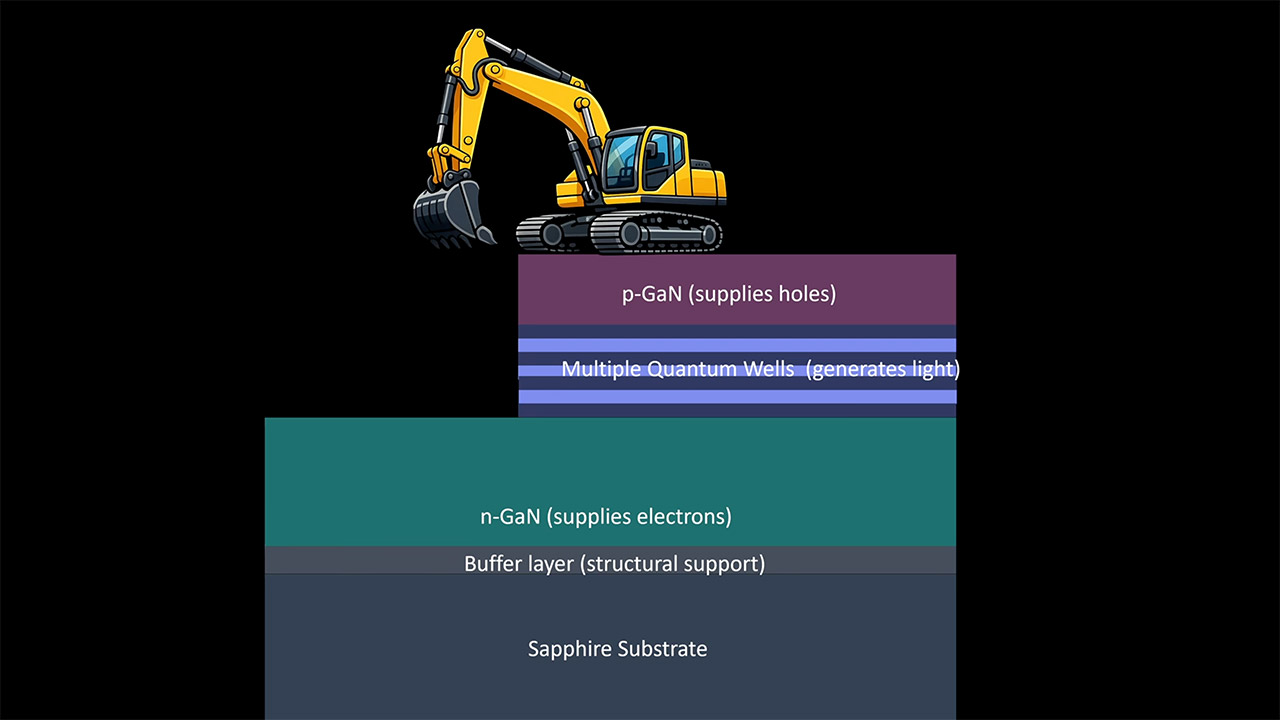
To get to the buried n-layer, however, you must cut through the top two layers without damaging the rest. You can’t simply use a chlorine plasma etcher like the big boys do in actual fabs since they’re way too expensive and unsafe for a home setup. The problem is that gallium nitride absorbs 355 nanometer UV radiation whereas sapphire does not, therefore you need a controlled means to ablate the coating. A refurbished glass-engraving laser from eBay does the work. Getting the right settings can take some trial and error on scrap parts, but once you’ve figured it out, the laser can cut nice little boxes down to the n-layer. To ensure that the wafer still works before any fancy lithography begins, simply apply a smear of soft indium metal to the etched spot and another to the unaltered p-surface, then connect a 9-volt battery between the two, which will glow blue in no time.
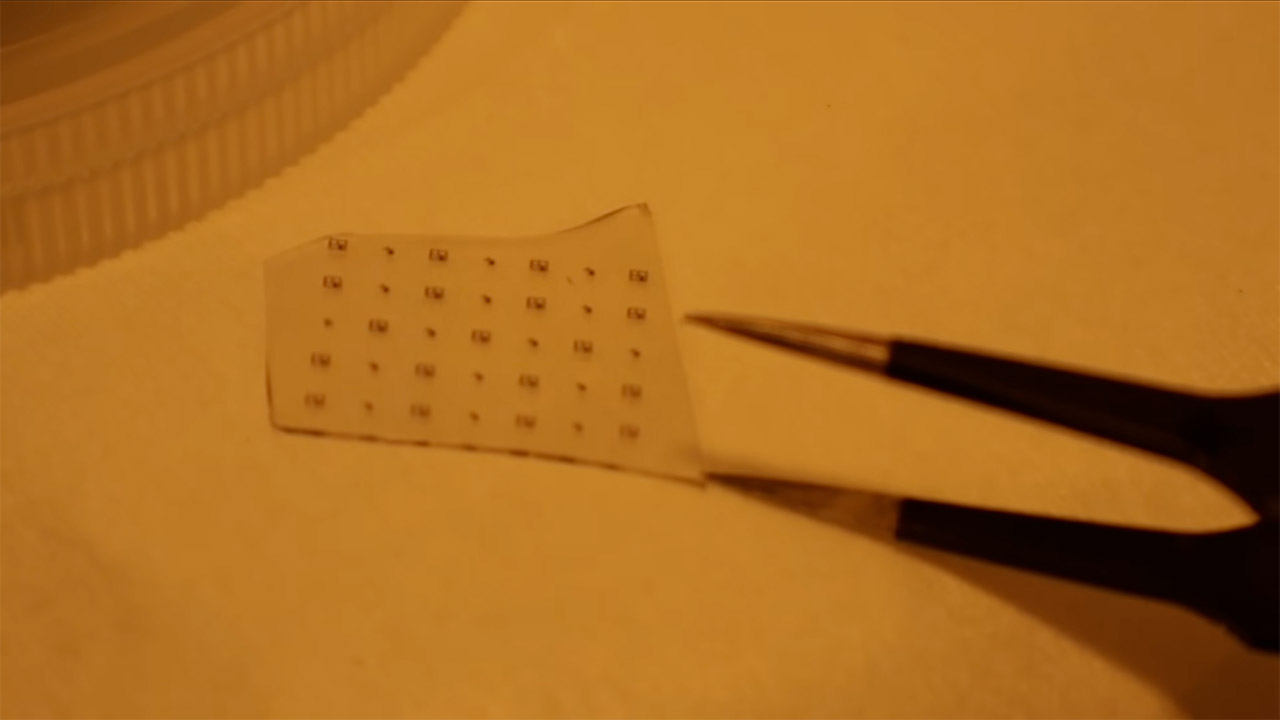
This process can leave behind some ugly metallic gallium and rough sidewalls, which a warm potassium hydroxide bath can remove by peeling the damaged material away like an onion and leaving the top surface clean and smooth. Then it’s just a matter of following the more common flow from there: spin on the usual lift-off resist and photoresist, bake and expose through a microscope stepper (which can print a YouTube logo or simple contact pads), and after a few developments, sputter on some nickel and then silver for the p-contact in a vacuum chamber. A 400 to 450 degree air anneal converts the nickel into a good semiconductor contact and allows the silver to do its job. Following a second alignment and lift-off in DMSO, the titanium and silver create the n-contact.

When a voltage is applied to the p-side positive and the n-side negative, the dies light up a stunning blue-purple, and the turn-on voltage is an ideal 2.5 volts for this material. One major problem is sawing sapphire at home, which is a hassle to get through, but the same 355 nm laser can do the trick if you aim it so it is absorbed inside the transparent crystal, allowing you to cut the wafer into individual chips over several passes. The edges may become scatter-damaged throughout the procedure, so leave some additional space around each die.
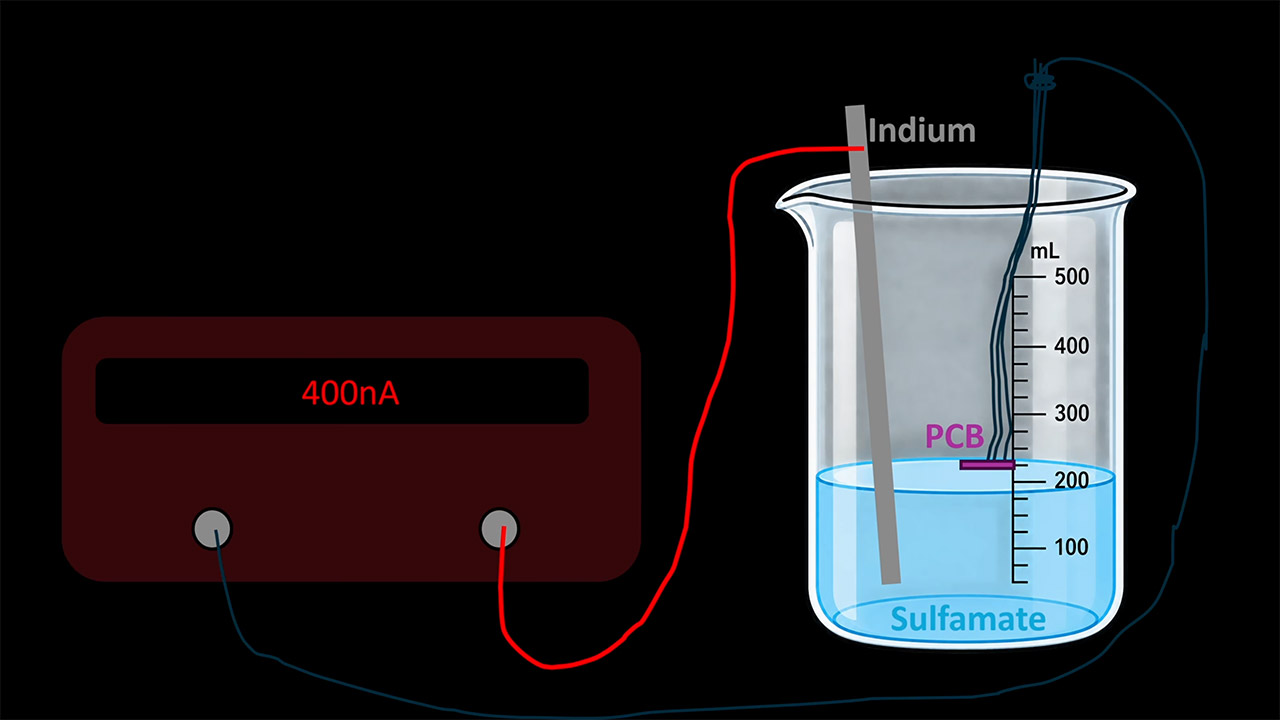
To make the LEDs more practical, you’ll need some custom boards with plated vias, which can then be electroplated with indium bumps. Mask off the regions that must remain clean using Kapton tape and rosins, then apply a little amount of flux to prevent the indium from oxidizing. A micromanipulator aligns the tiny die over the bumps, heat melts the metal, and you have a bonded chip. If you run current through the board vias, the packaged LED will light up just like a factory part. Blue LEDs on their own can appear frigid and uninviting, but when mixed with cerium-doped YAG phosphor powder and hardware-store silicone, the majority of the blue turns yellow. The eye views the combination as white since the more powder you add, the warmer the color becomes, and a small amount of silicon dries rapidly but appears rough, but it still works.
The M6 update for the Mac Mini arrived not a moment too soon. Not only has it been nearly two years since the last Mac Mini was released, but it’s also become increasingly difficult to find an older M4 Mini for purchase in recent months. In the year of the AI agent, Apple’s Mac Mini has enjoyed a surge in popularity to the point of dwindling supplies and long wait times.
The compact, quiet and affordable Mini with its energy-efficient yet powerful Apple silicon and unified memory has become a popular pick for people looking to run OpenClaw and other local AI agents around the clock. Even at its slightly elevated starting price of $899, the M6 Mini is sure to remain en vogue as a tiny, always-on AI server. The core count ticks up for the CPU, GPU and NPU in going from the M4 to the M6, skipping over the M5 in the process.
If you want to pack more power into the Mac Mini for running demanding creative workloads or larger LLMs, Apple offers two M5 Pro processor upgrades and the ability to stuff the Mini with up to 64GB of RAM. Apple sent me a pair of Mac Minis to test, an M6 model with bumps to the memory and storage and a loaded M5 Pro unit whose price places it in Mac Studio territory.
Apple Mac Mini specs (as tested)
| Mac Mini M6 | Mac Mini M5 Pro | |
| Price as reviewed | $1,299 | $2,899 |
| CPU | M6 12-core CPU | M5 Pro 18-core CPU |
| Memory | 24GB unified memory | 48GB unified memory |
| Graphics | Integrated M6 12‑core GPU | Integrated M5 Pro 20‑core GPU |
| Storage | 512GB SSD | 1TB SSD |
| Networking | Wi-Fi 7 and Bluetooth 6 | Wi-Fi 7 and Bluetooth 6 |
| Ports | Front: USB-C (x2, up to 10Gbps), 3.5mm headphone jack
Rear: USB-C Thunderbolt 4 (x3, up to 40Gb/s), HDMI out, Gigabit Ethernet, power input |
Front: USB-C (x2, up to 10Gbps), 3.5mm headphone jack
Rear: USB-C Thunderbolt 4 (x3, up to 40Gb/s), HDMI out, Gigabit Ethernet, power input |
| Operating system | MacOS 27.0 Golden Gate | MacOS 27.0 Golden Gate |
 Josh Goldman/CNET
Even before the latest price hike with the M6 model, the Mac Mini lost its standing earlier this year as Apple’s most affordable Mac computer. It debuted two decades ago at $499 and could be had for $599 for most of its tenure before jumping to $799 earlier this year.
Released this spring, the MacBook Neo became the cheapest Mac at just $699, but it’s based on an A18 Pro processor borrowed from the iPhone. So, the Mac Mini still remains the most affordable Mac computer with a proper M-series processor. At $899, it’s still $400 less than the cheapest MacBook Air. And it beat every MacBook in the race to be the first Mac to get Apple’s new M6 processor.
Meet the M6
The M6 processor is the first of Apple’s M series processors to be fabricated with a 2nm process, which allows for denser circuitry in the same size die. The smaller process usually results in greater efficiency and lets you increase the core count and clock speeds without increasing the size of the chip.
And sure enough, the M6 is richer in cores than the previous M4 part. The M6 has 12 CPU cores and 12 GPU cores — up from 10 cores of each type in the M4 chipset. Meanwhile, the core count of the neural processing unit that’s designed to handle the integer math required for AI tasks, including Apple Intelligence, has doubled.
 Josh Goldman/CNET
The M6 has a dual 16-core neural engine; its combined 32 cores are double the 16-core NPU of the M4 and M5 Pro. The M6 and M5 Pro also feature the same neural accelerators on the GPU that Apple introduced with the M5 to help boost AI and ray-tracing performance.
For $899, the M6 Mac Mini has 16GB of RAM, a 256GB SSD and a 2.5Gb Ethernet adapter. Offering 256GB of storage on a desktop computer, no matter how small that computer may be, is borderline offensive. You can’t even buy a MacBook Air with a 256GB SSD after Apple jettisoned that undersized option earlier this year. Unfortunately, the cost to double the storage to 512GB is steep at $200, which quickly pushes the price of the Mac Mini over $1,000. Want to double it again to 1TB? That’s another $300. Be prepared to part with another $500 if you want to double it yet again to 2TB.
Memory costs are similarly steep. Each 8GB upgrade adds $200 to the bill, going from 16GB to 24GB and 24GB to 32GB. Choose one of the M5 Pro upgrades, and you can take the memory to 48GB or 64GB and storage up to a whopping 8TB. (I’ll let you discover those upgrade prices on your own; just be sure you’re sitting down when you take a look.)
Pricing for the Mac Mini with an M5 Pro starts at $1,699. For that price, you get an M5 Pro with a 15-core CPU and 16-core GPU, along with 24GB of memory and a 512GB SSD. (Yes, along with you, I was relieved to see the 256GB SSD option disappear with the M5 Pro upgrade.)
 Josh Goldman/CNET
Apple sent me the higher of the two M5 Pro offerings. It has an 18-core CPU and a 20-core GPU. Apple also upped the memory to 48GB and the storage to 1TB while also upgrading the Ethernet adapter to 10Gbps. The cost of this test system is $2,899. That’s $400 more than the entry-level Mac Studio.
Notably, the M5 Pro chips have the same 16-core neural engine as the standard M5 chip and not the M6’s dual 16-core neural engine. No matter the CPU you choose, the Mac Mini comes with Apple’s N1 chip that delivers Wi-Fi 7 and Bluetooth 6 networking.
The good news and bad news with Apple’s unified memory
Let’s get the bad news (and a couple of acronyms) out of the way first. Apple’s M-series processors have a system-on-a-chip (or SoC) design with a unified memory architecture. The downside of this arrangement is that the RAM cannot be upgraded after purchase. You’re locked into whatever amount you buy. Common on today’s laptops, it’s more of a drag on a desktop computer, even one as compact as the Mac Mini, where space for upgrades is limited.
Now, the good news. The SoC design combines the CPU, GPU and neural engine to remove bottlenecks and speed up both performance and efficiency. And with Apple’s UMA, the system’s memory is shared among the CPU, GPU and neural engine instead of splitting it into separate blocks where most of the RAM is accessed by the CPU and only a smaller amount of video RAM is allocated to the GPU. Running a local LLM is extremely memory-intensive, which is why the affordable Mac Mini, with its unified memory, has become the move for many people looking to run local AI agents.
 Josh Goldman/CNET
Memory bandwidth has improved with the new Mini models. The M6 Mac Mini’s memory has a bandwidth of up to 153 GB/s with 16GB of RAM and up to 170 GB/s with 24GB or more, which is an increase from the 120 GB/s of the M4 Mini. The M5 Pro jumps you up to a memory bandwidth of 307 GB/s.
Design stays the same
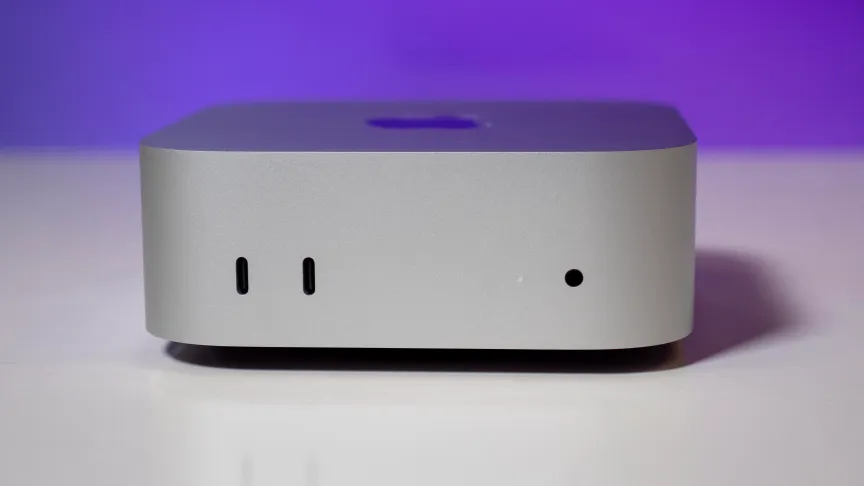
Apple refreshed the internals but kept the design the same from the M4 model, which introduced a much smaller footprint than the previous M2 model. The M6 Mini has the same 5-by-5-inch box that stands 2 inches tall, with the power button still in the same somewhat strange location. It’s on the bottom panel, which means you’ll need to pick up the Mini to power it on.
The same design means the new Mini has the same port selection, which was strong with the M4 Mini, so it wasn’t begging for a change — unless you were looking for the adapter-free convenience of getting a USB-A port. With all of the USB ports of the Type-C variety, you’ll need an adapter for older USB-A peripherals or a wired mouse. Like the M4 model, the M6 Mini supports up to three external displays.
 Josh Goldman/CNET
M6 and M5 Pro Mac Mini performance so far
Based on my initial testing, the M6 Mac Mini is looking like it’s going to be an even more popular pick than the M5 Pro Mini or previous M4 Mini for agentic AI workloads. The dual 16-core neural engine, combined with the neural accelerator on each GPU core, helped the M6 rocket ahead of the M4 Mini on our Geekbench AI test, which measures the on-device AI performance of a laptop’s NPU. The M6 also topped the M5 Pro Mini and every M5-based MacBook we’ve tested on this test. The M5 has the GPU neural accelerators of the M6 but not its dual 16-core neural engine.
Still, the Asus Ascent QN10 mini PC based on a Qualcomm Snapdragon X2 Elite CPU performed better on this test than the M6 Mini, thanks to its NPU, which is capable of 80 trillion operations per second.
On our application benchmarks, the M6 Mini turned in outstanding single-core performance on the Geekbench 6 and Cinebench 2024 tests, where it again outpaced the M5 Pro and the crop of M5 MacBooks and Windows competitors. The M5 Pro Mini put its extra CPU cores to good use and beat the M6 Mini on the Geekbench 6 multicore test, but surprisingly, it fell short of the M6 Mini on the multicore CPU test of Cinebench 2024.
Where the M5 Pro Mini had its largest advantage over the M6 Mini in graphics performance. It easily outpaced the M6 Mini on our 3DMark Steel Nomad test.
I have more tests to run on these two machines to further investigate their AI and graphics performance. Check out the initial benchmark results below for the M6 and M5 Pro Mini, and check back soon for my full review of Apple’s latest Minis.
System configurations
| Apple Mac Mini (M6) | MacOS Golden Gate 27.0; Apple M6 (12-core CPU, 12-core GPU), 24GB LPDDR5, 512GB SSD |
| Apple Mac Mini (M5 Pro) | MacOS Golden Gate 27.0; Apple M5 Pro (18-core CPU, 20-core GPU), 48GB LPDDR5, 1TB SSD |
| Apple Mac Mini (M4) | MacOS Sequoia 15.1; Apple M4 (10-core CPU, 10-core GPU), 16GB LPDDR5, 512GB SSD |
| Apple MacBook Pro 16 (M5 Max) | Apple MacOS Tahoe 26.3.1; Apple M5 Max (18-core CPU, 40-core GPU); 128GB LPDDR5; 4TB SSD |
| Apple MacBook Pro 16 (M5 Pro) | Apple MacOS Tahoe 26.3.1; Apple M5 Pro (18-core CPU, 20-core GPU); 48GB LPDDR5; 2TB SSD |
| Apple MacBook Pro 14 (M5) | Apple MacOS Tahoe 26.0.1; Apple M5 (10-core CPU, 10-core GPU); 16GB LPDDR5; 1TB SSD |
| Apple MacBook Air (M5) | Apple MacOS Tahoe 26.3.1; Apple M5 (10‑core CPU, 10‑core GPU); 16GB LPDDR5; 1TB SSD |
| Asus Ascent QN10 | Microsoft Windows 11 Pro; Qualcomm Snapdragon X2 Elite X2E-88-100; 32GB LPDDR5; Qualcomm Adreno X2-90; 1TB SSD |
| Asus NUC 16 Pro | Microsoft Windows 11 Pro; Intel Core Ultra X7 358H; 64GB LPDDR5; Intel Arc B390; 1TB SSD |
| Minisforum AtomMan G1 Pro | Microsoft Windows 11 Pro; AMD Ryzen 9 8945HX; 32GB LPDDR5; Nvidia RTX 5060; 1TB SSD |

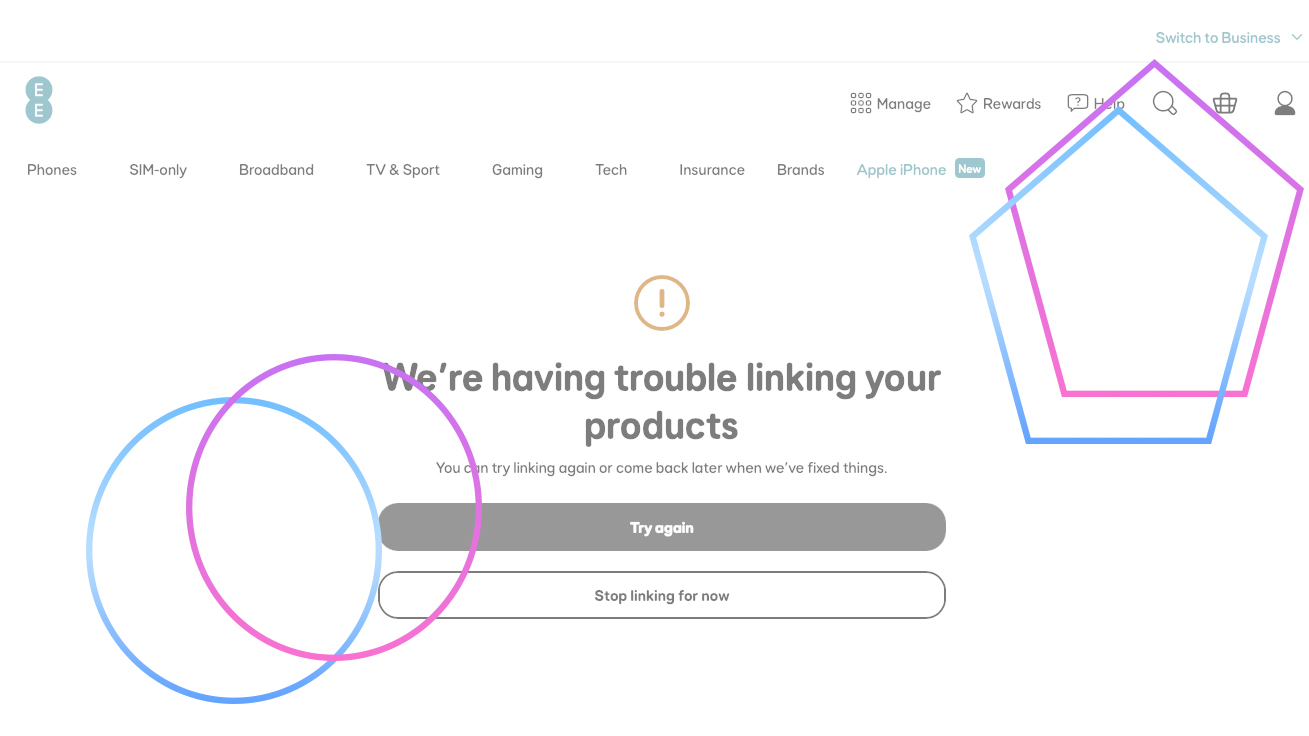
I recently switched my phone service to EE, as it has better coverage (and 5G) where I spend a lot of time. As a freelancer, I had to get my phone on a business contract, which started oddly and soon turned into a farce, and now it’s impossible to manage my account online.
In this age of advanced AI, super-fast mobile networks and data at our fingertips, how can a company the size of EE (and owned by BT) be unable to make something as simple as online account management work?
An eSIM by post
Things started strangely when I tried to order an eSIM. I thought that I’d get the eSIM in an email, but I was told that the system was down, so it had to be posted. Yes, you read that right: the eSIM had to be posted.
To be fair, the service was fast, and the next day I had an envelope with a cardboard wallet containing the QR code for my eSIM. A few minutes later, I had the eSIM installed and connected, and glorious 5G was mine, with better reception.
It was even smooth transferring my old number to my new account. But that’s where things started to go wrong.
Online account linking didn’t work
I was about to go on a work trip to Berlin, so I wanted to check that my Roam Abroad Inclusive Extra, which I’d picked on checkout, was added to my account. Despite being able to create an EE account, I found that it wouldn’t let me add my phone.
So, I called for support and was told there was an issue, but my account would be manually linked, and it would take up to four working days. I explained about the work trip and was told that it was noted, and roaming was turned on.
When I landed in Berlin, I got a text saying roaming charges applied per day. My Roam Abroad extra had not been applied. Fortunately, I could do this by text.
Business account linking can’t be done manually
When I got back, I found that my account still hadn’t been linked, so I had to phone again. This time, I got closer to the truth.
“The reason being the EE app is getting upgrade to a better version and it’s under maintenance, so that’s the reason why you are not able to [link your account],” the support person told me.
I was then offered paper bills every month, and the option to call for help every time I wanted to do something simple, but no option to have the actual issue fixed. When I took out the account, the sales team didn’t mention that online account management was broken. I told this to the support person, who denied that account linking is broken and said that “it is getting upgraded to a better version”.
When pressed on why the account linking is broken, I was told, “It is not broken.”
Apparently, “There’s a difference between a broken app. There’s a difference between an app and an app under maintenance and getting upgraded to a better version.”
And there is. A broken app doesn’t work and doesn’t let you do the most basic of things.
I asked, “So, does my app work at the moment?”
And the answer was, “No.”
“So if it doesn’t work…” I began to say.
“That doesn’t mean it’s broken,” interrupted the support person.
“It does. If something doesn’t work, it’s broken,” I said.
I was then offered some further help and asked to wait for two minutes. Which I did. Rather than help, I was put through to the e-business upgrades team instead. Another trip through security questions, and I was transferred to the service team, who also had to put me through the security questions.
Business account linking has been broken for ages and there’s no confirmed fix
Finally, this support person told me what the actual problem was.
“You are not being able to sync your numbers, check accounts online, manage your account online. Basically our EE app and our website; both versions are not working as they should,” said the support person. “There are technical difficulties that have been going on for several months now. I’ll be very honest with you. This is a recorded line. I’m giving you this information. Okay. Now, this has been going on for several months.”
Apparently, EE needs to build a new application to manage accounts, and there’s no confirmed date for when this will be done. And, the old version can’t be reverted to, either.
“Previously what we were trying was to revive the application which we already had, but we have things have not turned up good,” I was told.
I was then told that if I really wanted online account management, you know, almost as though we were in the 21stcentury in a world filled with technology, then I could cancel my account as I was in the cooling-off period. Or, I could have paper billing, which would be provided free of charge.
I asked for a discount on my line while the issues are fixed, but apparently that’s impossible to do on any day except day one of the contract.
My call finished with the service representative confirming that the online application is broken: “To manage things online, yes, you need access to our online applications, which is currently broken.”
So, what is going on? Looking around, it seems as though the issue has been dragging on for a long period. This Reddit thread from a year ago describes the same issue. So does this thread from September 2025 on the EE support forum, which describes the issue as starting in November 2024.
I got in contact with EE to ask for a statement and for more detail on the issue, but only had my request put through as a complaint. The resolution of the complaint? Paper billing, of course.


Oura spent the first nine months of its financial year buying its own shares back from its investors. On Monday it started selling them to everybody else.
The Finnish smart ring maker launched its initial public offering before the New York open. It is marketing 50 million shares at $40 to $44 each. At the top of that range the deal raises $2.2bn. That values Oura at about $14.1bn, according to Bloomberg, which calculated the figure from the share count in the filing. Oura has applied to list on the Nasdaq Global Select Market under the ticker OURA.
Read the split and the deal changes shape. Of the 50 million shares, Oura is selling 13.5 million. The other 36.5 million belong to existing stockholders. The 30-day over-allotment option of a further 7.5 million shares is also entirely theirs.
Oura keeps a quarter of its own flotation
At the top of the range, the company collects roughly $594m before fees. Its shareholders collect about $1.61bn, or 73% of the base deal. Exercise the over-allotment and the selling stockholders take close to $1.94bn of a $2.53bn deal. That is 77% of it. The release puts the point without decoration. “Oura will not receive any proceeds from the sale of its common stock by the selling stockholders,” it says.
Cash-outs are normal in a late-stage listing. The ratio is what draws attention. Most of the money raised on Oura’s debut goes to people who already own Oura. The company itself walks away with less than a third of it.
The ask has come down
A month ago the number was bigger. Bloomberg reported in August that Oura was targeting up to $3bn. The valuation attached to it was above $16bn, as TNW covered at the time. The launched deal is about 27% smaller than that ask, at a valuation roughly $2bn lower.
Set against a different marker, it still reads as a step up. Oura closed an $875m Series E last September at $10.9bn. A $14.1bn debut is 29% above that in twelve months. Which comparison matters depends on whether you were in the August book or the 2025 round.
Why the company wants the cash
The $594m lands on a balance sheet that has been emptied out on purpose. In the nine months to 30 June, Oura repurchased $1.17bn of its own stock. That included 13,295,528 preferred shares at $40.18 each in a February tender offer. It drew $375m on a revolving credit facility to help pay for it.
Those buybacks are the reason the filing shows a $924.3m loss. The operating business made $60.8m of net income over the period. A $985m deemed dividend to preferred holders turned that into a loss attributable to common stockholders. TNW set out that distinction when the S-1 first appeared. By 30 June the company held $371.8m of cash against a stockholders’ deficit of $1.62bn.
Seen that way, the Oura IPO is the back half of a transaction that started in February. Oura bought its early investors out at $40.18. It is now offering the same company to the public at $40 to $44.
The membership line is the bull case
Hardware is not what the bankers are selling. Oura’s membership revenue grew 121% to $240.5m over the nine months, against 65% growth in hardware. The membership gross margin is 89%. Roughly 94% of ring buyers convert to a paid plan and about 85% stay after a year. Sixty-three per cent take the annual option.
The company updated its S-1 on Monday. It now guides towards approximately 5.7 million paid members by the end of fiscal 2026. That would be 96% year-on-year growth, and it credits sales of the Oura Ring 5, the model it shipped in May. Members stood at 5.0 million at the end of June, so the guidance implies another 700,000 in the final stretch.
Oura sold about 3.6 million rings in the trailing twelve months and holds around 2% of the global wearables market. Eli Lilly’s $50m investment converts to stock at pricing.
What the sceptics are pointing at
Two things sit in the risk section and neither is abstract. The first is warranty. Oura booked $84.4m of warranty expense in fiscal 2025. It carried a $132.3m accrual at the end of June, having paid $75.5m of claims in nine months. For a company that sold 3.1 million rings over the same period, that is a live cost line rather than a rounding error.
The second is the accuracy question. A proposed class action in the Northern District of California challenges Oura’s marketed claim of 95% sleep staging accuracy against a clinical sleep lab. It cites research on 45 patients that put overall classification at 53.18%. Oura rejects it. “We stand behind our science, research, and accuracy claims,” the company said. It pointed to studies comparing its staging favourably with polysomnography. The suit names both Oura Inc. and the Finnish parent, Oura Health Oy.
Eighteen banks, and Robinhood is the last one
Goldman Sachs, Morgan Stanley, J.P. Morgan, Allen & Company and Jefferies are joint lead book-running managers. BofA Securities, Barclays and Wells Fargo Securities sit a tier below, then Citizens, KeyBanc and Guggenheim, then six more. Robinhood appears once, at the bottom, as the sole co-manager.
That placement was visible in the S-1 two weeks ago and it has survived to launch. The retail broker is in the syndicate for this deal, and it is in it last.
Founded in Finland, listed in New York
Oura was founded in Finland in 2013 and keeps its EU headquarters in Oulu. Its corporate headquarters is San Francisco, and the listing is on Nasdaq. It is the same route Revolut is now planning and the one Anthropic has chosen. European policymakers keep describing that pattern as a problem: companies built in Europe raise their public money somewhere else.
The test is not the first day of trading. It is whether 5.7 million paid members arrives on schedule. The number to read it against is the warranty line, when Oura files its first quarter as a public company.

Crypto’s Fairshake repeats history with $30 million to oppose Sherrod Brown Senate bid

Farage Plays Down Latest ‘Bump In The Road’ For Reform UK

Asiad 2026 Sept 22 schedule, India medal-event timings, live streaming | Asian Games 2026




-

 Fashion3 days ago
Weekend Open Thread: Talbots – Corporette.com
-

 Tech17 hours ago
Researchers escape OpenAI Codex sandbox to run commands on host
-

 Crypto World3 days ago
Circle launches Arc Studio AI agent for building onchain apps
-

 Crypto World7 days ago
Revolut Attackers Warn of Ongoing Daily Customer Data Leaks
-
 NewsBeat3 days ago
Trump says US has reached an agreement to take permanent control of Greenland’s security
-

 Crypto World7 days ago
Kraken Lets xStocks Holders Earn Yield Through DeFi
-

 Crypto World6 days ago
Robinhood engineers charged over $50K crypto scheme
-

 Crypto World3 days ago
Bitcoin price breaks channel as RSI climbs to 63
-

 Crypto World5 days ago
US Charges Robinhood Engineers Over Crypto Listing Trades
-

 Crypto World6 days ago
What Is the Status of the U.S.-Iran Peace Talks? Here's What Both Sides Are Saying
-

 Crypto World6 days ago
NVIDIA Analysis: Attempted Rising Wedge Breakout Amid Pressure on the AI Sector
-

 Tech6 days ago
Webb’s IC 348 Mosaic Includes Two-Jupiter Dwarfs, Twin Jets, and a Nursery Still Making Worlds
-

 Crypto World3 days ago
World Money launches in 150+ countries with Stripe
-
Crypto World7 days ago
Can Circle’s Arc Repeat Robinhood Chain’s Meme Coin Boom?
-

 Crypto World3 days ago
Silver prices recover quickly, hitting weekly high today
-

 Entertainment6 days ago
Big Brother Update: Melody Explodes at Drew as Illness Sweeps BB28 House
-
 NewsBeat3 days ago
US was ‘on brink of war’ with China over false AI report of nukes moving in Middle East
-

 Crypto World7 days ago
Kraken Adds DeFi Yield on Tokenized Stocks and ETF Assets
-

 Crypto World3 days ago
Trading Bitcoin on Robinhood? Why 2% Spread Has Traders Worried
-

 Crypto World7 days ago
DOJ Seeks to Seize $61M in Iran Oil Funds From Binance Accounts It Vouched For
You must be logged in to post a comment Login