
Tech
Rated and reviewed by our experts


Although numerous gadgets are deemed must-haves, you can’t forget about the humble microwave – no kitchen is complete without one partially due to their impressive versatility.
Traditionally, microwaves were just used to quickly heat and reheat food but recently they’ve taken on a whole new status, boasting even more additional features for hassle-free cooking, defrosting and even grilling.
As some microwaves can go well past the £100 mark, it’s worth assessing your needs before making an investment. If you know you’ll solely use your microwave to reheat leftovers, then you probably don’t need a more premium pick with multiple mod-cons.
If, however, you’re looking for an appliance that can do a bit more, then a combination microwave would be a better investment for you. A combi microwave can boast features including individual cooking programmes for different foods, convection ovens and even grill modes, so you can truly do everything with just one appliance.
You should also consider power levels, program settings and the size of the physical microwave to make sure it’ll fit comfortably in your space. You also should ensure that the internal capacity of your microwave is big enough to fit your widest plates and tallest containers.
To help you decide, we’ve tested multiple microwaves, from the budget-friendly to more premium models, and compiled the highest-rated options into this handy list.
All microwaves we review are rigorously tested by our experts. We inspect every aspect from the design and capacity to the cooking functions, performance and power. We then ensure that each microwave is built for purpose, putting them through real-world tests such as defrosting bread, reheating cooked rice and cooking jacket potatoes.
If you want to add more to your kitchen beyond a new microwave, you might be interested in our other numerous review guides including best air fryer guide, best toasters, best kettles and best coffee machine.
SQUIRREL_ANCHOR_LIST
We test microwaves to see how good they are at their main job. For that, we start with tests designed for the microwave mode only. These include reheating rice and toasting bread, using a thermal camera to see exactly how well (and how evenly) the microwave heats.
We also cook a baked potato, using a microwave-only mode if that’s available, but we’ll use a combi mode, adding convection oven or grill, to see how this works. Where microwaves have a grill, we test them with bread and see how even the grilling is across as many slices as we can fit into a product.
We’ll also test convection oven settings by heating a baking tray full of ceramic cooking beads, and then using a thermal camera to view how evenly the oven heats.
If there are other key functions, such as air frying, steaming or crisping, we try these out following suggestions in the manual.
Much more than just a basic microwave, the Sage Combi Wave 3-in-1 also works as an oven, air fryer and even sports a grilling feature too. Although its height and width are typical of a microwave, with its whopping 32-litre capacity, the depth is excessive at 490mm – and that’s without factoring in the handle which adds another 23mm.
On the front of the appliance is a generous viewing window which allows you to keep an eye on your food, alongside six clearly labelled function buttons and two dials.
The six function buttons include Fast Combi, From Frozen, Air Fry, Oven, Microwave and Food Menu with the latter acting as a selection of smart cook options for various ingredients such as meat and vegetables.
Although Food Menu is useful, there are notable limitations specifically regarding weight limits, so just be sure to check the manual before cooking. Open the soft-close door and you’ll see a series of labelled shortcut buttons which allow you to quickly select the optimum time and power levels for tasks such as softening butter, melting chocolate or to enable the grill function.
Although the latter is undoubtedly a useful addition, it’s worth noting that the grill is quite gentle and therefore requires ingredients to be propped up closer to the heating element at the top.
During our testing, we found that the Sage Combi Wave performed admirably across the majority of its functions, from defrosting bread to cooking a jacket potato impressively quickly at under seven minutes.
We also found that not only does air fry mode result in evenly browned and crispy chips but the Combi Wave conveniently alerts half-way through cooking to remind you to stir the contents for the best possible results. The Sage Combi even took cooking a 1.6kg chicken in its stride, as it made use of the microwave, oven and grill functions for a perfectly cooked roast.
Even so, if you’re looking for a microwave that can double as an air fryer and oven then you’d be hard pressed to find a better option than the Sage Combi Wave 3-in-1.
With a 32-litre capacity, sleek design and impressive performance, the Samsung MS32DG4504ATE3 is perfect for larger households with lots of mouths to feed.
Keep in mind though that with such a large capacity, which Samsung claims is enough to cook 5kg of potatoes, comes mammoth dimensions. Measuring at 517 x 423 x 295 MM, ensure you have enough counter space to house this comfortably.
Although it’s undeniably huge, the Samsung MS32DG4504ATE3 has a stylish design thanks to its brushed metal finish which integrates nicely into a modern kitchen space. While the glossy finish on the door can attract fingerprints and grime, the cleverly placed handle on the top side of the door helps to minimise this.
Its control panel is easy-to-use and equipped with a digital display which allows you to see what function you’re selecting and provides readouts for time, weight and more. The MS32DG4504ATE3 is also fitted with multiple functions alongside its conventional microwave mode, including Auto Cook, Home Dessert and Keep Warm. There’s even a useful Deodorisation programme which removes any lingering cooking smells from the appliance.
We were seriously impressed by the MS32DG4504ATE3’s results, both as a conventional microwave and for more difficult tasks like defrosting and cooking. We found defrosting chicken took around 10 minutes, while defrosting salmon took just seven and a half minutes.
We then used the Auto Cook function for the defrosted chicken and found it cooked perfectly, although it did take slightly longer than the manual suggested.
Of course, the main function of a microwave is to warm foods up and, fortunately, we were very pleased with the results. Cooked bacon took just 45 seconds to become piping hot while day-old bread only took 70 seconds. If you need a larger microwave that looks stylish, is easy-to-use and performs consistently well throughout all its functions then the Samsung MS32DG4504ATE3 Solo Microwave Oven is one for you.
With its drop-down door, the spacious Panasonic NN-CS89LBBPQ looks more like an oven than a microwave, but its real shining point are the plentiful auto programmes, covering defrosting, steaming, grilling, roasting and baking. The oven space is the most generous we’ve seen thanks to the flatbed design and the three tray slots, which allow several items to be cooked at the same time on different levels, further emphasised by the auto programmes’ ability to cook as much as 2kg of meat.
The accessories include a wire shelf, enamel and glass trays as well as a plastic trivet meant specifically for steaming tasks.
One highlight is a humidity-measuring auto sensor combi programme that adjusts the power level and cooking time accordingly and delivers a jacket potato with crispy skin and fluffy texture.
For the steam function, a water tank and a drip tray are located at the bottom of the appliance. The drip tray handily stops water from running onto your worktop when the oven door is opened. Very conveniently, the NN-CS89LBBPQ is also self-cleaning, with four steam function-based cleaning settings, including deodorisation and cavity cleaning to remove grease build-up inside the oven.
While navigating its touch-sensitive controls and deciphering the various programmes isn’t always intuitive, a thick instruction manual is provided, also featuring some 40 pages of recipes.
If there’s one problem with microwaves, it’s trying to work out how to choose the right setting for the right dish. The Samsung Easy View Convection Oven with HotBlast Technology MC28M6075CS makes this easier, with some very clever automated programmes.
The smartest mode is the Sensor cooking. In this mode, the microwave can cook a range of different ingredients, including jacket potatoes, cauliflower and chilled soup. Measuring the gasses released from foods, the microwave can stop cooking at the optimal point: I found it made my jacket potato perfect: fluffy on the inside, cooked all the way through and not shrivelled up.
HotBlast modes can be used with the baking tray to cook common foods, such as oven chips, using the convection oven feature and blasting air down from the top element. Here, we found the results good, although we did find that an air fryer will give crispier results.
We love the automatic defrost programmes: select the food type and weight, and the microwave handles the rest. Our test bread slices were cool to the touch but not frozen, and leaving them for just a couple of minutes had them ready for sandwiches. More than just a microwave, the Samsung Easy View Convection Oven with HotBlast Technology MC28M6075CS is a handy convection oven, too. With its very smart automated programmes, it can cook food beautifully with virtually no hassle.
The Russell Hobbs Scandi Digital Microwave stands out among its affordable peer group due to the addition of a couple of simple auto-cook programmes that calculate the cooking time according to the food’s weight. It’s also not as small as a 17-litre capacity may lead you to believe. However, with a 245mm turntable, it doesn’t fit larger dinner plates. While the combination of shiny glass, plastic and metal with walnut-imitation wood is a very particular look, likely to have a Marmite effect, the Scandi Digital is available in black, grey, and white to suit different colour schemes.
Its auto-cook menu has eight programmes, for reheating food and microwaving popcorn, beverages, pizza, sliced potatoes, vegetables, meat, and fish. Using the reheat programme, cold, cooked rice came out evenly heated. And a raw jacket potato had a decent texture after just 8mins of microwaving.
This is a handy appliance for anyone looking for some microwaving shortcuts.
Fed up with wrestling larger and odd-sized dishes into your microwave? A flatbed model like the CASO MCG 25 Ceramic Chef might just be one for you.
With a 25-litre capacity, the MCG 25 Ceramic Chef is the average size for a countertop microwave and sports familiar controls on its front, like the door eject button. However, it also doubles as a working grill and a convection oven too, and comes equipped with useful accessories such as a wire shelf and a round baking tray.
Operating the MCG 25 Ceramic Chef is a bit confusing at first, so make sure you keep the manual handy when you’re getting started. While it’s undoubtedly a feature packed device, with preset programmes for certain foods, grilling options and multi-stage cooking, actually selecting the modes isn’t particularly straightforward. Although the user interface isn’t terrible, we did find ourselves pressing the wrong buttons and hearing error beeps while we got used to it. Even so, we found the MCG 25 Ceramic Chef to be a solid performer during our tests. At our most simple tests of heating food up, we found the microwave offered event results with no cold spots.
Things are a bit more hit and miss when it comes to using the more advanced modes. For example, we were a bit disappointed with the grill option and found the overall result wasn’t particularly even. Having said that, it’s worth remembering you should keep turning food during this to ensure even results.
We also found that although some of the preset programmes weren’t too convincing, using the combination grill and microwave mode worked much better. Not only that, but the convection oven setting worked brilliantly too. While it may not rival the best air fryers, it still performed admirably.
Although it might take some getting used to, if you want a flatbed microwave that doubles as a decent enough grill and convection oven, then the MCG 25 Ceramic Chef is a great choice.Learn more about how we test microwaves
Pros
Pros
Cons
Pros
Cons
Pros
Cons
Pros
Cons
Pros
Cons
Easy to use
Versatile
Powerful and fast
Modern, seamless design
Consistent cooking
Extra-large capacity
Only basic functionality
Quite expensive
Versatile
Spacious
Self cleaning
Expensive
Not very intuitive
Some uneven results
Very easy to use
Automated cooking programmes work brilliantly
Can do many jobs that an oven can do
Need space for all the accessories
Auto-cook programmes
Affordable
Good cooking results
Fits smaller plates only
Not the most intuitive
Flatbed design
Excellent value
Wide range of cooking options
Fiddly to use
Grill wasn’t that even
FAQs
The answer depends on whether you’d use them or not. A grill or convection oven combined with a microwave can give you additional cooking space, or the ability to combine programmes, say grilling and microwaving at the same time, to speed up cooking.
The more power, the faster the microwave will cook, but that can be a double-edged sword. Warming up your dinner with the 1000W setting may be overkill and leave you with burnt bits. However, heating water in a jar to sterilize it may benefit from higher settings.
Flatbed microwaves often need food to be turned manually to get even results but you get more space in them and can use irregular-sized pots and containers; turntable microwaves cook more evenly but you’ve got less room and are restricted in the size of container you can use.
Measured in litres, the internal size tells you how big the cavity is. The bigger the household, the larger the microwave you’ll want. Also consider use; if you occasionally heat some pasta sauce or reheat the occasional left-overs, then a smaller microwave will do you.
Neither’s better, but integrated models are neater as they’re permanently installed and often have larger capacities. They’re a good choice if you’re having a new kitchen and have place to permanently put a microwave, although seriously consider a combi model that can act as a second oven, as this gives you more cooking options.
Freestanding models are generally cheaper and come in a wider range of sizes. As they just plug in, they’re easier to change if something goes wrong, and you can take them with you if you move house. Freestanding models are a good upgrade if you’ve got all of your integrated appliances already, or only have room for a single integrated oven.
Test Data
| Sage Combi Wave 3 in 1 | Samsung MS32DG4504ATE3 Large Capacity Solo Microwave Oven | Panasonic NN-CS89LBBPQ Combination Microwave Oven | Samsung Easy View Convection Oven with HotBlast Technology MC28M6075CS | Russell Hobbs Scandi Digital Microwave | Caso MCG 25 Ceramic Chef Microwave |
|---|
Full Specs
| Sage Combi Wave 3 in 1 Review | Samsung MS32DG4504ATE3 Large Capacity Solo Microwave Oven Review | Panasonic NN-CS89LBBPQ Combination Microwave Oven Review | Samsung Easy View Convection Oven with HotBlast Technology MC28M6075CS Review | Russell Hobbs Scandi Digital Microwave Review | Caso MCG 25 Ceramic Chef Microwave Review | |
|---|---|---|---|---|---|---|
| UK RRP | £399.95 | £168 | £519.99 | £219 | £84.99 | – |
| Manufacturer | Sage | Samsung | Panasonic | Samsung | Russell Hobbs | – |
| Size (Dimensions) | 519 x 513 x 316 MM | 517 x 423 x 295 MM | 500 x 480 x 541 MM | 517 x 463 x 310 MM | 451 x 353 x 256 MM | 490 x 285 x 480 MM |
| Weight | – | 14.6 KG | 24.5 KG | -1 G | 10.7 G | 16.65 KG |
| ASIN | – | – | – | B079T8NPBV | B07YF69D9Q | – |
| Release Date | 2021 | 2024 | 2021 | 2023 | 2021 | 2025 |
| First Reviewed Date | 05/01/2022 | 20/08/2024 | 05/01/2022 | 04/04/2023 | 18/02/2022 | 22/07/2025 |
| Model Number | Sage Combi Wave 3 in 1 | – | Panasonic NN-CS89LBBPQ Combination Microwave Oven | Samsung Easy View Convection Oven with HotBlast Technology MC28M6075CS | Russell Hobbs Scandi Digital Microwave | CASO MCG 25 Ceramic Chef Microwave |
| Model Variants | – | – | – | – | White or grey | – |
| Stated Power | 1550 W | 1000 W | 1300 W | 1400 W | 700 W | 2050 W |
| Special features | Smart Cook, Smart Defrost, Smart Reheat, Fast Combi, Cook From Frozen, Air Fry, Oven, Microwave, Grill, A Bit More, Child Lock,+30 Instant Start, Turntable Off, Shortcuts Panel | – | 12 combi cooking options and 36 auto programmes | Automatic cooking | Eight auto-cook programmes | Grill, convection oven |
| Oven type | Combi | Microwave | Combi | Combi | Microwave | Combi |
| Appliance type | Freestanding | Freestanding | Freestanding | Freestanding | Freestanding | Freestanding |
| Number of ovens | 1 | 1 | 1 | 1 | 1 | 1 |
| Oven description | Combi microwave, grill, convection oven and air fryer | – | 4-in-1 combination steam oven (microwave, oven, steam and grill) | Combination microwave convection oven | Freestanding microwave | Freestanding microwave, oven and grill |
| Oven grill | Yes | – | Yes | – | – | Yes |
| Oven microwave | Yes | Yes | Yes | Yes | Yes | Yes |
| Oven steam | – | – | Yes | – | – | – |
| Microwave bed type | Rotating | Rotating | Flat | Rotating | Rotating | Flat |
| Microwave max power | 1100 W | 1000 W | 1000 W | 900 W | 699 W | 900 W |
| Oven capcity | 32 litres | 32 litres | 31 litres | 27 litres | 17 litres | 25 litres |



Amazon isn’t just buying Globalstar — it’s inheriting Apple’s satellite roadmap.
The Seattle-based company’s agreement to acquire the satellite operator behind Apple’s iPhone Emergency SOS feature promises to give it a new constellation of operating satellites, a key slice of mobile spectrum, and Apple as a flagship partner.
The cash-and-stock deal, announced Tuesday, will help the Amazon Leo satellite broadband business press fast-forward in its attempt to catch up with Elon Musk’s Starlink.
Amazon told GeekWire the transaction was valued at approximately $10.8 billion as of April 9, when the exchange ratio was fixed. This differs from the slightly higher figure reported by multiple news outlets Tuesday. The value will fluctuate with Amazon’s share price until closing, capped at $90 worth of Amazon stock per Globalstar share.
Apple is already Globalstar’s biggest customer. In 2024, it committed about $1.5 billion to the company — a combination of prepayments for satellite services and a 20% equity stake in a Globalstar subsidiary — in exchange for the right to most of its network capacity.
Under a separate long-term agreement announced along with the deal, Amazon Leo will power satellite features on future iPhone and Apple Watch models, including Emergency SOS, messaging, Find My location sharing, and roadside assistance. Amazon will also continue supporting the Apple devices that already rely on Globalstar’s existing network.
Amazon renamed its satellite venture from Project Kuiper to Amazon Leo in November, a move the company framed at the time as a key step toward commercial service.
On Monday, a day before the Globalstar announcement, Amazon Leo unveiled a new aviation antenna capable of delivering gigabit download speeds to aircraft, part of the build-out for its Delta and JetBlue in-flight Wi-Fi deals.
The acquisition agreement values Globalstar at $90 per share in cash or stock and is expected to close in 2027, pending regulatory approval. Thermo Funding, which controls 57.6% of Globalstar, has already agreed to the deal, according to an SEC filing, meaning no shareholder vote is required.
Globalstar, based in Covington, La., currently operates about two dozen satellites in low Earth orbit. It is in the middle of a major expansion, backed by Apple, that will grow the fleet to 54 satellites. It also holds licensed mobile-satellite spectrum — a scarce and tightly regulated asset that is difficult for newer entrants like Amazon to acquire.
Starlink operates about 10,000 satellites and serves more than 9 million subscribers. Amazon has launched about 200 satellites and has yet to begin consumer service.

Looking for the most recent regular Connections answers? Click here for today’s Connections hints, as well as our daily answers and hints for The New York Times Mini Crossword, Wordle and Strands puzzles.
Today’s Connections: Sports Edition includes some fun categories. There’s a certain Olympic sport that pops up in the purple category, and if you just watched the Winter Games, you may do well. If you’re struggling with today’s puzzle but still want to solve it, read on for hints and the answers.
Connections: Sports Edition is published by The Athletic, the subscription-based sports journalism site owned by The Times. It doesn’t appear in the NYT Games app, but it does in The Athletic’s own app. Or you can play it for free online.
Read more: NYT Connections: Sports Edition Puzzle Comes Out of Beta
Hints for today’s Connections: Sports Edition groups
Here are four hints for the groupings in today’s Connections: Sports Edition puzzle, ranked from the easiest yellow group to the tough (and sometimes bizarre) purple group.
Yellow group hint: Baseball abbreviations.
Green group hint: Not lions.
Blue group hint: Hollywood hoops.
Purple group hint: Winter Olympics sport.
Answers for today’s Connections: Sports Edition groups
Yellow group: MLB teams, on scoreboards.
Green group: Tigers.
Blue group: Members of the Los Angeles Lakers.
Purple group: Curling terms.
Read more: Wordle Cheat Sheet: Here Are the Most Popular Letters Used in English Words
What are today’s Connections: Sports Edition answers?
The completed NYT Connections: Sports Edition puzzle for April 15, 2026.
The yellow words in today’s Connections
The theme is MLB teams, on scoreboards. The four answers are CIN, MIL, PIT and STL.
The green words in today’s Connections
The theme is tigers. The four answers are Clemson, Detroit, LSU and Memphis.
The blue words in today’s Connections
The theme is members of the Los Angeles Lakers. The four answers are Doncic, James, Smart and Vanderbilt.
The purple words in today’s Connections
The theme is curling terms. The four answers are bonspiel, end, house and stone.

OpenAI’s $852 billion valuation is facing skepticism from some of its own investors as the company scrambles to reorient itself around enterprise customers and fend off Anthropic, according to the Financial Times.
Anthropic’s annualized revenue jumped from $9 billion at the end of 2025 to $30 billion by the end of March, driven largely by demand for its coding tools. One investor who has backed both companies told the FT that justifying OpenAI’s round required assuming an IPO valuation of $1.2 trillion or more — making Anthropic’s current $380 billion valuation look like the relative bargain.
The secondary market tells a similar story right now, where demand for Anthropic shares has grown nearly insatiable while OpenAI shares are trading at a discount.
Altman has been here before. During his tenure leading Y Combinator, aggressive valuation inflation left some portfolio companies financially stranded while others proved worth every penny and then some.
Iconiq Capital partner Roy Luo — whose firm has invested over $1 billion in Anthropic while holding a smaller stake in OpenAI — told the FT where he stood. “There’s room for both, but there is fundamentally a number one and a number two dynamic, and the number one will win disproportionately,” he said. “We picked.” OpenAI CFO Sarah Friar pushed back, telling the FT that the company’s $122 billion raise — the largest private fundraising in history — was evidence of continued investor confidence.

The FCC has granted (PDF) Netgear the first exemption from its foreign-made router ban, allowing the company to keep selling new consumer router models made outside the U.S. through Oct. 1, 2027. PCMag reports: The Defense Department reviewed Netgear’s application for an exemption and found that its products “do not pose risks to US national security.” The FCC’s order doesn’t elaborate on why. Netgear is based in San Jose, California, although its products are made in Asia. The exemption, known as a conditional approval, lasts until Oct. 1, 2027. It covers a large range of future Wi-Fi models from Netgear, spanning the R, RAX, RAXE, RS, MK, MR, M, and MH series, the Orbi consumer mesh, mobile, and standalone routers under the RBK, RBE, RBR, RBRE, LBR, LBK, and CBK series, as well as cable gateways and cable modems under the CAX and CM series.
The exemption isn’t a full green light for the future product models from Netgear. The FCC says the company still needs to go through the normal Commission-regulated equipment authorization process for each device. The Oct. 1, 2027 date effectively amounts to a deadline for Netgear to receive FCC certification for the router models; each certification is also permanent, enabling the product to be sold in the US on an ongoing basis. This also suggests that Netgear has an 18-month period to receive FCC certifications for future products.

Microsoft has introduced new Windows protections to defend against phishing attacks that abuse Remote Desktop connection (.rdp) files, adding warnings and disabling risky shared resources by default.
RDP files are commonly used in enterprise environments to connect to remote systems because admins can preconfigure them to automatically redirect local resources to the remote host.
Threat actors have increasingly abused this functionality in phishing campaigns. The Russian state-sponsored APT29 hacking group has previously used rogue RDP files to remotely steal data and credentials from victims.

When opened, these files can connect to attacker-controlled systems and redirect local drives to the connected device, allowing the attacker-controlled device to steal files and credentials stored on disk.
They can also capture clipboard data, such as passwords or sensitive text, or redirect authentication mechanisms like smart cards or Windows Hello to impersonate users
New RDP protections roll out
As part of the April 2026 cumulative updates for Windows 10 (KB5082200) and Windows 11 (KB5083769 and KB5082052), Microsoft has now released new protections to prevent malicious RDP connection files from being used on devices.
“Malicious actors misuse this capability by sending RDP files through phishing emails,” warns Microsoft.
“When a victim opens the file, their device silently connects to a server controlled by the attacker and shares local resources, giving the attacker access to files, credentials, and more.”
After installing this update, when users open an RDP file for the first time, a one-time educational prompt is shown that explains what RDP files are and warns about their risks. Windows users will then be prompted to acknowledge that they understand the risks and press OK, which will prevent the alert from being shown again.
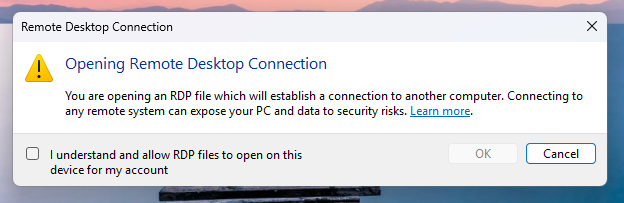
Source: Microsoft
Future attempts to open RDP files will now display a security dialog before any connection is made.
This dialog shows whether the RDP file is signed by a verified publisher, the remote system’s address, and lists all local resource redirections, such as drives, clipboard, or devices, with every option disabled by default.
If a file is not digitally signed, Windows displays a “Caution: Unknown remote connection” warning and labels the publisher as unknown, indicating there is no way to verify who created the file.
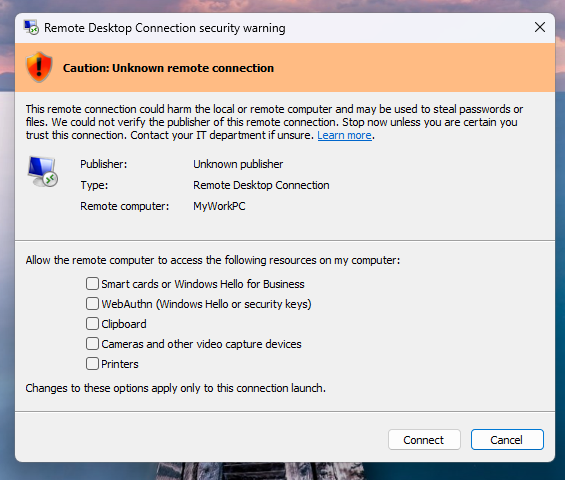
Source: Microsoft
If the RDP file is digitally signed, Windows will display the publisher, but still warn you to verify their legitimacy before connecting.
It should be noted that these new protections apply only to connections initiated by opening RDP files, not to those made through the Windows Remote Desktop client.
Microsoft says that Administrators can temporarily disable these protections by going to the HKLM\Software\Policies\Microsoft\Windows NT\Terminal Services\Client Registry key and modifying the RedirectionWarningDialogVersion value so it is set to 1.
However, as RDP files have historically been abused in attacks, it is strongly recommended to keep these protections enabled.

Automated pentesting proves the path exists. BAS proves whether your controls stop it. Most teams run one without the other.
This whitepaper maps six validation surfaces, shows where coverage ends, and provides practitioners with three diagnostic questions for any tool evaluation.
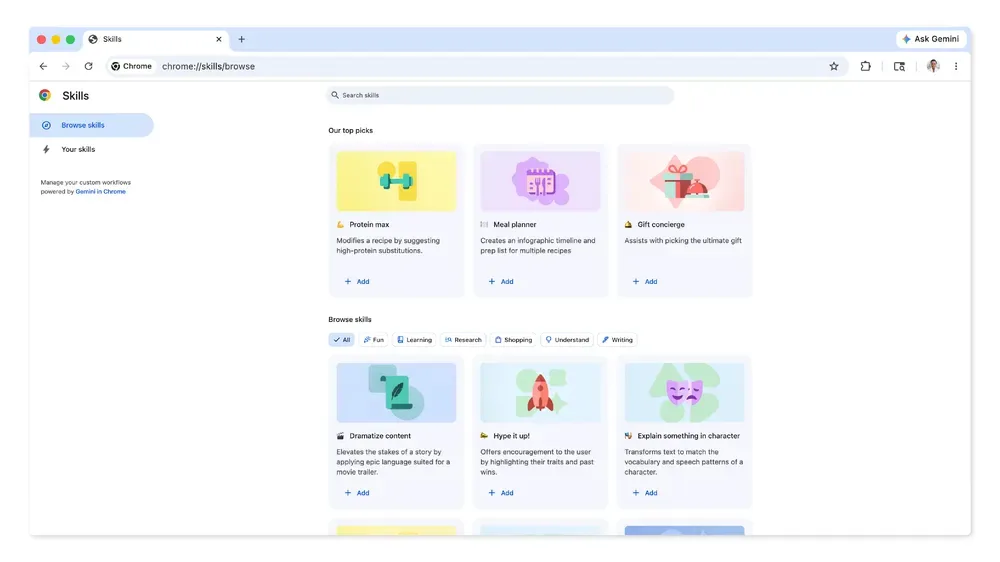
If you have ever typed the same AI prompt into Gemini multiple times across different tabs, you know how tedious that gets. Google has now solved that problem by launching a new feature called Skills in Chrome. It lets you save your most useful Gemini prompts and run them again instantly with a single click.
So what can I do with Skills in Chrome?
Skills can turn your Gemini prompts into reusable one-click tools. Once saved, a Skill stays available across all your desktop devices signed into the same Google account.
Early testers have used them to calculate protein macros from recipe pages, generate side-by-side product spec comparisons across multiple tabs, and scan lengthy documents to summarize information.

Google is also launching a pre-built Skills library with ready-to-use prompts for common tasks. You can use them as-is or customize them to fit your needs. Skills also come with privacy guardrails. Before taking sensitive actions such as sending an email or adding a calendar event, it will ask for your confirmation first.
How to use Skills in Google Chrome
Skills are rolling out to desktop Chrome users with their language set to English-US. To save a Skill, open Gemini in Chrome and type a prompt you want to reuse. Once the conversation is in your chat history, you will see the option to save it directly as a Skill from there.

To run it, type a forward slash ( / ) in the Gemini chat box and select your saved Skill. You can also use the plus sign ( + ) button to access Skills. To manage or edit them, type forward slash ( / ) and click the compass icon. To browse the pre-built library, look for it inside the same menu.
It is worth noting that Google is also testing a Projects feature for Gemini that lets you organize AI chats into folders, similar to ChatGPT. However, the feature is currently available to a small group of users and is not fully functional yet.

Apple reportedly threatened Grok owner xAI with an App Store ban if the deepfake nude generation issues weren’t addressed. In spite of ongoing problems with the chatbot, the app was never removed.

X and Grok faced backlash after deepfake problem
For several horrific days in January, social media platform X was flooded with AI-generated pornographic images involving non-consenting adults and minors. Many wondered why legal entities were slow to respond, but above all, why Apple was completely silent on the matter.
According to a new report from CNBC, shared by 9to5Mac, Apple did threaten to remove Grok from the App Store. While Elon Musk did change moderation rules on X, even after monetizing the illegal porn, the Grok app didn’t change much at all.
Continue Reading on AppleInsider | Discuss on our Forums


Longtime Seattle investor and entrepreneur Chris DeVore is managing partner of Founders’ Co-op.
I have a confession to make. I’m a Democrat. And a capitalist. Both, at the same time.
This didn’t used to be a position that needed defending. But over the course of my adult life these two ideas have moved farther and farther apart. The bond is now at the breaking point, and if it snaps, the party I grew up in will abdicate its once-legitimate claim to the best of the American idea.
The belief in free markets is actually shared by the vast majority of Americans, and while it may anger the populist fringe, embracing capitalism would be a rallying cry to centrists from both parties who despair for our future and are hungry for a message that makes sense.
Today, the party that has labored to defend and perfect the American experiment — with opportunity, justice and equal treatment under the law for all — has either lost its mind, or its memory, for the motive force that makes those ideals possible.
Take away the promise of a better life (immigration), the means to achieve it (capitalism), and the certainty that the fruits of your labor won’t be arbitrarily confiscated (rule of law), and the engine that has made America the richest, most powerful and most admired country in the world grinds to a halt, and the whole grand experiment comes to an end.
One can acknowledge all the historical errors that mar the American project — the displacement and murder of indigenous people, slavery and Jim Crow, the creeping capture of government by corporations, rich people, old people, the list goes on — and not lose sight of the three essential ingredients that make our strange and complicated country possible: capitalism, the rule of law, and a welcome embrace of all who wish to make America their home.
But if you listen to Democrats at both the state and national level today, capitalism is the enemy. Billionaires and their current avatars, AI and data centers, have become the bogeymen that electeds and party leaders invoke to stir outrage in the base.
What’s offered as an alternative isn’t economically coherent (“tax the rich,” when the top 10% of earners already pay ~75% of all federal income taxes; “ban data centers,” industrial-scale NIMBYism that simply pushes development elsewhere), but the message behind the slogans is clear: American prosperity is not something to be conserved, much less promoted; it is a natural resource that we somehow lucked into and can harvest at will, an overflowing fountain of wealth that will never run dry.
How did we get here? How has capitalism, the incontrovertible powerplant of democracy, become anathema to the Democratic party?
Today’s apparent loss of faith is actually rooted in capitalism’s undefeated record of success, coupled with the fitful but now accelerating failure of our democratic machinery.
It’s strange that the centrality of capitalism to our national project requires explanation, but that’s actually the best evidence of its truth: we have been so rich for so long, so embarrassed with our abundance of material and experiential choices, that we have come to take it for granted. We blithely assume that the neighborhood business owners and global corporations that make abundance possible, depositing bi-weekly paychecks in the bank accounts of their millions of workers and filling store shelves with the bewildering array of goods and services we enjoy every day, have simply always been there, will always be there, like the air we breathe.
This is a tragic mistake.
I have made a career, or more truly, I have found a calling, in supporting entrepreneurs from their moment of inception. Every business that exists, from the most humble corner cafe up to and including General Motors and Amazon, only does so because a small number of unreasonable people overcame extraordinary obstacles over many years to create something from nothing.
Every paying job, every charitable gift, every nickel of tax revenue that finances the safe and convenient world we all enjoy, springs from that improbable act of creation. The machinery of capitalism works so well, allowing one person’s vision to be transformed into millions of jobs and billions of dollars of tax revenue, that we have simply forgotten how extraordinary it is, how dramatic a break it represents from thousands of years of autocracy, feudalism, injustice and inequality.
The engine of capitalism is so efficient that it also conceals the deepest truth of all organic systems: companies, just like people, are born, live a short time, and then decline and die. This is hidden by the irrepressible generative energy of well-regulated self-interest: new companies arise to fill the gaps and address the shortcomings of current incumbents, fueling an endlessly diverse and creative process of regeneration. Every company that falters is replaced by two more, eager to serve the customers no longer satisfied by the prior wave’s lackluster efforts.
To paint a picture of this cycle of renewal, of the top 100 most valuable companies in America today, 15 were founded in just the past 10 years, 30 didn’t exist 25 years ago, 45 didn’t exist 50 years ago, and less than a third (30 of 100) have been around for 100 years or more. Great companies can seem like they’ve always been here, but in fact they are dying and being born every day. New companies have to come from somewhere, and that somewhere is the solar energy of the capitalist biosphere: entrepreneurship.
If capitalism, and its essential generative act of entrepreneurship, are so great, how could we possibly have turned against them?
The answer is both democracy’s greatest failure, and its most obvious path to redemption.
For at least the past century, Democrats and Republicans have divided themselves by their views on the role of the state. Democrats see government as an essential partner in the national project: providing critical infrastructure like roads and airports, securing the national defense, providing basic education and health services, and ensuring that the rule of law is applied fairly and equally, both to the companies that help our economy thrive as well as to its individual citizens. Republicans share many of these same views, but where Democrats push for more, Republicans have generally wanted less: lower taxes, fewer regulations, and a generally less-generous redistribution of national income to those lower on the economic ladder.
But to obtain the levers of power needed to advance their respective goals, both parties have relied on the obvious carrot of legislative giveaways to secure blocs of electoral support: farmers, labor unions, business owners, real estate developers, the list is as endless and varied as the economy itself. The result is a regulatory and tax system so stuffed with incentives, tax breaks and special protections that any citizen, even and especially those favored by one set of legislated advantages, can point to those in another group and cry “unfair!”, “undemocratic!”, “corrupt!”
It is this general stench of favoritism and corruption, slowly accreted over 250 years of electoral back-scratching on both sides of the aisle, that has brought us to our present crisis. Each party is so captured by its crazy quilt of protected electoral blocs and aggrieved parties, and so credibly able to point to the injustices perpetrated by the other side, that it becomes plausible to question the entire free-market edifice.
Great wealth now has the taint of theft, with no fine distinctions between entrepreneurial success and a systematic looting of the Treasury.
Things tend to continue as they began. So the most likely, and most depressing, scenario is that we are witnessing the final throes of the American idea. Two centuries of bipartisan regulatory capture have so encrusted our legislative and fiscal infrastructure that equal treatment under the law is now a bitter punchline, not the proud aspiration that once bound us together as a nation. Each party is now fully captive to its donor base, its electoral security purchased with gifts of regulatory ledgermain and dollars siphoned from public coffers, that there is precious little oxygen left for the promises on which the nation was built.
But to use this bipartisan failure of democracy to make a villain of capitalism, to paint as enemies of the state the few founders who have reaped extraordinary gains from their entrepreneurial ventures, when the vast majority are lucky to keep their employees paid and the lights of their modest establishments lit, is to eat out the very heart of the American project.
This is already playing out in miniature at the state level. Traditionally Democratic states like Washington, Oregon and California are pursuing confiscatory tax policies that villainize entrepreneurial wealth. The net result is not the hoped-for increase in state tax revenue, but a highly visible and accelerating flight of entrepreneurial wealth and energy to more capitalist-friendly domiciles like Florida, Texas and Wyoming.
This is not to argue that the unexampled boon of living in a society where one can both earn and keep great wealth does not come with serious civic obligations. By all means use regulation to ensure fair and safe business operations and prevent abuse. Levy the taxes necessary to nurture our remarkable civic infrastructure, allowing entrepreneurs to build new companies from scratch without fear of expropriation, whether by criminals or the state itself. Unquestionably demand that corporations be positive civic actors, as if they were citizens themselves, with all the rights and obligations that entails.
But as a lifelong Democrat, and a passionate believer in the fundamental goodness of the American idea, I have one simple request for the party I still believe is most likely to carry our national experiment forward: recognize capitalist entrepreneurship as the motive force that has made our extraordinary success possible, and restore capitalism as one of the central pillars of our national promise.
By continuing to take our unprecedented prosperity for granted, you misunderstand both its source and its chances of survival. Worse yet, by demonizing the engine of our shared prosperity, you are sowing the seeds of our collective destruction.
Stop now, before it’s too late.


Pragmata is drawing positive early reviews thanks to its inventive mix of third-person shooting and real-time hacking mechanics alongside striking futuristic visuals. The dynamic between its lead characters and the game’s strategic combat depth stand out as key strengths.

Sony is removing some features from its TV guide and program guide displays for channels received by an over the air TV antenna on select models of Bravia televisions from 2023-2025. Cord Cutters News reported on the changes, which will take effect in late May.
Channel logos and thumbnail images in program descriptions are going away from the built-in TV Guide for antenna TV channels. Only programs from recently watched channels will be shown in the guide, and depending on the channel, program information may not be displayed. Change is also coming for set top box users, with the dedicated Set Top Box TV menu being removed and replaced by a Control menu. This setup will also not show program thumbnail images any longer.
This is an admittedly narrow use case in the age of both streaming and cable TV, but Sony didn’t provide any reason for making the change. And for those people who are impacted, this could be an unpleasant surprise next month that makes the TV guide and program guide much less helpful.

Goldman Sachs files for Bitcoin Premium Income ETF

Charlize Theron’s Raunchy, R-Rated Western Is The Closest Thing You’ll Get To Blazing Saddles

Vance heckled as he chides Pope

Why Israel is blocking foreign journalists from entering

Bitcoin: We’re Entering The Most Dangerous Phase

Alan Cumming Brands Baftas Ceremony A ‘Triggering S**tshow’

Will Bitcoin Skyrocket When Iran War Ends?

Financial crises agya h.kya apne Emergency fund bnaya h ya nahi? #Financetips #Emergencyfund #shorts

Would you be interested in working with the FBl’s Financial Crimes Unit? | #catchmeifyoucan
-

 Politics4 days ago
US brings back mandatory military draft registration
-
 Sports4 days ago
Man United discover Nico Schlotterbeck transfer fee as defender reaches Dortmund agreement
-

 Fashion4 days ago
Weekend Open Thread: Veronica Beard
-

 Politics5 days ago
Malcolm In The Middle OG Turned Down ‘Buckets Of Money’ To Appear In Reboot
-

 Politics3 days ago
World Cup exit makes Italy enter crisis mode
-

 Crypto World6 days ago
Canary Capital Files SEC Registration for PEPE ETF
-

 Business4 days ago
Tesla Model Y Tops China Auto Sales in March 2026 With 39,827 Registrations, Beating Cheaper EVs and Gas Cars
-

 Crypto World1 day ago
The SEC Conditionalises DeFi Platforms to Be Avoided for Broker Registration
-

 Crypto World1 day ago
SEC Signals Exemption for Crypto Interfaces From Broker Registration
-

 Crypto World7 days ago
Bitcoin recovers as US and Iran Agree a Ceasefire Deal
-
 NewsBeat2 days ago
Pep Guardiola and Gary Neville agree over Arsenal title problem that benefits Man City
-

 Business5 days ago
OpenAI Halts Stargate UK Data Centre Project Over Energy Costs and Copyright Row
-

 Business3 days ago
Ireland Fuel Protests Enter Day 5 as Blockades Spark Shortages and Government Prepares Support Package
-

 Politics5 days ago
LBC Presenter Mocks Trump Over Iran War Failures
-

 Crypto World4 days ago
Federal judge blocks Arizona from bringing criminal charges against Kalshi
-
 NewsBeat3 days ago
JD Vance announces ‘no agreement’ with Iran over nuclear weapons fear
-

 Tech5 days ago
A version of Windows 10 released a decade ago is now eligible for additional security patches
-

 Crypto World22 hours ago
SEC Proposes Certain Crypto Interfaces Don’t Need to Register as Brokers
-

 Business4 days ago
IMF retains floor for precautionary balances at SDR 20 billion
-

 NewsBeat18 hours ago
Trump and Pope Leo: Behind their disagreement over Iran war
You must be logged in to post a comment Login