Reallusion launched AI Studio, a production platform that pairs its iClone 3D animation tools with ByteDance’s Seedance 2.0 to give filmmakers spatial precision that text-prompt-only AI video generators cannot match. The multi-model platform also supports Veo 3, Kling AI, and others.
Reallusion, the 3D animation software company behind iClone and Character Creator, has launched AI Studio, a production platform that pairs traditional 3D scene-building with generative AI video models. The centrepiece is a direct integration with ByteDance’s Seedance 2.0, currently the top-ranked AI video model on the Artificial Analysis leaderboard.
Advertisement
The pitch is straightforward. AI video generators like Seedance, Google’s Veo 3, and Runway’s Gen-4 can produce impressive footage from text prompts, but they struggle with precision. Complex character motion, camera choreography, and spatial continuity break down when the AI is working from language alone. Objects warp, perspectives shift, and directors have limited control over what actually appears on screen.
Reallusion’s answer is a hybrid workflow. Artists build their scene in iClone, a real-time 3D animation tool, setting camera paths, character positions, skeletal motion, and lighting. That 3D data then serves as what the company calls a “precision control layer” for the AI model. Seedance 2.0 handles the visual rendering, textures, and cinematic quality, while the 3D scene provides the spatial structure. The artist retains directorial control. The AI handles execution.
Seedance 2.0 is well suited to this approach. ByteDance designed it with strong spatial intelligence, meaning it can interpret exact scene layouts, camera paths, and skeletal data without the guesswork that plagues other models. It generates clips up to 15 seconds in length with camera choreography and motion dynamics that feel intentional rather than random. China’s AI video industry has moved faster than any other market on production tooling, and Seedance reflects that momentum.
AI Studio is not limited to a single engine. Reallusion has built it as a multi-model platform, consolidating Flux and Nano Banana for image generation alongside Kling AI, Veo 3, Wan, LTX, and Scail for video. Users can switch between models depending on the shot, choosing one for photorealism and another for stylised animation. The idea is to give studios the flexibility to use whichever model best fits each scene rather than locking into a single provider.
Advertisement
The timing matters. OpenAI shut down Sora in April after the video tool peaked at one million users and reportedly cost $1 million per day to operate. The shutdown rattled creators who had built workflows around it and underscored the risk of depending on a single AI platform. The AI-animated film Critterz missed its Cannes market debut as a direct consequence.
Reallusion is positioning AI Studio as a more stable alternative. Because the 3D scene data lives locally in iClone, the creative work is not lost if a particular AI model is discontinued or repriced. The 3D assets, motion data, and camera setups remain usable. Only the rendering layer changes. That is a meaningful difference for studios investing in long-term production pipelines.
The company, founded in 1993 with R&D centres in Taiwan and offices in Silicon Valley, Canada, Germany, and Japan, has spent decades building tools for real-time 3D character animation. iClone and Character Creator are used in game development, film pre-visualisation, and virtual production. AI Studio extends that ecosystem into generative video without abandoning the 3D skill set that existing users have invested years in developing.
Adobe has taken a similar approach with its Firefly AI Assistant and Project Graph, integrating generative models into existing creative software rather than replacing it. The pattern across the industry is converging: the most useful AI creative tools are not standalone generators but hybrid systems that augment professional workflows.
Advertisement
Whether AI Studio gains traction will depend on whether the hybrid model delivers on its promise. Pure AI video generation is improving rapidly, and each new model narrows the gap between what a text prompt can produce and what a 3D-controlled pipeline delivers. Reallusion is betting that the gap will never fully close, that professional filmmakers will always need spatial precision, repeatable camera setups, and frame-level control that language-driven generation cannot guarantee.
For an AI video market in flux, where the leading model changes every few months and platforms can vanish overnight, a tool that keeps the creative decisions in the artist’s hands rather than the model’s weights is a bet on stability over spectacle. Whether that bet pays off will depend on how many filmmakers prefer control to convenience.
AI is rapidly expanding across finance, but most agentic offerings have yet to reach core production systems. Only 10% of enterprises are using AI tools in a meaningful, production-grade way. Not because of a lack of interest, but because connecting AI to core systems to trade capture, risk, and surveillance is still a work in progress.
These systems offer the greatest opportunity for AI to simplify finance operations through efficient workflows and live trading queries. Yet, legacy systems force this technology to operate in isolation. The volume of architecture connected to traditional platforms often creates this constraint.
Andrew George
Managing Director and Solutions Architect at 3forge.
The financial services industry has forced firms to adapt core architecture rather than replace it, preserving operations, but limiting AI compatibility. Now, the challenge is incorporating AI into these existing systems without forcing an infrastructure replacement that would cause platforms to pause or fail.
Latest Videos From
To bridge the gap between existing systems and modern demands, firms need an architectural layer to help bridge legacy access, implement a governed AI gateway, and introduce AI-native workflows within trusted guardrails. With the right foundation, firms can extend these capabilities directly into production systems and utilize the full value of AI.
Advertisement
Taming the legacy stack without rewiring it
Years of regulations, acquisitions, asset-class specialization, and incremental development without a shared core have created an extensive stack of internal software required to keep operations running – a stack that was never designed to support responsive, AI-driven interaction.
Rather than rebuilding these systems, financial institutions are introducing an architectural layer that unifies access across fragmented infrastructure. This virtualized approach eliminates the need for costly rewiring while allowing organizations to consolidate access to both static and streaming data.
Instead of adding complexity, it creates a simpler path to deploying AI within existing environments.
Advertisement
Sign up to the TechRadar Pro newsletter to get all the top news, opinion, features and guidance your business needs to succeed!
IT teams can start this process by establishing a single abstraction layer across fragmented systems, allowing technology integration while applying entitlements at the data layer. In practice, this would allow:
Natural-language interrogation: Organization-specific data through chatbots and AI assistants.
Virtualization of systems: Abstraction of all systems behind a permission-aware access point.
Safe interaction: AI accessible touchpoints within operational infrastructures.
When organizations effectively apply abstraction layers to existing legacy architecture, AI can improve functions while interacting with internal systems through a controlled, permission-aware layer.
A controlled gateway for AI interaction
Abstraction layers are most effective when financial institutions apply them with gateways for AI access. When organizations apply these models together, this infrastructure creates a controlled AI interaction layer that provides a deliberate medium for producing deterministic, repeatable outputs.
Advertisement
Agents can then access data exclusively through the created pathway. This architecture creates transparency and provides for the application of a consistent set of data and functional access controls.
Ultimately, it allows stakeholders to gain confidence and trust, allowing agentic solutions to migrate from an assistive layer to an operational one capable of coordinating workflows, executing logic, and interacting with live systems.
Through this channel, agents can operate within defined policies and fully log all outputs, verifying repeatability and providing compliance teams with unified oversight of operations. A single control plane can grant permissions, log events, and instantly kill defective outputs, assuaging regulatory concerns.
Advertisement
These capabilities allow AI to expand financial institution growth in production-ready technological environments.
Accelerating development inside trusted boundaries
Once these foundations are in place, AI development can accelerate inside trusted boundaries. By doing so, organizations can reduce code surface area and shorten audit cycles.
Within these types of environments:
Advertisement
AI is equipped with proper boundaries for successful development.
Agents can generate layouts, workflows, and full applications.
AI can operate inside transparent and fully auditable runtimes.
Advanced coding can often power this controlled scale, offering development workflows that promote multimodal interaction, including voice, visual, and text. These capabilities further facilitate AI to fully operationalize efficient workflows across financial organizations.
However, when implementing AI adoption pathways, many organizations are now working through how to scale these capabilities consistently across systems. Financial firms facing this dilemma should follow the example of other industries.
The shift from rebuilding to building on top
Other industries have already solved a similar challenge of rebuilding their technology stacks much earlier in the development process. When this issue arose, they standardized their foundation across their industry, focusing on differentiated delivery rather than excessive rebuilding.
This often meant establishing application engines, a feature now used in gaming (Unity/Unreal), E-Commerce (Shopify), and general CRM (Salesforce).
Advertisement
If IT teams adopted these systems, purpose-built for finance, financial firms could focus primarily on delivery.
An engine could lay the foundation for virtualized legacy access, AI-governed gateways, and AI-native development within trusted guardrails, avoiding a full infrastructure replacement and establishing a safe way to integrate technology that reduces manual reconciliation.
A new foundation in financial systems
As AI moves deeper into core financial systems, the opportunity is not just in deploying models but rethinking how software is built and operated. Application engines provide a path forward by allowing firms to integrate AI into live systems, scale workflows, and generate new functionality from human intent, all within a governed environment.
This article was produced as part of TechRadar Pro Perspectives, our channel to feature the best and brightest minds in the technology industry today.
The views expressed here are those of the author and are not necessarily those of TechRadarPro or Future plc. If you are interested in contributing find out more here: https://www.techradar.com/pro/perspectives-how-to-submit
NASA has named Randy Bresnik, Luca Parmitano, Frank Rubio, and Andre Douglas as the crew for Artemis III, which has been reworked from a moon-landing mission into a roughly two-week Earth-orbit test of lunar landers being built by SpaceX and Blue Origin. NBC News reports: Randy Bresnik, Luca Parmitano, Frank Rubio and Andre Douglas are expected to launch into Earth orbit next year, with the goal of testing two commercially developed lunar landers that are slated to carry astronauts to the surface of the moon during the Artemis IV mission in 2028. Bresnik will be the mission’s commander, with Parmitano, an Italian astronaut with the European Space Agency, serving as the pilot. Douglas and Rubio will be mission specialists, and Bob Hines will train with the crew as a backup member. “This test flight will enable us to prove we can carry out highly choreographed operations with our partners across hardware interfaces, software propulsion systems and life support elements with crew in the high-stakes space environment,” Jeremy Parsons, NASA’s Artemis program manager, said during NASA’s announcement on Tuesday.
Bresnik has been to the International Space Station twice, most recently as commander of an expedition in 2017. A retired U.S. Marine colonel, he was selected as a NASA astronaut in 2004. Bresnik has helped oversee development and testing of spacecraft for the Artemis program as an assistant to the chief of the Astronaut Office, which manages astronaut training and operations. Parmitano has also done two stints on the ISS and served as commander of an expedition in 2019. He has completed a total of six spacewalks and also performed the first live DJ set in orbit. Before becoming an astronaut, Parmitano was a test pilot for the Italian air force.
For Rubio, a physician with 28 years of service in the Army, Artemis III will be his second trip to space. From 2022 to 2023, he spent 371 days on the space station, breaking the record for longest-duration spaceflight by an American, according to NASA. Douglas is the only crew member making his spaceflight debut. An engineer who previously worked on space exploration and robotics at Johns Hopkins University Applied Physics Lab, he became a NASA astronaut in 2022. Douglas was the backup crew member for the Artemis II mission around the moon earlier this year. He told NBC News in an interview after Tuesday’s announcement that the role had at times been a challenge. “It was hard to figure out how do you balance getting ready to go, not go, all that stuff,” he said. “But to go now is just fantastic.”
Back in January of this year, RFK Jr. clearly strong armed the CDC into changing the childhood vaccination schedules in America to mimic those of Denmark. The public messaging was crafted to sound as reasonable as possible and amounted to a claim that America was going to revise vaccination schedules to match those of another successful, industrialized, peer country. There were a couple of problems with the move.
For starters, Kennedy did his usual move of trying to make this change completely outside of the normal process for such things. There was no indication that any of this was done at the behest of his reformed ACIP panel. It didn’t go through the normal scientific checks and balances. And even if it had, the courts later put a stay on all such changes, because Kennedy didn’t follow the American Procedure Act in either those revised schedules or even the formation of ACIP itself. The Trump administration has appealed that decision.
The other main issue with the change was the obvious one: America is not Denmark. Calling Denmark a peer nation to America is laughable for many reasons. As one Danish official pointed out at the time: Denmark has a homogeneous population, universal free healthcare, lower serious outcomes from infectious diseases that they don’t vaccinate for, and a population that actually largely trusts government institutions. America doesn’t have any of that, in large part because the party of Trump doesn’t want us to have it.
Donald Trump doesn’t know how to take an “L”, though, so of course he simply picked up a pen recently and is attempting to executive order his way to trying to change those same vaccination schedules.
Advertisement
While the federal government is appealing that injunction, the new executive order on Friday reaffirms Kennedy’s plans to adopt Denmark’s strategy, calling for “realigning” US vaccine policy with “best practices from peer, developed countries.”It states that the scientific assessment written by Høeg and Kulldorff is a “guiding resource for the Federal Government” and that the CDC shall ” take any appropriate steps to update the United States childhood and adolescent vaccine schedule.”
As before, the AMA is strongly against the unilateral change made without backing from scientific evidence.
“Altering [the vaccine schedule] without clear, evidence-based justification risks continued confusion for parents and patients, undermining trust in vaccines, and ultimately lowering vaccination rates,” Mukkamala said. “That would put more children and communities at risk of preventable illness.”
The American Medical Association (AMA) wasn’t the only one to come out against this top-down edict. The American College of Physicians (ACP) likewise pushed back on the EO publicly, stating unequivocally that it must not be implemented or there would be severe negative health outcomes for American children.
As did, hilariously, scientists in Denmark itself.
Advertisement
Anders Hviid, who leads research on vaccine safety and effectiveness at the Statens Serum Institut, Denmark’s equivalent of the CDC, told The New York Times in December that it did not make sense to compare the US to Denmark. “It’s not at all fair to say look at Denmark unless you can match the other characteristics of Denmark,” he said.
Hviid also told the Times that the US public health policies under Kennedy “get crazier and crazier” by the month. “It is surreal, and it is difficult, from a Danish perspective, to understand what’s going on.”
Trust me, dear Anders, it’s difficult to understand from within the American borders, too.
Now, neither Trump nor Kennedy give a flying damn about Denmark, of course. That much is obvious to anyone with a working frontal cortex. The country’s vaccination schedules are merely being used as a prop to reduce the vaccination schedules for American children because that’s all Kennedy really wants. Over the objections, it turns out, of Danish scientists themselves.
I’m sure the AMA, ACP, or the American Academy of Pediatricians (AAP) will be filing lawsuits over this Executive Order. And I see no reason why the courts shouldn’t put a hold on its implementation, as it did to Kennedy.
Advertisement
But the real mystery is why the do-nothings in Congress just can’t be bothered to push back directly on all of this.
MSP says it is ‘absolutely devastated’ as woman arrested on suspicion of murder
Neil Muller, newly appointed Group CEO of managed service provider Node4, has died after an alleged stabbing at his home. He was 54.
Muller, a well-respected and long-serving figure in Britain’s tech supply chain, was found with chest wounds at his residence in Claverdon, Warwickshire, in the early hours of June 7.
Advertisement
Warwickshire Police said in a statement: “We received a report from ambulance services at 6.15am about a man in his 50s who required emergency medical care following a stab wound in his chest. Sadly, he was declared deceased at the scene at 6.37am.”
A 55-year-old woman from Birmingham was arrested on suspicion of murder at 7.33am and has since been released on bail. Police confirmed an investigation is underway and said there is “no wider risk to the public.”
Muller had only taken on the Group CEO role at Node4 this month, tasked with refining its strategy and expanding its AI-augmented managed services platform. The MSP said it was “absolutely devastated” by his death, adding: “Although Neil only recently joined Node4, he made a meaningful impact in a short space of time. Our thoughts are with Neil’s family at this very difficult time.”
Before Node4, Muller led Digital Space for seven years, and prior to that he was chief exec at telecoms biz Daisy Group, whose B2B ops merged with Virgin Media O2 last year. Muller started his career at Computacenter – one of Europe’s largest services-based resellers – rising through sales and operations to become UK and Ireland managing director during a 21-year tenure.
Advertisement
Mike Norris, Group CEO at Computacenter and a close friend of Muller, told The Register that he was “deeply saddened from a personal point of view.”
Norris was not alone: many in Britain’s tech business community expressed shock. Charles Bligh, former TalkTalk chief operating officer, wrote on LinkedIn: “Just so shocked to hear this terrible news. Neil was a class act and he filled the room with his energy and leadership. My condolences to his family and his children should know their father was a respected, liked and thought leader in the business community. I know this is cold comfort. Neil you will be missed terribly and RIP.”
Muller is survived by his wife and two children. ®
Even before the recent nationwide rise in gas prices in response to geopolitical circumstances in the Middle East, fuel economy has always been one of the biggest factors that buyers consider when choosing a new vehicle. Whenever gas prices go up, the differences in fuel efficiency ratings between different models matter more to people.
Yet even with elevated fuel prices, the popularity of pickup trucks in America seems unlikely to fade. And while these vehicles may not be as efficient as your average sedan or crossover, recent fuel economy gains have been impressive. So which trucks are the most efficient? If you’re looking for maximum pickup truck efficiency overall, Rivian is the truck brand that gets the win, but its all-electric models are not directly comparable to internal combustion models.
Advertisement
When it comes to traditional pickup trucks with internal combustion engines, a few models come out on top in the fuel economy rankings, though their efficiency is heavily dependent on which engine option you choose. Thanks in particular to the growth of the hybrid truck market, many of these pickups have far better MPG figures than you might assume — we’ve highlighted the standouts below.
Advertisement
Ford Maverick
Sure, you could put an asterisk next to the Ford Maverick’s inclusion in this list because it’s not a “real” body-on-frame pickup and instead uses a more car-like unibody platform with front-wheel drive being the standard drivetrain layout. Buyers don’t seem to mind, though, and the Maverick has been an absolute hit as far as sales figures go.
When it comes to gasoline use, the Maverick is the most fuel-efficient pickup choice out there, by a significant margin. In its front-wheel-drive hybrid form, the Maverick delivers an incredible 38 MPG combined rating from the EPA, with the all-wheel-drive hybrid version coming in just behind that. Maverick buyers can also opt for non-hybrid models with the more powerful 2.0-liter turbocharged engine, and though the fuel efficiency ratings for the 2.0 Maverick aren’t as high, they are still quite good by pickup truck standards.
As our testing has found, though, there’s more to the Ford Maverick than just great MPG. The truck has also won over buyers who like its compact size, and the Maverick’s affordable price tag is another huge draw at a time when many feel that pickup truck prices are ballooning out of control. When looking for a sensible truck, the potential to save serious money at the gas pump is just one part of the Maverick’s compelling formula.
Advertisement
Chevy Silverado 1500 and GMC Sierra 1500
One might assume that full-size half-ton pickup trucks would be pretty far down a list like this, well behind the smaller mid-size trucks, but that’s not actually the case. Per the EPA’s fuel economy ratings, the truck that comes in second place to the Ford Maverick for fuel efficiency is the Chevrolet Silverado 1500, along with its GMC twin, the Sierra 1500.
More specifically, it’s the Silverado and Sierra powered by the stellar 3.0-liter Duramax inline-six turbodiesel engine. When equipped with this engine, the two-wheel drive Silverado and Sierra 1500 both deliver a combined EPA rating of 25 MPG. The engine’s stout horsepower and torque numbers aside, this is a number that was formerly unheard of when it comes to full-size pickups.
Advertisement
However, when talking about fuel efficiency and saving money on gas, it’s important to note that diesel prices are often higher than gasoline, and even more so under current conditions. You can, of course, get Silverados and Sierras with gasoline engines like the 2.7-liter turbocharged four-cylinder. Despite its lower fuel economy rating, the gas 2.7 could end up being cheaper to fuel than the more efficient turbodiesel models, and even the EPA’s official estimates show the expected annual fuel costs of the two engines are nearly identical.
Advertisement
Ford F-150
The Ford F-150 pickup isn’t just a perennial bestseller, depending on powertrain options, it can also be one of the most fuel-efficient trucks on the road. When equipped with its available hybridized 3.5-liter V6 engine, the F-150 PowerBoost is actually the most fuel-efficient non-diesel full-size truck you can buy right now.
The F-150 PowerBoost has an EPA combined rating of 23 MPG, which includes an especially high rating of 22 MPG in city driving — and better yet, that’s the rating for a four-wheel drive model. The Chevy and GMC Duramax diesel half-ton trucks might have the edge in pure fuel efficiency, but per the EPA, the gasoline-powered F-150 Hybrid should be significantly cheaper to fuel up than a comparable Duramax truck.
In our review of the 2025 F-150 Hybrid, we found the added efficiency of the F-150’s hybrid option to be well worth its extra cost, which also buys you a nice bump in horsepower and a fairly substantial boost in torque over the non-hybrid 3.5 EcoBoost F-150. Ford of course, offers other less efficient powertrains in the F-150, including the Raptor R’s gas-guzzling supercharged V8 — but when it comes to balancing performance and fuel economy, the PowerBoost version is hard to beat.
Advertisement
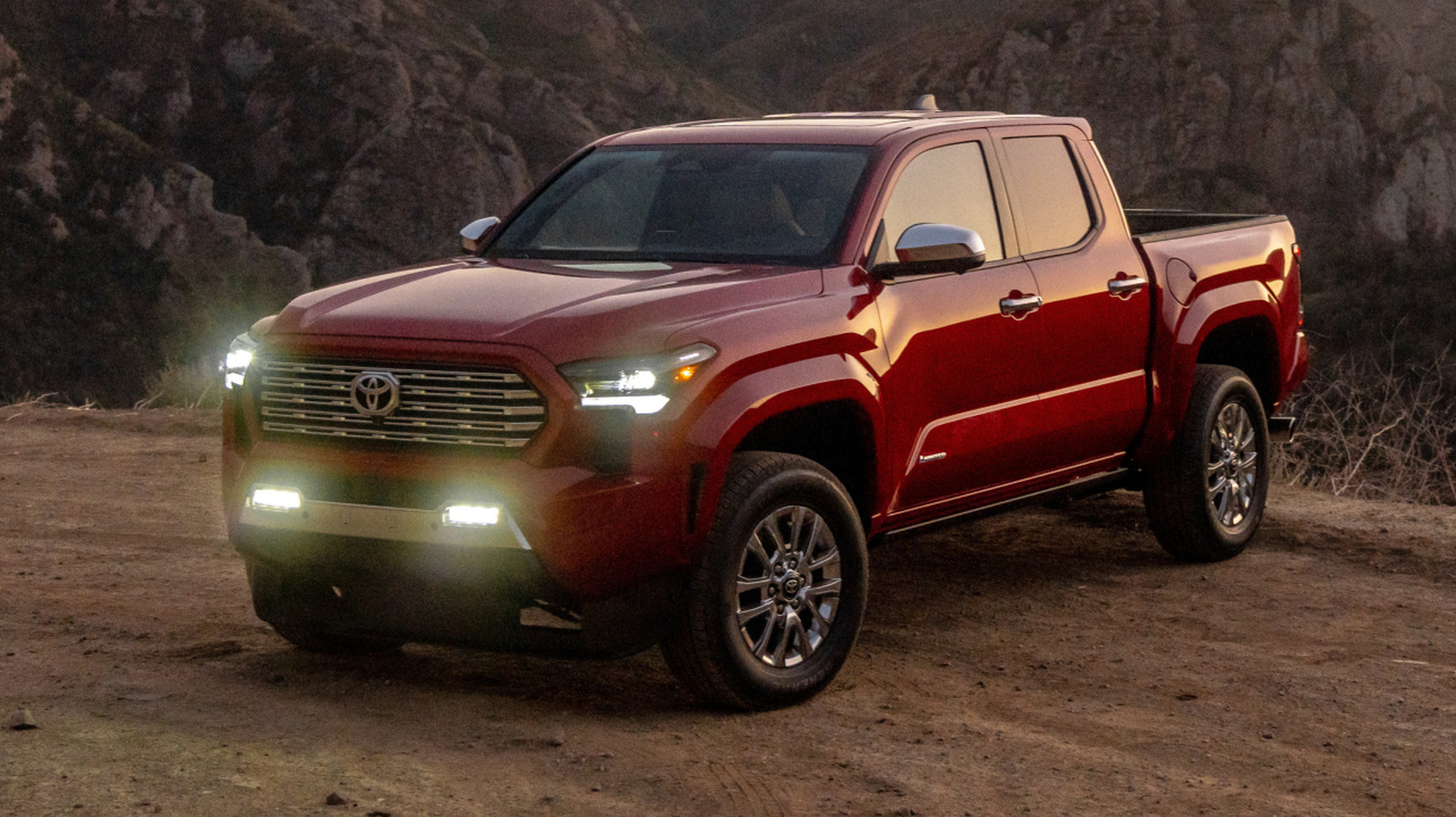
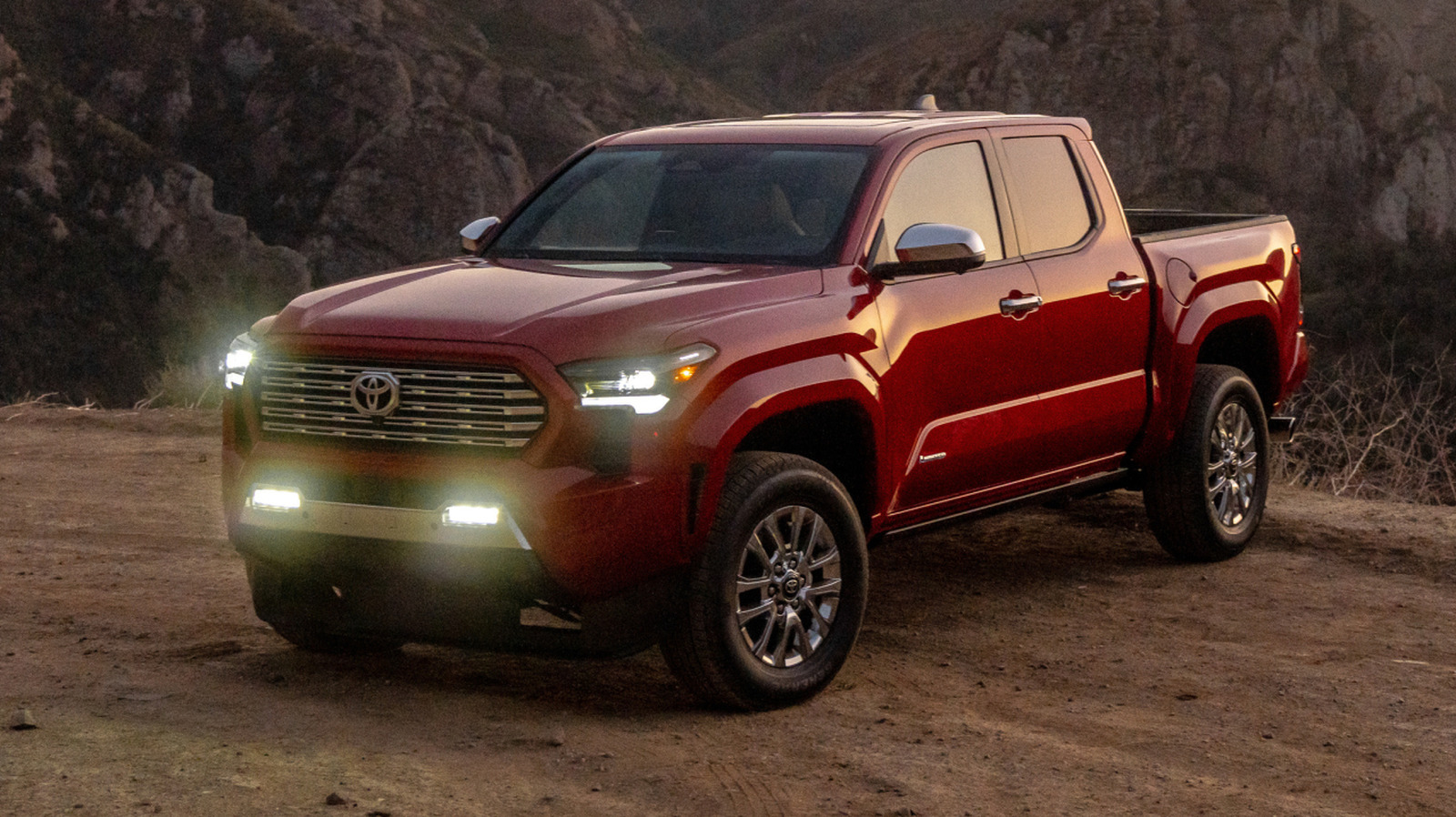
Toyota Tacoma
If you are in the market for a mid-sized pickup truck and place a high value on fuel economy, the Toyota Tacoma is going to be difficult to top. Toyota currently offers the Tacoma with two different engines — a standard 2.4-liter turbocharged four-cylinder or a hybrid i-Force Max version of that same engine, which is available on the truck’s upper trim models.
Toyota has been greatly increasing hybrid options across its vehicle lineup in recent years, but the hybrid Tacoma is less about raw fuel efficiency and more about the added horsepower and torque compared to the non-hybrid version. In our review of the 2024 Toyota Tacoma TRD Pro, we found the engine’s impressive 326 hp and 465 lb-ft of torque to be a significant improvement over the base, non-hybrid versions.
Advertisement
However, if you’re simply looking for the most fuel-efficient Tacoma, there actually isn’t a massive difference between the Tacoma Hybrid 4WD’s 23 MPG combined EPA rating, and the non-hybrid 4WD model’s 21 MPG combined rating. If you factor in the added cost of the hybrid powertrain, the money-saving math probably won’t work out in the hybrid’s favor, but that’s not surprising. As mentioned a moment ago, the i-Force Max version of the Tacoma is more about driving performance than saving money at the pump.
Advertisement
Ford Ranger
Not to be overlooked between the compact Ford Maverick and the larger F-150 is the mid-sized Ford Ranger, which also offers strong fuel-efficiency numbers for its class. Unlike some of the other trucks on this list, the Ranger gets these numbers not from a hybrid or upmarket turbodiesel powertrain, but with its base 2.3-liter turbocharged EcoBoost four-cylinder.
In its two-wheel-drive spec, the 2.3-liter Ranger earns an EPA rating of 23 MPG combined, which, for the money, is about as good as you’ll find in any body-on-frame pickup truck on sale right now. Our review of the current generation Ranger XLT found that the truck’s real-world economy backs those numbers up, which we found very impressive for a non-hybrid, base engine. Those looking for more power from their Ranger can opt for the larger 2.7-liter EcoBoost V6 engine, but as you’d expect, that drops overall fuel economy numbers by a few miles per gallon.
Beyond that, there’s the much more powerful Ford Ranger Raptor, which, not surprisingly, drops that combined EPA rating down even further to 17 MPG. Given recent electrification trends, perhaps at some point Ford will add a hybrid Ranger option similar to the F-150, which would likely take the Ranger’s already-strong fuel economy numbers to a new level.
Advertisement
Methodology
When putting this list together, we used official EPA fuel ratings as our primary source to pick five of the best-performing, current pickup trucks with internal combustion engines. We also used our first-hand experience on most of these models to back up the selection with real-world fuel economy and performance observations. We all allowed current truck models with either gasoline, hybrid, or turbodiesel engines.
Marshall’s prolific 2026 continues with the launch of the Stockwell II wireless speaker, which boasts some pretty big specs.
The Stockwell II was one of our favourite Bluetooth speakers when it launched, so we’re looking forward to seeing how Marshall can improve, and on paper, there are some big improvements.
But before that, let’s start with sustainability. The Stockwell III introduces replaceable and modular components, a list which includes the battery, carry strap, silicone sleeve as well as the front and rear grilles to ensure that the Stockwell III can last as long as possible without the need for a full replacement if it gets damaged.
To help its longevity, battery life has been expanded from the Stockwell II’s 20+ to 40+, practically double the battery life than before. The speaker can also act as a powerbank for other devices (such as your mobile device).
Advertisement
Image Credit (Marshall)
Advertisement
Marshall’s True Stereophonic 360 sound has made its way to the Stockwell III, offering consistent audio from whichever angle the speaker is placed to ensure there’s no ‘sweet spots’. Dynamic Loudness also features, taking care of managing bass, mid and treble at any volume and keeping them in balance.
The design remains practically the same, with its vertical silhouette and guitar-inspired PU leather strap and velvet lining. Controls have been updated to make it easier to access presets with the M-button or skip tracks with the media jog. An IP55 rating means that it’s not fully waterproof, but can survive a dip into water for a small amount of time. That’s still a jump up from the Stockwell II’s IPX4 rating.
Pricing is within reach of the older model in some markets, but overall it is more expensive. The Marshall Stockwell III has a price of £199.99 / $249.99 / €229.99 with availability in August (you can register interest in the speaker now). Colours are a choice of Black and Brass, and Cream.
This story is part of a series commemorating the five-year anniversary of the Voices of Change fellowship. Avery Thrush, a former Voice of Change fellow, is currently a LEE Fellow at the Massachusetts Department of Elementary and Secondary Education.
Reading my articles from the fellowship feels like reading diary entries. They’re raw, honest and they reflect how much I was struggling with teaching at the time. Overwhelm is apparent. So is frustration. As a teacher who was impacted by COVID-19 and the year of fully remote learning for students, the Voices of Change fellowship gave me the space to reflect and name the questions that had brought me to teaching in the first place. Since leaving the classroom almost two years ago, I’ve returned to writing frequently to work through the questions teaching left me with.
Having attended Title I public schools myself, I entered the classroom seeking a lens through which to understand my school experiences. As I became more interested in education as an engine of social mobility, I wanted to understand why some kids learned to read and some did not. I wanted to understand why some schools had more resources than others. I wanted to understand why some kids went to college, and some did not. Teaching felt like a way to move closer to those answers.
The process of learning these answers was swift and painful. The stark reality was playing out in front of me every day as I taught at a public charter school during the day and then drove to the suburbs in the evenings to tutor for extra cash. I quickly saw how rarely student success is the product of a single school or teacher, but rather an aligned system of supports that begins at birth.
Advertisement
So here’s what I learned: some kids can read because their schools taught phonics and screened for reading disabilities in kindergarten. Some schools have more resources because housing policy and decades of segregation shaped property values and neighborhood composition. Some kids go to college because they benefited from networks of financial and familial stability, giving them resilience through challenges like the SAT, the Common App and FAFSA. The questions I began with spun out into winding tangles of policy choices, zip codes, race and class.
I’ve come to understand that the grief I felt at leaving the classroom was more than being overwhelmed and overworked — it was the undoing of my belief that education was society’s great equalizer. It was also the realization that I had been lucky; my graduation from high school and matriculation to a four-year college was as much a function of my family’s assumption from birth that I would go to college as it was my academic performance or the opportunities my schools offered.
Achieving academically was easy because I had stable housing, good health care and a network of loving and supportive adults. Had I experienced any learning challenges, they would have been swiftly addressed by my white-collar parents, who are comfortable speaking with educated professionals. Students spend the vast majority of their lives before the age of 18 outside of school. Teaching revealed how profoundly the promise of education depends on systems beyond the classroom.
That isn’t to say that schools and teachers cannot move the needle for students. Teachers grow their students every day in ways that feel nothing short of miraculous. You’d be hard-pressed to find an adult who cannot name a teacher who made a difference in their life. But the biggest gains for students occur when the systems around schools align to support the work teachers are doing — when children arrive at school healthier, safer and more secure in their lives outside the classroom.
Advertisement
On this front, there are two movements I’ve been paying attention to, one that brings me hope and one that makes me nervous. In graduate school, I learned about place-based partnerships, initiatives that bring stakeholders in health care, housing, education, youth services, local government and philanthropy into alignment around shared goals for supporting children and families. The most famous example is the Harlem Children’s Zone, but the model has spread widely. Organizations like StriveTogether now support networks of communities working toward cradle-to-career outcomes. Partners for Rural Impact is helping rural communities coordinate services for children across schools and social supports. Here in Boston, the Boston Children’s Council is bringing together city agencies, nonprofits and schools to think more holistically about the conditions shaping children’s lives.
What gives me hope about these efforts is that they acknowledge something teachers already know: students do not arrive at school as blank slates each morning. They arrive carrying the cumulative effects of housing stability, health-care access, nutrition, family income and community safety. Place-based partnerships represent a policy approach that supports teachers by strengthening the ecosystems around them rather than asking schools to solve poverty alone.
NEWSLETTERS
STAY AHEAD IN EDUCATION.
Sign up for EdSurge newsletters for timely news, insights and analysis.
Advertisement
What makes me more uneasy is the direction some of the frustration with public education has taken. If we spent decades telling ourselves that schools were the great equalizer, then the persistence of large racial and economic achievement gaps, especially in the wake of COVID frustrations, can feel like a failure of the institution itself.
In my home state of West Virginia, that frustration has helped fuel support for the Hope Scholarship, the nation’s only universal education savings account program, which has deleterious impacts on the public education system most students rely on. Policies like this are often framed as empowering families with choice, but I worry they also reflect a disillusionment with the project of public schools as engines of democracy. It is my belief that many of the inequities in public education were never fully within schools’ control to address.
My experience as a teacher, and now as a policy practitioner, has convinced me that the path forward is not to abandon public schools, but to surround them with stronger systems of support for children and families. The question I find myself paying closest attention to now is how policy can help build those systems: partnerships that allow teachers to do what they already do best, while ensuring the conditions outside the classroom make their work possible.
This story is part of an EdSurge series chronicling diverse educator experiences. These stories are made publicly available with support from the Chan Zuckerberg Initiative. EdSurge maintains editorial control over all content. (Read our ethics statement here.) This work is licensed under a CC BY-NC-ND 4.0.
Advertisement
Avery Thrush is a West Virginia native and former educator.
Apple’s iPadOS 27 update is shaping up to be less about one headline feature and more about pulling the whole system closer together with Apple Intelligence is running through the middle of it.
The biggest shift is Siri, which is getting a major upgrade into what Apple is now calling “Siri AI”. Instead of short, scripted requests, Siri AI can now handle natural conversations and follow-up questions.
Additionally, it can tap into personal context on the device. That means it can surface old emails, find specific photos from years ago, or pull up notes without users having to remember exact file names or locations. Apple is also pushing this further with actions inside apps. For example, Siri can do things like edit a recently sent message, add music to a playlist, or help manage reminders based on what you’re currently doing.
There’s also a new dedicated Siri app, which acts as a kind of hub for conversations across Apple devices. You can start a request on iPhone and pick it up on iPad without losing context. This feels like Apple trying to make Siri less of a one-off interaction and more of an ongoing assistant.
The system-wide push continues in Messages and Mail, where Apple Intelligence suggests quick actions based on context. For instance, it can add events to your calendar or pull up relevant photos. There’s also a new Image Playground tool for generating and modifying images from simple prompts. This fits into Apple’s broader move toward description-based input across the system.
Shortcuts is another big beneficiary. Instead of building automations step by step, users can now just describe what they want. Then iPadOS will assemble the shortcut automatically. It’s the same idea Apple is pushing everywhere else: you say what you want, and the system figures out the structure behind it.
Advertisement
Visually, iPadOS 27 also brings refinements to the Liquid Glass design, improving contrast and readability. At the same time, users can adjust how translucent or tinted the interface looks. It’s not a dramatic redesign. Still, it does tighten up the overall feel of the system, especially on larger displays.
There are more practical upgrades too. Passwords can now flag weak or compromised credentials and update them automatically, while Safari and file transfers are noticeably faster. Apple also says performance improvements extend to app launches and AirDrop, making the system feel more responsive in day-to-day use.
On the safety side, Apple is expanding parental controls with more granular setup options, website approval requests through Ask to Browse, and clearer visibility into how children are using their devices. Communication Safety is also being extended to better handle harmful content in shared media.
Advertisement
Advertisement
Expect the software to arrive later this year, and there’s a developer beta available now.
Supporters of a permanent data center ban, including members of Kshama Sawant’s congressional campaign, hold signs reading “Stop the Data Centers & AI Layoffs” during public comment at Tuesday’s Seattle City Council meeting. (Screenshot via Seattle Channel)
The city that gave the world cloud computing just hit pause on the machines that power it.
The Seattle City Council voted unanimously Tuesday to impose a one-year emergency moratorium on new large data centers inside the city limits, responding to concerns about the implications of AI for the city’s power grid, water supply, utility rates, and economy.
The moratorium would take effect as soon as Mayor Katie Wilson signs it, temporarily halting projects like several large data centers that companies have approached Seattle City Light about building in the city. Those projects reportedly had a combined peak demand equal to about a third of Seattle’s average daily power consumption.
“This is Seattle’s position on AI and data centers,” said Councilmember Debora Juarez, who sponsored the council’s resolution on data center policy. She drew cheers from the audience at the meeting when she said she would halt AI and data center development entirely if she could.
It’s a major statement in a region that’s home to Amazon Web Services and Microsoft Azure, as well as engineering centers for Google, Oracle, Meta and other companies collectively spending hundreds of billions of dollars on data centers globally to meet demand for AI.
Advertisement
The moratorium puts Seattle among the largest U.S. cities to halt the industry’s buildout, joining Minneapolis, Denver, Baltimore, and Indianapolis in a wave of local pushback.
The council approved two measures: an ordinance halting applications for data centers with electrical capacity of more than 20 megavolt-amperes — enough power for thousands of homes — and a resolution committing the city to study their impacts as a precursor to permanent regulations.
The vote followed weeks of escalating public pressure. More than 50 people testified Tuesday, and not one spoke in favor of data centers. Many argued the moratorium doesn’t go far enough, calling for a permanent ban. Councilmembers said they received more than 98,000 emails on the issue.
Some of the most pointed testimony came from inside the industry.
Advertisement
Members of Amazon Employees for Climate Justice, who also testified at two meetings last week, urged the council to add renewable energy requirements and labor protections, and called for an end to what one AECJ member called the industry’s race “to build out as much compute capacity as they can, as fast as they can, before regulations can catch up.”
“It’s great to see this council choose to empower ordinary people and workers over those who see them as expendable,” said Srija Nagireddy, an AECJ member, citing layoffs this year at Amazon and Meta amid record earnings.
Councilmember Bob Kettle offered the closest thing to a defense of the facilities, distinguishing hyperscale projects from what he called “traditional data centers” — including one downtown that he said heats a half-dozen nearby buildings and supports the city’s first responders. His amendment to the resolution, adopted unanimously, specified that AI is driving demand for “hyperscale” facilities, and added the reliance of government, healthcare, and education on existing data centers to the city’s study list.
Notably, neither Amazon nor Microsoft operates data centers in Seattle itself. Kettle pointed out during the meeting that Amazon’s facilities cluster in Oregon, while Microsoft’s data center presence in the state is in Quincy, the central Washington town transformed by cheap Columbia River hydropower. That means the moratorium’s immediate effect falls on data center developers rather than the tech giants.
Advertisement
The ordinance exempts the roughly 30 smaller data centers already operating in Seattle, allowing each to expand by up to another 20 megavolt-amperes, which is the same amount as the threshold of the moratorium on new facilities.
Mayor Wilson, who first floated the idea of a moratorium in April, is expected to sign the legislation. City departments would then develop permanent data center regulations, with zoning legislation expected to reach the council by early 2027.
The fate of one project — Digital Realty’s proposed facility at 301 Virginia St., filed 11 days before the vote — remains unclear. Whether the moratorium can halt an application already in the pipeline is likely a question for permitting officials and possibly the courts.
Samsung refreshed its smartwatch lineup with careful attention to daily comfort and practical health details that many people actually use. The Galaxy Watch 8, priced at $290 (was $350), arrives in two sizes and focuses on longer battery stretches, a brighter screen, and several new measurements that go beyond basic step counts or heart rate. For anyone eyeing an Apple Watch alternative while carrying an Android phone, this model presents a clear case worth examining closely.
The case now has a thinner cushion contour that sits very flat against your wrist. Its 8.6mm thickness makes it feel significantly lighter over long periods of use, and the aluminum body is available in both graphite and silver finishes, which look great and are really versatile. The bands now have an enhanced lug system that keeps the sensors close to your skin without pinching or leaving gaps. This causes many people to forget they are wearing the watch, even overnight, which is a huge step forward in terms of making it usable throughout the day.
WHY GALAXY WATCH8: Advanced health and sleep tracking features.* A lighter, more snug design for all day comfort.* Improved user interface.* Personal…
SLEEP SMARTER. LIVE BETTER: Energize your days with a great night’s rest using Advanced Sleep Coaching¹ – improved with even more ways to keep your…
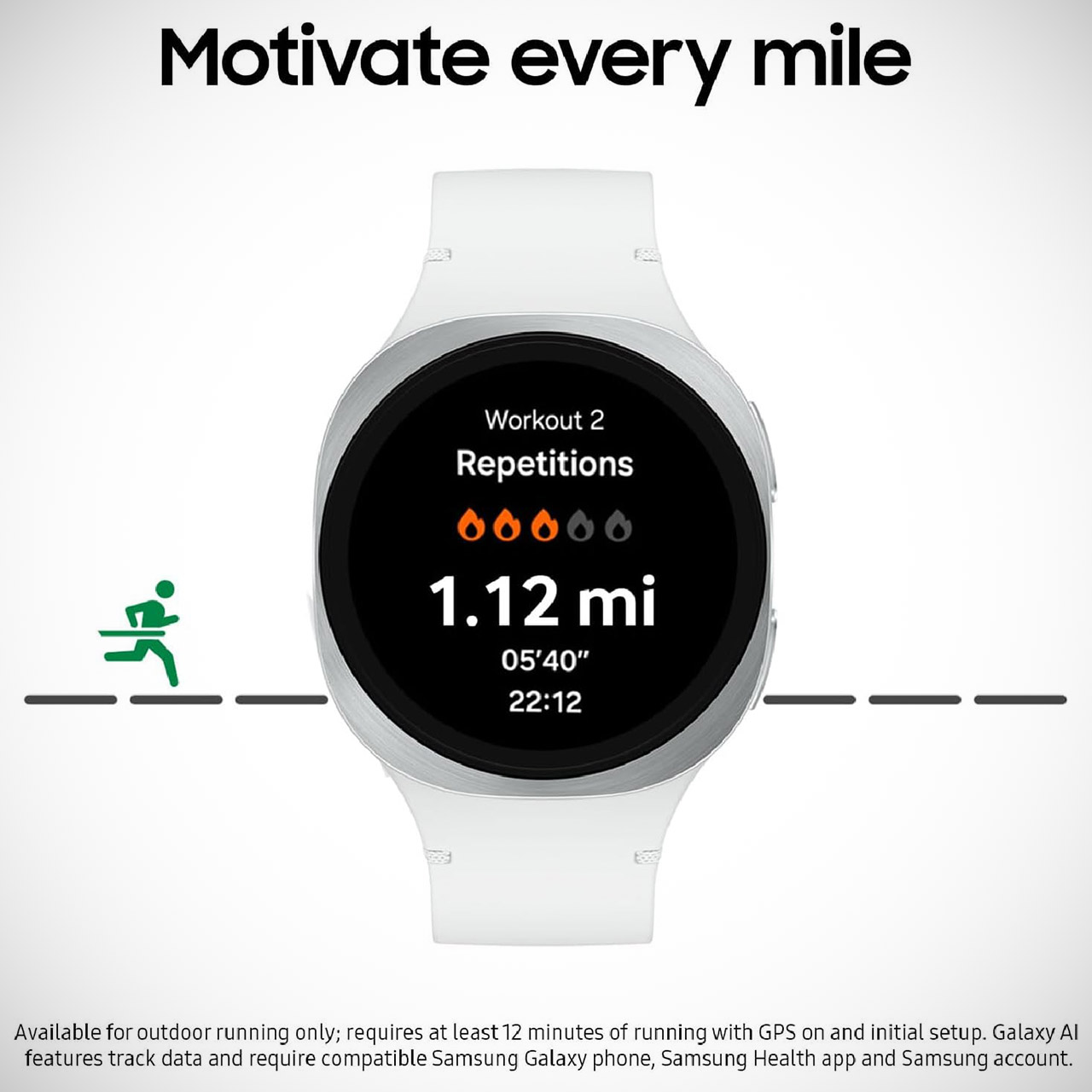
YOUR RUN, YOUR COACH: Step up your running routine with a Running Coach³ that analyzes your performance and gives you real-time feedback. Training…
The 40mm model features a 1.34-inch Super AMOLED screen with 438 × 438 resolution. It has a maximum brightness of 3000 nits, allowing you to use it in direct sunlight while the competition fades out. Because to efficiency improvements elsewhere in the hardware, the always-on option now functions without depleting your battery’s life. The battery capacity has been increased to 325 mAh for the 40mm model and 435 mAh for the 44mm. Samsung claims up to 30 hours of use with the always-on display turned on, but real-world tests show ranging from 24-36 hours depending on how frequently you use features like workout tracking, notifications, and the built-in Gemini AI.
Advertisement
People who purchase these watches primarily for health tracking will discover some surprising capabilities built in. The BioActive sensor suite uses bioelectrical impedance to determine your heart rate, blood oxygen, ECG, and body composition, which is a fairly standard set of capabilities at this level. New features include an antioxidant index that shows how your skin is performing in terms of carotenoid levels; simply press your thumb on the sensor to find out where you are. The vascular load feature then analyzes your data overnight to assess how much strain your circulatory system has been under and suggests improvements to your sleep or exercise regimen. They also detect sleep apnea, which checks for dips in oxygen levels, and in countries where it is FDA approved, it works completely. In addition, you will obtain an energy score that offers a snapshot of your daily sleep and movement habits.
Fitness features have also been improved. Following a brief test run, the running coach develops a personalized plan for you and delivers real-time pace recommendations and progress reports as you exercise. The dual frequency GPS (L1 and L5) is very handy because it allows you to correctly locate your location even in challenging conditions, and the heart rate zones adjust to your specific data and track more advanced metrics if you enjoy cycling or swimming. These utilities can be used without a Samsung phone, although a recent Galaxy handset offers some additional features.
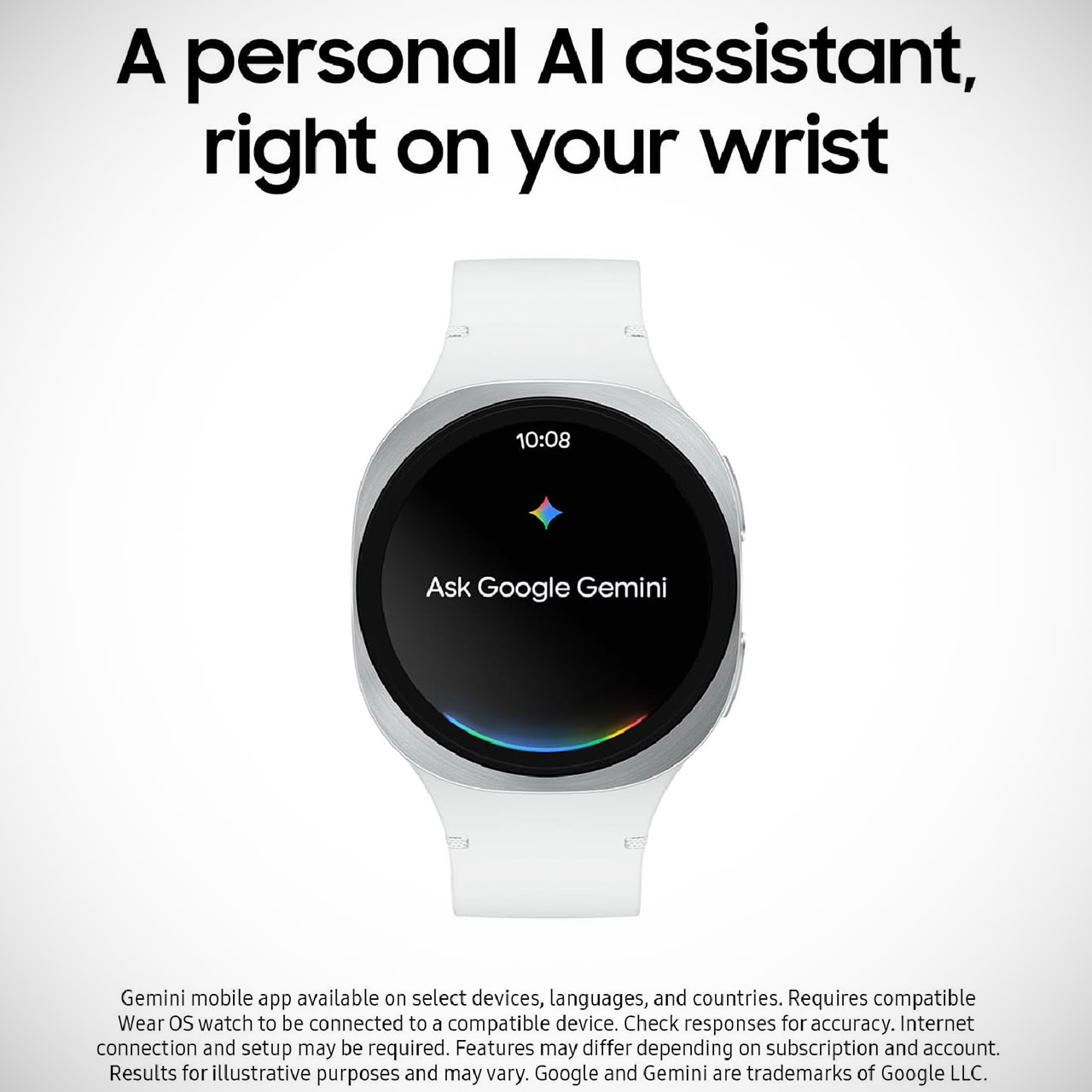
Wear OS 6 is the operating system, with Samsung’s One UI Watch 8 built on top; the interface helps to arrange all current information into tiles that may be modified to match your specific needs. Google Gemini sits on your wrist and can remind you of things, answer questions, and execute follow-up tasks all without requiring you to take out your phone.



























































You must be logged in to post a comment Login