Meta employs around 1,800 people in Ireland, some of whom will lose their jobs as part of Meta laying off 10pc of its workforce.
Technology giant Meta will reportedly lay off as many as 350 Ireland-based employees as part of its plans to cut 8,000 people from the globally-dispersed workforce, representing around 10pc of its staff worldwide.
Early this morning (20 May) staff in Ireland received an email informing them that some people will be impacted by the global redundancies and Meta has since submitted a collective redundancy notification to the Department of Enterprise.
In late April it was reported that Meta had told its staff that 10pc of the workforce would be let go, apparently as a means of mitigating the costs of heavy AI spending and investment, with the first cuts expected in late May.
Advertisement
At the time, Meta’s chief people officer Janelle Gale, said: “We’re doing this as part of our continued effort to run the company more efficiently and to allow us to offset the other investments we’re making.”
Earlier this week Meta also announced that the organisation would be reassigning 7,000 employees to facilitate more AI-aligned roles. In a memo, also issued by Gale, it said that the new corporate structure will be “flatter”, with “smaller teams”.
This isn’t the first time this year that Meta’s Ireland-based teams have been heavily impacted by cuts. Around 15 people lost their jobs in early March.
In response to the recently announced layoffs, Labour’s enterprise spokesperson George Lawlor called on the Minister for Enterprise, Tourism and Employment Peter Burke, TD and the Minister of State for Trade Promotion, Artificial Intelligence and Digital Transformation Niamh Smyth, TD, asking them to create a strategy that would protect jobs in the technology sector, amid a spate of high-profile redundancies.
Advertisement
Lawlor said, “This is a deeply worrying and stressful time for anyone employed by Meta and I firstly want to express my solidarity with those people working there, their families and their communities. Minister Burke must work with Meta to ensure fairness is applied and to protect jobs and livelihoods where possible.
“We need to see a comprehensive plan in place for the State to help secure jobs and protect worker’s incomes in the event their employer and sector faces a downturn or a change in business model. It is not just workers who are directly employed by these companies which are affected either. The cumulative effect of these cuts are devastating for families and for people who are indirectly employed by the tech industry too.
“Combined with spiralling food, fuel, energy, and housing prices and the shameful rental changes that are increasing rents and driving evictions, this is a very worrying time for working people in the sector and indeed across the country.”
Don’t miss out on the knowledge you need to succeed. Sign up for the Daily Brief, Silicon Republic’s digest of need-to-know sci-tech news.
Identity has long been the load-bearing wall of cybersecurity. The logic was simple: verify the employee, secure the access. But as professionalized threat actors weaponize AI and sophisticated phishing kits, that wall is cracking. Identity is being forced to carry a structural burden it was never designed to support.
While identity isn’t obsolete, in ecosystems defined by SaaS sprawl, BYOD, and hybrid work, a valid credential is no longer a guarantee of a safe connection. The real danger is not authentication failure, but whether the right signals are being verified. Without real-time device checks, a legitimate login could just as easily be a compromised session.
The post-authentication blind spot
Multi-factor authentication (MFA) was supposed to close this gap. However, phishing kits now let attackers sit between a user and the real login portal, proxying the authentication in real time and stealing the session token that gets issued after MFA succeeds. The victim completes every security check exactly as intended. The attacker walks away with the cookie that proves it.
NIST Special Publication 800-207, the foundational framework for Zero Trust architecture, anticipated this problem. It warns against relying on implied trustworthiness once a subject has met a base authentication level, and specifies that access decisions should account for whether the device used for the request has the proper security posture.
Advertisement
In practice, most organizations still treat authentication as a one-time check. Identity is verified, MFA passes, a session begins, and trust holds until the token expires. But a session token in an attacker’s browser looks identical to the same token in the user’s browser. Traditional authentication logs cannot tell them apart.
Verizon’s Data Breach Investigation Report found stolen credentials are involved in 44.7% of breaches.
Effortlessly secure Active Directory with compliant password policies, blocking 4+ billion compromised passwords, boosting security, and slashing support hassles!
Most Zero Trust implementations have ended up heavily identity centric. They focus on strengthening authentication, enforcing MFA, reducing password reliance, and introducing risk-based sign-in policies. Device verification, meanwhile, is inconsistently applied. It often stops at the point of login, or it applies only to browser-based workflows inside modern conditional access frameworks. Legacy protocols, remote access tools, and API integrations tend to inherit trust implicitly once identity has been established.
The result is a fragmented model. Personal and third-party devices may be loosely controlled or entirely unmanaged. Session trust persists even if device posture degrades mid-session. Identity signals and endpoint signals sit in separate tools with limited integration. Identity gets scrutinized heavily at login, and then access is rarely reassessed in any meaningful way.
Advertisement
The device is the other half of the answer
A stolen password used from an attacker-controlled laptop should not be treated the same as the same password used from an enrolled, encrypted, compliant corporate endpoint. Yet that is exactly what happens when identity alone governs access.
Device posture answers questions identity cannot. Is the device encrypted? Is endpoint protection active and healthy? Is the operating system patched? Has the configuration drifted from policy? Is this approved hardware?
More importantly, those answers have to stay current beyond the initial login and across the entire session. An update can be delayed, endpoint protection can be disabled, unapproved software can be installed. Conditions at login are not conditions at hour three of a session. Continuous device verification reduces the value of stolen credentials and intercepted tokens, because access becomes bound not just to an identity, but to a trusted, healthy endpoint.
Four principles for a stronger model
A more defensible approach combines identity with continuous device verification. In practice, that looks like this:
Advertisement
Continuously verify both the user and the device: Access should stay conditional on device health, not just identity proof. If endpoint protection is turned off or encryption is disabled mid-session, trust should adjust in real time. This reduces the effectiveness of stolen credentials, token replay, MFA fatigue, and attacker-operated endpoints in one move.
Bind access to approved hardware: Device-based controls let organizations enroll trusted hardware and differentiate between corporate, personal, and third-party endpoints. Valid credentials used from an unrecognized device should not simply proceed because MFA succeeded.
Apply proportionate enforcement: Rigid controls create workarounds. A mature posture strategy can apply conditional restrictions, reduced privileges, or time-bound grace periods instead of defaulting to a hard block. That balance matters for hybrid and remote teams.
Enable self-service remediation: If trust is tied to device health, users need a way to restore that trust. Guided fixes for encryption, OS updates, or endpoint protection let employees resolve posture issues without filing a ticket or losing access unnecessarily.
Solutions like Specops Device Trust operationalize this model by extending trust decisions beyond identity and maintaining enforcement as conditions change. It authenticates users and verifies their devices continuously across Windows, macOS, Linux, and mobile platforms, not just at the point of login.
Identity still matters. It just can no longer carry the full weight of an access decision on its own.
If you’re looking to evolve your identity security strategy to include device trust, contact Specops today or book a demo to see how our solutions could work in your environment.
StitcherAI co-founders Varun Mittal (left) and Udam Dewaraja. (StitcherAI Photo)
StitcherAI, backed by $3 million in pre-seed funding, launched today with an unusual approach to help companies get a handle on AI and cloud spending before the bills get out of control.
Founded by a pair of Seattle enterprise tech veterans, the startup is avoiding the traditional FinOps dashboard, instead pushing real-time cost data directly into apps and services where engineers — and increasingly AI agents — are making spending decisions.
The idea is to catch spending problems before they happen. AI agents, in particular, often have no context for the company’s budget or existing contracts. For example, an agent might choose an expensive AI model when the company has already prepaid for a cheaper alternative.
“It’s really important to get that context into the places where the decisions are happening, whether it’s human or the agent,” said StitcherAI CEO and co-founder Udam Dewaraja.
The 10-person company emerged from stealth Tuesday morning with the announcement of the general availability of its product. Its $3 million pre-seed round, raised last fall, was led by Founders Co-op with participation from Sunshine Lake VC, Ascend, and Plug & Play Ventures.
Advertisement
Dewaraja built the global IT finance practice at Citi, one of the world’s largest technology spenders. He also co-created the FOCUS open billing data standard now used by AWS, Microsoft, and Google, which StitcherAI also uses as part of its system.
Co-founder Varun Mittal is an AI researcher and natural language processing specialist who previously ran NLPCore, a Seattle-based NLP platform company, for eight years.
Dewaraja and Mittal previously worked together at Apptio, the Bellevue-based IT financial management company that was taken private in 2019 and acquired by IBM in 2023.
Apptio is one of the companies StitcherAI will be competing against in the broader field of tracking IT spending. Dewaraja led engineering for Cloudability, Apptio’s cloud cost management product. Other established players in the space include Flexera and VMware’s CloudHealth, along with many startups focused on cloud and AI cost management.
Advertisement
Dewaraja said he saw the limitations of the dashboard approach firsthand when he moved to Citi and became a buyer of the tools he’d helped build. Engineers are too busy juggling security, performance, and deployment issues to check a financial dashboard.
“Cost becomes a forgotten part,” he said.
StitcherAI’s platform pulls in cost data from across the different services used by a company, including cloud providers, AI services, SaaS subscriptions, and PDF invoices. It then creates a unified cost model with information on different products, teams, and revenue streams.
The platform presents the data in whatever tools the organization uses, including data platforms like Snowflake, business intelligence tools like Tableau, or workplace apps like Slack and Jira. It can also feed financial context into AI coding tools like Cursor and OpenAI’s Codex, so agents making technical decisions have visibility into the budgets and contracts.
Advertisement
The company says it is already working with several large customers, including nine-figure cloud spenders with rapidly growing AI budgets. One early customer is a Fortune 500 employment marketplace. StitcherAI says those beta customers reduced the cost of building and maintaining internal IT finance infrastructure by 80% on average.
Dewaraja said the startup plans to use the funding to grow the team and continue developing its platform, with the FinOps X conference in San Diego in June as its next major milestone.
Huy Vector turned a childhood obsession with the Fallout games into a working smartwatch that looks and feels like it came straight from the vaults. The finished piece sits comfortably on the wrist with a simple leather strap, yet every detail echoes the classic Pip-Boy design from the series. Green text scrolls across a small screen against a black background, vital signs appear in the familiar retro font, and the whole thing runs on everyday parts anyone can order online.
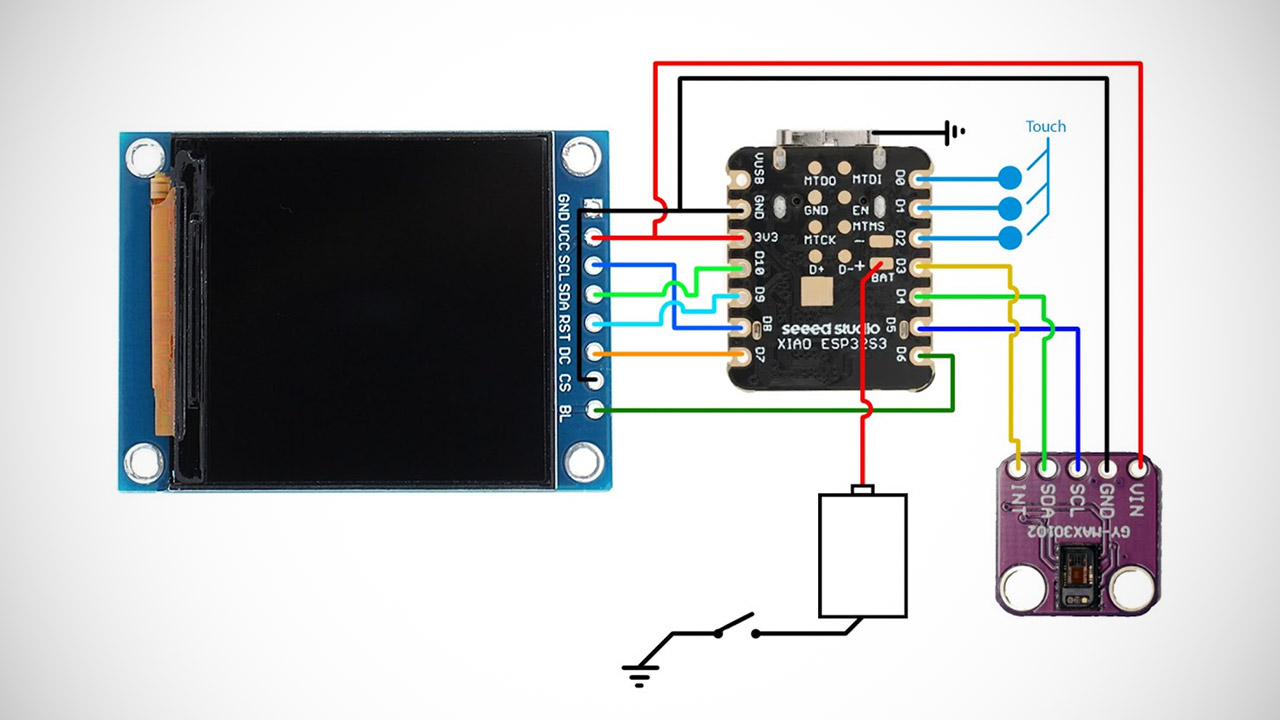
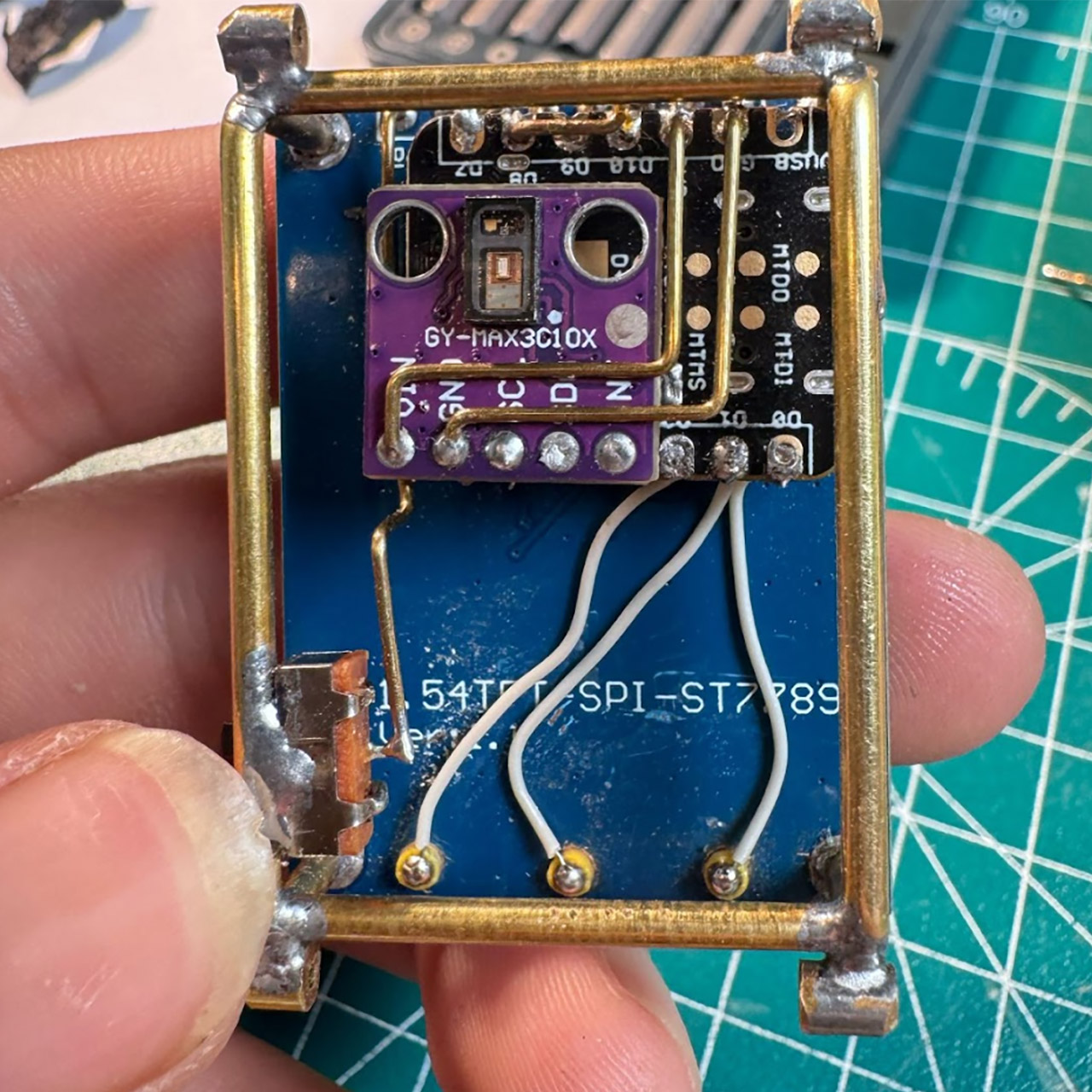
Vector used the Seeed Studio XIAO ESP32-S3 board for the Vector project, which crams a microcontroller, Bluetooth, and Wi-Fi into an extremely compact device that fits beneath the display. He chose a 1.54-inch LCD for the panel, which replicates the green-on-black image that gamers fondly remember. A MAX30102 sensor is nestled into the back to monitor heart rate and blood oxygen levels in real time, which is ideal for keeping an eye on things while playing. The entire system is powered by a small lithium-ion battery that is discreetly hidden. It’s all held together with copper tubing and some clever brass hardware that also serves as controls.
Vector’s assembly requires some careful soldering and a few simple tools. Vector constructed the frame with 0.8 millimeter copper wire, a handful of M2 brass screws, and some short parts of brass tube. Once he had tidied up the wiring and ensured its stability, the screws served as touch points. To prevent accidental triggering, the bases of those screws are encased with heat-shrink tubing. There’s a little switch that allows you to turn on and off the unit without having to reach for your phone. If you’re curious about the parts list, Vector lays it down on his website and links directly to the vendors, even the solder and flux, so if you have basic abilities, you should be fine.
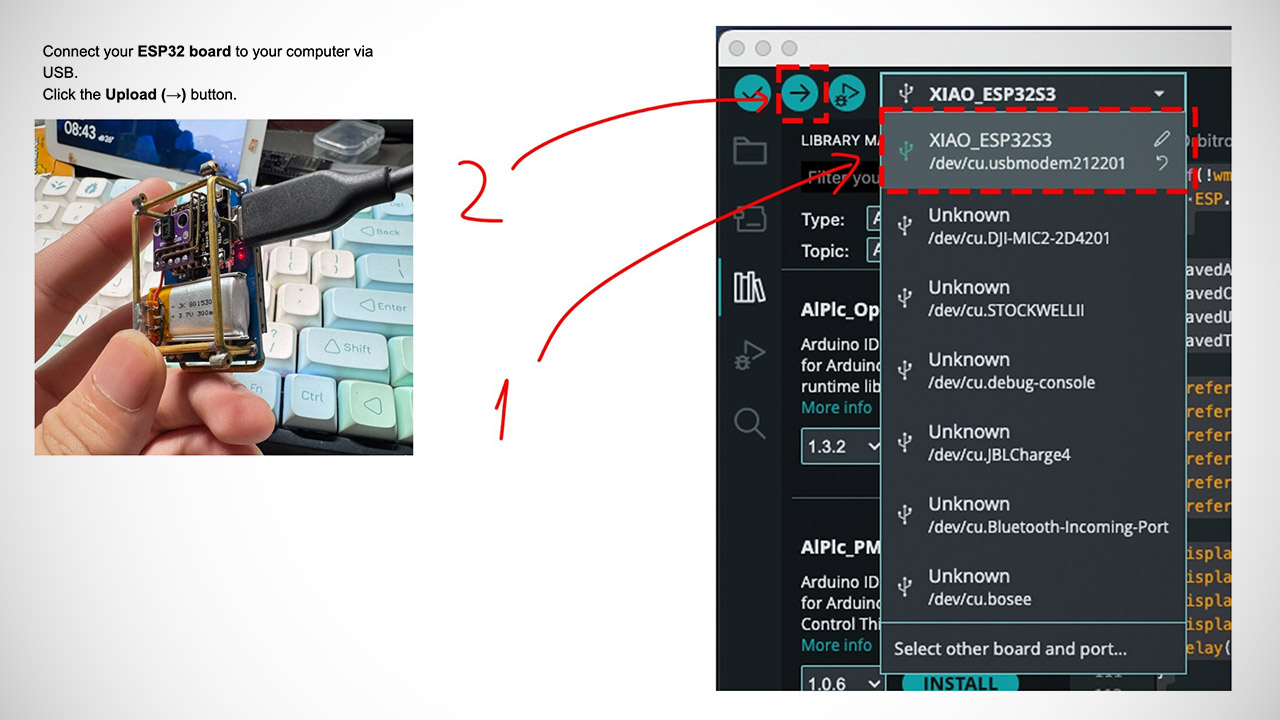
Vector programmed his own code to extract data from the heart rate sensor and send it to the Pip-Boy interface, using the Adafruit GFX library for visuals and the SparkFun MAX3010x library for readings. The program can be downloaded onto the ESP32 board via a typical USB connection. Once it’s running, you’ll see live heart rate and SpO2 data in a clean, game-accurate interface. Toggling the brass points navigates between the various panels, and the wireless functionality is still in the works, waiting for future upgrades that may include notifications or other data.
He also made the complete list of parts, wiring schematic, and code file available on his website for free. There aren’t any kits for sale currently, but if you’re the sort to tackle a project like this, you can get the individual parts and make one yourself. Just be aware that it may be one-of-a-kind, but that’s all part of the excitement. [Source]
Transform your future in cybersecurity with 7 courses on next‑level packet control, secure architecture, and cloud‑ready defenses inside the 2026 Complete Firewall Admin Bundle. Courses cover IT fundamentals, topics to help you prepare for the CompTIA Server+ and CCNA exams, and more. It’s on sale for $25.
Note: The Techdirt Deals Store is powered and curated by StackSocial. A portion of all sales from Techdirt Deals helps support Techdirt. The products featured do not reflect endorsements by our editorial team.
Astronomers using the James Webb Space Telescope have identified an ultra-faint galaxy seen just 800 million years after the Big Bang. The galaxy contains almost no heavy elements, shows signs of intense early stellar radiation, and could offer a rare glimpse into the first stages of galaxy formation. Phys.org reports: In a paper published in the journal Nature, a team of scientists led by Kimihiko Nakajima, an astronomer at Kanazawa University, Japan, describes how they used the telescope to study a part of the deep universe and discovered a faint galaxy called LAP1-B. “LAP1-B establishes a ‘fossil in the making,’ a direct high-redshift progenitor of the ancient ultra-faint dwarf galaxies observed in the local universe,” they wrote. Because the galaxy is so small and distant, it would normally be impossible to see. However, it was spotted due to a phenomenon known as gravitational lensing, in which a massive cluster of closer galaxies acts like a giant magnifying glass, boosting the light from LAP1-B by 100 times.
The scientists realized that most of the light from the galaxy wasn’t coming from the stars, but from glowing clouds of gas. They analyzed this light by splitting it into a spectrum and studying the emission lines, which revealed the chemical composition of the gas. They found that the galaxy contains almost no heavy elements, and its oxygen abundance is about 240 times lower than the sun’s, making it one of the most primitive star-forming galaxies ever observed. The emission lines also revealed intense ionizing radiation, which is what scientists expect to see from the first generation of stars.
The team also measured an elevated carbon-to-oxygen ratio. This matches the predicted chemical signature for the first star explosions in history from Population III stars, the first stars to exist in the universe. The stars we see today are Population I stars, which formed later and contain more heavy elements. Another fascinating finding is that, after measuring the gas’s motion and speed, the researchers concluded that the galaxy is held together by a massive cloud of invisible dark matter.
Fly ash is a material produced after pulverized coal has been burned in a power plant. It is a hazardous material, one that needs to be kept out of the air we breathe. As such, it can be very dangerous to living things. However, since 1937, it has also been used as a key ingredient in concrete production.
There are a number of benefits that flow from using fly ash in making concrete. All fly ash is pozzolanic, meaning that it reacts with calcium hydroxide and water to form calcium silicate hydrate, which is what makes concrete both durable and strong. Concrete made with fly ash may not be as strong as conventional concrete during the early stages of drying, but it will ultimately exhibit greater chemical resistance and strength over time. This is because fly ash consumes the weak, excess calcium hydroxide produced during standard cement hydration and converts it into an additional strong binder.
Another significant benefit of using fly ash in concrete is that, once incorporated into concrete, the fly ash component is no longer considered hazardous waste. It also requires less energy to produce fly ash concrete, reducing the product’s carbon footprint. Researchers have even used fly ash to make bendable concrete that needs no cement.
Advertisement
While there are advantages to using fly ash in concrete production, including a reduced likelihood of shrinkage and cracking, its slower curing and overall drying time can become drawbacks in certain situations. These include times when the concrete is used at low temperatures.
Advertisement
What else should you know about fly ash?
BELL KA PANG/Shutterstock
To expand, fly ash is what’s left after coal is burned to produce electricity or for other industrial purposes. Once it’s collected using filters or electrostatic precipitators, it is stored dry in silos or wetted down for use as fill material, or, if delivered to a jobsite, like the one where Texas is moving these interstates. Due to its hazardous nature as a raw material, fly ash must be kept either wet or covered at all times to eliminate the possibility of fly ash dust being spread by the wind.
Fly ash can be classified into two categories. Class C ash comes from sub-bituminous coal and is called high calcium fly ash because it usually contains over 20 percent of free lime, also known as CaO or calcium oxide. Class F ash is produced by bituminous and anthracite coal and is known as low calcium fly ash, thanks to its lower CaO content of under 10 percent.
Based on its composition, fly ash can range in color from dark gray to tan. There are several standards that apply to measuring the quality of fly ash, depending on its intended use case. These include uniformity, chemical composition, fineness, and LOI (loss on ignition), which measures how much unburned carbon remains. Too much carbon content causes problems, which leads federal and state highway departments to require an LOI of between five and six percent max. There’s plenty of roadwork to be done and plenty of fly ash to make concrete with, especially when it comes to repairing aging infrastructure like LA’s deteriorating roadways.
People type questions into Google dozens of times a day, often in short bursts that barely scratch the surface of what they want to know. Starting today, that simple white box on the homepage looks and behaves differently, and the change feels long overdue after twenty-five years of almost no movement.
The box itself now stretches taller when you type anything more than a few words. It organically expands to accommodate complete sentences or even paragraphs rather than cramming everything into a single constricted line. As text occurs, further ideas appear below that go much beyond standard auto-complete. These tips read the entire question and suggest methods to refine it before you even press enter, saving you clicks and clarifying intent right away.
Google Pixel 9a is engineered by Google with more than you expect, for less than you think; like Gemini, your built-in AI assistant[1], the incredible…
Take amazing photos and videos with the Pixel Camera, and make them better than you can imagine with Google AI; get great group photos with Add Me and…
Google Pixel’s Adaptive Battery can last over 30 hours[2]; turn on Extreme Battery Saver and it can last up to 100 hours, so your phone has power…
A row of shortcuts lies right below the box, providing easy access to three new modes. One immediately enters into a chat-style interaction powered by the latest Gemini model. Another feature allows users to say their question aloud and receive real-time results. The third opens a Google Lens-enabled creativity tool for quickly converting thoughts into photos or simple designs. None of these options are intended to replace the traditional search experience; rather, they serve as additional options.
Advertisement
A small + symbol on the left side of the box expands the choices. Tap it to add a photo from your phone, shoot a brief video on the spot, or pull a document from your folders. If necessary, the system can accept all of those inputs simultaneously. Chrome tabs behave similarly, allowing users to reference something that is already open in their browser without having to copy and paste links. Everything feeds into a single unified query, which the box processes together.
For simple text searches, the results remain in the conventional list style. However, follow-up inquiries now flow straight into the conversational mode, eliminating the need for users to switch tabs or restart from scratch. This configuration converts a single search into an ongoing dialogue that retains context over multiple steps.
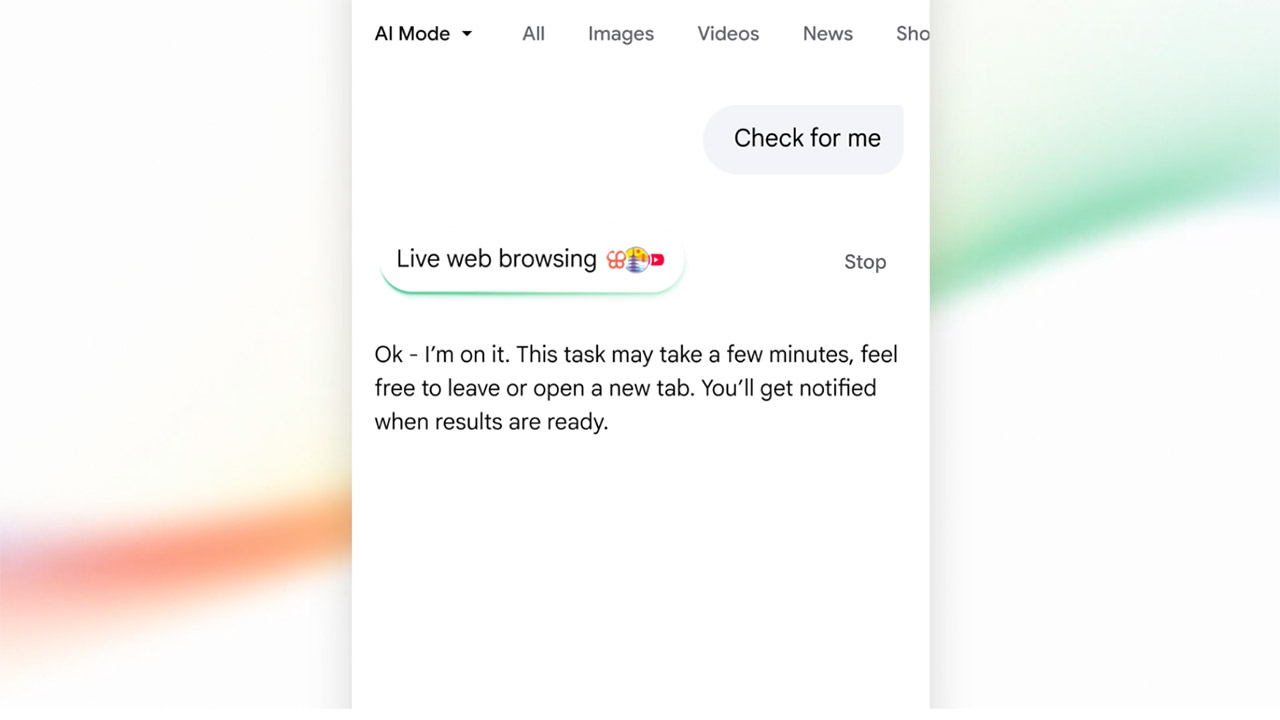
Deeper capabilities will be introduced in stages, beginning later this summer with small automated agents that will run in the background for anyone who configures them. Someone looking for a new apartment can tell the agent which neighborhood, price range, and characteristics are most important to them; the agent then searches the web for properties and delivers updates only when something matches. Stock watchers and sports lovers can develop comparable monitors that provide timely notifications without requiring frequent human inspections.
Subscribers to the higher tiers of Google’s AI service will immediately acquire another layer. They can create their own tiny dashboards for common tasks, such as a simple fitness diary that takes data from other applications or a menu planner that alters based on the ingredients in the fridge. These small tools are integrated into the search experience and seem more like personal shortcuts than standalone programs.
We may receive a commission on purchases made from links.
Unlike cars, which have so many of their important parts tucked under their hoods, motorcycles tend to be more exposed to the elements. Because of this, you need to take extra care to make sure your motorcycle’s chrome is clean, which includes wiping off dirt, applying polish, and removing rust build up before it causes any trouble. Realistically, it’s impossible to completely prevent rusting on motorcycles forever. However, if you’re serious about maintaining your motorcycle, there are ways that you can delay the process with specialized solutions, such as the Lear Chemical ACF-50.
Priced at $22.11 (or about $1.70 per fl. oz.) on Amazon, the ACF-50 is a special solution that helps slow down corrosion. For motorcycles, you can apply it to things like wiring, compressors, battery terminals, light sockets, and ignition systems. Additionally, it can also help you maintain more sensitive electrical components, like radios, antennas, and so on. Depending on the level of corrosion, you can either spray it directly on the targeted part or wipe it on with a microfiber cloth.
Advertisement
On Amazon, Lear Chemical’s ACF-50 Anti-Corrosion Lubricant Compound has received generally positive feedback. Apart from being an Amazon’s Choice product, more than 650 people have also rated it 4.7 stars on average. But what do people actually have to say about it, where else can it be used, and how well does it stack up to its competition?
Advertisement
How well does ACF-50 Anti-Corrosion Lubricant work?
As of May 2026, the large majority (84%) of ACF-50’s buyers on Amazon had rated it 5 stars. People have consistently said it works on motorcycles, including corroded terminal connectors. One user shared that it was able to keep their bike rust-free even after three months of exposure to the elements, like snow, salt, and rain.
Compared to WD-40, which has many different uses that are helpful for motorcycle owners, several users claimed that the ACF-50 performs better, doesn’t wipe off as fast, and doesn’t leave a greasy residue. However, they didn’t specify if they were using the normal WD-40 or the Specialist Rust Inhibitor variant. Nevertheless, other satisfied buyers of ACF-50 have mentioned using it not just on motorcycles but other vehicles like boats and even aircraft. Homeowners also praised its effectiveness for all kinds of power tools, including lawnmowers, smokers, and grills. Some dissatisfied users who rated it a single star did, however, complain about clogged nozzles, running out of propellant too soon, and damaging their shoes with the product.
That said, there were some reviewers who said they preferred CorrosionX’s Rust Inhibitor. Similar to the ACF-50, the 16 oz. can of industrial-strength corrosion-prevention aerosol spray has a 4.7-star rating from over 780 Amazon customers. Similarly, customers said the spray was useful for sensitive electronics and all sorts of equipment, including bikes.
Aavik Acoustics, part of Audio Group Denmark, has introduced three phono preamplifiers labeled as the R-188, R-288, and R-588 for ultra high-end vinyl playback systems using Moving Coil cartridges or DS Audio optical cartridges. Built around trickle down technology from Aavik’s flagship R-880 ($73,500) reference phono stage, the new R x88 Series is aimed at listeners who already live deep in the analog trenches and probably don’t need anyone explaining why a $20,000 phono preamp exists.
This is the same Danish audio group behind Børresen, whose $1.15 million M8 Gold Signature loudspeakers we recently covered, so nobody should be shocked that Aavik’s idea of “more accessible” still starts at $20,000.
External phono preamps, also known as phono stages, remain one of the most important but least understood parts of a serious vinyl playback system. Their job is to properly match the output of the phono cartridge to the amplifier or preamp that follows, while applying the RIAA equalization curve that restores the tonal balance of the original recording.
Most phono stages support Moving Magnet cartridges, some add Moving Coil support, but the Aavik R x88 Series takes a more specialized route with MC and DS Audio optical cartridge compatibility. Standard MM cartridge users need not apply.
Advertisement
Aavik R x88 Phono Stage Series
Aavik Acoustics’ three model R x88 Series lineup starts at $20,000 for the R-188 phono preamp, and steps up an additional $5,000 for the R-288 and R-588, respectively. That is Aavik’s version of connecting with a “broader audience,” which still assumes your vinyl budget has its own climate controlled room.
Aavik says the goal is a quiet, low noise connection between cartridge and amplifier that preserves the detail, dynamics, and tonal information cut into the record groove. Each unit is handcrafted in Aalborg, Denmark, using in house production and selected Danish and international partners.
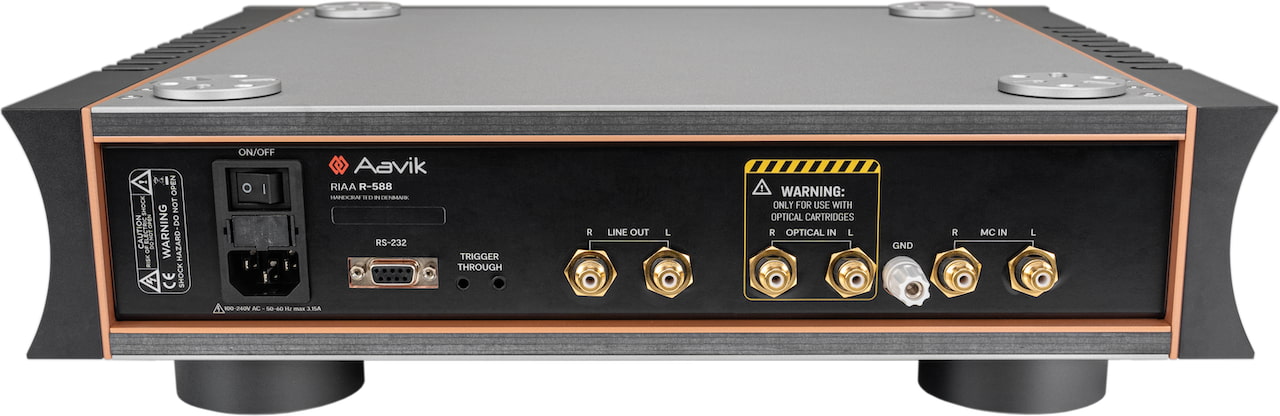
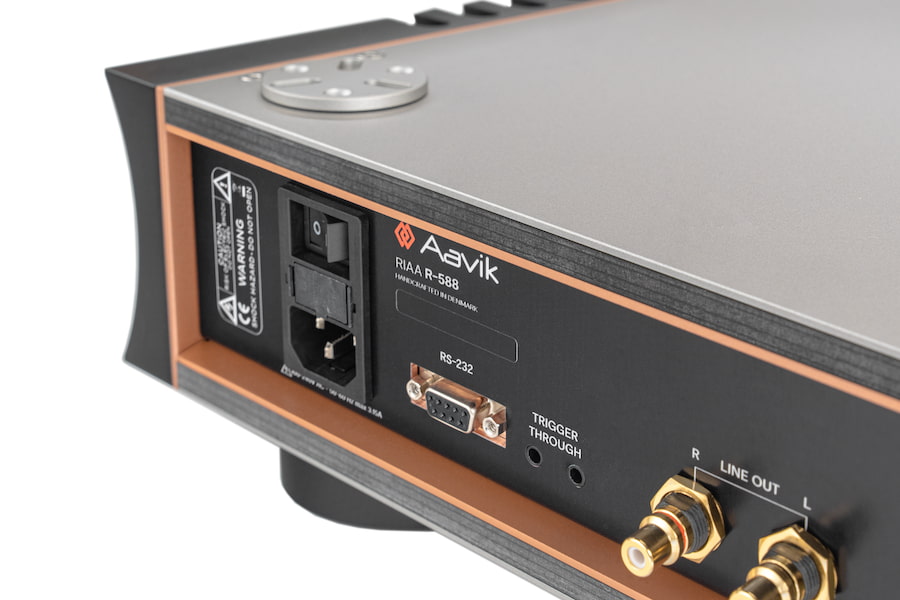
All R x88 models have the same rear panel and inputs.
R x88 Series Shared Features
Versatility: The Aavik R x88 Series supports both Moving Coil cartridges and DS Audio optical cartridges, with adjustable gain and filter settings for system matching. Standard Moving Magnet cartridge support is not included, which makes this a very specific product for very specific vinyl systems.
Noise Rejection: The R x88 Series incorporates Integrated Ansuz Active Tesla Coils, Square Tesla Coils, Analog Dither Circuits, and Anti Aerial Resonance Coils. These technologies are designed to reduce unwanted electrical noise and preserve low level detail before the signal reaches the amplifier.
Advertisement
Extreme Low Noise Floor: The Aavik R x88 Series uses a discrete RIAA input stage built around ultra low noise bipolar transistors arranged in parallel. Aavik specifies a 94 dB signal to noise ratio measured at 1 kHz, which is critical when dealing with the very low output levels of MC cartridges. The Moving Coil input stage is also balanced and floating, meaning it is not connected to ground.
Resonant Mode Power Supply: The R x88 Series also uses custom DC/DC converters designed to generate clean sine wave voltages with very low noise and minimal distortion. The goal is to provide a stable, quiet power foundation for the phono circuit, because with vinyl playback, noise does not need an invitation. It usually finds a way in.
Advanced Circuit Design: The flagship Aavik R 588 adds Aavik’s discrete operational amplifiers and independent voltage rails, which are intended to improve resolution, dynamics, and transparency. In plain terms, the R 588 is where Aavik pushes the circuit design harder for systems where every upstream choice is already under a microscope.
Advertisement. Scroll to continue reading.
Advertisement
Connectivity: For all of the internal complexity, the R x88 Series keeps the rear panel relatively straightforward. Separate inputs are provided for turntables fitted with Moving Coil and DS Audio optical cartridges, with clearly labeled connections for each. Analog audio line outputs are included for connection to an amplifier or receiver, while RS 232 and 12V trigger connections provide external wired control. A power inlet and rear power switch are also included.
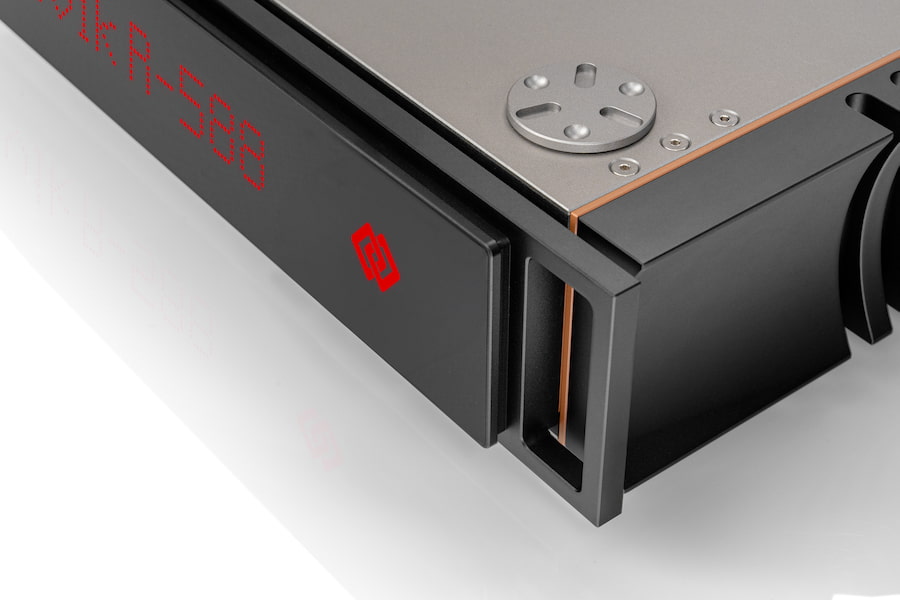
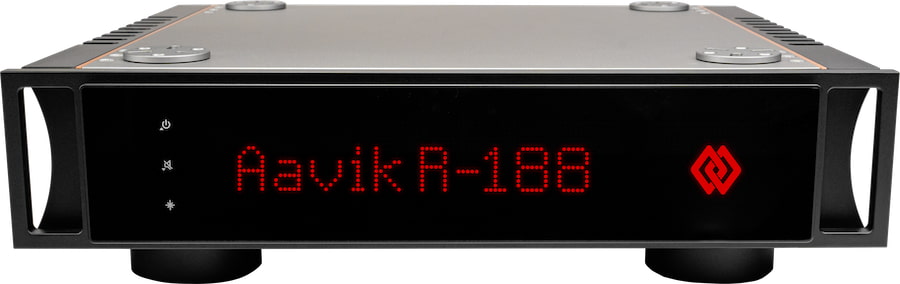
Front Panel Display and Controls: The Aavik R x88 Series includes a large front panel display that shows the active input, display brightness, display dimming, software version, and factory reset option. To the left of the display are physical controls for Standby, Mute, and Input Select/Menu operation. Aavik also includes a wireless remote control for more extensive access, because at $20,000 and up, reaching for the front panel should remain strictly optional.
Cabinet Construction: The Aavik R-x88 series phono preamps were designed by Flemming Erik Rasmussen and Michael Børresen. The hybrid enclosure combines wood, copper, and steel. This combination is designed to support exceptional resonance control and structural stability, complemented by a visually appealing cabinet design.
The physical design of all Aavik R x88 models are the same.
Key Differences Between Models
R-188: The Aavik R-188 is the “entry level” model in the R-x88 Series, which is doing a lot of work when the starting price is $20,000. It features 36 Active Tesla Coils, 72 Active Square Tesla Coils, and 3 dither circuits.
Advertisement
R-288: The Aavik R-288 steps up from the R-188 with 72 Active Tesla Coils, 144 Active Square Tesla Coils, and 6 dither circuits. Aavik positions the additional noise reduction hardware as a path to greater clarity and lower noise within the same core platform.
R-588: The Aavik R-588 is the flagship model in the R-x88 Series, with 108 Active Tesla Coils, 216 Active Square Tesla Coils, and 9 dither circuits. It also adds discrete operational amplifiers and independent voltage rails, making it the most advanced version of the lineup for systems where the phono stage is expected to do more than just sit quietly on the rack looking expensive.
Comparison
Aavik Model
R-188
R-288
R-588
Product Type
Phono Preamp
Phono Preamp
Phono Preamp
Price
$20,000
$25,000
$30,000
MC (Moving Coil) Inputs
Floating RCA (1 set)
Max input: 5mVrms
Advertisement
Gain: 58dB or 64dB @ 1 kHz
Input load resistance adjustable from 50 ohm to 10k ohm
Floating RCA (1 set)
Max input: 5mVrms
Advertisement
Gain: 58dB or 64dB @ 1 kHz
Input load resistance adjustable from 50 ohm to 10k ohm
Floating RCA (1 set)
Max input: 5mVrms
Advertisement
Gain: 58dB or 64dB @ 1 kHz
Input load resistance adjustable from 50 ohm to 10k ohm
Frequency Response (MC)
58dB: +0.1/-0.4dB (20Hz-20kHz)
64dB: +0.1/ 1.1dB (20Hz-20kHz)
Advertisement
58dB: +0.1/-0.4dB (20Hz-20kHz)
64dB: +0.1/ 1.1dB (20Hz-20kHz)
58dB: +0.1/-0.4dB (20Hz-20kHz)
64dB: +0.1/ 1.1dB (20Hz-20kHz)
Advertisement
Optical Input
RCA (1 set)
Max input: 500mVrms
Gain: 26dB
RCA (1 set)
Advertisement
Max input: 500mVrms
Gain: 26dB
RCA (1 set)
Max input: 500mVrms
Gain: 26dB
Advertisement
Frequency Response (Optical)
+0.1/-0.3dB (20Hz-20kHz)
+0.1/-0.3dB (20Hz-20kHz)
+0.1/-0.3dB (20Hz-20kHz)
Output
1 pair of RCA outputs. Distortion: <0.05% (THD at 1kHz, nominal input) Output impedance: 70 ohms
1 pair of RCA outputs. Distortion: <0.05% (THD at 1kHz, nominal input) Output impedance: 70 ohms
1 pair of RCA outputs. Distortion: <0.05% (THD at 1kHz, nominal input) Output impedance: 70 ohms
The Aavik R-x88 Series phono stages are not for casual vinyl listeners, MM cartridge users, or anyone still debating whether an external phono preamp is worth it. These are ultra high end analog components built specifically for systems using Moving Coil or DS Audio optical cartridges, with serious attention paid to noise reduction, power supply design, and signal purity.
What makes the R-x88 Series unusual is the combination of MC and optical cartridge support, Aavik’s extensive use of Ansuz noise reduction technologies, and a three model structure that starts at $20,000 and only climbs from there. The R-188, R-288, and R-588 are clearly aimed at vinyl listeners who have already invested heavily in the turntable, cartridge, amplification, and loudspeakers surrounding them.
Who is this for? The obsessed analog listener with a very serious system, a very quiet listening room, and a willingness to spend real money chasing the last few layers of resolution from the groove. Everyone else can keep walking. Denmark has locked the door behind them.
Google’s DeepMind built this new Omni model family from the ground up as one unified system that handles text, images, audio, and video together. Instead of bolting separate tools onto each other, the network reasons across whatever you feed it and produces a single, consistent output. The first practical result arrives right now in the form of video generation, and the early examples already feel like a quiet shift in how quickly ideas move from head to screen.
Gemini Omni Flash can create a short stop-motion sequence of amino acid chains twisting into alpha helices and beta sheets that is almost comforting to watch, with a quiet voiceover guiding the viewer through the process. The animation would appear quite smooth, as the model creates the scene using a snapshot and a few basic lines of instruction while retaining the original parts. Then it just inserts some audio, and the clip is properly synced.
Google Pixel 10a is a durable, everyday phone with more[1]; snap brilliant photography on a simple, powerful camera, get 30+ hours out of a full…
Unlocked Android phone gives you the flexibility to change carriers and choose your own data plan; it works with Google Fi, Verizon, T-Mobile, AT&T…
Pixel 10a is sleek and durable, with a super smooth finish, scratch-resistant Corning Gorilla Glass 7i display, and IP68 water and dust protection[4]
People who have been testing early versions of the model have been using it on everyday tasks that formerly required extensive professional software and hours of adjusting. They requested that a vacation clip be edited to remove the intrusive background checks and it was done soon away. They asked for a product shot with a slogan that looks exactly like the real thing, complete with shadows, and they got exactly what they wanted. They’ve even used technology to produce super-personalized clips where a digital version of themselves comes up on stage and accepts an award, or floats about near the moon looking just like them.
Of course, all of this is possible because the tech behind it all is actually set up properly. For once, it’s not treating audio as an afterthought, or becoming confused when images, text, and other data all contradict one other. Gemini Omni Flash is trained on all four data types at the same time, so it understands that a marble sliding down a track should follow gravity and that a harp string plucked by a leaf should produce the correct sound at the appropriate time. That shared understanding is what makes the result seem and sound so natural, even after numerous rounds of conversation-style editing.
Advertisement
So, the Gemini Omni Flash version is now available in the main Gemini app, the creative studio Flow, and YouTube Shorts. Clips start at roughly ten seconds long, which is ample time to cover the most of your normal social post or fast test. A more robust Pro model will be released later, if internal quality standards are met, and an API will be available in the coming weeks for all developers who wish to incorporate the technology into their own workflows.
The next steps on the roadmap include longer clips and new areas of innovation. The team wants to train the model to convert audio into still images and, who knows, maybe even extract soundtracks from mute footage. Each phase keeps the essential idea the same: feed the model what you have, tell it what you want to modify, and you’ll get something that feels thought out rather than merely pasted together. [Source]


































































You must be logged in to post a comment Login