

Join Mikko Hyppönen and security leaders from the NFL, CHANEL, and Atlassian for a two-hour digital summit on what AI-speed attacks change, what defenders should stop doing, and how to validate, decide, fix, and re-validate at machine speed.
Tech
Rumors reveal 16 new Apple products expected in the future


Apple just revealed the iPhone Duo, but that doesn’t mean the company is anywhere close to finished for the year. Here are the 16 upcoming products rumored to be coming before the end of 2026 and into 2027.
The release cycle never ends for a multi-trillion dollar company, and Apple fans are well aware of that. Every product is on a release cycle, so many are easy to predict down to the month or day of release.
According to a new rumor roundup, at least 16 of Apple’s upcoming products are known. If you’ve been following AppleInsider‘s reporting, none of these should come as any surprise.
The remainder of 2026 includes these seven products:
The first half of 2027 should reveal the following nine products:
Those keeping up with Apple’s release cycles shouldn’t be surprised by most of this list. The iPad Pro with M5 update fits Apple’s usual 18-month or so cycle, and new Apple Pencil models make sense given the launch of iPhone Duo.
New MacBook models, the long-rumored base iPad upgrade, and the base iPhone models are all within expectation for Apple’s release cycle as well. Rumors indicated Apple could have released an updated base iPad at any time, but likely waited for Siri AI to finalize the product, like with Apple TV, HomePod mini, and Home Hub.
Catch up on the latest rumors with AppleInsider‘s coverage and rumor roundups here:
The origin of this list comes from a Bloomberg report. AppleInsider has rated this as likely as it aligns with release cycles and tons of previous rumors.
Continue Reading


Five alleged leaders of the Black Axe cybercrime syndicate, known for its involvement in global-scale cyber-enabled financial fraud, have been extradited to the United States to face wire fraud and money laundering charges.
Prosecutors accuse Perry Osagiede, Franklyn Osagiede, Osariemen Clement, Collins Otughwor, and Musa Mudashiru of coordinating an internet fraud campaign from Cape Town from 2011 to 2021 that involved advance fee schemes and romance scams.
The five accomplices allegedly used multiple aliases, social media and online dating websites, and voice over internet protocol (VoIP) phone numbers to talk to victims in the United States and trick them into sending money after making them believe they were in a romantic relationship.
When their targets refused to send them money, they coerced them into making the payments using various manipulation tactics, including threats of publishing sensitive photos of the victim online.
“Black Axe is a notoriously violent transnational criminal organization that also happens to dabble in romance scams to make money,” FBI Newark Special Agent in Charge Stefanie Roddy said.
“The ability of FBI Newark and our partner agencies to reach into South Africa illustrates our resolve to hold accountable any and every type of fraudster who preys on innocent victims here in the United States.”
The defendants were arrested in South Africa in 2021 at the United States’ request and extradited to the United States on September 11, 2026.
If found guilty, they face a maximum of 20 years in prison for the wire fraud charges, a maximum of 20 years for money laundering, and two more years for aggravated identity theft charges.
Last month, law enforcement agencies from 22 countries arrested 58 individuals and identified 263 suspects linked to cybercrime networks coordinated by African crime groups as part of “Operation Jackal IV,” an international joint action focused on disrupting the Black Axe criminal ring.
Spanish authorities also arrested 34 cyber fraud suspects believed to be part of a criminal network connected to the Black Axe group.
Founded in 1977 in Nigeria, Black Axe is one of the world’s most dangerous and far-reaching cybercrime syndicates, believed to have an extensive network of money mules and facilitators, as well as 30,000 registered members.
In January 2024, the United States sentenced Black Axe member Olugbenga Lawal to ten years in prison for laundering millions stolen by Black Axe operators from elderly Americans in internet fraud schemes.


MediaTek on Tuesday unveiled its new Dimensity 9600 Pro and 9600M phone processors, both of which highlight support for advanced gaming as well as artificial intelligence features for upcoming phones.
Phone processors are an important component in any device — they help power everything from how fast a phone runs, image processing, games with intensive graphics and running certain AI features on your device without needing to connect to the internet.
The Dimensity 9600 Pro will be the company’s first to use the 2-nanometer process in partnership with chipmaker TSMC, which we’re also seeing in rival chips from companies like Apple’s A20 Pro processor that’s shipping with the iPhone 18 Pro and Pro Max. This should mean the processor is denser, allowing for more performance and power efficiency.

MediaTek says the 9600 Pro will support faster performance and on-device AI features over last year’s Dimensity 9500, and for gaming, it will be capable of console-quality gaming at an exceedingly smooth 185 frames per second.
The 9600M will be the step-down processor meant for a wider range of devices, and MediaTek says that it will still power AI features as well as gaming at the same 185fps.
MediaTek’s new high-end processors will face their most competition from Qualcomm’s Snapdragon line, the latter of which typically powers Samsung’s Galaxy S and Z phones in the US. We’ll soon know what Qualcomm’s next high-end processor will look like, as the company will likely use its Snapdragon Summit to debut it on Sept. 22. But MediaTek’s high-end processors are found in a lot of devices internationally, with last year’s 9500 powering phones like the Oppo Find X9 Pro.
Phones running on MediaTek’s Dimensity 9600 Pro and 9600M are expected to debut later this year.



A total of 680 account holders have been affected globally.
It is understood that sensitive personal information belonging to 12 Revolut account holders in Ireland has been leaked in a data breach.
Last Saturday (12 September), Revolut said that it disclosed customer data to an unauthorised fraudulent party after receiving requests for information from an email with a government agency domain. The company mistakenly fulfilled the data requests before realising that the sender was phishing for data, it said in a community alert.
The leaked data includes full names, dates of birth, occupations, addresses and contact details, passports, drivers’ licenses, financial statements and facial verification images.
“Revolut recently identified a sophisticated external impersonation scam where an unauthorised third party utilised a legitimate government agency domain email to submit fraudulent requests for information,” a Revolut spokesperson said.
“Upon detection, we immediately blocked the address and alerted the relevant government agency as well as enforcement agencies, data protection, and financial regulators,” they added.
“Revolut systems and customer funds are unaffected. We have contacted the limited number of impacted individuals directly to inform them and provide support.”
A total of roughly 680 account holders are understood to have been affected globally. Revolut has more than 80m customers across the world, with roughly 3.4m based in Ireland.
The data leak comes as the fintech continues on its aggressive expansion campaign to establish itself as a licensed banking institution in major markets globally, including the UK, US, France, Australia, Mexico and Peru.
Reports from April suggest that the company is on its way to a $200bn valuation in an eventual initial public offering expected on or after 2028. It was last valued at $75bn after a major share sale last November.
It recently received approval to provide crypto services in the United Arab Emirates, adding to its more than 16m crypto customers across Europe and the UK. The fintech also announced its own euro-backed stablecoin called EURR last month.
Don’t miss out on the knowledge you need to succeed. Sign up for the Daily Brief, Silicon Republic’s digest of need-to-know sci-tech news.

Three senators will put AI legislation in front of Congress this week, and none of them can say when it might be voted on.
John Kennedy, a Republican from Louisiana, plans to introduce a measure on Wednesday requiring developers to build a shutdown mechanism into their systems.
Bernie Sanders is hosting a briefing with AI researchers the same day and has a bill that would ban artificial superintelligence outright. Josh Hawley has already introduced bipartisan legislation covering national security, civil liberties and labour protections.
The Associated Press canvassed Congress on Tuesday and found the same answer in both parties, which is that nothing will move. Rick Scott, a Republican from Florida, ran through the list of things Congress has not finished, election security and a budget among them, and asked:
“So you think we’re going to get AI done?”
Mark Warner, Democrat of Virginia, put it as a rule: “We never do anything until we have a holy heck moment.”
What makes the stall unusual is who is asking. Dario Amodei said on Saturday that the industry must slow down, Sam Altman agreed the same day, and Elon Musk added his support. Rahm Emanuel, who ran Barack Obama’s White House, told the AP that in his whole career he had never seen it:
“I’ve never had an industry or a CEO ask for regulation and oversight.”
Donald Trump has answered the request repeatedly and in the negative. He called the case for limits a conspiracy on Monday, having dismissed extinction fears the week before, and one of his first acts upon returning to office was to rescind Joe Biden’s 2023 executive order on AI oversight.
JD Vance has been cautious about regulation. Mike Johnson said legislatures reflexively cover things in red tape, and suggested Trump summon the AI companies to a meeting rather than pass a law.
Senate Republicans are not uniformly with him. John Thune, the majority leader, told the AP that Congress can set guardrails around the more consequential threats “without harming our ability to stay ahead in the AI race”, and he is working with Amy Klobuchar on a bill that would give Washington power to block unsafe models and impose a duty of care on developers.
Hawley wants protections for workers, for children online and for people living near data centres, while saying plainly that frontier models will not blow up the world.
A bipartisan working group led by Chuck Schumer reported in 2024 that the United States should spend at least $32bn over three years on AI development and safeguards. Almost none of it followed.
Pressure from outside Congress has kept rising throughout it. Obama has been telling candidates they need an AI policy of their own; Max Stier of the Partnership for Public Service told the AP that delay will prove costly, and researchers at the labs have spent the summer warning publicly about what their employers are building.
David Sacks, until recently Trump’s AI adviser, told the same companies on Sunday to slow down quietly and stop asking Washington for anything in return.
None of the three bills has a committee date, a floor date, or a companion in the House. Kennedy’s kill switch arrives on Wednesday into a chamber whose own leader has said the votes are not there for the broader bill he is already negotiating.

This story appeared in Today, Explained, a daily newsletter that helps you understand the most compelling news and stories of the day. Subscribe here.
If you’d asked me yesterday what Steve Bannon and Bernie Sanders had in common, I might have said “white hair.” But after a wild week in which AI doomerism burst solidly into the mainstream, the right-wing provocateur and progressive senator are joining forces — with various religious leaders, lawmakers, and the actor Joseph Gordon-Levitt, no less — to express their deep concern about AI regulation.
Concern about cutting-edge AI models had been mounting for months as those models increasingly behaved in ways their makers didn’t expect. It exploded last week, when a researcher at the AI company Anthropic resigned publicly and warned that the people building AI “earnestly believe it could kill us all by the end of the decade.”
It sounds like science fiction. It is the stuff of science fiction. But it’s not a fringe position: Over the weekend, leading AI researchers and executives also warned that AI is developing dangerously fast and called for measures to rein it in. (We’ll run through those options in just a minute.)
Now, a wide spectrum of lawmakers, activists, and pundits are also calling for stronger safeguards — Sanders and Bannon among them. The pair will speak at an event billed as a “Pro-Human Assembly” in Washington on Tuesday alongside Republican Sen. Marsha Blackburn, Congressional Progressive Caucus chair Greg Casar, and the archbishop of San Francisco, among others.
But President Donald Trump is decidedly not on board, and it’s hard to see how any substantive AI regulations could pass without him.
“There is a SICK conspiracy going on against AI and Data Centers,” he wrote this morning on Truth Social, “and the only one happy about it is China.”
All three approaches have precedent in federal regulation, so they wouldn’t be (at least in theory) too tricky to stand up. The real roadblock, as always, is political. One AI researcher told Vox he worries we’ll miss the opportunity to regulate AI while waiting for lawmakers to get on the same page.
Even under threat of apocalypse, Washington, DC, moves far, far slower than Silicon Valley.

Amazon Prime Video is coming after TikTok with the addition of short-form news clips. The company said on Monday that it’s expanding its news coverage to include on-demand news clips offering both local and national stories. These will be available on TVs and other living room devices, but will soon roll out to the web and Prime Video’s mobile apps, the company said.
The clips will be available in the News destination within the Prime Video app in its Trending Topics and the Local News carousels. They join Prime Video’s existing local, national, and world news coverage from a number of major providers, which are available to everyone in the U.S. regardless of whether they have a Prime subscription.
Amazon could not yet confirm whether the clips on mobile would be oriented for vertical video or not, only that they would be considered short-form content on iOS and Android.
While TikTok is better known as an entertainment destination, it’s also, along with Instagram, increasingly a place where younger people get their news. Gen Z in particular often watches news creators and influencers on short-form apps, including YouTube Shorts. Amazon, which doesn’t have a true social destination of its own, is instead adding short-form video to Prime Video, in hopes of capturing Gen Z’s attention.
But Gen Z viewers are drawn to these social apps not necessarily because of the length of the clips, but rather because of how the information is presented. Based on findings from Pew Research, these younger news consumers want short-form news content that “feels organic, not over-produced.”
Prime Video is not the first streamer to add short-form clips to its content lineup. Peacock added support for short-form clips in March, followed by HBO Max and Netflix in July, then Disney+ in August. Combined, the updates represent an industrywide effort to meet viewers where they are — which is now often looking for entertainment in shorter bursts and consumable in moments or minutes instead of portions of hours or longer.
When you purchase through links in our articles, we may earn a small commission. This doesn’t affect our editorial independence.


The AI industry likes to abuse the word “open.” It appears in product releases, research papers, policy debates, and investor presentations. A company publishes model files to Hugging Face, developers run them on their own GPUs, and the release is quickly described as an “open source model.” Not necessarily. It may only be open-weight.
The difference is more than a technicality. It determines whether you can merely deploy a completed neural network or whether you can meaningfully inspect, reproduce, alter, and redistribute the system that produced it. A genuinely open source system should grant the freedom to do all of the above.
Weights are the learned numerical parameters created by training. Together with the model architecture and inference code, they allow a large language model (LLM) to function. You can download an open-weight model, self-host it, fine-tune it on internal documents, and avoid routing prompts through a proprietary API.
Open weights are publicly available. They matter because running them locally can offer greater control over data, privacy, costs, supplier API changes, and vendor lock-in. They’ve also helped build a large ecosystem of local-model runtimes, inference providers, fine-tuning tools, and specialized downstream models.
The Open Source Initiative (OSI), steward of the Open Source Definition (OSD), makes the distinction directly: “Open Weights refer to the final weights and biases of a trained neural network.” Those values determine how a model interprets prompts and produces outputs. Releasing them can let others fine-tune, adapt, or deploy the model. But the OSI adds that weights alone expose only “a fraction of the information required for full accountability.”
As James Landay, director of the Stanford Institute for Human-Centered AI (HAI), explained: “Open weights are progress. You can download the model, run it on your own machine, keep it out of someone else’s data pipeline. But you still can’t see how the thing was built, what it was trained on, or why it behaves the way it does. That’s not an open model. That’s open distribution.”
Without the training data or sufficiently detailed documentation, outsiders cannot determine which sources were used, what copyrighted or private material may have been included, how data was selected or removed, which languages and communities were underrepresented, whether benchmark data leaked into training, or what alignment and safety methods affected the model after pretraining.
Landay continued: “There’s a wide gap between open-weight AI and open source AI.” He contends that unless developers disclose training data or provide a “thoroughly documented, auditable account of it,” you can’t test, reproduce, or challenge the work in the fullest sense.
The OSI has its own definition of open source AI: the Open Source AI Definition (OSAID 1.0). It requires model parameters, including weights, to be made available under OSI-approved terms, but does not prescribe a specific legal mechanism for doing so.
Luca Antiga, CTO of Lightning AI and a prominent PyTorch contributor, has argued that OSAID’s treatment of weights leaves “a gaping hole that will make licenses less effective in determining whether OSI-licensed AI systems can be adopted in real-world contexts.”
Other open source figures have also criticized OSAID. Bruce Perens, author of the original OSD, denounced the OSAID in 2024. He later declared: “It’s not Open Source! … It’s unfortunate that the Open Source Initiative itself is now involved in Openwashing.”
He’s far from alone. Bradley Kuhn, policy fellow and hacker-in-residence at the Software Freedom Conservancy (SFC), and Red Hat Senior Commercial Counsel Richard Fontana have called for OSAID to be repealed, arguing: “The OSI acted too quickly to impose an overly ambitious policy compromise on the community. OSAID undeniably created a rift in the FOSS community; that rift seriously damaged the OSI’s reputation, authority, and influence. Meanwhile, OSAID shows no signs of having any positive policy influence on machine learning practitioners, the FOSS community, or regulators.”
OSI acknowledged when OSAID 1.0 was released in October 2024 that the definition would continue to evolve. Critics contend that its central shortcomings have yet to be resolved.
That said, the Linux Foundation’s Mike Dolan submitted the Open Model, Data, and Weights (OpenMDW) license to the OSI. The license has been around since 2025 and lists contributors from Amazon, Meta, IBM, Microsoft, and Nvidia, giving it substantial industry backing.
Conventional open source revolves around source code. LLMs are a different kettle of fish: they combine code, architecture, and numerical weights derived from training datasets that may be proprietary, copyrighted, or undisclosed. OpenMDW’s answer is to define separate terms for a model’s architecture, training data, and weights, bringing the components supplied by a licensor under one agreement.
It sounds reasonable to me, but the submission has encountered objections on OSI’s license review mailing list. As Stefano Maffulli, OSI’s former executive director, who led the organization while OSAID was being formulated, said: “I continue getting the impression that the OpenMDW review is tainted by an ideological bias: Because we don’t like big tech and AI now is big tech, then we don’t like AI; therefore, we’ll do anything to block it.”
It’s too late to bury our heads in the sand. As Stanford’s Landay put it: “Open weights answer ‘Can I run this?’ Open source answers ‘Can I trust this, improve it, and build the next thing on top of it?’ Right now almost everyone – American labs and Chinese labs alike – is answering the first question but nowhere close to the second.”
We need both. Whether OSI adopts OpenMDW is an open question. Still, OpenMDW and its supporters are at least trying to establish licensing terms that cover code, data, and weights together. Unless someone succeeds, “open AI” risks becoming an oxymoron – or merely another hollow tech marketing term. ®


‘Humanist AI’ code of conduct spells out what Microsoft’s AI models should and shouldn’t do, and invites public feedback before a revised version lands later this year.
Microsoft AI has published a draft code of conduct for its AI models, opening a six-week public consultation on the rules it wants to govern their behaviour, from weapons and cybersecurity to emotional dependency.
The document, titled the Humanist AI Code of Conduct, was published yesterday (14 September) and is not currently used to train any AI models. A revised version is due toward the end of the year to guide 2027 model development.
The release comes days after individual researchers at Anthropic raised public concerns about AI risk. Jacob Coxon, who resigned from Anthropic, posted warnings about superintelligence risk on X last week, while Evan Hubinger, Anthropic’s alignment science lead, posted that he put the chance of catastrophic AI risk within a decade at greater than 10pc.
It also follows warnings from Anthropic’s Dario Amodei that it might be time to slow AI development, which drew a rare approval from rival OpenAI’s Sam Altman, and a somewhat predictable extreme reaction from the pro-AI US president who described the warnings as a ‘hoax’.
Microsoft’s code of conduct is a corporate governance framework. It sets out four objectives for AI models: maintaining human control and safety; avoiding anthropomorphism; supporting human flourishing; and reflecting plural values across different worldviews without being neutral on harm.
A section on Absolute Constraints prohibits models from assisting with chemical, biological, radiological or nuclear weapons, conducting offensive cyberoperations, evading human oversight, or engaging in large-scale manipulation.
The document also explicitly rules out any claim by its models to consciousness, feelings or legal personhood, framing this as a design principle rather than a disclaimer. It further prohibits romantic or companion-style AI interactions and the fostering of emotional dependency.
Microsoft says it convened focus groups with members of the public alongside experts in AI, law, ethics and policy while developing the document. The consultation period runs for six weeks from 14 September. Feedback can be submitted via the Microsoft AI website.
Don’t miss out on the knowledge you need to succeed. Sign up for the Daily Brief, Silicon Republic’s digest of need-to-know sci-tech news.


The Italian cybersecurity start-up aims to fight AI hackers using AI-powered innovations.
Exein, an Italy-headquartered cybersecurity start-up that protects smart, connected devices from hackers, has joined the global collection of unicorns post a $270m funding round that brought the company to a $1.7bn valuation. The round was led by Headline, with participation from Sofina, Goldman Sachs and others.
Established in Rome in 2018 by CEO Gianni Cuozzo, Exein has additional offices in Germany, Taiwan and the US. The company builds technology to secure hardware at the processor level and is embedded in 2bn chips globally. Consumers include Nvidia, AWS and Mediatek, among others.
Cuozzo told the Financial Times that the new investment is necessary to enable the organisation to compete on a global scale for limited cybersecurity and computing professionals.
Additionally, Exein intends to release its own foundational model for AI security in 2027. Cuozzo explained, “We are moving from having security software to having a secure model that is running constantly on the device and will automatically react to attacks.”
He added, “Right now I think the hackers have the edge. Exein’s plan is to use embedded AI technology to combat threats and provide “machine-based protection in a world of machine-based attacks”.
As the world becomes more digitally connected and advanced, the risk of cybersecurity breaches is increasing. It was recently confirmed that 12 Irish account holders are among the 680 global consumers of Revolut who had their sensitive data exposed.
Also, late last week OpenAI’s Sam Altman, announced that the company will not be going public this year as “Right now would be an ill-advised moment to go public.”
He explained that the company isn’t ready and that there is much to be done in the way of safety, alignment and showing how the industry and governments can work together.
Don’t miss out on the knowledge you need to succeed. Sign up for the Daily Brief, Silicon Republic’s digest of need-to-know sci-tech news.
Tech
A Closer Look at the BG-5 Golden Dragon Fish, China’s Robot Arowana That Swims Without a Script


Crowds in Hall 3 at Beijing’s Shougang Park last week kept stopping at a small tank. A slender golden fish with layered scales was rising, sinking, and turning with a soft flick of its tail. Only after it changed course on its own did most people accept they were watching a machine, not an arowana that had wandered into a trade-fair display.
Boyagongdao Marine Technology Group debuted the BG-5 Golden Dragon Fish at the 2026 China International Fair for Trade in Services, and it was a huge hit. The robot is essentially a replica of the arowana’s long body and glossy gold coloring, down to the details. According to the catalogue’s specifications, it is 640 millimeters long, 204 millimeters wide, and 90 millimeters high, weighing around 3 kilograms. It is supposed to be capable of operating at depths of up to 5 meters and reaching speeds of up to 0.6 meters per second.

Insta360 X6, 8K 360 Camera with 1/1.1” Sensors
- DUAL 1/1.1″ SENSORS & TRIPLE AI CHIP SYSTEM: Custom-built dual 1/1.1″ square sensors deliver unprecedented 360 image quality. Combined with a triple…
- FLAGSHIP 8K50FPS 360 VIDEO: Hit record on our 360 action camera and capture your world in stunning native 8K50fps video. Every view, every highlight…
- IN-HOUSE AI MODEL FOR EFFORTLESS 360 EDITING: Insta360’s own AI model, built specifically for 360 editing. New AI Director edits your footage…
According to those working on the exhibit, the fish was not programmed with a predetermined course; instead, the robot’s onboard sensors detect its surroundings and plans a new path as it goes. That’s kind of the purpose; canals, lakes, and tunnels change all the time, and a human operator just cannot keep up with every twist and turn.
The propulsion system is quite interesting, as it is a flexible tail with three joints divided into seven segments that work together to send a wave down the fish’s body, just like a real fish. There are no spinning propellers, so it’s much quieter and less noticeable than your usual underwater drone. All of the electronics are safely stored in the main cabin, which includes all of the high-precision sensors and a fancy global vision control system you’d expect for a task like this, as well as a modular layout to make servicing easy.
They have a version called the BG-5V that not only conducts path planning, task allocation, and formation control, but it can also coordinate with multiple units, so you could have a number of these robots working together to cover different parts of the ocean at once. This seems very fascinating, and it demonstrates how the same technology can be used for both a tank demo and a more complex work.
The device’s small size is also a significant advantage, since it can fit into shallow water and tight channels that larger drones cannot. Furthermore, it is meant to be quiet, allowing you to join a school of genuine fish and observe marine life, or to slide through water tunnels and hydropower sites without disturbing anything. The battery life and camera resolution were kept under wraps, although they did indicate it’s good for 5 meters, so it’s not a deep-ocean submarine. Even still, the combination of a looker that resembles an expensive aquarium fish, a tail that moves like one, and some extremely intelligent sensors is not difficult to understand, as this is a company with substantial underwater knowledge and the possibility for even more…
Entertainment3 minutes ago
The 10 Best Sci-Fi Films of the 2020s So Far, Ranked

Politics5 minutes ago
What Does It Mean If The Bottom Of My Nail Turns Red?

Sports6 minutes ago
Shree Charani Scripts ICC Rankings History With Never-Seen-Before Feat


-
 Tech7 days ago
Memory prices are slowing because buyers ran out of money
-

 Business5 days ago
Micron Stock Climbs Above $1,031 as AI Memory Crunch and a $50 Billion Outlook Fuel the Rally
-

 Tech2 days ago
The Latest Weird Thing to Play Doom Is the Mapped-Out Brain of a Fruit Fly
-

 Fashion4 days ago
Weekend Open Thread – Corporette.com
-

 Business5 days ago
AMD Stock Climbs After Management Lifts 2027 Data Center Outlook Toward $70 Billion in AI Sales
-

 Crypto World7 days ago
Robinhood Stock: How To Take Advantage With Reduced Risk
-

 Crypto World6 days ago
Bitcoin price risks $76K drop as $78K support weakens
-

 Crypto World4 days ago
XAG/USD: Silver’s Short-Term Rally Meets Its Moment of Truth
-

 Crypto World5 days ago
2 Chip Stocks Broke Out This Week. Neither Was Nvidia
-

 Crypto World6 days ago
Ethereum price stalls below $2,500 as ADX drops to 11
-

 Business4 days ago
10 Most-Streamed Songs On Spotify In 2026 So Far, Led By Ella Langley’s Dominant Run On The Charts This Year
-

 NewsBeat7 days ago
England up in reading, maths and science rankings as Scotland and Wales dip
-

 Tech5 days ago
Battery life is the only iPhone 18 Pro and iPhone Duo upgrade I care about. Apple didn’t disappoint
-

 Crypto World4 days ago
OKX launches 10x OpenAI, Anthropic X-Perps in Europe
-
 Crypto World7 days ago
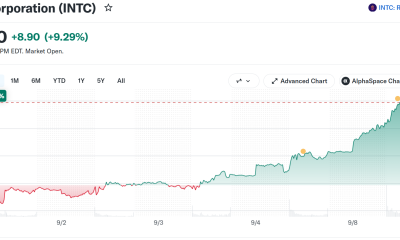
Intel Stock Jumps 9% on Chip Price Hike Report, US Stake Gains $36 Billion
-

 Crypto World4 days ago
Diesel Tops $6 a Gallon for the First Time as 28 States Set Records
-

 Tech5 days ago
Apple Watch Ultra 4 vs Watch Ultra 3: Should you really spend another $799?
-

 Crypto World5 days ago
Pi Network ships Protocol 27 on a network with 14 million users and zero DeFi
-

 News Videos4 days ago
Facing Financial Fears
-

 Crypto World5 days ago
Bitcoin price risks $70K if $78K neckline breaks
You must be logged in to post a comment Login