Samsung isn’t chasing the soundbar market; it has effectively been running it for 12 straight years alongside two decades of dominance in global TV sales. The company’s 2026 Q-Series soundbars, the HW-Q990H, HW-Q900H, HW-Q800H, and HW-QS90H, build on that position, with the flagship Q990H and QS90H first previewed at CES 2026 and now joined by the full lineup. Following its latest OLED, Neo QLED, MiniLED, and Frame TV announcements, Samsung is tightening its grip on the TV and home audio ecosystem in one move.
Our Editor at Large Chris Boylan got to spend some quality time with the QS90H and Q990H at Samsung’s US headquarters last month and was impressed by what he saw (and heard).
Samsung Q-Series Soundbars
Samsung’s 2026 Q Series soundbars are aimed at anyone who wants a cinematic experience without dealing with an AVR or a room full of wired speakers. The focus here is scale and flexibility, delivering immersive sound that adapts to different room sizes and listening habits without requiring a dedicated home theater setup.
Q Series Soundbar Features
Here are some key features shared across Samsung’s 2026 Q Series soundbars:
AI Dynamic Bass Control: Designed to deliver deeper, more controlled low frequencies with reduced distortion, while supporting high resolution audio up to 24-bit/96kHz.
Advertisement
Active Voice Amplifier Pro: This feature analyzes background noise in real time and adjusts dialogue levels accordingly, helping voices cut through without constantly reaching for the remote.
Wireless Dolby Atmos: Although Q-Series soundbars provide a Dolby Atmos-compatible HDMI-eARC connection, there is a wireless connection option. The soundbars are compatible with Dolby Atmos delivered over Wi-Fi from select streaming sources.
Eclipsa Audio: Samsung’s Q-Series SoundBars incorporate Eclipsa Audio, an open immersive surround sound format developed by Samsung in partnership with Google and other companies. Similar to Dolby Atmos, Eclipsa Audio expands on traditional surround sound with the addition of height information. With Eclipsa Audio-encoded content, sound can come from all around and above the listener. This enables a more enveloping and immersive listening experience with sound emanating from all three dimensions, just like in real life. Eclipsa Audio is currently the only immersive surround sound format supported on YouTube.
Advertisement
Sound Elevation: Designed to align audio with what you’re seeing on screen, this feature directs sound upward so dialogue appears to come from the characters, not the soundbar sitting below the TV.
Auto Volume: Helps keep levels consistent across channels, apps, and sources, reducing those sudden jumps that usually send you scrambling for the remote.
Advertisement. Scroll to continue reading.
Q-Symphony: This feature allows Q Series soundbars to work with compatible Samsung TVs and Wi Fi speakers as a single, integrated system. It can pair with up to five Samsung audio devices, creating a more flexible home theater setup while adjusting performance based on speaker placement in the room.
Advertisement
SpaceFit Sound Pro: Samsung’s built-in room calibration system uses the soundbar’s onboard microphones to analyze your space and adjust playback accordingly. It can update settings automatically over time, or recalibrate when the soundbar is moved, helping maintain consistent performance without manual tweaking.
Voice Assistants and Control: Q Series soundbars support voice control via Alexa, Google Assistant, and Bixby. For those who prefer buttons, onboard controls and the upcoming Samsung Sound app handle the basics, and there’s even a dedicated Spotify Connect button. Notably, a traditional remote is not included.
HW-Q990H
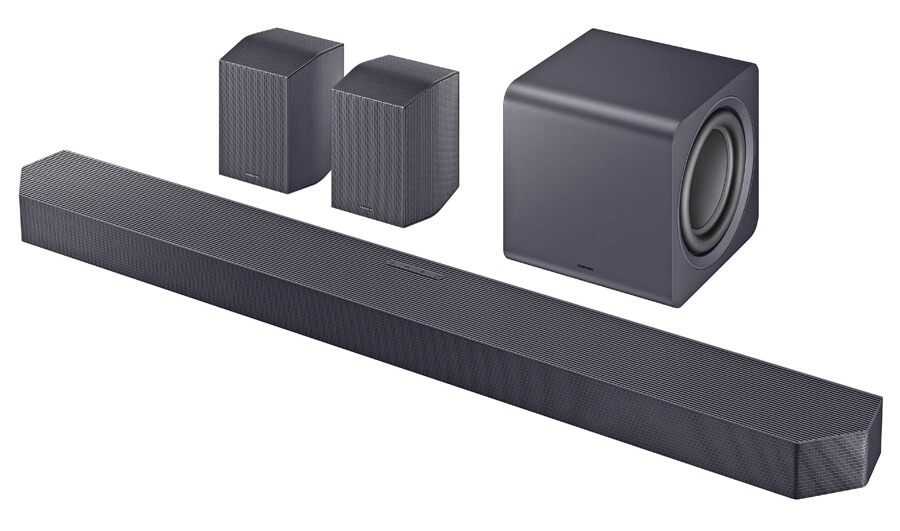
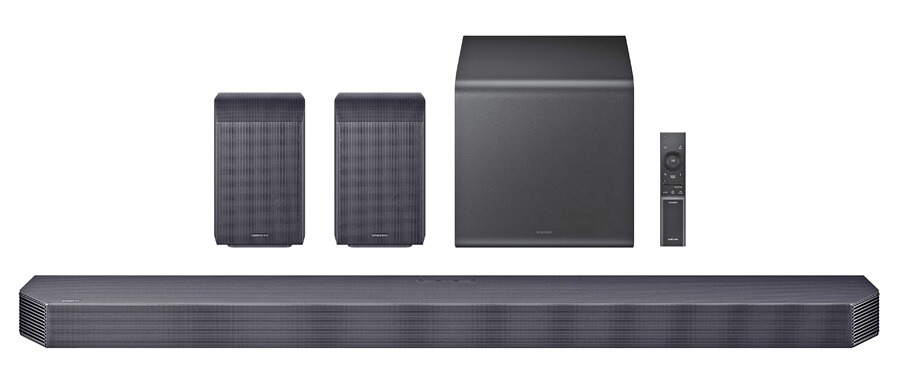
The HW-Q990H is Samsung’s Q Series flagship and its most ambitious soundbar to date. It uses an 11.1.4 channel layout with three front channels, two side firing, two wide firing, and four rear channels, along with four upfiring channels split between the front and rear. The included compact subwoofer features a dual 8-inch driver design aimed at delivering serious low end without overwhelming the room.
Height effects are handled by the upfiring channels in both the bar itself and the included rear speakers, while next generation AI tuning adjusts output in real time based on both the room and the content. The goal is to deliver a level of immersion that approaches a full home theater system, without the rack of gear or the wiring that usually comes with it. Just as important, Samsung is focusing on features that address everyday soundbar frustrations rather than piling on gimmicks.
The Q990H supports Dolby Atmos and DTS-X as well as Eclipsa Audio immersive surround sound.
Advertisement
The main soundbar measures 48.5 inches wide, 2.8 inches high, and 5.5 inches deep, making it a solid match for 50-inch and larger TVs. It can be placed on a shelf or wall mounted.
Per editor at Large, Chris Boylan, the HW-Q990H offered a cinematic sound on DTS-X and Dolby Atmos soundtracks like “Blade Runner” and “F1” with nice immersion and surprisingly solid bass reproduction, considering the compact size of the included subwoofer.
HW-Q900H
The HW-Q900H is a step down from the Q990H but still brings a substantial feature set. It uses a 9.1.4 channel layout with three front channels, two side firing, two wide firing, and two rear channels, along with four upfiring height channels split between the front and rear. The system also includes a compact active subwoofer with a dual 8 inch driver design intended to deliver strong low end without overwhelming the room.
Unlike the flagship, the Q900H supports Dolby and Eclipsa Audio formats but does not include DTS compatibility.
The main soundbar measures 43.71 inches wide, 2.8 inches high, and 4.73 inches deep, making it a good fit for a wide range of TVs. It can be placed on a shelf or wall mounted.
Advertisement
HW-Q800H
The HW-Q800H is a more streamlined option in the lineup, built around a 5.1.2 channel configuration with three front channels, two side firing, and two upfiring height channels, paired with a wireless subwoofer.
Advertisement. Scroll to continue reading.
Like the Q900H, it supports Dolby and Eclipsa Audio formats but does not include DTS compatibility.
The soundbar measures 43.71 inches wide, 2.8 inches high, and 4.72 inches deep, making it an easy fit for most TV setups. It can be placed on a shelf or wall mounted.
HW-QS90H
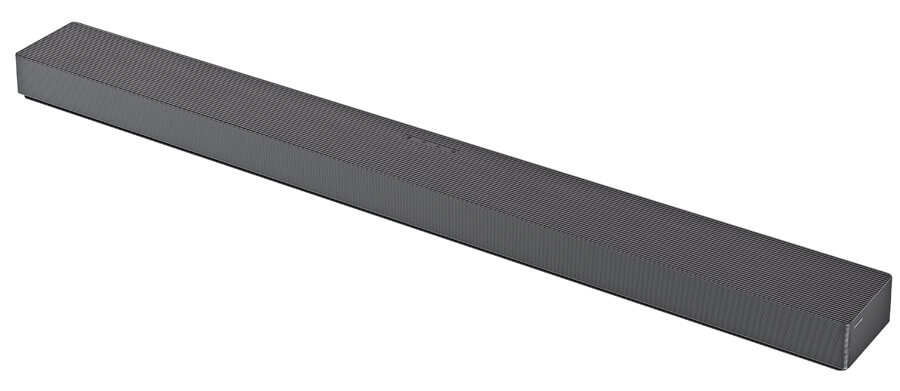
The Samsung HW-QS90H takes a different approach, trading modular expansion for simplicity. It features a self contained 7.1.2 channel design with 13 drivers, including nine wide range speakers, eliminating the need for separate surrounds or a dedicated subwoofer.
The unit features a “Convertible Fit” design which uses an internal gyroscope to detect whether it is installed horizontally (like on a credenza) or vertically (like mounted on a wall) and automatically adjusts its driver array to accommodate these different placements. The result is a soundbar that adapts to the room rather than forcing the room to adapt to it, which makes a lot more sense as living spaces get tighter.
Advertisement
The QS90H uses a built-in Quad Bass Woofer system, designed to deliver meaningful low frequency impact from a single enclosure, keeping floor space clear and setup straightforward.
The QS90H supports both Dolby and DTS formats as well as Eclipsa Audio.
It measures 49.02 inches wide, 2.71 inches high, and 4.92 inches deep, and can be placed on a shelf or wall mounted.
Our Editor at Large Chris Boylan tested the QS90H with several 4K Blu-rays and clips from a Kaleidescape Strato E 4K media player including “Blade Runner, “Baby Driver,” “F1” and “Spider-Man: Into the Spiderverse.” He found that the bar did a convincing job drawing the viewer into the action, when mounted on a wall below the company’s S90H OLED TV. Surround sound virtualization was effective at giving the illusion of sound coming from behind the viewing position and bass was solid for a one-piece unit though he did miss the bass extension you get with a separate dedicated subwoofer. Boylan confirmed that the bar could decode both Dolby Atmos and Eclipsa Audio (DTS-X is also supported).
Advertisement
Comparison
Samsung Model
HW-Q990H
HW-Q900H
HW-Q800H
HW-QS90H
Product Type
Soundbar System
Soundbar System
Soundbar System
Soundbar
Price
$1,999.99
$1,499.99 (Coming Soon)
$1,099.99
$999.99 (Coming Soon)
Number of Channels
11.1.4
9.1.4
5.1.2
7.1.2
Primary Channels
3 Front (Left, center, right)
2 Side-Firing
2 Wide-Firing
4 Rear Channels
3 Front (Left, center, right) · 2 Side-Firing
Advertisement
2 Wide-Firing
2 Rear Channels
3 Front (Left, center, right)
2 Side-Firing
3 Front (Left, center, right) ·
Advertisement
2 Side-Firing · 2 Wide-Firing
Subwoofer Channel
1
1
1
N/A
Up- firing Channels
2 Front 2 Rear
2 Front 2 Rear
2 Up- firing
2 Up- firing
HDMI ARC
Yes (eARC)
Yes (eARC)
Yes (eARC)
Yes (eARC)
Dolby Atmos™
Yes
Yes
Yes
Yes
DTS:X
Yes
No
No
Yes
Remote Controller
Yes
Yes
Yes
Yes
Q-Symphony compatible
Yes
Yes
Yes
Yes
Surround Sound Expansion
Yes
Yes
Yes
Yes
Game Mode Pro
Yes
Yes
Yes
Yes
AVA Pro
Yes
Yes
Yes
Yes
Connecitivity
Wi-Fi
Bluetooth Version: 5.3
Voice Assistants Built-in: Alexa, Bixby
Advertisement
Works with: Google cast, Airplay
HDMI IN: 2
HDMI OUT: 1
HDMI CEC
Optical In: 1
Advertisement
USB: N/A
Spotify Connect
Roon Ready
Wi-Fi
Advertisement
Bluetooth Version: 5.3
Voice Assistants Built-in: Alexa, Bixby
Works with: Google cast, Airplay
HDMI IN: 1
Advertisement
HDMI OUT: 1
HDMI CEC
Optical In: 1
USB: N/A
Advertisement
Spotify Connect
Roon Ready
Wi-Fi
Bluetooth Version: 5.3
Advertisement
Voice Assistants Built-in: Alexa, Bixby
Works with: Google cast, Airplay
HDMI IN: 1
HDMI OUT: 1
HDMI CEC
Advertisement
Optical In: 1
USB: N/A
Spotify Connect
Roon Ready
Advertisement
Wi-Fi
Bluetooth Version: 5.3
Voice Assistants Built-in: Alexa, Bixby
Works with: Google cast, Airplay
Advertisement
HDMI IN: 1
HDMI OUT: 1
HDMI CEC
Optical In: 1
Advertisement
USB: N/A
Spotify Connect
Roon Ready
Audio Formats/AV Decoding
Dolby Atmos™
Dolby TrueHD
Dolby Digital Plus
Advertisement
Dolby 5.1ch
DTS:X
DTS 5.1ch
DTS-HD HRA
DTS-HD MA
DTS Express
MP3
Advertisement
AAC
OGG
FLAC
WAV
Advertisement
ALAC
AIFF
Dolby Atmos™
Dolby TrueHD
Dolby Digital Plus
Dolby 5.1ch
DTS:X: No
Advertisement
DTS 5.1ch: No
DTS-HD HRA: No
DTS-HD MA: No
DTS Express: No
Advertisement
MP3
AAC
OGG
FLAC
Advertisement
WAV
ALAC
AIFF
Dolby Atmos™
Dolby TrueHD
Dolby Digital Plus
Advertisement
Dolby 5.1ch
DTS:X: No
DTS 5.1ch: No
DTS-HD HRA: No
Advertisement
DTS-HD MA: No
DTS Express: No
MP3
AAC
OGG
Advertisement
FLAC
WAV
ALAC
AIFF
Advertisement
Dolby Atmos™
Dolby TrueHD
Dolby Digital Plus
Dolby 5.1ch
Advertisement
DTS:X
DTS 5.1ch
DTS-HD HRA
DTS-HD MA
Advertisement
DTS Express
MP3
AAC
OGG
Advertisement
FLAC
WAV
ALAC: Yes
AIFF: Yes
Advertisement
Sound Modes
Surround Sound Expansion
Game Mode Pro
Adaptive Sound
DTS:X
Advertisement
Bass Boost: No
Night Mode
Voice-enhance mode
Surround Sound Expansion
Game Mode Pro
Advertisement
Adaptive Sound
DTS:X: No
Bass Boost: No
Night Mode
Voice-enhance mode
Advertisement
Game Mode Pro
Adaptive Sound: Yes
DTS:X: No
Bass Boost: No
Night Mode
Advertisement
Voice-enhance mode
Game Mode Pro
Adaptive Sound: Yes
DTS:X
Advertisement
Bass Boost: No
Night Mode
Voice-enhance mode
Video Compatibilty
4K Video Pass: 120Hz
Advertisement
HDR: HDR 10+
4K Video Pass: 120Hz
HDR: HDR 10+
4K Video Pass: 60Hz
HDR: HDR 10+
4K Video Pass: 60Hz
Advertisement
HDR: HDR 10+
Dimensions (WHD)
Soundbar 48.50 x 2.8 x 5.43
Subwoofer: 9.80 x 9.91 x 9.80
Rear Speaker: 5.10 x 7.93 x 5.53
Advertisement
Soundbar 43.71 x 2.38 x 4.72
Subwoofer: 9.80 x 9.91 x 9.80
Rear Speaker: 5.10 x 7.93 x 5.53
Soundbar43.71 x 2.38 x 4.72
Subwoofer: 9.80 x 9.91 x 9.80
Rear Speaker: N/A
Advertisement
Soundbar: 49.02 x 2.71 x 4.92
Weight (lbs)
Soundbar: 16.08
Subwoofer: 18.28
Rear Speaker: 7.49
Soundbar: 11.68
Advertisement
Subwoofer: 15.87
Rear Speaker: 6.83
Soundbar: 11.24
Subwoofer: 15.87
Advertisement
Rear Speaker: N/A
Soundbar: 14.75
Package Contents
Soundbar
Subwoofer
Rear Speaker Kit
HDMI Cable (HDMI 2.1)
Advertisement
Wall Mount Kit
Rubber Foot
Remote Controller
Battery for Remote Controller
Advertisement
Soundbar
Subwoofer
Rear Speaker Kit
HDMI Cable (HDMI 2.1)
Advertisement
Wall Mount Kit
Rubber Foot
Remote Controller
Battery for Remote Controller
Soundbar
Advertisement
Subwoofer
Rear Speaker Kit: No
HDMI Cable(HDMI 2.1)
Wall Mount Kit
Advertisement
Ruber Foot
Remote Controller
Battery for Remote Controller
Soundbar
Advertisement
Subwoofer: No
Rear Speaker Kit: No
HDMI Cabl (HDMI 2.1)
Wall Mount Kit
Advertisement
Rubber Foot
Remote Controller
Battery for Remote Controller
The Bottom Line
Samsung didn’t reinvent the soundbar in 2026, but it didn’t need to. What it’s doing here is doubling down on the formula that put it on top in the first place: tight integration with its TVs, flexible system scaling, and fewer wires without completely sacrificing immersion.
What’s new or at least more refined is the range itself. You now have a clearer ladder from the full surround Q990H, to the more compact Q900H and Q800H, all the way down to the one-piece QS90H, which ditches the usual box of extras and goes all in on a single enclosure. The QS90H in particular stands out because it tries to solve the biggest real world problem: people want better sound, but they don’t want more stuff in the room.
Advertisement
What still makes Samsung unique is ecosystem control. Q-Symphony, SpaceFit, and Wireless Dolby Atmos aren’t just features, they are leverage. Pair these with a recent Samsung TV and you get the full experience. Use another brand and you leave performance and functionality on the table. That’s not a bug, it’s the strategy.
What’s missing is just as important. DTS support is inconsistent across the lineup, which is hard to ignore for anyone with a physical media library. But they do offer Eclipsa Audio decoding, which may matter in time as more content creators create immersive audio content in that format on YouTube. There’s also still a reliance on Samsung’s ecosystem to unlock everything, which won’t sit well with buyers who mix and match brands.
Advertisement. Scroll to continue reading.
So who is this for? Anyone building a TV-first home theater who wants strong, immersive sound without the complexity of separates. If you already own a Samsung TV, the case is easy. If you don’t, these are still competitive soundbars, but the real value only shows up when you stay inside the walled garden.
James Comey is not exactly someone we’ve ever been a fan of on Techdirt. He was a terrible FBI director in so many ways. We’ve spent years criticizing the man — for his crusade against encryption, his supporting the FBI’s ridiculously aggressive impersonation of reporters, his embrace of the FBI’s program to coerce and entrap people down on their luck into fake terrorist plots, and much more. And, while the impact has been exaggerated, it is true that he took multiple actions violating DOJ procedures that likely helped get Donald Trump elected in 2016. So it’s not like I’m rushing to support the guy. He’s a bad cop and has been for some time.
But the indictment the Department of Justice handed down against James Comey on Tuesday is a truly embarrassing legal document, and everyone involved in producing it should be professionally radioactive for the rest of their careers. I would have said it’s one of the most embarrassing legal documents that this DOJ has produced, but remember, just a day earlier they filed a legal brief that was indistinguishable from a Truth Social post.
The charge, in its entirety, concerns this Instagram post from May 2025:
If you can’t see that, it’s an Instagram post from Comey showing some shells on some sand with the shells spelling out 8647 and the caption on the post saying:
Cool shell formation on my beach walk
For this — for posting a photo of arranged seashells in a slightly sassy pattern and posting it to Instagram — Comey has been charged with two federal felonies: threatening the President under 18 U.S.C. § 871, and transmitting a threat in interstate commerce under 18 U.S.C. § 875(c). (For what it’s worth Comey has claimed he didn’t arrange the sea shells, but just found them. It’s unclear if that makes much of a difference, it’s protected speech either way).
Advertisement
Ken “Popehat” White, who has perhaps done more than any other lawyer in America to explain First Amendment doctrine to laypeople, didn’t mince words about what this is:
The charge is preposterous and no competent or honest prosecutor would bring it. It represents a betrayal of the professional and ethical obligations of every U.S. Department of Justice attorney involved, and reflects the complete collapse of the Department’s credibility and independence in favor of a cultish and cretinous devotion to Donald Trump.
He’s right, and the way to understand just how right he is requires understanding the path that brought us here.
Because this is the second time the Trump DOJ has tried to indict Comey. The first attempt collapsed in spectacular fashion last year, after Trump — in what was apparently supposed to be a private direct message but accidentally went out as a public Truth Social post — demanded that Pam Bondi install Lindsey Halligan, a former insurance lawyer with no relevant experience, as a U.S. Attorney specifically because she had promised to indict Comey. The problem: Halligan wasn’t legally appointed. The entire indictment got tossed before the court could dismiss it for being ridiculous (which would have happened) because the person who filed it wasn’t allowed to file it.
As we noted at the time, this pattern of procedural self-sabotage is a recurring feature of an administration that treats legal procedure as an inconvenience rather than the actual point of having a justice system.
Advertisement
So how did the DOJ respond to that humiliation? By coming back with something substantively even worse. In theory, they tried fixing the “wrong person filed it” problem by having an actually legally appointed person file something… even if that something has no legal basis whatsoever. Progress! Sort of?
The seashell indictment was filed by W. Ellis Boyle, the U.S. Attorney for the Eastern District of North Carolina, with Assistant U.S. Attorney Matthew R. Petracca listed as the prosecuting attorney. Remember those names. They put their signatures on this. Boyle is listed as the U.S. Attorney for the Eastern District of North Carolina, but he’s serving in an acting capacity — Trump has nominated him multiple times, yet the Senate has still refused to confirm him.
The legal problem with the indictment is pretty easy to spot: to convict someone under either of the threat statutes the DOJ is invoking, the government has to prove the communication constituted a “true threat.” Under controlling Fourth Circuit precedent (this case is in North Carolina), a true threat is something “an ordinary, reasonable recipient who is familiar with the context in which the statement is made would interpret as a serious expression of an intent to do harm.”
As Ken White noted, the Supreme Court established this framework in Watts v. United States, a 1969 case involving an 18-year-old draft protester who said:
Advertisement
They always holler at us to get an education. And now I have already received my draft classification as 1-A and I have got to report for my physical this Monday coming. I am not going. If they ever make me carry a rifle the first man I want to get in my sights is L. B. J.
The Court found this was protected political hyperbole, not a true threat. An explicit statement about wanting a President in your rifle sights — protected.
If Watts isn’t damning enough, there’s United States v. Bagdasarian, a much more recent Ninth Circuit case where a man posted online statements about wanting to shoot then-candidate Barack Obama, including some genuinely vile racially explicit language about hoping Obama would be killed. The court held that even that did not constitute a true threat under the relevant statutes.
I’d be curious to hear from anyone defending this indictment whether they think Bagdasarian was wrongly decided. Or do we change the “true threat” standard when the target is Trump?
So the descending ladder of seriousness looks like this:
Advertisement
Explicit racial language about wanting a President shot: protected
Telling a crowd you want LBJ in your rifle sights: protected
Posting a photo of seashells arranged on a beach to spell “86 47”: two federal felonies
Any first-year law student who’s taken a basic First Amendment course could tell you the seashell post is constitutionally protected. Any prosecutor with five minutes of research time would know that Bagdasarian and Watts exist. But, of course, as we’ve seen over and over and over again in the Trump era, the point is not to bring a good case or a winnable case. The point is just to punish Trump’s enemies with vexatious, vindictive prosecutions in hopes of creating a chilling effect among the populace and stopping them from criticizing the President with the thinnest skin possible.
Now, “86” has had various meanings over the years — to “86” something in restaurant slang means to remove it from the menu or get rid of it. The DOJ’s theory is apparently that when used about a person, it means to kill them. No one else believes that. This is the kind of motivated reading that requires ignoring both the dictionary and how actual humans use language.
But fine, let’s grant the absolute most uncharitable reading and say “86 47” means “get rid of the 47th President through killing.” Even granting that — even doing all the work for the prosecution — it’s still obviously protected political expression, and still obviously not a true threat under the controlling case law.
Which brings us to the part that genuinely cannot be explained by anything other than pure vindictiveness. Here is a tweet from Jack Posobiec, a prominent Trump loyalist/conspiracy theorist, posted in January 2022:
That tweet is still up. I just made that screenshot minutes ago. As of this writing, it has been online for nearly four years. No FBI investigation. No federal indictment. No felony counts. Literally no one thought that was an actual threat. Because it’s not. Apparently the DOJ’s theory of criminal threats has a loyalty-based expiration date — the same numerical expression is a felony when arranged in shells by a Trump critic and a perfectly fine tweet when posted by a Trump supporter about a different President.
Indeed, the fact that Posobiec seems to have no issue keeping this tweet up is itself a sign that the MAGA world knows it’s engaged in purely theatrical vindictive prosecution — and wants you to know they know. To them, once again, nothing here is about justice or the rule of law. It’s just “will this make the people I dislike upset.” That is their only motivating factor.
Advertisement
The DOJ has baked the selective prosecution argument directly into its own theory of the case. Comey’s lawyers will surely refresh the selective prosecution motion they filed in the first, dismissed indictment, and the facial absurdity of this one — combined with the existence of identical, ignored expression by Trump allies — makes that motion approximately as easy to support as such motions ever get.
There’s a specific kind of institutional rot in play here, driven entirely by Donald Trump and his minions. Competent authoritarianism is dangerous in obvious ways. Incompetent authoritarianism that keeps trying anyway is dangerous in different ways: it normalizes the use of state power for personal vengeance while demonstrating that the people wielding it will stop at nothing — even on the most facially ridiculous grounds. That’s a chilling effect doubled: a politicized DOJ, staffed by people who can’t pass a First Amendment quiz.
White is right that the indictment is unlikely to survive. Comey’s attorneys can challenge it on its face, arguing that even taking every allegation as true, seashells spelling “86 47” are protected by the First Amendment as a matter of law. The assigned judge was appointed by a Republican but is reportedly not a partisan hack, and the case law here is so clear that it would take extreme judicial bad faith to let this proceed. The selective prosecution motion is also stronger now than it was the first time, with Posobiec’s untouched tweet sitting there as Exhibit A.
But as White notes, surviving the motion to dismiss isn’t actually the point:
Advertisement
The point of the indictment is to demonstrate that the United States Department of Justice is wholly an instrument of Donald Trump’s senescent pique, no more independent of him than a boil on his ass. The point is to show that the administration can, and will, use the Department’s mechanisms to punish enemies. The point is to show that the Department can, and will, punish protected speech. The point is to show that the Department is staffed by committed fanatics willing to do anything, however unethical and unconstitutional, to promote Trump.
The point is to show that in the war between Donald Trump and the U.S. Department of Justice, Trump has won. Now they’re on the field slitting the throats of the wounded and looting bodies.
W. Ellis Boyle and Matthew R. Petracca put their names on this indictment. They will, presumably, lose this case the way the previous Comey case was lost — embarrassingly, on grounds that any competent attorney not engaged in cult-like performative fealty to a wannabe authoritarian could have anticipated. And when this is all over, when there is some accounting for what was done to the Department of Justice in these years, the people who signed the seashell indictment should never be trusted with prosecutorial power, a bar membership, or any position requiring professional judgment ever again.
The shells, for what it’s worth, were on a beach. The tide has presumably long since rearranged them. The Instagram post was taken down fairly quickly when the MAGA world lost their minds over it. The federal felony charges, somehow, remain.
After suggesting a wood-burning stove, and a mini bellows, you should have seen this coming. What you need to complete the full-fire package is Cooking On Fire, a gorgeous book of recipes and techniques for cooking over an open flame. Cooking on Fire has a good mix of recipes, ranging from simple and delicious veggies to slow-cooked meats that require hours. There’s also plenty of background on different types of fires and cooking techniques, as well all the equipment you might want to cook various things (for example: spits, forked sticks, cast iron pans, and so on). It’s everything you—er, sorry, your outdoorsy friend—need to get started cooking on fire.
What I really want to try is the fire inside a log technique pictured on the cover, but I haven’t gotten around to that yet. So far I’ve only had a chance to make the grilled pork belly, with grilled carrots and “Krabbelurer” griddle cakes for desert. All of them were excellent, though of course, perhaps that universal rule applies more so here than with any other form of cooking: Your results may vary. In the end, though, this isn’t really a gift about cooking. It’s gift to remind us all to slow down and take your time, with food and everything else.
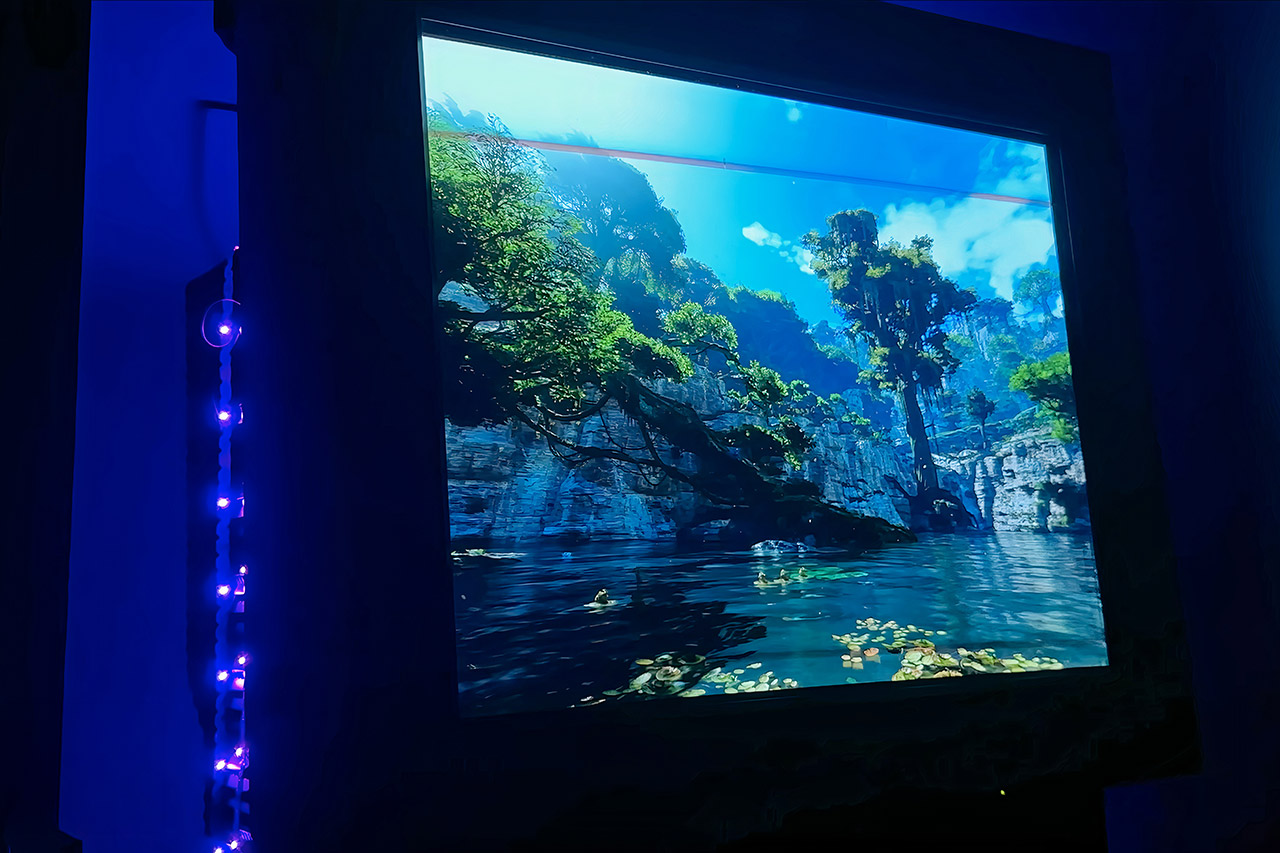
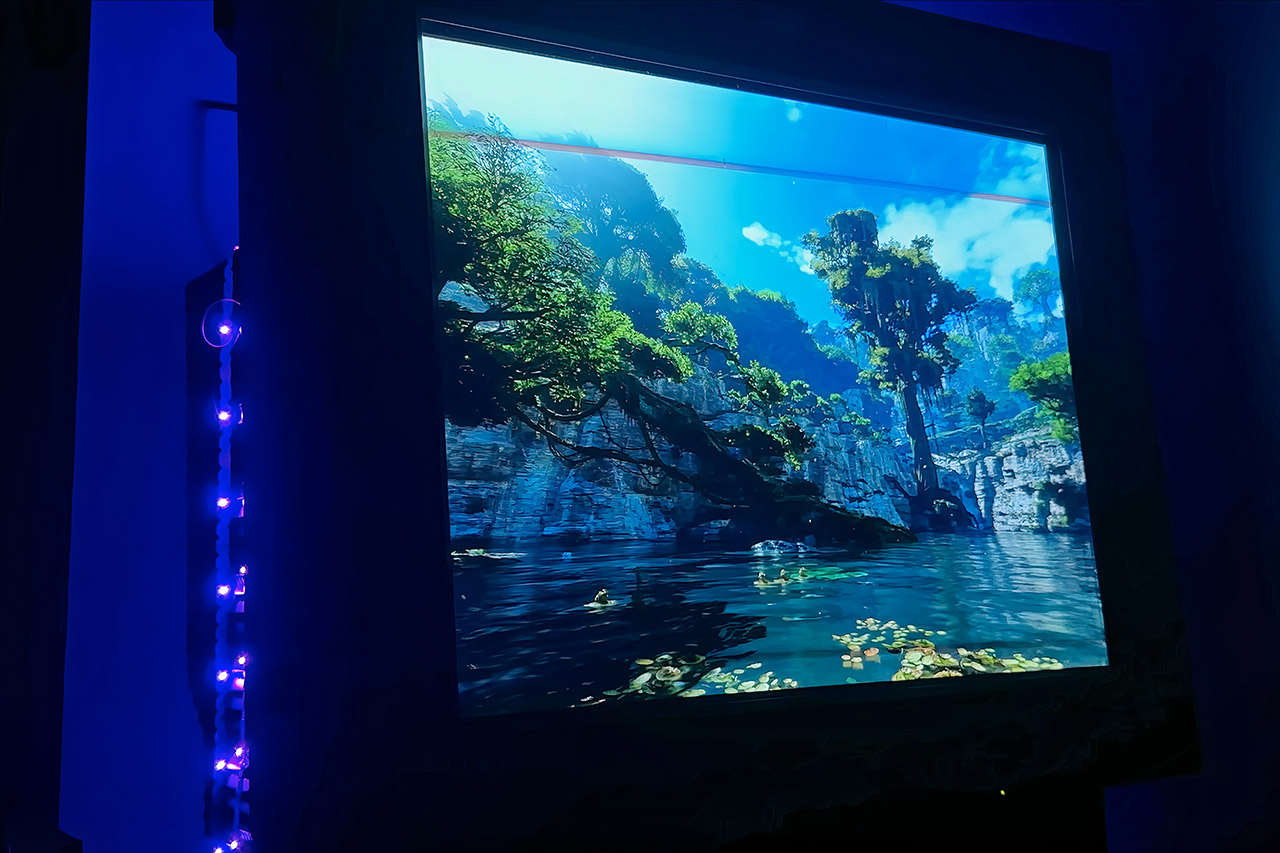
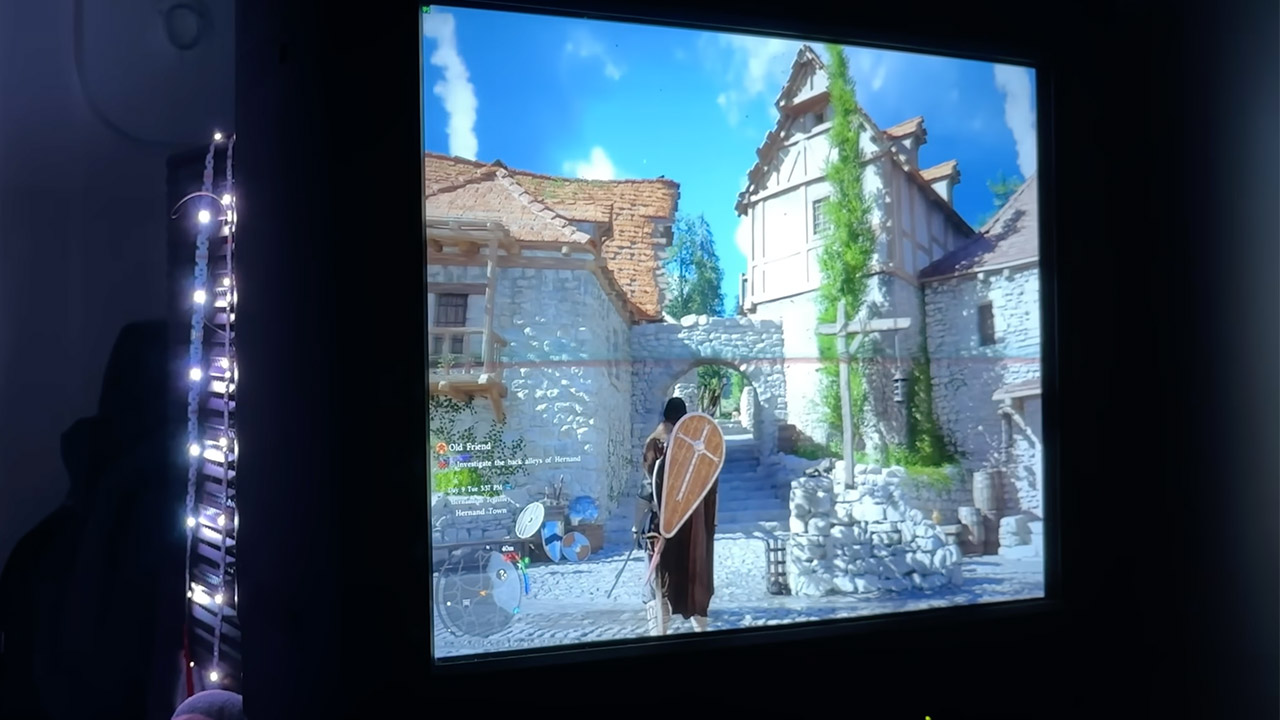
Gamers who remember the old days understand why CRT screens are so popular. Instant responsiveness to every command, no screen tearing, and images that feel alive in a way that newer flat screens cannot match. Found Tech has taken that magic and pushed it all the way to nearly 4K on something you wouldn’t expect, a dusty old IBM 275 monitor that’s been around since the turn of the century.
Found Tech began with a vintage IBM 275, which is roughly 20 years old and fairly strong for an office monitor constructed around a cathode ray tube. The problem is that modern graphics cards cannot generate the necessary signal to drive such high resolutions, therefore he relied on the “free” Intel graphics in his system. An RTX 4080 Super handled all the heavy rendering work while the Intel chip generated the final video feed. Custom Resolution Utility software let him dial in a 2880-by-2160 interlaced mode that standard drivers refuse to allow. After testing dozens of driver versions, the combination finally locked in.
Stunning Image Quality in 4K Display – The 27-inch UHD 4K (3840 x 2160) IPS display reproduces clear images and vibrant colors with up to 95% DCI-P…
4K UHD HDR – To more fully realize content creators vision, this monitor is compatible with VESA DisplayHDR 400 high dynamic range, supporting…
Color Your World – Explore HDR content the way it was meant to be seen with up to 95% DCI-P3 color gamut expression—an elevated color spectrum that…
CRTs can support this high-resolution setup because they function differently than modern monitors. Instead of a set grid of pixels, a CRT projects an electron beam across a layer of illuminating phosphors. The beam may draw lines as close together as the signal desires, and at this very high density, interlacing concerns simply vanish. The impression is that the lines mix together so smoothly that it resembles progressive scan. The tube’s analog nature takes care of the rest, providing edges with a softness that digital sharpening cannot imitate.
Advertisement
However, at this resolution, motion truly shines. LCD and OLED screens maintain each frame on the screen for a fraction of a second, resulting in a slight but consistent blur during fast panning and quick character movements, whereas a CRT lights up each phosphor for as long as the beam is over it and then fades away quickly. The result is incredibly crisp action, even with things racing across at full speed, and games feel much more immediate because you can see every frame just as the graphics card created it.
The depth is difficult to understand without seeing it for yourself, as the image looks to be sitting inside the tube rather than on its surface. Dark places remain pitch black, with no light leaking in. Bright highlights are super intense, and when speeding through the large open world of Crimson Desert at this resolution and 60 frames per second, the scenery begins to feel like it has depth and distance to it. [Source]
Amazon Web Services growth accelerated to 28% in the first quarter — its fastest pace in nearly four years — pushing Amazon’s results past Wall Street’s expectations and validating, at least for now, the company’s controversial $200 billion capital spending plan.
Overall, Amazon posted sales of $181.5 billion, up 17%, and operating income of $23.9 billion, up 30%. Both topped guidance and exceeded Wall Street’s expectations of about $177 billion in revenue.
Profits were $30.3 billion, or $2.78 per diluted share. However, that included a $16.8 billion pre-tax gain on Amazon’s investment in Anthropic, which inflated the bottom-line numbers. Excluding that one-time gain, adjusted earnings per share would have been $1.61, just shy of analyst expectations of $1.62.
Amazon’s advertising business grew 24% to $17.2 billion in the quarter, and the company said advertising revenue topped $70 billion over the past 12 months.
In the core e-commerce business, unit sales grew 15%. Amazon CEO Andy Jassy called it the strongest growth rate since the waning days of the COVID-19 lockdowns. It was boosted in part by faster delivery, with more than 1 billion items shipped same-day or overnight in the U.S. so far this year.
Amazon is in “the middle of some of the biggest inflections of our lifetime,” Jassy said in a release.
Advertisement
The company spent $147.3 billion on property and equipment over the past 12 months, nearly doubling from $88 billion a year earlier and leaving just $1.2 billion in free cash flow.
In other words, Amazon is making more money than ever but plowing nearly all of it back into building out capacity, mostly for AWS and AI infrastructure. The company has said it expects to spend about $200 billion in capital expenditures for the full year.
Shares were down about 2% in initial after-hours trading.
Update: On the earnings call, Amazon disclosed that its AWS revenue backlog jumped to $364 billion, up from $244 billion last quarter. That figure does not include a recently announced deal with Anthropic valued at more than $100 billion. Jassy said the backlog has reasonable breadth beyond just one or two customers.
Advertisement
Jassy also disclosed that Amazon now has more than $225 billion in revenue commitments specifically for Trainium, its custom AI chip. He called Amazon’s custom silicon business one of the top three data center chip businesses in the world and said the chips business grew nearly 40% from the prior quarter.
For the second quarter, Amazon expects revenue between $194 billion and $199 billion, with operating income between $20 billion and $24 billion. The guidance assumes Prime Day will take place in Q2 in most countries, a shift from Q3 last year.
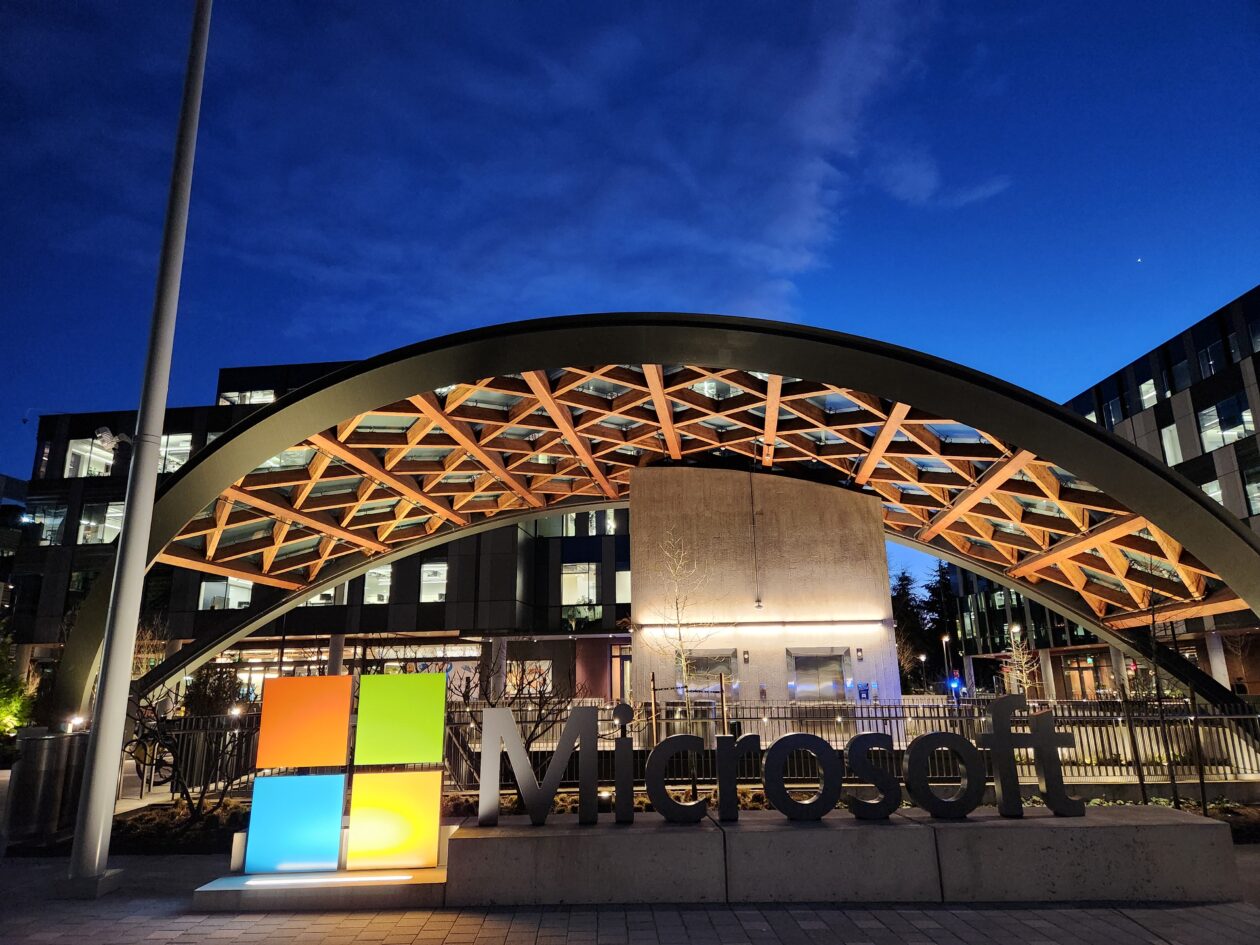
The night sky over Microsoft’s headquarters campus in Redmond, Wash. (GeekWire File Photo / Todd Bishop)
Microsoft will take a $900 million charge in its current quarter for its one-time voluntary retirement program, the company disclosed in its earnings report Wednesday.
Just to put that in context, it’s roughly equal to one day of revenue for the company at its current rate. Microsoft brought in $82.9 billion in its most recent quarter, ended March 31.
The retirement program is part of a broader reshaping of Microsoft’s workforce, which numbered 228,000 employees globally as of mid-2025, the last publicly released count.
Without giving specific numbers, Microsoft said Wednesday that its headcount declined year-over-year in the most recent quarter and will decline again in fiscal 2027, which starts in July.
On the earnings conference call, CFO Amy Hood said the company is focused on “building high performing teams that operate with pace and agility.”
Advertisement
At the same time, Microsoft plans to spend more than $40 billion on capital expenditures in the current quarter — a new record — primarily on data centers and AI infrastructure.
The voluntary retirement program, announced last week, is open to U.S. employees at the senior director level and below whose age and years of service add up to 70 or more.
Eligible employees are expected to get details May 7. They’ll have 30 days to decide.
At last count, Microsoft had about 125,000 U.S. employees, and the company has said about 7% are eligible for the program, so that would translate into about 8,750 eligible employees.
Advertisement
The program will include a financial payout and extended healthcare, but Microsoft hasn’t disclosed the specific terms of the plan yet.
The $900 million charge, split between $350 million in cost of revenue and $550 million in operating expenses, reflects the company’s estimate of the cost, including its assumptions about how many employees will accept, which is also number it hasn’t disclosed.
The program has sparked a range of reactions on LinkedIn and other social networks. Some employees and HR professionals have praised it as a more humane alternative to layoffs, noting that it gives longtime employees a choice rather than a pink slip.
But others have warned that Microsoft risks losing experienced engineers and leaders who built the systems the company still depends on, and some eligible employees have noted that being told they qualify for “retirement” in their late 40s doesn’t feel like a benefit.
Hackers are exploiting two authentication bypass vulnerabilities in the Qinglong open-source task scheduling tool to deploy cryptominers on developers’ servers.
Exploitation started in early February, before the security issues were disclosed publicly at the end of the month, according to researchers at cloud-native application security company Snyk.
Qinglong is a self-hosted open-source time management platform popular among Chinese developers. It has been forked more than 3,200 times and has over 19,000 stars on GitHub.
The two security problems impact Qinglong versions 2.20.1 and older and can be chained to achieve remote code execution:
CVE-2026-3965: A misconfigured rewrite rule maps ‘/open/*’ requests to ‘/api/*’, unintentionally exposing protected admin endpoints through an unauthenticated path
CVE-2026-4047: The authentication check treats paths as case-sensitive (/api/), while the router matches them case-insensitively, allowing requests like ‘/aPi/…’ to bypass authentication and reach protected endpoints.
The root cause in both flaws is a mismatch between middleware authorization logic and Express.js routing behavior.
“Both vulnerabilities stem from a mismatch between the security middleware’s assumptions and the framework’s behavior,” Snyk researchers explain.
Advertisement
“The auth layer assumed certain URL patterns would always be handled one way, while Express.js treated them differently.”
Snyk reports that attackers have been targeting these two flaws on publicly exposed Qinglong panels to deploy cryptominers since February 7.
This activity was first spotted by Qinglong users, who reported about a rogue hidden process named ‘.fullgc’ utilizing between 85% and 100% of their CPU power.
The name deliberately mimics “Full GC,” an innocuous but resource-intensive process, to evade detection.
Advertisement
According to Snyk, the attackers exploited the flaws to modify Qinglong’s config.sh and injected shell commands that downloaded a miner to ‘/ql/data/db/.fullgc,’ and executed it in the background.
The remote resource located at ‘file.551911.xyz’ hosted multiple variants of the binary, including for Linux x86_64, ARM64, and macOS.
The attacks continued with multiple confirmed infections across various setups, including behind Nginx and SSL, while the Qinglong maintainers only responded to the situation on March 1.
The maintainer acknowledged the vulnerability and urged users to install the latest update. However, the mitigation in pull release #2924 focused on blocking command injection patterns, which Snyk says was insufficient.
Advertisement
The researchers report that the effective fix came in PR #2941, which corrected the authentication bypass in the middleware.
AI chained four zero-days into one exploit that bypassed both renderer and OS sandboxes. A wave of new exploits is coming.
At the Autonomous Validation Summit (May 12 & 14), see how autonomous, context-rich validation finds what’s exploitable, proves controls hold, and closes the remediation loop.
For a few hours recently, global cloud platform Cloudflare went down – and a noticeable chunk of the internet went with it.
Services stalled, platforms froze, and businesses were left dealing with failures they didn’t trigger and couldn’t control – from broken checkouts to lagging internal tools.
Fadl Mantash
Chief Information Officer at Tribe.
From the outside, it looked like the usual internet wobble. A quick refresh, a short wait, and most people moved on. Inside the organizations that depend on those upstream layers, the mood was very different.
Article continues below
Advertisement
Teams watched systems slow down or stop entirely, and it became clear – again – how easily a single fault in one provider can spill across the wider digital ecosystem.
And these incidents aren’t isolated.
Late last year, another Cloudflare issue hit – this time a configuration change that went wrong – and it took major platforms offline within minutes. Outages at global tech platforms and hyperscalers such as AWS have shown how disruption in one region can ripple outward at speed.
Advertisement
Even external events, like conflict in the Middle East, have knocked data centers offline and forced providers to reroute traffic under pressure. In addition, AI‑assisted changes have introduced unexpected instability.
Sign up to the TechRadar Pro newsletter to get all the top news, opinion, features and guidance your business needs to succeed!
The triggers vary, but the pattern is becoming familiar: one layer stumbles, and everything built on top of it feels the shock.
Advertisement
Why outages don’t stay contained
Most companies don’t think of themselves as heavily dependent on the likes of Cloudflare, AWS, or any other upstream provider in any meaningful way. In reality, they’re embedded across almost every part of modern digital services.
Today’s systems are built on stacked infrastructure: cloud platforms, routing and security layers, CDNs, authentication systems, and third-party APIs. Each layer adds capability, but also dependency.
When something breaks upstream, it doesn’t stay contained. It moves outward through those layers, affecting systems several steps removed from the original fault.
Advertisement
What catches people out is how far this travels. A failure in one provider doesn’t just hit its direct customers; it hits the platforms built on top of it, the tools those platforms rely on, and the businesses relying on all of them to operate. By the time the issue becomes visible, the blast radius is already far and wide.
Where the cracks show first
Payments tend to expose these failures faster than most. A single transaction touches a long chain of systems: cloud infrastructure, fraud engines, authentication services, and processing networks. If one link snaps, the impact shows up immediately. Transactions hang, checkouts stall, and customers abandon carts.
That has a direct business cost within minutes, or even seconds.
Advertisement
But payments aren’t uniquely fragile; they’re just where people feel the outage the hardest – it’s their money on the line. The same dependencies run through ecommerce platforms, SaaS tools, logistics systems, customer support and internal operations. Payments just make the problem impossible to ignore.
That’s what makes the concentration of infrastructure such a risk. A relatively small number of providers now sit at the core of a huge share of digital services. That scale brings reach and reliability, but it also means the impact isn’t isolated: when something goes wrong, it rarely affects just one company.
Planning for failure, not perfection
Despite all this, outages are still treated as ‘we’ll deal with it when it happens’ moments, instead of something you actively design for.
Advertisement
Redundancy gets weighed against cost; dependency mapping is incomplete, and continuity plans sit untouched. And the assumption persists that major providers ‘don’t go down’, even though recent history shows that they most definitely do, and they will again.
There’s another issue behind all of this, and it’s one most organizations don’t say out loud: they no longer control the infrastructure they rely on.
Over the past decade, companies have handed more of their core systems to hyperscalers and a mix of third-party providers. It’s been great for speed and scale. But the trade-off is obvious every time an upstream service wobbles.
When something breaks several layers above you, there’s very little you can do except wait and watch the impact roll downhill.
Advertisement
Most organizations already have frameworks that are meant to cover this. But when the internet goes down, it’s not security or compliance that gets tested: it’s availability. And that’s the part that has to hold up in the real world.
In financial services especially, there’s a quiet move toward hybrid setups: keeping the big clouds in play but adding regional or specialist providers as backup routes.
Part of that shift is down to geopolitics as much as technology. Most European businesses still run on US cloud and AI platforms, and that’s fine until global politics get jumpy. Banks in particular are asking a simple question: what happens if those services get caught up in a political row they have no control over?
When a single outage can knock out authentication, routing or payments across a whole region, having another route stops being a nice-to-have and starts being basic self-preservation.
Advertisement
Different organizations are moving at different speeds, whether because of regulation or risk. But the message is clear: staying online isn’t luck. It’s something you build for.
The pressure is only increasing
The conditions that make these incidents so disruptive (shared infrastructure, tightly connected systems, real-time digital services) aren’t going anywhere. If anything, they’re getting more intense.
So, the real question for businesses isn’t whether another outage will happen, it’s how exposed they are when it does – and how quickly that exposure turns into lost revenue, operational disruption, and customer frustration.
Advertisement
Given how the modern internet behaves, staying online isn’t luck; it must be designed for. So, remember… do the basics to soften the blow: backup routes, a clear view of their dependencies, and no hidden single points of failure waiting to trip you up.
This article was produced as part of TechRadar Pro Perspectives, our channel to feature the best and brightest minds in the technology industry today.
The views expressed here are those of the author and are not necessarily those of TechRadarPro or Future plc. If you are interested in contributing find out more here: https://www.techradar.com/pro/perspectives-how-to-submit
This is an interesting challenge from the “why not?” files — [GPUSpecs] over on YouTube built a gaming PC without using a single component from NVIDIA, Intel, or AMD. That immediately makes us think of the high-power ARM workstations or perhaps even perhaps the new “AI workstations” coming available with RISC V architecture, but the challenge here was specifically “gaming PC,” not workstation. A gaming PC, without a GPU by one of those three? To make it even more interesting, the x86 CPU isn’t Intel or AMD either.
If you’re of a certain vintage, you may remember Cyrix. Cyrix reverse-engineered the x86 ISA and made their own compatible chips in the 90s, before being bought out by National Semiconductor, and then VIA Technologies. VIA partnered with the Government of Shanghai to found Zhaoxin, and it is from Zhaoxin that the KaiXian KX 7000 CPU hails — an x86-64 device, that isn’t Intel or AMD. We’ve actually covered the company before. This particular chip benchmarks like an old i5, so not spectacular, but usable.
The GPU is also Chinese: a Moore Threads MTT S80, with 16 GB of DDR6 vRAM, 4096 shading units, 256 texture mapping units, and 256 ROPs. On paper, that looks like a very respectable graphics card, but it’s not clear how well the games [GPUSpecs] tested were actually using it. Based on the numbers he was getting in his testing, there are some serious driver issues with this card. Even Black Myth: Wukong, which is supposed to be a game the card targets, was sitting at 13.6 FPS on low settings and 1080p. That almost feels like integrated graphics numbers, not something a beefy GPU would give you — but it matches what other reviewers were saying when the card first came out.
So if you’re looking for a sanction-proof gaming rig, we’re sorry to say it’s not quite ready for triple-A. On the other hand, it’s a neat hack and we didn’t know this box could even get built. Right now, it looks like you will need at least one of the big three names to game on–you can game on ARM with NVIDIA graphics, or even with Intel graphics, and of course AMD, which has been in the works the longest.
Tesla has produced the first Semi from its new high-volume production line at Gigafactory Nevada, a milestone for the long-delayed electric Class 8 truck program after years of pilot builds and delays. Electrek reports: The Tesla Semi has had one of the longest gestation periods in Tesla’s history. First unveiled in 2017, the truck was originally promised for production in 2019. That target slipped repeatedly — to 2020, then 2021, then 2022 — before Tesla finally delivered a handful of units to PepsiCo in late 2022. Those early trucks were essentially hand-built on a pilot line. Tesla spent the next three years refining the design, cutting roughly 1,000 lbs from the truck, and building out a dedicated factory adjacent to Gigafactory Nevada in Sparks. The company revealed the final production specs in February, confirming two trims: a Standard Range with 325 miles at full 82,000-lb gross combination weight, and a Long Range with 500 miles of range.
Tesla is quoting $290,000 for the 500-mile Long Range version and roughly $260,000 for the Standard Range — making it the lowest-priced Class 8 battery electric tractor on the market. The shift from a pilot line to a high-volume production line is significant. Tesla’s Semi factory is designed for an annual capacity of 50,000 trucks, though the company will ramp gradually. Analysts project deliveries between 5,000 and 15,000 units in 2026, but that sounds way too optimistic. […] Both trims feature an 800-kW tri-motor drivetrain producing 1,072 hp and support 1.2-MW Megacharger speeds, restoring 60% of range in roughly 30 minutes — conveniently timed around a driver’s mandatory rest break. Tesla has opened its first Megacharger station in Ontario, California, and has mapped 66 Megacharger locations across 15 states.
This is a playbook Motorola has used for the rest of its Moto G phones to keep prices static, but it especially stings here with the price increase. Thankfully, performance is completely fine. I have been using this phone for nearly a month and haven’t had any issues, outside of some lag when launching the camera app. You’ll see more of its limits running graphics-heavy games—something competing phones won’t have as much trouble with—but it’s generally more than adequate.
There’s a slight bump in battery capacity to 5,200 mAh, and I can easily go two full days with light to average use. One day, when I had a very high screen-on time of nine hours, I had to recharge the phone by around 7 pm, so if you’re screen-maxxing, you’ll definitely need to top up once during the day. Overall, I’m happy with the juice. A nice perk: There’s wireless charging, so you have two ways to charge it up.
As for the 6.7-inch, 120-Hz AMOLED screen, I haven’t had a problem reading it on sunny days, but like the Nothing Phone (4a) Pro, Motorola’s auto-brightness slider is very sensitive and constantly dims the screen when I don’t want it to, so that might be something you’ll get miffed by (you can always turn auto-brightness off).
Camera Blur
The camera system is where Moto G phones have always struggled, and now, in perspective with other $500 phones, the Moto G Stylus still doesn’t quite measure up. The 50-megapixel main camera—in indoor conditions with decent lighting—struggles to capture a sharp photo of my dog when there’s slight movement. (I have a lot of blurry photos.)
Advertisement
When he is staying very still, there’s usually another problem, like too-dark shadows or too-bright highlights. Looking at one of my pet pics, the camera tried to keep the room well-exposed, but my pup’s eyes are pitch black, and you can’t see any detail on his nose—it’s just a black void. In these kinds of high-contrast scenes, you’ll also notice colors looking a little muted, too. In good lighting, you can snap great results, though the 13-MP ultrawide still struggles with colors; the sky has an unnatural blue tinge. The selfie camera is a decent performer, though, even when I’m backlit.





























































You must be logged in to post a comment Login