
Tech
Samsung may give the Galaxy S27 Pro and Ultra brighter, longer-lasting OLED displays

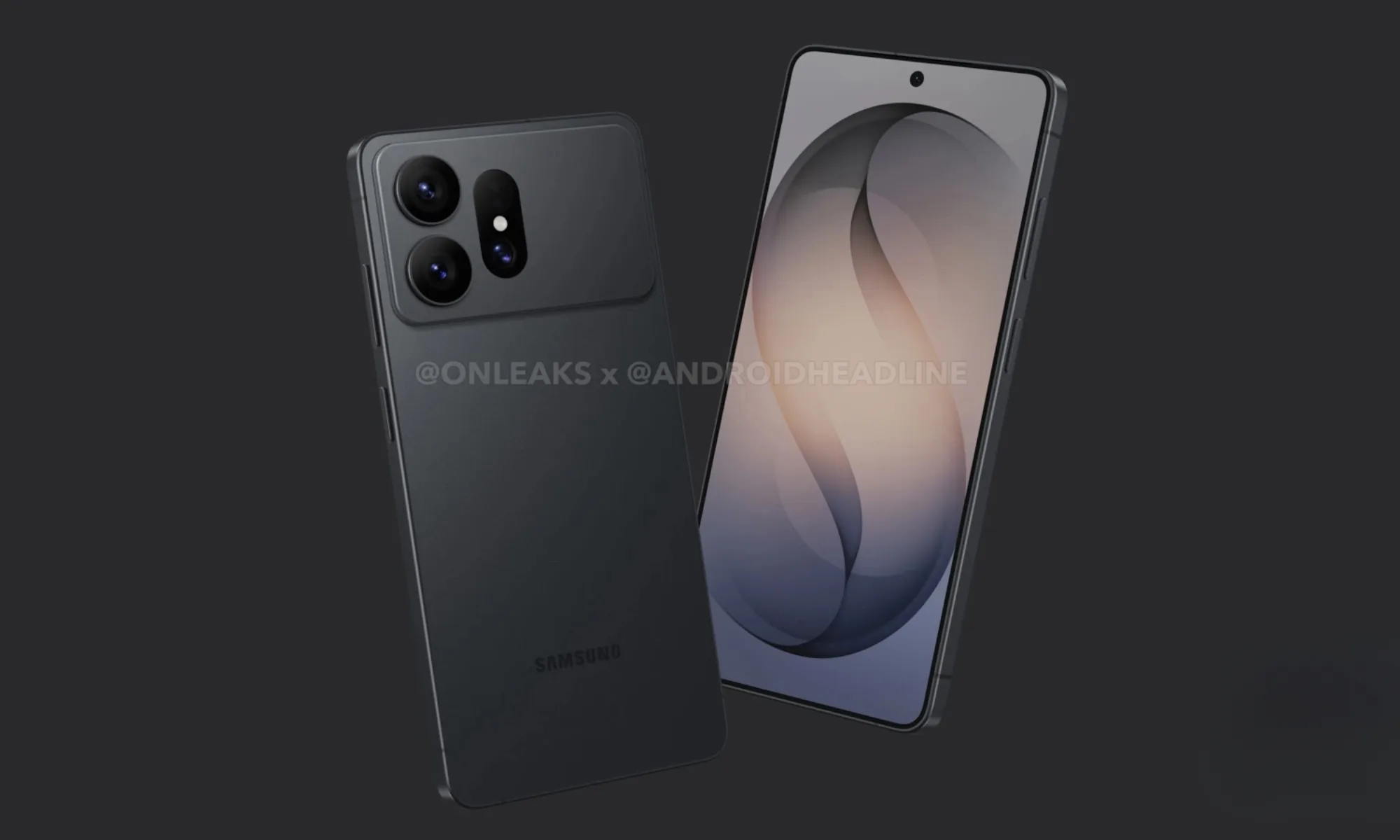
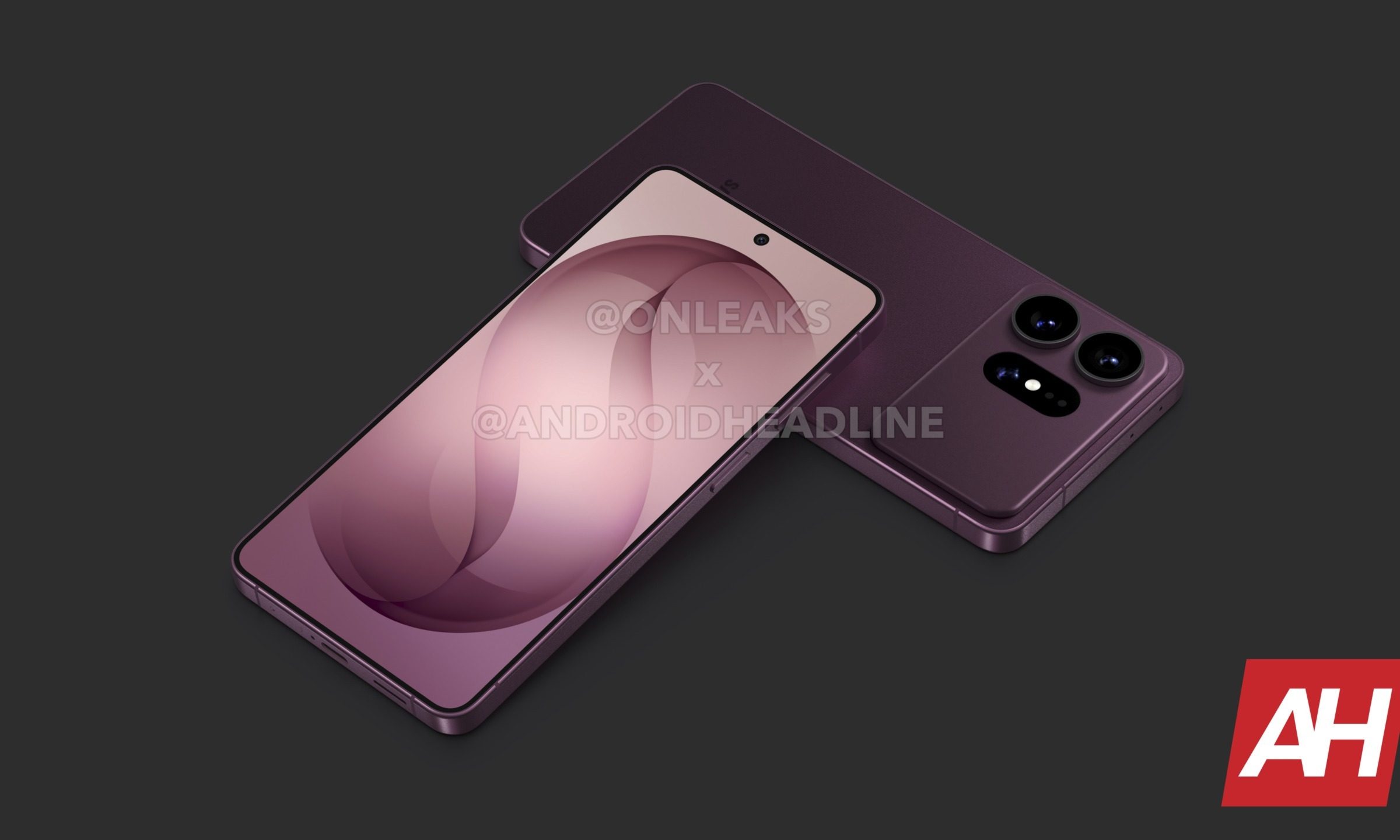
For the past few generations, Samsung’s flagship Ultra phone has felt increasingly predictable. The only upgrade that really grabbed my attention on the Galaxy S26 Ultra earlier this year was its Privacy Display. The Galaxy S27 generation looks different, though, as Samsung appears to be putting some genuine effort into improving its flagship phones.
We have already seen a redesign in leaked renders, heard rumors of a larger battery, and read reports of changes to the zoom camera. Now, according to ETNews, Samsung plans to equip both the Galaxy S27 Pro and Galaxy S27 Ultra with Samsung Display’s latest M16 OLED material set. These would be the first Samsung smartphones to use M16.
So what exactly does M16 change?
M16 refers to the collection of organic materials Samsung Display uses to produce its OLED panels. The choice of materials affects the color, brightness, efficiency, and panel lifespan. Moving to M16 could give Samsung more flexibility to increase brightness or reduce how much power the display consumes.
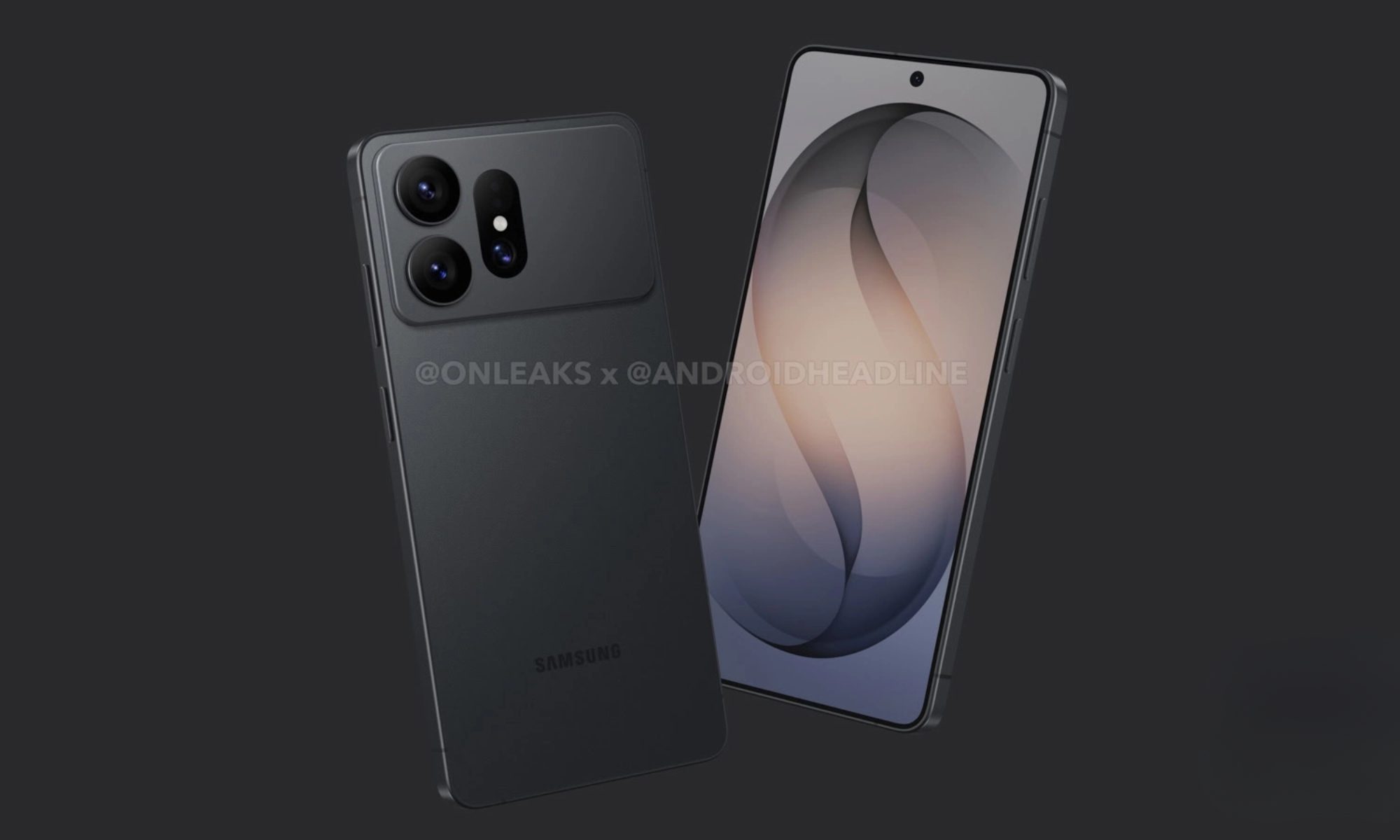
The regular Galaxy S27 and S27+ are reportedly getting newer display materials as well. Samsung is expected to move those phones from M13 to M14, the material set introduced on the Galaxy S26 Ultra. Samsung Display already supplies M16 panels to other phone makers. The recently launched iPhone 18 Pro and Pro Max and the Pixel 11 series use the material set, and the upcoming iQOO 16 is expected to get it later this month.
Samsung has more display upgrades in the works
M16, CoE (Color Filter on Encapsulation), and Privacy Display are expected to help distinguish the Galaxy S27 Pro and Ultra from the regular S27 and S27+. Privacy Display returning on the Ultra would hardly be surprising, but bringing it to the new Pro model could give buyers another good reason to consider it.
The Galaxy S27 Ultra may also get an upgrade to its protective layer. Samsung and Corning are reportedly developing a new Gorilla Armor coating that could heal minor surface scratches over time. None of these changes sound particularly dramatic on their own, but the growing list of upgrades is making Samsung’s next generation of flagships much more interesting.

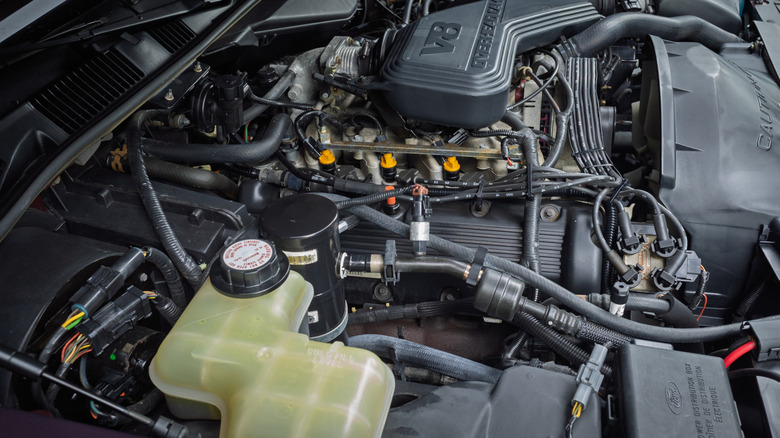
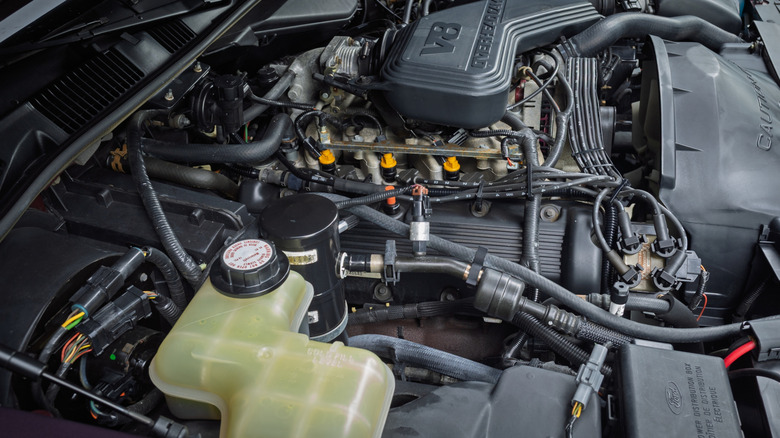
The Ford Crown Victoria is an American icon, instantly recognizable due to its prominence as a police car. In the 1990s, 85% of police cars in the United States and Canada were Crown Vics. That’s because this sedan is known for its body-on-frame build, simplicity, and reliability, making fleets affordable to run, fix, and replace. One reason for the Crown Victoria’s reliability was its engine, the Ford 4.6-liter V8.
This V8 was initially released in 1991 for the Lincoln Town Car and was used in later models like the Mustang GT and Crown Victoria. It was recognized throughout the years for its durability and solid construction until it was discontinued in 2014, replaced by the 5.0-liter Coyote V8. The 4.6-liter V8 was the first in Ford’s modular camshaft engine line — modular meaning the engine assembly was simplified, efficient, and easy to swap. While the engine gets a lot of respect now, it was actually a bit ridiculed back in the 1990s for its lack of power, as the 1992 Ford Crown Victoria only had 190 horsepower — 220 hp for police who equipped a dual exhaust.
Why did police use the Ford Crown Victoria?

Ford vehicles have been used by law enforcement since the 1910s, prompting Ford to even create police packages for some of their vehicles by the 1950s. These police trims came with modifications focused on speed, comfort, and safety. By 1961, 58% of police cars in the largest cities across the United States were using Ford vehicles. When the Mustang entered the service in 1982, Ford highlighted its fast acceleration, warning drivers that it could even catch exotic sports cars.
In 1983, police started adopting the LTD Crown Victoria, with its 5.8-liter V8 engine and police package. The Crown Victoria became its own model in 1992 and the police-focused Interceptor variant quickly became the majority of police cars in the U.S. and Canada by 1998. It continued to serve in the police force until 2012, not long after Ford discontinued the Crown Vic in 2011.
Even though police have used plenty of other vehicles — Ford and otherwise — since then, the Crown Victoria still gets respect for its time thanks to its speed, handling, good crash rating, pretty roomy cabin space, and ability to serve well past 200,000 miles with minimal and cheap maintenance. The 4.6-liter V8 also has plenty of endurance, making up for it not being the fastest in cars like the P71. For these reasons, you’ll still see some police departments using Crown Victoria sedans to this day.

Amazon’s best MacBook Air deals deliver prices as low as $1,199 for M5 models, with discounts of up to $150 off.
A 30-day low price is in effect on Apple’s M5 13-inch MacBook Air in your choice of Silver or Midnight, bringing the cost down to $1,199. This standard configuration has a 10-core CPU, 8-core GPU, 16GB of memory, and 512GB of storage, but you can also save triple digits on higher-end retail models during Amazon’s laptop sale.
Today’s best MacBook Air deals
- 13″ MacBook Air M5 (16GB RAM, 512GB SSD): $1,199 ($100 off)
- 13″ MacBook Air M5 (16GB RAM, 1TB SSD): $1,449 ($150 off)
- 13″ MacBook Air M5 (24GB RAM, 1TB SSD): $1,649 ($150 off)
- 15″ MacBook Air M5 (16GB RAM, 512GB SSD): $1,399 ($100 off)
- 15″ MacBook Air M5 (16GB RAM, 1TB SSD): $1,649 ($150 off)
In addition to the markdowns highlighted above, you can check out even more discounts across popular retailers in our MacBook Air Price Guide.
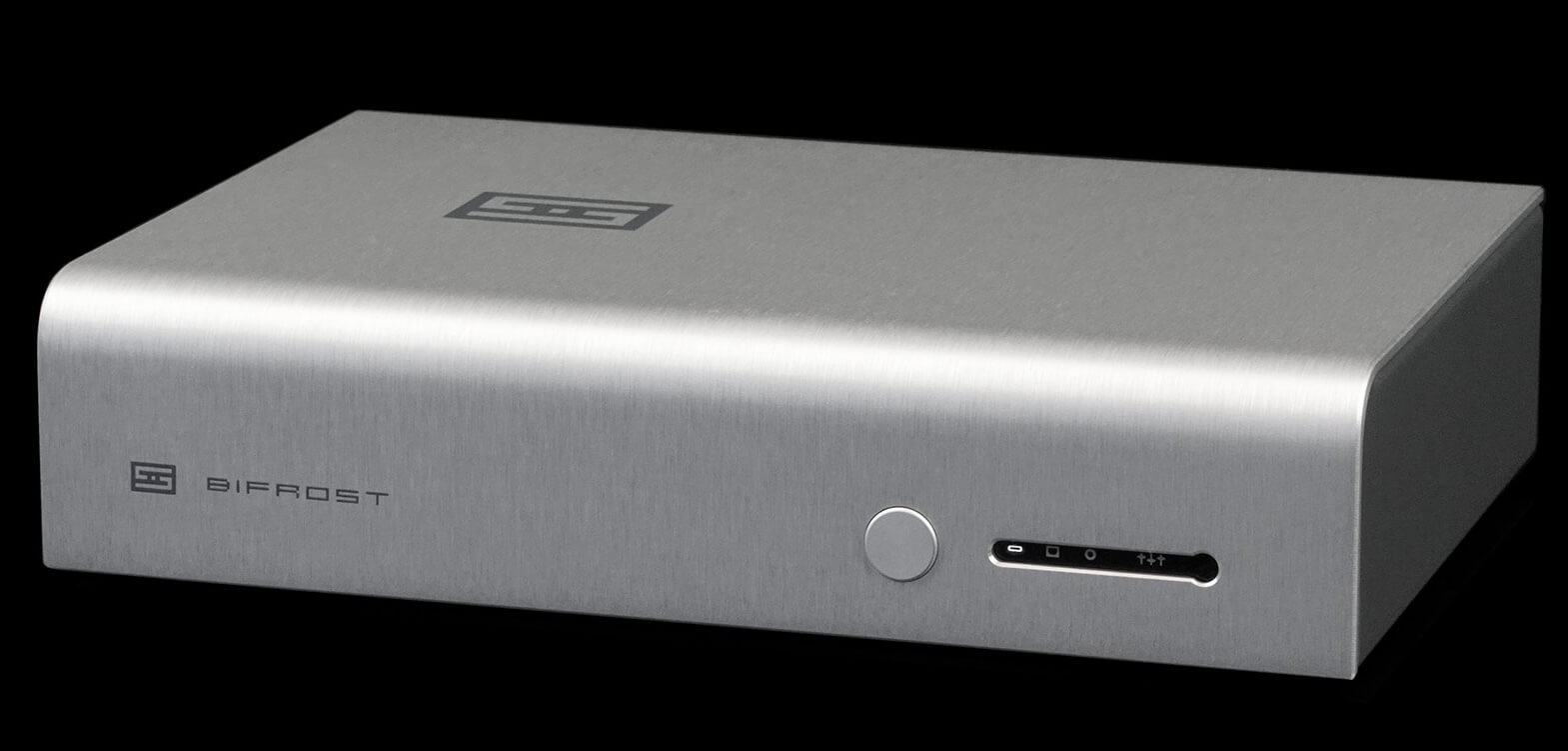
Schiit Audio has spent years convincing audiophiles that multibit DACs, proprietary digital filtering, modular hardware, and refusing to chase every new format were all perfectly sensible ideas. With the new Bifrost 3, the Texas manufacturer is keeping three of those ideas and making a rather significant change to the fourth.
Priced at $699 in black and $729 in silver, Bifrost 3 replaces the $799 Bifrost 2/64 as Schiit’s midrange standalone DAC. It adds 32-bit/384 kHz USB playback, Forkbeard control, parametric EQ, digital preamplifier functions, over-the-air firmware updates, and a new Mesh conversion architecture. Preorders require a refundable $10 deposit, with shipping expected around the end of October 2026.
And yes, it costs $100 less than the model it replaces. Somewhere an accountant has been asked to leave the audiophile industry.
What Happened to True Multibit?
Bifrost 2/64 used Schiit’s True Multibit architecture with four Texas Instruments DAC8812 converters in a hardware-balanced configuration. Bifrost 3 instead uses Schiit’s Mesh 8×39 architecture, combining the company’s proprietary time- and frequency-domain optimized digital filter running on an Analog Devices SHARC DSP with ESS ES9039 devices operating as delta-sigma modulators.
That does not mean Schiit has abandoned Multibit. Gungnir 2 and versions of Yggdrasil continue down that path, and the company says it intends to keep developing both multibit and hybrid approaches.
What has changed is Schiit’s belief that Mesh can now meet or exceed the subjective performance it has achieved from True Multibit while delivering stronger measured performance at a lower manufacturing cost. Schiit specifically credits its own SMD production line for helping reduce the price.
Translation: Schiit found another way to make a DAC it likes, and apparently decided ideological consistency was less important than whether the thing actually sounds good. How disappointingly rational.
Bifrost 3 Specifications
- Price: $699 black; $729 silver
- Conversion: Schiit Mesh with ESS ES9039 delta-sigma modulation
- Digital processing: Proprietary Schiit filter on Analog Devices SHARC DSP
- USB: Unison 384
- USB resolution: Up to 32-bit/384 kHz PCM
- Coaxial/optical: Up to 24-bit/192 kHz
- Inputs: USB, coaxial S/PDIF, optical S/PDIF
- Outputs: RCA and balanced XLR
- Maximum output: 2V RMS RCA; 4V RMS XLR
- THD+N: <0.00015%, -118 dB typical
- S/N: >125 dB
- IMD: <0.0003%
- Crosstalk: -128 dB, 20 Hz–20 kHz
- Output impedance: 75 ohms
- Analog stage: AD4898-based I/V and filtering
- Power supply: Internal linear supply with 11 stages of regulation
- Power consumption: 15 watts
- Dimensions: 9 x 6 x 2 inches
- Weight: 6 pounds
- Warranty: 5 years

Forkbeard Changes What Bifrost Can Do
The other major change is Forkbeard, Schiit’s control platform.
With the included Forkbeard module, Bifrost 3 can operate as a digital preamplifier with volume control, parametric EQ, balance and loudness adjustment. Firmware can also be updated over the air, eliminating the MicroSD-card update routine required by Bifrost 2.
There is still an included IR remote for source selection, phase inversion and mute, because apparently not every function in 2026 needs an app and a password.
Bifrost 3 remains fully modular as well. Its DAC and input cards slide out for replacement, maintaining one of the most useful aspects of the Bifrost platform.
What About Bifrost 2 Owners?
This is where Schiit deserves some credit.
The new $250 Bifrost 3 Mesh card can be installed in Bifrost 2, with the required firmware supplied on an SD card. Even more unusually, the original Bifrost 2 AD5781 analog card and the later Bifrost 2/64 DAC8812 card can both be installed in Bifrost 3.
What you cannot add to Bifrost 2 is Forkbeard. Schiit says that would require a new motherboard, chassis and other hardware, at which point you have essentially recreated the new DAC using the least convenient method possible.
The outgoing Bifrost 2/64 remains a 24-bit/192 kHz True Multibit DAC with NOS mode, while Bifrost 3 raises USB capability to 32-bit/384 kHz and adds the digital preamp/EQ functionality. Published THD+N also improves from under 0.0008% to under 0.00015%, although not every specification moves dramatically in the same direction: Bifrost 2/64 lists slightly better crosstalk and a tighter frequency-response tolerance on paper.
Numbers remain useful. Worshipping them requires membership on some audio forum obsessed with measurements and not actually listening.
The Bottom Line
Bifrost 3 is interesting because Schiit has not merely updated Bifrost 2/64. It has changed the technological premise of the product. True Multibit is no longer the default. Mesh is.
In exchange, buyers get higher-rate USB, Forkbeard EQ and preamp functionality, OTA firmware updates, substantially lower measured distortion, and a price that drops from $799 to $699. Existing Bifrost 2 owners can also adopt the new Mesh conversion card without throwing their current DAC into the recycling bin.
That last point matters. Schiit has built much of its reputation around selling equipment that can evolve rather than expire, and Bifrost 3 continues that philosophy even while changing direction internally.
Whether longtime Bifrost owners prefer Mesh to True Multibit is something only listening will settle. Which, inconveniently, means audiophiles may eventually have to stop arguing about DAC architecture on the internet and actually play some music.
For more information: schiit.com
Related Reading:

As part of this work, hundreds of seismometers, as well as networks of fiber-optic cables, will be used to record even the tiniest of earthquakes during periods of tranquility and unrest. This monitoring effort will be aided by machine learning programs that will be taught to identify minute shifts in the seismic soundtrack of these volcanoes. In recent years, these programs have been used to process a huge volume of data far more proficiently and efficiently than scientists can manage alone. This work has already revealed myriad previously hidden magmatic pathways beneath volcanoes while also permitting scientists to track, almost in real time, magma barreling through the crust.
The idea of Ex-X is to gain unprecedented detail on how tiny changes in the behavior or position of magma can lead to eruptions. Those insights can, in turn, illuminate some of the underlying physics. All these Caribbean volcanoes, diverse though they may be, could have a shared set of fluid dynamics equations.
However, seismology won’t be enough by itself. “We lack the physical understanding of what exactly is going on in a magma chamber,” Poland says. What causes the unstoppable nucleation of bubbles within a body of magma, which can propel hot, buoyant magma through the crust above with soda can-like effervescence? What combination of molten rock, crystals, and gas is primed to trigger an eruption? What drives an eruption to switch from expelling oozing lava to blasting ash and rock into the sky?
Geochemistry is essential to this effort, too. Today, scientists scoop up lava or ash, fresh or ancient, around volcanoes—both during an eruption and in the interregnum between them—to identify subtle changes in chemical makeup. Scientists use sophisticated numerical models to simulate volcanic viscera, but this is still educated guesswork. Laboratory experiments, though, may be able to ground these models.
Replicating the most extreme phenomena in laboratory settings is not easy. But in successful experiments in the fall of 2025, scientists re-created the conditions present at the birth of planets, complete with simulacra of magma and miniature hydrogen atmospheres. “You can’t just make a magma chamber at the surface of the Earth,” Poland says. “But we’re a heck of a lot closer to that sort of thing than we were a while ago.”
Ideally, volcanologists want to try something else truly ambitious: “Drill all the way down to where there is some magma sitting at depth, and really see these processes in situ, rather than just seeing the results of them,” Winder says. That is one of the objectives of the Krafla Magma Testbed in Iceland. This literally groundbreaking facility is set to become the world’s first direct magma observatory.
“There’s no reason we can’t think that, at some point in the future, we can have volcano forecasts that are like weather forecasts,” Poland says. But deriving a unified theory of volcanism will require a geologic Manhattan Project.
First, a constellation of highly diverse volcanoes will need to be slathered in geophysical instrumentation and consistently monitored over multiple eruption cycles—meaning many decades. “You would like to think, ‘OK, volcanoes are pretty well monitored.’ But they’re not,” Roman says. “There’s a handful of Cadillac volcanoes that have permanent networks.” Even many of the United States’ most dangerous volcanoes, along the Cascades in the Pacific Northwest (home to the notorious Mount St. Helens, for example, and the precarious Mount Rainier), are only partly covered in a limited number of sensors.
First look: AMD has expanded both ends of its desktop CPU platform lineup with the Ryzen 5 5500F for AM4 systems and the Ryzen 5 7500 for AM5 builds, offering two six-core parts aimed at lower-cost upgrades and entry-level PCs. The launches give AMD a new option for builders still using the long-running AM4 socket while adding an AM5 alternative for buyers who want Zen 4 performance without moving up to the Ryzen 5 7600. Both chips have six cores and 12 threads, but they serve distinctly different platform generations and use different silicon designs.
The Ryzen 5 7500 is essentially the Ryzen 5 7500F with an integrated GPU. It has six Zen 4 cores and 12 threads, a 3.7 GHz base clock, and boost speeds up to 5.0 GHz. It also has 38 MB of combined cache: 6 MB of L2 and 32 MB of L3. Its 65 W TDP is unchanged from the 7500F.
The important difference is the graphics hardware. AMD has added a small RDNA 2 graphics unit with two compute units clocked at up to 2.2 GHz.
At $189, the Ryzen 5 7500 sits below the Ryzen 5 7600, which sells for about $226. The 7600 has a 100 MHz advantage in both base and boost clock speeds, so it should remain somewhat faster in CPU-limited workloads. The Ryzen 5 7500F, meanwhile, has fallen to about $157, making it the less expensive option for buyers who already plan to install a dedicated GPU.

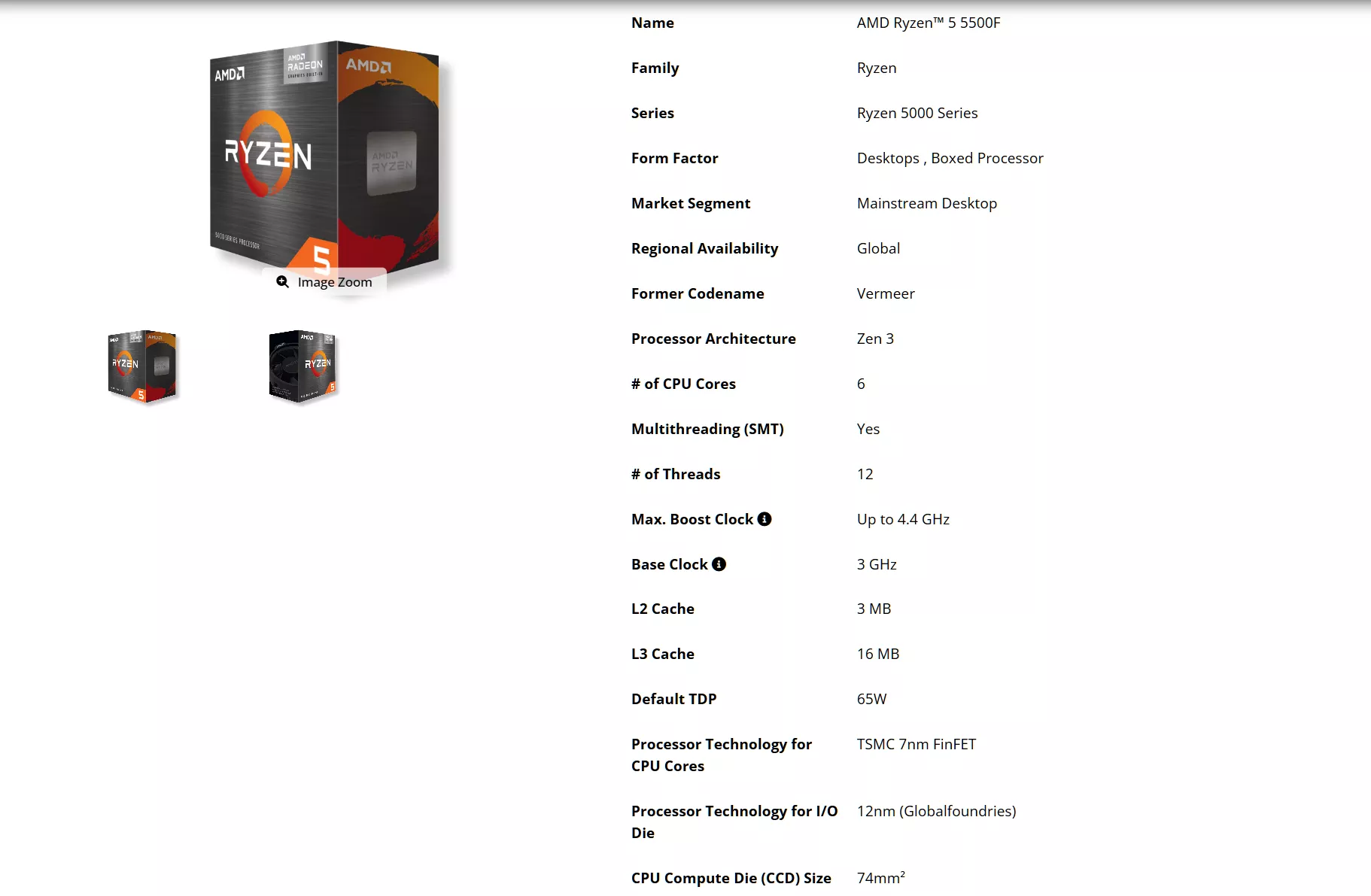
The Ryzen 5 5500F is more complicated than its name suggests. It is not simply a Ryzen 5 5500 without integrated graphics. AMD built the 5500F on Vermeer, the chiplet-based Zen 3 design used in the Ryzen 5000 desktop series. The standard Ryzen 5 5500 uses Cezanne, a monolithic design from the Ryzen 5000G family.
That gives the 5500F one notable advantage: PCIe 4.0 support. The Ryzen 5 5500 is limited to PCIe 3.0. For an AM4 system using a newer graphics card or PCIe 4.0 SSD, the newer processor may offer more flexibility.
The 5500F has six Zen 3 cores and 12 threads. It runs at 3.0 GHz and boosts to 4.4 GHz, with a 65 W TDP. It has 16 MB of L3 cache, however, which is half the amount in the Ryzen 5 5600. The 5600’s boost clock is also 500 MHz higher.

For that reason, the 5500F is best viewed as a cut-down Ryzen 5 5600 rather than a direct replacement for the Ryzen 5 5500. AMD has priced it at $99, compared with roughly $159 for the Ryzen 5 5600. The older Ryzen 5 5500 can still cost less, with OEM tray versions starting around $74, but its platform support is more limited.
The two releases show that AMD is still serving both desktop sockets. AM5 is the company’s current platform, with DDR5 memory and PCIe 5.0 support. But AM4 remains widely used, and the Ryzen 5 5500F gives owners of those systems another inexpensive upgrade choice.

Welcome back to Power Play! Each week, senior writer Molly Taft tackles a topic around this midterm season’s biggest issue: data centers. If you’ve got a question or thought for the column, feel free to shoot Molly an email at [email protected] or reach them securely on Signal at mollytaft.76.
“What on earth are they building all of these data centers for?” an exasperated friend asked me recently.
They’re not the only one asking: We got several similar questions on our recent data center livestream. It’s a really reasonable thing to wonder about. After all, if AI is already making all these breakthroughs, why are tech companies taking on billions of dollars of debt and constructing some of the biggest power plants in the world to build even more data centers?
The answer isn’t to help the average user search for recipes or look up places to visit on a vacation; simple chatbot queries are an increasingly outdated way of thinking about how AI works. Now, AI is all about agents—there’s no official definition, but roughly speaking, agents are large language model-based systems designed to make autonomous decisions to execute a task—and the shift towards them is part of what’s driving Silicon Valley’s power buildout.
“Rather than asking an AI chatbot a simple question and answer, these agents can give themselves hundreds of small prompts based on a user’s original question,” says my colleague Maxwell Zeff, who writes the weekly Model Behavior newsletter. “For example, if someone asked an AI agent to build them a website, it might run for hours to build out features, re-prompting itself dozens of times in the process to build different web pages, menus, and datasets that power the thing.”
Agents are now at the heart of the frontier labs’ work on AI. They’re doing some astounding—and terrifying—things. Recently, OpenAI announced that a swarm of more than 10,000 agents sending 2.7 million messages had solved a longstanding math problem. (Mathematicians pushed back on the company’s claims.) While this is an outlier—AI labs are highly committed to solving supposedly unsolvable problems, and willing to throw unusual amounts of resources into doing so—all those messages burned through a lot of processing power. That equates to a lot of energy: probably tens of millions of dollars’ worth, Max tells me, though how much exactly is tough to say.
Private AI companies have historically been choosy about what to disclose when it comes to environmental metrics around their products. Many CEOs often point to single queries made by individuals as a measure of resource use. In a recent podcast interview, OpenAI CEO Sam Altman claimed that the water use needed to harvest a single almond amounted to 38,000 ChatGPT queries. (The calculation has been disputed.)
“The people that are scarfing down 12 almonds at a time don’t feel like they’re doing something horrible from a water perspective for the most part,” he said.
Introducing AI agents, which are much more energy-intensive than simple queries, into the picture makes these calculations a lot more complex. There’s a major dearth of information around the energy use of agents, whose tasks can range from simple jobs to a full day of autonomous coding involving a team of parallel “helper” agents. There’s a massive gulf in power use between these applications—and a potentially limitless expansion as tasks get more complex.
“In other technological growth areas, we’re constrained by how many people are driving a car or streaming Netflix,” says Boris Gamazaychikov, the co-founder and CEO of Sustainable AI, a research and advisory group. “Now, this stuff is kind of decoupled from users—and if you listen to AI leaders, I think that’s what they want. They’re talking about unicorns that have one employee.”


Manufacturers selling products with digital elements in the EU must now report actively exploited vulnerabilities to cybersecurity authorities under the Cyber Resilience Act’s mandatory reporting rules.
The reporting duties set out in Article 14 of the CRA became applicable today. Subject to the regulation’s exemptions, they apply to manufacturers of products with digital elements made available in the EU, regardless of where those manufacturers are based.
Manufacturers must submit an early warning within 24 hours of becoming aware of an actively exploited vulnerability, followed by a more detailed notification within 72 hours.
The same deadlines apply to severe incidents affecting the security of products with digital elements.
The only difference in timing is related to the final report. Manufacturers must provide a final report on an actively exploited vulnerability within 14 days of making a corrective or mitigating measure available. For serious incidents, the final report is due one month after the first report.
Darren Anstee, CTO for security at Netscout, said the reporting deadlines introduce much-needed urgency in working toward global cyber resilience.
“The 24-hour window in which an initial warning must be reported creates a level of urgency, with subsequent deadlines ensuring that the gathering and release of additional information is prompt,” he said.
“Better, more rapid sharing of information helps organisations put defences and mitigating controls in place when they know there is heightened risk.”
EU and non-EU manufacturers must file these reports through ENISA’s Single Reporting Platform (SRP).
Notifications are addressed to the coordinating computer security incident response team (CSIRT) determined under the CRA. For an EU manufacturer, this is generally the CSIRT for the member state where it has its main establishment; separate rules determine the coordinator for manufacturers based outside the bloc.
Manufacturers must also inform affected users, where appropriate, about actively exploited vulnerabilities or severe incidents. The CRA states that users must be informed of available corrections or mitigations without undue delay.
Generally, failures under the CRA are punishable by varying tiers of fines, the most serious of which can reach €15 million ($17.4 million) or 2.5 percent of the offender’s annual turnover, whichever is higher.
The reporting duties that took effect today are classified as core responsibilities under the act, meaning failures to comply with them could lead to the maximum fines being issued.
They are the latest step in the EU’s plan to drip-feed tighter security regulations on companies operating in the bloc.
Most remaining CRA provisions become applicable on December 11, 2027, at which time manufacturers will also be required to embed security by design and default. That means no default passwords and security updates are no longer optional.
Products covered by the CRA will also have to undergo the applicable conformity assessment before being placed on the EU market and bearing a CE mark.
More than a deadline
The CRA’s new rules are not just intended to accelerate manufacturers’ responses to security flaws. They are also intended to give businesses a better understanding of their software supply chains.
With the reporting clock starting as soon as manufacturers become aware of an issue, they cannot afford to begin mapping an affected product only after a vulnerability or incident emerges. They need a comprehensive view of the affected product and any related products that may share the flaw if they are to meet the deadlines.
Furthermore, those requirements demand that manufacturers maintain this understanding throughout each product’s lifecycle.
Creating a software bill of materials (SBOM) when a product is launched is one thing. The SBOM becomes a mandatory requirement when most of the CRA’s remaining provisions become applicable next year.
Maintaining that security snapshot over time, however, is intended to help reduce the number and impact of serious cyberattacks across the EU.
“What all this means for manufacturers is that secure development, effective vulnerability handling, and traceability across the software supply chain should be elevated to the top of their priority list,” said Eran Kinsbruner, veep of product marketing at Checkmarx.
“Modern applications are assembled from a complex ecosystem of components, with combinations of proprietary code, open-source packages, third-party components and, increasingly, AI models and services all interconnected,” he added. “Organizations need to understand these components, their dependencies and the risks they introduce.”
Given enough time, the CRA looks set to improve cyber resilience across the board. However, lawyers warn that manufacturers, particularly those outside heavily regulated sectors, must now contend with a growing body of overlapping rules.
“The CRA is arriving as organizations are already grappling with a growing body of Digital Decade legislation, including NIS2, DORA, the Data Act, and the AI Act,” said Heidi Waem, data, privacy and cybersecurity partner at DLA Piper.
“We’re seeing the compliance challenge for many businesses evolving beyond understanding single regulations in isolation, but determining how multiple frameworks interact, where requirements overlap and how compliance programmes can be coordinated across them.”
John Magee, partner and global co-chair of data, privacy, and cybersecurity at the same law firm, added: “Even now we’re seeing the breadth of the regulation’s reach catching organizations off guard.
“Many still associate the CRA primarily with consumer IoT devices, when in reality it applies to a much broader pool of products with digital elements. For compliance teams already very busy managing multiple Digital Decade initiatives, there is a risk that this first wave of CRA obligations has arrived sooner, and with a wider impact, than they had expected.” ®
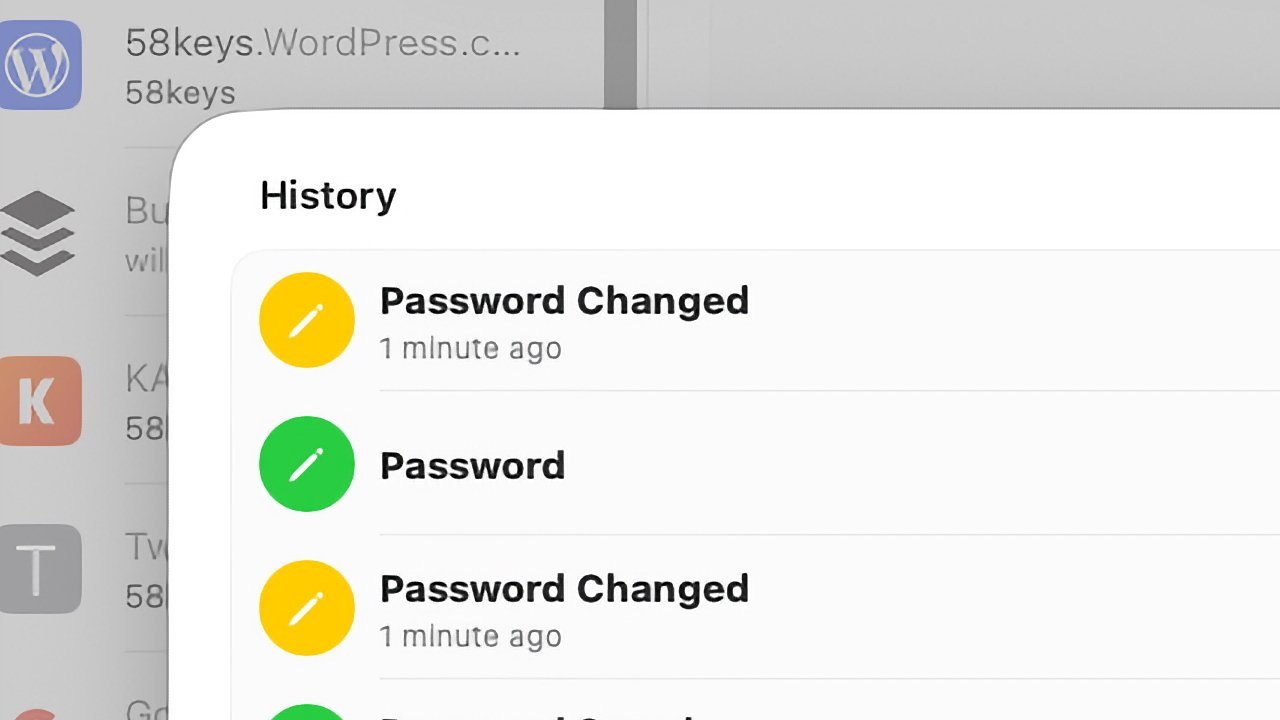
Apple’s changes to the Keychain in macOS Tahoe made it more secure. However, by binding it to device-specific Secure Enclave keys, users now can’t manually copy the login Keychain and use it on another Mac.
Attacks on Mac users are getting more sophisticated over time, with AI also opening the door to even more malware and the discovery of new intrusion techniques. While Apple does work to increase the security of its operating systems and software to counter the threats, they can also become a burden to administrators.
In a blog post on September 8, Rich Trouton wrote that it wasn’t possible to manually copy login Keychain files from one Mac to another. At least, doing so and still being able to use them on the new machine.
As he explains, the login keychain is a SQLite database file stored in the user’s home folder, which you could previously copy from one Mac to a second. While you could use the file straight away on earlier versions, an update to macOS Tahoe meant that it wouldn’t work for Macs using a Secure Enclave.
The Secure Enclave guards the metadata key that protects the keychain attributes required to decrypt it. The change means that the Secure Enclave must be used whenever the login Keychain file is accessed.
The metadata key can be cached in the Application Processor for fast keychain entries. However, the Secure Enclave must be accessed for that cache to exist in the first place.
If you’ve moved the Keychain file to another Mac, it won’t have access to the Secure Enclave, and therefore won’t open.
Changed chain in macOS Tahoe
While the change is only really becoming known now, it’s something that actually happened back in March. According to Trouton and another September 10 post by Jeff Johnson, the macOS 26.4 update introduced it.
Testing confirmed that the ability to copy the file worked for macOS 26.3, including via a virtual machine. However, copying the login Keychain from a virtual machine running macOS 26.4 didn’t work, due to not being able to be read on other Macs.
Other non-login Keychain files are unaffected and can be unlocked on other Macs fine.
In an addendum on September 11, Johnson writes that this was a “ticking time bomb” that Apple included in a minor macOS update. For macOS 26.3 and earlier, Johnson explains that users could recover their login Keychain on a new Mac, but that’s not possible on macOS 26.4 by copying it over.
In an emergency and with the death of a Mac, Johnson says users would only discover the login Keychain wouldn’t work at the worst possible moment. “This is incredibly irresponsible of Apple,” he concludes.
Exceptions and workarounds
It is evident that a straight copy of the login Keychain and opening it elsewhere simply won’t work. The hardened security is there to stop malicious actors from doing just that.
However, it is only a problem if you are copying your credentials in this particular way.
For users who are restoring backups to the same Mac, they will not be affected by the issue, as it’s the same Mac. It also won’t affect anyone using Migration Assistant, though it will be a problem for administrators performing bulk migrations in a corporate environment.
Exporting items before a migration is also a way around the issue, as well as the use of custom keychains and other password managers.
For home users, taking advantage of iCloud Keychain may be the route ahead. As well as ensuring your passwords are shared to your iPhone and iPad, they can also be synchronized with your other Macs.
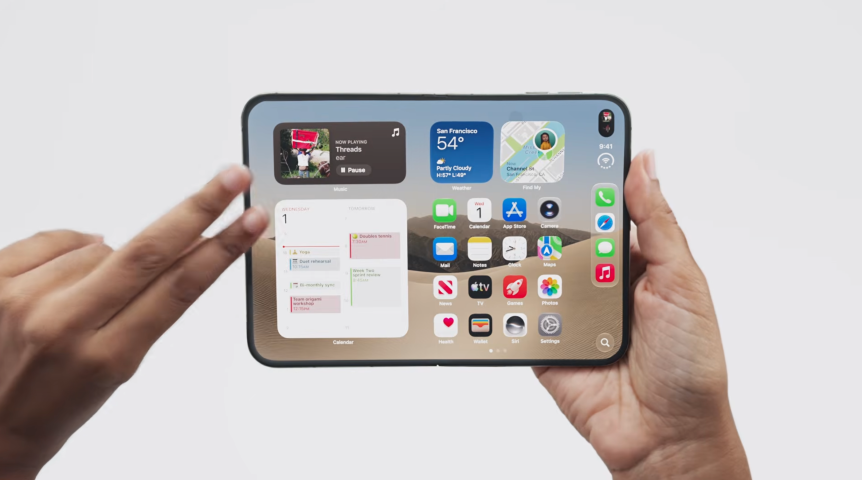
You take a risk when you buy the first version of something to ever exist, even when it’s made by a company with a history as well-documented as Apple’s. The new iPhone Duo looks cool, with its passport-style hinge and massive displays, but buying it is still a risk. You’re spending at least $2,000 on something you’ll use for multiple hours every day over at least the next 12 months, which is enough to give just about anyone a moment of pause to check in mentally and make sure this is the right decision.
The risk is real, I get it. Do it anyway, and be loud about it.
 Apple/Screenshot by CNET
Apple is nowhere near the first to make a foldable phone, but this is the first iPhone that will bend (more than once, at least). That’s an interesting place to be, due largely to the folks who tend to own iPhones. Samsung is in its seventh year of releasing foldables, and I maybe see one or two of them in the wild when I wander major cities or busy airports. The folks who have them love them, and they’re happy to tell their friends about the cool things these phones can do, but the audience is largely early adopters, comfortable with things that aren’t fully baked.
Feedback from someone who isn’t tech-obsessed will always be more valuable to Apple than to a lot of its competitors. Features will be created and retired from that feedback, and it will eventually appear on most other folding phones.
My favorite example of this is actually another Apple product, the Watch. The first Apple Watch had some fitness features, but was largely focused on the idea that you could leave your phone behind because that’s what the competition was doing already. Instead of trying to replicate your phone in watch form, right down to the tiny keyboard seen on other smartwatches at the time, Apple focused on its fitness tracking and health monitoring features. They quickly became the most popular.
By the time the third-gen Apple Watch was announced, GPS and cellular features were now being shown off as a way to make those fitness features better. The Watch was no longer about replacing your phone. Now that we’re at Apple Watch Gen 12, fitness is basically all anyone talks about.

The next six months are going to be important for the future of Apple’s contribution to the foldable phone market, because the audience response will help shape the next iPhone Duo. Popular third-party apps will become native features, accessories will be made to address situations that haven’t happened yet and current features will be copied in every direction. It benefits everyone if the majority of the folks providing early feedback and getting excited about new ways to use this phone are outside of the standard group of IT folks, business execs on weekly flights or whoever is going to watch that front screen for 44 hours.
Grab one, if you can afford it. Watch Netflix on it and talk about how that experience could be better. Use your favorite apps side by side and see if it’s easy or intuitive for you to figure out on your own. Be an early adopter, and this time next year a lot more people will feel like the Duo was made with them in mind.

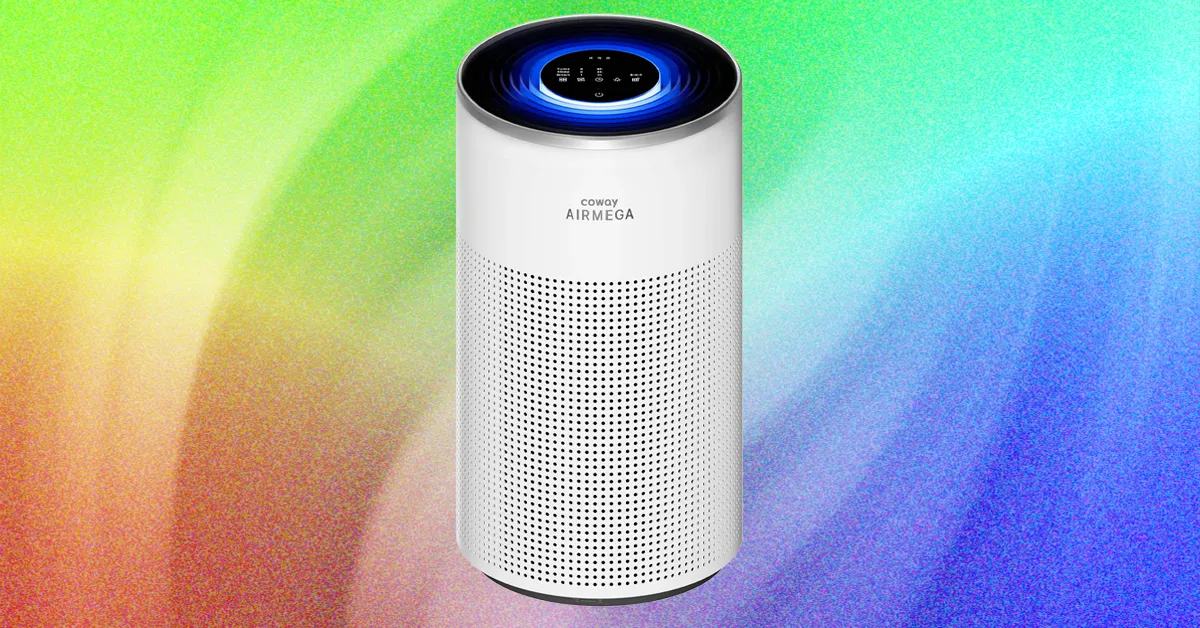
Inside, the Halo has a cylindrical IEST-certified HEPA three-stage filter that claims to capture 99.97 percent of nano-sized particles down to 0.3 microns, but in my opinion the coolest feature is the MegaScan Particle Sensor, which continuously monitors the air in real time to detect smoke, fine dust, and allergens down to PM2.5. PM2.5, typically used as the standard measurement for air purifiers’ ability to measure and lower levels of microscopic allergens or pollutants, are tiny airborne particles that measure 2.5 micrometers or less in diameter. They are particularly dangerous because their size means they can penetrate deep into the lungs and cause serious illness like asthma, heart disease, and lung cancer.
From the purifier’s top touchscreen panel, you can control fan speed, timer, and settings. On the quietest sleep setting, my decibel monitor app wasn’t even able to pick up the noise, as the fan wasn’t perceptible above the ambient noise of my house, even when I switched off all nearby appliances. Coway claims it’s 17 decibels in sleep mode, which I believe after not even being able to hear the machine in this mode. On the highest turbo setting, my decibel reader had it hovering around 75 decibels, which is akin to running a dishwasher or a vacuum.
As part of the Airmega Halo’s sleep features (in addition to whisper-quiet functioning), it has a low yellowish night light when in sleep mode, but this can also be turned off so the top panel is completely dark. It has a light sensor and automatically enters sleep mode, dimming lights and noise level when low light is detected.
When in smart mode and it’s dark for more than three minutes, the machine will automatically enter sleep mode. If the pollutant levels are “good” for more than three minutes, the fan stops automatically to save energy. But if it detects pollutants, it will restart the fan.
It has four lights indicating air quality levels: blue for good, green for moderate, yellow for unhealthy, and red for very unhealthy. The colored lights show in a halo around the top of the machine. I found it sort of tough to distinguish between levels at a glance because this color-coding system differs from the US AQI standards of green for good, yellow for moderate, red for unhealthy, purple for very unhealthy, and maroon for hazardous.
Mixed Signals
Hopefully, you come to WIRED Reviews because we actually vigorously test the gear we recommend. I didn’t just read the specs online and flip through the instruction manual—this machine was put through some intensely bad air to see if it could hold its own.
As with all air purifiers I test, the Halo was put through testing in various unhealthy air quality situations. I used this model for nearly a month, moving around my house to test in different locations: when cooking on my unventilated gas stove, under my living room window that draws in a lot of building and exhaust fumes, and outside my cat’s litter box. Additionally, I use an indoor air quality monitor to test pollutant levels against what the machine claims.

Sandra Bullock Was Asked to ‘Drop’ Her Pants in Early Auditions

Singaporean Malone Lam pleads guilty in US court over role in cryptocurrency theft ring

West Ham legend Ludek Miklosko dead aged 64: Tributes pour in for ‘gentle giant’ as former Hammers goalkeeper and coach passes away after long battle with cancer

Memory prices are slowing because buyers ran out of money

The Latest Weird Thing to Play Doom Is the Mapped-Out Brain of a Fruit Fly

Micron Stock Climbs Above $1,031 as AI Memory Crunch and a $50 Billion Outlook Fuel the Rally
Singaporean Malone Lam pleads guilty in US court over role in cryptocurrency theft ring

WATCH THIS to retire COMFORTABLY! | How much money do we need? | Retirement in 40s? #rahuljain

The Best Financial Strategies by Income in Canada: $50K, $100K, $150K+
-
Tech6 days ago
Memory prices are slowing because buyers ran out of money
-
 Tech19 hours ago
The Latest Weird Thing to Play Doom Is the Mapped-Out Brain of a Fruit Fly
-
 Business4 days ago
Micron Stock Climbs Above $1,031 as AI Memory Crunch and a $50 Billion Outlook Fuel the Rally
-

 Business4 days ago
AMD Stock Climbs After Management Lifts 2027 Data Center Outlook Toward $70 Billion in AI Sales
-
 Crypto World5 days ago
Bitcoin price risks $76K drop as $78K support weakens
-

 Fashion3 days ago
Weekend Open Thread – Corporette.com
-

 Crypto World6 days ago
Robinhood Stock: How To Take Advantage With Reduced Risk
-

 Crypto World3 days ago
XAG/USD: Silver’s Short-Term Rally Meets Its Moment of Truth
-
 Crypto World4 days ago
2 Chip Stocks Broke Out This Week. Neither Was Nvidia
-
 Crypto World5 days ago
Ethereum price stalls below $2,500 as ADX drops to 11
-

 NewsBeat6 days ago
England up in reading, maths and science rankings as Scotland and Wales dip
-

 Business3 days ago
10 Most-Streamed Songs On Spotify In 2026 So Far, Led By Ella Langley’s Dominant Run On The Charts This Year
-

 Crypto World3 days ago
OKX launches 10x OpenAI, Anthropic X-Perps in Europe
-

 Tech3 days ago
Battery life is the only iPhone 18 Pro and iPhone Duo upgrade I care about. Apple didn’t disappoint
-

 Crypto World3 days ago
Diesel Tops $6 a Gallon for the First Time as 28 States Set Records
-
 Crypto World6 days ago
Intel Stock Jumps 9% on Chip Price Hike Report, US Stake Gains $36 Billion
-

 Tech4 days ago
Apple Watch Ultra 4 vs Watch Ultra 3: Should you really spend another $799?
-
 Crypto World4 days ago
Bitcoin price risks $70K if $78K neckline breaks
-

 Crypto World6 days ago
Pump Fun and Kraken delete Hunter Biden $LAPTOP promotion
-

 NewsBeat5 days ago
What went right this week: an ‘historic’ fall in violent crime, plus more
You must be logged in to post a comment Login