Connect with us
DAPA Banner

Tech

Screens in Schools: What the New Screen-Time Debate Means for Educators

Published

on

The screen-time debate is no longer confined to parenting advice. As states introduce legislation limiting devices in schools, and pediatric researchers rethink how digital environments affect development, educators are confronting a difficult question: when does technology support learning, and when does it undermine it?

In the first part of this series, I examined the American Academy of Pediatrics’ updated guidance on children’s digital ecosystems and how screens can shape early development at home. The same principles now apply in another place where children spend much of their day: school.

Screens are already a routine part of early childhood classrooms. In a 2025 RAND survey of pre-K teachers, roughly two-thirds reported using games on electronic devices in their classrooms. At the same time, a growing body of research is raising new questions about how different types of digital media affect children’s developing brains.

One frequently cited Canadian longitudinal study followed nearly 2,500 children between 24 and 36 months old and found that higher levels of screen time were associated with missed developmental milestones on screening tests at ages 36 to 60 months. That means that we’re seeing the developmental effects of increased toddler screen time as early as one year later.

Advertisement

Other studies suggest that certain types of media may be particularly overstimulating for young children. Fast-paced content designed to capture attention usually features rapid scene changes, constant motion, bright colors and loud sound effects. I love shows like Netflix’s “Word Party” for the language acquisition skills it teaches, but its features can overwhelm developing brains and temporarily disrupt executive functions such as attention, emotional regulation and self-control (ask me how I know).

These design features are meant to hold viewers’ attention, but the result can sometimes be what many parents recognize instantly: the moment when their sweet child suddenly turns into what I jokingly call a “screen monster.” I have three of them. I can’t imagine a classroom full of screen monsters.

As new technology becomes even more embedded in our lives, screens have become more pervasive in both homes and classrooms. And because technology changes so frequently, it’s helpful for educators to understand how instructional technology choices can either support or disrupt healthy digital environments for students.

I know this tension well, both as a parent and as a behavioral science and public health researcher. In the first part of this column series, I wrote about how screens have both helped and challenged my own family as we navigated parenting during the pandemic. Like most parents and teachers, we are still figuring it out. I’ve written previously about how short-form video addiction has made its way to Gen Z and Gen Alpha. And I recently reported the results of a research project we did at EdSurge that showed that prohibiting devices doesn’t really meet its intended goal.

Advertisement

Devices, screens, algorithms and technology in general have mutated from a household question to an education policy issue.

The Emerging Landscape of Technology Regulation

From a public health perspective, digital media is becoming part of the broader developmental environment shaping childhood development.

In education, conversations about technology traditionally have focused on the digital divide and ensuring equitable access to devices and internet connectivity. That conversation is shifting.

Researchers are now examining how digital environments affect sleep, attention, emotion regulation and social development. Population-level research suggests that heavy or poorly designed media exposure can contribute to sleep disruption, emotional dysregulation and difficulty disengaging from devices. Remember, screen monsters are lurking with their snotty noses and sippy cups.

Advertisement

Now, these concerns are beginning to influence policy.

Across several states, lawmakers are proposing restrictions on student device usage during the school day, including bans on smartphones and new scrutiny of edtech that uses personalized algorithms to maximize engagement. Since many edtech companies have enhanced or marketed their AI-powered features, the competition to capture and hold students’ attention has likely stiffened.

This is a significant shift. Historically, digital technology, social media and the Internet has been one of the least regulated environments with, arguably, among the greatest effects on both children’s and adults’ lives. Technological change often moves faster than public policy and data, leaving lawmakers and educators to respond after new tools become widespread.

Now the regulatory landscape appears to be catching up and entering the environments children already inhabit.

Advertisement

So What Should Educators Do?

What started as a deeply personal parenting dilemma has become a much larger question for schools. As pediatric researchers update guidance on children’s digital environments, and states debate limits on student screen exposure, educators are being asked to reconsider how technology shapes the cognitive environments where children learn.

The debate often falls into extremes. Some people argue that screens are ruining learning. Others claim that technology is the future of education.

The research suggests that the truth lies somewhere in the middle.

This is one of those test questions where “all of the above” fits best. How screens affect children depends heavily on context, content and duration of use. A passive, fast-paced digital experience is very different from an interactive lesson where students discuss ideas, solve problems or collaborate with peers.

Advertisement

It can be tempting to respond to uncertainty by rejecting technology altogether. And I don’t fault that perspective, because I believe that response comes from a desire to protect kids from unpredictable harm. But the reality is that there is no one-size-fits-all approach for every child, classroom, school or community.

Public health offers a useful framework for thinking about this challenge: harm reduction.

When an exposure is widespread and difficult to eliminate, reducing risk is often more effective than banning it outright. Seatbelts and car seats made riding in cars and buses safer, instead of banning vehicles to reduce vehicular accidents. That’s a classic harm-reduction strategy.

Similarly, screens are unlikely to disappear from classrooms. The more productive question is how educators can create guardrails that reduce potential harms while preserving the benefits of digital tools. I think students would keep using devices, anyway. What’s school without TikTok dances nowadays?

Advertisement

That means choosing technology that supports interaction rather than passive consumption, and balancing digital activities with discussion and hands-on learning. The personalized algorithms in edtech are becoming more common, but the science suggests that it’s best to avoid tools designed primarily to maximize screen engagement.

As states debate new regulations on student screen exposure, educators and school leaders will increasingly be asked to make decisions about how technology shapes the environments where children learn.

The research offers a useful starting point: children’s brains learn best through interaction, conversation, manageable stimulation, productive struggle, and moments of curiosity that make ideas stick.

Technology can support those experiences. But it cannot and will not replace the relationships between students and the adults who teach and care for them.

Advertisement

The real question for schools is not whether screens belong in classrooms, but whether they help students think, or simply keep them clicking and scrolling.

Source link

Continue Reading
Click to comment

You must be logged in to post a comment Login

Leave a Reply

Tech

This version of the Kindle Scribe Colorsoft is quite hard to get hold of

Published

on

A few months after its initial launch, Amazon has recently unveiled the Kindle Scribe Colorsoft in a brand new fetching Fig shade that’s proved especially popular.

In fact, the Fig-colour Kindle Scribe Colorsoft is so popular that it’s becoming increasingly difficult to get our hands on the e-reader, with shipping delays stretching well beyond the typical delivery windows we’d expect from Amazon.

At the time of writing, new orders for the Fig iteration in the US are expected to arrive anywhere between mid-April to mid-May. However, you can get your hands on the standard Graphite finish which is currently still in stock within the US. This suggests that the issue really only affects the newer colour option, rather than the entire product line.

Such differences in availability often point to supply constraints or production adjustments, particularly when a new finish launches after the initial release and demand shifts toward the latest variant.

Advertisement
Kindle Scribe Colorsoft in FigKindle Scribe Colorsoft in Fig
Kindle Scribe Colorsoft in Fig. Image Credit (Amazon)

Advertisement

It’s worth noting that at the time of writing, neither the Fig nor Graphite Kindle Scribe Colorsoft has officially launched in the UK. In addition, neither iterations are even available to pre-order, as the product page just states the e-reader is “coming soon”. Instead, you can opt into receiving an email to get notified on when the product will be available to buy.

Delays highlight uneven availability

The Kindle Scribe Colorsoft was initially only available in a Graphite option until Amazon recently introduced the new Fig finish, which seemingly appears to have drawn a considerably higher demand than anticipated. Either that, or the Fig shade has encountered production challenges soon after release.

However, delays tied to a specific colour variant are not uncommon, as sometimes manufacturing complexity or material sourcing can affect certain finishes differently than standard models.

In addition, the extended wait times also suggest that supply has not yet caught up with demand, especially as colour e-paper devices remain a relatively new category with more limited production scale compared to traditional e-readers.

Advertisement
Kindle Scribe Colorsoft in GraphiteKindle Scribe Colorsoft in Graphite

Essentially, customers are left choosing between faster delivery by opting for the Graphite version, or waiting considerably longer to nab the Fig iteration instead.

Advertisement

This situation leaves buyers choosing between faster delivery with the Graphite version or waiting longer to secure the Fig model.

Same hardware, different buying experience

Following on from the above, it’s worth noting that both versions of the Kindle Scribe Colorsoft share the same core hardware, including an 11-inch colour e-paper display based on Kaleido 3 technology, which combines standard black-and-white clarity with lower-resolution colour output.

The device also integrates a redesigned front-light system and a textured display surface that improves writing feel, placing it closer to digital notebooks than traditional e-readers focused only on reading.

Advertisement

Storage options and connectivity remain consistent across variants, with support for Wi-Fi, Bluetooth audio, and bundled stylus input, which reinforces that the delay relates to availability rather than product capability.

Amazon has not provided a detailed explanation for the extended shipping times on the Fig model, but current delivery estimates suggest that availability may stabilise later in the Spring.

Advertisement

If you are exploring other options, our Best Kindle 2026 roundup highlights the top-performing e-readers available today.

Advertisement

Source link

Continue Reading

Tech

Arm Unveils New AGI CPU With Meta As Debut Customer

Published

on

Arm unveiled its first self-developed data center chip, the AGI CPU, designed for handling agentic AI workloads. The new chip was built in partnership with Meta and manufactured by TSMC. Other customers for the new chip include OpenAI, Cloudflare, SAP, and SK Telecom. Reuters reports: The new chip, called the AGI CPU, will address data-crunching needed for a specific type of AI that is able to act on behalf of users with minimal oversight, instead of responding to queries as part of a chatbot. For years, Arm, majority-owned by Japan’s SoftBank Group has relied only on intellectual property for revenue, licensing its designs to companies such as Qualcomm and Nvidia and then collecting a royalty payment based on the number of units sold.

“It’s a very pivotal moment for the company,” CEO Rene Haas said in an interview with Reuters. The new chip will be overseen by Mohamed Awad, head of the company’s cloud AI business, and Arm has additional designs in the works that it plans to release at 12- to 18-month intervals. TSMC is fabricating the device on its 3-nanometer technology and is made from two distinct pieces of silicon that operate as a single chip. Arm plans to put it into volume production in the second half of this year but has received test chips that function as expected. In addition to the chip itself, Arm is working with server makers such as Lenovo and Quanta Computer to offer complete systems.

Source link

Continue Reading

Tech

I Wish More Movies Made 3D-Printable Models Like Project Hail Mary

Published

on

If you haven’t watched Project Hail Mary yet, you should. Try to watch it on the largest screen possible. It’s beautiful, heart-warming and fun for any audience. I’ve been obsessed with it since I listened to the Audiobook with Ray Porter, and the cinema version doesn’t disappoint.

Movies like this help inspire people to be scientists and explorers, and to look for the good in people. It shows that no matter who you are, you can change the world.

That’s my mini review, but not the real reason for this article. Project Hail Mary has done something that makes me, a 3D-printing maker, happy, happy, happy. If you visit the Project Hail Mary website and look in the bottom-right corner, you can download a 3D model of a stylized spaceman used in the movie.

Advertisement

I’ll try not to spoil anything, but the little spaceman is given to the main character, Ryland Grace, to help him visualize the ideas that his companion is trying to portray. It’s a beautiful little model, and not the first time a company has done something like this to promote a movie.

Horror popcorn bucket

James Bricknell/CNET

Many years ago, Paramount released a 3D model from Transformers: Rise of the Beasts. This year, Markiplier created a haunted 3D-printed popcorn bucket that you could actually take to the theater and get a free popcorn order. It was gross and cool at the same time, but unique enough that a lot of people enjoyed making it.

My hope is that more movie studios will realize how well these files are received by the maker community and keep giving us more. A lot of the models VFX designers create can be converted into 3D-printable models with ease, and in the case of Project Hail Mary, this file was almost certainly a 3D-printed prop anyway. They have the file, so why not share it with the world?

While we didn’t have any Xenonite around to 3D print with, we did have some lovely silver silk PLA to make this fancy little spaceman. Printing it on the fantastic Bambu Lab H2D was a breeze with some supports as needed. The pattern of the model makes it look so surreal and gives it an alien quality that really makes it stand out. Print time was around four hours using PLA.

Advertisement

My next project after this is to print the same model in Iron filament from Protpasta and let it rust to really make it feel otherworldly.

Project Hail Mary is something of a cultural phenomenon right now, and rightfully so. Adding the ability to 3D models directly from the studio has added a little more advertising from a group of people who are very likely to love a deep sci-fi movie and share what they’ve made with the world. Let’s hope more movie studios see how successful this is and jump on the idea, too.

Source link

Advertisement
Continue Reading

Tech

iOS 18.7.7, macOS 15.7.5 updates fix kernel memory leaks & WebKit flaws

Published

on

Apple pushed out a coordinated round of security updates on March 24, covering older versions of iOS, iPadOS, and macOS that are still widely used and still need protecting.

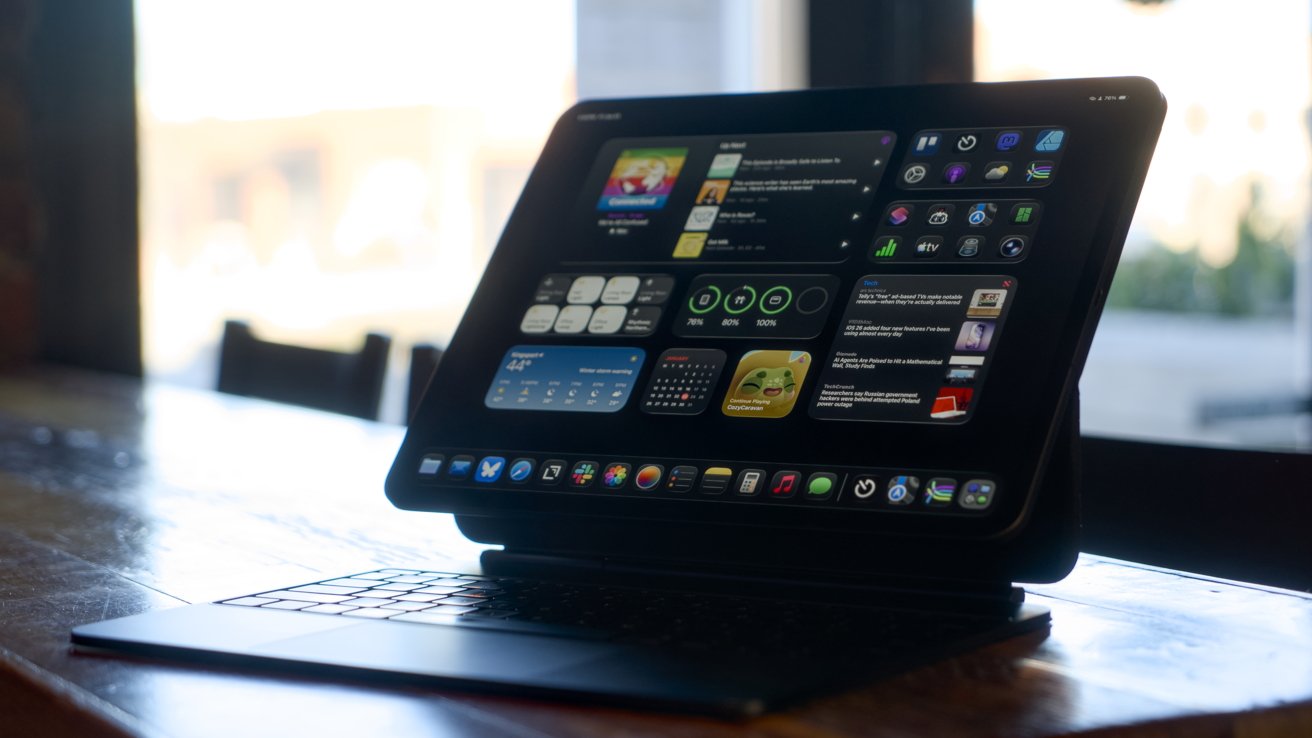
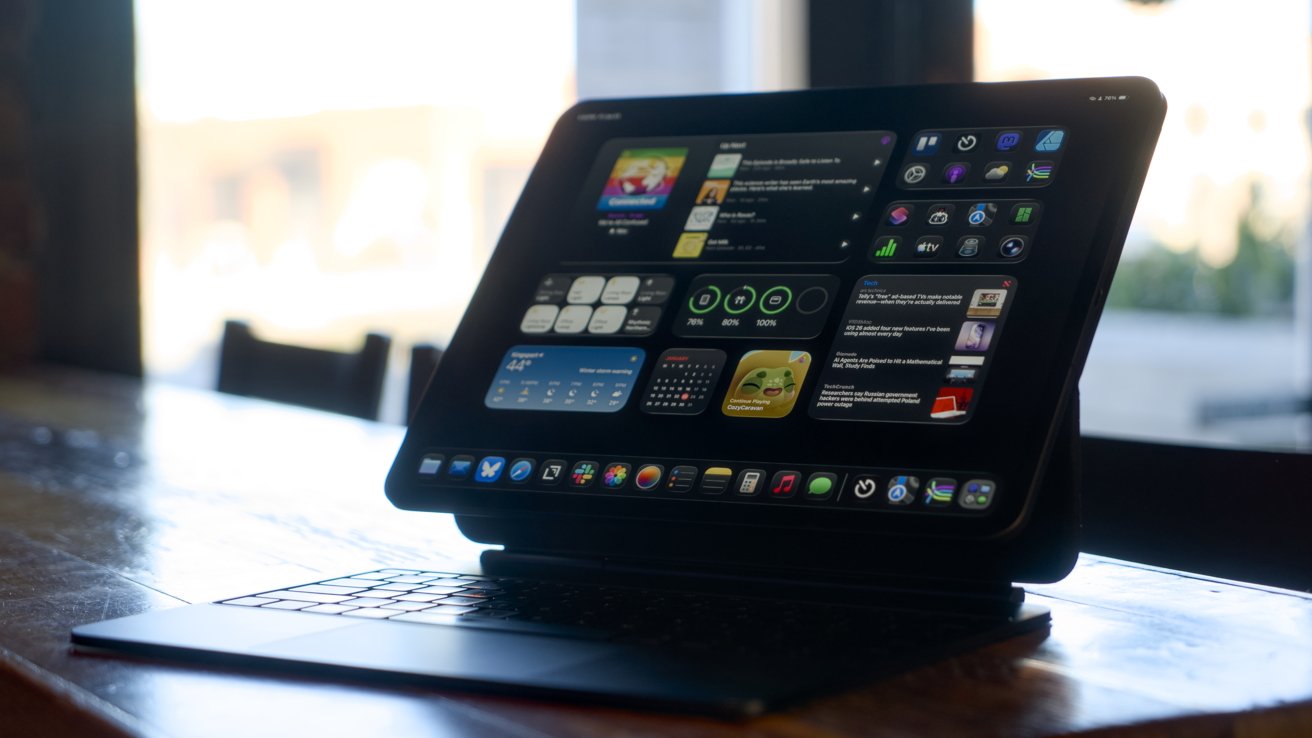
Tablet with keyboard case on a wooden table, screen showing colorful app icons and widgets, in a bright cafe or workspace with blurred chairs and windows in the background
iPad Pro

The updates include iOS 18.7.7, iPadOS 18.7.7, macOS Sequoia 15.7.5, and macOS Sonoma 14.8.5. They close a long list of vulnerabilities across core parts of the system, from networking to the kernel.
On iPhone and iPad, the fixes cut across everything from low-level system components to user-facing frameworks. Some bugs could let an app access sensitive user data, while others could crash processes or expose internal system state.
Continue Reading on AppleInsider | Discuss on our Forums

Source link

Continue Reading

Tech

ALPR Tech Now Preventing Parents From Enrolling Their Kids In School

Published

on

from the making-being-awful-more-efficient dept

All the people who have always brushed off concerns about surveillance tech, please come get your kids. And then let someone else raise them.

Lots of people are fine with mass surveillance because they believe the horseshit spewed by the immediate beneficiaries of this tech: law enforcement agencies that claim every encroachment on your rights might (MIGHT!) lead to the arrest of a dangerous criminal.

Running neck and neck with government surveillance state enthusiasts are extremely wealthy Americans. When they’re not adding new levels of surveillance to the businesses they own, they’re scattering cameras all around their gated communities and giving cops unfettered access to any images these cameras record.

Here’s how it plays out at the ground level: parents can’t get their kids enrolled in the nearest school because of surveillance tech. In one recent case, license plate reader data was used to deny enrollment because the data collected claimed the parent didn’t actually reside in the school district.

Advertisement

Just over a year ago, Thalía Sánchez became the proud owner of a home in Alsip. She decided to leave the bustle of the city for a quiet neighborhood setting and the best possible education for her daughter.

However, to this day, despite providing all required paperwork including her driver’s license, utility bills, vehicle registration, and mortgage statement, the Alsip Hazelgreen Oak Lawn School District 126 has repeatedly denied her daughter’s enrollment.

Why would the district do this? Well, it’s apparently because it has decided to trust the determinations made by its surveillance tech partner, rather than documents actually seen in person by the people making these determinations.

According to the school district, her daughter’s new student enrollment form was denied due to “license plate recognition software showing only Chicago addresses overnight” in July and August. In an email sent to Sánchez in August, the school district told her, “Although you are the owner on record of a house in our district boundaries, your license plate recognition shows that is not the place where you reside.”   

But that’s obviously not true. Sanchez says the only reason plate reader data would have shown her car as “staying” in Chicago was because she lent it to a relative during that time period. The school insists this data is enough to overturn the documents she’s provided because… well, it doesn’t really say. It just claims it “relies” on this information gathering to determine residency for students.

All of this can be traced back to Thompson Reuters, which apparently has branched out into the AI-assisted, ALPR-enabled business of denying enrollment to students based on assumptions made by its software.

Advertisement

Here’s what little there is of additional information, as obtained by The Register while reporting on this case:

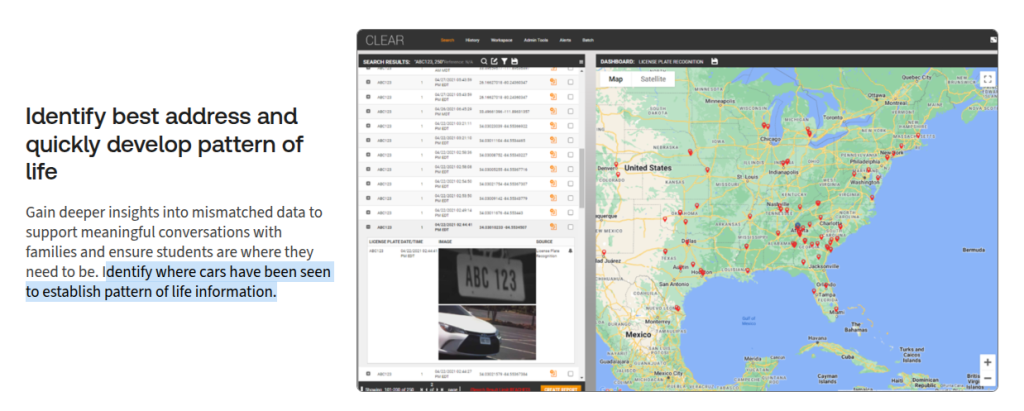
Thomson Reuters Clear, which more broadly is an AI-assisted records investigation tool, has a page dedicated to its application for school districts. It sells Clear as a tool for residency verification, claiming that it can “automate” such tasks with “enhanced reliability,” and can take care of them “in minutes, not months.” 

One of the particular things the Clear page notes is its ability to access license plate data “and develop pattern of life information” that helps identify whether those who are claiming they’re residents for the sake of getting a kid enrolled in school are lying or not. 

Thomson Reuters does not specify where it gets its license plate reader data and did not respond to questions.

We’ll get to the highlighted sentence in a moment, but let’s just take a beat and consider how creepy and weird this Thomson Reuters promotional pitch is:

Advertisement

The text reads:

Gain deeper insights into mismatched data to support meaningful conversations with families and ensure students are where they need to be. Identify where cars have been seen to establish pattern of life information.

No one expects a law enforcement agency to do this (at least without a warrant or reasonable suspicion), much less a school district. Government agencies shouldn’t have unfettered access to “pattern of life” information just because. It’s not like the people being surveilled here are engaged in criminal activity. They’re just trying to make sure their kids receive an education. And while there will always be people who game the system to get their kids into better schools, that’s hardly justification for subjecting every enrolling student’s family to expansive surveillance-enabled background checks.

And while Thomson Reuters (and the district itself) has refused to comment on the source of its plate reader data, it can safely be assumed that it’s Flock Safety. Flock Safety has never shown any concern about who accesses the data it compiles, much less why they choose to do it. Flock is swiftly becoming the leading provider of ALPR cameras and given its complete lack of internal or external oversight, it’s more than likely the case that its feeding this data to third parties like Thomson Reuters that are willing to pay a premium for data that simply can’t be had elsewhere.

We’re not catching criminals with this tech. Sure, it may happen now and then. But the real value is repeated resale of “pattern of life” data to whoever is willing to purchase it. That’s a massive problem that’s only going to get worse… full stop.

Filed Under: alpr, chicago, license plate readers, surveillance, wtaf

Companies: flock, flock safety, thomson reuters

Advertisement

Source link

Continue Reading

Tech

Energy Vault acquires 175 MW battery storage project near Dallas

Published

on

In the sprawl north of Dallas, where data centres are multiplying and the Texas grid groans under record demand, Energy Vault has placed a new bet on battery storage, and on the idea that the companies powering AI’s insatiable appetite for electricity will need far more of it, far faster.

The California-based energy storage company announced on Monday that it has acquired the McMurtre Battery Energy Storage System (BESS), a 175 MW / 350 MWh project near Dallas, from greenfield developer Belltown Power. The deal advances Energy Vault’s plan, first outlined at its 2025 Investor and Analyst Day, to deploy an initial 1,500 MW of battery storage capacity across the United States and beyond.

Why ERCOT North, and why now

The McMurtre project sits in the ERCOT North market, a region that has become one of the most contested patches of real estate in American energy. Rapid data centre construction near Dallas has driven sustained demand for grid stability and new generation capacity, and power price dynamics in the region remain among the strongest in the country. Energy Vault says it selected the interconnection point specifically for its revenue projections and proximity to that expanding compute infrastructure.

The project already holds an executed Small Generator Interconnection Agreement (SGIA) and full site control, two milestones that significantly de-risk the path to construction. Energy Vault expects to receive Notice to Proceed in the fourth quarter of 2026, with commercial operation targeted for December 2027.

Advertisement

The financial picture

The 💜 of EU tech

The latest rumblings from the EU tech scene, a story from our wise ol’ founder Boris, and some questionable AI art. It’s free, every week, in your inbox. Sign up now!

According to the company, McMurtre is expected to generate between $15 million and $20 million in average annual revenues over its technical life, translating to an estimated $350 million to $375 million or more in total lifetime revenues. These are forward-looking projections, however, and remain subject to the usual caveats around market conditions, permitting, and execution risk.

Energy Vault intends to contribute the project to its Asset Vault platform, a fully consolidated subsidiary that develops, builds, owns, and operates energy storage assets globally, once it reaches Ready-to-Build status. The company’s $300 million preferred equity investment commitment is designed to support projects like McMurtre as they advance through development and into construction, enabling over $1 billion in total project capital expenditure across the portfolio.

Advertisement

Three asset classes, one thesis

McMurtre is not just a standalone battery project. It fits into a broader strategic architecture that Energy Vault has been assembling around three complementary asset classes: battery energy storage systems, “powered land,” and “powered shells,” the latter referring to modular data centre infrastructure deployed close to energy assets.

That strategy took concrete shape in February 2026, when Energy Vault announced a framework agreement with Crusoe Energy Systems to deploy Crusoe’s Spark modular AI factory units at Energy Vault sites, starting with a 25 MW deployment in Snyder, Texas. The partnership marked the company’s formal entry into AI compute infrastructure and signalled that battery storage, in Energy Vault’s view, is not merely a grid-balancing tool but the foundational layer for a new class of energy-adjacent digital infrastructure.

Robert Piconi, Energy Vault’s chairman and chief executive, framed the acquisition in those terms. The company is building battery assets that enable powered shell deployments, which in turn serve the booming demand for AI compute capacity. McMurtre, he indicated, strengthens that foundation.

A growing portfolio

The acquisition brings Energy Vault’s total owned assets, whether acquired, under construction, or in operation, to 715 MW across all asset classes within its Asset Vault platform. Other projects in the pipeline include the 150 MW / 300 MWh SOSA Energy Center in Texas, the 57 MW / 114 MWh Cross Trails BESS in Texas, an 8.5 MW / 293 MWh resiliency centre in Calistoga, California, and two long-duration storage projects in New South Wales, Australia: the 125 MW / 1.0 GWh Stoney Creek BESS and the 100 MW / 870 MWh Ebor BESS.

Advertisement

The McMurtre system will use Energy Vault’s B-VAULT AC Technology Platform 3, the company’s latest battery product. Globally, the B-VAULT portfolio now exceeds 3 GWh of deployed or contracted systems across Europe, North America, and Australia.

The bigger question

Energy Vault’s wager is ultimately a bet on convergence: that the companies racing to build AI infrastructure will pay a premium for co-located, reliable power, and that vertically integrated storage operators are better positioned than anyone to deliver it. Whether that thesis holds will depend on execution, on ERCOT’s continued growth trajectory, and on whether the AI data centre buildout sustains its current ferocious pace.

For now, the McMurtre deal adds another tile to a mosaic that Energy Vault is assembling across three continents and, increasingly, across the boundary between energy and compute. The grid, it seems, is no longer just about keeping the lights on. It is becoming the scaffolding for something much larger.

Advertisement

Source link

Continue Reading

Tech

Using A Fiber Laser To Etch 0.1 Mm PCB Traces

Published

on

Creating PCBs at home is quite easy these days (vias not withstanding), but even the best DIY methods usually can’t match the resolution offered by commercial PCB production lines. Large traces are easy enough to carve out of copper-backed FR1 or FR4 with even a mill, what if you need something more like 100 µm sized traces with similar clearance? This is what [Giangix] has been experimenting with, using both a fiber laser and chemical etching to see what approach gives the best results.

The thin copper clad boards are put on the 20 Watt fiber laser and held in place with the vacuum table that [Giangix] previously made, using the power of suction to make sure the board doesn’t move. The used laser specifies a minimum line width of 0.01 mm, so that’s clearly fine enough to engrave away the chemical resist layer that is sprayed on top of the copper layer.

After some experimentation, it was found that increasing the trace clearance between the 0.1 mm traces to a hair above 0.1 mm was necessary for the subsequent chemical etching step to work the best, as otherwise some copper was still likely to remain. The chemical etching bath mixture consists of hydrochloric acid and hydrogen peroxide, in a ratio of 2 mL water to 2 mL 30% HCl and 2 drops of 35% H2O2. This is agitated for 90 s to get a pretty good result.

Advertisement

Although the final resistance measurements on the traces is a bit higher than theoretical, comments suggest that maybe some of the copper got removed along with the removal of the resist layer. Perhaps the most interesting question here is whether directly ablating the copper using the fiber laser would give even better results and bypass the etching chemicals.

Advertisement

Source link

Continue Reading

Tech

Apple Confirms It’s Bringing Ads to Maps as Part of New Apple Business Platform

Published

on

Apple is moving forward with plans to roll out advertising on its Maps platform, appearing on devices like iPhones and the web version of the app as early as this summer.

Bloomberg first reported on Apple’s plans last October, and now Apple has confirmed it’s a reality and part of a new platform called Apple Business, launching April 14, offering advertising opportunities across not only Maps but also Mail, Wallet and Siri.

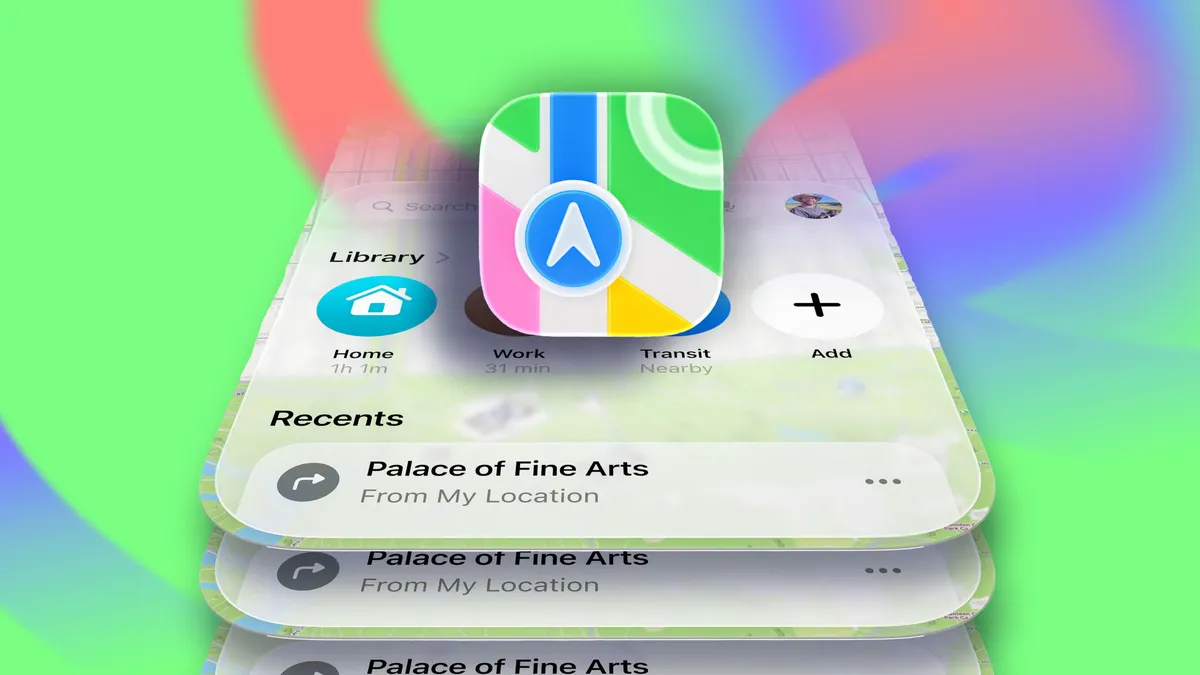
The advertising system, as far as Maps goes, would work similarly to Google Maps advertising. Slots would be available for brands or businesses to purchase and would be tied to search results in Maps. 

Advertisement

The Business platform that Apple is launching will be available in more than 200 countries and regions, according to the company.

Ads in Maps will initially only roll out in the US and Canada this summer.

The move is part of a larger plan to keep growing Apple’s services business, which includes subscriptions like Apple TV Plus, as well as Apple News, iCloud and the App Store. While Apple’s advertising business is a smart part of the company’s revenue, services now account for a quarter of Apple’s annual sales, reportedly more than $100 billion a year, according to a Bloomberg update.

Apple Business will also include options for companies to buy upgraded iCloud storage and AppleCare Plus for Business; there will also be a dedicated Business app that lets companies manage Apple accounts and devices and assign apps and roles within an organization.

Advertisement

Source link

Continue Reading

Tech

How to Set Up Google Family Link on Android: Step-by-Step Guide (2026)

Published

on

Google Family Link is a free parental control tool built directly into Android that lets you manage your child’s device from your own phone. It covers app approvals, screen time limits, content filters, location sharing, and more — all without installing any third-party software. This guide walks you through every step: from pre-setup requirements to configuring the controls that actually matter after you are linked.

Quick take: Setup takes about ten minutes if both devices are nearby and the child’s Google Account is already created. The most common cause of failure is having multiple Google accounts on the child’s device — Family Link requires the child’s supervised account to be the only account on their phone during setup.

Before you start: what you need

Getting the right pieces in place before you open the app saves time and avoids the most common setup errors.

Device requirements

According to Google’s official Family Link device compatibility page, your child’s Android device needs to run Android 7.0 (Nougat) or higher for full functionality. Devices running Android 5.0 or 6.0 may support some settings but are not fully reliable. Your own device — the parent phone — needs Android 7.0 or higher, or iOS 16 or higher if you use an iPhone.

Advertisement

To check your child’s Android version: open Settings → scroll to the bottom → tap About phone → look for Android version.

Account requirements

  • You need a Google Account (standard Gmail is fine).
  • Your child needs a Google Account. If they are under 13, you will create one through the Family Link setup flow — you cannot use a standard account for children under 13 without parental supervision.
  • The child’s device must have only one Google account signed in at setup time. If there are multiple accounts, Family Link will remove them during the process — a warning you want to see before, not during, setup.

Apps to download

  • On your phone: Google Family Link (the parent version)
  • On your child’s phone: Google Family Link for Children & Teens (a separate app)

Both are free on the Google Play Store. Make sure you download the correct version for each device — they are listed separately and serve different functions.

Step 1: Create your child’s Google Account (if they do not have one)

If your child already has a supervised Google Account, skip to Step 2.

Open the Family Link app on your phone and tap Get started. The app will ask whether your child has a Google Account. Select No. You will then be guided through creating a supervised account, which requires:

  • Your child’s first name (a last name is optional)
  • Their date of birth — this determines the type of account created and the applicable age rules in your country
  • A Gmail address for the child (the app will suggest available options)
  • A password for the child’s account
  • Your own Google Account password to verify parental consent

Once the account is created, Google will ask you to review the privacy settings and data collection preferences for the account. Read through these carefully — this is where you control whether Google can use personalised ads, activity tracking, and similar settings on your child’s profile.

With both apps open and both devices nearby, the Family Link app on your phone will generate a short linking code. Here is the exact sequence:

Advertisement
  1. On your phone (parent device): open the Family Link app, sign in with your Google Account, select your child’s account, and tap through until you see the linking code screen. Keep this screen visible.
  2. On your child’s phone (child device): open the Family Link for Children & Teens app, sign in with the child’s Google Account, and enter the code shown on your screen when prompted.
  3. Back on your phone: the app will confirm that the devices are linked. Tap Next to proceed to the permissions setup screen.

If the code expires before you enter it, tap Generate new code on the parent device. Codes are valid for a short window.

Step 3: Grant permissions on the child’s device

After the link code is accepted, the child’s device will display a series of permission screens. Keep tapping Allow or Next through all of them — these permissions are what allow Family Link to enforce screen time limits, manage apps, and report activity. Without them, most controls will not work.

You will also be prompted to name the child’s device (useful if you have more than one child or device) and to choose which apps the child can access immediately. You can approve or restrict app access from this screen, but you can also do it later from the Family Link dashboard on your own phone.

Step 4: Configure the controls that matter most

Once linked, most parents open the dashboard and are not sure where to start. Here is a practical order that covers the highest-value settings first.

Screen time limits and Downtime

Go to Screen time in the Family Link app on your phone (this tab was redesigned in Google’s February 2025 Family Link update). You can set a total daily screen time limit, schedule Downtime (when the device locks automatically — useful for bedtime and homework), and view how much time your child spends on each app. These are the controls most families configure first.

Advertisement

School Time

School Time is a dedicated block mode that limits device use to approved apps only during school hours. It was previously available on smartwatches and became available on Android phones and tablets in the same February 2025 update. Set your child’s school schedule once, and the device will automatically restrict access during those hours without you needing to manage it manually each day.

App approvals

Under Controls, you can require your approval for every app your child attempts to download from the Play Store. When your child requests an app, you receive a notification on your phone and can approve or decline with one tap. You can also block specific apps already installed on the device.

Content filters

Family Link applies content filters across Google Search (SafeSearch), Chrome (site filtering), YouTube (supervised or restricted mode), and the Play Store (age-based content ratings). Go to ControlsContent filters to review each one. The default settings are conservative but worth reviewing against your child’s age and needs.

Approved contacts

Following the February 2025 update, parents can now set which contacts their child is allowed to call and text on Android phones. Go to ControlsContacts to add approved contacts directly from the Family Link app. Your child can request to add new contacts, which you can approve or decline. This is useful for younger children whose device use should be limited to family and close contacts.

Advertisement

Location sharing

Under your child’s profile in the app, you will find a Location section. Tap See location to view the device on a map. Location sharing requires the child’s device to be on with location services enabled and connected to mobile data or Wi-Fi. It does not update in real time continuously; it shows the most recent known location and can be refreshed manually.

Step 5: Review security settings on the child’s device

Before handing the device back, confirm that Google Play Protect is enabled on the child’s phone. It scans installed apps for harmful behaviour and runs automatically in the background. To check: open Play Store → tap your account icon → Play Protect → confirm scanning is on.

Also review which apps have access to the camera, microphone, and location under SettingsPrivacyPermission manager. Remove permissions that do not match an app’s obvious function. This is a good habit to repeat every few months, particularly after new apps are added. For a broader overview of what each permission does, see the guide on understanding Android app permissions on this site.

What happens when your child turns 13

This is the section most setup guides miss, and it changed significantly at the start of 2026. Previously, children could independently disable Family Link supervision once they reached age 13. Google reversed that policy in January 2026 — teens now require explicit parental permission to remove supervision, regardless of age. You will receive a notification when your child is approaching the applicable age and can decide at that point whether to continue supervision or transition to an unsupervised account through a managed conversation.

Advertisement

If you choose to continue supervision for a teenager, it is worth revisiting your content filter and screen time settings. Controls that work well for a nine-year-old often create unnecessary friction for a fourteen-year-old, which can damage the trust that makes monitoring useful in the first place. You can find a more detailed discussion of that transition in the wider guide on legal Android phone monitoring for parents.

  • Child under 13 using a personal Android device → Family Link is the right default. Free, official, no third-party trust required.
  • Teenager active on social media with mental health or safety concerns → consider adding Bark alongside Family Link. Bark’s AI content detection covers platforms Family Link does not.
  • Multiple children across Android and iOS, or a need for detailed per-app time limits → Qustodio covers multi-device families better than Family Link alone.
  • Want to know more before deciding → the Bark vs Qustodio comparison on this site covers both in detail.

Implementation checklist

  • Confirm child’s device runs Android 7.0 or higher.
  • Download the correct Family Link app on both devices (two separate apps).
  • Remove any additional Google accounts from the child’s device before starting.
  • Create a supervised child Google Account during setup if the child does not already have one.
  • Grant all permissions on the child’s device when prompted — do not skip any.
  • Set Screen Time limits and Downtime schedule immediately after linking.
  • Configure School Time if the child’s school schedule is consistent.
  • Enable app approval for Play Store downloads.
  • Set approved contacts if the child is young enough to benefit from contact restrictions.
  • Confirm Google Play Protect is active on the child’s device.
  • Review app permissions on the child’s device before handing it back.

Troubleshooting

Codes expire quickly. Tap Generate new code on the parent device and re-enter it on the child’s device within a few seconds. Make sure both devices are connected to the internet.

The most common cause is the child’s device being offline. Controls sync when the device has an internet connection. Also check that all permissions were granted during setup — open the child’s Family Link app and look for any incomplete setup warnings.

The child’s device shows a different account is still signed in

Family Link requires the child’s supervised account to be the only Google Account on the device. Go to SettingsAccounts on the child’s phone and remove any additional accounts before relinking.

Location is not updating

Check that location services are enabled on the child’s device (SettingsLocation → make sure it is on). Also verify that the Family Link app has location permission under SettingsAppsFamily LinkPermissions.

Advertisement

App approvals are not coming through to the parent device

Check that notifications are enabled for the Family Link app on your own phone (SettingsAppsFamily LinkNotifications). Without notifications, approval requests will pile up unnoticed.

School Time is not locking the device during school hours

Confirm the schedule was saved correctly in the app and that the child’s device time zone matches the schedule you set. Devices in a different time zone will trigger School Time at the wrong local time.

Key takeaways

  • Family Link is free, built by Google, and integrates at the OS level — it is the most reliable starting point for Android parental controls.
  • Setup requires two separate apps: one on your phone, one on your child’s phone. Using the wrong app on either device is the most common setup error.
  • The child’s supervised account must be the only Google Account on their device during setup.
  • As of January 2026, teens need parental approval to remove supervision — this is a significant change from earlier policy.
  • School Time, parent-approved contacts, and the redesigned Screen Time tab were all added in the February 2025 update — older setup guides may not mention these.
  • Family Link works best alongside a conversation about why monitoring is in place. Transparent oversight tends to build better digital habits than hidden controls.

FAQ

Yes. Google Family Link is completely free. There is no paid tier or premium version — all features are included at no cost.

Does my child know they are being monitored?

Yes. Family Link is a transparent tool by design. The child’s device displays a supervision indicator, and the child can see which apps are approved or restricted. It is not a hidden monitoring app.

Yes, but only if the account was created for a child under 13 through the supervised account creation flow, or if you add supervision to a teen’s existing account. Standard adult Google Accounts cannot be placed under Family Link supervision.

Advertisement

What happens if my child’s phone dies or goes offline?

Screen time limits and Downtime schedules that were already set will continue to apply. However, the parent dashboard will not update with new location data or activity reports until the device reconnects.

The parent Family Link app supports iOS 16 or higher on the parent’s device. However, Family Link cannot manage an iPhone as the child’s device — it only supervises Android devices and Chromebooks. For iPhone supervision, Apple’s Screen Time is the equivalent built-in tool.

Family Link can show you your child’s device location when the device is online and location services are active. It does not continuously stream a live location; instead, it shows the most recent known location and allows you to request a refresh.

No. Family Link cannot be uninstalled by the child from a supervised Android device without parental approval. Since January 2026, teenagers also need parental permission to disable supervision from their account settings.

Advertisement

Google Play parental controls only restrict content ratings inside the Play Store itself — they do not cover screen time, location, app usage, web filtering, or the rest of the device. Family Link is the full parental control system that includes Play Store controls alongside all other features. If you only want to restrict what your child can download, Play Store controls alone may be enough; for broader oversight, you need Family Link.

Source link

Continue Reading

Tech

Firefox now has a free built-in VPN with 50GB monthly data limit

Published

on

Firefox now has a free built-in VPN with 50GB monthly data limit

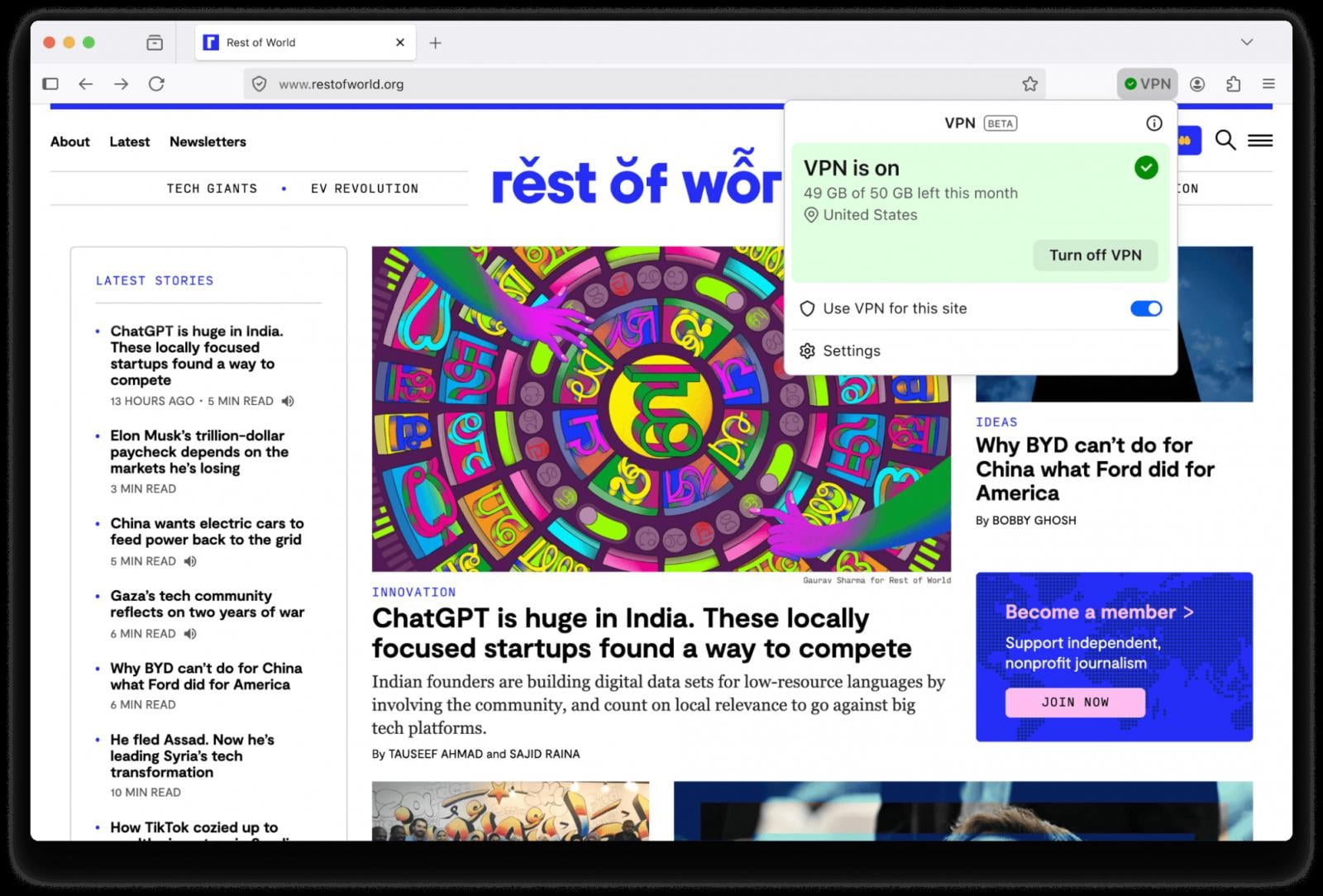
Mozilla released Firefox 149 with added privacy protection through a built-in VPN tool offering up to 50GB of monthly traffic.

The feature uses a secure proxy server to route only traffic from the browser, unlike the company’s commercial Mozilla VPN, which covers system-wide traffic.

“Whether you’re using public Wi-Fi while traveling, searching for sensitive health information, or shopping for something personal, this feature gives you a simple way to stay protected,” Mozilla says.

“Once you sign in and turn it on, you can hide your location and IP address by routing it through a secure proxy while you browse in Firefox.”

Advertisement
Firefox's new built-in VPN tool
Firefox’s new built-in VPN tool
Source: Mozilla

Users with a Mozilla account will get 50 GB of traffic per month. In-browser notifications will alert them when they approach the limit.

You can turn on the VPN feature through a toggle switch in the top right of the browser interface. There is also the option to activate the VPN only on specific websites, up to five, to save traffic.

Some websites and essential services are excluded from VPN routing to avoid account sign-in problems and make sure VPN reconnection works properly.

Mozilla says that it will only collect technical data relevant for maintaining the performance and stability of the new service, and interaction data to understand usage.

“For example, we may log whether a connection succeeded or failed, or record that 2 GB of data was used on a certain day,” the company explains.

Advertisement

The routing server is based in the U.S., and it is selected considering location and performance for the best user experience.

Starting today, the built-in VPN feature will roll out progressively to users in the U.S., UK, Germany, and France. Currently, there is no timeline for expanding the service to more regions.

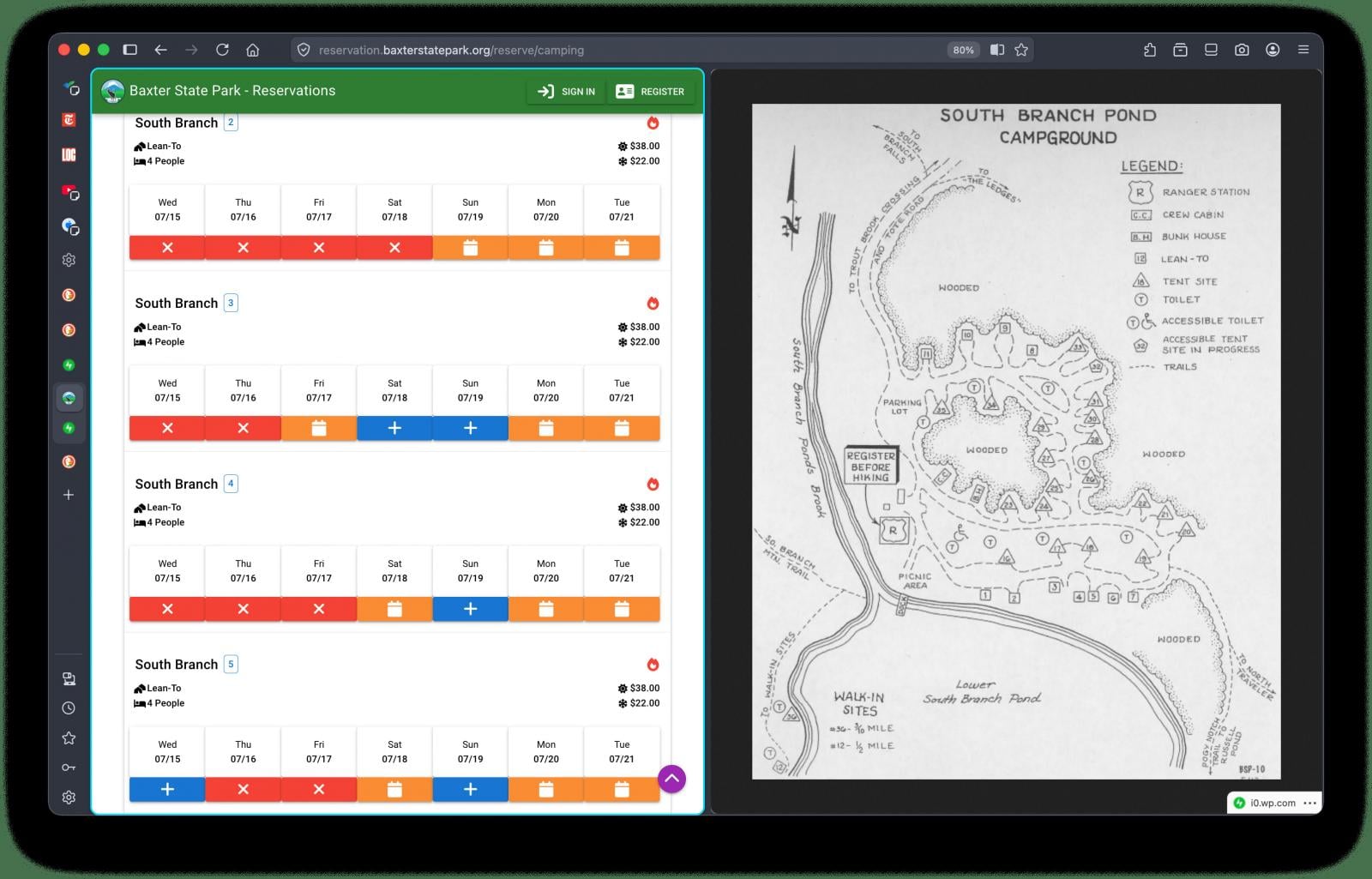
Firefox 149 also comes with Split View, a function that has been present in Google Chrome for a while, which allows placing tabs side by side in the same browser window. Mozilla highlights use cases such as planning, comparing, note-taking, and small administrative tasks, such as tax filing.

New SplitView on Firefox
Source: Mozilla

Firefox also now automatically blocks notifications and revokes permissions from websites that the ‘SafeBrowsing’ security system has flagged as malicious.

Firefox 149 also fixes multiple security vulnerabilities. The list includes 46 issues, more than half receiving a high severity score. Several of them are user-after-free flaws, out-of-bounds errors, JIT engine flaws, and sandbox escape vulnerabilities.

Advertisement

Malware is getting smarter. The Red Report 2026 reveals how new threats use math to detect sandboxes and hide in plain sight.

Download our analysis of 1.1 million malicious samples to uncover the top 10 techniques and see if your security stack is blinded.

Source link

Continue Reading

Trending

Copyright © 2025