
Tech
Seattle startup Arkero expands English soccer reach, landing historic club as latest AI customer

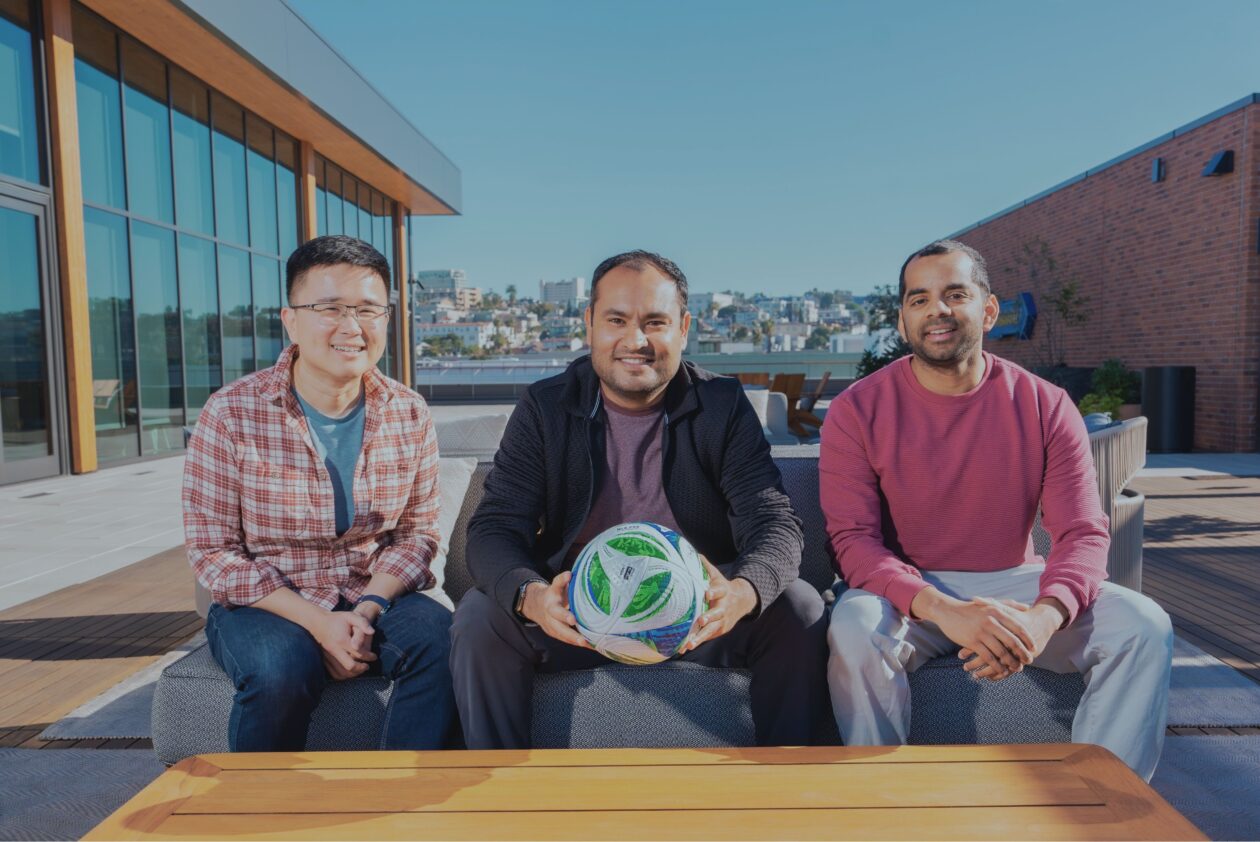

Arkero, a Seattle-area startup leveraging AI to help professional sports teams streamline business operations, has expanded its reach in English soccer by landing Bolton Wanderers FC as its latest client.
The agreement builds on momentum for Arkero, which was launched last fall by the co-founder of Seattle digital remittance company Remitly and raised $6 million at the start of this year.
Bolton Wanderers — which earned promotion back to the English Championship in May — joins a client roster that includes Major League Soccer’s Seattle Sounders FC, NWSL’s Seattle Reign FC, MLS expansion team San Diego FC, and fifth-tier English side Southend United.
The project with Bolton centers on a three-month effort to overhaul the team’s data infrastructure and build a custom “club intelligence layer.” Designed to connect directly to Bolton’s internal data, systems, and workflows, the platform centralizes organizational knowledge so staff across business and football operations can query information and deploy practical AI tools and agents.
“AI transformation does not begin with a chatbot. It begins with a club’s data, systems, knowledge and workflows,” said Shivaas Gulati, founder and CEO of Arkero, in a news release on Friday. “The future football workplace will bring experienced people and AI systems together. Bolton has approached this work with real ambition.”
Gulati’s drive to apply AI to sports comes directly from his own ties to the game. He serves on the ownership group of Southend United and previously acted as a technical advisor to Sounders FC on its tech and AI strategy.
“We get to see the real problems inside sports teams given our access to Southend United,” Gulati told GeekWire. “Clubs have been doing things the same way for a long time, and with AI they can truly re-imagine how their workforce operates and adapts to the demands of a modern enterprise.”
A longtime angel investor, Gulati co-founded Remitly in 2011 and left in 2022. He launched Arkero with help from Vamsi Narla, who leads product and engineering, and Daniel Shi, who oversees business operations. The startup has eight full-time employees.
@media (max-width: 600px) {
aside.callout { float:none !important; max-width:100% !important; margin-left:0 !important; margin-right:0 !important; }
aside.callout .callout-img { display:none !important; }
}
Based in Greater Manchester, Bolton Wanderers boasts a rich legacy as one of the 12 founding members of the English Football League in 1888. Originally formed in 1874 as Christ Church F.C., the historic club has won four FA Cups and spent over 70 seasons in English football’s top flight.
Bolton CEO David Ray said the club is making a long-term investment to ensure it isn’t “playing catch-up” as technology reshapes the sports industry. The club aims to use Arkero’s platform to drive revenue, streamline administrative tasks, and better engage fans — joining teams like the Sounders and Reign, which project over 50% efficiency savings in matchday planning using the startup’s tools.
Arkero says interest in its deep AI integration model is accelerating across the sports world. The startup is currently in discussions with multiple English Football League clubs as well as professional sports teams and leagues across Europe and North America, as leadership teams seek to move beyond generic AI tools and connect AI directly to their proprietary data and daily workflows.
“There is a window right now for forward-thinking clubs to build a meaningful advantage,” Gulati said. “In a few years, working alongside AI will simply be how professional sports organizations operate.”


Noise canceling is also top-tier. The buds have the standard noise cancellation, transparency, adaptive, and off modes, and you can fine-tune ANC strength (from one to five) using the case or Soundcore app. The only earbuds that noticeably canceled more noise were the Bose QuietComfort Ultra Earbuds (2nd Gen) and Sony WF-1000XM6.
Video: Harry Rabinowitz
Video: Harry Rabinowitz
Out of the box, the sound profile (called Soundcore Signature) isn’t an immediate slam dunk like call quality and ANC are. It’s bass-heavy, so much so that I would bet even an untrained ear would notice the bass boost, especially compared to other earbuds from Apple or Bose. There are five preset sound profiles (I preferred Soundcore Balance), an eight-band custom equalizer to play with, and a personalized HearID mode, which tunes the profile to your preferences based on an audio quiz where you select which clip you prefer.
Using the Soundcore Balance or custom HearID profile, the Liberty 5 Pro sounds great. Again, it’s not quite as detailed as AirPods Pro 3 or QuietComfort Ultra Earbuds, but it’s close enough to be enjoyable for most people, especially given the significantly lower price.
Daily Versatility

Photograph: Harry Rabinowitz
It’s not often that a new pair of earbuds becomes my go-to. The convenience of the Apple ecosystem usually means AirPods Pro 3 are, begrudgingly, my earbuds of choice. But I’m still using the Liberty 5 Pro; I’m using them as I write this review. The Liberty 5 Pro is comfortable, sounds good, has great ANC, works well on iPhone and Android devices, and fits securely, making it well suited for almost any task. An IP55 rating means the earbuds should hold their own against dust and light rain. Most importantly, it offers such dramatically better call quality that I enjoy phone calls more, even with my mumbling and NYC street noise.
Sure, sound clarity isn’t perfect. Yes, the buds are a bit large. But when those are the only complaints I have about earbuds that cost nearly $100 less than most of my other top recommendations, that’s a big deal. In 2026, the Liberty 5 Pro might be the best value earbuds you can get.
OpenAI is ending its contract to supply models to Cursor following SpaceX’s $60B acquisition, with access shutting off on 12 November and its forthcoming Astra model withheld. Cursor and SpaceXAI shipped Grok 4.5 together in July, which is available in Cursor on every plan.
OpenAI is ending its contract to supply models to Cursor. The shutoff date is 12 November, the company said on Saturday.
The reason given is unusually direct. OpenAI said it cannot be confident SpaceX will use its technology within its terms of service, “based on our experience with Elon Musk’s companies violating contracts“.
Bloomberg reported it first. OpenAI published the same notice on X and on its own website.
Two grounds are named, both about earlier conduct. SpaceX’s acquisition of Twitter breached OpenAI’s terms, the company said, and xAI violated them in a way Musk admitted under oath this year.
The buyer completed its purchase this month. SpaceX closed the $60B all-stock acquisition of Cursor after agreeing it in June.
OpenAI says it gave the maximum notice its contract allows, about two and a half months. Astra, its next model, will not be supplied to Cursor at all. It added that it is ready to go above and beyond to support developers moving off.
The leverage in that is thinner than it looks. Cursor and SpaceXAI shipped Grok 4.5 together in July, a model Musk called Opus-class, available in Cursor on every plan.
So OpenAI is removing a supplier from a company that now owns a frontier lab. The gesture costs Cursor less than it would have in June, when the deal had only been agreed.
What it costs developers is real. Europe wrote rules for exactly this dependency, and since September 2025 cloud customers have been able to switch on two months’ notice and port their assets within 30 days. From January 2027 the provider cannot charge for any of it.
Whether those rules reach this is unresolved. The definition sweeps in as-a-service models broadly, and nobody has ruled on whether a model API counts as one.
There is a further gap in them. The switching rules protect a customer who wants to leave a provider, not a customer whose provider decides to leave. Nobody drafted for a supplier walking out.
Which is where European developers on Cursor now sit. Seventy-five days of notice, granted by a contract they never saw, with nothing statutory underneath it.

Apple’s latest Mac mini and Mac Studio models are reportedly set to ship with macOS Golden Gate, rather than macOS Tahoe.
The upcoming software appears to be mentioned on the product pages for both new Macs, giving us an early indication that Apple plans to have its next-generation operating system ready before the computers arrive.
According to Daring Fireball’s John Gruber, the new Mac mini and Mac Studio are “slated to ship” with macOS Golden Gate. Apple’s product pages already reference features coming with the next version of macOS, including Siri AI, further suggesting that the software will be installed on the machines from launch.
Apple itself also refers to the upcoming operating system in its announcement for the new Mac mini, saying that the computer will launch with “the upcoming macOS 27”. The company highlights Siri AI, Apple Intelligence features and improvements designed to make the Mac more responsive and reliable.
There’s some additional evidence behind the claim, too. FCC documents and other findings reported by MacRumors reportedly point towards macOS Golden Gate being pre-installed on the new Macs.
That also gives us a fairly narrow window for when Apple needs to release the software. Apple says the new Mac mini and Mac Studio will be released on Tuesday, September 22, meaning macOS Golden Gate would need to arrive before then if customers are to receive the machines with the new operating system already installed.
Apple hasn’t confirmed an exact release date for macOS Golden Gate yet, but its previous release patterns provide a reasonable clue. The software could arrive during the week beginning Monday, September 14, giving Apple enough time to get it onto the new Macs before they start shipping.
For existing Mac owners, this means the launch of Apple’s latest hardware could also mark the arrival of the next major macOS update. However, Apple has yet to officially confirm the release date, so we’ll have to wait for further details before treating that timing as final.
it seemed odd that Apple announced these new Macs, and then said it wouldn’t ship them until late next month.
However, this makes a lot more sense now. Apple probably also wants to get these out (at least the official launch of them) before the real fun stuff starts to arrive, like the firxt foldable iPhone.
Opinion


I am nothing if not a huge movie buff. I watch way too many of them, and I’m always on the hunt for a new format in which to experience them. So when XREAL, the smart glasses company, sent me an a01 — one of its newer models, which it released in May of this year — I was eager to give them a spin as the newest vector by which to satisfy my media fanaticism.
The a01 isn’t a particularly sophisticated smart glasses model. Unlike more software-heavy AR glasses like, say, the Meta Orion or Snap’s Specs, it’s basically just an external monitor. It also doesn’t have a battery or an internal power mechanism. Instead, a simple USB-C cable plugs the glasses into a device of your choosing, which then becomes the headset’s power source. It’s also not so expensive, at an accessible price point of around $300.
The a01 is actually optimized for gaming, in that it can be plugged into a Steam Deck or other handheld gaming device. However, XREAL also advertises them as a way to watch movies and TV — and since that’s more my speed, once I had the a01 in hand, I plugged it into my personal laptop and booted up the Criterion Channel. I then sat watching David Lynch’s film “Wild at Heart” for a while, enjoying a sequence where Nicolas Cage, dressed in a snakeskin jacket, beats up a guy in a bar and then sings an Elvis song.
I’ll say this: The images look quite good. The glasses, which come outfitted with dual mini OLED panels, provide quite a nice image (those panels offer a 1080p resolution with up to 1,600 nits of brightness), with very vibrant colors. If you aim the glasses at a wall, it feels vaguely like you’re using a really vivid home projector — or perhaps are at a drive-in movie. In a dark room, you’re one step closer to the in-theater experience.
However, the overall experience also brought some questions to mind. Namely, why would I sit next to my computer with glasses on my head watching a thing that is also playing on my laptop only 14 inches away? The reason, XREAL offers, is that the glasses are more immersive (they claim the device’s projections are equivalent to viewing content on a 147-inch screen). Still, the redundancy of watching a movie while it plays right next to you makes you question what the actual purpose of the device is.
XREAL has suggested that the glasses can function as a “second monitor” (indeed, they’ve actually been referred to as a “wearable display”) but the functionality of this is, again, questionable. It’s rather difficult to see anything other than what the glasses are projecting — which would make it quite difficult to, say, work on a laptop while also wearing them.
The glasses can also be connected to your phone. Unfortunately, I have an older iPhone, which means that the a01’s cable is not compatible with the phone’s port. An adapter would have been necessary to link the two.
The user experience is easy enough to imagine, however. Connecting the glasses to a phone means that you’re not captive to an indoor experience anymore as you would be with a heftier device like a laptop. You can watch a movie while you’re traveling on a plane or a train (or, hell, while you’re walking down the street — although I would say this last option is generally ill-advised unless you want to accidentally walk into traffic).

However, there are still inconvenient limitations with using the device this way. For one thing, the glasses still only function as a screen-mirroring device — meaning that the screen of your phone needs to remain active while you’re using the glasses. This brings us back to the redundancy problem. You’re watching a video on a screen attached to your face while the same video plays on a different screen that is located less than a foot away. You could partially solve this issue by putting the phone in your pocket, but the chances seem high that any jostling might upset the device’s playback functionality.
It’s worth noting that the device can also be paired with a separate device, dubbed the Beam Pro, which is essentially a mini-tablet and can act as an isolated streaming hub. Users download shows and movies onto the Beam, connect it to the glasses, and watch. However, this device will cost you another $200.
Then there’s the heat. It doesn’t take long for the a01 to start warming up — producing an odd tingling sensation on the bridge of your nose and over your eyes. This is, of course, not an experience unique to XREAL’s products — it’s a well-known defect of most XR glasses. You can only cram so much computing into a small plastic device before all the electrical processing begins to warm everything up. Still, it’s a tad disconcerting, and not exactly what you would want from an accessory that you’re wearing on your face.
I will say that — heat aside — the a01 is a relatively lightweight and comfortable device — and it isn’t overly cumbersome like other smart glasses that I’ve worn. (Having given Snap’s Specs a try at CES earlier this year, I promise you those are significantly heavier — although it’s also a very different kind of device than the a01.)

XREAL continues to iterate its product line, with each new device seeming to improve upon the previous one. Indeed, some of the existential dilemmas present in the a01 and previous XREAL headsets seem to have been ironed out in the company’s newest (and yet to be released) device: Project Aura — which I caught a glimpse of during my visit to Google I/O earlier this year — promises a significantly more immersive and convenient experience.
The Aura is powered by Android XR, an extended reality operating system developed by Google and Samsung. The Aura comes with native hand tracking (which is absent in the a01), as well as access to the Google Play Store, giving the glasses significantly more interactive abilities and AR potential. It also comes with a puck, tethered to the glasses, that acts as both the charging source and a compute node. The puck, which can be easily placed in your pocket, means that — unlike the a01 — you have substantially more mobility and you don’t have to keep it plugged into a separate device.
Let’s return to the a01, though. Unfortunately, from a cinephile’s perspective, watching movies on a pair of sunglasses just isn’t ideal. In general, movie fans like a big screen — the bigger, the better, really. In a world of 4K OLEDs of varyingly gargantuan sizes, consumers have a lot of options. My TV — a 55-inch TCL S-series — isn’t even a particularly powerful device, but it provides a home-viewing experience that is more comfortable and satisfying than what the a01 can provide. To my mind, watching a movie at home on a large flat screen is second only to actually going to a theater. Watching a film on tiny screens less than an inch from your eyes, meanwhile, is an interesting experience for its distinct sense of immersion but not what I’d call optimal.
The a01 is an interesting glimpse into a hardware industry that continues to evolve and that is still finding its footing with consumers. I’m curious to see how the user experience shifts with XREAL’s upcoming Aura, and I’m game to reevaluate my movie-watching preferences when that time comes.
When you purchase through links in our articles, we may earn a small commission. This doesn’t affect our editorial independence.
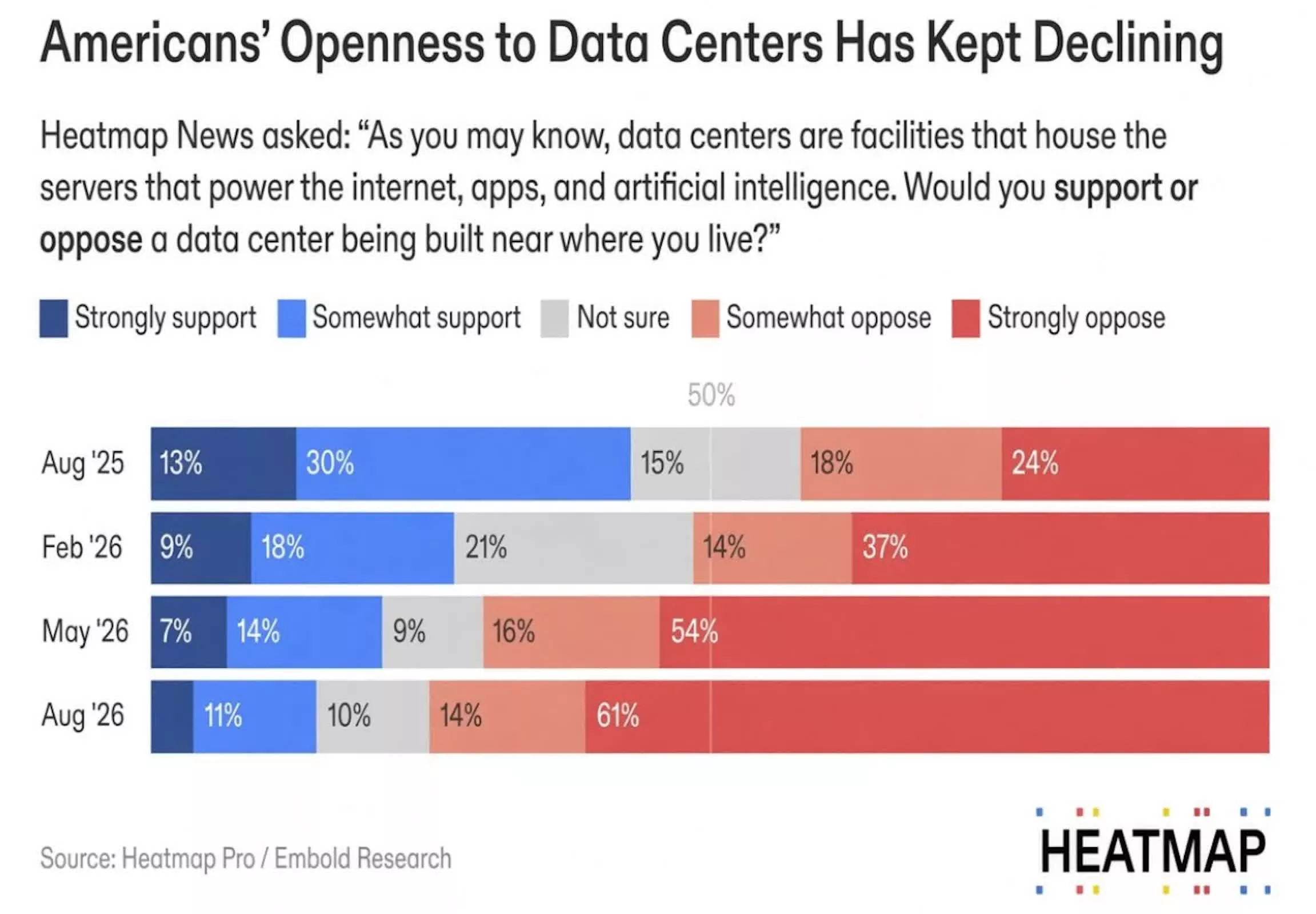
The big picture: The fight over data centers is increasingly centered on what these facilities could mean for nearby residents’ power bills, water supplies, and quality of life. New research suggests that opposition is driven less by fears about AI itself than by concerns that communities will be left to absorb the infrastructure costs required to support it.
Researcher Andy Masley reviewed polling data on the backlash and concluded that its main drivers are not simply distrust of Big Tech, skepticism about AI, or concerns about China. Instead, he found that people are responding to “object-level local environmental and economic harms” associated with proposed projects.
Power is often the first concern. Large data centers can require significant grid upgrades, including new substations, transmission lines, and other equipment. In the PJM Interconnection region, those costs have often been spread across all customers, even when the upgrades are driven by data center demand. Some customers have seen their utility bills rise by as much as 76%.
The issue has become significant enough to draw attention from the Trump administration. President Trump brought together technology companies, AI hyperscalers, utilities, and governors to sign a “ratepayer protection pledge” intended to ensure that AI companies “pay their own way” for the energy infrastructure they require.
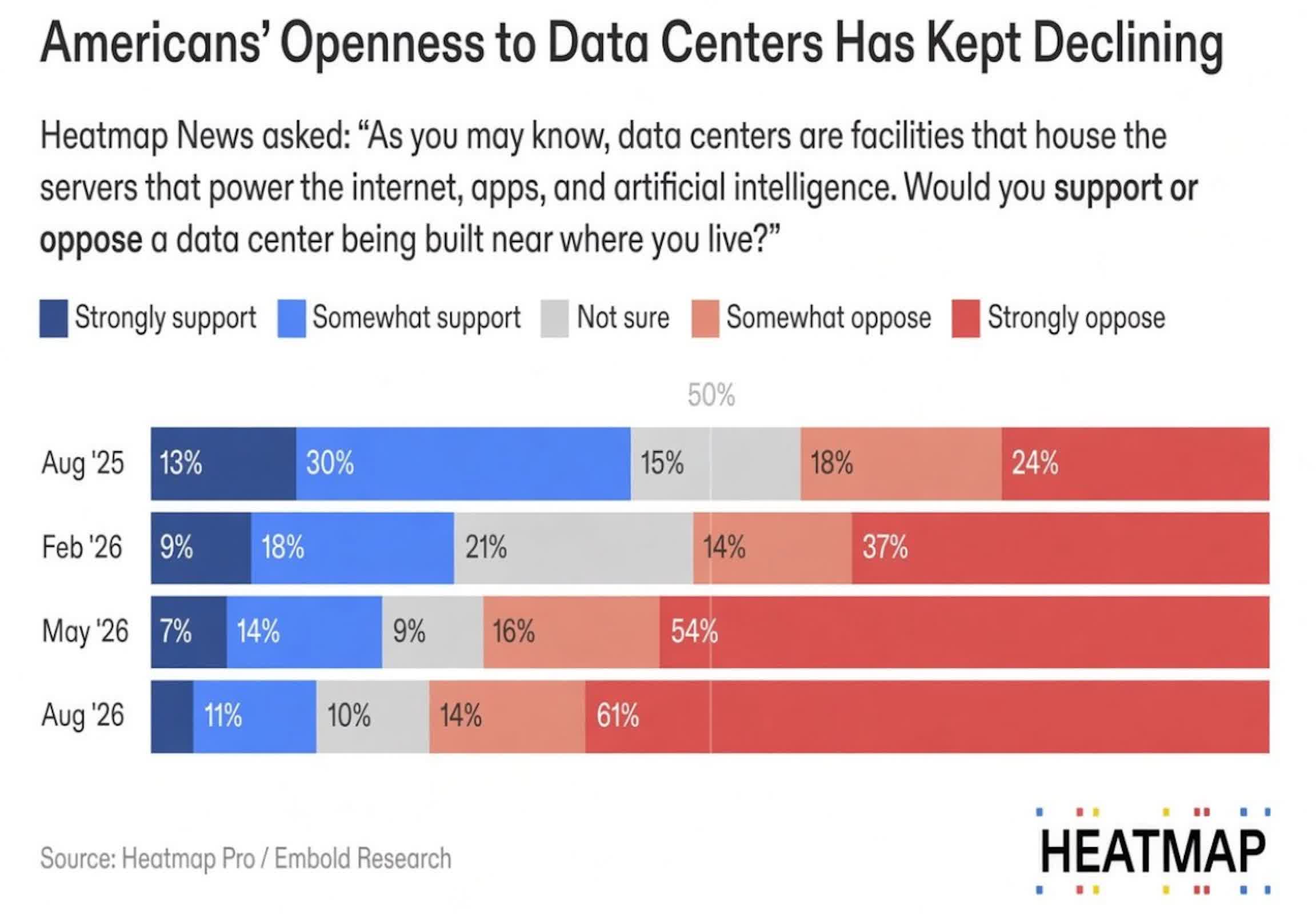
Some states are beginning to address the issue directly. Oregon has adopted a law requiring facilities that use at least 20 megawatts of electricity to cover their share of grid-related costs. Portland General Electric, the state’s largest utility, raised rates for data centers by 30% while cutting residential rates by 1.3%.
Water use has also become a flashpoint. In Georgia, reports linked data center operations to low water pressure and, in one case, muddy water coming from household taps. A separate dispute in Wyoming involved a Meta contractor that allegedly contaminated Cheyenne’s reclaimed-water system. City officials later suspended certain fill-and-flush and closed-loop discharges associated with the project.
Other communities have raised concerns about noise and emissions. Residents near a Michigan data center said the facility produced a constant sound, comparing it to having “someone set up a vacuum, like in your living room.” The company was fined for violating a local industrial noise ordinance and offered to buy homes from nearby residents.
Some projects have also faced criticism over the use of mobile turbine generators or plans to build dedicated gas-fired power plants. A proposed Amazon-related facility in Texas includes a 7.65-gigawatt natural gas plant authorized to emit up to 33 million tons of greenhouse gases annually.
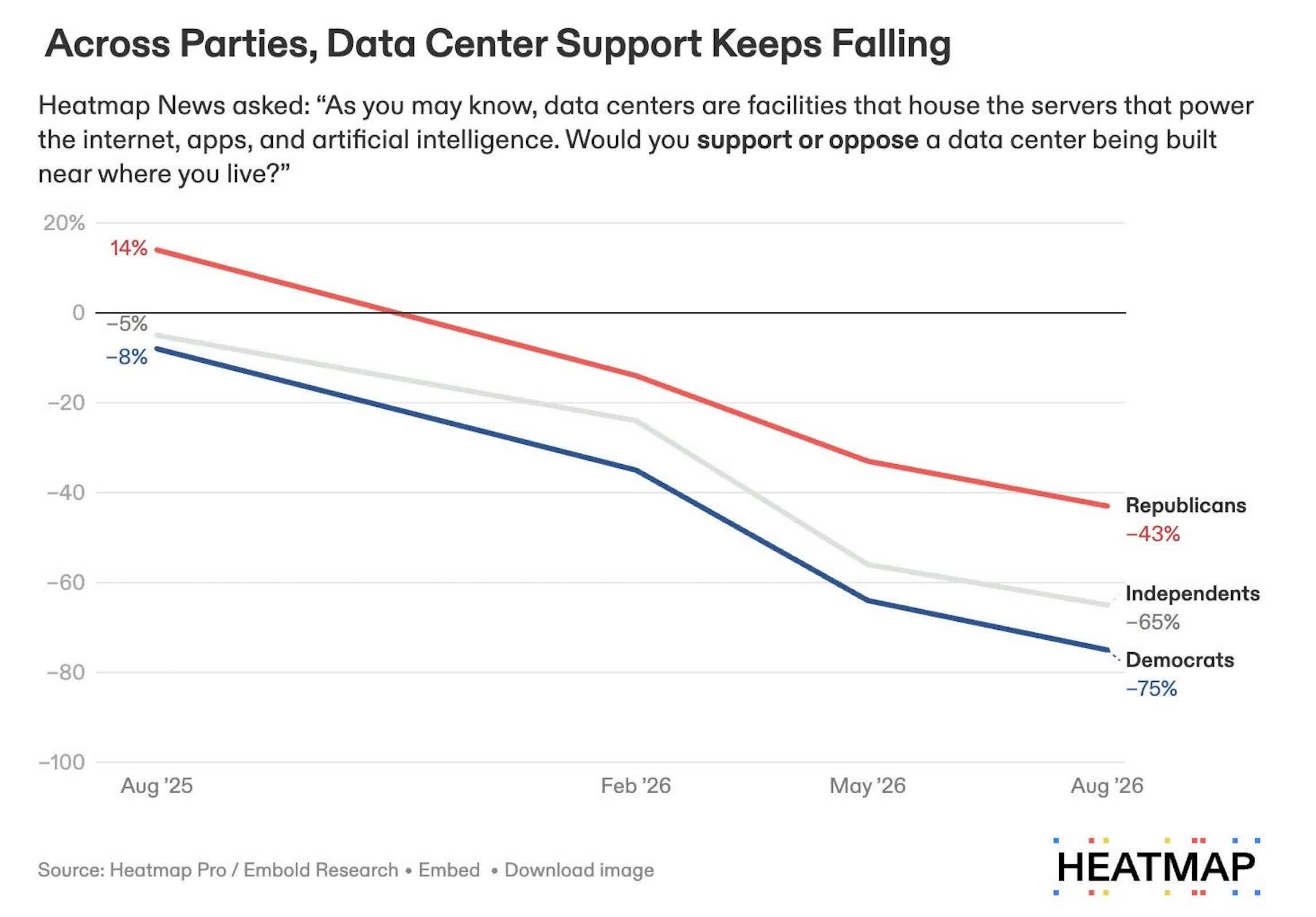
Masley argues that these are concrete concerns, not vague fears. They stem from issues that residents can see, hear, or pay for. However, he also noted that coverage of individual disputes can sometimes leave out important details about proposed projects or fail to compare them with other data center sites. That can lead people to assume that problems reported elsewhere will automatically occur in their own communities.
For developers, this makes transparency more important. Residents want to know how much power a site will use, who will pay for grid upgrades, where the water will come from, and how it will be handled after use. They also want clear information about backup generators, emissions, and noise controls.
Instead, some developers have taken a more confrontational approach. Several have sued local governments that imposed data center bans or moratoriums, arguing that officials exceeded their authority or violated due process and equal protection rules.
In one Pennsylvania town, officials presented a developer with 43 requirements before approving a project. The developer considered the demands too onerous, withdrew from the talks, and later reapplied. The council described the move as an attempt at “approval by tantrum.”
The dispute over data centers is unlikely to disappear as demand for AI computing capacity grows. However, the resistance is not only about the technology itself. It is also about whether the costs of building that infrastructure will be borne by the companies using it or by the communities living next to it.
Image credit: Andy Masley


Presented by Nutanix
Autonomous systems that can reason, make their own decisions, and execute actions across an environment introduce a category of risk that application-level controls were never built to contain. Treating that risk as a single problem produces incomplete architectures, says Oscar Wahlberg, senior director of product management at Nutanix.
“The guardrails to catch a malicious prompt won’t stop an agent from hallucinating and doing something it never should have done, like accidentally deleting databases or leaking sensitive data with a credential it was granted but then uses for something entirely different,” Wahlberg says. “That’s the central problem as enterprises move autonomous agents out of experimentation and into production.”
Once an agentic system is granted execution privileges across the data center, the security posture has to scale into a defense-in-depth architecture spanning infrastructure, storage, compute, networking, and a governing control plane. Each layer addresses a distinct category of risk, rather than duplicating the same controls across the stack. No single security control or vendor can provide that protection on its own. Defense-in-depth depends on those layers working together.
By dividing the responsibilities across the stack and adhering to zero trust segmentation, organizations can create a secure framework that improves their overall posture. Understanding which risks belong in each layer is what turns the principle of defense-in-depth into a practical security framework, with three layers that each have a distinct responsibility.
Infrastructure layer: Establishing trust where AI agents run
The infrastructure layer’s foundational responsibility is establishing a root of trust that answers a simple question: who is operating in the environment? That trusted identity becomes the prerequisite for every security control above it. Before an organization can trust what an agent does, it first has to trust the integrity of the environment where the agent runs. When an agent requests permission to execute an operation, the system must be able to verify that the request came from the legitimate agent — not something impersonating it.
Delivering that kind of assurance depends on technologies that root trust in the hardware itself, including platform attestation, confidential computing, and secure boot, alongside controls that prevent unauthorized access both within a server and beyond it. For regulated industries such as financial services, this layer provides the ability to isolate AI production workloads so that neither the agent nor the environment can operate outside its assigned scope. That mitigates risks including model and runtime tampering, supply chain compromise, and unauthorized access to sensitive AI workloads.
Network layer: Governing how AI agents communicate
Once agents begin communicating with other agents, APIs, applications, and enterprise systems, they generate a level of concurrency and dynamic communication that traditional static network configurations were never designed to handle. An agent configured to call APIs, query data sources, and spin up additional agents without constraint creates a sprawling web of east-west traffic that becomes very difficult to reason about, and that complexity can easily mask lateral movement or data exfiltration when the right network security layers are not in place.
“We should treat AI agents as a new class of network identity, and make sure that an agent can only talk to other agents or data sources where it’s explicitly allowed to do so,” Wahlberg says. “That means moving away from rigid static rules toward dynamic policy enforcement.”
Nutanix’s solution is Agent Gateway, part of the Nutanix Agentic AI solution. It’s a unified, governed layer that is designed to provide cost control and governance capabilities to help manage autonomous agent users. Coupled with agents grounded in zero trust segmentation and using capabilities like Nutanix Flow for micro segmentation and integrating with networking vendors, including its integration into the Cisco Secure AI Factory, Agent Gateway helps enterprises govern interactions across agents, models, data sources, and enterprise applications.
The network layer governs lateral movement, data exfiltration, and gates the agent’s network interactions. A zero trust framework with access blocked by default and scalable interaction monitoring is important for agents since they can exhibit unreliable behavior. The Nutanix software integration with Cisco UCS servers and Cisco AI PODs delivers the turnkey physical infrastructure (compute, storage, and networking) that the AI factory runs on.
Control plane layer: Governing what AI agents are permitted to do
The control plane is the brains of the operation, providing a central point for managing agent permissions, tool access, resource consumption, and runtime visibility. What matters most is having a single place where policies can be enforced consistently rather than reinvented for every agent, Wahlberg says.
“Agent Gateway acts as a universal endpoint for different models and tools, so an IT team can configure their agents to talk to this single control point,” he explains.
The centralized AI gateway enables the admin to observe, audit, and control access to models as well as MCP tools protecting data and gating privileged access. This layer is designed to help mitigate risks such as privilege misuse, runaway agents, unauthorized tool usage, data leakage, and the excessive model consumption that can lead to increased token consumption when agents get stuck in runtime loops. And it depends on treating governance as a runtime control system rather than a compliance afterthought.
Why one-size-fits-all security fails agentic AI environments
The biggest architectural mistake enterprises make is assuming a single security model can be stretched across every layer of an AI stack. When an organization tries to solve for hardware-level trust with application-level software, or leans on static legacy network rules to manage dynamic agents, it builds an architecture that either blocks the agentic system from doing its job or leaves critical doors wide open. One-size-fits-all thinking tends to produce significant performance penalties and operational friction.
“By failing to assign specific responsibilities to the appropriate layers, enterprises end up with blind spots in governance,” Wahlberg says. “They might secure the model output but miss that there’s data leakage between agents, or they might secure the network but lack the control plane visibility to understand that they’re wildly burning tokens because the agents are stuck in some kind of runtime loop.”
Focusing exclusively on the model leaves the largest gaps of all, because a guardrail that catches a malicious prompt does nothing to stop a hallucinating agent from misusing a legitimate credential. Embedding security across the full stack helps ensure that even when a model level threat slips past the initial filters, the agent remains constrained by hardware rooted trust, network isolation, and access controls at the agent layer.
How Intel, Cisco, and Nutanix build defense-in-depth together
The three-way partnership from the three companies demonstrates how the layered architecture comes together in practice as a well-governed, enterprise-grade AI Cloud. Intel supplies the computer to run agentic workloads and secures the execution environment through hardware-rooted trust and confidential computing, while also driving costs down through their accelerators. Intel Xeon 6 processors with built-in AMX accelerate AI inference efficiently without relying exclusively on expensive GPUs.
Cisco wraps the environment in a secure fabric that governs communication between agents and enterprise tools, while Nutanix provides the software platform, minimizing architectural silos, and the central control plane that enforces permissions, delivers visibility and cost governance, and ties the architecture together into a defense-in-depth solution that lets enterprises scale agentic AI.
Of the three layers, enterprises currently underestimate the control plane the most, Wahlberg says. A true control plane extends far beyond initial deployment to simplify Day 2 operations, he explains, giving IT teams the continuous observability, and strict token governance required to keep autonomous agents secure and cost-effective in production.
“Apart from model and tool selection, governing the agent deployments and their access to models and business tools in a tightly integrated full stack platform will be important for the success of AI projects,” he says, pointing to a near future in which organizations move from a handful of AI use cases to thousands of agents working autonomously to drive the business.
Technology leaders should prioritize building a centralized governance layer today that can manage agent identities, tool permissions, and token budgets in real time, because that control point is what builds the operational muscle to scale safely.
“You can’t build an AI system without getting into a lot of complex decisions,” he explains. “And you need a control plane that talks across multiple vendors and infrastructures to help you solve for those defense-in-depth strategies.”
Learn more about the Nutanix Agentic AI solution here.
Sponsored articles are content produced by a company that is either paying for the post or has a business relationship with VentureBeat, and they’re always clearly marked. For more information, contact sales@venturebeat.com.

A Kentucky-based glass plant is poised to become a much bigger piece of the iPhone supply chain, with hundreds of both long-term and temporary jobs expected as production ramps up.
Apple has been getting glass for iPhone for 20 years from Kentucky. Specifically, in Harrodsburg, Kentucky, where the tech giant plans to expand manufacture the glass for every iPhone and Apple Watch.
Apple COO Sabih Khan and U.S. Secretary of Commerce Howard Lutnick toured Corning Inc. on Friday. The tour comes one year after Apple had invested $2.5 billion more in Kentucky, hoping to double plant jobs and triple its current output.
“Made in Kentucky. Made in America. Sold around the world,” U.S. Rep Andy Barr said during the tour, according to The Lexington Herald-Leader. “We invent it here. We have the talent, and we have the manufacturing heritage. We will build it here, and we will sell it to the world.”
“I want Kentucky to be the first place companies think about when deciding to make their next major American investment.”
The plant currently has 350 employees, but hopes to employ 200 new hourly production jobs, alongside a handful of salaried employees in glass development. That’s not quite double the existing 350, but that’s because Corning was including construction jobs in that total.
However, Apple and Corning are planning to build a new Apple-Corning Innovation Center at the site. It is believed that construction will create 100 jobs, but those won’t last.
“At Apple, we share the administration’s commitment to producing more of the most innovative technology right here in the United States,” said Khan.
“We’re expanding our U.S. supply chain, and we will continue to build on these efforts because at Apple, we believe in the power of American innovation. We believe in the ingenuity of American workers, and we believe deeply in the promise of America.”
The Apple-Corning Innovation Center may be similar to Apple’s Advanced Manufacturing Center in Houston, though likely at a smaller scale.


If you are stuck with the same five prestige dramas everyone’s already talking about, here are three that got criminally overlooked. For this weekend, we have a yakuza thriller, a finance drama, and a televangelist saga that still delivers after four seasons. All three underrated shows are streaming right now on HBO Max, and deserve a spot on your watchlist. If you don’t have the time or the appetite to commit to multiple seasons, I have created a list of the best limited series on Netflix that’s worth checking out.
We also have guides to the best new movies to stream, the best movies on Netflix, the best movies on Hulu, the best free movies, and the best movies on Amazon Prime Video.
Tokyo Vice (2022-2024)
Genre: Crime, Drama, Thriller
IMDb: 8.0/10
Rotten Tomatoes: 89%
Jake Adelstein (Ansel Elgort) talks his way onto a Japanese newspaper’s crime desk in the late ’90s, then keeps pulling threads until he’s tangled up with actual yakuza. Detective Hiroto Katagiri (Ken Watanabe) half mentors him, half tolerates him, and their partnership carries the whole show. Underneath the neon and the subtitles, this is really a story about how far someone can go for a byline.
Michael Mann directed the pilot, setting a gorgeous, moody, authentic tone that you can feel in every frame. The secret weapon here is Show Kasamatsu, who plays a rising mobster with incredible charisma. This show on HBO Max has two tight seasons, zero filler, and an ending that actually reaches a resolution.
You can stream Tokyo Vice on HBO Max
Industry (2020- present)
Genre: Drama
IMDb: 7.5/10
Rotten Tomatoes: 91%
Harper Stern (Myha’la Herrold) and Yasmin Kara-Hanani (Marisa Abela) fight for a handful of permanent jobs at a London investment bank, and every day on the trading floor is an absolute knife fight for survival. They drown their grueling late-night hours in substance abuse, complex office politics, and deeply terrible relationship choices. The show is also about what ambition does to people who never learn to stop.
What got me hooked wasn’t the finance jargon; it was watching characters make self-destructive choices and finding myself still rooting for them. I’ve recommended this to friends who work in soul crushing jobs, and they texted me mid-season one saying, “this is too real.” Four seasons in and a fifth already confirmed, this thing keeps getting sharper instead of running out of ideas.
You can stream Industry on HBO Max
The Righteous Gemstones (2019-2025)
Genre: Comedy, Drama
IMDb: 8.0/10
Rotten Tomatoes: 91%
Eli Gemstone (John Goodman) tries to keep his three deeply flawed adult children from tearing apart the megachurch empire he built. Jesse (Danny McBride), Judy (Edi Patterson), and Kelvin (Adam DeVine) spend four seasons scheming against each other and occasionally the whole family at once. It’s a dark comedy about how faith and greed end up looking identical once enough money gets involved.
I put off watching this for years, assuming it was just Danny McBride yelling for four seasons, but the show proved me wrong. He channels pure satirical genius here, delivering funny moments without dropping the narrative. There is also a real tenderness buried under all the chaos, which I liked. And this hidden gem on HBO Max wrapped up with a perfect critic score on the finale.
You can stream The Righteous Gemstones on HBO Max

President Trump awarded the four-member Artemis II crew the Congressional Space Medal of Honor and signed an executive order directing the creation of a new U.S. Space Academy. The proposed academy would train engineers, scientists, technicians, operators, and astronauts for NASA, the Space Force, and the commercial space industry. Houston Public Media reports: The Artemis II crew — NASA’s Reid Wiseman, Victor Glover, Christina Koch, and the Canadian Space Agency’s Jeremy Hansen — retraced history as they flew around the moon and back in April, the first time humans have been in lunar territory since the 1970s. He had previously hosted the crew members at the White House following their mission and called them during the mission while the crew was tens of thousands of miles away. “The one thing that really sticks out to us [from that call] is you said how proud you are and how proud our nation is for the job that we’ve just accomplished,” Wiseman said during Friday’s ceremony. “And for us, that is what we set out to do. We wanted to inspire this nation to learn.”
During the ceremony, Trump also signed an executive order to create the “United States Space Academy.” Under the order, a Presidential Commission on the U.S. Space Academy has 120 days to create a report with guidelines for the U.S. Space Academy. The Commission will include NASA Administrator Jared Isaacman as its Chair, as well as other NASA and space officials. Secretary of Defense Pete Hegseth, Trump’s Chief of Staff Susie Wiles, and Michael Kratsios, assistant to the president for science and technology. In effect, it allows the Trump Administration to build the U.S. Space Academy to its liking. “It will serve both the United States Space Force as well as NASA and the civilian spaceflight industry,” Trump said. “And it will attract, train, graduate the very best that our nation and our nation really has to offer.” As for where the academy will be located, Trump said he was “going to be choosing a location very shortly.”


Read more of this story at Slashdot.
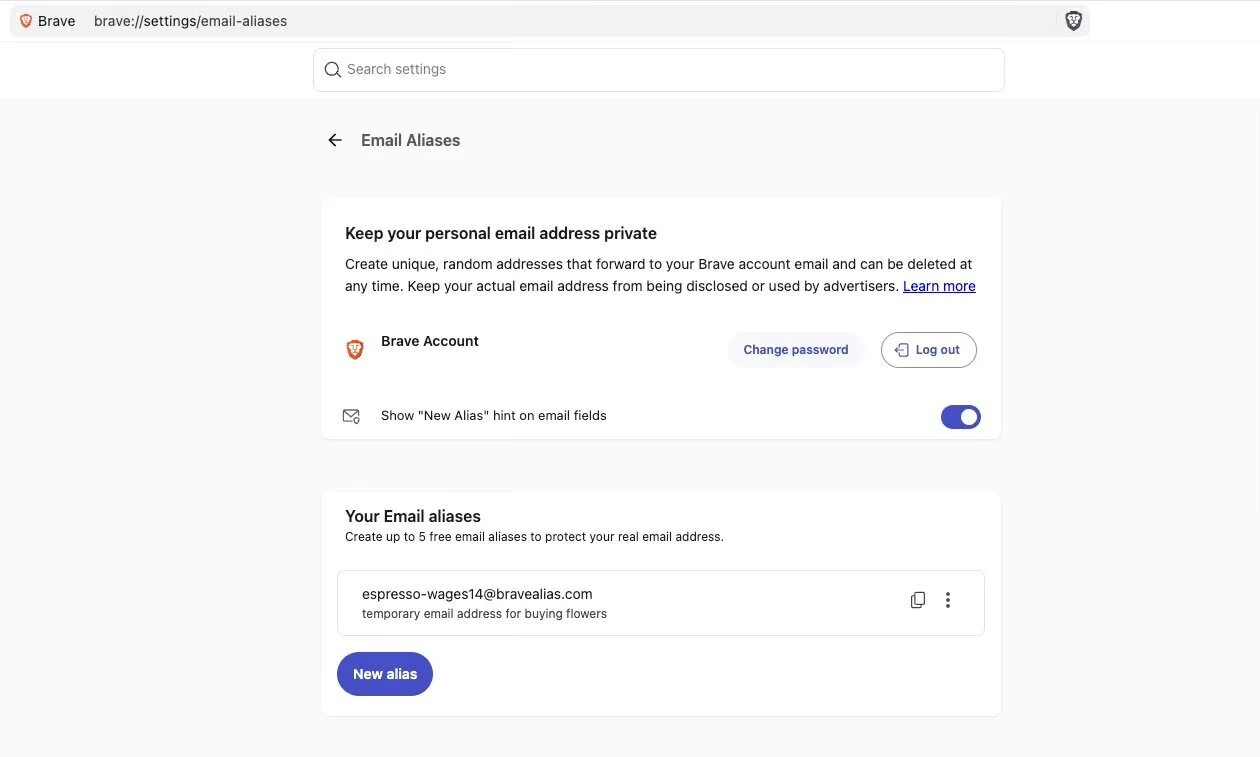
Your email address is one of the easiest ways for websites and advertising companies to identify you online. If you provide the same address to multiple websites, it can potentially be used to connect your activity across different services.
Brave is now trying to limit this type of tracking. Starting with desktop version 1.94, the browser has added Email Aliases, which let users provide websites with a different email address instead of revealing their primary one.
How do Brave Email Aliases work?
Once users create a Brave Account, they can generate an alias directly from an email field on a website. Any messages sent to this address are then forwarded to the primary email address connected to the Brave Account.
The website never receives the primary address. Companies can upload customer email addresses to advertising platforms such as Google, Meta, and LinkedIn to match them against existing user profiles. Since this matching can happen on company servers, browser-based tracker blocking cannot always prevent it. Aliases can also limit how widely a primary email address spreads if a website suffers a data breach.
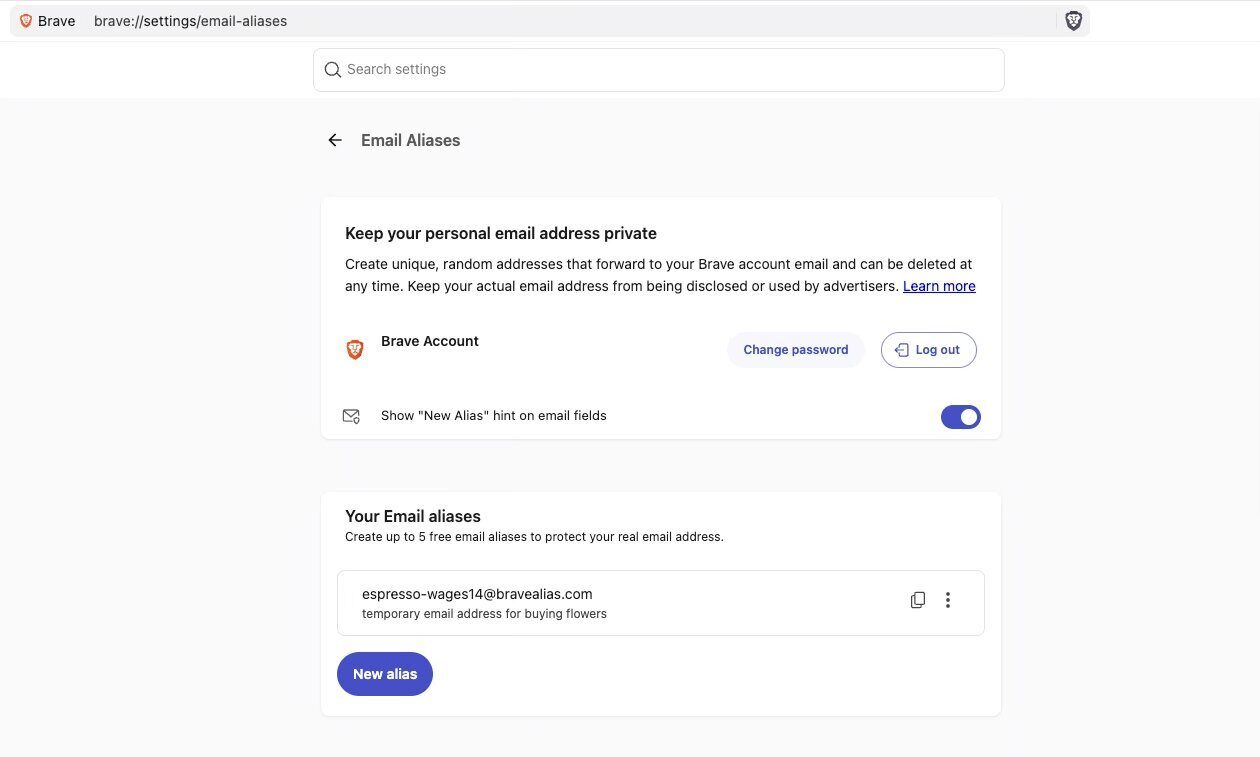
However, Brave Email Aliases does not automatically block newsletters or promotional messages. Anything sent to the alias can still be forwarded to the primary inbox. If an alias starts receiving unwanted emails, users can deactivate it, preventing future messages sent to that address from reaching them. Brave is initially offering five aliases for free, while a Premium version and mobile support are planned for the future.
Brave is not the first browser to do this
Email aliases themselves are nothing new. DuckDuckGo Email Protection already provides private @duck.com addresses that forward messages to an existing inbox. It can also remove supported email trackers before forwarding them. Firefox Relay provides a similar service and can generate email masks through Firefox. Its free tier currently supports up to 50 masks.
Brave’s advantage here is having another privacy feature built directly into its browser. The company recently added Containers to separate accounts, cookies, and browsing sessions. Email Aliases now give users another way to keep information shared with different websites separated.

Motley Fool Stock Advisor Claims 964 Percent Return Since 2002, but the Number Hides a Complicated Story
3 Major Solana (SOL) Developments You Should Know About

Jimmysstar primed for Memsie Stakes return in 2026





-

 Crypto World3 days ago
SpaceX stock could rise 75% to $240, JPMorgan says
-

 Crypto World2 days ago
Bitcoin’s 22% rally now needs real demand to outlast Treasury liquidity boost
-

 Business7 days ago
Musk’s Tesla, SpaceX Confirm $16.8 Billion ‘Terafab’ Chip Plant as World’s Largest Building in Texas
-

 Fashion18 hours ago
Weekend Open Thread: Maeve – Corporette.com
-

 Crypto World4 days ago
A $30 Billion AI Fund Implodes, Now the SEC Is Investigating Wall Street’s Role
-

 Crypto World3 days ago
Warsh Jackson Hole keynote puts financial innovation first
-

 Business1 day ago
Salesforce Stock Soars 19% as Blowout Earnings and Agentforce AI Growth Silence Software Skeptics
-

 Politics7 days ago
6 months on, Irish renters crushed by effects of government housing bill
-

 Crypto World3 days ago
Did Trump Just Move SpaceX Stock With One Truth Social Post?
-

 Business6 days ago
Mystery AI Model ‘Ox Alpha’ Draws Developers With Free Access as Chinese Lab Origins Remain Debated
-

 Business3 days ago
Walmart takes aim at younger shoppers with new fashion brand
-
 NewsBeat3 days ago
Lindsay Clancy jury braces for closing arguments as judge tells court: ‘You’ve heard all the evidence’ – Live updates
-

 Business5 days ago
Moderna CEO warns China is pouring state money into mRNA technology
-

 Business5 days ago
NVIDIA Stock Drops Nearly 2 Percent to $210 on Seventh Losing Day Ahead of Critical AI Earnings
-

 Crypto World3 days ago
Elon Musk Grok Bot Promise: We Will Make You Whole if AI Loses Your Money
-

 Crypto World2 days ago
NVIDIA revenue hits $96.2B as AI demand doubles
-

 Business19 hours ago
iPhone 18 Pro Pre-Orders Could Shift to Saturday as Apple Reportedly Avoids September 11 Anniversary
-
 Crypto World5 days ago
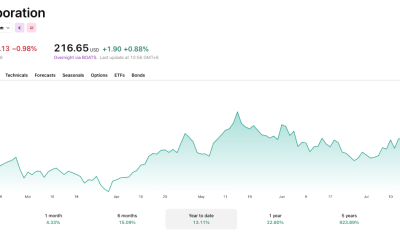
$92 Billion Nvidia Earnings Could Make or Break the AI Trade
-
 Business3 days ago
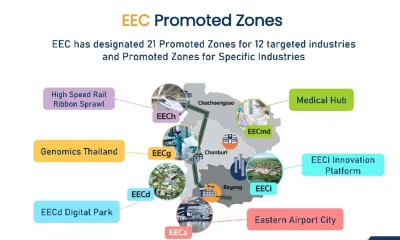
Thailand’s Eastern Economic Corridor Capital City (EECiti): Key Developments and Investment Opportunities
-

 Business6 days ago
Where Will Kevin Durant Play in 2027? Rockets Hold Player Option Key to His Future With Houston via Deal
You must be logged in to post a comment Login