Magnets are awesome, so it’s no wonder we love to add them to our 3D prints. Doing so in a way that will actually last is harder, with thermal creep being one reason a simple friction fit will loosen over time, and using super glue to hold a magnet in place can be messy. In a recent video, [Slant 3D] covers seven ways to install magnets in 3D prints without resorting to glue, along with the advantages and disadvantages of each.
With friction, the argument is that you can still use them, but you’d want to use something like cylindrical magnets rather than flat magnets to increase the friction with the thermoplastic. Using an arbor press rather than human primate hand power is also beneficial.
Rather than installing magnets halfway through a print with all the logistics that entails, you can use side slots to install said magnet into, which is much easier, but as with all embedded magnets, you get that plastic barrier between the magnet and its target.
Other methods involve using a bit of extra material that you need to push the magnet past, using something like an arbor press, so the magnets should never just fall out. A wildcard here: spherical magnets, which can be locked in using a similar method, while automatically orienting themselves to an opposing magnet.
Advertisement
The final tip is to never use two magnets in a magnetic lock. Instead, use a cheaper ball bearing or a similar plain metal part on one side instead. Magnets tend to be much more brittle than whatever stainless steel ball bearing or washer you can use on the other side.
Of course, people will always try to install magnets during an FDM print, but before they try to do that anyway, they really should learn about the fascinating ways in which magnets can ruin print beds, destroy nozzles, and otherwise make a total mess of a print. Magnets seem magical. Maybe they are.
He left the industry behind to build his own hypercar. He said it’d have an output of 1,070 horsepower. He was wrong. The bespoke V12 powering this upcoming hypercar, the NILU, actually ended up exceeding its original performance target during its first dyno testing. It’s a major milestone for ex-Lamborghini designer Sasha Selipanov’s startup Nilu27, especially as they move closer to building their first drivable prototype with New Zealand-based Hartley Engines. The naturally aspirated 6.5-liter V12 even revved to an 11,000-rpm redline: a number the company called “spine-tingling.” It’s up there with some of the highest-revving engines ever released.
The powertrain uses an unusual “Hot V” configuration that puts the exhaust headers between the cylinder banks. This improves packaging and thermal management, for one, but it also shows off the engine through the vehicle’s fully exposed rear engine bay. Pair that with a Porsche-style seven-speed manual transmission, Nilu27 is going out of their way to double down on a traditional driving experience. At a time when so many other high-performance automakers are shifting toward electrification and digital controls, it’s a decision that stands out.
Advertisement
What it means for the future of the startup
Selipanov spent nearly twenty years working with Lamborghini, Bugatti, and Koenigsegg before launching his startup in 2024. That’s when he unveiled the Nilu27, his analog-focused hypercar. (“Analog” meaning it bucks the electrification trend with a carbon-fiber tub, an open-gate manual gearbox, and that “spine-tingling” bespoke V12.) Simply put, he just wants to deliver a more mechanical and driver-focused experience using an all-new engine architecture. If he succeeds, it could become one of the best V12 engines ever made.
Advertisement
As far as next steps are concerned: There’ll be some additional calibration and refinement work in New Zealand, at which point the completed engine will be shipped to Nilu27’s research, development, and production facility in Lahr, Germany. Once it arrives, it’ll be installed in the company’s first driving prototype. If the NILU succeeds, Nilu27 and partner Hartley Engines expect to open the doors to broader commercial ventures beyond Selipanov’s hypercar. They’re not opposed to designing and manufacturing road-certified engines for third-party customers. For the time being, it’ll cost you $3.7 million to own one of the first 15 units on the way.
From left: Clarify CEO Patrick Thompson, Seam AI CEO Nicholas Scavone, and Clarify CTO Ondrej Hrebicek. (Clarify and Seam Photos)
Clarify, the Seattle-based AI startup that has raised more than $22 million to take on Salesforce and other CRM incumbents, has made its first acquisition: San Francisco-based Seam AI.
Seam’s technology monitors buying signals across the web — such as funding rounds, hiring, website activity, and executive job moves — and surfaces them to sales teams. Clarify plans to fold the technology into a new product called Clarify Signals, slated to launch later this year.
Clarify is led by co-founders Patrick Thompson (CEO) and Ondrej Hrebicek (CTO), who previously co-founded Iteratively, a Seattle data-analytics startup that was acquired in 2021 by Amplitude, the publicly traded digital-analytics company.
Rationale: Clarify says the deal is part of a shift beyond what it calls a “system of record” that tracks what already happened to a “system of awareness” that flags what’s about to happen.
Thompson said the Seam deal fills a gap in what Clarify’s own AI can pull from the open web, giving the CRM access to proprietary datasets that can’t be reached with a simple search.
Advertisement
“The value that Seam is providing is typically the information that’s not necessarily easy to get from the web,” Thompson explained in an interview. “It’s the harder stuff to find.”
Hrebicek said Clarify’s customers have been looking for a bigger and richer dataset — the ability to “look around the corners on who would be a good lead.”
Deal points: Financial terms weren’t disclosed. Clarify, which had raised a total of $22.5 million in its seed and Series A rounds from investors including U.S. Venture Partners, Gradient Ventures, and Madrona, said it brought in additional funding as part of the deal but did not disclose the amount.
As part of the acquisition, five Seam employees are joining Clarify, including Seam co-founder and CEO Nicholas Scavone. With the deal, Clarify is adding a San Francisco office alongside its Seattle headquarters. The company now has 30 people total.
Advertisement
Backstory: Scavone started Seam in 2020 after five years at Okta, where he saw teams accumulate many different sales and marketing systems, with customer data scattered across all of them.
Seam raised $7 million including angel funding and a seed round led by Bessemer Venture Partners in April 2024. It counts Zapier, GoFundMe, Drata, and Betterment among its customers. Existing customers are on hold while the technology is integrated into Clarify, but many have already indicated they plan to move over to the new platform.
Scavone said he had been weighing whether to raise a new round or find a home for the company when he and Thompson, who have known each other for years, began talking about a combination.
“We’re all going after the same big incumbents here,” he said, explaining that he ultimately decided Seam had a better chance of taking on the market’s dominant players by joining forces with Clarify than as a standalone company.
Advertisement
In a post announcing the deal, the Seam and Clarify founders said they “realized we weren’t building competing products—we were building different halves of the same future.”
Landscape: Clarify is entering a crowded field. Sales-intelligence platforms like Clay, ZoomInfo, and Apollo already sell third-party data to revenue teams, and 6sense and Demandbase lead the account-based marketing category Seam had been targeting.
Thompson said one edge for Clarify is that signals arrive inside the CRM sellers already use, not a separate dashboard.
The company was co-founded in early 2024 by Thompson, Hrebicek, and Austin Hay, a marketing-technology operator who served as co-CEO alongside Thompson. Hay departed in September 2025 and is now with Khosla Ventures, per his LinkedIn.
Advertisement
What’s next: Clarify plans to launch Signals later this year, Thompson said, noting that the company is considering raising additional funds in a Series B round early next year.
Matty Benedetto keeps finding new ways to turn everyday habits into elaborate projects. This time the Vermont designer behind Unnecessary Inventions has built a portable snack safe that stays shut until its owner logs a set number of steps. The idea is simple enough. Load a treat, dial in the calorie count, close the lid, and start walking. Only after the counter hits zero does the door release.
The case resembles a sturdy lunchbox, with a convenient handle on top. Everything was 3D printed, then finished with snappy UV-printed typography and laser-cut acrylic panels for a sleek appearance. There’s a window in the back that lets you see what’s inside at all times, and it’s actually very effective at keeping you going. Watching a bag of gummy bears shrink in size is an excellent way to stay motivated.
NO ICE NEEDED: RapidChill Technology is our innovative two-part system that spins an auger around a cooling cylinder to freeze liquid evenly and…
A SUPERIOR FROZEN DRINK EXPERIENCE: With this versatile machine, turn your favorite liquids into smooth, flavorful frozen drinks: wine, coffee, soda…
ONE-TOUCH FROZEN DRINKS: Temperature and texture controls deliver consistently smooth results in up to 60 minutes at max capacity. Creating drinks can…
The front panel features a set of seven-segment displays that show your remaining step count in large, colorful numbers, as well as two rotary dials. They function as both a lock button and a mechanism to enter the calorie count of whatever snack you’re attempting to ‘accidentally’ conceal from yourself. Press the middle of the dial to close the box, then rotate it to enter the calorie count. The onboard computer calculates the number of steps required to burn all of those calories. I once saw a bag of gummy bears that required a series of procedures to release.
Advertisement
The electromagnets do all of the actual locking. They are quite strong, as a pair of them securely closes the door against any negligent tugging. An accelerometer on the inside monitors every step you take. As long as you keep moving, the counter will count down in real time. Stopping for a second freezes the counter until you move again. When the display reaches zero, the magnets disengage and the door snaps open.
All of the box’s brains are contained on an ESP32 development board, ensuring that all of the displays and devices work together seamlessly, while the cables and power are squeezed within so that nothing sticks out or gets in the way while walking. It’s light enough to take for a neighborhood loop or a longer errand run without feeling like a chore.
Benedetto tested it with gummy bears and a high step objective that corresponded to their calorie intake. The prize remained visible via the back glass at all times. He eventually burned off the calories, the magnets let go, and the bag became available. The entire process transforms getting a snack on a whim into a mini-commitment. [Source]
‘Can we please stop pretending environmental rules are a burden on Europe’s economy?’ says EEB policy director Faustine Bas-Defossez.
EU environment ministers are set to meet in Dublin on Thursday (23 July) for an “informal” session discussing the climate and environmental challenges impacting the bloc.
Hosted by Minister for Climate, Energy and the Environment Darragh O’Brien, TD, the two-day meeting this week is one of 22 such sessions that Ireland will conduct as part of its eighth round leading the EU Council.
According to the meeting agenda, ministers are expected to discuss decarbonisation in EU’s competitiveness and industrial strategy, and prepare for upcoming UN environment conferences.
Advertisement
Brussels-based European Environmental Bureau (EEB), which will be in attendance at the conference, is expected to push for the full implementation of the EU Green Deal.
“Can we please stop pretending environmental rules are a burden on Europe’s economy?,” said EEB policy director Faustine Bas-Defossez.
“The real burden is the cost of failing to deliver the European Green Deal. Environment ministers must defend this agenda tooth and nail. If a crisis with that human and economic toll is not our top priority, what is?”
The EEB is a mega-network of 190 environmental citizens’ organisations across 42 countries.
Advertisement
The gathering comes as Western Europe faced its hottest June on record this year, while the bloc continues to remain off track on the vast majority of its 2030 environmental targets.
The June past was also the second warmest globally, only behind June 2024 by 0.09 degree Celsius. European countries reported more than 10,000 excess deaths during last month’s heatwave, with a majority dead being aged 65 and above.
Meanwhile, failures in implementation and enforcement of environment law in the bloc is estimated to be costing residents at least €180bn annually.
The EU Green Deal targets a 50pc emissions cut by 2030, while legally binding the 2050 neutrality goal through the European Climate Law.
Advertisement
Alongside this major goal, the deal aims to fuel the economy with investments to upskill workers in new, sustainable technology and help households with energy efficiency.
At the same time, the EU is ramping up efforts to better compete with the likes of US and China by cutting red tape and simplifying regulation. It aims to cut administrative workload by at least 25pc for all companies and at least 35pc for small and medium-sized enterprises while staying the course on its environment goals.
Although, according to the EEB, evidence shows that Europe’s long-term competitiveness, security and resilience depend on fully implementing and strengthening the European Green Deal.
The group is calling on the Irish presidency to ensure that simplification leads to better implementation; secure a long-term EU budget that invests in climate resilience, nature restoration and pollution prevention; and safeguard science-based policymaking, democratic accountability and meaningful civil society participation.
Advertisement
“Europe cannot build competitiveness, security or prosperity on collapsing ecosystems and escalating climate disruption. Tackling the triple ecological crisis cannot be treated as just another priority, it is what will allow Europe to tackle the rest of its challenges,” said Bas-Defossez.
“The choice facing environment ministers in Ireland this week is simple; continue down the path of deregulation and delayed action, ignoring facts, science and citizens or put Europe back on track as a global leader in the transition to a resilient, fossil fuel-free and prosperous future. The costs of inaction are already being felt across the continent.”
Don’t miss out on the knowledge you need to succeed. Sign up for the Daily Brief, Silicon Republic’s digest of need-to-know sci-tech news.
Craft Recordings has spent 2026 emptying the jazz vaults at a pace that suggests someone misplaced the brake pedal. It is only mid-July, and the label has already released six Original Jazz Classics titles, while Jazz Dispensary has marked its 10th anniversary with Top Shelf editions of Joe Henderson’s Tetragon, The Visitors’ Motherland, and Roger Glenn’s Reachin’. Woody Shaw’s Song of Songs is next, and it may be the most adventurous selection of the group.
Originally released by Contemporary Records in 1973, Song of Songs was Shaw’s second album as a leader and captured the trumpeter working in the fertile territory between hard bop, modal jazz, and the avant-garde. Recorded in Los Angeles in September 1972, the four-track album featured George Cables, Henry Franklin, Woodrow Theus II, Emanuel Boyd, Ramon Morris, and Bennie Maupin, with every composition written by Shaw. This was not experimentation for its own sake; Shaw was already developing the harmonic language, forceful tone, and compositional sophistication that would make him one of the most influential trumpeters of his generation.
Returning to vinyl in its original format for the first time in more than 50 years, the new Jazz Dispensary Top Shelf edition has been cut directly from the analog master tapes by Kevin Gray at Cohearent Audio and pressed on 180-gram vinyl at Fidelity Record Pressing. The LP arrives in a tip-on jacket reproducing the original Contemporary Records artwork, while standard and high-resolution digital editions will reach streaming platforms on the same day. Song of Songs arrives September 4, 2026, and continues a remarkable run from Craft that has been very good for jazz listeners and increasingly dangerous for their record-storage situation.
Forgive me IKEA.
Advertisement
Related Reviews:
From Sideman to Singular Voice
Woody Shaw was not merely another gifted trumpeter to emerge from the hard bop tradition. He was a composer, bandleader, and formidable technician who expanded the harmonic vocabulary of the instrument and helped push modern jazz beyond the familiar language established by earlier generations.
Born in Laurinburg, North Carolina, and raised in Newark, New Jersey, Shaw developed quickly enough to attract the attention of Eric Dolphy, Willie Bobo, and Bud Powell while still a young musician. After spending time in Europe, he returned to the United States and worked with Chick Corea, Max Roach, Art Blakey, and Joe Henderson. Those experiences placed him alongside some of the most adventurous musicians of the period and encouraged him to develop a voice that was increasingly his own.
Shaw began recording as a leader with Blackstone Legacy in 1970, a politically charged double album that connected his bebop foundation with the freer and more exploratory language of the avant-garde. Song of Songs, released by Contemporary Records in 1973, continued that development while presenting Shaw as an increasingly confident composer and bandleader.
The album features keyboardist George Cables, bassist Henry Franklin, drummer Woodrow Theus II, tenor saxophonist Ramon Morris, and multi-instrumentalist Emanuel Boyd, with Bennie Maupin appearing on “The Goat and the Archer.” Across four extended original compositions, Shaw gives the ensemble room to stretch without allowing the music to lose its structure or direction.
Advertisement
The nearly 12-minute title track was built around a five-note Indonesian scale and written against the backdrop of the Vietnam War. Shaw dedicated the composition to the people of Southeast Asia, explaining in the original liner notes that the suffering caused by the war had influenced both his thinking and his music. The result is expansive and cinematic, but its political and emotional intent prevents it from becoming an abstract exercise.
“Love, for the One You Can’t Have” moves in a more personal direction. Written following Shaw’s separation from his wife, the ballad balances restraint with considerable emotional tension. “The Goat and the Archer,” inspired by Shaw’s Capricorn birth sign, introduces a more direct blues and swing foundation, while Maupin’s tenor saxophone adds further weight and contrast to the front line.
The closing “The Awakening” may be the clearest statement of where Shaw was headed. The performance is rooted in spiritual jazz, collective improvisation, and careful listening rather than a conventional succession of solos. Shaw described the title as a reflection of his own artistic awakening and his growing determination to lead a permanent group through which he could fully express his ideas.
Advertisement. Scroll to continue reading.
Advertisement
That is what makes Song of Songs such an important record. It captures Shaw at the point where he was moving beyond the role of exceptional sideman and establishing a distinct musical identity as a composer and leader. The album connects post-bop, modal jazz, spiritual jazz, and the avant-garde without sounding like a collection of borrowed styles.
Shaw would go on to record more than two dozen albums as a leader and become one of the most influential trumpeters of the post-bop era. His harmonic ideas, technical command, and commitment to teaching left a lasting impression on the generation that followed, including Wynton Marsalis, Terence Blanchard, and Chris Botti. Song of Songs documents the moment when much of that future began to take shape.
WordPress patches two flaws: CVE‑2026‑60137 (SQL injection, medium severity) and CVE‑2026‑63030 (REST API batch‑route confusion, critical severity)
When chained, the bugs enabled unauthenticated remote code execution, allowing full site takeover
Admins should urgently upgrade to WordPress 6.9.5 or newer to protect against widespread active attacks
Millions of WordPress websites could be at serious risk, researchers are warning, due to two recently patched vulnerabilities that are being actively exploited in the wild.
WordPress developers released a patch for two vulnerabilities – an SQL injection bug tracked as CVE-2026-60137, and a REST API batch-route confusion bug, tracked as CVE-2026-63030.
The former is a medium-severity, 5.9/10 vulnerability affecting WordPress 6.8.x before 6.8.6, 6.9.x before 6.9.5, and 7.0.x before 7.0.2, while the latter is a critical-severity, 9.8/10 flaw affecting versions 6.9.x before 6.9.5 and 7.0.x before 7.0.2 of the world’s most popular website builder.
Latest Videos From
Exploitation underway
According to The Register, these bugs are not that dangerous when looked at separately, since they are rather difficult to exploit. However, when chained together, they allow unauthenticated threat actors to execute malicious code remotely, which means full website takeover.
Advertisement
Security researchers at Knott say threat actors picked up on the scent rather quickly.
The patch was released on Friday, but “by the early hours of Saturday morning, successful exploitation was already well underway, initially using public exploit code to exfiltrate hashed credentials, with remote code execution following once additional details were made public,” Knott said.
“From our vantage point across a global client base, we are seeing widespread impact of this vulnerability across organizations of every size and every vertical.”
Advertisement
Sign up to the TechRadar Pro newsletter to get all the top news, opinion, features and guidance your business needs to succeed!
It is worth mentioning that these vulnerabilities affect WordPress directly, instead of different plugins or themes. WordPress is by far the most popular website builder platform in the world, powering more than half of all websites in existence today.
To protect your assets, make sure to upgrade WordPress to version 6.9.5, since it contains fixes for both flaws.
The U.S. Justice Department has seized more than 1,000 websites and blocked 1,970 domains used to stream FIFA World Cup 2026 matches without authorization.
Law enforcement authorities identified the seized domains using leads provided by U.S. authorities, FIFA (Fédération Internationale de Football Association), the Motion Picture Association’s Alliance for Creativity and Entertainment (ACE), and multiple entertainment networks, including beIN Media Group, NBCUniversal, Ultimate Fighting Championship (UFC), and Warner Bros.
These seizures are part of several joint law enforcement actions based on investigations by the National Intellectual Property Rights Coordination Center (IPR Center) and the U.S. Homeland Security Investigations (HSI) Washington.
The Justice Department’s Criminal Division seized over a thousand domains as part of Operation Offsides, a joint law enforcement action led by the IPR Center in coordination with HSI Washington and involving 14 partners across 54 countries, including nearly 400 web domains by the end of last month.
“Operation Offsides is part of the Department’s ongoing effort to protect copyright while reducing the risk to American consumers from the malicious software embedded in many illicit streaming services,” said Assistant Attorney General A. Tysen Duva.
Advertisement
“These streamers not only violate copyright laws but also expose viewers to potential threats — including malware attacks and unsecure connections that can compromise personal and financial data,” added HSI Special Agent in Charge Eric Weindorf.
Banner displayed on seized sites (U.S. Justice Department)
In coordination with the Justice Department’s International Computer Hacking and Intellectual Property program, law enforcement authorities also carried out “Operation Red Card,” blocking hundreds of illegal streaming sites in Argentina, Ecuador, Peru, Brazil, the Dominican Republic, and Colombia.
A second phase of Operation Red Card launched July 10 in Colombia also led to the arrest of four members of the Los Ciberinfiltrados cybercriminal group, charged with illegally accessing telecommunications systems and selling pirated streaming content since at least 2024.
“The unauthorized broadcast of World Cup matches violates intellectual property rights and fuels criminal organizations,” noted IPR Center director Ivan J. Arvelo. “Through Operation Offsides and strong partnerships with law enforcement and the private sector, we identified and seized hundreds of domains, disrupting those who steal and distribute copyrighted content.”
The announcement comes after the FBI’s warning in May that fake websites impersonating FIFA ahead of the 2026 World Cup were selling fake tickets and hospitality packages, stealing personal and financial information, and pushing other scams and fraud attempts related to the event.
Advertisement
In June, Mexican authorities also shut down 44 domains linked to the illegal PirloTV streaming platform and a major sports piracy ring. Collectively, these domains generated over 950 million visits every year, including around 230 million visits from Mexico alone.
Security teams log 54% of successful attacks and alert on just 14%. The rest move through your environment unseen.
The Picus whitepaper shows how breach and attack simulation tests your SIEM and EDR rules so threats stop slipping by detection.
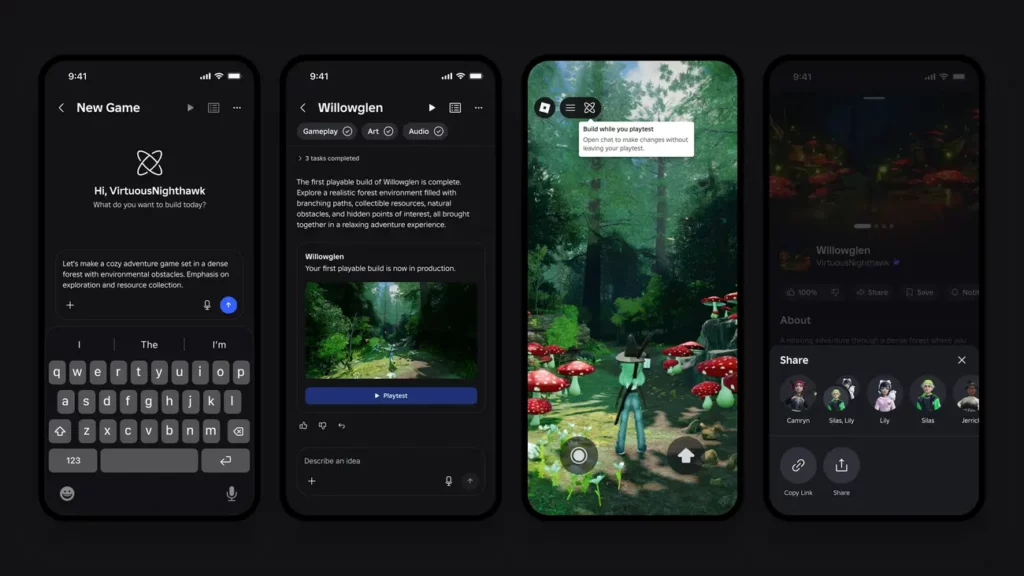
With over 132 million daily active users, Roblox has become one of the world’s biggest platforms for user-created games. Now, the company is taking game creation a step further by launching Build, a new AI-powered tool that allows users to create games using natural language prompts. Roblox says the feature will make game development more accessible to everyone.
What Is Roblox Build?
Roblox Build is a new feature that makes game creation easier for everyone. The feature introduces a mobile-first creation tab in the Roblox app, which lets users create games virtually from anywhere as long as they write a brief description of what kind of game they want to create using a short text command. The AI creates a playable template of the game, which creators can then customize after testing. After testing and refining the game, it can be posted to Roblox. One can even move to Roblox Studio when more advanced editing features are required, as both platforms work hand in hand.
The Build tool uses AI to do a number of things automatically within the game development process. With the help of Roblox AI and other types of AI technology, Build can create anything from characters and worlds to gameplay, sound effects, and graphics. Roblox says its AI has been trained using gaming-specific data and a large library of 3D models. As a result, it can create game-ready objects and fully playable scenes, helping more users bring their ideas to life.
Roblox plans to expand Studio with a new suite of AI tools for creators. One AI agent will automatically test games and find bugs before release. Another will provide easy-to-understand insights about game performance, and a third will recommend ways to boost player retention and monetization. In addition, Roblox is building AI technology that can generate editable 3D scenes from simple text descriptions.
For 20 years, Roblox has been on a mission to remove limits on what gaming is – and what it can be. Today, we’re introducing Build – a new way for anyone to create a game on Roblox from their phone. And we’re expanding AI-powered tools for developers of every level. We’re doing…
Roblox is launching Build in public alpha starting July 28. The ability to publish games will first reach selected creators in New Zealand, before expanding to additional countries in the coming months. The company says age-verified users aged 9 and older can use Build during the testing phase. However, only games that clear Roblox’s safety checks will be available to age-verified users aged 16 and above. Roblox also plans to keep the basic version free while introducing paid options for power users later.
According to Roblox, these tools are part of its vision to let anyone turn a game idea into reality. By making development simpler, the company hopes more creators will build and publish engaging games on the platform.
Revolut has major plans to become ‘the world’s first truly global bank’.
Revolut establishes its first banking entity in the Asia-Pacific after receiving regulatory approval in Australia.
With this latest approval, Revolut adds Australia to its full-licensed-banking-footprint across the UK, Mexico and the European Economic Area (EEA).
The company, with its existing retail customer base of more than 1m in the country, will now be competing for market share with Australian banking big wigs Commonwealth Bank, National Australia Bank, Westpac and the ANZ Group.
Advertisement
The UK fintech, which operates across 40 markets and serves more than 75m customers, is aggressively expanding its footprint in a bid to become “the world’s first truly global bank”. It recently won regulatory approval in Peru and the United Arab Emirates, and has applied for a banking license in the US.
Revolut’s regulatory success in Australia comes alongside a nearly A$400m investment commitment into the country over the next five years, including across growth and workforce.
“Launching our Australian bank has been a long-term strategic priority and marks another significant step in our mission to build the world’s first truly global bank. Securing this licence in a market as highly regulated and competitive as Australia is a testament to our business model and our teams,” said Nik Storonsky, the founder and CEO of Revolut.
Matt Baxby, the CEO at Revolut Bank Australia said: “It’s the launchpad for our next chapter, enabling us to expand into a broader suite of products, including savings and credit, to sit alongside the innovative services our customers already rely on every day.
Advertisement
“Our mission remains simple; to build the most seamless, secure, and customer-first banking experience for Australian consumers and businesses.”
The fintech reported its fifth consecutive year of net profitability with gross revenues up 46pc to $6bn in 2025, up from $4bn the year before. It is reportedly gearing to go public around 2028 for a valuation of between $150bn and $200bn.
The company also shared plans to pilot a physical store in Barcelona with a new format built for “how modern customers engage with brands today”.
Don’t miss out on the knowledge you need to succeed. Sign up for the Daily Brief, Silicon Republic’s digest of need-to-know sci-tech news.
Connecting the dots: The anti-PlayStation backlash does not appear to have cooled in the weeks following Sony’s announcement that it will cease manufacturing physical game discs in January 2028. However, despite online sentiment, available sales data shows that angry consumers are not voting with their wallets.
Circana analyst Mat Piscatella recently stated that only seven PlayStation games have sold more than 100,000 physical copies in the first half of 2026. Only two sold more than 10,000 during the week ending July 11, potentially vindicating Sony’s claim that PlayStation owners overwhelmingly prefer digital purchases.
Piscatella’s statistic came in response to the more than 10,000 comments that flooded a recent trailer for the upcoming Sony-published title Wolverine, set to launch September 15. Compared to other Sony trailers with larger view counts, the figure suggests that conversations about the company’s impending digital-only era remain heated.
2 PlayStation video games sold more than 10k physical units in the US during week ending July 11, 2026. 7 have sold more than 100k physical units year-to-date. Source: Circana Retail Tracking Service
Although Piscatella’s figures offer only a snapshot of US sales, other numbers paint a similar picture. A Change.org petition demanding Sony continue manufacturing discs has exceeded 300,000 signatures, but Dr. Serkan Toto, CEO of Japanese game industry consultancy firm Kantan Games, recently told IGN that the number is dwarfed by the roughly 50 million PlayStation Plus subscribers.
Sony’s 2025 fiscal year statement also confirms that 78% of the games it sold that year were digital, though the number includes titles that are only available digitally, which constitute the majority of the PlayStation 5’s library. The remaining 22% of sales were physical, amounting to nearly 70 million discs. For those curious, the PlayStation titles that have exceeded 100,000 physical units so far this year are, in order, Resident Evil Requiem, Crimson Desert, MLB The Show 26, 007 First Light, Lego Batman, WWE 2K26, and Call of Duty Black Ops 7.
Frustrated users who prefer physical games are likely powerless to change the PlayStation maker’s course. The company has already begun winding down disc manufacturing operations at its final plant, although games released before 2028 can still receive additional print runs after the cutoff date. Furthermore, the European Union confirmed that it cannot stop console manufacturers from abandoning physical media.
Advertisement
Jumping ship to Microsoft will likely not be an option for long. Rumors suggest that the company is strongly considering forgoing an optical drive for its next Xbox console, expected in 2027 or 2028. However, Microsoft is also reportedly developing a method to transfer physical game copies to digital-only devices.




































































You must be logged in to post a comment Login