
TL;DR
Amazon’s Jassy reportedly told the government that researchers used Fable 5 for cyberattack info. That triggered the order to shut down Fable 5 and Mythos 5.



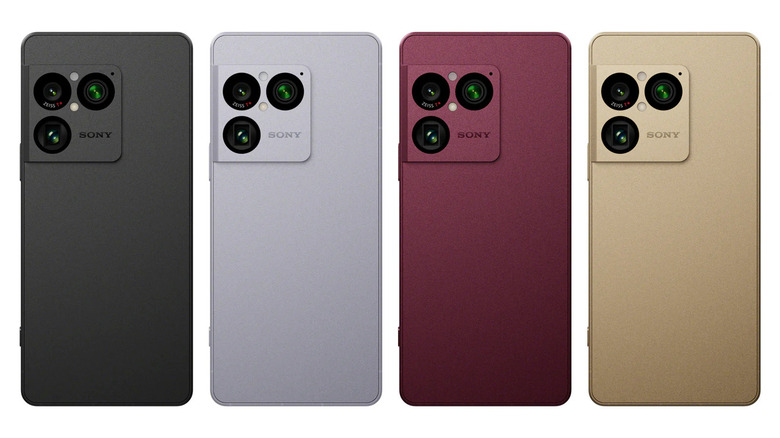
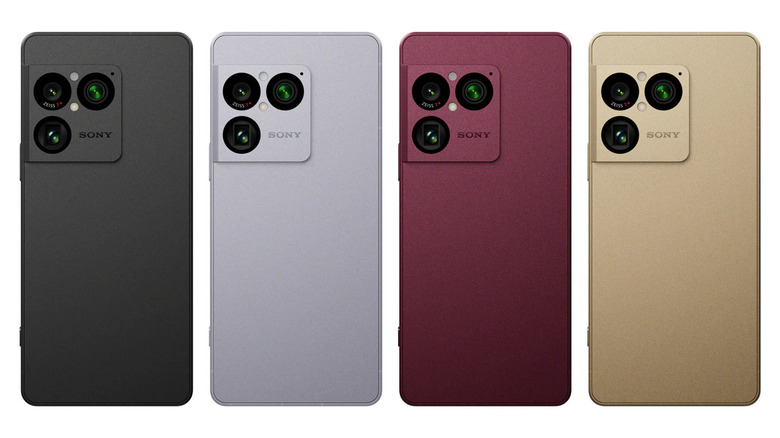
Sony has launched a new flagship phone, the Xperia 1 VIII, with its most notable features revolving around photography. The phone comes with the brand’s new AI Camera Assistant powered by Xperia Intelligence. Sony says the assistant can suggest changes to your settings based on what you’re photographing. When you point the camera at your subject, the assistant is supposed to automatically recognize the scene, the subject itself and the weather conditions to make suggestions on the best color tones, lens and bokeh effects to use. You can then tap on the suggestion to apply it to your photo.
The new Xperia also features a new 1/1.56‑inch image sensor in its telephoto camera. Sony says it’s approximately four times larger than the one it used in the previous model and enables detailed images even in low-light conditions. The phone applies RAW multi-frame processing, HDR and noise reduction for photos taken in low light. All of the device’s rear cameras are now arranged in a square rather than on a vertical island. In front, there’s a 12-megapixel camera for selfies. Aside from its photography-focused capabilities, another standout feature is the 3.5mm audio jack for wired headphones, which you rarely find on modern smartphones.
Sony’s Xperia 1 VIII has a 6.5-inch OLED display and is powered by Qualcomm’s Snapdragon 8 Elite Gen 5 Mobile Platform. It will be available in Graphite Black, Iolite Silver, Garnet Red and Native Gold colors for 1,499 euros or £1,399 for the 12GB RAM/256GB storage configuration and for 1999 euros / £1,849 for the 16GB RAM/1TB storage configuration. You can pre-order the phone starting today and get it in June at the earliest, but only if you’re in Europe. Sony has no plans to bring it to the US at the moment. If you do pre-order, you’ll get Sony’s WH-1000XM6 headphones for free.


Washington state Gov. Bob Ferguson on Tuesday announced that banning cellphone use in kindergarten through 12th grade throughout the school day will be one of his top priorities when lawmakers convene in January.
“More than half of states across the country are moving in one direction, and one direction only. They’re passing laws to keep cell phones out of classrooms,” Ferguson said. “Washington state is not one of them, and that must change in the next legislative session.”
Despite mounting concern, Washington has moved cautiously on the issue. Legislators passed a law in March requiring the Office of the Superintendent of Public Instruction to study district phone policies, review research and gather student input for an analysis due at the end of 2027.
Ferguson is urging faster action, seeking all-day bans on the devices in public schools by the start of the 2027-28 academic year. Superintendent of Public Instruction Chris Reykdal also supports a ban and is proposing a similar policy.
A study published in January from the University of Washington School of Medicine and others found that U.S. adolescents ages 13-18 spend more than one hour per day on phones during school hours, with “addictive” social media apps accounting for the largest share of use. Newly released documents reveal strategies employed by social media companies that aim to increase student use of the apps.
At the same time, the impact of phone restrictions are less clear. Recent research found that test scores did not improve at schools where cellphones were put away all day, but teachers observed fewer distractions and students reported a greater sense of personal well-being, per the New York Times.
Support among teachers is strong. At the Washington Education Association’s annual meeting in April, nearly 1,000 educators passed a resolution almost unanimously to ban cellphones during school.
“We support a statewide ‘away for the day’ cellphone policy, so that students can focus on learning, growing, and reaching their full potential,” said Larry Delaney, president of the WEA. “We owe it to our students to make this happen.”
The push comes as local districts are already acting. Last month, Seattle Public Schools instituted a district-wide policy requiring K-8 students to put phones away for the entire school day. High schoolers must store them during instruction time but have access during lunch and passing periods. Exemptions exist for health and educational needs.
Tuesday’s announcement was made at Robert Eagle Staff Middle School, one of the first in the district to institute an all-day phone ban. The speakers included Zoe Taggart, a seventh grader at the school.
Taggart said that while she sometimes misses her phone, the benefits to students are clear. “We spend more time talking to each other, building friendships and relationships in the present day,” she said. “Instead of texting someone who’s right down the hall, we actually go down and find them and have a real conversation.”
The Phone-Free Schools State Report Card, which rates school cellphone policies nationwide, gives Washington and three other states a failing grade for lacking statewide regulations.
Four states have earned “A” grades for requiring phones to be fully inaccessible during the entire school day, or “bell-to-bell.” Twenty states plus Washington, D.C., have “B” grades for all-day restrictions, though in those cases devices are stored in lockers or backpacks, keeping them potentially within reach.


Amazon’s Jassy reportedly told the government that researchers used Fable 5 for cyberattack info. That triggered the order to shut down Fable 5 and Mythos 5.
Amazon CEO Andy Jassy was reportedly the source of security concerns that led the US government to force Anthropic to shut down Fable 5 and Mythos 5 for every customer on Friday. The Wall Street Journal reported that Jassy told Treasury Secretary Scott Bessent and other officials that Amazon researchers used Fable 5 to obtain information that could be used in cyberattacks. The government then imposed an export control ban on both models.
The revelation adds an uncomfortable dimension to the story. Amazon is one of Anthropic’s largest investors, having put in billions and receiving a $100 billion cloud spending commitment in return. The company that bankrolls Anthropic’s infrastructure is also the one that told the government its models are dangerous.
An Amazon spokesperson said it is “not uncommon for governments to seek our counsel on potential security risks” but declined to share details of the discussions. The spokesperson also pointed to an AWS status update confirming that Amazon’s own cloud platform was affected by the model shutdown.
David Sacks, Trump’s former AI czar who now co-chairs the President’s Council of Advisors on Science and Technology, offered a different account. He said “a highly credible trusted partner of both Anthropic and the USG came forward with a jailbreak.” Sacks added: “The Admin asked Dario to fix the jailbreak or de-deploy the model. Dario refused.”
Anthropic’s version is different. The company said it reviewed the jailbreak technique and found it surfaced “a small number of previously known, minor vulnerabilities.” It called the government’s response disproportionate and said the capabilities causing concern are already available in other publicly accessible models. The shutdown affected every customer globally because Anthropic cannot filter foreign nationals from US users in real time.
The sequence matters for the AI industry. Amazon invested billions in Anthropic. Anthropic built models on AWS. Amazon’s CEO told the government those models pose security risks. The government used export controls to force them offline. AWS was then affected by the shutdown. It is an ouroboros of corporate dependency and regulatory blowback.
For Anthropic, the immediate question is how quickly it can restore access. For the broader industry, the precedent is what matters. If a major cloud provider can trigger an export control action against its own portfolio company by raising concerns with the Treasury Secretary, the competitive dynamics of the AI market just gained a new weapon. Mythos is used by banks and government agencies for vulnerability discovery. Every one of those customers lost access because of a dispute between Anthropic’s biggest investor and the government its CEO has been lobbying for more regulatory power.


For all the things that Formula 1 has changed over the years, from the powertrains, drivers, and safety equipment, some aspects always stay the same. One of the most vital of these is communication. Bear in mind that, unlike in video games, drivers don’t have convenient heads-up displays telling them what position they’re in, where their opponents are in relation to them, and other vital pieces of information. That’s the job of the race team in the pits, which usually relay such information over the radio. But what if the radio fails, it’s difficult to understand, or any number of other scenarios occur? Then it’s time to go old school.
Enter the traditional pit board: A large, easy-to-read board filled with numbers and letters. There’s no specific set language, but everything is concise and carries specific meanings — it’s designed to be read as the driver passes the start-finish line at racing speeds, after all. It’s never going to be as involved as actual radio calls or presenting the information on a steering wheel display, of course. But it’s a system that will never break down due to electronic or mechanical failure, which is why it’s still just as valid today as it was yesteryear.
F1 teams use pit boards to eke out every last possible advantage in a championship race and to avoid losing time and position. When points are on the line, a team doesn’t want to be forced to retire because of something like a radio failure. Auto racing is a brutal and unpredictable sport; that’s why these redundancies exist. Much like an aircraft flying on one engine, it may not be the most efficient, but using pit boards to communicate can still get you across the finish line.
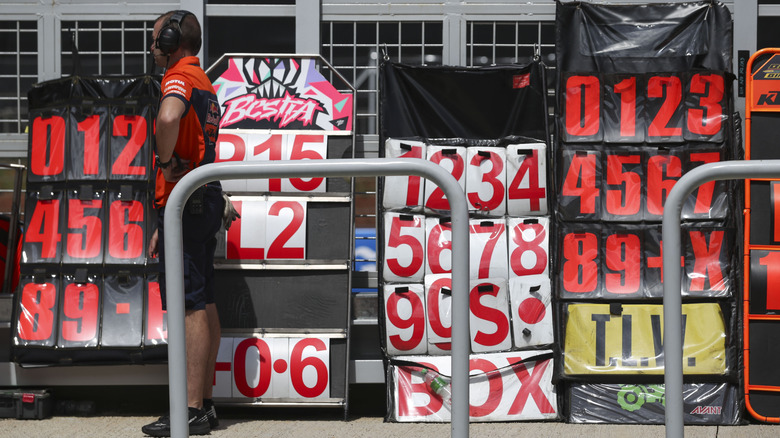
This is the biggest question for onlookers especially newbies just getting into F1, and the simplest answer is that it depends. Pit boards are designed to convey information, pure and simple — what that information precisely says varies depending on the team and what needs to be said. Generally, a pit board contains one or more of several points: Driver position, gap between cars, pit orders, sector cautions and other safety information, and general one or two-word commands can all be conveyed on a pit board.
There’s no real accepted “style,” per se. How many letters are used, what color the font is, what information is placed where on the board — it all varies. But you’ll often find that it’s usually based on common sense; you won’t place “BOX,” shorthand for “come in for a pit stop,” in the middle of two driver positions, for instance. Ultimately, it’s a form of coaching, and like the coaches themselves, there’s no set “right” or “wrong” way to convey the information as long as it’s clearly conveyed.
Let’s use an example. Imagine you’re leading on lap 10 and Verstappen is behind you by a little over 2 seconds. The pit board may say something like, “P1 – VER +2.1 – L10”, meaning you’re in Position 1, Verstappen is 2.1 seconds behind, and it’s Lap 10. Again, there’s no set language — different boards will have different formats. Sometimes they will spell out words like “LAP” or someone’s top message will be someone else’s bottom message. Because it has to be read at speed, presumably the order is committed to memory so it’s quickly legible at a glance. As a driver, it could potentially mess you up if your board’s format suddenly switches.
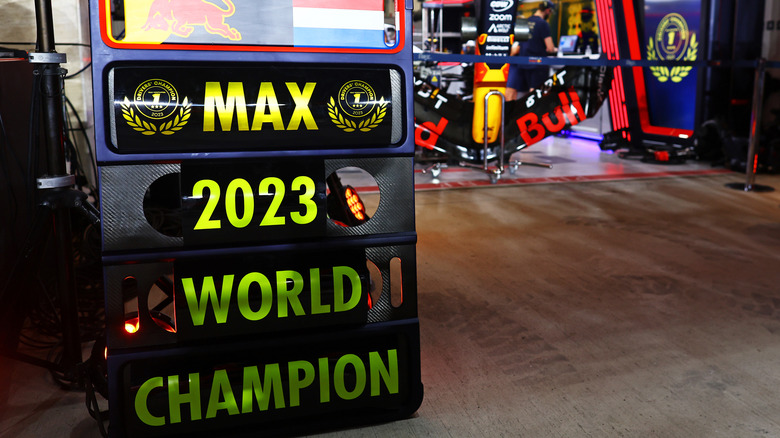
The biggest reason you’ll often see aside from track position and gap time is safety. Stewards use trackside boards to denote incidents, such as a large “SC” to indicate the presence of a safety car, or different colored boards to indicate flags; there’s a lot of racing flags, and their colors have their own standardized language.
As for the traditional pit board, it still has its uses outside of the radio or electronic equipment being broken. Sometimes it’s used because of personal preference or to keep from distracting the drivers. Bear in mind that top-level motorsport is incredibly demanding on drivers’ concentration, especially when racing in packs, which results in many compilations of drivers angrily shouting into their radios mid-race (much to our amusement). But let’s be honest — how many of us miss important pieces of information when we’re in high-stress environments? Something like a pit board might be more useful, even if just to repeat this sort of information.
In its purest sense, the pit board is a low-tech solution to the modern problem of information overload. With today’s F1 cars being faster than ever, coupled with the rising prevalence of automation and software on the racetrack, the sport has arguably become just as much a technical showcase as it is about the drivers’ skills. A pit board is a simple and effective method of getting information across to drivers without having to use words or other distractions, a point no less valid today, which is why it’s been crucial to motorsport since the dawn of the discipline.


The iconic neon sign at the Pike Place Market in Seattle manages to attract a lot of attention, but a glowing new structure across the street will likely turn a few curious heads, too.
The first of dozens of IKE Smart City digital wayfinding kiosks planned for downtown and around Seattle was unveiled on Tuesday at the busy intersection of First Avenue and Pike Street. It’s the realization of a years-long effort to bring the information many people access on smartphones straight to giant interactive screens at street level.
“Seattle is a tech town, and we finally have a 21st-first century modern wayfinding system,” said Jon Scholes, president and CEO of the Downtown Seattle Association, the organization that spearheaded the effort to get the kiosks approved and installed.

The devices are a product of Columbus, Ohio-based advertising company Orange Barrel Media, which is partnering with DSA on the experience. IKE devices are already deployed in more than 25 cities nationwide.
A total of 50 kiosks are planned for Seattle in two phases. The first 30 will be installed in the downtown Metropolitan Improvement District footprint, with 20 more to follow in business improvement areas including Ballard, SoDo, the University District and West Seattle.
The first four downtown units include Tuesday’s unveiling as well as another that’s operational at Fourth Avenue and Pine Street. Units at Second Avenue and Stewart Street and Third Avenue and Virginia Street are next.
Each unit stands just over 8 feet tall and 3 feet wide, with a 12½-square-foot touchscreen that functions like a giant smartphone — letting users scroll through maps, nearby restaurant listings, transit routes and city apps. The kiosks are ADA-compliant and connect to the Seamless Seattle program for real-time multimodal navigation directly from each location.
Beyond wayfinding, each kiosk serves as a free public Wi-Fi hotspot, lists nearby businesses at no charge, and includes a 911 emergency call button. At least 25% of annual screen time is reserved for non-commercial content promoting events, nonprofits and civic initiatives. An ongoing digital public art program, curated with local and national artists, is also part of the offering.

The kiosks will not include video cameras for surveillance. They do include a selfie camera that is part of a “Photo Booth” application, where users can interact and snap pictures to send to themselves. But IKE says photos are not stored on the kiosks or retained by the company.
The devices and effort to install them ultimately prevailed over those who expressed concern during Seattle Design Commission meetings about visual clutter in the city’s landscape, oversaturation of advertising, and light pollution.
The devices are maintained by Orange Barrel and come at no cost to the city or to DSA, and are sustained entirely through advertising revenue. DSA anticipates the kiosks will generate approximately $1.1 million per year, money the organization says it will reinvest into downtown programming.
Scholes said it’s a “long-term investment,” with a permit between Orange Barrel and the city that’s good “for about 20 years.”
“We believe that great downtowns make it easy for you to discover what’s happening, to take part in events, to take part in arts and cultural gatherings and attractions,” Scholes said before cutting a ceremonial ribbon cutting alongside Orange Barrel officials, and current and former City of Seattle officials.

Former Seattle City Council President Sara Nelson was in attendance to celebrate — and interact with — the devices she had long championed.
“This is the city at your fingertips,” Nelson told GeekWire. “Not only is there important information for emergencies, but it also supports our small business community — it is a focal point, it’s a gathering spot, and that is what we need more of downtown.”
The rollout of the kiosks has been in the works for more than a year. The Seattle City Council gave final approval in June 2025 by a 6-2 vote, and former Mayor Bruce Harrell — a supporter of the project — signed the legislation.
DSA had hoped to have more up and running before the start of the FIFA World Cup next week and the onslaught of expected visitors to the city. The remaining 28 planned for downtown will be installed over the next several months, Scholes said.


Looking for a different day?
A new NYT Connections puzzle appears at midnight each day for your time zone – which means that some people are always playing ‘today’s game’ while others are playing ‘yesterday’s’. If you’re looking for Saturday’s puzzle instead then click here: NYT Connections hints and answers for Saturday, June 13 (game #1098).
Good morning! Let’s play Connections, the NYT’s clever word game that challenges you to group answers in various categories. It can be tough, so read on if you need Connections hints.
What should you do once you’ve finished? Why, play some more word games of course. I’ve also got daily Strands hints and answers and Quordle hints and answers articles if you need help for those too, while Marc’s Wordle today page covers the original viral word game.
SPOILER WARNING: Information about NYT Connections today is below, so don’t read on if you don’t want to know the answers.

Today’s NYT Connections words are…
What are some clues for today’s NYT Connections groups?
Need more clues?
We’re firmly in spoiler territory now, but read on if you want to know what the four theme answers are for today’s NYT Connections puzzles…
What are the answers for today’s NYT Connections groups?
Right, the answers are below, so DO NOT SCROLL ANY FURTHER IF YOU DON’T WANT TO SEE THEM.

The answers to today’s Connections, game #1099, are…
Seeing TEA PARTY and MASSACHUSETTS beside each other my first thought was Boston; I added GLOBE because the Boston Globe newspaper sounded like a possibility and took a chance on CREAM PIE. I pressed “submit” fully expecting to get a purple first — alas, it was completely wrong.
At this point I thought of the most common appearance of a CREAM PIE — as a practical joke — and managed to compile the four CLASSIC SLAPSTICK PROPS.
As it often does, getting the first group unlocked the others — although it did take me two attempts to get THINGS THAT SPIN as I had POCKET WATCH instead of GRINDSTONE.
NYT Connections is one of several increasingly popular word games made by the New York Times. It challenges you to find groups of four items that share something in common, and each group has a different difficulty level: green is easy, yellow a little harder, blue often quite tough and purple usually very difficult.
On the plus side, you don’t technically need to solve the final one, as you’ll be able to answer that one by a process of elimination. What’s more, you can make up to four mistakes, which gives you a little bit of breathing room.
It’s a little more involved than something like Wordle, however, and there are plenty of opportunities for the game to trip you up with tricks. For instance, watch out for homophones and other word games that could disguise the answers.
It’s playable for free via the NYT Games site on desktop or mobile.


The model is open for the public to view as part of the Heart exhibition in RCSI’s Humanarium.
Researchers at RCSI University of Medicine and Health Sciences hope to better understand diseases in the mitral heart valve with an artificial model that mimics the valve’s complex mechanisms.
The heart’s mitral valve opens and closes around 100,000 times each day, making its mechanical properties key to healthy heart function.
When the valve does not work properly, blood can leak backwards through the heart in a condition called ‘mitral regurgitation’. This condition affects millions worldwide, with that number growing alongside global life expectancy.
“Advancing our understanding of mitral valve function is dependent on developing synthetic alternatives that capture the valve’s complex mechanical behaviour, which is achieved in this study,” explained Dr Claire Conway, a lecturer in RCSI’s department of anatomy and regenerative medicine, and one of the authors of the new study published in Acta Biomaterialia.
The study was funded through an RCSI Star Lectureship and the Research Ireland Frontiers for the Future Programme, and carried out by the RCSI Tissue Engineering Research Group.
Generally, synthetic mitral valves lack multi-directional mechanical properties and are unable to withstand the blood pressure and flow of a human heart, the researchers said.
This new model makes a marked change by being the “first of its kind” to incorporate the mechanical properties of real heart valve tissue, while also operating under realistic heart pressures and flow conditions, they explained.
The model also allows control over the tension and thickness of the parts that allow the valve to open and close effectively.
“This model captures native anatomy and the fabrication is precise and repeatable,” said Conway. “Physical and digital tests of the valve revealed it successfully functioned under physiological flow and physiological pressure, representing a significant advance in the field.”
Dr Sina Javadpour, first author of the study and a postdoctoral fellow at Trinity College Dublin, said: “This model gives us precise control over key features of the mitral valve while still reproducing the way it functions in the heart.
“That makes it a powerful tool for studying valve disease and testing new repair strategies in a controlled laboratory environment.”
The model is open for the public to view as part of the Heart exhibition in Humanarium at RCSI.
Don’t miss out on the knowledge you need to succeed. Sign up for the Daily Brief, Silicon Republic’s digest of need-to-know sci-tech news.

Looking for the most recent Connections answers? Click here for today’s Connections hints, as well as our daily answers and hints for The New York Times Mini Crossword, Wordle, Connections: Sports Edition and Strands puzzles.
Today’s NYT Connections puzzle offers some fun categories. I actually liked the purple grouping today! Read on for clues and today’s Connections answers.
The Times has a Connections Bot, like the one for Wordle. Go there after you play to receive a numeric score and to have the program analyze your answers. Players who are registered with the Times Games section can now nerd out by following their progress, including the number of puzzles completed, win rate, number of times they nabbed a perfect score and their win streak.
Read more: Hints, Tips and Strategies to Help You Win at NYT Connections Every Time
Here are four hints for the groupings in today’s Connections puzzle, ranked from the easiest yellow group to the tough (and sometimes bizarre) purple group.
Yellow group hint: Think about The Three Stooges.
Green group hint: Round and round.
Blue group hint: Curiouser and curiouser.
Purple group hint: Not Pa, but close.
Yellow group: Classic slapstick props.
Green group: Things that spin.
Blue group: Featured in “Alice’s Adventures in Wonderland.”
Purple group: What “MA” might refer to.
Read more: Wordle Cheat Sheet: Here Are the Most Popular Letters Used in English Words
The completed NYT Connections puzzle for June 14, 2026.
The theme is classic slapstick props. The four answers are banana peel, cream pie, rubber chicken and seltzer bottle.
The theme is things that spin. The four answers are globe, grindstone, gyroscope and roulette wheel.
The theme is featured in “Alice’s Adventures in Wonderland.” The four answers are caterpillar, pocket watch, rabbit hole and tea party.
The theme is what “MA” might refer to. The four answers are Massachusetts, master of arts, milliampere and mother.


Frequent flyers and daily commuters have a common frustration. Engine drone on flights, train clatter, and workplace background noise all compete for attention over extended periods of travel or sitting at a computer. Many noise-cancelling headphones provide relief, but they come with software, touch controls, and expensive pricing that appear unnecessary for just basic needs. ONANOFF’s Made for Amazon headphones, priced at $19.99 (was $80), cut through the noise in a refreshingly practical manner.

The over-ear design promotes comfort, with lightweight materials and the softest ear cushions to keep you comfortable even after hours of listening. People have commended the seal’s endurance, even on long, multi-hour flights or back-to-back meetings, because there is no need to fuss with it to ensure a correct fit.
Active noise cancellation is as simple as pressing a single button, and it effectively reduces low-frequency sounds that can be bothersome in contexts such as airplane cabins and autos. Many users have used these for long flights and noted that engine rumbling is practically eliminated, allowing them to listen to podcasts or music without having to crank up the volume to the limit. The experience is heightened by the passive noise isolation provided by the ear cups, which effectively provides a comfortable listening environment without the need to constantly tinker with it.
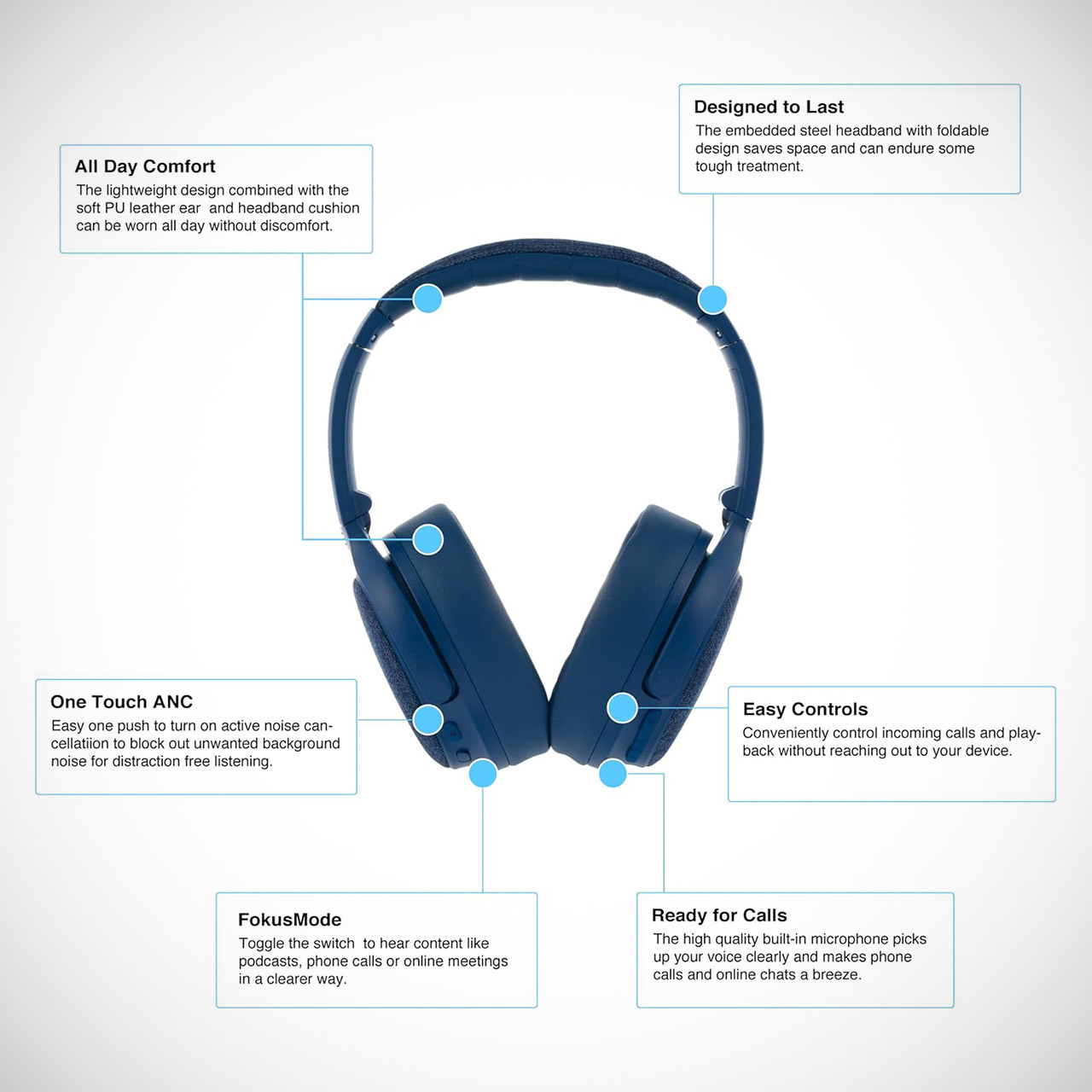
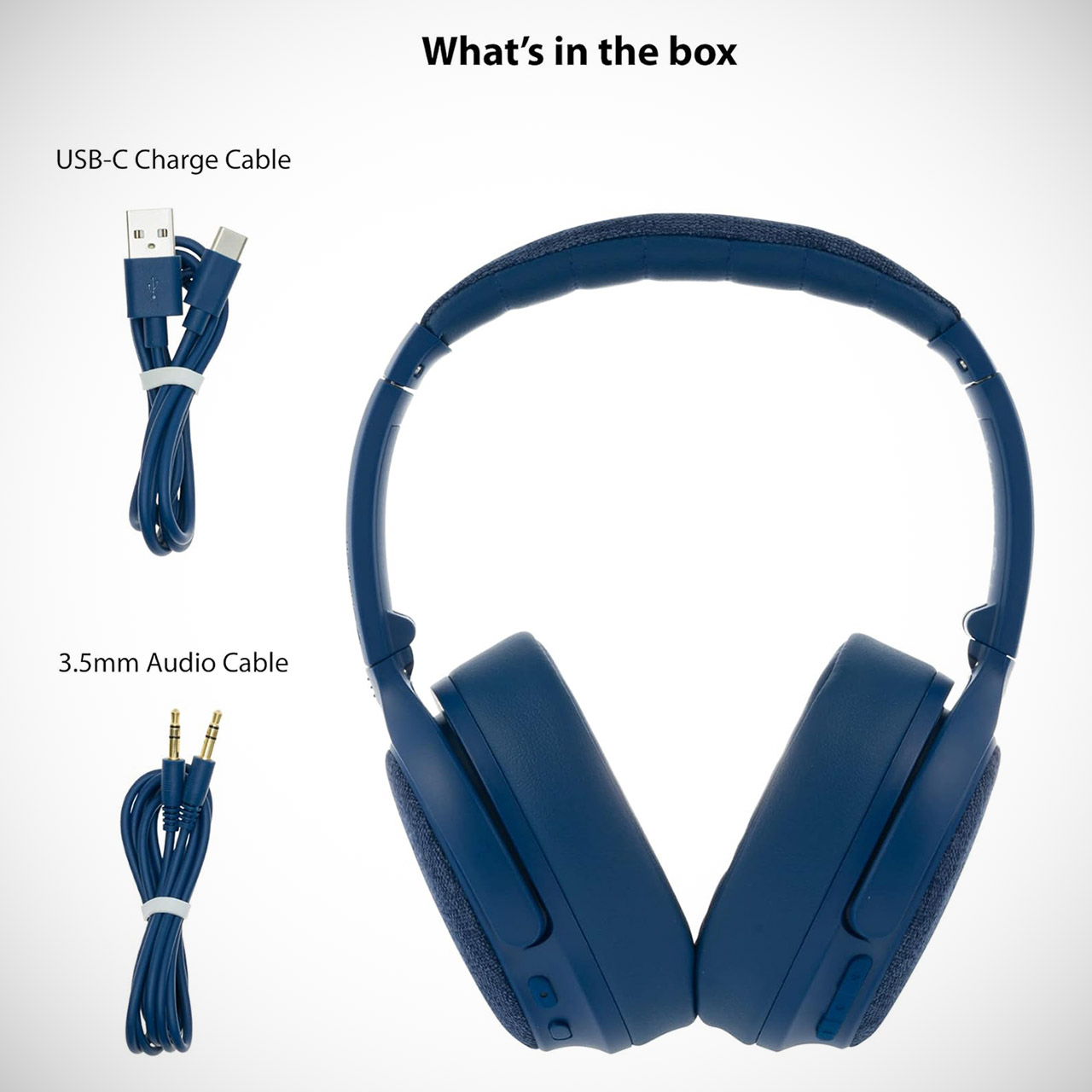
When it comes to real-world schedules, the battery life is spot on, boasting roughly 20 hours of wireless listening with noise cancellation running, which is enough to span the duration of many flights as well as all of your regular commutes for several days before it needs to be recharged. There is also a useful old-fashioned auxiliary cable available in case you run out of power mid-flight or on a plane with all of its entertainment systems, which serves as an excellent backup option.
The controls are simple and intuitive, with old-school buttons on the ear cups that let you to control music, volume, and calls without having to swipe. There’s also an extra little switch there that activates FOKUS mode, which allows you to prioritize vocal clarity, guaranteeing that your podcasts and phone calls are perfectly clear with no background noise in the mix. It’s especially beneficial when you’re traveling and need to catch up on audio content or make business calls in a congested terminal.
The sound is good and balanced, with just enough bass to give your music weight while not overpowering the rest of the mix. The mids and highs are clear and sharp, letting you to listen to anything you desire, including music, podcasts, and spoken word. They’re not striving to be ultra-high-end, show-off-spec headphones; instead, they provide nice, reliable listening that won’t wear you out after a few hours. If all you need is something practical, this is it.
Pairing with your phone, laptop, or tablet is simple; all you need is a short tap and you’re done. The “Made for Amazon” label indicates that it will perform well in the Amazon environment, but it will also work well with all other Bluetooth devices. There’s no worry, no mess, and no need to set up any ridiculous apps; simply plug in and go.


John Cook and Charles Fitzgerald spent several days in Cleveland this week, and they came back with a cautionary tale for Seattle: don’t assume the good times will last. But they also found inspiration: a city that’s coming back by getting its business, civic, and public leaders to row in the same direction.
The GeekWire co-founder and the Seattle angel investor called into the GeekWire Podcast from an unlikely setting: an abandoned Westinghouse light bulb factory on Cleveland’s near east side, part of an industrial district called The Midline that’s being redeveloped for a new generation of jobs.
The Cleveland trip closes a loop that opened in February, when Fitzgerald, a GeekWire contributing columnist, wrote a provocative piece warning that Seattle risked becoming the next Cleveland.
Cleveland Mayor Justin Bibb joined the podcast to push back and make the case for his city, then invited the two to come see its comeback for themselves. This week, John and Charles took him up on it.
Over several days, they met with Bibb, Ohio Gov. Mike DeWine, and a roster of developers, entrepreneurs, and civic and business leaders. What stood out, they say, was a city hustling and aligned around jobs and growth in a way Seattle no longer is. Their takeaway is blunt: Cleveland could eat Seattle’s lunch if Seattle keeps taking its prosperity for granted.
For the full rundown of advice from those Cleveland leaders, see John’s previous story.
Then we turn to the week’s news back home. The Seattle City Council voted unanimously for a one-year moratorium on new large data centers. Fitzgerald argues it’s political theater, since the big AI data centers were never coming to high-cost Seattle anyway, and says the real concern is the signal it sends about whether the city is open for business.
And with the SpaceX IPO landing on Friday, Fitzgerald explains why he’s sitting it out.
Subscribe to GeekWire in Apple Podcasts, Spotify, or wherever you listen.
Looking for a different day?
A new NYT Strands puzzle appears at midnight each day for your time zone – which means that some people are always playing ‘today’s game’ while others are playing ‘yesterday’s’. If you’re looking for Saturday’s puzzle instead then click here: NYT Strands hints and answers for Saturday, June 13 (game #832).
Strands is the NYT’s latest word game after the likes of Wordle, Spelling Bee and Connections – and it’s great fun. It can be difficult, though, so read on for my Strands hints.
Want more word-based fun? Then check out my NYT Connections today and Quordle today pages for hints and answers for those games, and Marc’s Wordle today page for the original viral word game.
SPOILER WARNING: Information about NYT Strands today is below, so don’t read on if you don’t want to know the answers.
• Today’s NYT Strands theme is… Peer group
Play any of these words to unlock the in-game hints system.
• Spangram has 8 letters
First side: top, 3rd column
Last side: bottom, 4th column
Right, the answers are below, so DO NOT SCROLL ANY FURTHER IF YOU DON’T WANT TO SEE THEM.

The answers to today’s Strands, game #833, are…
Even though I understood today’s theme I still struggled to find all of the la-de-da titles after exhausting the obvious ones of EARL, LADY and LORD and needed hints to get to the finish line.
NOBILITY has become a strange thing in the United Kingdom; the days when we revered them are long gone. They are less visible in society, but they still exist and enjoy opulent lifestyles on a different planet to most people and have the ability to look down their noses at everyone — no amount of money can buy you access to their club.
The only way to think of the subject of peers is as peculiar comedy characters, which is why I spent most of this game remembering the brilliant Grey Poupon TV adverts from the 1980s and ’90s — it even has wine, don’t you know.
Strands is the NYT’s not-so-new-any-more word game, following Wordle and Connections. It’s now a fully fledged member of the NYT’s games stable that has been running for a year and which can be played on the NYT Games site on desktop or mobile.
I’ve got a full guide to how to play NYT Strands, complete with tips for solving it, so check that out if you’re struggling to beat it each day.




Alexander Zverev wins the French Open to finally earn a 1st Grand Slam title

The Best Mystery Series of All Time Is Surging on Streaming 30 Years After It Ended


Anatomy of the June crypto crash: Fed, Iran, Saylor


Oppenheimer backs SpaceX as $70 billion retail frenzy builds


Markets Rally as SpaceX IPO Looms Amid Iran Tensions and Inflation Surge

Alexander Zverev conquers demons and outlasts Flavio Cobolli to win French Open for first major title


Microsoft unveils seven homegrown AI models in new bid for ‘long term self-sufficiency’


High Stakes for Wembanyama as New York Pushes for 3-0 Lead


Notion restores access to Anthropic after service disruption

The Pain Points Taking a Fragile Tech Rally Down a Notch

Eli Lilly (LLY) Stock Surges 4% Following Breakthrough Sleep Apnea Trial Results

The investment to transform historic St Helen’s ground in Swansea


Trump’s AI Ownership Plan Could Benefit Anthropic at OpenAI’s Expense


FIFA WC 2026 Group C: Morocco, Scotland challenge Brazil’s hunt for glory | FIFA World Cup 2022

Bangladesh beat Australia after 20 years in ODIs, register only their second win over six-time world champions | Cricket News


NanoClaw integrates JFrog registries to secure AI agent downloads


Bitget enters Argentina’s regulated crypto market through PSAV registration


Weekend Open Thread: Tuckernuck – Corporette.com


This Week In Security: Microsoft On Microsoft, Register Your Domains, Linux On ARM, And FreeBSD Joins The File Cache Club


Politics Home | Healey Resignation Is “Colossal Failure Of Government”, Says Former Labour Defence Secretary



You must be logged in to post a comment Login