Connect with us
DAPA Banner

Tech

S’pore saw the biggest drop in job postings in 5 yrs

Published

on

Just as hiring appeared to be picking up, Singapore’s job market has reversed course. Job postings have fallen to the lowest level since Mar 2021, according to the latest report from job listing portal Indeed.

In Feb 2026, postings dropped 4.5% to sit 12% below a year ago, a decrease that has more than offset three consecutive months of gains.

Still, the headline figures only tell part of the story. Hiring trends vary significantly across sectors, with gains in some occupations offset by steep declines in others.

Here’s a breakdown of how job postings have shifted across different roles:

Advertisement

The winners & losers

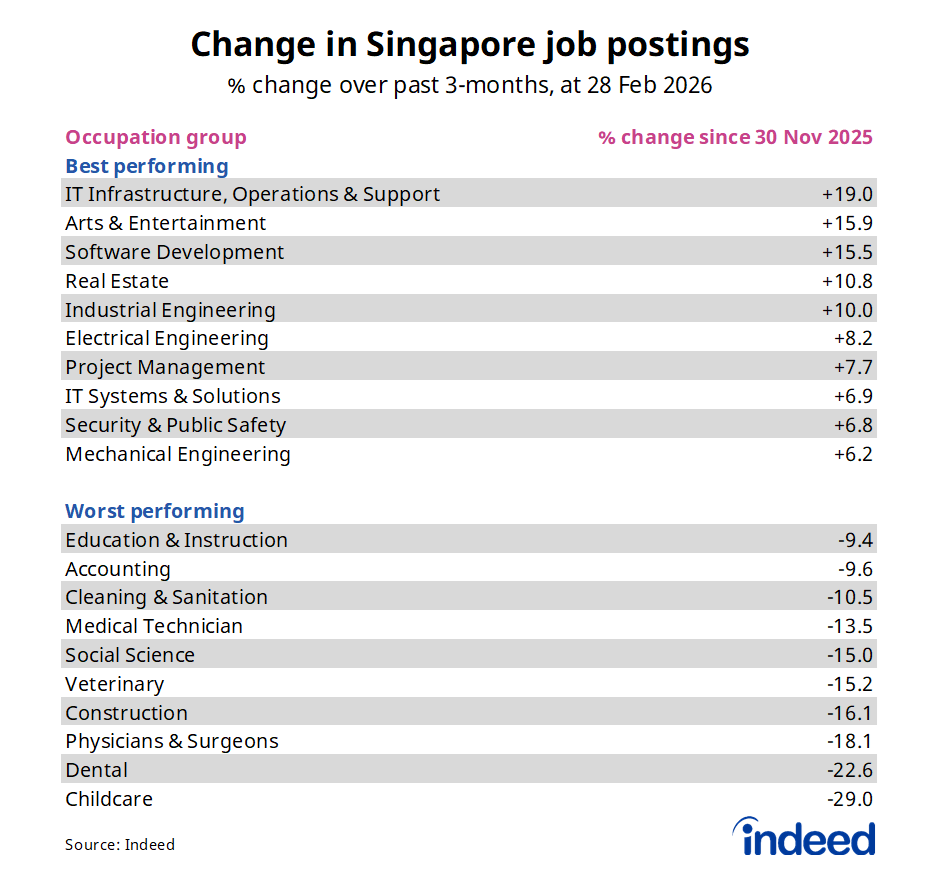
Indeed provides a rolling three-month breakdown for the professions with the largest swings in demand, so we can compare which jobs are going up and which are falling out of favour.

Job postings rose in around half of occupational categories over the past three months, led by gains in IT infrastructure, operations & support (+19%), arts & entertainment (+16%) and software development (+15%).

Interestingly, some of the strongest gains were recorded in occupations that have a high exposure to AI transformation.

But those gains were offset by steep declines elsewhere.

Postings fell sharply in childcare (-29%), dental (-23%) and civil physicians & surgeons (-18%), with education and healthcare among the sectors seeing the most pronounced pullback in recent months.

Advertisement

More remote work opportunities

The report also found that remote work is gradually gaining ground.

In February, 8.6% of all job postings explicitly mentioned terms like “work from home” or “work remotely.” That’s a slight increase from the 8.4% recorded a year ago, and has climbed from a post-pandemic low of 6.9% in late 2022. 

Remote work opportunities are most common in IT systems & solutions at 15.6% of postings in the February quarter, ahead of sales (15.5%) and media & communications (14.0%). 

Large gains were also seen in occupations that have traditionally offered few remote or hybrid opportunities. Social sciences (+4.5%) and real estate (+3.5%) led the way.

But not all sectors are moving in the same direction.

Advertisement

Remote postings fell sharply in insurance (-7.5%), human resources (-6.0%), architecture (-5.3%), and electrical engineering (-3.6%), underscoring how remote work trends vary widely across occupations.

The labour market still remains strong

On the whole, though, it seems like the labour market situation in Singapore still remains stable and strong, despite the decrease in the total number of openings.

At the end of Feb, job postings were still 32% above pre-pandemic levels.

The post-pandemic job boom in Singapore was so large that even though job postings are down 45% from their peak in Jul 2022, it’s still sufficiently high to keep the unemployment rate low—just 2% at the end of last year.

Advertisement

However, the Singapore economy will face some stiff economic headwinds this year as the conflict in the Middle East triggers higher inflation and increased cautiousness from households and businesses alike.

With a tight labour market and solid economic growth last year, Singapore is relatively well positioned to weather these challenges. Nevertheless, the economic outlook has softened in recent weeks, underscoring the risks ahead.

Indeed expects that job opportunities will continue to moderate over the course of 2026. 

  • Read other articles we’ve written on Singaporean businesses here.

Featured Image Credit: Shadow_of_light/ depositphotos

Advertisement

Source link

Continue Reading
Click to comment

You must be logged in to post a comment Login

Leave a Reply

Tech

Portal Space Systems raises $50M as it gets set to launch its first orbital vehicle made for rapid maneuvers

Published

on

An artist’s conception shows Portal’s Starburst spacecraft in the foreground with its Supernova space vehicle and three more Starbursts (plus Earth) in the background. (Portal Space Systems Illustration)

Bothell, Wash.-based Portal Space Systems has raised $50 million in a funding round aimed at speeding up development of the Seattle-area startup’s highly maneuverable space vehicles.

The first such vehicle, Starburst-1, is due for launch as early as this fall as a payload on SpaceX’s Transporter-18 satellite rideshare mission. Portal is also getting ready to move into a 52,000-square-foot manufacturing facility where future Starburst spacecraft and even more capable Supernova space vehicles will be built.

Portal CEO Jeff Thornburg — who co-founded the company in 2021 following stints at tech ventures including SpaceX and Stratolaunch Systems — characterized the newly announced Series A funding round as closer to a giant leap than a small step.

“The thing that’s exciting me the most, and really the company at large, is that it helps us move faster,” he told GeekWire. “We’re obviously focused on getting Starburst and Supernova capabilities demonstrated and available to our customers as quickly as we can.”

The round was led by Geodesic Capital and Mach33, with participation by Booz Allen Ventures, AlleyCorp and FUSE. It builds on a $17.5 million seed round that was announced last year.

Advertisement

Portal is developing a solar thermal propulsion system that will use focused sunlight to heat the ammonia-based propellant for its Supernova space vehicle. The system is designed to allow for rapid adjustments in Supernova’s orbit. Orbital maneuvers that would typically take weeks or months to execute using traditional propulsion systems could be done in hours or days.

Starburst would use a more traditional thruster system, but would take advantage of many of the technologies being developed for Supernova. “Eighty-one percent of the components are shared between Starburst and Supernova,” Thornburg said. “We’ve got a lot of delta-v packed in the Starburst, even though it’s a smaller platform.”

Starburst-1, which is being readied for a potential October launch, will be equipped with TRL11’s video camera and edge processing system plus Zenno Space’s superconducting magnetic actuator for a yearlong test mission in sun-synchronous orbit.

An experimental payload nicknamed “Mini-Nova” was sent into orbit last month to test the control software and power systems for Starburst as well as for Supernova. “Mini-Nova is healthy … and so I think we’re in good shape for what’s to come,” Thornburg said.

Advertisement

The first Supernova is due to be launched next year, thanks in part to $45 million in funding from the U.S. Space Force’s SpaceWERX program. Thornburg said Supernova-1 could take on any of a variety of missions that “support the Defense Department’s needs where it comes down to rapid maneuverability.”

Portal’s team is already looking further out on the mission timeline.

“We have a lot of interest from a lot of different customers, including the government just by itself, as well as commercial companies in the service of defense or commercial missions,” Thornburg said. “So, we’re leaning forward on the second Starburst build. And then, in parallel, one of the first uses of the new building will be assembly work for Supernova-1. … We can continue to build Starburst in our existing facility if we want to, for a certain amount of time.”

Portal is aiming to build as many as four spacecraft per month by the end of 2027 — which means the company is going to need a bigger workforce. “We’re at about 40 people at the company,” Thornburg said. “We’ll probably double in size throughout the rest of this year.”

Advertisement

How would Starburst and Supernova be used? “For defense, what we’re really targeting is areas I would describe as space domain awareness, or being able to observe things that sometimes can be difficult to observe,” Thornburg said. “And then I think the second application in the defense category is to protect and defend. We have adversaries on orbit doing things that are very confrontational, and I don’t know that we always have equivalent capabilities or deterrence in kind.”

On the commercial side, Thornburg points to orbital debris tracking and removal. “Recently you had a Starlink satellite breaking up,” he said. “That creates a problem for SpaceX and other people. Having to move around this stuff costs money and time. So, you’re seeing a profit motive for dealing with orbital debris on the commercial side, as well as their own surveillance.”

Portal and an Australian venture called Paladin Space recently announced a partnership to create an orbital debris tracking and removal service that could go into business as early as next year. Starlab Space, an industry consortium that has been laying the groundwork for a commercial space station, has already signed a letter of intent to integrate the Portal-Paladin service into future station operations.

Thornburg said Supernova could also play a role in NASA’s Artemis moon program, which recently set its sights on building a permanent lunar base. “We have the performance to be able to easily move between GEO [geostationary Earth orbit] and cislunar domains in a way that could be helpful for logistics, experiments, communications, data and other things. We don’t have a lot of spacecraft that can do that without the aid of a rocket right now,” he said.

Advertisement

In all these cases, Portal aims to capitalize on its ability to offer rapid mobility in space — a strategy that received strong backing from the company’s leading investors. “We are confident that Portal will become the Space Mobility Prime in the near future,” said Aaron Burnett, group CEO of Mach33.

“The future of space is dynamic, and that shift is being recognized globally,” said Rayfe Gaspar-Asaoka, partner at Geodesic Capital. “Portal Space is pairing deep propulsion expertise with advanced spacecraft development built for mobility, reliability and scale. Geodesic is thrilled to co-lead Portal’s Series A and work alongside Jeff and the team as they continue to expand what’s possible in space.”

Source link

Advertisement
Continue Reading

Tech

YouTubers sue Amazon for allegedly scraping their videos to train Nova Reel

Published

on

In short: Three YouTube content creators, specifically the company behind H3H3 Productions, a solo golf presenter, and a golf channel, have filed a proposed class action lawsuit in Seattle alleging that Amazon bypassed YouTube’s technical protections using virtual machines and rotating IP addresses to scrape their videos without consent, feeding the footage into training datasets for Nova Reel, its generative video AI model available through Amazon Bedrock. The suit invokes the anti-circumvention provisions of the Digital Millennium Copyright Act and is the latest in a series of similar cases the same group has filed against Nvidia, Meta, ByteDance, Snap, OpenAI, and Apple.

Ted Entertainment Inc., the company behind H3H3 Productions and H3 Podcast Highlights, the YouTube channels run by Ethan and Hila Klein, filed the complaint in the US District Court for the Western District of Washington alongside Matt Fisher, who runs the MrShortGame Golf channel, and Golfholics Inc. The three plaintiffs collectively account for more than 2.6 million YouTube subscribers, approximately four billion combined views, and more than 5,800 original videos. The suit names Amazon as the defendant and targets Nova Reel specifically as the product built, in part, on their content.

The complaint and its legal theory

The lawsuit rests on Section 1201 of the Digital Millennium Copyright Act, the anti-circumvention provision that prohibits bypassing technological protection measures put in place by copyright holders to restrict access to their works. The plaintiffs argue that YouTube’s systems for protecting its video files constitute such technological protection measures and that Amazon circumvented them deliberately and at scale to extract training data. If the theory holds in court, it would establish that the act of downloading YouTube videos for AI training purposes constitutes a DMCA violation regardless of whether the content is publicly viewable, because circumventing the technical mechanisms that enforce terms of service crosses the statutory line.

The complaint draws attention to what the plaintiffs describe as the permanent nature of the harm: “Once AI ingests content, that content is stored in its neural network and not capable of deletion or retraction.” The plaintiffs are seeking both damages and injunctive relief, the latter potentially forcing Amazon to stop distributing a model trained in part on their content or to retrain it without the disputed material.

Advertisement

How the scraping allegedly worked

The complaint centres on two academic datasets: HD-VILA-100M, produced by Microsoft Research Asia in 2021, and HD-VG-130M, produced by researchers from Peking University and Microsoft. Both were published for academic purposes and consist of URL identifiers pointing to YouTube videos rather than the video files themselves. That distinction is legally significant: to use either dataset for AI model training, a company must download the actual video files from YouTube, and the plaintiffs allege Amazon did exactly that.

The 💜 of EU tech

The latest rumblings from the EU tech scene, a story from our wise ol’ founder Boris, and some questionable AI art. It’s free, every week, in your inbox. Sign up now!

According to the complaint, Amazon did not simply download the videos. It deployed automated programmes combined with virtual machines that rotated IP addresses continuously to evade YouTube’s detection and blocking systems. The combination of these technical measures, namely automated mass downloading, virtual machine infrastructure, and IP rotation, is characterised in the complaint as a deliberate circumvention of the technological protection measures YouTube maintains over its video library. The same evasion pattern was alleged in this group of plaintiffs’ earlier suit against Nvidia, which the complaint in that case said had downloaded 38.5 million video URLs using comparable infrastructure.

Advertisement

Nova Reel and Amazon’s video AI ambitions

Nova Reel is Amazon’s text-to-video generative AI model, launched in December 2024 and made available through Amazon Bedrock. The model accepts text prompts and images as inputs and generates video clips ranging from six seconds to two minutes in length, with a watermarking feature that Amazon positions as a content authenticity measure. It sits within the broader Nova model family, which Amazon has been expanding across text, image, and video modalities as competition in enterprise AI accelerates.

The competitive pressure on Amazon to build capable video AI is substantial. Nova Reel represents the company’s attempt to compete with Sora, Google Veo, and other text-to-video systems for enterprise workloads. Amazon’s wider AI infrastructure investment, including its partnership with Uber to deploy custom Trainium chips for large-scale model training via AWS, reflects the breadth of the company’s ambitions across the AI stack, from cloud compute to generative media. The capital available to frontier AI developers has intensified the competitive pressure to acquire training data at speed and at scale, with SoftBank’s $40 billion bridge loan to OpenAI illustrating the resources flowing into the race for generative AI supremacy.

A pattern of lawsuits, and a legal theory in development

The three plaintiffs arrived at this complaint with prior litigation experience. The year 2025 was one in which AI training data practices moved from an industry footnote to the subject of co-ordinated legal action. In December 2025, Ted Entertainment, Fisher, and Golfholics filed a proposed class action against Nvidia in California federal court, alleging that Nvidia scraped their YouTube content using the same HD-VILA-100M and HD-VG-130M datasets and the same IP-rotation and virtual machine infrastructure to train its Cosmos video model. In January 2026 the group extended the strategy, filing suits against Meta, ByteDance, and Snap. In the first week of April, parallel complaints against OpenAI and Apple were filed in the Northern District of California. The Amazon suit, filed in Seattle, is the most recent entry in the sequence.

The suits arrive as the broader wave of copyright litigation against AI developers continues to grow. The number of US copyright cases filed against AI companies has now surpassed 100, a figure that includes a March 2026 complaint from Encyclopaedia Britannica and Merriam-Webster against OpenAI, alleging that nearly 100,000 of Britannica’s articles were used as training inputs without consent. That case, like the YouTuber suits, relies on the argument that AI developers have systematically extracted content from publishers and creators whose work underpins the capabilities that those developers are now commercialising.

Advertisement

The academic dataset mechanism sits at the centre of what the plaintiffs’ legal theory is attempting to challenge. By alleging that downloading video files pointed to by an academic URL index constitutes a DMCA violation, the suits target the gap between the published URL list — which carries a veneer of academic legitimacy — and the actual extraction activity required to use it. Questions about how frontier AI models source and handle their training data have come into sharper focus in 2026, as scrutiny of the industry’s data supply chain has intensified. If courts accept the plaintiffs’ reading of Section 1201, the practical consequence would be that AI developers using academic video URL datasets as a path to training footage face the same exposure as developers who downloaded that footage directly. Amazon, like the other defendants in this series of suits, has not commented publicly on the filing.

Source link

Advertisement
Continue Reading

Tech

Viral iPhone Fold unboxing video is a very well made fake

Published

on

A new video purporting to show the unboxing of an iPhone Fold months before it’s even expected to be announced, is an excellent piece of work. It’s also entirely false.

Two hands hold an open foldable smartphone with two blank black screens side by side against a plain light background.
Turn it on, then – image credit: Viktor Seraleev

This isn’t like the YouTubers who unboxed an M5 iPad Pro back in September 2025. As unlikely as that video had seemed, it turned out to be genuine when Apple released that iPad a few weeks later.
The iPhone Fold unboxing video doing the rounds is instead purporting to be of a product that has only just gone into manufacturing testing. It’s also said to be having problems in that testing.
Rumor Score: 💩 B#$&(*it
Continue Reading on AppleInsider | Discuss on our Forums

Source link

Continue Reading

Tech

“We want Surfshark to be the Revolut of cybersecurity.”: How Surfshark’s new CEO is looking to shape accessible privacy

Published

on

After eight years under the guidance of company founder Vytautas Kaziukonis, Surfshark has entered its next era with a new CEO – Dovydas Godelis.

In his own words, “Vytautas was more of a visionary at the strategic level”. Godelis, though, is looking to “stay very close to the employees”, retaining the singular vision that’s bound them together, and him to the company, for years.

Source link

Continue Reading

Tech

Forza Horizon 6 Initial Drive Trailer Captures an Epic Opening Drive Across Japan with In-Game Footage

Published

on

Forza Horizon 6 Initial Drive
The just released in-game footage of Forza Horizon 6’s initial drive sequence isn’t messing around. You’re immediately thrust into high-speed pursuits alongside a bullet train on a roadway adorned with cherry blossoms and the distant shape of Mount Fuji. A Polaris RZR Pro 4 truck blasts itself over gigantic off-road jumps, while jets and helicopters fly overhead over the icy mountain passes. The sequence then progresses to precise drifts in a Porsche 911 GT2 as you carve up the twisty touge paths, culminating in an all-out sprint with the cover vehicle, the 2025 Toyota GR GT Prototype.


Following that prologue, you can use the preview builds to create extended sessions that include structured races with plenty of freedom to roam around wherever you choose. The early qualifications are rather simple, with only three events to get you started utilizing cars provided by the game: a modified Nissan Silvia K’s for road racing, a 1994 Toyota Celica GT-Four for rallying, and a 1970 GMC Jimmy jacked up for off-road expeditions. As you level up, wristbands you collect indicate your progress through the automobile classes, essentially guiding you from complete novice to full admission to the festival without overloading you with a million options at away. Meanwhile, there are grassroots circuits all over the world that allow you to simply drive up in any car for a time attack or some local battles.

Sale


ASUS ROG Xbox Ally – 7” 1080p 120Hz Touchscreen Gaming Handheld, 3-month Xbox Game Pass Premium…
  • XBOX EXPERIENCE BROUGHT TO LIFE BY ROG The Xbox gaming legacy meets ROG’s decades of premium hardware design in the ROG Xbox Ally. Boot straight into…
  • XBOX GAME BAR INTEGRATION Launch Game Bar with a tap of the Xbox button or play your favorite titles natively from platforms like Xbox Game Pass…
  • ALL YOUR GAMES, ALL YOUR PROGRESS Powered by Windows 11, the ROG Xbox Ally gives you access to your full library of PC games from Xbox and other game…


Tokyo is a standout on the map, with its tight alleyways, multi-level freeways, and nighttime illumination of sites such as Shibuya Crossing and Tokyo Tower. Then there’s the northern mountain ranges, where gentle snowfall on the green slopes and blossom-covered roads opens up to these breathtaking views of the entire country from far above. Of course, the rural villages, woodland shrines, and dockside container yards all combine to fill in the gaps, resulting in a connected landscape that rewards you as much for leisurely driving as it does for competitive driving. Over 550 cars are released, including Japanese models at the forefront, as well as all of the insane Forza Edition versions that just improve the performance of all regular cars.

Advertisement

Forza Horizon 6 Initial Drive Screenshot
You never know what you’ll find when you start exploring, as roadside parking spaces can include all sorts of amazing aftermarket vehicles, already outfitted with body kits or tuned parts and ready to go. Then there’s the personal estate in the mountains, which you can use as a base and decorate with buildings and garages inspired by community designs. When it comes to the seasons, they just cycle through like they do in the other entries, which means that the activities and road conditions are all refreshed, but the festival atmosphere remains vibrant thanks to all of the organized barriers, marshals, and volunteer crews.

Forza Horizon 6 Initial Drive Screenshot
Touge clashes provide some intense rivalry on the beautifully small mountain roads, and Horizon CoLab allows players to form groups and create and share their own bespoke events in real time. Car meetings are typically held at gas stations or multi-story parking lots, which are ideal for co-op runs or simply hanging out with friends. Accessibility is prioritized, with high-contrast modes, proximity radar, and other features to ensure that everyone can participate and have fun. On PC, you receive the complete treatment, including ray-traced global illumination and reflections; on consoles, quality and performance are balanced for consistent as-you-go frame rates.

Forza Horizon 6 Initial Drive Screenshot
The game will be available for Xbox Series X, Xbox Series S, and PC on May 19th through the Microsoft Store and Steam, with the premium edition arriving a few days earlier. PS5 support arrives later this year. According to previews, this game has toned down some of the more out-there elements from the previous game, allowing the magic of the roads and cars to shine through, resulting in an opening drive that grabs you and an open world that makes you want to keep coming back for more.

Source link

Continue Reading

Tech

Anthropic loses bid to pause Pentagon blacklisting as AI legal battle escalates

Published

on


The ruling keeps Anthropic locked out of DoD contracts for now, even though a separate federal court in California recently barred the Trump administration from enforcing a broader ban on the use of Claude.
Read Entire Article
Source link

Continue Reading

Tech

Some Windows 3.1 apps were simply "too evil" for Windows 95 to support, says Microsoft veteran

Published

on


Microsoft veteran Raymond Chen is once again spilling the beans on how Windows 95 became one of the most influential operating systems ever. Back in the Nineties, Microsoft developers were busy working on many custom solutions to make the new OS compatible with previous software products. However, a few programs…
Read Entire Article
Source link

Continue Reading

Tech

Kia cuts EV target, confirms electric pickup, and plans to put Atlas robots in its Georgia factories

Published

on

In short: On the day that 25% US tariffs on South Korean imports took effect, Kia held its 2026 CEO Investor Day in Seoul and presented a plan built for a changed world: a quietly reduced EV sales target for 2030, a major expansion of its hybrid range, the first confirmation of a North American electric pickup truck, and a commitment to deploy Boston Dynamics’ Atlas humanoid robots in its Georgian factories from 2028. The five-year investment plan reaches KRW 49 trillion, and the company is targeting KRW 170 trillion in revenue by 2030.

Kia President and CEO Ho-sung Song opened the event with a statement of direction: “EVs, HEVs, autonomous driving, and robotics will serve as key drivers for Kia’s fastest growth to date.” The framing is deliberately broad,  a recognition that the path to Kia’s 2030 ambitions no longer runs through battery-electric vehicles alone, and that the company must build revenue across multiple technology bets simultaneously.

A lower EV target, a bigger hybrid push

The most numerically significant announcement at this year’s event is one Kia did not frame as a retreat. The company’s 2030 EV sales target now stands at 1 million units annually, across a lineup that will expand to 14 models. That figure represents a reduction of roughly 20% from the approximately 1.26 million target set at last year’s investor day, and a sharper fall from the 1.6 million target Kia set at its 2023 event. The causes are well understood: the elimination of US EV subsidies, the slowdown in US battery-electric sales, and the weight of import tariffs that cost the group KRW 3.3 trillion (approximately $2.3 billion) in 2025 alone.

In place of the lost EV volume, Kia is expanding its hybrid offer substantially. Annual HEV sales are now targeted at 1.1 million units by 2030, supported by a lineup growing to 13 models. Combined with the EV target, Kia plans to sell 2.1 million electrified passenger vehicles per year by the end of the decade, out of a total of 4.13 million units and a targeted global market share of 4.5%. Its purpose-built vehicle (PBV) range, comprising the PV5, PV7, and PV9 commercial models, adds a further 232,000 unit target by 2030. Regionally, Kia is targeting 1.02 million units in the US, 746,000 in Europe, and 1.48 million in emerging markets.

Advertisement

The immediate financial picture is more pressing than the 2030 targets. For 2026, Kia is projecting KRW 122.3 trillion in sales and KRW 10.2 trillion in operating profit — a recovery from the tariff-hit prior year, premised on the 15% tariff rate established under the Korea-US agreement in late 2025, which replaced the previous 25% rate. Whether that rate holds under continued trade policy pressure remains an open question.

The 💜 of EU tech

The latest rumblings from the EU tech scene, a story from our wise ol’ founder Boris, and some questionable AI art. It’s free, every week, in your inbox. Sign up now!

A pickup truck for America, and for the tariff era

The announcement that received the most immediate attention is Kia’s confirmation that it will build a mid-size electric pickup truck aimed specifically at North America. The model will be built on a next-generation EV platform, and the company is targeting a 7% share of the North American pickup truck market, implying annual sales of approximately 90,000 units in the medium to long term.

Advertisement

Kia did not confirm where the vehicle will be manufactured, but the strategic logic is clear. Both of the group’s US facilities — Hyundai Motor Group Metaplant America in Georgia and Kia’s own manufacturing plant in West Point, Georgia — are positioned to produce vehicles that avoid import tariffs, including both the longstanding “Chicken Tax” applied to light trucks and the newer EV import levies. The timing of the announcement, made on the same day that 25% reciprocal tariffs on South Korean imports came into force, underlines the degree to which Kia is reconfiguring its product strategy around US production.

Atlas on the factory floor

Kia also used the investor day to advance its timeline for deploying Boston Dynamics’ Atlas humanoid robots in its manufacturing operations. Atlas robots — trained at Hyundai Motor Group’s Robotics Metaplant Application Centre — are scheduled to begin sequencing tasks at HMGMA in 2028, with more complex assembly operations beginning by 2030. The programme will then expand to Kia AutoLand Georgia in the second half of 2029.

The contest to deploy humanoid robots in production environments at scale has been building for several years, with automakers positioned as early adopters given the structured and predictable nature of assembly line work. Boston Dynamics unveiled a production-ready version of Atlas at CES 2026 and said all 2026 deployments were already committed. As humanoid robots move from demonstration to production-line deployment, manufacturers are working out what tasks the technology can handle reliably and which require further development before genuine integration into complex assembly. Kia’s roadmap, sequencing tasks first, assembly later — reflects that staged approach.

Boston Dynamics is a subsidiary of Hyundai Motor Group, which gives Kia preferential access to Atlas deployments. Alongside the factory programme, Kia is exploring last-mile logistics applications that combine its PBV range with Boston Dynamics’ Stretch logistics robot for warehouse operations and its Spot quadruped for on-site delivery.

Advertisement

Software-defined vehicles, autonomy, and the financial plan

Kia’s technology roadmap beyond hardware commits the company to completing its first software-defined vehicle model, equipped with highway-level 2+ autonomous driving capability, by the end of 2027. Urban autonomous driving at Level 2++ is targeted for rollout from early 2029. The competitive context for higher-level autonomy is shifting quickly, with robotaxi operators expanding their geographic footprints and the gap between technology leaders and production vehicle manufacturers becoming harder to ignore. Kia’s AV programme, while more conservative than pure-play autonomous operators, is designed to bring meaningful driver assistance into high-volume production vehicles rather than limited commercial fleets.

The financial scaffolding for all of this is KRW 49 trillion in investment over the five-year period from 2026 to 2030, of which KRW 21 trillion is earmarked for future business areas including robotics, SDVs, and autonomous driving. The year 2025 crystallised how unevenly the AI and technology dividend was being distributed across industries, and Kia’s investment plan reflects an explicit attempt to ensure that the automotive business captures value from the automation and software transitions rather than ceding it to technology companies entering the mobility space. By 2030, Kia is targeting KRW 170 trillion in annual revenue and a 10% operating profit margin, implying KRW 17 trillion in operating profit. Whether that margin is achievable depends heavily on how trade policy, EV demand, and the pace of hybrid uptake develop over the next four years. The convergence of automotive hardware and AI-driven mobility software is accelerating, and Kia’s investor day is, in aggregate, a bet that traditional automakers can compete in both domains if they act now.

Source link

Advertisement
Continue Reading

Tech

How AI-Powered Identity Verification is Redefining Business Security

Published

on

Passwords have been the standard of online security. Next was the two-factor authentication. Then security questions, CAPTCHA, and fingerprinting of devices. Every layer introduced with a new threat. Both were ultimately defeated by more advanced scams.

The trend is obvious: any security system relying on what one knows or possesses will be susceptible to theft, copying, or social engineering. The one verification level that is truly hard to counterfeit is who someone is – and that is exactly where artificial intelligence has transformed all that.

Identity verification using AI is no longer a niche technology that is implemented only by banks and governmental agencies. It is also going to be the minimum security requirement of any business onboarding clients digitally, transacting high-value deals, or working within a regulated sector in 2026. The knowledge of how it works, why it is important, and how to apply it is now a business competency rather than an IT issue.

The Issue Classic Security Cannot Address

It is only prudent to know what AI-driven identity verification is meant to address before delving into how it works, since the threat landscape has changed drastically.

Advertisement

Credential breach has rendered credentials a worthless security signal. The Cost of a Data Breach Report by IBM indicated that in 2024, the mean data breach involved more than 25,000 records. Out of the thousands of breaches that have taken place worldwide in the last ten years, billions of usernames and passwords, social security numbers, dates of birth, and answers to security questions are now being sold on the dark web. With access to such databases, a fraudster can easily pass through traditional credential checks since the credentials are authentic, only that they are owned by a different person.

The synthetic identity fraud has generated a new breed of criminal. More than stealing an existing identity, advanced fraudsters are building identities, assembling a real Social Security number (usually that of a child or an aged individual with no credit history) with invented names, addresses, and biographical information. These artificial identities can withstand a simple verification check since some of the information is authentic. They are mostly unnoticed by traditional rules-based fraud detection systems.

Deepfakes created by AI have defeated selfie-based authentication. The fast development of generative AI has brought about tools that are capable of generating photorealistic fake images, videos, and even real-time video feeds of non-existent individuals within minutes. The days of systems utilizing a mere selfie photo to verify identity are long gone, with fraudsters capable of uploading a deepfake image that, visually, resembles a real photo.

Credential theft, synthetic identity fraud, and AI-generated deepfakes are the three converging threats that next-generation AI-powered identity verification is designed to deal with.

Advertisement

The reality of what AI-Powered Identity Verification does

Identity verification is not just an AI-based technology. It is a multi-tiered system of a series of AI models operating together to determine with high probability that an individual is who they claim they are.

Document Authentication

The initial layer is document checking. A user enters a government-issued identity document, passport, driver’s license, national ID card, and an AI model compares it with thousands of known document templates that exist in the world.

The level of the analysis is much higher than determining whether the document is real. Machine learning algorithms trained on millions of real and fake documents analyze the quality of microprints, the presence of UV patterns, holographic elements, font authenticity, MRZ (Machine Readable Zone) information integrity, and pixel-level anomalies (which signify editing and manipulation). Digitally manipulated documents (even in subtle ways) are detected within seconds.

Advertisement

The system of document verification is available in modern document verification systems that can verify more than 14,000 types of documents representing more than 190 countries, which would not otherwise be feasible to verify manually.

Biometric Face Matching

When the document has been verified, the system will compare the face on the document to a live selfie or a video submission by the individual purporting to be the document holder. In AI facial recognition models, the geometric distance between facial features, such as the distance between eyes, nose shape, jaw angle, and a confidence score of the match, is calculated.

It is a quick, precise, and much more dependable method than a visual inspection by people. Research by the National Institute of Standards and Technology (NIST) consistently reported that the best facial recognition algorithms perform better than human examiners in face matching tasks, especially when there are changes in lighting, angle, and age.

Advertisement

Liveness Detection

It is the layer that deals with deepfake fraud in particular, and it is in this area that AI has achieved the most critical progress.

Liveness detection identifies when the face presented is that of a real, physically present human being, or whether it is a photograph, printed mask, video recording, or deepfake generated by a computer AI. Passive liveness detection examines a single image of slight signs of non-liveness: texture anomalies, unnatural light reflection, absence of micro-movements, or compression artifacts suggesting a screen capture. Active liveness detection requires the user to do randomized behaviors: blink, move their head, smile, which are virtually impossible to impersonate by a still image and computationally infeasible to spoof by a live deepfake.

Passive and active liveness detection combined has increased the threshold to deepfake fraud attacks to the extent that the cost of a successful attack is usually more economical than the fraudulent value, and AI-generated identity fraud attacks are thus not economical in most criminal activities.

Advertisement

Cross-Referencing of Data and AML Screening

Outside the biometric layer, identity verification systems built with AI will cross-verify the verified identity data against external databases in real-time. This encompasses global sanctions lists, Politically Exposed Persons (PEP) databases, adverse media sources, and watchlists that are managed by regulatory agencies such as the OFAC, the UN, and the EU.

It is this AML screening layer that makes identity verification a compliance tool, as well as a security tool, such that businesses can fulfill their Know Your Customer (KYC) and Anti-Money Laundering (AML) requirements alongside the verification check, instead of as a downstream operation.

The Importance of Thematically Integrated Security to Business Security – Not Just Compliance

The argument of AI-based identity verification as compliance is well-established. In practically every jurisdiction, financial services companies, fintech, and other regulated businesses are required to perform KYC and AML processes on a compulsory basis. Failing to meet them carries substantial financial penalties and reputational risk.

Advertisement

However, the business security case is far bigger than regulatory compliance – and to most businesses, the non-compliance risks pale in comparison with the direct losses of fraud that can be easily facilitated by poor identity verification.

Businesses are directly affected by account takeover fraud. Once a fraudster manages to create a successful impersonation of an authentic customer in the process of onboarding or recovering an account, they access the available accounts, payment methods, and stored credit. The ensuing chargebacks, frauds, and dispute settlements are more on the business side than the card network. Account takeover fraud is a major and increasing direct operating expense to e-commerce companies and financial technology applications.

New account fraud generates unpayable debts. Synthetic identity fraud generally leads to the so-called bust-out schemes in which a fraudster accumulates credit exposure on a variety of products, and then defaults on all of them at once. To lenders, credit providers, and buy-now-pay-later sites, the damages of a single synthetic identity that has been nurtured over months can go into tens of thousands of dollars.

Financial loss is compounded by reputational loss because of instances of fraud. In cases where clients of a business fall victim to fraud by a security breach on a platform, the reputational loss is more than just the direct financial loss. The loss of customers, media attention, and regulatory investigations after a fraud incident can be even more expensive than the actual losses incurred in the fraud itself – especially to a business in which trust is the product.

Advertisement

At the onboarding stage, AI-based identity checks prevent the vast majority of such attack vectors, prior to the creation of a fraudulent account. Compliance cost avoidance is only part of the payback; it is the avoidance of downstream fraud losses that grow with business expansion.

Real-life Application: What Companies Should know

The practical considerations of AI-powered identity verification extend beyond the technology when business leaders consider this technology.

Should Be API-First Deployment

Contemporary identity verification systems are implemented through API integration – linking your onboarding process with the verification service without having the customer leave your site. This retains the customer experience and facilitates instant verification decisions. Find options that enable integration of SDKs in mobile applications and provide a webhook-based delivery of decisions to reduce the onboarding latency.

Advertisement

Risk Level should be configurable to determine Verification Decisions

Customers do not pose the same fraud risk, and not all transactions need the same level of verification. An effective AI-based solution enables companies to set up verification processes according to risk indicators – introduce lightweight document verification to transactions with low risks and complete biometric verification with liveness detection to high-value or high-risk onboarding situations. This risk-based model maintains conversion rates among legitimate customers and focuses verification resources where the fraud risk is the greatest.

Audit Trails are Not Negotiable

Each verification decision, be it approval, rejection, or flagged to undergo manual review, should be recorded with a time stamp, the particular methods used to verify, the confidence levels delivered by the methods, and the documentation. Such an audit trail is necessary in regulatory audits, chargeback audits, and internal fraud audits. Firms that are subject to FINTRAC, GDPR, or other regulations must generate such records when they are requested, usually in 30 days or fewer.

Advertisement

Should Be Constructed Human Review Escalation

AI verification systems are extremely precise, yet no computerized system can be 100 percent confident in all cases. Good implementations involve a queue of cases with AI confidence less than a set-point – often around 5-10% of all verifications. The edge cases that are not detected by the automated systems are picked by human reviewers looking at the flagged cases, and their verdicts are used to inform further improvement of the model.

Select a Partner that has Worldwide Document Covers

When you have customers in a variety of countries, your identity verification provider should accept document types in those countries. An optimized system for North American documents will result in an unacceptable high rate of false rejection of customers with a Southeast Asian, Middle Eastern, or African identity document. Such solutions as the document verification offered by Shufti Pro can work with documents issued in 190+ countries – an essential feature that businesses with international clientele can use.

Advertisement

The Competitive Advantage of this Right

The divide between companies that have invested in solid identity verification infrastructure and those that have not is widening, and the difference has repercussions beyond losses in fraud.

The relations between payment processors are based on fraud indicators. The card networks and payment processors keep a close eye on the chargeback rates and the fraud rates. Companies with low fraud traces due to proper identity checking receive superior processing rates, increased transaction limits, and preference of merchants. Companies that have higher fraud rates will be charged higher fees, delays in processing, and, in the worst case, the merchant account will be shut down.

Security posture is also necessary to acquire enterprise clients. Enterprise customers: Large enterprises (especially in the financial services, medical, and government contracting) perform vendor security testing before contracting. Documented, auditable identity verification and fraud prevention program is becoming a condition to winning enterprise business, and not a differentiator.

Fraud infrastructure is studied in investor due diligence. In the case of growth-stage businesses that are in need of investment, fraud prevention infrastructure is part of due diligence. Fintech, e-commerce, and SaaS investors prefer to observe that the business has developed security basics that can scale up since fraud losses that can be controlled at the early stage become existential at the growth stage when the infrastructure is lacking.

Advertisement

The Future: The Future of AI Identity Verification

The technology does not stand still. Several trends are underway transforming AI-driven identity verification in 2026 and beyond.

Continuous authentication has passed onboarding. Instead of authenticating identity when creating an account, AI systems are starting to track behavioral indicators, such as typing patterns, mouse motions, transaction activities, etc., in real time, and used in the course of a user session, which indicates anomalies that may indicate account takeover.

There is an increasing regulatory trend toward decentralized identity frameworks, in which verified credentials are stored by the user, but not by individual businesses, both in the EU and Canada. These frameworks minimise the data liability that businesses already bear when it comes to storing identity documents and biometric data.

There are ever-growing regulatory requirements across the world. Fintrac of Canada, the AML package of the EU, and other systems in Asia-Pacific are increasing standards of identity verification – that is, what is best practice now will become legal minimum tomorrow.

Advertisement

Concluision

The paradigm change that AI-enabled identity verification will be a transition to proactive security, rather than reactive security. Conventional methods identified fraud only once it occurred, by way of chargeback, account audits, and forensic audits. Verification, which is AI-based, detects fraud when it is attempted – before creation of a fraudulent account, before a stolen identity being impersonated, before a deep fake passing through an onboarding test.

In the case of businesses that are scaling, that change does not qualify as a security upgrade. It is a foundation. Survivable losses of fraud at a small scale are devastating at the growth stage. It is the businesses that develop strong identity verification infrastructure early that develop without the compounding drag of costs associated with fraud, compliance failures, and reputational incidents slowing them down.

With the cost of impersonation in a digital economy falling to almost zero, the cost of not authenticating identity is increasing year after year. 

Advertisement

Source link

Continue Reading

Tech

Decentralized AI Training Turns Homes Into Data Hubs

Published

on

Artificial intelligence harbors an enormous energy appetite. Such constant cravings are evident in the hefty carbon footprint of the data centers behind the AI boom and the steady increase over time of carbon emissions from training frontier AI models.

No wonder big tech companies are warming up to nuclear energy, envisioning a future fueled by reliable, carbon-free sources. But while nuclear-powered data centers might still be years away, some in the research and industry spheres are taking action right now to curb AI’s growing energy demands. They’re tackling training as one of the most energy-intensive phases in a model’s life cycle, focusing their efforts on decentralization.

Decentralization allocates model training across a network of independent nodes rather than relying on one platform or provider. It allows compute to go where the energy is—be it a dormant server sitting in a research lab or a computer in a solar-powered home. Instead of constructing more data centers that require electric grids to scale up their infrastructure and capacity, decentralization harnesses energy from existing sources, avoiding adding more power into the mix.

Hardware in harmony

Training AI models is a huge data center sport, synchronized across clusters of closely connected GPUs. But as hardware improvements struggle to keep up with the swift rise in size of large language models, even massive single data centers are no longer cutting it.

Advertisement

Tech firms are turning to the pooled power of multiple data centers—no matter their location. Nvidia, for instance, launched the Spectrum-XGS Ethernet for scale-across networking, which “can deliver the performance needed for large-scale single job AI training and inference across geographically separated data centers.” Similarly, Cisco introduced its 8223 router designed to “connect geographically dispersed AI clusters.”

Other companies are harvesting idle compute in servers, sparking the emergence of a GPU-as-a-Service business model. Take Akash Network, a peer-to-peer cloud computing marketplace that bills itself as the “Airbnb for data centers.” Those with unused or underused GPUs in offices and smaller data centers register as providers, while those in need of computing power are considered as tenants who can choose among providers and rent their GPUs.

“If you look at [AI] training today, it’s very dependent on the latest and greatest GPUs,” says Akash cofounder and CEO Greg Osuri. “The world is transitioning, fortunately, from only relying on large, high-density GPUs to now considering smaller GPUs.”

Software in sync

In addition to orchestrating the hardware, decentralized AI training also requires algorithmic changes on the software side. This is where federated learning, a form of distributed machine learning, comes in.

Advertisement

It starts with an initial version of a global AI model housed in a trusted entity such as a central server. The server distributes the model to participating organizations, which train it locally on their data and share only the model weights with the trusted entity, explains Lalana Kagal, a principal research scientist at MIT’s Computer Science and Artificial Intelligence Laboratory (CSAIL) who leads the Decentralized Information Group. The trusted entity then aggregates the weights, often by averaging them, integrates them into the global model, and sends the updated model back to the participants. This collaborative training cycle repeats until the model is considered fully trained.

But there are drawbacks to distributing both data and computation. The constant back and forth exchanges of model weights, for instance, result in high communication costs. Fault tolerance is another issue.

“A big thing about AI is that every training step is not fault-tolerant,” Osuri says. “That means if one node goes down, you have to restore the whole batch again.”

To overcome these hurdles, researchers at Google DeepMind developed DiLoCo, a distributed low-communication optimization algorithm. DiLoCo forms what Google DeepMind research scientist Arthur Douillard calls “islands of compute,” where each island consists of a group of chips. Every island holds a different chip type, but chips within an island must be of the same type. Islands are decoupled from each other, and synchronizing knowledge between them happens once in a while. This decoupling means islands can perform training steps independently without communicating as often, and chips can fail without having to interrupt the remaining healthy chips. However, the team’s experiments found diminishing performance after eight islands.

Advertisement

An improved version dubbed Streaming DiLoCo further reduces the bandwidth requirement by synchronizing knowledge “in a streaming fashion across several steps and without stopping for communicating,” says Douillard. The mechanism is akin to watching a video even if it hasn’t been fully downloaded yet. “In Streaming DiLoCo, as you do computational work, the knowledge is being synchronized gradually in the background,” he adds.

AI development platform Prime Intellect implemented a variant of the DiLoCo algorithm as a vital component of its 10-billion-parameter INTELLECT-1 model trained across five countries spanning three continents. Upping the ante, 0G Labs, makers of a decentralized AI operating system, adapted DiLoCo to train a 107-billion-parameter foundation model under a network of segregated clusters with limited bandwidth. Meanwhile, popular open-source deep learning framework PyTorch included DiLoCo in its repository of fault tolerance techniques.

“A lot of engineering has been done by the community to take our DiLoCo paper and integrate it in a system learning over consumer-grade internet,” Douillard says. “I’m very excited to see my research being useful.”

A more energy-efficient way to train AI

With hardware and software enhancements in place, decentralized AI training is primed to help solve AI’s energy problem. This approach offers the option of training models “in a cheaper, more resource-efficient, more energy-efficient way,” says MIT CSAIL’s Kagal.

Advertisement

And while Douillard admits that “training methods like DiLoCo are arguably more complex, they provide an interesting tradeoff of system efficiency.” For instance, you can now use data centers across far apart locations without needing to build ultrafast bandwidth in between. Douillard adds that fault tolerance is baked in because “the blast radius of a chip failing is limited to its island of compute.”

Even better, companies can take advantage of existing underutilized processing capacity rather than continuously building new energy-hungry data centers. Betting big on such an opportunity, Akash created its Starcluster program. One of the program’s aims involves tapping into solar-powered homes and employing the desktops and laptops within them to train AI models. “We want to convert your home into a fully functional data center,” Osuri says.

Osuri acknowledges that participating in Starcluster will not be trivial. Beyond solar panels and devices equipped with consumer-grade GPUs, participants would also need to invest in batteries for backup power and redundant internet to prevent downtime. The Starcluster program is figuring out ways to package all these aspects together and make it easier for homeowners, including collaborating with industry partners to subsidize battery costs.

Backend work is already underway to enable homes to participate as providers in the Akash Network, and the team hopes to reach its target by 2027. The Starcluster program also envisions expanding into other solar-powered locations, such as schools and local community sites.

Advertisement

Decentralized AI training holds much promise to steer AI toward a more environmentally sustainable future. For Osuri, such potential lies in moving AI “to where the energy is instead of moving the energy to where AI is.”

From Your Site Articles

Related Articles Around the Web

Source link

Advertisement
Continue Reading

Trending

Copyright © 2025