— Former Microsoft, Amazon and Google exec Brian Hall is now chief marketing officer for Mistral — and he’s bullish on the move. “I think this could be the most interesting marketing job in the world,” Hall said on LinkedIn.
Mistral is a Paris-based enterprise AI platform that in 2024 signed a multi-year partnership giving it access to Microsoft’s data centers; Microsoft in turn agreed to offer Mistral’s models through Azure.
Hall said the company differs from major players such as OpenAI, Anthropic, Google, Meta, Microsoft and Amazon by providing AI that customers can own more of, control more tightly and run on their own terms. He’s excited about the approach, which he said will also let him “learn and discover with the research, science, and developer communities.”
Hall spent roughly 20 years at Microsoft, then worked at Doppler Labs and Amazon before joining Google in 2020 as vice president of its cloud operations. He left Google in September.
Aaron Rubenson. (LinkedIn Photo)
— After 23 years with the company, Amazon‘s VP of Alexa Domains Aaron Rubenson is retiring to spend more time with family. During his tenure, Rubenson also led Amazon’s Appstore, which sold Fire tablets, phones and other products; the company’s cell phones and wireless services category; and third-party electronics.
“I’m so proud of the products we launched for customers. I feel honored to have had the opportunity to innovate in so many important and interesting areas,” Rubenson said on LinkedIn.
Advertisement
Kimberly Schultz. (Seismic Photo)
— Kimberly Schultz has left Amazon to join Seismic as chief human resources officer. Schultz was with Amazon for more than 11 years, most recently as director and head of corporate development integration.
Seismic CEO Rob Tarkoff praised Schultz’s “deep experience in people strategy, organizational design and scaling global teams.”
The San Diego company builds AI agents that support corporate revenue teams.
Patrick Duffy. (LinkedIn Photo)
— Seattle-based cybersecurity startup Dropzone AI has named Patrick Duffy as head of product. Duffy joins from Material Security and was previously at Expel. He praised Dropzone AI’s ability to keep up with the volume and pace of cyber attacks and its support for analysts.
“The company’s innovation is rooted in a clear understanding of where cybersecurity is headed, with AI agents working across tools, data, and workflows to transform how security operations get done,” Duffy said.
Dropzone AI is No. 19 on the GeekWire 200, a ranked index of the Pacific Northwest’s top startups.
Advertisement
Wasif Jamal. (LinkedIn Photo)
— Wasif Jamalhas departed Providence to become SVP and chief information officer for WellSpan Health, a Pennsylvania-based hospital and healthcare system. Before joining Providence, he was a group engineering leader at Microsoft.
Jamal had a six-year tenure at Providence, a healthcare network based in Washington and spanning seven states. On LinkedIn, he expressed gratitude for the opportunity to improve the organization’s technology and cybersecurity capabilities, expanding its use of data and AI, and “most importantly,” better serving patients, caregivers and communities.
— Alaska Airlines has promoted Shane Tackett to president and chief financial officer, effective June 29. Tackett was previously CFO and executive VP of finance. He has been with the company for 25 years.
“Bringing commercial and finance leadership together under Shane will strengthen alignment and accelerate our priorities as we continue advancing our strategy and creating long-term value for our stakeholders,” said Alaska Air Group CEO Ben Minicucci.
Nidhin George. (LinkedIn Photo)
— Former Amazon leader Nidhin George was named chief product officer for A Place for Mom, a New York-based platform that helps families transition loved ones to assisted living. George, who will remain in the Seattle area, joins from Grubhub, where he served as SVP of product. Before that, he was with Amazon for more than 16 years, departing in 2022 as head of product for global logistics.
“Over the past two decades, I have had the privilege of building and scaling complex marketplaces that connect people, businesses, and service providers at critical moments in their lives,” George said on LinkedIn. “What drew me to APFM is the opportunity to apply those lessons to a mission that matters deeply.”
Advertisement
Emory Clark. (LinkedIn Photo)
— Emory Clark is now founder designer at SageOx, a Seattle startup building tools for teams where humans and AI coding agents work side by side. The company launched in January and last month announced $15 million in funding.
Clark joins SageOx from Learning Design Alliance. She earlier co-founded Celipa, a startup that built an app to enable bill splitting among friends.
— Mike Gaalhas taken on a new role at Microsoft, leading the Software & Digital Platforms team for Microsoft Americas and serving as general manager of Digital Natives. Gaal, who is based in San Francisco, has been with Microsoft for 14 years across 10 roles.
— Dr. Veena Shankaranwas named the inaugural recipient of the Lert Family Endowed Chair at Fred Hutchinson Cancer Center. Shankaran is a gastrointestinal cancer specialist and co-director of the Hutchinson Institute for Cancer Outcomes Research.
— Space Northwest, an organization working to strengthen the connections among industry, government and academia to grow the region’s space economy, has named new members to its board of directors. They are:
Advertisement
Jeff Thornburg, CEO of Portal Space Systems, who was named vice chair of the board
Sierra Clouse, managing partner of the Seattle investment firm Barclo Ventures
Brenda Kuhns, vice president of marketing and communications for Kymeta
Chris Stessing, general manager of Karman Space & Defense
Dan Lewis, co-founder and former CEO of the online freight marketplace Convoy, has left Microsoft to start a new company focused on one of the most expensive problems in artificial intelligence: the cost of running AI models. Read more.
Sri Chandrasekaris now managing director for Seattle’s AI House, which until today was known as AI Incubator. Read more.
Indeed’s report found that three out of four Ireland-based employees are open to moving into a new career, but are being held back by a number of factors.
Job recruitment platform Indeed has published new research indicating that there are a multitude of factors preventing Ireland’s employees from making a significant career move into another field, despite a significant portion being open to making the change.
On behalf of Indeed, Censuswide collected data from 1,000 jobseekers and employees based in Ireland in June of this year. A main finding of the research was that, of those who contributed their information, three-quarters of workers are open to a career change, however, there is a lack of understanding into how this may be facilitated.
31pc of participants explained that they are held back by financial uncertainty, 23pc are concerned about having to start as a beginner all over again, 23pc fear that they don’t have the necessary qualifications and a further 23pc are uncertain about which jobs would suit them.
Advertisement
Concerns around skill level stood out, as more than 60pc were of the opinion that while they do have transferable skills, they aren’t quite sure where those skills might be most relevant. Half of respondents said they wish they knew what jobs they qualify for based on their skillset and experience.
Commenting on the report, Conor McCarthy, the vice-president of sales for the UK and Ireland at Indeed, said: “Changing careers can feel daunting, especially in a rapidly changing work environment. People know they have valuable skills but cannot see how they translate into new opportunities in today’s workplace.”
Calm, cool and confident
Indeed’s research found that increased confidence and guidance could potentially encourage people to explore new opportunities. 71pc said they wish they could ask questions about a company or role before applying for it, with an additional 54pc agreeing that they have struggled to explain why they are a good fit for a role during an application or interview.
The report suggests that ambition is not lacking among Ireland’s employees, as 61pc said that they have a dream career they would love to make a reality, while 88pc could imagine moving into a field “where workers will be needed in the long term”.
Advertisement
With longevity in mind, employees are navigating growing uncertainty about the future, with this being a leading concern for of workers that are thinking about their professional future (34pc), followed closely by the impact of AI and automation (32pc).
Career coaching also remains largely untapped, claimed the report, which found that only 21pc of participants have ever used a career coach, with the biggest barriers including never having considered using one (39pc), concerns about cost (28pc), uncertainty about what a career coach does (25pc) and not knowing where to find one (24pc).
McCarthy said: “For many people, career support has either felt out of reach or too generic to be useful.”
Updated, 4.42pm, 24 July 2026: This article has been amended to fix some incorrect statistics.
Advertisement
Don’t miss out on the knowledge you need to succeed. Sign up for the Daily Brief, Silicon Republic’s digest of need-to-know sci-tech news.
A new Quordle puzzle appears at midnight each day for your time zone – which means that some people are always playing ‘today’s game’ while others are playing ‘yesterday’s’. If you’re looking for Friday’s puzzle instead then click here: Quordle hints and answers for Friday, July 24 (game #1642).
Quordle was one of the original Wordle alternatives and is still going strong now more than 1,500 games later. It offers a genuine challenge, though, so read on if you need some Quordle hints today — or scroll down further for the answers.
Enjoy playing word games? You can also check out my NYT Connections today and NYT Strands today pages for hints and answers for those puzzles, while Marc’s Wordle today column covers the original viral word game.
Advertisement
SPOILER WARNING: Information about Quordle today is below, so don’t read on if you don’t want to know the answers.
Latest Videos FromTechRadar
Advertisement
Quordle today (game #1643) — hint #1 — Vowels
How many different vowels are in Quordle today?
• The number of different vowels in Quordle today is 4*.
* Note that by vowel we mean the five standard vowels (A, E, I, O, U), not Y (which is sometimes counted as a vowel too).
Quordle today (game #1643) — hint #2 — repeated letters
Do any of today’s Quordle answers contain repeated letters?
• The number of Quordle answers containing a repeated letter today is 1.
Advertisement
Quordle today (game #1643) — hint #3 — uncommon letters
Do the letters Q, Z, X or J appear in Quordle today?
• No. None of Q, Z, X or J appear among today’s Quordle answers.
What letters do today’s Quordle answers start with?
• S
Advertisement
• S
• B
• G
Right, the answers are below, so DO NOT SCROLL ANY FURTHER IF YOU DON’T WANT TO SEE THEM.
Advertisement
Quordle today (game #1643) — the answers
(Image credit: Merriam-Webster)
The answers to today’s Quordle, game #1643, are…
Advertisement
Sign up for breaking news, reviews, opinion, top tech deals, and more.
A nice and easy game (for me at least) to start the weekend.
My starter words paid huge dividends, giving me two straightforward anagrams to solve and making significant headstarts with SALON and GOURD. Happy days.
Advertisement
Daily Sequence today (game #1643) — the answers
(Image credit: Merriam-Webster)
The answers to today’s Quordle Daily Sequence, game #1643, are…
The company has comitted to 10 natural gas plants since last year.
Tada Images/Shutterstock
A decade ago, Meta joined RE100, a major renewable energy initiative aimed at helping large corporations transition to renewable electricity. Now, the company has pulled out of the group as it increasingly relies on natural gas for its AI data centers.
RE100 is overseen by UK nonprofit Climate Group. It has more than 400 members, including Microsoft, Google and Apple — all of which have made commitments to source 100 percent of their energy needs from renewable sources. Meta, as TechCrunch notes, signed on in 2016 with a target of 2020 for fulfilling its goal.
Meta’s involvement with RE100 was always voluntary, but the move does underscore how the company’s priorities have shifted as it’s poured massive amounts of money into AI infrastructure. Meta’s departure from the pact was first reported by Recharge. Climate Group told the publication that the Facebook and Instagram maker “is no longer able to meet the technical criteria due to investments made in new gas power.” Meta, meanwhile, told TechCrunch that it was still committed to “100% clean and renewable energy” but that leaving RE100 was a “mutual” decision.
Advertisement
Earlier this year, Meta said it would fund seven new natural gas plants to help fuel its data centers. The company has now committed to 10 such projects since last year.
As both TechCrunch and Recharge point out, funding natural gas plants doesn’t necessarily mean that Meta can’t still claim to be making good on renewable energy commitments. Companies like Meta typically fulfill their promises by buying energy attribute certificates to offset their use of fossil fuels.
But Meta has now invested so much in natural gas — its 10 natural gas power plants will produce enough energy to power the state of South Dakota, according toTC — it’s going to get more difficult to offset. Or, as an analyst told Recharge, “a 100 percent renewable claim becomes harder to defend.”
A reusable microwave drone reportedly disables more than 50 hostile UAVs per flight
Lockheed Martin pushes cheaper answers to increasingly dangerous battlefield drone swarms
The Morfius X-Rotor counter-drone system enters testing after successful multi-state flight evaluations
Lockheed Martin has unveiled its Morfius X-Rotor counter-drone system at the 2026 Farnborough Airshow, calling it a low-cost answer to challenging drone swarms.
The ground-launched system uses a one-to-many high-power microwave, or HPM, approach designed to disable multiple unmanned aerial vehicles during a single mission.
Company officials say the platform can neutralize more than 50 hostile drones in one flight, a capability aimed at addressing large-scale swarm attacks.
Latest Videos FromTechRadar
Advertisement
A reusable alternative to costly interceptors
The 2026 Farnborough Airshow has centered largely on affordable counter-drone technology as militaries confront growing swarm threats across the globe.
Lockheed Martin says the approach avoids reliance on costly guided munitions typically used to strike individual aerial threats one at a time.
Unlike traditional interceptors that are destroyed after use, the Morfius X-Rotor is designed to be recovered and redeployed following each engagement.
According to Lockheed Martin, the system is compatible with existing command and control networks and does not require a dedicated sensor or fire-control radar.
Sign up to the TechRadar Pro newsletter to get all the top news, opinion, features and guidance your business needs to succeed!
That design choice, the company says, lowers the barrier for integration across a wide range of existing battlefield command networks.
Advertisement
The system “sets a new benchmark for counter-drone capability — delivering a high kill rate while keeping the cost per kill low,” said Randy Crites, vice president and general manager of Lockheed Martin Missiles and Fire Control Advanced Programs.
“By leveraging a lightweight, field reusable high-power microwave architecture, we provide the most effective, low-cost solution on the market today.”
Lockheed Martin also announced plans to accelerate prototype production of both the drone platform and its microwave payload for frontline forces.
Advertisement
However, it has not disclosed a firm timeline for when the system might reach full-rate production for its military customers worldwide.
Testing continues amid interceptor shortages
The Morfius X-Rotor recently completed flight testing in Arizona, California, and Oklahoma, where the system reportedly carried out interception missions.
Additional evaluation campaigns are scheduled for the coming months while engineers collect operational performance data before any broader deployment.
Advertisement
Lockheed Martin has not specified which branches of the U.S. military have expressed formal interest in acquiring the Morfius platform.
This announcement arrives as US forces seek cheaper alternatives to costly interceptors after depleting stockpiles against Iranian missiles and Shahed drones.
That shortfall has intensified debate over whether cheaper, non-kinetic systems like Morfius could reduce dependence on expensive munitions over time.
Lockheed Martin used the same event to introduce a lower-cost Patriot interceptor, part of a broader push to reduce per-unit defense costs.
Advertisement
Together, the two announcements suggest Lockheed Martin is betting heavily on affordability as a selling point amid tightening defense budgets.
Whether the Morfius X-Rotor can match its stated kill rate under real combat conditions remains unverified outside company-run trials so far.
Independent assessments of its effectiveness against dense, coordinated drone swarms will likely determine whether militaries adopt the system at scale.
Paramount Skydance has agreed to postpone its $111 billion Warner Bros. Discovery merger until five days after an antitrust trial or June 1, 2027, whichever comes first. The agreement with a 12-state coalition led by California effectively shelves the deal for months while states argue it would reduce competition in cable and theatrical markets. Variety reports: Paramount had been keen to close the deal before Sept. 30, when it will begin to incur a $7-million-a-day “ticking fee” to be paid to Warner Bros. investors. The agreement is a tacit acknowledgement that that will not happen, barring a settlement with the states. Paramount previously sought a three-day hearing on the injunction motion in late August, hoping to win the judge’s blessing to close the deal sometime in early September. But the states resisted that idea, saying they would need more time to take discovery and prepare for a full trial on the merits. The states were due to file their injunction motion on Thursday night, but held off as the two sides held discussions on a path forward. In a statement, the company said the agreement is a “significant win.”
“Today’s agreement is a significant win because the result is exactly what we have sought from the outset: a direct path to a trial based on the evidence,” a Paramount spokesperson said. “This is the fastest and clearest way to prove that this transaction is good for competition, good for consumers, and good for creators, a conclusion dozens of competition authorities around the world have already reached. Plaintiffs’ market definitions bear no relationship to the realities of today’s marketplace and cannot withstand scrutiny. We look forward to proving our case at trial.”
A hearing was scheduled for Aug. 3 in federal court in Oakland, at which point the two sides were expected to argue over the injunction motion. The two sides agreed to cancel that hearing. U.S. District Judge Araceli Martinez-Olguin approved the joint stipulation on Friday afternoon, about an hour after it was entered. The Writers Guild of America filed its own motion for an injunction earlier this week, which was also set to be heard on Aug. 3. That motion has been withdrawn, as Paramount has effectively conceded that it will not close the deal until a determination of the merits of the antitrust claims. The parties also agreed to submit a joint stipulation by July 31 on their respective positions on trial scheduling. The states previously proposed to hold the trial in April 2027.
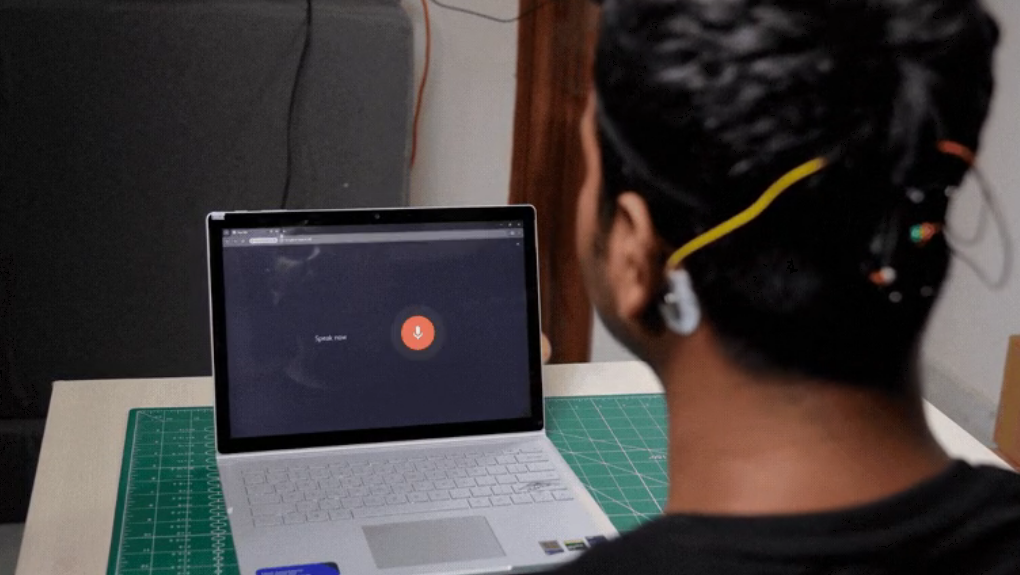
The standard computer mouse is a perfectly useful peripheral if your hands work. If you’ve got some trouble in that area, you might appreciate an alternative input solution. To that end, [Varun Adinath Patil] created a neat hands-free solution for moving a cursor around a screen.
The build is based on the Neuro PlayGround Lite, a board built for physiological signal acquisition in the Feather form factor. It’s hooked up to an IMU sensor—both a MPU6050 or BMI270 work—which tracks head movements to allow the cursor to be panned around the screen. Other biological signals are then used to activate other standard mouse functions. Clenching the jaw fires off a left click, while a triple blink fires a right click. Clicking and dragging is achieved by a double-blink. The jaw muscles are sensed via EMG signals picked up with gel electrodes on the skin, while the blinks are detected via EOG signals via the same contact points.
The big picture: McAfee was a trusted name in the antivirus software market during the MS-DOS days. Many computers came with a copy of the company’s VirusScan freeware tool to fend off trojan horses and other virus threats. Today, McAfee is a name that’s almost exclusively trusted in the advertising and B2B markets. End users would very much prefer to avoid McAfee products at this point, which is why they tend to get angry when someone tries to push the McAfee brand through bundled advertising pop-ups.
The controversial advertising partnership between LG and McAfee has apparently come to an end after Microsoft got involved in the matter.
Pavan Davuluri, executive vice president of Windows and Devices, recently confirmed that Redmond got in touch with LG, the company that started it all. LG has “agreed” to remove the McAfee pop-up from its Windows Store app, Davuluri said, which likely means that Microsoft forced the South Korean manufacturer to stop pushing McAfee-related advertising to customers who purchased a new gaming monitor.
The controversy began earlier this month, when users discovered that the “LG Monitor App Installer” app was displaying McAfee promotions. Windows installed the app after affected users connected their brand-new LG monitors, with no easy way to uninstall the tool without resorting to third-party applications or disabling the Microsoft Store itself.
According to Davuluri’s post, Microsoft “connected” with LG before the latter agreed to remove the McAfee adware message from the LG Monitor App Installer app. Both companies apparently share a common goal of improving the Windows ecosystem and providing customers with the best possible software experience.
Per user complaints, the list of LG monitors reportedly found to automatically push the LG Monitor App Installer app onto users’ PCs includes the following models: 34GX900A-B, 45GX950-B.AEU, 32GS95UE-B, 39GX950B, 27GP83B-B, 27GN800, 32GS95UE-B, and 27GN850-B.
Apps developed through Microsoft’s Universal Windows Platform can be designed to install automatically when a user connects a specific device to a Windows machine. Put simply, Microsoft approved this practice for UWP app developers, and the LG monitor tool was simply working as designed.
The official UWP documentation even states that automatic installation can be a source of confusion because users do not receive any notification about the installation process.
Advertisement
Other companies known to take advantage of this auto-installation feature include Razer, Logitech, Asus, and Gigabyte.
A federal judge has ordered a public iPhone exploit taken offline after Magnet Forensics argued it wasn’t independent security research at all, but instead a stolen trade secret.
U.S. District Judge Victoria Marie Calvert partially approved Magnet’s request for a preliminary injunction. She directed Paradigm Shift and former Magnet exploit engineer Mario Del Gaudio to delete the usbliter8 article, code, technical details, and related materials in their possession by 11:59 p.m. Eastern on July 23.
By July 23, Paradigm Shift had replaced the original article with a page indicating the blog post was unavailable. The preliminary injunction will continue throughout the litigation unless the court removes it in a separate order.
Magnet’s July 7 complaint asserts that usbliter8 originated from a confidential A12 and A13 SecureROM access capability integrated into a commercial forensic product. The company alleges Del Gaudio acquired the technique while employed by Magnet and later shared it through Paradigm Shift.
Advertisement
Paradigm Shift originally presented usbliter8 as newly published security research before releasing it on June 18.
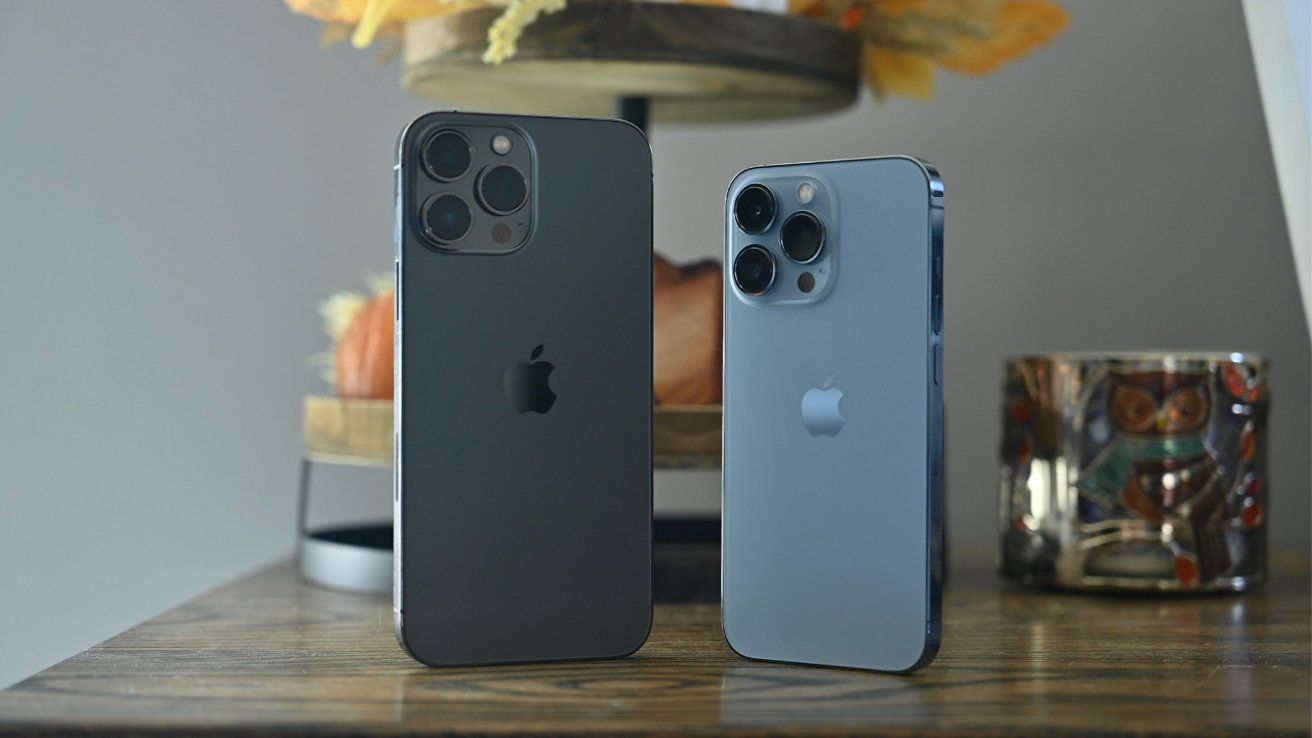
We reported at the time that the exploit affects devices including the iPhone XS, iPhone XR, iPhone 11 lineup, and second-generation iPhone SE. The court hasn’t made a final ruling on liability.
Calvert found that Magnet had established a likelihood of success on its trade-secret and contract claims for purposes of the preliminary injunction, based on evidence the defendants didn’t contest at the July 16 hearing.
The iPhone exploit requires physical access
Usbliter8 targets SecureROM, the immutable code that starts Apple’s secure boot process. It combines a flaw in a USB controller with security settings used on A12 and A13 devices to execute code while a device is in Device Firmware Update mode.
Advertisement
Because SecureROM is built into the processor during manufacturing, Apple can’t replace the vulnerable code through an ordinary software update. It may still be able to develop mitigations that interfere with exploitation or reduce its usefulness.
The flaw doesn’t create a remote attack or automatically expose everything stored on an iPhone. Using usbliter8 requires physical access to the device, a USB connection, DFU mode, and programmable hardware capable of sending specially constructed USB traffic.
The exploit can run unsigned code before the operating system starts, but it doesn’t directly compromise the Secure Enclave or automatically reveal a user’s passcode and encrypted data. Additional vulnerabilities or forensic techniques would be needed to cross those protections.
Those requirements make usbliter8 especially relevant to forensic investigations involving seized devices. Magnet sells investigation products to law enforcement agencies, intelligence services, government bodies, and private organizations.
Advertisement
Magnet says usbliter8 came from a secret capability
Del Gaudio worked as an exploit engineer placed with Magnet from November 2023 through November 2024. He signed an agreement covering confidential information, intellectual property, and continuing restrictions that survived the end of his placement.
Magnet says Del Gaudio had access to a zero-day capability internally called “MSG,” which targeted the same A12 and A13 SecureROM vulnerability later described in the usbliter8 publication.
According to the complaint, Magnet engineers discussed the vulnerability in meetings attended by Del Gaudio by April 2024. The company says it integrated MSG into one of its products in May 2024 and that Del Gaudio used the capability dozens of times while testing another tool.
Magnet says Del Gaudio had access to a zero-day capability internally called “MSG.”
Magnet supplied additional details in a July 17 declaration addressing questions Calvert raised at the July 16 hearing. The company’s director of iOS research said Del Gaudio attended restricted sessions during a company gathering in Denver from March 11 through March 15, 2024.
Fewer than 20 people attended the smaller iOS sessions, according to the declaration. Magnet said the group discussed the SecureROM vulnerability, MSG’s technical architecture, and its development into an access capability for the company’s products.
Advertisement
Magnet links Del Gaudio to the publication
After his placement ended in November 2024, Del Gaudio became affiliated with Paradigm Shift, according to the complaint. The Spanish security company published “Introducing usbliter8: An A12/A13 SecureROM Exploit” on June 18.
A preserved screenshot connected Del Gaudio’s name and photograph to the @NotHdesk account associated with the research, according to Magnet. The company also says the account was linked to an email address known to belong to him.
Those details form part of Magnet’s case that Del Gaudio had access to MSG and was connected to the usbliter8 publication. The public record doesn’t include source-code comparisons, file-transfer records, or a detailed technical analysis showing exactly how MSG and usbliter8 match.
The original usbliter8 article was deliberately omitted from the complaint because Magnet argued that attaching it would further distribute the information it sought to protect. The company offered to provide the material privately for the court to review.
Advertisement
On June 18, Magnet sent Del Gaudio a cease-and-desist demand and contacted Paradigm Shift the next day. The demand sought removal of the article and code, identification of anyone who received the information, preservation of evidence, and return or destruction of Magnet material.
In letters dated June 22 and June 28, Paradigm Shift’s attorneys disputed Magnet’s claims and pressed the company to identify the information it considered a trade secret. Magnet filed the lawsuit on July 7 after the parties failed to reach an agreement.
Neither Del Gaudio nor Paradigm Shift appeared at the July 16 injunction hearing, despite receiving electronic notice. Calvert therefore considered an uncontested record when deciding whether temporary relief was warranted.
The court questioned whether the flaw should remain secret
Magnet argues that publication let competitors study the technique without making the same investment. The company also says Apple could reduce the exploit’s value through mitigations, while the disclosure may weaken customer trust in Magnet’s ability to protect sensitive capabilities.
Advertisement
The dispute raises a security question over whether companies should keep zero-days secret for forensic use or disclose them so manufacturers and device owners can respond.
Magnet argues that publication let competitors study the technique without making the same investment.
Calvert described the public-interest issue as the most difficult part of the case. The judge addressed concerns about companies and government actors stockpiling zero-day vulnerabilities rather than reporting them to affected manufacturers.
The court also questioned whether consumers were better protected by knowing about the vulnerability once its existence had become public. Calvert concluded the court couldn’t resolve that policy debate through an unopposed preliminary injunction motion.
Paradigm Shift, as reported by MacRumors, said it informed Apple Product Security before publishing on June 18. The order doesn’t prevent Apple from using information it already has to mitigate the vulnerability.
Since Apple already has the disclosure, the injunction can’t fully restore the secrecy Magnet claims gave the capability commercial value. However, Calvert found that removing the material could still limit further harm and prevent Paradigm Shift from using the research for promotion.
Advertisement
The central trade-secret question remains unresolved
Magnet also sought extensive forensic access to the defendants’ computers, accounts, and storage. Calvert declined to grant that relief outside the normal discovery process.
The court observed that Magnet accepted Del Gaudio might not have required company hardware or files to replicate the capability. In Magnet’s view, familiarity with the research could have been enough.
A key question remains for future steps, such as whether Del Gaudio copied protected Magnet data or drew on technical understanding and experience kept after departing the firm.
The injunction covers material held by the defendants but can’t remove copies already downloaded or shared elsewhere. The case now turns on whether usbliter8 represents independent research or the disclosure of Magnet’s confidential forensic capability.
The big picture: Nvidia lifted the embargo on its Vera CPU deep dive this week, and the disclosure amounts to a direct challenge to two decades of x86 datacenter design philosophy. This is the most detail the company has shared on the chip since it first appeared on the Rubin roadmap, and it confirms something I have suspected for a while: Nvidia is not treating the CPU as an attach story anymore. It is treating it as a battleground with a lot of potential dollars at play.
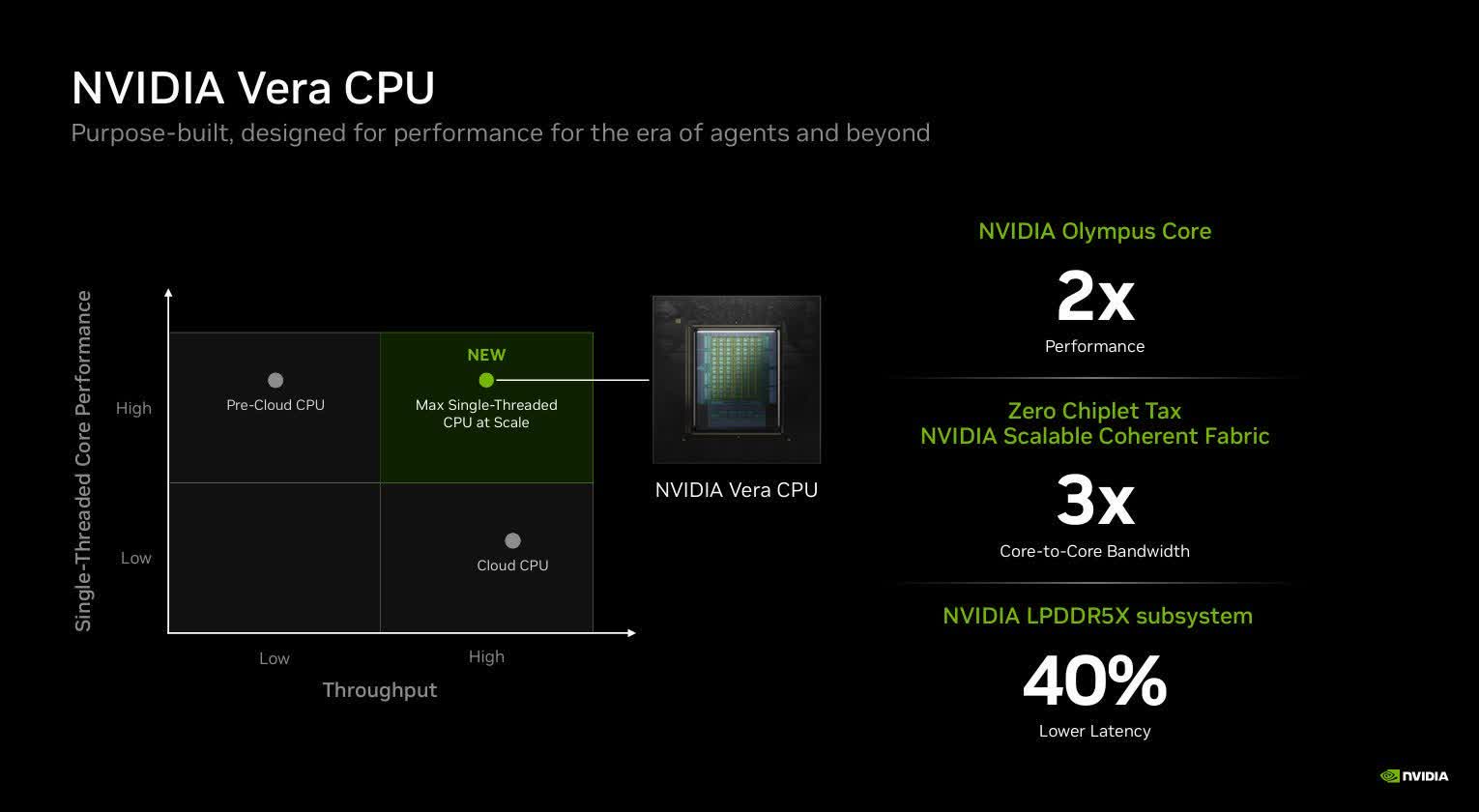
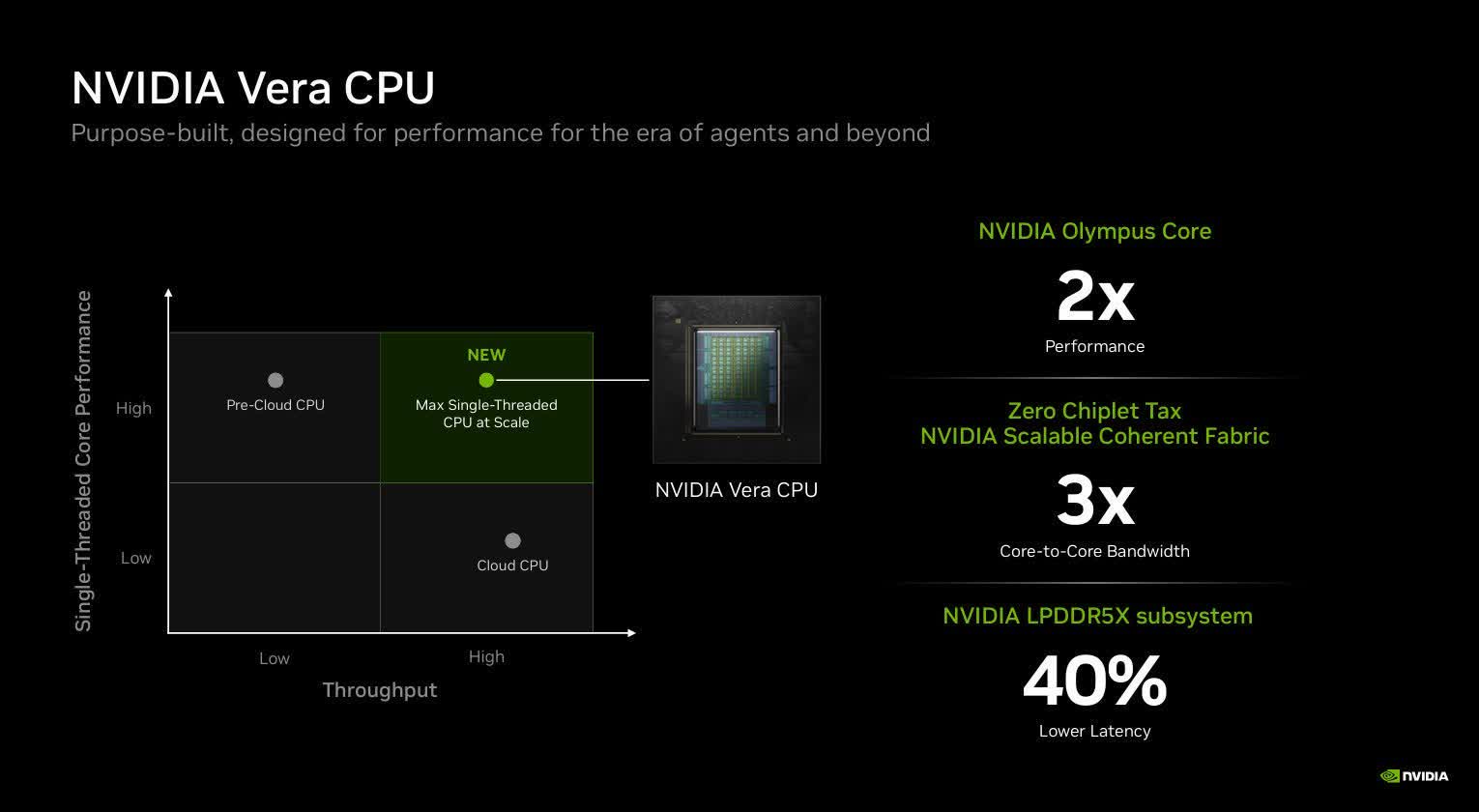
Vera is built around the Olympus core, the first custom CPU core Nvidia has ever brought to the datacenter and the first custom core the company has designed anywhere since the Denver and Carmel efforts of the Tegra era nearly a decade ago.
Ryan Shrout is a longtime technology analyst and industry veteran who has spent over two decades covering PC hardware, graphics, and semiconductors. He previously led technical marketing at Intel and was the founding editor of PC Perspective. He is currently President and GM at Signal65. You can follow him on X @ryanshrout.
Grace used licensed off-the-shelf Arm Neoverse V2 cores. Olympus is an Nvidia design from the ground up, a wide, high-IPC core with a 10-wide decode front end that reorders aggressively and prefetches based on patterns like graph structures in memory.
Advertisement
88 of those cores sit on a monolithic compute die, running 176 threads through a partitioned scheme Nvidia calls Spatial Multithreading, a deliberate departure from the opportunistic resource sharing of traditional SMT.
That monolithic choice matters. Nvidia still uses chiplets for the memory controllers and I/O, but the compute die is one piece of silicon connected by a second-generation scalable coherency fabric. The company measures bisection bandwidth across the die at roughly 3.4 terabytes per second.
The memory subsystem is LPDDR5X hardened for the datacenter with ECC and full telemetry, delivering up to 1.2 TB/s of bandwidth, roughly 3x the memory bandwidth per core and about 5x the bandwidth per watt of conventional DDR-based server designs (all based on Nvidia claims).
The headline claims stack up as roughly 2x faster performance from the Olympus core, 3x the core-to-core bandwidth of chiplet-based competition, and 40% lower memory latency under load through the LPDDR5X subsystem.
Advertisement
Vera ships in two forms: a dense liquid-cooled rack packing 256 CPUs and more than 22,000 cores, and a conventional air-cooled 2U with two sockets. Dell has committed to multiple PowerEdge systems built on it. Nvidia sizes the opportunity as a $200 billion expansion of the CPU market, which explains a lot of the recent market dynamics.
The argument behind the architecture
In 2014, a top Xeon carried 14 to 18 cores. Today an Epyc Turin part carries 128. Core counts grew roughly 9x over that stretch because cloud economics rewarded rentable vCPUs, while per-core performance only about doubled. Chiplets kept costs down but taxed memory bandwidth, data movement, and latency along the way.
Nvidia argues that agentic AI breaks this trade. An agent reasons on the GPU, then drops to the CPU for tool calls, SQL queries, API work, and scripting, then goes back to the GPU, sometimes hundreds of times per task. That loop is sequential.
You cannot throw more cores at a sequential loop and make it shorter. Only a faster core, fed with data faster, compresses it. The loaded-latency data Nvidia showed makes the point visually, with chiplet designs hitting a saturation wall just shy of 400 GB/s of memory traffic while Vera keeps scaling.
Advertisement
The company has landed on “max single-threaded CPU at scale” as the category name. It is a mouthful, and I will get to that.
The proof points
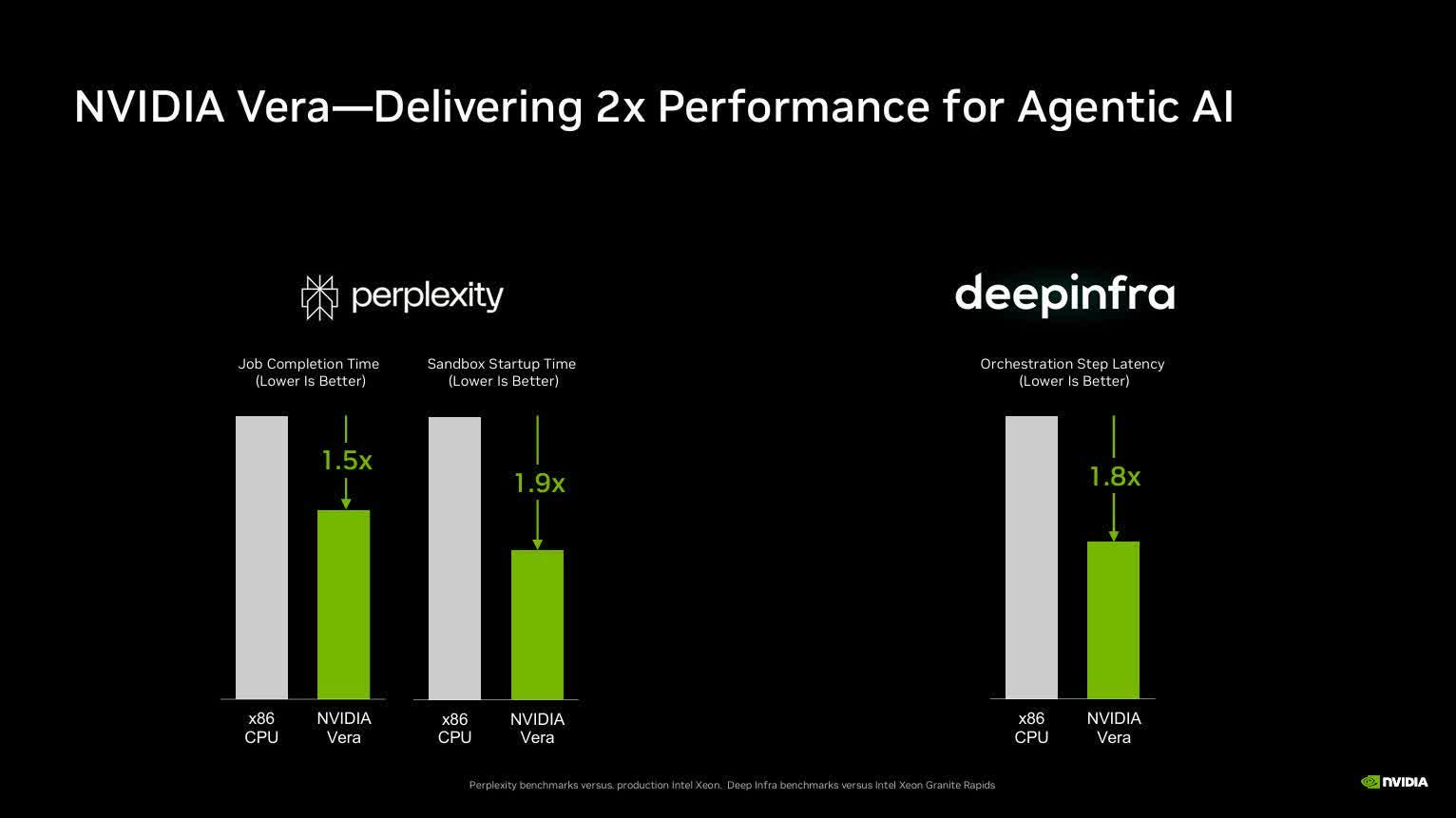
The customer data is early but notable. Perplexity ran coding sandboxes on Vera and completed jobs 1.5x faster than the production Xeon fleet it runs today, with concurrent sandbox startup 1.9x faster.
The New York Stock Exchange, which processes 1.1 trillion records a day, tested Vera with the Redpanda streaming engine on HPE systems and measured 6x lower p99 latency versus Epyc Turin, and is now evaluating it as a replacement. Los Alamos National Laboratory saw 7x on an agentic workload and 3x on radiation transport and multigrid simulation codes.
These are real workloads rather than synthetic benchmarks, which I give Nvidia credit for, and the supporting documentation puts names and configurations on most baselines. They remain vendor-supplied and worth reading closely.
Advertisement
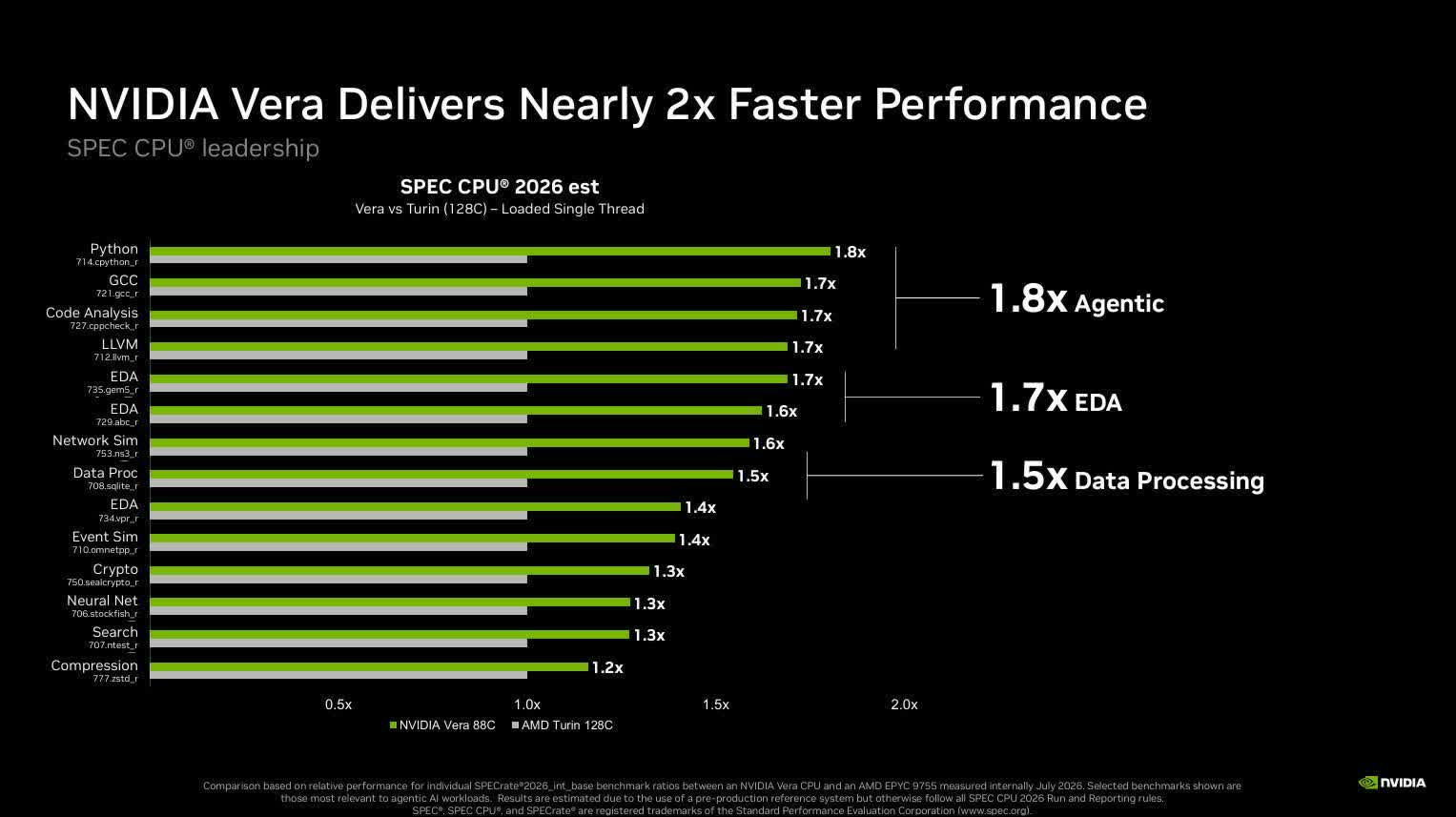
The SPEC CPU 2026 numbers carry an estimated label from a pre-production reference system, and every comparison lands on Zen 5 Turin or current and older Intel silicon. The Los Alamos runs were measured against a Sapphire Rapids based supercomputer that launched in early 2023. Beating shipping parts is the right first test, but Venice and Diamond Rapids arrive within the year, and that is the fight that will settle this.
Where there is more detail needed
I asked the Nvidia team directly during the analyst briefing last week what actually separates an agentic CPU from a plain, very good datacenter CPU. We have had big, fast processors running back-to-back loops of VMs and containers for years. Is this genuinely a new workload class, or a fast CPU wearing new marketing?
To their credit, the team acknowledged that “agentic CPU” is the wrong label and would pigeonhole the part. The honest answer is that the fundamentals have not changed, but the rates have.
Agent pipelines hydrate and tear down environments constantly rather than occasionally. Memory pressure is continuous. Latency under load becomes the whole game, because every millisecond the CPU stalls is a millisecond a very expensive GPU sits idle. That is a real architectural argument, and the decision to spend die area on per-core speed instead of core count is a genuine philosophical break from where x86 roadmaps have been heading.
Advertisement
What the market needs now is independent, rigorous CPU measurement built around these agentic pipelines, run across current and next generation parts from every vendor. That is exactly the kind of work we are looking forward to diving into at Signal65.
The ecosystem arrived on day one, to no surprise
The partner roster attached to this launch is unusually deep for a CPU announcement. OpenAI says it will deploy Vera at scale beginning in Q3, and the early adopter list also includes Anthropic, SpaceX, and Perplexity, with Los Alamos, NERSC, and TACC representing the supercomputing side.
Dell, HPE, Lenovo, Supermicro, and Bull all have Vera systems coming, backed by the full ODM bench.
The rack-scale platform is ramping just as visibly. CoreWeave was the first cloud to bring up and validate Vera Rubin NVL72 and published the first measured numbers from live hardware, a 10x gain in tokens per second per megawatt over Grace Blackwell NVL72 on DeepSeek-R1.
Advertisement
Google Cloud stood up the first A5X instance on Vera Rubin for the reinforcement learning startup Ineffable Intelligence, Azure and OCI have racks running, and a newly expanded Microsoft and Mistral agreement puts Vera Rubin at the center of a multibillion-dollar European buildout.
On the CPU specifically, DeepInfra, which serves nearly five trillion tokens a week, measured support for 1.6x more concurrent agents and 2.2x faster orchestration versus Granite Rapids. Nvidia counts 300 partners and more than 350 factory sites in 30 countries behind the ramp.
What this means for AMD, Intel, and the hyperscalers
The timing is not subtle. This disclosure lands the day before Advancing AI opens in San Francisco, the flagship AMD event where the 256-core Zen 6 Venice generation of Epyc and the Instinct MI450 family are expected to headline the keynote from Lisa Su on Thursday. Nvidia just set the terms of the datacenter CPU conversation roughly 24 hours before its biggest rival takes the stage.
If a faster CPU returns GPUs to work sooner, the CPU price becomes a rounding error in rack TCO, and the fight shifts from dollars per core to tokens per rack. That framing is the one AMD and Intel now have to answer, and it is a very different conversation than the one that produced 128-core roadmaps.
Advertisement
AMD is not conceding the frame. It has already argued that rack-level performance per watt favors high-core-count Epyc, and the 256-core Venice generation will sharpen that response. Intel has Diamond Rapids coming. The hyperscalers have Graviton, Axion, and Cobalt, all designed around the scale-out economics Vera explicitly rejects.
But Nvidia is not selling a merchant CPU into a commodity socket. It is selling the CPU as the utilization lever for the most expensive assets in the AI factory. If a faster CPU returns GPUs to work sooner, the CPU price becomes a rounding error in rack TCO, and the fight shifts from dollars per core to tokens per rack.
That framing is the one AMD and Intel now have to answer, and it is a very different conversation than the one that produced 128-core roadmaps.
Nvidia has promised deeper head-to-head benchmark data against both x86 and Arm competition in the coming weeks. That data, and the independent validation that should follow it, will tell us whether Vera resets the datacenter CPU conversation or simply carves out a well-defended niche inside the Nvidia rack.
Hot on the heels of the season three finale, AMC has announced the fourth season of Anne Rice’s Interview With the Vampire. Revealed during a panel for The Vampire Lestat at San Diego Comic-Con on Friday, season 4 will be titled Anne Rice’s Queen of the Damned.
On hand for the announcement were cast members of the vampire series Sheila Atim, Jacob Anderson, Assad Zaman and Eric Bogosian, as well as executive producers Mark Johnson and Hannah Moscovitch.
They also dropped a teaser trailer for the series.
Advertisement
Queen of the Damned will see “our established and beloved characters confront Akasha with their world, and ours, very much hanging in the balance,” said AMC Studios President Dan McDermott in a statement.
Moscovitch will serve as showrunner for Queen of the Damned, with Johnson and Rolin Jones executive producing.
No word yet on when season 4 will air, but it will stream exclusively on AMC Plus. You can catch the first two series of Interview With the Vampire on Netflix.
Corinne Reichert
Senior Editor
Advertisement
Corinne Reichert (she/her) grew up in Sydney, Australia and moved to California in 2019. She holds degrees in law and communications, and currently writes news, analysis and features for CNET across the topics of electric vehicles, broadband networks, mobile devices, big tech, artificial intelligence, home technology and entertainment. In her spare time, she watches soccer games and F1 races, and goes to Disneyland as often as possible.
See full bio


























































You must be logged in to post a comment Login