Welcome back to TechCrunch Mobility — your central hub for news and insights on the future of transportation. To get this in your inbox, sign up here for free — just click TechCrunch Mobility!
You might recall the congressional hearing last month that sparked criticism against Waymo over its use of remote assistance workers in the Philippines. We have covered that issue extensively. You can read about the company’s remote assistance and road assistance teams here and here.
Waymo tends to get the most attention because, well, those robotaxis are now operating commercially in 10 U.S. cities, with more coming soon. But the issue of remote assistance is not a Waymo issue. It’s an autonomous vehicle technology issue.
A new report from Sen. Ed Markey (D-MA) makes my point.
Advertisement
Markey sent letters to seven U.S. companies — Aurora, May Mobility, Motional, Nuro, Tesla, Waymo, and Zoox — working on autonomous vehicle technology with a list of questions. He wanted to know how often these companies’ vehicles relied on input from remote staff.
They all refused to say, according to the results of Markey’s investigation. Markey said it was a “stunning lack of transparency from the AV companies around their use of remote assistance operators to help guide their AVs.”
You can read senior reporter Sean O’Kane’s article, which digs into the issue and includes the rather mute responses from the companies. (TechCrunch reached out to all of them.) One interesting admission from Tesla: The company said its remote assistance workers are authorized to temporarily assume direct vehicle control (a very different thing than “remote assistance”) as a final escalation maneuver.
Techcrunch event
Advertisement
San Francisco, CA | October 13-15, 2026
But here’s the thing — this is not going away. And silence will not defuse the matter. If anything, Markey seems more motivated than ever to get answers. He is now calling on the National Highway Traffic Safety Administration to investigate companies’ use of remote assistance workers and said he is “working on legislation to impose strict guardrails on AV companies’ use of remote operators.”
It seems like just last week I was writing about Uber being everywhere, all at once. And I see it is still a trend, although this time it isn’t directly related to autonomous vehicles.
Uber said it is buying Berlin-based startup Blacklane, which provides on-demand, black-car chauffeur services, as the ride-hail giant expands deeper into luxury and executive travel services. Blacklane, which was founded in 2011, had raised more than $100 million to date from rental car company Sixt, Mercedes-Benz, and Alfahim, a conglomerate in the UAE.
The timing of the acquisition is notable. It comes just a few weeks after Uber announced the launch of Uber Elite, a chauffeur service that also offers a bunch of luxury offerings like airport meet-and-greets and in-vehicle amenities.
Other deals that got my attention …
Manna Air Delivery, a consumer drone delivery startup based in Ireland, raised $50 million from ARK Invest, the Ireland Strategic Investment Fund, Schooner Capital, Coca-Cola HBC, and Molten Ventures.
Advertisement
Saronic Technologies, an autonomous military ship developer based in Austin, raised $1.75 billion in a Series D funding round led by Kleiner Perkins. The company is now valued at $9.25 billion. Other investors include Advent International, Bessemer Venture Partners, DFJ Growth, BAM Elevate, and other new partners and recognizes the continued commitment of its existing investors, including 8VC, Caffeinated Capital, Andreessen Horowitz, Elad Gil, and Franklin Templeton.
Voltify, a startup that has developed a way to retrofit diesel locomotives with battery power, raised $30 million in seed funding co-led by Israeli venture firm Aleph and Australian miner Fortescue.
Notable reads and other tidbits
Image Credits:Bryce Durbin
Also, the micromobility company created inside Rivian that spun out last year, will work with DoorDash to develop autonomous delivery vehicles. As part of the deal, DoorDash took part in Also’s $200 million Series C funding round, which was led by Greenoaks Capital. DoorDash is getting a seat on Also’s board of directors, too.
Baidurobotaxis stalled throughout Wuhan, China, in some cases trapping passengers for up to two hours due to system failure.
GM is ramping up its efforts to improve its advanced driver-assistance system, Super Cruise. CEO Mary Barraposted on LinkedIn that GM has started supervised testing of its next-gen automated driving system on public highways in California and Michigan.
Advertisement
“Soon, more than 200 supervised and manual test vehicles will be in live traffic, with trained drivers ready to take over at any time. This data will guide future updates to strengthen our autonomous capabilities,” she wrote.
Lucidissued a recall for more than 4,000 Gravity SUVs after discovering a problem with the seat belts.
The National Highway Traffic Safety Administration reported that traffic deaths fell 6.7% to 36,640 in 2025 from the prior year. This is the second-lowest traffic fatality rate in recorded history at 1,10 fatalities per 100 million vehicle miles traveled, according to the NHTSA.
All of those long TSA lines are prompting airlines to catch up and adapt. For instance, United Airlines has updated its mobile app to show TSA wait times at select airports.
Advertisement
The Subaru-Toyota partnership keeps cranking out EVs. At the New York Auto Show, Subaru introduced the all-electric Gateway, a three-row SUV that is essentially a rebadged Toyota Highlander EV.
Tesla’s Q1 sales figures show its cheaper vehicles aren’t helping it turn around declining sales. (Some legacy automakers have seen EV sales plummet.) That seems to have affected Tesla’s workforce numbers at its Austin, Texas, factory, which dropped 22% in 2025. Meanwhile, I riff on the changing of the guard over at Tesla (and, no, I am not referring to the string of executive departures there, although that is interesting). CEO Elon Musk shared that production of the Tesla Model S and X has ended, a milestone that marks the shift away from building cars designed for people to drive and toward robots and self-driving cars.
Toyota’s Woven Capital has appointed a new CIO and COO in a push to find the “future of mobility.”
Uber and Chinese autonomous vehicle company WeRide launched robotaxi operations without a human safety operator in Dubai as part of a broader expansion in the Middle East.
Advertisement
Waymo’s robotaxi service is now live at San Antonio International, its fourth major airport. Meanwhile, Wired looked at Waymo’s school bus problem (meaning the investigation into the illegal behavior of its robotaxis around school buses). The article provides new details on how the Austin School District tried to help Waymo solve the problem. It didn’t work.
One more thing …
My podcast, the Autonocast, spent some time talking with Ashu Rege, DoorDash’s VP of Autonomy. We recorded the episode prior to the Also-DoorDash announcement, which makes his comments about the company’s strategy all the more interesting. Check out the episode here.
Eric Howard, founder of Dog Tired, rides his One Wheel while running Boone, a golden retriever, near Lake Tapps, Wash. (Photo courtesy of DogTired)
It’s tough to tell who has the bigger smile: the guy zipping by on the Onewheel, the dog running alongside him at full sprint, or the passersby lucky enough to witness it.
Howard is the founder and chief dog runner at Dog Tired, a dog-exercising service outside of Seattle that operates at a different speed. After stints in tech, including at data visualization company Tableau, Howard ditched the corporate leash for one he actually wanted to hold.
“I show up and I’m like the Beatles, and they’re like a teenage girl. They’re just excited to see me,” Howard said of his four-legged clients. “It’s hard to have a bad day when you go see eight dogs and they’re all just losing their mind, happy to see you.”
A longtime adventure seeker, Howard is a snowboarder and kiteboarder who fell in love the first time he stepped on a Onewheel — the self-balancing, single-wheeled electric board that riders control by shifting their weight.
Advertisement
He’s also a dog lover. When a relationship in Portland ended and the dog he’d shared with his girlfriend stayed behind, he got another one — a 15-pound poodle mix named Riley — and soon realized he was cut out for some sort of job in the pet industry.
The concept for Dog Tired came together when a friend had a high-energy rat terrier that was, in Howard’s words, bouncing off the walls. Howard tried running the dog alongside his Onewheel and it quickly became a daily — sometimes twice daily — ritual.
His friend noticed the difference immediately. The dog was more manageable and happy. And Howard saw an opportunity.
A nudge from dad
Howard graduated from the University of Washington with a degree in informatics at age 31 — a non-traditional path that he describes as a theme in his life. He joined Tableau as a senior tech support engineer when the company was still in what he considered a startup phase — long before it was acquired for $15.7 billion by San Francisco-based Salesforce in 2019.
Advertisement
He spent nearly five years across two separate stretches at Tableau, which he called the best employer he’s ever had. But as the startup atmosphere began to fade he lost his passion for data analysis, server engineering and managing a team. He needed a change.
“My dad really wanted me to do the Onewheel business. I really credit my dad with giving me that final nudge,” Howard said. “He was like, ‘You’ve got some money in your retirement and some money in savings. How long could you survive without making any money?’”
Howard figured he could make it six months or so.
“As soon as I started reaching out, spreading the word, it just caught fire,” he said. “People were just like, ‘This is a genius idea.’”
Advertisement
‘Bottomless demand’
Howard soon had 15 clients and a regular weekly routine. Within six months he was covering his bills. And five years later, Dog Tired has grown into a full-fledged operation. Howard does 50 runs a week and a part-time employee handles another dozen or more.
“I’ve got about 5,000 dog runs under my belt, about 17,000 miles total,” he said, adding that the business largely sells itself, with little turnover. “There’s a bottomless demand out there of dogs that are just waiting to get the exercise they need.”
Howard has a 100-pound-dog limit and he sticks to low-traffic areas. It helps him stay in control on the Onewheel when his clients want to chase squirrels or rabbits.
He said the work is really about relationship management, which is a lot of what he learned at Tableau. There’s plenty of troubleshooting, but in this case it’s dogs rather than computers.
Advertisement
“I’m not rich. I don’t make a fortune, but I feel very rich,” Howard said. “I look forward to every day. I get up early in the morning and the day can’t get started fast enough for me.”
The lowest price ever is in effect now on Apple’s M5 MacBook Air, with a weekend deal at Amazon slashing prices by $150 (and there are numerous 13-inch and 15-inch configurations to choose from).
Grab the lowest price ever on Apple’s new M5 MacBook Air.
Apple’s brand-new M5 MacBook Air, which was released in March 2026, is on sale at Amazon today, with multiple 13-inch and 15-inch configurations to choose from. Kicking off the sale is a $150 discount on the standard 13-inch MacBook Air with Apple’s M5 chip. Pick up the M5/16GB/512GB configuration for $949.99, the lowest price to date on the Sky Blue and Starlight models. Continue Reading on AppleInsider | Discuss on our Forums
A new Quordle puzzle appears at midnight each day for your time zone – which means that some people are always playing ‘today’s game’ while others are playing ‘yesterday’s’. If you’re looking for Sunday’s puzzle instead then click here: Quordle hints and answers for Sunday, April 5 (game #1532).
Quordle was one of the original Wordle alternatives and is still going strong now more than 1,400 games later. It offers a genuine challenge, though, so read on if you need some Quordle hints today – or scroll down further for the answers.
Enjoy playing word games? You can also check out my NYT Connections today and NYT Strands today pages for hints and answers for those puzzles, while Marc’s Wordle today column covers the original viral word game.
Advertisement
SPOILER WARNING: Information about Quordle today is below, so don’t read on if you don’t want to know the answers.
Article continues below
Quordle today (game #1533) – hint #1 – Vowels
How many different vowels are in Quordle today?
• The number of different vowels in Quordle today is 3*.
* Note that by vowel we mean the five standard vowels (A, E, I, O, U), not Y (which is sometimes counted as a vowel too).
Advertisement
Quordle today (game #1533) – hint #2 – repeated letters
Do any of today’s Quordle answers contain repeated letters?
• The number of Quordle answers containing a repeated letter today is 2.
Quordle today (game #1533) – hint #3 – uncommon letters
Do the letters Q, Z, X or J appear in Quordle today?
• No. None of Q, Z, X or J appear among today’s Quordle answers.
What letters do today’s Quordle answers start with?
• C
Advertisement
• I
• P
• B
Right, the answers are below, so DO NOT SCROLL ANY FURTHER IF YOU DON’T WANT TO SEE THEM.
Advertisement
Quordle today (game #1533) – the answers
(Image credit: Merriam-Webster)
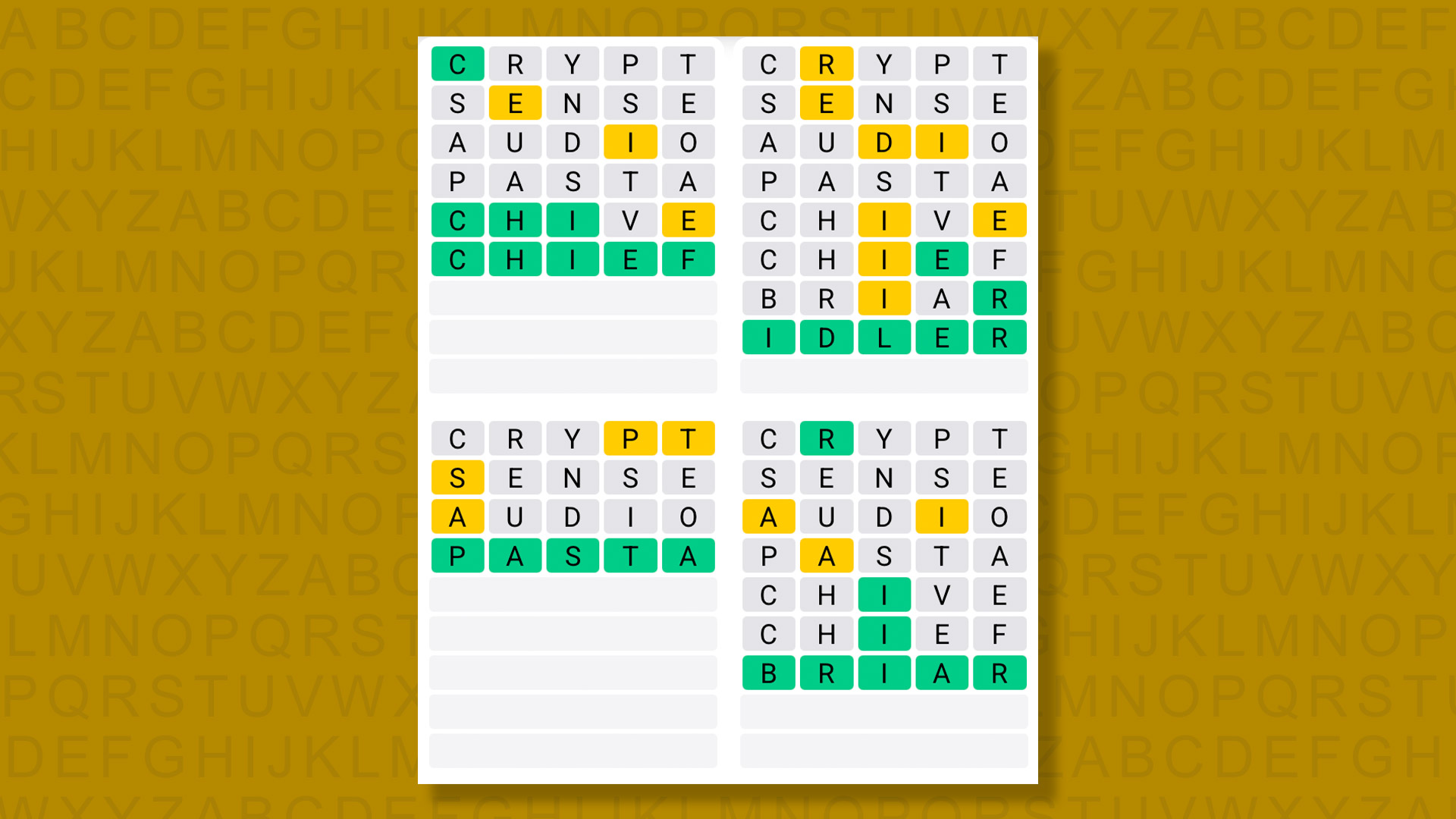
The answers to today’s Quordle, game #1533, are…
Advertisement
Sign up for breaking news, reviews, opinion, top tech deals, and more.
Today’s game prompted me to think about a British magazine I used to subscribe to called the IDLER, whose slogan is “slow down, have fun, live well”.
It’s a motto worth remembering while playing Quordle, as speed leads to mistakes while a slower game brings the joy of untangling a tricky puzzle such as today’s.
Advertisement
Daily Sequence today (game #1533) – the answers
(Image credit: Merriam-Webster)
The answers to today’s Quordle Daily Sequence, game #1533, are…
A WIRED investigation based on Department of Homeland Security records this week revealed the identities of paramilitary Border Patrol agents who frequently used force against civilians during Operation Midway Blitz in Chicago last fall. Several of the agents, WIRED found, appeared in similar operations in other states around the US.
Customs and Border Protection may want to remember to protect its sensitive facility information. Using basic Google searches, WIRED discovered flashcards made by users of the online learning platform Quizlet that contained gate codes to CBP facilities and more.
In a rare move, Apple this week released “backported” patches for iOS 18 to protect millions of people still using the older operating system from the DarkSword hacking technique that was found in use in the wild. Discovered in March, DarkSword allows attackers to infect iPhones that simply visit a website loaded with the takeover tools embedded in it. Apple initially pushed users to update to the current version of its operating system, iOS 26, but ultimately issued the iOS 18 patches after DarkSword continued to spread.
And that’s not all! Each week, we round up the security and privacy news we didn’t cover in depth ourselves. Click the headlines to read the full stories. And stay safe out there.
Earlier this week, a security researcher flagged that Anthropic accidentally made the source code for its popular vibe-coding tool, Claude Code, public. Immediately, people began reposting the code on the developer platform GitHub. But beware if you want to try to download some of those repos yourself: BleepingComputer reports that some of the posters are actually hackers who have tucked a piece of infostealer malware into the lines of code.
Anthropic, for its part, has been trying to remove copies of the leak (malware-ridden or not) by issuing copyright takedown notices. The Wall Street Journal reported that the company initially tried to remove more than 8,000 repositories on GitHub but later narrowed that down to 96 copies and adaptations.
This isn’t the first time that hackers have capitalized on interest in Claude Code, which requires users who might not be as familiar with their computer’s terminal to copy and paste install commands from a website. In March, 404 Media reported that sponsored ads on Google led to sites that were masquerading as official Claude Code installation guides, which directed users to run a command that would actually download malware.
Advertisement
The FBI formally classified a recent cyber intrusion into one of its surveillance collection systems as a “major incident” under FISMA—a legal designation reserved for breaches believed to pose serious risks to national security. The determination, reported to Congress earlier this week, is understood to be the first time since at least 2020 that the bureau has declared a major incident on its own systems. Politico, citing two unnamed senior Trump administration officials, reported that China is believed to be behind the intrusion. If confirmed, the breach could mark a significant counterintelligence failure for the FBI.
The FBI said it detected “suspicious activities” on its networks in February. In a notice to Congress on March 4, reviewed by Politico, the bureau said the compromised systems were unclassified and held “returns from legal process,” citing, as examples, phone and internet metadata collected under court orders and personal information “pertaining to subjects of FBI investigations.” The intruders reportedly gained access through a commercial internet service provider, an approach the FBI characterized as reflecting “sophisticated tactics.” In its only public statement, the bureau said it had deployed “all technical capabilities to respond.”
A new NYT Connections puzzle appears at midnight each day for your time zone – which means that some people are always playing ‘today’s game’ while others are playing ‘yesterday’s’. If you’re looking for Sunday’s puzzle instead then click here: NYT Connections hints and answers for Sunday, April 5 (game #1029).
Good morning! Let’s play Connections, the NYT’s clever word game that challenges you to group answers in various categories. It can be tough, so read on if you need Connections hints.
What should you do once you’ve finished? Why, play some more word games of course. I’ve also got daily Strands hints and answers and Quordle hints and answers articles if you need help for those too, while Marc’s Wordle today page covers the original viral word game.
Advertisement
SPOILER WARNING: Information about NYT Connections today is below, so don’t read on if you don’t want to know the answers.
Article continues below
NYT Connections today (game #1030) – today’s words
(Image credit: New York Times)
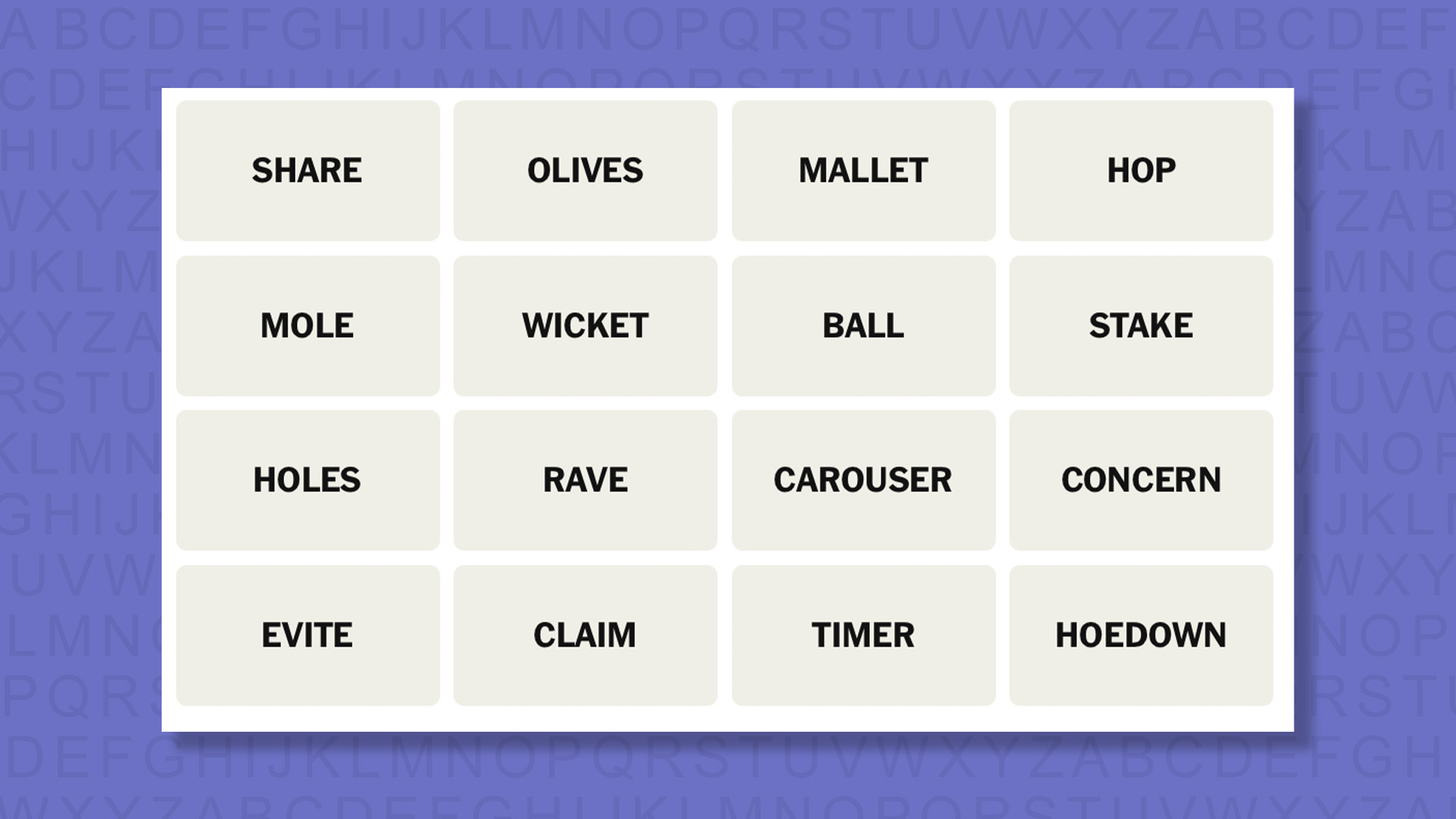
Today’s NYT Connections words are…
SHARE
OLIVES
MALLET
HOP
MOLE
WICKET
BALL
STAKE
HOLES
RAVE
CAROUSER
CONCERN
EVITE
CLAIM
TIMER
HOEDOWN
NYT Connections today (game #1030) – hint #1 – group hints
What are some clues for today’s NYT Connections groups?
YELLOW: Boogie nights
GREEN: Involved
BLUE: Fun game where you hit a fake animal
PURPLE: OnBroadway but a bit off
Need more clues?
We’re firmly in spoiler territory now, but read on if you want to know what the four theme answers are for today’s NYT Connections puzzles…
Advertisement
Sign up for breaking news, reviews, opinion, top tech deals, and more.
NYT Connections today (game #1030) – hint #2 – group answers
What are the answers for today’s NYT Connections groups?
YELLOW: EVENTS WITH DANCING
GREEN: INTEREST
BLUE: COMPONENTS OF WHAC-A-MOLE
PURPLE: MUSICALS WITH LAST LETTER CHANGED
Right, the answers are below, so DO NOT SCROLL ANY FURTHER IF YOU DON’T WANT TO SEE THEM.
Advertisement
NYT Connections today (game #1030) – the answers
(Image credit: New York Times)
The answers to today’s Connections, game #1030, are…
YELLOW: EVENTS WITH DANCING BALL, HOEDOWN, HOP, RAVE
GREEN: INTEREST CLAIM, CONCERN, SHARE, STAKE
BLUE: COMPONENTS OF WHAC-A-MOLE HOLES, MALLET, MOLE, TIMER
PURPLE: MUSICALS WITH LAST LETTER CHANGED CAROUSER, EVITE, OLIVES, WICKET
My rating: Hard
My score: 1 mistake
Seeing MALLET and WICKET in today’s grid I convinced myself that we were looking for elements of the niche upper class sport of croquet, which involves both these things and a BALL and quite possibly a STAKE, although I’m not entirely sure.
Anyway, I was wrong — very, very wrong.
Advertisement
Fortunately, this was the end of my mistakes and I landed the other groups of four in difficulty order. Kudos to anyone who spotted the musicals — a genius bit of wordplay from our puzzling overlords.
Yesterday’s NYT Connections answers (Sunday, April 5, game #1029)
GREEN: PARTS OF A SHERLOCK HOLMES COSTUME DEERSTALKER, MAGNIFYING GLASS, PIPE, VIOLIN
BLUE: THINGS TO FLIP COIN, LIGHT SWITCH, PANCAKE, THE BIRD
PURPLE: STARTING WITH SYNONYMS FOR “SLUSH” GOOGOL, MUSHROOM, PASTEURIZE, PULPIT
What is NYT Connections?
NYT Connections is one of several increasingly popular word games made by the New York Times. It challenges you to find groups of four items that share something in common, and each group has a different difficulty level: green is easy, yellow a little harder, blue often quite tough and purple usually very difficult.
On the plus side, you don’t technically need to solve the final one, as you’ll be able to answer that one by a process of elimination. What’s more, you can make up to four mistakes, which gives you a little bit of breathing room.
Advertisement
It’s a little more involved than something like Wordle, however, and there are plenty of opportunities for the game to trip you up with tricks. For instance, watch out for homophones and other word games that could disguise the answers.
It’s playable for free via the NYT Games site on desktop or mobile.
A new NYT Strands puzzle appears at midnight each day for your time zone – which means that some people are always playing ‘today’s game’ while others are playing ‘yesterday’s’. If you’re looking for Sunday’s puzzle instead then click here: NYT Strands hints and answers for Sunday, April 5 (game #763).
Strands is the NYT’s latest word game after the likes of Wordle, Spelling Bee and Connections – and it’s great fun. It can be difficult, though, so read on for my Strands hints.
Want more word-based fun? Then check out my NYT Connections today and Quordle today pages for hints and answers for those games, and Marc’s Wordle today page for the original viral word game.
Advertisement
SPOILER WARNING: Information about NYT Strands today is below, so don’t read on if you don’t want to know the answers.
Article continues below
NYT Strands today (game #764) – hint #1 – today’s theme
What is the theme of today’s NYT Strands?
• Today’s NYT Strands theme is… Fringe group
NYT Strands today (game #764) – hint #2 – clue words
Play any of these words to unlock the in-game hints system.
Advertisement
DARK
GRADE
MEET
TRIM
RING
TEXT
NYT Strands today (game #764) – hint #3 – spangram letters
How many letters are in today’s spangram?
• Spangram has 11 letters
NYT Strands today (game #764) – hint #4 – spangram position
What are two sides of the board that today’s spangram touches?
First side: left, 6th row
Last side: right, 5th row
Advertisement
Right, the answers are below, so DO NOT SCROLL ANY FURTHER IF YOU DON’T WANT TO SEE THEM.
Advertisement
NYT Strands today (game #764) – the answers
(Image credit: New York Times)
The answers to today’s Strands, game #764, are…
EDGE
EXTREMITY
BRINK
VERGE
MARGIN
BOUNDARY
SPANGRAM: OUTERLIMITS
My rating: Hard
My score: 1 hint
Thinking the “fringe group” was some kind of hair-based pun, I was certain that “trim” would be my first word.
Sign up for breaking news, reviews, opinion, top tech deals, and more.
Instead, after getting EDGE following a hint, I soon discovered that the theme was referring to the OUTERLIMITS (also the name of a great 1990s sci-fi series, by the way) of things.
It is so strange with Strands that a little kickstart is all you need to see all the rest of the words you are looking for, a feeling that simultaneously makes you feel smart for seeing them all amid the letter soup and dumb for not spotting them originally.
Advertisement
Yesterday’s NYT Strands answers (Sunday, April 5, game #763)
KANGAROO
BILBY
KOALA
WOMBAT
OPOSSUM
SPANGRAM: MARSUPIALS
What is NYT Strands?
Strands is the NYT’s not-so-new-any-more word game, following Wordle and Connections. It’s now a fully fledged member of the NYT’s games stable that has been running for a year and which can be played on the NYT Games site on desktop or mobile.
I’ve got a full guide to how to play NYT Strands, complete with tips for solving it, so check that out if you’re struggling to beat it each day.
On PlayStation Studios’ official site, Sony has updated the main banner to prominently feature Ghost of Yotei and Intergalactic: The Heretic Prophet, while Demon’s Souls Remake no longer appears in the lineup. Read Entire Article Source link
When a wave of unusual activity swept through Syrian government accounts on X in March, it first looked like pure chaos—trolling, parody names, and even explicit content. But beneath the noise lay something far more telling: a state still struggling with the most basic layer of its cybersecurity.
In early March, several official Syrian government accounts on X—including those linked to the presidency’s General Secretariat, the Central Bank, and multiple ministries—were hacked. The compromised profiles posted “Glory to Israel,” retweeted explicit material, and briefly renamed themselves after Israeli leaders.
Authorities moved to restore control within days, with the Ministry of Communications and Information Technology announcing “urgent steps” to recover the accounts and prevent further breaches. Yet what remained unsettled was the deeper question: How secure is the state’s digital front door?
In a government now dependent on commercial platforms for communication, losing a verified account doesn’t just disrupt messaging—it silences the state’s voice.
Advertisement
When the State Stops Speaking for Itself
At first glance, the breach appeared politically charged. Pro‑Israel messages circulating on verified government accounts during a tense regional moment fueled speculation over motive and attribution. No group claimed responsibility, and officials did not clarify whether internal systems were compromised.
To analysts, the episode pointed less to a geopolitically driven hack and more to a familiar, systemic weakness.
“We still do not know exactly what happened. Whether the accounts were directly hacked or accessed through weak or reused credentials, the conclusion is much the same: very poor digital security practices,” says Noura Aljizawi, a senior researcher at the Citizen Lab, a research organization that monitors threats to civil society in the digital age.
The ministry said it had coordinated with account administrators and X to “restore control and strengthen security,” promising new regulatory measures soon. The perpetrators have not been publicly identified.
Advertisement
One Weak Link, Multiple Accounts
Before the accounts were recovered, several displayed identical pro‑Israel messaging—a detail that suggested shared credentials or centralized access, according to platform monitoring data.
That assessment was echoed across the cybersecurity community.
“The fact that several official X accounts seemed to fall in quick succession suggested some form of centralized control, possibly with the same credentials used across multiple accounts,” says Muhannad Abo Hajia, cybersecurity expert at Damascus-based group Sanad. “That kind of setup is not inherently wrong, but only if proper safeguards are in place.”
Experts say this pattern is consistent with common failures: password reuse, phishing attempts, compromised recovery channels, or the absence of multifactor authentication (MFA). In practice, one careless password or a single compromised recovery email could give outsiders control of multiple institutions.
Advertisement
“Account takeovers of this kind are common enough globally and usually result from familiar vulnerabilities: phishing, password reuse, compromised recovery emails, weak credentials, or the absence of MFA,” says Rinad Bouhadir, a cybersecurity engineer tracking the region.
A System Built on Fragile Foundations
The breach, specialists say, reflects not a targeted cyber‑offensive but deeper structural flaws.
“The current authorities inherited a near-nonexistent cybersecurity system and have yet to treat repairing it as a real priority,” says Dlshad Othman, a Syrian cybersecurity specialist.
He believes the incident likely stemmed from either a centralized unit managing several official accounts or a shared third‑party tool used across ministries—both of which create a single point of failure.
Advertisement
That design makes multiple agencies vulnerable at once. In moments of heightened tension, even one falsified post from a verified government account could stoke panic, misreporting, or escalation before correction.
A verified government account can be weaponized to spread false information in real time, particularly during periods of regional escalation, when confusion carries immediate real-world risk.
The Artemis II crew is almost at the moon, and the astronauts spent this weekend carrying out preparations for their lunar flyby on Monday. That included manual piloting demonstrations, reviewing their science objectives for the six-hour observation period and evaluating their space suits, which are there for life support in the event of an emergency and for their return home. But, they’ve had plenty of time to take in the views, too — and those views sure are spectacular. In the latest series of images shared by the space agency, the astronauts are seen gazing at Earth through the windows of the Orion spacecraft.
Orion will reach the moon’s vicinity shortly after midnight on Monday, April 6. Later that day, the crew is expected to reach a point farther than any humans have traveled from Earth, surpassing the record of 248,655 miles from Earth set by the Apollo 13 astronauts in 1970.
Mission specialist Christina Koch takes in the view. (NASA)
The lunar observation period will start at 2:45PM ET, and a few hours later, they’ll be behind the moon and briefly drop out of communication. The spacecraft’s closest approach to the moon is expected to occur at 7:02PM, when it will be 4,066 miles from the surface. “From that distance, the crew will see the entire disk of the Moon at once, including regions near the north and south poles,” according to NASA. The crew will later get a chance to see a solar eclipse “as Orion, the Moon, and the Sun align in such a way that the astronauts will see our star disappear behind the Moon for about an hour.” NASA will have coverage of the flyby starting at 1PM ET.
When taking macro photographs, you often need just a tiny bit of controlled motion — so little that it’s tough to pull off by hand. To address this, [Salveo] designed a small open-source macro photography slider featuring an anti-backlash handle.
Macro photography gives you an extremely shallow field of view, sometimes under 1 mm of depth, in which subjects stay in focus. To combat this, it’s common to capture multiple images while sliding the camera forward or backward, then combine them for a much larger depth of field than a single shot provides. [Salveo]’s slider gives fine control over this focus-stacking process, with the knob even marked to show every 1 mm of linear travel.
The slider is built around a 150 mm linear rail, though it could easily be lengthened or shortened to suit your needs. A T8 leadscrew, paired with anti-backlash nuts, translates the knob’s rotation into smooth linear motion. The knob itself uses a custom-designed anti-backlash mechanism to ensure the slider works cleanly in either direction.
Advertisement
You can grab all the 3D-printable files as well as the full bill of materials from the project page. Be sure to check out [Salveo]’s build video below. Thanks [Tim L.] for sending in this awesome open-source slider. Be sure to check out some of the other macro photography projects we’ve covered, too.



























































You must be logged in to post a comment Login