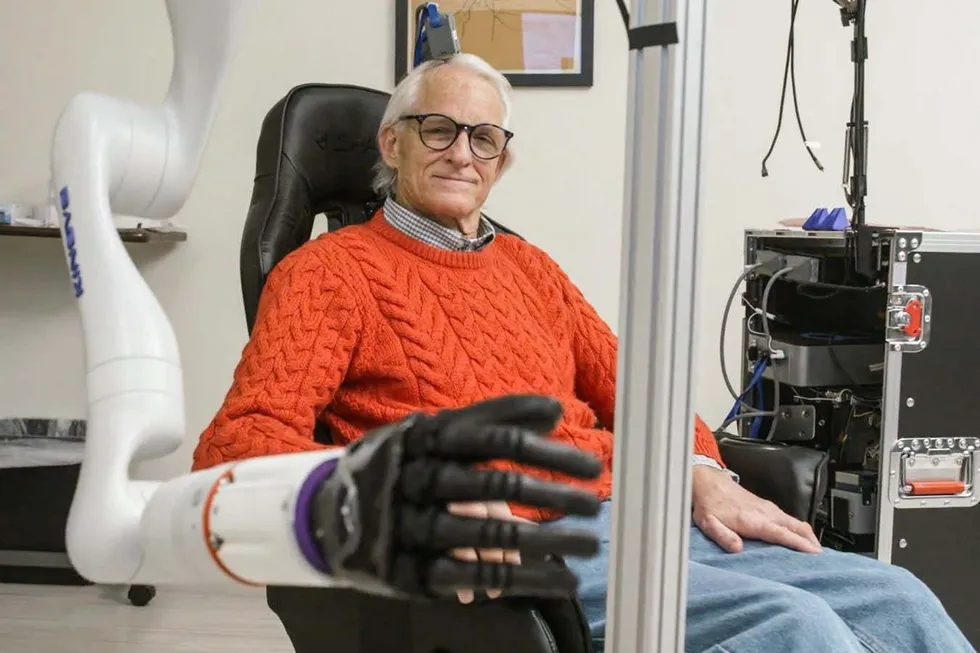
Scott Imbrie vividly remembers the first time he used a robotic arm to shake someone’s hand and felt the robotic limb as if it were his own. “I still get goosebumps when I think about that initial contact,” he says. “It’s just unexplainable.” The moment came courtesy of a brain implant: an array of electrodes that let him control a robotic arm and receive tactile sensations back to the brain.
Getting there took decades. In 1985, Imbrie had woken up in the hospital after a car accident with a broken neck and a doctor telling him he’d never use his hands or legs again. His response was an expletive, he says—and a decision. “I’m not going to allow someone to tell me what I can and can’t do.” With the determination of a head-strong 22-year-old, Imbrie gradually regained the ability to walk and some limited arm movement. Aware of how unusual his recovery was, the Illinois-native wanted to help others in similar situations and began looking for research projects related to spinal cord injuries. For decades, though, he wasn’t the right fit, until in 2020 he was finally accepted into a University of Chicago trial.
Scott Imbrie has shaken hands with a robotic arm controlled by a brain implant. The electrodes record neural signals that enable him to move the device and receive tactile feedback. Top: 60 Minutes/CBS News; Bottom: University of Chicago
Imbrie is part of a rarefied group: More people have gone to space than have received advanced brain-computer interfaces (BCI) like his. But a growing number of companies are now attempting to move the devices out of neuroscience labs and into mainstream medical care, where they could help millions of people with paralysis and other neurological conditions. Some companies even hope that BCIs will eventually become a consumer technology.
None of that will be possible without people like Imbrie. He’s a member of the BCI Pioneers Coalition, an advocacy group founded in 2018 by Ian Burkhart, the first quadriplegic to regain hand movement using a brain implant.
Advertisement
That life-changing experience convinced Burkhart that BCIs will make the leap from lab to real world only if users help shape the technology by sharing their perspectives on what works, what doesn’t, and how the devices fit into daily life. The coalition aims to ensure that companies, clinicians, and regulators hear directly from trial participants.
Ian Burkhart founded the BCI Pioneers Coalition to ensure that companies developing brain implants hear directly from the people using them. Left: Andrew Spear/Redux; Right: Ian Burkhart
The group also serves as a peer-support network for trial participants. That’s crucial, because despite the steady drumbeat of miraculous results from BCI trials, receiving a brain implant comes with significant risks. Surgical complications, such as bleeding or infection in the brain, are possible. Even more concerning is the potential psychological toll if the implant fails to work as expected or if life-changing improvements are eventually withdrawn.
Researchers spell this out upfront, and many are put off, says John Downey, an assistant professor of neurological surgery at the University of Chicago and the lead on Imbrie’s clinical trial. “I would say, the number of people I talk to about doing it is probably 10 to 20 times the number of people that actually end up doing it,” he says.
What Happens in a BCI Trial?
BCI pioneers arrive at their unique status via a number of paths, including spinal cord injuries, stroke-induced paralysis, and amyotrophic lateral sclerosis (ALS). The implants they receive come from Blackrock Neurotech, Neuralink, Synchron, and other companies, and are being tested for restoring limb function, controlling computers and robotic arms, and even restoring speech.
Advertisement
Many of the implants record signals from the motor cortex—the part of the brain that controls voluntary movements—to move external devices. Some others target the somatosensory cortex, which processes sensory signals from the body, including touch, pain, temperature, and limb position, to re-create tactile sensation.
Ease of use depends heavily on the application. Restoring function to a user’s own limbs or controlling robotic arms involves the most difficult learning curve. In early sessions, participants watch a virtual arm reach for objects while they imagine or attempt the same movement. Researchers record related brain signals and use them to train “decoder” software, which translates neural activity into control signals for a robotic arm or stimulation patterns for the user’s nerves or muscles.
Paralyzed in a 2010 swimming accident, Burkhart took part in a trial conducted by Battelle Memorial Institute and Ohio State University from 2014 to 2021. His implant recorded signals from his motor cortex as he attempted to move his hand, and the system relayed those commands to electrodes in his arm that stimulated the muscles controlling his fingers.
Ian Burkhart, who is paralyzed from the chest down, received a brain implant that routed neural signals through a computer to his paralyzed muscles, enabling him to play a video game. Battelle
Getting the system to work seamlessly took time, says Burkhart, and initially required intense concentration. Eventually, he could shift his focus from each individual finger movement to the overall task, allowing him to swipe a credit card, pour from a bottle, and even play Guitar Hero.
Advertisement
Training a decoder is also not a one-and-done process. Systems must be regularly recalibrated to account for “neural drift”—the gradual shift in a person’s neural activity patterns over time. For complex tasks like robotic arm control, researchers may have to essentially train an entirely new decoder before each session, which can take up to an hour.
Austin Beggin says that testing a BCI is hard work, but he adds that moments like petting his dog make it all worth it. Daniel Lozada/The New York Times/Redux
Even after the system is ready, using the device can be taxing, says Austin Beggin, who was paralyzed in a swimming accident in 2015 and now participates in a Case Western Reserve University trial aimed at restoring hand movement. “The mental work of just trying to do something like shaking hands or feeding yourself is 100-fold versus you guys that don’t even think about it,” he says.
It’s also a serious time commitment. Beggin travels more than 2 hours from his home in Lima, Ohio, to Cleveland for two weeks every month to take part in experiments. All the equipment is set up in the house he stays in, and he typically works with the researchers for 3 to 4 hours a day. The majority of the experiments are not actually task-focused, he says, and instead are aimed at adjusting the control software or better understanding his neural responses to different stimuli.
But the BCI users say the hard work is worth it. Beyond the hope of restoring lost function, many feel a strong moral obligation to advance a technology that could help others. Beggin compares the pioneers to the early astronauts who laid the groundwork for the lunar landings. “We’re some of the first astronauts just to get shot up for a couple of hours and come back down to earth,” he says.
Advertisement
The Emotional Impact of BCIs
Speak to BCI early adopters and a pattern emerges: The biggest benefits are often more emotional than practical. Using a robotic arm to feed oneself or control a computer is clearly useful, but many pioneers say the most meaningful moments are the ones the experiment wasn’t even trying to produce. Beggin counts shaking his parents’ hands for the first time since his injury and stroking his pet dachshund as among his favorite moments. “That stuff is absolutely incredible,” he says.
Neuralink participant Alex Conley, who broke his neck in a car accident in 2021, uses his implant to control both a robotic arm and computers, enabling him to open doors, feed himself, and handle a smartphone. But he says the biggest boost has come from using computer-aided design software.
A former mechanic, Conley began using the software within days of receiving his implant to design parts that could be fabricated on a 3D printer. He has designed everything from replacement parts for his uncle’s power tools to bumpers for his brother-in-law’s truck. “I was a very big problem solver before my accident, I was able to fix people’s things,” he says. “This gives me that same little burst of joy.”
BCI user Nathan Copeland used a robotic arm to get a fist bump from then-President Barack Obama in 2016. Jim Watson/AFP/Getty Images
The outside world often underestimates those little wins, says Nathan Copeland, who holds the record for the longest functional brain implant. After breaking his neck in a car accident in 2004, he joined a University of Pittsburgh BCI trial in 2015 and has since used the device to control both computers and a robotic arm.
Advertisement
After he uploaded a video to Reddit of himself playing Final Fantasy XIV, one commenter criticized him for not using his device for more practical tasks. Copeland says people don’t understand that those lighthearted activities also matter. “A lot of tasks that people think are mundane or frivolous are probably the tasks that have the most impact on someone that can’t do them,” he says. “Agency and freedom of expression, I think, are the things that impact a person’s life the most.”
Nathan Copeland plays Final Fantasy XIV using his brain implant to control the game character.
When Brain Implants Become Life-Changing
This perspective resonates with Neuralink’s first user, Noland Arbaugh—paralyzed from the neck down after a swimming accident in 2016. After receiving his implant in January 2024, he was able to control a cursor within minutes of the device being switched on. A few days later, the engineers let him play the video game Civilisation VI, and the technology’s potential suddenly felt real. “I played it for 8 hours or 12 hours straight,” he says. “It made me feel so independent and so free.”
Before receiving his Neuralink implant, Noland Arbaugh used mouth-operated devices to control a computer. He says the BCI is more reliable and enables him to do many more things on his own. Rebecca Noble/The New York Times/Redux
But the technology is also providing more practical benefits. Before his implant, Arbaugh relied on a mouth-held typing stick and a mouth-controlled joystick called a quadstick, which uses sip-or-puff sensors to issue commands. But the fiddliness of this equipment required constant caregiver support. The Neuralink implant has dramatically increased the number of things he can do independently. He says he finds great value in not needing his family “to come in and help me 100 times a day.”
Advertisement
For Casey Harrell, the technology has been even more transformative. Diagnosed with ALS in 2020, the climate activist had just welcomed a baby daughter and was in the midst of a major campaign, pressuring a financial firm to divest from companies that had poor environmental records.
Casey Harrell was able to communicate again within 30 minutes of his BCI being switched on. The device translates his neural signals quickly enough for him to hold conversations. Ian Bates/The New York Times/Redux
“Every morning we’d wake up and there’d be a new thing he couldn’t do, a new part of his body that didn’t work,” says his wife, Levana Saxon. Most alarming was his rapid loss of speech, which, among other things, left him unable to indicate when he was in pain. Then a relative alerted him to a clinical trial at the University of California, Davis, using BCIs to restore speech. He immediately signed up.
The device, implanted in July 2023, records from the brain region that controls muscles involved in talking and translates these signals into instructions for a voice synthesizer. Within 30 minutes of it being switched on, Harrell could communicate again. “I was absolutely overwhelmed with the thought of how this would impact my life and allow me to talk to my family and friends and better interact with my daughter,” he says. “It just was so overwhelming that I began to cry.”
While earlier assistive technology limited him to short, direct commands, Harrell says the BCI is fast enough that he can hold a proper conversation, and he’s been able to resume work part-time.
Advertisement
What’s Holding BCI Technology Back?
BCI technology still has limits. Most trial participants using Blackrock Neurotech implants can operate their devices only in the lab because the systems rely on wired connections and racks of computer hardware. Some users, including Copeland and Harrell, have had the equipment installed at home, but they still can’t leave the house with it. “That would be a big unlock if I was able to do so,” says Harrell.
The academic nature of many trials creates additional constraints. Pressure to publish and secure funding pushes researchers to demonstrate peak performance on narrow tasks rather than build more versatile and reliable systems, says Mariska Vansteensel, who runs BCI studies at the University Medical Center Utrecht in the Netherlands. She says that investigating the technology’s limits or repeating an experiment in new patients is “less rewarded in terms of funding.”
In a clinical trial, Scott Imbrie uses a BCI to control a robotic arm, using signals from his motor cortex to make it move a block. University of Chicago
One of Imbrie’s biggest frustrations is the rapid turnover in experiments. Just as he begins to get proficient at one task, he’s asked to switch to the next task. Study designs also mean that much of the users’ time is spent on mundane tasks required to fine-tune the system.
Advertisement
Perhaps the biggest issue is that trials are often time-limited. That’s partly because scar tissue from the body’s immune response to the implant can gradually degrade signal quality. But constraints on funding and researcher availability can also make it impossible for users to keep using their BCIs after their trials end, even when the technology is still functional.
Ian Burkhart’s BCI enables him to grasp objects, pour from a bottle, and swipe a credit card.
Burkhart has firsthand experience. His trial was extended, but the implant was eventually removed after he got an infection. He always knew the trial would end, but it was nonetheless challenging. “It was a little bit of a tease where I got to see the capability of the restoration of function,” he says. “Now I’m just back to where I was.”
The Push to Commercialize BCIs
Progress is being made in transitioning the technology from experimental research devices to fully-fledged medical products that could help users in their everyday lives. Most academic BCI research has relied on Blackrock Neurotech’s Utah Arrays, which typically feature 96 needlelike electrodes that penetrate the brain’s surface. The implant is connected to a skull-mounted pedestal that’s wired to external hardware. But some of the newer devices are sleeker and less invasive.
Advertisement
Neuralink’s implant houses its electronics and rechargeable battery in a coin-size unit connected to flexible electrode threads inserted into the brain by a robotic “sewing machine.” The implant, which is roughly the size of a quarter or a euro, is mounted in a hole cut into the skull and charges and transfers data wirelessly. Synchron takes a different approach, threading a stent-like implant through blood vessels into the motor cortex. This “stentrode” connects by wire to a unit in the chest that powers the implant and transmits data wirelessly.
Rodney Gorham can use his Synchron implant to control not just a computer, but also smart devices in his home like an air conditioner, fan, and smart speaker. Rodney Decker
Neuralink’s decoder runs on a laptop, while Synchron deploys a smartphone-size signal processing unit as a wireless bridge to the user’s devices, which allows them to use their implants at home and on the move. The companies have also developed adaptive decoders that use machine learning to adjust to neural drift on the fly, reducing the need for recalibration.
Making these devices truly user-friendly will require technology that can interpret user context, says Kurt Haggstrom, Synchron’s chief commercial officer—including mood, attention levels, and environmental factors like background noise and location. This approach will require AI that analyzes neural signals alongside other data streams such as audio and visual input.
Last year, Synchron took a first step by pairing its implant with an Apple Vision Pro headset. When trial participant Rodney Gorham looked at devices such as a fan, a smart speaker, and an air conditioner, the headset overlaid a menu that enabled him to adjust the device’s settings using his implant.
Advertisement
Rodney Gorham uses his Synchron implant to turn on music, feed his dog, and more. Synchron BCI
Another way to reduce cognitive load is to detect high-order signals of intent in neural data rather than low-level motor commands, says Florian Solzbacher, cofounder and chief scientific officer of Blackrock Neurotech. For instance, rather than manually navigating to an email app and typing, the user could simply think about sending an email and the system would then open it with content already prepopulated, he says.
Durability may prove a thornier problem to solve, UChicago’s Downey says. Current implants last around a decade—well short of a lifelong solution. And with limited real estate in the brain, replacement is only possible once or twice, he says.
Rapid technological progress also raises difficult decisions about whether to get a BCI implant now or wait for a more advanced device. This was a major concern for Gorham’s wife, Caroline. “I was hesitant. I didn’t want him to go on the trial but maybe a future one,” she says. “It was my fear of missing out on future upgrades.”
This kind of talk inspires mixed feelings in users. The hype brings visibility and funding, says Beggin, but could divert attention from medical users’ needs. Copeland worries that consumer branding could strip the devices of insurance coverage and that rising demand may make it harder to access qualified surgeons.
Noland Arbaugh, the first recipient of Neuralink’s BCI, says that using the implant to control a computer made him feel independent and free. Steve Craft/Guardian/eyevine/Redux
There are also concerns about how data collected by BCI companies will be handled if the devices go mainstream. As a trial participant, Arbaugh says he’s comfortable signing away his data rights to advance the technology, but he thinks stronger legal protections will be needed in the future. “Does that data still belong to Neuralink? Does it belong to each person? And can that data be sold?” he asks.
Blackrock’s Solzbacher says the company remains focused on the medical applications of the technology. But he also believes it is building a “universal interface to any kind of a computerized system” that may have broader applications in the future. And he says the company owes it to users not to limit them to a bare-bones assistive technology. “Why would somebody who’s got a medical condition want to get less than something that somebody who’s able-bodied would possibly also take?” says Solzbacher.
Advertisement
The ever-optimistic Imbrie heartily agrees. Medical devices are invariably expensive, he says, but targeting consumer applications could push companies to keep devices simple and affordable while continuing to add features. “I truly believe that making it a consumer-available product will just enhance the product’s capabilities for the medical field,” he says.
Imbrie is on a mission to refocus the conversation around BCIs on the positives. While concerns about risks are valid, he worries that the alarming language often used to describe brain implants discourages people from volunteering for trials that could help them.
“I remember laying there in the bed and not being able to move,” he says, “and it was really dehumanizing having to ask someone to do everything for you. As humans, we want to be independent.”
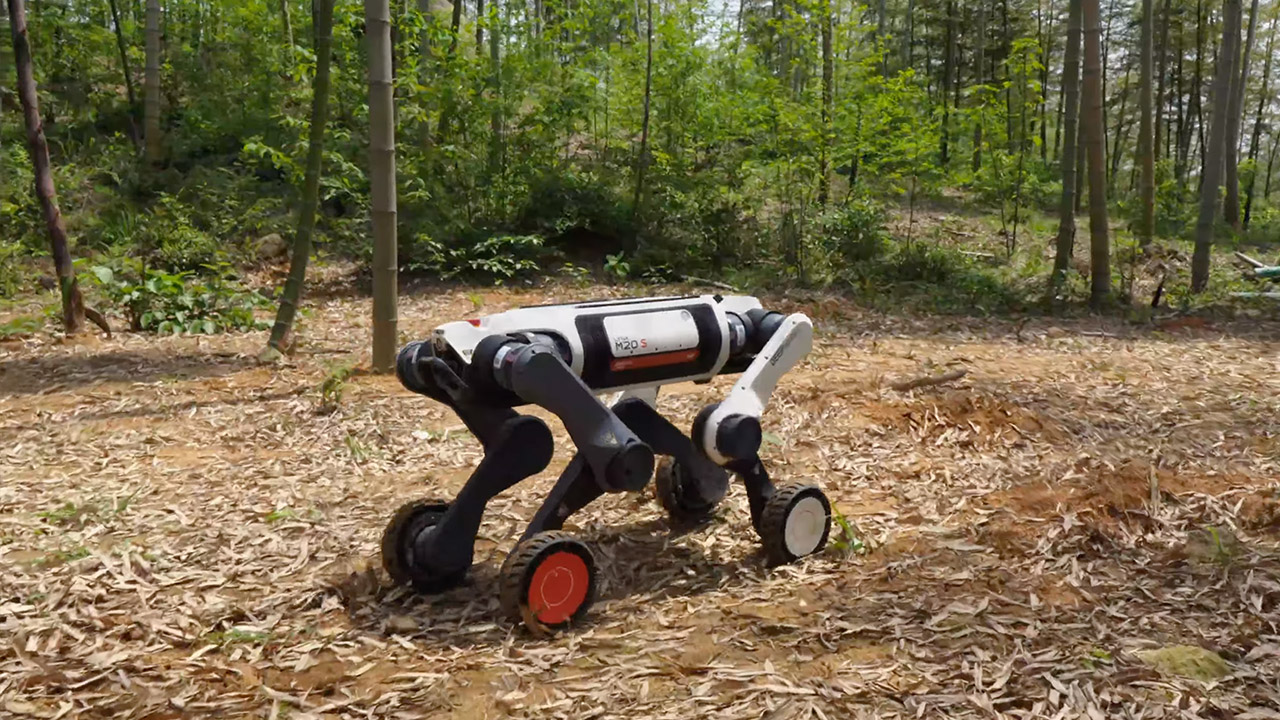
Deep Robotics has just released its latest four-legged robot, the Lynx M20S, and it’s evident that this machine was built to handle situations that would bring others to a halt. The days of the Lynx M20 being content with the safety of a controlled factory floor or a bone dry path are over, as the Lynx M20S simply continues truckin’ without blinking, trekking through water and dirt like it’s nothing. The engineers expanded on the previous Lynx M20’s robust foundation by improving three critical areas: hauling capacity, water resistance, and sheer speed.
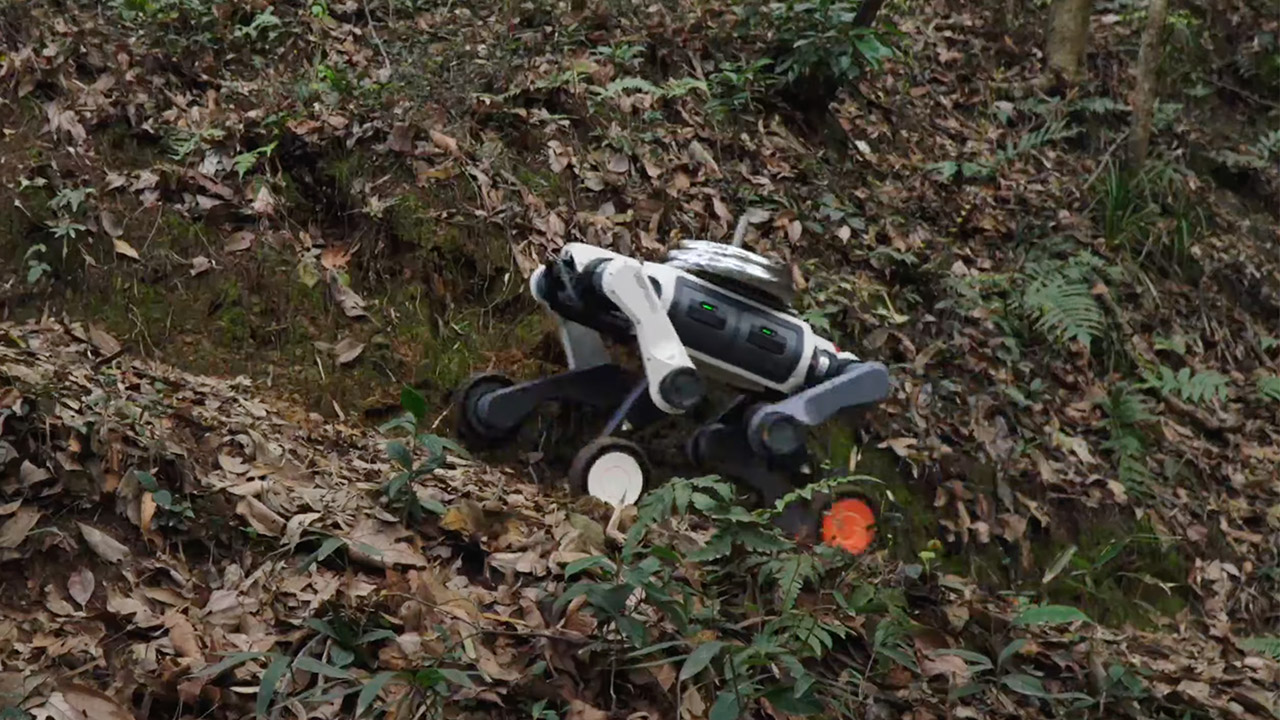
The Lynx M20S may appear familiar, but it has been refined, measuring approximately 82cm long, 43cm broad, and 57cm tall, a sleek structure that maintains the overall weight under 33kg with the battery included. That means one person can easily move it around when necessary, so getting it from a truck to a job site is no trouble. M20S has wheels on the ends of each leg, so when in rolling mode, it glides along pavements and packed paths with ease. Flip a switch, and the wheels lock and the legs bend and lengthen, allowing you to step over logs, scamper up embankments, or step over obstacles up to 80cm tall. If you have to climb stairs, it is content to go to the next level at a fairly consistent rate: 25cm each step with a maximum slope angle of 45 degrees. It has a clever hybrid system that allows it to determine the optimal path forward based on what’s in front of it, all with a smooth transition from one mode to another.
【Next-Generation Robotic Companion: Meet the Unitree Go2 Robotic Dog】 The Unitree Go2 X is a powerful and intelligent quadruped robot designed for…
【Intelligent Navigation with 3D LiDAR & Obstacle Avoidance】 Featuring ultra-wide 3D LiDAR with 360°x96° perception, the Go2 X detects obstacles…
【High-Definition Vision & Seamless App Integration】 A front HD camera streams 1280×720 video to the app. Control the robot, view real-time data…
Speeds have undoubtedly increased with this new iteration, as lab testing suggest it can achieve a top speed of 9m/s, which is fast enough to keep up with a jogging on open ground. However, for everyday use, it has a more manageable top speed, striking a good mix between control and performance. Payload capacity has also been increased, allowing you to carry 35kg of weight in real work, up from 15kg previously. Hot-swappable batteries provide 3 hours of juice when unloaded and a good 2.5 hours when loaded, and the 1.5 hour charge time allows you to get back on the road quickly. Distance is expected to be roughly 15 kilometers without cargo and 12 kilometers with weight on board – quantities that matter when the operation is spread out over a vast location or a remote trail.
Protection levels received the same level of attention to detail. The Lynx M20S has recently received an IP67 rating. It’s well-sealed against dust and may be submerged in water for a short period of time without issue. I mean, earlier versions had an IP66 rating, which was fine for dealing with heavy rain or the occasional splash, but don’t expect it to get through a deeper puddle or an unforeseen flood. Temperatures range from negative 20 degrees Celsius to a blistering 55 degrees Celsius, so the robot can actually run whether it’s snowing or the sun is pouring down on some unfortunate guy in the desert. The Lynx’s joints and electronics are all shielded, so it can withstand a good old-fashioned rainstorm, muddy wetlands, or a dusty construction site, and all of that durability means it can do jobs when the weather is a complete nightmare.
Sensors and brains are the final piece of the puzzle. It has dual 96-line LiDAR units that scan the entire 360 degrees around it (and 90 degrees up), sending thousands of data points to the navigation system per second. Wide-angle cameras provide it with some visual input, and the onboard processors map out the way ahead and dodge obstacles in real time, plus the machine works out when to roll, how to stride, and exactly how to modify its stance for balance on its own. Operators can monitor the live feed and intervene if things go wrong, but the majority of the movement occurs automatically. With those modular ports, you can add all sorts of different gear for whatever project you’re performing, such as gas detectors and inspection cameras.
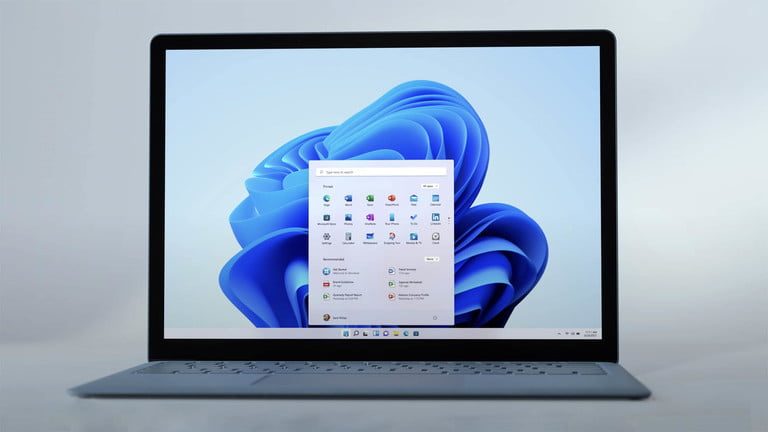
There was a time when buying a PC felt… rational. 8GB of RAM got the job done, 16GB felt like a power move, and anything beyond that was reserved for people doing genuinely heavy work. That balance existed because software respected hardware. Today, that balance has quietly collapsed, and Microsoft seems perfectly okay with it.
Microsoft
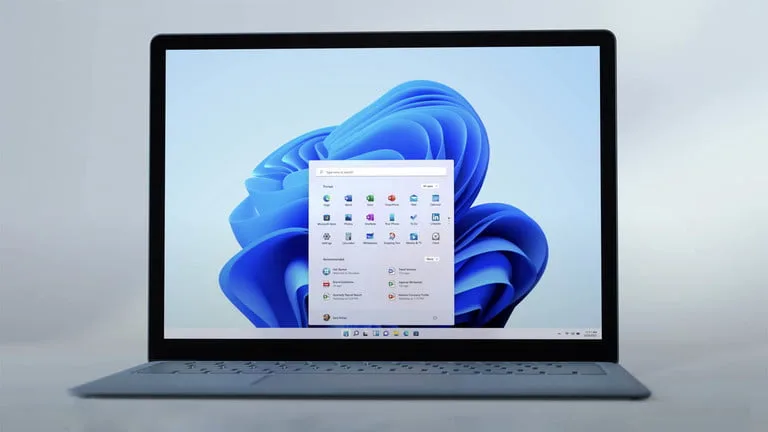
The company’s since-pulled guidance, casually positioning 16GB as the baseline and 32GB as the “no worries” zone, wasn’t just a recommendation. It’s a shift in responsibility. Because nothing about modern hardware suggests we suddenly need double the memory for the same everyday tasks. DDR5 memory is faster, more efficient, and more capable than anything we’ve had in the past. On paper, systems should feel smoother, more responsive, and more efficient. Instead, users are being nudged into upgrading just to maintain the same level of comfort they had years ago.
And that’s where the frustration kicks in. This whole situation feels like Microsoft telling users their OS is too big for its own britches, and it’s the user’s job to buy it a larger pair of pants. That’s not progress. That’s a workaround disguised as innovation.
Optimization Isn’t Dead, It’s Just Missing on Windows
Let’s not pretend this is an industry-wide problem. It isn’t. Platforms like macOS continue to prove that optimization still matters. Apple’s MacBook Neo, even with modest 8GB memory on paper, manages to deliver smooth, consistent performance because the software is tightly controlled and efficient. The same goes for Linux distributions like SteamOS, Bazzite, and CatchyOS, which run lean while still offering a full desktop experience.
Now compare that with Windows 11. Idle RAM usage hovering around 6 to 8GB has become the norm, not the exception. That’s before opening a browser, before launching a game, before doing anything remotely demanding. It’s like moving into a house where half the electricity bill is already gone before turning on the lights. And instead of fixing the wiring, the landlord is suggesting a bigger power connection.
Advertisement
We’re running hardware that dwarfs moon landing computers, yet even opening Calculator still takes its sweet, dramatic time.
Part of the problem lies in how modern Windows apps are built. Native, efficient applications have slowly been replaced by web-based frameworks and Electron wrappers. Apps like Discord and WhatsApp on PC aren’t really apps in the traditional sense anymore. They’re essentially glorified browser tabs who thinks it’s a sovereign nation. These apps are memory hogs by design, and Microsoft’s own system components have followed suit, with Edge WebView2 instances popping up in the background like uninvited guests at a dinner party.
Then there is the “AI Bloatware” saga, a masterclass in corporate rebranding that would make a used car salesman blush. After the community rightfully revolted against the initial wave of heavy-handed AI integration, Microsoft pinky-promised to scale things back. What they actually did was just change the names and hide the toggles. These features are still there, lurking in the background, continuing to chip away at system resources.
Microsoft
The sheer lack of respect for the user’s hardware is what really stings. When your PC is idling at 8GB of RAM usage, it’s not because it’s doing something brilliant for you; it’s because the OS is too bloated to stay quiet. Microsoft has traded efficiency for “convenience”, though it’s actually convenience for their developers, who find it easier to wrap a website in a container than to write actual, native code. Like, seriously, we shouldn’t need a supercomputer to run a spreadsheet and a chat app simultaneously.
If Microsoft knows they can make it better, why are they asking us to pay for their current failures?
What makes it even more ironic is what’s happening internally. Satya Nadella recently spoke about Windows K2, a project aimed at making the OS leaner and more efficient. This admission is the ultimate self-own. In one breath, the CEO is acknowledging that the OS is a bloated mess that needs a ground-up redesign to be competitive, and in the next, the company is telling users to go out and buy 32GB of RAM to band-aid the current disaster. If a better, optimized future is already being worked on, why is the present solution being pushed onto users’ wallets?
The Real Problem Isn’t Memory, It’s The Mindset
To be clear, 32GB of RAM absolutely has its place. Heavy multitaskers, creators, and gamers dealing with modern AAA titles will benefit from the extra headroom. That’s not the issue. The issue is presenting it as the new normal for everyone, regardless of usage. The vast majority of Windows users are people who just want to browse the web, check their emails, and maybe play a casual game of Minecraft. For these people, 16GB should be more than enough. And the fact that it often is, on other platforms, makes this even harder to justify. This isn’t about hardware limitations. It’s about software inefficiency.
Advertisement
When a system feels heavy despite capable hardware, the fault doesn’t lie with the machine. It lies with the experience being delivered.
The result of this tone-deaf management is exactly what you’d expect: a mass exodus. Users are finally reaching their breaking point and realizing that the grass really is greener on the other side. People are realizing that they don’t actually hate their hardware; they just hate the OS that’s holding it hostage. When a non-gamer can get a full day of productivity out of 8GB on a Mac, but struggles to keep three Chrome tabs open on a 16GB Windows machine, the problem isn’t the memory — it’s the middleman. On top of that, Microsoft is trying to gaslight us into thinking we need more power, when what we actually need is better software.
Microsoft
The irony is, Microsoft already knows how to fix this. Just look at what Asha Sharma and the Xbox team have been doing: listening to users, delivering meaningful improvements, and focusing on experience over excess. It’s proof that the company can still get it right when it wants to. Maybe instead of telling us to buy more memory, Microsoft should try remembering how to build a good operating system.
Bose knows a few things about soundbars. It has sold enough of them over the years to know what people actually want under their TVs, and the new Lifestyle Ultra Soundbar and Lifestyle Ultra Subwoofer arrive with Dolby Atmos support, Apple AirPlay, Google Cast, and the kind of simplified setup that made Bose a household name long before every TV brand decided it also needed to sell you “cinema sound” in a plastic bar.
The Lifestyle Ultra Soundbar will sell for $1,099, the wireless Lifestyle Ultra Subwoofer for $899, and both arrive May 15th alongside the Lifestyle Ultra Speaker, Bose’s new $299 wireless smart speaker, which we cover separately in our related story that you can read here.
But this story is really about home theater, and Bose knows the room has changed. LG, Samsung, Sony, Klipsch, and Sonos are all fighting for the same wall space under your TV. And while a traditional 5.1 AVR-based system can still deliver better performance for the money, it also brings more boxes, more setup, and enough cable management to make grown adults consider moving.
Most people buy soundbars because they want one speaker to do almost everything. Maybe two if they add a subwoofer. Maybe four if rear channels enter the witness protection program. Bose is betting the Lifestyle Ultra Soundbar and Subwoofer can make sound quality matter again without turning the living room into the Big Dig with speaker wire.
Advertisement
Built for Atmos and Bigger Bass
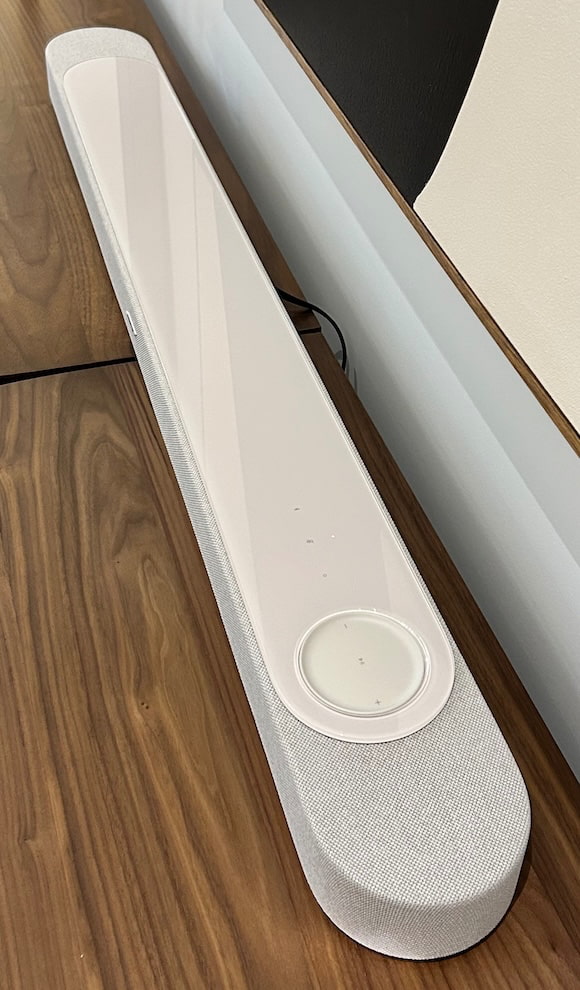
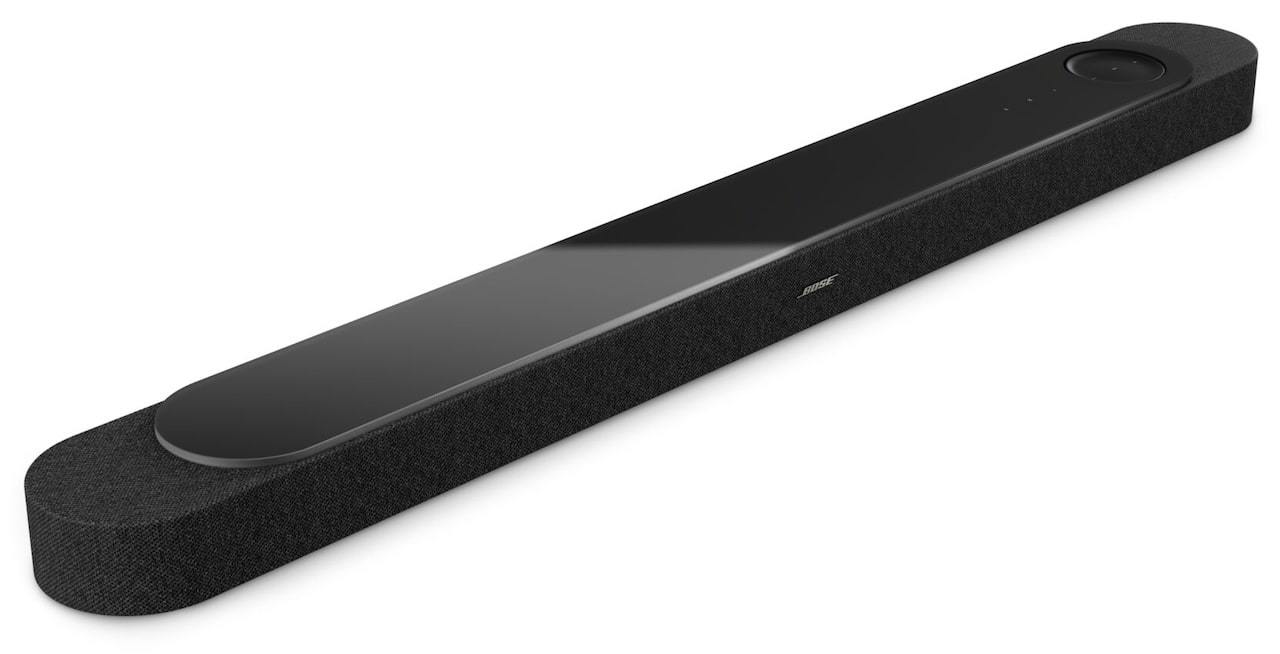
The Lifestyle Ultra Soundbar is the anchor for Bose’s new home theater system, and it is more than a cosmetic update. Bose says this is its first major soundbar redesign in more than a decade, built around a nine driver array that includes six full range drivers, two of them up firing, four front facing, a dedicated center tweeter, and two proprietary PhaseGuide drivers. At 43.54 inches wide, 2.64 inches tall, and 4.96 inches deep, and weighing 14.8 pounds, it is sized for larger TVs without turning into furniture. The goal is clear: deliver Dolby Atmos playback, wider spatial effects, stronger dialogue intelligibility, and more convincing height from a single enclosure before you start adding more boxes to the room.
The technology matters because each piece is aimed at a specific soundbar problem: limited width, limited height, buried dialogue, lightweight bass, and unpredictable room acoustics. PhaseGuide is used to steer sound horizontally so effects appear to come from areas where there are no physical speakers. TrueSpatial processing is designed to make non-Atmos content sound more immersive.
SpeechClarity uses adjustable AI-driven speech enhancement to lift dialogue without changing the entire mix. CustomTune room calibration uses an iOS or Android microphone as the reference point to analyze the room, seating, surfaces, and layout. CleanBass works with Bose’s QuietPort acoustic opening and DSP to reduce the kind of low frequency distortion that usually shows up when compact speakers are asked to do too much.
Bose Lifestyle Ultra Subwoofer
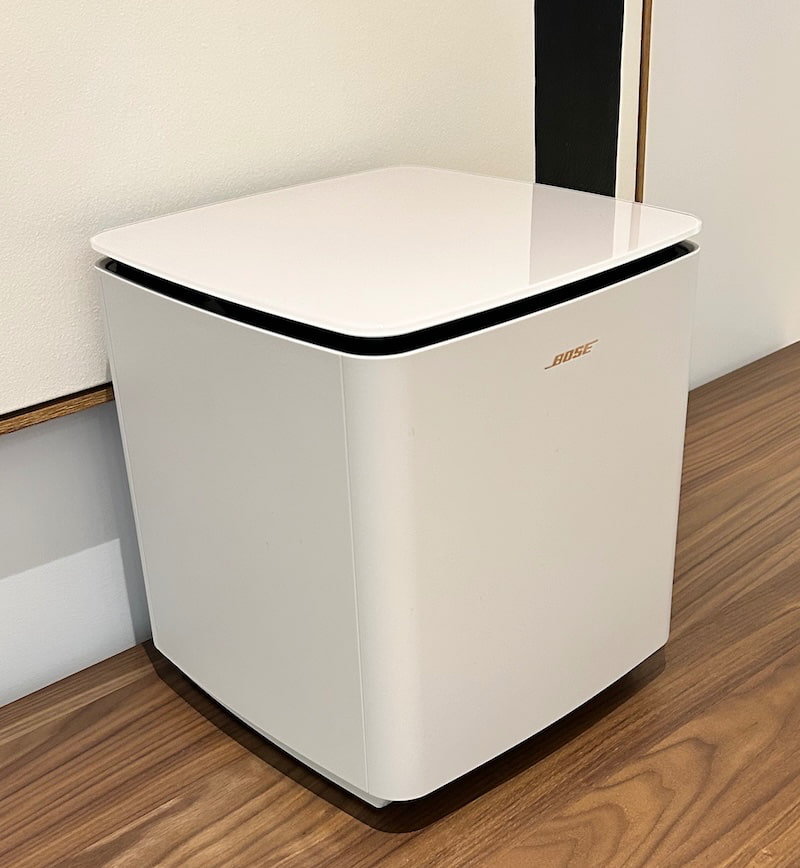
The Lifestyle Ultra Subwoofer is the obvious next step if this is going under the main TV. It measures 11.63 inches wide, 12.88 inches tall, and 11.63 inches deep, weighs 33.7 pounds, and connects wirelessly through the Bose app with a stated range of 30 feet. Bose also lists a 3.5 mm wired connection as an option. Its job is not complicated: take over the demanding low frequency effects, add weight, and let the soundbar focus more on dialogue, spatial cues, mids, and highs. In 5.1.2 or 7.1.4 configurations, the subwoofer also works with CustomTune room calibration, which matters because bass and rooms have a long history of not playing nicely together.
The configuration path is where Bose is trying to keep things flexible. The Lifestyle Ultra Soundbar can be used on its own as a 5.0.2 system. Add the Lifestyle Ultra Subwoofer and it becomes 5.1.2. Add two Lifestyle Ultra Speakers as wireless surrounds and the system expands to 7.0.4 without the subwoofer, or 7.1.4 with the subwoofer included. That gives buyers a way to start with the bar and build out the system without committing to an AVR, speaker wire, stands, banana plugs, and the usual Saturday afternoon descent into cable management hell. Bose does offer custom-designed stands for the Lifestyle Ultra Wireless Speakers with cable management.
Bose Lifestyle Ultra Soundbar (black)
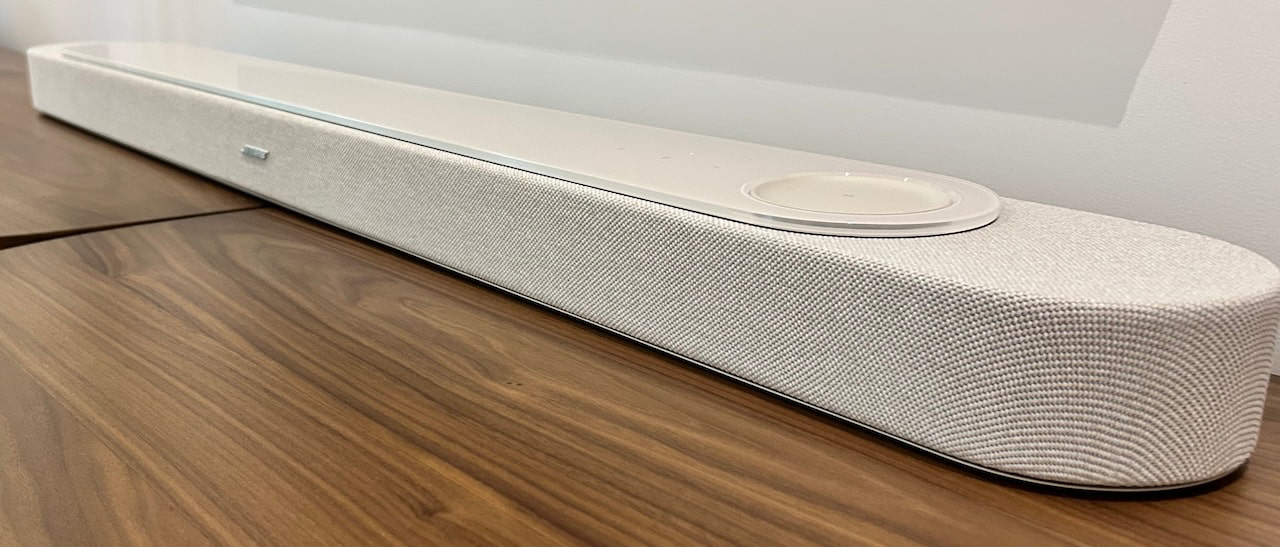
A few practical details matter. The soundbar supports HDMI ARC and eARC, Wi-Fi, Bluetooth 5.3, Google Cast, Apple AirPlay, Spotify Connect, Alexa, and Alexa Plus in the U.S. It also includes tactile controls, a hidden LED for status feedback, an eARC compatible HDMI cable in the box, and optional accessories including a wall bracket and remote control. The soundbar and subwoofer both come in Black and White Smoke, with a textured knit fabric grille on the bar and premium glass top design language shared across both products.
Advertisement
One thing Bose is not claiming at launch: dual subwoofer support. Previous Bose systems have supported dual bass modules, but that is not part of the Lifestyle Ultra system right now. At the Bose House event in NYC last week, Bose also did not tell me that dual subwoofer support is never coming. So the accurate answer is this: one subwoofer today, no promise of two tomorrow, and no reason to pretend the door has been nailed shut.
Advertisement. Scroll to continue reading.
What We Heard at Bose House
My embargoed review can’t be published until May 15th, so we’re limited to early impressions based on Bose’s controlled demonstrations at its townhouse on the Upper West Side of Manhattan. Bose set up the Lifestyle Ultra Soundbar system in its full 7.1.4 configuration, then removed the rear channels and switched the subwoofer in and out so we could hear how much each piece contributed. That matters, because soundbar demos often hide the sausage. This one gave us a better sense of what the bar can do on its own, what the subwoofer adds, and how the system changes when the Lifestyle Ultra Speakers are used as surrounds.
The room was also relevant. Bose had the system set up in the den on one of the upper floors, not in a massive showroom or some acoustically doomed hotel space. I don’t know the exact dimensions, but it felt close to my 16 x 13 foot den at home, probably a little deeper, with ceilings that appeared to be at least 10 feet high. It was still a typical NYC brownstone, with brick walls covered in plaster, but the room was well behaved acoustically. We were close to Broadway in the mid 70s, and you could not hear the street outside. For Manhattan, that’s basically science fiction with better parking rules.
The first demo track was from Dune, specifically the Arrakis rescue sequence involving a spice harvester. The scene gave the Lifestyle Ultra system a lot to manage at once: swirling sand, engine noise, the score, dialogue, and the movement of the rescue craft overhead as the crew is pulled out before the worm arrives.
Advertisement
No ballerinas or opera singers were harmed during the rescue. Timothée Chalamet may have had a point about opera and ballet struggling for mainstream relevance in 2026, but context matters. Arrakis is dangerous enough without dragging the arts community into the sandstorm.
What stood out almost immediately was the scale of the sound. Wide. Some real depth. A lot of height, which is where the upward firing drivers did their job. The Bose also handled dialogue very well. I did not feel like I was fighting to hear voices through the effects, sand, machinery, and Hans Zimmer doing Hans Zimmer things with the subtlety of a sandworm at brunch.
Bass impact with the subwoofer engaged was good, although not exactly SVS level, which is fine because Bose is not trying to sell you a refrigerator with a woofer in it. The rear channels were more effective than I expected. When the aircraft lifted off and moved overhead, the sound tracked with it, passed above me, and continued behind the listening position in a way that made the 7.1.4 setup feel genuinely useful rather than decorative.
Before I get too deep into the listening impressions, Bose’s SpeechClarity tech deserves its own mention. It uses adjustable AI driven speech enhancement to isolate and elevate dialogue without blowing up the rest of the mix, and that matters if you watch a lot of sports, movies, or prestige TV where everyone whispers like they are hiding from a tax audit. If your spouse does not want to hear you yelling “What did he say?” through the entire Stanley Cup Playoffs, turn this on. Yup. Go Sabres. Sorry, Bruins. Better luck next season.
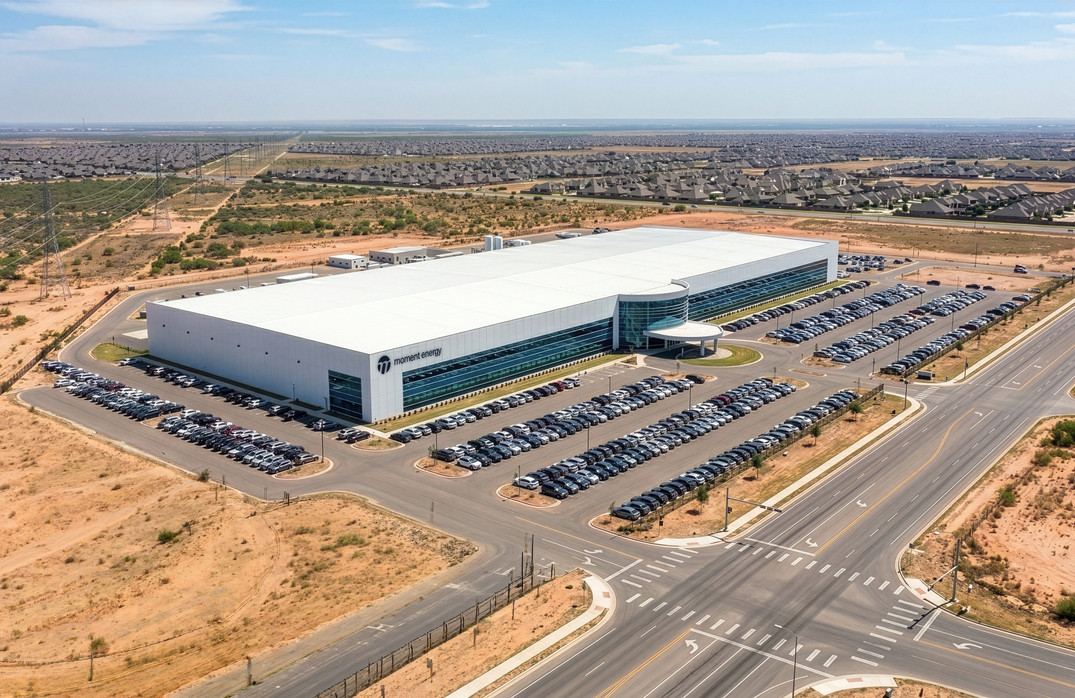
Artist’s rendering of Moment Energy’s planned Austin, Texas, gigafactory. (Moment Energy Image)
Moment Energy, a British Columbia-based startup repurposing used electric vehicle batteries, has announced a $40 million investment to help fund construction of a massive factory in Texas and more than triple its headcount.
The company, headquartered just outside Vancouver, has now raised more than $100 million in total. Moment Energy is plugging into growing demand for energy storage, which supports data centers, utilities, residential use and industrial operations.
“We are building a new generation of energy infrastructure that can be deployed rapidly, manufactured domestically and powered by existing battery resources,” said Edward Chiang, co-founder and CEO of Moment Energy, in a statement.
Moment Energy launched in 2019, co-founded by Chiang, Sumreen Rattan, Gabriel Soares and Gurmesh Sidhu, all engineering graduates from Simon Fraser University in B.C. The team’s first battery system deployment came in 2021 on Quadra Island, off the coast of Vancouver Island.
Moment Energy co-founders, from left: Gurmesh Sidhu, Sumreen Rattan, Gabriel Soares and Edward Chiang. (Moment Energy Photo)
The startup plans to break ground this year on a 200,000-square-foot gigafactory outside Austin, Chiang previously told Sustainable Biz Canada. The company expects its workforce to reach 250 once the facility is operational, up from more than 70 today.
Moment Energy is already deploying commercial projects and has customers across North America, including major tech companies and international airports.
Advertisement
The company’s model capitalizes on the natural lifecycle of EV batteries, which can retain 70-80% of their original capacity after roughly 10 to 20 years of use — well past their automotive end of life. Moment Energy disassembles those batteries, tests their remaining capacity and reassembles them into stationary energy storage systems the startup says can operate for up to 30 years.
The company has also secured multiple safety certifications, which it says makes it the only provider that can deploy repurposed battery systems in the built environment “without special dispensations.”
A Moment Energy battery system. (Moment Energy Photo)
The Series B round was led by Evok Innovations, with participation from Liberty Mutual Investments, W23 Global Fund and Acario, the corporate venture capital arm of Tokyo Gas. Existing investors including Amazon’s Climate Pledge Fund, Voyager Ventures and In-Q-Tel also joined in the round.
“Moment Energy is the only player in the EV battery repurposing industry that has proven safety and scalability are not mutually exclusive,” said Marty Reed, a partner at Evok Innovations, adding that the company is positioned to deploy energy storage systems “at enormous scale.”
Moment Energy operates in a growing field. Other companies focused on battery repurposing include Redwood Materials, which was launched by former Tesla CTO JB Straubel, and RePurpose Energy. Battery recycling players include Cirba Solutions, Ascend Elements, Li-Cycle and Ecobat — with Redwood Materials active in recycling as well.
Integrity360’s Matthew Olney explains the ins and outs of IT and OT security, and the importance of having both secured.
From manufacturing lines and water utilities to transport hubs and energy plants, operational technology (OT) is a prime target for cybercriminals and nation-state actors.
As the lines between information technology (IT) and OT blur, understanding the difference between them and securing both effectively has never been more critical.
IT v OT security
IT securityis the practice of protecting an organisation’s IT assets, including computers, networks, and data, from unauthorised access, attacks and other malicious activity. It involves using a combination of technologies, processes and physical controls to ensure the confidentiality, integrity and availability of information. A key objective is to prevent threats like data breaches, malware and phishing.
Advertisement
OT security, on the other hand, protects the physical systems that keep operations running – machinery, control systems and critical infrastructure. Here, priorities shift: availability and safety come first, because downtime doesn’t just cost money; it can halt production or endanger lives.
Many industrial organisations still treat IT and OT as distinct domains – one governed by corporate IT teams, the other by engineering departments.
Historically, this separation made sense when OT systems operated in isolation. But that’s no longer the case.
Today, nearly 40pc of OT assets are connected to the internet without adequate security, and by 2025, 70pc of OT systems are expected to be integrated with IT networks.
Advertisement
With 72pc of industrial cybersecurity incidents originating in the IT environment before infiltrating OT systems, a unified, cross-functional approach to securing both realms is growing in importance.
Attackers exploit weak segmentation, unsecured remote access, and legacy systems that were never designed with cybersecurity in mind. Once inside, they can halt production, damage equipment, or even threaten human life or cause environmental damage.
The unique challenges of OT environments:
Legacy technology
Many systems run on outdated or unsupported software, sometimes decades old, that can’t easily be patched without interrupting operations.
Advertisement
Proprietary protocols
OT devices use vendor-specific communication methods not recognised by standard IT tools.
Availability over confidentiality
Shutting down a process for security reasons may be more damaging than the attack itself.
Human and safety impact
A compromised industrial controller could affect worker safety or public services.
Limited visibility
Without asset inventories or monitoring, intrusions can go unnoticed for months.
Advertisement
Common weaknesses found in OT networks
Integrity360’s experts regularly uncover recurring issues across industrial environments, including:
Poor network segmentation, allowing attackers to move from IT to OT.
Unpatched systems and default configurations left unchanged.
Weak or insecure remote access used by vendors and contractors.
Lack of asset inventory or real-time monitoring.
No endpoint protection against malware propagation.
These weaknesses make OT environments particularly attractive to threat actors seeking maximum disruption.
When operations depend on continuous uptime, a single breach can lead to production loss, safety risks, reputational damage and regulatory penalties.
By Matthew Olney
Advertisement
Olney is a cybersecurity content and communications specialist with extensive experience translating complex security topics into clear, engaging content for technical and executive audiences. As content marketing and social media lead at Integrity360, he works closely with Integrity360 experts to develop thought leadership, technical blogs, webinars and multi-channel campaigns that help organisations understand and respond to emerging cyberthreats.
The company confirmed to me that it is moving in a direction that other platforms have taken: converting users to the app. Reddit says that the test aims to find out if people like me—those who use the service but aren’t generally logged in—get a better experience with the app.
I often prefer the open web and don’t really want one more app cluttering up my phone. And while I’m open to learning about the “much better” experience in the app, hardball blocking tactics seem an odd way to educate users about something supposedly in their own interests. (After clearing cookies in my browser, I was able to access the mobile website again. It sounds like you can alternately log in to Reddit, though the overlay says nothing about this; I cleared cookies before I could try it.)
User reaction to the move seems somewhat negative. Futurism ran an angry article last week saying that Reddit “Intentionally Breaks Its Mobile Website.” And redditors have posted numerous complaints in places like r/bugs, r/help, and (naturally) r/enshittification. (Representative sample comment: “Reddit is a Website; why is it forcing me to the app?”)
Some of this carping does feel a bit strident for a free and (generally) useful service. Perhaps I should switch to the app. Perhaps I should browse while logged in to enable a truly customized feed. Perhaps I really would love the better search options.
Advertisement
But as I mentioned at the beginning, I often wonder if I could spend my Reddit time in more productive ways; signing up for a more targeted feed that better plays on my dopamine triggers doesn’t actually sound helpful. I think that’s one reason I resist these pushes to log in, to customize, to spend even more time on site. Indeed, if more force continues to be applied, perhaps the better choice would simply be to walk away altogether.
Disclosure: Advance Publications, which owns Ars Technica parent Condé Nast, is the largest shareholder in Reddit.
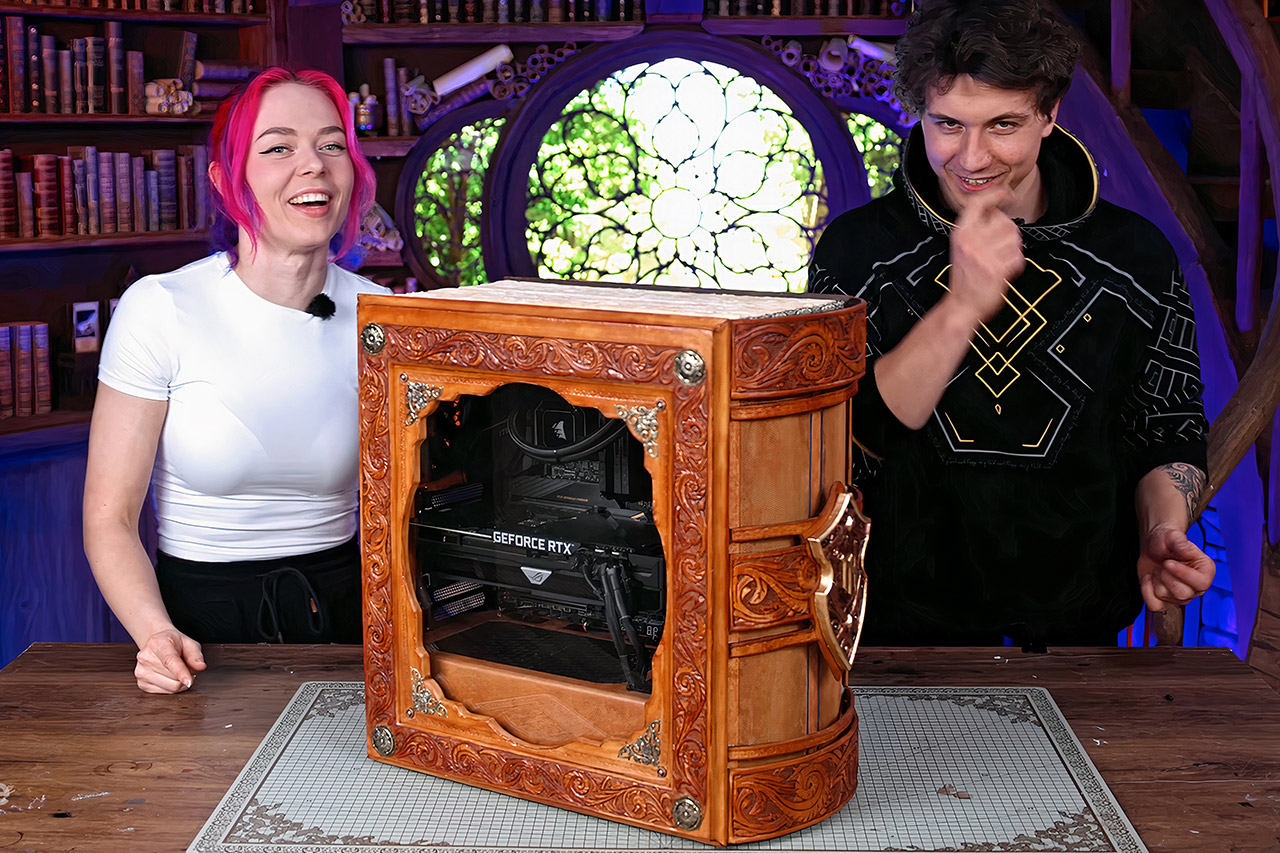
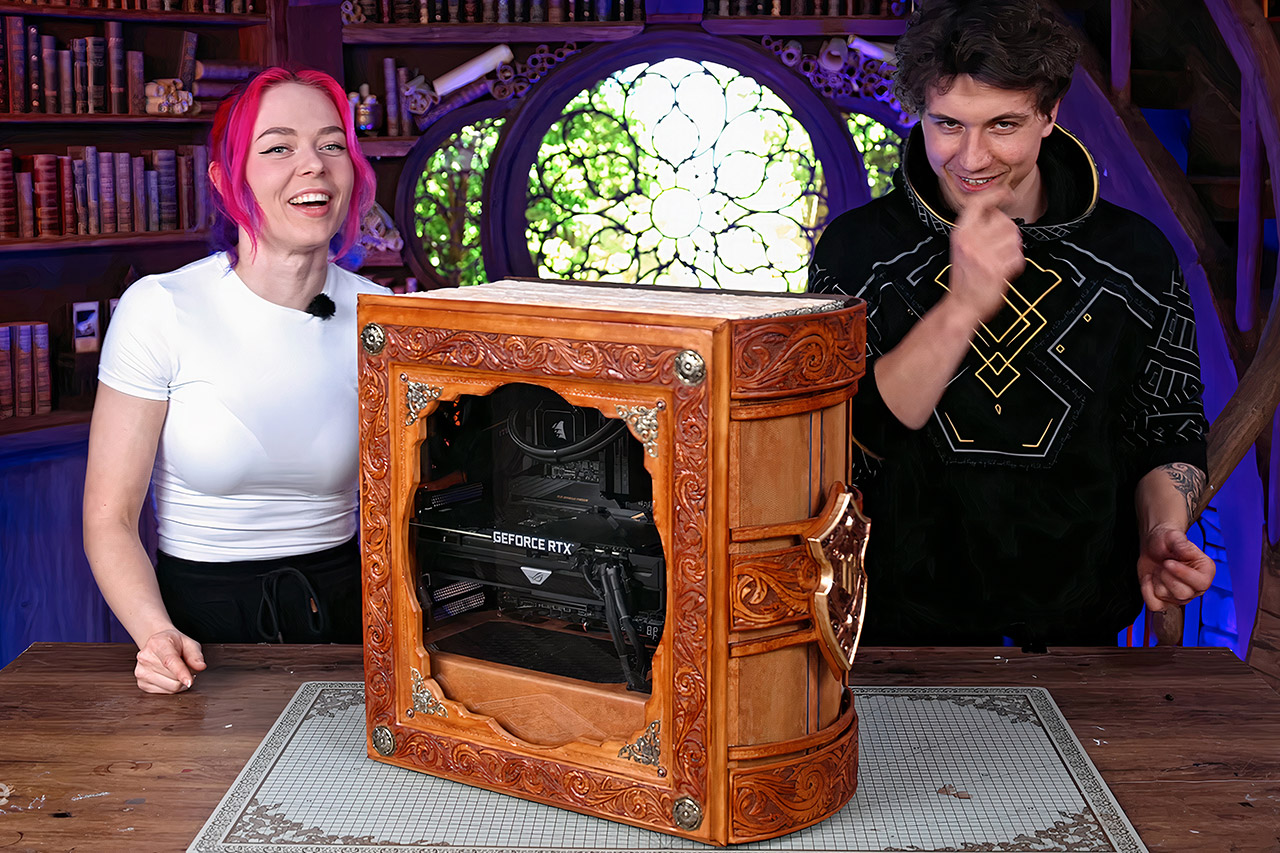
Martini and Hansi of Nerdforge have long been splitting their time between crafting one-of-a-kind leather bound books and building custom computers. One day, they were wondering what would happen if they combined the two worlds into one project. The end result looks like a large, old book pulled from a dusty library shelf and placed on a desk.
The exterior gives you a clue right away, as the thick vegetable tan leather that wraps around the sides was chosen for its solidity, making every carved line and stamped detail stand out. The hides were soaked in a sealed bag overnight to soften them enough for tooling, and then allowed to dry naturally. Each side panel began as four laser-cut plywood layers joined together to form a solid slab. The corners were routed smooth before the leather was applied, and contact cement was utilized to adhere the heavy hide after standard wood glue couldn’t handle the thickness. The edges fold cleanly together, and after a little sharpening with a thinner leather strip, the finished covers appear very crisp and professional.
HELLO, MACBOOK NEO — Ready for whatever your day brings, MacBook Neo flies through everyday tasks and apps. Choose from four stunning colors in a…
THE MOST COLORFUL MACBOOK LINEUP EVER — Choose from Silver, Blush, Citrus, or Indigo — each with a color-coordinated keyboard to complete the…
POWER FOR EVERYDAY TASKS — Ready the moment you open it, MacBook Neo with the A18 Pro chip delivers the performance and AI capabilities you need to…
Carving on the leather required a lot of patience because it was done entirely by hand, with lines drawn freehand and backdrop stamps used to drive the leather down and provide some wonderful contrast. Then they utilized other stamps to create raised, 3D elements that stand out when light hits them. It took two full days to complete each cover, but it was worthwhile because the finished product seemed handmade rather than mass-produced. The spine was given the same treatment, with curved pieces of leather meticulously molded over a form and tooled with matching patterns. After everything had dried and gotten a faint stain, the tint turned out to be a warm, somewhat aged tone that resembled a genuine hand bound book.
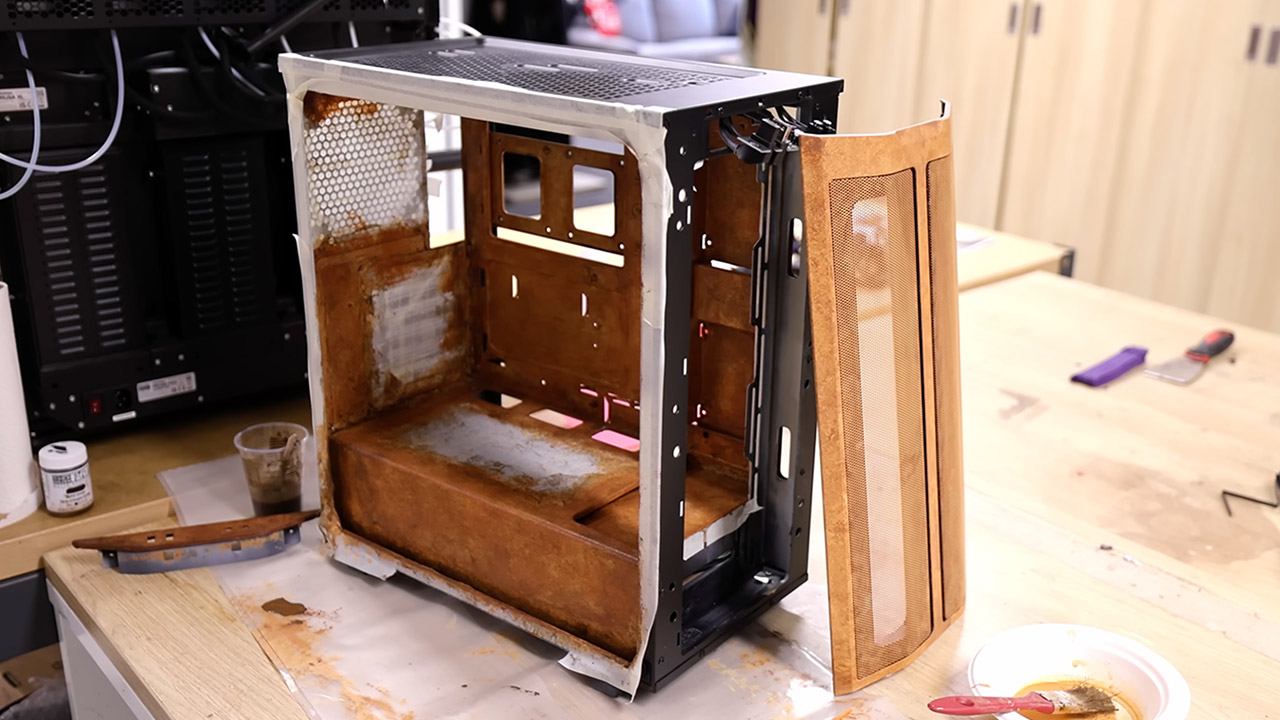
Inside the book form sits the actual computer case, painted to blend perfectly with the leather. The top panel posed the biggest puzzle. Ordinary grates would ruin the illusion, so thin strips of laser-cut MDF were spaced apart and sandwiched between sheets of paper. From any normal viewing angle the surface now looks like stacked book pages, yet air flows freely through the gaps. The spine front keeps its ventilation holes completely open. Nothing blocks the fans or traps heat. RGB lighting tucked within the case casts a soft glow outward, turning the carved leather into something that feels alive at night.
Assembly brought its share of moments where plans had to shift. The leather proved heavier and stiffer than expected once it met the plywood. Clamps ran out, so pieces were weighted down on the workshop floor. Glue dried faster in some spots than others, forcing careful realignment mid-process. Still, every adjustment kept the final shape true to the book idea. Power and reset buttons hide discreetly along one edge. Cables route out the back without breaking the illusion. Once powered on, the system boots like any other machine, ready for work or play.
“For the first time in the history of the Reporters Without Borders (RSF) World Press Freedom Index, over half of the world’s countries now fall into the “difficult” or “very serious” categories for press freedom. In 25 years, the average score of all 180 countries and territories surveyed in the Index has never been so low.”
The study notes that in 2002, 20% of the global population lived in a country where the state of press freedom was categorized as “good.” A quarter century later, less than 1% of the world’s population lives in a country that falls under this category.
At the same time, journalism layoffs continue to be rampant at the hands of corporate media giants dead set on destroying whatever was left of media consolidation limits, public interest reporting, and even archival and journalistic history. The result is a lazy, ad-driven, badly automated engagement ouroborus where anything serving the public interest is a distant and fleeting consideration.
The better performers in the index include Norway, Finland (where they teach kids media literacy and how to identify propaganda starting at the age of three), Sweden, Denmark, and Estonia. While decidedly smaller with vast differences, such countries have strange perks like functional public media and an operational social safety net not yet hollowed out by grotesque levels of corruption.
From the study:
Advertisement
“In the United States (which ranks 64th out of 180 countries and territories) journalists who were already fighting against economic headwinds and dealing with a crisis of public trust—among other challenges—now also contend with President Donald Trump’s systematic weaponisation of state institutions, including funding cuts to public broadcasters such as NPR and PBS, political interference in media ownership, and politically motivated investigations targeting disfavoured journalists and media outlets.”
It can, of course, always get worse. Autocracies start by consolidating media and turning established outlets in to autocratic agitprop bullhorns, but ultimately move on to dominating or destroying whatever’s left of independent journalism through legal harassment and ultimately murder.
There are paths out from under this, but it requires a lot of coordinated efforts the U.S. has historically had an allergy to. Including restoring antitrust reform and imposing not just consolidation limits but diversity ownership requirements. It would also help to drive creative new funding models for journalism, dramatically reshape media literacy policy, and aggressively support real publicly-funded media freed from corporate influence, historically a close ally to maintaining a functioning democracy.
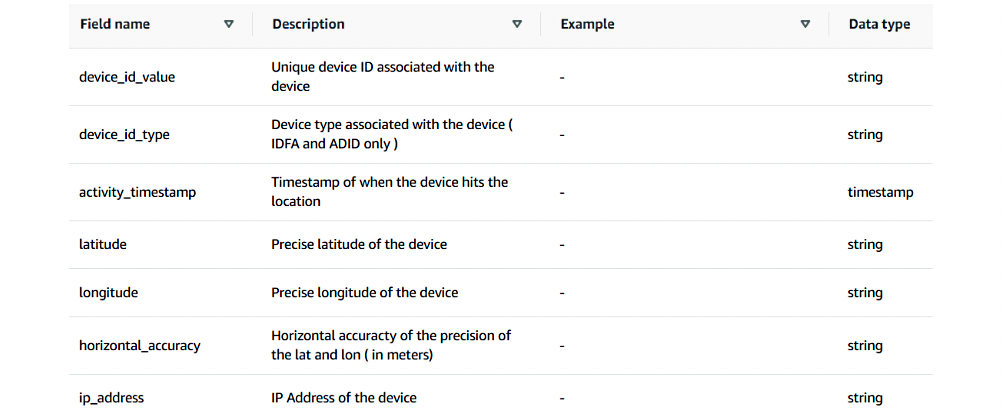
The Federal Trade Commission (FTC) will ban data broker Kochava and its subsidiary Collective Data Solutions (CDS) from selling location data without consumers’ explicit consent to settle charges brought nearly four years ago.
The FTC sued Idaho-based Kochava in August 2022, alleging it collected and sold precise geolocation data from hundreds of millions of mobile devices. This information allowed Kochava’s clients to track the mobile users’ movements to and from sensitive locations, including mental health and addiction recovery facilities, reproductive health clinics, places of worship, and shelters for the homeless and domestic violence survivors.
According to the complaint, the company provided clients who paid a $25,000 subscription fee with access to this data through a user-friendly data feed via the Amazon Web Services (AWS) Marketplace, claiming it delivered “rich geo data spanning billions of devices worldwide.”
Kochava also claimed that its location data feed “delivers raw latitude/longitude data with volumes around 94B+ geo transactions per month, 125 million monthly active users, and 35 million daily active users, on average observing more than 90 daily transactions per device.”
Advertisement
The Commission said at the time that the affected consumers were unaware of and had not consented to the data sharing, leaving them with no means to avoid resulting harms, including stalking, discrimination, and physical violence.
Kochava also sued the FTC for overreaching and said (one day before filing the complaint against the U.S. consumer watchdog) that it would introduce “Privacy Block”, a “privacy-first approach to block health services locations from the Kochava Collective marketplace” to address the privacy issues pointed out by the FTC.
Location data sold by Kochava (FTC)
Under the proposed order filed in the U.S. District Court for the District of Idaho, Kochava and its subsidiary (which has since taken over Kochava’s data broker business) will be prohibited from selling, licensing, transferring, or disclosing precise location data unless they have affirmative express consent, and the data is used to provide a service that the consumers directly requested.
Beyond the sales prohibition, the companies must also establish a sensitive location data program, implement a supplier assessment program to verify consumer consent, allow consumers to request disclosure of who received their data and withdraw consent, submit incident reports to the FTC when third parties misuse location data, and create a data retention and deletion schedule.
This proposed order will carry the force of law upon approval by the District Court judge.
Advertisement
The FTC also announced in August 2022 that it was exploring new rules to crack down on businesses engaged in mass commercial surveillance, in which consumers’ information is collected, analyzed, and monetized. One month earlier, the Commission warned that it would enforce the law if companies illegally shared or used consumers’ sensitive information.
AI chained four zero-days into one exploit that bypassed both renderer and OS sandboxes. A wave of new exploits is coming.
At the Autonomous Validation Summit (May 12 & 14), see how autonomous, context-rich validation finds what’s exploitable, proves controls hold, and closes the remediation loop.
An anonymous reader quotes a report from Ars Technica, written by Andrew Cunningham: As its name implies, the venerable Notepad++ text editor began as a more capable version of the classic Windows Notepad, with features such as line numbering and syntax highlighting. It was created in 2003 by Don Ho, who continues to be its primary author and maintainer, and it has been a Windows-exclusive app throughout its existence (older Notepad++ versions support OSes as old as Windows 95; the current version officially supports everything going back to Windows 7). I’m not a devoted user of the app, but I was aware of its history, which is why I was surprised to see news of a “Notepad++ for Mac” port making the rounds last week, as though it were a port of the original available from the Notepad++ website.
Apparently, this news surprised Ho as well, who claims that the Mac version and its author, Andrey Letov, are “using the Notepad++ trademark (the name) without permission.” “This is misleading, inappropriate, and frankly disrespectful to both the project and its users,” Ho wrote. “It has already fooled people — including tech media — into believing this is an official release. To be crystal clear: Notepad++ has never released a macOS version. Anyone claiming otherwise is simply riding on the Notepad++ name.” Ho repeatedly asked the developer to stop using the brand and eventually reported the trademark use to Cloudflare, the CDN of the Notepad++ for Mac site. “Every day that website remains active, you are in further violation of the law,” Ho wrote. “I cannot authorize a ‘week or two’ of continued trademark infringement.”
Letov has since begun rebranding the app as “NextPad++,” though the old branding and URL reportedly remained available. The name changes is “an homage to NeXT Computer,” notes Ars, “and uses a frog icon rather than the Notepad++ lizard.”



 Scott Imbrie has shaken hands with a robotic arm controlled by a brain implant. The electrodes record neural signals that enable him to move the device and receive
  Ian Burkhart founded the
  Ian Burkhart, who is paralyzed from the chest down, received a brain implant that routed neural signals through a computer to his paralyzed muscles, enabling him to play a video game. Battelle
 Austin Beggin says that testing a BCI is hard work, but he adds that moments like petting his dog make it all worth it. Daniel Lozada/The New York Times/Redux
 BCI user Nathan Copeland used a robotic arm to get a fist bump from then-President
  Before receiving his Neuralink implant, Noland Arbaugh used mouth-operated devices to control a computer. He says the BCI is more reliable and enables him to do many more things on his own. Rebecca Noble/The New York Times/Redux


 Casey Harrell was able to communicate again within 30 minutes of his BCI being switched on. The device translates his neural signals quickly enough for him to hold conversations. Ian Bates/The New York Times/Redux

 Rodney Gorham can use his
  Noland Arbaugh, the first recipient of Neuralink’s BCI, says that using the implant to control a computer made him feel independent and free. Steve Craft/Guardian/eyevine/Redux

























































You must be logged in to post a comment Login