OpenWorld is taking a significant step toward the future of capital markets by announcing plans to tokenize its equity on the blockchain. The company has entered into an agreement with Figure Technology Solutions to issue tokenized shares through its Onchain Public Equity Network (OPEN), in parallel with a proposed Nasdaq listing.
The move reflects a broader shift in financial markets as companies explore blockchain infrastructure to modernize how equities are issued, traded, and managed.
A dual listing model combining Nasdaq and blockchain
Under the proposed structure, OpenWorld aims to offer investors exposure to its shares both through traditional markets and via blockchain-based ownership on OPEN.
This dual approach could introduce new flexibility for investors, including:
Advertisement
direct ownership of blockchain-based shares
the ability to lend assets and earn yield
cross-collateralization between crypto and equities
These features highlight how tokenization could expand the functionality of traditional financial instruments.
Real-world asset tokenization gains momentum
The agreement reinforces OpenWorld’s broader strategy around real-world asset (RWA) tokenization, a sector that continues to gain traction among institutional players.
By tokenizing its own equity, the company is effectively using its balance sheet as a test case for the infrastructure it promotes globally.
According to the company, this approach is intended to demonstrate real-world applicability to partners, including sovereign entities and institutional investors.
Regulatory clarity accelerating adoption
Recent developments from U.S. regulators, including the SEC and CFTC, have contributed to increased clarity around digital assets and tokenized securities.
Advertisement
This evolving regulatory environment is creating a window of opportunity for companies seeking to establish a leadership position in compliant blockchain-based capital markets.
Figure’s OPEN network aims to reshape equity markets
Figure’s OPEN network is designed to rebuild public market infrastructure using blockchain technology, enabling real-time settlement and reducing operational inefficiencies.
The platform also introduces programmable financial features that are not typically available through traditional brokerage systems.
A broader shift toward onchain capital markets
The partnership between OpenWorld and Figure reflects a larger industry trend: the gradual transition of financial infrastructure toward blockchain-based systems.
Advertisement
As tokenization expands beyond private markets into public equities, initiatives like this could play a key role in shaping the next generation of capital markets.
Risk & affiliate notice: Crypto assets are volatile and capital is at risk. This article may contain affiliate links. Read full disclosure
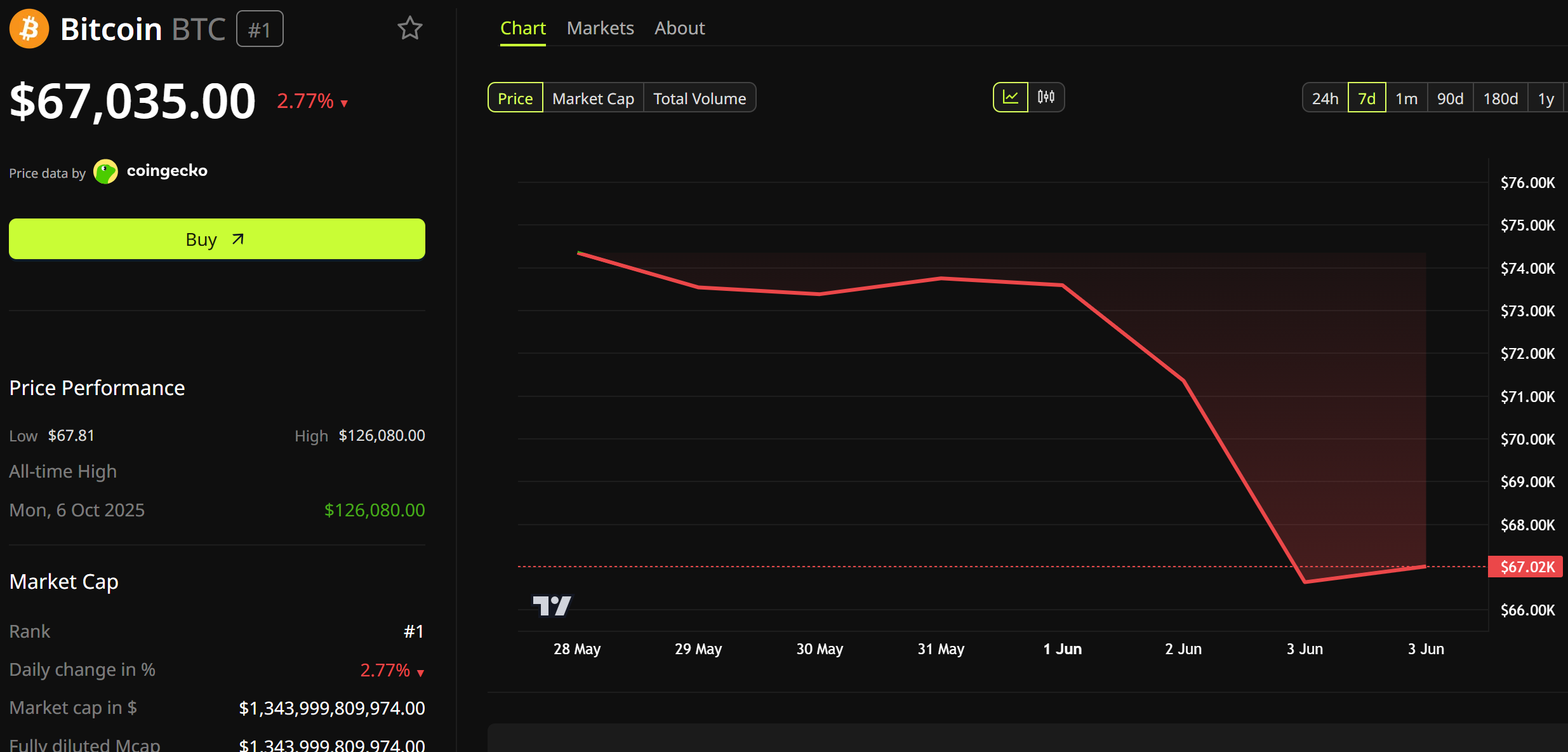
Bitcoin slid below $66,000 in early Wednesday trading and traded as low as $65,372 before rebounding above $67,000, capping a 6% one-day drop that has erased the price action of the last two months and pushed the world's largest cryptocurrency 47% below its October all-time high. BTC spot was… Read the full story at The Defiant
Cardano News: TapTools, the primary blockchain analytics hub for the Cardano ecosystem, is shutting down within two weeks after losing its fifth senior executive in 2026, a news of leadership collapse that left the platform unable to maintain operations at scale.
Founded in 2022, TapTools has become the default reference tool for ADA traders tracking native token prices, DeFi protocol metrics, NFT floor prices, and DEX liquidity across the network.
“After four years of building for Cardano, today we have difficult news to share,” the company posted on X on Tuesday.
Source: TapTools
The announcement comes days after the launch of the Cardano-based NFT marketplace JPG.Store permanently ceased operations on May 23, compressing two of the ecosystem’s most-used consumer-facing products into a single week of exits.
Cardano News: TapTools Collapse, What the Platform Actually Did and Why the Gap Is Real
TapTools was not a simple price aggregator. The platform offered an all-in-one interface covering token prices and market caps for thousands of Cardano native tokens, historical charts, liquidity pool analytics, staking metrics, portfolio tracking, and project discovery tools, all within a single UI that simplified data from Cardano’s notoriously complex EUTXO model.
Intermediate and advanced traders relied on it daily for whale movement tracking, TVL shift monitoring across Cardano-based DeFi protocols, and on-chain discovery of new token launches. That is the specific stack that now has no direct replacement.
Cardano (ADA)
24h7d30d1yAll time
The transmission mechanism is direct: without TapTools, market transparency for smaller-cap native assets collapses.
Advertisement
Projects that depended on TapTools for visibility lose a primary discovery surface. Retail traders tracking DeFi yield opportunities across Cardano protocols lose aggregated data that they cannot easily reconstruct from raw chain queries.
DexHunter and Minswap’s internal analytics exist, but neither provides the standalone depth TapTools covered; they are protocol-specific, not ecosystem-wide.
“Infrastructure costs are real. Development costs are real. Support costs are real. Operating a platform that serves the ecosystem at scale is expensive.”
Tap Tools shutting down is not good! When I think of Cardano, I think of TapTools. Tough to imagine Cardano without TapTools. TapTools literally can't shut down! https://t.co/P4pNQz3c37
The staffing picture is stark. Both co-founders departed earlier in 2026, followed by the COO and CTO. A backend developer stepped into the CTO role as the company attempted to restructure, that executive has now also left, taking technical expertise the company said it could not replace quickly enough to continue responsibly.
Advertisement
Five senior departures in a single year is not a retention problem. That is an organizational unraveling.
TapTools said it remains open to acquisition offers or external funding to keep the platform running. No buyer had emerged publicly at the time of publication.
Traders on prediction market platform Kalshi think the cryptocurrency has more room to fall in its current “crypto winter.”
There’s a nearly 80% chance that the flagship crypto’s price will fall below $60,000 in 2026. That would mean bitcoin hitting a new low, tumbling below February’s levels. Early that month, bitcoin dropped as low as $60,062.
Traders also think there’s a 52% chance prices will dip under $50,000 this year. Bitcoin hasn’t traded with a four in front of its price since August 2024.
Bitcoin prices are off more than 45% since their highs of more than $120,000 last October.
Advertisement
Week to date, the cryptocurrency is down nearly 10% and bitcoin was last trading around $66,500.
Traders on Kalshi have also grown more bearish on the outlook for when the cryptocurrency might hit six figures again. They give just a 27% chance that happens in 2026, after giving it nearly 50% odds as recently as early May.
Traders on Polymarket, meanwhile, see a 12% likelihood bitcoin hits new all-time highs in 2026.
Disclosure: CNBC and Kalshi have a commercial relationship that includes customer acquisition and a minority investment.
BlackRock and the Winklevoss twins moved more than 7,000 BTC into exchange wallets within hours on June 2. The large Bitcoin (BTC) transfers fueled speculation about institutional selling.
Blockchain analytics firm Arkham flagged both moves. They landed as spot Bitcoin exchange-traded funds extended a long run of net outflows and prices fell sharply.
BlackRock Sends 6,005 BTC to Coinbase Prime
BlackRock routed 6,005 BTC worth about $403 million to Coinbase Prime, according to on-chain tracker Solid Intel. The coins moved in quick batches from IBIT wallets.
Coinbase serves as the official custodian for IBIT. Flows like these often support fund creation and redemption rather than open-market sales.
The activity followed weeks of spot Bitcoin ETF outflows that pulled more than $2 billion from the funds since mid-May.
Winklevoss Twins’ Bitcoin Transfers Land in Gemini Custody
The Winklevoss twins sent 1,000 BTC, roughly $67.5 million, from Gemini custody into a Gemini hot wallet. Arkham noted that moves to a hot wallet can precede selling.
Are the Winklevoss Twins selling Bitcoin? The Winklevoss Twins just transferred 1000 BTC ($67.5M) from Gemini Custody into Gemini Hot Wallet. Typically, a transfer to an exchange Hot Wallet indicates intent to sell. Are they selling? pic.twitter.com/KqjG1yqkOX
Arkham data shows their entity still holds about 8,328 BTC. The twins also stepped up Winklevoss Capital Bitcoin buying earlier this year.
Advertisement
“The Winklevoss Twins owned around 1% of the BTC circulating supply in 2014. They made over $1 Billion on Bitcoin all-time. Currently, they still hold $692 Million. What a trade,” Arkham remarked.
Neither transfer confirms a sale, since the coins remain on exchange wallets. With Bitcoin trading near $66,973 and down 11% on the week, the moves add to fears about major holders reducing exposure.
Bitcoin Price Performance. Source: BeInCrypto
TapTools, the four-year-old analytics and price-tracking platform that became the default front-end for trading and project discovery on Cardano, said on X on Tuesday that it will wind down operations over the next two weeks after a fifth senior executive departure left it without the technical… Read the full story at The Defiant
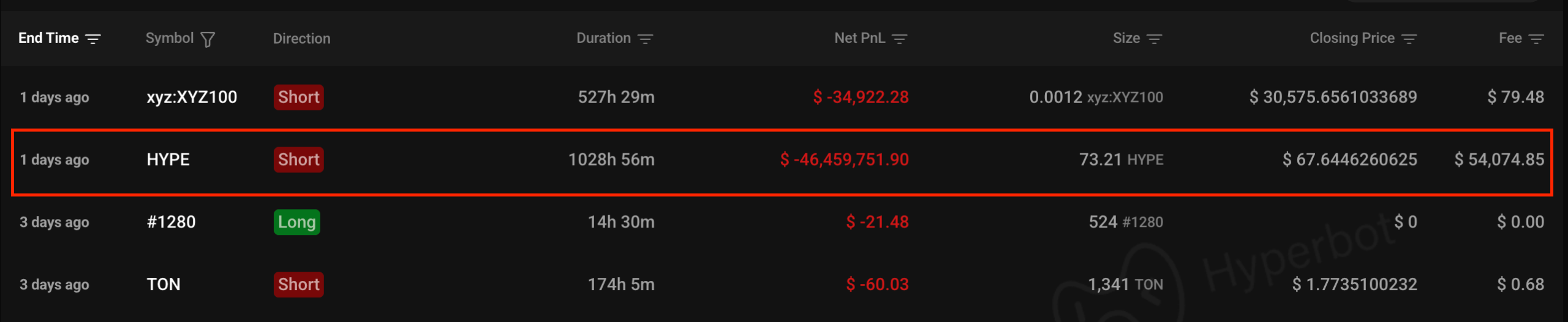
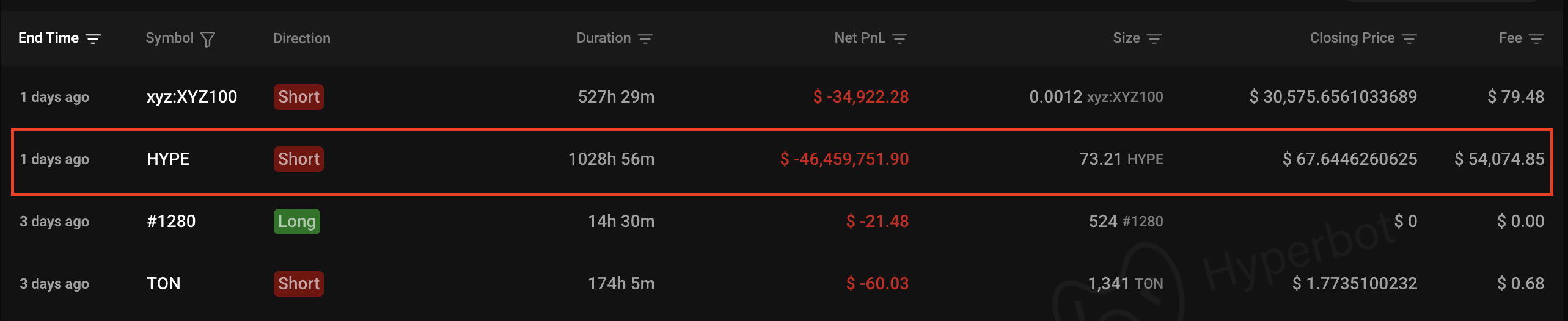
The position also cost him more than $54,000 in funding fees, showing how aggressively he had bet against HYPE’s bullish trend.
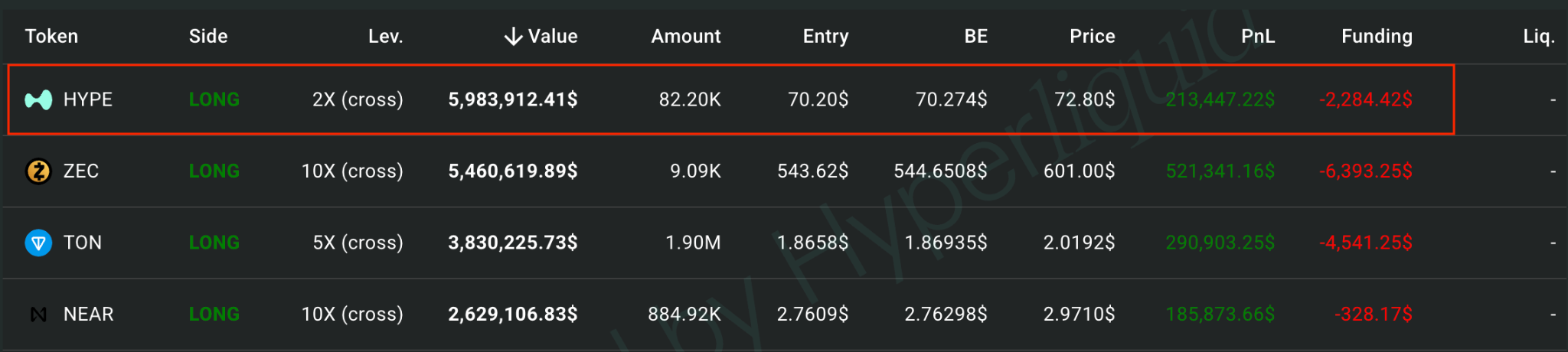
Shortly after closing the losing short, Loracle.hl flipped long, opening a 2x leveraged position on 82,200 HYPE, worth about $5.98 million, at around $70.20, according to HypurrScan data.
Advertisement
Loracle.hl’s open perpetual trades. Source: HypurrScan
By Wednesday, the trade was already sitting on more than $213,000 in unrealized profit as HYPE climbed to $72.80.
Whale goes net long on Hayes’ “Holy Trinity”
Loracle.hl’s reversal was not limited to HYPE.
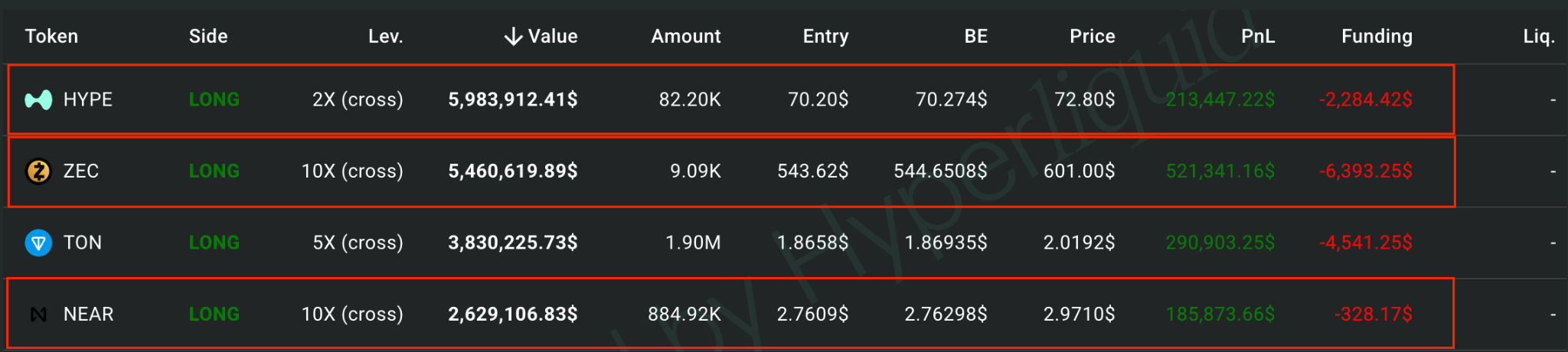
HypurrScan data shows the trader also holding long positions in ZEC and NEAR, effectively putting him net long on BitMEX co-founder Arthur Hayes’ so-called “holy trinity” trade: HYPE, NEAR, and ZEC.
The wallet held roughly $5.98 million in HYPE, $5.46 million in ZEC and $2.63 million in NEAR exposure as of Wednesday.
Advertisement
Loracle.hl’s open perpetual trades. Source: HypurrScan
The three positions were already collectively up by more than $920,000, led by over $521,000 in unrealized profit on ZEC, roughly $213,450 on HYPE and around $185,900 on NEAR.
The pivot suggests Loracle.hl has capitulated and joined the “holy trinity” momentum.
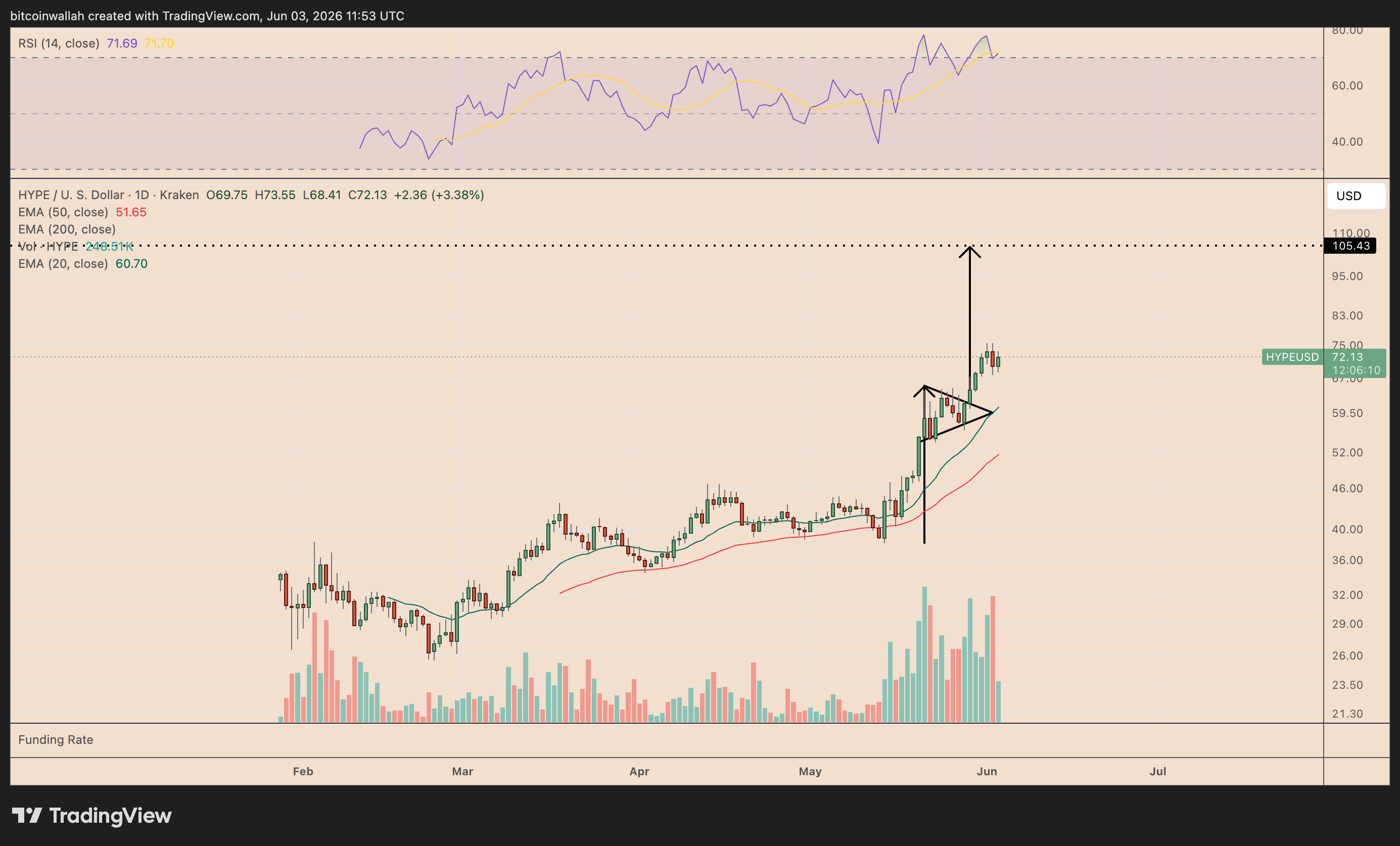
The setup formed after the token’s sharp late-May rally, followed by a tight consolidation marked by lower highs and higher lows.
A pullback could retest the 20-day EMA near $60.70. For Loracle.hl, whose 82,200 HYPE long was opened near $70.20, a rally to $105 would lift the unrealized profit to roughly $2.86 million, excluding funding fees.
[PRESS RELEASE – Bratislava, Slovakia, June 3rd, 2026]
Cryptocurrency service crypto4me, operated by licensed crypto-asset services provider Madison Six j. s. a., has introduced Recurring Purchases (DCA), a new feature that allows users to set up automatic monthly cryptocurrency purchases. The service is designed for people who want to buy crypto regularly without repeating the same process manually each month, whether they are making their first steps in digital assets or already have experience with the market.
Recurring Purchase allows clients to choose a monthly amount, select one or more cryptocurrencies and define how the purchase will be funded. Once the plan is active, purchases are carried out automatically in monthly cycles according to the selected settings. Users can also modify, pause or cancel the plan, keeping control over both the frequency and structure of their purchases.
The feature became available in mid-May and follows the earlier introduction of crypto4me’s cryptocurrency packages, which allow users to gain exposure to selected groups of digital assets through pre-built strategies. With Recurring Purchases, crypto4me is expanding its service with a tool focused on convenience, regularity and easier day-to-day use.
Advertisement
“Many people are interested in cryptocurrencies, but they do not necessarily want to go through the same purchase process every month or constantly decide when to make the next step. Recurring Purchases make this easier by allowing users to set their preferences once and adjust them whenever needed. It is a practical feature that reflects what crypto4me is built around – making access to crypto simpler, while keeping the user in control,” said Miloš Mázor, Chairman of the Board of Directors and CEO of Madison Six.
Before confirming a recurring purchase plan, users see an overview of the selected amount, cryptocurrencies, fees and payment details. The aim is to make regular cryptocurrency purchases more transparent and manageable, without adding unnecessary complexity to the process.
About crypto4me
Crypto4me enables the purchase of major cryptocurrencies, including bitcoin, ether and SOL. In compliance with the strict conditions of the European MiCA license, the company ensures the highest standards of security for trading and the storage of cryptocurrencies in wallets, as well as additional measures such as multi-factor client authentication, encryption, and regular penetration testing.
The crypto4me service is operated by Madison Six j. s. a. As of December 18, 2025, the company holds authorization to provide cryptocurrency-related services, granted by the National Bank of Slovakia under number 100-001-025-213 in accordance with the MiCA regulation*. At the same time, based on this license, the company is authorized to provide cryptocurrency services on a cross-border basis throughout the EU/EEA.
* Regulation (EU) 2023/1114 of the European Parliament and of the Council of 31 May 2023 on markets in crypto-assets and amending Regulations (EU) No 1093/2010 and (EU) No 1095/2010 and Directives 2013/36/EU and (EU) 2019/1937.
Advertisement
Cryptocurrencies are highly volatile and may carry an increased risk of losing your investment.
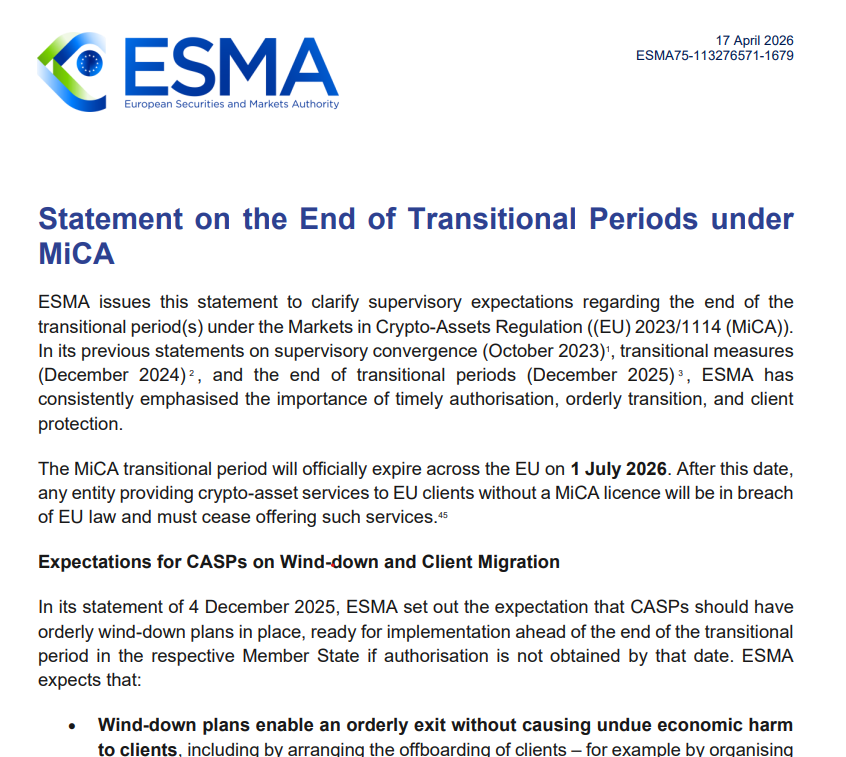
The European Union’s Markets in Crypto Assets Regulation hits a hard deadline on July 1 when the transitional period ends and in-scope crypto asset service providers operating under national regimes must either hold a MiCA licence or stop serving EU clients.
A spokesperson from the European Securities and Markets Authority (ESMA) told Cointelegraph that from that date, non-authorized entities “will not be allowed to operate within the EU” and should implement wind-down and client migration plans rather than rely on open-ended transitional status while awaiting a decision.
The deadline could force some crypto firms to suspend EU operations while their applications remain under review, potentially affecting millions of users who continue to engage with platforms that are not yet authorized under MiCA.
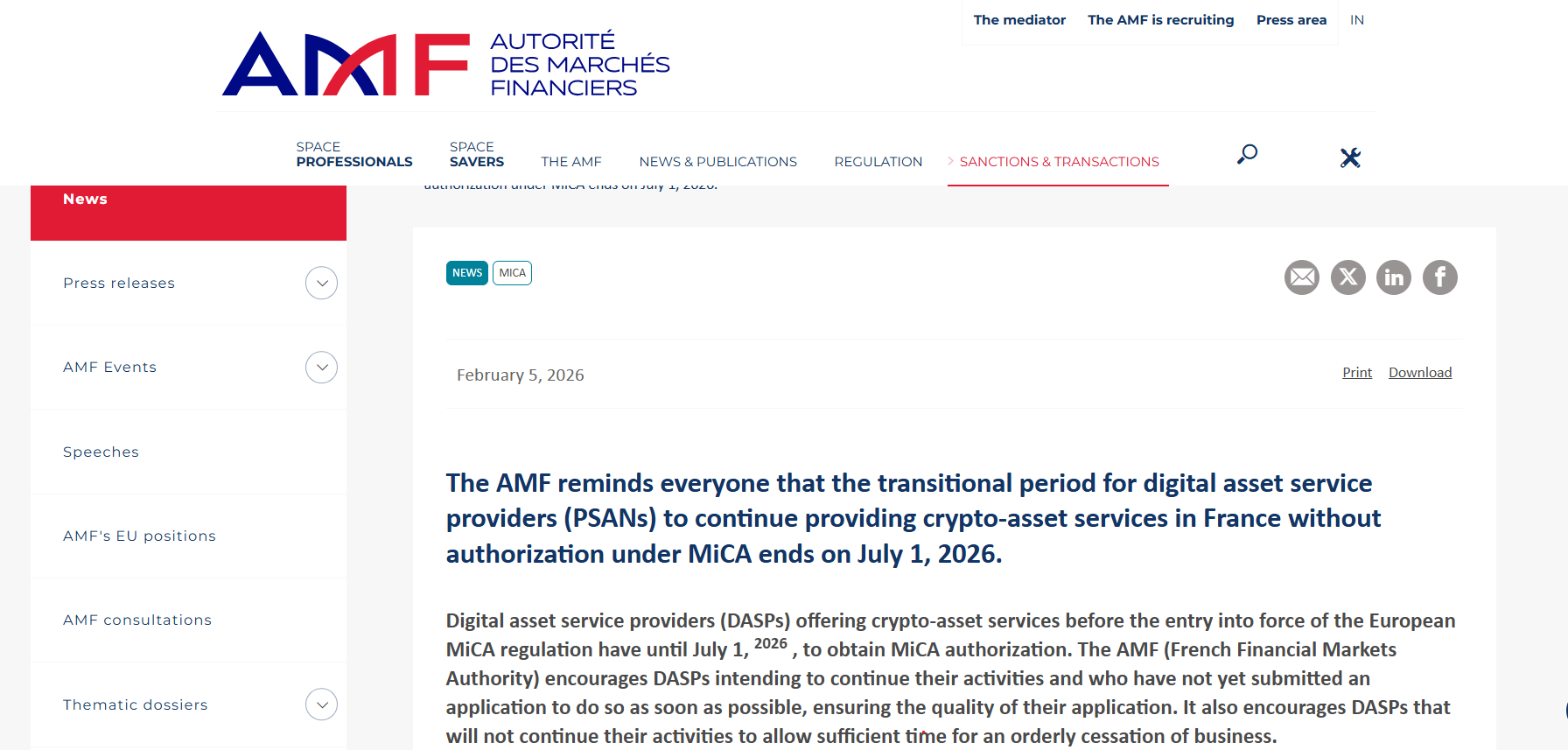
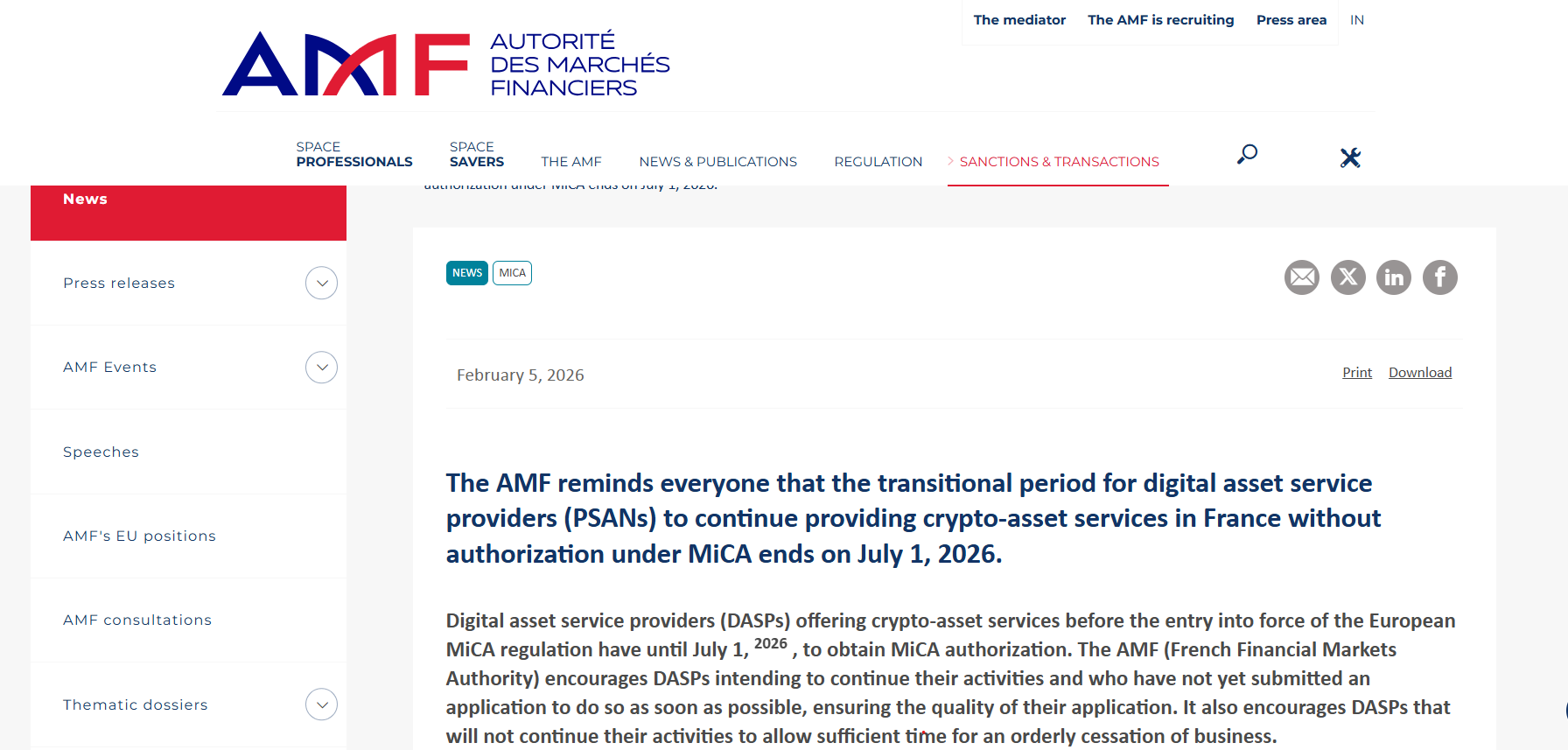
In France, 19 crypto asset service providers (CASPs) have been authorized so far, and roughly 25 applications remain under review, a spokesperson for the Autorité des marchés financiers (AMF) told Cointelegraph.
Advertisement
From July 1, providers that are not MiCA-authorized “must cease their activities,” the spokesperson said, pointing to a February AMF warning that unauthorized crypto asset services are a criminal offence punishable by up to two years in prison and a 30,000 euro (roughly $35,000) fine.
The watchdog says it can also add firms to a blacklist, issue public warnings and seek court orders to block access to the websites of unauthorized providers targeting French users.
AMF warning to unregulated crypto asset platforms. Source: AMF
Germany has set a licensing requirement under its national implementation of MiCA, requiring crypto asset service providers that were operating under prior exemptions to obtain authorization by June 30, a spokesperson from German regulator BaFin told Cointelegraph.
The country generally follows EU and national deadlines, the spokesperson said, and may apply enforcement measures “where possible and appropriate,” adding that some applications remain under review.
Advertisement
In contrast, Austria chose not to extend grandfathering for virtual asset service providers under its pre-MiCA regime, which ended on Dec. 31, 2025, so no exchanges are still operating without a license in the country.
A spokesperson from the Finanzmarktaufsicht (FMA) told Cointelegraph it has licensed nine CASPs so far and that MiCA application volume is “significant,” although it does not disclose how many applications are pending.
Lawyers warn pending applications offer no protection
Having an application in the queue will not shield CASPs from the deadline, Niall Esler, head of the regulatory and risk advisory practice at law firm Walkers, told Cointelegraph. He said that companies still serving EU clients without authorization after the transition ends will be operating unlawfully and cannot expect to continue business as usual.
Advertisement
MiCA requires member states to give national authorities powers to order an immediate halt to services, compel client offboarding, name firms publicly and impose administrative fines for unauthorized activity.
Statement on the end of transitional periods. Source: ESMA
That could affect a substantial number of European crypto users. According to analysis shared with Cointelegraph by OKX Europe, of 18.5 million crypto app downloads in Europe between May 2025 and May 2026, about 7.6 million (41%) were to exchanges that do not appear on the independent register of MiCA-authorized providers compiled from ESMA and national data.
ESMA declined to provide an estimate of how many EU users remain on non-authorized platforms, saying it cannot share non-public information.
OKX Europe CEO Erald Ghoos said app download figures understate the issue because they miss users who access exchanges via web browsers or installed apps earlier and remain active.
Advertisement
To bridge that gap, OKX says it combined App Store data with web traffic estimates and search trends to approximate active usage. Ghoos said the company believes “approximately 60% of European crypto users are actively engaging with platforms that hold no MiCA authorization,” including some of the world’s largest exchanges by trading volume.
Several major exchanges are still awaiting MiCA authorization as national regulators review their applications.
Bitget, for example, applied for a MiCA license in Austria in 2025. The company’s chief legal officer told Cointelegraph it expects regulatory approval in the second quarter of 2026 and will not offer services in the European Economic Area until authorization is granted.
Advertisement
Binance, meanwhile, applied for a MiCA licence in Greece in January through the country’s Hellenic Capital Market Commission and is not currently listed among MiCA-authorized providers in the EU. The company did not respond to a request for comment on its application status.
The little guy is getting lost in the political horse-trading around the CLARITY Act.
Advertisement
The U.S. Senate Banking Committee recently advanced the Digital Asset Market CLARITY Act, legislation that, if enacted, could finally establish clear rules for digital assets in the United States. The bill has survived months of bipartisan negotiations and horse trading between banking interests and upstart fintech companies.
A bipartisan compromise brokered by Senators Thom Tillis (R-NC) and Angela Alsobrooks (D-MD) broke a log-jam that had slowed down the bill’s progress. In the end, the banks got most of what they wanted in this “deal”: the legislation explicitly prevents fintech platforms from treating stablecoins, digital assets backed by dollars, as interest bearing accounts, while still permitting them to pay rewards and bonuses, as banks and credit card issuers do.
That should have ended the debate. Yet banking lobby groups are demanding tighter restrictions to eliminate many forms of consumer rewards altogether. Clearly, they seek to squash this already compromised bill before a full Senate vote, so that it never reaches the Resolute Desk.
Lost amid the political wrangling of crypto and banking interests is the average American consumer.
Advertisement
According to the Consumer Financial Protection Bureau (CFPB), Americans paid roughly $5.8 billion in overdraft fees in 2023, even after years of industry efforts to reduce so-called “junk fees.” Overdraft charges disproportionately hit financially vulnerable households, with nearly 80% of fees concentrated among 9% of accounts. And then there are account minimums, wire charges and payment delays, which add friction. Meanwhile, the average savings rate is only 0.38%.
Consumers want financial services to move faster, cost less and earn them more.
Stablecoins are gaining popularity because they herald a world where digital dollars move across the internet as cheaply and seamlessly as a WhatsApp message. They can lower remittance costs, improve access to digital commerce, expedite real-time payments and create new ways for consumers to save, spend and transact online.
And Americans are asking for CLARITY because many already use these tools. According to the Crypto Council for Innovation, one in five American adults now owns cryptocurrency. That’s roughly 68.5 million people. Stablecoins are among the fastest-growing categories of digital assets, particularly among younger consumers, immigrants, freelancers and underserved communities seeking faster and cheaper financial tools. Four in five merchants believe accepting crypto could help attract new customers, while 73% of small business owners expect crypto payments to grow.
Advertisement
That’s what makes this debate so politically mystifying. For years, progressives argued that concentrated financial power harmed consumers and Main Street. They criticized large banks for extracting rents while lobbying against regulations that diluted bank influence. Those critiques were often correct. Today some of those progressives, like Elizabeth Warren, who championed the Consumer Financial Protection Bureau, are now defending banking profits against a technology that could inject real competition into financial services and empower consumers and small businesses.
Do American politicians want their country to continue leading, or do they prefer watching such financial transformation from the sidelines?
In the 1990s, the Clinton administration helped usher in the commercial internet through the Telecommunications Act of 1996, a bipartisan effort expanding innovation and competition. Now, Congress has an opportunity to unleash the new internet of value by passing CLARITY.
Advertisement
Under GENIUS and CLARITY, stablecoin issuers must meet strong reserve requirements, transparency obligations, anti-money laundering standards, cybersecurity rules and consumer protections. Sensible public policy will unleash investment and innovation, as it did in the internet era.
This story need not end in conflict between banks and blockchains. Incumbents can just as easily embrace blockchain and its various benefits, from real-time global settlement and tokenized assets, to new forms of on-chain lending, payments, savings and commerce.
The question is whether lawmakers will vote to lead this next technological revolution and advance the interests of American consumers or cede the future to entrenched interests.
Principled Perspectives
Advertisement
Why Crypto May Need ETFs More Than ETFs Need Crypto
Crypto spent its first decade trying to replace Wall Street. Its next trillion dollars may come from partnering with it. The first wave of tokenization focused on creating new assets, new venues and new systems outside traditional finance. Some of that innovation mattered. Much of it struggled with the same problem: markets do not scale on technology alone. They scale on trust, liquidity and distribution. That reality favors ETFs.
The ETF wrapper became one of the most successful financial products of the modern era because it solved practical investor problems at scale: low-cost access, transparency, intraday liquidity, operational simplicity and broad distribution across brokerage platforms and advisory channels.
Those advantages took decades to build. Tokenization does not erase them. In fact, it may amplify them. If blockchain rails can be integrated into ETFs, investors may not have to choose between innovation and protection. They could gain exposure to familiar products with the potential benefits of faster settlement, programmable ownership, collateral mobility and broader digital interoperability, all inside a structure already trusted by institutions, advisors and retail investors.
Advertisement
That is a far bigger commercial opportunity than asking trillions of dollars to migrate into unfamiliar vehicles. This is why one underappreciated development matters. On January 21, 2026, F/m Investments LLC and The RBB Fund, Inc. filed what is believed to be the first exemptive application by an ETF issuer seeking to tokenize shares of an exchange-traded fund, TBIL, the U.S. Treasury 3 Month Bill ETF. The proposal would record ownership on a permissioned blockchain ledger while preserving the same fund, same economics, same exchange listing and same regulatory framework. The application remains pending before the SEC, and there can be no assurance relief will be granted. That may sound like a niche legal filing. It is not. It is a test of whether capital markets modernization happens inside the regulatory perimeter or outside it.
That distinction matters to investors because the next major on-chain growth category may not be speculative tokens. It may be trusted yield, usable collateral and regulated exposure. Stablecoins already demonstrated the demand for digitally native dollars. The next logical step is digitally native instruments backed by real portfolios, real governance and real investor protections.
That is where tokenized ETFs could become powerful.
Imagine Treasury exposure that can plug into next-generation collateral networks. Imagine ETF shares that remain within familiar regulatory guardrails while operating on more modern rails. Imagine advisors and institutions accessing blockchain efficiency without having to underwrite experimental structures.
Advertisement
The first tokenization narrative was “replace incumbents.” The stronger narrative may be “upgrade incumbents.” That does not diminish crypto; it commercializes it.
For regulators, tokenized ETFs may offer a pragmatic path forward: enable innovation where investor protections remain intact, rather than pushing demand into parallel channels with greater uncertainty. For exchanges, custodians, brokers and market makers, it could create a new infrastructure layer around products investors already understand.
For issuers, it may become a race. The firms that combine trusted wrappers, credible assets and functional on-chain rails could capture disproportionate flows. And for allocators, the signal may be simple: blockchain technology is becoming less about novelty and more about plumbing.That is usually when real adoption begins.
The broader lesson is that distribution often beats disruption:
Advertisement
Who already has trusted wrappers?
Who already has liquidity?
Who already has access to advisors, retirement assets and institutions?
Who can bridge old rails and new rails fastest?
Advertisement
Those questions point toward ETFs.
The next trillion dollars of tokenized assets may not come from inventing something entirely new; they may come from upgrading what already works. Crypto’s first era was about building outside the system. Its next era may be about powering the system.
Headlines of the week
By Helene Braun
A few of crypto’s biggest debates converged this past week as Michael Saylor’s Strategy (MSTR) sold bitcoin to fund preferred stock dividends, JPMorgan CEO Jamie Dimon escalated his fight against yield-bearing stablecoins during the CLARITY Act debate, and Citi projected tokenized securities could grow into a $5.5 trillion market by 2030, driven by rising demand for onchain Treasuries and tokenized stocks.
Advertisement
Chart of the Week
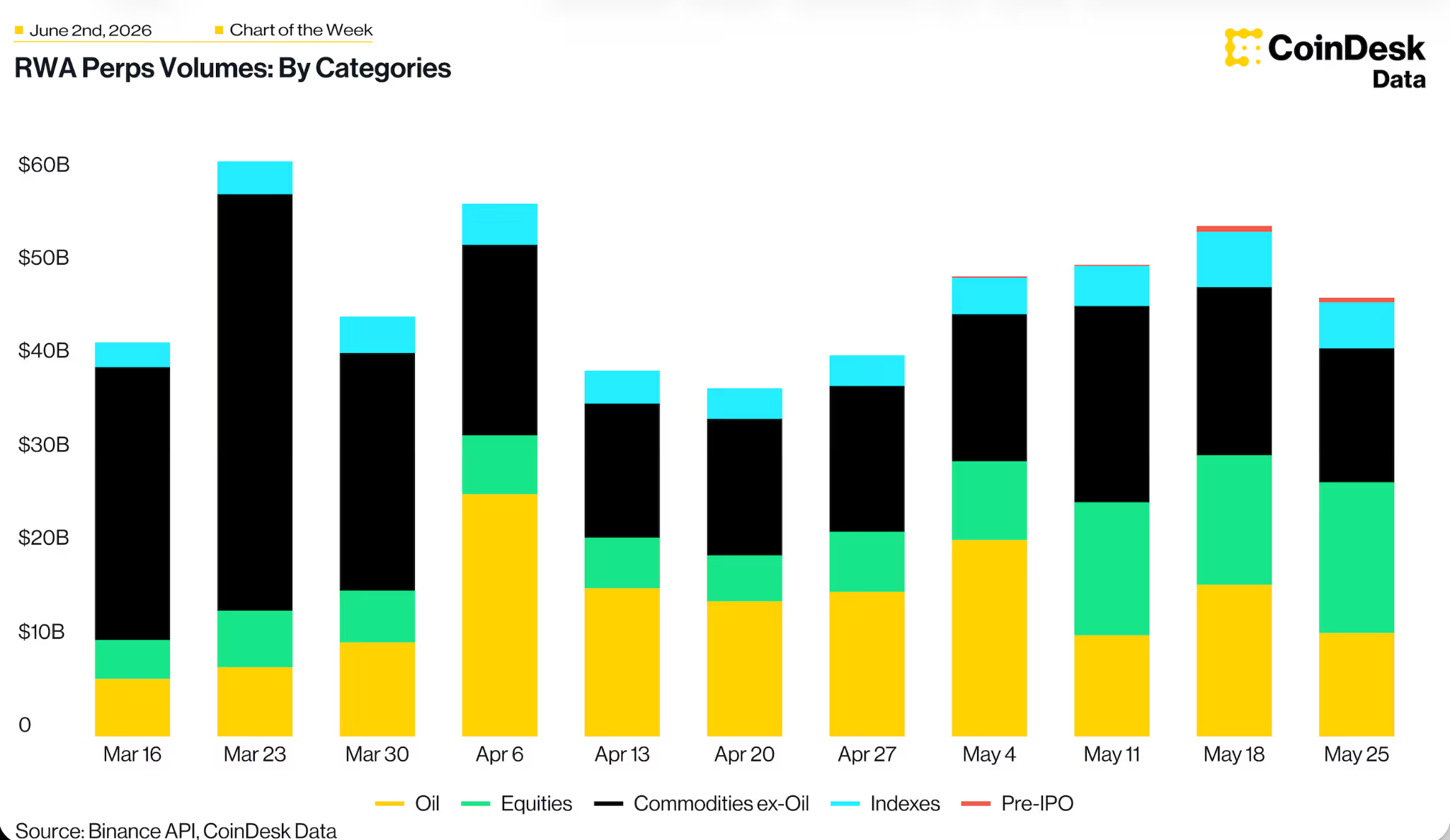
RWA Perp Volume by Category: Equities Overtake Commodities (excluding oil)
RWA perps run ~$45–60 billion/week, and flow is rotating out of commodities into equities. Equities roughly tripled to ~$18 billion and just overtook the commodities (excluding oil) block, while oil faded after its April macro spike. This implies that crypto-venue derivatives are increasingly used for 24/7 equity exposure, with commodities now the episodic, event-driven slice.
Note: The views expressed in this column are those of the author and do not necessarily reflect those of CoinDesk, Inc., CoinDesk Indices or its owners and affiliates.
The ruble-backed stablecoin A7A5 has continued to expand despite Western sanctions, processing more than $110 billion in cumulative on-chain transactions, according to CertiK. Issued by Old Vector LLC in Kyrgyzstan on behalf of Russia’s cross-border settlement firm A7 LLC, the token now accounts for roughly 43% of the global non-dollar stablecoin market, with its holder base growing from about 13,000 wallets in February 2025 to 29,000 by May 2026.
CertiK describes A7A5 as a leading example of a sanctions-evasion stablecoin ecosystem, linking its activity to Russian cross-border settlement channels. The European Union’s 19th sanctions package, adopted on October 23, 2025, forbids A7A5 transactions from November 12, 2025. Yet, CertiK notes that the reserve and issuance architecture places key assets outside direct Western enforcement reach.
Key takeaways
A7A5 has surpassed $110 billion in cumulative on-chain activity and commands about 43% of the global non-dollar stablecoin market, with wallets swelling to roughly 29,000 by May 2026.
The project’s reserves sit in banking networks outside Western jurisdictions, and its design minimizes centralized control to resist direct enforcement.
Liquid supply is distributed through DeFi pools (Curve, Uniswap) to avoid centralized exchange freezes, and the system deliberately lacks a centralized kill switch.
Regulators have begun to squeeze onramps and execution points via the EU’s sanctions package and parallel actions, even as the blockchain itself cannot be “erased” by regulators from the outside; enforcement targets choke points.
Sanctions-era architecture and growth
The A7A5 project, launched in January 2025 by Old Vector LLC—a Kyrgyz entity acting for the Russian cross-border-settlement group A7 LLC, co-owned by Moldovan-Russian oligarch Ilan Shor and Russian state-owned lender Promsvyazbank—has intentionally built its framework to endure outside Western financial rails. CertiK notes that the reserves backing A7A5 sit largely in Central Asian banking networks and in the Russian banking system, reducing exposure to Western sanction enforcement.
A7A5’s design also emphasizes a distributed issuance and freezing model. Rather than anchoring control to a single centralized infrastructure, the project relies on decentralized finance liquidity layers, including Curve and Uniswap, to disperse liquidity and prevent unilateral freezing by centralized venues. Jonathan Riss, OSINT and blockchain intelligence analyst at CertiK, explained that this structure makes direct blockchain “rewrites” by regulators ineffective, while opening multiple points for enforcement actions to target residual choke points.
“While Western regulators cannot directly rewrite the Ethereum or Tron blockchain to erase A7A5, the EU’s 19th package and parallel US/UK actions target the physical and digital choke points.”
Riss emphasized that the three immunities crafted into A7A5—reserves outside Western reach, a non-centralized kill-switch, and DeFi-based liquidity—create practical resilience against sanctions that crippled other stablecoins in the past. CertiK characterizes A7A5 as one of the clearest examples of sanctions-evasion in a stablecoin ecosystem, closely tied to Russia’s cross-border settlement architecture.
Advertisement
The stablecoin’s path to prominence has not been accidental. A7A5’s on-chain activity and user base point to meaningful demand for ruble-based settlement and payments that can operate across borders even when traditional financial rails are constrained. The use of DeFi pools helps preserve liquidity in a way that reduces single points of failure, a feature that distinguishes A7A5 from more tightly centralized stablecoins.
Regulatory response and market dynamics
Washington and Brussels have moved to curb sanctioned assets by targeting the on- and off-ramp infrastructure that supports their circulation. The EU’s 19th sanctions package, in force for A7A5 from November 12, 2025, marks a meaningful escalation in the legal framework surrounding such tokens. However, the legal reach of sanctions—particularly when assets are held in jurisdictions outside Western control—remains a point of contention. As CertiK’s assessment suggests, regulators can strip access at centralized gateways and choke points, but they cannot “rewrite” the blockchain itself.
Beyond the paper trail of sanctions, A7A5 has demonstrated tangible market activity. The token recorded about $11.2 billion in trading volume for A7A5/RUB and roughly $6.1 billion for A7A5/USDT pairs, with Grinex (the successor to Garantex) serving as a primary conduit. This is notable given Garantex’s history as a laundering venue linked to illicit flows and later enforcement actions. In 2025, the U.S. Secret Service seized the Garantex domain, and Tether froze approximately $28 million in USDT held in wallets tied to Garantex, underscoring how on- and off-ramps still attract regulatory scrutiny even as new rails proliferate.
Owners and governance structures also weigh into the risk profile. The Ruble vault’s control framework was designed to retain issuance and reserves outside Western control, but the project’s governance is not centralized in a single public-facing entity. The leadership and ownership history surrounding A7A5’s parent entities suggest potential regulatory and compliance risk as authorities escalate enforcement against sanction-busting financial instruments.
Advertisement
Ownership, governance, and regulatory exposure
At the core of A7A5’s governance is Ilan Shor, who holds 51% of A7 LLC, the parent company behind the stablecoin’s issuance. Shor’s legal history adds a layer of geopolitical and regulatory sensitivity to the project. A Moldovan court convicted him in 2014 for theft from Moldovan banks, and he fled Moldova in 2019 to obtain Russian citizenship. He was sentenced in absentia in 2023 and currently resides in Moscow. This ownership backdrop has intensified attention on the project as Western authorities seek to constrict sanctioned digital assets from multiple angles.
The combination of Shor’s ownership, the token’s opaque reserve geography, and the reliance on DeFi rails creates a unique governance and risk profile for A7A5. Observers will be watching how regulators pursue enforcement actions that can disrupt liquidity or compel exchanges and liquidity providers to comply with sanctions, even as the asset circulates across borderless, permissionless networks.
As the regulatory landscape evolves, market participants should monitor how additional sanctions packages or enhanced enforcement actions affect onramps, liquidity provisioning, and cross-border settlement flows tied to ruble-denominated stablecoins. While the blockchain itself remains outside direct regulatory rewriting, the surrounding infrastructure—exchanges, custodians, and banks—continues to be a focal point for policymakers aiming to constrain sanctioned financial activity.
Readers should keep an eye on how this ecosystem adapts to shifting compliance requirements, potential liquidity pressures on DeFi pools, and any new oversight that targets the facilities that make sanctions-busting stablecoins viable—while hoping for clearer international norms on what constitutes legitimate cross-border settlement in a digitized world.
Advertisement
Risk & affiliate notice: Crypto assets are volatile and capital is at risk. This article may contain affiliate links. Read full disclosure






















 Tech6 days ago
 News Videos5 days ago
 News Videos5 days ago
 Business2 days ago


 Business4 days ago



 Business4 days ago
 Crypto World5 days ago
 Politics4 days ago
 Tech5 days ago

 Entertainment5 days ago


You must be logged in to post a comment Login