For the uninitiated or anyone who thinks “portable audio” means a waterproof pill clipped to a backpack, the boomboxes that ruled the streets were the original mobile music weapons. Born in the late 1960s and peaking in the late ’70s and ’80s, these weren’t just stereos you carried around; they were cultural battering rams. Think Fab 5 Freddy on your TV, Yo! MTV Raps in full rotation, the Beastie Boys causing trouble in a Brooklyn alley, and breakdancers turning flattened cardboard into battlegrounds.
Boomboxes transformed sidewalks into dance floors and backseats into clubs. These weren’t gadgets. They were attitude, wrapped in metal and plastic, blasting identity at unsafe volume levels.
Back then, a ghetto blaster wasn’t a polite lifestyle accessory with Bluetooth and passive-aggressive EQ presets. It was a war chest with woofers; loud, heavy, unapologetic. Models like the JVC RC-M90, Lasonic TRC-931, Sharp GF-777, and Panasonic RX-5600 didn’t just play music; they announced your presence and dared anyone nearby to argue with your taste. And nobody embodied that energy more than Radio Raheem, hauling his box like a sonic manifesto in Do the Right Thing.
Advertisement
Before playlists were swiped, skipped, and forgotten, there were mixtapes—built in real time, often straight off the radio, finger hovering over the pause button like it mattered. Because it did. A mixtape was intent. Sequencing was personal. A Maxell XLII-S with Sharpie handwriting wasn’t nostalgia; it was proof you cared enough to get it right. Boomboxes carried those tapes into the streets, and for a while, they made the world listen.
What Is a Boombox? The Original Portable Stereo Explained
A boombox is a large, portable, battery-powered audio system with built-in speakers, a radio, and a cassette player and recorder. First appearing in the late 1960s, the format hit its peak in the 1980s and early 1990s. Later versions added CD players and, much more recently, Bluetooth and USB connectivity, but the basic idea never changed. A big box, a solid handle, and enough output to make sure your music was heard whether anyone asked for it or not.
The name boombox came from its integrated stereo speakers and their ability to deliver loud, booming sound. The nickname ghetto blaster came later, born on the streets rather than in a marketing meeting. These things were not polite. They were heavy, power-hungry battery pigs that chewed through D-cells like candy, and carrying one any real distance counted as arm day. Portability was relative. You could move it, but you were going to feel it.
While the ghetto blaster became closely associated with early rap and the rise of hip-hop culture, it was never limited to a single genre. Boomboxes powered block parties, fueled breakdancing battles, and blasted everything from rap and R&B to funk, reggae, pop, and rock. For teens and twenty-somethings, the boombox was more than a way to listen to music. It was a status symbol, a social magnet, and a public declaration of taste delivered at full volume.
Advertisement
Let’s take a look at some of the most notable boomboxes from the era when they ruled the streets.
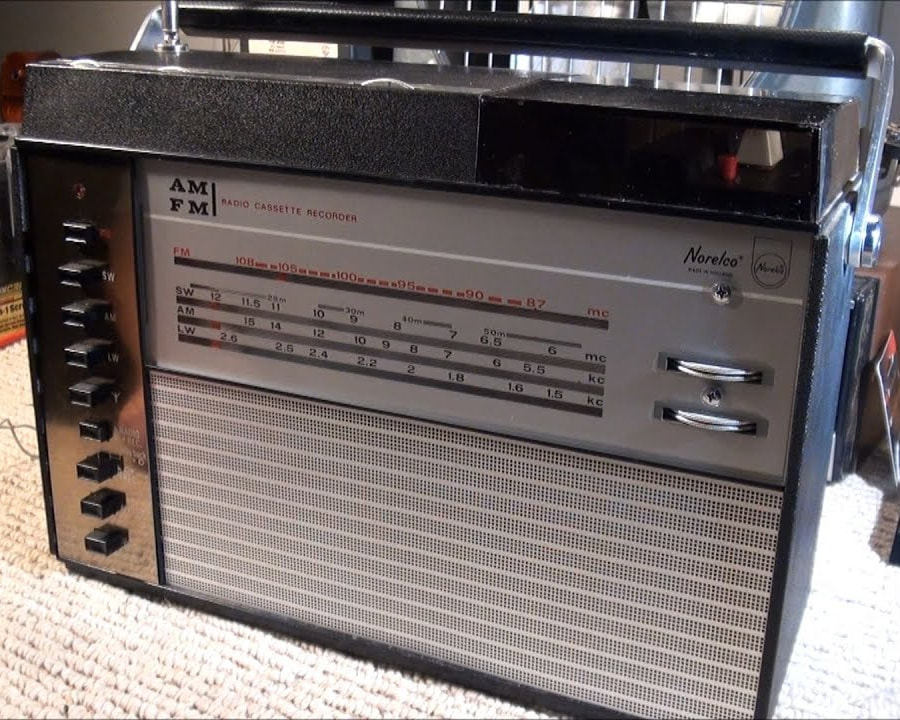
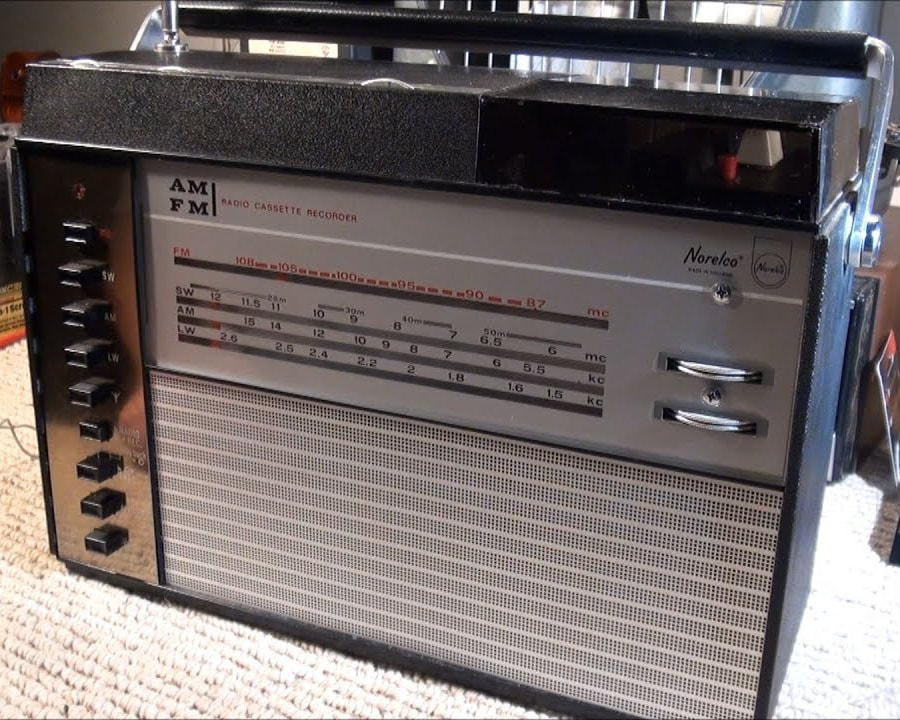
Norelco 22RL962
The Norelco 22RL962, made by Netherlands-based Philips (the same company that invented the compact audio cassette), is widely credited as the first true boombox. Introduced in the late 1960s, the 22RL962 established the core formula: portability, battery operation, a built-in speaker, and a single box that combined radio and tape playback.
Equipped with a carrying handle, AM/FM radio, and a compact cassette player and recorder, the 22RL962 delivered a modest 1 watt of output through its integrated speaker. Crucially, it was the first consumer audio product that allowed users to record radio broadcasts directly to cassette tape for later listening, a feature that would become central to mixtape culture in the decades that followed.
Additional connections included inputs for an external power supply, external loudspeaker or earphones, a microphone, and even a wired remote control. None of this came lightly. The 22RL962 weighed nearly 9 pounds, making it a serious haul by today’s standards and a reminder that early portability came with muscle strain included.
Advertisement. Scroll to continue reading.
Advertisement
The original U.S. price was approximately $500, listed at 5,995 Austrian schillings at the time. Today, value depends heavily on condition, originality, and whether the unit still functions, but demand remains strong among collectors who recognize it as the box that started it all.
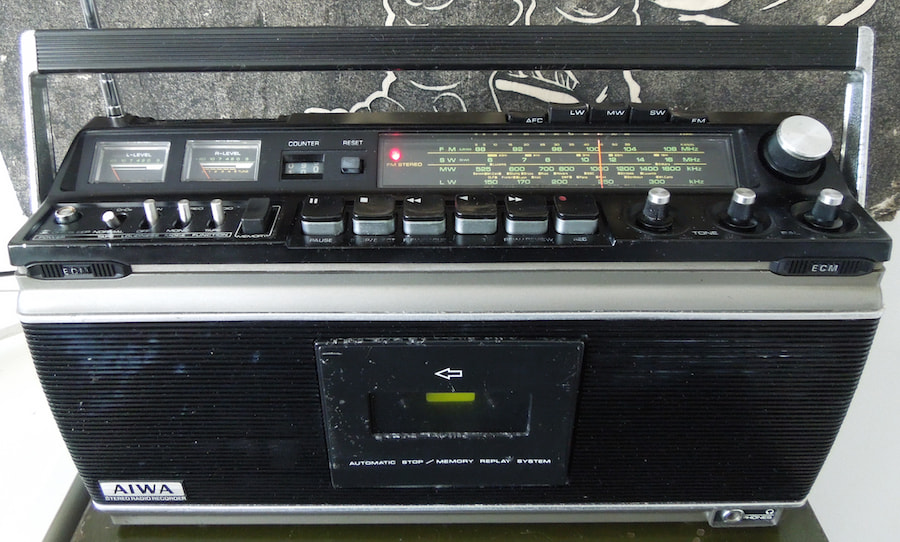
AIWA was one of the most respected audio brands of the last quarter of the 20th century, and in 1974 it entered the emerging boombox market with the TPR-930. Built like a small appliance rather than a toy, the TPR-930 reflected AIWA’s reputation for serious engineering at a time when portability still meant compromise.
Packed with 40 transistors, an integrated circuit, and a four-speaker system, the TPR-930 delivered sound quality that still earns it respect among collectors. Its heavy-duty construction came at a cost. With batteries installed, it tipped the scales at roughly 13.75 pounds, making it a true battery pig and a reminder that early boombox portability required commitment.
The TPR-930 featured a wide-band radio tuner covering SW1, SW2, AM, and FM, along with a single cassette deck. Supporting features included AIWA’s Matrix Sound System, Loudness control, AFC for more accurate radio tuning, Automatic Stop, and a Memory Replay System. It also supported CrO₂ tapes, included a three-digit analog tape counter and a built-in condenser microphone, and offered connections for external 4-ohm speakers.
Advertisement
Originally priced between $150 and $200 during its production run, the TPR-930 reportedly still trades in that same range today depending on condition. For collectors looking for a historically important boombox with legitimate sound quality, it remains one of the better bargains in the category.
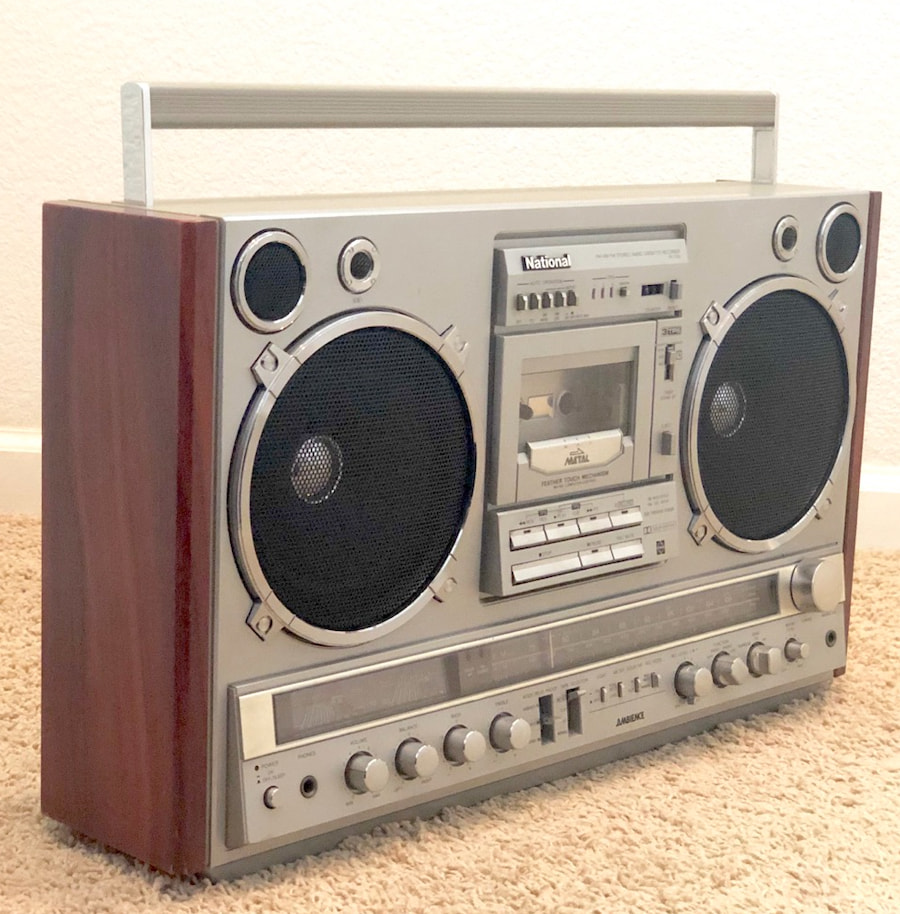
First released in the 1977-1978 timeframe, the National Panasonic Ambience RX-7000 was conceived as a high-end boombox equally comfortable anchoring a living room or making a very loud statement outside. This was not a casual portable. It was Panasonic aiming straight at the top of the category.
At its core, the RX-7000 combined an AM/FM radio with a single cassette deck, but the deck itself was unusually sophisticated for the era. Features included a tape counter, Dolby B noise reduction, Panasonic’s “3 TPS” Tape Program Sensor, a Feather Touch mechanism, microcomputer control, play and record timers, cue and review functions, manual or automatic record level control, support for Normal, FeCr, CrO₂, and Metal tapes, and a Dolby LED indicator.
Supporting features were equally comprehensive. The front panel included VU, tuning, and battery meters, mono, stereo, and Ambience (stereo-wide) listening modes, balance, bass, and treble controls, an FM stereo indicator, and a terminal for a wired remote control. Inputs were generous, with dual microphone jacks featuring mixing level control, an RCA phono input with ground terminal, and a headphone output.
Advertisement
One standout capability was amplification. In addition to its built-in speaker system, the RX-7000’s amplifier delivered 2 x 11 watts RMS and could power modest external speakers via dedicated terminals. The internal speaker array consisted of two 2-inch tweeters and two 6-inch woofers, reinforcing its ambitions as more than a street box.
All of that capability came with mass. The RX-7000 weighed approximately 17.6 pounds, firmly placing it in the “battery pig” category. Original pricing reflected its premium positioning, landing between $850 and $900 at launch. Today, depending on condition and completeness, demand pricing typically ranges from around $500 to well over $1,300, making it one of the most serious and collectible boomboxes of its era.
Released in 1978, the Sanyo M-9994 carved out its place in boombox culture by delivering serious sound in a relatively disciplined package. Rated at 2 x 5 watts of output power, it featured a capable speaker system with 6.3-inch woofers and 2-inch cone tweeters. Notably, the tweeters were rotatable, allowing users to improve high-frequency directionality depending on placement and listening position.
Sanyo marketed the M-9994 as a “professional edition,” and it leaned into that claim with included external handheld microphones complete with plastic desk stands. Supporting features included an Input Volume control that allowed attenuation of incoming signals from line-level or phono sources, along with a dedicated headphone output for private listening.
Originally priced between $300 and $350, the Sanyo M-9994 has appreciated significantly over time. Today, demand pricing can reach as high as $1,500 for pristine, fully functional examples, reflecting its reputation as one of Sanyo’s most desirable classic boombox designs.
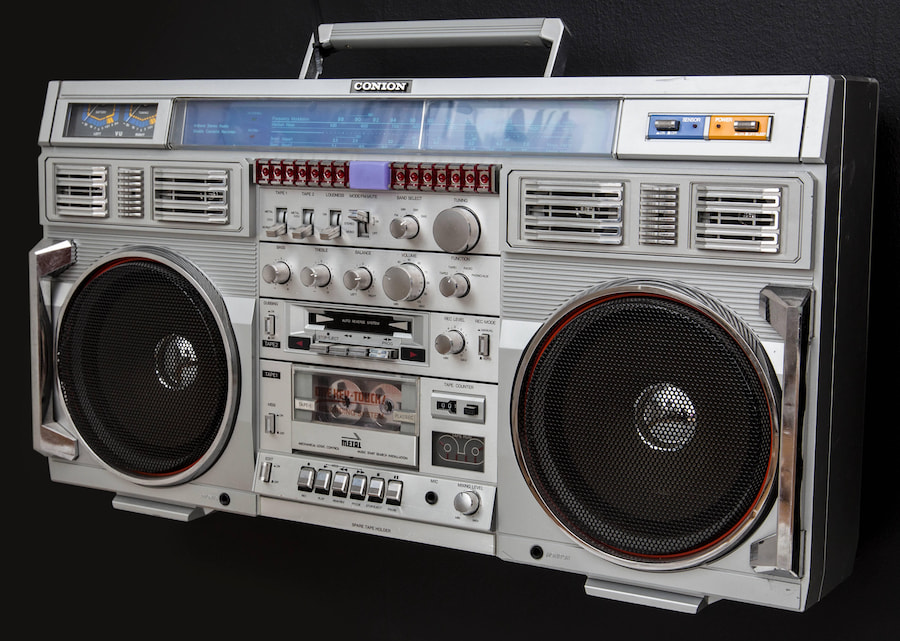
Released around 1984, the Conion C-100F is pure boombox legend and remains one of the most aggressively sought models among collectors. Oversized, overbuilt, and unapologetically loud, this was a statement piece even in an era defined by excess.
Pro Tip: The Conion brand was part of Onkyo, which helps explain why this box leaned harder into features and spectacle than restraint.
Advertisement
The C-100F came loaded. It featured a dual cassette deck configuration with one front-loading deck and one slot-loading deck, a four-band radio covering SW1, SW2, FM, and AM, dual VU meters, twin LED level displays, and two headphone jacks. One standout party trick was a built-in motion sensor that could be activated to trigger a security alarm if the unit was moved, a very on-brand feature for a boombox of this size and value.
The speaker array was equally ambitious, consisting of two woofers, two midrange drivers, and two tweeters. Output power was rated at 30 watts RMS at 10 percent THD, a figure that tells you everything you need to know about how hard this thing was meant to be pushed at its limits.
All of this hardware lived inside a massive 30-inch-wide chassis weighing just over 26 pounds. Portability was theoretical. Running the C-100F off batteries required ten D-cells, firmly placing it in battery-pig territory and guaranteeing that shoulder fatigue was part of the experience.
Depending on the market, the same design was also sold as the Helix HX-4365 and the Clairtone 7980. Original pricing for the Conion C-100F landed between approximately $450 and $475 in the U.S. Today, demand pricing typically ranges from around $750 to as much as $2,000, depending on condition, originality, and whether the alarm still scares the neighbors.
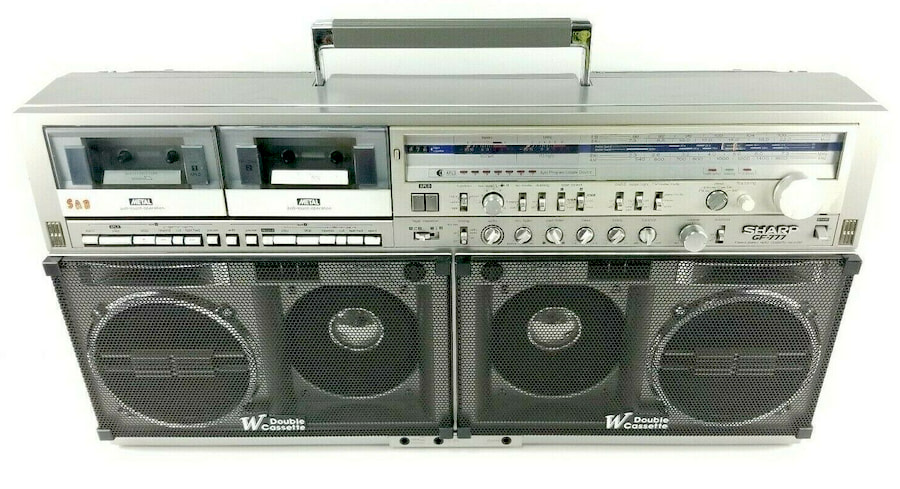
Another highly prized boombox among collectors is the Sharp GF-777, also sold in Japan as the GF-909. This model sits firmly in the heavyweight division, both in reputation and in physical presence.
The GF-777 featured a six-speaker array consisting of two woofers, two dedicated “sub” woofers, and two horn-type tweeters. Output power was rated at approximately 2 x 12 watts RMS, giving it the kind of authority that made it impossible to ignore once the play button was pressed.
Size and weight were part of the appeal. The GF-777 stretched roughly 30 inches wide and tipped the scales at about 27 pounds before batteries were added. Running it as a true portable required ten D-cell batteries, though it could also be operated on AC power for less shoulder strain and fewer trips to the battery aisle.
Advertisement
Originally priced at around $800, the Sharp GF-777 remains surprisingly attainable today. Depending on condition, completeness, and functionality, current demand pricing typically falls between $500 and $700, with exceptional examples commanding higher figures from collectors who know exactly what they are looking at.
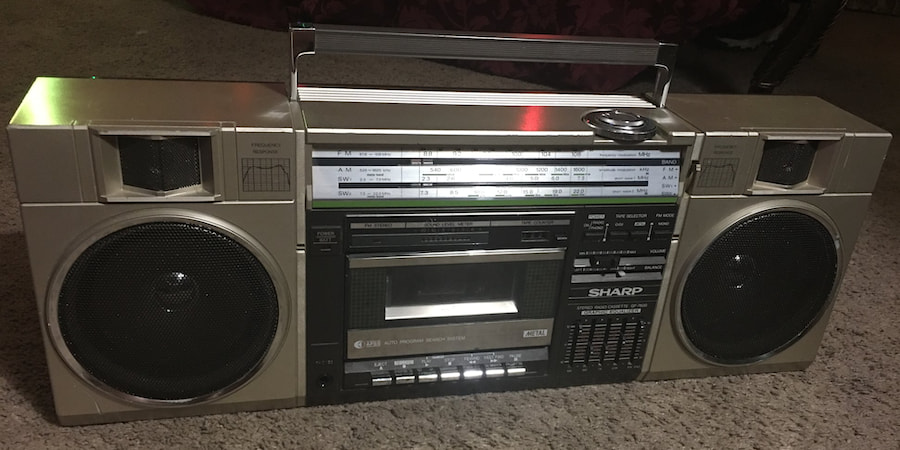
The Sharp GF-7600 is not the biggest, loudest, or most technically ambitious boombox of the 1980s, but it may be the most culturally significant. Released in 1983, it achieved permanent pop-culture status thanks to its starring role in the 1989 film Say Anything. Pity John Cusack didn’t drop it on his head.
Despite its more manageable size, the GF-7600 was surprisingly well equipped. It featured a four-band radio covering SW1, SW2, AM, and FM, a single cassette deck, a five-band graphic equalizer, an LED VU meter, line-in and line-out connections, and external microphone inputs. This was a serious feature set for a box that looked almost polite by Sharp’s usual standards.
The cassette deck supported metal tape, included full auto-stop and APSS track search, and offered a frequency response rated from 50 Hz to 16,000 Hz. Speaker duties were handled by a pair of 4.7-inch woofers and horn tweeters, while output power is generally estimated at around 5 to 6 watts per channel. Not a brute, but loud enough to make a statement—and immortal once held aloft over a rain-soaked lawn.
Advertisement
Original pricing varied by retailer. Today, demand pricing typically ranges from approximately $125 to $500, depending on condition, completeness, and functionality.
Before Sony upended personal audio with the Walkman, it was already deeply embedded in boombox culture. One of its standout entries was the Sony CFS-99, also known as the Energy 99, released in 1981. Big, loud, and unmistakably ’80s in both sound and styling, the CFS-99 paired a rugged build with serious output. It also weighed in at a back-testing 23 pounds, firmly earning its place in the heavyweight class.
Core features included an AM/FM radio and a cassette deck, with certain variants adding an LED track indicator along with dual microphone inputs featuring pan control and echo effects. Connectivity was unusually flexible for the time, offering RCA line-level inputs and outputs, while some versions also included banana speaker terminals for driving external speakers.
Advertisement
Advertisement. Scroll to continue reading.
The original retail price is no longer well documented. Today, demand pricing typically starts around $500 and can climb higher depending on condition, originality, and whether the unit has been modified to add Bluetooth connectivity.
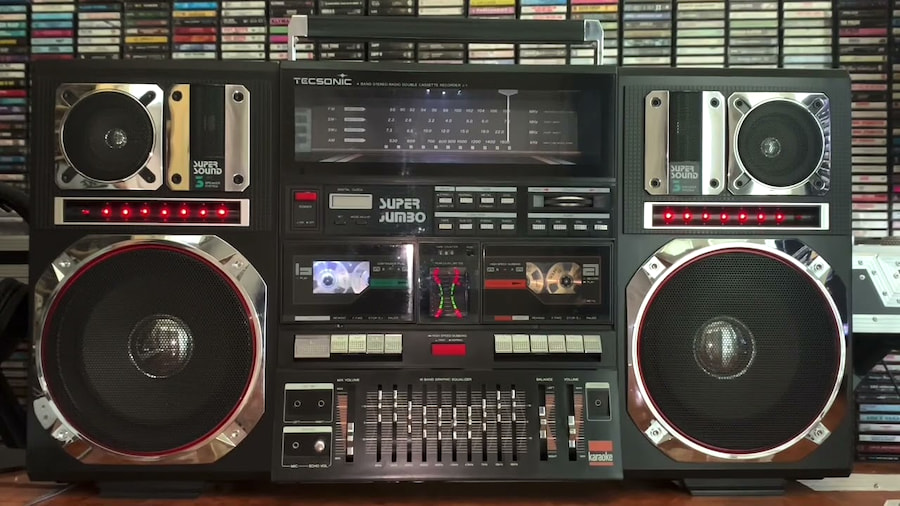
The Tecsonic J-1 Super Jumbo is another culturally significant boombox, cemented in history by its appearance in Do the Right Thing. Released in the 1987-1988 timeframe and manufactured in South Korea, the Super Jumbo wasn’t subtle. It didn’t need to be. This was a box built to be seen, heard, and remembered. Fight the Power.
The J-1 Super Jumbo featured an imposing speaker array with dual 8-inch woofers, a pair of midrange drivers, and twin tweeters. Feature-wise, it came loaded: dual cassette decks, AM/FM radio, karaoke sing-along functions, a 10-band equalizer, balance control, mixing volume, left and right front microphone inputs, a dedicated mix microphone input, phono jack, auxiliary/CD input, peak level meter, high-speed dubbing, tape counter, A/B continuous play, and an LED clock. Excess was the point.
Advertisement
Physically, the J-1 lived up to its name. It measured roughly 31 inches wide and 16.5 inches tall, and weighed in at around 25 pounds. Reported output power is approximately 2 x 20 watts, more than enough to back up its visual presence with real authority.
Original pricing for the Tecsonic J-1 Super Jumbo is no longer well documented. Today, demand pricing typically hovers around $1,000, depending on condition, completeness, and whether it still looks ready to be hoisted over someone’s head as a very loud act of defiance.
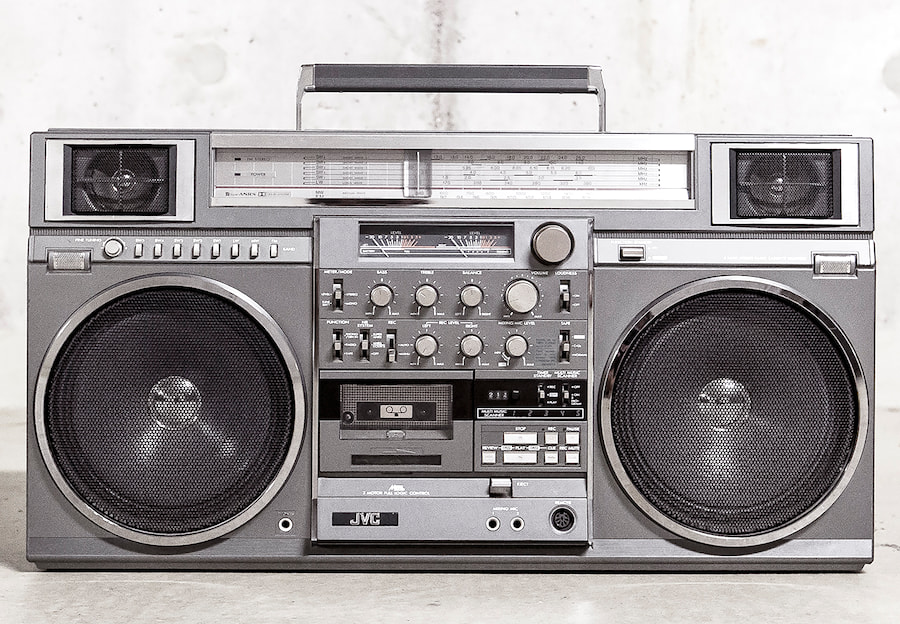
Some regard the JVC RC-M90 as the “King of Boomboxes,” and it’s not an argument without merit. Released in 1981, this was a no-compromise design that combined brute force with an unusually deep feature set.
The built-in speaker system used a two-way, four-speaker layout consisting of dual 8-inch woofers and two 2.5-inch tweeters, driven by amplification rated at approximately 2 x 20 watts. It was designed to move real air, not just make noise.
Advertisement
Operational features were extensive. The RC-M90 included an eight-band tuner with AM and FM coverage plus six shortwave bands, all supported by fine tuning. The cassette deck featured a tape counter, dual-motor full-logic transport, Normal, CrO₂, and Metal tape bias and EQ, JVC’s Multi Music Scanner, record and playback timers, and Dolby NR or Super ANRS noise reduction. With metal tape, cassette frequency response was rated at roughly 30 Hz to 17,000 Hz, impressive for a portable system.
Additional features included two built-in microphones, independent left and right recording level controls, microphone mixing level control, dual meters for VU, battery, and tuning, bass, treble, and balance controls, a loudness switch, and mono or stereo selection. Nothing about this box was casual.
Original pricing is documented at approximately £333 in the UK, with U.S. pricing from 1981 remaining elusive. Today, demand pricing for the JVC RC-M90 routinely exceeds $1,000, with top-condition examples commanding significantly more. For many collectors, this is the mountain every other boombox is measured against.
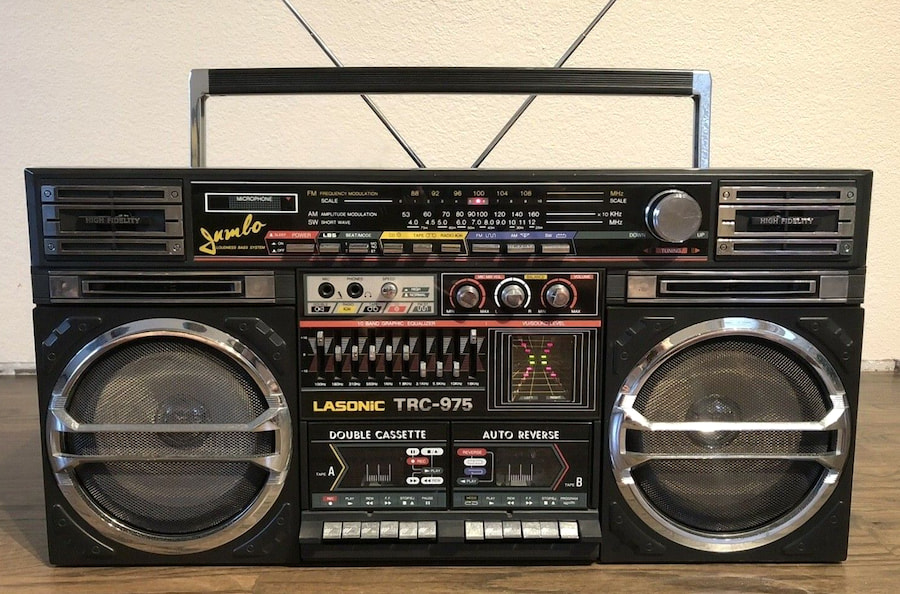
Jumping ahead to 1993, the Lasonic TRC-975 arrived as a genuine value play, originally selling for around $179. While the decade had shifted, its design was pure late-’80s muscle, and the sound followed suit. The TRC-975 earned a reputation for serious output thanks to its “Jumbo” Extra Bass system and a 10-band graphic equalizer that encouraged aggressive tweaking rather than restraint.
The speaker system consisted of dual 8-inch woofers paired with two 2-inch tweeters, a configuration aimed squarely at loud, physical sound. Feature-wise, the TRC-975 included dual cassette decks for recording and dubbing, AM/FM/SW radio, auto-reverse playback, and both normal- and high-speed dubbing. Connectivity was basic but practical, with an auxiliary input for external sources.
Some units on the secondary market have since been modified to add Bluetooth or MP3 playback, though purists tend to prefer unaltered examples. Closely associated with hip-hop culture, the Lasonic TRC-975 has become one of the most aggressively sought boomboxes of the 1990s era. Current demand pricing typically ranges from around $700 to as high as $2,300 for pristine, original-condition units, while modified versions with Bluetooth often trade closer to the lower end of that range.
Just as CDs were beginning to reshape how people listened to music in the early 1980s, Sharp responded with one of the strangest boombox designs ever put into production: the VZ-2000, released around 1982-1983.
What made the VZ-2000 truly weird was its ambition. In addition to a radio and cassette deck, it incorporated a vertical turntable capable of playing both sides of a record at 33 or 45 rpm without flipping. To pull that off, Sharp employed dual linear-tracking tonearms controlled by a microcomputer, enabling fully automatic playback. Each arm was fitted with a Sharp 118 phono cartridge and STY-118 stylus, turning this boombox into a portable record player in the most literal sense of the word.
Beyond the vinyl trickery, the VZ-2000 featured a two-way speaker system, easy-touch controls, an auto program pause system, and metal tape compatibility for the cassette deck. On paper, it checked an absurd number of boxes for a single portable unit.
Portability, however, was relative. The VZ-2000 weighed over 35 pounds, which severely limited how far anyone was realistically carrying it. Original pricing was approximately $550, and today a fully operational example typically commands between $1,000 and $1,500 or more, depending on condition. It remains one of the clearest examples of early-’80s audio excess, when engineers still believed anything was portable if you added a handle.
These 12 boomboxes barely scratch the surface of what flooded streets, stoops, and backseats throughout the 1970s and 1980s, when portable audio was as much about presence as playback. Today’s Bluetooth speakers and smartphones are lighter, cleaner, and infinitely more convenient, but they’ve traded shared experience for private consumption. Boomboxes weren’t just how people listened to music. They were how music forced its way into the room—and made everyone deal with it together.
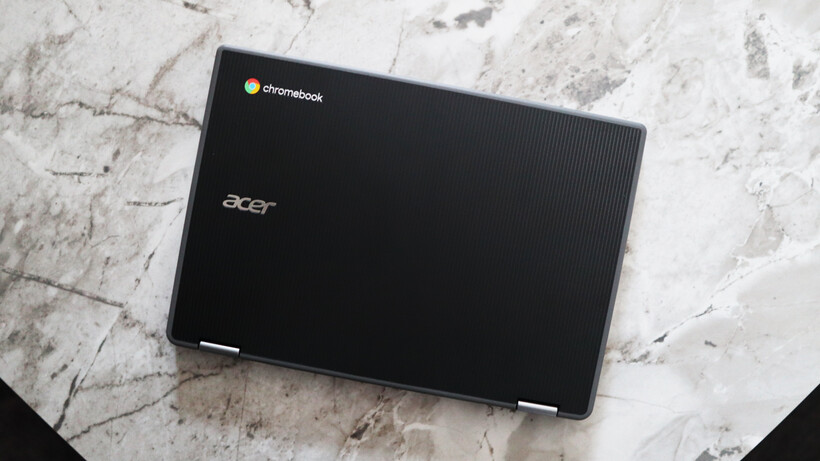
The Acer Chromebook Spin 311 (2026) is a decent small-form-factor Chromebook with solid endurance, okay power for basic tasks and a comfortable keyboard to boot. The screen here feels a little low-res in 2026, while its port selection also isn’t as strong as rivals.
Excellent battery life
Solid performance for basic tasks
Functional port selection
1366×768 resolution feels dated
Thick bezels around the screen
Squirrel Widget
Advertisement
Key Features
11.6-inch HD IPS touchscreen:
The Chromebook Spin 311 (2026) has one of the smallest touchscreens you’ll find on a laptop this affordable, making it a solid choice for the classroom.
Advertisement
MediaTek Kompanio 540 processor inside:
It also has an eight core MediaTek processor inside for reasonable performance for basic tasks.
Advertisement
1.30kg weight:
This smaller Chromebook is quite light too, making it an easy one to carry around on the go.
Advertisement
Introduction
The Acer Chromebook Spin 311 (2026) marks the latest iteration of the brand’s dinkiest ChromeOS-powered laptop.
This new model is designed strictly with efficiency and usability in mind, promising up to 15 hours of battery life and a boost in power with its new MediaTek Kompanio 540 processor, plus it has replaceable USB-C ports and a keyboard that needs two screws to remove it.
Alongside this, the 11.6-inch touch-enabled 1366×768 IPS screen is back, plus a decent port selection, snappy keyboard and more to like out of such an affordable laptop. For reference, it costs £369/$579.99, which makes it one of the cheaper Chromebooks of its kind, alongside the Acer Chromebook Spin 312 and HP Chromebook x2 11, even if US pricing pushes it up somewhat.
Advertisement
Advertisement
To see whether this little Acer laptop is one of the best Chromebooks we’ve tested, I’ve been putting it through its paces for the last week or so.
Design and Keyboard
Compact plastic frame
Meagre port selection
Snappy keyboard, but a small trackpad
Owing to its small form factor, the Chromebook Spin 311 (2026) is a very compact customer indeed, which makes it one of the most portable laptops you’ll find out there. Its all-black finish is pleasant, and the textured black plastic feel provides a semblance of durability, too. I’m not a big fan of the large bezels around the screen, though, which give this Chromebook a bit of a dated look.
There is a bit of flex at the corners when pressed, and on the keyboard deck, too, although as this is a cheaper laptop, I don’t mind too much. It tips the scales at 1.3kg, which is on the heavier side for such a small laptop. With this in mind, the 11-inch screen size and its associated form factor make this easily portable in a rucksack or bag.
Image Credit (Trusted Reviews)
Advertisement
The port selection on the Chromebook Spin 311 (2026) doesn’t set the world alight, but for such a small laptop, it’s reasonable. Each side is home to a USB-C port and a USB-A each, plus the right side has a headphone jack, too. The larger Chromebook Spin 312 model I tested last year supplements this with an HDMI and SD card reader.
The keyboard deck of this laptop is a smaller form factor, complete with arrow keys and a function row. The keys themselves have decent tactility to them, and it’s reasonably easy to get up to speed with them. There isn’t any form of backlighting for after-dark working, though.
Advertisement
Image Credit (Trusted Reviews)
I’m less enthusiastic about the trackpad, though, with its distinct lack of vertical space feeling quite restrictive. It’s reasonably accurate, although quite stiff in use.
For the benefit of repairability and because this is a device designed for harsh educational environments, the USB-C ports here are serviceable (a feature borrowed from business laptops that are a lot more expensive than this one, such as the Dell Pro Max 16 Plus), while the keyboard deck is easily replaceable, too.
Image Credit (Trusted Reviews)
Advertisement
The laptop also comes in plastic-free packaging and is somewhat assembled with PCR plastics to give it some sustainability cred.
Display and Sound
1366×768 resolution isn’t too brilliant
Reasonable brightness and colours
Okay speakers
The display here is a touch-enabled 11-6-inch IPS screen with a 1366×768 resolution and a classic 16:9 aspect ratio that feels very dated against this Chromebook’s rivals, not least with huge bezels surrounding the panel.
The problem I have is the resolution, which feels subpar in 2026. Even the Chromebook Spin 312 and other more compact choices have a Full HD screen, rather than an ‘HD Ready’ one as it were. This leaves it lacking detail, and it can feel a little fuzzy at times. Considering this is a touch-screen designed for budding creatives, it leaves a bit of a sour taste.
Image Credit (Trusted Reviews)
There isn’t a quoted brightness figure for the Chromebook Spin 311 (2026)’s display, although it feels a little dimmer than our usual 300 nit target to my eye when put at full blast. For indoor working, I think you’d be okay, although taking it outside probably isn’t the best idea. Colours look reasonable to my eye, but owing to the lower brightness, there is an element of the panel that feels a smidgen washed out.
Advertisement
Advertisement
To its credit, this Chromebook has a Corning Gorilla Glass coating for added durability, which is important considering the target audience of children, and the touchscreen nature felt surprisingly responsive.
Image Credit (Trusted Reviews)
The Chromebook Spin 311 (2026)’s speakers are downwards-firing and are mostly mids, as you’d expect from a cheaper laptop. They’re okay for casual viewing, but little beyond that. For more extended listening, utilise the headphone jack on the right hand side.
Performance
Okay performance for casual tasks
4GB of RAM is low in 2025
eMMC storage is a shame
The press release for the Chromebook Spin 311 (2026) made a lot about it being one of the first Acer Chromebook devices to ship with the MediaTek Kompanio 540 processor. This is one of MediaTek’s latest low-power mobile chips that features eight cores, including two Arm Cortex-A78 ‘big cores’ and six Arm Cortex-A55 cores, plus a dual-core GPU.
It’s not a chip that’s necessarily designed for outright grunt, and is more for zippy performance for basic tasks where it’s needed. Think of it as a competitor to Intel’s N-series of chips – quiet, but efficient.
Advertisement
Image Credit (Trusted Reviews)
In running it through the Geekbench 6 benchmark test, the Chromebook Spin 311 (2026) provided scores that were very similar to an Intel N100 in the same test. The multi-core result is a bit lower than I expected, owing to the quantity of cores this MediaTek chip has over the N100.
With this in mind, though, outright speed and performance aren’t the name of the game for the Chromebook Spin 311 (2026). Its purpose is to be a portable and efficient laptop for light productivity loads, which it performs decently well. I didn’t experience too much of a slowdown while using multiple Chrome tabs for Docs, Slack and Spotify.
Advertisement
Image Credit (Trusted Reviews)
This particular configuration also nets 4GB of RAM and 64GB of eMMC storage. For the price, I’m not too bothered about this, although it would have been nice to see solid-state storage in 2026 on a more affordable device. The RAM headroom is just enough for basic tasks, although for any extended multi-tasking, going for a model with more RAM is advisable.
Software
Lightweight and clean ChromeOS install
No Chromebook Plus features
Advertisement
The first thing to note with the Chromebook Spin 311 (2026) is that it runs ChromeOS, meaning it’s got a clean and lightweight UI with no real bloatware pre-installed, that’s easy to get your way around and jump into apps such as Google’s G-Suite of productivity apps.
This specific Chromebook Spin 311 (2026) model also doesn’t meet the Chromebook Plus minimum spec requirements, although even with those models that do, they’ve made the decision not to designate this laptop as one. This also means we aren’t getting new features such as Help Me Read, the Quick Insert key or Magic Eraser, for instance.
Image Credit (Trusted Reviews)
There is one benefit to this being a newer model, as it comes with Google’s new Quick Insert key, where the Caps Lock is, which opens a Spotlight Search-style menu which can be used for everything from inserting a link to looking up files.
Battery Life
Lasted for 13 hours 47 minutes in the battery test
Capable of lasting for between one and two working days
The Chromebook Spin 311 (2026) comes with a modest 45Whr battery, which isn’t the biggest it must be said. Owing to the increase in efficiency that MediaTek has touted from the processor inside this laptop, Acer is quoting up to 15 hours of runtime from this laptop before it’ll conk out.
Advertisement
In running a Full HD video loop test at around 50 percent brightness, this small Chromebook lasted for 13 hours and 47 minutes. That’s pretty good and isn’t too far off from Acer’s original estimates. It means you’ll be able to get through two working days with this Chromebook before needing to plug it back into the mains.
Advertisement
Image Credit (Trusted Reviews)
The Chromebook Spin 311 (2026) also comes with a dinky 45W USB-C charger that’s one of the smallest I’ve seen, and was reasonably brisk at putting charge back into the laptop’s battery. A 50 percent charge took 38 minutes, while a full charge took 86 minutes.
Squirrel Widget
Should you buy it?
You want a very small touchscreen Chromebook:
The Chromebook Spin 311 (2026) is one of the smallest touchscreen Chromebooks out there, and if you want the flexibility in a dinky chassis, this is a decent choice.
Advertisement
This Chromebook is quite limited in power with its MediaTek chip and especially with just 4GB of RAM. If you can forgive a touchscreen, the asking price goes a long way in more standard Chromebooks.
Advertisement
Final Thoughts
The Acer Chromebook Spin 311 (2026) is a decent small-form-factor Chromebook with solid endurance, okay power for basic tasks and a comfortable keyboard to boot. The screen here feels a little low-res in 2026, while its port selection also isn’t as strong as rivals.
For instance, the Acer Chromebook Spin 312 model ups the screen size a smidgen, but also brings the resolution to Full HD. It also has a much further-reaching set of ports, and matches this smaller choice in battery life. It’s also around the same price in terms of RRP, making it a bit of a no-brainer in my eyes. For more choices, check out our list of the best Chromebooks we’ve tested.
Advertisement
Advertisement
How We Test
This Acer laptop has been put through a series of uniform checks designed to gauge key factors, including build quality, performance, screen quality and battery life. These include formal synthetic benchmarks and scripted tests, plus a series of real-world checks, such as how well it runs popular apps.
FAQs
What processor does the Acer Chromebook Spin 311 (2026) have?
This sample of the Acer Chromebook Spin 311 (2026) has a new MediaTek processor inside for efficiency over outright power.
Looking for the most recent Strands answer? Click here for our daily Strands hints, as well as our daily answers and hints for The New York Times Mini Crossword, Wordle, Connections and Connections: Sports Edition puzzles.
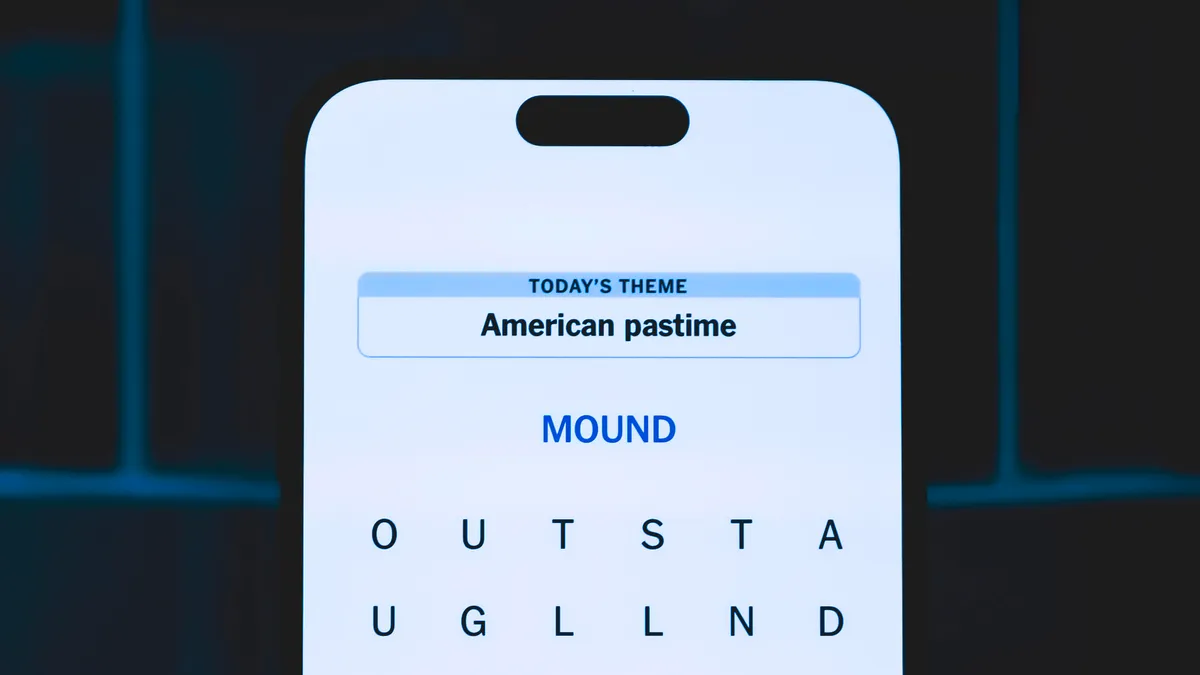
Today’s NYT Strands puzzle could be tough. Hope you know your animals! One of them is an animal I had never heard of before. Some of the answers are difficult to unscramble, so if you need hints and answers, read on.
If that doesn’t help you, here’s a clue: Helps to be Australian.
Clue words to unlock in-game hints
Your goal is to find hidden words that fit the puzzle’s theme. If you’re stuck, find any words you can. Every time you find three words of four letters or more, Strands will reveal one of the theme words. These are the words I used to get those hints but any words of four or more letters that you find will work:
POUR, BALL, LAYS, PAIL, TAIL, RUSK, BAIL
Answers for today’s Strands puzzle
These are the answers that tie into the theme. The goal of the puzzle is to find them all, including the spangram, a theme word that reaches from one side of the puzzle to the other. When you have all of them (I originally thought there were always eight but learned that the number can vary), every letter on the board will be used. Here are the nonspangram answers:
BILBY, KANGAROO, WALLABY, WOMBAT, KOALA, OPOSSUM
Today’s Strands spangram
The completed NYT Strands puzzle for April 5, 2026.
NYT/Screenshot by CNET
Today’s Strands spangram is MARSUPIALS. To find it, start with the M that’s five letters down on the far-left vertical row, and wind up and over.
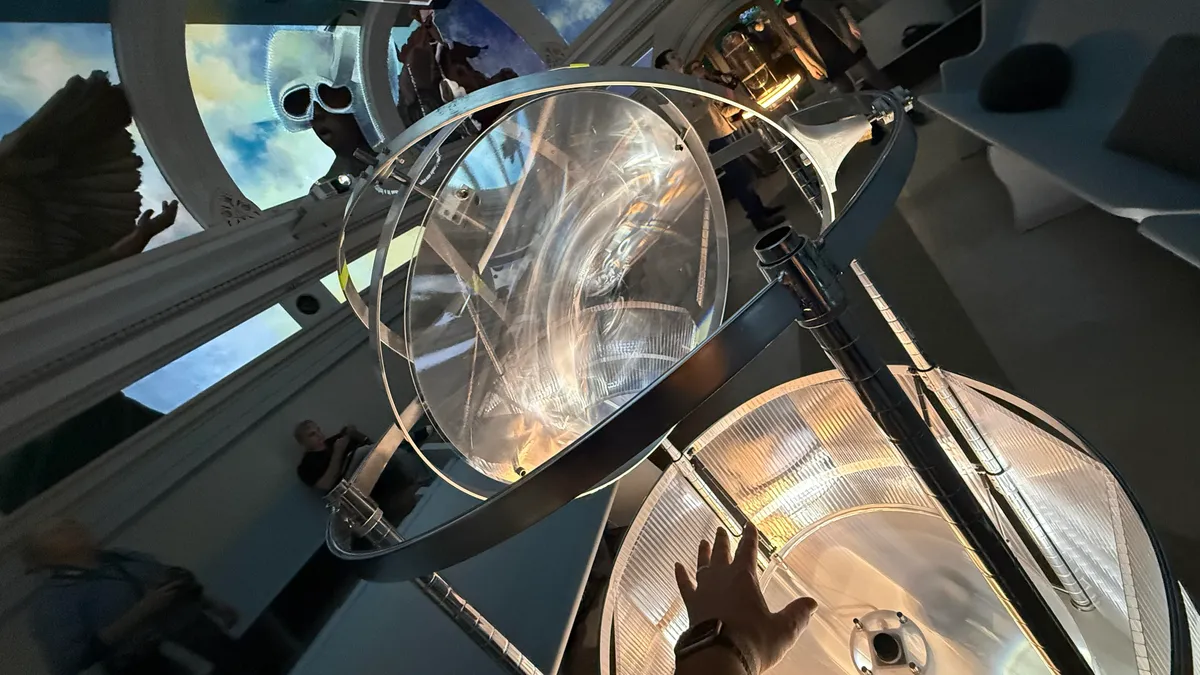
Climbing up flights of stairs in a bank building full of rooms draped in surrealist art, tunnels with lurking beasts called “skin horses” and exhibits of keepsakes imaginary and real, I find myself looking at an art mural across a domed ceiling that I can explore with instruments next to me. Speaking into a microphone, I see my words scroll across the edges. My hands, thrust into a small chamber, are projected across the ceiling, highlighting parts of the mural. Suddenly, AI-generated descriptions emerge where I’d put my hands.
This is the Ministry of Awe, a new installation experience in Philadelphia that I was lucky enough to visit ahead of its opening, and it’s a welcome East Coast dose of strangeness. Created by Meg Saligman and over 100 other artists, it’s a six-story space that makes me think of Meow Wolf or long-time LA oddity the Museum of Jurassic Technology — or even London’s very real Sir John Soane’s Museum.
Advertisement
This “skin horse” lurks in the basement, if you look hard enough.
Scott Stein/CNET
The former bank building’s now an immersive art gallery full of hands-on experiences to unravel and a storyline too: messages in drawers, phones that can be dialed or answered, bathrooms that record your “deposits” with audio messages. Everything at the Ministry is an exploration of the meaning of banks and their associated power. But what drew me here just as much was the idea of how tech would fold into a space like this.
Watch this: I Saw the Future of Tech Art in Philly
Much like Meow Wolf’s explorations of layers of tech into artist installations, something I talked about at SXSW recently, Ministry of Awe is playing with tiny doses of AI — nothing that generates or replaces the work of artists but rather in a way that highlights and possibly enhances. The Ministry of Awe’s signature fifth-floor artwork, The Heavens, is a giant mural work by Saligman that’s projected across the segments of the ceiling. Angled seats let visitors hang around and gaze up, but several “instruments” in the room let you play with the space, too, created by the tech company Spatial Pixel.
Advertisement
A full look at the projector-filled room where the Heavens mural exists, along with interaction instruments. This is just one room of many in the Ministry.
Scott Stein/CNET
Spatial Pixel is focused on “spatial computing for spaces, not faces,” and was founded by Violet Whitney, former director of product and associate director of design at Google Sidewalk Labs, and William Martin, an architect and designer. Both also teach a course in spatial AI at Columbia University.
Exploring AI through art
The Heavens’ interaction tools and how they’re designed to feel integrated and somewhat invisible are part of Whitney and Martin’s explorations of where AI could work in subtler space-aware ways. This fascinates me because AI, smart glasses in particular, are already trying to solve for this with very mixed success. What I’ve found is that art and entertainment can often be better places to explore ideas of AI in contained ways, with rules deliberately made to respect the work and art.
Advertisement
Spatial Pixel’s team in the room they helped design.
Scott Stein/CNET
Whitney and Martin met Saligman in the same Philadelphia neighborhood, which is how they ended up collaborating on the Ministry of Awe’s exhibits. The Heavens experience is run using Spatial Pixel’s open-source platform, called Procession, that blends multiple AI models into a system that works in physical spaces. Whitney and Martin already have an interactive lab space for it at the School of Visual Arts in New York City, but the Ministry of Awe is a public test-bed, working off art that they want to keep sacred.
“A lot of what we’ve been doing is finding ways of changing the mural, or the way that you see the mural through light. A core way we’ve been trying to allow visitors to interact with it is to pick up on the things that they’re saying in the space,” said Whitney. “We want to take the things they’re saying and change the mural based on their words and what they point at.”
Advertisement
The Ministry of Awe’s multilevel former bank building has many rooms inside, many of them interactive, and they were designed differently by different artists.
Scott Stein/CNET
Right now, a lot of the mural interactions are simple and ephemeral: My words disappear, my highlights fade. But the Ministry of Awe’s toying with the theme of banking in personal data, too. And the software being used to run the installation is programmable, so Spatial Pixel aims to keep evolving what happens over time.
“Our goal is eventually to record what the people are contributing, with the right consent. But then maybe those ideas become like this bank. It is a bank, after all, to store these ideas, and then Meg can use them and review them and use it to evolve the painting and physical space. And so it becomes this sort of perpetual dialogue with the muralist,” said Martin.
Advertisement
It’s part of the thinking that Spatial Pixel wants artists to play with, as opposed to tech companies.
Words overlay with art, depending on how you interact. The work changes slightly over time.
Scott Stein/CNET
“What if you could actually talk to a painting? What if you could actually interact with a work of art and then explore it in new ways? We realized,” said Martin, “that accessing these tangible computing techniques, like being able to recognize gesture, move objects around — there’s certainly a lot of academic groups that are discussing this, but it’s still really inaccessible to the actual designers that want to make experiences in that way.”
Advertisement
The idea echoes experimental AI art I saw in Austin at SXSW just days after my Ministry of Awe visit — questions about agency and ownership, where boundaries between AI and personal work get drawn. And as I toured the Ministry space with Meta’s smart glasses on my face, it made me think about how smart glasses — and most AI tools — right now have almost no consideration for this delicate line.
But they’ll need to. And maybe art spaces are the places to begin to think it out, with no glasses or personal wearable tech needed at all.
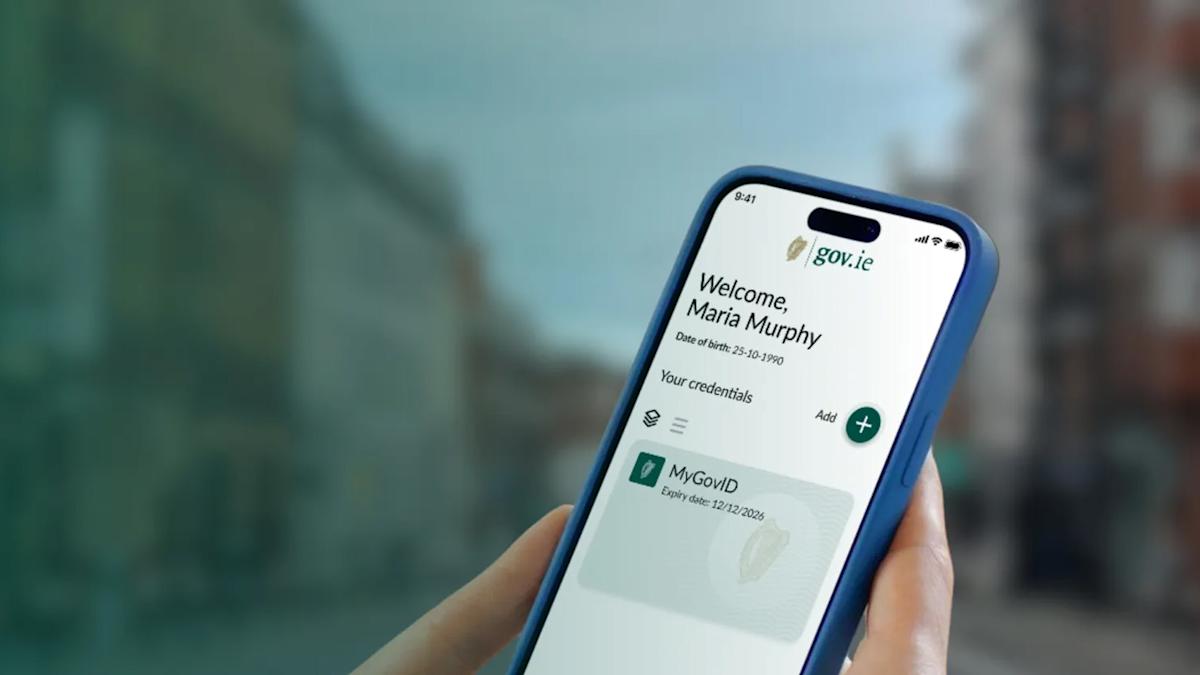
Before it’s publicly available later this year, the Irish government is trialing its Government Digital Wallet, which includes a way to verify a user’s age to access social media platforms. In its press release, the government’s Department of Public Expediture, Infrastructure, Public Service Reform and Digitalisation said people can store digital versions of their birth certificates, driving licenses, European health cards and more.
Frank Feighan, the department’s minister, said that this testing phase would help inform the development of the digital wallet and ensure it was user friendly. The government hasn’t laid out when the Government Digital Wallet graduates beyond the testing phase, but Ireland is required to create a digital wallet by the end of 2026 as part of a European Union regulation.
“It will be able to facilitate secure age verification capability as set out in Digital Ireland and the implementation of the Online Safety Code, under which designated platforms must have age verification measures in place to help protect, in particular, children and young people from online harm,” Feighan said of Ireland’s digital wallet.
The pilot phase will be done on an opt-in basis and the government has a short survey available for comments and concerns. Along with Ireland, many other European Union member states are working on their own age verification methods. Earlier this year, Spain’s prime minister Pedro Sanchez announced a law to ban social media for anyone under 16.
Many of us are guilty of toeing the line between having a ready supply of components at hand and simply hoarding for fear of throwing anything out. In a first admission of this problem, [Scott Lawson] decided to implement a couple of changes to assess his own position on this sliding scale.
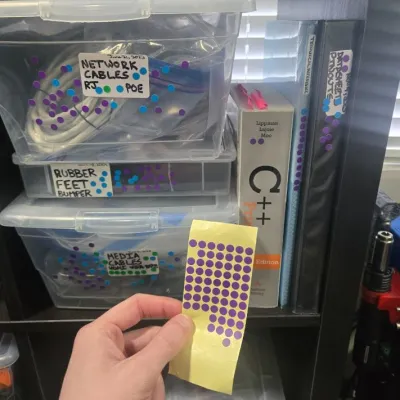
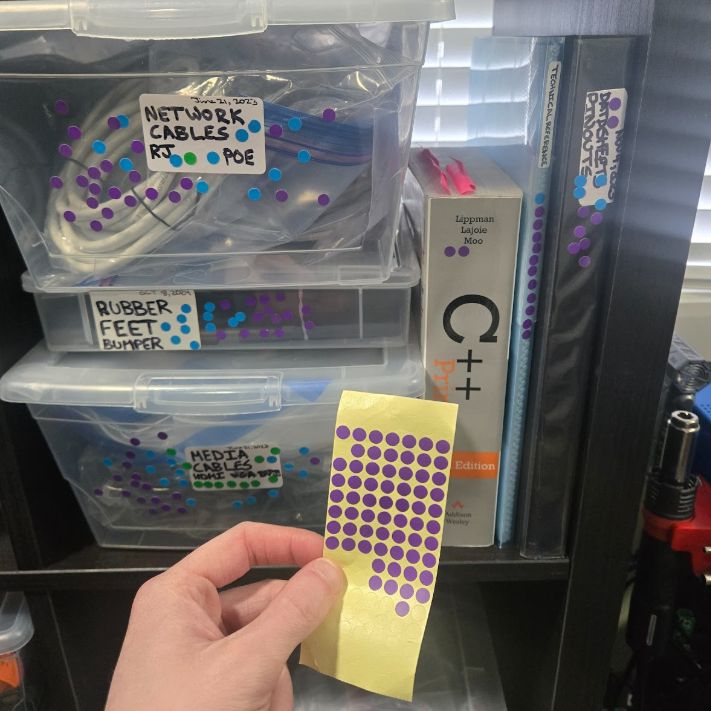
The first change was to only put parts, components, and supplies in transparent boxes. Next was to add a sticker on each box noting the contents and box creation date. This was extended to plastic bags inside the boxes when further subdivision was warranted.
Next, the question was about usage patterns, as you may think that you know how often you use something from a specific box, or how important its contents are, but it helps to add some objectivity to this. For this, [Scott] used sheets of dot stickers, with a sticker added each time he opened a box and used something from it.
By persistently doing this for a few years at his home lab, [Scott] was able to assess which boxes fell into any of three categories: hot, warm, and cold. Cold boxes are very rarely — if ever — accessed, and can thus be readily moved to the attic, shed, or even sold off if they have spent a year or longer in cold storage. Hot boxes should obviously be kept near the work areas. This way, one can make objective decisions of what boxes should go where for optimal access, and what things in your home lab are basically just there to look pretty and gather dust.
Advertisement
This is an effective low-tech way to get organized. Or you can go the opposite direction.
KPop Demon Hunters fans, get to McDonald’s fast. For a limited time, you can nab a meal that might seem like an April Fool’s Day joke, but isn’t. Participating McDonald’s restaurants are offering both the HUNTR/X meal, named for the girl group from Netflix’s Oscar-winning animated film, KPop Demon Hunters, and the Saja Boys Breakfast Meal, named for the movie’s boy band.
I beat a path to McDonald’s on Tuesday, the first day the new meals were out, so I could try everything.
Advertisement
I mean, yay, holographic photo cards, but I think I would have preferred a KPop Demon Hunters figurine. Or patterned socks, like those that were given out with the Grinch meal.
NYT/Screenshot by CNET
And the KPop Demon Hunters items are surprisingly pretty good! Be warned: Once word gets around, they might be hard to get. The McDonald’s holiday Grinch Meal sold out quickly at some locations (too bad if you wanted a pair of the adorable Grinch-themed socks that came with it), so don’t wait on this limited-edition menu.
Shake up the fries, skip the Demon sauce
The HUNTR/X Meal, named for the K-pop girl group in KPop Demon Hunters, is a 10-piece chicken McNuggets meal that includes a medium drink and three special menu items.
Advertisement
The top fry is one I shook up with the Ramyeon seasoning, while the other one is just a regular McDonald’s fry. I was surprised by how much I liked the seasoning!
Gael Fashingbauer Cooper/CNET
Ramyeon McShaker fries come with a small bag of soy, garlic, sesame and spice seasoning, along with regular McDonald’s fries. You sprinkle the seasoning into the provided bag, dump in the fries, shake it all up and eat.
McDonald’s does not skimp on the amount of fry seasoning they give you.
Advertisement
NYT/Screenshot by CNET
My take: McDonald’s fries are legendary, and honestly, I didn’t want to season them and risk wrecking the taste. Here’s the shocker: I loved it. They give you a ton of seasoning, and the fries become thickly coated, which I thought would be a nightmare. But they were a salty, tasty delight. There’s no meat in the seasoning, but it reminded me of a fried-chicken coating — tasty and rich.
The meal includes two new sauces for the fries and nuggets. Hunter sauce is a sweet chili sauce mixing notes of chili, garlic and pepper. If you’re familiar with McDonald’s longtime sweet-and-sour sauce, this reminded me of that, with just a touch of heat.
You can order one of each of the two KPop Demon Hunters sauces. Hunter sauce is better than the shockingly purple Demon sauce, in my humble opinion.
Advertisement
Gael Fashingbauer Cooper/CNET
The other new sauce is Demon sauce, a mustard sauce with some heat and a bold purple color. There’s just not enough dark purple food out there. But while the color was cool, I ended up scraping the Hunter sauce cup almost empty, leaving most of the purple Demon sauce behind. I appreciated the almost-but-not-quite wasabi flavor of the mustard, but I wouldn’t order this sauce again.
Look! My McNugget is wearing a purple wig! The best thing about the Demon sauce was the bold purple color, not the kind-of-meh hot-mustard sauce itself.
NYT/Screenshot by CNET
You can try both sauces without an extra charge. I ordered via the app and just selected one of each of the two new sauces.
Advertisement
Ramyeon McShaker fries come with a small bag of a soy, garlic, sesame and spice seasoning that customers sprinkle into a bag with the fries and shake up before eating.
McDonald’s
There’s also a new dessert, the Derpy McFlurry, which blends creamy vanilla soft serve with berry-flavored popping boba pearls and a swirl of wild berry sauce. McDonald’s named it for the supernatural feline, Derpy Tiger, from the KPop Demon Hunters movie.
You know all the jokes about how McDonald’s ice-cream machine is always broken? I tried to order the Derpy McFlurry at my local McDonald’s, but the app said it wasn’t available. I don’t know if that location’s ice cream machine was actually broken or if they didn’t get their shipment of popping pearls, but this is America: There was another McDonald’s less than a mile away that had the dessert.
Advertisement
My McFlurry had kind of melted by the time I got home because the McDonald’s closest to my house didn’t have it. Insert your favorite “McDonald’s eternal broken ice-cream machine” joke here.
NYT/Screenshot by CNET
And I’m glad they did! Although I’m not a berries-in-ice-cream fan, the thick soft-serve and wildberry sauce (blueberry? raspberry? both? I couldn’t tell) were a smooth, sweet mash-up. The boba pearls were fun to pop inside my mouth, too, though beware, they kind of leave behind a little… boba skin?
Advertisement
The Derpy McFlurry blends creamy vanilla soft serve with berry popping pearls.
McDonald’s
If breakfast is your bag, the new morning meal is the Saja Boys Breakfast Meal.
It includes a Spicy Saja McMuffin sandwich, which is a sausage McMuffin with egg and a spicy Saja sauce, hash browns and a small drink. I hadn’t had the chance to tell my husband what was in the sandwich when he swooped through the kitchen while talking on a work call and nabbed a bite. He widened his eyes and waved at his mouth in the universal signal for “HOT!”
At first, I thought he was exaggerating, but then I had a second bite, and the orangish, peppery sauce is hot. It’s also too sweet for my taste, and I wouldn’t reorder this. Without the sauce, the breakfast is just an Egg McMuffin.
Advertisement
The Spicy Saja McMuffin is a sausage McMuffin with egg, topped with a peppery sauce.
NYT/Screenshot by CNET
Both meals come with a photocard for one of the bands and a Derpy card. My breakfast meal included a photo card of Jinu, and my lunch meal featured one of Zoey. Each meal also had a Derpy card with a picture of Derpy Tiger and a QR code that, for some reason, I found incredibly difficult to scan. When I finally did, it took me to the McDonald’s app on my phone and asked for the code on the card. Then it didn’t really do anything.
A McDonald’s rep told me that’s by design: Entering the code means I will unlock content that won’t appear until April 26 and will reveal “the winner of McDonald’s ultimate battle for the fans.” So, I got that goin’ for me.
Advertisement
Demon sauce is a bold mustard sauce with heat and tang — and best of all, it’s bright purple.
McDonald’s
The full KPop Demon Hunters menu should be available at participating McDonald’s locations now, and while I nudged McDonald’s reps for an exact ending date, it’s just “while supplies last.”
Advertisement
Hunter sauce is a sweet chili sauce mixing notes of chili, garlic and pepper.
McDonald’s
My final take: KPop Demon Hunters fans will get a kick out of the meals, though if they are kids, they may wish for a smaller Happy Meal-style option. Ten McNuggets and fries are a lot, and a spicy Egg McMuffin probably isn’t for everybody. I tried to order a mini version of the Derpy McFlurry, but it was grayed out in my app, and the regular one was enormous.
If you do want to try the meals, I highly recommend the fries with the Ramyeon seasoning, the Hunter sauce and the Derpy McFlurry with its satisfying popping boba (share it with a friend if you have a small appetite or if, like me, you’re slogging through the full KPop Demon Hunter menu). I’d give a pass to the Demon sauce and the Spicy Saja McMuffin.
It’s also a bit of a bummer that the only extras in the meals (besides the colorful themed Happy Meal-style boxes) were glittery holographic photo cards and a code for online content that’s still a month away. No collectible figurines or even patterned socks a la the Grinch? That hit a bit of a sour note in this musical munch-fest.
Apple has signed a driver for AMD or Nvidia eGPUs connected to Apple Silicon but there are some big caveats, and it won’t improve your graphics. Here’s what they’re for.
An earlier time when you could use eGPUs with Macs
When Apple announced the use of eGPUs with AMD Radeon cards in 2016, we were pretty excited. Full support shipped in early 2017 and for a few short years, Thunderbolt provided an excellent graphics-accelerating one-cable dock to our MacBook Pros. But even then, Apple has stubbornly prevented modern Nvidia GPUs from working with Macs. And, with the change to Apple Silicon, Apple effectively killed off any real use of an externally usable Nvidia GPU with its Mac lineup. Continue Reading on AppleInsider | Discuss on our Forums
Lindsay-Rae McIntyre is the new chief people officer at Seattle-based Alaska Airlines. She joins the airline from Microsoft, where she most recently served as chief diversity officer and corporate VP of Talent and Learning.
“There is a vast, complex world counting on Microsoft to help bend the arc of the future toward good,” McIntyre said in LinkedIn post framed as a two-part letter to the tech giant and her new employer.
“I am honored to have been part of this transformation for the past eight years,” she said of her time at Microsoft. “Please take good care of one another, and of our customers.”
Addressing the combined teams at Alaska and Hawaiian Airlines, McIntyre noted deep family ties to the industry: her grandfather and uncle were pilots for Air Canada, and her aunt was a flight attendant. “I grew up in awe of airplanes and of the extraordinary people who make air travel possible,” she said.
Prior to Microsoft, McIntyre was with IBM for more than 18 years serving in top leadership roles.
Advertisement
Armon Dadgar. (LinkedIn Photo)
— Armon Dadgar, the Seattle-based co-founder and chief technology officer for HashiCorp, is leaving the infrastructure software company. Dadgar launched HashiCorp in 2012 with co-founder Mitchell Hashimoto after the two graduated from the University of Washington. IBM acquired the San Francisco company for $6.4 billion last year.
“For me, HashiCorp was always more than a job, and I’ve always felt a deep sense of responsibility for the people, products, customers, and community,” Dadgar said on LinkedIn. “The role I’ve played has always been rewarding, but equally it has been demanding.”
Dadgar, whose last day at HashiCorp is Friday, said he will take time to “pause and recharge” and will be moving from Seattle to New York City.
Omar Shahine. (LinkedIn Photo)
— After nearly three decades at Microsoft, Omar Shahinehas taken on a new role leading a team developing personal assistants for Microsoft 365 customers. He previously served as corporate vice president for Microsoft Word.
“My goal is to help usher in a new generation of proactive assistants, ones that lighten your load by taking on tasks end-to-end, and that can also step in proactively when they can help,” Shahine said on LinkedIn.
His role includes partnering with the OpenClaw and Microsoft 365 communities. Shahine’s new assignment comes amid a steady stream of new releases in Microsoft’s Copilot tools for businesses in the competitive agentic AI landscape.
Advertisement
Damon Lanphear. (Artera Photo)
— Damon Lanphear is the new chief technology officer at Artera, a company using agentic AI to help healthcare providers communicate with patients. Lanphear joins the company from Amazon, where he spent more than five years across two stints, most recently as a director of engineering. He previously held the same title at AWS.
A veteran of the Seattle health-tech scene, Lanphear was the CTO for pioneering telehealth startup 98point6 for nearly seven years, joining that company at its inception.
Lanphear will work in a hybrid role for the Santa Barbara, Calif.-based Artera.
Atul Deo. (LinkedIn Photo)
— Atul Deo has joined SAP as senior VP and global head of AI Product Management and Partnerships, where he will lead work on the company’s AI assistant and broader AI platform. Based in Seattle, Deo will work in a hybrid role for the German-headquartered software giant.
Deo joins SAP from Amazon, where he spent nearly 12 years and was the founder and general manager for Amazon Bedrock, the flagship generative AI platform for Amazon Web Services (AWS).
“This next chapter is a deliberate shift. It brings together my experience with a deeper focus on how AI is applied to business processes and outcomes,” Deo said on LinkedIn. “The opportunity to make AI genuinely useful in real systems of record and decision-making is what drew me here.”
Advertisement
John He. (LinkedIn Photo)
— John Heis spearheading the launch of the first U.S. office for PixVerse, a Singapore-based video generation startup. Serving as U.S. general manager, builder and chief of staff, He is setting up the new office in Bellevue, Wash.
He spent more than a decade at Microsoft early in his career, departing in 2018, and most recently came to PixVerse from Salesforce. His background also includes co-founding MinMax AI and a tenure at Alibaba Group.
— Truveta named Robin Damschroder, an executive VP and CFO at Henry Ford Health, as chair of its board of directors. She succeeds Dr. Rod Hochman. The Seattle-area health data company has made numerous changes to company leadership in recent months.
— Abdurazak Mudesir is resigning from the T-Mobile board of directors, effective today. The Bellevue, Wash.-based wireless carrier disclosed the news in a recent SEC filing.
— Starcloud, a startup building solar-powered, space-based data centers, added Benchmark general partner Chetan Puttagunta to its board of directors as part of a $170 million funding round announced Monday. The Redmond, Wash.-based company has achieved unicorn status with a $1.1 billion valuation.
Advertisement
— Glynis Thakur is joining Inmedix as chief revenue officer. The Normandy Park, Wash.-based startup is developing medical diagnostic tools related to stress biology.
— Nicholas Anderson, former chief technologist for Cool Amps, is now materials chemist for Seattle startup Emerald Battery Labs. Anderson’s past roles include director of R&D for BlueDot Photonics.
A new NYT Connections puzzle appears at midnight each day for your time zone – which means that some people are always playing ‘today’s game’ while others are playing ‘yesterday’s’. If you’re looking for Saturday’s puzzle instead then click here: NYT Connections hints and answers for Saturday, April 4 (game #1028).
Good morning! Let’s play Connections, the NYT’s clever word game that challenges you to group answers in various categories. It can be tough, so read on if you need Connections hints.
What should you do once you’ve finished? Why, play some more word games of course. I’ve also got daily Strands hints and answers and Quordle hints and answers articles if you need help for those too, while Marc’s Wordle today page covers the original viral word game.
Advertisement
SPOILER WARNING: Information about NYT Connections today is below, so don’t read on if you don’t want to know the answers.
Article continues below
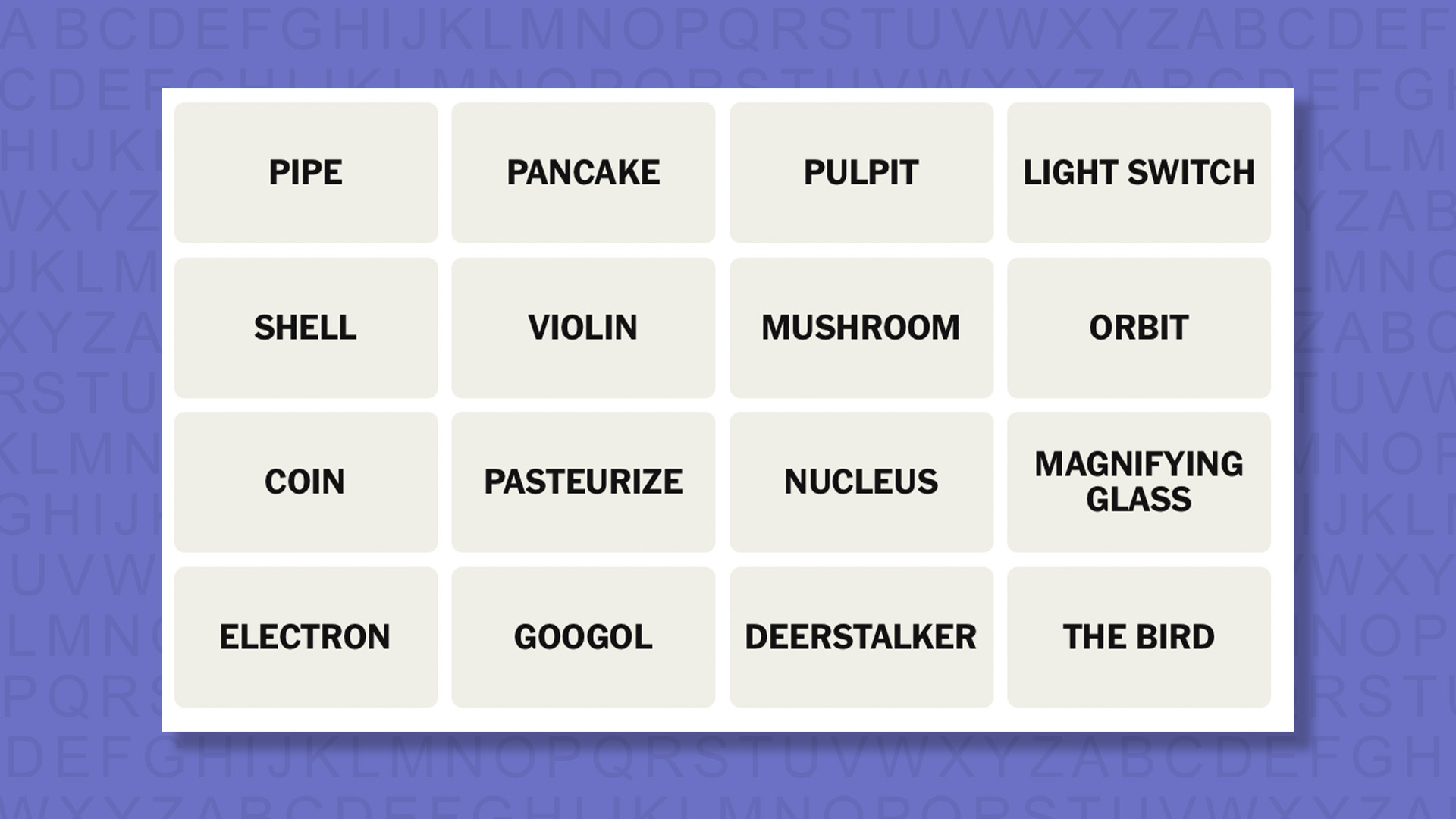
NYT Connections today (game #1029) – today’s words
(Image credit: New York Times)
Today’s NYT Connections words are…
PIPE
PANCAKE
PULPIT
LIGHT SWITCH
SHELL
VIOLIN
MUSHROOM
ORBIT
COIN
PASTEURIZE
NUCLEUS
MAGNIFYING GLASS
ELECTRON
GOOGOL
DEERSTALKER
THE BIRD
NYT Connections today (game #1029) – hint #1 – group hints
What are some clues for today’s NYT Connections groups?
YELLOW: Particle science
GREEN: A sleuth’s stuff
BLUE: Use your fingers
PURPLE: Look for types of mush
Need more clues?
We’re firmly in spoiler territory now, but read on if you want to know what the four theme answers are for today’s NYT Connections puzzles…
Advertisement
Sign up for breaking news, reviews, opinion, top tech deals, and more.
NYT Connections today (game #1029) – hint #2 – group answers
What are the answers for today’s NYT Connections groups?
YELLOW: ATOMIC STRUCTURE TERMS
GREEN: PARTS OF A SHERLOCK HOLMES COSTUME
BLUE: THINGS TO FLIP
PURPLE: STARTING WITH SYNONYMS FOR “SLUSH”
Right, the answers are below, so DO NOT SCROLL ANY FURTHER IF YOU DON’T WANT TO SEE THEM.
Advertisement
NYT Connections today (game #1029) – the answers
(Image credit: New York Times)
The answers to today’s Connections, game #1029, are…
GREEN: PARTS OF A SHERLOCK HOLMES COSTUME DEERSTALKER, MAGNIFYING GLASS, PIPE, VIOLIN
BLUE: THINGS TO FLIP COIN, LIGHT SWITCH, PANCAKE, THE BIRD
PURPLE: STARTING WITH SYNONYMS FOR “SLUSH” GOOGOL, MUSHROOM, PASTEURIZE, PULPIT
My rating: Hard
My score: Perfect
The first thing that stood out from today’s tiles was DEERSTALKER, an item of headwear that will forever be associated with one person — Sherlock Holmes. I was less certain of the other items, but MAGNIFYING GLASS and PIPE seemed to fit and I’ve got vague recollections of Benedict Cumberbatch’s version playing VIOLIN, so I went for it.
Happily I was correct but I’d like to take issue with a violin being considered PARTS OF A SHERLOCK HOLMES COSTUME.
Anyway, pressing onwards, and slightly disappointed that my shot in the dark wasn’t a purple group, a distant memory of science revision helped me connect the four ATOMIC STRUCTURE TERMS.
Grinding to a halt and initially seeing no links between the remaining eight tiles I decided that PANCAKE, COIN, LIGHT SWITCH and THE BIRD were all THINGS TO FLIP.
Advertisement
Yesterday’s NYT Connections answers (Saturday, April 4, game #1028)
YELLOW: “LET SLEEPING DOGS LIE” DOGS, LET, LIE, SLEEPING
GREEN: OBSCURE COVER, MASK, SCREEN, SHIELD
BLUE: COASTAL LANDFORMS BLUFF, CAPE, POINT, SPIT
PURPLE: ____ CAMP BAND, BASE, BOOT, SUMMER
What is NYT Connections?
NYT Connections is one of several increasingly popular word games made by the New York Times. It challenges you to find groups of four items that share something in common, and each group has a different difficulty level: green is easy, yellow a little harder, blue often quite tough and purple usually very difficult.
On the plus side, you don’t technically need to solve the final one, as you’ll be able to answer that one by a process of elimination. What’s more, you can make up to four mistakes, which gives you a little bit of breathing room.
It’s a little more involved than something like Wordle, however, and there are plenty of opportunities for the game to trip you up with tricks. For instance, watch out for homophones and other word games that could disguise the answers.
It’s playable for free via the NYT Games site on desktop or mobile.
A new Quordle puzzle appears at midnight each day for your time zone – which means that some people are always playing ‘today’s game’ while others are playing ‘yesterday’s’. If you’re looking for Saturday’s puzzle instead then click here: Quordle hints and answers for Saturday, April 4 (game #1531).
Quordle was one of the original Wordle alternatives and is still going strong now more than 1,400 games later. It offers a genuine challenge, though, so read on if you need some Quordle hints today – or scroll down further for the answers.
Enjoy playing word games? You can also check out my NYT Connections today and NYT Strands today pages for hints and answers for those puzzles, while Marc’s Wordle today column covers the original viral word game.
Advertisement
SPOILER WARNING: Information about Quordle today is below, so don’t read on if you don’t want to know the answers.
Article continues below
Quordle today (game #1532) – hint #1 – Vowels
How many different vowels are in Quordle today?
• The number of different vowels in Quordle today is 3*.
* Note that by vowel we mean the five standard vowels (A, E, I, O, U), not Y (which is sometimes counted as a vowel too).
Advertisement
Quordle today (game #1532) – hint #2 – repeated letters
Do any of today’s Quordle answers contain repeated letters?
• The number of Quordle answers containing a repeated letter today is 1.
Quordle today (game #1532) – hint #3 – uncommon letters
Do the letters Q, Z, X or J appear in Quordle today?
• No. None of Q, Z, X or J appear among today’s Quordle answers.






 Many of us are guilty of toeing the line between having a ready supply of components at hand and simply hoarding for fear of throwing anything out. In a first admission of this problem, [Scott Lawson] decided to implement a couple of changes to assess his own position on this sliding scale.












































You must be logged in to post a comment Login