
Tech
The Censorship Industrial Complex Didn’t Exist Until The People Who Invented It Took It Over


from the nonsense-peddlers-peddling-nonsense dept
For many, many years now we’ve been calling out how the entire narrative around the “censorship industrial complex” was absolute bullshit, made up by a group of either deliberate misinformation peddlers or confused “contrarian” journalists too stupid to understand how basic things work. And I say that as someone who has long been critical of efforts to “ban disinformation” online, and especially of attempts to regulate mis or disinformation.
So when the whole narrative of the “censorship industrial complex” came about, you’d think that I would have been on board, having called out years of efforts by politicians to pressure companies into removing certain speech along with a moral panic about “disinformation.”
But, reality matters. And that’s why, when stories started popping up about a vast collaboration between tech companies and governments to “censor” people based on ideological viewpoints, I looked at the details — and it was basically all bullshit.
The reality is that there are efforts at spreading disinformation and propaganda. And while I’m skeptical about how powerful or successful those can be… ironically, the one example that has caused me to reconsider my position is the success of the blatant lie about the “censorship industrial complex.”
Type Investigations and the MIT Tech Review teamed up to put together a deeply researched article highlighting how a group of bullshit peddling right-wing influencers basically invented the entire concept of the “censorship industrial complex” and were able to mainstream it across the right-wing mediasphere, deep into the Trump White House, and are likely a big part of the reason Elon Musk focused on killing USAID in his early days at DOGE. It’s quite a report. The key thing, though, is that a bunch of motivated propagandists took any effort at making internet websites safer… and insisted that they were about censorship. And then they would put together conspiracy cork boards insisting that these efforts were really controlled by the government.
The second Trump administration’s war on censorship has contributed to the dismantling of numerous government agencies, like the Cybersecurity and Infrastructure Security Agency at the Department of Homeland Security, the FBI’s Foreign Influence Task Force, and the US Agency for International Development (USAID), among others. It’s razed the infrastructure that tracks and counters attempts by foreign powers to influence elections and popular opinion. It has also been used to justify sweeping travel bans and sanctions on targeted individuals and entire industries. It’s provoked tensions with the European Union over its tech regulations, which these critics say silence Americans. And it’s even reshaped US national security strategy.
Its reach, though, isn’t limited to US bureaucracy, academia, or civil society groups. The weaponization of ideas about censorship also affects the billions of people globally who get information, or interact with each other, online—which is to say, just about everyone.
Much of what has been characterized as censorship is really part of an effort to make the internet safer. This could include work quantifying just how often people online have generated nonconsensual sexualized content of women and children; helping victims of online stalking, doxxing, and other crimes seek justice; or identifying whether someone we are interacting with online is genuine and not, say, a foreign agent posing as an American voter.
At the center of it all is a dude named Mike Benz, who was outed as a racist internet troll who spent years pushing the “great replacement theory” and screaming about “white genocide,” who reinvented himself from a low level Trump staffer in Housing and Urban Development into a self-styled “cyber expert” in the State Department who claimed he had inside knowledge on the whole “censorship industrial complex.” The reality is that Benz worked in the State Department for just a few months after Donald Trump lost the 2020 election, and already had a history of insisting that basic trust & safety work — including fact checking, let alone limiting or banning someone for violating a site’s terms of service — was “censorship.”
At the center of this effort is Mike Benz, Rubio’s interview partner last April. Benz served a brief stint in Donald Trump’s first administration but has largely remained unknown, even as some of his ideas—including the conspiracy theory that Taylor Swift was a NATO asset and the pro-white-identity content he published anonymously before he joined the government—have gained followers. Our analysis uncovers just how integral he in particular was to spreading the CIC theory: We found him to be the most prolific creator of related content online, which was in turn picked up by right-wing media outlets and podcasts and eventually reached the highest echelons of power in the US. His work prompted congressional—and eventually presidential—action and generated both attention and financial benefits for Benz personally. (Benz did not respond to multiple requests for comment.)
Last April, near the end of the interview at the State Department, Rubio shot Benz a friendly finger gun.
“Thanks for your attention to this topic,” Rubio said. “I know you’ve been on this a long time.”
Benz spent much of the Biden administration trying to convince everyone of this vast censorship industrial complex. Notably, just days before this Type Investigations piece came out, Renee DiResta (who Benz and others falsely insist was a key player in this mythical censorship industrial complex) published a recording and transcript of the Twitter Spaces where a very credulous Matt Taibbi fell for Benz’s bullshit, leading to years of Taibbi spewing complete nonsense about the so-called “Twitter Files.”
Benz did not mention that he was appointed to this portfolio in November 2020. The Trump administration ended on January 20, 2021. His State Department tenure lasted roughly two months…over the holidays.
Taibbi bit immediately. He told Benz he’d sent him a DM, adding: “I’m very anxious to talk to you in a longer setting if that’s possible.” Benz, he said, “could probably be invaluable” to a huge project he was launching to map the same world.
Benz continued listing his bona fides: there was no close second with his knowledge, he said. He had delivered “eight or nine congressional briefings,” spoken with “four or five senators,” and briefed House and Senate committees. If Taibbi would talk to him privately, Benz said, he could describe “every single individual, institution, the chronology, the pretexts that were used, all of the dirty little tricks that were done each step of the way.”
“I can tell you literally everything,” he said.
“That’s great,” Taibbi replied.
As this new report points out, once Benz reached Taibbi (and via him, Michael Shellenberger), combined with Rep. Jim Jordan, you had a closed loop of utter bullshit, with each of them egging the others into deeper conspiracy theories on a foundation of confirmation bias and not bothering to check.
In a 2023 podcast interview, Shellenberger credited Benz with opening his eyes to the full extent to which conservative voices were being silenced. “We basically went from being concerned about bad forms of censorship by Twitter and other social media platforms to being concerned about government censorship,” Shellenberger said.
“We were, like, proverbially touching the elephant. We didn’t understand what the elephant was [until] we discovered your work, Mike.”
And it’s one thing if the damage to this were just about disinformation research. All that effort absolutely kneecapped the ability of the US to deal with foreign misinformation (and it’s mildly amusing watching MAGA folks now freaking out about how the US is so bad at responding to foreign influence campaigns, when they’re the reason that we destroyed our capacity). But as the Type Investigations article shows, the machinery Benz had spent two years building was also a big part of why Elon Musk shut down USAID, likely leading to hundreds of thousands of deaths. Benz deserves some of the credit for that apparently:
The agency had been a longtime obsession for Benz, who argued that it was an instrument of censorship as early as FFO’s first report in July 2022. An effort in Brazil to limit the spread of disinformation on messaging apps like WhatsApp and Telegram, FFO alleged, was a form of censorship financed by USAID and others. Later that year, Benz also accused USAID of funding what he called a “Countering Disinformation Guidebook for Digital Censorship.” In reality, it was a USAID primer for its overseas staff on how to recognize disinformation campaigns in the foreign countries where the agency operated.
Our analysis shows that Benz and FFO were the dominant voices promoting conspiracy theories around USAID and censorship from 2022 until late 2024, when Benz talked about it on Rogan’s podcast. “USAID is effectively a ‘switch player’ to assist the Pentagon on the national security front, to assist the State Department on the national interest front, or to assist the intelligence community on a sort of clandestine operation front,” Benz alleged.
His appearance drew millions of viewers, including Musk. The trillionaire retweeted an X user’s glowing summary of the interview. “Mike Benz just revealed everything,” the user wrote, including “how ‘democracy’ was redefined to silence you.”
This marked the first time Musk, newly installed at DOGE, had posted specifically about USAID. But Benz and Musk were already acquainted. The two had exchanged tweets and threads about censorship and other conspiracy theories for years.
Oh, and it should be mentioned that Marco Rubio hired Benz to spend his time sorting through what’s left of USAID to try to justify his bullshit claims, just as Musk had Taibbi and Shellenberger sniff through Twitter’s internal docs in the hopes that they would craft a narrative to support his prejudices.
The incredible bit to me here is that in both the Twitter Files nonsense and with the US government, Musk was always in a position where he could look at the source documents and details himself. He could speak to actual experts. Instead, he took the kook conspiracy theories from nonsense peddlers, assumed they were true because they fed into what he wanted to believe, and ran with them — with every bit of available evidence saying he was just swallowing propaganda.
The article also details the plumbing: how a small, heavily interconnected — and largely commonly funded — slice of the right-wing media ecosystem pumped these ideas back and forth until they looked like consensus:
In each case, our analysis found, CIC-related conspiracy theories on social media were supported by a number of conservative groups; key among them were FFO and AFL, which played a crucial role in obtaining government records they claimed showed evidence that conservatives were censored. FFO then used these documents to write exhaustive reports supposedly connecting the dots to explain how the censorship industry worked. AFL also instigated a number of lawsuits against supposedly CIC-implicated individuals and organizations.
These materials were then amplified by a slew of right-wing media outlets, many with shared funding.
Much of that financing was funneled through the Informing America Foundation (IAF), a media-oriented grant-making organization that John Solomon helped to launch after leaving his position at The Hill back in 2019, following public scrutiny of columns about the Bidens and Ukraine. IAF funds a network of podcasts called Real America’s Voice, which includes shows run by key Trump allies like Steve Bannon, Jack Prosobiec, and the late Charlie Kirk, as well as Solomon himself. It also finances a network of what media scholars call “pink slime” websites, which are designed to look like nonpartisan local news but have a partisan slant. Benz appeared regularly on these podcasts and in these outlets, further embedding the CIC narrative in the right-wing information ecosystem—while simultaneously enhancing his own profile and revenue streams on X Premium and other platforms.
As the article also notes, all of these jackasses pushing nonsense about a non-existent censorship industrial complex have basically all been either entirely silent or — worse — have effectively cheered on examples of the Trump administration actively censoring speech of critics. But, as free speech expert David Kaye mentions in that article, it seems like the claims about the censorship industrial complex is all fluff and nonsense to distract from the very real censorship of the Trump administration:
That’s why it’s important to look beyond the political narratives themselves and consider actions, says David Kaye, a law professor at the University of California, Irvine, and a former UN special rapporteur for free speech. “The administration probably realizes that … Americans do not generally feel censored by Europe or Brazil,” he says. But by focusing on Europe, Brazil, and the broader CIC idea, it hopes to “distract” from the fact that “Americans are definitely facing the most substantial censorship in, I don’t know, 100 years,” he adds—though “it’s actually the Trump administration” that is responsible.
The notion of a censorship-industrial complex is proving again and again to be a convenient and powerful pretext for silencing the loudest critics of those in power. “The very thing that they are accusing people of—censoring—is something that they’re now perpetuating,” says Jankowicz.
And as the article points out, Benz is 100% on board with using the government to stifle speech. Just so long as it’s the speech of his ideological foes.
That, of course, may have been the goal all along. From the stage of the Heritage Foundation back in 2024, Benz spoke of the CIC as having its hand on a “God button” giving it the power to “control discourse on every political issue.” Now conservatives can wield that power themselves.
“Democracy is about the hearts and minds of the people,” he told the audience. “If you can simply shut off the ability to influence hearts and minds through censorship, you win by default.”
There’s much more in the article (also available at MIT Tech Review), and you should read it — not because you need convincing that Mike Benz is full of shit, but because bits of this conspiracy theory have leaked well outside of MAGA world. I still regularly run into perfectly reasonable non-MAGA people who believe some version of “the Biden administration worked with social media to silence conservatives.” It didn’t. But the story was told loudly enough, for long enough, by enough people who had a financial and/or political interest in telling it, that it became accepted wisdom among many.
And look at where it landed. The State Department shut down the office that tracked foreign influence operations, and Rubio announced it in a friendly video chat with the guy who spent a decade inventing the reason to shut it down. Rubio then banned five Europeans from entering the United States for the crime of advocating for content moderation rules he doesn’t like — calling them “agents of the censorship-industrial complex” — until a judge blocked it as “likely viewpoint discriminatory.” The State Department launched a website, freedom.gov, whose entire purpose is to relitigate other countries’ moderation decisions. And, of course, you have the Trump FCC chair going after broadcasters for airing jokes about the president and for platforming Democratic candidates.
Every one of those is actual censorship. Every one is the government using state power to punish speech it dislikes. None of those are a trust & safety team enforcing violations of its terms of service on its own private property.
So it was a disinformation campaign so successful that it kneecapped our ability to fight disinformation campaigns. That would be bad enough on its own. But the more lasting damage is that the censorship-industrial complex Benz spent a decade describing didn’t exist when he started describing it. But it exists now, and it’s controlled by Marco Rubio, Elon Musk… and Mike Benz.
Filed Under: censorship industrial complex, disinformation, jim jordan, marco rubio, matt taibbi, michael shellenberger, mike benz, misinformation, trust & safety, usaid


Atlantis Lab may not be a familiar name to most American audiophiles, but the French loudspeaker manufacturer has been building high efficiency designs since 1998. Originally known as Atlantis Acoustique, the company was founded by Eric Buy with a focus on producing speakers that could deliver substantial output without requiring massive amounts of amplifier power.
That philosophy guided the company for nearly two decades before Atlantis shifted direction in 2017, bringing in a team of sound engineers to optimize its loudspeakers for professional studio use as well as home audio systems. The change also brought a new name and product lines that retained the efficiency of the earlier models while adding the heavy duty drivers, cabinets, and components more commonly associated with professional sound reinforcement equipment.
The result is a range of loudspeakers that are relatively easy to drive, built to withstand demanding use, and flexible enough to work in rooms where conventional designs can struggle. Tunable ports allow many Atlantis Lab models to sit closer to the wall without overwhelming the room with bass, helping the company build a loyal following across Europe.
The problem in the United States was never the product. It was finding one. Early availability was inconsistent, and dealer support was limited. With Decibel+ now representing Atlantis Lab, distribution and customer support have improved considerably. That should make the brand a far more common sight in American studios, showrooms, and listening rooms.

The current Atlantis Lab lineup includes the AT-13 Pro and AT-21 Pro bookshelf speakers, along with the AT-16 Pro, AT-18 Pro, AT-23 Pro, AT-31 Pro, and AT-38 Pro floorstanding models. The company also offers a dedicated home theater range with AT-13 and AT-21 center channels, the AT-22 satellite speaker, and the AT-33 subwoofer.
Taken together, the lineup covers nearly every room size and application, with prices starting at roughly $1,650 and climbing to $13,000 each for the flagship AT-38 Pro. That is a substantial range, but it also gives buyers the ability to select a model based on the room rather than trying to force an undersized or oversized loudspeaker into a space where it does not belong.
After speaking with Decibel+ about which model would make the most sense for this review, we settled on the AT-23 Pro as the best match for the room I had available. Positioned near the middle of the lineup, the AT-23 Pro retails for approximately $3,400 per speaker, depending on the selected options.
These are designed to fill a room rather than function as oversized nearfield monitors, so choosing the correct model for the space was important. I wanted to evaluate how the AT-23 Pro energized the entire room, not simply toe the speakers toward my listening position and judge them solely on their on-axis performance.
Related Reviews:
The AT-23 Pro Makes Its Presence Felt Before the Music Starts
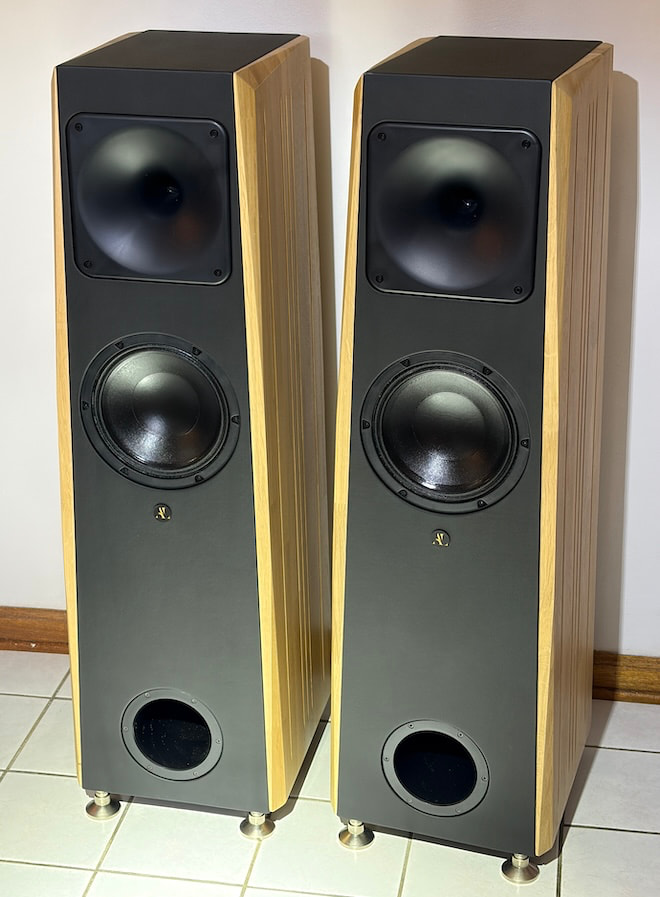
Unboxing the AT-23 Pro is a challenge, as each speaker weighs 35 kilograms, or roughly 77 pounds. This is not a speaker you casually lift out of the box and carry across the room without first considering the condition of your back.
The front baffle is wrapped in black leather, although white leather is also available. Solid oak panels cover both sides of the cabinet and slope gently inward, making the enclosure slightly narrower at the top than at the base.
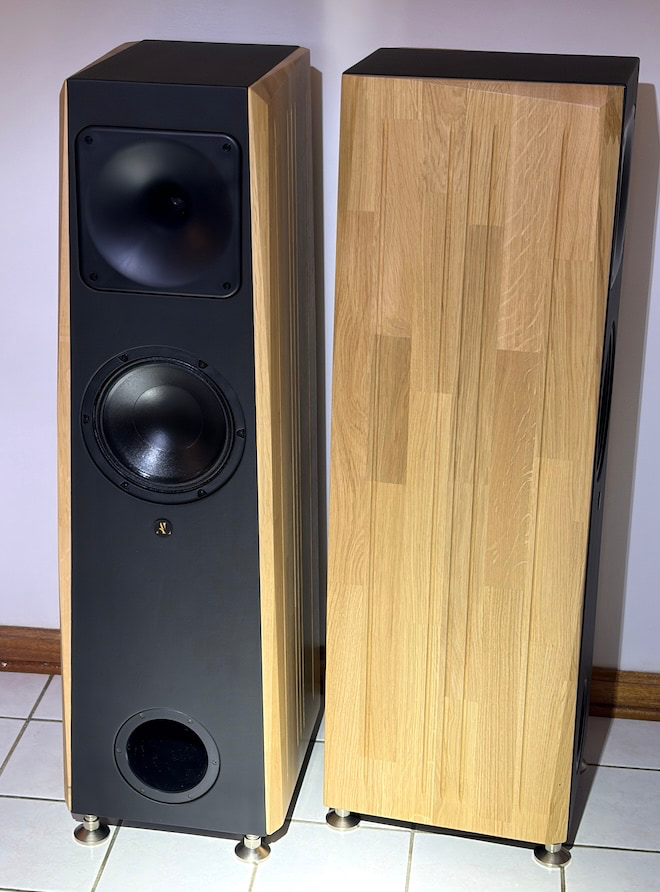
Each side panel is constructed from vertical oak slats measuring 54mm wide. Not every slat is made from a single piece of wood, so horizontal joints are visible in several places. The finished cabinet is certainly distinctive, although it may not be the easiest visual match for rooms with similarly colored hardwood floors or a lot of existing wood furniture.
The side panels are likely to be the most divisive aspect of the AT-23 Pro’s appearance. Some people I asked really liked the combination of leather and natural oak, while others felt the segmented wood panels detracted from the overall aesthetic. Offering a solid-color finish or a continuous veneer might make the AT-23 Pro easier to integrate into a wider range of listening spaces.
Pro Drivers With Room-Friendly Placement
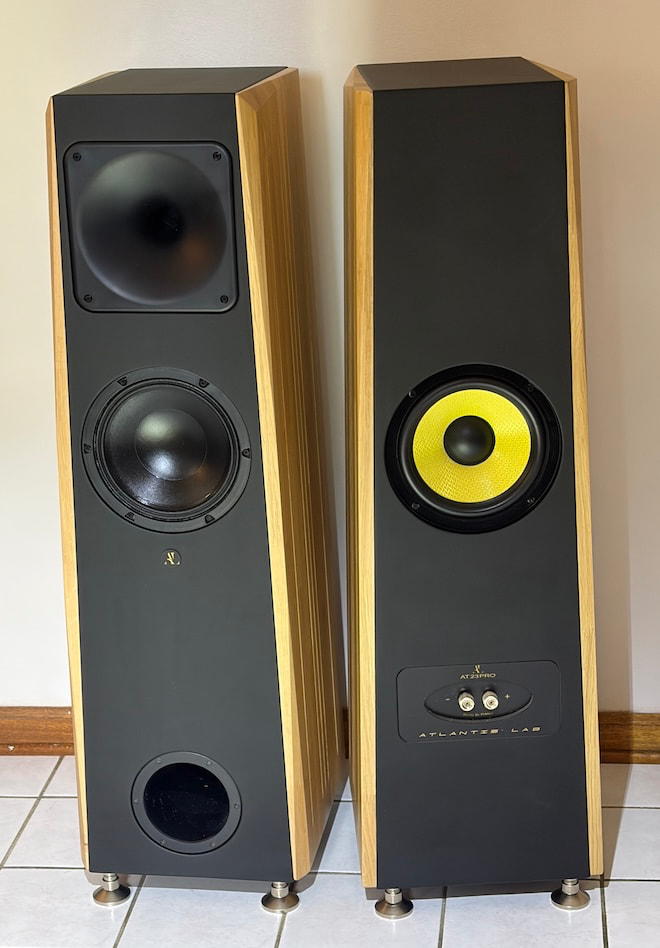
Starting at the top of the front baffle, the AT-23 Pro uses a 1-inch horn-loaded tweeter with a titanium diaphragm and a round waveguide offering 90-by-90-degree dispersion. Directly below it sits a 21cm midwoofer, paired with a second 21cm driver mounted in opposition on the rear of the cabinet.
The front-firing driver is an Eighteen Sound model with a paper cone selected for greater transparency, while the rear driver uses the company’s Kevlar cone to add depth and impact. This arrangement gives the AT-23 Pro a more substantial low-frequency presentation without relying on a conventional collection of front-facing woofers.
A tunable port at the bottom of the front baffle allows the speaker to be adjusted for placement closer to or farther away from the rear wall. That flexibility makes the AT-23 Pro particularly useful in rooms where the speakers need to sit near a wall to avoid blocking walkways or consuming too much floor space.
The leather finish continues across the rear of the cabinet as a single uninterrupted piece running from the bottom of the front baffle, over the top, and down the back. This creates a cleaner visual contrast with the more segmented appearance of the oak side panels.
The rear-facing 21cm Kevlar driver is positioned roughly halfway up the cabinet. Below it, a single pair of binding posts accepts bare wire or banana plugs. The through-hole design can accommodate bare speaker cable up to approximately 10 gauge, which should be more than sufficient for nearly any domestic installation.
Easy to Drive, Hard to Overwhelm
The AT-23 Pro is a 4-ohm loudspeaker rated to handle 300 watts continuously and 600 watts peak. Atlantis Lab specifies a frequency response of 33Hz to 20kHz, but my in-room testing found output remained within roughly 1dB down to 28Hz before the roll-off became more pronounced. That makes the AT-23 Pro entirely usable without a subwoofer for most music systems, although home theater users may still want one for the lowest effects.
One of the original design goals was to combine the performance of the AT-21 loudspeaker and AT-33 subwoofer in a single cabinet. Based on the measurements and what I heard in the room, Atlantis Lab largely succeeded.
The adjustable port provides another level of control over the low end. I found that slightly increasing the tube length from its default setting produced the best balance in my listening room. The adjustment is simple, and the audible difference is substantial enough to be useful. This is not a gimmick. It is a legitimate room-tuning tool.
With a rated sensitivity of 96.5dB, the AT-23 Pro can also be paired with a much wider range of amplifiers than its size and power handling might suggest. It worked equally well with lower-powered tube amplifiers and far more muscular solid-state designs. I expected it to favor one end of that spectrum, but it remained composed and engaging regardless of which amplifier I used.
My first test platform was a modified Dynaco ST-70 producing roughly 32 watts per channel, with peak output reaching into the 70-watt range before distortion begins to take a meaningful toll on sound quality. I then moved to the opposite extreme and connected the AT-23 Pro speakers to my main system, which uses a pair of Mark Levinson No. 23.5 amplifiers capable of delivering 400 watts without much effort.
Those two systems represent something close to the practical lower and upper limits most owners are likely to consider. The AT-23 Pro handled both without complaint, which says a great deal about its efficiency, power handling, and overall versatility.
Atlantis Lab AT-23 Pro Specifications
- Type: High-efficiency floorstanding loudspeaker
- Configuration: 3-driver, bass-reflex design
- Tweeter: 1-inch titanium-diaphragm, horn-loaded tweeter
- Waveguide dispersion: 90 x 90 degrees
- Front driver: 21cm Eighteen Sound paper-cone midwoofer
- Rear driver: 21cm Eighteen Sound Kevlar-cone woofer
- Bass tuning: Adjustable front-firing reflex port
- Frequency response: 33Hz to 20kHz
- Measured bass extension: Approximately 28Hz at -1dB in-room
- Sensitivity: 96.5dB
- Nominal impedance: 4 ohms
- Continuous power handling: 300 watts
- Peak power handling: 600 watts
- Connections: Single pair of binding posts
- Compatible terminations: Banana plugs and bare wire up to approximately 10 gauge
- Cabinet finishes: Oak side panels with black or optional white leather baffle
- Dimensions (HxWxD): 111 x 40 x 40 cm (43.7 x 15.75 x 15.75 inches)
- Weight: 35 kg / 77 lbs each
Listening
The AT-23 Pro speakers effortlessly bring a room together with their captivating sound quality. At AXPONA, it was evident that while the cabinetry might stir some debate among enthusiasts, the sound quickly shifts the focus back to what truly matters: pure, immersive listening enjoyment.
The AT-23 Pro delivers robust, solid bass that often forced me to remind myself that my subwoofers were disconnected. The bass is not only quick but also richly textured, displaying an impressive level of detail that one might not expect from relatively small drivers paired with a large reflex port.
Contrary to expectations, there is minimal distortion, which is a common issue when smaller drivers attempt to mimic larger ones. The low-end capabilities of these speakers make them an excellent option for rooms where subwoofer placement is problematic or impossible. Those looking for true home theater impact, or listeners who favor heavy EDM, can add a subwoofer to take the slam and rumble to another level.
Midrange frequencies are reproduced with excellent clarity and above-average dynamics, allowing horns and strings to resonate with convincing energy and life. Acoustic guitar and piano are rendered with a level of realism that many more expensive loudspeakers struggle to duplicate.
My usual classical and jazz playlists were a joy to experience through the AT-23 Pro. Even when I switched to the dense, complex layers of Miles Davis’ “Bitches Brew,” I remained thoroughly engrossed by the nuanced presentation of each horn and the speaker’s ability to keep individual instruments distinct within the mix.
Vocal reproduction through the AT-23 Pro is generally excellent, although it highlights the importance of both recording quality and careful system matching. The horn-loaded tweeter can emphasize brightness when paired with similarly voiced electronics, but it also reveals just how well, or poorly, a recording was engineered.
Recordings handled by engineers such as Rudy Van Gelder and Bruce Swedien sounded open, detailed, and remarkably lifelike. Poorly mastered tracks were far less forgiving, with harshness and compression brought more clearly into focus.
That sensitivity is better understood as a reflection of the AT-23 Pro’s resolving ability than an inherent flaw. Pair it thoughtfully and feed it quality recordings, and the speaker rewards the effort.
The dynamic range and engaging character of the AT-23 Pro are undeniable. The speakers handle the delicate passages of Tchaikovsky’s “The Sleeping Beauty” with grace and air, then power through Mussorgsky’s “The Great Gate of Kiev” with explosive energy and precision.
With the right recordings and complementary electronics, the AT-23 Pro delivers a thrilling and highly immersive listening experience.
The Bottom Line
The Atlantis Lab AT-23 Pro is a versatile floorstanding speaker for medium to larger rooms, especially for listeners who want deep, authoritative bass without adding a subwoofer. Its high sensitivity, tunable port, and ability to perform closer to the rear wall also make it easier to place than many speakers of this size.
The AT-23 Pro combines detailed highs, precise midrange performance, and substantial low-end output in a package that reminds me of the Vandersteen Treo CT at close to half the price. The Treo still offers greater treble refinement, and the AT-23 Pro’s oak-slat cabinetry will not appeal to everyone, but neither issue diminishes how engaging these speakers are.
They are not yet widely known in the United States, but improved distribution through Decibel+ should change that. Anyone shopping in this price range should make the effort to hear them. They are easy to drive, difficult to ignore, and even easier to get lost in.
Pros:
- Deep, powerful bass that often eliminates the need for a subwoofer
- Clear, realistic midrange with excellent dynamics
- High sensitivity makes amplifier matching relatively easy
- Tunable port allows more flexible near-wall placement
- Engaging, room-filling presentation with strong value for the price
Cons:
- Horn tweeter can sound bright with aggressive electronics or recordings
- Oak-slat cabinetry will be visually divisive
- Large, heavy cabinets require help during setup
- Treble is not quite as refined as some more expensive competitors
Our Ratings:
★★★★★★★★★★ Sound Quality
★★★★★★★★★★ Build Quality
★★★★★★★★★★ Aesthetics
★★★★★★★★★★ Value
Where to buy:
Related Reading:
SpaceXAI has launched Grok Bot in beta, AI agents that sign into apps and websites, retain context between tasks and coordinate with each other. Access is limited at first to SuperGrok Heavy, Cursor Ultra and Cursor Teams Premium subscribers, with an enterprise waitlist.
SpaceXAI has released Grok Bot, software that hands work to groups of AI agents running on their own machines. The agents sign into apps and websites, keep context between tasks, and pass work back only when they need a human decision. It went into beta on Tuesday.
Access is restricted at first to SuperGrok Heavy, Cursor Ultra and Cursor Teams Premium subscribers, with a waitlist for enterprise customers. It runs on macOS, Windows, Linux and iOS, with Android to follow.
The selling point is that the agents work through interfaces rather than APIs, signing in the way a person would, and that several can run at once and share what they know. SpaceXAI says it has been using them internally across engineering, growth and marketing, citing overnight sales research, expense receipts pulled out of email, and bug fixes.
TNW reported in July that Cursor was building a general-purpose office agent, codenamed Sand, aimed at Claude Cowork and ChatGPT Work. Grok Bot arrives in that same territory, as SpaceXAI and Cursor merge into a single company.
SpaceX agreed a $60bn all-stock deal for Cursor’s parent Anysphere in June, days after its own listing, in what was reported as the largest startup acquisition on record. Cursor’s coding tools already run inside much of the Fortune 500.
The product is Musk’s answer to having fallen behind in agents. SpaceXAI shipped its first coding agent in May, then followed with Grok 4.5, built with Cursor, in July.
Rivals are circling the same idea. OpenAI’s Sam Altman discussed agents coordinating with one another when he met lawmakers in Washington last month.
Handing sign-in credentials to autonomous software raises an obvious question for this company in particular. Cursor’s Grok Build tool was found to be uploading entire Git repositories, committed secrets included.
The commercial pressure now sits with SpaceX. Musk told investors on last week’s earnings call that AI work was progressing and that Grok 4.6 could ship within days. Grok’s slow adoption in Washington has already weighed on the IPO story.


Last week, a researcher outlined what he said was a “novel attack surface” in passkeys, the new authentication paradigm that offers a more secure alternative to password-based methods. In fact, the attacks demonstrated in the post are neither novel nor unique to passkeys. This distinction is important because the research has generated confusion among end users and security professionals as they assess whether this new mechanism is truly safe to use.
The attack is called Pass-ta-key—a blending of the word passkey with the phrase “pass the key” and a nod to a plate of pasta. Arie Olshtein, a researcher at security firm Palo Alto Networks, described in a post last week how Pass-ta-key could obtain all passkeys stored in the Google Password Manager app (GPM) for Windows when it’s running on a machine infected with malware.
This came as a surprise to many people because they believed passkeys are stored exclusively in the trusted platform manager (TPM), the locked-down enclave in a hardened silicon chip that’s reserved for storing cryptographic keys and other highly sensitive information on Windows machines. If passkeys are stored in the TPM, then how was Pass-ta-key able to extract the entire set of passkeys stored by the app, they wanted to know.
Local passkey storage is OK, with one exception
The answer is that, contrary to common belief, the FIDO 2 specifications—managed by the industry group FIDO Alliance—don’t mandate that passkeys be kept in TPMs, or any other sort of dedicated piece of hardware (they go by different names, depending on the platform, including secure enclaves, trusted execution environments, and StrongBoxes). In fact, most platforms and third-party software for managing passkeys do not store passkeys in such dedicated hardware. Virtually the lone holdout is Microsoft, which gives users the option to store passkeys in the Windows TPM. The company mainly recommends this choice to enterprises, not consumers.


Jennifer Bailey, head of Apple Pay and Wallet since the service launched in 2014, is retiring in October after more than 25 years at Apple. Her exit is one of several senior departures ahead of Tim Cook handing the chief executive job to John Ternus on September 1.
Jennifer Bailey, who has run Apple Pay since the service launched in 2014, is retiring in October after more than 25 years at Apple. Services chief Eddy Cue announced her departure in a staff memo seen by Bloomberg News. A successor will be named before she goes.
“Under Jennifer’s leadership, Apple Pay has changed the way hundreds of millions of our users pay,” Cue wrote. Bailey will stay on in an advisory role through the handover. Apple declined to comment.
The division she leaves behind is one of Apple’s most profitable. Apple Pay brings in more than $7.5bn a year on analyst estimates compiled by Bloomberg, and functions as a reason for customers to stay on iPhone. Bailey also built Wallet, which began as a place to store card details and now holds keys for homes, cars and hotels, along with identification.
Apple Card and the company’s recently announced device upgrade subscription both grew out of the same division. Before Apple Pay, Bailey ran Apple’s online store, having joined in the early 2000s from a string of internet companies.
People familiar with the move describe her exit as a significant loss, and as a sign of what is coming. Apple has a demographic problem. A cohort of executives who grew wealthy over decades at the company are reaching retirement age together, and no longer need to work.
General counsel Kate Adams is retiring this year, and environment chief Lisa Jackson left at the start of 2026. Former finance chief Luca Maestri and marketing veteran Phil Schiller have stayed on in smaller roles but are probably near the end. Cue, retail boss Deirdre O’Brien and marketing head Greg Joswiak have each been at Apple for around four decades.
The largest change lands on September 1, when Tim Cook hands the chief executive job to John Ternus and becomes executive chairman. Ternus, 51, who built Apple’s hardware for more than two decades, is expected to make further personnel changes and has already brought a retired hardware leader onto his team.
The drain is not limited to the executive floor. Apple’s design studio has lost nearly every Ive-era designer, a gap Ternus has said he intends to close.
Josh Rosenstock, a senior director of corporate communications, is also leaving, in what Bloomberg reports is an unrelated move.


Current space exploration aims to establish permanent structures on the Moon, Mars, and eventually other planetary bodies. Successful lunar missions depend on understanding lunar regolith, the granular material covering the Moon’s surface, whose behavior is governed by low gravity, vacuum conditions, particle irregularity, electrostatic effects, and extreme thermal environments. This webinar will focus on two connected modeling problems related to lunar regolith: plume–regolith interaction during lunar landings and induction heating of porous regolith for thermal processing and melting. Together, these problems show how simulation with the COMSOL Multiphysics® software can help engineering and research teams predict, control, and utilize granular lunar material.
The first part of the talk will address plume–regolith interaction. During spacecraft landings, underexpanded rocket exhaust plumes impinge on the surface, producing compressible flow structures, erosion, particle ejection, and possible surface damage. High-speed dust can reduce visibility and threaten astronauts, equipment, and nearby assets. These issues are especially important for Artemis and future missions involving repeated landings and larger spacecraft. Modeling the coupled gas-particle response provides insight into landing-site safety, erosion patterns, ejecta trajectories, and mitigation strategies.
The second part of the webinar will examine induction heating of porous regolith, where electromagnetic energy is converted into heat to raise temperature, drive phase change, and potentially melt lunar soil. The discussion will emphasize temperature-dependent porous media properties, latent heat treatment, melt fraction evolution, and the differences between constant-property and piecewise-property models. By connecting these studies, the webinar will demonstrate how COMSOL-based workflows can quantify flow fields, particle transport, thermal response, and phase-change behavior while supporting safer operations, regolith processing technologies, and the development of future space infrastructure.


Presented by Rezolve Ai
When an AI assistant recommends a product or brand, it generates something valuable: a purchase-ready consumer with high intent and low friction in their decision. That consumer has already compared options, asked follow-up questions, and arrived at a conclusion. They want to buy.
What they encounter next is a commerce infrastructure that was not designed for them.
The gap between recommendation and purchase
The typical enterprise commerce stack was built for a specific model: a consumer who arrives at a brand’s website through search or a direct link, navigates product pages, adds to cart, and completes checkout through a multi-step form flow. That model assumed the consumer would do the work of bridging their intent to the transaction. Most commerce systems still assume exactly that.
Agentic commerce breaks that assumption. When intent is generated outside the brand’s owned environment, the handoff to transaction becomes a structural problem. Context doesn’t transfer. Sessions don’t persist. The consumer who asked an AI assistant for a recommendation and received one now faces the same friction-laden checkout process as someone who arrived with no prior intent at all.
Cart abandonment rates have remained stubbornly high for years. Baymard Institute research puts the average at 70%. That figure predates the agentic commerce era. As more purchase intent is generated through AI interfaces, and as the gap between that intent and a brand’s transaction layer widens, the abandonment problem is likely to get structurally worse before it gets better.
What the current stack wasn’t built to handle
The commerce infrastructure most enterprises operate today was assembled over two decades of incremental investment. Each layer added a capability: a search tool, a recommendation engine, a personalization layer, and a checkout system. Each was built to solve a specific problem within a human-initiated shopping journey.
None of it was built to receive intent from an AI agent.
When an AI system generates a purchase recommendation, it needs to do more than surface a product page. It needs to verify real-time inventory. It needs to apply pricing logic and promotional rules. It needs to respect brand policy around which products can be recommended together, which channels apply which discounts, and what the correct fulfillment path looks like for a given consumer. And it needs to do all of that without breaking the conversational context that made the recommendation possible in the first place.
Current commerce stacks can’t do this reliably. The systems that hold the relevant data, inventory, pricing, order management, fulfillment, are not exposed in ways that AI agents can safely and accurately access. The result is a journey that starts with intelligence and ends with a broken experience: a link out to a product page, a generic checkout flow, and a consumer who arrived ready to buy and left without completing the transaction.
The conversion problem is an architecture problem
The industry has treated conversion optimization as a front-end problem for most of its history: better copy, cleaner checkout UX, fewer form fields, smarter retargeting. Those interventions were appropriate for the model they were built to serve.
The agentic commerce era introduces a different kind of conversion failure, one that front-end optimization cannot fix. When intent is generated externally, conversion depends on whether the back-end infrastructure can receive that intent, act on it accurately, and complete the transaction within the guardrails the brand has established. That is not a UX problem. It is an infrastructure problem.
Brands that are investing heavily in AI-powered discovery while leaving their execution layer unchanged are widening the gap between the promise AI makes on their behalf and the experience they can actually deliver. That gap has a cost, measured not just in lost transactions but in consumer trust that erodes each time the promise and the reality don’t match.
Rezolve Ai commissioned research across 1,500 US consumers in January 2025 that found consumers who encounter friction immediately after an AI recommendation are significantly less likely to complete a purchase than those who encounter friction at the top of a traditional funnel. The implication is direct: AI raises the expectation bar at the moment of intent. Brands whose infrastructure cannot clear that bar are paying a conversion penalty they may not even know they’re incurring.
What closing the gap requires
Closing the gap between AI-generated intent and completed transaction requires rethinking which layer of the commerce stack carries the most strategic weight in an agentic world. For most of the past decade, that weight sat with discovery and experience. The brands that invested most in search, personalization, and content won a disproportionate share.
In the agentic era, the weight shifts to execution. The brands that can reliably take AI-generated intent and turn it into a governed, accurate, brand-safe transaction will have a structural advantage over those whose infrastructure stalls at the handoff.
That is a different investment thesis than the industry has operated on. And most enterprise commerce roadmaps have not yet caught up to it.
Sponsored articles are content produced by a company that is either paying for the post or has a business relationship with VentureBeat, and they’re always clearly marked. For more information, contact sales@venturebeat.com.

The Samsung S99H, or S95H as it’s also known in the US (the UK also has the S95H but with a different appearance, confusingly), is Samsung’s flagship OLED for 2026. As befitting its flagship status, it pairs vivid colour and picture quality with cinema-accurate reproduction that serious film fans will appreciate, all wrapped in a genuinely distinctive design.
Design-wise, the S99H makes no apologies for its appearance. The screen sits within a metallic frame, kept ultra-slim, with a wider backing panel extending past the edges that houses Samsung’s Object Tracking Sound (OTS+) 4.2.2-channel speaker array.
The effect is that sound comes from the correct part of the screen, delivering a properly precise soundstage. It’s a striking look, and it’s really built for wall mounting. The feet attach near the bottom corners of the screen, so you’ll need a very wide unit if you prefer it freestanding.
The S99H includes an advanced anti-glare filter. You can sit it opposite a window or beneath wall lights and reflections simply aren’t an issue. Connectivity is also generous, with four HDMI 2.1 inputs, two USB ports, Ethernet and an optical digital audio output. The S99H is also compatible with Samsung’s Wireless One Connect boxes, which add four further HDMI inputs, taking the total to eight, and let the TV sit cable-free in a room.
Tizen OS handles the smart side of things, offering pretty much every major streaming app alongside AI-driven search through Copilot and Perplexity. The interface isn’t the cleanest available, but the option to disable adverts helps considerably. There’s a dedicated gaming page, and Galaxy Watch gesture support is a nice touch for basic menu navigation.
At its core, the S99H features a QD OLED panel backed by Samsung’s OLED HDR Pro and OLED Brightness Booster features. The Booster pushes peak brightness into seriously high territory, so the set performs well in a bright living room, while HDR Pro handles upscaling and colour improvements. There’s also support for HDR10+ Advanced, Samsung’s answer to Dolby Vision 2, to deliver brighter images with better local tone mapping, alongside HDR10 and HLG.
Colour and brightness are both spectacular in Standard mode. Bright highlights erupt from inky blacks, and contrast is phenomenal. Switch to Filmmaker Mode and colour accuracy errors sit below the threshold of human visibility. It’s a subtle, immersive image that home cinema fans will genuinely appreciate.
Upscaling is close to masterful too, pulling HD and SD sources cleanly into 4K without smearing, with noise reduction handled before the upscaler does its work.
Gaming is a real highlight. The S99H supports 165Hz with AMD FreeSync Premium and NVIDIA G-Sync, and input lag in Game Mode measures 9.7ms. A dedicated gaming menu offers useful extras such as mini-map zoom and a raised brightness floor for dark areas.
Sound quality is impressive overall. The OTS+ system places effects accurately across the screen and beyond, with a wide dynamic range by TV standards. Very bright treble effects can occasionally sound a little brittle, and deep bass lines can produce some crackling artefacts at higher volumes.
The Samsung S99H delivers spectacular yet carefully judged pictures with standout connectivity options. It’s expensive, but for those seeking Samsung’s most accomplished OLED, this is the one to buy.


Spanish startup Kreios Space just named Kongsberg NanoAvionics as the builder of the platform that will carry its experimental thruster into space. The goal is straightforward and ambitious: prove that a satellite can collect residual atmospheric gases at extremely low altitudes and turn them into continuous thrust, staying aloft where conventional craft fall quickly.

Very low earth orbit, particularly the zone between 150 and 300 kilometers up, has certain obvious advantages. Being so close to the surface results in crisper photos, much stronger signals, and much less lag. The catch has always been drag, as the thin air at that altitude acts as a powerful brake. Most satellites in that zone require huge fuel tanks, which add weight and shorten the lifespan, or both. Short-term missions have always been the best we could hope for.

LEGO Icons Hubble Space Telescope 11382
- EXPLORE THE HUBBLE SPACE TELESCOPE – Celebrate one of humanity’s greatest scientific feats while enjoying a relaxing building experience with the…
- REPLICA SPACE MODEL – Recreate the legendary space-based telescope with posable solar arrays and antennas, an opening aperture door and a detailed…
- AUTHENTIC DETAILS – Remove the exterior panels to reveal a detailed instrument bay, which features gyroscopes alongside primary and secondary…
Kreios has developed an air-breathing electric propulsion system that challenges that equation. They’ve devised a system in which oxygen, nitrogen, and other particles are drawn in from the front of the spacecraft. These gases are then fed into a helicon plasma thruster, which converts them into plasma using radio-frequency power before expelling them all. The electricity comes from the sun. The key advantage is that there is no requirement for propellant tanks onboard. Lab versions of this thruster have already gone through several iterations, with the first becoming online in 2021. A second one was more advanced, contained an intake, and worked in a vacuum. A third went even further, testing with various gasses and power sources and achieving the best results yet.
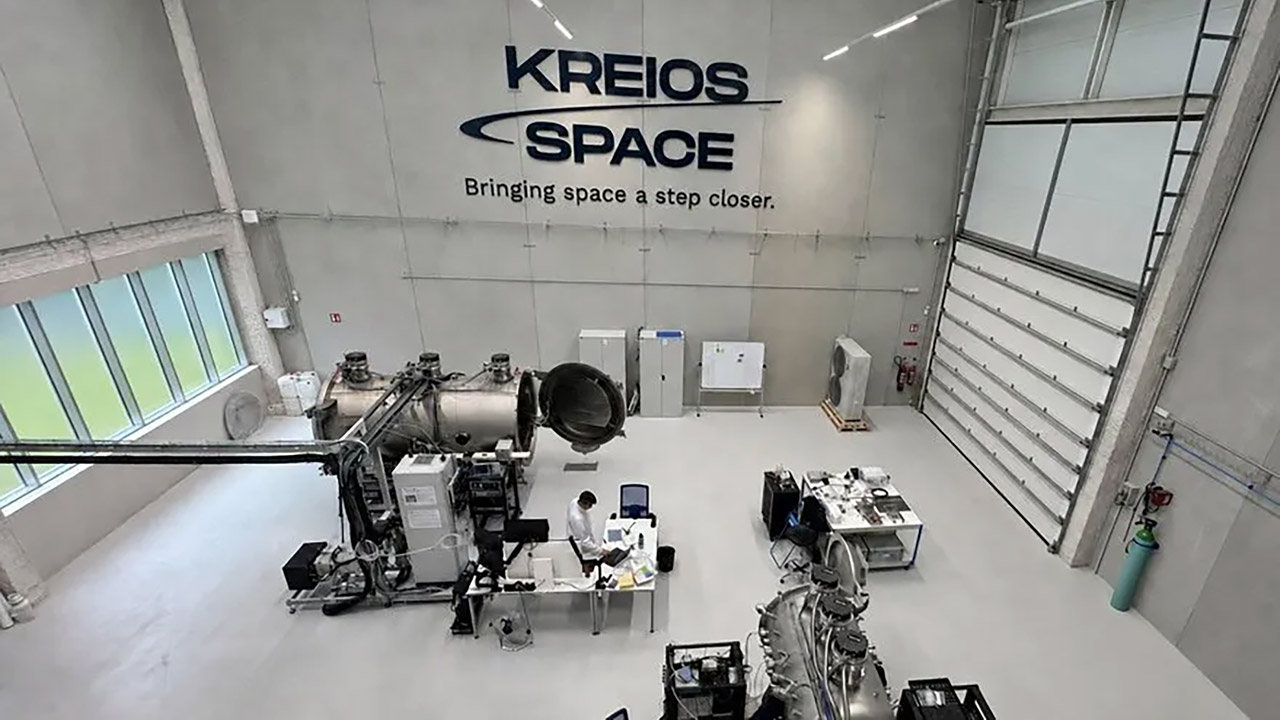
Kreios chose NanoAvionics’ tried-and-true MP42 microsatellite bus for its first orbital mission. Once the optical payload is installed, the entire spacecraft will weigh approximately 200 kg. NanoAvionics will modify the bus, integrate cameras that take photos in visible and near-infrared light with sub-meter resolution, test the entire system, and manage commissioning early in orbit. Once that’s completed, Kreios will take over day-to-day operations. The demonstration will begin higher up, about 300-350 kilometers, and gradually float downward while the thruster fires at various heights. The engineers will be collecting performance data, sampling the local atmosphere, and photographing the entire process.

The MP42, on the other hand, isn’t exactly meant for drag-free VLEO, so the demo will be finished in about six to ten months, which is just as well, because the actual aim here is simply getting this thruster up and operating so Kreios can refine their future platforms. Their long-term goal is to construct satellites that can operate for seven years or longer below 200 kilometers.
[Source]

Launched in 2014, Bumble rose in popularity as a unique alternative among dating apps with a policy requiring women to message first in matches between men and women. With Tuesday’s update, Bumble will let either person in a match send the first message.
The app’s previous requirement that matches must respond within 24 hours, or the match would expire, has been extended to 72 hours.
“While women making the first move was a radical idea, being women-first was never about prescribing just one way to connect. It was about designing an experience with women’s needs in mind to create better outcomes for everyone,” Bumble CEO Whitney Wolfe Herd said in a statement (PDF).
“Today, our community is asking for more flexibility, less pressure and more opportunities to create real, meaningful connections and that is what this new experience provides. This evolution isn’t a departure from our founding vision, but the realization of it.”
CNET reached out to Bumble for comment on how it plans to stand out from other dating apps, including Hinge, Tinder, Match.com and OkCupid.
Why is Bumble changing its chat experience?
The company said the changes reflect “member-backed insights around how dating has grown over the past decade.”
The company said a recent survey of users found that nearly two-thirds (66%) of women preferred that men send the first message, and that more than half of those surveyed said that increasing the reply window from 24 hours would improve their experience.
The survey also found that expectations in dating are evolving, with 62% of respondents saying they are more confident when given flexibility in how and when to begin a conversation with a match.
The company says these changes build on other updates “to improve every stage of the dating journey.” For instance, Bumble is one of many dating apps that incorporate AI-powered features such as AI-generated prompts and profile feedback.



Cybersecurity researchers discovered a fairly insidious bug in Zoom that lets people quite literally take control of someone else’s device. This is done by exploiting a flaw in the screen-sharing function. The vulnerability has been found in the Zoom Workspace app for Windows, Mac, iOS Android and Linux.
Attacks do not require the victim to do anything and there’s no visible warning. When someone launches the annotation tool while sharing the screen, the vulnerability lets bad actors remotely execute malicious code for access.
However, it remains to be seen if this vulnerability has ever been used in the wild. The researchers that found it used AI prompts to develop the screen-sharing exploit in under 24 hours, illustrating how AI could assist in cyberattacks.
“This class of capability would previously have only been available to nation-state threat actors, but the model requiring elite teams, months of effort and weapons-grade budgets has collapsed,” the cybersecurity company wrote in a blog post. “Today, a single researcher was able to develop a nation-state-level exploit in less than a day.”
Zoom was notified about the bug and has deployed various fixes to mitigate the threat. It says “users can help keep themselves secure by applying the latest updates.” The vulnerability exists in all Zoom Workspace versions prior to the latest updates.
Critical macOS security flaw 🚨
A vulnerability in Screen Sharing could allow attackers on the same network to bypass authentication and gain access without valid credentials.
Apple has released fixes in macOS 26.6.1, 15.7.9, and 14.8.9.
Update your Mac. pic.twitter.com/XAqRHk5qXL
— AB 🔶 (@Abrlien) August 10, 2026
Something similar just happened to Apple computers, forcing the company to issue various macOS updates. The newest versions, including Tahoe 26.6.1, Sequoia 15.7.9 and Sonoma 14.8.9 are all safe.

XRP $1,000+ What To Watch & Clarity Act Hasn’t Priced Crypto

Trump’s shocking two-word response after being snuck back ON the AF1 plane full of unknowing press after Iran threat

Jensen Huang’s plan faces China risk


-

 Fashion4 days ago
Weekend Open Thread: Mattifying Sunscreen
-

 Fashion4 days ago
Frugal Friday’s Workwear Report: Cap-Sleeve Pointelle Crewneck Sweater
-

 Sports6 days ago
Jordan Coyle & Cordiamo take Laya Arena Stakes at RDS
-

 News Videos3 days ago
Can Astrology Help Find Gold and Silver Trends? A Financial Astrology Guide
-
 Business6 days ago
US stocks: Dow closes at record on Mideast optimism; SpaceX, AMD drag Nasdaq
-

 Politics5 days ago
Reform UK And Greens Sink To Lowest Favourability Ratings To Date
-

 Business7 days ago
Nvidia Stock Climbs 2.5% as Chip Sector Rally Builds Ahead of AMD Earnings, Nvidia’s Own Report Looms
-

 Tech7 days ago
OpenAI, Anthropic AI agents targeted real people and systems in cyber tests
-

 Business6 days ago
Supply chain issues impact Ingredion
-

 Tech4 days ago
Rinn Pharma & Biopharma to join NordicPharmaTrain network
-

 Business3 days ago
How to Start a Cleaning Business: A Step-by-Step Guide
-
 Crypto World7 days ago
Dow and S&P 500 Hit Records on AI Earnings: When Will the Bubble Burst?
-

 Business2 days ago
Datadog: Best Of Breed For Multiple Reasons
-

 Business3 days ago
BDC Weekly Review: Private BDC Q2 Numbers Are Strong
-

 Business7 days ago
McDonald’s (MCD) Q2 2026 earnings
-
 Crypto World7 days ago
Dollar Index Trapped at 100 as Hawkish Fed Meets Official Selling
-

 Fashion7 days ago
The Bright Side of Black and White
-

 Fashion6 days ago
Suit of the Week: Me + Em
-

 Business7 days ago
Apple UK encryption challenge filed against Home Office
-
Sports6 days ago
Spider-Man: Brand New Day ending explained: Is Peter Parker alive?
You must be logged in to post a comment Login