
Tech
The Exploration Company nabs $450 million to challenge SpaceX


The queue to send objects into orbit is growing, but space infrastructure isn’t keeping up with demand. As the realization sinks in that Elon Musk’s SpaceX can’t be the sole answer, other companies are raising their hand — and money.
These include The Exploration Company (TEC), which operates out of Germany, France, Luxembourg, Spain, and Italy, and which has raised $450 million in what it describes as “the largest-ever Series C by a European space company.” But the race is global, with U.S.-based rival Stoke Space currently raising a $1 billion Series E round.
Rivalry aside, these rounds show that investors on both sides of the Atlantic are willing to back companies seeking to build reusable spacecraft. That’s a category pioneered by SpaceX, but that many players, both public and private, now believe it shouldn’t solely control as space gains strategic importance.
These sovereignty-related concerns create extra tailwinds for an EU-headquartered company like TEC. Led by Hélène Huby, a French national who spent two decades at Airbus and ArianeGroup, the company intends to use its funding to build the foundation for a reusable European heavy-lift launcher offering an affordable alternative to SpaceX.
SpaceX itself may have no other choice but to loosen its nascent monopoly on low-earth-orbit launches to prioritize its own payloads; reports suggest that its Falcon rockets are already increasingly reserved for its Starlink satellites, amid uncertainty as to what will happen when these get retired in favor of Starship.
This creates demand that TEC won’t be able to meet for years, even if it sticks to its self-admittedly ambitious timeline. According to Atomico, “10 Nyx missions are booked,” with “more than $2 billion in contracts and commitments.”
Some of these commitments come from institutional partners, including the European Space Agency, but also NASA. Its Series C was also transatlantic, with Atomico, and the EQT-managed Scaleup Europe Fund co-leading the round alongside Bessemer Venture Partners, whose partner Alex Ferrara will join TEC’s board of directors.
This latest round also consolidates TEC’s status as a company mostly funded by private investors, and one that plans accordingly. In a press conference earlier today, Huby said that she’d love to see Europe add human space flight to its roadmap, but wouldn’t be able to convince VCs to spend $4 billion towards a crew capsule, “then wait 10 years.”
So, TEC’s timeline is more pragmatic, but it is tight. Its most immediate focus is Nyx, a reusable capsule akin to SpaceX’s Dragon and capable of carrying cargo, then people. The company intends to get Nyx to dock with the soon-to-be-retired International Space Station and return safely to Earth by November 2028.
According to Huby, funding from the Series C will stretch to also fund Storm, a rocket engine program paving the way for further developments, at least initially. “Where we need more money is to build a launch pad, and to build the rocket itself,” she told journalists.
TEC wouldn’t be the first European commercial space company to launch a rocket — German startup Isar Aerospace crossed that milestone out of Norway last weekend. Huby praised the feat as “great news for the whole ecosystem,” but said that TEC intends to build a much bigger rocket than Isar’s expandable Spectrum vehicle.
However, Isar also has “a much bigger” launch vehicle in its roadmap, Ars Technica reported — presumably for the same reason Huby gave as to why TEC does. “In the next five to 10 years, half of our broadband communication could come from space, data centers could be in space; […] and if this is the case, we need massive rockets and cadence.”
That cadence will rely on reusability, which TEC plans to reach by using the same technology as SpaceX and Stoke: full-flow stage combustion “It’s the most difficult, but also the most efficient engine cycle in the world. It is the first time ever in Europe that a company develops such a rocket engine,” Huby said.
TEC’s advances haven’t gone unnoticed in Europe, with French president Macron and the European Commission’s president Ursula von der Leyen both praising its Series C. It is also not a coincidence that it was disclosed on the eve of the International Space Summit in Paris, where Huby hinted that related announcements will be made.
When you purchase through links in our articles, we may earn a small commission. This doesn’t affect our editorial independence.



There are numerous sensors installed in your vehicle that measure conditions within the engine and exhaust system. Each sensor plays a role in monitoring a specific process. In the case of oxygen sensors (also known as O2 sensors), they detect how much oxygen is in the exhaust system. Modern vehicles generally have at least two oxygen sensors: one before the catalytic converter and one after. However, with many V6 and V8 engines, which have one exhaust manifold for each set of cylinders, you’ll likely see four oxygen sensors.
Measuring the level of oxygen in the exhaust system helps detect imbalances in the combustion mix and ensure a critical emissions reduction component is doing its job. For a combustion engine to run optimally, it needs the correct mix of air and fuel, which will differ depending on the type of fuel and what the engine’s intended for. Either way, the upstream oxygen sensor(s) before the catalytic converter will catch irregularities in this mixture, so that the vehicle’s ECU (engine control unit) can quickly make the necessary adjustments.
The downstream oxygen sensor(s) lie beyond the catalytic converter. Nearly every car is required to have a catalytic converter, which helps control vehicle emissions. Without that downstream oxygen sensor(s), it may not be clear if the catalytic converter is performing optimally or if there’s a problem.
Upstream and downstream oxygen sensors aren’t interchangeable

While upstream and downstream O2 sensors basically do the same thing, mixing them up will cause you problems. A downstream oxygen sensor emits a consistent voltage level to the ECU when the catalytic converter is working properly; it isn’t intended to feed the ECU varying voltage levels to help it adjust the fueling. Unlike the upstream sensor, which actively varies voltage to indicate whether your car is running lean or rich, the downstream oxygen sensor should be relatively unchanged in terms of output voltage.
So, if you accidentally install a downstream sensor in the place of an upstream, your ECU will get confused. The consistent voltage from a mistakenly installed downstream sensor will likely result in the car’s computer declaring it a failed sensor. This could also cause the vehicle’s computer to change the combustion mixture in an attempt to correct for the strange readings.
The combustion mixture is important to balance performance with fuel economy. Rich (more fuel and less oxygen) and lean (more oxygen and less fuel) mixtures negatively affect the engine and its emissions. If you run rich, your fuel economy may drop, and your car’s emissions can increase. The excess unburnt fuel may reach the catalytic converter, causing it to overheat and destroy the sensitive internals. Conversely, if you run too lean, you can get engine knock, which may damage it in the long run.
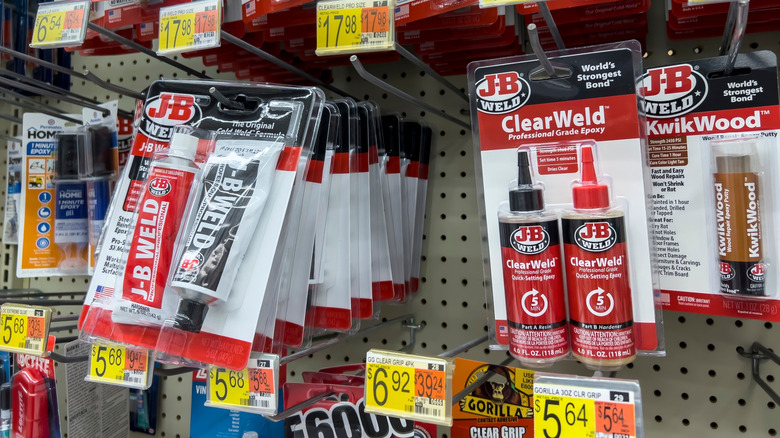
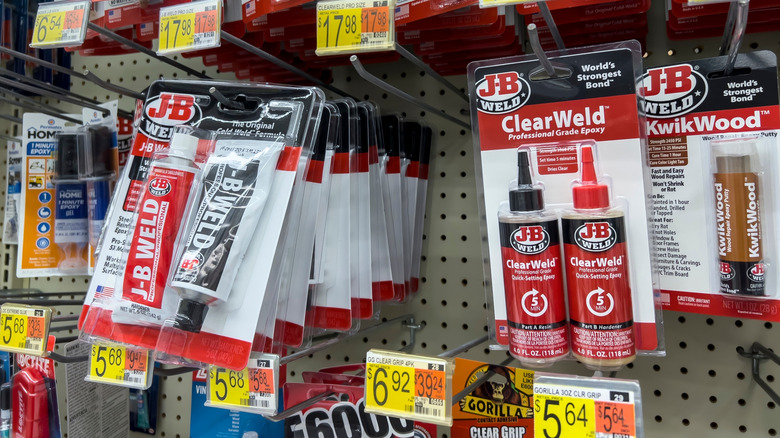
Few things sound the death knell of an engine as clearly as a cracked engine block. The signs are usually obvious – daily puddles of coolant spreading across a garage floor, the tell-tale rainbow sheen of oil appearing where it shouldn’t, or a worrying trail of sounds and smells — the sweet tang of burning coolant, or the staccato beat of rough idling and misfires. All represent symptoms pointing toward impending breakdown, a very expensive repair, or complete replacement. It is no surprise, then, that when facing that impending expense, a five-dollar tube of J-B Weld starts looking surprisingly attractive.
J-B Weld has an extensive product range, covering everything from simple metal repairs to high-temperature compounds and automotive sealants. The standard J-B Weld formula is a two-part epoxy designed for metal, including cast iron and aluminum, and is rated to 550 degrees Fahrenheit (288 degrees Celsius) once fully cured. A promising claim, especially when a cursory Google search will tell you that apart from the combustion chamber and exhaust manifold, the majority of a block doesn’t get hotter than around 427 degrees Fahrenheit.
The appeal is obvious. Avoid the hassle of a full engine replacement, or an expensive TIG welding bill, while still getting a vehicle mobile again. However, an engine block is an exceptionally volatile environment. That crack formed in that spot for a reason; repeated heating and cooling, vibration, fluid pressure, and potentially enormous combustion forces. So, much like a space-saver spare, epoxying an engine block should be considered a stopgap. Will it hold? Probably, for a while, but stay out of the fast lane and get a real fix on ASAP.
Where J-B Weld can work, and where it won’t

Why put epoxy on an engine block at all? The same reason you would carry a spare tire or a set of jumper cables. Disaster tends to strike at the most inopportune moments. A carefully applied epoxy repair can temporarily patch a crippling fracture or fault, buying you valuable time or miles to get to somewhere you can effect a permanent fix.
Ultimately, the location of the damage is going to be the critical factor. A small crack in a non-structural area or away from a gasket is a great candidate for an epoxy repair. Conversely, an epoxy-patch over a crack that exposes an oil gallery, cylinder wall, head sealing surface, or combustion chamber is unlikely to withstand the heat and pressure of a running engine for the long term.
Other issues that may arise include thermal expansion. As they heat and cool, metal and cured epoxy expand and contract at different rates. Because the epoxy will deform much faster than the base metal, the joint can suffer from delamination, cracking, or even complete debonding. A second issue is epoxy contamination. Trace chemicals within the epoxy itself can taint metal, while having to grind away cured epoxy can complicate welding and expose internal chambers to contamination, leading to future damage.
How to make an epoxy repair work
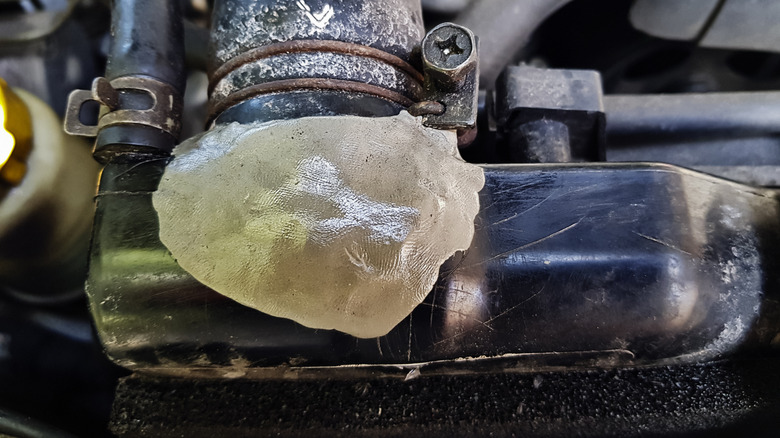
If you do decide that epoxy is the way to go, correct preparation is critical, and is going to be what separates a trustworthy patch from a botched mess. Epoxy cannot compensate for a contaminated surface, so start with a completely cold engine and remove every trace of oil, coolant, grease, rust, and loose material. A repair can be also be strengthened by drilling small holes to stop the crack’s progression at both ends, a technique known as stop drilling.
Routing, the use of a grinder or rotary tool to open the crack into a shallow V-shaped groove, can provide a larger surface area of substrate for the epoxy to bind to. Remember, epoxy is more effective when applied as a broad patch extending beyond the damaged area. Unlike cyanoacrylate and anaerobic adhesives, like superglue and thread-lockers, epoxy doesn’t adhere to the “less is more” rule.
Finally, exercise patience. Epoxy requires about 15–24 hours to fully cure. Rushing the curing process and driving a car that is held together with uncured, pre-polymer epoxy is just going to end with a Jackson Pollock-esque splatter of B-stage resin across the inside of the engine bay.
So if the crack involves combustion pressure, a major structural area, an important oil passage, or a rapidly growing fracture, epoxy should only represent a short-term substitute for professional repair or replacement. It might get you somewhere. It might even work surprisingly well. But you probably shouldn’t plan your next road trip around it.
Tech
Cognition hits $48B valuation, signaling investors believe AI coding is far from a winner-take-all market

Cognition, the startup developing coding assistant Devin, announced it raised $2 billion at a $48 billion valuation. The round, which comes just four months after Cognition’s previous fundraise at a $26 billion valuation, was led by Andreessen Horowitz, Accel, Founders Fund, General Catalyst, and Avenir.
The startup’s soaring valuation signals that VCs still see room for multiple major players to capture meaningful market share in AI coding, one of the technology’s most significant applications. Cognition said that since announcing its last fundraise in May, its annualized run-rate revenue has grown from $492 million to $900 million. While the startup didn’t explain how it calculates that run-rate revenue, the metric is usually defined as a month’s top line multiplied by 12.
Cursor, another popular coding assistant, was in talks in April to raise capital at a $50 billion valuation before agreeing to sell to SpaceX for $60 billion later that month. At the time of the funding talks, Cursor’s annualized revenue had surpassed $2 billion. This means Cognition currently commands a higher revenue multiple than Cursor did in the spring.
Cursor ultimately sold to SpaceX largely because it was severely compute-constrained, according to investors familiar with its financials. It is unclear whether Cognition will face similar compute shortages.
Cognition leases an Nvidia server cluster that costs hundreds of millions of dollars annually, which could push its total cash burn to $800 million this year, The Information reported.
Like Cursor did before joining SpaceX, Cognition is training its own model based on open source alternatives. Over time, reducing its reliance on expensive third-party models from OpenAI and Anthropic will help cut costs and bring the company closer to breakeven.
Cognition is expected to reach $4 billion to $5 billion in annualized revenue by the end of 2026, according to The Information. By comparison, TechCrunch reported in the spring that Cursor was on track to surpass $6 billion by year-end. Still, it’s notable that a16z, a major backer of Cursor, which made a killing when it sold to SpaceX, is back to lead a round in a Cursor competitor.
Founded in 2024 by math prodigy Scott Wu, Cognition counts Mercedes-Benz, NASA, Goldman Sachs, and Citi among its major enterprise customers.
When you purchase through links in our articles, we may earn a small commission. This doesn’t affect our editorial independence.
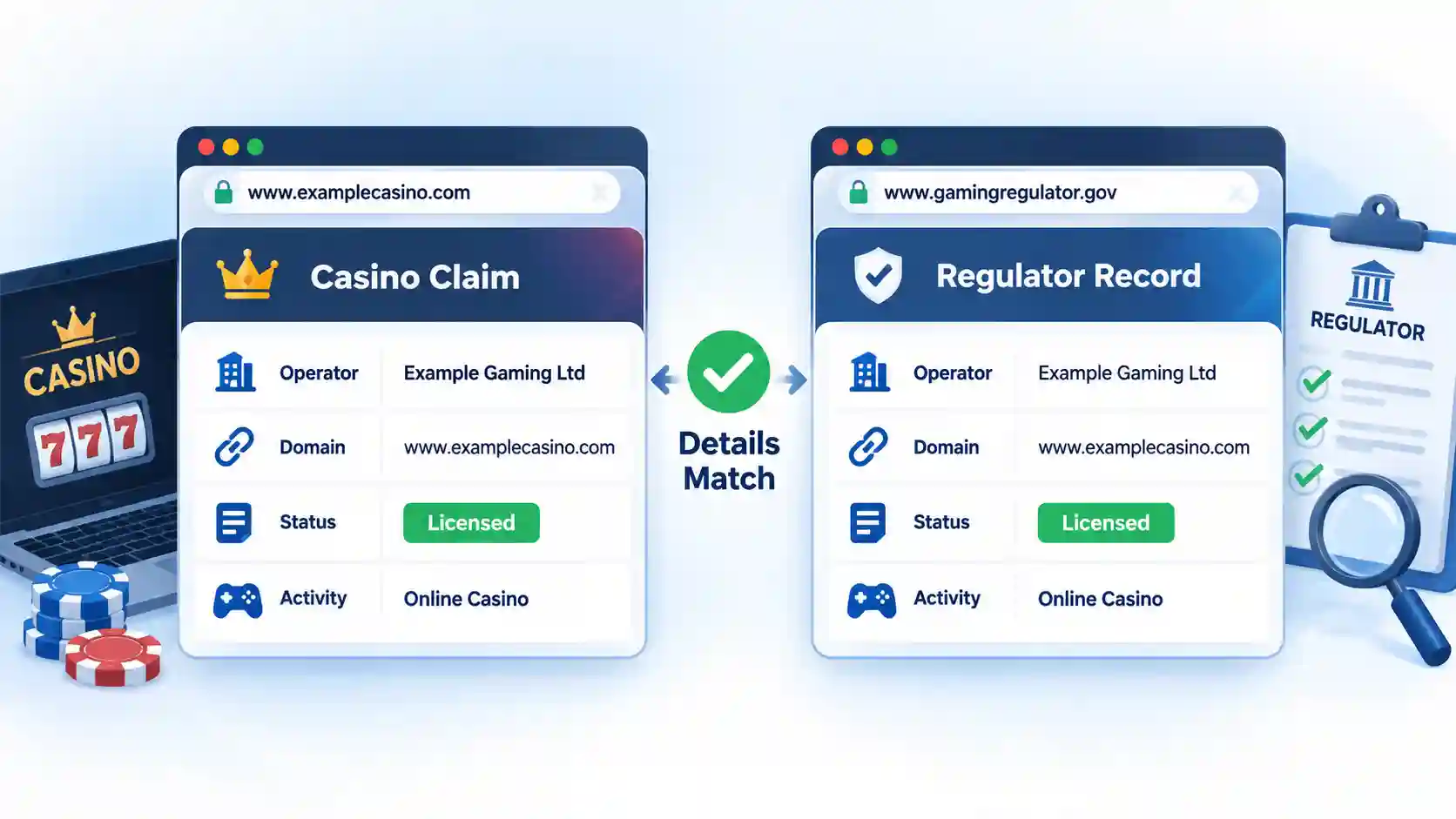
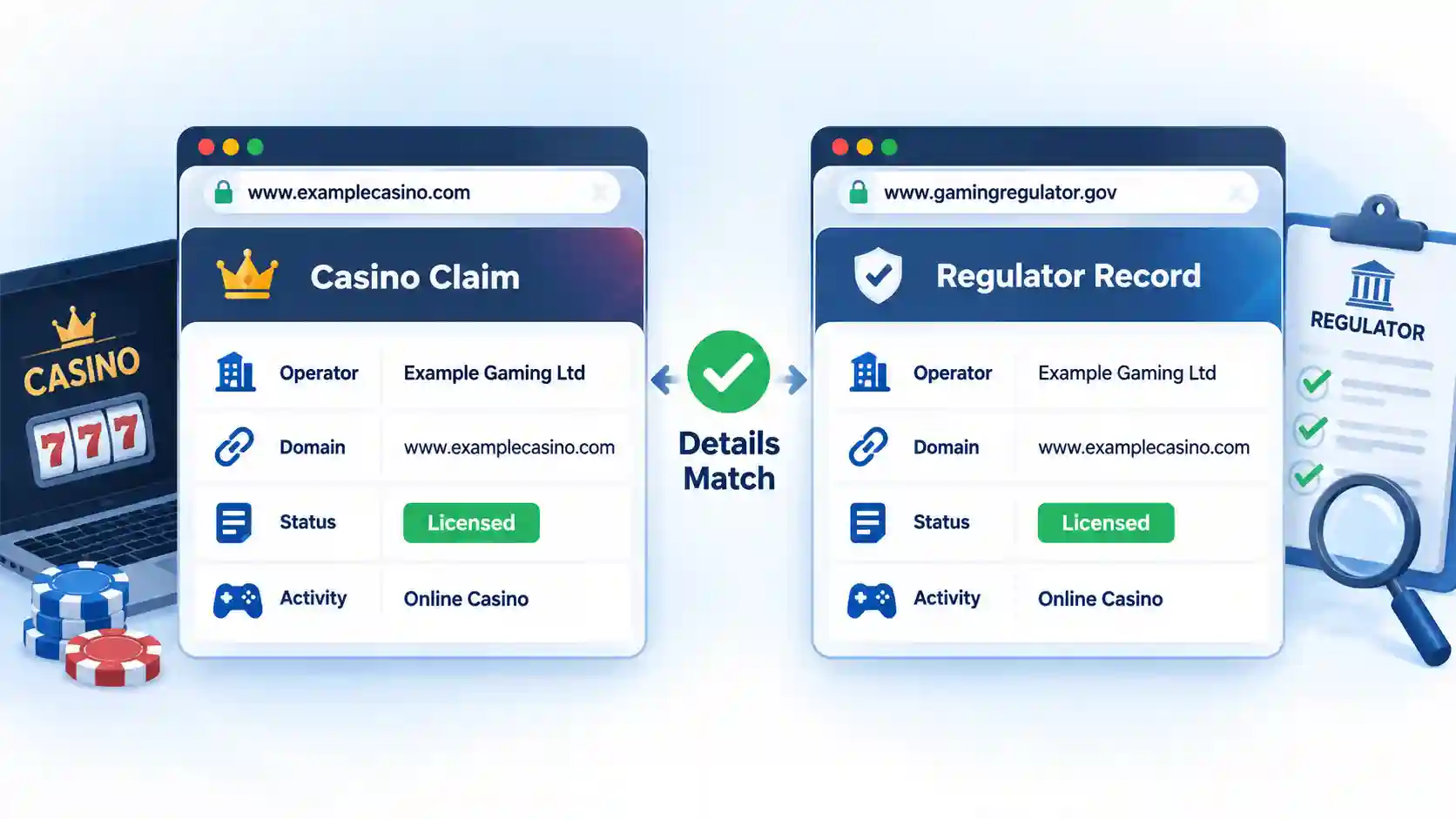
To verify an online casino licence, find the casino’s legal operator and claimed licence details, then check them in the regulator’s official register. The operator, exact website domain, licence status, permitted gambling activity, and authorized location must all match before you register or deposit.
A licence logo by itself proves nothing. Fake and cloned casino websites can copy regulator seals, company names, and genuine licence numbers from legitimate operators.
Quick Take: The Four Details That Must Match
A casino passes the basic licensing check only when you can confirm all four of these details through an official regulatory source:
- Legal operator: The company named in the casino’s terms must correspond to the licence holder or a disclosed white-label operator.
- Exact domain: The website address you are visiting must appear as an authorized domain where the regulator publishes domain information.
- Active authorization: The licence must be active, not pending, expired, suspended, surrendered, forfeited, lapsed, or revoked.
- Permitted activity and location: The licence must cover online casino games and authorize the operator to serve players in your jurisdiction.
If one of these material fields does not match, do not deposit while you investigate. After the casino passes the licensing check, you can compare its available payment methods, withdrawal rules, fees, and account limits.
What You Need Before Starting
Collect the licensing claim before opening an account. You should be able to find the necessary information without installing an application, submitting identity documents, or depositing money.
- The complete casino URL shown in your browser address bar
- The casino’s public brand or trading name
- The legal company named in its terms and conditions
- The licence or regulatory account number
- The name of the claimed regulator
- Your country, state, or province
- A place to save screenshots, URLs, dates, and search results
Check the website footer, terms and conditions, privacy policy, responsible-gambling page, and contact page. Licensed businesses in Great Britain are required to display their licensing status and provide a link to the regulator’s register, according to the Gambling Commission guidance.
Record the information displayed by the casino, but do not assume it is accurate. Your next task is to verify the claim independently.
How to Verify an Online Casino Licence
-
Copy the exact casino domain
Copy the hostname from the browser address bar. The hostname is the central part of the address, such as examplecasino.com or casino.example.com. You normally do not need page paths, referral codes, or tracking parameters that appear after the domain.
Inspect the spelling one character at a time. Look for extra hyphens, repeated letters, substituted numbers, unfamiliar endings, and misleading subdomains. For example, casino.regulator-check.example.com belongs to example.com, not to a regulator whose name appears earlier in the address.
Expected result: You have the exact domain that must be matched against the official record.
-
Find the legal operator and claimed regulator
Locate the company responsible for operating the casino. The brand displayed in the header may differ from the legal entity in the terms. That difference is not automatically suspicious because one company can operate several brands, and some casinos use a white-label platform.
Record the company’s complete legal name, registered address, trading names, licence number, and regulator. Avoid relying on a logo without accompanying legal information.
Expected result: You can attribute the casino to a named business and a specific licensing claim.
-
Open the regulator’s website independently
Do not rely solely on the regulator badge in the casino footer. Search for the regulator independently and inspect the destination domain before using its register. A copied logo can link to a page designed to resemble a real regulator’s validation screen.
This precaution is not theoretical. In July 2026, the Malta Gaming Authority reported websites impersonating licensed operators and using false MGA licensing claims. Its impersonation warning directs the public to verify both the operator and website through the official register.
Expected result: You are using the regulator’s authentic website rather than a validation page supplied by the casino.
-
Search the official licence register
Search by the exact domain first when that option is available. If it produces no result, search by legal company name, trading name, and licence number. Try exact and shortened company names because corporate suffixes or punctuation may affect results.
The UK business register accepts searches by business name, trading name, domain name, or account number. The MGA Licensee Register also provides a dedicated URL checker.
Other jurisdictions may publish a list rather than a searchable licence database. The correct verification source is still the regulator or government-authorized market administrator, not an affiliate review or commercial licence-checking service.
Expected result: You find an official record that can be compared with the casino’s claim.
-
Match the legal entity
Compare the licence holder’s legal name with the company in the casino’s terms. Also inspect registered addresses, trading names, related companies, and any disclosed white-label relationship.
A brand mismatch can be legitimate when the register lists the casino as a trading name or approved domain of the licensed company. It becomes a serious warning when the casino uses a real licence number belonging to an unrelated business, or when no official record connects the brand or domain to the licence holder.
If the ownership structure is unclear, check the regulator’s detailed record and the casino’s terms again. Do not accept a support agent’s unsupported statement as a substitute for registry evidence.
Expected result: The public casino brand has a documented connection to the licensed legal entity.
-
Match the exact website domain
Compare the hostname you copied with the domains shown in the official record. The match should be exact. A genuine licence held for examplecasino.com does not automatically cover example-casino.net, examplecasino.bet, or a similarly named mobile website.
Pay attention to status labels. The UK register distinguishes active, inactive, and white-label domains. An active domain is currently recorded for the operator. An inactive domain should not be treated as current authorization. A white-label label generally means that another licensed company operates the service behind the consumer-facing brand.
A white-label casino is not necessarily unlicensed. You must verify the operating licence holder, the listed domain, the current status, and the authorized activities. For more help identifying deceptive variations, see the guide to spotting a cloned casino website.
Expected result: The website you are actually visiting appears in the regulator’s records or has another official, verifiable connection to the licence holder.
-
Check the licence status and regulatory history
Finding a company in a register does not prove that its licence remains active. Registrators may preserve historical records after authorization ends.
Read the status field carefully. The UK register defines statuses including active, pending, expired, lapsed, forfeited, suspended, surrendered, and revoked. It also includes published regulatory actions. A pending licence is not an active licence, and a suspended operator should not be treated as currently authorized to continue normal licensed activity.
Check enforcement notices, public statements, sanctions, settlements, and effective dates. Confirm whether an enforcement action affects the licence, the particular domain, or a specific activity.
Expected result: The relevant authorization is active and has no current restriction that prevents the offered service.
-
Confirm that casino games are authorized
A gambling authorization may cover only particular products. Approval for sports betting, horse racing, poker, bingo, lotteries, or land-based gambling does not necessarily include online casino games.
France provides a useful illustration. The ANJ operator directory lists approved websites alongside categories such as sports betting, horse-race betting, and circle games. It should not be interpreted as a general authorization for every gambling product.
Compare the activities in the official record with the games being offered to you. If the site promotes slots or live-dealer casino games while its record covers only sports betting, stop and seek confirmation from the regulator.
Expected result: The licence covers the specific gambling product you intend to use.
-
Confirm that the operator may serve your location
Licensing is jurisdiction-specific. An operator licensed in one country does not automatically have permission to accept players in another. In the United States, authorization generally depends on the state. Canadian provinces can also operate distinct regulatory systems.
For example, the Ontario operator directory identifies websites offered by regulated operators for users physically located in Ontario. Its entries can include exact regional subdomains, which demonstrates why checking only a global brand name is insufficient.
Consult the regulator responsible for your actual location. Do not assume that the ability to register, access the cashier, or select your country proves that the casino is legally permitted to serve you.
Expected result: The operator and domain are authorized for the player’s location, not merely licensed somewhere else.
-
Save the evidence before depositing
Save a screenshot or PDF of the registry result. Record the regulator URL, date checked, legal operator, domain, account or licence number, status, authorized activities, and any complaints information.
Also save the casino’s current terms and conditions, withdrawal policy, bonus terms if relevant, and responsible-gambling information. Websites and licence records can change, so dated evidence is more useful than memory if a later dispute arises.
Expected result: You have a dated record showing what you verified and which terms applied before payment.

Final Verification: Pass, Caution, or Fail
| Result | Conditions | Recommended action |
|---|---|---|
| Pass | Legal entity, exact domain, active status, permitted activity, and player location all match | Continue to payment, withdrawal, security, and terms checks |
| Caution | The operator appears genuine, but a white-label relationship, new domain, company change, or activity remains unclear | Contact the regulator through independently verified details before registering |
| Fail | No official record, unrelated company, wrong domain, inactive licence, unauthorized product, or unsupported location | Do not create an account, upload documents, or deposit |
A pass confirms that the licensing claim matches the official record at the time checked. It does not guarantee fast withdrawals, good customer service, favorable terms, game quality, or the operator’s future financial condition.
Read the casino’s contract separately using the guide to casino terms and conditions. Pay particular attention to identity requirements, restricted locations, dormant-account charges, withdrawal limits, bonus conditions, and dispute procedures.
Licence Verification Problems and Red Flags
| Problem | What it may mean | Verification action |
|---|---|---|
| Regulator logo is visible but not linked | The badge may be decorative, outdated, or copied | Find the regulator independently and search its register |
| The badge opens a regulator lookalike | The validation page may be fabricated or part of a phishing flow | Close it and navigate to the known official regulator domain |
| The licence number belongs to another company | The casino may be borrowing genuine credentials | Look for an official trading-name, domain, or white-label connection |
| The company appears but the domain does not | The site may be a clone, unrecorded skin, old domain, or recent addition | Ask the regulator before proceeding |
| The domain is marked inactive | The domain is not currently recorded as active under that entry | Do not treat historical authorization as current approval |
| The domain is marked white label | A different company may hold the operating licence | Verify the named licence holder, domain status, and permitted activities |
| The record covers betting but not casino games | The advertised casino product may fall outside the authorization | Stop until the regulator confirms the product is covered |
| The site accepts your registration from an unlisted region | Technical access may not equal legal permission | Check the regulator responsible for your location |
| The site has HTTPS and a padlock | The connection is encrypted, but licensing remains unverified | Complete the full registry check |
| Positive reviews conflict with the register | The reviews may be outdated, promotional, manipulated, or unrelated to the exact domain | Treat the official regulatory record as the primary evidence |
What a Valid Casino Licence Does and Does Not Prove
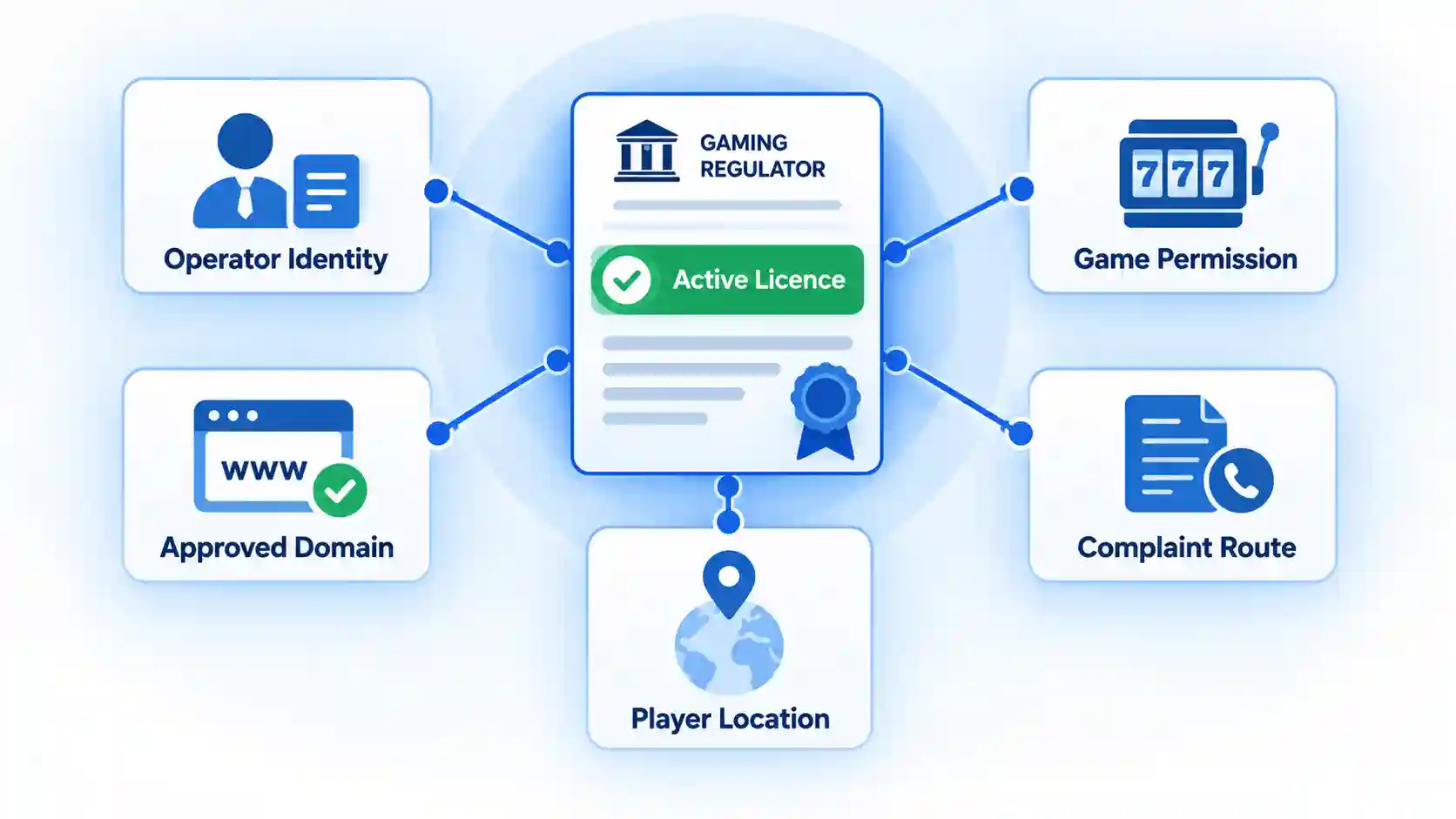
A valid licence can establish that an identifiable company has permission to conduct specified gambling activities under a particular regulator. Depending on the register, it may also identify approved domains, trading names, regulatory actions, complaints routes, and the dates on which activities began or ended.
Licensing can provide access to regulatory requirements concerning identity checks, player protection, financial controls, advertising, complaints, and responsible-gambling measures. The precise obligations vary by jurisdiction.
A valid licence does not prove that:
- Every gambling product is covered by the authorization.
- The operator may accept players from every country.
- Every game outcome or published return figure has been independently tested.
- The website cannot experience a data breach or account takeover.
- Every withdrawal will be approved immediately.
- A player will win a complaint or payment dispute.
- The casino’s terms are suitable for the player.
Licensing verification is therefore the first safety gate, not the entire evaluation. Payment terms, withdrawal procedures, security controls, account restrictions, and responsible-gambling tools still require separate checks.
Operational Limits and Edge Cases
Some legitimate situations require closer inspection. A casino may operate under a white-label agreement, change its legal company name, add a new domain, maintain several regional websites, or hold different licences for different markets.
A mobile application can also use a publisher name that differs from the casino brand. Confirm the application through a link on the verified casino domain, then compare the publisher, legal operator, privacy policy, and licence record. Do not download an app merely because it uses a familiar brand logo.
Regulator databases also vary. Some provide exact domains and activity categories, while others publish only approved operators or downloadable licensing files. A temporary register outage is not a reason to rely on an unofficial checker. Wait, consult an official downloadable dataset, or contact the regulator through independently verified details.
If a licence has recently changed, ask for written confirmation and save it. Do not deposit while a material inconsistency remains unresolved. For broader differences between official authorities, see the planned guide to online gambling regulators.
If a verified casino later withholds a payout, licensing evidence can help identify the proper escalation route. Follow the separate procedure for a pending or rejected casino withdrawal.
Key Takeaways
- Start with the regulator’s official register, not the casino’s licence badge.
- Match the casino brand to the licensed legal operator.
- Verify the exact domain, including its spelling and regional subdomain.
- Confirm that the licence is active rather than pending, expired, suspended, surrendered, or revoked.
- Check that the authorization covers online casino games.
- Confirm that the operator may legally serve your location.
- Verify white-label casinos through the named operating licence holder.
- Save dated evidence before registering, uploading documents, or depositing.
- Treat any unresolved material mismatch as a reason to stop.
Frequently Asked Questions
Why does the casino name differ from the company on the licence?
The public casino name may be a trading name owned or operated by a differently named legal company. It may also be a white-label brand running on another company’s licensed platform. The difference is acceptable only when the regulator’s record or another official source connects the brand and exact domain to the licence holder.
Can an online casino hold more than one gambling licence?
Yes. An operator may hold separate licences for different countries, states, provinces, products, or group companies. Verify the authorization that applies to your location and the exact service you intend to use rather than selecting whichever licence appears strongest.
Is an MGA licence valid for players in Great Britain?
An MGA licence does not by itself authorize an operator to serve consumers in Great Britain. A gambling business serving that market generally requires the applicable UK Gambling Commission authorization. The relevant licence depends on the player’s location and local law.
Can a casino app be licensed when its name differs from the website?
Yes, but verify the chain carefully. Reach the app store through the verified casino website, then compare the developer or publisher, legal operator, privacy policy, official domain, and regulator entry. A familiar icon or similar app name is not enough.
How often should I recheck an online casino’s licence?
Check before your first deposit and again after a domain change, company-name change, app migration, significant regulatory announcement, or unexplained account restriction. Recheck before maintaining a large balance because licence status and approved domains can change.

TL;DR: The remake of The Legend of Zelda: Ocarina of Time has a confirmed launch date. The game will arrive on November 5 for the Switch 2. Nintendo shared the launch date during a 40th anniversary Zelda-themed Direct presentation that premiered Tuesday morning.
The remake brings one of Nintendo’s most beloved games into the modern era. The original arrived on the Nintendo 64 in late 1998 and was unlike anything seen up to that point. The 3D action adventure game was initially planned for the 64DD, but was eventually moved to cartridge when that peripheral was canceled. Despite having just 32MB of memory to work with, Nintendo put out a masterpiece that pushed the limits of storytelling, puzzle-solving, and combat to new heights.
The remake features a complete graphical overhaul that initially makes the game look more like a new entry than something from the past. Iconic scenes and elements from the original like Epona galloping across the sweeping plains of Hyrule as the Moon hangs in the distant sky and versions of Link as a child and an adult, however, bring us right back to reality.

The new game additionally features more NPC dialogue, enhanced camera controls, a jump button that replaces Link’s auto-jump ability, and a new feature called Threads of Time that serves as a guide for your next objective. Nintendo has also added an exclusive feature that allows you to hum a song into the controller, and Link will play it on his in-game ocarina.
Nintendo shared a three-and-a-half-minute trailer for the new game that should whet the appetite of most. Those interested in learning more are encouraged to check out the extended 15-minute preview hosted by series producer Eiji Aonuma.
The Legend of Zelda: Ocarina of Time launches on Switch 2 on November 5. Pricing is set at $59.99 for the digital edition and $69.99 for a limited edition physical copy featuring a gorgeous retail box complete with textured foil cover art. Between this, GTA 6, and a handful of other upcoming titles, gamers will have plenty to look forward to this holiday season.


Peter Ryseck built a pole that balances on a contact patch about the size of a coin and stays there long after most people would have walked away. Four drone propellers sit on a 3D-printed mount at the top and give small sideways pushes whenever the shaft begins to tip. Nearly all of the weight still travels down the tube and into the ground, so those motors spend most of their time barely above idle.
He took the shaft from a carbon fiber swimming pool cleaning net and secured the electronics with a single screw. A pixhawk running the PX4 OS handles all sensing and control, while a 3s LiPo battery provides power. On paper, the gear appears to be far too simplistic to complete the job. The major challenge was getting the device to respond quickly and softly enough.

Bambu Lab A1 mini 3D Printer + LED Lamp Kit, Ready-to-Use for Beginners
- A1 mini + LED Lamp Kit for Creative Light Projects: Bring your ideas to life with the included LED Lamp Kit. Simply print compatible lamp models and…
- The Perfect 3D Printer for Beginners: A1 mini 3D Printer is designed to make 3D printing easy from day one with automatic calibration, simple setup…
- Experience the Bambu Lab Ecosystem: Access MakerWorld’s huge library of ready-to-print models, manage prints through the Bambu Handy app, and enjoy…
First, he attempted large, slow-turning props, which were chosen for their efficiency and minimal noise. The difficulty was that they refused to accelerate quickly enough, which was a major issue. You’d get a lean, and the controller would call for a correction, but the blades were still catching up. It would oscillate and then simply hang there. He then tried smaller props, only three inches in size, but they lacked the authority to complete the task. It needed five inch props to strike the proper balance: enough force to catch a fall while remaining light enough to spool up before the pole passed the point of recovery.
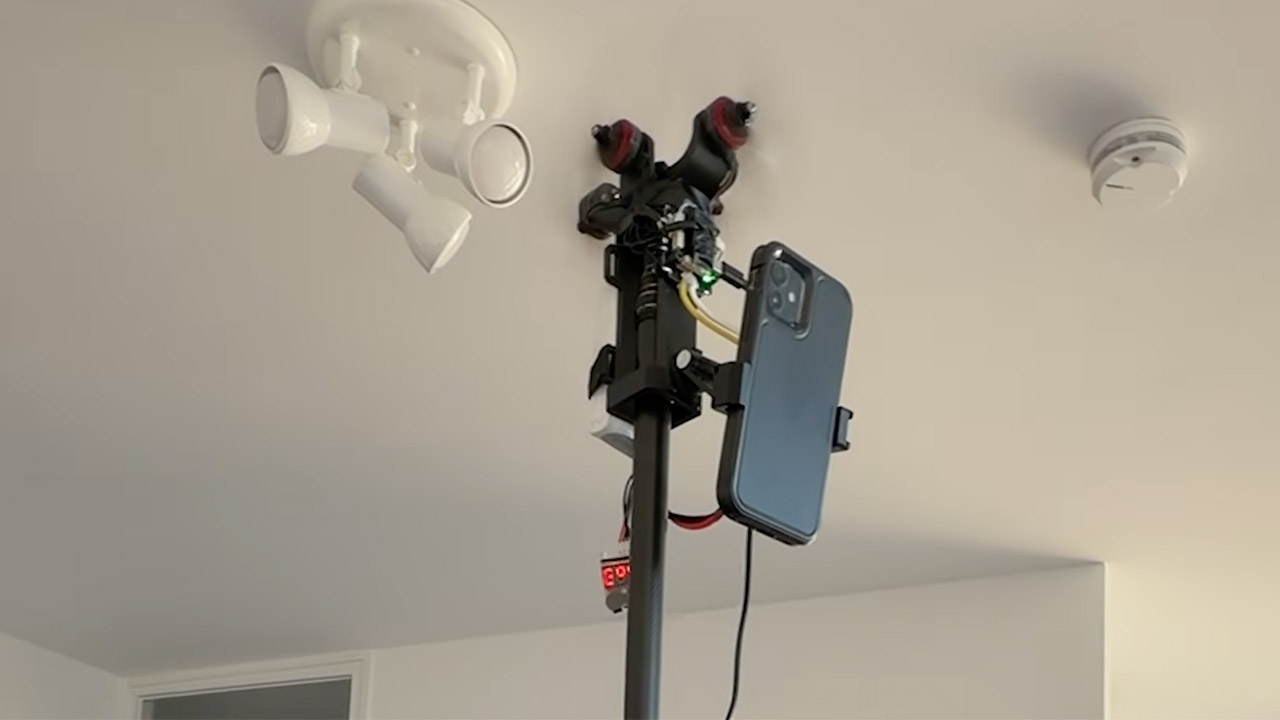
So the system uses a simple PD loop, which monitors how much the pole has slanted over as well as how quickly it is tilting, and attempts to balance both at the same time. Ryseck first simulated the tuning before applying it to the real system. He was seeking for a single set of numbers that could withstand a longer shaft, a larger load (he used a phone for a selfie as an example), and some outdoor gusts without having to re-tune every time something changed.
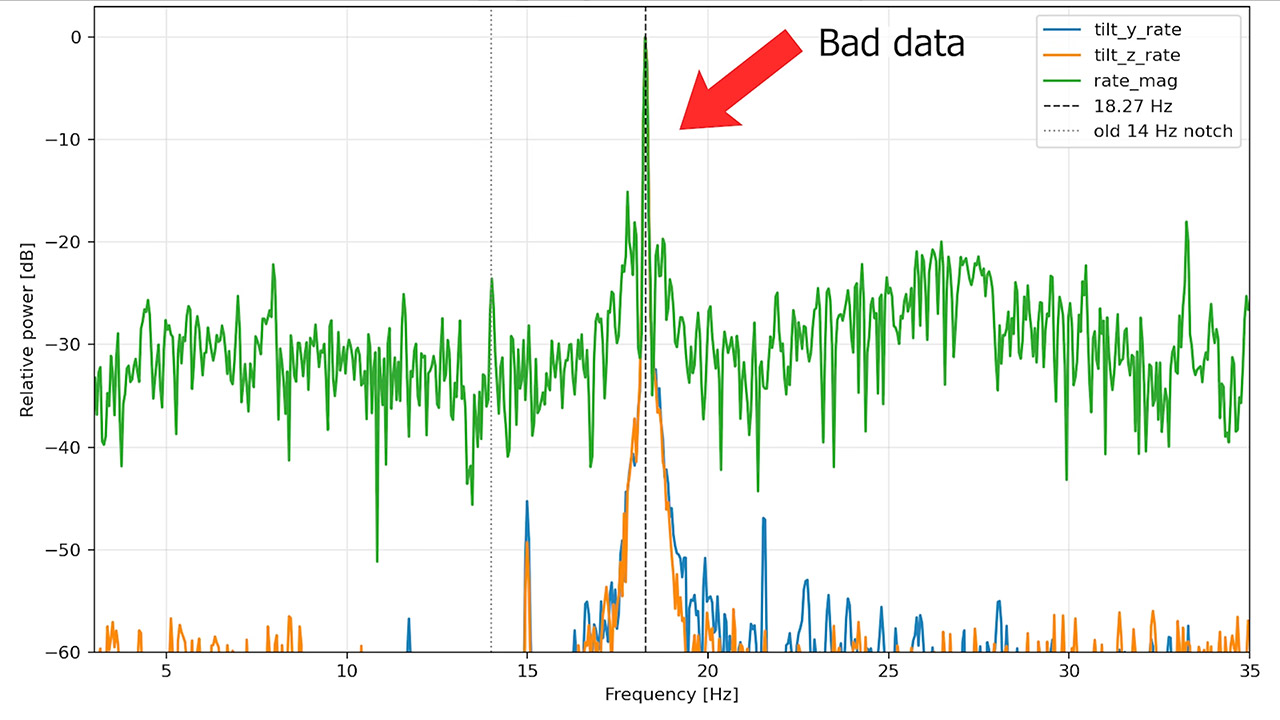
The carbon fiber pole flexes, indicating a high structural resonance near 18 hertz, which the earlier model did not have. Actual balancing motions are considerably below 5 hertz, therefore a dynamic notch filter is now operating on the flight controller, which detects those frequencies every time the system is armed and shuts them out without slowing the response when the pole begins to fall. There’s also a low-pass filter in the chain.

If you left it to steady wind and IMU drift, the motors would just keep pushing all day. Instead, software gradually adjusts the goal angle so that the pole leans only a few degrees into the crosswind. Then gravity does the majority of the work in keeping it there. The motors keep close to idle, the setup is quiet, and the pack lasts much longer. When Ryseck tried setting the idle to zero, he discovered that it contributed some instability, so he kept on a small amount of throttle just to keep the propellers spinning.

Ryseck left the finished pole in Olympia Park on a windy day and walked away. Two hours passed. Three hours passed. After 3.75 hours, the shaft remained in the same location. The voltage on the 12.6v battery had decreased to 11.1 volts, and nite had fallen – but the pole remained as steady as possible. Troy Wigton was one of the persons that contributed with some of the control ideas. Give the item a tiny push, and the four props whisper gently, the shaft straightens itself, and it returns to doing almost nothing. You’d think that was a very typical control challenge, yet the end result is surprisingly quiet.
[Source]


AI music generator Suno has just introduced its new v6 family of models. The models mark the first time the company has worked with labels to train a new set of AI systems. As of today, the v6 series consists of three models: v6, v6-wild and v6-mini. The first of those is Suno’s new flagship offering. The company describes v6 as “reliable, precise,” and capable of delivering consistently “polished music across every genre and style.”
For users who want “less predictable” outputs, there’s v6-wild. Suno says it’s designed for experimentation. “What we’ve heard time and time again [from musicians and producers] is that they’re often not looking for the single best output of the music model,” says Jack Brody, Suno’s chief product officer. “They’re actually looking for something that helps them think more expansively about the kind of music they could make. They’re looking for a brainstorming partner, and so v6-wild is our most creative model yet.”
Finally, there’s v6-mini, which is the one model Suno is making available to free accounts; the other two require either a Pro or Premier subscription to access. According to Brody, the new models are faster than the ones they replace, allowing users to listen to the tracks they generate within seconds of writing a prompt. They also offer new features, starting with the ability to edit specific sections of a song using only natural language. Additionally, you can now generate mashups from multiple sources in a single request. So, for example, you can tell the models to pull vocals from one of your generated songs and drums from another, then add new lyrics on top. Sampling is more precise too, allowing users to isolate and generate a new beat through a single text prompt.
Separately, the new models offer better multi-modal understanding, allowing them to generate songs from other audio, as well as images and video. At the same time, you can now describe a feeling you want a song to evoke and the models will do their best to create something appropriate to that emotion. You can now also replace a single lyric without generating a song all over again.
When I asked Brody to describe how the new models work, he declined to share specifics, saying only that the v6 family incorporates training data Suno had not used before. “The v6 family has been trained from the ground up with a new set of data that differs from the data that went into our previous models,” he said. “That includes licensed data from our partners and user data, but most importantly all of the iteration and R&D that has gone into fine-tuning these models in ways to make them subjectively the best models on the market.”
You might recall that in 2024 a group of record labels made up of the industry’s largest players, including Warner Music, sued Suno and Udio, accusing the companies of copyright infringement at a “massive scale.” In 2025, Warner dropped its lawsuit against Suno in exchange for a licensing agreement that it said would gave its artists “full control” over how their voices and music are used in AI-generated tracks.
Brody said v6 is the formal start of the company’s relationship with labels like Warner and BMG. “From the day it launches on September 9, this partnership starts generating revenue for our partners,” he said. “[…] it enables new product experiences to be developed with artists and our partners that allow people to create music and remix music from participating artists, which will in turn create additional revenue streams for the artists who participate.”
Whether those partnerships are enough to legitimize Suno remains to be seen. A 2026 leak found that the company had scraped decades’ worth of music and podcasts from YouTube, Deezer and other platforms to train its previous models. Not by accident, Suno is retiring those older models as the v6 family rolls out.

“Star Trek” marks its 60th anniversary today, September 8, six decades after the original series premiered in 1966 and went on to become one of the most successful science-fiction franchises in television history. Outlets across the web are commemorating the milestone with full health reports, hot takes, behind-the-scenes retrospectives, and reflections on the franchise’s influence and what may lie ahead. The New York Times reports: As of 2026, the 60-year-old science fiction franchise boasts a fandom of carbon units — sorry, humans — that spans at least three generations. What began, in 1966, as a five-year space mission on the U.S.S. Enterprise to “boldly go where no man has gone before” now represents an anthology of space travel across more than 25 series and films in parts of two centuries. Where once it was James T. Kirk or bust, it’s not unusual to find fans who prefer other captains, like Picard, Janeway or Sisko. There are so many series to keep track of that fans often communicate using country code-like abbreviations for each installment: TOS (the original series), TNG (“The Next Generation”), DS9 (“Deep Space Nine”), ENT (“Enterprise”) and so on.
Outside the Trekiverse, disparities in generational slang, politics and social mores are practically a foregone conclusion. But “Star Trek” functions as connective tissue between fans past and present. Some of that tissue is just shared references: There will always be captain’s logs, timelines by stardate, warp factors one through 10, phasers and photon torpedoes and, every now and then, a doctor who insists, “I’m a doctor, not a ____!” The Vulcan salute has become a general symbol of geek-recognize-geek, but real Trekkies (or Trekkers, as some prefer) know that “Live long and prosper” is only half the message; the recipient is meant to say “Peace and long life” in response. But the series’ staying power, and the ease with which each generation finds its way into them, is an indication that fans of all ages share not only language, but values, in common. Here are some of our favorite Slashdot stories from the early days. The 2004 “Should Star Trek Die?” is an especially good callback today because it features LeVar Burton (Geordi La Forge in Star Trek: The Next Generation) arguing that Trek needs to disappear for several years to become special again…
Star Trek Lawsuit (1998)
Salon Writes on The Troubles with “Trek” (1999)
Star Trek’s Next Series (2001)
Should Star Trek Die? (2004)
UPN Officially Cancels ‘Star Trek: Enterprise’ (2005)


Read more of this story at Slashdot.
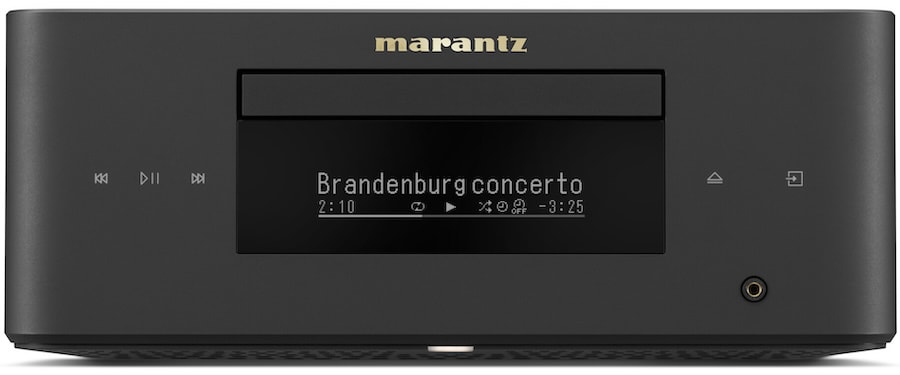
The compact all-in-one hi-fi category is getting crowded for a very good reason. A growing number of listeners want serious two-channel performance without a rack full of components, but they also aren’t necessarily willing to abandon CDs, vinyl, streaming or their television just to simplify the system.
That has created an interesting opening between traditional integrated amplifiers and the new generation of streaming amps from Eversolo, WiiM and others. Marantz is jumping directly into that space with the new MCR 60n, a $1,000 compact all-in-one hi-fi system designed to handle both physical media and modern streaming without requiring consumers to build an entire stack of separate components. Marantz calls it its most capable compact music system to date.
More importantly, the MCR 60n arrives at exactly the same $1,000 price as the Marantz MODEL M1, which raises an obvious question: does Marantz now have two very different answers for the same customer?
Related Reading:
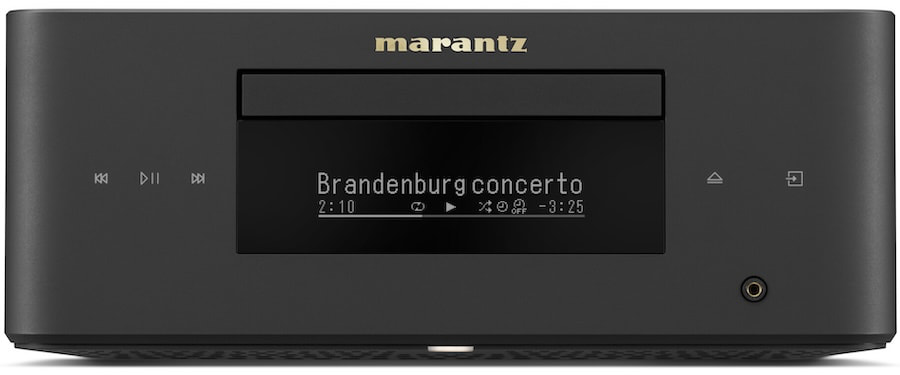
Marantz MCR 60n: More Than Just Another Streaming Amplifier
According to Marantz, the MCR 60n is its most capable compact music system to date.
Inside its durable and stylish chassis, the MCR 60n combines CD playback, network streaming, HDMI eARC compatibility, turntable connectivity, and premium amplification designed to deliver Marantz sound quality without unnecessary user complexity. With amplification built in, all you need is a good pair of speakers and you are ready to go.
Tuned by the Marantz Sound Master, the MCR 60n combines decades of hi-fi heritage with the latest streaming technologies in a single component.
Whether you are streaming hi-res music, playing discs from a CD collection, connecting a turntable, or upgrading your TV sound, the MCR 60n brings multiple sources together within one intuitive system designed to fit naturally into modern living spaces. Its compact footprint makes it equally suitable for a dedicated listening room, home office, bedroom, or living room, while Matte Black and Marantz Champagne Gold finishes provide two distinct design options. Champagne Gold, however, will not be available in North America.
Output Power & Speaker Configuration
To optimally support the Marantz sound, its new power supply is designed to provide greater current capability and increased amplifier headroom compared with older models. According to Marantz, this results in improved dynamics, stronger bass performance, and greater control across a wider range of loudspeakers.
Output power has been increased to 65 watts per channel into 4 ohms, providing a substantial performance improvement over its predecessor while maintaining the warm, detailed, and emotionally engaging Marantz sound signature.
With four channels of amplification, including Bi-Amp, Parallel Bridge-Tied Load (BTL), and dual speaker outputs, the MCR 60n allows users to optimize performance for different loudspeaker configurations or power two independent listening zones from a single compact amplifier.
Content Access
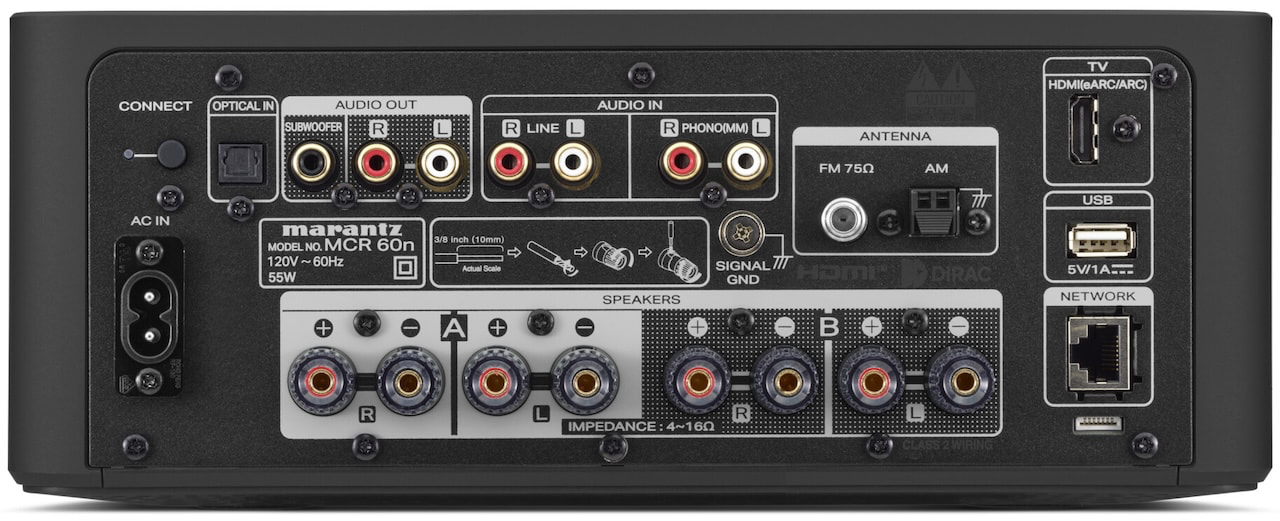
For additional audio input flexibility, the MCR 60n also includes HDMI eARC. This allows easy integration with modern TVs, enabling high-quality stereo playback of TV sound while supporting HDMI-CEC volume control and Dolby Digital and Dolby Digital Plus decoding.
Pro Tip: Keep in mind that Dolby Digital and Dolby Digital Plus are mixed down to two channels by the MCR 60n.
For vinyl enthusiasts, an included MM phono stage makes connecting a turntable easy, while a precision-engineered front-loading CD mechanism continues Marantz’s longstanding tradition of compact disc playback.
High-resolution music streaming is supported with PCM up to 384kHz/32-bit and DSD up to 11.2MHz, all powered by the latest HEOS networking platform. Built around the latest generation of HEOS, the MCR 60n provides a faster, more intuitive setup experience, along with access to streaming services, internet radio, and whole-home multi-room audio.
Spotify, TIDAL, and Qobuz Connect are supported, along with AirPlay 2 and Roon Ready, giving users plenty of flexibility in how they choose to stream music wirelessly.
Four customizable Smart Select presets provide instant recall of favorite sources, listening modes, and volume settings with a single press of a button on the remote control.
Bluetooth functionality has also been expanded with both receive and transmit modes. This means you can send music from your phone to the MCR 60n or use wireless headphones to listen to music and TV content without disturbing anyone else.

Optimization for Any Room
A configurable subwoofer output with adjustable crossover settings is provided for more precise low-frequency integration, while Dirac Live Room Correction is available as an optional upgrade for stereo playback. If users take advantage of that option, they can calibrate the system for their listening environment to improve imaging, tighten bass response, and achieve greater tonal accuracy.
For added setup flexibility, variable audio outputs are also included. This allows the MCR 60n to function as a streaming preamplifier, making it equally suitable for driving active loudspeakers or integrating with existing Marantz components and vintage hi-fi systems. An Ethernet network port, USB input, optical digital input, and DAB tuner (Europe only) round out the feature set.
MCR 60n Specifications
| Marantz Model | MCR60n |
| Product Type | All-in-One Hi-Fi System |
| Price | $1,000 |
| Number of Channels | 2 or 4 |
| Power Output | 2 x 65 W or 4 x 33 W |
| CD Compatibility | CD / CD-R/RW / WMA / MP3 |
| Tuner | FM / AM (US) DAB / DAB+ (Europe) |
| Network audio streaming | Yes |
| Streaming Support | Spotify Connect / TIDAL / Deezer / Amazon Prime Music / Pandora |
| AirPlay 2 | Yes |
| Roon Ready | Yes |
| Internet Radio | TuneIn |
| HEOS Multiroom and Streaming | Yes |
| Bluetooth | Yes – Includes AptX |
| Bluetooth Headphone Transmission | Yes |
| USB Audio | DSD / WAV / FLAC / AIFF / ALAC |
| Lossy formats | MP3 / WMA / AAC |
| Lossless formats | DSD / WAV / FLAC / AIFF / ALAC |
| Gapless Playback | Yes (FLAC, WAV, DSD) |
| Dirac Live Upgradability | Yes |
| Tone Control | Bass / Treble / Balance |
| Low Noise OLED display | 3 line |
| Clock | Yes – with programmable timer and sleep timer |
| Audio Inputs | 1 x Analog 1 x Digital Optical 1 x HDMI-eARC |
| Audio Outputs | 1 x Analog 1 x Subwoofer 1 x Main/Preout (AUX Assignable) 1 x Headphone |
| Speaker Outputs | Screw Type Terminals Speaker A/B with individual volume control Bi-amp Parallel BTL |
| Freq. Response (Analogue In) | 10Hz – 40kHz |
| Signal to Noise Ratio (audio) | 90 dB |
| Input sensitivity/impedance (Analogue In) | 200mV / 30 kohms |
| Total Harmonic Distortion 1 kHz, 5 W, 4 Ω / ohms | 0.1% |
| Remote Control | Yes |
| Ethernet / WiFi | Yes |
| Power Consumption | 55 watts |
| Standby Consumption | 0.3 watts |
| Dimensions (WDH) | 280 x 303 x 111 mm 11.0 x 11.9 x 4.4 inches |
| Weight | 4.2 kg 9 lbs 4 oz |
| Included in Box | Main unit AC cord Remote control, batteries FM antenna AM antenna Quick start guide |
Who Does the Marantz MCR 60n Compete With?
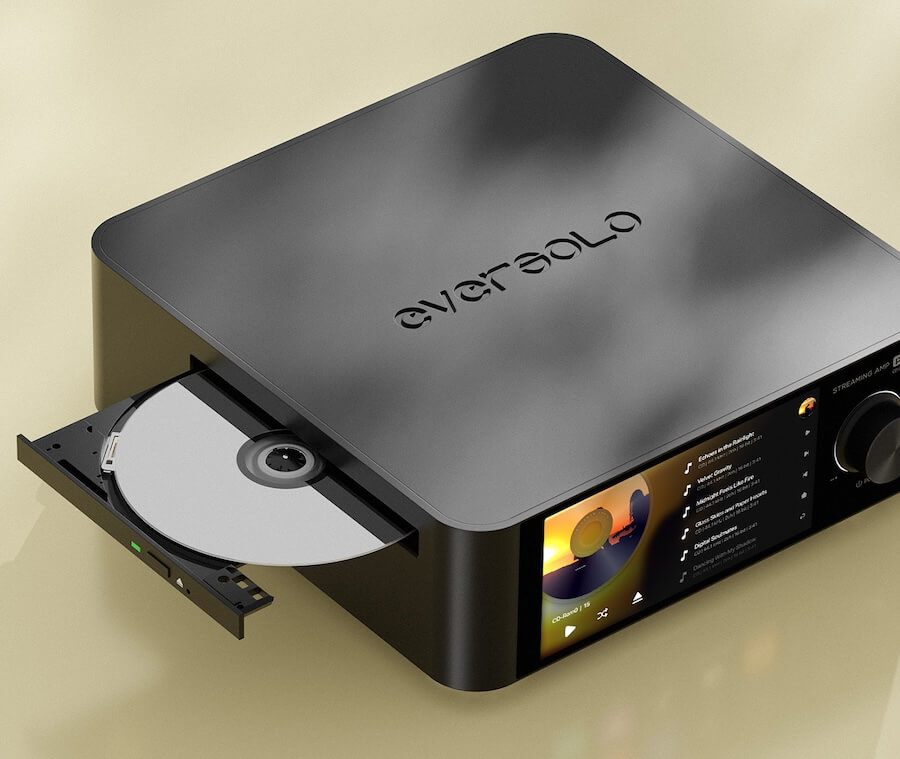
The Eversolo Play CD Edition (2025 model) is a challenger sitting across the table. At $799, it already combines streaming, amplification, HDMI ARC, a phono stage, room correction, a large touchscreen and a built-in CD drive. It delivers 60 watts per channel into 8 ohms and offers the kind of interface and feature set that has made Eversolo one of the fastest-moving brands in this category.
And here is where Marantz has to earn the extra $201.
The MCR 60n offers HDMI eARC, HEOS, AirPlay 2, Roon Ready support, Bluetooth transmit and receive capability, Dolby Digital and Dolby Digital Plus decoding, and optional Dirac Live. It also carries a name that has been sitting in hi-fi racks for more than 70 years, which still matters to a lot of consumers.
But purely on features and price? Eversolo is not going to make this easy.
For buyers who want the touchscreen, CD ripping capability and maximum functionality for the money, the Play CD Edition looks very difficult to ignore.
The Bottom Line
Marantz has clearly noticed two things: compact streaming amplifiers are everywhere, and CDs have stubbornly refused to disappear.
The new Marantz MCR 60n is the company’s $1,000 answer to both trends, combining a front-loading CD player, HEOS network streaming, HDMI eARC, an MM phono stage, USB and optical inputs, subwoofer connectivity and 65 watts per channel into 4 ohms inside one compact chassis. Optional Dirac Live Room Correction is also part of the package, and the MCR 60n can even operate as a streaming preamplifier with active loudspeakers or an existing hi-fi system.
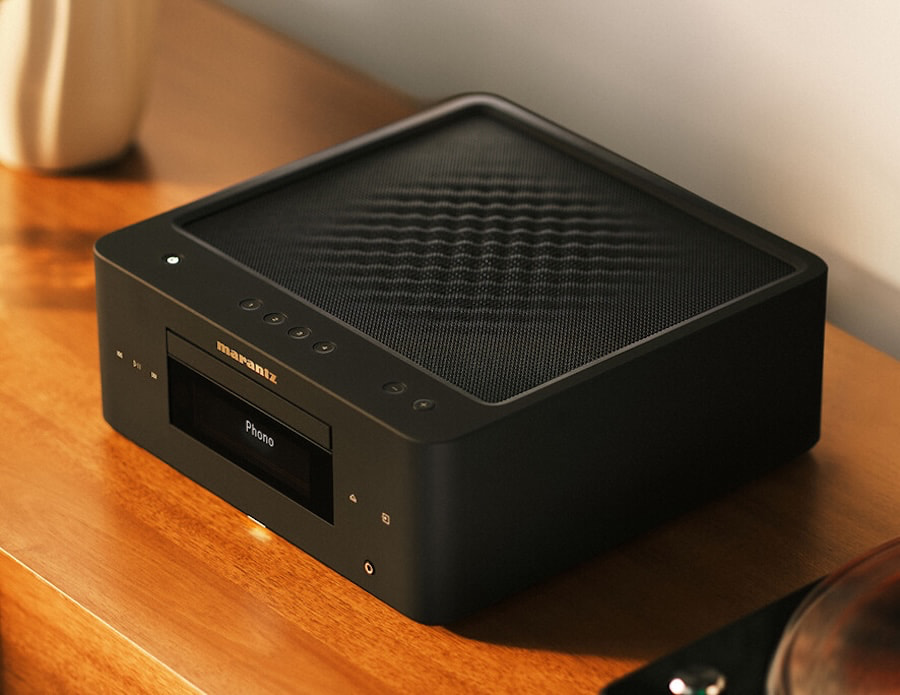
That makes this considerably more interesting than another streaming amplifier with an app and a Class D output stage. Marantz is effectively betting that there is still a large group of listeners who stream Qobuz or TIDAL, watch television through HDMI eARC, own a turntable, and have a shelf full of CDs that they have absolutely no intention of throwing away. Considering where the market is going, that does not feel like a particularly risky wager.
And then things get slightly awkward.
The MCR 60n costs exactly the same $1,000 as the Marantz MODEL M1, one of our favorite compact streaming amplifiers and an Editors’ Choice winner earlier this year. The M1 offers considerably more amplifier power, but no CD player and no phono stage. The MCR 60n gives up some horsepower and responds with considerably greater source flexibility. Marantz has effectively created two different answers to the same $1,000 question.
Price & Availability
The Marantz MCR 60n is priced at $1,000 and is available from Marantz or Authorized Marantz Dealers.
Note: The similarly named Marantz Model 60n is a $1,600 streaming amplifier without CD playback released in 2024.
Related Reading:
An anonymous reader quotes a report from The New York Times: OpenAIsaid on Tuesday that its newest artificial intelligence technology had solved one of the “Millennium Problems,” a collection of important unanswered math questions meant to push the world’s leading mathematicians to new heights. The announcement is an another clear sign that A.I. is fundamentally changing the upper reaches of mathematics, which have long been viewed as a pinnacle of human achievement. The change has excited some mathematicians, while stirring concern among others.
Over the past year, A.I. systems successfully solved a wide range of problems that have bedeviled mathematicians for decades. But these problems were not as complex, nor as closely watched, as the one that OpenAI’s technology has solved over the past several days. The Millennium Problems are among the most heavily researched in the field. “This is a spectacular culmination of the arc we have seen over the past twelve months,” OpenAI researcher Sebastien Bubeck said of the company’s new solution.
The company announced that one of its latest models, which has not yet been released to the public, needed just 88 hours to solve what mathematicians call “the Navier-Stokes existence and smoothness problem.” This problem involves a series of equations that are often used to predict the weather. The equations describe the movement of water and other fluids. The Navier-Stokes problem, which has no clear practical value, asks whether these equations completely break down in certain situations. OpenAI’s proof claims to have defined just such a situation.
This would imply, at least theoretically, that the laws of physics themselves would break down under certain conditions: that, for example, water could be made to spontaneously explode. But mathematicians and physicists do not believe that this mathematical breakdown could really lead to such an outcome in the physical world. The Navier-Stokes problem was one of seven “Millennium Problems” selected by the Clay Mathematics Institute in the year 2000 as a way of tracking the progress of mathematics in the new millennium. The institute, founded by an American businessman named Landon T. Clay, offered a million dollars for the first correct solution to each problem. Before OpenAI’s announcement, only one of the problems had been solved. OpenAI says it managed to solve the Navier-Stokes problem by coordinating as many as 10,000 AI agents, an extremely expensive process that may have cost millions of dollars in computing power.
For those curious about the findings, the company has released a paper (PDF) and formal Lean proof.
Read more of this story at Slashdot.

The Drums – Money

private prescribing is lowest where need is greatest

PC Jeweller shares jump 4%, surge 38% in one week. What’s polishing the stock’s shine?

Memory prices are slowing because buyers ran out of money

Phones confiscated, players sent home: Pakistan’s England tour turmoil revives memories of Mohammad Amir, Salman Butt and Mohammad Asif’s 2010 Lord’s spot-fixing scandal | Cricket News

England up in reading, maths and science rankings as Scotland and Wales dip


-
Tech23 hours ago
Memory prices are slowing because buyers ran out of money
-
Sports1 day ago
Phones confiscated, players sent home: Pakistan’s England tour turmoil revives memories of Mohammad Amir, Salman Butt and Mohammad Asif’s 2010 Lord’s spot-fixing scandal | Cricket News
-
 NewsBeat21 hours ago
England up in reading, maths and science rankings as Scotland and Wales dip
-

 Business1 day ago
Egyptian TV Presenter Sarah Khalifa, 11 Others Sentenced To Death In Major Drug Trafficking Case In Cairo
-

 Crypto World1 day ago
Visa expands stablecoin card network to 160 programs
-
 Tech1 day ago
Strong Password Policy and Password Manager Guide
-
 Crypto World21 hours ago
Brent Crude Oil Moves Above $100 for the First Time in 3 Months
-
 NewsBeat20 hours ago
Tehran’s assertive rhetoric signals a new and dangerous phase in conflict
-

 Crypto World10 hours ago
Ethereum price stalls below $2,500 as ADX drops to 11
-

 Tech20 hours ago
Google’s revived nuclear power plant gets $1.9B loan from US government
-

 Crypto World18 hours ago
Robinhood Stock: How To Take Advantage With Reduced Risk
-

 Sports17 hours ago
Ballon d’Or 2026 Nominees: Lionel Messi In, Cristiano Ronaldo Out; Erling Haaland Included In Top 30
-
 Business14 hours ago
Oil Higher on Hormuz Escalation, Weighing on Sentiment
-

 Crypto World18 hours ago
Intel Stock Jumps 9% on Chip Price Hike Report, US Stake Gains $36 Billion
-

 Politics24 hours ago
Critics Rip Trump After He Revives His Most Dubious 9/11 Claim
-

 Politics20 hours ago
The Ultimate September Reset Guide: How To Refresh Your Mind And Life This Autumn
-
 Tech14 hours ago
Meta debuts its Muse AI agent. Will consumers trust it?
-

 Crypto World10 hours ago
Bitcoin price risks $76K drop as $78K support weakens
-

 Business1 day ago
Claim Your Share Of $50 Million Disney Streaming Price Settlement By Sept. 8 Tonight
-
 Crypto World1 day ago
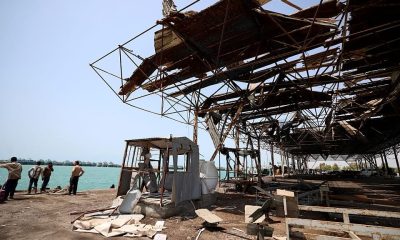
Iran Threatens to Target U.S. Energy Assets in Gulf If U.S. Strikes Again
You must be logged in to post a comment Login