

Join Mikko Hyppönen and security leaders from the NFL, CHANEL, and Atlassian for a two-hour digital summit on what AI-speed attacks change, what defenders should stop doing, and how to validate, decide, fix, and re-validate at machine speed.
Tech
The improbable music of the ZX Spectrum’s one-bit speaker



OFFBEAT
Ingenious coders coaxed multichannel chiptunes from the humblest of sound hardware
Even for 1982, the Sinclair ZX Spectrum had poor sound: a piezoelectric speaker that could beep. But you can do a lot with a single bit if you turn it on and off really fast.
Michael Martin’s Bumbershoot Software site has done some fascinating deep dives into several long-gone computer systems, including a whole series on implementing a game on the ZX Spectrum, starting in May with Giving the ZX Spectrum a Fair Shake.
More recently, though, Martin turned his attention to the Spectrum’s very limited sound capabilities. As we write, his newest post is Experimenting With 1-Bit Sound. The post concerns the original 16K and 48K ZX Spectrum models, not the Spectrum 128, with its fancy AY-3-8912 sound chip (also found in the US Timex Sinclair 2068).
Even as devoted Spectrum enthusiasts, we didn’t expect an article about the machine’s limited sound hardware to lead to hours of listening pleasure.
The Manic Miner intro music, after all, is a fair representation of early Spectrum chiptunes. (Turn your speakers way down before you listen!)
The ZX Spectrum could play music from the outset – Steven Vickers’ original Spectrum BASIC Manual includes the code for a tiny fragment of Mahler.
As The Register reported in 2015, Matt Westcott’s Mahler Project used a networked collection of original Spectrum computers to play all the parts of Mahler’s First Symphony.
Over at Bumbershoot Software, Martin is interested in programming the very limited hardware of these early home computers, and so his Spectrum audio post discusses audio-encoding methods, pulse-width modulation, and more in considerable depth. Toward the end, it links to a remarkable music demo called We are Vocoders.
A discussion among Spectrum aficionados on Hacker News then led us to the astounding work of Tim Follin in the 1980s. (The Video Game Music Preservation Foundation has an excellent profile, including a contemporary photo. Dean Benfield’s touching tribute to his brother Geoff has a more recent picture.) Follin hand-coded the music for Spectrum games such as Mastertronic’s Agent X…
And indeed Agent X II…
And Raw Recruit…
There are many more remarkable Follin tracks, including the music for Future Games, and the title music for Chronos.
Follin achieved this without additional hardware such as the RAM Music Machine – which even impressed the great Aphex Twin. There are also some very impressive demos, such as Dark Fusion by the late Ben Daglish.
Rich “Tufty” Hollins even created an entire half-hour album of one-bit audio, ON and OFF. You can listen to it in its entirety on Bandcamp, or accompanied by some Spec-tastic graphics on YouTube. ®
Continue Reading
Fusion power is getting back to its roots. As fusion startups keep chasing their ultimate goal — putting electrons on the grid — many are also now embracing, or returning to, the defense applications that laid the foundation for the industry.
The sector emerged decades ago when physicists looked for more constructive uses of the science behind the thermonuclear bombs that proliferated during the Cold War. The national security angle never really went away. A groundbreaking fusion power experiment in 2022 happened at the National Ignition Facility, which has supported national security applications for more than 25 years.
That shift has accelerated as venture dollars committed to climate tech — the funds that typically have supported fusion startups — have stalled. Fusion startups have captured a large portion of recent climate tech funding, but fusion is an expensive business, and VCs are always happy when their portfolio companies find other sources of money.
That’s where the defense industry comes in. The defense industry has explored laser weapons for years, but interest has spiked as drones have reshaped modern warfare. Traditional air defense systems were designed to target human-piloted aircraft, which tend to be larger and fewer in number. That has led to some comical mismatches between aggressor and defender. For example, about a decade ago, a U.S. ally used a $3 million Patriot missile to shoot down a $200 consumer drone. Effective, but not very efficient.
Laser weapons promise to alter the math. Instead of firing a single, expensive, one-use missile per shot, hey fire quickly and relatively cheaply, using electricity drawn from a generator or a ship’s reactor or engine.
Fusion startups working on laser-based reactor designs are ideal partners in developing such weapons. Last week, laser-based fusion startup Xcimer announced a partnership with and investment from RTX, the conglomerate that includes defense contractor Raytheon. Under the deal, Xcimer gets funding from RTX Ventures, while RTX can start exploring how to use Xcimer’s powerful lasers for its own purposes.
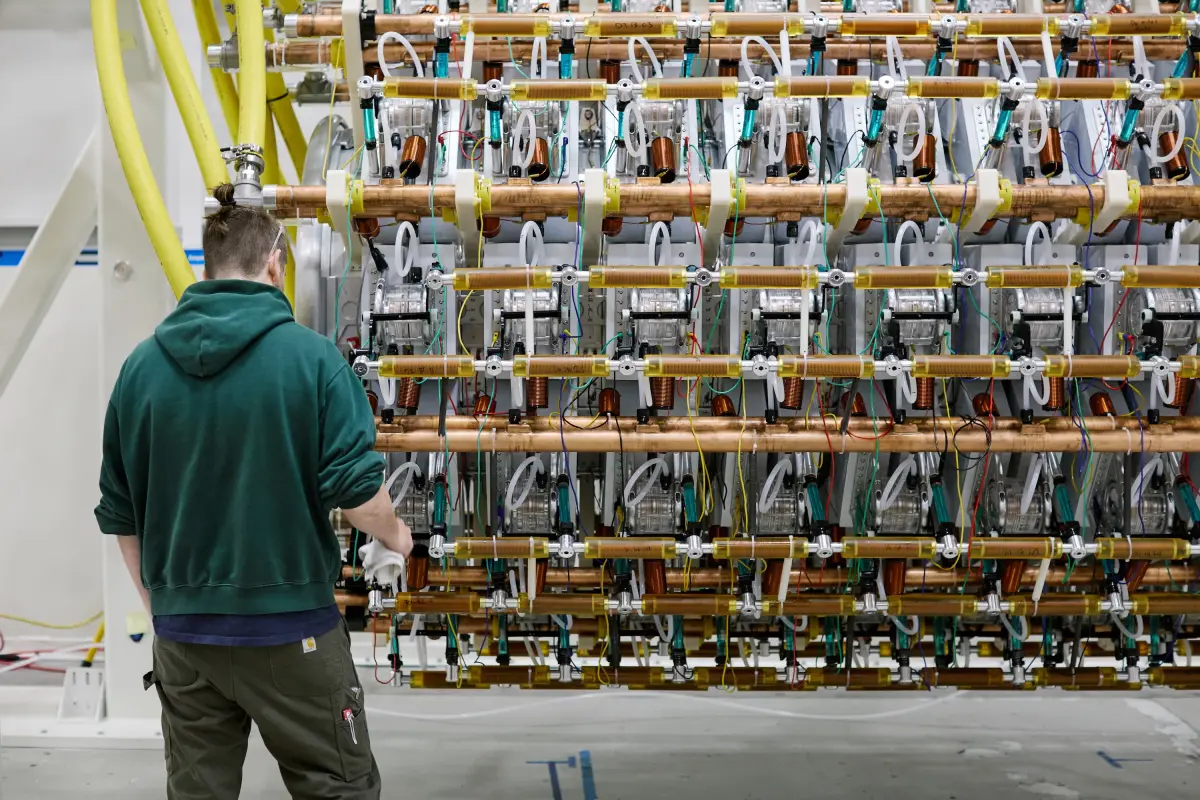
Denver-based Xcimer currently operates what it says is the largest privately owned laser system in the world, which it plans to use to develop a power plant. Inside its power plant, lasers will bombard fuel targets, compressing them until the atoms inside fuse and release energy. The startup’s current laser system, Phoenix, operates at an order of magnitude lower power than will be required for a power plant, but it is powerful enough to have caught the attention of the defense industry.
Xcimer isn’t the only player in the defense space. Pacific Fusion announced a memorandum of understanding last month with the National Nuclear Security Administration (NNSA) to work together on high-energy-density fusion experiments.
The startup recently broke ground on a demonstration facility in New Mexico not far from the Sandia and Los Alamos National Laboratories. While its primary purpose is to demonstrate that the company’s design can generate more power than the facility consumes, it has other uses. The fusion reactions at Pacific Fusion’s facility will be far more powerful than those the government currently uses to perform nuclear weapons experiments.
“It turns out that the facility that we’re building also has utility in this world-leading defense application,” Keith LeChein, co-founder and chief technical officer at Pacific Fusion, told TechCrunch recently.
It might sound like a convenient coincidence, but it isn’t one. Defense applications were “always on our mind,” said Carrie von Muench, co-founder and chief operating officer at Pacific Fusion. LeChien, who developed the company’s core technology, previously worked at Sandia National Laboratories, the Lawrence Livermore National Laboratory, and the National Nuclear Security Administration.
Fusion power has come a long way since the first weapons scientists dreamt it up decades ago, but its national security applications haven’t been forgotten. Their recent reacquaintance is perhaps overdue, and promises to give willing fusion startups a helpful boost.
When you purchase through links in our articles, we may earn a small commission. This doesn’t affect our editorial independence.

Apple has stuck to a familiar iPhone launch schedule for years, with its latest models typically arriving like clockwork every September. But this year, the regular iPhone 18 was nowhere to be seen.
While some might be disappointed by the six-month delay, I think Apple made the right call. Not only does it give the long-awaited foldable iPhone more room to shine, but it also highlights an uncomfortable truth about modern smartphones: we probably don’t need a new one every 12 months.
Apple has broken tradition for the first time in years
September is known for one thing in the tech calendar: new iPhones. Apple has stuck to the same launch schedule for its iPhone collection for years at this point, a trend it kicked off back with the iPhone 4S. Yes, there have been a few slips here and there – it shifted to October in 2020 during the height of Covid, for example – but for the most part, flagship iPhones have launched in September.
But not this year.

For the first time ever, Apple decided against launching the base-level iPhone alongside its Pro-level siblings. We saw the iPhone 18 Pro and Pro Max, complete with the rumoured variable aperture on its main 48MP camera, big battery upgrades and boosted Apple A20 Pro power, but the regular iPhone 18 was a no-show.
Instead, the rumours suggest that Apple is holding off on launching the iPhone 18 for another six months, with plans to reveal it alongside the next-gen iPhone Air and the iPhone 18e at an event in Spring of 2027.
It’ll likely appear sometime between March and May; while the flagship iPhone hasn’t launched in Spring before, Apple has used the window to launch other variants of iPhone – namely the budget-focused iPhone SE and iPhone ‘e’ models – and products like the iPad Pro and iPad Air.
Blame the foldable iPhone
Of course, we know the real reason that Apple didn’t launch the iPhone 18 earlier this week – the iPhone Duo. Apple’s first foldable iPhone has been a long time coming, with rumours circulating for literally years at this point, and it had to be a big part of the September launch event.

It makes sense too; this is the first time Apple has debuted a phone in this form factor, and it has done so years after much of the Android competition, so it needed to take more time to explain what makes it so special.
While the segment for products like the Apple Watch Series 12 and Ultra 4 was over in a little over 12 minutes, Apple took around 25 minutes to showcase the foldable iPhone, from hardware elements like the hinge, dual-cell battery design, screens and cameras, to small software additions that really elevate the foldable experience on the whole.

Now there is an argument that Apple could’ve simply extended the event to make room for the iPhone 18, and that is true, but I imagine there were fears from Apple execs that it’d simply get lost in the shuffle with the more advanced (and more exciting) Pro and Duo models.
It’s clear that those models would get most attention from attendees, media and likely diehard Apple fans, not giving the regular iPhone 18 a chance to really shine. By separating the launches by six months, Apple likely hopes that the iPhone 18 will get the attention it deserves, rather than being a more basic version of the shinier, cooler iPhones.
In reality, we don’t need a new iPhone every year
Now I don’t think this was Apple’s intention by shifting the iPhone 18 launch by six months, but it has really got me thinking; do we really need a new model of iPhone every 12 months? Now, more than ever, probably not.
The iPhone 17 remains just as capable a smartphone as it was just a year ago. It has a fantastic screen with a smooth 120Hz refresh rate, capable dual 48MP cameras, solid battery life and great performance that still beats much of the Android competition. And, anecdotally, it seems like it’s more popular than ever; I know three people who have bought one in the past six weeks.

And, let’s be honest, the iPhone 18 probably won’t be that much better. It’s not like it was a decade ago when each generation would represent a massive leap forward in tech; nowadays, yearly upgrades are much more incremental – a chip bump here, a slight boost to battery life there – while big overhauls and genuinely shiny new tech are much rarer.
With that shift, it doesn’t really make as much sense for manufacturers to launch new phones every 12 months. I’d argue that waiting a little longer and implementing more meaningful upgrades and tweaks would be the far better play. Let’s make phone launches genuinely interesting again, guys.
That said, with the launch of the iPhone 18 Pro, there are newer generations of iPhone now available, and the iPhone 17 is a year old, so a price cut to reflect this slightly older status would’ve been a nice way to placate fans.
But instead, Apple quietly did the opposite, raising the price of the iPhone 17 – along with the iPhone Air and iPhone 16 – by £100 in the UK and $100 in the US following Wednesday’s event. I mean, I get it: RAM and storage are more expensive than ever, and the new iPhones are also £/$100 more than last year, but it does feel a bit cheeky.
Either way, I do think that Apple was right to delay the launch of the iPhone 18 – though likely not for the same reasons as those at Apple Park.
Microsoft Excel users report that this week’s KB5002914 Office security update is breaking copy-and-paste operations and formula dragging, with affected users saying that removing or rolling back the update restores normal functionality.
Microsoft released the security update this week as part of its September 2026 Patch Tuesday, and reports of the problem soon appeared on both Reddit and the Microsoft Q&A forums.
“It seems that security update kb5002914 might have bricked autofill and copy paste in Excel 2016,” a Reddit user reported.
Other users confirmed similar problems, with one saying copy and paste and formula dragging no longer worked and that their entire team was blocked after most employees had already installed the update.
Another user reported that copy/paste shortcuts and formula dragging no longer worked.
Similar reports have appeared in the Microsoft Q&A forums, where users say copying and pasting no longer work after the September 9 update.
Reports indicate the problem isn’t limited to a single Office release or installation method.
One user reported the same issue on Office LTSC Standard 2021, while another said it affects both MSI and Click-to-Run installations and Office versions ranging from 2016 through 2024.
Removing or rolling back the update restores functionality
Affected users report that uninstalling KB5002914 from MSI-based Office installations restores Excel’s copy-and-paste functionality.
One Microsoft Q&A user shared the following PowerShell command for removing the update:
& "C:\Program Files\Common Files\Microsoft Shared\OFFICE16\Oarpmany.exe" /removereleaseinpatch "{90160000-0012-0000-1000-0000000FF1CE}" "{27882596-A8ED-4382-9C71-6CD2DD19F732}" '1036' "0"
“This worked for me; copy-and-paste is working again,” the user reported.
For Click-to-Run installations, another user said downgrading the Office build using XML or Group Policy also resolves the problem.
Another workaround being shared among affected users involves leaving KB5002914 installed but replacing the updated excel.exe executable with an older version.
BleepingComputer does not recommend using this workaround, as replacing individual Office binaries with files from an older version could leave the installation with mismatched files and potentially cause other stability, compatibility, or security problems.
Microsoft told BleepingComputer that it is aware of the reports and is investigating, and will share guidance as it becomes available.
Update 9/11/26: Microsoft has now formally acknowledged the bug, adding it as a known issue to the KB5002914 release notes.
“In Microsoft Excel 2024, 2021, 2019, and 2016, the paste operation might fail silently. Although users try to paste content, the source remains selected and the destination is unmodified. When this issue occurs, users receive no indication of the failure, such as a beep or error message. Microsoft is researching the issue and will post more information in this article when the information becomes available.”


America’s highest court heard Sam Bankman-Fried’s request for a new trial on Thursday, CNN reports. But they add that “the former crypto mogul who was convicted of defrauding investors by secretly diverting billions of dollars of their money” also asked America’s high court “to throw out a court order requiring him to pay $11 billion as part of his sentence.”
Bankman-Fried was sentenced to 25 years in prison in 2024 after prosecutors said he directed billions of dollars from the crypto exchange FTX to a hedge fund he controlled called Alameda Research, where the funds were used for risky investments, political donations and his own personal benefit. The Supreme Court appeal, which was reviewed by CNN, raises a technical question about evidence that was submitted at his trial, and whether Bankman-Fried should have been permitted to demonstrate that his investments were ultimately sound and would have covered any losses by FTX customers.
He also argues that the $11 billion forfeiture violates the 8th Amendment’s prohibition on excessive fines. “Where the government pursues a theory of fraud under which it doesn’t matter whether any victims lost money, introducing evidence suggesting that people actually lost money is distracting and prejudicial,” veteran Supreme Court attorney Jeffrey Fisher told CNN. “All the more so where the truth is the victims did not lose money, and the defendant is unable to make that clear.”
The 2nd US Circuit Court of Appeals rejected the arguments earlier this year.


Read more of this story at Slashdot.
“This is what happened when we tried to record Flock installing a new camera on public roads,” says Emmy award-winning reporter Brendan Keefe in a new video for InvestigateTV. In an accompanying article, InvestigateTV says their reporter “parked on the public street at a distance, donned a yellow safety vest and a hat emblazoned with the logo of InvestigateTV’s Atlanta affiliate where he also works, displayed a press placard on his dashboard and then pulled out a camera to record the installation…. The installer saw him and immediately packed up his equipment and drove away, so Keefe also returned to his car and followed several cars behind, hoping to document the next stop.”
And then Flock’s technician called 911. When asked “What’s the address of your emergency” Flock’s technician answered “I’m getting followed — harassed, pretty much. Taking videos and pictures!” Flock’s worker said they’d been harassed multiple times that day, then stated incorrectly that “I know for a fact” that that was what the reporter wanted to do too.
InvestigateTV reports that as a result of the Flock technician’s call, “Three police cars ended up in the national investigative reporter’s rearview mirror that Wednesday afternoon.” Keefe told one of the three police officers who pulled him over, “There is an irony here that they’re setting up these cameras that track all of our movements, that follow everywhere we go. But when I try to get video in public of him in public setting up a camera, he’s afraid I’m following him?”
InvestigateTV also reports that “About 17 minutes after the stop began, the responding officers returned to their vehicles and Keefe was allowed to drive away.” But the call that brought three police cars to their reporter “was not the first time this summer someone working for Flock Safety summoned police over a camera. ”
About 17 minutes after the stop began, the responding officers returned to their vehicles and Keefe was allowed to drive away… [But the stop] was not the first time this summer someone working for Flock Safety summoned police over a camera. On June 5, police in Smyrna, Georgia, responded to a 911 call from a Flock employee after a group of YouTube creators began filming outside the company’s distribution center located in the Atlanta suburb… The caller claimed the group filming had “been driving around the perimeter, basically harassing everyone” working at the facility. “Three young white males, probably mid-twenties, I’m not sure if they’re armed. And they’re carrying filming equipment as well,” the caller said. Three times during the call he raised the possibility the people filming might be armed, though, when asked, he told the dispatcher he had not seen any weapons… [One of the protesters later told the caller “I think it’s interesting, when you guys have this happen, you call the police and make us get stopped. But then you do it and it’s okay?”]
No one was charged in the YouTuber group, though the individuals were ordered to leave the premises under an official trespass warning.
Keefe’s video report ends with one final irony. “Every day on my way to work, I’m captured again by those same new shiny Flock cameras. We tried watching the watchers. Turns outs, it’s a lot easier for them to watch us.”
Flock responded to the report by claiming “We do not object to members of the public or press photographing Flock cameras or personnel in public.” But they added that employees working “in the field” must “prioritize their safety” and “may contact law enforcement when they believe they are being threatened, harassed, followed, or otherwise face a safety concern.”
Read more of this story at Slashdot.
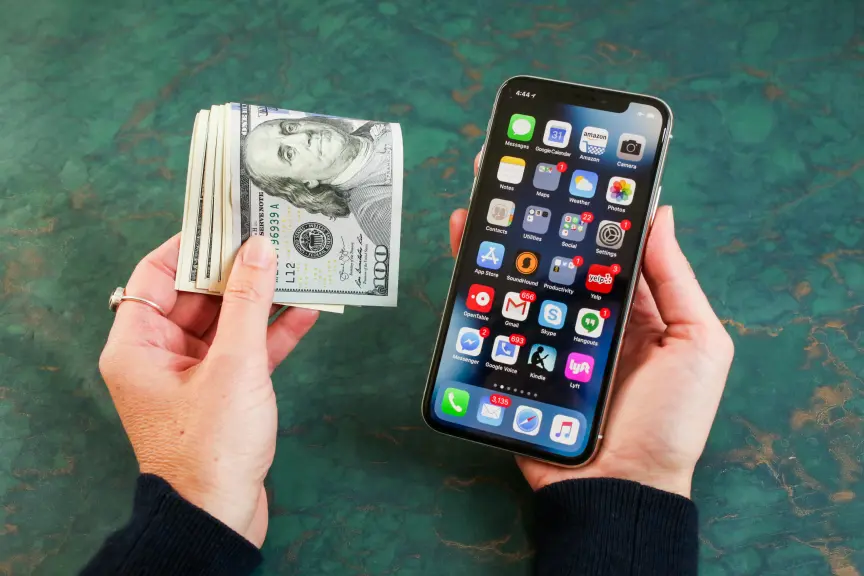
With phone prices climbing higher than ever, it’s no wonder most people turn to carrier financing to buy a new phone. Not only can you spread out your payments over time, but cellular companies often offer enticing deals to win customers over, especially if you’re switching to a new provider. Depending on the deal, sometimes you can even get your new phone for free.
But those deals can be a little confusing, and involve caveats and rules that aren’t always clear. Very rarely is a discount given without a catch. You might also come across terms like “bill credits” or “trade-in credits” that you don’t fully understand.
If you want to know what these terms mean or other details, like what happens if you decide to switch carriers midplan, read on as we walk you through what you need to know before accepting a new carrier deal.
This article was made possible in part by T-Mobile. It was written and edited independently without partner oversight.
What is carrier financing?

Simply put, instead of paying up front for a new phone, carrier financing lets you pay for the phone over time through an installment plan. So, for example, if a phone is $1,200, you can spread the cost over 24 months, which translates to just $50 a month. That’s a lot easier for most people to manage.
It’s worth noting that you will still need to pay upfront costs, like activation fees and taxes on the new phone, whether you’re on an installment plan or not. Sometimes carriers do offer deals that let you spread that out over time. T-Mobile, for example, has the Equipment Installation Plan Flex 36 that will spread out the payment of the device, fees and taxes over 36 months, making the initial cost zero. That said, you still need to qualify for the plan, and depending on your credit, you could have to pay interest on top of that.
One particular downside of carrier financing is that it locks you into that carrier for an extended period (usually two to three years). This means you can’t use your phone with another carrier during this time. If you want to end your agreement with the carrier, that will usually result in early termination fees, or ETFs.
Being stuck with a carrier-locked phone is sometimes bad news if you travel a lot and want to use international eSIMs, which only work with unlocked phones. Otherwise, you’ll have to use your carrier’s international data plan, which can be more expensive.
What are trade-ins and bill credits?

When shopping around for new phones, you might see the words “bill credit” or “trade-in credit” advertised by a carrier. For example, a carrier might offer a trade-in credit of up to $1,000 if you trade in your existing iPhone for a new one. Then they might say that the trade-in credit will be paid to you as 24- or 36-month bill credits.
What does all of that mean? First, let’s talk about that trade-in credit. Not all phones will be eligible for one. Often, the carrier will only give a trade-in credit for newer phones. The newer the device, the more trade-in credit you will get. So that out-of-date iPhone 11, for example, probably won’t be worth very much, if at all.
It’s also worth looking into what else is required for you to get that trade-in credit. Sometimes carriers will only offer the trade-in credit if you sign up for a more expensive monthly plan with services you might not need. Other times, however, the carrier just wants you to switch over, so you might not need to do that.
Let’s say you agree to the terms and the carrier offers you that $1,000 trade-in credit. Here’s where bill credits come in. If the carrier says the trade-in credit will be paid over 36 months of bill credits, it means that $1,000 will be paid off over the period of 36 months. You won’t get a lump sum of that $1,000 credit instantly, and the credits you do get can’t be cashed out and can only be used toward the amount of your phone bill.
But let’s say you don’t have a phone to trade in at all. You could still save some money if you don’t mind switching carriers. Sometimes carriers will offer to pay for your device as an incentive to switch over to their company. Again, device payments are often applied as bill credits spread over a 24- or 36-month period.
What happens if I pay off my plan early?

You can certainly pay off the remaining balance on your phone if you don’t mind paying the upfront cost. However, be warned that you’ll also forfeit any remaining credits you received for the device you traded in. You could also forfeit any other discounts that you agreed to upon signing up for the plan. Be sure to read through the early payoff rules before deciding to pay off your phone ahead of schedule.
What if I want to switch carriers?

If you want to switch carriers while you’re in an existing installment plan, you might have to pay ETFs to end your current agreement. However, most major carriers like T-Mobile, AT&T and Verizon will offer carrier-switching incentives where they’ll pay your ETFs for you. Bear in mind that there’s often a cap on how much of the ETF they will cover. The payment is also often in the form of bill credits.
You can take advantage of carrier deals when choosing this route. T-Mobile, for example, has a five-year price guarantee that locks in the price of text, talk and data for at least five years. AT&T is also attempting to draw new customers with a modular Build-A-Plan that lets you customize your plan according to your budget. Verizon recently introduced Simplicity, an unlimited phone plan that usually costs $45 a month, but is just $30 a month for new customers who bring their own number.



A Redmond, Wash., robotics software startup founded by former Microsoft researchers says its platform can now handle much of the work of getting a robot up and running in a factory, warehouse or other industrial setting, a job that used to take a team of engineers.
General Robotics said Wednesday that advances in GRID, its robot intelligence platform, have cut the process of onboarding a new robot from about a month to as little as two hours. The company calls the approach “Auto Engineering,” with each onboarded robot and diagnosed failure feeding back into the system and speeding up the next deployment.

“Before this moment, it would take us a team of experts to go and execute on behalf of our customers,” said General Robotics CEO and co-founder Ashish Kapoor in an interview. “Clearly non-scalable, clearly very expensive, and clearly will take a long time.”
With Auto Engineering, he said, “we can magnify and accelerate each engineer’s capability.”
Founded in 2023, the company has grown to about 50 employees, primarily engineers. It has raised nearly $34 million, most recently in an April round led by Construct Capital, with participation from Khosla Ventures, Accenture Ventures, Nvidia and Valo Ventures. PitchBook put the size of the round at $25 million; the companies didn’t disclose terms at the time.
Kapoor said General Robotics has roughly a dozen customers — large enterprises across manufacturing, logistics, energy and defense — and revenue in the millions of dollars.
Customers include HTX, the science and technology agency of Singapore’s Ministry of Home Affairs, which Kapoor said has been working with General Robotics for about a year and a half.
The company’s platform works with robot types including industrial arms, humanoids, quadrupeds, wheeled robots and drones, according to the company.
General Robotics is operating in a competitive and well-funded sector. Physical Intelligence, which builds foundation models for robots, has raised more than $2 billion. Nvidia — an investor in General Robotics, and the maker of the Isaac Sim simulation software built into GRID — is developing its own robot models and deployment tools.
Robot makers build good hardware, Kapoor said, but often lack the expertise to put it to work in a specific setting like a shipping terminal. “That last layer is missing.”
Before co-founding the company, Kapoor spent 17 years at Microsoft, ultimately as general manager of its autonomous systems and robotics research group in Redmond, where he created the open-source drone simulator AirSim. General Robotics co-founders Sai Vemprala (CTO) and Shuhang Chen came from the same Microsoft team.
GeekWire covered the launch in 2023, when it was Scaled Foundations and billed itself as “ChatGPT for robots.” It had five employees at the time, focused on aerial robotics and drones, with backing from Khosla and E14 Fund. It later renamed itself General Robotics.
Doom is such a simple, beautifully designed game that it can run on all sorts of weird things, from pregnancy tests to potatoes. Weird things can play it, too. In an effort to eternally one-up itself, the community has now gotten a map of a fruit fly’s brain to play the 1993 first-person shooter.
It started with Google, which partnered with HHMI Janelia Research and other collaborators to map the brain and central nervous system of a male fruit fly. This mapping, which is weirdly beautiful, contains 11,700 types of neurons and 166,000 neurons overall, breaking the record for the most complex neuron mapping ever done.
The research is pretty cool: It involved taking very thin slices of a fly’s brain and body, imaging them and using AI to combine the millions of 2D images into 3D neural shapes. Google says that “knowing the structure of the brain allows neuroscientists to understand the mechanisms behind brain function.”
Now, make it play Doom

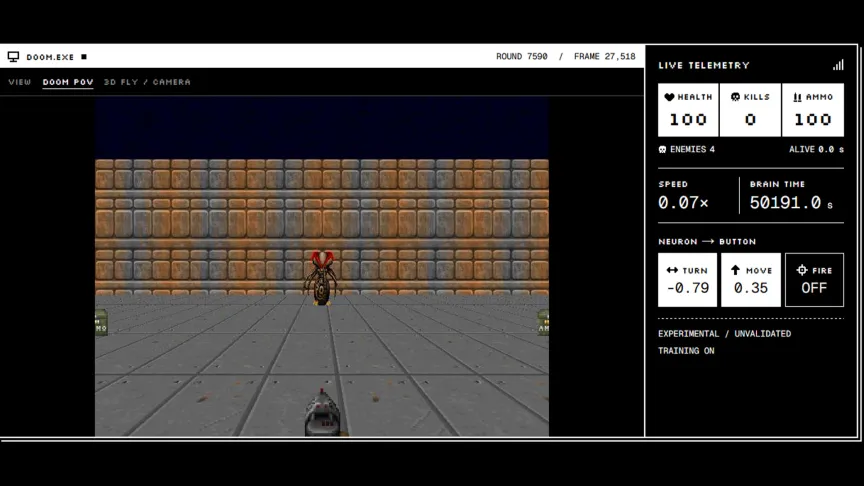
It turns out that knowing the structure of the male fruit fly brain can also help modders and developers teach it how to play Doom. A few days after Google dropped its fly brain research, software engineer Alex Wormuth created a simulated fly brain using Google’s map and then set it loose to learn how to play the pioneering FPS.
The process is quite complicated. Each frame of the game generates 3,335 brightness inputs and 811 R8 color inputs. These inputs are fed into the simulated fruit fly brain, which contains 25.6 million connections. These inputs hit specific neurons based on what the frame shows, and that information is used to determine which controls the fly uses. This process repeats each frame the game runs.
It even works with pain. Wormuth says that nonfatal damage targets the PPL101 dopamine receptors, which control hunger and aggression in real fruit flies.
You can watch the fly’s progress in learning how to play Doom on Wormuth’s Doomfly website, which also shows sensory input, neural activity and other metrics so you can watch the simulated fly brain work in real time. If you swap to the 3D view, you can watch the fly shoot demons.
Flying high with other games, too
Doom isn’t the only game that a simulated fly brain is learning how to play. Developer Jessica Paquette set up a similar neural network with the fly’s brain to learn how to play Super Mario 64, while mechanistic interpretability researcher Lyra Bubbles made another one learn how to play Beat Saber.
A few days later, X user David began teaching it how to do an escape room, and another, Shashank Jain, taught it how to play soccer. Wormuth came back a couple of days later and gave the fly brain $100 worth of bitcoin to trade to see what it would do. X user Simba made the fly brain deploy its own cryptocurrency token on Robinhood.
The fly brain experiment is going to have a lot more impact in neuroscience in the long run, but for at least the next few weeks, don’t be surprised if you see headlines about a fruit fly brain learning how to do other random stuff, like creating real fonts that you can download right now or putting it in music videos and letting it dance.

A reputable free VPN can be enough when its privacy practices and usage limits fit your needs. Paying generally buys more capacity, server choice, simultaneous connections, support, and advanced features, but it does not automatically make a VPN more private, secure, or faster.
The useful comparison is therefore not simply “$0 versus subscription.” You need to separate privacy evidence from product limits, distinguish an explicit speed restriction from congestion, and compare what a paid plan actually costs rather than relying on its advertised monthly equivalent.
Free VPN vs Paid VPN: What Actually Changes?
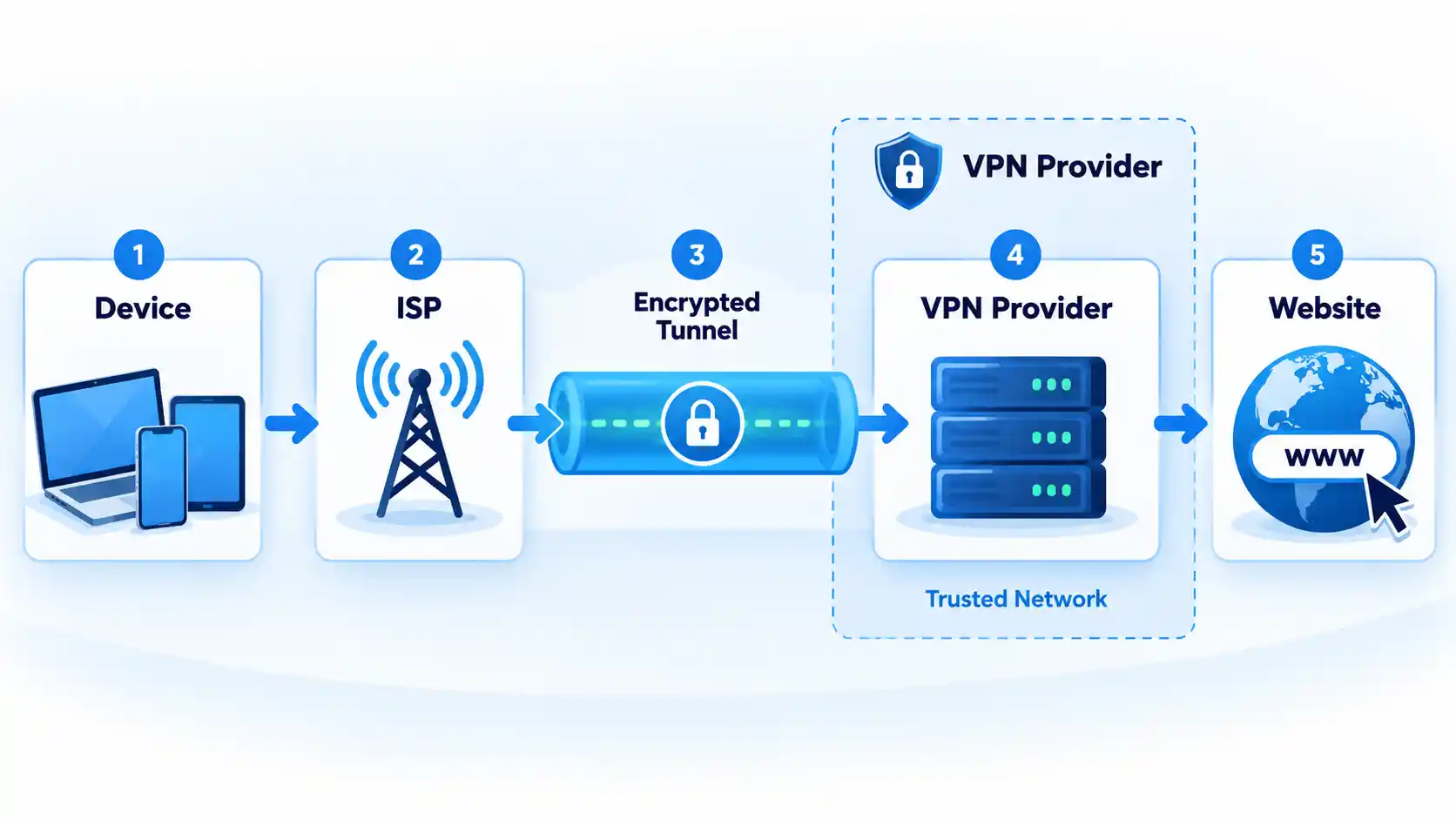
A virtual private network, or VPN, creates an encrypted tunnel between your device and a VPN server when the service and protocol are configured to provide that protection. Free and paid tiers from the same provider can use the same core VPN technology, while differing substantially in capacity, location choice, connection limits, and additional features.
Proton VPN is a useful example. Proton states that its free plan uses the same security level and no-logs policy as its paid plans, without a data, time, or routine speed limit. Its paid tiers add capabilities including broader server choice, more simultaneous devices, paid-plan streaming support, BitTorrent support, and advanced features. Proton’s free-versus-paid plan documentation also states that the free tier is limited to one device at a time.
That distinction matters because a free tier from an established provider is not necessarily a technically weaker VPN. Its main compromises may instead be data allowance, location control, device count, server availability, support, or premium functions.
Free VPN vs paid VPN at a glance
| Feature | Free VPN | Paid VPN |
|---|---|---|
| Subscription cost | No recurring subscription charge | Monthly, annual, or multi-year payment |
| Core VPN security | Can match the paid tier on documented freemium services | Provider-dependent; payment itself does not prove stronger security |
| Data allowance | May be unlimited or capped | Often removes a free-tier data cap |
| Server choice | Often restricted | Usually broader within the same provider |
| Simultaneous devices | Provider-dependent | May increase the connection allowance |
| Privacy | Depends on the provider, policy, implementation, and supporting evidence | Depends on the provider, policy, implementation, and supporting evidence |
| Performance | Can be affected by a smaller server pool, congestion, or plan restrictions | May provide more server choice or capacity, but faster performance is not guaranteed |
| Advanced features | Often limited | More likely to include additional routing, P2P, filtering, or support options |
There is no universal winner in that table. A free tier with unlimited data can be entirely adequate for one person, while someone who needs several simultaneous connections, precise exit locations, or paid-only features may encounter its limits immediately.
Privacy: Paying Does Not Automatically Make a VPN Trustworthy
Price is a poor shortcut for privacy. When a VPN is active, traffic is routed through infrastructure operated by the VPN provider, so the provider occupies a position of significant trust.
The U.S. Federal Trade Commission explains that a VPN can shift trust away from the local network or internet provider and toward the VPN operator. It also warns that VPN apps may request sensitive permissions, may share information with third parties, and do not make users completely anonymous. Although that guidance was published in 2018, its basic trust model remains applicable. The FTC’s VPN privacy guidance recommends examining the operator and its practices rather than relying on privacy marketing alone.
Recent research also shows why implementation matters. Work presented at USENIX Security 2026 describes observed VPN failure modes including real-IP leakage during tunnel failures, Domain Name System (DNS) queries escaping the tunnel, cleartext traffic, insecure configuration delivery, and advertising-ID exfiltration in the apps and providers studied. The USENIX Security 2026 presentation supports evaluating technical behavior rather than assuming that a paid label establishes security.
When a provider says it keeps “no logs,” check what that statement covers. A no-logs policy can address browsing activity and VPN-session information while the service still retains limited operational account data needed to administer an account or enforce a plan.
Windscribe provides a concrete example. It says a free account can retain a username, hashed password, an email address if supplied, the total bandwidth used during the current period, and a timestamp of last activity. It separately says it does not retain visited sites, DNS queries, the user’s real IP address, or traffic-linked session logs. Windscribe’s free-plan disclosure shows why operational records and browsing-activity logs should not be treated as the same thing.
Independent assessments can strengthen a provider’s claim, but they have a defined scope and date. Proton says its no-logs infrastructure completed a fifth consecutive annual third-party audit in 2026. Proton’s published audit history links the 2026 assessment and earlier reports. That is more useful evidence than an unsupported slogan, but it is not a permanent guarantee about every future app version or security failure.
Whether a VPN is free or paid, examine the provider’s privacy policy, ownership, requested application permissions, independent assessments where available, and the specificity of its technical claims. A subscription receipt is not privacy evidence.
Free VPN Limits: Data, Servers, Devices, and Features
The word “limit” can describe several different restrictions. A data cap limits how much traffic you can use during a period. A device limit controls concurrent connections. A server restriction limits the locations or infrastructure available to the account. None of those automatically means that every connection is deliberately slowed.
Windscribe uses a data-cap model. Its current free-plan page states that an account receives 2 GB per month without a confirmed email address or 10 GB per month with one, and that the free account can be used across unlimited personal devices. Its free server selection is smaller than the paid network. Windscribe documents the allowance and free-tier restrictions.
Windscribe’s current pages do not agree on the exact number of free countries: its main free-plan page lists 10, while a May 2026 support article says 11. Because the provider’s own documentation conflicts, the exact country count is not used here.
Proton takes a different approach. Its free plan has no monthly data ceiling, while paid service expands location choice, increases the connection allowance to as many as 10 devices on eligible paid plans, and adds features unavailable to free users. Proton’s VPN privacy policy says the free service generally has no speed restrictions but reserves the right to impose restrictions in cases of excessive consumption to maintain service quality on free servers.
The practical difference becomes clearer when you consider real workloads. A monthly allowance can be consumed by video, operating-system downloads, cloud synchronization, application updates, or other background traffic even when browsing itself is light. An unlimited-data plan avoids that particular constraint but can still restrict server selection, concurrent devices, or premium functionality.
Different services impose those restrictions in different combinations, so compare free VPN data allowances, device limits, and server restrictions rather than assuming every free tier makes the same compromise.
Speed: Why Paying Can Help Without Guaranteeing a Faster VPN
A paid tier can have a practical performance advantage when it provides access to more servers, additional locations, or infrastructure unavailable to free users. That does not establish a fixed speed difference between free and paid VPNs.
Throughput is the amount of data transferred over time. Latency is the delay between sending network traffic and receiving a response. Both can change because of server distance, congestion, protocol choice, internet routing, Wi-Fi conditions, packet loss, device processing limits, and the underlying connection.
A free plan can introduce another constraint. If free users share a smaller server pool, congestion can become more noticeable when demand rises. A provider can also impose an explicit free-tier speed restriction. Those are different mechanisms: congestion varies with load, while throttling deliberately limits performance according to a rule.
Proton is a useful counterexample to the blanket claim that free VPNs are always throttled. Its current documentation says it imposes no routine speed limit on Proton VPN Free, although free servers can have more users and its privacy policy reserves an excessive-consumption restriction. Paid plans provide broader server access and are marketed as offering faster performance. That supports a narrower conclusion: paying can give you more performance options, but it does not guarantee a particular speed.
No first-hand speed measurements were supplied for this article, so there is no defensible universal percentage showing how much faster a paid VPN is.
If performance is poor, price alone does not identify the cause. Server load, distance, protocol selection, local Wi-Fi, packet loss, routing, Maximum Transmission Unit (MTU) problems, and device processing can produce similar symptoms. VPN slowdown troubleshooting is therefore more useful than upgrading blindly when the problem has not been isolated.
Cost: Compare the Real Bill, Not Just the Monthly Headline
A free VPN has no subscription charge, but paid VPN pricing still requires careful comparison because providers use different billing structures.
Mullvad uses a simple model. In February 2026, it stated that its price remains €5 per month regardless of how long a customer pays for. Mullvad’s pricing statement makes the payment term and monthly rate relatively straightforward.
Windscribe illustrates a different structure. Its May 2026 pricing documentation lists Pro at $9 per month or $69 per year and describes Build-A-Plan as having a $3 minimum purchase. Windscribe’s current pricing explanation shows how monthly, annual, and configurable plans can coexist within one service.
Those prices should not be read as a direct cheapest-provider ranking because they use different currencies, products, and billing structures. Instead, use them to identify what needs checking before you buy:
- the amount charged at checkout;
- how long that payment covers;
- whether the advertised monthly figure requires annual or multi-year prepayment;
- the renewal price after any introductory period;
- whether tax is additional;
- and whether the plan includes services you do not need.
Some VPN pricing pages are also localized by region, currency, or promotion. Treat any quoted price as a dated snapshot and verify the checkout terms before purchasing.
When a Free VPN Is Enough
A reputable free plan can be sufficient when its documented restrictions do not interfere with what you need to do. Examples include light or occasional use, one device on a service with a one-device limit, or routine browsing where you do not need a specific exit location.
The data model matters. Proton’s unlimited allowance removes the need to monitor a monthly data meter, while Windscribe can accommodate multiple personal devices but applies a monthly data allowance to its standard free accounts.
The important qualification is reputable. A free application that provides little information about its operator, funding model, privacy practices, permissions, or technical controls should not be treated as equivalent to a documented freemium service merely because both cost $0.
A free VPN becomes a poor fit when you repeatedly exhaust its data allowance, cannot select a required location, exceed its connection limit, or need a feature reserved for paying accounts. At that point, the relevant question is whether paying removes a constraint you actually encounter.
When Paying for a VPN Is Worth It
A paid VPN is easier to justify when its additional capacity solves a specific problem. That can include sustained high-volume use, several simultaneous devices, access to particular server locations, broader P2P support, advanced routing options, or customer support unavailable on the free tier.
Paying can also reduce recurring friction. If you repeatedly disconnect one device to connect another, exhaust a monthly allowance, or cannot access a suitable server location, a paid plan may remove those constraints.
Do not pay solely because a product is described as “premium.” Identify the limitation you need removed, verify that the paid tier actually removes it, and compare the billing terms with alternatives.
Once a paid service fits your requirements better, compare VPN privacy evidence, device limits, protocols, features, and subscription terms rather than treating payment itself as the deciding factor.
Choose this if: you have verified the provider’s privacy practices and its data allowance, server access, location control, and connection limits already cover your normal use.
Avoid this if: you repeatedly hit a data cap, need unavailable locations, exceed its connection allowance, or require paid-only functions.
Main trade-off: no subscription charge in exchange for provider-specific limits on capacity, choice, or features. Choose this if: you need sustained usage, broader server choice, more simultaneous devices, additional routing or P2P functions, or support that a suitable free tier does not provide.
Avoid this if: the subscription adds features you will not use or you are relying on price alone as proof of privacy, security, or speed.
Main trade-off: greater capacity and flexibility in return for an ongoing charge and, on some plans, a longer prepaid commitment.
Which option should you choose?
Choose a free VPN
Choose a paid VPN
Start with provider trust, then compare your data volume, device count, required locations, performance needs, and additional features. If a reputable free tier satisfies those requirements, paying may add little practical value. If one of its restrictions repeatedly interferes with normal use, a well-vetted paid plan is usually the more practical choice.
Surfshark disclosed that hackers accessed one of its internal test servers after a configuration error exposed it to the internet.
The VPN service provider said the incident did not affect its customers and did not extend to other parts of its infrastructure, but it exposed service configurations and build-related credentials.
“Due to a human error, an internal test server used by our engineering teams was misconfigured in a way that made it reachable from the internet,” Surfshark explained on its website.
The exposed environment also contained portions of system binaries and code history.
Surfshark said that the unauthorized party accessed a separate server used for content-accessibility optimization. The machine acted as a proxy and did not have access to any sensitive data, like user identity, IP addresses, encryption keys, or browsing traffic.
The company did not specify which specific binaries, configurations, services, credentials, or files were exposed, but confirmed that production VPN infrastructure and customer data were not impacted.
“Personal information was never held and accessible from here [the breached server], VPN traffic and browsing activity are not logged or retained in the first place, and the apps and browser extensions on your devices were not altered in any way,” the VPN vendor assured.
The company detected suspicious activity on August 31 and contained the incident on September 2. Three days later, the company completed the remediation process.
It also said there was no evidence that the exposed credentials had been misused or that the compromise had spread to other systems.
In response to the incident, Surfshark rotated all internal credentials that may have been impacted, revoked the exposed tokens, and implemented additional threat detection, activity monitoring, and system hardening measures.
These measures include implementing production-level security controls to test environments, improving build-process credential management, and commissioning an independent audit of its broader infrastructure.
Surfshark promised to provide further updates if the ongoing investigation reveals additional important findings.
Based on the published information, Surfshark users do not need to take any action to protect their accounts. However, vigilance against suspicious activity or unsolicited communications is still recommended.
Join Mikko Hyppönen and security leaders from the NFL, CHANEL, and Atlassian for a two-hour digital summit on what AI-speed attacks change, what defenders should stop doing, and how to validate, decide, fix, and re-validate at machine speed.

Politics2 minutes ago
Labours Commons Majority Could Be Wiped Out In Snap Election

Sports3 minutes ago
Canucks’ Brooks Rogowski just beginning his climb as a top prospect

Tech4 minutes ago
Fusion power startups find new partners in the defense world

Tech5 days ago
Memory prices are slowing because buyers ran out of money

Business4 days ago
Micron Stock Climbs Above $1,031 as AI Memory Crunch and a $50 Billion Outlook Fuel the Rally

Business4 days ago
AMD Stock Climbs After Management Lifts 2027 Data Center Outlook Toward $70 Billion in AI Sales


-
Tech5 days ago
Memory prices are slowing because buyers ran out of money
-
 Business4 days ago
Micron Stock Climbs Above $1,031 as AI Memory Crunch and a $50 Billion Outlook Fuel the Rally
-
 Business4 days ago
AMD Stock Climbs After Management Lifts 2027 Data Center Outlook Toward $70 Billion in AI Sales
-

 Crypto World5 days ago
Bitcoin price risks $76K drop as $78K support weakens
-

 Crypto World5 days ago
Robinhood Stock: How To Take Advantage With Reduced Risk
-

 Fashion2 days ago
Weekend Open Thread – Corporette.com
-

 Crypto World5 days ago
Ethereum price stalls below $2,500 as ADX drops to 11
-

 Crypto World2 days ago
XAG/USD: Silver’s Short-Term Rally Meets Its Moment of Truth
-

 NewsBeat5 days ago
England up in reading, maths and science rankings as Scotland and Wales dip
-

 Crypto World3 days ago
2 Chip Stocks Broke Out This Week. Neither Was Nvidia
-

 Crypto World3 days ago
OKX launches 10x OpenAI, Anthropic X-Perps in Europe
-

 Crypto World2 days ago
Diesel Tops $6 a Gallon for the First Time as 28 States Set Records
-

 Tech3 days ago
Battery life is the only iPhone 18 Pro and iPhone Duo upgrade I care about. Apple didn’t disappoint
-

 Business2 days ago
10 Most-Streamed Songs On Spotify In 2026 So Far, Led By Ella Langley’s Dominant Run On The Charts This Year
-

 Crypto World5 days ago
Intel Stock Jumps 9% on Chip Price Hike Report, US Stake Gains $36 Billion
-

 NewsBeat5 days ago
What went right this week: an ‘historic’ fall in violent crime, plus more
-

 Crypto World4 days ago
Bitcoin price risks $70K if $78K neckline breaks
-
 Tech4 days ago
Apple Watch Ultra 4 vs Watch Ultra 3: Should you really spend another $799?
-
Crypto World3 days ago
Ethereum Price Analysis: Consolidation at $2.5K Tests Momentum as On-Chain Activity Surges
-
 Crypto World4 days ago
Bitcoin price holds near $79K as cycle drawdowns narrow
You must be logged in to post a comment Login