Connect with us

Tech

The only AI glossary you’ll need this year

Published

on

Artificial intelligence is rewriting the world, and simultaneously inventing a whole new language to describe how it’s doing it. Sit in on any product meeting, pitch, or panel these days, and you’ll hear people toss around LLMs, RAG, RLHF, and a dozen other terms that can make even very smart people in the tech world feel a little insecure. This glossary is our attempt to fix that: pain-English definitions of the AI terms you’re most likely to actually run into, whether you’re building with this stuff, investing in it, or just trying to keep up by reading TechCrunch or listening to related podcasts. We update it regularly as the field evolves, so consider it a living document, much like the AI systems it describes.


Artificial general intelligence, or AGI, is a nebulous term. But it generally refers to AI that’s more capable than the average human at many, if not most, tasks. OpenAI CEO Sam Altman once described AGI as the “equivalent of a median human that you could hire as a co-worker.” Meanwhile, OpenAI’s charter defines AGI as “highly autonomous systems that outperform humans at most economically valuable work.” Google DeepMind’s understanding differs slightly from these two definitions; the lab views AGI as “AI that’s at least as capable as humans at most cognitive tasks.” Confused? Not to worry — so are experts at the forefront of AI research.

An AI agent refers to a tool that uses AI technologies to perform a series of tasks on your behalf — beyond what a more basic AI chatbot could do — such as filing expenses, booking tickets or a table at a restaurant, or even writing and maintaining code. However, as we’ve explained before, there are lots of moving pieces in this emergent space, so “AI agent” might mean different things to different people. Infrastructure is also still being built out to deliver on its envisaged capabilities. But the basic concept implies an autonomous system that may draw on multiple AI systems to carry out multistep tasks.

Think of API endpoints as “buttons” on the back of a piece of software that other programs can press to make it do things. Developers use these interfaces to build integrations — for example, allowing one application to pull data from another, or enabling an AI agent to control third-party services directly without a human manually operating each interface. Most smart home devices and connected platforms have these hidden buttons available, even if ordinary users never see or interact with them. As AI agents grow more capable, they are increasingly able to find and use these endpoints on their own, opening up powerful — and sometimes unexpected — possibilities for automation.

Advertisement

Given a simple question, a human brain can answer without even thinking too much about it — things like “which animal is taller, a giraffe or a cat?” But in many cases, you often need a pen and paper to come up with the right answer because there are intermediary steps. For instance, if a farmer has chickens and cows, and together they have 40 heads and 120 legs, you might need to write down a simple equation to come up with the answer (20 chickens and 20 cows).

In an AI context, chain-of-thought reasoning for large language models means breaking down a problem into smaller, intermediate steps to improve the quality of the end result. It usually takes longer to get an answer, but the answer is more likely to be correct, especially in a logic or coding context. Reasoning models are developed from traditional large language models and optimized for chain-of-thought thinking thanks to reinforcement learning.

(See: Large language model)

This is a more specific concept that an “AI agent,” which means a program that can take actions on its own, step by step, to complete a goal. A coding agent is a specialized version applied to software development. Rather than simply suggesting code for a human to review and paste in, a coding agent can write, test, and debug code autonomously, handling the kind of iterative, trial-and-error work that typically consumes a developer’s day. These agents can operate across entire codebases, spotting bugs, running tests, and pushing fixes with minimal human oversight. Think of it like hiring a very fast intern who never sleeps and never loses focus — though, as with any intern, a human still needs to review the work.

Advertisement

Although somewhat of a multivalent term, compute generally refers to the vital computational power that allows AI models to operate. This type of processing fuels the AI industry, giving it the ability to train and deploy its powerful models. The term is often a shorthand for the kinds of hardware that provides the computational power — things like GPUs, CPUs, TPUs, and other forms of infrastructure that form the bedrock of the modern AI industry.

A subset of self-improving machine learning in which AI algorithms are designed with a multi-layered, artificial neural network (ANN) structure. This allows them to make more complex correlations compared to simpler machine learning-based systems, such as linear models or decision trees. The structure of deep learning algorithms draws inspiration from the interconnected pathways of neurons in the human brain.

Deep learning AI models are able to identify important characteristics in data themselves, rather than requiring human engineers to define these features. The structure also supports algorithms that can learn from errors and, through a process of repetition and adjustment, improve their own outputs. However, deep learning systems require a lot of data points to yield good results (millions or more). They also typically take longer to train compared to simpler machine learning algorithms — so development costs tend to be higher.

(See: Neural network)

Advertisement

Diffusion is the tech at the heart of many art-, music-, and text-generating AI models. Inspired by physics, diffusion systems slowly “destroy” the structure of data — for example, photos, songs, and so on — by adding noise until there’s nothing left. In physics, diffusion is spontaneous and irreversible — sugar diffused in coffee can’t be restored to cube form. But diffusion systems in AI aim to learn a sort of “reverse diffusion” process to restore the destroyed data, gaining the ability to recover the data from noise.

Distillation is a technique used to extract knowledge from a large AI model with a ‘teacher-student’ model. Developers send requests to a teacher model and record the outputs. Answers are sometimes compared with a dataset to see how accurate they are. These outputs are then used to train the student model, which is trained to approximate the teacher’s behavior.

Distillation can be used to create a smaller, more efficient model based on a larger model with a minimal distillation loss. This is likely how OpenAI developed GPT-4 Turbo, a faster version of GPT-4.

While all AI companies use distillation internally, it may have also been used by some AI companies to catch up with frontier models. Distillation from a competitor usually violates the terms of service of AI API and chat assistants.

Advertisement

This refers to the further training of an AI model to optimize performance for a more specific task or area than was previously a focal point of its training — typically by feeding in new, specialized (i.e., task-oriented) data. 

Many AI startups are taking large language models as a starting point to build a commercial product but are vying to amp up utility for a target sector or task by supplementing earlier training cycles with fine-tuning based on their own domain-specific knowledge and expertise.

(See: Large language model [LLM])

A GAN, or Generative Adversarial Network, is a type of machine learning framework that underpins some important developments in generative AI when it comes to producing realistic data — including (but not only) deepfake tools. GANs involve the use of a pair of neural networks, one of which draws on its training data to generate an output that is passed to the other model to evaluate.

Advertisement

The two models are essentially programmed to try to outdo each other. The generator is trying to get its output past the discriminator, while the discriminator is working to spot artificially generated data. This structured contest can optimize AI outputs to be more realistic without the need for additional human intervention. Though GANs work best for narrower applications (such as producing realistic photos or videos), rather than general purpose AI.

Hallucination is the AI industry’s preferred term for AI models making stuff up — literally generating information that is incorrect. Obviously, it’s a huge problem for AI quality. 

Hallucinations produce GenAI outputs that can be misleading and could even lead to real-life risks — with potentially dangerous consequences (think of a health query that returns harmful medical advice).

The problem of AIs fabricating information is thought to arise as a consequence of gaps in training data. Hallucinations are contributing to a push toward increasingly specialized and/or vertical AI models — i.e. domain-specific AIs that require narrower expertise — as a way to reduce the likelihood of knowledge gaps and shrink disinformation risks.

Advertisement

Inference is the process of running an AI model. It’s setting a model loose to make predictions or draw conclusions from previously seen data. To be clear, inference can’t happen without training; a model must learn patterns in a set of data before it can effectively extrapolate from this training data.

Many types of hardware can perform inference, ranging from smartphone processors to beefy GPUs to custom-designed AI accelerators. But not all of them can run models equally well. Very large models would take ages to make predictions on, say, a laptop versus a cloud server with high-end AI chips.

[See: Training]

Large language models, or LLMs, are the AI models used by popular AI assistants, such as ChatGPT, Claude, Google’s Gemini, Meta’s AI Llama, Microsoft Copilot, or Mistral’s Le Chat. When you chat with an AI assistant, you interact with a large language model that processes your request directly or with the help of different available tools, such as web browsing or code interpreters.

Advertisement

LLMs are deep neural networks made of billions of numerical parameters (or weights, see below) that learn the relationships between words and phrases and create a representation of language, a sort of multidimensional map of words.

These models are created from encoding the patterns they find in billions of books, articles, and transcripts. When you prompt an LLM, the model generates the most likely pattern that fits the prompt.

(See: Neural network)

Memory cache refers to an important process that boosts inference (which is the process by which AI works to generate a response to a user’s query). In essence, caching is an optimization technique, designed to make inference more efficient. AI is obviously driven by high-octane mathematical calculations and every time those calculations are made, they use up more power. Caching is designed to cut down on the number of calculations a model might have to run by saving particular calculations for future user queries and operations. There are different kinds of memory caching, although one of the more well-known is KV (or key value) caching. KV caching works in transformer-based models, and increases efficiency, driving faster results by reducing the amount of time (and algorithmic labor) it takes to generate answers to user questions.   

Advertisement

(See: Inference)  

Model Context Protocol, or MCP, is an open standard that lets AI models connect to outside tools and data — your files, databases, or apps like Slack and Google Drive — without a developer building a custom connector for every single pairing. Think of it as a USB-C port for AI. Anthropic introduced MCP in 2024 and later handed it over to the Linux Foundation, and it’s since been adopted by OpenAI, Google, and Microsoft, making it one of the fastest-spreading standards in recent AI history.

Mixture of Experts is a model architecture that splits a neural network into many smaller specialized sub-networks, or “experts,” and only activates a handful of them for any given task. Rather than routing every request through the entire model — like calling in your whole office for every question — an MoE model has a built-in “router” that picks just the right specialists for the job. This makes it possible to build enormous models that stay relatively fast and cheap to run, since only a fraction of the network is doing work at any one time. Mistral AI’s Mixtral model is a well-known example; OpenAI’s newer GPT models are also widely believed to use some version of this approach, though the company has never officially confirmed it.

(See: Neural network, Deep learning)

Advertisement

A neural network refers to the multi-layered algorithmic structure that underpins deep learning — and, more broadly, the whole boom in generative AI tools following the emergence of large language models. 

Although the idea of taking inspiration from the densely interconnected pathways of the human brain as a design structure for data processing algorithms dates all the way back to the 1940s, it was the much more recent rise of graphical processing hardware (GPUs) — via the video game industry — that really unlocked the power of this theory. These chips proved well suited to training algorithms with many more layers than was possible in earlier epochs — enabling neural network-based AI systems to achieve far better performance across many domains, including voice recognition, autonomous navigation, and drug discovery.

(See: Large language model [LLM])

Open source refers to software — or, increasingly, AI models — where the underlying code is made publicly available for anyone to use, inspect, or modify. In the AI world, Meta’s Llama family of models is a prominent example; Linux is the famous historical parallel in operating systems. Open source approaches allow researchers, developers, and companies around the world to build on top of one another’s work, accelerating progress and enabling independent safety audits that closed systems cannot easily provide. Closed source means the code is private — you can use the product but not see how it works, as is the case with OpenAI’s GPT models — a distinction that has become one of the defining debates in the AI industry.

Advertisement

Parallelization means doing many things at the same time instead of one after another — like having 10 employees working on different parts of a project at the same time instead of one employee doing everything sequentially. In AI, parallelization is fundamental to both training and inference: modern GPUs are specifically designed to perform thousands of calculations in parallel, which is a big reason why they became the hardware backbone of the industry. As AI systems grow more complex and models grow larger, the ability to parallelize work across many chips and many machines has become one of the most important factors in determining how quickly and cost-effectively models can be built and deployed. Research into better parallelization strategies is now a field of study in its own right.

RAMageddon is the fun new term for a not-so-fun trend that is sweeping the tech industry: an ever-increasing shortage of random access memory, or RAM chips, which power pretty much all the tech products we use in our daily lives. As the AI industry has blossomed, the biggest tech companies and AI labs — all vying to have the most powerful and efficient AI — are buying so much RAM to power their data centers that there’s not much left for the rest of us. And that supply bottleneck means that what’s left is getting more and more expensive.

That includes industries like gaming (where major companies have had to raise prices on consoles because it’s harder to find memory chips for their devices), consumer electronics (where memory shortage could cause the biggest dip in smartphone shipments in more than a decade), and general enterprise computing (because those companies can’t get enough RAM for their own data centers). The surge in prices is only expected to stop after the dreaded shortage ends but, unfortunately, there’s not really much of a sign that’s going to happen anytime soon.  

Like AGI, recursive self-improvement is a threshhold for how smart AI can get, and how little it may rely on humans. In the RSI scenario, AI models start improving themselves without human intervention, leading to a huge acceleration in capabilities and autonomy. In some tellings, this would be a cataclysmic moment akin to the singularity, a moment when AI models become immune to outside intervention. But RSI also describes a basic capability — can an AI model design its own successor? — which makes it much easier for engineers to try to build it. A number of recent AI startups have set out to build recursively self-improving models, but most of them dismiss the apocalyptic implications, presenting RSI as simply the next frontier for research.

Advertisement

Reinforcement learning is a way of training AI where a system learns by trying things and receiving rewards for correct answers — like training your beloved pet with treats, except the “pet” in this scenario is a neural network and the “treat” is a mathematical signal indicating success. Unlike supervised learning, where a model is trained on a fixed dataset of labeled examples, reinforcement learning lets a model explore its environment, take actions, and continuously update its behavior based on the feedback it receives. This approach has proven especially powerful for training AI to play games, control robots, and, more recently, sharpen the reasoning ability of large language models. Techniques like reinforcement learning from human feedback, or RLHF, are now central to how leading AI labs fine-tune their models to be more helpful, accurate, and safe.

When it comes to human-machine communication, there are some obvious challenges — people communicate using human language, while AI programs execute tasks through complex algorithmic processes informed by data. Tokens bridge that gap: they are the basic building blocks of human-AI communication, representing discrete segments of data that have been processed or produced by an LLM. They are created through a process called tokenization, which breaks down raw text into bite-sized units a language model can digest, similar to how a compiler translates human language into binary code a computer can understand. In enterprise settings, tokens also determine cost — most AI companies charge for LLM usage on a per-token basis, meaning the more a business uses, the more it pays.

So again, tokens are the small chunks of text — often parts of words rather than whole ones — that AI language models break language into before processing it; they are roughly analogous to “words” for the purposes of understanding AI workloads. Throughput refers to how much can be processed in a given period of time, so token throughput is essentially a measure of how much AI work a system can handle at once. High token throughput is a key goal for AI infrastructure teams, since it determines how many users a model can serve simultaneously and how quickly each of them receives a response. AI researcher Andrej Karpathy has described feeling anxious when his AI subscriptions sit idle — echoing the feeling he had as a grad student when expensive computer hardware wasn’t being fully utilized — a sentiment that captures why maximizing token throughput has become something of an obsession in the field.

Developing machine learning AIs involves a process known as training. In simple terms, this refers to data being fed in in order that the model can learn from patterns and generate useful outputs. Essentially, it’s the process of the system responding to characteristics in the data that enables it to adapt outputs toward a sought-for goal — whether that’s identifying images of cats or producing a haiku on demand.

Advertisement

Training can be expensive because it requires lots of inputs, and the volumes required have been trending upwards — which is why hybrid approaches, such as fine-tuning a rules-based AI with targeted data, can help manage costs without starting entirely from scratch.

[See: Inference]

A technique where a previously trained AI model is used as the starting point for developing a new model for a different but typically related task — allowing knowledge gained in previous training cycles to be reapplied. 

Transfer learning can drive efficiency savings by shortcutting model development. It can also be useful when data for the task that the model is being developed for is somewhat limited. But it’s important to note that the approach has limitations. Models that rely on transfer learning to gain generalized capabilities will likely require training on additional data in order to perform well in their domain of focus

Advertisement

(See: Fine tuning)

Validation loss is a number that tells you how well an AI model is learning during training — and lower is better. Researchers track it closely as a kind of real-time report card, using it to decide when to stop training, when to adjust hyperparameters, or whether to investigate a potential problem. One of the key concerns it helps flag is overfitting, a condition in which a model memorizes its training data rather than truly learning patterns it can generalize to new situations. Think of it as the difference between a student who genuinely understands the material and one who simply memorized last year’s exam — validation loss helps reveal which one your model is becoming.

Weights are core to AI training, as they determine how much importance (or weight) is given to different features (or input variables) in the data used for training the system — thereby shaping the AI model’s output. 

Put another way, weights are numerical parameters that define what’s most salient in a dataset for the given training task. They achieve their function by applying multiplication to inputs. Model training typically begins with weights that are randomly assigned, but as the process unfolds, the weights adjust as the model seeks to arrive at an output that more closely matches the target.

Advertisement

For example, an AI model for predicting housing prices that’s trained on historical real estate data for a target location could include weights for features such as the number of bedrooms and bathrooms, whether a property is detached or semi-detached, whether it has parking, a garage, and so on. 

Ultimately, the weights the model attaches to each of these inputs reflect how much they influence the value of a property, based on the given dataset.

This article is updated regularly with new information.

When you purchase through links in our articles, we may earn a small commission. This doesn’t affect our editorial independence.

Advertisement

Source link

Continue Reading
Click to comment

You must be logged in to post a comment Login

Leave a Reply

Tech

I’ve started grading iPhone 17 Pro Max footage, and ProRes RAW is why

Published

on

Every year, Apple adds a handful of camera features to the iPhone Pro line that sound impressive on paper but change almost nothing about how the phone is actually used. ProRes RAW is not one of those features.

It’s the first time a smartphone has shipped with true RAW video capture, and after spending real time pulling iPhone 17 Pro Max footage into DaVinci Resolve, I don’t think that claim is marketing spin.

What ProRes RAW actually gives you

Advertisement

Source link

Continue Reading

Tech

Today’s NYT Mini Crossword Answers for Saturday, Aug. 1

Published

on

Need some help with today’s Mini Crossword? It’s a long one today. Read on for all the answers.


Mini across clues and answers

1A clue: Coffee choice before bed
Answer: DECAF

6A clue: Recurring bug?
Answer: CICADA

7A clue: California’s most valuable crop, just barely edging out grapes
Answer: ALMONDS

Advertisement

8A clue: Fist pound
Answer: DAP

9A clue: Back of a soccer goal
Answer: NET

10A clue: Carefully thought (over)
Answer: MULLED

12A clue: Brain sparks
Answer: IDEAS

Advertisement

13A clue: Something that might end after “Pencils down!”
Answer: TEST

The completed NYT Mini Crossword puzzle for Aug. 1, 2026.
The completed NYT Mini Crossword puzzle for Aug. 1, 2026.NYT/Screenshot by CNET

Mini down clues and answers

1D clue: Indentations at the end of a smile
Answer:
DIMPLES

2D clue: Green: Prefix
Answer:
ECO

3D clue: Film festival with the Palme d’Or
Answer:
CANNES

4D clue: No ___ sugar (product claim)
Answer:
ADDED

Advertisement

5D clue: Speedy
Answer:
FAST

6D clue: Anthropic’s A.I. assistant
Answer:
CLAUDE

7D clue: Own up to
Answer:
ADMIT

11D clue: Back muscle, for short
Answer:
LAT

Advertisement
ExpressVPN

Get CNET’s top-rated VPN for privacy and usability

Source link

Continue Reading

Tech

Thinking Machines Lab unveils new Inkling version at 25pc size

Published

on

Inkling-Small matches or exceeds Inkling on reasoning and agentic tasks, the company said.

Nvidia-backed Thinking Machines Lab has unveiled a new open-weights model that performs “comparabl[y]” to Inkling, but at one-quarter of its size.

The company launched its first AI model Inkling earlier this month following a mega partnership with Nvidia that gave Thinking Machines access to GB300 NVL72 systems for training. The chipmaker also made a significant investment into the AI company.

Inkling-Small comes in at 276bn total parameters, with 12bn active. Compared to its bigger predecessor, the new model achieves similar performance with much less compute, said Thinking Machines. It matches or exceeds Inkling on reasoning and agentic tasks, the company added.

Advertisement

Artificial Analysis scores Inkling-Small 40pc on the Intelligence Index, placing it “well above average” relative to other comparable models. Inkling hits 41pc while DeepSeek V4 Flash matches Inkling-Small at 40pc. At 93 tokens per second, the model is also faster than the average, according to the benchmark.

On Humanity’s Last Exam, the new model scored above 31pc, ahead of Inkling’s 29.7pc, and on SWEBench-Verified, it crossed 80pc. The model takes text, image, and audio inputs, and outputs text.

Thinking Machines said that Inkling-Small, much like Inkling, is suited for real-world applications such as cropping, zooming and programmatic image inspection, improving usability on documents and charts where information could be difficult to read directly.

“Inkling-Small was made in pursuit of our mission to build AI that extends human will and judgement,” the company said. “Tinker customers have seen first-hand that the right fine-tuned model can outperform closed models on a variety of tasks, and do so faster and cheaper.”

Advertisement

The Mira Murati-led company is focused on creating highly customisable AI systems, according to its website.

Inkling is designed to be broad, the company explained at the time of its launch. “We trained it across agentic, reasoning, coding, instruction-following, factuality, vision and audio tasks, rather than narrowly optimising for one domain,” it said earlier this month.

Don’t miss out on the knowledge you need to succeed. Sign up for the Daily Brief, Silicon Republic’s digest of need-to-know sci-tech news.

Advertisement

Source link

Continue Reading

Tech

Here’s How Car Safety Ratings Are Determined By The NHTSA & IIHS

Published

on


There are two organizations that test the safety of vehicles and assign them ratings — NHTSA and IIHS. NHTSA stands for the National Highway Traffic Safety Administration and IIHS is the Insurance Institute for Highway Safety. Both use crash test dummies, which have a horrifying history, by the way.

The NHTSA is a governmental agency that focuses on highway safety. NHTSA started crash-testing cars back in 1978, when the only test was for frontal impacts. Over time, it added side-impact tests and rollover tests, as well as recommended safety systems, evolving into its New Car Assessment Program (NCAP) with a five-star ratings system. The top rating is five stars. NHTSA selected 37 vehicles for NCAP testing during calendar year 2025. Added to other vehicles that are essentially unchanged, NHTSA says that its ratings cover 87% of new vehicles available. Its testing is done by several independent firms in various locations around the country.

The IIHS is an insurance-backed, independent and nonprofit organization that performs its own six tests on car crashes. The IIHS and its sibling organization, the Highway Loss Data Institute (HLDI), are totally funded by the auto insurance industry. The IIHS is known for its testing of 100+ popular vehicles annually, rating various aspects of their safety performance as Good, Acceptable, Marginal, or Poor. The highest accolade a vehicle can get from the IIHS is a Top Safety Pick+ rating. 

Advertisement

What tests do the NHTSA & IIHS perform?

Both the NHTSA and IIHS test new cars by putting them through a variety of different crash tests. The NHTSA tests include a head-on crash into a fixed barrier at 35 mph, which is similar to hitting another vehicle that weighs about the same. There is also a side-pole crash test, which replicates a side impact at 38.5 mph. The side-barrier test mimics the driver hitting a utility pole at 20 mph, while the rollover test determines how likely a vehicle is to overturn during a high-speed driving maneuver. Analysis of the results provides a rating of between one and five stars, with a five-star rating being the best. You can search for NHTSA ratings here.

The IIHS tests consist of moderate-overlap front, side, and small-overlap front. It also tests each car’s headlights and how well its crash prevention systems work. To get a Top Safety Pick+ rating according to 2026 IIHS criteria, a car must receive a Good rating in the crash tests and the pedestrian front crash prevention test, as well as a Good or Acceptable rating in the headlight test and the vehicle-to-vehicle front crash prevention test. IIHS ratings are available here.

Advertisement

The safety level of a new car is very important when considering your purchase. After all, you will be driving it and also bringing along your friends, family, and other loved ones. So, it’s critical to know the 5 car brands with the best safety ratings, and you should also be aware of the 10 new cars with the worst safety ratings


Advertisement

Source link

Continue Reading

Tech

Online ad firm Adform’s script compromised to steal cryptocurrency

Published

on

Online ad firm Adform’s script compromised to steal cryptocurrency

Online advertising firm Adform suffered a supply-chain attack that delivered cryptocurrency-stealing scripts to websites using its ad platform, replacing wallet addresses copied to visitors’ clipboards with ones controlled by an attacker.

Adform is one of Europe’s largest adtech firms, providing a full-stack platform that includes Demand-Side Platform (DSP), Supply-Side Platform (SSP), ad servers, and management tools.

Security researcher Kevin Beaumont discovered the malicious activity, saying that it stemmed from ‘trackpoint-async.js,’ Adform’s JavaScript tracking script served from ‘s2.adform.net’ and embedded in every website using the advertising platform.

According to the researcher, the trojanized JavaScript continuously monitors the clipboard of users visiting websites that embed trackpoint-async.js.

Advertisement

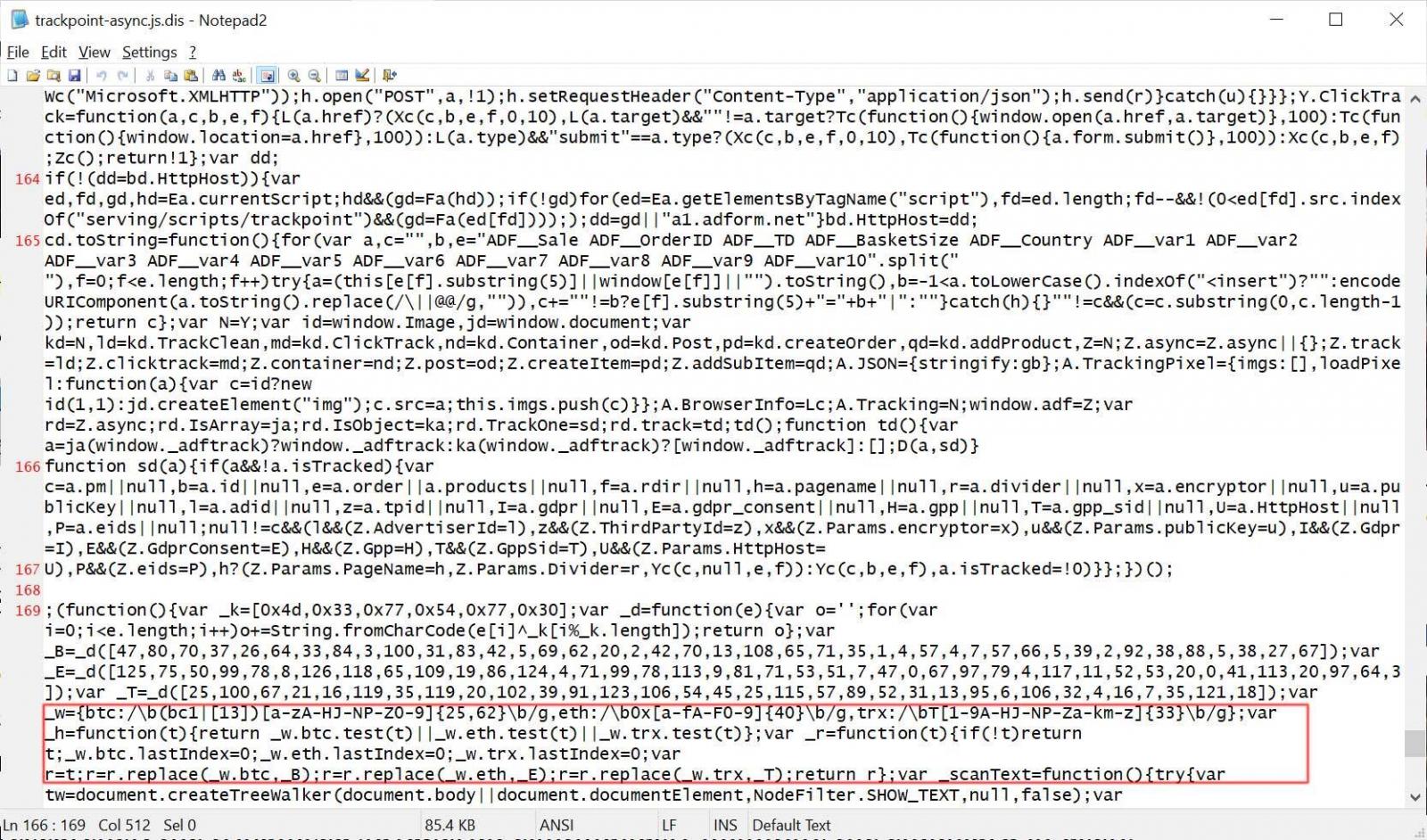
If the script detected Bitcoin, Ethereum, or TRON wallet addresses, it replaced them with an attacker-controlled address to redirect cryptocurrency payments.

Compromised Adform script replacing crypto addresses
source: BleepingComputer

“This allows end-user devices of downstream websites to be compromised with crypto-stealing malware. Meaning if you visit example.com and they use Adform, example.com will compromise your device,” Beaumont explains.

The researcher also observed other malicious Adform-hosted scripts communicating with an attacker-controlled server at 84.32.102[.]230:7744, sending the victim’s IP address, referring website, and URL path.

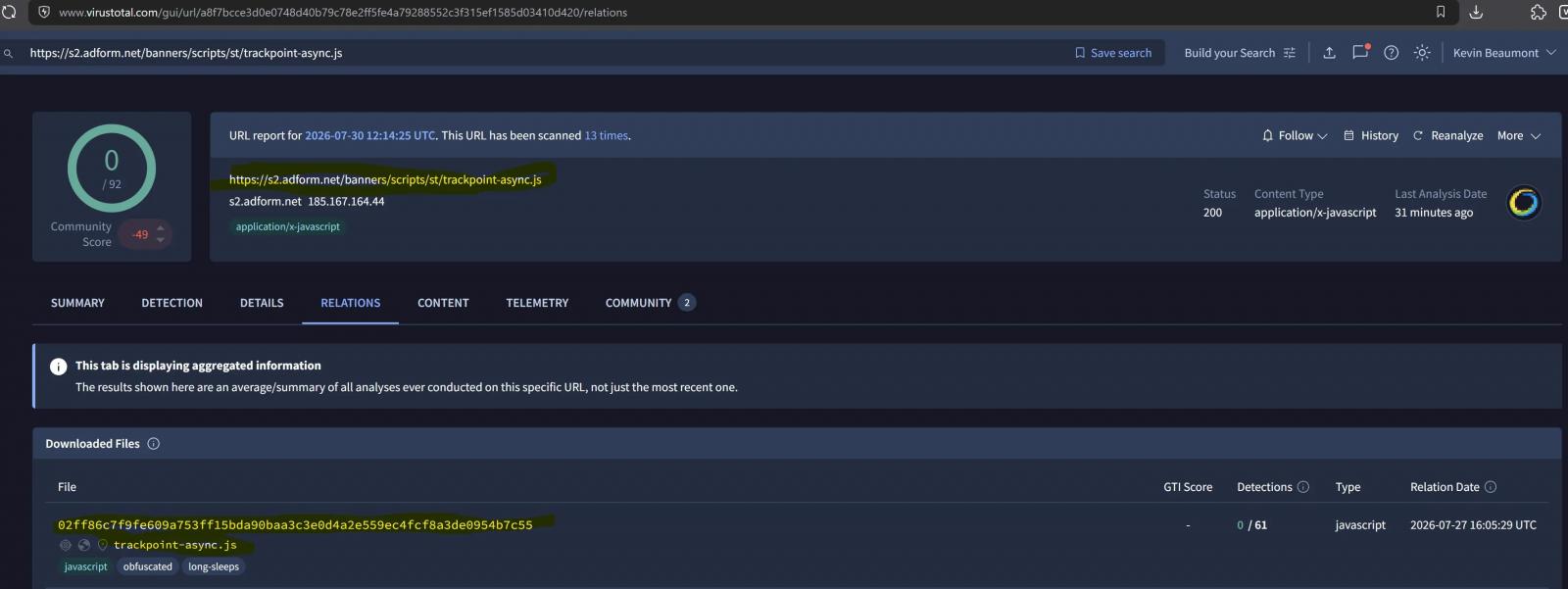
Running the script through the VirusTotal scanning platform shows that it is not flagged as malicious by any of the available antivirus engines.

VirusTotal scan of the script comes clean
VirusTotal scan of the script gives clean result
Source: doublepulsar.com

Current status

Beaumont notes that the malicious code was removed from Adform’s tracking script soon after his discovery.

Adform confirmed its detected suspicious activity on July 27 and discovered a “cybersecurity threat.” The company said that it removed the malicious code and “took further measures to protect website visitors, our clients, and the Adform platform.”

Advertisement

“To our knowledge, the code was not designed to install software on a user’s device or establish persistence. It operated only while an affected webpage was open,” Adform says.

The company states that its services are now safe to use but its investigation continues.

Individuals who visited websites that embedded the “affected Adform technology on 27 July 2026” are impacted and the recommendation is to clear browser cookies to eliminate the malicious code.

“Adform has informed affected clients through dedicated communications and provided them with relevant information and recommended actions.” 

Advertisement

Beaumont has shared a sample of the malicious script via Pastebin for security engineers to analyze.

BleepingComputer’s analysis of a sample stored on Archive.org also confirmed that a self-executing payload had been injected into the Adform tracking library served from the company’s infrastructure.

The malicious code was appended in obfuscated form at the end of the legitimate library and included a function that replaced any string matching a crypto wallet address format.

Apart from hijacking clipboard content, the malware can also rewrite wallet addresses on web pages. This way, if a payment address is displayed, it would be the attacker’s.

Advertisement

Beaumont says the malicious activity delivered through Adform has been ongoing for the past week without being detected. The oldest sample BleepingComputer could find was from from the Archive.org snapshot on July 26, taken at 23:29:03 GMT.

BleepingComputer has contacted Adform to request a statement regarding Beaumont’s findings and will update the story if we receive a response.


article image

Security teams log 54% of successful attacks and alert on just 14%. The rest move through your environment unseen.

The Picus whitepaper shows how breach and attack simulation tests your SIEM and EDR rules so threats stop slipping by detection.

Get the whitepaper

Source link

Advertisement
Continue Reading

Tech

How Jazza and Friends Built the World’s Biggest D20

Published

on

World's Biggest D20 Largest 20-Sided Die
Australian creator Jazza and the team at Lumin’s Workshop decided a regular gaming die was far too small. They set out to make a twenty-sided die big enough to claim the title of largest dice of any kind, and one that could still tumble and settle on a single face.


The concept began to take shape as the groups collaborated on the huge roach costume project. Discussions at that first meeting kept returning to the concept of scaling up a D20, which they had previously investigated, but this time they wanted to go even bigger to be able to roll it properly. John took on the interior framework, and because a conventional icosahedron has 12 vertices, they created 12 corner pieces to construct those points and 3D printed them. Solid aluminum bars were then screwed along every single outer edge to provide the necessary bracing to keep the design straight even when standing alone. Before ultimately locking everything in, they completed a dry fit with the entire frame, which had to be perfect for the faces to line up properly; a single tiny shift and the whole thing was off.


CiaraQ Polyhedral Dice Set – DND Role Playing Dice
  • 🎲 5 Complete Dual-Color DND Dice Sets – 35 Pieces Total – Includes five full 7-piece dice sets (35 acrylic dice total). Each set comes with one…
  • 🎲 5 Unique Two-Tone Color Combinations – You get five striking dual-color sets: green/blue, blue/yellow, brown/blue, red/black, and purple/blue…
  • 🎲 Durable Acrylic Build – Easy-to-Read Numbers – Made from high-quality acrylic that’s waterproof, oxidation-proof, and built to last. The…

Twenty faces followed, each starting as a 1.5-meter equilateral triangle. They’d sourced sheets of 20mm foam, and a custom jig helped cut the precise angles required to ensure the edges met perfectly when assembled. Because the foam was fairly thick, they had considered it into their estimations from the start, and layers were stiffened using contact cement to prevent flex. To avoid any gaps, we added extra foam strips to the outer frame bars.

World's Biggest D20 Largest 20-Sided Die
The color and finish came next, with deep red paint applied in multiple coats because the foam soaked up so much of the first layer. We also needed to get the details right, so the edge details and rivet-style accents were painted with a yellow ochre base and then a metallic gold applied with a sponge for texture. Darker shading on the edges to give it an aged appearance, as well as some purposeful cracks to make it look like old stone or marble rather than plain foam, gave the finished die a strong presence.

World's Biggest D20 Largest 20-Sided Die
With the die eventually completed, they required a trailer to transport it out of the factory, so they took it to Lumin’s factory in Campbellfield, outside of Melbourne, for some real-world testing. A trailer was required to haul the beast about, and lifting it and sending it tumbling down a slope resulted in some quite pleasant rolls that fell on various numbers, including one of those ultra-rare twentys when Jazza and a workshop mate assisted. The die is now housed inside the shop as both a display item and an office mascot.
[Source]

Advertisement

Source link

Continue Reading

Tech

Today’s NYT Connections: Sports Edition Hints and Answers for Aug. 1, #677

Published

on

Today’s NYT Connections: Sports Edition puzzle is a fun one, covering a wide variety of sports. If you’re struggling with the puzzle but still want to solve it, read on for hints and the answers.

Hints for today’s Connections: Sports Edition groups

Yellow group hint: Fore!

Green group hint: Football games.

Blue group hint: College competitors.

Advertisement

Purple group hint: Not shoes.

Answers for today’s Connections: Sports Edition groups

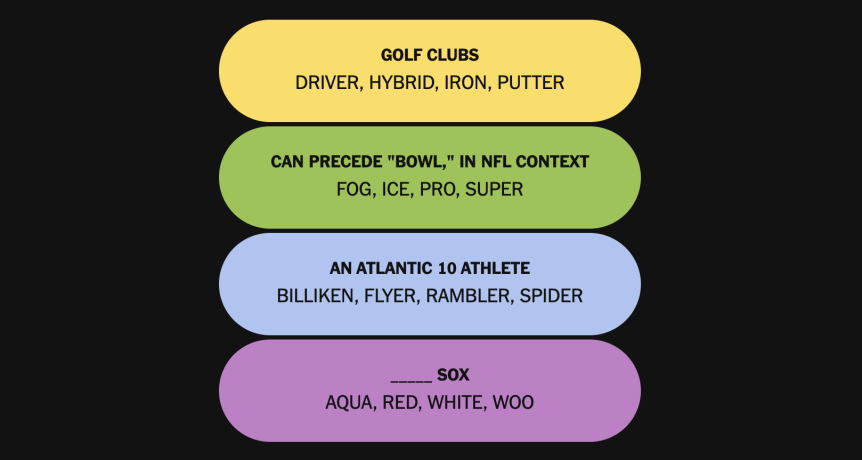
Yellow group: Golf clubs.

Green group: Can precede “Bowl,” in NFL context.

Blue group: An Atlantic 10 athlete.

Advertisement

Purple group: ____ Sox.

What are today’s Connections: Sports Edition answers?

The completed NYT Connections: Sports Edition puzzle for Aug. 1, 2026.
The completed NYT Connections: Sports Edition puzzle for Aug. 1, 2026.NYT/Screenshot by CNET

The yellow words in today’s Connections

The theme is golf clubs.

The four answers are driver, hybrid, iron and putter.

The green words in today’s Connections

The theme is can precede “Bowl,” in NFL context.

The four answers are fog, ice, pro and Super.

Advertisement

The blue words in today’s Connections

The theme is an Atlantic 10 athlete.

The four answers are Billiken, Flyer, Rambler and Spider.

The purple words in today’s Connections

The theme is ____ Sox.

The four answers are Aqua, White, Red and Woo.

Advertisement

Source link

Advertisement
Continue Reading

Tech

Dell Coupon Codes: 20% Off for August 2026

Published

on

Expect to save over $600 on the hottest models, including $250 off monitors, for crisp and clear gaming (or writing), 40% off laptops, and up to $1,200 off desktops for true gamers. We’ve rounded up the top Dell coupon codes and discounts so you can save big on pricey tech.

Get 10% Off With Top Dell Coupon Codes

If you haven’t bought from Dell, right now you can get seriously rewarded for switching. Right now, new customers can get 10% off Dell products when you sign up for their email newsletter. Plus, you’ll get additional perks like exclusive offers in your inbox and invites to special sale events, including flash discounts during seasonal sales. Plus, right now you can use Dell promo code AFFBUNDLE10 to get an extra 10% off when you bundle select PCs with accessories. And, save your tech refresh with clearance sale discounts and Dell promo codes today.

20% Off With This Dell Coupon: Dell 14 Premium

As mentioned, one of the best ways to save big on tech purchases is by buying a certified refurbished Dell laptop through the Dell Outlet. The Dell outlet has tons of like-new tech for hundreds less than if bought brand new. You can get top tech like the Dell 14 Premium for $1,036 when bought refurbished—that’s $259 in savings! With this powerful laptop, you’ll have built-in Intel Arc 140T Graphics and FHD RGB + IR Camera and Microphone, among other perks. Be sure to check out the Dell Outlet for tons of Dell tech for hundreds less.

Get $520 Off the Dell 14 Plus

The Dell 14 Plus served as Dell’s rebranding launch, and when we reviewed the laptop, we appreciated its fast performance, great battery life, solid IPS display, comfortable keyboard and touchpad. With this Dell 14 Plus offer, you get the laptop for only $860 if you have a valid college email address that’s been verified. You’ll get the Intel Core Ultra 7 256V with eight core processing, Windows 11 Home operating system, Intel® Arc Graphics, 16 GB of memory, and 1 TB of SSD storage.

Advertisement

Save $450 With Dell Coupons for Laptops, Alienware Monitors, and More

Been wanting to upgrade your WFH or gaming setup? Dell has marked down some of their most popular laptops and monitors during their holiday and tech refresh sale events. There are stellar deals like $400 off the Alienware 16X Aurora (one of the best gaming laptops we’ve seen of its kind), and $450 off the Alienware 18 Area-51. Complete your gaming experience with an Alienware Area-51 desktop for $1,200 off, which includes 50% more processing power. Some other great Dell monitor deals we’ve found include the ability for Rewards members to earn up to 3 times the amount of points (or 9% back) on select Alienware monitors. Plus, you can save $100 on the Alienware 4K QD-OLED gaming monitor, or $120 on the Alienware 27 Gaming monitor, right now. And you can also get 30% off the Dell 24-inch monitor when you purchase any laptop or desktop computer.

We’ve also found steep discounts on some of our favorite WIRED-tested gear, including $160 off the Bose Quiet Comfort headphones (now only $199), and $350 off the Dell 14 Plus Laptop.

The deals don’t stop there though, with discounts on Dell’s best-selling laptops and PCs, including: $200 off the Dell 15 laptop, $500 off the Dell 16 Plus laptop, and 50% off software when you purchase a PC. Whether you want to work-from-home or game-from-home more effectively, check out the latest offers in the Dell deals hub.

Dell has rotating best deals of the week too, like their best-selling monitors, which include Dell 27 Plus 4K monitors (starting at $129), $400 off QD-OLED gaming monitors like the popular Alienware 34 Curved model, plus $350 off Alienware Aurora gaming desktops and $200 off Tower Plus desktop computers.

Advertisement

10% Dell Coupon for Students, Military Members, and Medical Workers

Students, it’s the worst time of your life, you might as well save a little money. Just kidding, life only gets harder from here. Kidding. Again. Maybe. What is not a joke is this deal. Dell is giving students a 10% discount on things students need like Dell XPS laptops and Alienware gaming rigs. No need to say anything about gaming. It’s for your eyes, because they’re starting to bleed from all the term papers.

To the discount, first, make sure you have a Dell account and that the Dell Rewards box is checked. Once you’re enrolled in both, verify your .edu email address through the membership tab of your account. Not a student? No problem, Dell still has some great deals for your computing needs. Beyond students, Dell offers an extra 5% off Heroes discount for military members, veterans, employees, rewards members, and businesses. Verify through GovX or VCS in a matter of minutes to get exclusive pricing and early access to sale events.

Don’t Miss Dell’s Ultimate College Offer

Getting prepared for college is the most exciting, sometimes stressful, and often one of the most expensive times in a person’s life. With Dell’s Ultimate College Offers, students can save an extra 10% and get the Microsoft College Offer for free on select PCs—this includes a year of Microsoft 365, Xbox Game Pass, and a customizable Xbox controller, because Dell knows that although you work hard, you need to play a little too. This is over $500 worth of products, for free, with this limited-time Dell discount offer.

Exclusive Discount for Seniors at Dell

Dell wants to make their valuable tech more accessible to seniors by providing Dell discounts for seniors. Once you become a verified senior, you’ll be eligible for special Dell savings on laptops and computing tech. First, create a Dell account, then register as a Dell Rewards member. Once you verify your senior status, exclusive Dell senior savings will be reflected in the cart!

Advertisement

Get 6% Back With Dell Rewards Coupons and Financing Offers

Don’t forget that, in addition to the Dell coupons available, there are also limited-time discounts for Dell Rewards program members. Rewards customers get double the points right now, or 6% back on almost everything. This means if you’re signed up with an email, you can get triple the discount, plus, 5% off select XPS and Dell Premium systems. If you open a Dell Pay Credit Account, you’ll earn $100 (or 10,000 points) in Dell Rewards dollars once you enroll in the Dell Rewards program.

Earn $50 Back With Dell Online Coupon

Becoming a Dell Rewards Member is one of the easiest ways you can save when shopping online at Dell. When you shop Dell.com as a member you’ll earn 3% back in rewards, which are usually added to your account within 30 days of your order’s ship date. Plus, you can monitor Rewards history, get exclusive member perks, deals, and member-only benefits with your rewards account. And perhaps best of all, right now Dell Rewards Members can earn an extra $50 back on any XPS PC (until July 1).

Always Get a Discount With Dell Price Matching

Unlike many companies, Dell’s Price Match Guarantee covers competitor prices and if a product drops on the Dell website. Best of all, their competitor price match policy is available before or after you buy. So, when you find an identical Dell, HP, Apple or Lenovo computer, you’ll just need to share the link with a Dell expert through chat or a phone call to get that lower price. If you’ve already purchased the item, but find the product on Dell’s or a competitor’s site within 30 days, share the link through the Order Support portal and you’ll be refunded the difference.

Shop Our Favorite Dell Laptops for Your Gaming or Office Upgrade

Dell’s XPS laptops are the perfect addition to your tech setup. They’re lightweight, small, and plenty speedy. They’re Windows’ rough answer to Apple’s Macbook Pro line. The XPS 13 and upgraded Dell 14 Premium are some of our favorite laptops. Check out the featured laptop offers above to save up to $600, complete with free 2-day shipping and AI-driven PC options powered by Microsoft Copilot technology. If you’re a gamer, you probably already know that Dell makes Alienware, and the Dell Alienware m16 R2 is a powerful gaming machine masquerading as your next work laptop. It’s one of our favorite dual-use gaming rigs, making it perfect for students.

Advertisement

Join Dell’s Business Partnership Program for More Savings

The Dell Business Partnerships program is ideal for small business owners, with exclusive access to business-only tech savings. When enrolled in this valuable service, you’ll get exclusive member-only discounts, IT help, and exclusive access to Dell business tech advisors to help you navigate through any business tech issues. Plus, you’ll get extra savings when enrolled with Dell Rewards, automatic savings that are applied at checkout, and tons of membership benefits like discounts and guided help. To enroll in Dell’s Business Partnership program, you’ll need to get your Dell Membership passcode, sign in or create your account and enroll in Dell Rewards. Once that’s done, you’ll just need to validate your membership passcode, and your discount will be applied automatically in your cart.

Source link

Continue Reading

Tech

Kyty Just Put the First Real 3D PS5 Games on a PC at Nearly 30 Frames

Published

on

KytyPS5 Emulator PlayStation 5 Emu
Two weeks ago the same project could only push a handful of PlayStation 5 titles past their loading screens. Today a free, open-source emulator called Kyty is running fully 3D commercial games on ordinary Windows PCs with player control and frame rates that actually feel usable.


XIII, a 2020 cell-shaded version of a classic first-person shooter, is an excellent example. The PS5 Emulation community’s footage demonstrates that the game is truly starting to come together, with frame rates ranging from 20 to 30. You can walk about, shoot objects, and look up and down, and even if the floor and skyboxes are missing in some spots, the textures break, and the lighting goes all goofy, the game is still playable. To be fair, it has never actually been playable outside of official hardware.


PlayStation®5 console – 1TB
  • From Jan. 2028, newly released games on PlayStation will be available for purchase on PlayStation Store and at retailers in digital format only. Discs…
  • PlayStation 5 Console – 1TB, includes wireless controller, 1TBSSD, Disc Drive, 2 Horizontal Stand Feet, HDMI cable, AC power cord, USB cable, printed…
  • 1TB of Storage, keep your favorite games ready and waiting for you to jump in and play


Teenage Mutant Ninja Turtles: Wrath of the Mutants isn’t far behind, as after a slight wobble at launch, it settles into a fairly consistent 22 to 24 frames per second, with crisper character models and settings than XIII. The movement is still choppy, but you can play as the turtles bashing the bad enemies without the entire scene disintegrating into chaos. Both of these results are quite remarkable, coming as they did within a 48-hour period at the end of July. That speed is significant, as Kyty has previously managed menus and short video clips for games such as Grand Theft Auto V and Quake II Remastered, but it has only lately been able to get in-game control to function reliably on two separate 3D engines. This has put it well ahead of its primary competitor, SharpEmu, at least in terms of what they are presenting publicly. SharpEmu has its job cut out just getting some of the deeper rendering and synchronization issues resolved before they can reach the same point, and they won’t get there anytime soon based on the current demos.

It’s easy to see why this is happening, given that Sony has discontinued physical CDs and Grand Theft Auto VI still has no release date on PC, much alone a release date at all. The emulation community has seized the opportunity and is working tirelessly to close the gap. Kyty is developed in C++, and the developers refer to it as a compatibility layer rather than a full-fledged reimplementation from the ground up. It can already handle a combination of Unreal, Unity, and bespoke engines without the need for any specific hardware modules.

Advertisement


All of this is still very much a work in progress, as you can notice graphical errors from a mile away, the frame rate drops like a stone when you hit a difficult scenario, and some games are still only running at one or two frames. To complicate matters further, it requires a legal dump of the game you own to function (even though you probably already have one laying around). Also, keep in mind that this is still very early days, and each new build released can change behavior overnight. What is evident is that the community is accustomed to sharing short video and demonstrating their growth, which is becoming increasingly visible week after week.

What sticks out is the simplicity of the hardware requirements. None of the videos discuss the necessity for costly equipment or a unique setup. You only have a standard gaming PC, which could be one of the reasons this community is developing so quickly. Anyone can download the most recent code from GitHub, attach it to a game folder, and return a log file. Each report assists the team in determining what is causing the next set of visuals to disappear or skyboxes to fail.
[Source]

Advertisement

Source link

Continue Reading

Tech

Arch Linux disables AUR package adoption to stop malware flood

Published

on

Arch Linux disables AUR package adoption to stop malware flood

The Arch Linux project has temporarily disabled adoption of Arch User Repository (AUR) packages after a surge in malicious takeovers of existing packages.

The decision was announced on the distribution’s mailing list by contributor Robin Candau, who said that the situation is temporary until a solution is found.

“Due to the current influx of malicious package adoptions and follow-up commits made via the AUR, package adoption is currently disabled while we are handling the situation,” announced Candau.

“We will send a follow-up once we’re able to. In the meantime, feel free to report suspicious adoption events or commits that haven’t been dealt with yet, and stay vigilant!”

Advertisement

Independent Federated Intelligence Network (IFIN) conducted a technical analysis of the malware and reported that the campaign began on July 29 with the package ‘openconnect-sso.’

IFIN reports that the campaign bears many similarities to the last campaign, including the use of the Tor network for staging.

In June, a separate campaign hit AUR via more than 400 packages, distributing a Linux rootkit and info-stealer malware to unsuspecting users.

In the latest attack, the researchers identified a two-stage infection, with the first stage acting as the loader, and the second one being a Linux x86_64 payload described as stealer malware with remote administration (RAT) and SSH worm features.

Advertisement

Further analysis showed that the first-stage loader evades detection by checking for debuggers, sandboxes, virtual machines, and CI/CD environments before installing systemd services and cron jobs to ensure persistence.

It then downloads and launches a Tor client disguised as dbus-daemon to retrieve the second-stage payload from an ‘.onion’ server.

The second stage is a Rust-based infostealer that targets browser credentials, cryptocurrency wallets, password manager data, cloud and developer secrets, AI service API keys, SSH keys, and messaging platform tokens.

It also provides the attacker with remote command execution over an encrypted Tor channel and can spread laterally by using stolen SSH keys to copy and execute itself on other systems.

Advertisement

A Reddit user tracking the campaign alleges that it has expanded to over 200 AUR packages, either through compromised maintainer accounts or by adopting orphaned packages.

According to the same researcher, the campaign has spread to fairly popular AUR packages such as boringssl-git, icloudpd, windscribe-cli-v2-bin, stirling-pdf-desktop-bin, openconnect-sso, arduino-language-server-noclang-bin, and pgadmin4-server.

The compromised status of these packages has not been independently confirmed, and a list of all 200 AUR packages believed to be malicious has not been made available as of publication.


article image

Security teams log 54% of successful attacks and alert on just 14%. The rest move through your environment unseen.

The Picus whitepaper shows how breach and attack simulation tests your SIEM and EDR rules so threats stop slipping by detection.

Advertisement

Get the whitepaper

Source link

Continue Reading

Trending

Copyright © 2025