Across the country, thousands of students are waving goodbye to high school and preparing to head off to college. If you know one such student, and want to gift them a gadget to send them off in style, you’ve come to the right place. I’ve rounded up what I think are the best high school graduation gifts you can buy, at a range of different budgets.
All of these gifts will come in handy in college, whether for work, play or general student life. I’ve included noise-cancelling headphones to block out distractions while studying, robust Bluetooth speakers for when it’s time to bring the party, and budget-friendly coffee makers for an instant boost in time for morning seminars.
I’ve also included some top, student-friendly laptops and tablets, but we have a separate guide to the best student laptops if you can’t find exactly what you’re looking for here. I’ve separated my suggestions into budget bands, for easier browsing.
Advertisement
Under $50
For under $50 you can pick up some really great compact Bluetooth speakers — the Tribit Stormbox Micro 2 is the standout here, scoring a perfect five stars in our review. In this price bracket, I’d also be looking at quirky desk accessories that boost productivity and deliver a smile, and colorful water bottles and insulated coffee cups, to keep your new student refreshed on the go.
Advertisement
$50-$100
In the $50-$100 bracket, I love Kodak’s instant-printing digital cameras, tapping into the retro tech trend and giving your student an easy way to decorate their dorm room. There are also a few strong, budget-friendly gadgets worth considering: the Sony Pro HQ51 are our favorite cheap, noise-cancelling headphones, and the dinky Instant Vortex Mini air fryer is ideal for kitting out a cramped kitchen.
$100-$200
Looking to spend over $100? Great news: there’s plenty of excellent tech to choose from in this price bracket. An e-reader makes a stellar gift for literature students or anyone who loves to read in their spare time — both the Kindle and Kobo are worth considering.
Advertisement
On the kitchen front, Ninja has a couple of appliances we rate really highly. For caffeine addicts, the DualBrew Pro is a capable coffee maker that can make a range of brews in different styles and sizes, while the Crispi is an innovative air fryer that uses the same glass containers for cooking and storage — perfect for batch cooking in small kitchens.
Sign up for breaking news, reviews, opinion, top tech deals, and more.
$200-$300
Want to spend a bit more? In the $200-$300 bracket, we have gadgets that are more of a long-term investment. The Sony WH-1000XM5 are some of the best noise-cancelling headphones on the market, and will have no trouble blocking out noisy roommates or crowded cafeterias so your student can focus. In the tablet market, we rate the Lenovo Idea Tab Pro as an excellent iPad alternative for an ultra-competitive price.
Advertisement
Over $300
Looking to spend over $300? I’ve picked a selection of laptops and tablets that would make an excellent study companion for a new student, including the new MacBook Neo that everyone’s talking about at the moment. For more options, head to my college tablet and laptop guide.
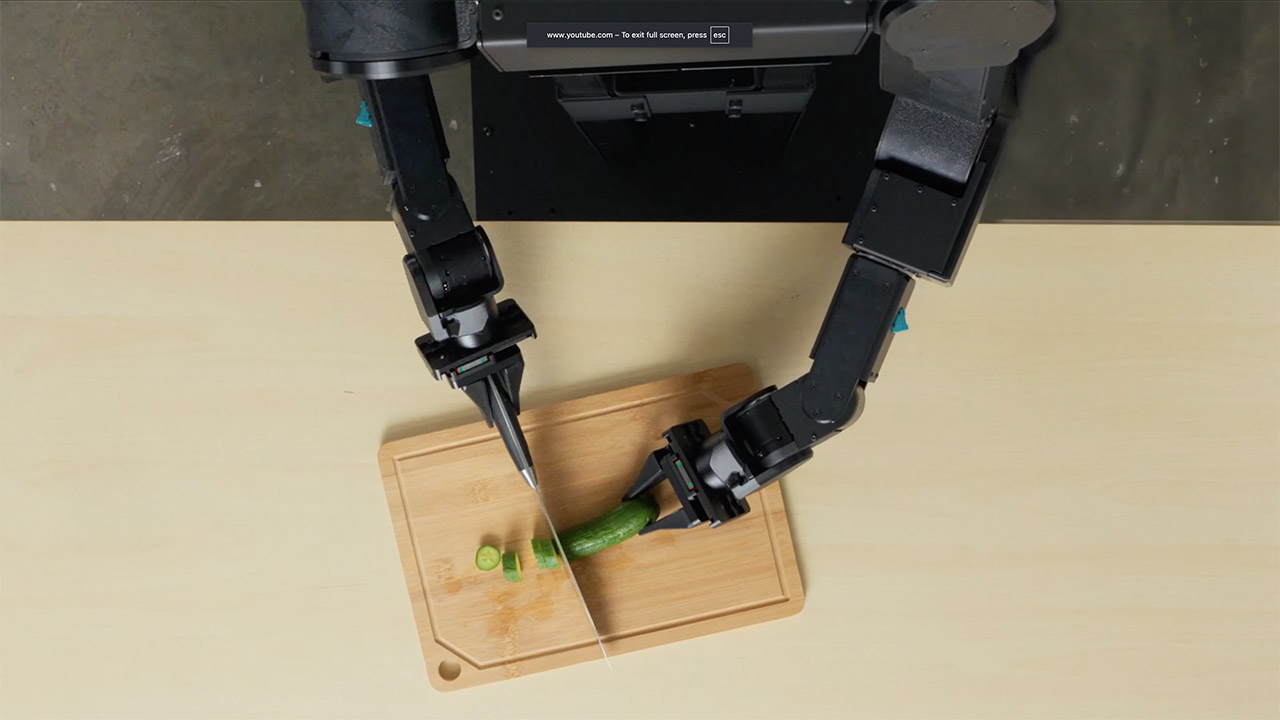
Almond Robotics launched Axol this week as a dual-arm robot built specifically for teams developing physical AI systems that must function in factories, warehouses, kitchens, and other unpredictable settings. The company spent the past year putting existing robots through real shifts in grocery stores and production lines. Those machines repeatedly hit limits that slowed progress or caused outright failures.
When attempting to insert its hand inside bins or equipment, reach usually fails. Payloads led the motors to overheat for extended periods of time, and the exposed cables were repeatedly bent until they broke. Singularities would regularly intervene, requiring the robot to slam on the brakes or perform more maneuvers to get back to a safe position. Even more frustrating, it would take forever to collect clean, labeled demo data because the robot couldn’t seem to approach the task in the same manner that a human operator would. Axol grew out of those hard lessons. Almond designed everything with long-term, contact-rich work in mind, and he devised a technique to accelerate data collection for training in the event that a human operator was absent.
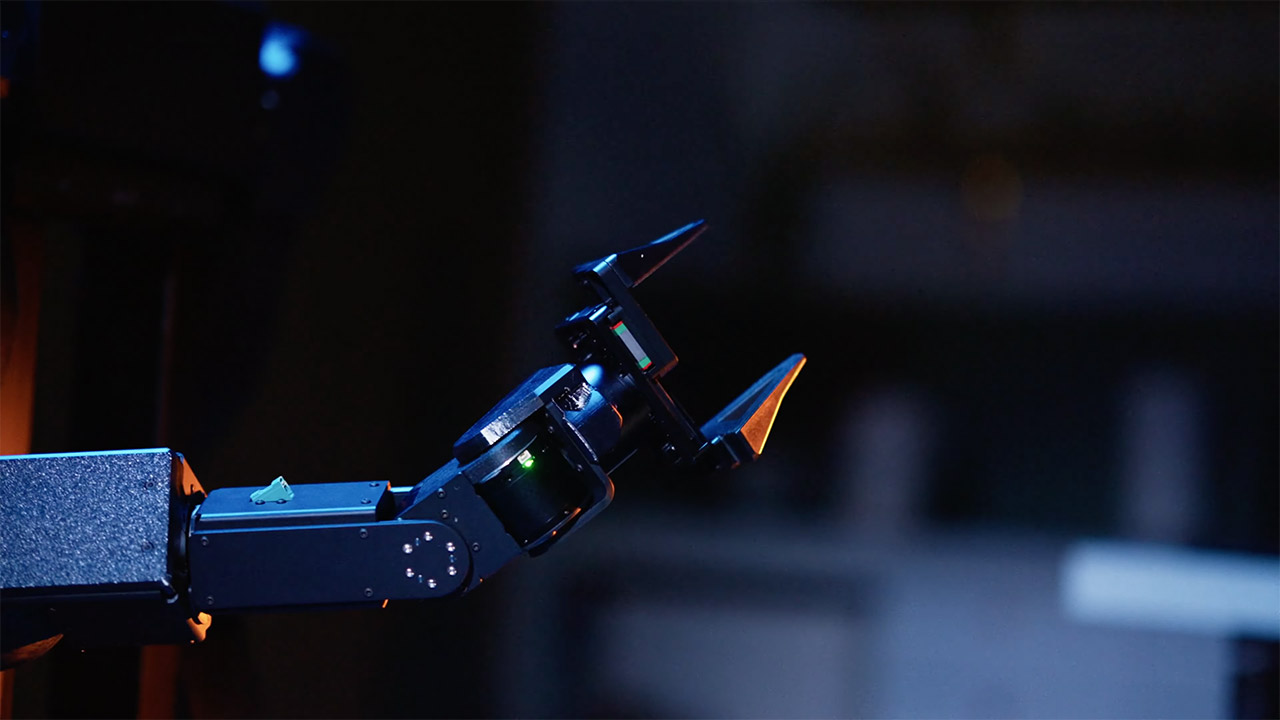
Each arm has seven degrees of flexibility and extends 860 millimeters from shoulder to fingertip, providing a robot with substantially more workspace than identical research arms without the need to reposition the base every five seconds. The wrist joints alone can perform full 180 degrees of pitch and yaw, giving the robot plenty of flexibility and reducing any annoying singularities that would normally limit the usable workspace on other platforms, all of which adds up to smoother trajectories when the robot is attempting to reach for something complex.
Payload peaks at 6.5 kilograms, and in typical operation, the actuators can support a steady four kilogram weight without ever throttling back owing to heat. That level of sustained capacity is essential for tasks that include frequent lifting, pressing, or tool use. All of the cables inside the item are routed internally, so there is no risk of them catching on anything or wearing out due to frequent movement. Two FAKRA GMSL 2.0 connections are neatly positioned at each wrist, ready to be connected to high-speed stereo cameras that deliver low-latency vision where it counts: precision grabbing and insertion.
Standard grippers include two fingers and interchangeable tips, and because the technology is modular, teams can easily swap in custom end effectors as projects progress without having to start over. The control loops operate at a constant 500 Hz, which is necessary for responsive, fine-grained movements, especially when dealing with delicate touch operations.
Axol delivers the robot directly from Almond’s workshop in San Francisco’s Dogpatch district, which is advantageous for a number of reasons, including faster part availability and on-site maintenance options for Bay Area deployments. Just as important, the software stack is given equal attention. The full solution is accessible as an open source Python SDK, which includes low-level CAN motor control, bimanual inverse kinematics, ZED camera streaming, and LeRobot connectivity, as well as a WebXR teleoperation pipeline for any compatible headset. The system records everything, including synchronized joint positions, camera frames, and actions, in policy-training-ready formats.
Since Almond is addressing startups and research groups, pricing is modest, hence the standalone Axol is listed at $7,999 during the launch window. The set includes a height-adjustable mobile platform, three ZED X One S cameras, an NVIDIA Orin NX 16 GB computer unit, and all necessary cables for $11,999, which includes shipping. Both options are available currently. [Source]
Germany’s reputation as tournament specialists has taken a battering in the past decade, with the four-time World Cup winners suffering group-stage exits in 2018 and 2022.
However, Die Mannschaft are ready to resume normal service at the FIFA World Cup 2026, led by exciting young playmakers Jamal Musiala and Florian Wirtz, and the familiar figure of 40-year-old Manuel Neuer in goal. They are unsurprisingly strong favourites in their Group E opener against tournament debutants Curacao in Houston, where a heavy victory would all-but guarantee a place in the last 32 and avoid the humiliation of falling at the first hurdle for the third successive World Cup.
Curacao have already made history just by qualifying for the tournament. The Caribbean island will be the smallest nation ever represented at a World Cup with a population of only 156,000 – to put that into perspective, that is more than two-and-a-half times smaller than Iceland, the previous country to hold that record. Experienced Dutch manager Dick Advocaat will ensure his team are as compact and hard to break down as possible, but they could hardly have asked for a more difficult opening match and the principal aim will be to avoid a thrashing.
Advertisement
So, read on as we show you exactly how to watch Germany vs Curacao for free from anywhere in the FIFA World Cup 2026.
How to watch Germany vs Curacao for free
Germany vs Curacao is available to watch for free in multiple countries, including the UK, Australia, Brazil, Belgium, Ireland, Netherlands, Switzerland and Turkey.
Abroad? Can’t access your free stream? Unblock your free World Cup stream with Norton VPN — more on that below.
Advertisement
Use a VPN to watch Germany vs Curacao live streams
It’s the World Cup, and if you’re traveling, you might discover your usual Germany vs Curacao stream is suddenly unavailable due to geo-restrictions.
Don’t worry, that’s exactly where a VPN can help. A virtual private network lets you connect to servers around the world so you can securely access your usual World Cup coverage as if you were back home.
Those looking for a streaming service instead can watch Germany vs Curacao on Fox One (3-day free trial).
Advertisement
Visiting the US from the UK? You can still watch your World Cup stream for free thanks to Norton VPN (try for 60 days).
How to watch Germany vs Curacao in the UK
UK customers are in luck as they can stream Germany vs Curacao for free on ITV. Live coverage is on ITV1 and ITVX.
You require a TV license and a valid UK postcode for an account (e.g. SE1 7PB).
Advertisement
Norton VPN can unlock your stream if you’re abroad today.
How to watch Germany vs Curacao in Australia
(Image credit: free)
Germany vs Curacao will be shown for free in Australia on SBS On Demand.
The streaming platform has every game of the tournament for free, making it the perfect place for your World Cup viewing.
Advertisement
Traveling for work or on holiday? A VPN like Norton VPN can help unlock your free stream.
How to watch Germany vs Curacao in Canada
(Image credit: Other)
In Canada, TSN and free-to-air channel CTV will be broadcasting Germany vs Curacao.
You can live stream via the TSN+ streaming platform, which costs CA$8 per month or CA$80 per year.
Advertisement
CTV will require your TV provider login details, but is also available via streaming platform Crave if you want an alternative.
Outside of Canada? Use Norton VPN whilst you’re traveling away from home to unlock your stream.
Germany vs Curacao: Match Information
What time does Germany vs Curacao start?
Germany vs Curacao kicks-off at 6pm BST / 1pm ET on Sunday, June 14. That’s 3am AEST on Monday, June 15 in Australia.
Advertisement
What are the squads for Germany vs Curacao?
Germany
Goalkeepers: Oliver Baumann (Hoffenheim), Manuel Neuer (Bayern Munich), Alexander Nubel (Stuttgart).
Defenders: Waldemar Anton (Borussia Dortmund), Nathaniel Brown (Eintracht Frankfurt), Joshua Kimmich (Bayern Munich), David Raum (RB Leipzig), Antonio Rudiger (Real Madrid), Nico Schlotterbeck (Borussia Dortmund), Jonathan Tah (Bayern Munich), Malick Thiaw (Newcastle United).
Midfielders: Nadiem Amiri (Mainz), Leon Goretzka (Bayern Munich), Pascal Gross (Brighton and Hove Albion), Jamie Leweling (Stuttgart), Jamal Musiala (Bayern Munich), Felix Nmecha (Borussia Dortmund), Aleksandar Pavlovic (Bayern Munich), Angelo Stiller (Stuttgart), Florian Wirtz (Liverpool).
Advertisement
Forwards: Maximilian Beier (Borussia Dortmund), Kai Havertz (Arsenal), Lennart Karl (Bayern Munich), Leroy Sane (Galatasaray), Deniz Undav (Stuttgart), Nick Woltemade (Newcastle United).
Of course, most broadcasters have streaming services that you can access through mobile apps or via your phone’s browser.
You can also stay up-to-date with all of the key World Cup moments on the official social media channels on X/Twitter (@FIFAWorldCup), Instagram (@FIFAWorldCup), TikTok (@FIFAWorldCup) and YouTube (@FIFA).
Advertisement
We test and review VPN services in the context of legal recreational uses. For example: 1. Accessing a service from another country (subject to the terms and conditions of that service). 2. Protecting your online security and strengthening your online privacy when abroad. We do not support or condone the illegal or malicious use of VPN services. Consuming pirated content that is paid-for is neither endorsed nor approved by Future Publishing.
Chinese hackers took control of a target organization’s authentication stack and maintained persistence for 10 years, with full visibility into the administrative activity.
Dubbed “Operation Highland,” the intrusion is attributed to the Velvet Ant cyberespionage threat group, which targeted vulnerable internet-facing systems before pivoting to a network with no direct external path.
Chinese hackers of the “Velvet Ant” activity cluster breached the isolated critical infrastructure network of a large organization and conducted cyber-espionage operations for 10 years.
The campaign, dubbed “Operation Highland” by Sygnia researchers who discovered it, began in 2016, targeting vulnerable internet-facing systems before pivoting to an “air-gapped” environment with no direct internet connection.
Velvet Ant’s lengthy espionage operations were documented in 2024, when Sygnia warned of a campaign targeting F5 BIG-IP devices that operated undetected for three years.
Advertisement
Also in 2024, Cisco warned of a zero-day in NX-OS running on Nexus switches, which was exploited by Velvet Ant to gain access to targets.
Velvet Ant attack chain
The attack begins with the compromise of internet-facing servers, though the researchers don’t mention the specific product or any vulnerability used.
Velvet Ant deployed a modified GS-Netcat reverse shell disguised as a legitimate system component that connected to a hardcoded relay domain, providing encrypted remote shell access.
The shell achieved persistence either via a malicious systemd service or through startup script modification.
Advertisement
Dissasembler showing the use of GS-Netcat Source: Sygnia
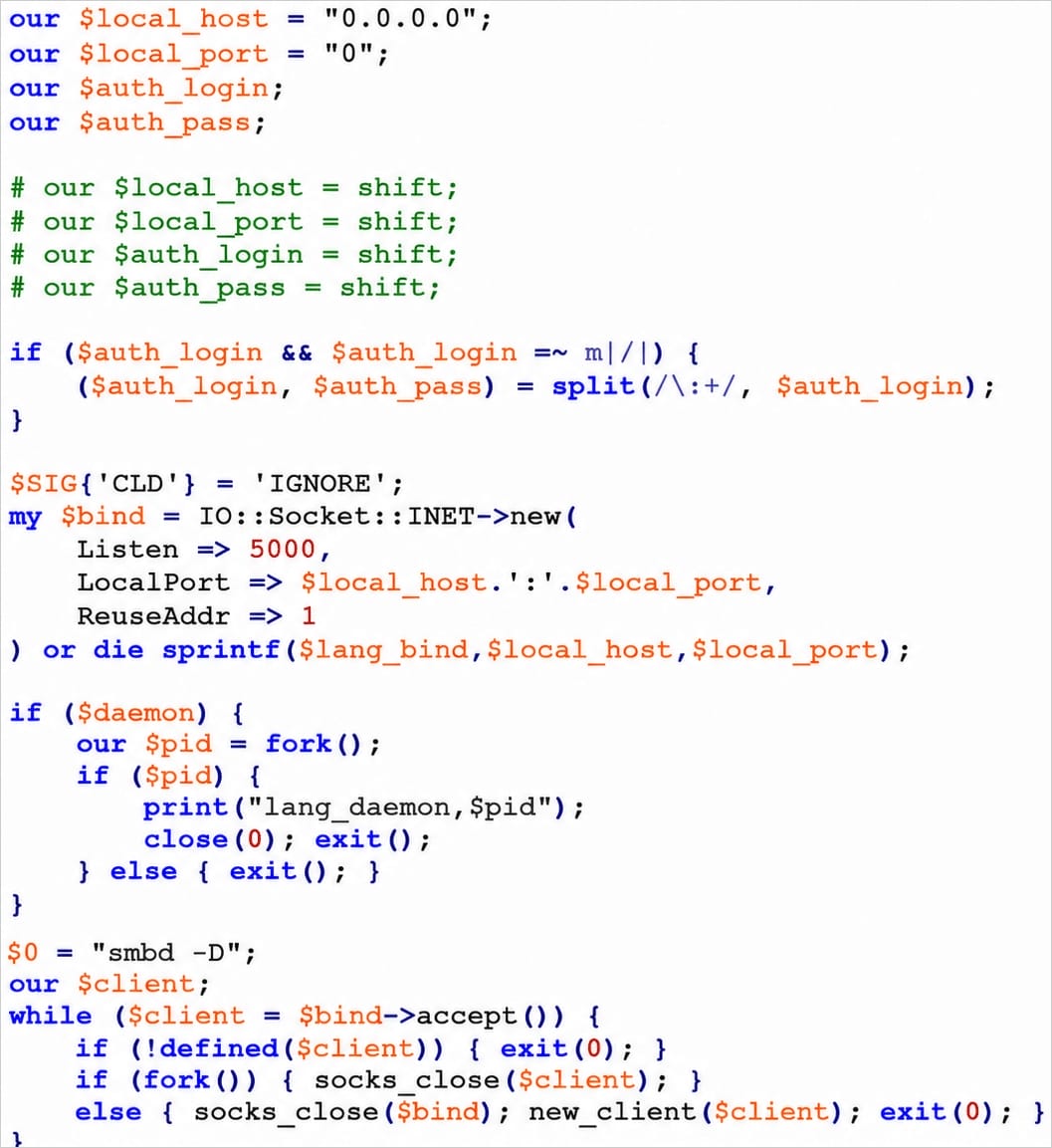
Next, Velvet Ant installed a custom SOCKS5 proxy for network traffic tunneling, enabling it to reach internal systems that are not directly accessible from the internet.
The proxy ran as a daemon masquerading as ‘smbd -D,’ using different filenames and ports on each host, and turning compromised servers into internal pivot points.
SOCKS5 proxy script Source: Sygnia
The most interesting part of the attack was building a remote execution path into the isolated network.
To achieve this, Velvet Ant modified the configuration of a compromised internet-facing Nginx server to proxy specially crafted requests to a compromised backend server.
The backend server’s Nginx configuration was also altered to forward requests to a FastCGI process (fcgiwrap) listening on a separate port.
The FastCGI wrapper acted as an execution bridge, processing requests and launching a custom binary named ‘uptime.’
Advertisement
The tool established SSH connections to systems within the isolated critical infrastructure network using parameters supplied in HTTP POST requests.
“By chaining these modifications, Velvet Ant established a remote-execution path into the segregated environment via simple HTTP requests, with no direct connection to the critical infrastructure network ever required.” – Sygnia
Having established their access into the isolated environment, Velvet Ant shifted focus to long-term persistence and credential theft by targeting Linux Pluggable Authentication Modules (PAM), a set of libraries that let administrators set up methods to authenticate users.
The attackers replaced legitimate ‘pam_unix.so’ modules with backdoored versions that accept hardcoded passwords and harvest user credentials.
Advertisement
Sygnia identified nine distinct variants of the malicious PAM module, each compiled in a separate build environment, indicating a well-resourced threat actor.
The researchers say that two of the malicious PAM modules stand out for acting as a backdoor only and for collecting credentials.
Velvet Ant actors also replaced OpenSSH components such as ssh, sshd, and scp with trojanized versions that captured credentials, logged commands entered during SSH sessions, and stored the collected data locally for future retrieval.
Sygnia says that by extending control to the authentication process by modifying the PAM and OpenSSH components, the threat actor had access to credentials as they were used in the target environment and could bypass the authentication flow.
Advertisement
“Administrative activity became fully observable: every login; every command executed across compromised hosts. Access was no longer tied to a specific foothold but embedded into the authentication process itself,” the researchers explain.
This way, the hackers ensured their persistence despite password changes and session terminations, and reduced “the effectiveness of conventional containment measures.”
Complex cleanup
Sygnia says even after discovering the compromise, remediating it and removing Velvet Ant from the compromised environment was particularly complicated.
The threat actors had replaced so many critical components with custom versions that removing them was likely to break authentication, lock legitimate administrators out, and cause operational outages.
Advertisement
To tackle this problem, the researchers built a testing lab to validate the binary replacement process, profiled each host, tested the results, and prepared rollback procedures before attempting the cleanup.
Sygnia recommends that defenders treat authentication components such as PAM, OpenSSH, and Windows LSASS as critical security assets and protect them with EDR, file integrity monitoring, hardened privileged access, multi-factor authentication (MFA), and continuous monitoring for unauthorized modifications.
Organizations should plan for offline recovery, which includes strict backups with an adequate schedule for automatically creating snapshots with immutable copies.
The restoration process should consider testing the backups and recovery hosts running operating systems that have been validated, along with the recovery scripts.
Advertisement
Security teams log 54% of successful attacks and alert on just 14%. The rest move through your environment unseen.
The Picus whitepaper shows how breach and attack simulation tests your SIEM and EDR rules so threats stop slipping by detection.
Skoda’s Peaq seven-seat EV starts around €50,000 with up to 600km range and V2H charging, undercutting the Kia EV9 and Ioniq 9 significantly.
Skoda has revealed the Peaq, its first seven-seat all-electric SUV and the most expensive car in the Czech automaker’s 130-year history. Built on the Volkswagen Group’s MEB platform at Skoda’s home plant in Mladá Boleslav, the Peaq stretches nearly 4.9 metres long and is designed to compete directly with the Kia EV9, Hyundai Ioniq 9, and Volvo EX90. The difference is price, with Skoda targeting a starting point of around €50,000 to €55,000, compared to roughly €66,000 for the EV9 and €70,000 for the Ioniq 9.
The lineup will launch with three variants. The Peaq 60 pairs a 150kW rear motor with a 63kWh battery for more than 460km of WLTP range, while the Peaq 90 steps up to a 210kW motor and a 91kWh pack for over 600km. The range-topping Peaq 90x adds a second motor for all-wheel drive and 220kW of total output, keeping the same 91kWh battery and 600km-plus range.
All three variants support DC fast charging at up to 200kW, which Skoda says will take the battery from 10 to 80 percent in approximately 28 minutes. The Peaq also supports bidirectional charging, meaning it can feed power back to a home through the VW Group’s Moon Power Ambibox DC wallbox. Vehicle-to-load capability is included as well, letting owners run external devices directly from the car’s battery.
Advertisement
The 💜 of EU tech
The latest rumblings from the EU tech scene, a story from our wise ol’ founder Boris, and some questionable AI art. It’s free, every week, in your inbox. Sign up now!
Inside, the third row folds flat to open up 890 litres of boot space. Options include a Sonos sound system, a panoramic glass roof, and massaging front seats. The design follows Skoda’s Modern Solid language, which debuted with the Vision 7S concept that previewed the Peaq’s shape back in 2022.
Skoda confirmed the Peaq name in January 2026 and showed a near-production version on March 30. The world premiere is set for June 23 in Monnetier-Mornex, France, with deliveries expected from mid-2026. Production will run alongside the Enyaq at Mladá Boleslav, making the Peaq the second MEB-based model built at the plant.
Advertisement
The pricing strategy is the Peaq’s sharpest weapon. Skoda has historically positioned itself as the VW Group’s value brand, and the Peaq extends that logic into the seven-seat EV segment where competitors have priced themselves into premium territory. The Kia EV9 starts at roughly €66,000 in Europe, the Hyundai Ioniq 9 at around €70,000, and the Volvo EX90 higher still.
That positioning matters at a time when tariffs and trade barriers are reshaping which EVs are available in which markets. A seven-seat electric SUV starting under €55,000 from a European manufacturer built in Europe avoids the import exposure that has forced several Korean and American models out of certain markets or into higher price brackets.
The Peaq also arrives into a segment that is still thin on options. The Peugeot E-5008 offers seven seats at a lower price but with less range and a smaller footprint. Above the Peaq, the choices jump quickly into luxury pricing. Skoda is betting that families shopping for a large EV want the space and capability of a premium model without the premium itself, and the Peaq’s spec sheet suggests it can deliver that.
Marvel Animation released the first trailer for season two of X-Men ’97 this week under the name Roll Call, and the footage makes the direction clear without giving every twist away. The core team ends up split across different eras after the events of the first season, with some members landing in the ancient past, others in a distant future, and all of them trying to find a route back to the time they know. Back in the 1990s, the absence leaves room for fresh waves of mutant fear and new enemies who see an opening.
The new season keeps the heart of the original but raises the stakes dramatically. Rogue is still devastated by Gambit’s death, and it will have a tremendous influence on the entire team. It has an impact not just on their mental well-being, but also on their ability to function. At the end of the last episode, there’s a brief end credits sequence in which Apocalypse holds one of Gambit’s playing cards while the guy talks to his buddies about anguish and death, hinting that old comic book themes may reemerge as the season develops. The trailer makes it clear that Apocalypse is the main antagonist, portraying himself as an Omega-level threat who claims to be the last one standing. The potential of a confrontation with Magneto heightens the drama.
MARVEL COLLECTIBLE – This buildable LEGO Marvel recreation of the X-Mansion is designed for adult fans of Super Hero movies and experienced…
10 MINIFIGURES – Includes iconic X-Men minifigures: Wolverine, Professor X, Jean Grey, Cyclops, Storm, Gambit, Rogue, Iceman, Bishop, Magneto as…
DIY KIT – Builders can lose themselves in this large-scale project as they construct a lasting model that appears in many Marvel Studios’ X-Men…
The main cast returns, including Ross Marquand as Professor X, Matthew Waterson as Magneto, and Ray Chase as Cyclops. We also have Jennifer Hale as Jean Grey, Alison Sealy-Smith as Storm, Cal Dodd as Wolverine (giving him that edge we adore), Lenore Zann as Rogue, George Buza as Beast, and the same strong blend of resolve and personality that made the first season so popular.
Some mutants that played minor parts the previous season will have far more to do this time around. Strong Guy offers some serious muscle to the fights, Psylocke provides some slick psychic moves, and Wolfsbane and Siryn get to show off their animal and sonic abilities. Then there’s Multiple Man, who is rather good at the “making copies of himself to handle stuff” trick. Meanwhile, Archangel, Havok, Polaris, and Emma Frost all receive far more screen time than the prior time. Oh, and Nightcrawler enters, engaging in some great sword combat with Exodus, while Storm has a very wonderful moment that demonstrates her leadership talents.
There are numerous new costumes floating around, as well as some really cool homage to historical covers, including a subtle nod to the first Frank Miller Wolverine comic, which was first published in 1982. The conflicts are faster and more intense, which contributes to the season’s attractiveness. What are the settings? It’s extremely diverse, which is part of the fun. he season consists of nine episodes, all of which will be available on Disney+ on July 1st.
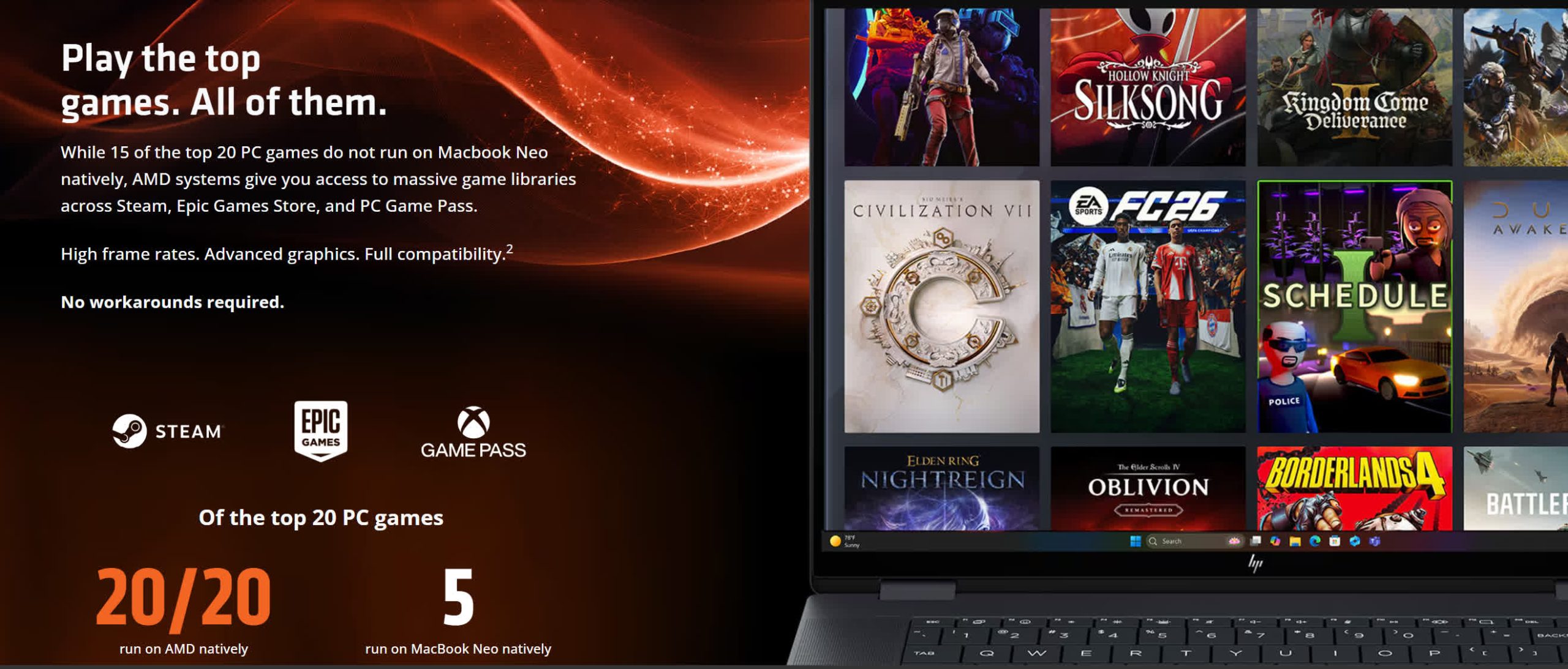
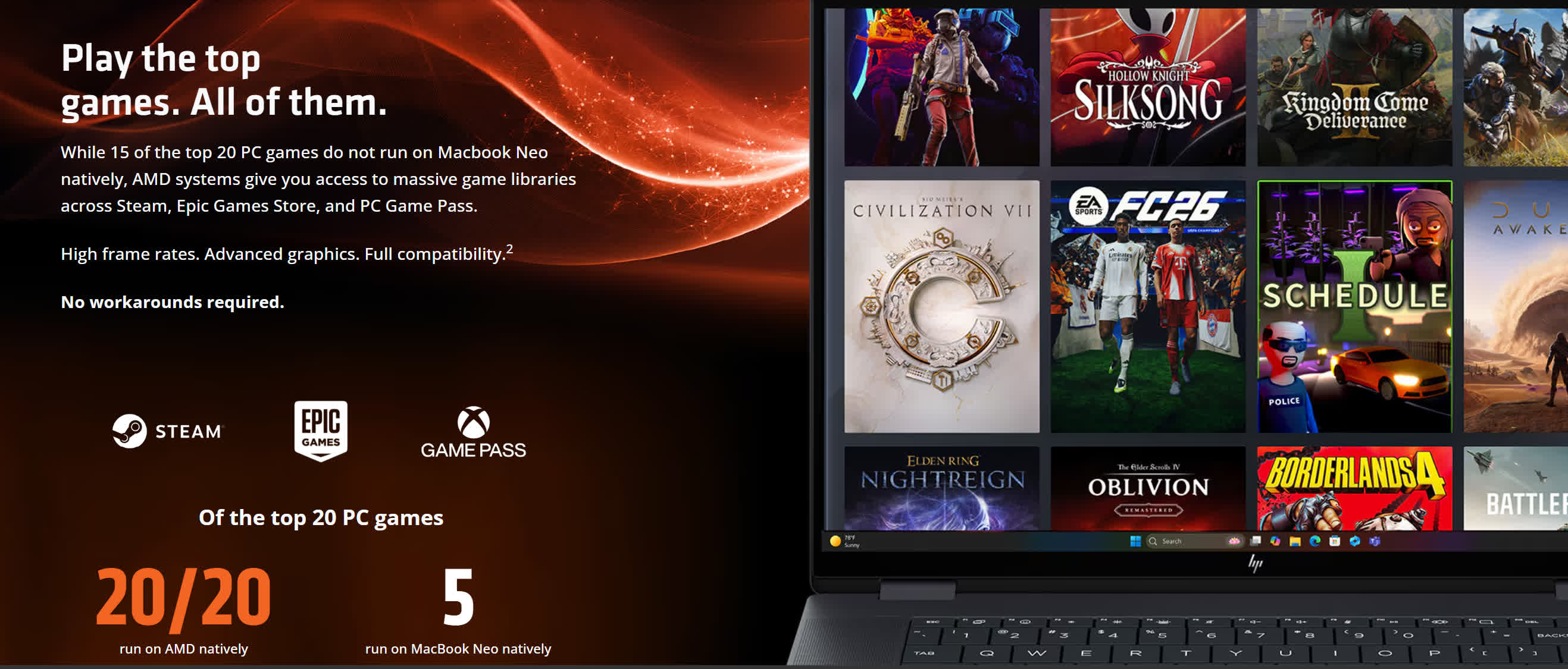
Facepalm: Few Apple devices have won as much praise as the MacBook Neo. Cupertino’s excellent budget laptop outsold the MacBook Air and Pro during its first three weeks, and it seems AMD is feeling a little jealous of all the attention. Team Red has just posted ads for its Ryzen laptops boasting of their gaming abilities, while also pointing out that the MacBook Neo can only play five out of twenty top PC games natively.
Like other companies, AMD likely feels a little threatened by the success of a budget MacBook, so it’s gone after its weakest area: PC gaming.
In its Ryzen AI processors ad, AMD compares an HP OmniBook X Flip, which features last year’s Zen 4-based Ryzen 5 220, against the Neo, which uses Apple’s A18 Pro chip. The company writes that the x86 machine offers access to game libraries across Steam, Epic, and PC Game Pass, complete with “high frame rates” and “advanced graphics,” and with “No workarounds required”
The ad also notes that just five of the “top 20” PC games run natively on the Neo. There are also stats about the HP laptop’s 512GB of storage (compared to the Neo’s 256GB), 2-in-1 touchscreen design, and extra ports. AMD adds that the Ryzen offers 57% better multitasking, 38% faster content creation, and up to double the WiFi speed.
Advertisement
While there’s no arguing that the OmniBook X Flip, which starts at $999, has plenty of elements that put it above the MacBook Neo, nobody is buying one of Apple’s machines to primarily play PC games, so it’s a strange comparison to make. It’s more like AMD is simply comparing operating systems, making points that will be obvious to most people.
Moreover, claiming the Radeon 740M GPU in the Ryzen 5 220 offers high frame rates and advanced graphics is quite a stretch – only the most forgiving games are playable, and even then, they have to set at their lowest 1080p settings. Meanwhile, the Neo has been shown to play some PC games quite well, given its hardware limitations.
The MacBook Neo is the clear budget-category winner in our Best Laptops feature. It sold 1.1 million units in under a month after launch thanks to its $599 starting price, design, and macOS experience. It’s an excellent laptop for the price, but not much good for PC gaming, obviously.
I’ve been testing the best fitness apps for many years now, and while I’m very grateful they all exist (after all, no one app will work for every user), it’s hard not to feel as though things have stagnated somewhat.
The AI boom (or bubble that could burst, depending on who you ask) means we have more options for AI fitness algorithms to pore over data than ever before, whether you’re using them on a phone or one of the best smartwatches.
BetterMe is a more holistic app that I’m used to, wrapping in just about every tenet of fitness and wellbeing, and while it’s a little overwhelming at first, I’ve slipped into a nice rhythm with it.
Advertisement
Latest Videos From
Not just curls and squats
(Image credit: BetterMe)
My go-to fitness app is Fitbod, and it has been for years. I appreciate its relative simplicity, its regular updates, and the fact that I can track how each muscle set grows in strength (plus the Spotify Wrapped-alike end-of-year review is always fun).
BetterMe, in many ways, dwarfs Fitbod and other rivals in terms of its sheer scale. This Ukrainian app has existed for almost a decade, and it shows — it’s absolutely packed with features that run the gamut from food plans to guided challenges, and a more traditional way of using it as a digital notebook to track reps and weights.
Workouts themselves are easy to follow, with rest stops between sets built into each program, along with warm-ups. You can also stream your workout info to your TV or Mac, which is a nice touch if you want a larger canvas for your metrics.
Advertisement
I also appreciate the “Common Mistakes” section. If you’ve not used a particular piece of gym equipment before, for example, this can highlight the best way to do so safely. For leg extension (one of my favorites, for example), it advised against heavy lifting, high reps, going too fast, or locking the knees.
Sign up for breaking news, reviews, opinion, top tech deals, and more.
If you are looking to use BetterMe without a membership, you can use many of the workout tracking tools without needing to pay anything, but you’ll have access to an encyclopedia of exercises if you want to pay for a one-week plan or above, like the paid tiers of many other fitness apps like Google Health Premium.
That’s where BetterMe’s ambitions will be tough to take for some: by incorporating so much under one umbrella, it’s fairly pricey, especially once you start adding additional options like Mindfulness to the standard plan framework that you can get for $14.99 (around £11 / AU$21) a month.
Advertisement
It’s also not always entirely clear how much each extra option will cost, because payment information is obfuscated in the app and on the BetterMe website. This is a design choice that, admittedly, makes me feel a little uneasy about using the app. There is, thankfully, a week’s free trial to test BetterMe.
Value packing
(Image credit: BetterMe)
And yet, if I wanted a one-stop shop for fitness, this is where I’d lay my money. BetterMe offers calorie and hydration tracking, meal plans, meditation, and exercise guides.
Advertisement
It’s not uncommon for a fitness app to have a sort of ‘Dashboard’ view with key metrics, but BetterMe’s relatively minimal colors and visual stylings make it much easier to see a week’s worth of workouts at a glance.
One of my favorite parts is the way each day is mapped out like a sort of task list. It begins with mindfulness exercises, then logging calories, a workout, a weigh-in, water intake, and more.
I’m also a big fan of the workout categories. Some apps dump a whole bunch of exercises into a list and call it a day, but I appreciate that there are Micro Workouts for those days where time is limited, pilates plans (including wall variants), and more focused exercises like boxing, chair yoga, and kegel for sexual wellness.
Many of these can then be splintered off into specific muscle categories, meaning there’s a ton of value here for those who like to mix things up regularly and keep their body guessing.
Advertisement
There really is so much content here that, after weeks of testing, I’m still not sure I’ve seen the bottom yet. While I’m not entirely sure BetterMe is the workout app I’d choose given how many features I wouldn’t use regularly, if you’re looking for something that offers a mind-boggling all-in-one solution, it’s one of the slickest, most comprehensive fitness apps I’ve tested.
Japan’s kei car regulations in the early 1990s capped length, width, engine size, and power in ways that pushed engineers toward inventive solutions. Mazda’s short-lived Autozam brand answered with a mid-engined two seater that looked ready to join far larger and more expensive exotics on any road. A 1992 AZ-1 example with roughly 33,400 miles recently changed hands at auction for $23,500. That figure drew attention because the car produces only 63 horsepower. Once the gullwing doors rise, though, the entire package starts to make sense to anyone who values presence over outright speed.
Suzuki’s mid-1980s prototypes, which experimented with mid-engine layouts within kei limitations, served as the foundation for development. Mazda then took up the idea, naming it the AZ-550 and presenting three different body versions at the 1989 Tokyo Motor Show. After further testing, they decided to produce the variation with gull wing doors.
Fast and Furious fans can relive thrilling moments from the 2 Fast 2 Furious movie with this LEGO Nissan Skyline GT-R (R34) model car building kit
Inspired by the real-life version, the toy race car model features iconic stripes on the side, a wing at the back and a grille on the front
LEGO Speed Champions and Fast and Furious fans will appreciate the impressive wheel arches and the nitro fuel canister on the passenger seat
The production cars measured 3,295 millimeters long, 1395 millimeters wide, and 1,150 millimeters tall. Weighing 720 kg, it was no slouch, thanks to a steel perimeter frame covered in lightweight composite panels that could be easily replaced after a bump or two. The engine, as it turned out, was mounted behind the cabin and drove the rear wheels through a five-speed manual transmission.
Advertisement
Suzuki generously offered a 657 cubic centimeter turbocharged three-cylinder engine for the AZ-1, which had the most power allowed under kei rules at the time, 64 PS at 6,500 rpm and 85 Nm of torque at 4,000 rpm. So, what about the AZ-1’s suspension and brakes? Independent struts all around and compact disc brakes, along with quick steering, keep the handling responsive. The car’s weight distribution was around 44% front and 56% rear.
In the real world, that translated into a 9 to 11 second sprint to 100 km/h for the pros and a top speed electronically limited to 140 km/h, but those modest stats belied a truly fascinating compact motorcar on a twisty route. At the time, reviewers lauded its sharp handling and lovely balance, which begged to be propelled forward by fluid inputs.
Design-wise, it was a bit of a cheat, since they replicated the styling of Italian supercars, with a low wedge shape, a big rear spoiler, and side intakes that screamed ‘look at me’. The gull wing doors hinged along the ceiling added to the drama while also allowing them to remove the body without utilizing B pillars. The side windows were more minimalist, with only minor folding sections, which was done on purpose to make the car appear more exotic.
Of course, not everything was perfect; taller drivers had to lower their necks slightly for the roof mechanism, and there was no automatic transmission, making it out of reach for certain buyers. It sat higher than the Suzuki Cappuccino and the Honda Beat.The Japanese economy’s bubble burst shortly after its inception, and demand was smaller than expected.
From October 1992 to 1994, they produced 4,392 AZ-1s. Suzuki later added a distinct “Cara” model, which raised the platform total by a notch or two. Unfortunately, this resulted in a huge number of unsold vehicles in storage, necessitating special edition runs to clear inventory. The limited numbers have spurred collector demand for the AZ-1, and you can now get an immaculate original example for a good price, far more than you would pay for a similar kei sports car from the same era. [Source]
My life has changed so much since my time as a Voices of Change fellow during the 2023 school year. As I wrote in my final essay of the fellowship, the beautiful, imperfect school I loved and helped build had closed. With the support of my fellowship editor, Cobretti Williams, I applied and was admitted to the Creative Writing Workshop at the University of New Orleans, where I am taking graduate classes and teaching a freshman English composition course.
In deciding what to write as a reflection on my time since the fellowship, I started three different essays and hated all of them. I did a lot of cursing, went on a couple of brooding walks and wondered why I agreed to write this in the first place. During the similarly maddening process of designing the syllabus for the first college course I taught, I took a break to write my students a letter. Here is an excerpt:
Before we start this course together, it’s important for me to name something foundational to how I approach teaching it: Writing is hard for everyone. I love writing and I believe that, if I keep practicing, I can become great at it… and I still hate doing it a lot of the time. This is why writing is so important. Almost everything we want is on the other side of making ourselves do things we don’t want to do. When we sit down to write, whether we want to or not, and we keep writing when we hit that initial point where we want to stop, and continue when those moments arise again and again like waves, we are getting vital practice. This skill, ignoring the complacent you, the you that would rather do the thing tomorrow, or tomorrow’s tomorrow, and doing the thing now instead is an act of becoming the you that has the things you want. Like anything else, this becomes easier the more you do it.
This excerpt reminds me that writing is much more difficult than most of the things we do in a world that commodifies ease and comfort, upholds them as desirable and makes us feel we are entitled to them while simultaneously less and less able to tolerate their lack.
There is a common misconception that my students come to me with that manifests most often in the statement “I don’t know what to write.” They think this means they are not ready to begin, because they believe that writing is putting what you already know onto paper. I understand why this misconception exists. So often in life, we only see finished products. The published novel, the final cut, the social media post depicting the outcome and not the process and the struggle. It’s easy to think that everyone else has things figured out, that what you see is how something was from the beginning. This can trick us into believing that if something isn’t good right away, we should abandon it. Drafting insists that we try before we feel sure, finish something even if it is not yet “good.” Revision insists that what we have can be something different, something better, and teaches us to hold multiple things in our heads at the same time. Throughout this process, we gain clarity.
Advertisement
Each time we give or receive feedback and assess whether it moves us closer to or further from our vision, we get better at articulating what we want and closer to achieving it. When teachers and students do this work together and commit to improvement, even when we both have moments of uncertainty about what to do next, we are practicing true collaboration. We both grow. What a way to become more skillful at building the world we want.
It is a strange time to be devoting so much of my life to writing, to be telling students that they should care about writing too. Just this week, an article came out detailing pervasive, undisclosed AI use to grade and give feedback to student writing in some New Orleans schools. A study conducted in May of 2025 showed that 84 percent of high school students used generative AI to complete their school work. I understand intimately the overwhelm of educators and students, and the temporary relief that cognitive offloading with AI can provide.
However, what we lose in the long term by not engaging deeply in the writing process, the practice of giving and receiving feedback, of watching revision unfold, is so much greater than the gains we feel in accepting AI’s “help” in our moments of overwhelm. What world are we building when we delegate the human work of communication through writing to machines? We would do better to engage in a process of re-evaluating our priorities, taking on fewer assignments for longer and working collaboratively as educators and administrators to redesign curricula and systems so that teachers have the capacity to get to know their students through repeated contact with their written work.
Sometimes, it feels like we are already living in a completely different world from the one in which I grew up and was educated. Luckily, these times, despite how often folks like to say they are not, are precedented. In these times, I have been turning to Black women writers like Toni Morrison, Toni Cade Bambara, Audre Lorde and June Jordan for guidance, and they all insist writing only becomes more urgent the more dire the times. In facing what Toni Morrison described in 2004 as “a burgeoning ménage a trois of political interests, corporate interests and military interests” working to “literally annihilate an inhabitable, humane future,” I have been especially steeled by Audre Lorde’s words, “In this way alone we can survive, by taking part in a process of life that is creative and continuing, that is growth.”
Advertisement
In the face of a world that would automate us right out of existence, I intend for us to survive, and so I insist we write.
This story is part of an EdSurge series chronicling diverse educator experiences. These stories are made publicly available with support from the Chan Zuckerberg Initiative. EdSurge maintains editorial control over all content. (Read our ethics statement here.) This work is licensed under a CC BY-NC-ND 4.0.
katie wills evans is a poet, writer, educator, and graduate student at the University of New Orleans.
Looking ahead: Since taking over Xbox earlier this year, Asha Sharma and Matt Booty have hinted at radical changes in the coming weeks to turn Microsoft’s struggling game console business around. New reports indicate that little is off the table, including steps that could lead to a sale of the division.
People familiar with the matter told The Information that Microsoft executives have not ruled out restructuring Xbox as a wholly owned subsidiary or even a joint venture. Although no such plans are currently in place, they remain a possibility.
If doing so would turn Xbox’s fortunes around, Microsoft could reorganize the division into something resembling its other subsidiaries, such as LinkedIn and GitHub. The tech giant could also find a partner to run Xbox as a joint venture or spin the division out. As the news spread, former PlayStation CEO Shuhei Yoshida rather pessimistically predicted that Xbox would “dissolve” into Windows, possibly referencing Microsoft’s plans for the next Xbox console, codenamed Helix, to support PC games.
Asha Sharma has promised a dramatic change of course since becoming the new Xbox CEO in February. So far, that has included included turning away from multiplatform game releases and lowering the cost of Microsoft’s Game Pass subscription service.
Advertisement
In a recent memo, Sharma hinted at more big changes on the horizon, which could include significant layoffs to help control costs. Chief Strategy Officer Matthew Ball also recently floated the idea of using in-game ads to help offset costs. Spending tens of billions of dollars on game studios and content over the past several years has not lifted Xbox console sales, the division’s profitability is falling, and the gaming industry at large currently faces skyrocketing memory costs.
Despite the challenges, Microsoft CEO Satya Nadella and CFO Amy Hood have given Sharma the green light to increase spending to expedite the development of major franchises such as Halo, Fallout, and The Elder Scrolls. While another Xbox titan, Gears of War, is receiving a prequel later this year, Halo, Fallout, and The Elder Scrolls have not seen significant new releases in several years.
Microsoft is set to release a remake of the first Halo title next month, but the status of the next installment’s development remains unclear. After Halo Infinite’s disappointing 2021 launch bruised the Xbox Series X/S rollout, developer 343 Industries was reorganized into Halo Studios, and the next entry shifted from an in-house engine to Unreal Engine 5.
Meanwhile, Bethesda’s The Elder Scrolls VI is nowhere to be seen eight years after its initial announcement. Since shipping Starfield, which also failed to revive Xbox sales, the studio has shifted to The Elder Scrolls VI, but CEO Todd Howard recently confirmed that it remains years away. The last installment, 2011’s The Elder Scrolls V: Skyrim, is one of the best-selling games of all time.
Advertisement
Fallout seems even further out – Bethesda does not plan to start production until after finishing The Elder Scrolls VI. However, a remaster of Fallout 3 is rumored to be coming soon. In the meantime, fans have hoped that Microsoft might hand Fallout to Obsidian, which currently employs Fallout creator Tim Cain and others involved with the first two installments. InXile, another Microsoft subsidiary, also has links to the franchise.
















































































You must be logged in to post a comment Login