
Tech
The World’s Smallest USB Drive Has More Storage Than An iPhone 17


At a time when storage space commands a premium price, SanDisk’s Extreme Fit drive is worth a look.

We may receive a commission on purchases made from links.
RAMaggedon has quickly made the price of both memory and storage skyrocket, with many SSDs now sporting obscenely inflated prices. As such, more and more folks are looking for cheaper alternative storage options. Enter the SanDisk Extreme Fit. Starting at around $30 for the 64GB model, the largest 1TB edition of this USB 3.2 USB-C drive is priced at $219 (that’s double the capacity of the iPhone 17’s top config). This stick is also absolutely tiny. Just how small is the SanDisk Extreme Fit? Let’s get into it.
What is SanDisk Extreme Fit?

Often regarded as the smallest USB flash drive in the world, the SanDisk Extreme Fit has been designed to sit almost flush inside a USB port. Measuring in at 0.73 x 0.54 x 0.63 inches and weighing 0.1 ounces, the Extreme Fit is an absurdly small drive. SanDisk describes it as a “plug-and-stay” device. Cute wordplay aside, this USB stick is meant to remain hooked up to a laptop in ultra discreet fashion, instantly boosting its storage capacity.
“This is the smallest SiP (System-in-Package) we have and the first time we created a vertical type C connector ever,” states Deepesh Singh, SanDisk’s Principal Engineer of Systems Design says in a statement on the company’s site. The reason the company was able to engineer such an astonishingly small USB-C drive is because its engineers mounted the connector perpendicular to the SiP, which works thanks to a proprietary interposer printed circuit board. Not that it was an easy road to get there, as Singh recalls. “We built several prototypes, but they kept breaking.” Thankfully his team eventually overcame hardware hurdles to arrive upon the Extreme Fit’s final, eye-catching form factor.
How fast is the SanDisk Extreme Fit USB-C?
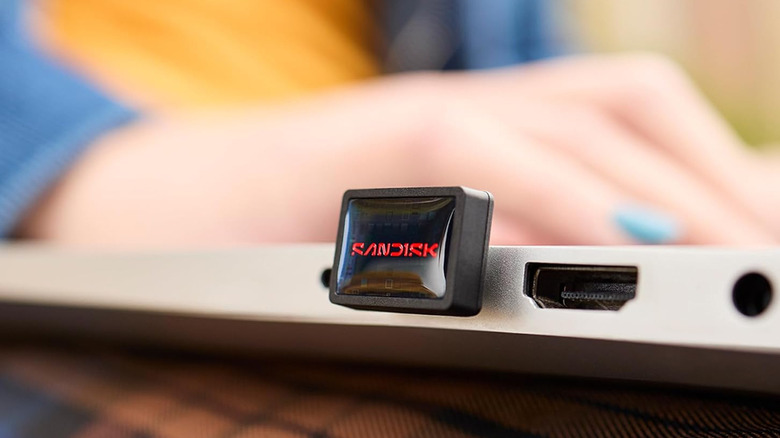
SanDisk’s tiny drive obviously isn’t going to hit NVMe speeds, but it’s fast for a USB stick. The four models that range between 128GB to 1TB all boast read speeds up to 400 MB/s, while the smallest 64GB drive is limited to 300 MB/s. Write speeds generally hover around 100-250 MB/s, which is respectable for a flash drive. Those speeds are certainly fast enough for transferring photos and other small files, but if you regularly move large 4K video files between devices, you’d be better off with one of the best SSDs.
Is the SanDisk Extreme Fit USB-C compatible with iPhones?

It sure is. Well, at least with certain models of iPhone. The SanDisk Extreme Fit works with iPhones with USB-C ports (so any model after and including the iPhone 15). You can technically get the drive working with older models with Lightning ports, though you’d need a Lightning-to-USB adapter for that. You can easily transfer files to and from the SanDisk Extreme Fit by using your iPhone’s Files app.


£501 off a watch built to survive years of proper use isn’t a discount you see very often, and it’s exactly what’s happened to the Garmin Fenix 7X Pro Sapphire Solar Edition right now.
The Fenix 7X Pro Sapphire Solar Edition has dropped from £870 to £369, a saving of 58% that turns Garmin’s most capable outdoor watch into something you can actually justify buying instead of quietly wishing for while telling yourself the current watch still works fine.
Get up to 37 days of battery life for less with this Garmin Fenix 7X Pro deal
Get up to a huge 37 days of battery life for a lot less with this rare discount on the Garmin Fenix 7X Pro.
That kind of saving matters most if you’ve spent months eyeing a proper outdoor watch but couldn’t quite stomach paying full price for something you’d mostly use to check the time and count your steps around the house.
None of that applies once you’re actually out using it, and the fenix 7X Pro tracks heart rate, stress, sleep and Body Battery energy levels continuously, so you get a genuine read on how your body is coping rather than a rough guess.
If you’re curious how the 7X Pro compares, our tech expert Michael Sawh tested the standard Fenix 7 Pro and found much the same core experience, praising the LED flashlight, upgraded heart rate sensor and new Endurance and Hill Scores as solid rather than groundbreaking additions.
That same toughness carries over to the X, though it goes further outdoors with multi-band GNSS, topographic mapping and a titanium bezel built to survive the kind of terrain that would scratch up a normal smartwatch within a single afternoon hike.

The number that stands out most is battery life, because the solar charging built into the display keeps the fenix 7X Pro running for up to 37 days in smartwatch mode or 122 hours with GPS switched on.
That’s the sort of number that changes how you actually think about wearing a watch, since charging it becomes something you plan around once a month rather than something you have to remember to do every single night.
The everyday side hasn’t been left out either, with smart notifications, Garmin Pay for contactless payments and safety tracking features that quietly stay switched on whether you’re deep in the mountains or just walking the dog around the block.
So if you’ve been putting off the upgrade because the full price never quite made sense to you, doesn’t a 58% cut on the Garmin fenix 7X Pro Sapphire Solar Edition finally answer that question for good?
SQUIRREL_PLAYLIST_10148964

Disney CEO Josh D’Amaro confirmed Wednesday that the entertainment giant is considering adding a free option for Disney Plus as a way to attract more people to the streaming service.
“We’re exploring a free product for consumers,” D’Amaro said during the company’s 2026 third-quarter earnings call. “A free offering could help us drive top-of-funnel Disney Plus subscriber growth.”
Also on Wednesday, Disney and TikTok announced that they have struck a deal to bring Disney-themed TikToks, made by selected creators, into the Disney Plus app. These videos will be in the app’s new Verts section and will be rolling out in a pilot program in the US later this year.
The House of Mouse’s hints about a potential free tier appear to confirm a report from Business Insider last month. The rumored new option would help Disney keep its ground in an ever-changing streaming landscape. In June, Fox announced that it is acquiring Roku for $22 billion.
Meanwhile, the ongoing sale of Warner Bros. Discover to Paramount SkyDance (itself created from a merger only last year) has sparked protests by entertainment industry workers about consolidations, amid concerns about job losses, fewer projects produced and for newsrooms, less editorial freedom. David Ellison, CEO of Paramount SkyDance and son of tech tycoon Larry Ellison, has rejected these concerns.
Disney executives put a rosier spin on things.
“A more consolidated industry is really a better investment backdrop,” D’Amaro said, “and we have a long history of partnering and streaming, and we believe that we can just keep building on that.”
Disney has its own Plus app, Hulu and ESPN, and has deals with Paramount-owned HBO Max, fueling its 11% increase in streaming-related earnings in the third quarter to a total of $5.53 billion. But free live TV streamers, like Fubo, are enticing viewers who don’t want to break the bank to watch individual live events. That’s where a free tier for Disney Plus may make sense.
Disney’s world beyond streaming
“It’s become clear Disney Plus is no longer just a streaming service, and perhaps that’s a good thing,” said Mike Proulx, research director at Forrester. Streaming “has a customer relationship problem,” which Disney is trying to solve by making its streaming service the focal point of its digital offerings.
“Movies and series are the foundation, but live sports, games, merchandise, creator content, and future perks give consumers more reasons to stay engaged with Disney,” Proulx said.
This is certainly what Disney is hoping for. D’Amaro defended recent box office flops Star Wars: The Mandalorian and Grogu and the live-action Moana. He said that while these didn’t meet box office expectations, the movies prompted growth in other parts of the business.
For example, The Mandalorian and Guru barely broke even, making it the lowest-grossing live-action Star Wars flick. But it also prompted a surge in merchandise sales – like apparel and Lego sets – and prompted visits to Walt Disney World’s Millennium Falcon attraction. The original Moana movie is one of the most-streamed movies on Disney Plus, and D’Amaro said Disney expects its live-action companion to perform well, despite reportedly standing to lose $100 million at the box office.
Then there’s a franchise like Toy Story, whose latest installment this summer was an undeniable theatrical success and also supported Disney’s other businesses.
“The nature of the film industry is such that it is more of a portfolio game,” D’Amaro said. “The theatrical window, in a lot of ways, it’s just one data point. And the real value of that IP is the cumulative benefit of decades-long storytelling and our ability to take that IP and play it into the entirety of the Disney flywheel.”


There’s no confirmation of Joy-Con 2 mouse control support just yet.

The best-selling video game of all time is making its way to yet another platform, as Minecraft will land on Nintendo Switch 2 on October 27. Developer Mojang says there will be an upgrade path for those who own the Switch version. More details about that will be revealed later.
Minecraft on Switch 2 should have stronger visuals than the the previous-gen version. By default, it will enable Vibrant Visuals, an enhanced graphics mode that Mojang released last year. It features directional lighting, volumetric fog, enhanced shadows and more. The Super Mario Mash-Up pack that’s exclusive to Nintendo versions of Minecraft will receive a Vibrant Visuals boost as well. (Vibrant Visuals won’t be available in split-screen play, some other game modes and certain Marketplace Worlds and other content.)
Mojang hasn’t confirmed whether the Switch 2 version will support Joy-Con 2 mouse controls, which could help players create more precise builds faster. We’ll surely learn more about the port in the coming weeks.
The Switch 2 version of Minecraft will arrive soon after the latest spin-off in the series. Minecraft Dungeons II will hit PC and consoles (including Switch and Switch 2) on September 29.


Google is laying off 52 employees in Washington state, according to a state filing released Wednesday.
The job cuts include software engineers, engineering and product managers, mechatronics engineers, UX designers and recruiters located in Kirkland, Redmond and Seattle offices as well as remote employees.
The layoffs are scheduled to take effect in September and early October. The notice from Google filed with the state’s Employment Security Department did not provide an explanation for the cuts.
GeekWire has reached out to Google for comment and will update if one is forthcoming.
Business Insider reported layoffs in the Google Cloud division earlier this summer, but did not say how many jobs were impacted.
While Microsoft, Amazon and other tech companies have cut Washington employees in multiple rounds over the past year, this is Google’s the first significant reduction in the state since 2023. In January of that year, Google parent Alphabet shed 12,000 workers globally or 6% of its workforce. It did not indicate how many jobs were lost in Washington.
Washington is one of Google’s largest engineering hubs outside of its Bay Area headquarters. It opened offices in the state more than 20 years ago, with a focus on Android, Chrome, Cloud, Maps, Ads and other projects.
Zillow Group this week disclosed it is eliminating 91 jobs in Washington state, landing heavily on senior staff.


security
A critical Langflow flaw allowing RCE on default deployments is being exploited, says the CISA
A critical vulnerability in IBM-owned, low-code AI builder Langflow lets unauthenticated attackers execute code remotely on vulnerable default deployments, potentially putting organizations running those instances at immediate risk.
The Cybersecurity and Infrastructure Security Agency (CISA) on Tuesday added CVE-2026-9198 to its Known Exploited Vulnerabilities catalog after identifying evidence of active exploitation and urged organizations to apply the vendor’s mitigation guidance as soon as possible. IBM says the flaw affects Langflow OSS versions 1.0.0 through 1.10.0 and recommends upgrading to version 1.10.1 or later; at the time of writing, the most recent version is 1.11.2.
Langflow, for those unfamiliar, is one of the more accessible AI agent builders on the market, as our hands-on look at the tool earlier this year demonstrated. It’s available on Linux, Windows, and macOS, and is basically an end-to-end, drag-and-drop GUI where users can construct agent workflows without having to know much, if anything, about the underlying code.
IBM owns the platform now, but Langflow was originally developed by Logspace, which was acquired by DataStax in 2024 before IBM scooped up DataStax, and Langflow with it, in 2025.
The acquisition of DataStax and its tools like Langflow by IBM paved the way for Langflow to be integrated into watsonx.ai, IBM’s AI development studio, as a piece of middleware extending watsonx.ai’s capabilities.
The ownership changes, however, didn’t stop the critical flaw from making it into production releases before it was finally fixed.
According to IBM, the vulnerability affects default Langflow deployments and combines two issues that, when chained, allow an unauthenticated attacker to execute code remotely.
First, there’s the matter of an auto-login endpoint in default deployments that’s willing to mint superuser tokens to any network caller. Combine those easily obtained superuser rights with the second issue, a code validation endpoint that’ll run any old Python code thrown at it, and you’ve got a recipe for someone taking over your entire Langflow server, or worse.
The CVE itself was published on July 17, meaning that it hasn’t taken long for bad actors to realize what they could do with RCE on any system hosting a default Langflow deployment with auto login enabled and that code validation endpoint left accessible on a network.
Langflow itself isn’t a vibe-coding platform, instead serving as an interface for building agentic and RAG workflows, so don’t blame vibe coding or no-code security failures for this one. Instead, what we appear to have is a standard case of how default configuration deployments can easily be a disaster.
It’s unknown how extensively exploited this vulnerability is; we’ve reached out to IBM to learn more. ®


Soft X-rays from a galaxy about 500 million light-years away triggered an urgent worldwide search in March 2026. The Einstein Probe satellite, built by the Chinese Academy of Sciences with the European Space Agency, recorded a brief pulse of these X-rays and labeled the event EP260321a. Ground telescopes responded within an hour and quickly found a supernova growing brighter by the minute. Researchers later named the explosion SN 2026gzf.
Two astronomy teams were diving into the same region, utilizing a range of NSF NOIRLab resources. One, led by Brendan O’Connor of Carnegie Mellon University, and the other by Jillian Rastinejad of the University of Maryland, reached the same conclusion after evaluating the data. Their early observations suggested that the explosion began with a shock breakout. A shock breakout occurs when an immensely powerful shockwave from a collapsing core smashes through the star’s surface, allowing the supernova to shine. This isn’t uncommon in supernovae, but they’re difficult to detect because they only endure a few seconds to a few hours. To put it in context, there has only been one validated x-ray shock in the last 20 years, and scientists were certain this was the real deal. EP260321a is a once-in-a-lifetime scientific discovery.

LEGO Icons NASA Artemis Space Launch System – DIY Rocket Model Building Set for Adults, Ages 18+ – Gifts…
- NASA rocket model kit – Launch into a creative project with the LEGO Icons NASA Artemis Space Launch System model building project for adult space…
- What’s in the box? – This creative building set includes everything you need to craft a multistage rocket with 2 solid-fuel boosters, an Orion…
- Features and Functions – This NASA-themed rocket model features retractable launch tower umbilicals, rocket support and crew bridge, detachable…
People looking over the data discovered that SN 2026gzf is a broad-lined Type Ic supernova. These explosions are typically extremely intense, resulting in streams of material that travel at the speed of light. They are frequently accompanied by a gamma ray burst, which is one of the most tremendous energy outputs ever observed. Unfortunately, in this case, the teams were unable to identify a gamma ray burst, its high-speed jet, or even the afterglow. O’Connor hypothesized that the jet was likely muted by the star’s surface or surrounding material before breaking loose. Even though the explosion was quite intense, the resulting x-ray flare was exceptionally mild for something linked with a broad-lined Type Ic supernova.

Over a decade earlier, the Dark Energy Camera on the Víctor M Blanco 4-meter Telescope captured images of a blue source in the same position. That was intriguing since it implied that the star was already fairly active before collapsing. DECam later captured several further photographs, revealing that the supernova was becoming increasingly strong. Meanwhile, the NSF-DOE Vera C. Rubin Observatory produced multiband observations of the event in its COSMOS Deep Meiling field, revealing information on the star’s behavior before to the explosion. The DESI on the Nicholas U. Mayall 4-meter Telescope captured a succession of spectra that helped determine the type of supernova and tracked the light as it spread.

Rastinejad’s team employed both Gemini telescopes, as well as the Gemini Multi-Object Spectrographs and the Goodman spectrograph on the SOAR 4.1-meter Telescope, to gain a comprehensive look at the event at all wavelengths. They examined the data and concluded that the star that went supernova was a Wolf-Rayet star. Born with nearly twenty times the mass of the sun, it had already depleted all of its hydrogen and blown off all of its helium in a series of frenzied explosions. The residual core was largely carbon and oxygen, and the mass loss episodes left behind a variety of material shells: a small tight one near to the star that provided the soft X-ray signal, and a larger one further away that created the supernova’s visible brightness.
[Source]
Tech
Reddit aims to make ‘karma’ less important for first-time posters with shift to AI moderation tools

Reddit on Wednesday announced a series of changes to its infrastructure and tools, designed to make it easier for people to participate on its site, protect against scraping and spam, and aid in the moderation of its online communities. In addition to providing a new suite of moderation tools, the company said it’s working on more advanced abuse prevention systems that could eventually help communities move away from using things like account age and “karma” to determine who’s allowed to post.
Karma, Reddit’s digital reputation system, allows users to raise their score by posting and commenting helpful, friendly, or funny responses that lead to upvotes. Originally designed to weed out spam, bots, and trolls, many communities came to rely on karma and other account-age restrictions that make it difficult for legitimate newcomers to participate in their communities. Reddit says it now wants to shift to stronger, built-in abuse prevention systems to do more of the moderation work, so communities can be more open to new users.
Reddit didn’t say karma would go away entirely with these coming changes, but it did suggest that its importance could dwindle in the future.
“This will make it easier for genuine new users to participate and easier for mods to welcome them with confidence,” Reddit’s announcement stated.
Related to this, the company said it’s expanding the test of its new suite of AI-powered moderation tools, the Rules Hub, which helps moderators by choosing when to automatically enforce certain community rules and what action should be taken when doing so. Initially used by 700-plus communities, Reddit says that all new communities can now test the tool. Later this year, the tool will be widely available to all communities, both new and existing.
With Rules Hub, Reddit uses large language models (LLMs) to determine whether a post or comment matches the intent of a rule, which the company says allows it to “better handle nuance,” natural language, and edge cases.
Reddit also expanded the capabilities of other tools, including one that helps moderators inform users about their community’s rules when posting and commenting, and another that helps members set their flair — a custom tag users append to their name that only appears in the community they’re posting in.
“Today, new users can encounter invisible barriers like account age and karma thresholds, unclear removals, and poor community discovery,” Reddit explained. “We want new users around the world to be able to easily find relevant communities, understand their rules and norms, and make useful contributions.”
The company also said it would make changes to its legacy desktop site, Old Reddit, by shifting its moderator workflows to its new stack and migrating other critical bots.
On Reddit’s second-quarter earnings calls with investors last week, company executives stressed that one of Reddit’s near-term goals was to convert its half-billion weekly active users to daily users through product updates. The company had crushed earnings with revenue of $805 million and earnings per share of $1.25, above estimates, but still saw its stock sink because of what Reddit CEO Steve Huffman described as “choppy” search referral traffic.
When you purchase through links in our articles, we may earn a small commission. This doesn’t affect our editorial independence.
Hark, the secretive AI startup founded earlier this year by serial entrepreneur and roboticist Brett Adcock, today announced Handoff, a “computer use agent” (CUA) that it says is among the top-performing in the world at navigating the open web on a user’s behalf — ordering dinner on DoorDash, booking flights on United and Delta, or messaging job candidates on LinkedIn — all autonomously, end-to-end.
Sign-ups open to the public today at hark.com, with availability planned for later this month as part of the initial release of Hark’s software platform.
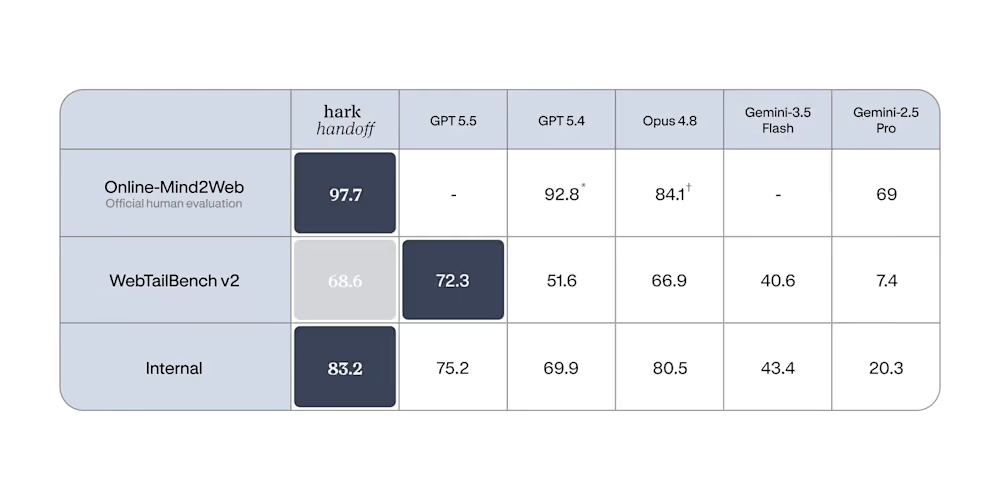
The company says Handoff recorded the top-ever score on Online-Mind2Web (OM2W), a third-party benchmark with a human-evaluated leaderboard for web agents, posting a 97.7 against 92.8 for OpenAI’s GPT 5.4, 84.1 for Anthropic’s Claude Opus 4.8, and 69 for Google’s Gemini 2.5 Pro.

Hark also says it can serve the model at less than one-tenth the token price of competing frontier models — $0.18 per million input tokens and $2.37 per million output tokens, versus $5 and $30 for GPT 5.5 — with per-turn model latency of 0.8 seconds.

For each request, Handoff spins up a dedicated virtual computer with its own browser, file system, and terminal, and users can connect existing accounts so the agent can log in and act with their saved addresses, payment methods, and history.
Hark’s research uncovered that despite people spending 75% of their screentime every day in a browser, fewer than 1 in 1000 websites have publicly accessible APIs, making it challenging for AI agents to take over the workload.
In a roughly four-minute produced announcement video posted on YouTube and social media, Adcock — seated in a bare warehouse space that doubles as a metaphor for the company’s build-out — speaks a request aloud to Hark (“let’s liven this place up a bit… let’s do some roses, maybe some cherry blossoms”) and Handoff is shown navigating a florist’s website to place the order, while Adcock narrates that unlike a typical chatbot, Handoff “is always working, it’s looping,” and says he now uses it for “all of my recruiting efforts end to end.” In Hark’s announcement blog post, more demos are shown in realtime and 5x speed.
But big some open questions about Handoff remain, especially for potential enterprise customers and users.
High-scoring benchmarks…but against last generation’s models
Notably, the benchmark comparisons Hark provided to VentureBeat for its Handoff AI agent are against GPT 5.5, GPT 5.4, Opus 4.8, and Gemini 2.5 Pro — the prior generation of frontier models.
The current leaders, OpenAI’s GPT-5.6 and Anthropic’s Opus 5, are absent, as are strong open-source computer-use contenders like DeepSeek V4, Kimi K3, and Qwen3.8-Max.
These newer models haven’t published Online-Mind2Web results, and no third party has posted them to the benchmark’s public leaderboard — meaning Hark’s “top-ever” claim cannot currently be checked against the strongest available systems.
The omission is notable because the newest frontier models have posted their largest gains precisely in computer use: on OSWorld 2.0, a related benchmark covering full computer control, Anthropic’s Opus 5 scores roughly 70.6% versus 55.7% for the Opus 4.8 model Hark chose as its comparison point.
The latency comparison comes with similar caveats: the 6.8-second and 6-second per-turn figures Hark cites for GPT 5.5 and Opus 4.8 were measured by Hark, in Hark’s own harness, with the competing models set to their highest — and slowest — reasoning level. No independent latency measurements exist for comparison.
Asked by VentureBeat whether Hark plans to publish comparisons against those newer models, the company did not specify.
Even within Hark’s own chosen comparisons, the “best” framing has an asterisk: on WebTailBench v2, one of the three benchmarks in Hark’s own results table, GPT 5.5 scores 72.3 to Handoff’s 68.6.
Two of the three benchmarks (WebTailBench and an unnamed internal evaluation) were also run inside Hark’s own harness, with pass rates computed by Hark’s internal LLM judge — conditions the company controls.
Hark’s pricing advantage is far clearer: Anthropic’s newer Opus 5 carries the same $5-per-million-input and $25-per-million-output list price as its predecessor, so Handoff’s roughly tenfold cost savings would hold up even against the current frontier — assuming its benchmark performance does too.
Training and file access
Hark’s research preview describes a sensible-sounding pipeline — supervised fine-tuning followed by asynchronous reinforcement learning using the GRPO algorithm, according to materials shared with VentureBeat prior to today’s announcement — but the company acknowledges it has only done post-training so far, with pre-training “planned for later this year.”
That means Handoff is built on top of a base model Hark did not train. Asked which base model it is, and what mix of proprietary and open data Handoff was trained on, Hark hasn’t yet specified.
Another big question mark for enterprise users: who can access the dedicated virtual computers and the files created on them?
A Hark spokesperson said “security and privacy is a primary focus, but this is a technical preview,” adding the company will share more when the product reaches market at the end of the summer.
Adcock’s history leading up to Hark
Hark is Adcock’s fourth company. He previously co-founded the talent marketplace Vettery (sold in 2018 for roughly $100 million), the air-taxi maker Archer Aviation, and the humanoid robotics unicorn Figure AI.
Hark raised a $700 million Series A round in May 2026 at a $6 billion valuation — led by Parkway Venture Capital, with participation from Nvidia, AMD, Intel Capital, Qualcomm Ventures, Salesforce Ventures, and ARK Invest.
Adcock seeded the company with $100 million of his own money and remains founder and CEO of both Figure and Hark simultaneously, a spokesperson confirmed.
Asked how the two companies interact, the spokesperson said Hark models “are being trained on the Figure robots,” but that Adcock has no plans to combine them.
Adcock’s promotional style has drawn skeptics. In April 2025, Fortune correspondent Jason Del Rey reported that Figure’s much-touted BMW partnership was far more modest than Adcock’s public claims of a robot “fleet” performing “end-to-end operations”: BMW spokesperson Steve Wilson said a single Figure robot was practicing picking up parts during non-production hours.
But the partnership has advanced, and as of June 2026, BMW said the Figure 02 robot supported production of more than 30,000 BMW X3 vehicles during a 10 month-period, and that the next-generation Figure 03 robot was being deployed at the plant for a parts-sequencing role in logistics.
On the social network X, Adcock called the story “mischaracterizations and downright lies” and threatened a defamation suit. Two months later, TechCrunch reported that Adcock skipped a promised live demo at a tech conference and sidestepped questions about the BMW deal onstage.
None of that means Handoff’s numbers are wrong. The agent may well be excellent, and the pricing — if it holds — would undercut every major lab.
The applications are in. The TechCrunch Startup Battlefield team made their decisions. Eight Australian startups have earned their spot on the Startup Battlefield stage at Stripe Tour Sydney on August 19 — and they’re ready to pitch for $15,000 in Stripe fee credits, investor attention, and a spot in Startup Battlefield 200 at TechCrunch Disrupt in San Francisco.
They represent the future of Australian tech — from enterprise tech to health and wellness tech to entertainment and media. Here’s who they are.
The eight finalists
Aigentsphere
Independent AI management and governance platform Aigentsphere helps enterprises scale AI safely and well, giving leaders visibility, control, and accountability over their entire AI agent workforce.
Apate.ai
Apate help banks, telcos, and governments dismantle scam operations by engaging scammers in live conversation and turning it into real-time intelligence.
Callease Ai
Callease Ai is the operating system for physical security control rooms, starting with voice AI that automates welfare, escalation, patrol, and many more — the entire calling engine.
Choosey App
Choosey App helps businesses hire instantly and workers get paid instantly through agentic AI-powered matching, workforce management, and same-day pay.
Doomers AI
Doomers AI helps AI and tech companies make product launches trend on X by orchestrating a vetted creator network that reaches the buyers who block ads.
equ
Startup equ helps health and wellness businesses deliver personalized nutrition at scale by embedding equ’s AI engine, built on 10 years of data and 100,000+ users, into their product.
LeadStory
LeadStory is the video intelligence layer powering the next generation of screens, surfacing exact video moments from sports, news, and finance clips to answer natural language queries.
Preve
Preve helps physical therapy clinics improve patient retention and clinical outcomes by automating the treatment plan creation and adherence.
Three will win prizes. One will go to San Francisco. All eight will pitch in front of investors, press, and the Australian tech community. If you want to see the future of Australian startups unfold, register for Stripe Tour Sydney on August 19 →
The stage is set. The judges are ready. Let the pitching begin.
Hosted and MC’d by Isabelle Johannessen, Director of Startup Battlefield.
When you purchase through links in our articles, we may earn a small commission. This doesn’t affect our editorial independence.

Speaking in June at the University of Washington Allen School commencement, AI pioneer Jeff Dean told computer science graduates how he “got the itch to join a startup in 1999,” landing at Google when it had a grand total of 20 people above what is now a T-Mobile store in Palo Alto.
Twenty-seven years later, now 58, the UW alum has the itch again.
Google announced Wednesday that Dean, its chief scientist, is leaving with three colleagues to launch Discovery Loop, a startup built to automate the experimental loop in scientific research: proposing experiments, running them, evaluating results, and iterating, thousands of times over.
“Imagine a future where a handful of people can conduct scientific research and engineering tasks much more rapidly, and with higher quality, than massive teams of scientists and engineers do today,” they write on their website.
Discovery Loop is based in Palo Alto, with what it describes as a lean team of its own. Joining Dean are Google senior fellow Sanjay Ghemawat, his collaborator of more than two decades; Google DeepMind research VP Oriol Vinyals; and Google Brain co-founder Quoc Le.
@media (max-width: 600px) {
aside.callout { float:none !important; max-width:100% !important; margin-left:0 !important; margin-right:0 !important; }
aside.callout .callout-img { display:none !important; }
}
Google is a founding investor and will supply computing power for at least the first year. Discovery Loop is structured as a public benefit corporation, with backing from Radical Ventures and Khosla Ventures (a name Seahawks fans will recognize from the team’s incoming ownership group).
The departures came as part of a broader shakeup announced in a memo from CEO Sundar Pichai. Demis Hassabis is handing off day-to-day leadership of Google DeepMind to become its chair and Alphabet’s chief scientist, while CTO Koray Kavukcuoglu steps up as SVP, overseeing Gemini model development. Alphabet shares fell about 4% after the announcement
“After an incredible 27-year run, Jeff Dean is at a moment where he wants to try something new, and we’re excited to support him in that,” Pichai wrote.
Dean, who earned his UW computer science Ph.D. in 1996, gave no hint of his plans at the Allen School commencement. He told Wired the idea came together only in recent weeks.
But the general theme was there. Listing problems he thought worth solving, he pointed the UW graduates toward “developing tools that accelerate scientific discovery and engineering.”
“One of the beauties of software,” he said during his commencement address, “is that small groups of people can build things that have enormous impact in the world.”

Professor at centre of plagiarism row resigns from University of Cambridge

MCX shares fall 4% after Q1 profit falls 22% QoQ to Rs 413 crore. What should investors do?

Strategy offers $250 yearly for employee Trump Accounts


-

 Business7 days ago
Why Trees Belong on the Risk Register
-

 Fashion5 days ago
Weekend Open Thread: Wit & Wisdom
-

 Politics5 days ago
Meta enters AI-training agreement with far-right ‘propaganda rag’ Newsmax
-

 Politics3 days ago
Zack Polanski: an incitement to murder Nigel Farage?
-

 Crypto World4 days ago
MicroStrategy Post-Earnings CLARITY Act Push Could Add New Catalyst for Its Stock
-

 Crypto World5 days ago
XRP Ledger v3.3.0 brings five institutional features
-

 News Videos6 days ago
Bitcoin Enters the 3rd Stage of the Bear Market
-

 Politics6 days ago
Luke Littler’s dominance sparks GOAT debate
-

 Sports6 days ago
Seema Kaliramna Wins Discus Throw Bronze, Takes India’s CWG Medals Tally To 17
-

 Crypto World5 days ago
New York sues Kalshi over prediction market gambling
-

 Crypto World3 days ago
Crypto PAC spending tops $2M in Michigan House race
-

 Business5 days ago
Trump Announces Hamas Disarmament Agreement as Iran Strikes Kuwait Air Base and US Attacks Pause Overnight
-

 Business3 days ago
DTCR: Deleveraging And A Hedge Fund Collapse Point To A Possible AI Bottom
-

 Tech4 days ago
ESET tracks rise in malicious AI skills and adaptable malware
-
 Crypto World5 days ago
3 Fed Officials Just Explained Their Rate Hike Vote: Is Inflation Winning?
-

 Tech5 days ago
Gemini Spark can now use Chrome logins and saved passwords to run errands on your behalf
-
 Tech5 days ago
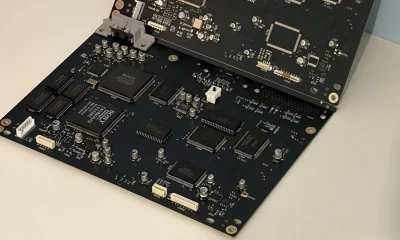
Building A Reproduction PlayStation Motherboard
-

 Sports4 days ago
France Cricket implodes: letters hidden in a drawer and a board at war
-

 NewsBeat6 days ago
Four people die trying to cross Channel in small boats
-

 Crypto World5 days ago
Moneyflip CEO charged in $40K murder-for-hire plot
You must be logged in to post a comment Login