Sony is expected to introduce its next Xperia phone in just a couple of days, but a new leak may have already revealed what the upcoming Xperia 10 VIII will look like.
An image shared by Android Headlines shows what is claimed to be the Xperia 10 VIII ahead of Sony’s August 25 event in Japan. Sony has only confirmed that a new “Xperia Product” is coming, though recent leaks have consistently pointed toward the Xperia 10 VIII. If the image is accurate, Sony does not appear to be changing much on the outside this year.
The Xperia 10 VII resemblance is difficult to miss
At first glance, there is very little separating the leaked phone from last year’s Xperia 10 VII. Sony appears to be retaining the horizontal camera module, with two rear cameras, an LED flash, and the company’s branding sitting alongside them.
Android Headlines
The phone is shown in a pale green finish, while the right side appears to retain the familiar volume controls and recessed power button. The latter would suggest Sony is once again using a side-mounted fingerprint scanner. Only the rear and part of the side are visible, so the leak does not reveal whether Sony has made any noticeable changes to the display or front-facing design.
The specifications may be familiar too
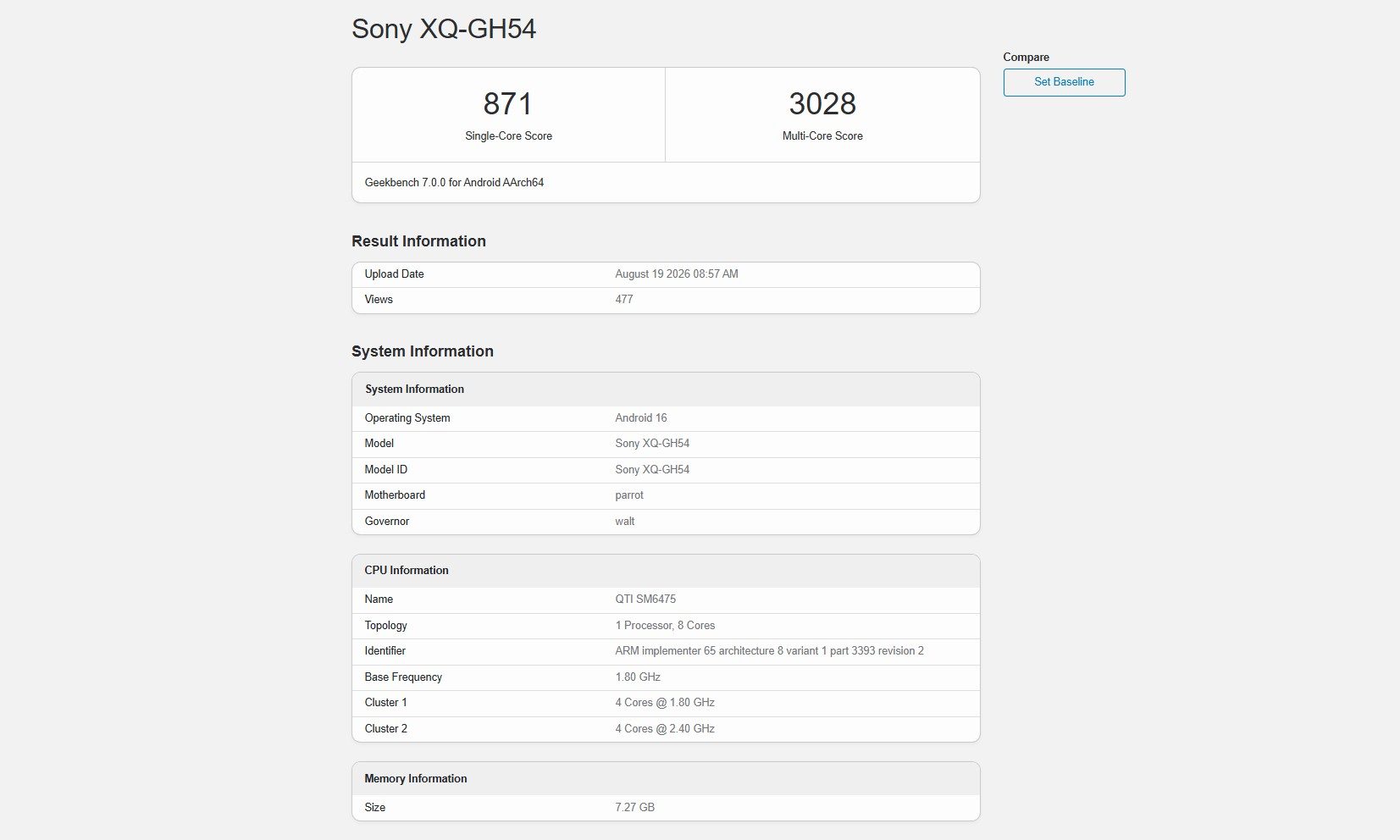
The design is not the only thing that could carry over from the Xperia 10 VII. A recent Geekbench listing for the Sony XQ-GH54, believed to be the Xperia 10 VIII, showed a Snapdragon 6 Gen 3 processor paired with 8GB of RAM.
Advertisement
Geekbench
That is the same chipset used inside last year’s model. The device recorded 871 points in Geekbench’s single-core test and 3,028 points in multi-core, suggesting there may not be a major performance upgrade this generation.
As we reported earlier, Sony’s event begins at 11 a.m. Japan time on August 25, or 10 p.m. ET on August 24 for U.S. viewers. Xperia phones are still sold in Japan and select markets such as the UK and Germany, but Sony has scaled back its smartphone presence considerably and no longer officially sells Xperia phones in the U.S. A stateside release for the Xperia 10 VIII therefore looks unlikely.
Sony should fill in the remaining gaps around the cameras, battery, pricing, and availability at the event.
The idea of AirPods with cameras has already made some people uneasy, even though Apple has not announced such a product yet. Online forums have highlighted growing skepticism around the possibility of camera-equipped earbuds, with concerns ranging from privacy to whether such devices could eventually be restricted in workplaces and other public spaces.
Those concerns may become harder to dismiss after a separate discovery reported by MacRumors offered a more detailed look at how Apple’s camera-equipped AirPods could potentially work.
According to MacRumors, forum member mactracker uncovered a hidden macOS framework called “AccessorySensorManager,” which appears to contain references to sensors capable of collecting visual and environmental information from connected AirPods. The findings do not confirm a final product, but they offer a glimpse into the kind of technology Apple may be testing.
The privacy question arrives before the product does
The prospect of putting cameras into earbuds has already triggered a skeptical response online. Unlike a smartphone or even a pair of smart glasses, earbuds are small, discreet, and often worn for hours at a time, making it far more difficult for people nearby to know when a camera might be active.
Advertisement
That creates an obvious challenge for Apple. Camera-equipped AirPods could make AI assistants considerably more useful by allowing them to understand what a wearer is seeing or provide information about their surroundings without requiring a phone to be pulled from a pocket.
Caleb Denison / Digital Trends
Convenience, however, may not be enough to overcome the social discomfort surrounding always-worn cameras.
Users on Reddit noted concerns that such devices could face restrictions in offices, schools, or other sensitive environments. Similar unease appeared in discussions surrounding the MacRumors report, where readers questioned whether the potential benefits justified adding cameras to a product designed to disappear into everyday life.
MacRumors’ findings show what Apple may be working on
The framework uncovered by mactracker suggests each earbud could contain a camera sensor capable of capturing synchronized RGB images at up to one megapixel, according to MacRumors. The system appears to focus on still-image capture rather than conventional photography or video recording, potentially feeding information into Visual Intelligence and other AI features.
The report also references active and passive capture modes. One could potentially be triggered through Siri, while another may collect lower-resolution environmental information related to nearby speech, sound changes, posture, head movement, and other contextual signals. The code also references a hardware indicator that could visibly signal when image capture is taking place, addressing at least part of the privacy problem.
Advertisement
Aaron / X
None of the findings confirm when, or even whether, Apple will release camera-equipped AirPods. MacRumors notes that the code could relate to an earlier design, while Bloomberg has previously reported that Apple is working on a camera-equipped AirPods model that could arrive in 2027.
Apple may have figured out how to make AirPods see. The harder task will be convincing everyone else that they should be comfortable with them looking.
You can keep Instagram from using your activity outside the app to influence the ads you get.
Charles-McClintock Wilson/Shutterstock
Instagram can make an ad feel almost telepathic. Browse a product on another site, and an ad for the same thing may appear in your feed minutes later. Despite its uncanny accuracy, Meta says it doesn’t use your phone’s microphone to listen in on your conversations to serve those ads. A retailer, app or other business may instead have sent it information about your visit, purchase or another interaction.
There’s no master switch that stops Instagram from collecting or using data. Meta can still learn from what you search for, watch, like, follow, post and click inside Instagram. It also receives device and network information, location-related signals, data from businesses and information shared across connected accounts. On top of that, Meta AI can use Facebook and Instagram activity to tailor its recommendations, too. The best approach to limiting what Instagram can track is to check settings for each of these sources separately.
Advertisement
Turn off personalization from other businesses
Novak Bozovic for Engadget
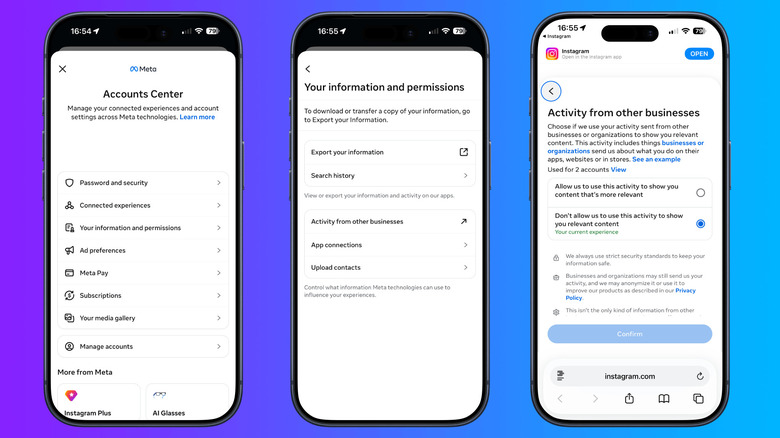
Meta began rolling out a broader Activity from other businesses control in July 2026. It’s replacing Your activity off Meta technologies and expanding an older ad setting called Activity information from ad partners. The new control decides whether businesses can use the information they already send to personalize ads, Feed content and AI responses.
To adjust this setting, open Instagram, go to your profile, tap the three-line menu and open Accounts Center. Look for Activity from other businesses. Because Meta is introducing the setting by country, some accounts may still show Ad preferences > Ad settings > Activity information from ad partners instead. Choose the option that prevents Meta from using this activity for personalization.
This won’t stop businesses from sending the data or Meta from using activity generated inside Instagram. Ads can still reflect the accounts you follow, posts or Reels you engage with, searches, ad clicks, profile details or customer lists uploaded by advertisers. The setting makes it so your activity off Meta’s platforms doesn’t inform your ad experience rather than shutting down all ad personalization.
In the European Region, Accounts Center also offers personalized or less-personalized ads under Ad preferences > Ad settings > Ad experience. The second option uses fewer signals, but Meta says it can still use details such as age, location, device information, ad interactions and content on screen during the current session.
Advertisement
Restrict Instagram’s access to your phone and accounts
Novak Bozovic for Engadget
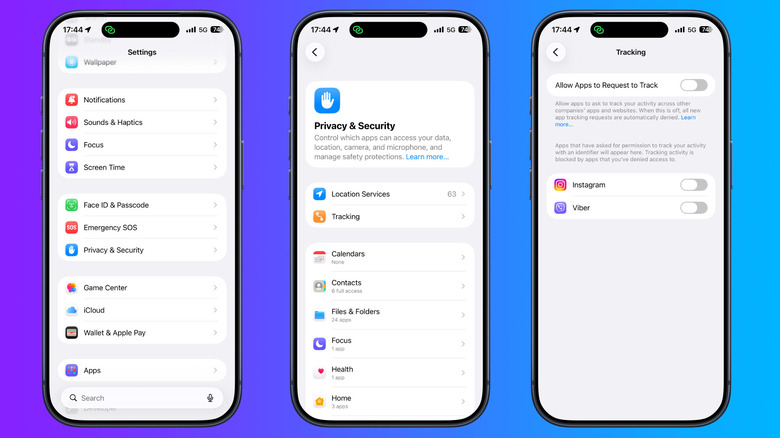
On an iPhone, open Settings > Privacy & Security > Tracking and turn off Instagram’s permission. Apple’s Ask App Not to Track control blocks tracking across other companies’ apps and websites for advertising or sharing information with data brokers. It doesn’t stop Instagram from recording activity inside its own app.
On Android, the path is usually Settings > Apps > Instagram > Permissions. Review access to location, contacts, photos and videos, camera and microphone, then deny anything you do not need. Turning off location removes one direct source, but Meta may still estimate where you are from an IP address, network information, device signals and account activity.
Contact syncing needs its own check. Go to Accounts Center > Your information and permissions > Upload contacts, select the Instagram account and turn off Connect contacts on every device. That stops future syncing but does not delete contacts already uploaded. To remove those, use Manage contacts in Accounts Center on Instagram.com. Meta says deletion can take up to 90 days.
Advertisement
Meta also uses information across accounts added to the same Accounts Center to personalize ads and suggest accounts to follow. Removing an account under Accounts Center > Accounts takes it out of that Accounts Center, but may disable shared logins and other connected features. It does not delete the account or its existing information.
Limit what Meta can learn from AI chats
Novak Bozovic for Engadget
Meta began using interactions with its AI features as signals for content and ad personalization on December 16, 2025, in most regions. A conversation about hiking, for example, could contribute to later recommendations for hiking posts or products. That said, Meta did not introduce a separate setting that lets users keep chatting with Meta AI while excluding those conversations from this use.
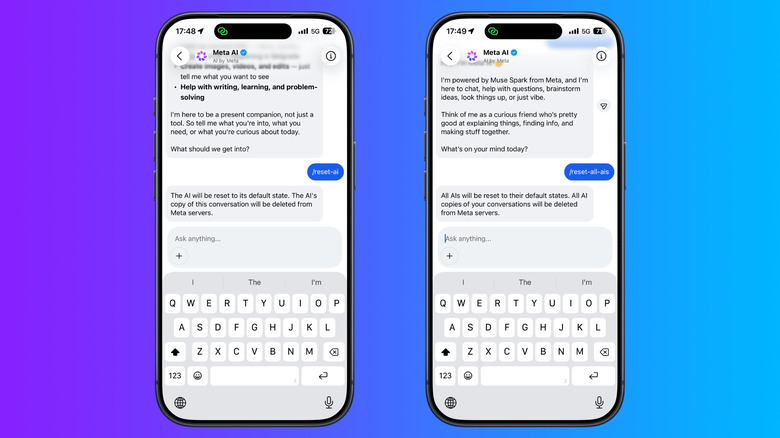
However, there are two cleanup commands in Instagram AI chats. Type /reset-ai to delete that AI’s copy of the conversation and the details it saved, or /reset-all-ais to reset every AI chat in the app. Your visible chat remains until you delete it separately. These commands clear saved context, and they don’t serve as opt-outs from advertising, ordinary data collection, or model training.
Advertisement
Model training is separate from personalization. Meta uses public posts and comments from adult accounts, along with interactions with its AI features, to improve generative AI models in regions where it relies on legitimate interests. Users in the EU and UK can object through Meta’s Privacy Center and that right isn’t a universal Instagram setting.
Do not put names, addresses, financial details, medical information or anything else you would not post publicly into a Meta AI chat. Use the reset commands after a conversation you don’t want the AI to remember, and use the objection form where it’s available.
Indian startups spent years getting consumers accustomed to having groceries and everyday goods delivered within minutes. Now Walmart-owned Flipkart is rapidly closing the gap with those quick-commerce pioneers, as global rival Amazon mounts its own push into instant delivery.
Flipkart Minutes, which debuted in August 2024 as the e-commerce giant’s foray into quick commerce, is now delivering 1.1 million to 1.2 million orders a day, up from about 390,000 to 400,000 in November, people familiar with the matter told TechCrunch. That puts the two-year-old service close to Swiggy’s Instamart, which is delivering about 1.4 million orders a day, according to a person familiar with its operations.
The gap is notable as Flipkart is a relative latecomer to a market whose top ranks have been dominated by Instamart, Blinkit, and Zepto. Food-delivery giant Swiggy launched Instamart in 2020 and Zepto arrived the following year, both during the pandemic, while Blinkit traces its roots to online grocery platform Grofers, founded in 2013. The three have since established themselves as India’s top quick-commerce players.
Blinkit continues to dominate the market with around 3.4 million to 3.6 million daily orders, followed by Zepto at about 2.4 million to 2.6 million, per recent estimates from market research firm Datum Intelligence. Flipkart is now rapidly narrowing the gap with Instamart, the smallest of the three established leaders by order volume.
Advertisement
Instamart still has substantial scale. Earlier this month, Swiggy said the quick commerce service has more than 14 million monthly transacting users and operates over 1,200 dark stores across over 130 cities. The company has also been narrowing Instamart’s contribution-margin losses, with more than 45% of its dark-store network now contribution-margin positive.
Nonetheless, Flipkart has fueled that growth with an aggressive expansion of its delivery infrastructure. Minutes now operates about 1,020 to 1,050 micro-fulfillment centers — essentially small warehouses located close to customers specially to handle quick deliveries — up from 600 in January and about 340 a year ago, one of the sources told TechCrunch. The company is adding around 100 such facilities a month, the source said, aiming to have 1,500 by the end of 2026.
Flipkart’s advantage goes beyond adding dark stores. The company can tap an enormous pool of existing e-commerce customers it has already spent years and billions of dollars acquiring, giving Minutes a ready audience for faster deliveries, Satish Meena, an adviser at Datum Intelligence, told TechCrunch.
“Flipkart is already a serious player,” Meena said. “Once you open 1,000 dark stores and [are] doing a million orders per day, it’s serious enough.”
Advertisement
Minutes is also seeing customers return and shop more frequently. About 65% to 70% of customers making purchases on the service each month are repeat buyers, while transactions per customer have increased 50% to 60% from a year earlier, people familiar with the matter said.
Those customers are spending an average of about ₹400 to ₹500 (about $4.20–$5.20) per order, with fruits and vegetables, staples, dairy, and meat among the fast-growing categories, the sources said. Flipkart is also expanding its selection of higher-end gourmet products, including organic and artisanal items, as it looks to capture more of customers’ spending on Minutes.
Even as Minutes has expanded, its average delivery time has fallen to about 11 minutes, from 13 minutes a year ago, one of the sources told TechCrunch.
A battle for India’s shoppers
Flipkart’s growth comes as quick commerce takes a bigger role in how Indians shop online, even as broader consumer demand has shown signs of weakness. In a recent report, Bernstein analysts said while the country’s consumption growth softened in July, a shift toward quick commerce and e-commerce continued, with quick-commerce platforms recording healthy growth in monthly active users.
Advertisement
Similar to Flipkart, Amazon is striving to gain its share in the Indian quick-commerce market. The Seattle-based company has been expanding Amazon Now, its quick-commerce service, as it seeks to bring the instant-delivery model to its existing e-commerce customer base.
During CEO Andy Jassy’s visit to India in June, Amazon stated that Now became its fastest-growing business in India, with orders doubling every quarter since launch. The company also laid out plans to take the service to more than 300 cities and set up a network of more than 1,000 micro-fulfilment centers, alongside larger facilities aimed at expanding the range of products it can deliver within minutes.
Amazon, Flipkart, Swiggy, Zepto, and Blinkit parent Eternal did not respond to requests for comment.
The quick commerce expansion is increasingly defensive as well as offensive for both Flipkart and Amazon, Meena told TechCrunch. As consumers grow accustomed to receiving certain purchases almost immediately, the e-commerce giants risk losing those transactions to specialist quick-commerce platforms if they cannot offer comparable speed.
Advertisement
“Can you go back to scheduled delivery now in grocery? No,” Meena said. “You will not go back.”
When you purchase through links in our articles, we may earn a small commission. This doesn’t affect our editorial independence.
A sale price at a Seattle grocery store. A proposed city ordinance would bar grocers from setting different prices for individual shoppers based on their personal data. (GeekWire Photo / Todd Bishop)
Seattle is in the final stages of becoming the first city in the country to ban so-called “surveillance pricing” in grocery stores. Experts disagree about whether it will actually save consumers money.
The proposed Fair Pricing and Transparency Ordinance would ban grocers from setting variable prices for individual consumers based on their personal data, both in-store and online.
This was one of Mayor Katie Wilson’s biggest campaign promises, and it comes after Maryland, Connecticut, and New Jersey passed the first state-level surveillance pricing regulations this spring. The City Council will hold a public meeting this Friday, Aug. 21, to hear amendments to the proposed ordinance.
The bill has received fierce criticism from tech and grocery industry representatives who say the ordinance would prohibit personalized discounts that benefit customers.
A City Council Central Staff Memo, which was first circulated last Thursday and will be presented at Friday’s meeting, raises some of those same concerns. Despite opposition from one councilmember and requests for major amendments from another, the bill seems well on its way to getting the requisite votes.
Advertisement
Impact on consumers
At the heart of the controversy is a disagreement about whether personalized pricing harms or benefits consumers.
The use of algorithmic pricing by Instacart last December met with so much backlash that the platform stopped using it. A 2025 Consumer Reports investigation had found that Instacart varied the total cost of the same cart at a Seattle-area Safeway by roughly $10, with only 8% of shoppers getting the lowest price. Those were randomized experiments to test price sensitivity rather than prices set from individual profiles, and Instacart stopped offering the technology behind them in December after the investigation was published.
In brick-and-mortar stores, electronic shelf labels have not yet been shown to offer individualized list prices. Instead, grocers such as Krogers and Albertsons personalize the effective price through the distribution of individualized digital coupons to loyalty club members.
The federal government is moving to regulate those. The FTC on Wednesday proposed an enforcement policy that would treat undisclosed personalized pricing, including discounts, as a violation of federal law, and opened it for public comment.
Advertisement
Amanda Dalton, who represents the Northwest Grocery Retail Association, said personalized discounts make groceries cheaper overall. Her organization was involved in drafting the bill but ultimately testified against it out of concern that it would prohibit those deals.
“We support what the council is trying to do as it relates to using personal information to drive higher prices,” Dalton told GeekWire. “Where we diverge is the need and ability to continue what we call pro-consumer common practices that are happening in grocery stores every day, like discount programs, coupons, fuel rewards, student discounts, and volume based deals.”
Contrary to messaging from some industry advocates, the current bill does allow some discounts. Loyalty programs, volume-based discounts, third-party manufacturer coupons, and discounts based on a broad identity, such as students or seniors, are all explicitly permitted.
Industry groups predict, however, that the liability exposure will make it too risky for stores to continue to offer those deals.
Advertisement
“There will be hoops that companies need to jump through to deliver those discounts, and a lot of legal exposure to liability,” Drew Ambrogi, a policy manager at Chamber of Progress, said.
As a solution, industry groups including Chamber of Progress, TechNet, and NWGRA have suggested that the bill be amended so that algorithmic pricing is prohibited for raising prices but is permitted for lowering them.
Advocates on the other side worry that would gut the bill entirely.
“That creates an incentive for retailers to inflate the list price and offer personalized discounts to each person based on their individual willingness to pay,” said Grace Gedye, a policy analyst for Consumer Reports.
Advertisement
UFCW 3000, which represents workers at major grocery chains, has also endorsed the bill, opposing individualized pricing regardless of whether it raises or lowers prices.
“It’s easy to figure out when your neighbors are getting a different price,” said union member J’Nee DeLancey, who works at Ballard Town and Country. “We grocery workers will have to handle the fallout of angry, confused customers.”
Loyalty programs
One Kroger and Albertsons-funded group called Protect Seattle Savings has claimed, online and in mass text blasts to Seattleites, that the proposed ordinance “puts your loyalty rewards program on the chopping block” — a claim that is not backed up by the bill itself.
In fact, the bill does exactly the opposite: it includes a carve-out for loyalty programs that allows retailers to use a customer’s purchase history to determine pricing so long as that customer has opted into a loyalty program and the criteria for the discount are disclosed.
Advertisement
That exception has drawn criticism from the NWGRA, which warns it may unintentionally penalize consumers who can’t afford to join the loyalty program. On DoorDash, for example, users have to pay $10 a month to be a “DashPass” loyalty rewards member. If DoorDash is only allowed to offer discounts to those members, then the bill may unintentionally make orders more affordable only for customers who can afford the membership fee.
NWGRA is calling on the city to expand the carve-out so that a retailer can offer purchase history-based discounts to non-loyalty members as well. The Central Staff Memo circulated last week highlighted the push from industry to preserve the use of purchase history for all customers, but wrote that it is “difficult to ascertain whether the limitations on personalized discounts would result in a net cost increase for consumers,” since consumer data could be used to raise prices as well as lower them.
Input from industry
Supporters of the regulation say they’ve already made significant compromises with industry. Councilmember Alexis Mercedes Rinck, who sponsored the bill, initially planned to ban electronic shelf labels, as New Jersey did, but dropped the provision after grocery workers said the new labels made their jobs easier. Now, the Seattle bill simply prohibits a store from using electronic shelf labels to display a price that has been determined using algorithmic pricing.
Another compromise was the narrowing of the regulation to exempt small grocers and convenience stores. The bill will apply only to grocers with 20 or more retail locations globally, as well as mixed-use retailers that sell groceries, like Costco; and delivery services, like Instacart and DoorDash.
Advertisement
Councilmember Rinck said the bill is the product of engagement with retailers, and that she hopes to keep them on board.
“We were at the table with grocers, and the proposal changed in response to their business concerns,” Rinck said. “We will be watching what folks in industry have to say about the legislation and amendments this Friday.”
Private right of action
The last major sticking point is the proposed enforcement mechanism, which industry representatives criticize for being overly aggressive.
The bill splits enforcement between the City Attorney’s Office and consumers. Both avenues allow civil penalties of up to $3,000 for a first violation and $10,000 for subsequent offenses, plus damages. The private right of action can only be pursued against stores with 25 or more locations instate, and civil penalties for a single collective action are capped at $1 million.
Advertisement
“The private right of action will have a chilling effect on the offering of discounts altogether,” Ambrogi said. “What is not explicitly banned by the bill may be presumptively banned because a business’s compliance department doesn’t think it’s worth exposing them to ambiguity.”
Dalton also opposes the private right of action for being too broad. Customers can seek damages for being offered an individual price, even if they did not buy the product in question.
“Our argument has been for clarity and simplicity,” Dalton said. “Now you’ve got a $1 million class action threat on every single product in your grocery cart.”
Consumer advocacy groups say the expansive private right of action is what gives the bill teeth, pointing to the similar clause in New Jersey’s surveillance pricing ban.
Advertisement
“If it was only public enforcement, there are practical limits on how frequent enforcement could be,” Gedye said. “Compliance might not be as rigorous as it would be if any consumer who thinks they’ve really been harmed by this practice can start looking into it and potentially initiate a case.”
City Attorney enforcement
The Central Staff Memo warned that the City Attorney’s Office may not be up for enforcing this law, either. Stores will be required to retain records on prices and discounts for three years. The bill charges the CAO with the task of auditing stores and ensuring compliance with the record keeping requirements.
Unlike the law that passed last year regulating algorithmic rent-fixing in Seattle, this bill does not enlist a city agency to help the CAO with enforcement. The regulation also applies to a far larger potential pool of complainants, and it does not arrange for additional funding in its fiscal note.
“The CAO may have to develop new systems and procedures to handle intakes directly and may not have capacity to conduct thorough investigations that would involve analyzing large volumes of data,” the memo said.
Advertisement
In response, a CAO spokesperson told GeekWire their office does not share the memo’s concerns and is in “full support” of the proposed ordinance.
“The City expects that grocery retailers will voluntarily comply with the legislation once it’s adopted, which includes a 1-year phase-in while the City will inform and educate retailers about the bill’s provisions,” a CAO spokesperson told GeekWire. “We anticipate the expected level of work can be managed using existing resources and funds recovered through litigation.”
The council will vote on the bill in September after they return from recess. But first, Friday’s committee meeting will reveal which councilmembers are in support of the legislation and what kinds of amendments will be considered.
Councilmember Rinck said she “feels good” about getting the bill passed, and looks forward to making Seattle the first city to regulate algorithmic pricing on groceries.
Advertisement
“Government gets a bad rap for being reactive,” Rinck said. “This is an opportunity for us to be proactive in trying to regulate this kind of practice before it really takes hold in our city.”
The Air Force wants drones spanning hobbyist toys to full stealth fighters
Fighter-mimicking drones must fly past Mach 1.6 at high altitude
Bomber-sized drones need matching radar, heat, and physical dimension signatures
The US Air Force is seeking industry proposals for target drones capable of imitating threats from cheap commercial aircraft to stealth fighters.
A recent Request for Information issued by the service sets a deadline of September 28 2026 for companies to submit concepts.
The requested drone series would span nearly every category of aerial threat, from small hobbyist-style platforms to heavy bombers.
Latest Videos FromTechRadar
Advertisement
A range of threats in one series
The Air Force’s request describes platforms that must stand in for cheap hobbyist drones on one end and advanced fifth-generation fighters or large multiengine aircraft on the other.
For supersonic fighter simulation, the request describes speeds beyond Mach 1.6 at roughly 40,000 feet, combined with sharp high-G maneuvering.
It also calls for tightly controlled radar signatures and layered infrared and radio-frequency emissions meant to resemble a genuine combat aircraft.
Systems meant to stand in for large drones would need to operate at altitudes near 50,000 feet, matching how high those aircraft actually fly.
Sign up to the TechRadar Pro newsletter to get all the top news, opinion, features and guidance your business needs to succeed!
Midsize platforms would need to fly at speeds between Mach 0.5 and 0.8 while making sharp, forceful turns similar to real fighters.
Advertisement
Smaller systems, meant to substitute for compact scout-class drones, would fly well under 150 knots and support coordinated swarm behaviour.
For aircraft the size of a C-130, engineers care less about raw performance and more about matching physical scale, subsonic handling, and propulsion behaviour.
That accuracy allows engineers to test how well a missile’s guidance system and warhead would perform against a realistically sized aircraft.
Advertisement
Cost and history shape the approach
The service is explicit that affordability matters as much as realism, describing a preference for systems cheap and simple enough to be treated as expendable when a test requires it.
Rather than relying solely on traditional defense contractors, the Air Force is inviting commercial, modified commercial, and dual-use proposals that might undercut the cost and complexity of older programs.
This approach follows nearly a century of remote-controlled target aircraft, stretching back to Britain’s converted Tiger Moth trainers flown in the 1930s.
Advertisement
Since 2007, the Air Force has leaned on the BQM-167A, a subscale subsonic drone roughly 20 feet long, far smaller than a Chinese J-20 fighter or an H-6 bomber.
The service also operates the QF-16, a retired F-16 that has been converted to stand in as a full-scale fourth-generation threat aircraft.
Though it cannot convincingly replicate a modern stealth aircraft, it remains too costly to expend in large numbers.
After its recent military engagement in Iran, the U.S. has seen every reason to emphasize ‘cheap’ instead of ‘performance.
Advertisement
In the war, the U.S. has lost approximately 45 MQ-9 Reaper drones — about 25% of its fleet — costing over $1.3 billion, to a series of comparatively cheap Iranian drones and missiles.
So, while the U.S. may or may not be winning the physical war, it is certainly not happy with the financial implications of the victories or losses.
Whether the commercial industry can actually deliver stealthy, high-speed, expendable drones at the price point the Air Force wants remains an open question.
Pop icon Cher’s 1969 album, recorded at the legendary Muscle Shoals Studio, was both a critical success and a commercial failure. Over the years, however, 3614 Jackson Highway has only grown in stature, prime evidence of her artistry and a tasty platter of choice covers arranged with that just-right blend of Southern soulfulness and pop sheen.
That said, finding original copies of this now much sought-after album is not as easy as it used to be, and thus prices can be costly on the collector’s market in top condition. Fortunately, there have been reissues over the years, and in fact, there is a new edition from Rhino’s generally excellent High Fidelity series which you may want to consider, albeit with a bit of caution.
The basic ingredients of this new Rhino reissue appear typically idyllic: 180-gram vinyl pressed at Optimal Media, with lacquers cut by Kevin Gray at Coherent Audio from the original master tapes. The label made this tip-on-style glossy laminated cover extra spiffy, adding a silver foil finish beneath Cher’s name. With three Dylan covers, as well as tunes by Dr. John, Stephen Stills, Steve Cropper, Otis Redding, Dan Penn, Spooner Oldham, and Chips Moman, 3614 Jackson Highway has all the ingredients for a terrific listen.
My listening process began well, actually, with the Rhino HiFi edition bettering my original white label promo “Monarch” pressing, the sound appearing wider, bigger, and richer overall.
Unfortunately, on Side 2, I began to hear nasty noises, which turned out to be a rather significant rash of “non-fill.” This production error can happen when the vinyl does not melt well enough to flow into the metal stamper grooves. An imperfect copy results, bearing tiny audible pits where the vinyl didn’t fill the grooves (thus the “non-fill” designation). You can usually easily see these telltale markings, such as in the photo following.
Advertisement
Trying to be fair, I wrote to the label and asked if they could send a replacement, hoping my problem album was a one-off anomaly. So far, Rhino’s High Fidelity series has been exemplary.
Unfortunately, my second copy also had non-fill issues, and this time there was also an audible hairline scratch on one side! This is a very unusual occurrence, in my experience, for records pressed at Optimal. I am not entirely surprised, given the strange, upside-down socioeconomic times our world is enduring these days, where understaffing and overwork are the norm. Someone clearly was rushing the process to meet deadlines.
Stuff happens. I get it. But this doesn’t make it any easier for consumers spending $39.98 on a new record who expect perfection! So, I went ahead with writing this “heads-up” type review. I am not trying to dissuade you from buying Rhino High Fidelity’s reissue of Cher’s 3614 Jackson Highway. If you are not in a rush, you might, however, want to wait for the non-numbered regular edition of this reissue series, which I hope will be a different pressing run that will showcase all the love and care we have come to expect from Rhino and Optimal.
Mark Smotroff is a deep music enthusiast / collector who has also worked in entertainment oriented marketing communications for decades supporting the likes of DTS, Sega and many others. He reviews vinyl for Analog Planet and has written for Audiophile Review, Sound+Vision, Mix, EQ, etc. You can learn more about him at LinkedIn.
For much of the past two years, the general belief in enterprise AI has been that more autonomy equals better performance. Build agents that can plan, decide, and act across multi-step workflows, and give them as much room to run as possible. That assumption is now being tested at scale, in real production environments — and in a lot of deployments it’s failing. The companies that end up benefiting from agentic AI won’t necessarily be the ones that have given their agents the most flexibility. They’re the ones who create AI agents with specific responsibilities and make sure they operate within clear rules.
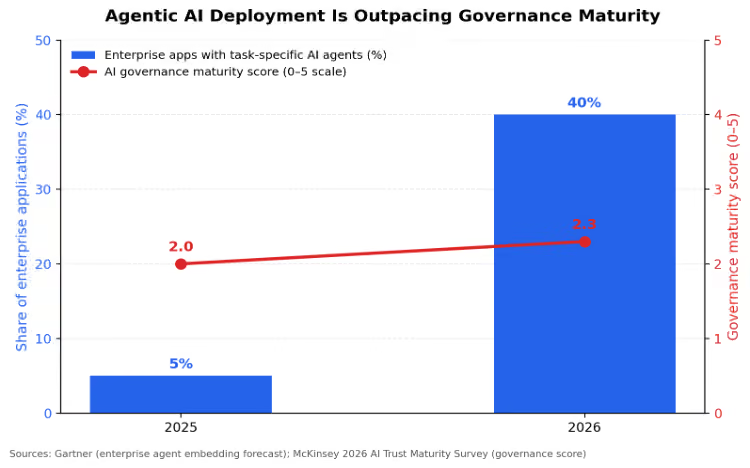
Two numbers tell you almost everything about where agentic AI stands in mid-2026. By Gartner’s own forecast, more than 40% of the agentic AI projects running today won’t survive to see 2028. Not because the models fall short; because of escalating costs, unclear business value, and inadequate risk controls. McKinsey’s 2026 AI Trust Maturity Survey fits right alongside that prediction: Agentic AI deployment is accelerating across every industry, but average responsible-AI maturity sits at just 2.3 out of 4. Only about 30% of organizations have reached a maturity level of three or higher in governance and agentic AI controls specifically.
Put those two numbers side by side, and the story tells itself. Capability is outrunning control.
That shift is changing the competitive framing, too. The 2024-to-2025 race was about who could deploy the most autonomous agent the fastest. The 2026-to-2027 race is a trust race.
Advertisement
It’s not about who can build the most capable agent. It’s about who can get an agent approved for production by risk, legal, and compliance teams, and keep it approved once it’s live. This is a different kind of engineering challenge than most enterprises are prepared for.
Why full autonomy breaks down in production
Gartner lays out the failure pattern as specific and repeatable. Projects launch with ambitious, broadly autonomous workflows. They hit integration complexity within weeks. Then they stall, with no defensible path to production ROI. Part of the problem is vendor noise. Gartner’s own count puts it starkly: Out of the thousands of products being sold under the ‘agentic AI’ label, only around 130 actually have real autonomous capability behind them. The rest are largely automation or chatbots repackaged for the moment.
But even genuinely agentic systems run into a structural problem that has nothing to do with hype. Autonomy and accountability move in opposite directions.
An agent capable of independently planning and executing a multi-step task is also an agent whose individual decisions get harder to trace after the fact. Let’s say something breaks a few steps into an autonomous chain. Figuring out why the agent made that decision and who is responsible can be a complicated process, not a simple lookup.
Advertisement
In areas like financial reconciliations, compliance processes, manufacturing quality checks, or clinical documentation, this lack of transparency can be the difference between a manageable mistake and a serious regulatory breach. It’s the reason legal, risk, and compliance teams block agentic projects from reaching production, regardless of how capable the underlying model is.
Integration complexity keeps showing up as a leading cause of project cancellation. Bolting an autonomous agent onto a legacy workflow takes more than technical connective tissue. The workflow’s existing decision points, approval chains, and audit trails all need to be rebuilt around a system that can now act without waiting for a human. Enterprises that treat this as a pure integration problem, solvable with more engineering hours, tend to be the ones that stall.
This isn’t a hypothetical risk. McKinsey’s research shows how exposed most enterprises currently are. Across nearly every category of AI risk, from data privacy to intellectual property exposure, the gap between the risks organizations say they’re aware of and the risks they’re actually mitigating remains wide.
Awareness has surpassed action. This gap is reflected in the businesses that report it as an obstacle to further scaling of agentic AI. Nearly two-thirds now say security and risk issues are the greatest challenge for them, surpassing regulatory uncertainty and technical barriers.
Advertisement
What governed orchestration actually looks like
The enterprises that are leading the way are not halting their AI plans. They’re restructuring how autonomy is being distributed within the system. The four patterns that stand out in organizations that are governance-mature are:
Narrow-scope agents over general-purpose ones. Decompose end-to-end workflows into single-responsibility agents with tightly bounded mandates. A smaller scope of work results in a smaller scope of failure, and a smaller scope of failure is much easier to audit.
Human checkpoints at decision boundaries, before the outcome, not after it. Review agent decisions before high-stakes actions execute, not after the fact. That means checkpoints before sensitive data moves, a transaction posts, or an external system is triggered. McKinsey’s framework calls for real-time, data-driven monitoring built into the agent pipeline itself, with humans retaining final accountability specifically for high-stakes decisions.
Decision traceability as a design requirement. A full action log and decision lineage should be available on demand for any agent, any decision. It shouldn’t need to be reconstructed under pressure during an audit. Regulators are pushing the same way. The EU AI Act’s human oversight requirements for high-risk systems are still coming, even though this year’s Digital Omnibus agreement pushed the compliance deadline out to December 2027. Enterprises building agent systems now are effectively building toward that requirement, whether or not it’s technically enforceable yet.
Data sovereignty does active governance work, not passive paperwork. Where an agent’s data sits, and who has access to it, decides how contained a failure can be. On-premise or controlled-environment deployment limit the blast radius of a misbehaving agent and simplifies exactly the kind of audit trail regulators and boards are starting to expect.
The risk runs in both directions, of course. Agentic AI is supposed to cut friction. An agent that needs a human to sign off on every minor task hasn’t cut anything; it’s just automation wearing a manual process as a costume. That quietly undercuts the whole case for building the agent in the first place. The goal isn’t maximum control. It’s calibrated control, concentrated where the cost of an error is actually high.
Agent deployment is scaling roughly 8x faster than governance maturity is improving.
A practical framework for evaluating your agent stack
If enterprise architects are reviewing an existing agent for deployment or are considering deploying an agent, they can begin by asking four questions.
1. Can you reconstruct, six months from now, exactly why a specific agent took a specific action?
If the honest answer requires digging through raw logs or guessing, decision lineage isn’t a design feature of the system. It’s an afterthought. And it will show up as a gap in the next audit.
Advertisement
2. Does every agent in the stack have one clearly bounded responsibility, or is at least one agent authorized to “figure it out” across a broad task?
Broad, open-ended mandates are exactly where compounding errors and untraceable decisions originate.
3. Are human checkpoints placed at defined decision boundaries, or only as a final review after the agent has already acted?
A review after the fact catches consequences. A checkpoint before the fact prevents them.
4. If an agent were compromised or malfunctioning right now, how much data and how many downstream systems could it touch before anyone noticed?
This is where data sovereignty and access scoping stop being compliance line items and start functioning as containment strategy.
These are all questions that don’t need to slow down the adoption of agentic AI. They need direction on how and where autonomy is of value to their organization and how to open up to exposure. This suggests building the orchestration layer on that separation, rather than adding governance after a production incident forces the question.
Advertisement
The real competitive advantage
Gartner’s 40% cancellation forecast isn’t really a warning about AI capability. It’s a forecast about organizational discipline. Right now, agentic AI sits at what Gartner defines as the “peak of inflated expectations,” and there’s a fairly straightforward explanation. Enterprises spent 2024 and 2025 optimizing almost entirely for autonomy. Now they’re paying down the governance debt that approach accumulated.
The winning position by 2027 won’t belong to whoever deployed the most autonomous agents fastest. It will belong to whoever built agent systems trustworthy enough that risk, compliance, and legal teams stopped being the bottleneck. The architecture answered their questions before anyone had to ask them.
That’s a different design brief than most agentic AI roadmaps were written against. It’s about making scoped autonomy, checkpointed decisions, full traceability, and data sovereignty integral to the architecture from the start, not add-ons after a pilot project has been a success.
Midhula Mariyam Jeevan is a content writer specializing in AI, enterprise technology, software engineering, and SEO.
Advertisement
Welcome to the VentureBeat community!
Our guest posting program is where technical experts share insights and provide neutral, non-vested deep dives on AI, data infrastructure, cybersecurity and other cutting-edge technologies shaping the future of enterprise.
Read more from our guest post program — and check out our guidelines if you’re interested in contributing an article of your own!
LG Energy Solution says the unsolved problem in solid-state batteries is making large cells at scale, and expects the technology to reach smartphones roughly a decade before electric vehicles. Europe’s first solid-state gigafactory broke ground in France in February.
The company that has just opened America’s newest battery plant does not think solid-state cells are close for cars. “The problem with solid state is large-scale production,” said Robert Lee, North America president of LG Energy Solution, at a media roundtable at its new Lansing factory.
The difficulty scales with the cell. Small formats reach good energy density, Lee said, but “if you’re making very large form factors, most companies are struggling.”
His ordering of the market is the blunt part. Solid-state will appear in smartphones “probably a decade before you would see it in EVs,” with specialised applications arriving before either cars or grid storage.
Advertisement
Europe is building on the opposite assumption. ProLogium broke ground in February on a 12 GWh solid-state plant in Dunkirk, and a Dutch startup won public money to develop a factory of its own.
European carmakers are further along in testing than in production. Mercedes ran a prototype EQS almost 750 miles on cells from Factorial Energy, BMW has put a Solid Power pack in an i7, and Stellantis is testing a pack in a Dodge Charger Daytona.
Two of those three are semi-solid rather than fully solid. That distinction is precisely the gap Lee is describing, and it runs through most of the promised launch dates in this field.
China is moving faster on paper. BYD, CATL, Geely and others are targeting pilot production of solid-state cells in 2027, with wider deployment hoped for by the end of the decade.
Advertisement
LG’s answer is to improve what already works. It is developing lithium manganese rich cells with General Motors that use far less nickel and cobalt, promising more than 400 miles of range from 2028 at roughly the cost of cheaper lithium iron phosphate packs.
It is also hedging across chemistries. The company is preparing 46-series cylindrical cells at its Arizona plant and running a sodium-ion pilot for storage, in a market where CATL commercialised sodium first.
For Europe the timing question matters more than the technology. The continent lost its own champion when Northvolt collapsed, and the plants now being built here belong to Taiwanese, Korean and Chinese companies.
Which makes Lee’s caution worth reading twice. If large-format solid-state cells are a decade out, Europe’s route back into batteries runs through incremental lithium-ion improvements it does not currently manufacture at scale.
Army AI agents now perform specialized cyber work under human supervision
Human commanders still decide which operational risks machines can handle
AI agents train for cyber roles using standards similar to personnel
The US Army is training AI agents to work alongside human forces in defined cyber roles, assigning specialized responsibilities within operational units.
According to Army Cyber Command (ARCYBER), these systems are being prepared to perform technical duties alongside personnel, while humans retain responsibility for decisions involving risk.
ARCYBER is developing and deploying these AI agents through Task Force Lexington, which oversees the command’s artificial intelligence programs.
Latest Videos FromTechRadar
Advertisement
Training AI agents for specialized cyber duties
“Every agent we create is trained in a work role inside the cyber force,” said Lt. Gen. Christopher Eubank, commander of Army Cyber Command.
The training covers positions including developers, data engineers, host analysts and exploitation analysts, with agents receiving standards comparable to human personnel.
Eubank said agents must receive Job Qualification Readiness approval before being assigned missions under human supervision and required to deliver results.
When an agent makes an error, personnel correct its approach before sending it through additional training and returning it to assigned duties.
Sign up to the TechRadar Pro newsletter to get all the top news, opinion, features and guidance your business needs to succeed!
Task Force Lexington has a streamlined team of roughly 10 technically experienced personnel handling the agents’ training and technical needs.
Advertisement
The team recently sent personnel to the Defense Innovation Unit, where senior engineers provided additional technical training.
AI agents are already being used for network hunting, cybersecurity risk management, and other functions connected with protecting Army information systems across daily operations.
Advertisement
Humans retain responsibility when operations involve risk
Despite the expanded use of agents, Eubank said the Army has not authorized them to independently accept operational risk during missions.
“We have not turned any agents loose to assume risk on their own behalf,” said Lt. Gen. Christopher Eubank, commander of Army Cyber Command.
Commanders assess the safeguards around each mission and determine which tasks can be delegated to AI tools and which should remain under human control.
The process becomes more difficult as agents can complete some tasks much faster than people, creating a trade-off between speed and oversight.
Advertisement
Agents therefore check their work with personnel, who review the output before directing the systems toward subsequent assignments or additional analysis.
The approach allows agents to operate at machine speed while keeping human personnel involved in decisions where consequences require direct judgment.
Lt. Gen. Jeth Rey, Deputy Chief of Staff, G-6, said the Army currently operates and defends its network at human speed.
“Our adversaries are doing it at machine speed and we must catch up and we must get ahead,” Rey said.
Advertisement
The network supports core military functions, including communications, movement and daily operations across the force.
The Army’s current approach therefore combines faster automated cyber activity with human oversight, rather than allowing agents to control operational decisions.
Wrongly discarded lithium batteries, such as those in vapes, are causing more than 10 fires a week at U.K. recycling centers, according to figures shared with the Guardian:
The Environment Services Association (ESA), the trade body for waste management companies, said its members had reported 1,518 fires in the year to March 2026. At least 541 of these fires were directly attributed to lithium ion batteries, the survey found. There were a further 216 battery fires in bin lorries [garbage trucks]. The ESA said the reported number of battery-related fires underestimated the scale of the problem, because in most incidents it was impossible to determine the cause of the blaze. A spokesperson said: “We know 40% of fires at recycling centres are caused by batteries, but we think the actual number is more like 70%.”
It estimates that annual cost of these fires has increased from £150m in 2021 to £1bn today…
The ESA is calling for a £5 deposit scheme on the sale of all vapes to ensure that vape users have an incentive to return used devices to retailers for safe disposal… [Patrick Brighty, the head of recycling policy at the ESA, said] “Vapes are among the biggest culprits because they’re cheap, abundant and typically have a short use-life.”
Thanks to long-time Slashdot reader AmiMoJo for sharing the news.
































































You must be logged in to post a comment Login