








Connect with us

Tech

There’s the Mac Mini, and Then This Mini Mac You Never Knew You Needed

Published

on

Custom Mini Mac Build Wondermac
Apple’s Mac Mini has been sitting quietly on desks all across the world, pushing through daily business and creative chores with the simplicity of a small powerhouse. In spirit, if not in design, it is right next to an equally little, yet quite different, machine known popularly as the Mini Mac, or Wondermac in some circles. This little device began life as a Maclock, a desk clock that looks exactly like the original 1984 Macintosh, complete with the instantly identifiable beige shell, a teeny-tiny screen bezel, and even a false floppy disk port, but what occurs next adds a lot of complexity to what was once a simple gimmick.



YouTuber This Does Not Compute disassembled the Maclock and then rebuilt it from the ground up, using a Raspberry Pi Zero 2 W, a chip small enough to fit discreetly inside the clock’s shell but powerful enough to tackle the work at hand. He combined it with a 2.8-inch Waveshare LCD panel, which is small enough to fit comfortably behind the curved plastic lens that attempts to simulate an old-school CRT monitor. The resolution is a respectable 640×480, which complements the old atmosphere perfectly. For power, he used a customized USB-C connection on the back, which was tuned to produce a clean 5 volts after some fiddling with the original charging circuit to bypass it. Then there’s a little heatsink that quietly keeps the Pi from overheating without creating any fan noise.

Sale


OIJ Maclock Retro Pixel Alarm Clock, 1984 Computer-Inspired USB Desk Clock with Pixel Display, Multiple…
  • 【Retro 1984 PC Design】 This miniature ivory-colored ABS/PMMA alarm clock revives the charm of the early computer era. A perfect nostalgic piece…
  • 【Multi-Mode Pixel Display】 The high-contrast LCD simultaneously displays time, calendar, date, and room temperature. A hidden pixel smiley…
  • 【Adjustable Brightness for Comfort】 Gentle, warm backlighting in the morning and dim lighting at night protect your sleep. Simple bottom dial…

Custom Mini Mac Build Wondermac
The front bezel required some custom work, which he solved by designing and 3D printing a black bracket to put the Waveshare display in place, cleaning up a bit of plastic in the process to ensure everything fit together smoothly. The original clock’s screws end up holding everything together. As an optional extra, you can sandwich the original’s old LCD layer between the lens and the Waveshare screen to maintain the real border look, albeit this will cost you a sliver of useful screen space. When all is said and done, the finished piece appears to be so beautifully put together that it could have come directly from the factory.

Custom Mini Mac Build Wondermac
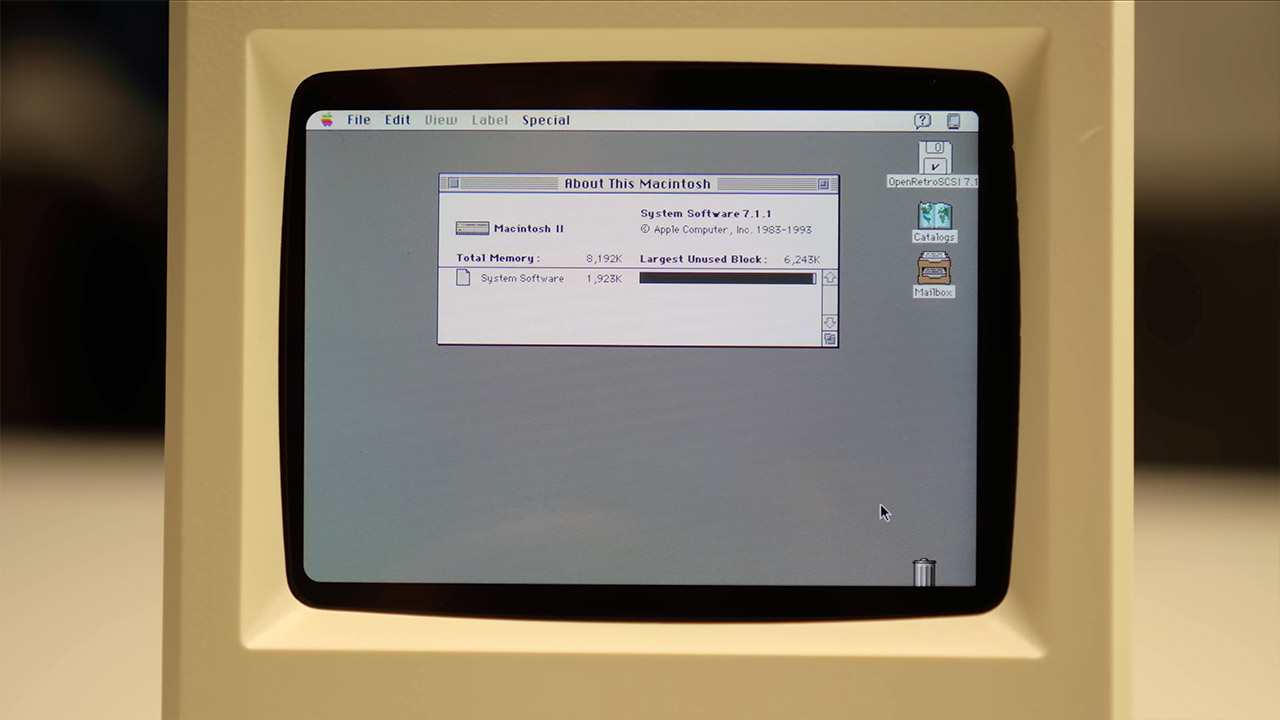
The real magic comes from the software, Raspberry Pi OS, notably the 32-bit version, which is stored on a fancy 32GB microSD card. After setting up the essentials like Wi-Fi and SSH, he installed the display drivers and adjusted the output to match the Mac case’s portrait orientation. The big event, however, is Mini vMac, a lightweight emulator that replicates ancient Macintosh computers in one fell swoop. Unfortunately for the project, newer versions were too hefty for the Pi Zero 2 W, so he reverted to an older release that he compiled from source. The laptop then boots directly into System 7 after loading a Mac ROM file and some system disk images, ready to run some vintage apps or simply sit there looking nice with one of those mesmerizing After Dark screen savers.

Custom Mini Mac Build Wondermac
Wondermac operates as a headless machine, displaying its replicated desktop on that little screen, essentially serving as a constant desk ornament. It uses very little power and is extremely silent. Overall, it cost him roughly $100, depending on where you can obtain the Maclock and parts. He’s retained a repository of all the software phases on GitHub, from getting started to mucking around with compilation notes, though he admits the project isn’t seeing much active activity right now.

Advertisement

Source link

Continue Reading
Click to comment

Leave a Reply

Your email address will not be published. Required fields are marked *

Tech

Week in Review: Most popular stories on GeekWire for the week of Feb. 8, 2026

Published

on

Get caught up on the latest technology and startup news from the past week. Here are the most popular stories on GeekWire for the week of Feb. 8, 2026.

Sign up to receive these updates every Sunday in your inbox by subscribing to our GeekWire Weekly email newsletter.

Most popular stories on GeekWire

Source link

Continue Reading

Tech

Dealing With Intermittent Water Utilities

Published

on

In many places, municipal water from a utility is something that’s often taken for granted. A local government or water utility will employ a water tower or pumping facility to ensure that there’s always water available to every home and business connected to it, all day, every day, and at a relatively constant pressure. This isn’t true the world over, though, and in [Sameer]’s home of Rajasthan he has to deal with a particularly onerous problem with the local water supply. Although he is connected to a utility, there is only water available at certain times of day, and not on a reliable schedule or at a particularly high pressure. This causes all kinds of problems, but he was able to employ an ESP32 to solve some of the headaches.

Most of [Sameer]’s neighbors install small pumps on the water main to pull water into reservoirs when it’s available. This creates two major problems, the first of which is that with all these pumps running, they can sometimes pull a vacuum on the water main, which can draw in contaminants and cause cavitation in the pumps. The second is that, if these pumps are on a timer and run when there’s no water available, they can damage themselves. [Sameer]’s solution pairs a flow sensor with a pump that is controllable via an automation tool like Home Assistant. He also includes a hydraulic analysis of this particular situation, such as placing the sensor on the output side of the pump rather than the inlet, as well as making sure that there is a laminar flow of water in the pipe it is installed on to ensure that it is taking valid measurements.

With everything set up and running, the water pump can automatically detect if there is water available, pump it to the reservoir as long as it lasts, and then automatically turn off the pump to avoid any thermal damage from running dry. [Sameer] even includes a complete Home Assistant setup for those who would like to replicate his work. We also think that this has utility outside of household water supplies as well, perhaps those watering their gardens with stored rainwater or those using other unique, semi-automated water catchment systems.

Advertisement

Source link

Advertisement
Continue Reading

Tech

Sky adding HBO Max is great, but I do wish it made 4K the standard

Published

on

The news that we (pretty much) told you last year is now done and dusted. HBO Max is coming to the UK, and it’ll be wrapped up into a nice shiny bow for Sky customers as part of its Ultimate TV subscription when it goes live in March.

This is a boon for Sky customers (new and existing), as it keeps hold of the Warner Bros. content that’s not just legendary but become synonymous with Sky for decades now.

Its partnership with Warners brought the likes of Game of Thrones, Boardwalk Empire, Entourage (remember that?) and Girls to the UK, and this new deal makes it easier for Sky customers to access that content in one place.

But, and there always is a but with me, I do have an issue.

Advertisement

Why can’t we have it all in 4K as standard?

Advertisement

Ultimate TV subscription in name only

I expect, at the very least, that when you call a subscription ‘Ultimate’, you’re getting all the bells and whistles that come with it. The (new) Ultimate TV sub, will have Netflix, Disney+, HBO Max, and Sky’s own content all included as standard, but read the small print, and the versions of these services and apps that you get come with ads, and, they’re only available in HD.

I can’t help feel a little disappointed that watching on my 4K TV, it’s actually having to upscale this legion of content because 4K and HDR (and Atmos) are an optional extra.

Advertisement

This is not strictly Sky’s fault, though it does play into the issue by offering an optional UHD/Atmos pack that you have to buy to unlock access to 4K HDR content. Streaming services themselves have secreted away all their 4K goodness to their premium tiers, in the hopes that you’ll pay more money for higher quality.

Except it doesn’t feel like people are doing that.

After an initial explosion of 4K live broadcasts, it’s mostly been watered down to HD HDR. The last Euros were shown in just HDR, and I honestly can’t remember the last time the BBC showed the FA Cup Final in anything but HD – it feels like it was aeons ago now.

This is partly down to the expense of broadcasting in 4K HDR (especially live), but also that viewers didn’t seem to be watching in 4K either, preferring to catch the action on their mobile devices instead.

Advertisement

Advertisement

The Pitt TV seriesThe Pitt TV series

To get HBO Max, Netflix, and Disney+ in 4K HDR; you’ll have to pay more, which makes the Ultimate TV subscription, which initially looks like a steal, a little less appetising if you want the best quality in your home.

I’ve always advocated for streamers and broadcasters to bring 4K to more people by making it the standard. Instead, we’re still locked into HD, which has been around for 20 years now. I think it’s time to give up the ghost, stop trying to entice people to pay extra for 4K and give them the best experience from the outset.

I doubt that Sky would love my thoughts on it, but the word Ultimate implies an experience that you’re getting the best. You are in a way, but it comes with a caveat. I do wish that barrier to 4K was taken down, not just with Sky but with every streaming service. Though many are embracing the streaming future, it still feels like we’re locked in the past.

Advertisement

Source link

Continue Reading

Tech

Maker Creates Robot That Looks Just Like a Spool of Filament for 3D Printers

Published

on

3D Printer Spool Filament Robot
A spool of filament rests calmly on a shelf, looking exactly like the usual orange Prusament roll found in numerous 3D printers, yet it hides a little secret. Prusa wanted a one-of-a-kind gift and asked Matt Denton to transform a regular 2kg spool of filament into an out-of-the-ordinary remote-controlled robot dubbed SpoolBot, which you’d be hard-pressed to tell is actually a robot going for a little roll on its own power.


Denton started from scratch with a genuine Prusament spool and simply retained the outward appearance the same, which means it still has the orange filament wrapped around a center drum in a sloppy, but highly realistic pattern. One side of the spool is fixed, but the other side detaches with magnets to allow you to go in and make changes. Those black plastic ends are actually the pieces that move the spool; they are the driving wheels. Inside, everything is held together by an internal frame that prevents the entire structure from looking out of place.


Bambu Lab A1 3D Printer, Support Multi-Color 3D Printing, High Speed & Precision, Full-Auto Calibration…
  • High-Speed Precision: Experience unparalleled speed and precision with the Bambu Lab A1 3D Printer. With an impressive acceleration of 10,000 mm/s…
  • Multi-Color Printing with AMS lite: Unlock your creativity with vibrant and multi-colored 3D prints. The Bambu Lab A1 3D printers make multi-color…
  • Full-Auto Calibration: Say goodbye to manual calibration hassles. The A1 3D printer takes care of all the calibration processes automatically…

The whole device is powered by two geared DC motors from Pololu, each equipped with an encoder that tells the bot exactly what it’s doing and causes the drive wheels at the spool’s edges to turn. Batteries are put low to function as a counterbalance, ensuring that the entire assembly remains upright when the spool spins around its center. A DFRobot Romeo Mini ESP32-C3 board handles all of the control, and it works in tandem with a BNO085 IMU sensor to keep an eye on things and ensure the spool remains upright and stable. An RC receiver links to a simple handheld controller.

3D Printer Spool Filament Robot
Movement is accomplished by a technique known as differential drive; in order to travel in a straight path, both motors must be moving at the same speed; however, varying the speeds results in pleasant smooth bends. The IMU monitors how far up and down and side to side it moves, and if it becomes unsteady, it slows down the motors to keep the whole thing from toppling over. Then there’s the gyro feedback, which effectively keeps the spool on track even when it’s on an uneven surface like a carpet. Several operating modes are available, allowing you to choose how the bot behaves. For example, you can keep it sitting in one location, have it follow a trail back to where it began, cruise along at a given speed, or even perform some beautiful spins at full or half speed.

3D Printer Spool Filament Robot
The entire assembly required a lot of meticulous planning and engineering to get right; as you can see, the outer shell must be able to spin freely on the center hub, so it’s all about getting the bearings perfect so it travels smoothly. The insides of the spool are made up of 3D-printed elements in black PETG and orange PLA, which are held in place by a variety of ingenious components such as heat-set inlays and precision bolts. The wiring is neatly tucked away so that it does not interfere with the movement of the various components. It took around five weeks to complete the project, from designing it in CAD to printing the pieces and writing the code.

3D Printer Spool Filament Robot
Matt Denton chose to be generous and share all of the build files and code with the world. You can get them on Printables and on GitHub, and there is even a video guide that shows you how to create one yourself, from installing the bearings to wrapping the filament around the central drum and calibrating the controller. Of course, like any decent robot, SpoolBot includes a couple googly eyes and a small indication to give it some personality as it rolls around the floor.
[Source]

Advertisement

Source link

Continue Reading

Tech

Apple may be adding a splash of color to its upcoming budget-friendly MacBook

Published

on

The hardest choice to make for building your next MacBook might be selecting a color. According to Bloomberg‘s Mark Gurman, Apple has tested colors including light yellow, light green, blue and pink for its next entry-level MacBook that’s aimed at students and enterprise users.

Beyond the more vibrant colors, Gurman said that Apple has also trialed its classic silver and dark gray colorways for its cheaper laptop. Gurman added that not all of these six colors will make it to the final product, but Apple has recently shown it’s not afraid to dip into flashier options. Apple refreshed the iMac in 2024 with a total of seven colors and swapped out the space gray option for sky blue for the latest MacBook Air.

Color choices aside, the latest rumors point to the upcoming MacBook having a price tag that’s anywhere between $699 and $799. To achieve that lower price point, Apple is expected to port over its chips designed for iPhones, like the A18 Pro that we first saw with the iPhone 16 Pro Max. We’re also anticipating Apple will compromise on specs, ports, or even the display, but Gurman reported that the company won’t be skimping when it comes to the shell. According to Gurman, Apple will employ a new manufacturing process to craft aluminum shells for the affordable MacBook, instead of opting for a cheaper material like plastic to cut costs. We may not have to wait long to see the official colors of the budget MacBook, as Gurman reported that it will be announced during an event in March.

Source link

Advertisement
Continue Reading

Tech

TechCrunch Mobility: Rivian’s savior | TechCrunch

Published

on

Welcome back to TechCrunch Mobility — your central hub for news and insights on the future of transportation. To get this in your inbox, sign up here for free — just click TechCrunch Mobility!

We are in the midst of one of my four favorite times of year — earnings season. And it’s not just that I like numbers. These required filings cut through a lot of the marketing noise presented by companies the rest of the year. They also help me assess the short- and long-term stakes the companies face.

Rivian’s fourth-quarter and full-year earnings did precisely that. My takeaway: Software, and specifically its technology joint venture with Volkswagen Group, was the company’s savior in 2025. It will also buoy the company into 2026 (another $2 billion is expected from VW Group) as Rivian launches its most important product to date: the lower-cost R2 SUV. 

The company’s earnings also provided a progress report on its bid to lower the cost of goods sold per unit. The TL;DR is that the cogs per unit for its current portfolio is still high but dropping, meaning it’s losing less on each vehicle it sells. According to Rivian, the company’s automotive cogs per unit delivered was $100,900 in 2025, down from $110,400 in 2024. 

Advertisement

The upcoming R2, which is supposed to be considerably cheaper (both in production cost and price tag) than its flagship R1T truck and R1S SUV, will be the next big test. We’ll get some insight into the results of that later this year.

The R2 is expected to go into production in the first half of the year (we’re hearing June), and based on its guidance for 2026, Rivian is confident it has the demand and the ability to ramp production. The company expects to deliver between 62,000 and 67,000 vehicles in 2026 — which could provide up to a 59% bump from last year. Rivian delivered 42,247 vehicles in 2025, which includes its two R1 consumer vehicles and the electric delivery van (EDV).

The market loved that guidance, btw. Rivian stock shot up 27% in the day after it reported earnings.

Techcrunch event

Advertisement

Boston, MA
|
June 23, 2026

A little bird

blinky cat bird green
Image Credits:Bryce Durbin

Over the past 18 months, I’ve noticed a divergence in how Uber and Lyft are approaching AVs. Uber is locking up AV partnerships with every player it can. Lyft is trailing behind. Turns out, I am not alone in this observation. 

Insiders have shared their puzzlement about why Lyft hasn’t been more aggressive on this front. They noted that Lyft is sitting on about $1.8 billion in cash, cash equivalents, and restricted cash, and recently announced a new $1 billion share repurchase program that represents about 15% of its market cap, per CNBC. That has some wondering why Lyft did not invest in parts of the AV value chain like Uber is doing versus buying shares back.

Advertisement

Meanwhile, these little birds also pointed to a few top executives who have departed over the past year. Aurélien Nolf left his position as VP of financial planning and analysis and investor relations to become CFO of Navan. Audrey Liu, who was an executive VP and head of rider and community safety, is now at Adobe. Ameena Gill, who was VP of safety and customer care just took a job at rival Uber.

Got a tip for us? Email Kirsten Korosec at kirsten.korosec@techcrunch.com or my Signal at kkorosec.07, or email Sean O’Kane at sean.okane@techcrunch.com

Deals!

money the station
Image Credits:Bryce Durbin

Close followers of the mobility-crazed years, between 2015 and 2019, might recall how many lidar companies popped up during that time. Many of the dominant and buzziest ones have since shuttered, while some of the smallest players have hung on and expanded. 

Take Ouster, for instance. I remember way back when Ouster had this tiny little booth in the jam-packed startups area (Eureka Park) at CES. Today, the company is much bigger — thanks to scale, its 2022 merger with rival Velodyne, and its acquisition of Sense Photonics in 2021. And it doesn’t appear to be finished. 

The company most recently acquired Stereolabs, a company that makes vision-based perception systems for robotics and industrial applications, for a combination of $35 million and 1.8 million shares.

Advertisement

As TechCrunch senior reporter Sean O’Kane notes in his article, the deal is the latest in a march toward consolidation among perception sensor suppliers. (Just last month, MicroVision bought the lidar assets of the buzzy-but-now-bankrupt Luminar for $33 million.)

So why all the activity? It’s complicated, as they say. From my POV, the frenzy around “physical AI” has reignited interest and investment in sensor technologies, particularly cameras.

Other deals that got my attention …

Ever, the EV-only marketplace, raised $31 million in a Series A funding round led by Eclipse. Other backers include Ibex Investors, Lifeline Ventures, and JIMCO — the investment arm of the Saudi Arabian Jameel family (an early investor in Rivian).

Advertisement

Natilus, the San Diego-based startup developing blended-wing aircraft, raised $28 million in a Series A funding round led by Draper Associates. Other investors include Type One Ventures, The Veteran Fund, and Flexport, as well as new backers New Vista Capital, Soma Capital, Liquid 2 VC, VU Venture Partners, and Wave FX.

Notable reads and other tidbits

Image Credits:Bryce Durbin

Aurora shared in its Q4 and full-year earnings report that its self-driving trucks can now travel nonstop on a 1,000-mile route between Fort Worth and Phoenix — exceeding what a human driver can legally accomplish. The company shared a number of other tidbits, and financials, which you can read about here

The U.S. Securities and Exchange Commission closed its investigation into Fisker last year, TechCrunch was able to learn, thanks to a Freedom of Information Act request. 

Lyft has launched teen accounts, a product that allows minors as young as 13 to hail a ride without an adult in 200 U.S. cities, including Atlanta, Boston, Chicago, and New York.

A fresh batch of videos gives us the best look at how Rivian has changed the rear door manual release on its upcoming R2 SUV. This seemingly minor design detail has life-or-death stakes and comes as the EV industry, and particularly Tesla, is getting pressure to change concealed, electronic door handles. 

Advertisement

The Trump administration officially repealed the EPA’s 2009 “endangerment finding,” which found that greenhouse gases such as carbon dioxide and methane were a threat to human health and welfare. This change would only affect tailpipe emissions for cars and trucks — if the EPA makes it through the lengthy process of repealing the law, which will certainly include numerous lawsuits aimed at stopping it.

Uber has locked in a couple dozen AV partnerships, and we’re starting to see the results of those deals. China’s Baidu and Uber plan to launch robotaxis in Dubai in the next month, starting with select locations within the Jumeirah area. Meanwhile, Chinese robotaxi company WeRide and Uber announced a “major expansion of their strategic partnership” to deploy at least 1,200 robotaxis across the Middle East through 2027, according to the companies. As part of this, WeRide and Uber have launched a robotaxi service in downtown Abu Dhabi.

Waymo pulled the human safety driver from its autonomous test vehicles in Nashville as the Alphabet-owned company moves closer to launching a robotaxi service in the city. Meanwhile, this tech-forward company is wrestling with the analog problem of ensuring the doors of its robotaxis are properly shut. Its solution? Pay DoorDash gig workers to shut Waymo robotaxi doors. Waymo tells us this is a pilot program in Atlanta to enhance its AV fleet efficiency. 

One final Waymo item: The company is starting to roll out its sixth-generation “Waymo Driver,” which is integrated into the Zeekr RT (rebranded Ojai) and will eventually be in the Hyundai Ioniq 5. Waymo has started “fully autonomous operations” in the Ojai vehicle in San Francisco and Los Angeles and is giving access to employees. The public will have to wait for a bit.

Advertisement

One more thing …

Rivian has pitched its upcoming R2 SUV as a more affordable model. What does “more affordable” mean? The company has thrown around $45,000 and $50,000 as a base price. The company’s launch version of the R2, which will be a dual-mode and all-wheel-drive premium trim, will undoubtedly be more expensive. In our newsletter this week, we asked readers, “What’s your guess on the cost of the launch edition?”

Sign up for our newsletter to participate in our polls!

Source link

Advertisement
Continue Reading

Tech

Apple’s upcoming low-cost MacBook might get an all-metal kit in fun colors

Published

on

One of the most anticipated devices in Apple’s 2026 portfolio is a low-cost MacBook, one that could be priced in the $700-800 ballpark. Currently in development under the codename J700, Bloomberg now reports that the upcoming laptop will feature a metallic chassis and might come in “playful colors.”

What’s coming?

“To stick with this premium material, Apple developed a new manufacturing process that allows the shells to be forged more quickly. The technique is designed to be both faster and more cost-effective than the one used with Apple’s current laptops,” says the report, which further adds that the machine could hit the shelves next month.

It was widely expected that the entry-level MacBook could trade the expensive metallic shell for plastic to bring down costs. But it appears that Apple wants to keep the signature in-hand feel of a MacBook despite the lower price tag. As far as colors go, the company has reportedly tested shades such as blue, classic silver, dark gray, light green, light yellow, and pink. 

It’s unclear whether the upcoming Apple laptop will stick with the same design as the current-gen MacBook Air, or whether the company will bring back the iconic wedge design of the 12-inch MacBook. Bloomberg reports the machine will feature a screen smaller than 13 inches, which raises hopes that Apple just might pull a blast from the past trick. 

What else?

Another standout aspect of the machine is going to be the mobile-class chipset. Instead of an M-series processor, which is now a mainstay across the Mac line-up and even the high-end iPads, the pocket-friendly MacBook will reportedly come equipped with an iPhone-class A-series processor.  

Advertisement

Does that mean cellular connectivity will also be part of the package? That seems unlikely, but now that Apple is making its own modems, it’s plausible that Apple might use the upcoming MacBook as a test bed and eventually offer the facility on the upcoming slate of MacBook Pro machines. 

Bloomberg reports that Apple will predominantly market its low-cost MacBook in the education and enterprise segments. How well it stacks up against Windows on Arm machines with Qualcomm’s Snapdragon X-series processors remains to be seen, but it’s definitely not going to be a sluggish mess. 

Source link

Advertisement
Continue Reading

Tech

Lumma Stealer and Ninja Browser malware campaign abusing Google Groups

Published

on

LummaStealer + Ninja Browser malware campaign

CTM360 reports that more than 4,000 malicious Google Groups and 3,500 Google-hosted URLs are being used in an active malware campaign targeting global organizations.

The attackers abuse Google’s trusted ecosystem to distribute credential-stealing malware and establish persistent access on compromised devices.

The activity is global, with attackers embedding organization names and industry-relevant keywords into posts to increase credibility and drive downloads.

Read the full report here: https://www.ctm360.com/reports/ninja-browser-lumma-infostealer

Advertisement

How the campaign works

The attack chain begins with social engineering inside Google Groups. Threat actors infiltrate industry-related forums and post technical discussions that appear legitimate, covering topics such as network issues, authentication errors, or software configurations

Within these threads, attackers embed download links disguised as: “Download {Organization_Name} for Windows 10”

To evade detection, they use URL shorteners or Google-hosted redirectors via Docs and Drive. The redirector is designed to detect the victim’s operating system and deliver different payloads depending on whether the target is using Windows or Linux


Malware lifecycle

Windows Infection Flow: Lumma Info-Stealer

For Windows users, the campaign delivers a password-protected compressed archive hosted on a malicious file-sharing infrastructure

Advertisement

Oversized archive to evade detection

The decompressed archive size is approximately 950MB, though the actual malicious payload is only around 33MB. CTM360 researchers found that the executable was padded with null bytes — a technique designed to exceed antivirus file-size scanning thresholds and disrupt static analysis engines.

AutoIt-based reconstruction

Once executed, the malware:

  • Reassembles segmented binary files.

  • Launches an AutoIt-compiled executable.

  • Advertisement
  • Decrypts and executes a memory-resident payload.

The behavior matches Lumma Stealer, a commercially sold infostealer frequently used in credential-harvesting campaigns

Observed behavior includes:

  • Browser credential exfiltration.

  • Session cookie harvesting.

  • Shell-based command execution.

  • Advertisement
  • HTTP POST requests to C2 infrastructure (e.g., healgeni[.]live).

  • Use of multipart/form-data POST requests to mask exfiltrated content.

CTM360 identified multiple associated IP addresses and SHA-256 hashes linked to the Lumma-stealer payload.

CTM360 identified thousands of fraudulent HYIP websites that mimic legitimate crypto and forex trading platforms and funnel victims into high-loss investment traps.

Get insights into attacker infrastructure, fake compliance signals, and how these scams monetize through crypto wallets, cards, and payment gateways.

Advertisement

Read the intelligence report here

Linux Infection Flow: Trojanized “Ninja Browser”

Linux users are redirected to download a trojanized Chromium-based browser branded as “Ninja Browser.”

The software presents itself as a privacy-focused browser with built-in anonymity features.

However, CTM360’s analysis reveals that it silently installs malicious extensions without user consent and implements hidden persistence mechanisms that enable future compromise by the threat actor.

Malicious extension behavior

A built-in extension named “NinjaBrowserMonetisation” was observed to:

Advertisement
  • Track users via unique identifiers

  • Inject scripts into web sessions

  • Load remote content

  • Manipulate browser tabs and cookies

  • Advertisement
  • Store data externally

The extension contains heavily obfuscated JavaScript using XOR and Base56-like encoding

While not immediately activating all embedded domains, the infrastructure suggests future payload deployment capability.

The installed extensions by the threat actor to the browser from server-side view
Source: CTM360

Silent persistence mechanism

CTM360 also identified scheduled tasks configured to:

  • Poll attacker-controlled servers daily

  • Silently install updates without user interaction

  • Advertisement
  • Maintain long-term persistence

Additionally, researchers observed that the browser defaults to a Russian-based search engine named “X-Finder” and redirects to another suspicious AI-themed search page

The infrastructure appears tied to domains such as:

  • ninja-browser[.]com

  • nb-download[.]com

  • Advertisement
  • nbdownload[.]space

Campaign Infrastructure & Indicators of Compromise

CTM360 linked the activity to infrastructure, including:

IPs:

  • 152.42.139[.]18

  • 89.111.170[.]100

C2 domain:

Advertisement

Multiple SHA-256 hashes and domains associated with credential harvesting and info-stealer distribution were identified and are available in the report.

Risks to organizations

Lumma Stealer risks:

Ninja Browser risks:

  • Silent credential harvesting

  • Remote command execution

  • Backdoor-like persistence

  • Advertisement
  • Automatic malicious updates without user consent

Because the campaign abuses Google-hosted services, the attack bypasses traditional trust-based filtering mechanisms and increases user confidence in malicious content.

Defensive recommendations

CTM360 advises organizations to:

  • Inspect shortened URLs and Google Docs/Drive redirect chains.

  • Block the IoCs at firewall and EDR levels.

  • Advertisement
  • Educate users against downloading software from public forums/sources without verification.

  • Monitor scheduled task creation on endpoints.

  • Audit browser extension installations.

The campaign highlights a broader trend: attackers are increasingly weaponizing trusted SaaS platforms as delivery infrastructure to evade detection.

About the Research

The findings were published in CTM360’s February 2026 threat intelligence report, “Ninja Browser & Lumma Infostealer Delivered via Weaponized Google Services”

Advertisement

CTM360 continues to monitor this activity and track related infrastructure.

Read the full report here: https://www.ctm360.com/reports/ninja-browser-lumma-infostealer

Detect Cyber Threats 24/7 with CTM360

Monitor, analyze, and promptly mitigate risks across your external digital landscape with the CTM360.

Join our Community Edition

Advertisement

Sponsored and written by CTM360.

Source link

Advertisement
Continue Reading

Tech

The enterprise AI land grab is on. Glean is building the layer beneath the interface.

Published

on

The battle for enterprise AI is heating up. Microsoft is bundling Copilot into Office. Google is pushing Gemini into Workspace. OpenAI and Anthropic are selling directly to enterprises. Every SaaS vendor now ships an AI assistant. 

In the scramble for the interface, Glean is betting on something less visible: becoming the intelligence layer beneath it. 

Seven years ago, Glean set out to be the Google for enterprise — an AI-powered search tool designed to index and search across a company’s SaaS tool library, from Slack to Jira, Google Drive to Salesforce. Today, the company’s strategy has shifted from building a better enterprise chatbot to becoming the connective tissue between models and enterprise systems.

Advertisement

“The layer we built initially – a good search product – required us to deeply understand people and how they work and what their preferences are,” Jain told TechCrunch on last week’s episode of Equity, which we recorded at Web Summit Qatar. “All of that is now becoming foundational in terms of building high quality agents.”

He says that while large language models are powerful, they’re also generic. 

“The AI models themselves don’t really understand anything about your business,” Jain said. “They don’t know who the different people are, they don’t know what kind of work you do, what kind of products you build. So you have to connect the reasoning and generative power of the models with the context inside your company.”

Glean’s pitch is that it already maps that context and can sit between the model and the enterprise data. 

Advertisement

The Glean Assistant is often the entry point for customers — a familiar chat interface powered by a mix of leading proprietary (ie, ChatGPT, Gemini, Claude) and open-source models, grounded in the company’s internal data. But what keeps customers, Jain argues, is everything underneath it. 

Techcrunch event

Boston, MA
|
June 23, 2026

Advertisement

First is model access. Rather than forcing companies to commit to a single LLM provider, Glean acts as the abstraction layer, allowing enterprises to switch between or combine models as capabilities evolve. That’s why Jain says he doesn’t see OpenAI, Anthropic, or Google as competition, but rather as partners. 

“Our product gets better because we’re able to leverage the innovation that they are making in the market,” Jain said. 

Advertisement

Second are the connectors. Glean integrates deeply with systems like Slack, Jira, Salesforce, and Google Drive to map how information flows across them and enable agents to act inside those tools. 

And third, and perhaps most important, is governance. 

“You need to build a permissions-aware governance layer and retrieval layer that is able to bring the right information, but knowing who’s asking that question so that it filters the information based on their access rights,” Jain said. 

In large organizations, that layer can be the difference between piloting AI solutions and deploying them at scale. Enterprises can’t simply load all their internal data into a model and create a wrapper to sort out the solutions later, says Jain. 

Advertisement

Also critical is ensuring the models don’t hallucinate. Jain says its system verifies model outputs against source documents, generates line-by-line citations, and ensures that responses respect existing access rights. 

The question is whether that middle layer survives as platform giants push deeper into the stack. Microsoft and Google already control much of the enterprise workflow surface area, and they’re hungry for more. If Copilot or Gemini can access the same internal systems with the same permissions, does a standalone intelligence layer still matter?

Jain argues enterprises don’t want to be locked into a single model or productivity suite and would rather opt for a neutral infrastructure layer rather than a vertically integrated assistant.

Investors have bought into that thesis. Glean raised a $150 million Series F in June 2025, nearly doubling its valuation to $7.2 billion. Unlike the frontier AI labs, Glean doesn’t need massive compute budgets.

Advertisement

“We have a very healthy, fast-growing business,” Jain said.

Source link

Continue Reading

Tech

Thanks AI: Hard drives aren't going to get cheaper anytime soon

Published

on

Hard drive prices will continue to be high for quite some time, as the needs of AI data centers continue to consume storage and raise prices for everyone.

Two Western Digital 3.5 inch hard drives, WD Blue 1TB PC HDD and WD Red Pro 8TB NAS HDD, standing upright against a faded background of overlapping US dollar bills
WD has run out of 2026 drive production capacity. Expect hard drives to stay expensive for a while.

One of the major talking points about artificial intelligence has been its impact on memory prices. The demand has caused components to become more expensive to manufacturers like Apple, as well as to consumers, thanks to the build-out of infrastructure needed for AI.
Memory may have made headlines, but it’s far from the only component feeling the squeeze. It’s also happening to the hard drive market, too.
Continue Reading on AppleInsider | Discuss on our Forums

Source link

Continue Reading

Trending

Copyright © 2025