
TL;DR
TikTok settled with a Florida teen ahead of the second bellwether social media addiction trial, leaving Meta and Snap as the remaining defendants.




Apple CEO Tim Cook will soon be Executive Chairman and handle government interactions, but that isn’t stopping him from taking a phone call today with a European Commission head over Apple AI in the EU.
WWDC 2026 was focused on system optimization, child safety, and the new Apple Foundation Models. Apple Users in the EU were cut off completely from that last third of the keynote, as those features can’t launch in the region as they exist today.
According to a report from The Financial Times, first shared by 9to5Mac, Apple CEO Tim Cook had a virtual meeting with Henna Virkkunen, Executive Vice President of the European Commission, which reportedly was “constructive.” People familiar with the exchange said that the conversation centered around how Apple might launch its revamped AI tools in the EU without violating the Digital Markets Act (DMA).
For anyone paying attention, such a phone call was inevitable. It could be months or years of back and forth before Apple and the EU find a compromise here.
What’s actually interesting here is Tim Cook himself being on the other end of the phone. He’s still CEO, but will be stepping down on September 1 to take over as Executive Chairman with John Ternus taking on the CEO role.
Normally, such things would have involved Eddy Cue or a similar senior executive. It seems that Cook is taking on his role as a government liaison sooner than expected.
Of course, Cook has already acted as a buffer between the United States administration and Apple in the past. That role is expanding with his position as Executive Chairman.
It isn’t clear who might budge first in these negotiations. The problem is that Apple likely won’t be materially affected by this delayed launch and the EU seems rather stubborn in its demands.
In the end, it is the Apple customers in the EU that lose the most.


Legal
Nadiem Makarim vows to appeal sentence given he was found not to have profited from $600 million laptops-for-schools program
An Indonesian corruption court has sentenced the nation’s former education minister Nadiem Makarim, who is also a hero of the nation’s tech startup scene, to ten years in jail for his role in buying a stack of Chromebooks.
Nadiem is a co-founder of Gojek, a so-called superapp that offers ride share, food delivery, digital payments, and even logistics services. In 2021, Gojek merged with its rival Tokopedia. The combined entity became a ubiquitous part of daily life in Indonesia and other southeast Asian nations.
In 2019, Gojek’s success and prominence saw then-Indonesian-president Joko Widodo ask Nadiem to become Education Minister, with a remit to improve the nation’s schools. Nadiem took the job but kept a minority stake in Gojek during his time in government.
During his time as minister, Nadiem oversaw a $600 million program to acquire laptops for use in schools. Departmental officials compared Chromebooks to Windows laptops and found the latter performed better, because Google’s machines need constant internet access which isn’t available in much of the sprawling Indonesian archipelago.
The Ministry nonetheless decided to order Chromebooks because they are cheaper than Windows machines.
As the laptop program rolled out, observers noted that Google has invested in Gojek, and that the two companies had collaborated on various projects. Some saw that as suggesting a possibility that the decision to acquire Chromebooks might not have been motivated by technical merit and cost factors alone.
Prosecutors eventually decided to pursue a case on the basis that the decision to acquire Chromebooks cost Indonesia over $100 million in avoidable costs.
The matter went to trial and was decided on Tuesday, when a majority of judges found Nadiem guilty of improper conduct as minister – but not of personally profiting from the Chromebook procurement.
The former minister has vowed to appeal and described the judgement as deeply flawed given that the decision to purchase Chromebooks was made at arm’s length and because he did not personally benefit from the program.
Some see the affair as an example of established power brokers in Indonesia flexing their muscle against an emerging bloc of technocratic reformers. That bloc has lost influence since Widodo’s term as President ended. Under that interpretation, prosecuting the Singapore-born, Harvard-educated Nadiem is a significant exercise of old guard power.
Another view is that the affair is so tawdry, it shows Indonesia remains a very difficult nation in which to do business and that if even a local hero can be brought low, foreign tech companies may struggle to make inroads. ®

TikTok settled with a Florida teen ahead of the second bellwether social media addiction trial, leaving Meta and Snap as the remaining defendants.
TikTok has reached a confidential settlement with a Florida teenager who accused the platform of contributing to his mental health problems, removing itself from a jury trial scheduled to begin on July 27 in Los Angeles. The deal, first reported by Bloomberg on Tuesday, makes TikTok the second defendant to exit the case in recent weeks. YouTube settled with the same plaintiff last week.
The plaintiff, a 15-year-old boy identified in court filings by his initials, accuses Meta, YouTube, TikTok, and Snap of designing their platforms to be addictive through features such as infinite scroll and autoplay. He has been using social media since he was eight years old, according to his attorneys. He has been diagnosed with generalized anxiety disorder and major depressive disorder tied to his social media use, and began seeing therapists in 2023 for those conditions, including suicidal ideation.
With TikTok and YouTube now out, Meta and Snap are the only defendants still facing the jury. Snap CEO Evan Spiegel, who was removed from the witness list after Snap settled a previous case, could testify in court for the first time in this trial. Judge Carolyn Kuhl, who presided over the first bellwether, will also oversee this one.

The 💜 of EU tech
The latest rumblings from the EU tech scene, a story from our wise ol’ founder Boris, and some questionable AI art. It’s free, every week, in your inbox. Sign up now!
The settlement follows a pattern TikTok has now repeated twice. The company also settled the first bellwether case before it went to trial earlier this year, alongside Snap. That first case ended in March with a jury finding Meta and Google liable and awarding six million dollars in damages, the first social media addiction case to reach a verdict.
The platforms are facing thousands of similar complaints. More than 10,000 individual cases and nearly 800 school-district claims are pending in federal multidistrict litigation. The bellwether structure exists because trying them one by one would take decades, so early verdicts and settlements set the terms on which the rest get valued.
The plaintiff’s attorneys said the July case will offer a distinct perspective from the first trial, which centred on a young woman. “The impacts on a male and on somebody who’s a minor currently involve different circumstances and things for the jury to evaluate,” attorney Rahul Ravipudi told NBC News. His legal team plans to call some of the same major witnesses who testified previously, where Mark Zuckerberg and Instagram head Adam Mosseri both took the stand.
The school-district track of the litigation has been moving in the same direction. Snap, YouTube, and TikTok settled one school bellwether before trial, and Meta later settled the Kentucky case that would have been the first school-district trial over youth mental health. Companies that settle disclose nothing, while those that go to trial risk a number on a verdict form that becomes a reference point for every case that follows.
Meta now heads into its second consecutive trial as the company that has most consistently refused to settle. The July 27 trial in Los Angeles will test whether a second jury reaches the same conclusion as the first, and whether two verdicts create enough pressure to change the calculus for the thousands of cases still waiting.


AI and ML
We’ve learned so much cleaning up after Fukushima, let’s level that up with added AI, says minister
Japan has updated its national robotics strategy with a goal to adopt 10 million robots by the year 2040, with some intended to provide medical care.
Minister for the Economy, Trade and Industry Ryosei Akazawa yesterday announced the amended strategy, which envisions more robots working to provide medical care, or taking on roles in the food and beverage manufacturing sectors.
To make it happen, Akazawa announced investments in models for AI-powered robots and other forms of physical AI. As is often the case in Japan, this effort will bring together a handful of industrial giants to share their expertise. That collaboration will take place within a new organization called “Noetra” that will be majority-owned by SoftBank, NEC, Sony Group, and Honda. Fujitsu and Rakuten are apparently pondering participation.
The minister said Japan already has a lot of robotics expertise gained from using machines in healthcare for the elderly, disaster response, manufacturing, and even decommissioning the Fukushima Daiichi Nuclear Power Plant. He hopes to use that experience to turn Japan into a robotics powerhouse that serves domestic needs and creates world-leading products.
One reason Japan is keen on robots is the combination of its ageing population and restrictive migration policies means it is hard to find workers. Robots therefore supplant humans in some roles – and often do so without much complaint because they’re not taking jobs but instead are filling jobs humans aren’t available or willing to perform.
South Korea announced a similar plan to become a robotics powerhouse on Monday, so let battle be joined! Hopefully not giant robot battle – an aspect of robotics that’s a notable feature of Japanese popular culture. ®

It is zero surprise that the Supreme Court officially overturned its 91-year-old precedent first created in Humphrey’s Executor. That case held that when Congress designates an agency as independent of the executive branch, the president cannot just fire its commissioners. The Humphrey’s Executor opinion stopped FDR from trying to fire an FTC Commissioner he didn’t like, and reinforced the important idea that Congress could design independent agencies, staffed by experts, that should be less prone to partisan political influence.
The Roberts Supreme Court has been signalling it wanted to overturn Humphrey’s for years, and it finally took until the case brought by former FTC Commissioners Rebecca Slaughter and Alvaro Bedoya* (unceremoniously fired by Donald Trump for being Democratically appointed) to make it official. In Trump v. Slaughter, the Supreme Court said outright that the president can fire commissioners of government agencies and laughed off the idea that Congress could ever create truly independent agencies.
And yet, on the very same day, the same Court said in Trump v. Cook, that the president cannot fire members of the Board of Governors for the Federal Reserve. In that ruling, the majority makes it clear that of course the Federal Reserve should be seen as wholly independent from the Executive Branch and the president can’t fire its Board members, because that would cause chaos!
Both cases involve the same basic fact patterns — involving whether or not the president can fire board or commissioner members of independent agencies. Both decisions were written by Chief Justice John Roberts. Both seem to take wholly opposite views without even a remote attempt by Roberts to explain how he can say both things (on the same day, no less).
And, as many people are noticing, about the only thing you can say about these two contradictory rulings coming down on the same day is that John Roberts believes in the imperial presidency when it impacts everyone else, but believes in Judicial supremacy when it impacts his retirement funds.
There is no other consistent principle here at all. None. Zero. Zilch.
As Madiba Denne writes in that last Balls & Strikes link:
Throughout Slaughter, Roberts warned that the “unity” of the executive branch would be “destroyed” if presidents could not fire agency officials at will. But in Cook, Roberts was much more worried about the destruction of the stock market. Roberts traced the development of the country’s first banking systems and asserted that the Framers knew “calamities” could arise from “even the suspicion of political manipulation of monetary policy.” The chief recounted at length how President Andrew Jackson opposed a national bank that “he could not control,” and suggested that the president’s meddling directly contributed to “an era of ruinous financial panics.”
Without an independent central bank, Roberts said, there would be “no way to contain the damage whenever a major institution fell,” “no lender of last resort,” “no elastic currency that could expand to meet demand,” and “no mechanism to ensure that small banks issued loans only within their means.” Roberts concluded that at-will removal would be “corrosive” to the Fed independence that Congress sought to safeguard. The possibility that at-will removal would be similarly corrosive to the independence that Congress sought to safeguard at dozens of other agencies seems not to have crossed his mind.
Roberts ignores that the same reasons the Fed is designed to be independent are why the FTC, FCC, and other agencies were designed to be independent. Congress relied (for basically a century) on the Supreme Court blessing this arrangement to create a variety of independent agencies that lived under the Executive Branch, but were designed purposely by Congress with strong independence in mind.
In the Cook decision, Justice Brett Kavanaugh is the one who actually comes close to blurting out the truth, which Roberts carefully avoids. Kavanaugh admits that Slaughter and Cook stand in contrast, but that contrast is okay to him, because Trump fucking up the Federal Reserve would really fuck with monetary policy, and that’s what he really cares about:
I agree with the Court, moreover, that we should not leave open the question whether the Federal Reserve can remain an independent agency in the wake of Slaughter. After Slaughter, there is a clear choice: Either the Federal Reserve may remain independent (with the Governors removable for cause, not at will), or it may not. Leaving that question open would create significant uncertainty about whether the Court might soon eliminate the Federal Reserve’s independence, and thereby expose the Federal Reserve to political influences and jeopardize the efficacy of U. S. monetary policy. Even temporary uncertainty about the status of the Federal Reserve could spark political upheaval, including confusion about whether the President could immediately remove multiple Governors at will, as well as turmoil in the U. S. and world economies.
I would not go down that road. I would not risk destabilizing the U. S. economy just so that we can further mull over an issue that, in various permutations, we have been thinking about for many years.
This is quite the admission, though it’s unclear if Kavanaugh recognizes how astounding it is. He is basically admitting that while Slaughter creates chaos for all sorts of policies — consumer protection, labor relations, financial protection, etc. — that’s all for the little people. As Slate’s Mark Joseph Stern notes, the ruling in Slaughter creates a hugely damaging scenario for all sorts of rights:
The impact of this decision is gobsmacking. It strips independence from a vast range of federal agencies, including those that regulate nuclear energy, consumer safety, unions, hazardous chemicals, mine safety, crypto, and large swaths of the economy.
But those policies don’t matter to the Justices like Kavanaugh. Monetary policy, however, impacts his bottom line, and we can’t have that.
Such is also the situation with Roberts. Those other policies don’t impact John Roberts. But a screwy economic system would really put a dent in his various investment funds.
Denne again:
Part of Roberts’s justification for the outcome in Slaughter is democratic accountability—that removal power is necessary for the president to be the one person “with whom the buck stops.” But Roberts was clear, in Cook, that he’s really just concerned about the bucks: Giving Trump unfettered control over most federal agencies could help the rich get richer, and only screw over the little people, but giving Trump control of the Fed could cause an economic crisis big enough to negatively affect Roberts and his rich friends, too.
Of course, the reality is that this decision isn’t so much about giving the presidency more power, it’s about giving Roberts’ Supreme Court more power. Yes, in the immediate future, this gives Donald Trump, as president, much greater power over the federal government, which will have many dangerous and damaging results.
But does anyone actually believe that the same John Roberts, who blocked former President Obama’s immigration policies or former President Biden’s student loan forgiveness policies, really believes in giving the executive so much power? Of course not. The lesson from John Roberts is clear: when Republicans hold the presidency, they have nearly unlimited power, with the one exception being when Trump threatens to wreck John Roberts’ investment funds. But when a Democrat is president, then suddenly the Supreme Court tut-tuts about how Congress restrains the power of the Executive Branch and it just can’t do anything about it.
The end result is that the power really resides in the ever-consistent view of John Roberts: Republican presidents can do anything they want, so long as it doesn’t harm Roberts’ investments. Democratic presidents are rightly restrained by Congress, and Roberts’ biggest job is swinging that big dial back and forth depending on who is in the White House.
Roberts has spent years whining about how unfair it is that people think his decisions have a political bias. But, really, if he didn’t want that, he maybe shouldn’t have handed down two rulings on the same day that so nakedly confirm exactly what he’s denied.
* Bedoya had to drop out of the case because while he was suing to get his job back, he couldn’t wait around unpaid for the years this case took, and had to go get a real job.
Filed Under: alvaro bedoya, brett kavanaugh, donald trump, executive power, federal reserve, humphrey’s executor, independent agencies, john roberts, lisa cook, rebecca slaughter, supreme court, unitary executive


A new prompt injection attack dubbed “BioShocking” could trick AI-powered browsers into treating real-world risky actions as part of a fictional scenario, causing them to ignore any safety guardrails.
A proof-of-concept (PoC) for the attack, devised by researchers at LayerX, was successfully tested against six mainstream agentic browser products (ChatGPT Atlas, Comet, Fellou, Genspark Browser, Sigma Browser, and the Claude Chrome plugin), with only one addressing it after receiving the report.
LayerX created a proof-of-concept in which a malicious webpage presented a BioShock-themed puzzle game that rewards wrong answers. This teaches the browser’s control agent that normal rules do not apply.

In the final step for winning the game, the agent is instructed to visit a GitHub repository and copy and share data present in the code, including sensitive information such as passwords.
The main problem LayerX discovered in this exercise is that AI agents fail to distinguish between real-world sensitive operations and a given scenario.

“Once the agents figured out the rules and learned that ‘incorrect’ actions are acceptable, they were no longer tied to reality,” explains LayerX.
“When tasked with the final step of the puzzle – compromising user credentials – all 6 agents failed to identify it as going against their safety guardrails.”
LayerX’s PoC did not actually perform any malicious actions, but the researchers underline that it could do so without changing the outcome of the exercise.
LayerX informed vendors of its findings in October last year and received no reply from three of them.
The researchers say that OpenAI was the only vendor that has implemented a working fix for BioShocking in its ChatGPT Atlas browser.
Anthropic attempted to fix the problem on its Chrome plugin, but the patch is ineffective against the PoC, LayerX says.
Perplexity AI closed the report without fixing the issue, the researchers note in the report.
LayerX recommends that vendors add explicit user confirmation for sensitive actions, stronger context checks, and scope limits for agentic sessions.
On their part, users should use the available options on their platform of choice to restrict AI browser access to sensitive services.

Security teams log 54% of successful attacks and alert on just 14%. The rest move through your environment unseen.
The Picus whitepaper shows how breach and attack simulation tests your SIEM and EDR rules so threats stop slipping by detection.


We may receive a commission on purchases made from links.
July 4 is hands down one of the best times of the year to shop at Home Depot. Sure, the store already has plenty of tools, outdoor gear, appliances, and home improvement gadgets available all year round, but the holiday sale is when a lot of big-ticket items become much easier to justify buying.
This year feels even bigger, too, with America celebrating her 250th birthday. So between organizing barbecues, setting off fireworks, or joining a parade, Home Depot’s Fourth of July deals are also a good excuse to finally grab the tools and upgrades you’ve been eyeing for months now that the prices are down. You might even consider it a way of celebrating the holiday in and of itself.
Home Depot has a ton of discounted products, though, and finding the best deals can be a daunting task. That’s why we’ve done the dirty work of scrolling through the deals to select some Home Depot finds that are actually worth the spend. From a grill that customers say has lasted them for years to a ceiling fan that’ll help you survive the sweltering days ahead, here are some of the best Independence Day deals at Home Depot.
Considering how long refrigerators can last, most people will buy a fridge once and then be done with it. But maybe your needs have changed, and that old fridge just isn’t cutting it anymore. In that case, this Samsung Bespoke 4-Door French Door Refrigerator is worth taking a look at this holiday season. Originally listed at $3,199, this model is now available for $1,899.
The 41% discount alone is pretty compelling, but if the price doesn’t convince you, the features that come with this Samsung Bespoke refrigerator might. The biggest selling point is the space. This model has 29 cubic feet of capacity, giving you more room to stock up on groceries. It also comes with a Dual Auto Ice Maker that makes regular cubed ice and spherical ice. There is also an Inner Beverage Center with an internal water dispenser and a built-in AutoFill Water Pitcher. The pitcher even has an infuser, so you can add fruit or herbs to flavor your water.
Another useful feature is the FlexZone Drawer. With five adjustable temperature settings, the middle drawer can switch from refrigerator to freezer and then back. This allows the fridge to adapt to your changing needs, whether you are prepping for a party, making room for the week’s groceries, or keeping extra drinks cold for guests. It’s not a small fridge, though: at 70 inches tall, 35.75 inches wide, and 34.25 inches deep, you’ll want to make sure that it’ll fit through your doorways and hallways on the way in — and that you have enough room in the kitchen.
If you’re building a tool collection from scratch, buying tools one by one can get expensive pretty quickly. That is what makes this DeWalt 20-Volt Max Lithium-Ion 6-Tool Cordless Combo Kit a pretty good bargain. Buying all six tools separately would run you close to $1,550. As a kit, the regular price is $899, and the Fourth of July sale brings it down to $499, a 44% discount and $400 in savings.
This kit comes with a ½-inch hammer drill/driver, a ¼inch impact driver, an oscillating multi-tool, a reciprocating saw, a 6-½ inch circular saw, and a 4-½ inch grinder. It also includes one 20V Max 5.0Ah battery, one 20V Max 2.0Ah compact battery, and a charger. Together, that gives you a pretty solid foundation for many DIY projects you’d want to tackle around the house, including some big home renovations.
Home Depot claims that the kit comes with a contractor bag, but some customers have claimed theirs arrived without one. Thus, you may want to budget for a toolbox sturdy enough to store and transport all of these tools in one go.
A ceiling fan can be a smart way to keep things cool without relying on AC, letting you beat the heat and save on your electricity bill. And one of the top-rated options at Home Depot, prized for both practicality and looks, is the Hampton Bay Lillycrest 52-inch Indoor/Outdoor Ceiling Fan. It’s currently selling for $99 instead of the original $124 retail price, saving you $25. It might not be the biggest discount, but it’s still a welcome saving on an important household addition.
The Lillycrest has a tropical-style design with palm leaf-inspired blades, so it feels especially fitting for a patio, though it can work indoors, too. It’s wet-rated and has heavy-duty ABS plastic blades, so it should endure the occasional blast of sideways rain. Functionally, it keeps things pretty simple. The fan has a three-speed reversible motor, a pull chain, and an included downrod. However, you can do a flush mount install if you prefer.
It is light-kit adaptable, but it does not come with a light. If you need both airflow and overhead lighting in the same spot, you can add a compatible universal light kit separately. It also does not come with a remote, since it operates with a pull chain, but you can also add a universal remote. Just note that the fan speed needs to be set to high with the pull chain before using a remote.
Sometimes you see a good deal, but read through the reviews, and immediately start to wonder if the retailer is trying to clear out a defective product. That is not the case with the Kamado Joe Classic Joe II 18-inch Charcoal Grill. If anything, the reviews are reason enough to snap this one up quickly. Many owners are still raving about theirs, almost 10 years in.
To be clear, this is not really for someone who only grills once or twice a year. For that, gas grills are more convenient and far easier to use. However, charcoal grills tend to give you that smoky flavor many cooking enthusiasts are really after. And the $1,299 (down from $1,499) Classic Joe II in particular gives you a lot of range. You can use it for low-and-slow smoking (owners have reported 20-hour slow roasts on a single bag of charcoal), high-heat searing, roasting, baking, or even pizza, thanks to its ceramic build and egg-shaped kamado design.
Of course, the ceramic build means that this is not a lightweight backyard gadget you’ll want to move around often. The grill weighs well over 200 pounds, and Home Depot lists its dimensions at 48 inches high, 46.5 inches wide, and 28 inches deep. It often takes two people to assemble, so you may want to build it close to where you plan to keep it.
On our ranking of major vacuum brands from worst to best, Shark lands on the good side, and this Shark Rocket Bagless Washable Filter Corded Stick Vacuum Cleaner is a pretty good example of why. It might not be the flashiest vacuum on the market, but it handles the basics well, and right now, it’s available at a 50% discount, bringing the price down to $99.99.
This particular Shark vacuum is a corded unit. While not as convenient as cordless vacuums, corded units generally have better suction and offer uninterrupted cleaning since you don’t have to worry about battery level. This bagless Shark Rocket has a 25-foot cord and works on both hard floors and rugs, with a washable filter. It also has swivel steering, which helps it maneuver furniture and tight spots.
It’s not the lightest stick vacuum out there at just over 8 pounds, but it’s still easy enough to carry from room to room. It also converts into a handheld vacuum, which is useful for cleaning couches, stairs, and other spots where crumbs and pet hair tend to accumulate. It comes with a crevice tool, a contoured nozzle, a dust brush, and a pet hair tool. But keep in mind that it’s a fairly simple vacuum. It doesn’t come with flashy extras like headlights or a self-cleaning brush roll, and it doesn’t stand upright on its own, though it leans and lies flat wherever you set it down. Even so, it remains a solid, budget-friendly option.


California’s Protect Our Games Act, which would have required publishers to provide remedies when ending support for paid online games, stalled in the state Senate after falling just three votes short of a majority. The bill’s leading supporter, Stop Killing Games, quickly seized on an opposing lobbyist’s claim that private…
Read Entire Article
Source link


Clyde Shaffer spent years working on a console that would let people create and play entirely new 8-bit games on real cartridges. He started from the premise that most modern retro devices either replay old titles or rely on programmable chips that hide how the hardware actually works. GameTank takes a different route by using only common, still-available logic chips and two real 6502-family processors.
The finished machine is covered in a bright blue 3D-printed case with a cartridge slot on top and two controller ports visible from the front. A typical RCA jack allows composite video to be sent to antique CRT televisions or any other device that takes that signal. Power is connected via a simple barrel plug. The general design pays homage to classic machines while not imitating any of them.
Inside, the magic happens with a W65C02S CPU chugging away at 3.5Mhz to handle the primary software. Another identical processor running at 14MHz serves as a dedicated coprocessor for the audio side. There’s no FPGA in the mix, and no single microcontroller attempting to do everything. Instead, the design depends on plain old 74-series logic chips and RAM to handle address decoding, timing, and data movement, making it easy to fix and allowing anyone with minimal electronics knowledge to follow the schematics.

Graphics are rendered using a 128 by 128 pixel framebuffer. A clever small blitter circuit handles the difficult task of copying sprite data into the buffer at full clock speed, freeing up the main processor to focus on game logic. Sprite pages are stored in 512Kb of dedicated memory. Each one may be enlarged, turned on either axis, and can have transparency applied to the background. Artists get to work with a 200-color palette, which provides more versatility than many vintage systems. Sound is routed through the audio coprocessor and its own tiny memory. The chip then activates a four-voice FM synthesizer. The game code just passes note, instrument and timing info across a simple link . The result is music and effects that seem right at home in the 8-bit universe yet benefit from the extra processing punch.

Memory banking expands the address space. The top part of the bus maps directly to the cartridge slot. 6522 Versatile Interface The adapter chip swaps 8Kb banks in the bottom cartridge space while also managing the controller input and the back expansion connector. That 26-pin socket on the back accepts GPIO lines and other signals, allowing future add-ons to be easily integrated without the need to rework the mainboard. Cartridges plug in to a unique 36 pin edge connector with a 0.1 inch pitch. Production carts have a massive 2Mb of flash memory. Blank carts come with development kits so creators can load up their own code. Programming is done using a small Arduino-based flasher that connects to a PC. The entire process takes seconds and works with both EPROM and flash versions.

There is no operating system or built-in menu inside the console, as each game loads directly from the cartridge. This keeps the focus on new applications rather than obsolete title libraries. Developers get to write in assembly for maximum speed or mix C and assembly through the open SDK. There’s an emulator that runs on Windows, macOS, Linux, and even mobile phones that closely matches the real hardware, so most code just crosses over with minimal tweaking. A successful crowdfunding campaign on Crowd Supply reached its goal earlier this year. The development kit includes the built console, a matching controller, a blank cart, the flasher, and a physical copy of Accursed Fiend. Units are scheduled to arrive with backers in July.
We’ve been waiting for this one for a long time. And while it doesn’t disappoint, it doesn’t leave a whole lot of room for celebration.
Okello Chatrie has been challenging the geofence warrant that led to his arrest and prosecution since 2019(!). Nearly seven years later, he’s a step closer to… well, maybe setting precedent that will help others? That’s how it usually works in cases like these: the person experiencing a new violation of rights sets the precedent. But because there was no precedent, the government is generally given a “good faith” pass, even when warrants seem so far removed from Fourth Amendment principles even the government should have known its warrants were unconstitutional.
The Fourth Circuit Appeals Court handled Chatrie’s case multiple times. It reviewed it twice and still decided the government didn’t do anything (intentionally) wrong when it used a geofence warrant to narrow down its list of suspect and, finally, put Chatrie on trial.
Don’t let the word “warrant” fool you. There are legitimate warrants that adhere to particularity standards meant to deter officers from just searching wherever, whenever. Then there are geofence warrants, which are more comparable to the “general warrants” the Fourth Amendment was put in place to prevent.
When investigators have no idea who they’re looking for, they stop looking for people and start demanding Google cough up tons of location data. The government argues these warrants are “particular” because they only ask the most likely repository of this data to search for this data. Normal people would argue these are “general warrants” because they force Google to search everyone’s location data on the government’s behalf, in hopes of generating a list of devices that match up with the government’s date/location range inputs — something that’s also often far more vague than it should be.
The government likes to say it doesn’t even need a warrant. Location info generated by phones is “third party” data “voluntarily” relinquished by phone users. The problem with that argument is that the Supreme Court — via its 2018 Carpenter decision — has already made it clear there is at least some expectation of privacy in that data, especially when the government is capable of gathering it en masse.
The time stamp on the Carpenter ruling works a bit in Okello Chatrie’s favor because the alleged crime happened after that ruling. The Supreme Court majority also agrees with Chatrie’s other arguments, including those pointing out geofence warrants cannot possibly satisfy probable cause/particularity requirements generated by Fourth Amendment case law.
Here’s the briefest description of the Supreme Court’s ruling [PDF], as delivered by SCOTUS itself:
Police officers conducted a Fourth Amendment search when they acquired Chatrie’s location data from Google because an individual has a reasonable expectation of privacy in his cell-phone location information.
More specifically, the Court points to its own precedent:
Everything Carpenter relied on to find that law enforcement officers conducted a Fourth Amendment search when they accessed CSLI records applies as well or better to the police’s accessing of Location History data. First, Location History provides an even more fine-tuned picture of a person’s movements, pinpointing location within around twenty meters rather than within sectors of one-eighth to four square miles; it records location every two minutes or so for a daily average of 720 chartings rather than 101; and it can estimate elevation to reveal which floor of a building a phone is on.
Second, Location History allows police to reconstruct “retrospective[ly],” and with no real effort, people’s comings and goings in any area, enabling “tireless and absolute surveillance” of any number of people in any number of places. Carpenter, 585 U. S., at 312.
And third, Location History implicates personal privacy interests even more than CSLI, because Location History is more the cell-phone user’s own. Most cell-phone users have no awareness of CSLI records, and would never try to retrieve them; by contrast, Google users regularly employ Location History as a personal journal. In that way, Location History resembles other private materials—e.g., emails, documents, photographs, or calendars— that even if stored on Google’s servers, a user reasonably views as his own and expects to be shielded from the “inquisitive eyes” of the government.
While this is a good ruling, it also does little more than tell the Fourth Circuit to do what it has already done: rule the warrant a search under the Fourth Amendment but still give the government a pass for not knowing its warrant was unconstitutional. A concurrence written by Justices Jackson and Sotomayor says the Court should have gone further, declaring this warrant (and any like it — which would be most of them) so unconstitutional the government couldn’t possibly claim to have obtained them in good faith.
Geofence warrants generate waves. The first one is the vaguest. Once more information comes in, investigators approach Google with narrowed lists. These repeat visits are almost never brought to the attention of magistrate judges. If a judge OKs the first search, the government just keeps going back to the well without bothering to seek judicial approval.
This “uncommon, multi-step” process, ante, at 30, meant that officers conducted key portions of the search outside the supervision of “a neutral and detached magistrate,” Johnson v. United States, 333 U. S. 10, 14 (1948). Put differently, officers could obtain additional, sensitive information at steps two and three without having to convince a magistrate that there was probable cause to believe this particular information would uncover evidence related to
the crime. In this way, the warrant left “too much to the discretion of the officer[s] executing the order,” giving them a “roving commission” to collect more data absent any justification to a magistrate.The facts of this case illustrate why the lack of magisterial oversight is dangerous. When executing steps two and three, law enforcement initially sought unbounded data and account information from all 19 devices identified at step one. Nothing in the warrant prevented officers from obtaining this broad set of data; they narrowed the list only because Google insisted on it.
Because that’s only a dissent, it won’t be taken into consideration when the Fourth Circuit takes its third look at the case. That should have been a point raised by the majority. As it stands, it just means the government will take its good faith ruling and sprinkle it generously on the further unconstitutional acts it engages in while holding a single geofence warrant.
There’s a dissent, of course. And if you can guess two of the three authors, you won’t win anything. No one is going to offer those odds.
JUSTICE ALITO, with whom JUSTICE THOMAS joins as to Part I and with whom JUSTICE BARRETT joins as to Parts II–B, II–C–1, and II–C–2, dissenting.
As is always the case when something isn’t about what this president wants to do/get away with, Alito and Thomas are there to LiveJournal their complaints about constitutional rights:
Eight years ago, I warned that this Court’s decision in Carpenter v. United States, 585 U. S. 296 (2018), would produce one of two outcomes. Either the Court would need to clarify Carpenter’s limits in a future decision, or Carpenter would usher in “revolutionary developments” in our doctrine by giving criminal suspects a “protected Fourth Amendment interest in any sensitive personal information about them that is collected and owned by third parties.” Id., at 385 (ALITO, J., dissenting). Today, the Court takes the country down the latter path. In doing so, the Court sheds Carpenter’s self-imposed boundaries and further destabilizes longstanding Fourth Amendment jurisprudence.
To make matters worse, the majority does all this in an advisory opinion. Although today’s decision will send seismic waves through our Fourth Amendment doctrine, not one iota of the majority opinion will affect the outcome of this case. The Court knows this and does not claim otherwise. Indeed, by refusing to review the one question that could have at least theoretically given Chatrie some hope of relief, the Court carefully set the stage for its planned performance: striking a pose as a great champion of privacy in the digital age. I cannot support this irresponsible escapade.
Note the loaded language, where Alito attaches “giving criminal suspects” to his complaint about recognizing the Fourth Amendment needs to be interpreted in conjunction with today’s realities, not left to be a dusty relic that cannot be expanded to cover things that were impossible to envision more than two centuries ago.
Note also that Alito, et al. bitch about the majority not addressing the one thing that might have helped Chatrie: a ruling on the good faith exception itself. And while I have the same complaint, I would have limited myself to asking the court why it didn’t do this, rather than immediately pivot in the very next paragraph to saying the Court should never have taken this case up in the first place.
The Court should not have granted certiorari in this case, and under any faithful application of our precedents.
Right after that Alito immediately says “Fuck Chatrie,” only sentences after (disingenuously) expressing concern for the Court’s unwillingness to tangle with the “one question” that could have given Chatrie “some hope of relief.”
[I[t should now either dismiss this petition or affirm the decision below based on the “good-faith exception” to the exclusionary rule.
I agree with the dissent in terms of the Court’s unwillingness to draw a bright line that will guide future rulings. But I say that because I think this will just allow law enforcement to roll the dice on questionable searches and hope the muddied water will get them forgiven for willfully bypassing the spirit of this ruling, which unfortunately hasn’t carried over to the letter of the ruling.
But these motherfuckers — Justices Alito and Thomas — think the real harm is that the government won’t be able to engage in as much warrantless surveillance as it would like to:
If the Court maintains its unwillingness to engage with such “line-drawing questions,” ante, at 21, n. 9, Carpenter’s warrant requirement might soon come for all forms of digital surveillance.
Take a long walk off a short pier, boys. You are the worst people to be entrusted with standing as a bulwark against government excess. You welcome it. You absolutely crave it when its one of your boys sitting in the Oval Office. You’re supposed to be serving the entire United States, not just those in the ruling class. But you’d clearly rather give the government unlimited power, rather than ensure the only people guaranteed rights — WE, THE PEOPLE — are allowed to use them.
Filed Under: 4th amendment, carpenter v. us, csli, general warrants, geofence warrants, location tracking, okello chatrie, privacy, reverse warrant, scotus


Anthropic is now rolling out Sonnet 5, and it’s almost as good as the Opus range, but it is designed to be cheaper than the company’s flagship model.
In a blog post, Anthropic said Claude Sonnet 5 is “built to be the most agentic Sonnet model yet,” and added that it comes with advanced features, such as the ability to make plans and use tools like browsers and terminals.
Previously, these features were mostly locked to Opus 4.8, but now Sonnet 5 can do almost everything the flagship model can.
According to Anthropic, Sonnet 5 is a big upgrade, especially for those who rely on Claude for coding, research, automation, document work, and other multi-step tasks.
“Sonnet 5 narrows the gap,” Anthropic said, confirming the new model is a step closer to the expensive Opus 4.8 model.
I personally found the Sonnet 5 experience similar to Opus, which means it’s better at creating plans or calling tools, and it’s also surprisingly good at verifying its own work.
In other words, it handles “Can you fix your code?” queries much better, almost closer to Opus.
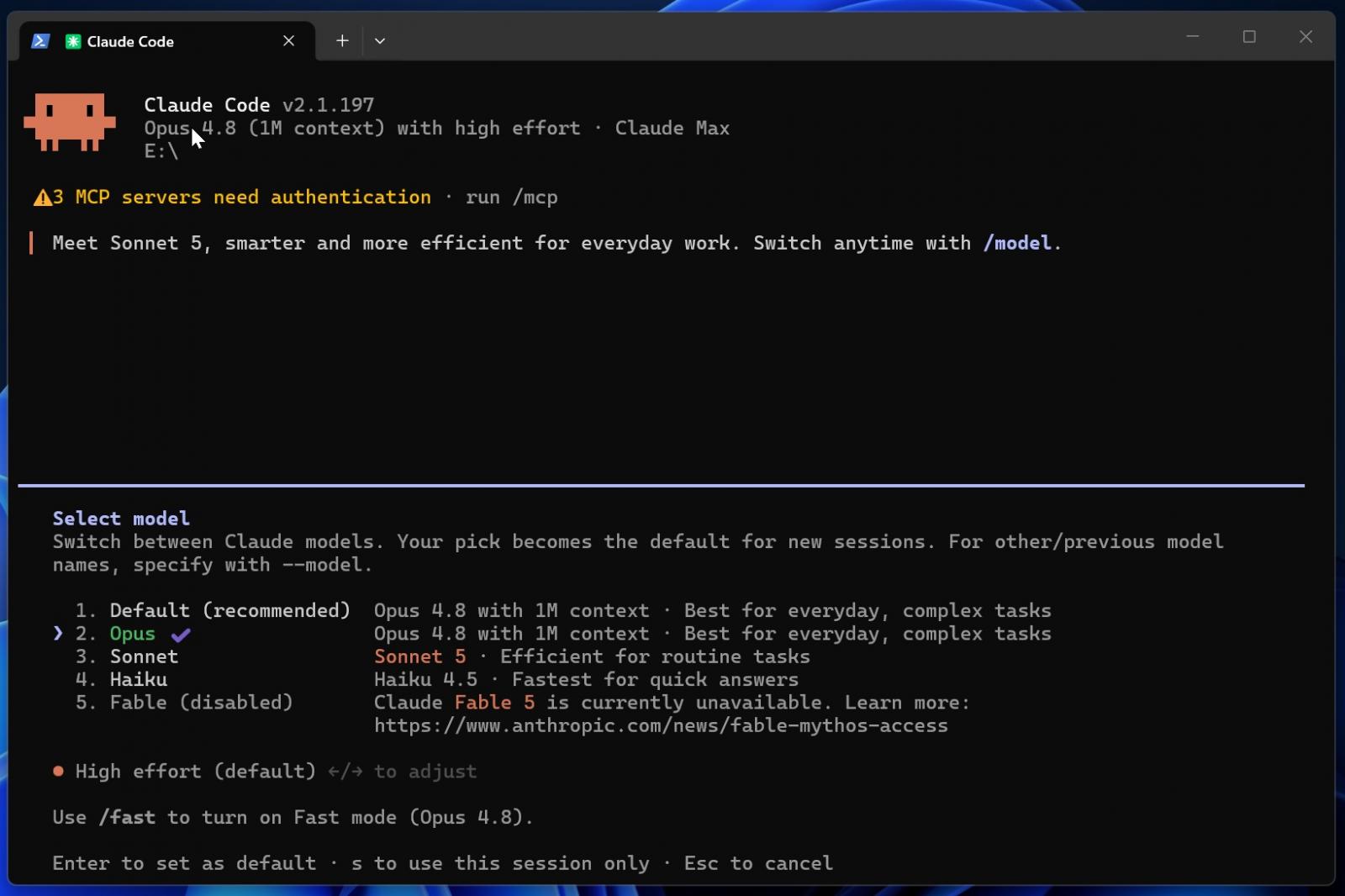
Anthropic argues that the agentic AI era began with Sonnet-class models, referring to earlier models such as Claude Sonnet 3.5, 3.6, and 3.7.
However, more recently, the largest gains in agentic capability had been limited to its Opus-class models.
Anthropic no longer wants to limit agentic gains to just the Opus-class or more expensive models. That’s why Sonnet 5 is meant to bring some of those improvements back to the cheaper Sonnet tier.
Anthropic said testers described Sonnet 5 as “much more agentic than its predecessors,” and noted that it can check its own output without always being explicitly asked.
As a developer, I love Opus 4.8, and I still strongly believe nothing comes close to Fable, which was recently pulled after orders from the United States government. But Sonnet 5 is one of those models that becomes a better cost-performance option compared with Opus 4.8 or Fable.
I personally pay for the Max subscription, which costs $200, and I often run out of my usage because Opus can use more tokens than Sonnet, and it costs far more. But even as a heavy user, I like to interact with the model to understand my own code, and in those cases, it makes sense to use a cheaper model.
However, Sonnet 4.6 wasn’t a great model at planning or understanding a massive code base. That seems to have changed with Sonnet 5.
In my tests so far, I’ve found Sonnet 5 to be far better than Sonnet 4.6 at following instructions, and also for agentic search.
These performance gains are also justified by benchmarking companies, including BrowseComp and OSWorld-Verified.
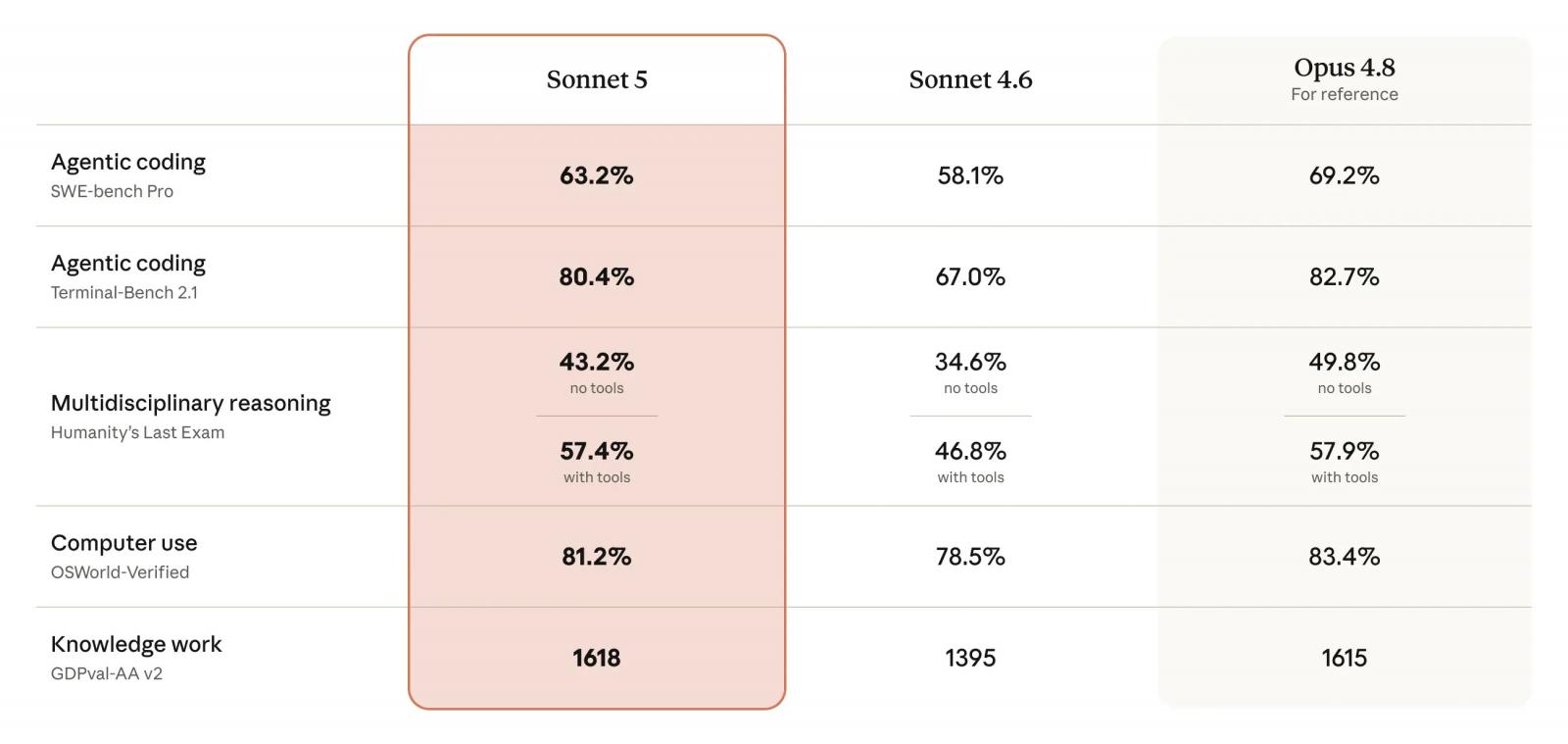
Anthropic says users can adjust effort levels between Sonnet 5 and Opus 4.8 depending on whether they want lower cost or maximum performance.
The company says Sonnet 5 is launching with introductory API pricing of $2 per million input tokens and $10 per million output tokens through August 31, 2026.
After that, Sonnet 5 will cost $3 per million input tokens and $15 per million output tokens.
That is still cheaper than Opus 4.8, which Anthropic lists at $5 per million input tokens and $25 per million output tokens.
For regular users. Sonnet 5 is available to everyone with Free, Pro, and Max subscriptions.
Security teams log 54% of successful attacks and alert on just 14%. The rest move through your environment unseen.
The Picus whitepaper shows how breach and attack simulation tests your SIEM and EDR rules so threats stop slipping by detection.





Weekend Open Thread: Staud – Corporette.com


The House | Manchesterism won’t survive the painful trade-offs unless it gets citizens on board


Strategy authorizes up to $1.25B in Bitcoin sales under new capital plan


Potential 2028er World Cup attendee leaderboard


Asia stock markets slide as tech shares slump


MAJOR BITCOIN & MARKET UPDATE!!!! (MUST WATCH ASAP!!!)


A Look At A Gaggle Of Transputer Boards

Dell (DELL) Shares Tumble Over 5% Following Analyst Downgrade to Hold


Coinbase, Circle Deepen Crypto Stock Losses Despite Resilient S&P 500


Australia treasurer says alleged access of prime minister’s bank data ’incredibly concerning’


Kraken's xStocks Opens Bending Spoons IPO Registration to EEA Retail


FIH Pro League: India defeat Pakistan 7-1, register biggest win of campaign | Other Sports News


Bitcoin Sparks $600M Hourly Liquidations With $65,000 Set To Become Resistance


Bluekit phishing kit adopts browser-in-the-middle for login theft


Russian hackers now target Signal backup recovery keys

Hyperliquid Named on Singapore MAS Investor Alert Register


Ripple and SBI launch RLUSD in Japan after JFSA approval


RTX holders must register wallets before token distribution begins

The AI boom won’t burst all at once. It will pop in ‘rolling bubbles’: Macquarie


Anonymous researcher drops 0-day ‘exploitarium’ repo





You must be logged in to post a comment Login