The market for AI in the SOC has moved faster than the methods for evaluating it.
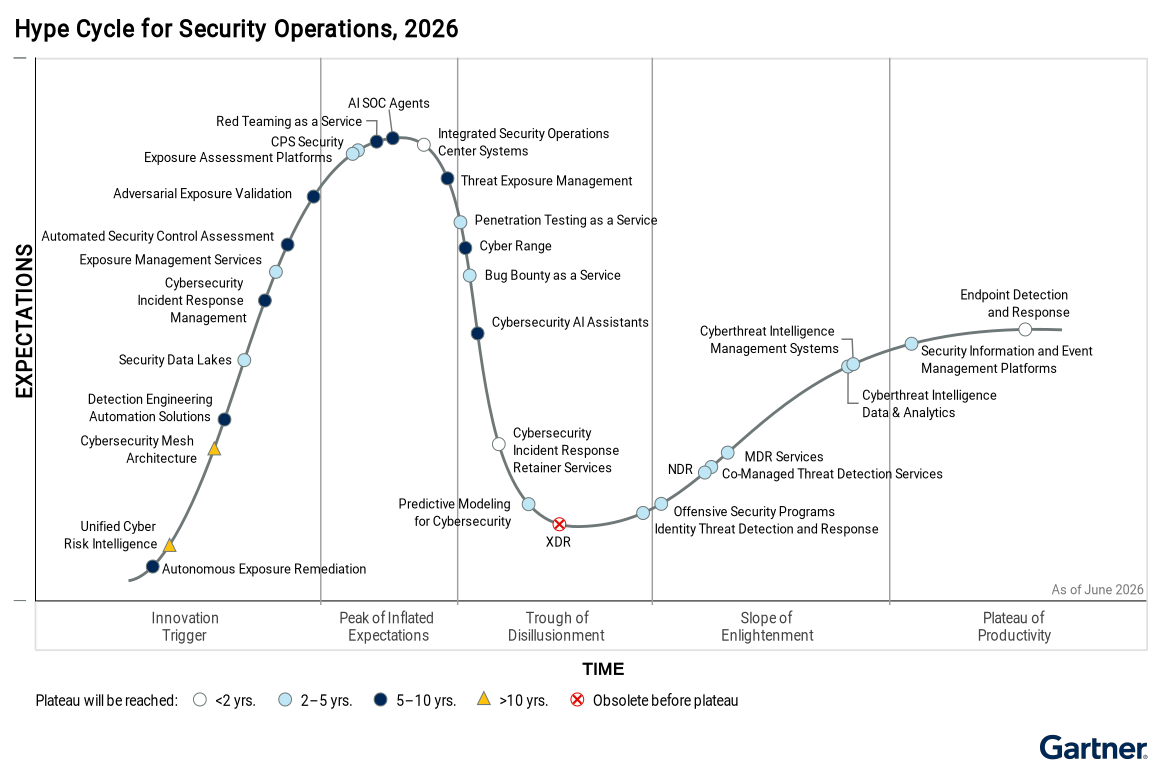
Just last year, Gartner placed AI SOC Agents at the Innovation Trigger stage with single-digit adoption.
As of a few weeks ago, Gartner’s “Hype Cycle for Security Operations, 2026” put them at the Peak of Inflated Expectations.
Most AI SOC vendors have a demo that feels like science fiction. Clean alerts go in, and accurate verdicts come out in seconds. It is a compelling pitch.
Accuracy often degrades, though, once these tools leave the curated demo and meet real production conditions. The technology shows promise, and some teams report meaningful gains, but for many organizations the gap between proof of concept and operational reality is still wide.
The guide behind this article puts a number on it: between 80% and 95% of enterprise AI projects fail in production.
To help security leaders close that gap, Prophet Security, a leading agentic AI SOC platform recognized in Rising in Cyber 2026, worked with former Gartner analysts Oliver Rochford and Prateek Bhajanka on a practical, vendor-agnostic guide for evaluating AI in the SOC.
You can download a copy here.
What are you actually evaluating?
A useful question to ask early: Are you acquiring a tool, a capability, or a new way of organizing security work? Be clear on what you expect a proof of concept to prove before you start one.
From Bayesian spam filters to SOAR, automation is nothing new to SecOps. GenAI and large language models are different in scope and reach, applied to everything from detection engineering to evidence gathering and autonomous alert triage, investigation, and response.
That breadth is why alignment between a product’s operating model and your team matters more than it used to, and why it belongs at the center of your evaluation.
This Gartner report provides cybersecurity leaders with key questions and a pragmatic way to evaluate AI SOC solutions, ensuring they actually improve Threat Detection, Investigation, and Response (TDIR) program efficiency and operational outcomes.
Download Now
1. Can the AI produce reliable verdicts in your environment?
Start with the most important question: can the AI produce accurate verdicts across the scenarios and attack surfaces your SOC actually faces?
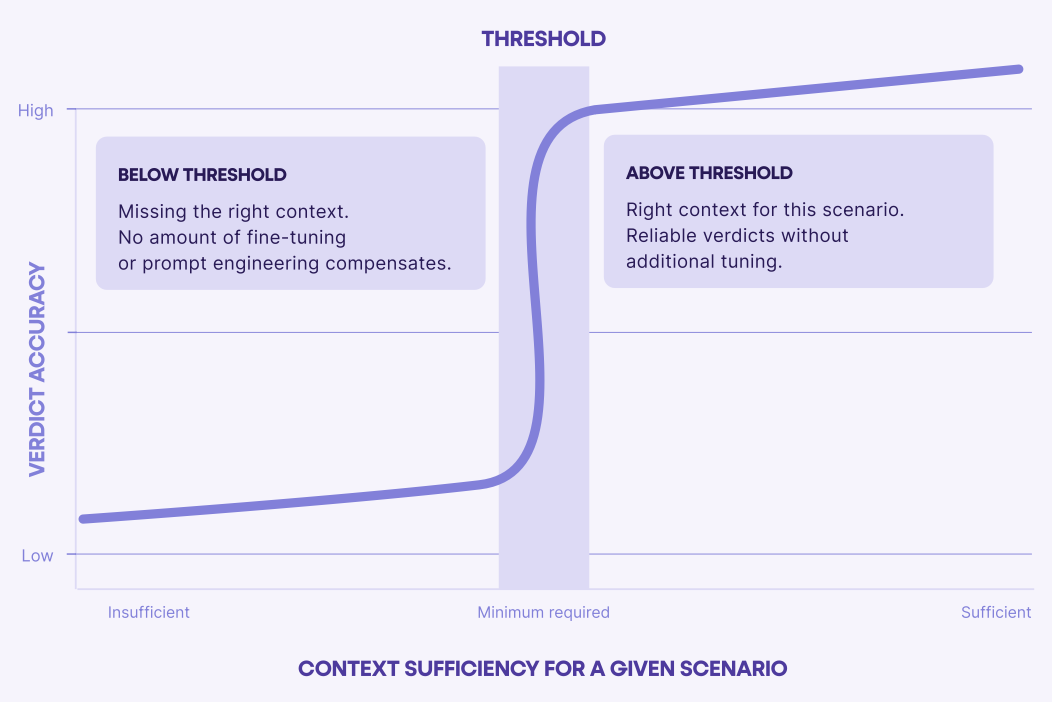
The key insight is counterintuitive. Verdict quality does not improve gradually as you feed the model more data. Below a threshold, no amount of fine-tuning or prompt engineering compensates; above it, the model produces reliable verdicts without additional tuning.
The data that pushes quality over that line is usually identity, asset, and organizational context, the information that lets the AI tell an attacker apart from a legitimate administrator.
That has a direct consequence for how you test. A phishing alert can be triaged from email metadata and a reputation lookup. Investigating privilege escalation or lateral movement requires identity data, asset inventories, behavioral baselines, and organizational structure.
If your proof of concept only covers cases where basic detection and telemetry suffice, you are testing the easy scenario and learning nothing about the hard one.
2. Does the operating model fit how your team works?
Misalignment between a product’s operating model and the team using it is one of the most common reasons AI SOC deployments underperform.
A one-person operation leans on AI to do work no one else can, so breadth and cost displacement dominate. A larger team needs AI to amplify human effectiveness, which calls for parallel testing, override telemetry, and deliberate role redesign. The right evaluation is the one built for the team you actually have.
The most revealing test here is human-AI parity: run the system in parallel with your analysts for a couple of weeks, capture baselines before the AI is introduced, and treat analyst overrides as first-class data rather than noise.
A warning sign is an evaluation where analysts end up ratifying the AI’s conclusions instead of independently reaching their own.
That points to the subtler risk in this category: every AI SOC platform makes a chain of decisions upstream of the analyst: what to ingest, what to suppress, how to prioritize, what context to assemble, and how to frame the investigation.
The further upstream a decision sits, the less visible it is and the harder it is to reverse. If the AI silently frames every investigation, your human in the loop becomes a rubber stamp.
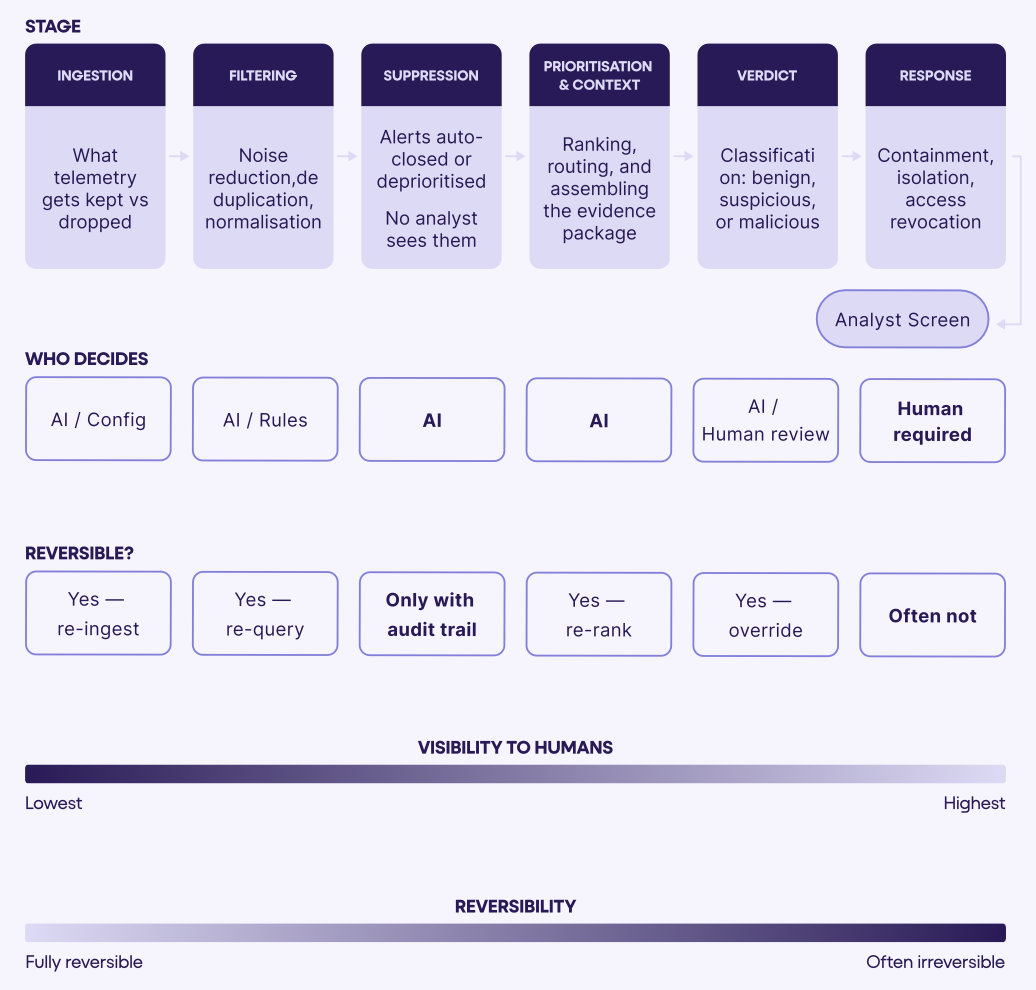
This is why explainability and investigation depth matter. Analysts can only trust and audit verdicts when they can see the reasoning behind them.
3. Will the AI stay reliable over time?
A product that works on day one can quietly degrade. This part of the framework tests for durability, and it is the part a two-week proof of concept tends to skip, because it cannot be observed in that window.
The guide flags several areas worth pressure-testing: adversarial robustness, model drift and degradation, adaptability as your environment changes, and lock-in.
There is always a balance between what a vendor can deliver today, what they envision for the future, and their track record of executing on both. This is where customer references earn their keep, so you can distinguish puffery from reality.
4. What do practitioners wish they had known prior?
The final part of the guide draws on practitioners who have run AI in the SOC in production.
The workforce shift is real, and it arrives faster than expected.
One enterprise CISO found that roles built around phishing triage and DMARC verification were automated within weeks, before the team had planned what those analysts would do next. The fix is to design the new roles (e.g. detection engineering, threat hunting, red teaming, and AI oversight) before deployment rather than in reaction to it.
The biggest gains came from expanded scope rather than raw speed.
They did not come from triaging existing alerts faster; they came from investigating things analysts would never have looked at.
One team resurrected detection rules it had shelved as impractical, correlating HR data, authentication logs, and asset records across locations to catch credential sharing, the kind of work no human would pursue at scale for a low-severity finding. AI makes it feasible.
It also changes detection engineering economics: experimental detections become viable when AI absorbs the false-positive overhead that used to cost full-time analysts.
“Inconclusive” is a valid answer in its own right. A system that always returns a binary verdict and never says “I don’t know” is masking uncertainty rather than resolving it. Look for tri-state classification (i.e. benign, suspicious, and malicious) with deterministic escalation rules for high-impact decisions.
The bigger picture
A technology at the Peak of Inflated Expectations is nothing to fear. Practitioners just need to manage expectations about what is vendor puffery and what the technology can realistically do in production.
Validate, ask for references, check case studies, and run your own evaluation. Both the former Gartner analysts and Prophet Security acknowledge that every organization’s needs differ. Some need a service, some need a product, some need a bit of both. There is no one-size-fits-all answer.
The guide’s throughline is a human-AI hybrid model, one in which probabilistic AI handles triage and investigation while deterministic safeguards and humans in and on the loop govern containment, escalation, and irreversible actions.
Prophet Security is an agentic AI SOC platform that autonomously investigates every alert with transparent, evidence-backed reasoning and escalates the decisions that need a human.
It built its AI SOC analyst around the same principles the guide describes: every verdict shows the queries the AI ran and the evidence it weighed, so analysts can review a complete investigation rather than accept a score on faith, while humans stay in control of high-impact actions.
For the complete four-part framework in this piece, including the scenario-by-scenario context maps, the red-flag checklists, and the full evaluation checklist you can take into a proof of concept, The Hype-Free CISO’s Guide to Testing an AI SOC Solution is available to download.
Get the guide here to access the complete framework, checklists, and questions to ask vendors at each stage.
Sponsored and written by Prophet Security.
























































You must be logged in to post a comment Login