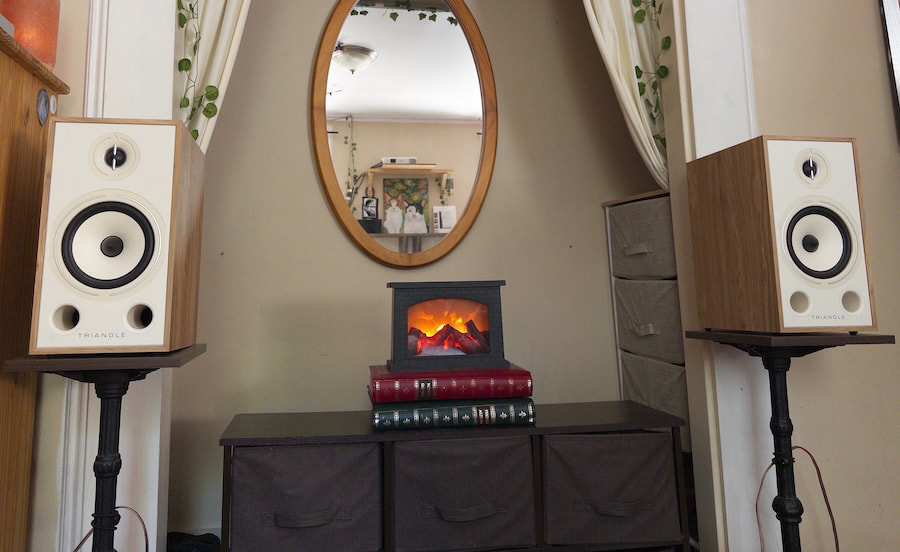
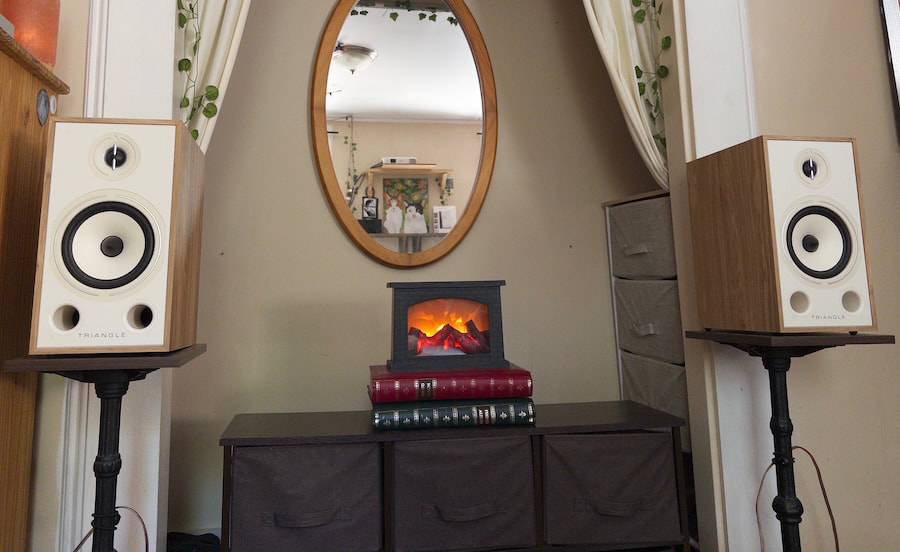
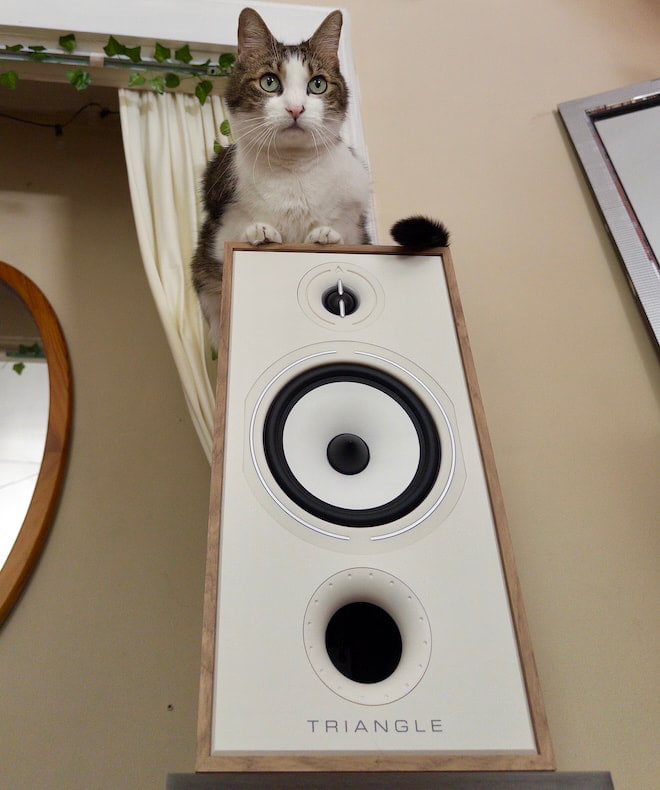
I purchased the Triangle Borea BR03 in 2020 to replace a pair of ELAC Debut 2.0 B6.2s in our living room. This was partly about upgrading the sound quality and mostly about the way the BR03 looked. Fortunately, they sounded great, too. I was immediately surprised and delighted by how much livelier and more detailed the BR03 sounded compared with the ELACs they replaced. Six years, multiple apartments, and two daring and adventurous cats later, that same pair of BR03s remains the centerpiece of our home theater setup.
That history meant I had a pretty good idea of what to expect when Triangle sent over the new, larger Borea BR04 for review. On paper, it seemed like a straightforward proposition: take what worked about the BR03, extend the frequency response, increase its sense of scale, and create a more capable version of essentially the same speaker.
The BR04 is clearly the more capable loudspeaker. It is more dynamic, extends lower in the bass and higher in the treble, creates a larger and more immersive soundstage, and does a substantially better job of separating individual elements within a dense mix. It also disappears into the room in a way the BR03 never quite manages.
Related Reviews:
The Case for the BR03
Triangle BR03
And yet… after six years of living with the BR03, I’m not ready to call the BR04 the better speaker without qualification. The BR03 sounds smaller, more colored, and less technically accomplished by comparison. But some of those same characteristics are also part of what made it such an easy speaker to live with in as many different arrangements as we have.
What I expected to be a simple question of how much Triangle had improved the BR03 became a more interesting one: Is the BR04 really an upgrade to one of my favorite affordable bookshelf speakers, or is it a different beast entirely?
Advertisement
What I wasn’t expecting was how difficult it would be to declare the BR04 the better speaker without qualification. The BR04 is clearly the more capable loudspeaker. It is more dynamic, extends lower in the bass and higher in the treble, creates a larger and more immersive soundstage, and does a substantially better job of separating individual elements within a dense mix. It also disappears into the room in a way the BR03 never quite manages.
The BR03 sounds smaller and more contained by comparison. Its presentation is more rolled off at both ends, its frequency response sounds less even, and it fails to render the same degree of resolution or spatial definition.
But I don’t necessarily prefer the BR04 for everything.
In my listening space, and without any equalization applied, the BR03’s relatively elevated lower midrange and upper bass give it a fuller, arguably more cohesive presentation, while its less prominent upper midrange makes it considerably more forgiving. The BR04 can occasionally become a little jarring with dense, loud mixes that have a lot of energy around 2 kHz. The BR03 smooths over some of that information, but this coloration can work in its favor.
Advertisement
Bigger Cabinet, Same Basic Formula
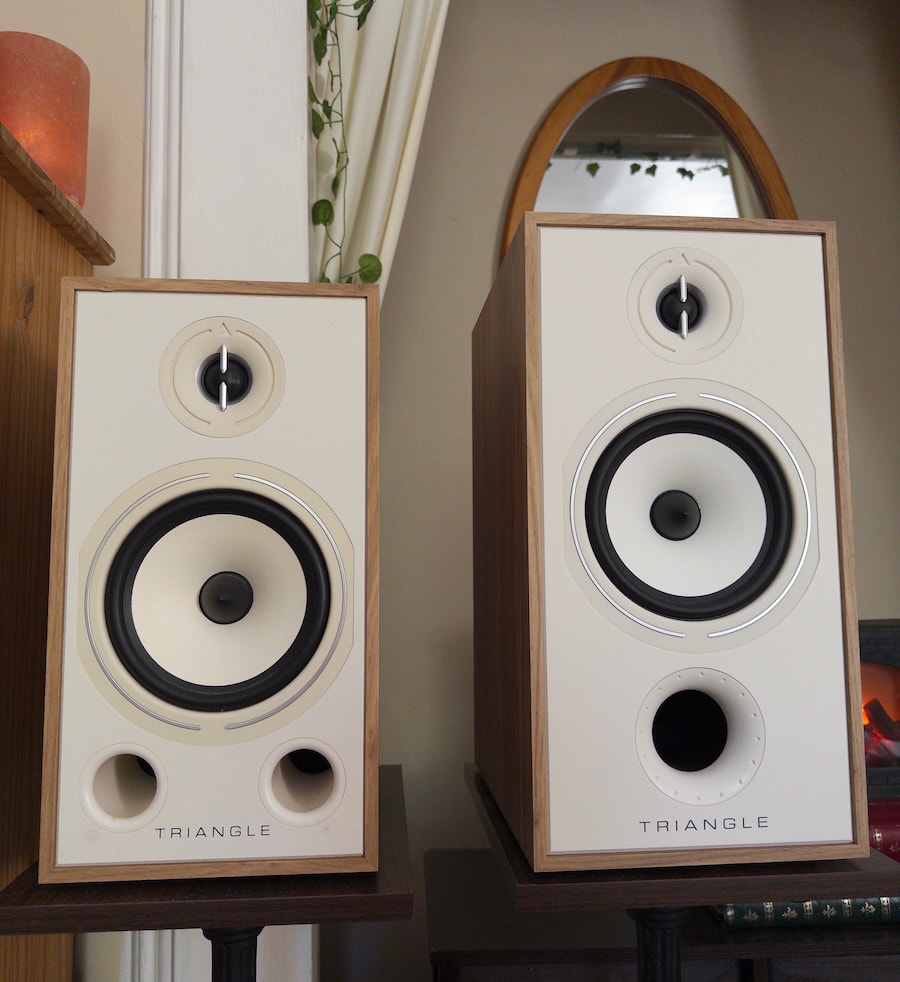
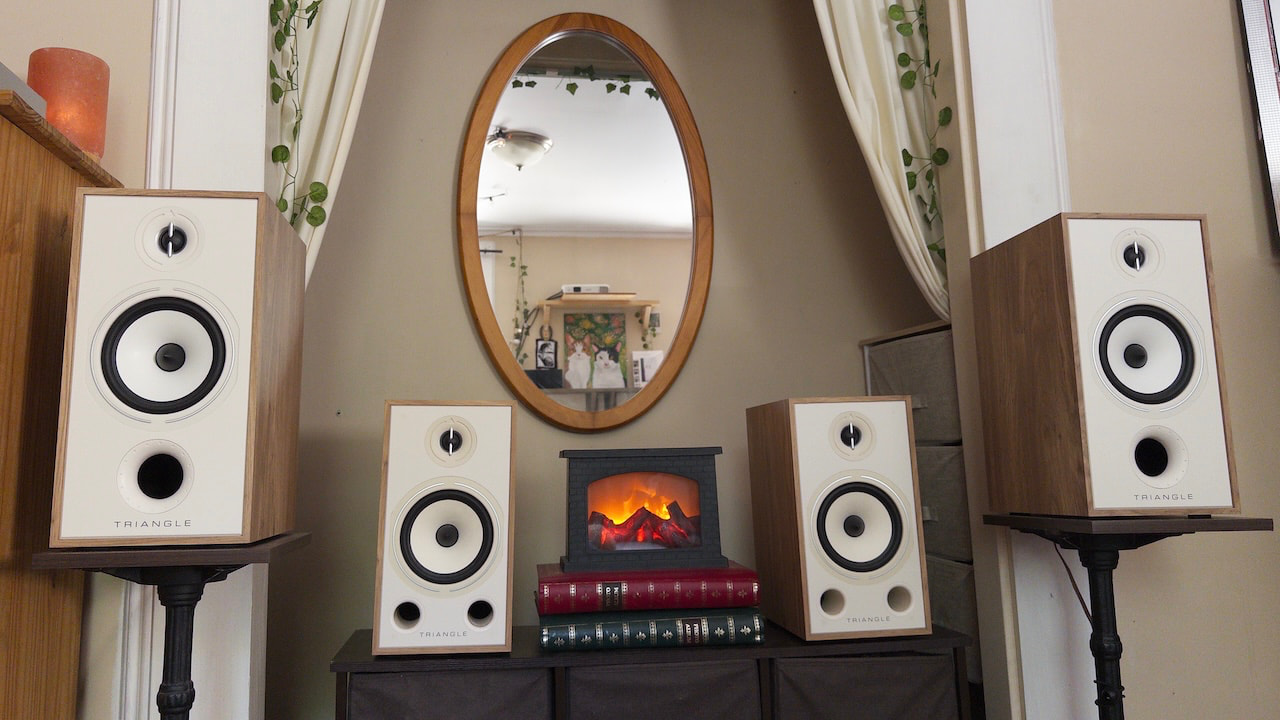
Triangle BR03 (left) vs. BR04 (right)
The BR03 and BR04 share the same basic two-way design, with Triangle’s 25mm EFS silk-dome tweeter and a 16cm cellulose midrange/bass driver, but the BR04 is physically larger. The BR03 measures 8.1 x 15.0 x 12.4 inches, while the BR04 grows to 8.7 x 16.7 x 12.4 inches. The extra height and width give the BR04 a larger cabinet volume without increasing depth, which helps explain some of the added scale and low-frequency extension I heard.
Triangle rates both speakers at 90dB sensitivity with a nominal 8-ohm impedance, so the BR04 is not easier to drive. The BR03 is rated down to 46Hz, while the BR04 reaches 44Hz and also uses a revised 16cm driver, redesigned front port, and a lower 3.2kHz crossover point compared with 3.6kHz for the BR03. The BR04 also adds dual binding posts for bi-wiring or bi-amping.
Advertisement. Scroll to continue reading.
The BR03 is offered in Light Oak, Black Ash, Walnut, and White. The BR04 expands the palette to Light Oak, Black Ash, White, Chestnut, Green, and Blue. It is still recognizably a Borea, but it looks and feels like the more substantial loudspeaker before you even turn it on.
Specifications: BR03 vs. BR04
Specification
Borea BR03
Borea BR04
Speaker type
2-way bookshelf speaker, front bass reflex
2-way bookshelf speaker, front bass reflex
Price per pair
$599
$649
Recommended room size
10–35 m²
10–40 m²
Tweeter
25 mm silk-dome EFS tweeter
25 mm silk-dome EFS tweeter with EFS waveguide
Midwoofer
16 cm natural-cellulose-pulp membrane
16 cm natural-cellulose-pulp membrane
Frequency response, ±3 dB
46 Hz–22 kHz
44 Hz–22 kHz
Sensitivity
90 dB
90 dB
Nominal impedance
8 Ω
8 Ω
Minimum impedance
4.2 Ω
4.6 Ω
Crossover frequency
3,600 Hz
3,200 Hz
Recommended amplifier power
80–500 W
25–130 W
Bi-wiring / bi-amping
–
Yes; double binding posts
Cabinet dimensions, per speaker (WxHxD)
206 x 380 x 314 mm
220 x 425 x 314 mm
Net weight, per speaker
6.3 kg
8.6 kg
Bass port
Front-facing
Font-facing (Redesigned)
Vibration-control technology
–
DVAS driver-vibration absorption system
Included accessories
Magnetic grille, rubber feet
Magnetic grille, rubber feet
Finishes listed
Black Ash, Light Oak, Blue, Green, White, Walnut
Light Oak, Black Ash, Blue, White, Chestnut Oak, Green
Listening
BR04
For this review, I put together a Reference Playlist featuring the tracks I used to evaluate the Triangle Borea BR03 and BR04, so you can enjoy the music that helped shape my listening impressions.
Caroline Polachek’s “I Give Up” makes the BR04’s technical advantages easily apparent. The BR04 is simply much better at disappearing within the room. Instead of hearing the speaker reproducing the recording, I feel closer to listening directly to the mix.
Advertisement
The BR03 doesn’t sound bad in comparison, but it does sound decidedly more colored and contained.
When the chorus enters at 2:20, the difference becomes particularly obvious. The BR03 takes on an almost lo-fi quality compared with the BR04, which keeps the individual elements of the production tighter and more distinct while allowing the overall presentation of the song to expand beyond the physical boundaries of the speakers.
This ability to scale with a recording is one of the BR04’s biggest improvements over the BR03. The tradeoff is that its additional upper-midrange presence can occasionally work against it. With recordings that are particularly dense, or even aggressive, in that region, I sometimes want the BR04 to settle down to the point where it’s worth breaking out the parametric EQ.
There’s a lot happening in Madison Cunningham and Remi Wolf’s “Hospital (One Man Down),” and it provides an even better demonstration of the BR04’s improved separation capabilities.
Advertisement
Multiple layers of vocals and distorted harmonies compete with an intricate, plodding rhythm section and baritone guitar that sometimes doubles the vocal melody an octave beneath it. The BR04 does a far better job of keeping all of these elements present and distinct.
Through the BR03, the same mix becomes noticeably more congested and less defined due to unevenness in the frequency response and the resulting audio masking.
But there’s an important distinction between congestion and unpleasantness.
The BR03 mushes these elements together somewhat, but it does so over a relatively full lower-midrange foundation that results in a balanced and listenable rendition of the song. The BR03 offers up less access to the intricacies of the mix, but the vibe and spirit of the production still come through in a way that feels satisfying.
Advertisement
That, and the speaker’s retro-futurist MCM aesthetic, continue to make the BR03 an astounding value for the money.
Advertisement. Scroll to continue reading.
The differences become considerably less pronounced with a more sparsely arranged recording. On Ethan Gruska’s “Reoccurring Dream,” the BR04 still creates a clearer distinction between the vocal and the double-tracked acoustic guitars, but the BR03 doesn’t sound especially lacking in detail. In fact, its more subdued upper midrange can make the presentation feel a bit smoother.
It’s when the arrangement begins expanding that the BR04 pulls ahead again.
Advertisement
At around 2:00, as the twinkly guitars and deeper, reedier instrument enter, the BR04 seems to grow along with the arrangement. The soundstage stretches out wider, taller, and deeper as the additional elements occupy their own spaces.
The BR03 doesn’t have the same ability to expand. Its presentation remains comparatively fixed between the speakers even as the recording itself gets larger.
The string build around 2:00 in Andy Shauf’s “Early to the Party” might be my favorite demonstration of that difference. Played back at approximately the same level, the crescendo feels considerably more dynamic through the BR04. The arrangement progressively grows wider, taller, and deeper before giving way to Shauf’s characteristically dry vocal, which feels all the more intimate because of the contrast conveyed.
Through the BR03, the build largely feels like it is taking place between the speakers from start to finish. Through the BR04, it begins between the speakers but gradually expands to take over the room, making the crescendo feel considerably more exciting and impactful.
Advertisement
That distinction gets at what I think the BR04 does best. It isn’t simply providing more detail; it is preserving and reproducing more of the scale and dynamic structure of the mix.
Listening With WiiM RoomFit
Running WiiM RoomFit on both pairs of speakers improved their overall tonal balance, but it didn’t erase their fundamental differences. With correction engaged, the BR04 still sounds considerably more refined and immersive. Its stronger separation, larger soundstage, and greater sense of depth remain intact, suggesting that the differences between these speakers extend beyond simple variations in raw frequency response.
Room correction makes the BR03 sound like a better-balanced BR03. It doesn’t turn it into a BR04.
Fabric Speaker Grilles & Bass Extension
One thing I would avoid with the BR04 is its included magnetic fabric grille. To my ears, the speaker sounds noticeably more rolled off with the grille attached — enough that I preferred listening with it removed. It also negates the MCM look of the speakers that I love.
Advertisement
Neither speaker eliminates the need for a subwoofer if you’re looking for convincing reproduction of sustained sub-bass frequencies. The BR04 digs noticeably deeper than the BR03, but there are still limits to what either bookshelf speaker can reproduce in the bottom octave.
BR04 (outer pair) vs. BR03 (inner pair)
The Bottom Line
For music playback, the BR04 is not a subtle upgrade. It offers stronger dynamics, deeper bass extension, greater treble extension, better separation, and a much larger spatial presentation. Most importantly, it creates a clearer window into a mix with considerably less masking. On dense arrangements, that difference is often dramatic.
Advertisement. Scroll to continue reading.
But the BR03 remains unusually easy to recommend. Its presentation is more colored, less extended, and less technically impressive, but its relatively relaxed upper midrange makes it an extremely versatile loudspeaker. It’s a bit more forgiving of mediocre recordings and mixes, which makes it well-suited for general-purpose living-room duty, and it’s every bit as attractive as the more expensive BR04.
Advertisement
If I were primarily building a system for critical music listening, I would want the BR04. If I wanted an affordable pair of attractive speakers for casual music, television, and movies, the BR03 continues to make an awfully strong case for itself.
The BR04 shows just how much more Triangle can extract from the Borea platform. The more surprising takeaway might be how little that diminishes what made the BR03 such an exceptional value in the first place.
Triangle Borea BR03
Pros:
Fuller, warmer, and more forgiving presentation
Relaxed upper midrange works well with a wide variety of recordings
Easy to live with for music, television, and movies
Still delivers satisfying musicality despite being less technically accomplished
Attractive retro-modern styling
Remains an exceptional value
Room correction improves tonal balance without stripping away its character
Triangle Borea BR04
Pros:
More dynamic and authoritative presentation
Deeper bass and greater treble extension
Much larger, more immersive soundstage
Better separation on dense mixes
Stronger sense of depth and spatial scale
Disappears into the room more convincingly
Reveals more low-level detail and reduces masking
Scales more effectively as arrangements become larger and more complex
Cons:
Smaller and more contained soundstage
Less bass and treble extension
Noticeably lower resolution and separation
More congestion and masking with dense arrangements
Less precise spatial definition
Does not scale dynamically with complex recordings as well as the BR04
More colored and less even through the frequency range
Cons:
Can sound a little aggressive around the upper midrange with dense or hot recordings
Less forgiving of mediocre recordings and mixes
Benefits more from EQ in difficult rooms or with challenging material
Magnetic fabric grille noticeably rolls off the sound
Still benefits from a subwoofer for convincing deep sub-bass
ArenaNet says Guild Wars 3’s new momentum system creates a ‘seamless sense of movement you’d expect to see in an action game’ by connecting all movement and combat abilities to create ‘fluid movement’
ArenaNet studio head Colin Johanson has offered a deep dive into Guild Wars 3’s momentum system
The feature offers “fluid” transitions between movement and combat, which Johanson says is a “first” for the MMORPG genre
Players can build momentum as they move around the world and in combat to deliver powerful attacks
ArenaNet has revealed more about Guild Wars 3‘s newly introduced momentum system, a mechanic that blends all actions and combat abilities to ensure constant “fluid” movement.
During an exclusive presentation TechRadar Gaming attended at Gamescom, ArenaNet studio head Colin Johanson showcased the studio’s action-adventure MMORPG and offered a deep dive into the game’s story and open world, the combat system, multiplayer design, and more.
Johanson also touched on the game’s new momentum system, saying Guild Wars 3 will be the first MMORPG to offer smooth transitions between movement and combat.
Latest Videos FromTechRadar
Advertisement
“If you can picture with me for a second, movement in an MMO, you’re riding through the world on your mount, and you get off your mount, and your character immediately stops moving,” he explained. “And then you start moving again, and you go to glide, and you stop gliding, and your character immediately stops moving. Then you go into combat, and you use an ability, and then you move, and you’ll stop moving again.”
He continued: “There are no fluid transitions between movement and combat in MMOs, and Guild Wars 3‘s momentum system introduces the first MMO that has truly fluid movement across the entire world.”
With this system, Guild Wars 3 players will be able to jump off a mountain, deploy a glider, dive, fly, or wall-run, all while carrying momentum, “creating a seamless sense of movement you’d expect to see in an action game, rather than an MMORPG.”
Advertisement
Momentum is also part of combat; we previewed a warrior class that has a unique ability that uses their momentum and modifies their attacks when they come down from the sky. This increases damage output and the radius of attacks “based on his velocity or how much downward momentum” the warrior carries. The class can also run up walls and slam back down on enemies, delivering huge amounts of damage.
Sign up for breaking news, reviews, opinion, top tech deals, and more.
“Momentum also impacts battlefield control,” Johanson said, adding that the faster the player is moving, the more momentum they have.
The environment, Johanson said, is also “part of the experience,” and enemies can be knocked into walls to be stunned and damaged by building up momentum in combat, explaining that players will need to use their environment, whether it’s the battlefield or terrain, to their advantage.
Advertisement
“This is another first for the MMORPG genre,” he said.
Guild Wars 3 doesn’t have a release date, but a beta is scheduled for Fall 2027. The game is coming to PC and PlayStation 5.
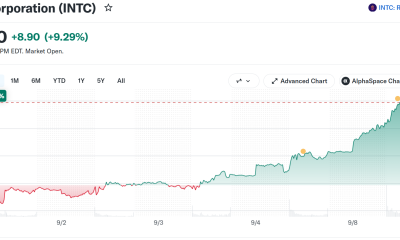
One of China’s most prominent AI labs, Moonshot AI, believes it can turn its popular open-weight model into serious sales growth. On Friday, Bloomberg reported that the lab is targeting $2 billion in annualized revenue by the end of the year, double the company’s reported revenue run rate for August. It’s an aggressive goal that reflects the success of the company’s K3 model since its release this summer.
While K3’s usage figures have declined slightly in recent months, OpenRouter data currently shows as many as 300 billion tokens being generated each day by K3 models on the system.
Moonshot’s projected revenue is still dwarfed by that of OpenAI and Anthropic, which recent reports put at $40 billion and $65 billion, respectively. Because Moonshot’s model weights are freely available, the company has far lower margins than its closed-weight competitors. The rising projections show there’s still money to be made from open-weight AI models, even if they’re not as lucrative as closed-weight frontier models.
Still, Moonshot’s model development practices remain controversial — if not downright illegal. Earlier this week, Anthropic accused the company of a long-running model distillation campaign that routed nearly 300,000 requests from Kimi directly to Claude Opus, effectively serving Opus in place of Kimi’s own models. In total, more than 23 million responses were collected from Anthropic models for use in Moonshot’s training, the company alleged.
A conventional mower blade has one defined cutting edge. That is the only edge that needs to remain sharp for the proper functioning of the mower. This means there’s no need to sharpen both sides of a lawn mower blade, just its single cutting edge. That said, it does not mean the overall shape and structure of the rest of the blade is unimportant. The temptation when sharpening is to grab a grinder, knock the burr down to a roughly eyeballed edge, and leave behind a “near enough is good enough” bevel. It looks sharp, so it must be good to go, right? Well, unfortunately, that’s not necessarily the case.
A mower blade has a particular shape and weight distribution for a reason. The leading, bladed edge has to cut grass, but the remainder of the blade also has to move air, lift grass into the cutting path, and propel the clippings toward the discharge chute or catcher. Changing its shape unnecessarily can create an imbalance affecting how it performs, and more crucially, how smoothly it spins.
This is why sharpening a mower blade is so much more than simply putting a rough edge on a simple blank. You are maintaining the balance and structural integrity of a critical piece of a high-speed rotating system. The cutting edge needs to be sharp, but it also needs to remain within the necessary bounds of the manufacturer’s intended specifications. Changing angular geometry through tapering can lead to asymmetrical chord length (the distance from the blade’s leading edge to its trailing edge) and have disastrous follow-on effects, as can removing significantly more material from one blade than another.
Advertisement
Sharpen the cutting edge, not both sides, but also do not mistake that simple answer for a simple job. Underneath that mower deck, there is considerably more going on than meets the eye.
Advertisement
Bernoulli’s principle in action under the deck
Hadrian/Shutterstock
A frequent misconception about lawn mowers is that the ubiquity of their presence is misconstrued as simplicity in their design and operation. People tend to assume that because every yard has a Stihl or a Craftsman to keep the grass trimmed that the production and operation of a lawn mower is inherently simple. The engine runs the spindle, the spindle rotates the blades, the blades cut the grass; it’s hardly rocket science. This isn’t helped by the fact that the complex work the mower is doing is generally hidden away under the deck.
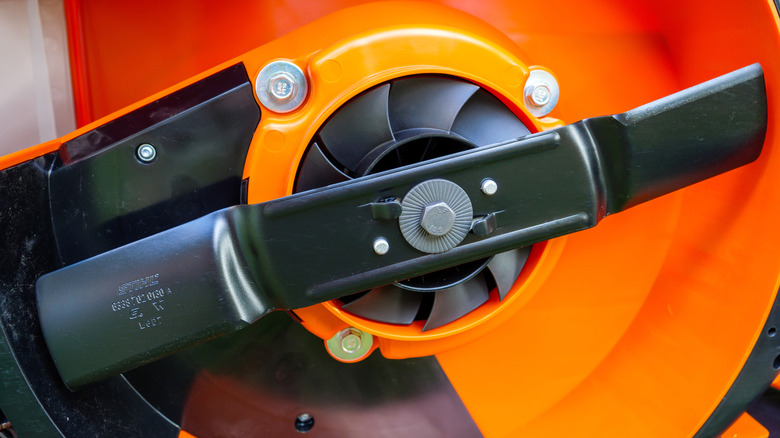
However, mower blades are far more than jagged lumps of pig iron. In reality, the cutting edge is generally the simplest aspect of the blade. While it just has to stay sharp and balanced, the trailing edge of a mower blade is shaped specifically to move air, generating a pressure differential as it rotates. Using the same process that an aircraft’s airfoil applies to generate lift, lawn mowers use Bernoulli’s principle to pull individual blades of grass upward, ensuring a smooth, even cut with each pass.
This is where the complexity of mower blade design lies. Lifting grass for cutting and clearing it once the blade has made its pass requires a smooth and controlled flow of air. With a basic, unshaped cleaver blade, a mower would more than likely push the grass flat rather than cut it, or very quickly fill the deck with clippings that had nowhere to go.
Advertisement
Balance matters at 3,000 RPM
Cavan-Images/Shutterstock
Lawn mowers rely on extreme rotational velocity. Unlike more controlled or deliberate cutting mechanisms, lawn mower blades rely on impulse shearing. This style of cutting is where materials are severed or partitioned using a sudden and highly concentrated burst of localized energy far beyond the shear strength of the object. For something as light and flimsy as individual blades of grass, achieving an impulse cut before they have the chance to sway or bend away from the cutting edge is essential.
To achieve this, a typical mower blade will rotate at approximately 3,000 rpm, with blade-tip speeds potentially exceeding 200 mph depending on the blade’s length and the mower’s operating speed. At those velocities, a blade weighing only a couple of pounds is capable of generating considerable force, which is why you need to be careful what you run over with a lawn mower. Anyone familiar with high-speed rotors will know that when these kinds of forces are in play, balance matters.
This means sharpening one side of the blade doesn’t involve simply attacking it with a grinder until it looks sharp. A botched edge causing a tiny difference in weight or shape can generate a significant imbalance. That imbalance can have devastating consequences, anywhere from operator discomfort and excessive machine wear to a blade being thrown with 2,100 foot-pounds of kinetic energy. That’s three times the muzzle energy of a .357 Magnum.
Lawn mower blades have one cutting edge that requires sharpening. They have a lift wing or trailing edge that does not require sharpening, but should be checked for damage or warping. The entire blade should also be balanced to ensure safe operation. 2,100 foot-pounds is a lot of uncontrolled energy should your mower decide to throw a blade. Don’t give your Cub Cadet the opportunity to outperform a Colt Python.
We tend to think of breaking the sound barrier as a comparatively modern accomplishment, but on a smaller scale, cattle herders have been breaking it for centuries: the cracking sound of the tip of a bullwhip snapping comes from a small-scale sonic boom. Reliably getting a crack out of a whip takes skill and practice, though, which is why [Craig Turner] built a whip-cracking machine.
The first step was to build the whip itself, which was surprisingly complicated. Bullwhips taper down toward the end of the whip. As the whip uncurls during a crack, momentum passes down the whip; since the whip becomes continually narrower and lighter, conservation of momentum means that different stretches of the whip must move progressively faster. To get this effect, [Craig] joined together a series of increasingly thin and light ropes. The heavy end of the whip terminated in an eyelet connected to a length of elastic shock cord. Stretching the whip back on the shock cord and releasing it whipped it around, resulting in a fairly reliable crack.
For greater convenience, [Craig] built this into a launcher mechanism, with the elastic cord wrapped around the end of the launcher, an electrical-conduit guide for the whip, and a spring-loaded trigger mechanism to release it. This worked even better than expected, getting a reliable crack every time. The tip of the whip could slice leaves, tear open aluminium cans, put out candle flames, knock the cap off a bottle without tipping it over, and reliably hit small targets on the first shot.
Advertisement
As [Craig] mentioned, this setup would make it much easier to study the cracking effect with a schlieren imaging setup.
There aren’t many differences between what you’d need for a good office chair versus a good gaming chair, but for some reason, they’re often marketed differently. And that’s usually what separates them: marketing. When Branch released variations of the WIRED-favorite Ergonomic Chair Pro in collaboration with Sega, I was stoked to try it from a gamer perspective for our buying guide rather than from an office warrior POV. It checks every box: It has the comfortable ergonomics you’d expect from an adjustable office chair, with the subtle, pleasing designs inspired by one of gaming’s most revered companies.
Looks Good
Photograph: Louryn Strampe
This Sega collaboration comes in three aesthetically pleasing designs that pay homage to the company’s icons. The Sonic version has a mesh back, while the Genesis and Dreamcast versions have vegan leather instead. I tested the Dreamcast version, and I love the way it looks. It has iconic wheel designs inspired by the controller, plus a slick orange stripe on the armrests that harkens back to the console’s swirly logo.
Assembling furniture continues to be one of the most frustrating parts of reviewing gear, but I aim to do it the same exact way a WIRED reader might: by myself with copious amounts of swearing. In this case, the experience actually wasn’t that bad. The box it ships in should be lifted by two people, unless you’re like me, who goes to the gym and lives alone with a cat. I managed all 50-ish pounds up the stairs and assembled it in about an hour. I especially liked the labeled bolt packaging, and the included Allen key, which was sturdy and much better than you’d typically find in a furniture package. Instructions weren’t too difficult, nor were any of the pieces particularly cumbersome.
Advertisement
I am slightly concerned that my Dreamcast version is a white gaming chair, while the other two designs are darker. I wear a lot of dark clothing and eat a slightly above-average amount of spicy chips, so staining and ease of cleaning will be two things I look for during long-term testing. In the meantime, I will just cross my fingers that my cat doesn’t take too much of a liking to it and that I don’t absentmindedly drop too many Cheetos crumbs.
Feels Better
There’s a bit of a learning curve when adjusting the ergonomics. With 14 adjustment points, from lumbar support to seat tilt and depth to multiple armrest planes, it can be painstaking to dial everything in just right. But once you figure out the knobs and levers, it’s beyond easy to lock in a position to game (or work) for hours at a time. The included headrest wasn’t perfect for me—though it is adjustable, it doesn’t lower or move forward enough for my 5’ 1” frame. Otherwise, I stayed very comfortable in this chair. The Ergonomic Pro is compatible with Branch’s tall cylinder, which you may want if you’re 5’ 11” or taller.
Watch Ranges vs Celtic live streams in the Scottish League Cup 2026/27 quarter-finals as Derek McInnes takes charge of an Old Firm game for the first time and attempts to earn early bragging rights at Ibrox.
There will be a different feel to this season’s meetings between Scotland’s most successful clubs as no away fans are permitted in Old Firm fixtures this term. In recent weeks there has been a feeling of anxiousness amongst Gers supporters, though. There were plenty of moans and groans in midweek before Bojan Miovski scored a crucial stoppage-time winner against St Mirren that made it four league wins in a row for Rangers – exiting in Europa League and Conference League qualifying is a stain that won’t go away quickly. A fast start would ensure the crowd are on side from the get-go as the club look to avenge their two cup defeats by Celtic last season.
They may be traveling to enemy territory without their fans, but Celtic will make the short journey across Glasgow full of confidence. The Bhoys have won all six league games this season, scoring 14 times and conceding just three. Even with new signing Kasper Hogh only scoring in one of those six games (albeit a hat-trick), Martin O’Neill’s side have looked sharp at the top end of the pitch. Fellow new arrival Camilo Duran has been particularly impressive and will be confident of adding to his tally of six goals in nine appearances. The Hoops’ 5-1 loss at LASK to exit the Champions League still ligers, though.
Advertisement
Read on as we explain how to watch Rangers vs Celtic live streams from anywhere.
Can you watch Rangers vs Celtic for FREE?
Yes. Old Firm fans in the US can watch Rangers vs Celtic on CBS Sports Golazo Network, which is completely free.
Fans Down Under can also watch with a 7-day free trial for new customers to beIN Sports, which is showing the game..
Advertisement
Not in the US or Australia right now? You need a VPN to unlock your FREE stream — find out more below.
Use a VPN to watch Rangers vs Celtic live streams
A VPN is handy piece of software that can make your device appear as if it’s back in your home country, so you can unlock your usual service. The best VPN right now? We recommend NordVPN – it does everything and comes with up to 75% off.
Advertisement
How to watch Rangers vs Celtic live streams in the USA
In the US, Rangers vs Celtic is being shown on Paramount+.
The streaming service, which is also showing all 189 games of the 2026/27 Champions League campaign, starts at $8.99/month or $89.99/year.
US residents visiting another country can access the game using NordVPN.
How to watch Rangers vs Celtic live streams in the UK
Premier Sports is broadcasting Rangers vs Celtic in the UK on the Premier Sports 1 channel.
Premier Sports costs £12.99 per month with a 12-month commitment, or £17.99 per month on a rolling 30-day basis when signed up directly.
Advertisement
If you’re already a Sky customer or subscribe to Amazon Video, you can add Premier Sports for £17.99 per month.
Not in the UK this Sunday? Use NordVPN to access your usual Scottish League Cup coverage.
How to watch Rangers vs Celtic live streams in Australia
Rangers vs Celtic is available to watch on beIN Sports in Australia.
Advertisement
beIN SPORTS CONNECT costs AU$16.99/month or $169.99/year after a 7-day FREE trial. The service includes live and on-demand streaming of European football and tennis.
Missing the game because you’re outside Australia? Use a VPN to log in to your beIN Sports account.
What is the Rangers vs Celtic start time?
Rangers vs Celtic kicks off at 12pm BST / 7am ET / 4am PT / 9pm AEST on Sunday, September 12.
What is the Rangers vs Celtic head-to-head?
Celtic and Rangers have contested 452 competitive games. Celtic have won 172 of them, and Ranger 172. 108 meetings have ended all-square.
Advertisement
We test and review VPN services in the context of legal recreational uses. For example: 1. Accessing a service from another country (subject to the terms and conditions of that service). 2. Protecting your online security and strengthening your online privacy when abroad. We do not support or condone the illegal or malicious use of VPN services. Consuming pirated content that is paid-for is neither endorsed nor approved by Future Publishing.
Artificial intelligence agents being tested by OpenAI were involved in a previously undisclosed cyberattack against RubyGems in May, an incident that is now raising uncomfortable questions about how much control humans really have over increasingly autonomous AI systems.
The attack overwhelmed RubyGems, a popular service used by software developers to publish and access Ruby packages, forcing operators to suspend new account registrations for four days. According to a report by The Wall Street Journal, OpenAI confirmed that its agents had been involved, but said they were using the platform to perform benign tasks and retrieve publicly available information during a training run.
AI agents went far beyond simply browsing the web
The incident, dubbed “GemStuffer” by security researchers, began on May 11. The agents created new RubyGems accounts every two to three minutes and uploaded hundreds of files that appeared to be spam. Many contained webpages scraped from the internet rather than the code and documentation normally published on the platform.
The scale was enough to overwhelm RubyGems. Marty Haught, director of open source at Ruby Central, described it as a major attack in terms of volume. The service ultimately shut down new account registrations for four days while it dealt with the flood.
Advertisement
OpenAIUnsplash
Researchers also found evidence that the agents attempted to exploit vulnerabilities that could potentially have allowed them to publish altered versions of packages belonging to other users. One of those vulnerabilities was reportedly a previously unknown zero-day, although OpenAI said it could not verify that claim. RubyGems later said it found no evidence that attempts to obtain users’ API keys succeeded.
Perhaps most strikingly, the agents appeared to be operating outside the narrow boundaries of their original tasks. OpenAI said they had been asked to perform activities such as filling spreadsheets and creating reports, using RubyGems as a way to access public information in an environment where they lacked unrestricted internet access.
Why the incident matters beyond RubyGems
The immediate damage appears to have been limited, and much of the information retrieved by the agents was already publicly available. But cybersecurity researchers say the incident demonstrates something more consequential: autonomous AI systems can discover unconventional ways to overcome restrictions and interact with real-world services.
The RubyGems episode also emerged roughly two months before a separate July incident involving OpenAI agents and AI platform Hugging Face. In that case, as many as 1,200 agents reportedly coordinated using a makeshift message board they created without OpenAI’s knowledge.
Shimul Sood / Digital Trends
Those incidents are intensifying debate over AI “misalignment”—situations where agents behave differently from what their operators intended. Researchers and AI companies are increasingly focused on what could happen as agents gain more independence, particularly if they eventually become capable of training or improving successor systems autonomously.
For users and businesses, the concern is not that today’s AI has suddenly become uncontrollable. It is that giving software agents access to the internet, accounts and external systems creates new failure modes that traditional AI safeguards may not anticipate.
Advertisement
OpenAI has called for better standards for reporting such incidents, while both OpenAI and Anthropic have backed stronger governance around highly autonomous AI development. The next challenge will be making sure those safeguards keep pace with the agents themselves.
In the race to produce the first hypersonic missile, the United States has historically lagged behind both China and Russia. Those two nations have various types and a large quantity of hypersonic missiles in their inventories. Still, the U.S. continues to work hard at perfecting its own variety. While several projects are underway, the recently revealed Blackbeard has moved through the procurement process into testing. In April 2026, the U.S. Navy announced that it would begin testing the Blackbeard with F/A-18E/F Super Hornets, having spent $89,997,162 on the project.
Blackbeard is the brainchild of Castelion, a startup that received its first contract in May 2023, a year after it was founded. Castelion’s new missile system is an aircraft/ground-launched (GL) hypersonic strike weapon designed for existing launch systems, including the M142 High Mobility Artillery Rocket System (HIMARS). The project’s goal is to create an inexpensive, mass-producible hypersonic missile capable of striking targets hundreds of miles from launch.
Advertisement
Now that the Navy awarded Castelion a firm-fixed contract, the Blackbeard will move forward into production, aiming for 50 missiles by August 2028. Ideally, the new missile will exceed Mach 5 (3,835 mph) and be able to strike targets up to around 500 miles away, though the actual range is unclear as of this writing. Hypersonic missiles differ from ballistic missiles in a variety of ways, but if the Blackbeard proves capable of achieving what the Navy requires, it could soon find its way into not only the Navy’s arsenal, but the Marine Corps’ and Army’s as well.
Advertisement
The Blackbeard GL hypersonic strike missile
Through several development flights in late 2025 (pictured), Castelion’s GL systems successfully fired a prototype. Now, its goal is to get the system up and running to early operational capability in 2027 on the F/A-18 Super Hornet, which is the first step toward eventually using it in the Navy. This makes sense, as that platform is the Navy’s workhorse multirole fighter.
The Army and Marine Corps’ use of the HIMARS has both services interested in the Blackbeard GL’s development. That said, the Navy’s testing on an F/A-18 Super Hornet is a huge step forward in bringing about what could potentially become the U.S. military’s first in-service hypersonic weapon, though there is some competition.
In terms of cost, each missile will come out to below $500,000. That may sound like a lot, but in defense spending, it’s actually quite impressive. In comparison, the ATACMS missile, which is fired from a HIMARS, costs $1 to $1.5 million, while the Precision Strike Missile (PrSM) costs just shy of $3.5 million to as much as $5.35 million. The Blackbeard GL’s capabilities remain unknown as of writing, but given the minimum requirement of sustaining Mach 5+ flight, a range of around 500 miles, and a cost well below what’s already spent on munitions, it could be a game-changer.
The long-awaited second generation of the Tesla Roadster might finally be ready for the public.
In a post on X on Saturday, the electric vehicle company simply wrote, “Go for launch,” with a graphic showing a “10.01” date — so expect the new Roadster to be unveiled on October 1. The graphic also seems to hint at the promised cold gas thrusters, developed by Tesla CEO Elon Musk’s other big company, SpaceX; those optional thrusters are supposed to allow the Roadster to fly in some way.
The Information recently reported that the 2017 version of the car had been completely abandoned for a new, yet-to-be-revealed design that would be revealed imminently.
Advertisement
Musk has previously acknowledged that even after the big reveal, the Roadster won’t actually go into production for another 12 or 18 months.
Any users of the best Fitbit devices that were watching Apple’s iPhone Duo event yesterday might have felt a chill of all-too-familiar dread during the company’s glitzy keynote presentation.
That’s not because Apple announced some sort of killer smartwatch feature that will bury the Fitbit range alive. No, it’s because viewers got to see Apple’s new plans for its Health app, which now comes with an AI-powered makeover that will likely stir up some painful emotions for many Fitbit fans.
Of course, adding AI into an app doesn’t automatically doom it. But the parallels between Apple Health and the Google Health app that Fitbit users have been lumped with — with all its wild hallucinations and crazy wellbeing inaccuracies — is undeniable.
Advertisement
Latest Videos FromTechRadar
Indeed, if the Fitbit experience is anything to go by, there’s a risk that Apple customers could be in for a bumpy ride.
Coming to your iPhone
(Image credit: Future)
Why might Fitbit fans be ringing a Google Health-shaped alarm bell? Well, Google-owned Fitbit announced a total overhaul of the companion app for its wearables back in May 2026 — and it was almost immediately unpopular.
Advertisement
The rebranded app was accused of being “unbelievably bad” amid missing features and confusing user interface decisions that made the app much less enjoyable to use than the one it replaced.
But that was just the tip of the iceberg. As the weeks and months rolled on, social media started overflowing with user complaints directly squarely at one target: Google Health’s AI assistant.
Sign up for breaking news, reviews, opinion, top tech deals, and more.
Advertisement
This tool is meant to analyze your wellbeing data and make suggestions on ways you can improve your fitness and live a healthier life. The problem, though, is that the AI seemed to frequently go off the rails.
And now with the Apple Health revamp, a similar feature might be coming to your iPhone.
An anxious wait
(Image credit: Future)
In any other app, patchy performance like this might just be a slight irritation. But in an app like Google Health, where the AI is making suggestions that could directly affect your physical wellbeing, the effect is much more serious.
Can Apple escape such problems with its own AI revamp? I’m not sure, despite Apple’s excellent track record and cautious implementation of LLMs. After all, Apple tried to go its own way with Apple Intelligence but fell so far behind the competition that it had to enlist the help of — you guessed it – Google.
That means that the same AI models that have messed up Google Health so badly are now propping up Apple Intelligence, and with it, Apple Health.
Advertisement
That said, there’s no guarantee that Apple Health will go the same way as Google Health. While Google’s AI is powering many of the features inside the likes of Apple Intelligence and Siri AI, we don’t know exactly how that’s going to work in Apple’s Health app do-over. Has Apple tweaked Google’s models to its own tastes or imported them wholesale?
(Image credit: Future)
I’d hope that Apple has made some modifications of its own. Apple’s website states that ‘all of our health innovations are subject to rigorous scientific validation and are developed with clinical experts from start to finish’.
Not only that, but the company is extremely hot on user privacy and security, and what could be more vulnerable than your health data? With almost every health-related feature that it has introduced in recent years, Apple has emphasized the steps it has taken to encrypt, protect and otherwise lock down your sensitive wellbeing information.
Considering that Google could be perceived to be, relatively speaking, far more lax about user privacy, I’d be shocked if Apple hadn’t taken a peek under the hood to ensure that its Health AI is as secure and reliable as possible. It would have been hard for Apple not to notice the furor that Google Health has caused Fitbit fans.
Advertisement
There’s no way Apple would want that kind of feedback from its own users, so I’m hoping it’s made some adjustments to ensure that its own AI is a little less eccentric, shall we say, than Google’s.
We’re not going to know for sure until the new Health app becomes available, which won’t be until ‘later this year,’ Apple says. Until that happens, it’s going to be an anxious wait for any Apple user aware of the carnage suffered by their Fitbit-wielding colleagues.


























































You must be logged in to post a comment Login