














Connect with us
DAPA Banner
DAPA Coin
DAPA
COIN PAYMENT ASSET
PRIVACY · BLOCKDAG · HOMOMORPHIC ENCRYPTION · RUST
ElGamal Encrypted MINE DAPA
🚫 GENESIS SOLD OUT
DAPAPAY COMING

Tech

Trump’s Tech Posse in China, Who’s Winning in Musk v. Altman, and Hantavirus Conspiracy Theories

Published

on

Brian Barrett: Our best and brightest.

Leah Feiger: Yeah. And so I’m just like, no, no, no, this is clearly not just about tech. This is about showing very specifically who Trump’s allies are and being able to position himself in front of a country and leader that he hasn’t spent a lot of time with recently.

Zoë Schiffer: Since we’re still talking about the people that he is going to China with, what do we know about why Jensen Huang was left off the list and then re-added last minute? Because my though when I saw it was, oh, this is about export controls and they think it’s going to be kind of weird and complicated to have him on the trip. But then obviously he is now on the trip.

Leah Feiger: So someone I cannot name, someone said to me, “Oh, I think the President may have just forgotten him,” to which I laughed.

Advertisement

Zoë Schiffer: Oh, you remembered Brett Ratner and you forgot?

Leah Feiger: No, I was like, “This is not true.” It’s just not even sort of true to the point where I was like, “I’m sorry, you’re expecting me to entertain this right now?”

Zoë Schiffer: I would absolutely buy that Trump forgot this man, but I’m like, “Trump has other people around him.”

Leah Feiger: This team didn’t forget this man.

Advertisement

Zoë Schiffer: Yes, please.

Leah Feiger: No, there’s no way on earth. I was very much just like, “Uh-huh. Yeah, yeah, yeah. Keep it moving.” And obviously guys, we have to talk about the Musk of it all. I know that Elon has been making his appearances back at a variety of White House or White House adjacent events, but this does feel like such a big moment for him to be on the international stage again by Trump’s side.

Zoë Schiffer: Did you know that Elon Musk’s mother is like low-key a celebrity in China?

Brian Barrett: Maye Musk, international model, Maye Musk.

Advertisement

Leah Feiger: Wait, new information. Say more.

Zoë Schiffer: People are obsessed with her there.

Leah Feiger: What?

Zoë Schiffer: Just a little fun fact.

Advertisement

Brian Barrett: I want to take a moment too not to get away from Maye Musk. We can talk and talk about Maye Musk all day long. About a year ago when the Pentagon set up Musk for a war briefing about what would happen if the US went to war. Do we remember this?

Leah Feiger: I do.

Zoë Schiffer: Oh, my gosh, I fully forgot about this. Yes.

Brian Barrett: The Pentagon invited Musk over to check out what the war plans would be if we went to fight China over Taiwan and that got scuttled apparently before he went. This was a New York Times report, but it is how far we’ve come and how not far. I don’t know. If I’m China, I don’t think I want to see Musk anywhere near this coalition. And if I’m Musk, I’m feeling pretty great about the level of influence I now have. Again, and then maybe I get a chance to look at those war plans again. Maybe I can sweet talk Pete Hegseth.

Advertisement

Source link

Continue Reading
Click to comment

You must be logged in to post a comment Login

Leave a Reply

Tech

Salesforce acquires Fin, formerly Intercom, for $3.6bn

Published

on

Salesforce acquires Fin, the customer-service AI company formerly known as Intercom, in a deal worth about $3.6bn. The CRM giant signed a definitive agreement on Monday, it said, to fold Fin’s “customer agent” technology into Agentforce, its own fast-growing AI-agent platform.

Fin’s pitch is autonomous support.

Its AI Agent handles customer queries end-to-end across live chat, email, WhatsApp, SMS, phone and Slack, and Salesforce says it resolves, on average, 76 per cent of support volume without a human. It runs on Fin’s own model, Apex, which the company says it post-trained specifically for support and which it claims outperforms frontier models from OpenAI and Anthropic on resolution.

Fin brings more than 30,000 business customers with it.

Advertisement

The deal is expected to close in the fourth quarter of Salesforce’s fiscal 2027, subject to regulatory clearance. Salesforce says it will not change its FY2027 guidance or its buyback plans.

The 💜 of EU tech

The latest rumblings from the EU tech scene, a story from our wise ol’ founder Boris, and some questionable AI art. It’s free, every week, in your inbox. Sign up now!

Why Salesforce acquires Fin instead of out-building it

Salesforce is not short of agents. Agentforce, its own platform, hit $1.2bn in annual recurring revenue in the first quarter, up 205 per cent year on year. So this is not a company filling a hole. It is buying speed.

Advertisement

Agentforce is the deeply customisable, enterprise-grade option, powerful but slower to stand up. Fin is the opposite: packaged, pre-trained and live in days, which suits smaller and mid-market firms that want a working support agent now. Buying Fin lets Salesforce sell both, from a drop-in support bot to a bespoke enterprise build, rather than forcing every customer down the heavyweight path.

“We’ll help companies of every size seize this opportunity,” chief executive Marc Benioff said.

A rival, and its own model, absorbed

The target is a pointed one. Fin, under co-founder and chief executive Eoghan McCabe, has spent years positioning itself as the company that defined the customer-agent category, often at the industry’s expense.

Intercom only renamed itself Fin, after its AI agent, in May. Now the agent, the brand and the team are Salesforce’s. “We can deploy it far and wide at a rate far faster than we could have ever achieved on our own,” McCabe said.

Advertisement

There is a quieter prize, too. Fin launched in 2023 on OpenAI’s GPT-4 and later leaned on Anthropic’s Claude, then built Apex, its own post-trained support model, to cut that dependence. Salesforce is buying not just an app but a proprietary model tuned for one job. It slots into a wider land-grab in agentic AI, where the big platforms are racing to own the software that does the work, not just the software people work in.

The test now is integration: whether a packaged agent built outside Salesforce still feels fast once it is wired into Salesforce’s data, security and governance stack.

Source link

Advertisement
Continue Reading

Tech

Attackers scale deception with AI. Defenders need truth at machine speed.

Published

on

Presented by Splunk


AI has changed the economics of cyber deception.

An attacker can now generate thousands of convincing phishing lures, fake identities, and tailored pretexts before a defender finishes a single change-control cycle. That is the new security challenge: deception got faster and cheaper, while verification did not.

Much of the discussion around AI for defense centers on detection models. Detection matters, but it is not the only bottleneck. The deeper constraint is evidence: where data lives, whether it is available when needed, how quickly it can be correlated, how long it is retained, and whether analysts or agents can trust what they retrieve.

Advertisement

Defense in the AI era is a data problem before it is a detection problem.

The defender’s advantage is truth

Attackers can afford to lie at enterprise scale. They can test endless combinations of messages, identities, domains, and attack paths, and most can fail at almost no cost.

Defenders do not have that luxury. Their advantage is truth: quickly knowing what happened, where, when, which identity was involved, which assets were affected, what changed, and what business process may be at risk.

That truth must be documented, governed, auditable, and defensible. Attackers are using AI to scale deception, impersonation, social engineering, and speed. Defenders need AI to scale verification.

Advertisement

The goal is not just to act faster than the attacker. It is to take action that people and machines can trust.

Fragmented data breaks modern defense

Consider a suspicious login from a contractor account. On its own, it is just another authentication anomaly. To know whether it matters, a security team may need identity history, endpoint activity, cloud access logs, ticketing records, asset ownership, configuration changes, network telemetry, and business context.

If those records sit in different tools, expire at different times, or require multiple teams to retrieve, defenders are not investigating the incident. They are negotiating with their own data estate.

When signals can be reached in place and correlated quickly, the issue is no longer just whether the login looks unusual. It becomes whether the enterprise has enough evidence, in enough context, to take action it can defend.

Advertisement

That challenge grows more urgent with AI assistants and agents. AI can only reason over what it can retrieve in time to matter. If the data is partial, stale, fragmented, unavailable, or stripped of context, AI does not create truth. It accelerates uncertainty.

The system of record must become a defensive control plane

For years, enterprises treated security platforms, SIEMs, and data lakes as passive repositories: places to store data for later search and analysis. That model is no longer enough.

What organizations now need is a defensive control plane: a layer that connects what happened, what it means, and what the enterprise is allowed to do about it. In architectural terms, it ties together raw machine data, business context, and policy. It does not just store evidence. It makes evidence usable for decisions and actions that must be explainable and trusted.

In practice, that means doing four things well: preserving evidence, reaching data wherever it lives, adding business context, and governing action. More on each below.

Advertisement

The old system of record answered one question: What is the official record?

A defensive control plane answers the questions that matter operationally: What happened? What does it mean? What evidence supports that conclusion? And what action can we trust?

AI does not reduce the need for authoritative records. It raises the standard for what those records must do.

A defensive control plane must do four things

  1. Preserve evidence. Logs, metrics, traces, events, identity records, configuration changes, tickets, and asset state all help establish what happened. Their value often becomes clear only after an incident begins.

  2. Make data accessible wherever it lives. Security-relevant data is already spread across object stores, cloud platforms, operational tools, and business systems. Moving every byte into one place is often too slow, too expensive, and too difficult to govern. The better model is to bring analytics to the data.

  3. Add business context. Correlating machine data with business information turns “anomaly on host X” into “the system supporting payment services for top accounts is being probed.” That is what allows organizations to prioritize correctly.

  4. Govern action. In the agentic era, systems will do more than summarize incidents. They will enrich alerts, open cases, trigger workflows, isolate assets, update policies, and escalate decisions. Enterprises need to know what evidence an agent used, what policy governed the action, whether it stayed within scope, and how the decision can be reviewed afterward.

The real SOC problem is not too little data

Modern SOCs are not suffering from a lack of data. They are suffering from a lack of usable context.

Advertisement

According to the Splunk State of Security 2025 report, SOC analysts continue to struggle with too many alerts (59%), too many false positives (55%), and alerts that lack context (46%). The issue is not data volume. It is the difficulty of turning fragmented signals into trusted decisions.

Today, analysts are left stitching together context manually, pivoting across disconnected tools, and making high-stakes decisions without the full picture in time. Even as AI improves, outcomes still depend on whether humans are willing to approve changes across fragmented environments.

This creates a daily crisis of context. Teams are forced to make consequential decisions based on data they cannot easily see, correlate, or trust. The result is latency, inconsistency, missed opportunities, and unnecessary risk.

Trusted action is the durable advantage

A data fabric architecture offers a way forward by creating a unified, intelligent layer across data sources spanning SecOps, ITOps, and NetOps. The goal is not centralization for its own sake. It is to break down silos and deliver context-rich insight at the speed AI-driven operations require.

Advertisement

This is an operating model before it is a product. AI-driven defense depends on a foundation that can preserve evidence, reach data where it lives, add context, and maintain a reviewable link between data, decision, and action. That is the architectural shift behind Cisco Data Fabric powered by the Splunk Platform, which brings together machine data, federation, business context, governance, and provenance to help teams move from signal to trusted action.

Attackers will keep making deception cheaper, faster, and more personalized. Defenders do not win that race by generating more noise. They win by making truth faster, and by grounding every action in evidence that people and machines can trust.

Learn more about the Cisco Data Fabric powered by the Splunk Platform.

Seth Brickman is VP, Global Product – Splunk Platform, Cisco.

Advertisement

Sponsored articles are content produced by a company that is either paying for the post or has a business relationship with VentureBeat, and they’re always clearly marked. For more information, contact sales@venturebeat.com.

Source link

Continue Reading

Tech

Samsung’s upcoming foldables leak in a very interesting size comparison

Published

on

Samsung’s next foldable line-up may have just leaked ahead of schedule. A new image appears to show screen protectors for the upcoming Galaxy Z Flip 8, Galaxy Z Fold 8 and Galaxy Z Fold 8 Ultra side by side.

While leaked screen protectors aren’t usually the most exciting reveal, this one offers an early look at how Samsung could be reshaping its foldable range.

Most notably, the Galaxy Z Fold 8 appears wider and slightly shorter than previous models. Meanwhile, the Fold 8 Ultra looks set to sit in a class of its own.

If the leak is accurate, it suggests Samsung is putting more distance between its standard Fold and Ultra models. The company may no longer treat the Ultra as a simple spec bump. That could help the company better compete. After all, rivals such as Apple, Xiaomi and Vivo continue to push into the foldable market.

Advertisement

The image was shared by well-known tipster Ice Universe and appears to show noticeable differences between the two Fold devices. The standard Fold 8 looks broader than before. This could make the outer display feel more like a traditional smartphone screen. It may also feel less like the narrow panels found on earlier Galaxy Fold devices.

Advertisement

Beyond the redesigned shape, previous leaks have pointed to several upgrades for the Fold 8. These include a less visible display crease, a 4,800mAh battery and a weight of around 201g.

The Galaxy Z Flip 8, meanwhile, is expected to be a more modest update. Rumours suggest Samsung has tweaked the hinge design to make the clamshell foldable slightly thinner when closed. Additionally, the company is also shaving off a little weight. The biggest changes may come under the hood. Reports point to Samsung’s Exynos 2600 chip in Europe and South Korea. In other markets, there may be a Snapdragon 8 Elite Gen 5 for Galaxy processor.

Samsung expects to officially unveil the Galaxy Z Flip 8, Galaxy Z Fold 8 and Galaxy Z Fold 8 Ultra at its next Unpacked event on July 22. The company will reveal these alongside the Galaxy Watch 9 and Galaxy Watch Ultra 2.

Advertisement

Source link

Advertisement
Continue Reading

Tech

How often do the sensors inside the 2026 FIFA World Cup ball record data?

Published

on

The 2026 World Cup ball is basically a flying motion tracker

Read Entire Article
Source link

Continue Reading

Tech

UK AI hiring surges as firms seek people to babysit the bots

Published

on

AI AND ml

PwC says AI hiring jumped 61 percent despite wider slowdown in vacancies, with employers increasingly looking for workers who can use AI rather than build it

Britain’s AI jobs boom is creating a two-track labor market, according to PwC, which just so happens to make a healthy living helping companies navigate AI-driven transformation.

The consulting giant’s latest AI Jobs Barometer found hiring for AI specialists in the UK jumped 61 percent over the past year, rising from 112,000 roles in 2024 to 180,000 in 2025, even as overall job vacancies across the economy fell by 6.6 percent.

Advertisement

That headline figure is the sort of thing consultancies put in press releases, but the more interesting bit comes later.

PwC’s analysis suggests employers aren’t rushing to hire hordes of machine learning engineers and model builders. Instead, they’re increasingly looking for people who can use AI inside existing professions and business functions. The firm found that so-called AI user roles grew by almost 66,000 positions during the year, while AI developer roles increased by just 2,600.

After years of declaring that AI will revolutionize everything from accounting to sandwich-making, companies appear to have reached the awkward stage where somebody actually must make the technology useful.

PwC argues the result is a “two-track” labor market. Jobs where AI helps skilled workers automate repetitive tasks and focus on higher-value work are growing faster than roles where the technology mainly makes tasks easier and lowers barriers to entry.

Advertisement

According to the report, roles most enhanced by AI have grown by 39 percent since 2018, compared with 17 percent growth in jobs where AI is primarily simplifying work.

The firm’s wage data tells a similar story. Jobs requiring AI skills now command an average wage premium of 34.2 percent, up from 11 percent a year ago. Consumer market companies are offering premiums as high as 64 percent, while government and public sector employers top out at 12 percent.

That’s certainly good news for workers with AI skills. It’s also not the sort of conclusion likely to upset a firm that advises clients on AI strategy for a living.

The findings land against a backdrop of growing anxiety about AI’s impact on employment. Recent polling found one in five Britons believes AI-driven layoffs could eventually trigger civil unrest, while another survey found that office workers are already spending nearly six hours every week checking, correcting, or redoing work generated by AI tools.

Advertisement

For all the excitement around AI, the hiring surge appears to be concentrated in a surprisingly old-fashioned category: people who know what they’re doing. ®

Source link

Continue Reading

Tech

Flatpak-NG sounds like bad news for systemd refuseniks

Published

on

SOFTWARE

Linux app packaging rethink could leave alternative-init distros in the cold

Flatpak development has been very quiet for years. Discussions about a next-generation take are happening – and some of the signs are worrying if, like many FOSS folks, you are systemd-intolerant.

In the course of researching our article on MX Linux 25.2, we came across an interesting Reddit discussion from last month, which in turn led us to a Flatpak development blog post from late last year.

Advertisement

It looks like a team is collecting ideas for what is currently called “Flatpak-NG” – as in next generation. If this solidifies into code, this may form the basis of Flatpak version 2.

The blog post isn’t very informative, but the Reddit thread links to the video of a presentation from last month’s Linux App Summit in Berlin, which spells things out more clearly.

The Flatpak-NG idea involves handing off a lot of the isolation in Flatpak from the current bubblewrap layer to an as-yet-unwritten systemd component that the developers are currently calling systemd-appd. This would considerably simplify Flatpak, and enable it to do more isolation, including virtualizing the network stack – but at the price of making Flatpak 2 depend on systemd. A developer who was at the talk, Jorge Castro, later explained and confirmed this in a Fediverse thread.

The teams behind other init systems could, of course, write their own replacement for the notional systemd-appd, but that would be a substantial amount of work. The tool that provides the new init-switching functionality in MX Linux 25.1 and 25.2, init-diversity, currently supports six other init systems besides systemd, and we’ve seen little sign of them cooperating to create an alternative to systemd that provides even a subset of its wider functionality.

Advertisement

Flatpak is widely used and supported. Not all distros include it by default, but it’s the only widely adopted alternative to Canonical’s Snap packaging system.

Snap is more versatile: it works fine with shell programs, and even the kernel can be packaged as a Snap, which is how Ubuntu Core handles it. Snap’s implementation is much simpler and cleaner than Flatpak’s, as is the distribution model – which, as we’ve reported before, is entirely open source. The only proprietary part is Canonical’s Snap Store website. The trouble is, the louder advocates in the peanut gallery rarely even think about things like implementation details; they just get upset about more visible things that are easier to understand – such as who owns a website.

There are other alternatives out there, such as AppImage, 0install, AppDir, and GNUstep’s implementation of NeXT and Apple’s .app format. We have compared these in detail before.

Only two really have wide adoption, though. There’s Snap, which Canonical claims has more users simply because Ubuntu has more users than all the other desktop distros put together, and there’s Flatpak, which is used by every other distro with any kind of cross-distro package support.

Advertisement

The snag is, if Flatpak 2 does arrive in a year or two, and requires systemd, then that could spell the end of Flatpak support on many systemd-free distros. That includes MX Linux, Alpine Linux, Devuan, Slackware, and many other smaller projects. For many of these, Flatpak is a lifeline: the only way to access much of the wider Linux app market.

It’s not so much that the Flatpak-NG team is the “A-Team,” but the only team. In the original A-Team, Colonel John “Hannibal” Smith was wont to say “I love it when a plan comes together.” We suspect a lot of people will not love it if this plan comes together. ®

Source link

Advertisement
Continue Reading

Tech

Fox Is Buying Roku For $22 Billion

Published

on

According to the companies, it would create the third-largest player in US TV.

The Fox Corporation announced it will be acquiring Roku, best known for its streaming device ecosystem. Subject to approval, Fox will pay about $22 billion for Roku, or $160 per share. 

“This is a defining moment for Fox and a natural extension of the deliberate and focused strategy we have been executing for nearly a decade,” CEO and Executive Chair of Fox, Lachlan Murdoch, said in a statement. “Today, we take the next step: bringing together the most valuable live content portfolio in video consumption with the preeminent streaming platform through which America watches it. This combination will transform the scope of our company into high-growth verticals and yield a step change in our overall growth profile.”

The two companies claim that Roku will still operate as its own “partner-friendly platform.” The Roku Channel currently serves over 100 million households worldwide. Fox states that it will have a greater scale with Roku, reaching audiences for live content and streaming. It also gives Fox access to the “high growth” area of advertising and streaming subscriptions. On this note, the company points to the deal enhancing its “long-term growth profile” across streaming and TV.

Advertisement

Fox is paying with a combination of cash and some of its Class A common stock. Roku CEO and founder Anthony Wood said in the release.”I’m incredibly proud of what our team has built and the combination with Fox is an extraordinary opportunity to accelerate our vision, scale faster and innovate more aggressively for viewers, partners and advertisers.” The companies claim that combined, it would create the third-largest entity in US TV based on viewer share and yes, the deal is subject to regulatory approval.

Roku just updated its homescreen last month — the first time it’s done so in a decade. It brought features like increased personalization and a “top picks” section, but overall it doesn’t look hugely different.

Advertisement

Source link

Continue Reading

Tech

India’s Razorpay files for IPO through the confidential route

Published

on

Razorpay, the Bengaluru payments company, has filed draft papers for an initial public offering through India’s confidential route, according to people familiar with the matter. The filing moves one of the country’s larger fintech firms a step closer to the public markets, without yet putting its financials on public display.

The confidential mechanism, which Indian regulators have permitted in recent years, lets a company submit a draft red herring prospectus to the Securities and Exchange Board of India and the exchanges while keeping business, operational, and financial detail out of public view until later in the process. It buys time and discretion, which is why a string of well-known names have used it.

People familiar with the plans put the issue at between Rs 5,000 crore and Rs 6,000 crore, which at the upper end is roughly $700m, and suggest a listing could value the company at Rs 50,000 crore to Rs 60,000 crore.

Those figures come from sources rather than from Razorpay, and the company has not confirmed them. The size and terms can change before the offer is made public.

Advertisement

The 💜 of EU tech

The latest rumblings from the EU tech scene, a story from our wise ol’ founder Boris, and some questionable AI art. It’s free, every week, in your inbox. Sign up now!

Razorpay was founded in 2014 by Harshil Mathur and Shashank Kumar and built out from payment acceptance into banking, payouts, payroll, and lending. It was valued at $7.5bn in a December 2021 round, a mark set during the last cycle of large private fintech valuations.

The listing has a longer backstory in the company’s corporate structure. In 2025, Razorpay completed a reverse flip, shifting its parent’s domicile from the United States back to India, a move that carried an estimated $150m tax bill and is a near-prerequisite for an Indian listing. The confidential filing is the next item on that checklist.

Advertisement

Razorpay would join a run of Indian technology firms that relocated their domicile home before listing, a pattern driven by the depth of India’s retail investor market and by regulators’ preference for domestic incorporation.

The reverse flip is the costly part of that decision, since it crystallises a tax charge, but it is the price of access to the exchange on which these companies increasingly want to trade.

The 2021 valuation is the figure that hangs over the listing. At $7.5bn, it was set at the top of the last funding cycle, and the valuation reports now circulating, at the rupee equivalent of roughly $6–7bn at the upper end, would mark a more sober number than the private peak. That gap, between a late-cycle private mark and what public investors will pay, is the question many of this cohort of fintechs are testing as they come to market.

What comes next is procedural. Under the confidential route, a fuller prospectus and the financials it contains become public at a later stage, before the offer opens. Until then, the headline numbers remain attributed to people who know the plans rather than to the company.

Advertisement

Source link

Continue Reading

Tech

UK latest to ban social media for under-16s

Published

on

‘Children will be given back their childhoods’, the UK government said in a statement.

The UK is the latest to ban social media for underage users, as countries across the world reassess Big Tech’s impact on children’s growth and safety.

“Children will be given back their childhoods…with less time for scrolling and more time for play”, the UK government said in a statement today (15 June).

The government is blanket banning under 16s from a number of large user-to-user platforms that enable social interaction and allow users to post in an algorithmic feed, such as Snapchat, TikTok, YouTube, Instagram, Facebook and X.

Advertisement

Livestreaming and “stranger communication” functionalities are also being banned, although, communication platforms such as WhatsApp and Signal narrowly avoided the government’s hand, despite safety issues associated with them.

“These restrictions – which together with the ban go further than any other country – will apply to a wider range of online services, including on gaming sites,” the government said.

The announcement follows a major public consultation in the country that received more than 100,000 responses submitted by parents, children and experts.

The data showed that 90pc of parents were in support of a social media ban for under-16s, and two-thirds of young people agree that under-16s should not be allowed to use at least some social media platforms.

Advertisement

The UK said that it is expanding on the same model for the ban as Australia, which became the first country to restrict social media for underage users last December.

Age-gating is an industry-wide challenge that often requires the use of AI or sensitive data collection by platforms or third-party services.

An Australian government-authorised report from last year found that age estimation technology also has a “margin of error” – meaning children could be wrongly estimated to be older than they are, while other issues such as VPN usage, joint family accounts or fake accounts also persist.

The UK’s media regulator Ofcom is expected to conduct new research on effective age assurances, review its enforcement capabilities and draft a clear enforcement strategy.

Advertisement

Restrictions will be in place by default for those under 16 and 17 to prevent a cliff-edge at 16, while the government said it will also look into possible overnight curfews and breaks in infinite scrolling for under-18-year-olds.

The government is also enforcing a minimum age of 18 for AI ‘romantic companions’ – chatbots designed to roleplay with users.

“This is a line in the sand. Tech giants had their chance and failed, but we’re stepping in to protect children, back parents and set a new normal for future generations,” said prime minister Keir Starmer, echoing comments made by French counterpart Emmanuel Macron, who told the media in January that “children’s brains are not for sale”.

Alongside the UK, France and Australia, countries such as Austria, Canada, Denmark, Germany, Spain and Greece have also made a similar move to restrict social media usage by children, which comes at a time when social media giants including Meta, Google and X face increasing regulatory scrutiny over child safety on their platforms.

Advertisement

Meanwhile, the EU, which also calls for a bloc-wide minimum age to access social media, video-sharing platforms and AI companions attempts to develop an app to enable anonymous age verification.

Don’t miss out on the knowledge you need to succeed. Sign up for the Daily Brief, Silicon Republic’s digest of need-to-know sci-tech news.

UK prime minister Keir Starmer holding a press conference on children’s online well-being. Image: Number 10 via Flickr (CC BY-NC-ND 4.0)


Advertisement

Source link

Continue Reading

Tech

National survey of parents identifies barriers to family well-being

Published

on

A new survey shows households with children under age 18 are experiencing economic strain, with parents suffering from depression, burnout, and hopelessness. 

Capita launched the new national survey, Quarterly Insights from American Families, in partnership with YouGov. The survey will be conducted quarterly.

“This is the baseline,” said Elliot Haspel, a senior fellow with Capita. “We really want to be able to ask questions that serve as an early warning system for family well-being.”

Haspel said what stood out to him from the survey is “how much parents are facing precarity right now… I think that it tells us that families are really struggling and they really need support.”

Advertisement

The questions

YouGov, on behalf of Capita, surveyed 1,000 parents with children under age 18 between Feb. 2 and Feb. 16, 2026. North Carolina is one of four states that were oversampled in the survey, meaning the results are especially representative of those facing parents in our state. 

The survey consists of 69 questions (available here) designed to track families across three dimensions: stability, predictability, and quality of life. Capita defines the question underlying each dimension:

  • Stability: Can families meet basic needs without falling into crisis?
  • Predictability: Can they plan their lives without constant disruption?
  • Quality of life: Do they have the time, health, and connection to flourish, not just survive?

Haspel explained that this survey is meant to fill the gap between surveys such as RAPID, which focuses on parents and caregivers of young children, and surveys of all Americans more broadly.

Sign up for Early Bird, our newsletter on all things early childhood.

Advertisement

He said two-thirds of the survey questions will remain the same each time, and another third will shift based on Capita’s specific areas of interest at a given moment.

Haspel pointed out that for all Americans, life can be stressful, and parenting in particular will always come with its own stressors.

Advertisement

“The issue is, what are the artificial, unnecessary stressors that we put on families as a result of policy choices?” Haspel said. 

The answers

One of the main findings from the survey revolves around the economic pressure that families are facing. As the Capita report puts it: “Multiple indicators point to significant and widespread financial stress.”

Here are some of those indicators:

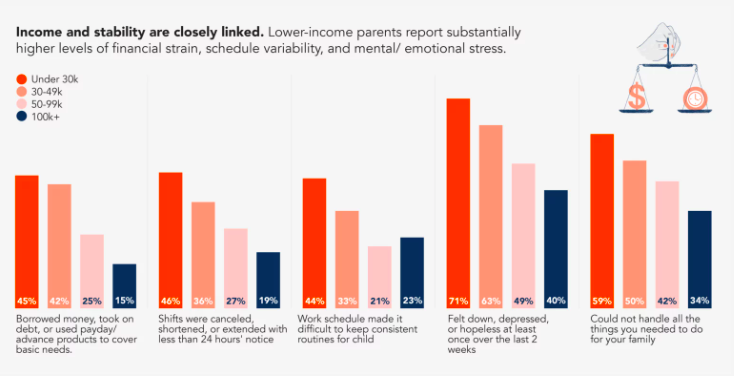
  • More than a third were worried at some point in the last year that food would run out before they had money to buy more — and almost as many actually had that happen. 
  • One in 5 reported skipping out on needed medical care due to costs in the last year, and 15% skipped filling a prescription for the same reason. 
  • In the last three months, 20% of households reported a member losing a job or having their hours cut.
  • In the last month, 25% of respondents said they had a shift canceled, shortened, or extended with less than 24 hours’ notice. The same percentage were required to be “on call” — available without guaranteed hours — during that period. 
Courtesy of Capita

Financial stress can be a leading driver of “toxic stress.” This compounding, long-term stress can do permanent damage to the health of parents and the development of children — and can sometimes lead to Adverse Childhood Experiences (ACEs). 

Evidence shows that safe, stable, and nurturing relationships with adults can protect children from the negative outcomes of ACEs and toxic stress. But the survey suggests most parents are struggling to maintain that kind of relationship with their children. 

Advertisement

Two-thirds of respondents said that in the last month, stress made it hard to be as patient with their children as they wanted to be. And half of parents reported feeling down, depressed, or hopeless in the last two weeks. 

There are several questions in the survey that pertain specifically to work and child care. Here are some related findings:

  • More than 70% of respondents describe their job as family friendly.
  • Almost two-thirds said family life is a top priority, and they want their job to fit around it.
  • In the last year, 27% of respondents missed work or lost pay because of child care problems.
  • One in 5 parents regularly supervise their children while working. 

Despite the challenges presented by scheduling, about 70% of parents report being satisfied with their existing child care situation, whether they have children who are school age or below. And 81% said their communities are welcoming to families with minor children.

But 43% said their work schedules made it hard to keep consistent routines for their children, and that matters. 

“That lack of control over one’s schedule contributes to lack of control over one’s life more broadly, and it can affect parenting relationships,” Haspel said. 

Advertisement

As the Capita report explains:

Volatile schedules make it hard for people to be the kind of parents they want to be. They may have to forego baseball games or dance recitals they planned to attend, skip sitting down to dinner as a family, or miss tucking their kids into bed. Instability also has a significant impact on child development. Consistent routines are the foundation for children’s growth, learning, and feelings of security. Chronically disrupting those routines not only stresses parents but also interferes with their children’s long-term trajectory. Inconsistent or nonstandard parent work schedules are associated with cognitive delays and behavioral outcomes, especially if they begin during a child’s first year of life. 

“Job quality or schedule quality is often thought of as labor policy, it’s not thought of as a family policy,” Haspel said. “If you care about having strong, healthy families, this is a contributing factor.”

The meaning

While this first set of survey results represent the baseline of what Capita plans to measure over time, there are still significant takeaways from this early warning system. 

“A lot of what we’ve been hearing around the issues with affordability, the issues with being able to navigate all the extra challenges of parenting in 2020s America is showing up in family well-being,” Haspel said. 

Advertisement

Here’s what Capita has to say about the initial survey results:

This first survey of Quarterly Insights paints a troubling picture of families feeling economic strain and suffering from depression, burnout, and hopelessness. These conditions reinforce one another, making it harder for parents to show up for their children, their partners, and themselves, maintain routines, and flourish. Ultimately, all of these factors make stability feel perpetually out of reach. While the heaviest burdens often land on those earning the least, working-class and middle-class families also feel the enormous weight of these compounding pressures.

The report goes on to point out that policies supporting the well-being of children and families are most likely to succeed if they address multiple aspects of family hardship and reach all families who are affected. 


Editor’s note: This article was corrected to say that four states were oversampled in the Capita survey.

Katie Dukes

Katie Dukes is the director of early childhood policy at EdNC.

Advertisement
Advertisement

Source link

Continue Reading

Trending

Copyright © 2025