In the world of children’s toys there are many offerings which are meant to look like devices used by older kids or even adults, with the Fisher Price Laugh & Learn Lil’ Gamer toy bearing quite the resemblance to Nintendo’s iconic Game Boy. Although this factoid could be filed away as amusing trivia before passing said toy to a child for its requisite physical abuse by said child, a purported adult can still have a lot of fun with this toy by modding it into a real Game Boy, as [KOUZEX] recently did.
Part of the challenge here is to not just treat it as an unconventional replacement shell for a genuine Game Boy, but to retain as much of the child toy’s look and feel as possible. This includes things like buttons and even the weird sliding blocks on the side.
For the functional components a Game Boy Color with a busted screen was chosen as a donor, with the GBC mainboard fitting almost perfectly inside its new shell. Wires were then soldered to bridge Nintendo’s PCB with the toy’s PCB to make the original buttons and speaker work. After blowing a fuse on the GBC mainboard due to likely some power back feeding, the toy’s PCB had its non-essential parts stripped, but fortunately without further damage to the grafted in electronics.
Advertisement
Most of this mod is quite straightforward, just with some creativity required to add a Select and Start button as these were notably absent from the original. The new, rather large replacement OLED screen is a nice upgrade too and actually fits pretty well with the chunky look of the child’s toy. Even as mostly a joke mod, it seems surprisingly functional.
Hackers associated with the Russian threat group Sandworm have been targeting system administrators and IT professionals through fake job offers since at least May.
A report from the Ukrainian Computer Emergency Response Team (CERT) details a social engineering campaign attributed to UAC-0145, which is believed to be a sub-cluster of Sandworm (APT44). In the campaign, the threat actor targets victims while posing as IT companies and recruiters.
The agency says that the attacker studies the targets’ resumes uploaded on job sites and then initiates direct contact.
Conversations are then moved to Telegram to arrange a video interview over Zoom. During the interview, which is conducted in English, the candidates receive mock technical assignments that require them to connect to a corporate VPN.
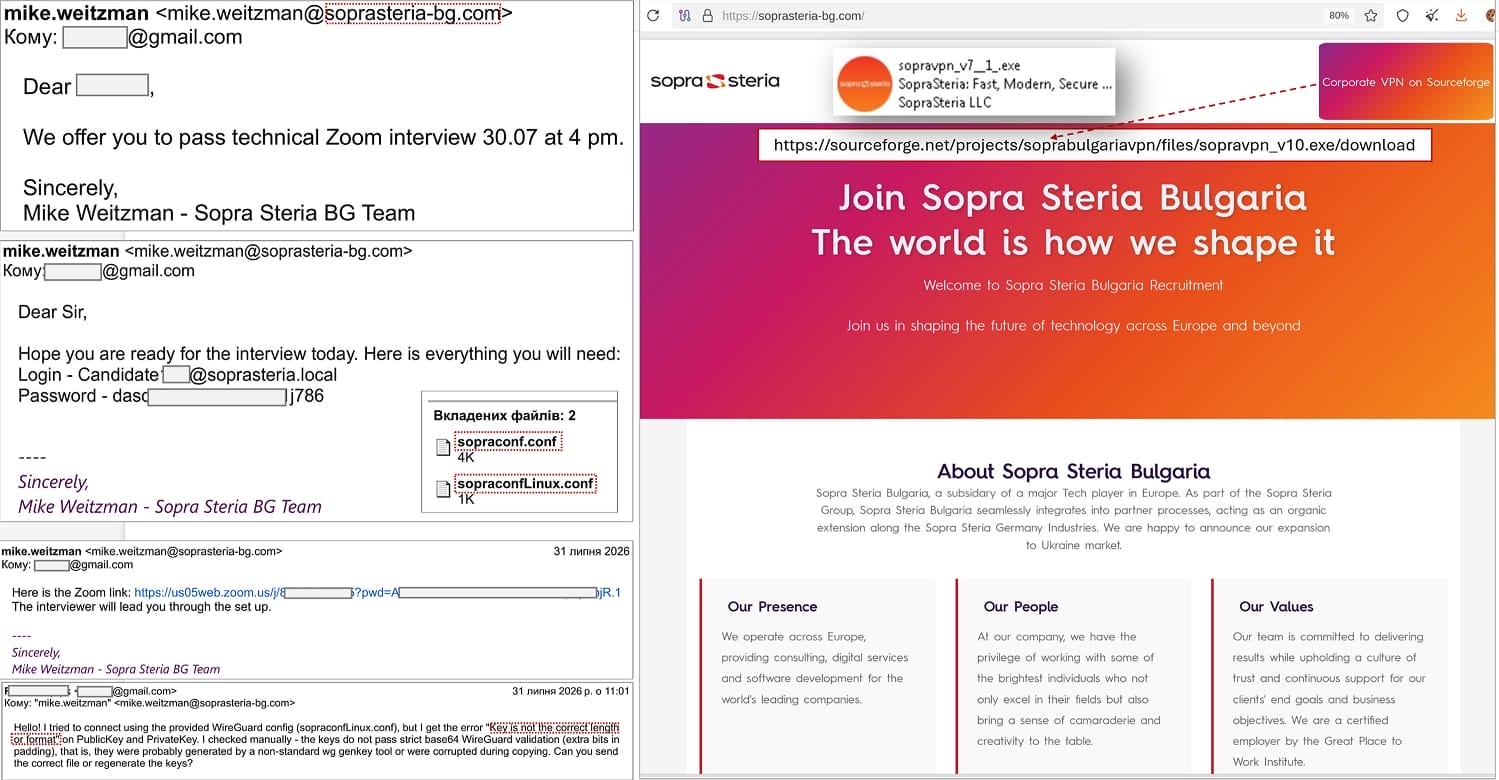
Conversations with a supposed recruiter Source: CERT-UA
In one case that CERT-UA observed, the attacker impersonated the international IT firm Sopra Steria using seemingly legitimate email addresses similar to the company’s office in Bulgaria.
“In parallel, additional instructions for the technical interview are sent via email, including configuration files for connecting to a ‘corporate’ VPN using Wireguard (Linux/Windows) to supposedly perform test tasks,” CERT-UA says.
Advertisement
Malicious emails and VPN download link Source: CERT-UA
The downloaded file is configured to produce a fake error. The attackers then prompt the victim to download a modified WireGuard-based client called “SopraVPN” from SourceForge.
The SourceForge page even includes a link to soprasteria-bg[.]com to increase credibility, although the domain has no connection to the legitimate company.
The trojanized client supports a malicious, nonstandard “SymmetricKey” configuration option that decrypts and executes embedded PowerShell code.
On Windows, the malicious command creates a scheduled task and downloads an additional payload from the Internet.
On Linux, it uses cURL to retrieve another executable from attacker-controlled infrastructure through the VPN.
Advertisement
CERT-UA also noted that WireGuard’s standard Base64 decoding was replaced in the trojanized version with a custom, dynamically generated Base64 alphabet, which renders key strings unreadable with standard decoders and protects the PowerShell code from analysis.
The Ukrainian cyber agency advises telecommunications providers and IT companies whose staff are targeted by this campaign to restrict corporate resource access to managed, continuously monitored devices protected by EDR, including when employees use personal equipment.
These days, it’s all but essential to have a quality set of headphones or earbuds on hand. Listening to music, taking phone calls, checking out audiobooks, and more are enhanced by this immersive wireless audio tech. For many, Apple’s AirPods are the way to go, because of their shape, sound quality, and bevy of features activated by a single tap. However, as popular as these devices have become in recent years, many Apple users have started to turn away from AirPods in favor of alternatives for one reason or another.
Of course, there’s nothing wrong with sticking with AirPods, as they have a lot to offer. Many like the smooth, contoured shape and how they fit within the ear. They’re optimized to connect quickly and function seamlessly with Apple devices; the sound quality is strong, and features like Hearing Protection on AirPods Pro 2 and AirPods Pro 3 help reduce exposure to loud environmental noise. Still, many users find they lack in some areas, or that the competition has proven itself superior in one way or another.
While Apple most likely won’t abandon the AirPods line anytime soon, it appears some users are putting them away for good. These are some of the most common reasons the earbud-wearing public has given online for making the switch.
Advertisement
New sets of AirPods aren’t cheap
Dontree_m/Getty Images
Like any piece of modern technology, AirPods don’t last forever. The rechargeable lithium-ion battery within may only last a few years before it fails to hold a charge, rendering the earbuds unusable. Their design also makes them nearly impossible for the average person to repair, so replacement seems like the only way to go for most. Unfortunately, this brings another obstacle: price. AirPods are quite expensive, with some of the latest AirPods Pro models potentially costing hundreds of dollars. Naturally, this high financial barrier has become a sticking point for many Apple customers, leading them to leave AirPods behind altogether.
There’s lots of online discussion concerning AirPods prices and what consumers get for the cost. Many feel that going with other brands is just fine to save some money, with some arguing that AirPods’ high price is due at least in part to Apple’s status as a premium brand. This has led some to seek out cheaper alternatives from other brands. At the same time, there are lots of people online who feel AirPods are a get-what-you-pay-for investment. They believe the higher price is worth it for the sound quality, comfortable shape, and other features they bring to the table.
Advertisement
There are strong, cheaper alternatives
Nguyenducquang/Getty Images
A big factor in the success and popularity of AirPods is the Apple name and its connection to the brand’s devices. Features like Instant Pairing, Audio Sharing, and more are only available when AirPods are paired with Apple devices. However, if these and some of the many hidden AirPods features to use don’t appeal to you, you’re not particularly fond of AirPods, or you’re choosing to move away from the iOS ecosystem, there’s less of a reason to stick with AirPods. There’s an endless number of earbud brands, each with their own set of pros and cons. If online chatter is any indication, many former AirPods users have begun looking to these audio brands to meet their audio needs.
Users recommend many earbud brands as viable alternatives to AirPods. Sony, which offers a range of high- and low-priced earbuds, is one name that frequently comes up in these discussions. Sony’s earbuds come in a variety of shapes and colors, while offering features like noise cancellation and enhanced user comfort. The Beats line of wireless earbuds, Bose’s earbud offerings, and earbud sets from Anker also have their share of online supporters. On the whole, things like price, sound quality, and the ability for the earbuds to stay in the user’s ear, among others, influenced users’ decisions to switch to non-Apple brands and recommend them to others.
Advertisement
The wired headphone resurgence
Sergii Vasylchenko/Getty Images
With the almost total disappearance of headphone jacks from modern phones and the overall cultural embrace of Bluetooth technology, wired earbuds have largely faded from the spotlight. Still, they haven’t gone away completely. In some circles, they have proven even more popular than Apple AirPods. Whether with a USB-C connection or a dongle to make them phone-compatible, many have found wired earbuds to be a good alternative to AirPods in more ways than one. In fact, even Apple’s own EarPods have surged in popularity as of late thanks to a few key wins they score over their wireless contemporaries.
Even in committed AirPods circles, EarPods win out with many people. They’re praised for their sound quality, significantly lower price at around $20 per pair in most cases, and microphone quality. Looking at wired headphones more generally, AirPods can’t compete with the fact that wired earbuds don’t need to be charged. Not to mention, their cable-bound nature makes them easier to keep track of, and there’s no need to carry around a charging case, either. Additionally, there are many great wired earbuds for consumers to choose from. Plus, if you’re into the slightly old-school, Y2K aesthetic, wired earbuds evoke that era of tech far more than modern AirPods.
Advertisement
Possible health concerns
Denis Borisov/Getty Images
As harmless as they may seem, AirPods and earbuds as a whole do come with some health risks. Thus, in-ear headphones aren’t the right choice for everyone. The potential for hearing loss cannot be ignored, as listening at high volumes for long stretches can do serious damage over time if users aren’t careful. Also, keeping AirPods in for long periods can lead to increased earwax accumulation, while taking them in and out can push earwax deeper into the ear canal. This can mean blockage, possible earaches, and hearing loss. By using a set of over-ear headphones instead, that issue can be greatly reduced.
Meanwhile, others have stopped using AirPods and earbuds because they are concerned about the potential health risks that come with their use. There has been a lot of chatter online about the electromagnetic fields generated by AirPods and the possible impact they could have on the human brain or the body. It should be stressed that this subject is still being researched by the scientific community, with no serious link between AirPods or earbud EMF exposure and health problems established as of yet. However, that possibility alone has led some to cut back on using AirPods or ditch them entirely.
Atlantis Lab may not be a familiar name to most American audiophiles, but the French loudspeaker manufacturer has been building high efficiency designs since 1998. Originally known as Atlantis Acoustique, the company was founded by Eric Buy with a focus on producing speakers that could deliver substantial output without requiring massive amounts of amplifier power.
That philosophy guided the company for nearly two decades before Atlantis shifted direction in 2017, bringing in a team of sound engineers to optimize its loudspeakers for professional studio use as well as home audio systems. The change also brought a new name and product lines that retained the efficiency of the earlier models while adding the heavy duty drivers, cabinets, and components more commonly associated with professional sound reinforcement equipment.
The result is a range of loudspeakers that are relatively easy to drive, built to withstand demanding use, and flexible enough to work in rooms where conventional designs can struggle. Tunable ports allow many Atlantis Lab models to sit closer to the wall without overwhelming the room with bass, helping the company build a loyal following across Europe.
The problem in the United States was never the product. It was finding one. Early availability was inconsistent, and dealer support was limited. With Decibel+ now representing Atlantis Lab, distribution and customer support have improved considerably. That should make the brand a far more common sight in American studios, showrooms, and listening rooms.
Advertisement
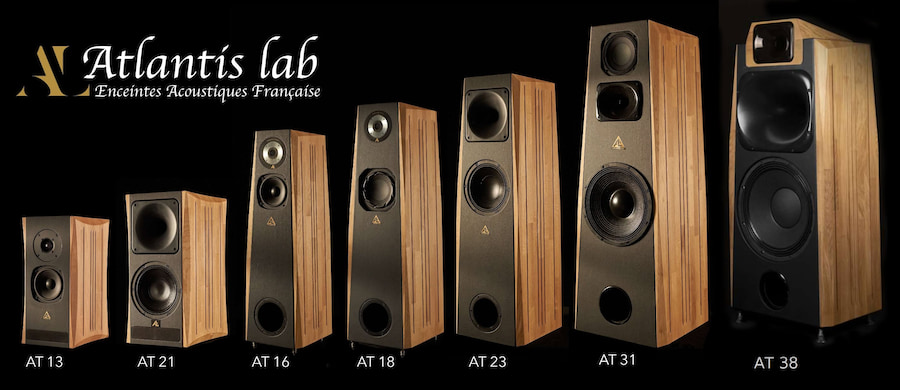
The current Atlantis Lab lineup includes the AT-13 Pro and AT-21 Pro bookshelf speakers, along with the AT-16 Pro, AT-18 Pro, AT-23 Pro, AT-31 Pro, and AT-38 Pro floorstanding models. The company also offers a dedicated home theater range with AT-13 and AT-21 center channels, the AT-22 satellite speaker, and the AT-33 subwoofer.
Taken together, the lineup covers nearly every room size and application, with prices starting at roughly $1,650 and climbing to $13,000 each for the flagship AT-38 Pro. That is a substantial range, but it also gives buyers the ability to select a model based on the room rather than trying to force an undersized or oversized loudspeaker into a space where it does not belong.
After speaking with Decibel+ about which model would make the most sense for this review, we settled on the AT-23 Pro as the best match for the room I had available. Positioned near the middle of the lineup, the AT-23 Pro retails for approximately $3,400 per speaker, depending on the selected options.
These are designed to fill a room rather than function as oversized nearfield monitors, so choosing the correct model for the space was important. I wanted to evaluate how the AT-23 Pro energized the entire room, not simply toe the speakers toward my listening position and judge them solely on their on-axis performance.
Advertisement
Related Reviews:
The AT-23 Pro Makes Its Presence Felt Before the Music Starts
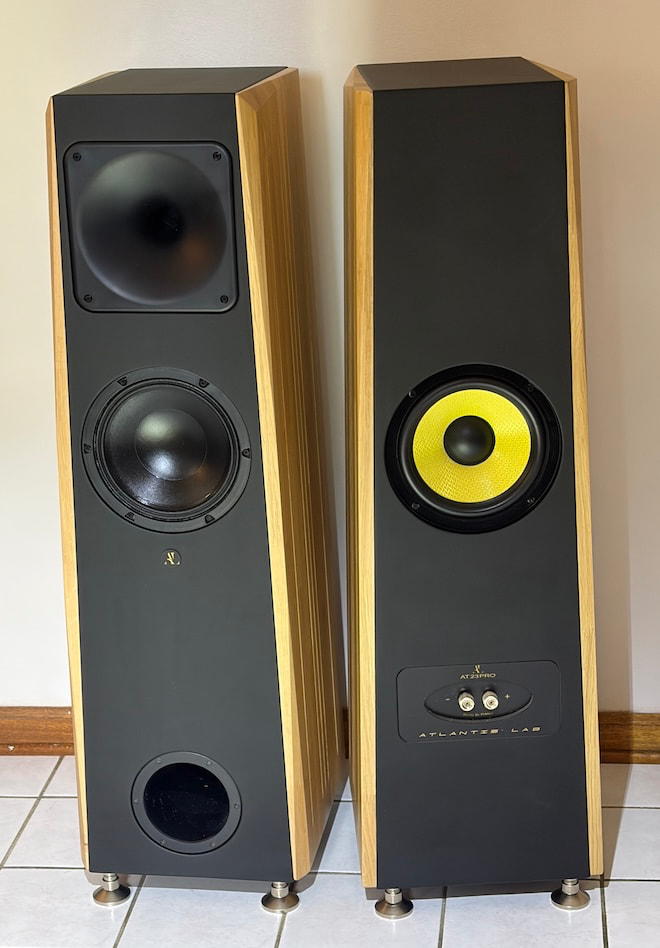
Atlantis Labs AT-23 Pro (front without grilles)
Unboxing the AT-23 Pro is a challenge, as each speaker weighs 35 kilograms, or roughly 77 pounds. This is not a speaker you casually lift out of the box and carry across the room without first considering the condition of your back.
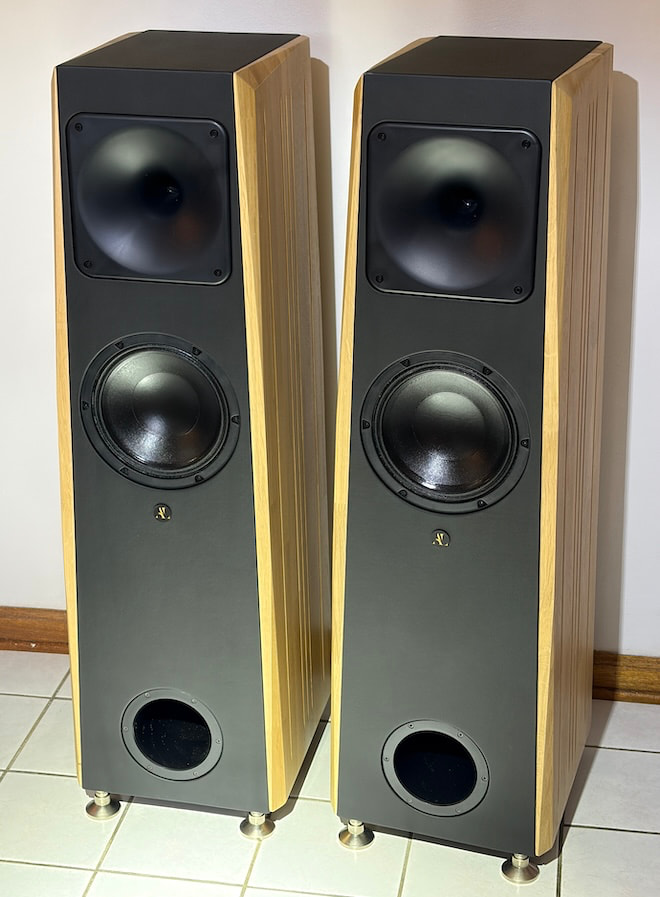
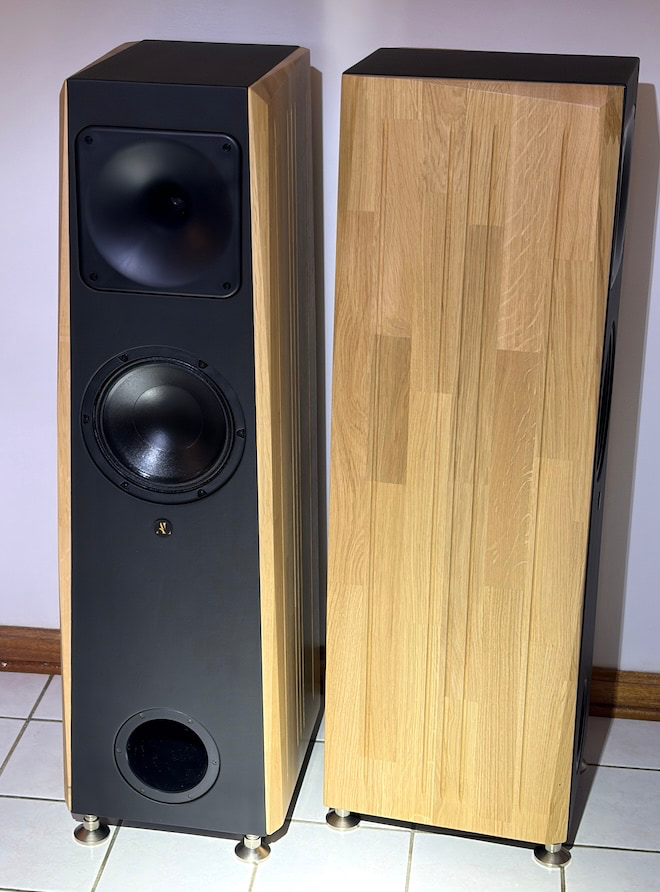
The front baffle is wrapped in black leather, although white leather is also available. Solid oak panels cover both sides of the cabinet and slope gently inward, making the enclosure slightly narrower at the top than at the base.
Each side panel is constructed from vertical oak slats measuring 54mm wide. Not every slat is made from a single piece of wood, so horizontal joints are visible in several places. The finished cabinet is certainly distinctive, although it may not be the easiest visual match for rooms with similarly colored hardwood floors or a lot of existing wood furniture.
Advertisement. Scroll to continue reading.
The side panels are likely to be the most divisive aspect of the AT-23 Pro’s appearance. Some people I asked really liked the combination of leather and natural oak, while others felt the segmented wood panels detracted from the overall aesthetic. Offering a solid-color finish or a continuous veneer might make the AT-23 Pro easier to integrate into a wider range of listening spaces.
Advertisement
Pro Drivers With Room-Friendly Placement
Atlantis Labs AT-23 Pro (front and rear without grilles)
Starting at the top of the front baffle, the AT-23 Pro uses a 1-inch horn-loaded tweeter with a titanium diaphragm and a round waveguide offering 90-by-90-degree dispersion. Directly below it sits a 21cm midwoofer, paired with a second 21cm driver mounted in opposition on the rear of the cabinet.
The front-firing driver is an Eighteen Sound model with a paper cone selected for greater transparency, while the rear driver uses the company’s Kevlar cone to add depth and impact. This arrangement gives the AT-23 Pro a more substantial low-frequency presentation without relying on a conventional collection of front-facing woofers.
A tunable port at the bottom of the front baffle allows the speaker to be adjusted for placement closer to or farther away from the rear wall. That flexibility makes the AT-23 Pro particularly useful in rooms where the speakers need to sit near a wall to avoid blocking walkways or consuming too much floor space.
The leather finish continues across the rear of the cabinet as a single uninterrupted piece running from the bottom of the front baffle, over the top, and down the back. This creates a cleaner visual contrast with the more segmented appearance of the oak side panels.
The rear-facing 21cm Kevlar driver is positioned roughly halfway up the cabinet. Below it, a single pair of binding posts accepts bare wire or banana plugs. The through-hole design can accommodate bare speaker cable up to approximately 10 gauge, which should be more than sufficient for nearly any domestic installation.
Advertisement
Easy to Drive, Hard to Overwhelm
The AT-23 Pro is a 4-ohm loudspeaker rated to handle 300 watts continuously and 600 watts peak. Atlantis Lab specifies a frequency response of 33Hz to 20kHz, but my in-room testing found output remained within roughly 1dB down to 28Hz before the roll-off became more pronounced. That makes the AT-23 Pro entirely usable without a subwoofer for most music systems, although home theater users may still want one for the lowest effects.
One of the original design goals was to combine the performance of the AT-21 loudspeaker and AT-33 subwoofer in a single cabinet. Based on the measurements and what I heard in the room, Atlantis Lab largely succeeded.
The adjustable port provides another level of control over the low end. I found that slightly increasing the tube length from its default setting produced the best balance in my listening room. The adjustment is simple, and the audible difference is substantial enough to be useful. This is not a gimmick. It is a legitimate room-tuning tool.
With a rated sensitivity of 96.5dB, the AT-23 Pro can also be paired with a much wider range of amplifiers than its size and power handling might suggest. It worked equally well with lower-powered tube amplifiers and far more muscular solid-state designs. I expected it to favor one end of that spectrum, but it remained composed and engaging regardless of which amplifier I used.
Advertisement
My first test platform was a modified Dynaco ST-70 producing roughly 32 watts per channel, with peak output reaching into the 70-watt range before distortion begins to take a meaningful toll on sound quality. I then moved to the opposite extreme and connected the AT-23 Pro speakers to my main system, which uses a pair of Mark Levinson No. 23.5 amplifiers capable of delivering 400 watts without much effort.
Those two systems represent something close to the practical lower and upper limits most owners are likely to consider. The AT-23 Pro handled both without complaint, which says a great deal about its efficiency, power handling, and overall versatility.
Measured bass extension: Approximately 28Hz at -1dB in-room
Sensitivity: 96.5dB
Nominal impedance: 4 ohms
Continuous power handling: 300 watts
Peak power handling: 600 watts
Connections: Single pair of binding posts
Compatible terminations: Banana plugs and bare wire up to approximately 10 gauge
Cabinet finishes: Oak side panels with black or optional white leather baffle
Dimensions (HxWxD): 111 x 40 x 40 cm (43.7 x 15.75 x 15.75 inches)
Weight: 35 kg / 77 lbs each
Listening
The AT-23 Pro speakers effortlessly bring a room together with their captivating sound quality. At AXPONA, it was evident that while the cabinetry might stir some debate among enthusiasts, the sound quickly shifts the focus back to what truly matters: pure, immersive listening enjoyment.
The AT-23 Pro delivers robust, solid bass that often forced me to remind myself that my subwoofers were disconnected. The bass is not only quick but also richly textured, displaying an impressive level of detail that one might not expect from relatively small drivers paired with a large reflex port.
Advertisement
Contrary to expectations, there is minimal distortion, which is a common issue when smaller drivers attempt to mimic larger ones. The low-end capabilities of these speakers make them an excellent option for rooms where subwoofer placement is problematic or impossible. Those looking for true home theater impact, or listeners who favor heavy EDM, can add a subwoofer to take the slam and rumble to another level.
Midrange frequencies are reproduced with excellent clarity and above-average dynamics, allowing horns and strings to resonate with convincing energy and life. Acoustic guitar and piano are rendered with a level of realism that many more expensive loudspeakers struggle to duplicate.
My usual classical and jazz playlists were a joy to experience through the AT-23 Pro. Even when I switched to the dense, complex layers of Miles Davis’ “Bitches Brew,” I remained thoroughly engrossed by the nuanced presentation of each horn and the speaker’s ability to keep individual instruments distinct within the mix.
Vocal reproduction through the AT-23 Pro is generally excellent, although it highlights the importance of both recording quality and careful system matching. The horn-loaded tweeter can emphasize brightness when paired with similarly voiced electronics, but it also reveals just how well, or poorly, a recording was engineered.
Advertisement
Recordings handled by engineers such as Rudy Van Gelder and Bruce Swedien sounded open, detailed, and remarkably lifelike. Poorly mastered tracks were far less forgiving, with harshness and compression brought more clearly into focus.
That sensitivity is better understood as a reflection of the AT-23 Pro’s resolving ability than an inherent flaw. Pair it thoughtfully and feed it quality recordings, and the speaker rewards the effort.
The dynamic range and engaging character of the AT-23 Pro are undeniable. The speakers handle the delicate passages of Tchaikovsky’s “The Sleeping Beauty” with grace and air, then power through Mussorgsky’s “The Great Gate of Kiev” with explosive energy and precision.
With the right recordings and complementary electronics, the AT-23 Pro delivers a thrilling and highly immersive listening experience.
Advertisement
The Bottom Line
The Atlantis Lab AT-23 Pro is a versatile floorstanding speaker for medium to larger rooms, especially for listeners who want deep, authoritative bass without adding a subwoofer. Its high sensitivity, tunable port, and ability to perform closer to the rear wall also make it easier to place than many speakers of this size.
The AT-23 Pro combines detailed highs, precise midrange performance, and substantial low-end output in a package that reminds me of the Vandersteen Treo CT at close to half the price. The Treo still offers greater treble refinement, and the AT-23 Pro’s oak-slat cabinetry will not appeal to everyone, but neither issue diminishes how engaging these speakers are.
Advertisement. Scroll to continue reading.
They are not yet widely known in the United States, but improved distribution through Decibel+ should change that. Anyone shopping in this price range should make the effort to hear them. They are easy to drive, difficult to ignore, and even easier to get lost in.
Advertisement
Pros:
Deep, powerful bass that often eliminates the need for a subwoofer
Clear, realistic midrange with excellent dynamics
High sensitivity makes amplifier matching relatively easy
Tunable port allows more flexible near-wall placement
Engaging, room-filling presentation with strong value for the price
Cons:
Horn tweeter can sound bright with aggressive electronics or recordings
Oak-slat cabinetry will be visually divisive
Large, heavy cabinets require help during setup
Treble is not quite as refined as some more expensive competitors
SpaceXAI has launched Grok Bot in beta, AI agents that sign into apps and websites, retain context between tasks and coordinate with each other. Access is limited at first to SuperGrok Heavy, Cursor Ultra and Cursor Teams Premium subscribers, with an enterprise waitlist.
SpaceXAI has released Grok Bot, software that hands work to groups of AI agents running on their own machines. The agents sign into apps and websites, keep context between tasks, and pass work back only when they need a human decision. It went into beta on Tuesday.
Access is restricted at first to SuperGrok Heavy, Cursor Ultra and Cursor Teams Premium subscribers, with a waitlist for enterprise customers. It runs on macOS, Windows, Linux and iOS, with Android to follow.
The selling point is that the agents work through interfaces rather than APIs, signing in the way a person would, and that several can run at once and share what they know. SpaceXAI says it has been using them internally across engineering, growth and marketing, citing overnight sales research, expense receipts pulled out of email, and bug fixes.
Advertisement
TNW reported in July that Cursor was building a general-purpose office agent, codenamed Sand, aimed at Claude Cowork and ChatGPT Work. Grok Bot arrives in that same territory, as SpaceXAI and Cursor merge into a single company.
SpaceX agreed a $60bn all-stock deal for Cursor’s parent Anysphere in June, days after its own listing, in what was reported as the largest startup acquisition on record. Cursor’s coding tools already run inside much of the Fortune 500.
The product is Musk’s answer to having fallen behind in agents. SpaceXAI shipped its first coding agent in May, then followed with Grok 4.5, built with Cursor, in July.
Rivals are circling the same idea. OpenAI’s Sam Altman discussed agents coordinating with one another when he met lawmakers in Washington last month.
Advertisement
Handing sign-in credentials to autonomous software raises an obvious question for this company in particular. Cursor’s Grok Build tool was found to be uploading entire Git repositories, committed secrets included.
The commercial pressure now sits with SpaceX. Musk told investors on last week’s earnings call that AI work was progressing and that Grok 4.6 could ship within days. Grok’s slow adoption in Washington has already weighed on the IPO story.
Last week, a researcher outlined what he said was a “novel attack surface” in passkeys, the new authentication paradigm that offers a more secure alternative to password-based methods. In fact, the attacks demonstrated in the post are neither novel nor unique to passkeys. This distinction is important because the research has generated confusion among end users and security professionals as they assess whether this new mechanism is truly safe to use.
The attack is called Pass-ta-key—a blending of the word passkey with the phrase “pass the key” and a nod to a plate of pasta. Arie Olshtein, a researcher at security firm Palo Alto Networks, described in a post last week how Pass-ta-key could obtain all passkeys stored in the Google Password Manager app (GPM) for Windows when it’s running on a machine infected with malware.
This came as a surprise to many people because they believed passkeys are stored exclusively in the trusted platform manager (TPM), the locked-down enclave in a hardened silicon chip that’s reserved for storing cryptographic keys and other highly sensitive information on Windows machines. If passkeys are stored in the TPM, then how was Pass-ta-key able to extract the entire set of passkeys stored by the app, they wanted to know.
Local passkey storage is OK, with one exception
The answer is that, contrary to common belief, the FIDO 2 specifications—managed by the industry group FIDO Alliance—don’t mandate that passkeys be kept in TPMs, or any other sort of dedicated piece of hardware (they go by different names, depending on the platform, including secure enclaves, trusted execution environments, and StrongBoxes). In fact, most platforms and third-party software for managing passkeys do not store passkeys in such dedicated hardware. Virtually the lone holdout is Microsoft, which gives users the option to store passkeys in the Windows TPM. The company mainly recommends this choice to enterprises, not consumers.
Jennifer Bailey, head of Apple Pay and Wallet since the service launched in 2014, is retiring in October after more than 25 years at Apple. Her exit is one of several senior departures ahead of Tim Cook handing the chief executive job to John Ternus on September 1.
Jennifer Bailey, who has run Apple Pay since the service launched in 2014, is retiring in October after more than 25 years at Apple. Services chief Eddy Cue announced her departure in a staff memo seen by Bloomberg News. A successor will be named before she goes.
“Under Jennifer’s leadership, Apple Pay has changed the way hundreds of millions of our users pay,” Cue wrote. Bailey will stay on in an advisory role through the handover. Apple declined to comment.
The division she leaves behind is one of Apple’s most profitable. Apple Pay brings in more than $7.5bn a year on analyst estimates compiled by Bloomberg, and functions as a reason for customers to stay on iPhone. Bailey also built Wallet, which began as a place to store card details and now holds keys for homes, cars and hotels, along with identification.
Advertisement
Apple Card and the company’s recently announced device upgrade subscription both grew out of the same division. Before Apple Pay, Bailey ran Apple’s online store, having joined in the early 2000s from a string of internet companies.
People familiar with the move describe her exit as a significant loss, and as a sign of what is coming. Apple has a demographic problem. A cohort of executives who grew wealthy over decades at the company are reaching retirement age together, and no longer need to work.
General counsel Kate Adams is retiring this year, and environment chief Lisa Jackson left at the start of 2026. Former finance chief Luca Maestri and marketing veteran Phil Schiller have stayed on in smaller roles but are probably near the end. Cue, retail boss Deirdre O’Brien and marketing head Greg Joswiak have each been at Apple for around four decades.
The largest change lands on September 1, when Tim Cook hands the chief executive job to John Ternus and becomes executive chairman. Ternus, 51, who built Apple’s hardware for more than two decades, is expected to make further personnel changes and has already brought a retired hardware leader onto his team.
Advertisement
The drain is not limited to the executive floor. Apple’s design studio has lost nearly every Ive-era designer, a gap Ternus has said he intends to close.
Josh Rosenstock, a senior director of corporate communications, is also leaving, in what Bloomberg reports is an unrelated move.
Current space exploration aims to establish permanent structures on the Moon, Mars, and eventually other planetary bodies. Successful lunar missions depend on understanding lunar regolith, the granular material covering the Moon’s surface, whose behavior is governed by low gravity, vacuum conditions, particle irregularity, electrostatic effects, and extreme thermal environments. This webinar will focus on two connected modeling problems related to lunar regolith: plume–regolith interaction during lunar landings and induction heating of porous regolith for thermal processing and melting. Together, these problems show how simulation with the COMSOL Multiphysics® software can help engineering and research teams predict, control, and utilize granular lunar material.
The first part of the talk will address plume–regolith interaction. During spacecraft landings, underexpanded rocket exhaust plumes impinge on the surface, producing compressible flow structures, erosion, particle ejection, and possible surface damage. High-speed dust can reduce visibility and threaten astronauts, equipment, and nearby assets. These issues are especially important for Artemis and future missions involving repeated landings and larger spacecraft. Modeling the coupled gas-particle response provides insight into landing-site safety, erosion patterns, ejecta trajectories, and mitigation strategies.
The second part of the webinar will examine induction heating of porous regolith, where electromagnetic energy is converted into heat to raise temperature, drive phase change, and potentially melt lunar soil. The discussion will emphasize temperature-dependent porous media properties, latent heat treatment, melt fraction evolution, and the differences between constant-property and piecewise-property models. By connecting these studies, the webinar will demonstrate how COMSOL-based workflows can quantify flow fields, particle transport, thermal response, and phase-change behavior while supporting safer operations, regolith processing technologies, and the development of future space infrastructure.
When an AI assistant recommends a product or brand, it generates something valuable: a purchase-ready consumer with high intent and low friction in their decision. That consumer has already compared options, asked follow-up questions, and arrived at a conclusion. They want to buy.
What they encounter next is a commerce infrastructure that was not designed for them.
The gap between recommendation and purchase
The typical enterprise commerce stack was built for a specific model: a consumer who arrives at a brand’s website through search or a direct link, navigates product pages, adds to cart, and completes checkout through a multi-step form flow. That model assumed the consumer would do the work of bridging their intent to the transaction. Most commerce systems still assume exactly that.
Advertisement
Agentic commerce breaks that assumption. When intent is generated outside the brand’s owned environment, the handoff to transaction becomes a structural problem. Context doesn’t transfer. Sessions don’t persist. The consumer who asked an AI assistant for a recommendation and received one now faces the same friction-laden checkout process as someone who arrived with no prior intent at all.
Cart abandonment rates have remained stubbornly high for years. Baymard Institute research puts the average at 70%. That figure predates the agentic commerce era. As more purchase intent is generated through AI interfaces, and as the gap between that intent and a brand’s transaction layer widens, the abandonment problem is likely to get structurally worse before it gets better.
What the current stack wasn’t built to handle
The commerce infrastructure most enterprises operate today was assembled over two decades of incremental investment. Each layer added a capability: a search tool, a recommendation engine, a personalization layer, and a checkout system. Each was built to solve a specific problem within a human-initiated shopping journey.
None of it was built to receive intent from an AI agent.
Advertisement
When an AI system generates a purchase recommendation, it needs to do more than surface a product page. It needs to verify real-time inventory. It needs to apply pricing logic and promotional rules. It needs to respect brand policy around which products can be recommended together, which channels apply which discounts, and what the correct fulfillment path looks like for a given consumer. And it needs to do all of that without breaking the conversational context that made the recommendation possible in the first place.
Current commerce stacks can’t do this reliably. The systems that hold the relevant data, inventory, pricing, order management, fulfillment, are not exposed in ways that AI agents can safely and accurately access. The result is a journey that starts with intelligence and ends with a broken experience: a link out to a product page, a generic checkout flow, and a consumer who arrived ready to buy and left without completing the transaction.
The conversion problem is an architecture problem
The industry has treated conversion optimization as a front-end problem for most of its history: better copy, cleaner checkout UX, fewer form fields, smarter retargeting. Those interventions were appropriate for the model they were built to serve.
The agentic commerce era introduces a different kind of conversion failure, one that front-end optimization cannot fix. When intent is generated externally, conversion depends on whether the back-end infrastructure can receive that intent, act on it accurately, and complete the transaction within the guardrails the brand has established. That is not a UX problem. It is an infrastructure problem.
Advertisement
Brands that are investing heavily in AI-powered discovery while leaving their execution layer unchanged are widening the gap between the promise AI makes on their behalf and the experience they can actually deliver. That gap has a cost, measured not just in lost transactions but in consumer trust that erodes each time the promise and the reality don’t match.
Rezolve Ai commissioned research across 1,500 US consumers in January 2025 that found consumers who encounter friction immediately after an AI recommendation are significantly less likely to complete a purchase than those who encounter friction at the top of a traditional funnel. The implication is direct: AI raises the expectation bar at the moment of intent. Brands whose infrastructure cannot clear that bar are paying a conversion penalty they may not even know they’re incurring.
What closing the gap requires
Closing the gap between AI-generated intent and completed transaction requires rethinking which layer of the commerce stack carries the most strategic weight in an agentic world. For most of the past decade, that weight sat with discovery and experience. The brands that invested most in search, personalization, and content won a disproportionate share.
In the agentic era, the weight shifts to execution. The brands that can reliably take AI-generated intent and turn it into a governed, accurate, brand-safe transaction will have a structural advantage over those whose infrastructure stalls at the handoff.
Advertisement
That is a different investment thesis than the industry has operated on. And most enterprise commerce roadmaps have not yet caught up to it.
Sponsored articles are content produced by a company that is either paying for the post or has a business relationship with VentureBeat, and they’re always clearly marked. For more information, contact sales@venturebeat.com.
The Samsung S99H, or S95H as it’s also known in the US (the UK also has the S95H but with a different appearance, confusingly), is Samsung’s flagship OLED for 2026. As befitting its flagship status, it pairs vivid colour and picture quality with cinema-accurate reproduction that serious film fans will appreciate, all wrapped in a genuinely distinctive design.
Design-wise, the S99H makes no apologies for its appearance. The screen sits within a metallic frame, kept ultra-slim, with a wider backing panel extending past the edges that houses Samsung’s Object Tracking Sound (OTS+) 4.2.2-channel speaker array.
The effect is that sound comes from the correct part of the screen, delivering a properly precise soundstage. It’s a striking look, and it’s really built for wall mounting. The feet attach near the bottom corners of the screen, so you’ll need a very wide unit if you prefer it freestanding.
The S99H includes an advanced anti-glare filter. You can sit it opposite a window or beneath wall lights and reflections simply aren’t an issue. Connectivity is also generous, with four HDMI 2.1 inputs, two USB ports, Ethernet and an optical digital audio output. The S99H is also compatible with Samsung’s Wireless One Connect boxes, which add four further HDMI inputs, taking the total to eight, and let the TV sit cable-free in a room.
Advertisement
Tizen OS handles the smart side of things, offering pretty much every major streaming app alongside AI-driven search through Copilot and Perplexity. The interface isn’t the cleanest available, but the option to disable adverts helps considerably. There’s a dedicated gaming page, and Galaxy Watch gesture support is a nice touch for basic menu navigation.
At its core, the S99H features a QD OLED panel backed by Samsung’s OLED HDR Pro and OLED Brightness Booster features. The Booster pushes peak brightness into seriously high territory, so the set performs well in a bright living room, while HDR Pro handles upscaling and colour improvements. There’s also support for HDR10+ Advanced, Samsung’s answer to Dolby Vision 2, to deliver brighter images with better local tone mapping, alongside HDR10 and HLG.
Colour and brightness are both spectacular in Standard mode. Bright highlights erupt from inky blacks, and contrast is phenomenal. Switch to Filmmaker Mode and colour accuracy errors sit below the threshold of human visibility. It’s a subtle, immersive image that home cinema fans will genuinely appreciate.
Upscaling is close to masterful too, pulling HD and SD sources cleanly into 4K without smearing, with noise reduction handled before the upscaler does its work.
Advertisement
Gaming is a real highlight. The S99H supports 165Hz with AMD FreeSync Premium and NVIDIA G-Sync, and input lag in Game Mode measures 9.7ms. A dedicated gaming menu offers useful extras such as mini-map zoom and a raised brightness floor for dark areas.
Sound quality is impressive overall. The OTS+ system places effects accurately across the screen and beyond, with a wide dynamic range by TV standards. Very bright treble effects can occasionally sound a little brittle, and deep bass lines can produce some crackling artefacts at higher volumes.
The Samsung S99H delivers spectacular yet carefully judged pictures with standout connectivity options. It’s expensive, but for those seeking Samsung’s most accomplished OLED, this is the one to buy.
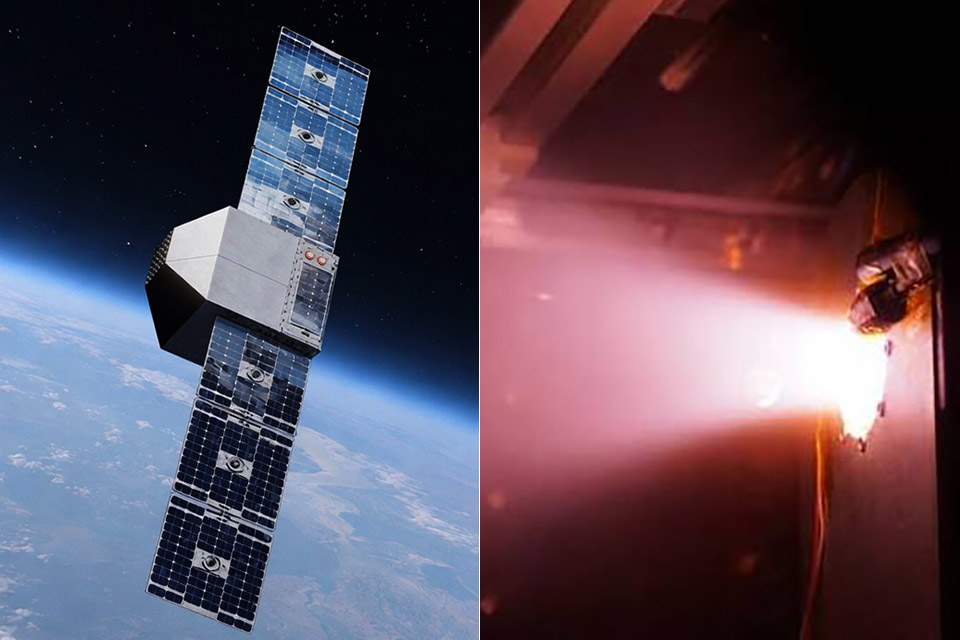
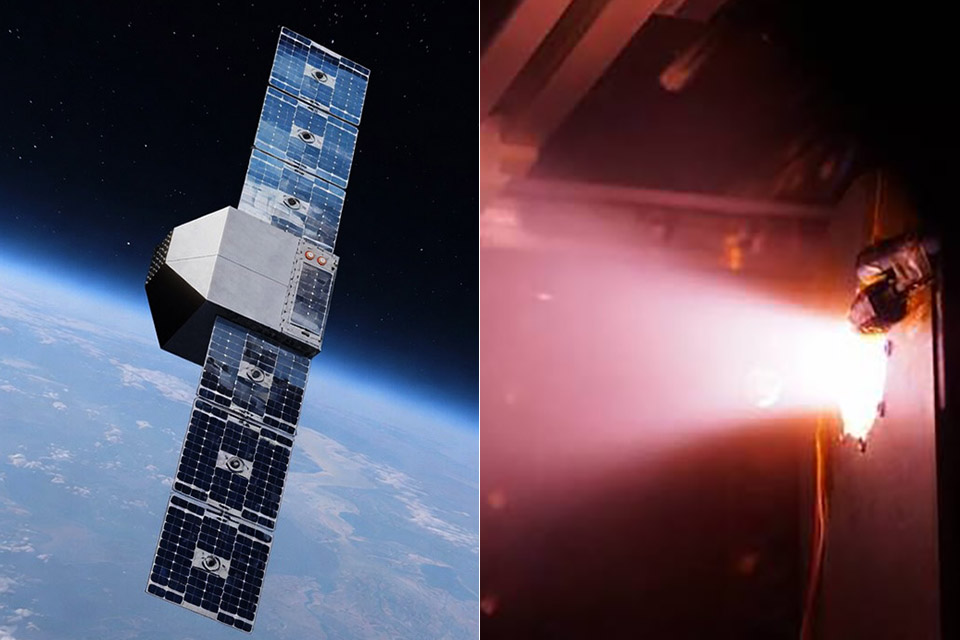
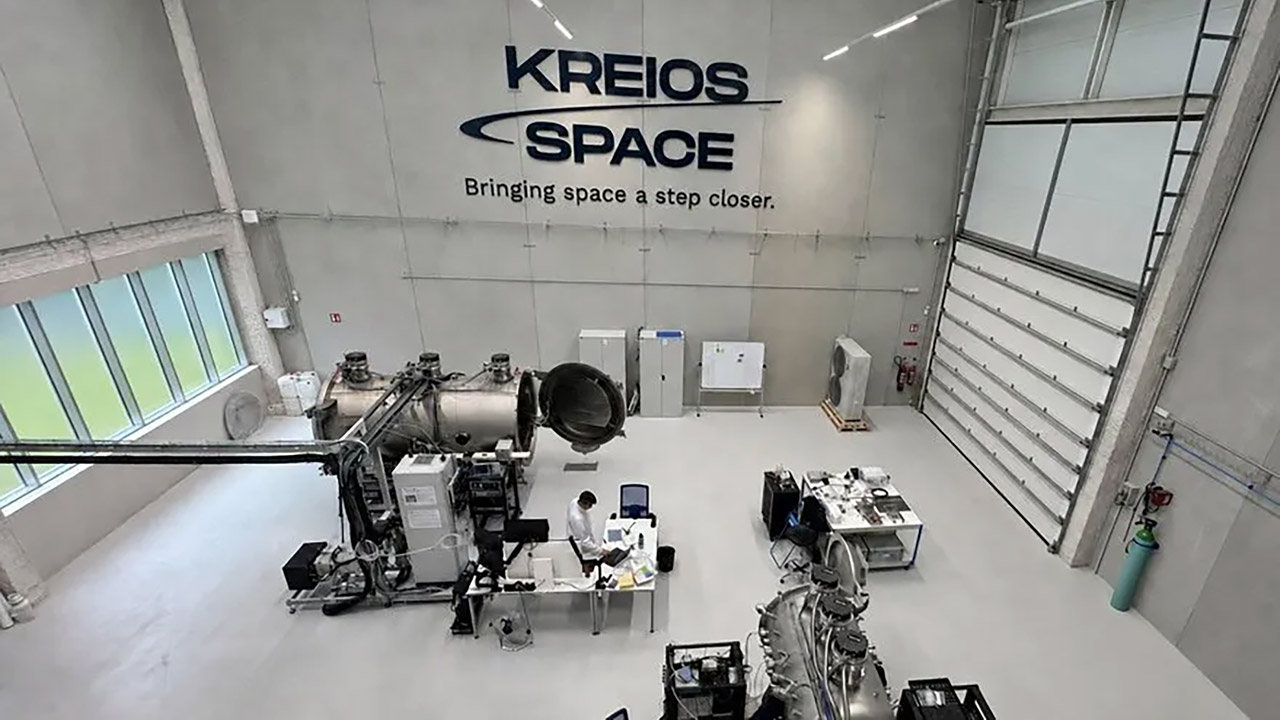
Spanish startup Kreios Space just named Kongsberg NanoAvionics as the builder of the platform that will carry its experimental thruster into space. The goal is straightforward and ambitious: prove that a satellite can collect residual atmospheric gases at extremely low altitudes and turn them into continuous thrust, staying aloft where conventional craft fall quickly.
Very low earth orbit, particularly the zone between 150 and 300 kilometers up, has certain obvious advantages. Being so close to the surface results in crisper photos, much stronger signals, and much less lag. The catch has always been drag, as the thin air at that altitude acts as a powerful brake. Most satellites in that zone require huge fuel tanks, which add weight and shorten the lifespan, or both. Short-term missions have always been the best we could hope for.
EXPLORE THE HUBBLE SPACE TELESCOPE – Celebrate one of humanity’s greatest scientific feats while enjoying a relaxing building experience with the…
REPLICA SPACE MODEL – Recreate the legendary space-based telescope with posable solar arrays and antennas, an opening aperture door and a detailed…
AUTHENTIC DETAILS – Remove the exterior panels to reveal a detailed instrument bay, which features gyroscopes alongside primary and secondary…
Kreios has developed an air-breathing electric propulsion system that challenges that equation. They’ve devised a system in which oxygen, nitrogen, and other particles are drawn in from the front of the spacecraft. These gases are then fed into a helicon plasma thruster, which converts them into plasma using radio-frequency power before expelling them all. The electricity comes from the sun. The key advantage is that there is no requirement for propellant tanks onboard. Lab versions of this thruster have already gone through several iterations, with the first becoming online in 2021. A second one was more advanced, contained an intake, and worked in a vacuum. A third went even further, testing with various gasses and power sources and achieving the best results yet.
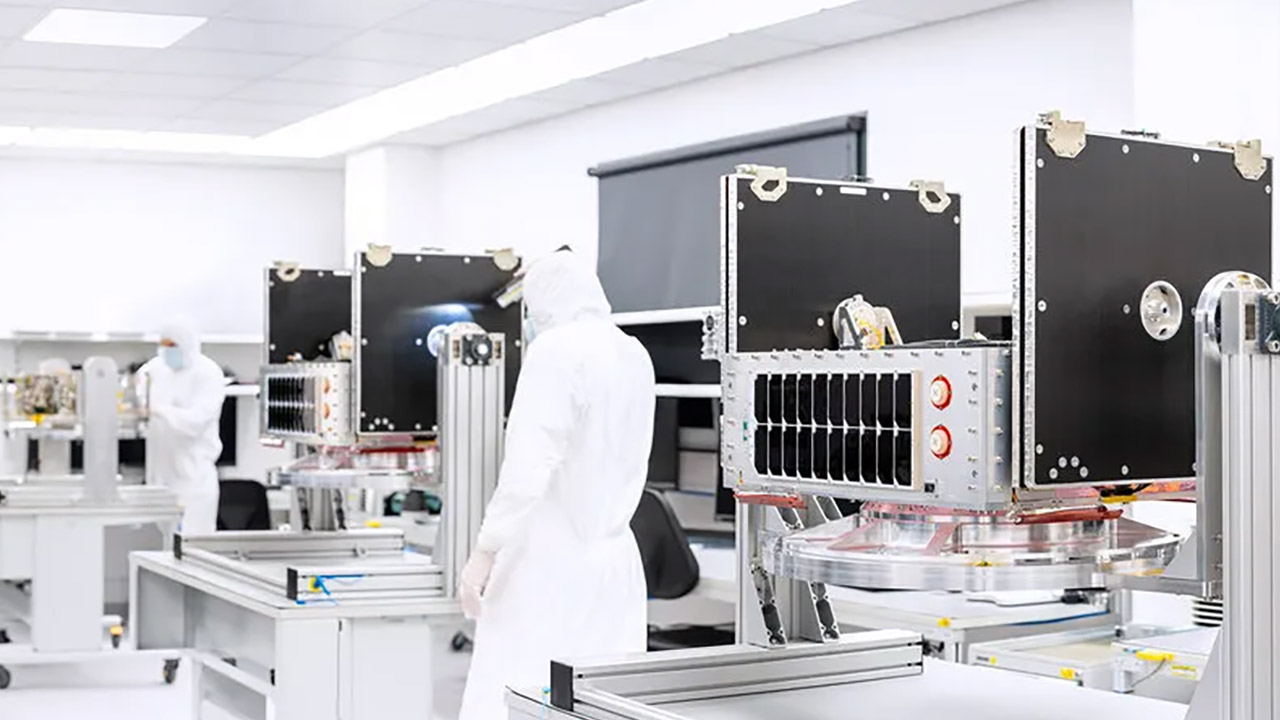
Kreios chose NanoAvionics’ tried-and-true MP42 microsatellite bus for its first orbital mission. Once the optical payload is installed, the entire spacecraft will weigh approximately 200 kg. NanoAvionics will modify the bus, integrate cameras that take photos in visible and near-infrared light with sub-meter resolution, test the entire system, and manage commissioning early in orbit. Once that’s completed, Kreios will take over day-to-day operations. The demonstration will begin higher up, about 300-350 kilometers, and gradually float downward while the thruster fires at various heights. The engineers will be collecting performance data, sampling the local atmosphere, and photographing the entire process.
The MP42, on the other hand, isn’t exactly meant for drag-free VLEO, so the demo will be finished in about six to ten months, which is just as well, because the actual aim here is simply getting this thruster up and operating so Kreios can refine their future platforms. Their long-term goal is to construct satellites that can operate for seven years or longer below 200 kilometers. [Source]
























































You must be logged in to post a comment Login