Voyager drone boats tracked smugglers before US Navy forces intercepted the shipment
Autonomous vessels helped seize cocaine worth more than $81 million offshore
Electric-powered drone boats can patrol continuously for more than 100 days
Unmanned surface vessels have helped the US Navy intercept a cocaine shipment worth more than $81 million in the Caribbean Sea.
Two Voyager drone boats, built by California-based Saildrone, tracked a vessel of interest before coordinating directly with naval forces stationed nearby.
This coordination allowed a Navy ship to move in, intercept the suspect craft, and seize its illegal cargo without delay.
Latest Videos FromTechRadar
Advertisement
Built for extended maritime patrols
The Voyager measures over 10 meters (33 feet) in length and runs on an electric motor rather than conventional fuel.
It can operate continuously for more than 100 days before returning to port for maintenance work.
Saildrone describes the vessel as a high-capacity platform supporting advanced sensor integration across a wide range of maritime surveillance missions.
According to the company, Voyager remains the only unmanned surface vessel maintaining continuous operations with the Navy’s Fourth Fleet.
Sign up to the TechRadar Pro newsletter to get all the top news, opinion, features and guidance your business needs to succeed!
This fleet oversees the Caribbean along with sections of the Atlantic and Pacific near Central and South America.
Advertisement
Unlike a typical budget drone built for hobbyist use, this system is a purpose-built military asset designed for sustained, long-range ocean surveillance.
A growing role for autonomous systems
Saildrone argues that the recent seizure shows how autonomous vessels can support real operational missions rather than remaining limited to experimental demonstrations.
“The continuity of Saildrone’s presence along the southern border for nearly three years demonstrates the strategic value we bring as the world’s most experienced operators of unmanned surface vehicles,” said John Mustin, president of Saildrone.
“Our unmatched ability to remain on station and on mission in critical regions for months at a time is why our fleet serves as a powerful deterrent to bad actors.”
The company expects continued cooperation with the Navy as maritime security efforts extend across the country’s southern approaches and border regions.
It describes the Voyager as a high-capacity platform capable of supporting numerous surveillance sensors while maintaining long endurance without requiring frequent maintenance or logistical support.
Advertisement
The US Navy previously awarded Saildrone a task order worth $16.3 million to expand Voyager operations across the Caribbean and the Eastern Pacific region.
That contract specifically supports efforts to combat drug trafficking alongside other illicit activity occurring across international waters.
Whether autonomous drone boats can consistently replace crewed vessels for high-risk interdiction work still remains an open question for naval planners.
However, the technology clearly reduces risk to personnel by allowing unmanned surface vessels to do the hard job before a US Navy ship swoops in.
Advertisement
What started as something closer to a beginner drone concept for coastal monitoring has evolved into a sophisticated tool for international drug enforcement.
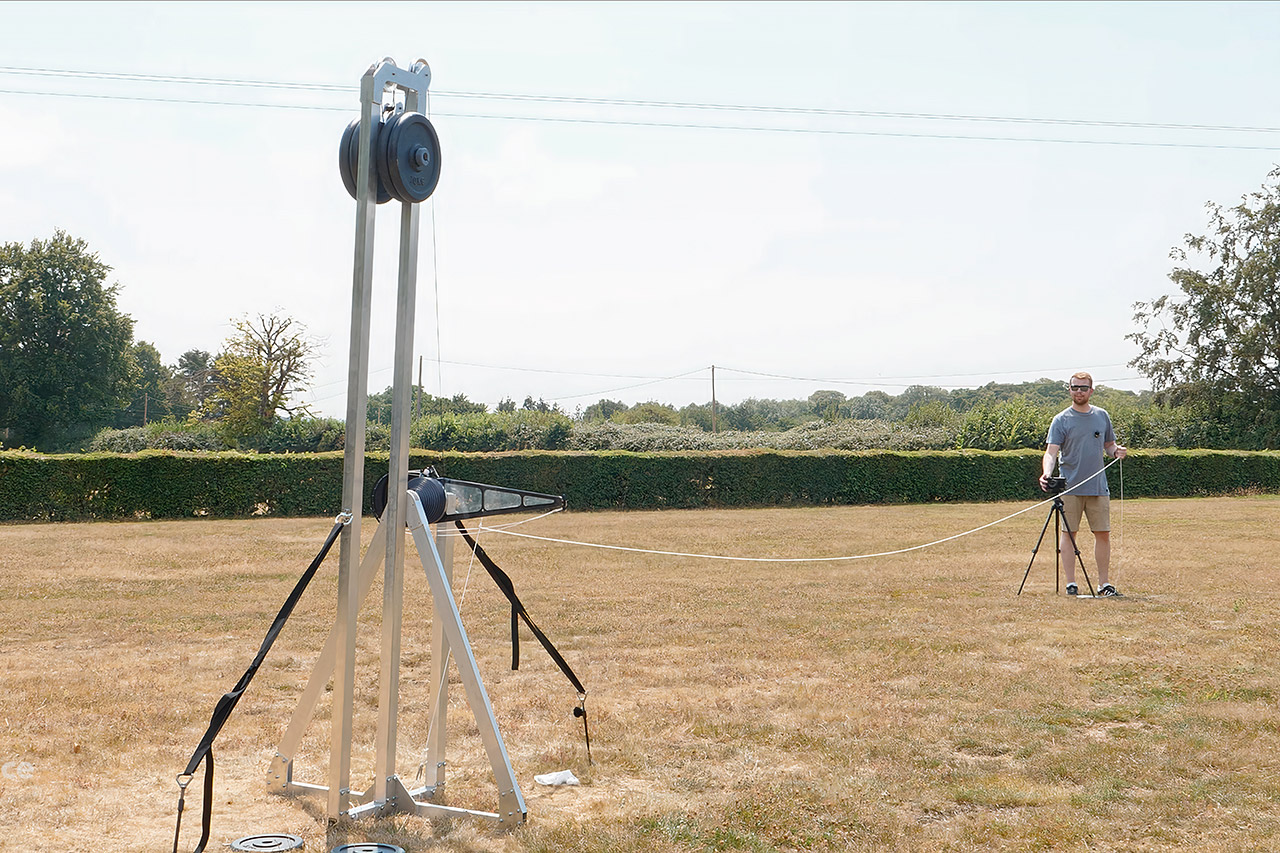
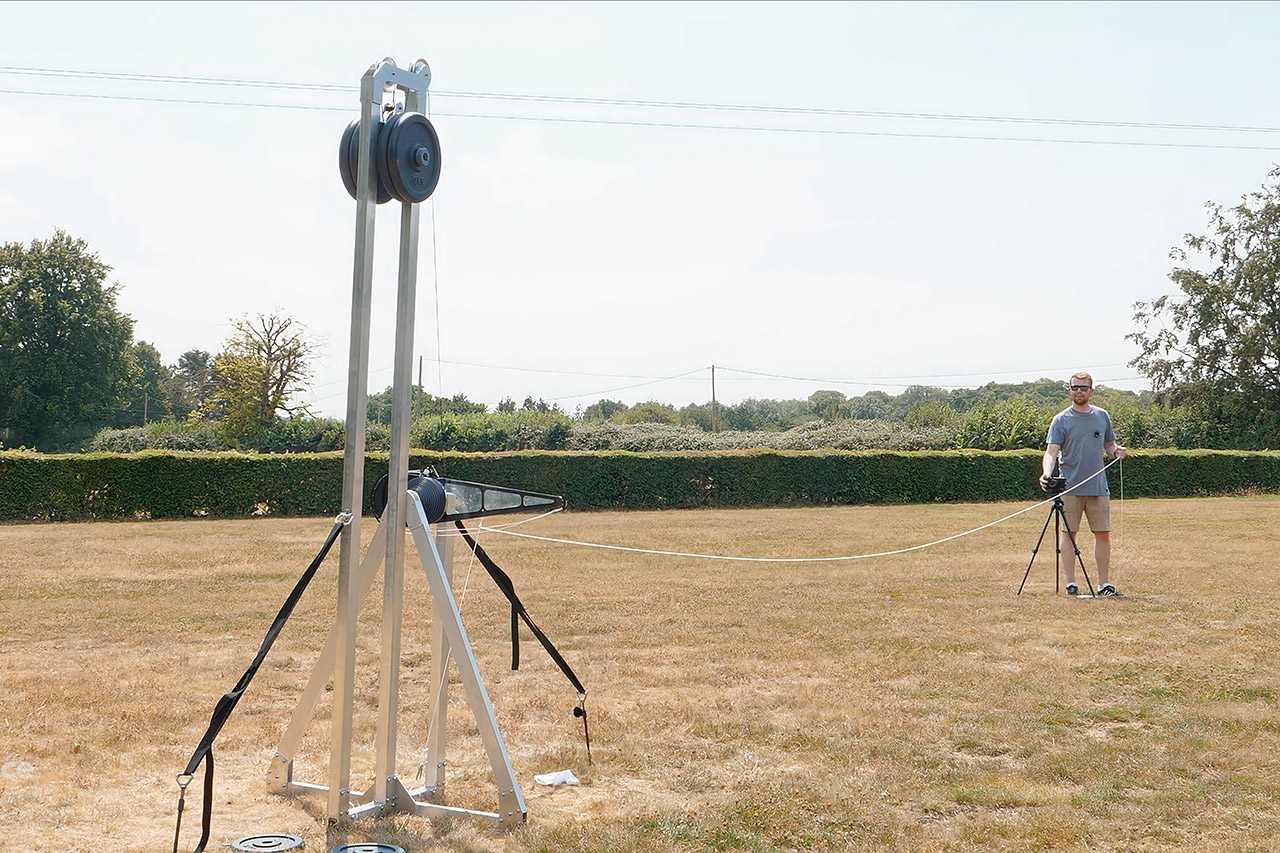
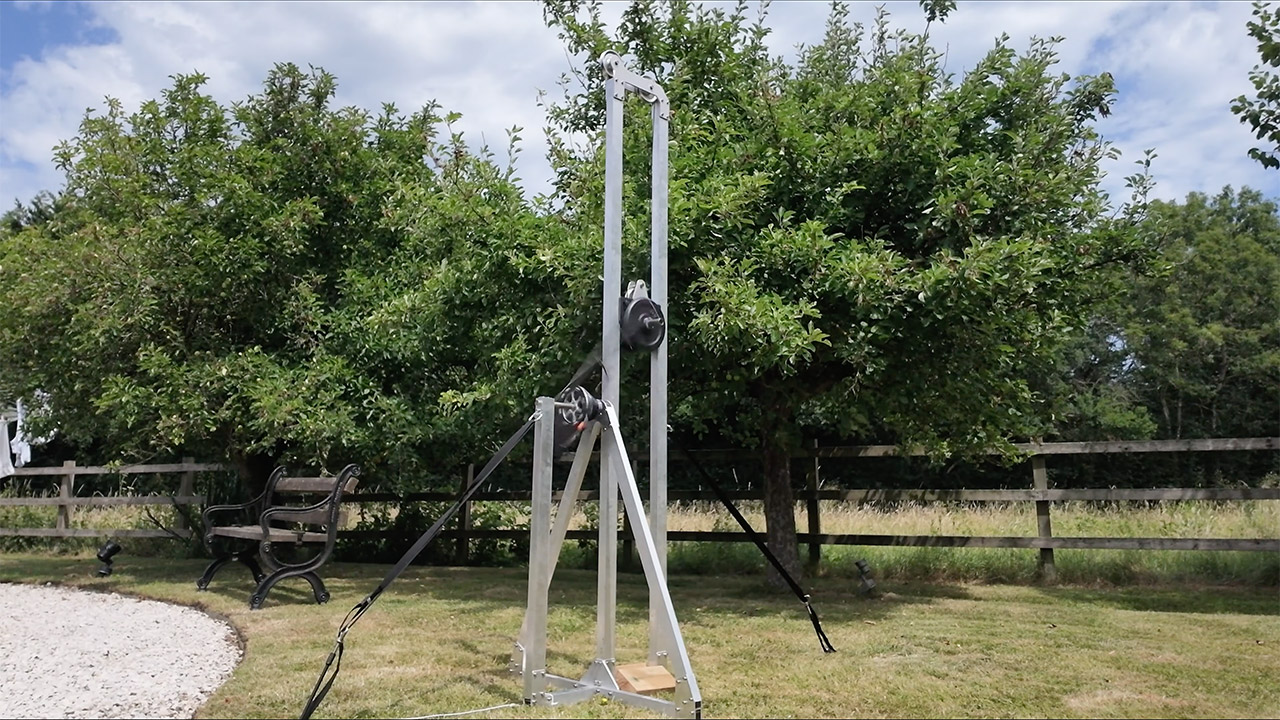
Tom Stanton has spent years chasing a number that gravity itself seemed to forbid. On a quiet field somewhere in the UK, a 40-kilogram mass dropped a short distance, spun a carbon-fiber arm past 2,300 revolutions per minute, and sent a 4-gram projectile into the air at 776 miles per hour. That is nine miles per hour past the speed of sound. For the first time, a purely gravity-powered trebuchet crossed the barrier.
Medieval engineers created these machines to fling huge stones at castle walls. The basic idea is to hoist a large heavy weight, let it fall down, and then use the lever and sling to redirect that energy into a much lighter projectile. Unfortunately, physics gets in the way. A weight in free fall accelerates at a maximum of 9.81 meters per second squared; drop one from 2 meters and it smacks into the ground at around 6 meters per second. No matter how heavy you make the weight, the speed remains constant, and a typical arm is like a car with a bike chain stuck in first gear, with lots of torque at first but just enough to get it moving by the end.
Stanton devised a creative engineering solution to the speed problem. The counterweight is suspended from a pulley system with a 3:1 ratio, as a large diameter at the beginning propels the arm with plenty of force, and as it winds down, the smaller diameter end provides a significant jump in rotational speed. In the end, the drum was redesigned so that weight could be lifted up to 1.9 meters, storing more power in the system than previous iterations.
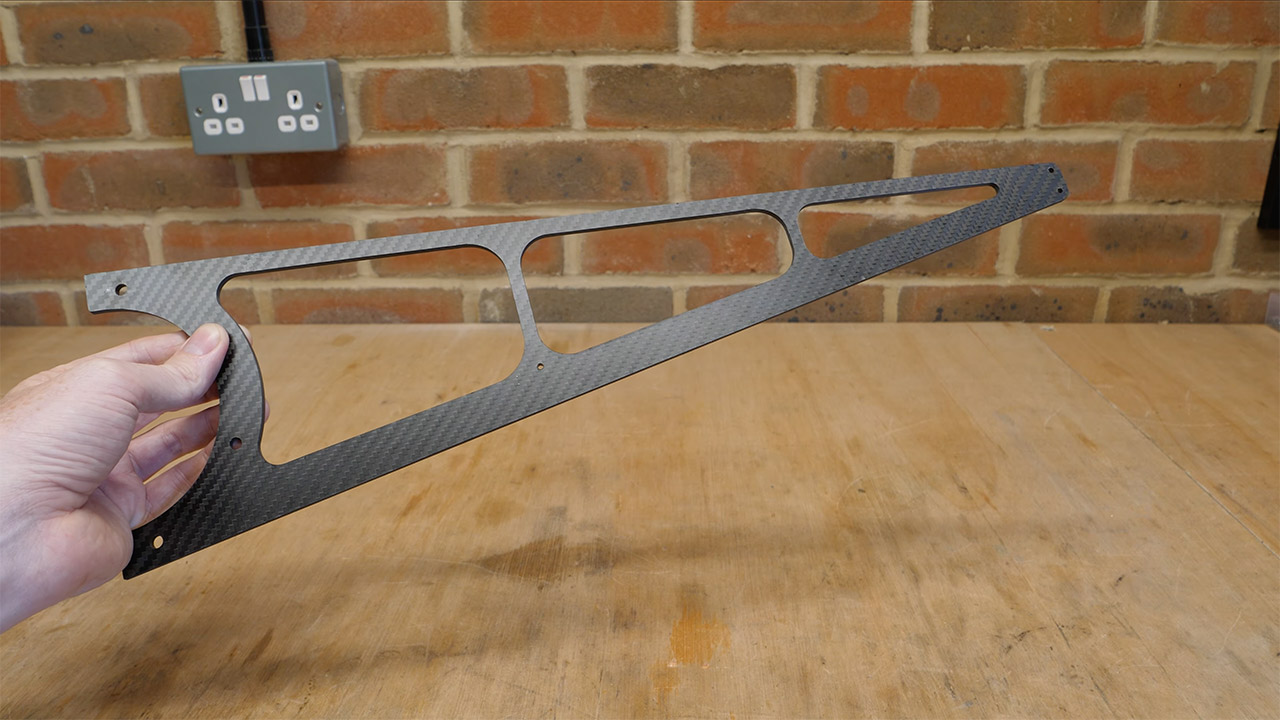
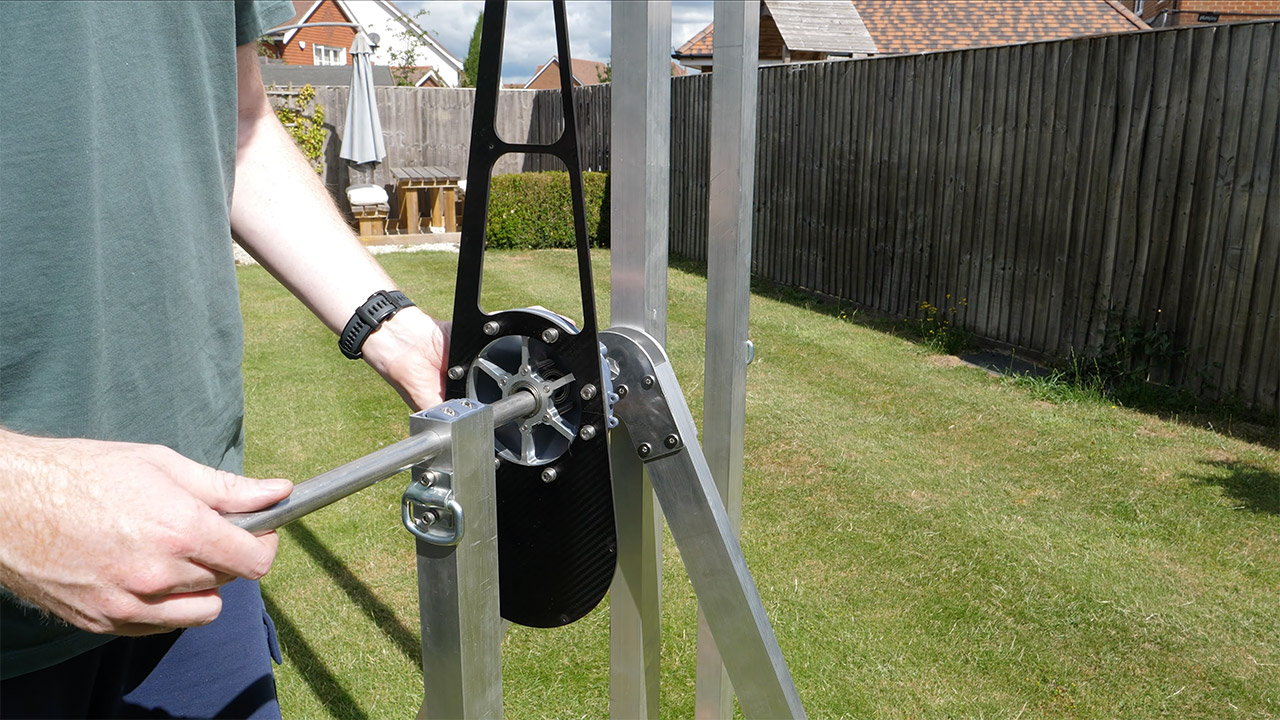
The arm has to be both incredibly light and super rigid. Carbon fiber was really the only option because it isn’t heavy enough to weigh down the entire system while yet being able to withstand punishment. Stanton used his homemade CNC mill to carve the piece, keeping the dust under control with a HEPA vacuum and a good spray of water. It weighs only 116 grams. Stress tests and numerous defective 3D printed prototypes revealed that it would buckle under the sling’s pressure, so he modified the design to compensate, removed material from the tensioned side, toughened up the opposite side, and added some extra bracing for good measure. Aluminum hubs connect the arm to a short counter-arm, keeping the spinning bit as balanced as possible.
The projectile now starts near the axle, wrapped firmly in a sling that unwraps at just the right moment. The entire system is mechanically released, using a spring-loaded catch that opens after a certain number of rope rotations. The release window is only a few milliseconds long, which is plenty of time to complete the task. Early iterations failed under stress, but the final pin-and-loop structure held up.
Testing was carefully increased, and he began with a 10 kg weight. The modified aerodynamic arm reached a respectable 1248 rpm and launched at 394 mph with an incredible 43.7% efficiency. Twenty and thirty kilograms passed thru without a hitch. 40 kg, on the other hand, sped the arm to 2336 rpm and the missile to a blistering 716 mph, falling only 51 mph short of the magic barrier. The machine eventually snapped, and the clasp shattered beneath the weight of 50 kg. Stanton reduced the projectile weight to approximately 4 grams, changed the drum taper once more, and returned to the test area with the 40 kilogram setup.
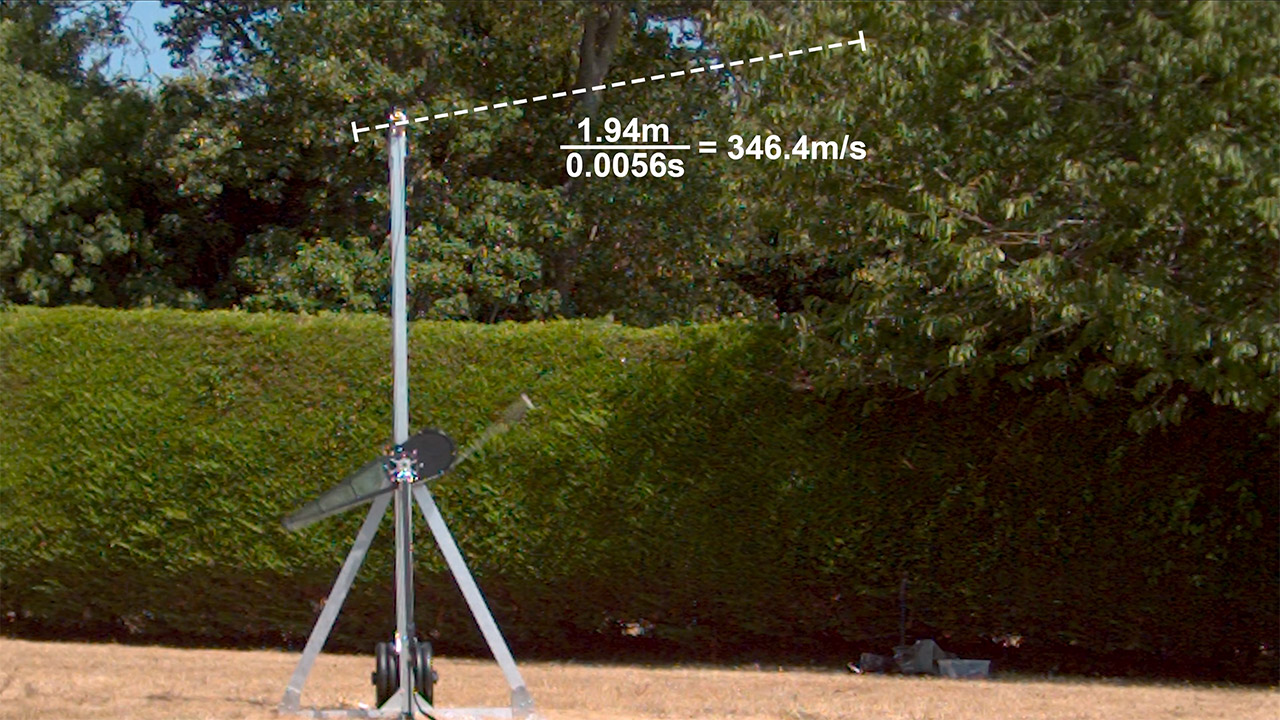
The final test is obviously the most important, since the arm spun up to 2342 rpm. Tip speed reached a staggering 274 mph. The high-speed footage was truly eye-opening, as the missile traveled 1.94 meters in 5.6 milliseconds. Crunching those statistics yields 346.4 meters per second, or a more than respectable 776 mph. To top it all off, there was a loud crack followed by a pleasant echo, confirming the sonic boom to everyone within earshot. Not one aspect of the machine came close to failing, or so we’d like to think.
We spend hours testing every product or service we review, so you can be sure you’re buying the best. Find out more about how we test.
Xiaomi Sound Play review
It turns out that major mobile manufacturer Xiaomi also makes Bluetooth speakers, and its latest model, the Xiaomi Sound Play, is aiming to deliver “immersive, powerful sound” as well as a “stylish and versatile” design.
But that’s not all. The tech giant is doing all of this while keeping its speaker nice and cheap. It comes in at just £49.90 (about $67 / AU$95) — which is refreshingly affordable for an 18W model with features such as smart lighting, Auracast, and IP68 waterproofing.
Advertisement
So can the Xiaomi Sound Play compete with some of the very best Bluetooth speakers around? The answer is a little more complicated than a simple yes or no.
Latest Videos FromTechRadar
Let’s start by looking at the areas in which the Sound Play excels, and there are a fair few of these. I alluded to some a moment ago — its waterproofing and LED lights, for example. That IP68 rating means that the speaker is fully dustproof, but can also survive a dunking under a meter and a half of water for as long as 30 minutes, so you really can take it anywhere without fear of damage.
Advertisement
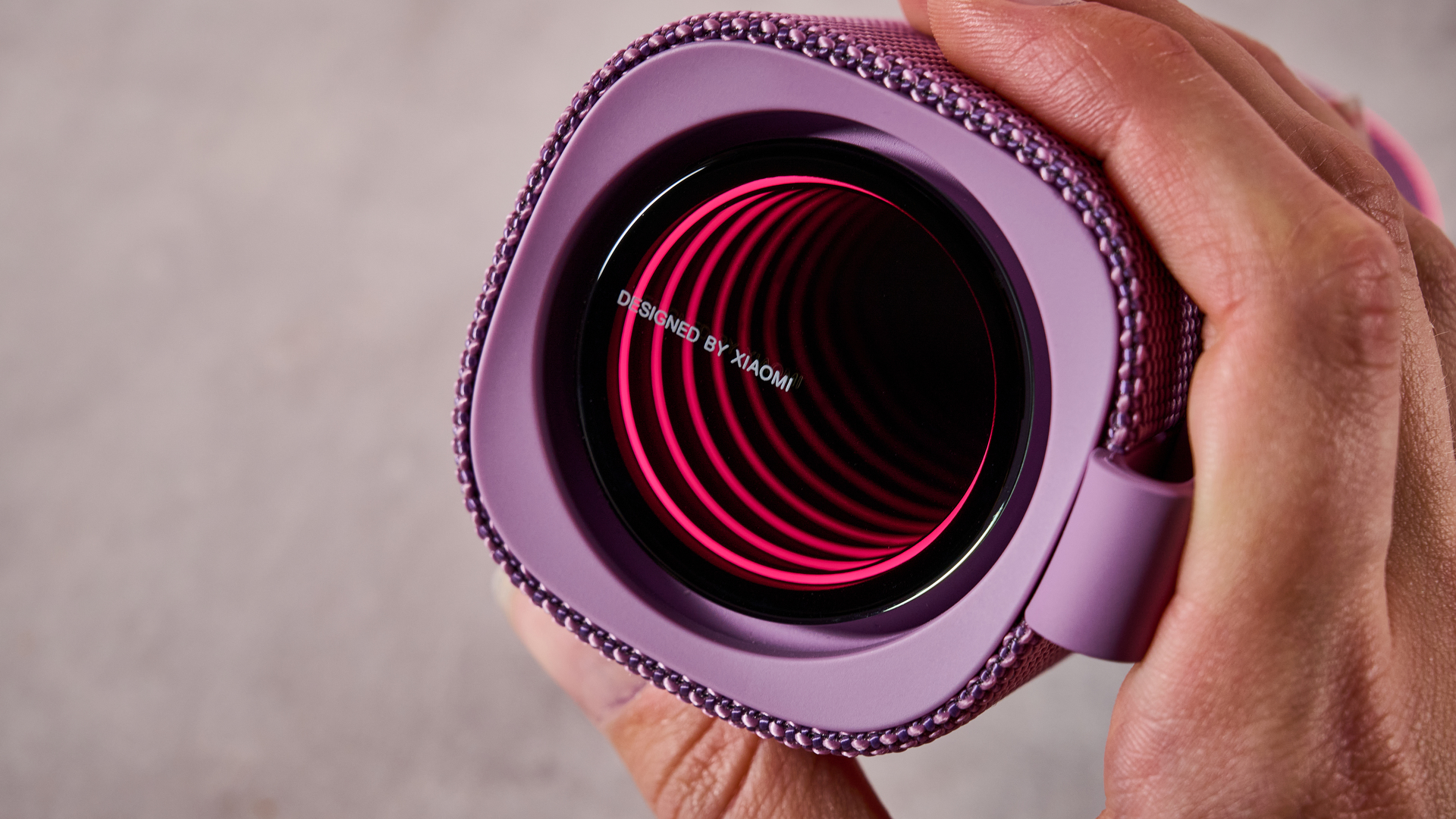
The lighting — a key selling point of this speaker — is pretty neat too. Lights sit on the base of the speaker and beneath a panel on the top side, which resembles an infinity mirror. And the rings of lighting really help to make your listening sessions more immersive, especially in lower-lit conditions. You can customize the color and pattern of the lights too, and one setting also syncs up to bass output. That level of customizability is spectacular to see on a speaker in this price category.
More generally, I’m quite a big fan of how the Sound Play looks. It comes in four very stylish colors — the Purple variant I tried is quite the looker, as is the Green version. It is reminiscent of the JBL Flip 7 in terms of look and feel, with a neat fabric exterior and psuedo-cylindrical build. The inclusion of the infinity mirror light and handy rubber strap also make it a real stand-out, looks wise.
Another welcome inclusion is a built-in mic, for speakerphone duties. This is something you don’t often see these days and it does add value, on paper. However, I made a phone call and although my voice sounded clear on the other end, I noticed a high-pitched chime whenever the other person wasn’t speaking. It wasn’t a dealbreaker (my discussion was still easy to navigate), but it’s my job to notice these things.
Sign up for breaking news, reviews, opinion, top tech deals, and more.
Advertisement
Other highlights include a JBL Grip-rivalling 14-hour battery life — which is excellent for a speaker of this size — as well as Bluetooth 6.0 connectivity, and true wireless stereo playback for anyone with multiple Sound Play models at their disposal.
Something that the Sound Play omits, however, is companion app support. For me, this is a bigger miss — an app could’ve opened up EQ adjustment, remote light alteration, and precise battery life tracking. The speaker’s nominal price doesn’t quite excuse this either. There are a number of budget-friendly rivals from the likes of Earfun, Edifier, and Tribit that do come with app support.
(Image credit: Future)
By now you must be wondering how Xiaomi’s speaker sounds. In honesty, it’s a bit of a mixed bag. It’s a steady performer in some areas, but in need of improvement in others.
Advertisement
In general, the Sound Play delivers fairly clear audio. In Yes I Know My Way by Pino Daniele, vocals had good presence in the mix, and even had a decent sense of separation from other instruments in the mid-range. OK, higher-pitched drums weren’t the most expressive or articulate, but they didn’t sound tinny at mid-volume, and bass was weighted relatively well too.
With more energetic tracks, such as Trip by Ruze, the cracks started to show. There was a slightly compressed quality to the track, and the pumping bass just didn’t come through with the command or depth of similarly sized rivals, including the JBL Grip, which I directly tested against the Sound Play.
During this comparison, the Grip just delivered a more fun performance, with enhanced directionality and low-end punch. But that’s not to say Xiaomi’s speaker was blown out of the water — it still held its own with commendable clarity in the mid-range and fairly agile bass.
In House tracks, bass drops didn’t always have the impact or dynamism I was listening out for, and vibrant drums could occasionally sound on the blunt side. But then again, the Xiaomi didn’t succumb to a boomy, super-muddy sound that a lot of its budget rivals do — it puts up a fairly controlled performance overall.
Advertisement
As a smaller speaker, the Sound Play can’t get super loud, and bass will thin out substantially at top volume levels. It also won’t deliver the most detailed or open sound ever — again, I found a few tracks sounded a little compressed and narrow, which isn’t helped by the lack of higher-res codecs like LDAC or aptX.
(Image credit: Future)
All in all, I think the Sound Play sounds good enough for the price you pay. Sure, it’s not the most dynamic or revealing-sounding model on the market, but you get typically clear, decently balanced sound without having to shell out all too much cash.
So, looking at the Xiaomi Sound Play as a whole, would I consider it worth buying? Well that depends. If you’re on a tight budget, and you want a speaker for less than £50, then I think the Sound Play is an option worth considering. It doesn’t sound amazing, but it gets the job done, and I’m a big fan of its durable yet eye-catching design.
However, if you’ve got a little more money to play with, then I’d suggest picking up the JBL Flip 7. That model can produce truly seismic bass, incredibly clean audio, and has a top-class companion app to boot. The JBL Grip is another neat alternative, especially if you can grab it on sale.
Advertisement
(Image credit: Future)
Xiaomi Sound Play review: price & release date
Priced at £49.90 (about $67 / AU$95)
Launched in May 2026
Scheduled to release in Australia in August 2026
The Xiaomi Sound Play was launched in May 2026, at the same time as its recently released 17T series. The speaker is available for £49.90 (about $67 / AU$95) in the UK, although Xiaomi told me that there are no plans for a US release, and the speaker won’t be available in Australia until August 2026. It can be purchased in one of four colors — Black, Green, Purple, or White — via Xiaomi’s digital store.
Xiaomi Sound Play review: specs
Swipe to scroll horizontally
Weight
0.9lbs / 415g
Advertisement
Dimensions
2.5 x 2.7 x 7.9 inches / 63.4 x 69.5 x 201.1mm
Connectivity
Bluetooth 6.0
Advertisement
Battery life
14 hours
Speaker drivers
1x 18W full-range
Advertisement
Waterproofing
IP68
(Image credit: Future)
Should I buy the Xiaomi Sound Play?
Swipe to scroll horizontally
Attribute
Advertisement
Notes
Score
Features
Adjustable lighting, good battery life, but lack of app is a shame.
Advertisement
3.5/5
Performance
Decently balanced audio with clear vocals, but lacks the depth and dynamism of some rivals.
3.5/5
Advertisement
Design
Infinity mirror and lights look great, neat color options, well protected against the elements.
4.5/5
Value
Advertisement
Decent enough audio and great design at a very affordable price point.
4/5
Buy it if…
Advertisement
Don’t buy it if…
Xiaomi Sound Play review: also consider
Swipe to scroll horizontally
Header Cell – Column 0
Xiaomi Sound Play
Ultimate Ears Wonderboom 4
JBL Go 5
Advertisement
Price
£49.90 (about $67 / AU$95)
$99.99 / £89.99 / AU$149
$54.95 / £39.99 (about AU$75)
Advertisement
Weight
0.9lbs / 415g
0.9lbs / 420g
0.5lbs / 230g
Advertisement
Dimensions
2.5 x 2.7 x 7.9 inches / 63.4 x 69.5 x 201.1mm
4.1 x 3.8 x 3.8 inches / 104 x 95.3 x 95.3mm
4 x 3.1 x 1.7 inches / 101 x 77.4 x 43mm
Advertisement
Connectivity
Bluetooth 6.0
Bluetooth 5.2
Bluetooth 6.0, USB-C
Advertisement
Battery life
14 hours
14 hours
10 hours (with PlayTime Boost)
Advertisement
Speaker drivers
1x 18W full-range
2 x 40mm active drivers, 2 x 46.1×65.2mm passive radiators
1x 45mm full range
Advertisement
Waterproofing
IP68
IP67
IP68
Advertisement
How I tested the Xiaomi Sound Play
(Image credit: Future)
I spent multiple days testing
Mainly streamed tunes via Tidal
Reviewed by someone who’s tested more than 50 Bluetooth speakers
I spent multiple days testing out the Xiaomi Sound Play, during which time I listened to countless tunes, exhausted its various features, and compared it against various rivals.
When listening to music I mainly streamed tracks over Tidal, but I dipped into Spotify from time to time as well. As always, I started out by sifting through the TechRadar reference playlist, which features songs from a wide variety of genres. I also listened to a ton of tunes from my personal library as well, though.
More generally, I’ve spent years reviewing audio gear here at TechRadar, and have tested a whole lot of Bluetooth speakers — more than 50 in fact. I’ve tried out everything from pocket-sized audio companions like the Bose SoundLink Micro Gen 2 through to luxurious large-sized alternatives like the Marshall Bromley 750, as well as Xiaomi Sound Play rivals like the JBL Grip, so I know exactly what it takes for a speaker to stand out in this highly competitive market.
I’ve been a fan of Zoner Studio since first reviewing it in 2025 – it’s a fusion of Lightroom and Photoshop-style tools for photographers, with some compelling advantages over both.
My team recently re-reviewed the photo editing and organizing software, complete with its big summer updates roll-out, where it earned an even higher score for 2026 (read our Zoner Studio review).
I spoke to Zoner’s Thomas Urban to find out what’s new in this Windows-only photo editor, why the devs prefer meaningful features over flashy gimmicks, and how the software handles the messy realities of shooting.
Advertisement
Latest Videos FromTechRadar
Thomas Urban
Adobe has a near-monopoly on creative software. What is the elevator pitch to a photographer who is locked into the Lightroom/Photoshop ecosystem to try Zoner Studio?
Great point, they are a household name. If you want a single interface for all your editing, faster culling and RAW capabilities, not being stuck in a catalog while being able to work with local files if you’d like and all of this for a lower price, then you should try out Zoner Studio.
Advertisement
I hope with time, society as a whole, we make our way back to authentic things that matter
In your summer update, you intentionally avoided “flashy new features you’ll use once a year.” Why do you think so much of the industry is chasing AI gimmicks instead of fixing core editing speed?
Perhaps they think people will find these types of upgrades boring? Maybe the core issues are more difficult to address? And, some of these features like a completely revamped search engine, just aren’t visually that striking, for sure.
When you’ve taken thousands of photographs though and just want to get through the culling in a responsible and effective way with quality metadata and organisation, these less flashy things are going to save your time down the road and your mental state.
Advertisement
It seems the entire world now has the attention span of a few seconds and everyone is fighting for a fraction of your attention, god forbid your undivided attention. It may be that in order to actually present those important features, you need the flashy stuff to catch the attention first.
Sign up to the TechRadar Pro newsletter to get all the top news, opinion, features and guidance your business needs to succeed!
I hope with time, society as a whole, we make our way back to authentic things that matter, things that last and things we’re proud of because they’re done well.
Advertisement
Most suites force you to lock in your RAW edits before moving to layers. What’s the practical advantage of keeping a photographer’s entire pipeline inside a single workspace?
Photo editing should match that fun and complement this process instead of being a chore
Simplicity. We all started this whole photography thing because it was fun and gave us something we kept coming back to. Photo editing should match that and complement this process instead of being a chore.
We want photographers to have a proper partner to their camera and being able to do everything in a single UI just felt like the natural solution.
The fact that each photographer can stay in the same interface allows them to stay in the creative flow rather than worry about whether or not this particular photo is now good enough to move on to layers. That just seems counter to what we’re trying to do as photographers.
Advertisement
(Image credit: Future)
Cleaning sensor dust or portrait blemishes across a massive shoot is soul-crushing work. Where does your Smart Healing excel, and where do complex textures still force a photographer to step in manually?
Our tools are non-destructive and fast compared to our competition (which is a rare combination)
Our tools still require manual inputs as we don’t have automatic detection of dust or blemishes. Our tools however, are non-destructive and fast compared to our competition (which is a rare combination).
Source search is on the verge of being possible without the use of AI and they also allow for very complex retouching. Retouching is divided into individual layers, and individual strokes are separated on the layers.
Within strokes, the user can utilize entire strokes (some only allow circles) or subtract from them, brushes have all parameters and we have the best tablet pen integration on the market. It’s possible to customize and map out your parameters based on your pen pressure.
Advertisement
Again, I wanted to remind you of the non-destructive model because this combination is not common for most of these operations in other photo editors. Users have to go to bitmap editors like Ps or Affinity whereas with Zoner Studio, you don’t even have to leave the Develop module.
This makes it easy and there’s no need to make a complicated trip from one program to another while also considering the correct order of operations.
Manual keywording and file tagging is a major chore. How does your Search engine let someone instantly pull up shots without forcing them to build a rigid catalog first?
Our Catalog serves more as a cache. The photographer is not locked into Zoner Studio’s infrastructure
Yes, this is a core issue with many photo editors. To start, the difference between Zoner Studio and most of the competition is that you don’t need to create a Catalog as a blackbox per se but rather a Catalog built on market standard files or data that sits next to these common files.
Advertisement
Because of this, our Catalog serves more as a cache and does not contain unique data that the photographer could lose and is always “rebuildable” based on the data stored in those photos. Therefore, the photographer is not locked into Zoner Studio’s infrastructure.
We still rely on manual keywording and tagging (unfortunately, the program cannot replace manually entered data because it’s our interpretation of structures) and we’re also working robustly with names and the folder structure, which are an important part of manually entered data and are often ignored by other photo programs.
We also focus on working effectively with them and also with regards to the data that is inherently in the photos themselves. Then based on your knowledge of your data, you can effectively find a lot of things.
(Image credit: Future)
Advertisement
Automatically grouping and merging panoramas or focus stacks sounds great in theory. But how did you design the software to handle the messy reality of real-world shooting?
In our opinion, a large number of future disruptive technologies will be built on automatic stacking
For us, it’s not only good in theory but is great in practice. Of course, we can always improve but we have been optimizing the algorithms for several periods and are still working on them.
If the photographer uses the automatic camera functions like exposure and focus bracketing, and doesn’t make major mistakes when taking photos, we have an almost 100% hit rate.
Of course, it’s ideal to catch those deviations and we are very grateful to the user base for supplying us with samples. We’re really happy that in most cases it simply boils down to a shooting error. In our opinion, a large number of future disruptive technologies will be built on automatic stacking.
It’s necessary to realize that it’s not only about stacking panoramas and others that form a fraction of what a photographer processes but also continuous shots and generally similar images with which the user works as a whole and, for example, selects the best shot.
Advertisement
From turning burst sequences into time-lapses to simulating long exposures without an ND filter, what do you think are the most underrated creative tricks hidden in Zoner Studio?
Back to the basics; LUT’s. There are plenty of them on the internet and they are great for everyone.
They’ll be liked by the user who still can’t click and use sliders to achieve their desired results and by the user who has the ability to accurately utilize the entire RAW processing pipeline.
We aren’t exactly fans of the sort of “tricks” philosophy idea but if we had a choose an underrated function that can pull some serious weight, it would be the preview function in the Manager module that allows photographers to preview multiple images at once
The 2026 MotoGP season returns from its summer break as a fascinating riders’ championship battle resumes at Silverstone, the home of UK motorsport, for the British Grand Prix 2026.
Just 24 points separates the top five riders in the standings, with 2024 champion Jorge Martin (Aprilia Racing) leading SuperFile Trackhouse’s Ai Ogura by 14. However, the duo will be nervously looking over their shoulders after seven-time world champion Marc Marquez (Ducati Lenovo) roared back into contention with three wins in the past four grands prix having recovered from a fractured foot. He is only 18 points off the summit, while Martin’s Aprilia teammate Marco Bezzecchi is a further four adrift with Fabio Di Giannantonio of Pertamina Enduro VR46 Racing in fifth following a consistent first half of the season.
Bezzecchi has recent experience of success at Silverstone, taking the checkered flag in the 2025 race ahead of Johann Zarco and Marquez. The latter has historically struggled here, despite his incredible success over the years, managing just one British Grand Prix victory in his glittering career – and that was back in 2014. Meanwhile, his Ducati teammate and 2022 race winner Francesco Bagnaia is set to compete despite undergoing arm pump surgery during the four-week summer break, so it will be interesting to see how he fares in Northamptonshire.
Advertisement
So read on to find out how to watch the British Grand Prix 2026 MotoGP for free online and from anywhere in the world.
Can you watch British Grand Prix 2026 MotoGP for free?
Yes. ThreeNow in New Zealand has free-to-air coverage of every session, from first practice to qualifying and, of course, the race. The streaming service is showing all 22 races live across the 2026 season at no cost – you just need to create an account and away you go.
Free MotoGP coverage is also available from Servus On in Austria, RTBF in Belgium, and Canale 8 in Italy.
Advertisement
Traveling abroad right now? You can use a VPN to watch British Grand Prix 2026 MotoGP for free as if you were right at home.
Use a VPN to watch British Grand Prix 2026 MotoGP live streams
A VPN is handy piece of software that can make your device appear as if it’s back in your home country, so you can unlock your usual service. The best VPN right now? We recommend NordVPN – it does everything and comes with up to 75% off.
Advertisement
How to watch British Grand Prix 2026 MotoGP live streams in the US
In the US, live coverage of the British Grand Prix 2026 MotoGP will be on FS1, which is showing Saturday’s qualifying session and the race on Sunday.
If you don’t have the channel on cable, FS1 is available throughSling – specifically the Blue plan, which starts at $45.99/month. You can also access it viaYouTube TV (free trial),Fubo (free trial), andDirecTV.
Alternatively, you can live stream every race of the 2026 MotoGP season via Fox One, which costs $19.99/month after a3-day FREE trial.
Visiting the US coverage from New Zealand? UseNordVPN to watch free-to-air MotoGP coverage.
Advertisement
How to watch British Grand Prix 2026 MotoGP live streams in the UK
(Image credit: Other)
TNT Sports is showing the British Grand Prix 2026 MotoGP live in the UK.
TNT Sports is the exclusive rights holder of MotoGP in the UK, with coverage of every session at Silverstone live on TNT Sports 2.
You can add TNT Sports to your Sky, Virgin Media or EE TV package, or get anHBO Max plan that includes TNT Sports. Prices start at £25.99/month if you commit to a year.
Advertisement
If you’re out of the UK but still want to tune in, explorethe VPN route set out above, which will help you access your accounts from anywhere.
How to watch British Grand Prix 2026 MotoGP live streams in Australia
(Image credit: free)
MotoGP fans in Australia can watch the British Grand Prix 2026 live on ESPN via Foxtel (streamed viaFoxtel Now). Subscriptions start at AU$35/month for the Starter Plan.
The race can also be streamed through the excellent sports streaming platformKayo Sports (from AU$29.99/month for the Standard Plan, or your first month for $1 if you choose the Premium Plan, which costs AU$45.99/month thereafter).
Advertisement
Both ESPN via Foxtel and Kayo Sports are showing every single MotoGP race live during the 2026 season, so you won’t miss a lap.
Not in Australia right now? You can simply use a VPN likeNordVPN to watch all the action as if you were back home.
How to watch British Grand Prix 2026 MotoGP in Canada
(Image credit: Other)
In Canada, you can watch live coverage of the British Grand Prix 2026 MotoGP on Sportsnet.
Advertisement
Sportsnet is available to live stream via Sportsnet Plus, which starts at CA$29.99/month or CA$249.99/year. The platform is Canada’s leading sports network and will show all 22 grands prix during the 2026 MotoGP season.
If you’re traveling outside of Canada, you can make use of NordVPN to catch the action.
MotoGP 2026 Q&A
What is the MotoGP 2026 schedule?
MotoGP 2026 schedule
Advertisement
Sunday, March 1 Thai Grand Prix | Buriram International Circuit (Winner: Marco Bezzecchi – Aprilia Racing)
Sunday, March 22 Brazilian Grand Prix | Autodromo Internacional Ayrton Senna (Winner: Marco Bezzecchi – Aprilia Racing)
Sunday, March 29 US Grand Prix | Circuit of the Americas (Winner: Marco Bezzecchi – Aprilia Racing)
Sunday, April 26 Spanish Grand Priz | Circuito de Jerez (Winner: Alex Marquez – BK8 Gresini)
Advertisement
Sunday, May 10 French Grand Prix | Bugatti Circuit (Winner: Jorge Martin – Aprilia Racing)
Sunday, May 17 Catalan Grand Prix | Circuit de Barcelona-Catalunya (Winner: Fabio Di Giannantonio – Pertamina Enduro VR46)
Sunday, May 31 Italian Grand Prix | Autodromo Internazionale del Mugello (Winner: Marco Bezzecchi – Aprilia Racing)
Sunday, June 7 Hungarian Grand Prix | Balaton Park Circuit (Winner: Marc Marquez – Ducati Lenovo)
Advertisement
Sunday, June 21 Czech Grand Prix | Brno Circuit (Winner: Marc Marquez – Ducati Lenovo)
Sunday, June 28 Dutch TT | TT Circuit Assen (Winner: Ai Ogura – SuperFile Trackhouse)
Sunday, July 12 German Grand Prix | Sachsenring (Winner: Marc Marquez – Ducati Lenovo)
Sunday, August 9 British Grand Prix | Silverstone
Advertisement
Sunday, August 30 Aragon Grand Prix | Circuito de Alcañiz
Sunday, September 13 San Marino and Rimini Riviera Grand Prix | Misano World Circuit Marco Simoncelli
Sunday, September 20 Austrian Grand Prix | Red Bull Ring
Sunday, October 4 Japanese Grand Prix | Mobility Resort Motegi
Advertisement
Sunday, October 11 Indonesian Grand Prix | Mandalika International Street Circuit
Sunday, October 25 Australian Grand Prix | Phillip Island Grand Prix Circuit
Sunday, November 1 Malaysian Grand Prix | Sepang International Circuit
Sunday, November 8 Qatari Grand Prix | Lusail International Circuit
Advertisement
Sunday, November 22 Portuguese Grand Prix | Portimão Circuit
Sunday, November 29 Valencian Community Grand Prix | Circuit Ricardo Tormo
What are the MotoGP 2026 Riders’ Championship standings? (top 10 only)
Riders’ Championship standings
Jorge Martin (Aprilia Racing) – 208 points
Ai Ogura (SuperFile Trackhouse) – 194
Marc Marquez (Ducati Lenovo) – 190
Marco Bezzecchi (Aprilia Racing) – 186
Fabio Di Giannantonio (Pertamina Enduro VR46) – 184
Raul Fernandez (SuperFile Trackhouse) – 159
Pedro Acosta (Red Bull KTM Factory) – 148
Francesco Bagnaia (Ducati Lenovo) – 143
Alex Marquez (BK8 Gresini) – 87
Luca Marini (Honda HRC Castrol) – 79
What are the MotoGP 2026 Teams’ Championship standings?
Teams’ Championship standings
Aprilia Racing – 394 points
SuperFile Trackhouse – 353
Ducati Lenovo – 333
Pertamina Enduro VR46 – 230
Red Bull KTM Factory – 212
BK8 Gresini – 172
Honda HRC Castrol – 105
Red Bull KTM Tech3 – 86
Castrol Honda LCR – 82
Monster Energy Yamaha – 76
Prima Pramac Yamaha – 31
Who are the MotoGP 2026 riders?
MotoGP riders
Aprilia Racing Marco Bezzecchi Jorge Martin Lorenzo Savadori
Castrol Honda LCR Johann Zarco Cal Crutchlow Diogo Moreira
Ducati Lenovo Francesco Bagnaia Marc Márquez
Honda HRC Castrol Luca Marini Joan Mir
Advertisement
Monster Energy Yamaha Fabio Quartararo Alex Rins Augusto Fernandez
Pertamina Enduro VR46 Franco Morbidelli Fabio Di Giannantonio
Prima Pramac Yamaha Toprak Razgatlioglu Jack Miller
Red Bull KTM Factory Brad Binder Pedro Acosta
Advertisement
Red Bull KTM Tech3 Maverick Vinales Jonas Folger Enea Bastianini
SuperFile Trackhouse Raul Fernandez Ai Ogura
We test and review VPN services in the context of legal recreational uses. For example: 1. Accessing a service from another country (subject to the terms and conditions of that service). 2. Protecting your online security and strengthening your online privacy when abroad. We do not support or condone the illegal or malicious use of VPN services. Consuming pirated content that is paid-for is neither endorsed nor approved by Future Publishing.
The humble flash drive has come a long way over the years, yet there’s no shortage of internet experts telling you to stop using them, or that there’s no need for them anymore. You’ve been told to throw them out and stop buying them; you’ve been told they’re obsolete, or have gone extinct. If that old story sounds familiar, it’s because it is — the same things were said about CDs and vinyl records. Neither of those formats ever died. Vinyl has been enjoying increased sales since 2008 and hit $1 billion in sales for the first time in history in 2025. CDs and other physical formats, despite never leaving, are also part of a bigger shift back towards physical media. There are still a surprising number of new cars that offer CD players.
I bring this up because it’s a recognizable pattern in technology — a new format will supersede and displace the last. CDs displaced vinyl, MP3s took over after CDs, and streaming now dominates everything. You can trace the same pattern throughout the history of computer storage, from magnetic tape all the way to cloud storage. While older USB flash drives have declined in use in favor of portable SSDs or cloud storage, flash-based storage has not disappeared. And just because you have some older flash drives lying around, that doesn’t mean they’re not worth using — unless they’re very old, to the tune of USB 1.x or USB 2.0, in which case you should probably opt for newer ones.
Despite being overshadowed by the cloud, Wi-Fi 6E/7, and wireless file sharing like AirDrop or Quick Share, flash drives refuse to die. That’s because certain use cases still make them worth using in 2026, and they still tend to be more portable than external SSDs.
Advertisement
Flash drives are dead; long live flash drives
Adrian Plitzco/Getty Images
The term flash drive in 2026 is murky; in the days of yore, before the advent of consumer SSDs, a flash drive only meant one thing, and that was the little thumb drive with an exposed USB-A connector. Nowadays, anything that uses NAND flash can technically be considered flash storage, although “USB flash drive” still usually refers to a small removable USB device. Just as HDDs have faded in use in favor of SSDs but still have their place, the same is true of flash drives.
In a world where everything is cloud-connected, powered by data centers, and requires user accounts, flash drives are the opposite — you plug them in, and they work. This makes them immune to the increasingly disruptive internet and cloud-service outages that can take down chunks of the web and the services that rely on it. Sometimes, simple is better. They are also reliable for large file transfers or one-time file transfers, especially in cases where internet service is slow or unreliable. Flash drives now come with USB 3.2 Gen 2 interfaces; certain flash drives can approach read-write speeds of 1,000 MB/s, which is several times faster than older USB 2.0 and 3.0 drives.
Advertisement
There is also the aspect of physical possession of local data, meaning the data isn’t sitting on a server where third parties have access to it. That data can also be shared or printed without having to upload or email it somewhere. USB drives are still handy for bootable OS media, so you can reformat and install an OS without an internet connection. You can also use USB drives for portable apps that you can use across different computers, without having to install them.
Advertisement
The line between flash drives and SSDs is becoming blurred
Igorbondarenko/Getty Images
It needs to be said that in some cases, there is very little separating a flash drive from an external SSD — some flash drives are SSDs in all but name and form. In fact, there are a growing number of SSDs that are coming in the thumb drive form factor. Products like Adata SC750 and SK Hynix Tube T31 are actually SSDs that are roughly in the form of a USB stick. Many USB 3.2 Gen 2 flash drives now come in USB-C, but the presence of USB-C doesn’t necessarily mean it’s an SSD housed in a thumb drive. You can check out our picks for USB-C flash drives that are fast and worth the price.
The key differences that separate a flash drive from a proper SSD are usually the sophistication of the controller, the type and quality of flash used, and features like wear-leveling, which balances write activity across NAND cells and extends the drive’s longevity. Some SSDs also include DRAM cache. These are all things that a traditional USB thumb drive may not have or may implement in a much simpler form. With USB4 Version 2.0, we’re bound to see even more innovation in flash storage, but whether or not we can actually get USB4 Version 2.0 speeds in a flash drive remains to be seen.
RPCS3 is a multi-platform open-source Sony PlayStation 3 emulator and debugger written in C++ for Windows, Linux, macOS and FreeBSD. The purpose of the project is to completely and accurately emulate the Sony PlayStation 3 Computer Entertainment System in its entirety with the power of open-source community and reverse engineering.
Our goal is to preserve the legacy of the PlayStation 3 hardware and its vast library by bringing it and its exclusives to the PC platform. We want to achieve this by targeting and supporting multiple operating systems as well as being compatible with a wide range of computer hardware with realistic requirements.
What input devices can I use with RPCS3?
We currently support keyboard / mouse inputs and native DualShock 3, DualShock 4 and DualSense controllers. We plan to add additional input methods in the future as we implement more meaningful features to the emulator.
What PlayStation 3 peripherals can I use with RPCS3?
We currently have support for the PlayStation Eye Camera, however PlayStation 3 Move controller support is still under development.
Can I just insert a PlayStation 3 game disc and start playing games?
In its current state, RPCS3 does not support reading game data directly from PlayStation 3 format discs. PlayStation 3 discs are formatted in a very special way that can only be read with an actual PlayStation 3 system, or a compatible Blu-ray drive from select manufacturers. For more information on what Blu-ray drives are capable of reading games, please refer to the Quickstart Guide.
Advertisement
Where do I get PlayStation 3 games and software?
Typically, you want to dump your own PlayStation 3 games and software from your own console. We believe that this is the most efficient and safest way to migrate your disc-based games and digital games from your console to your PC.
You can also dump games using select compatible Blu-ray drives. Not every Blu-ray drive will recognize PlayStation 3 games due to how data is formatted on the disc. For more information on what Blu-ray drives are capable of reading games, please refer to the Quickstart Guide.
RPCS3 uses the GNU General Public License Version 2 (June 1991). According to the license, you are welcome to use RPCS3 and its source code for any purpose, but distributing RPCS3 requires that the source code be released and attribution given. For more details on how the GNU General Public License system works, please refer to GNU.org
High Resolution Rendering
Advertisement
One of the most anticipated features has just been added to RPCS3! High resolution rendering allows users to play at resolutions far exceeding what the PS3 could handle. If you thought your favourite PS3 games were starting to look a bit dated, just wait until you get to experience them in up to 10k! Although, we doubt many users will have the setup necessary to benefit from 10k today, emulation is all about preserving for tomorrow.
Performance
Rendering a modern PC game in high resolutions such as 4k, while beautiful, is quite taxing on your hardware and there is often a massive hit in performance. However, since most of the workload for RPCS3 is on the CPU and GPU usage is low, there is a lot of untapped performance just waiting to be used. All processing is done CPU side, and as far as the GPU is concerned it is simply rendering 2006 era graphics (yes, the PS3 is 11 years old now). We’re happy to report that anyone with a dedicated graphics card that has Vulkan support can expect identical performance at 4k.
Anisotropic Filtering (AF)
Advertisement
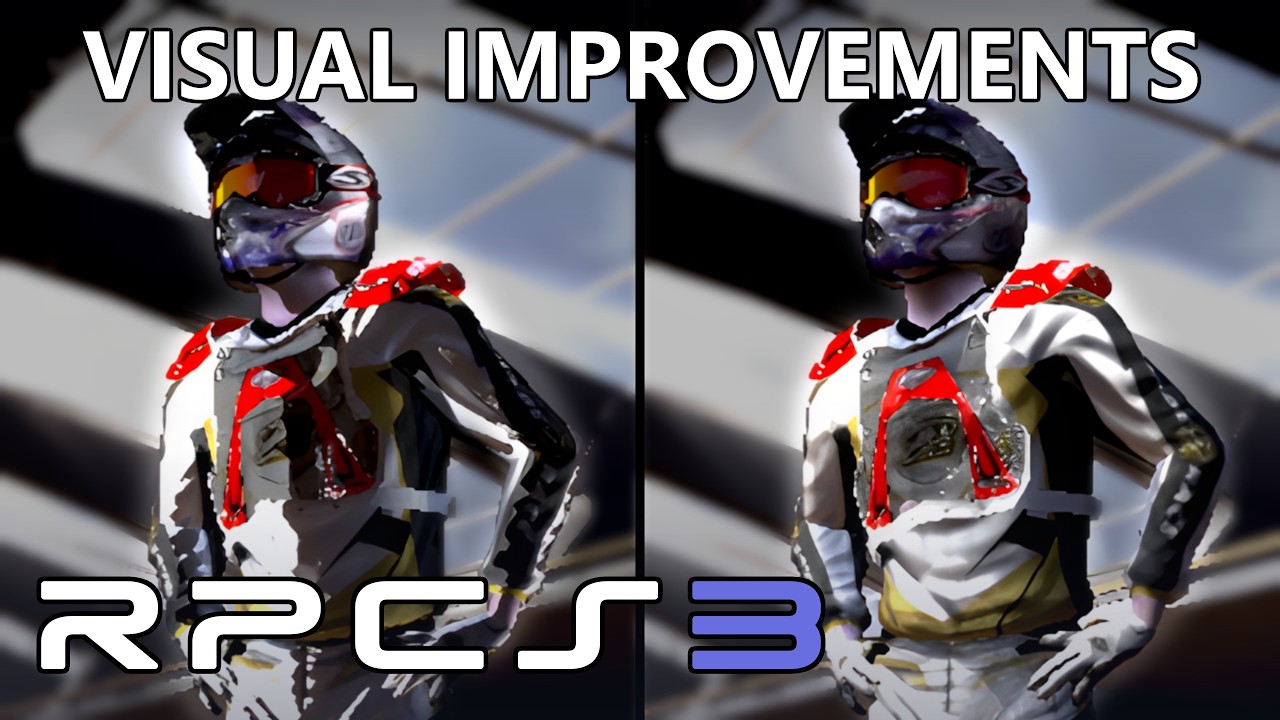
High resolution support wasn’t the only thing that was added in this update! Another reason for such a massive upgrade in visual fidelity is having full 16x AF support. This greatly improves how textures can look, especially when viewed at an angle. Take a look at the below screenshots of Ni no Kuni as an example of the default AF vs forced 16x. The difference is especially noticeable on the ground inside the gate.
A practical framework for securing every identity in the modern workforce, human or not.
Your organization already has a rigorous process for governing human identities. New employees go through onboarding. They get a role, a set of entitlements, and a named manager accountable for their access. When they leave, their credentials are revoked and access is terminated. It’s a well known IT process: every workforce identity that can access your systems needs to be known, scoped, and accountable from the moment they enter your world, to the moment they are off-boarded.
AI agents are now operating inside those same systems. They access Salesforce, create tickets in Jira, provision infrastructure, process financial transactions, and communicate on behalf of your teams. In every meaningful sense they are members of your workforce, except that in most organizations they were never onboarded, have no named owner, and have no offboarding process when their purpose expires.
Advertisement
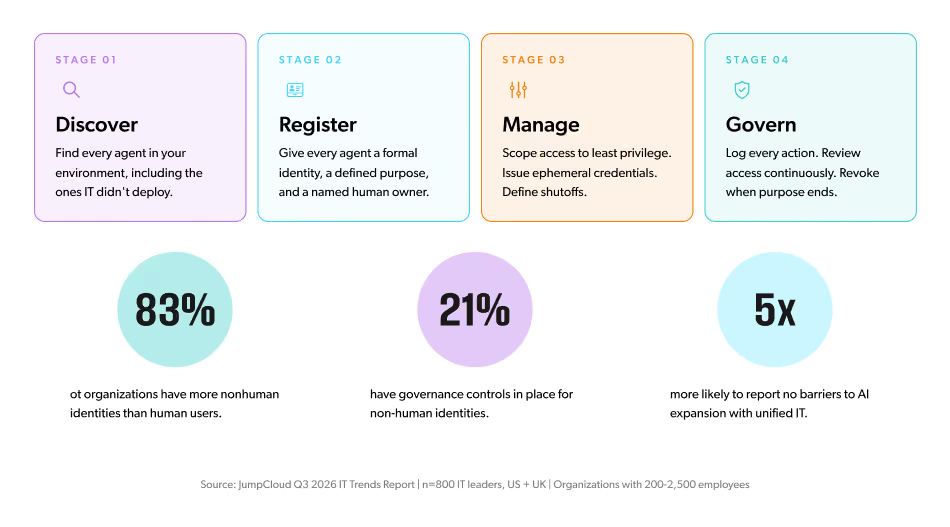
JumpCloud’s Q3 2026 research found that non-human identities now outnumber human users in 83% of organizations, and only 21% have implemented governance controls specifically for them. The framework below is designed to close that gap.
Stage 1: Discover every agent operating in your environment
Governance starts with an accurate inventory, and most organizations are working with an incomplete one. AI agents are being deployed by product teams, operations leaders, and individual contributors who have both the tools and the motivation to move fast. IT inherits the governance responsibility after the fact, often without knowing the full scope of what has been deployed.
Shadow AI is the practical consequence: agents operating across production environments with no formal record, no defined owner, and no systematic way to stop them if something goes wrong. Discovering your agent population is an ongoing practice, not a one-time audit. Build an inventory across every environment where agents could be running: cloud platforms, managed devices, SaaS integrations, and on-premise systems. For each agent, document what it can access, what workflows it influences, and what triggers its actions. That inventory is the foundation everything else in this framework depends on.
Stage 2: Register every agent as a formal identity with a named owner
Every agent that operates in your environment should exist as a formal identity in your directory, with the same basic attributes you assign to any employee: a defined purpose, a scope of authorized action, and a named human owner who is accountable for its behavior.
This is the architectural decision that separates organizations that can govern their agents from those that cannot. Agents registered as proper identities can be assigned entitlements, subjected to conditional access policies, and included in access reviews. Agents that exist only as service account workarounds or API keys in environment variables are ungovernable by any systematic means.
Advertisement
Registration is also the mechanism for addressing Zombie Agents: agents that outlived their original purpose but kept running, kept accessing systems, and kept accumulating permissions. When every agent has a named owner responsible for its renewal, agents without active ownership naturally lose their access when that ownership lapses. The offboarding happens as a consequence of process rather than as a reactive cleanup after something breaks.
Stage 3: Manage agent access with least privilege and zero standing credentials
Registered agents need access to do their jobs. The governing principle for that access is least privilege: each agent should have entitlements scoped precisely to what its defined purpose requires, with access that is time-bounded wherever possible and revocable immediately if the agent’s behavior changes.
Standing credentials in environment variables are a persistent liability. Static API keys that never rotate are a persistent liability. In practice, managing agent access securely means issuing just-in-time credentials for privileged operations, building approval workflows that require human sign-off before agents reach sensitive systems, and maintaining emergency shutdown mechanisms that work at the speed the situation requires.
For agents that need access to privileged web applications, SSH servers, or databases, credential shielding is an additional requirement: the agent should be able to complete its task without the underlying credentials ever being exposed to the model running it. Every privileged session should be recorded and available for audit.
Advertisement
Stage 4: Govern agent behavior continuously, not just at deployment
The first three stages establish the controls. Governance is what keeps them current. It is the ongoing practice of verifying that what agents are actually doing matches what they are authorized to do, and course-correcting when those diverge.
Every agent action should be logged. Access reviews should happen on a regular cadence, evaluating whether each agent’s entitlements remain appropriate for its current purpose. When an agent’s behavior deviates from its defined scope, the anomaly should be detectable before it becomes an incident. When an agent’s purpose ends, access revocation should be a procedural step, not a reactive measure triggered by something going wrong.
Governance also means maintaining the audit trail needed to answer accountability questions: what did this agent access, what actions did it take, who authorized it, and what was the outcome? Organizations that cannot reconstruct that chain for any given agent are not governing their agents in any meaningful sense. They have deployed them and hoped for the best.
The foundation underneath all four stages
Each stage of this framework becomes significantly harder to execute when the underlying IT environment is fragmented. Identity, access, device management, and security controls spread across disconnected systems create the gaps where agent governance falls through, and organizations end up applying different policies in different places rather than consistent governance everywhere.
Advertisement
JumpCloud’s research found that organizations operating in fully unified IT environments are five times more likely to deploy agents in business-critical workflows than those running fragmented stacks. Whether the control layer is coherent enough to apply consistent policies across humans, devices, and agents simultaneously is what determines whether governance scales with AI adoption or lags behind it.
This is the core premise of Agentic IAM: that governing humans, devices, and agents through a single coherent control layer is what makes the framework above executable at scale rather than aspirational.
Securing every identity, human or not, is the operational foundation that makes AI safe to scale. Organizations that build it now will not just reduce risk. They will expand AI into more workflows, move faster, and do it with the confidence that comes from knowing every identity in their environment is known, governed, and accountable.
JumpCloud’s Q3 2026 IT Trends Research report (n=800 IT leaders, US + UK) is available here. The Agentic IAM lifecycle framework referenced in this article was developed by JumpCloud and is available here.
Advertisement
Greg Keller is CTO and Co-founder at JumpCloud.
Sponsored articles are content produced by a company that is either paying for the post or has a business relationship with VentureBeat, and they’re always clearly marked. For more information, contact sales@venturebeat.com.
Website support widget lasted 18 months before Redmond ended the conversation
Microsoft is killing Live chat in Teams about 18 months after launch as it seeks to “focus investments on newer customer engagement and communication experiences.”
The service will be retired on October 5, when customer messages will stop reaching Teams. Microsoft blocked new setups on August 6 and told users to remove the widget from their websites before retirement. Any remaining instances will be hidden afterward.
Advertisement
Live chat was a relatively simple feature available with the Teams versions of Microsoft 365 Business Basic, Standard, and Premium. Companies embedded a chat widget on their websites, and messages from visitors were routed to a support team in Teams. Administrators could specify business hours and assign up to 25 users to handle conversations.
Existing customer data and Teams channels will remain available, but no new conversations, escalations, or interactions will be possible.
Microsoft pointed customers toward Dynamics 365 Contact Center with Live Chat and Copilot Studio’s contact center AI tools instead.
In March 2025, it was all going to be very different as Microsoft trumpeted the service’s arrival. Brenna Robinson, General Manager, Microsoft 365 & Copilot, Small and Medium Business, wrote: “Today we’re excited to take that customer experience to a new level with the introduction of live chat in Microsoft Teams – a faster and more engaging way for you to connect with your customers.”
Advertisement
Robinson has since become Microsoft’s General Manager for AI Business Solutions. Live chat, meanwhile, has been wheeled into the Raiders of the Lost Ark-style warehouse where Microsoft stores everything that once seemed like a good idea.
Microsoft has axed several Teams services over the last few months. In February, it announced the end of Teams live events, replaced by a Teams “events experience.” The Teams Together mode, which placed users in a virtual meeting space, was also ditched.
Live chat is another casualty of Microsoft’s efforts to tidy Teams’ unwieldy collection of features. The company has not elaborated on those “newer customer engagement and communication experiences,” although its recommendation of Copilot Studio means AI is already waiting in the wings. ®
OpenAI continues to churn out upgrades to its various GPT models, the latest GPT-5.6 promises to be more succinct and provide confident wrong answers less often. Here’s what’s new.
Apple and OpenAI have a relationship where ChatGPT is an extension for the previous version of Siri, though that could come to an end soon. The latest updates don’t affect users of that specific function, but the Mac utilities and iOS app will gain new features and performance.
Now, we’re going to have to sift through OpenAI’s anthropomorphized language of its chatbot models to understand exactly what’s being introduced here. The press release says a lot about “thinking” versus instant answers, but always remember: artificial intelligence can’t think, reason, understand, or sympathize.
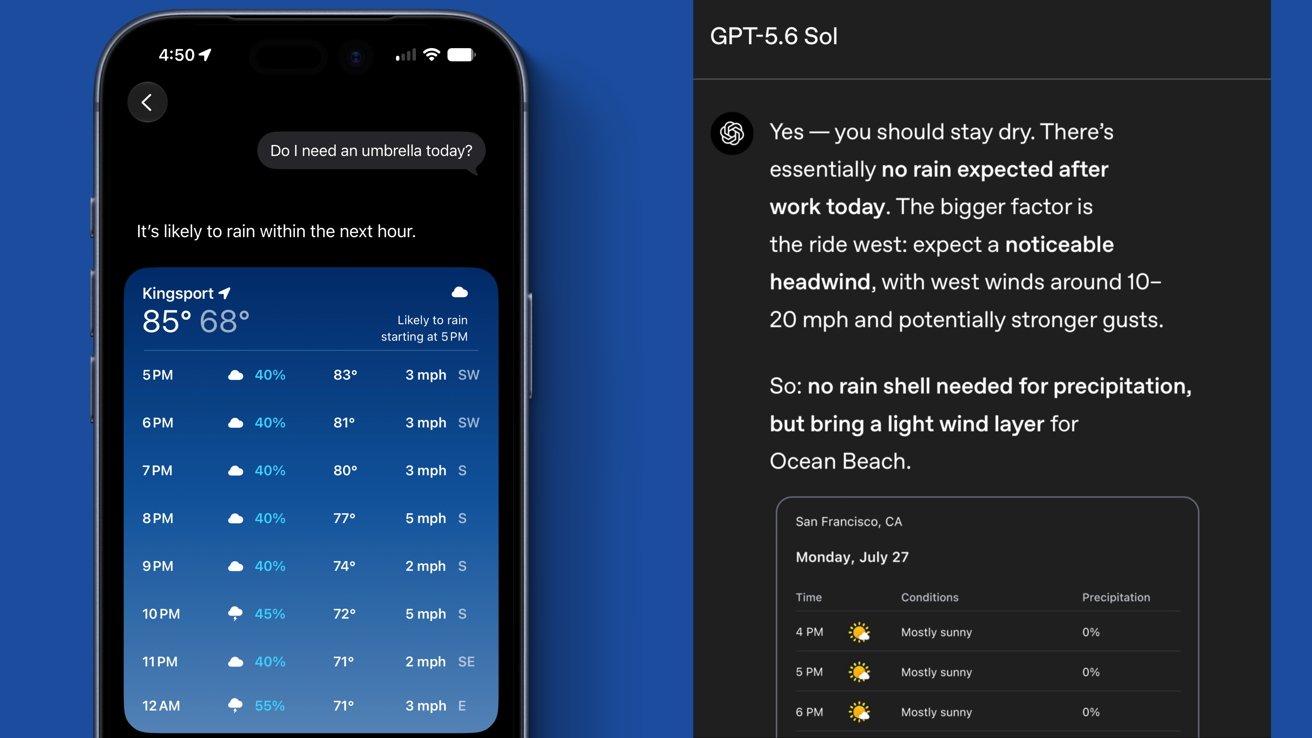
GPT-5.6 Sol appears to be a release hoping to address several concerns brought up by users of ChatGPT. They often complain it uses too many filler words, takes too long to get to the point, and provides affirming answers even when the user is wrong.
Advertisement
ChatGPT caveman
According to the release, GPT-5.6 Sol provides “more focused answers, adapts its level of detail to the question, avoids unnecessary formatting, and offers a helpful correction when simply agreeing wouldn’t be useful.” These problems have become so well known and bothersome users have turned to skills like “caveman” to force ChatGPT to be brief and direct.
SiriAI gets to the point, while OpenAI does shows some restraint
The example provided by OpenAI looks incredibly similar to what a user might see when using Siri AI. A brief summary of a weather result with a weather widget is shown instead of a wall of text padded with filler.
Incredibly, the release mentions “more reliable facts.” Hallucinations are a part of AI no matter how many guardrails are introduced, so it’ll be interesting to see if OpenAI has actually accomplished this in a meaningful way.
Advertisement
For example, Siri AI tends to avoid hallucinations by not summarizing content when possible. When you ask a question, the source is quoted and linked directly, which ensures random incorrect information isn’t inserted. Of course, that’s only if the answer is correct in the first place.
While AI tools can be used for research, AppleInsider strongly urges users to avoid any AI-generated content from appearing in a finished work. Lawyers, doctors, and financial advisors have encountered horrific problems when relying too heavily on AI to perform their work.
No amount of promises and fixes from OpenAI will create a foolproof AI tool.
A “Think” button
If you’ve used Siri AI, you might notice that the same question can sometimes produce very different results in terms of detail. That’s because on-device models are much smaller and seek an end result that is much less computationally expensive versus server-side models.
Advertisement
Apple and ChatGPT have similar ideas on how to approach AI chatbots
Apply that same idea to ChatGPT “Thinking” and Instant modes, and you’ll understand what’s happening. Previously, these two models would be so different that the answers would vary wildly in tone or style.
The names say what they do: Thinking takes longer with a heavier model while Instant is fast with a smaller model. There’s also a new “thought” slider.
This terrible naming convention is yet another attempt to humanize the chatbots, but basically, think of it as a compute slider. Lower means less compute, faster results, while higher means more compute, longer, more detailed results.
Advertisement
Obviously, OpenAI hopes users will change the slider for more simple queries that don’t need a lot of information resources. It’s computationally less expensive, uses less tokens on input, and likely means less tokens on output.
That’s likely going to be useful for private ChatGPT use, but corporate users never bother. Research shows that OpenAI’s most expensive ChatGPT users are in an office, choosing the most complex GPT version available, and doing so to convert a PDF into a slideshow.
It’s wasteful and expensive, especially for OpenAI, which is likely giving that compute time away at a bargain. Sliders would be helpful for the company that can’t turn a profit, but not if users just ignore them.
Free GPT
Free users are also getting an upgrade as everyone will default to GPT-5.6 Luna and gain a “Think” button for questions users believe are harder.
Advertisement
AI is a tool that is now easily found on your iPhone, which is a problem for OpenAI
Analyzing such an update can provide interesting insight into OpenAI. It’s priorities as a company providing AI to the masses while developing a HomePod that can wiggle is interesting. Especially given the Apple lawsuit.
One of the biggest reasons why OpenAI has such a large valuation is because it released a powerful technology and essentially gave it away for free. Like Spotify, the free use of this technology is draining the company and all that keeps them afloat are whales and investors.
The AI bubble is teetering on collapse, or is at least deflating, even as consumers tire of AI as a concept. It isn’t clear if OpenAI will find its footing before it runs out of cash sometime in 2028, or if everything comes crashing down around it.
Advertisement
As an Apple fan, the whole thing is a train wreck observed in real time. Sure, it took two years for Apple to find the right path forward with AI and execute that plan, but it spent pennies on that compared to its competitors.
There are real draws to flat-top cooking. I asked an award-winning pitmaster for a breakdown of the trendy grill type.
Andrew Collins
Just when we all thought we had grilling figured out, flat-top grills burst on the scene and offered another buying decision for outdoor cooking. I grew up on grated grills, and they’re still the most widely used style in the US, whether powered by wood pellets, charcoal or gas, but this new flavor offers a slightly different take — and some real benefits — with regard to the time-honored summer tradition.
At its core, “grill” means the direct application of high heat even if it has become synonymous with a slatted cooking surface. If you’ve struggled with the feeling that you’re supposed to use a grill during warm months but find yourself looking for excuses not to use it — either because it’s too hard to clean or because you can’t seem to get it right — a flat-top model might be the answer.
The 9 Best Grills Out of 30 We Tested
Advertisement
So, is a flat-top grill worth it? I consulted a seasoned grillmaster, Erica Blaire. The former attorney and licensed sommelier is also a Food Network BBQ Brawl champion and voracious outdoor cooking ambassador. Blaire offered insight into the nuances of flat-top cooking and whether it might be right for you.
What is a flat-top grill and how does it work?
Flat-top grills have become popular. There’s less daily cleaning but slightly more ongoing maintenance to consider.
Weber
While the term may be obvious to some, many people associate flat tops with indoor cooking, such as on a griddle. “A flat-top grill is basically a griddle,” says Blaire. “You’re going to be searing. You’re not smoking, and you’re not grilling in the traditional sense,” she said. With a flat-top grill, “you are searing on a uniformly hot surface with no airflow underneath it.”
Flat-top grills feature a flat, solid metal cooking surface with zones powered by individual burners, depending on the model’s size. While many small griddles are available for indoor use, some of which can sit directly on your kitchen range for heat, outdoor flat-top grills are typically electric or gas-powered.
What can you use a flat-top grill for?
Smashburgers, pancakes, and home fries are just a few flat-top grill foods you can make with ease.
Weber
Consider your typical grill fare or outdoor cooking needs, then ask yourself whether a griddle or flat top might be a better fit than a traditional grill.
Advertisement
“For a flat top, you’re thinking burgers — especially smashburgers — you’re thinking fajitas,” Blaire said, as well as other batch preparations that are entirely out of the grill’s league, like fried rice, eggs and anything that you’re worried would too easily slip through the grates or that which otherwise regularly misbehaves on a traditional grill. (Looking at you, salmon.)
“Because you’re getting such high temperatures and such uniformity on a flat-top surface, the sky’s the limit on what you can do,” she said, which of course also includes the ultimate grill expression: steaks.
Many chefs say cast iron the absolute best way to cook certain types of steaks, even during grilling season; an outdoor flat-top grill offers the same functionality, letting you really crank the heat without smoking up your whole kitchen.
“If you’re doing super thin cuts like a flank steak or a skirt steak, on a griddle, you’re able to get the outside perfectly seared but keep the inside super moist and have lots of flavor without worrying about drying it out,” Blaire said.
Advertisement
You wouldn’t want to try pancakes on a grated grill.
Blackstone
What’s more, “with a traditional grill, you’re fighting against the open spaces,” said Blaire, “so all the sauces, those butters, and your herbs or other aromatics may end up in the void. With a griddle, you can put everything on there, and it’s going to stay.”
Maintaining and cleaning a flat top grill
Flat-top grills need seasoning much like a cast-iron skillet.
Chris Wedel/CNET
Like a good cast iron, preparing a flat top by seasoning it goes a long way toward making your life easier every time you use it. “Using a thin layer of oil with a high smoke point, you turn up the heat until the oil smokes,” said Blaire, “then let it cool, and do it a few more times, wiping away any excess.” This essentially gives you a nonstick surface.
The particular challenge with a flat-top grill isn’t so much cleaning it, which can be extremely easy, especially if you’ve seasoned it; the challenge is timing the cleaning. “A lot of times after you use a flat top, you might just go eat, and think you’ll get to it later,” said Blaire, “but now you’ve ruined your life because it doesn’t have the holes and the void spaces in it, like a grill does.”
If you’re not ready to go full force, you can buy a griddle attachment for your grated grill.
David Watsky/CNET
A flat top really needs to be cleaned right away, or at least while it’s still warm, so you’ve got a moment to start enjoying the fruits of your flat top labor, but in the pause you risk forgetting about it until after it has cooled. “When a flat top dries and cools, everything is stuck on there,” Blaire says. “So you’re going to be having to take a scraper and use a lot of arm power, but if you clean your griddle as soon as you’re finished cooking, and while it’s still warm, you wipe it down and it’s done.” Most flat tops designed for outdoor cooking also have a small well or catcher for the bits and scraps that collect during the wiping-down process.
The cleaning factor is an important consideration for an outdoor cooking host, especially if you have a personality type that makes your life difficult every time you use the flat top. Basically, a flat-top grill can be much easier to clean than a grates grill, but it can also be much harder.
How much does a flat-top grill cost?
Blackstone’s flat-top grills start at around $300.
Much like charcoal or gas grills, there’s a real range to what you can spend, depending on your size needs and budget. “It really depends on what you’re trying to get, because now every brand is making options in affordable tiers for all levels,” said Blaire.
A quick look at Amazon shows that many standing flat-top grills range in price from about $250 to $700, depending on what accessories you might want included, such as prep shelves and utensil hooks, with a little savings if you’re looking for a tabletop camping model.
Advertisement
Premium models, including complete outdoor flat-top cooking islands, can go from $700 and well beyond. The good news, according to Blaire, is that nearly any flat-top model will get the job done. “As long as all the burners work and the surface level gets hot, you’re good to go,” she said, whereas grated grills that include lids and multiple cooking levels have a lot more factors to consider in terms of value versus functionality.
So you know, for less than $100, you can even get a flat top surface to sit on top of your grated grill — in case you’re reading this and bemoaning the fact that you already own the wrong type for you.
Pamela Vachon
Contributor
Pamela is a freelance food and travel writer based in Astoria, Queens. While she writes about most things edible and potable (and accessories dedicated to those topics,) her real areas of expertise are cheese, chocolate, cooking and wine. She’s a culinary school grad, certified sommelier, former bartender and fine dining captain with 10 years in the industry. When not sitting at the keys, she leads in-home cheese classes, wine tastings and cocktail demonstrations.
See full bio

































































You must be logged in to post a comment Login