








Connect with us

Tech

Valve Sponsors Work Bringing Open-Source RADV Driver To Windows

Published

on

Valve is funding Collabora’s experimental effort to port the open-source RADV Vulkan driver from Linux to Windows. The team has already demonstrated Counter-Strike 2 running with RADV, but a stable interface or compatibility shim will be needed to handle undocumented driver changes. Phoronix reports: Louis-Francis Ratte-Boulianne put out a blog post highlighting their initial work on porting RADV to Windows. Besides working on Windows WDDM2 integration for Windows, a big challenge with porting RADV to Windows is on relying on the AMD Radeon Software Windows kernel driver.

It’s out-of-scope of this current work for trying to port the AMDGPU Linux kernel graphics driver to Windows, so they are working on bringing RADV to Windows while relying on AMD’s official Windows kernel driver. That in turn has led to reverse engineering and other steps for figuring out the proprietary kernel driver’s data structures and other elements so RADV can be adapted to use it.

Source link

Continue Reading
Click to comment

You must be logged in to post a comment Login

Leave a Reply

Tech

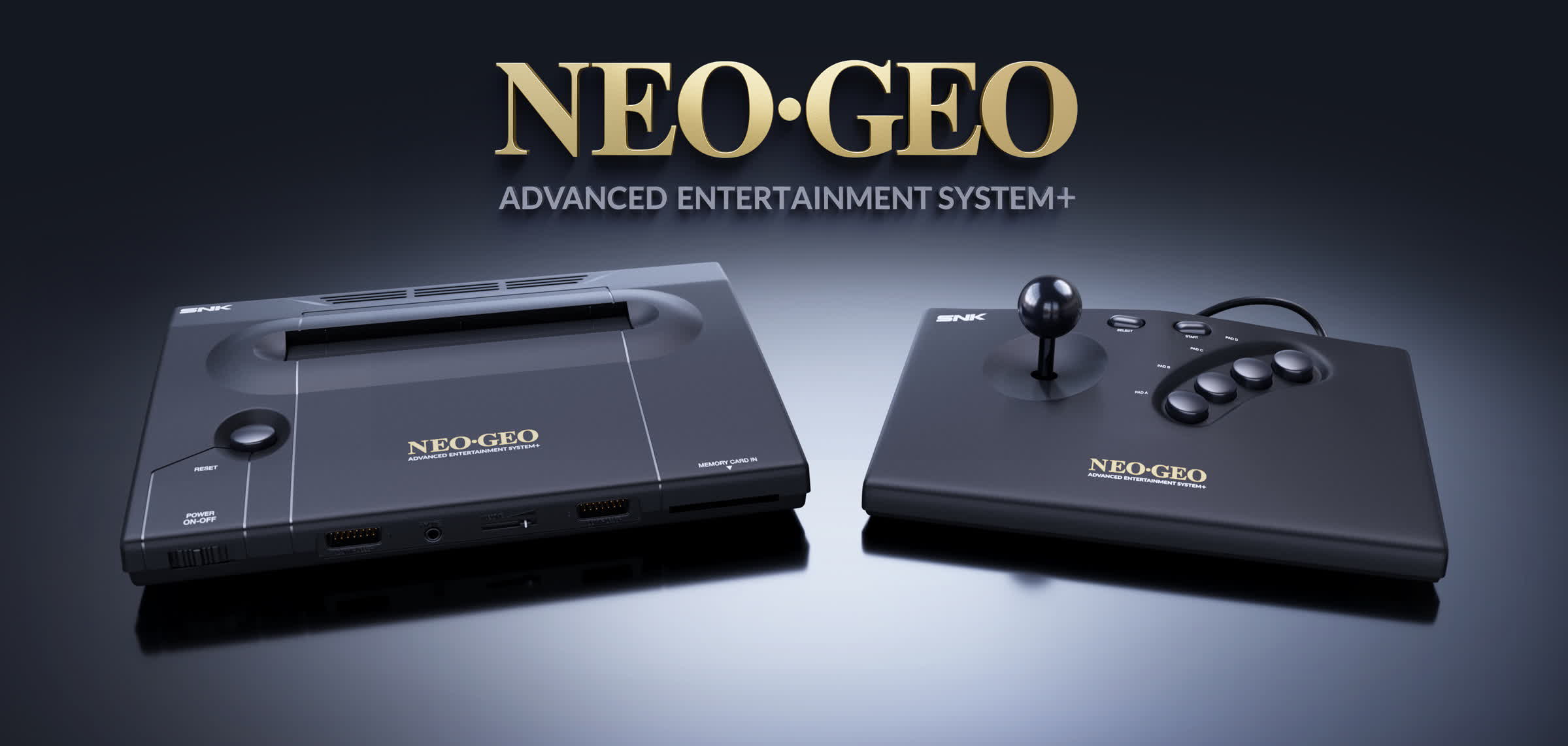
The Neo Geo AES is coming back, right down to real cartridge support

Published

on

Retro-Suckers: Back in the 1990s, Neo Geo was one of the most popular arcade platforms thanks to its unmatched computing power and graphics prowess. SNK tried to bring the system into the home with the Neo Geo AES console, which used its own cartridges that were physically incompatible with arcade MVS cartridges. The attempt ultimately failed, but the Neo Geo AES is now making a comeback among gamers seeking an “authentic” hardware experience without relying on emulation.

Plaion and SNK announced the revival of the Neo Geo AES platform earlier this year. The “premium” retro-gaming console is now available for pre-order, with multiple variants, accessories, and even an “extra-luxury” edition packed with controllers, cables, and game cartridges.

The Neo Geo AES+ is part of Plaion’s “Replai” offering, which sells several modern iterations of classic platforms such as the Intellivision, Atari 2600, and the Amiga. Plaion describes the Neo Geo AES+ as a faithful reimplementation of the original Japanese machine, using legacy ASIC-based solutions that don’t require any kind of emulation.

Custom ASIC chips replicate the original machine’s software and hardware functionality, which allegedly includes full compatibility with original AES cartridges.

Advertisement

Arcade authenticity aside, the Neo Geo AES+ also includes a few modern niceties to ease the pain of using classic consoles with modern setups. The machine provides a low-latency HDMI output, overclocking, and high-score storage on a separate memory card. I can safely say that overclocking is a rather crucial upgrade, as Metal Slug and other Neo Geo games are infamous for turning into annoying slideshows when too many sprites are shown on screen.

Neo Geo AES+ is coming out on November 12, 2026, with plenty of different pre-order options. The original edition costs €200 and includes a console, an arcade stick, and an HDMI cable. There is also an all-white Anniversary Edition, which costs €300 and comes with an additional wireless arcade stick, a white Metal Slug cartridge, a memory card, and more.

Sitting at the other end of the spectrum, the Neo Geo AES+ Ultimate Edition packs several additional controllers, 10 fan-favorite Neo Geo games, and plenty of dongles and cables. This particular version has a €900 price tag, which is still not enough to impress retro enthusiasts who remember how much the original console cost back in the 90s.

The Neo Geo platform played an important role in video game history, blowing away the hardware competition and giving rise to long-running series such as Metal Slug, The King of Fighters, and more. Neo Geo emulation has long been a “solved” problem on PCs and mobile devices, thanks to MAME and other actively developed projects.

Advertisement

The Neo Geo AES+ is the latest in a long list of modern devices designed to replicate both the games and hardware features of the original console. It might very well be the most effective one yet, although I don’t plan on spending €80 on one of the individual AES cartridges that Plaion is going to launch alongside the console.

Source link

Advertisement
Continue Reading

Tech

How to watch Women's Open 2026: Free Live Streams, TV Channels & Preview

Published

on

The fifth and final major of the season is set to be electric, with so many of the top contenders out to fulfil lofty personal ambitions at Royal Lytham & St Annes, none moreso than Ryu Hae-ran and Nelly Korda.

World No.1 Korda won the first two majors of 2026, only for Ryu to double up too. It’s the first time ever that two players have secured multiple majors in a season. They’re both hoping to emulate the great Inbee Park, the last player to win three major titles in a single calendar year. That was way back in 2013.

The consistency of Korda, who’d also complete a career Grand Slam with victory in Lancashire, has been astounding over the past few seasons, but she missed her first cut in two years earlier this month.

Victory would see Miyu Yamashita become the first player to go back-to-back in a major since Yani Tseng in 2011, a scenario that isn’t out of the question in current form. The 24-year-old has made the top-five in four of the past six tournaments she’s contested.

Yamashita’s triumph a year ago consigned Charley Hull to her second Women’s Open runner-up finish in three years, but she has a big reason to be cheerful this weekend: the past two winners of the Women’s Open at Royal Lytham were Brits.

Advertisement

Read on for our guide on where to watch Women’s Open 2026 online, on TV and potentially for free wherever you are.

Can you watch Women’s Open 2026 for free?

Yes. Full Women’s Open 2026 coverage is free-to-air on R&A TV in the UK.

Another free option is BBC iPlayer, which is airing a nightly highlights show.

Traveling abroad right now? You can use a VPN to watch the Women’s Open for free as if you were right at home.

Advertisement

Use a VPN to watch Women’s Open 2026 live streams

A VPN is handy piece of software that can make your device appear as if it’s back in your home country, so you can unlock your usual service. The best VPN right now? We recommend NordVPN – it does everything and comes with up to 75% off.

🟩 NordVPN – get the world’s best VPN
Not having a VPN is like leaving your front door wide open in a busy city – anyone can walk right in and take a peek.
TechRadar regularly reviews all the biggest and best VPN providers and NordVPN is our #1 choice.
Up to 75% off today
3 extra months free
Unlocks all necessary streaming services
Get NordVPN and stream Women’s Open 2026 from anywhere.View Deal

Advertisement

How to watch Women’s Open 2026 live streams in the US

US flag banner

Women’s Open 2026 coverage is shared between NBC, USA Network, Golf Channel and Peacock in the US. All NBC coverage is being simulcasted on Peacock.

Round 1 and Round 2 air on Golf Channel from 4am-8am, and on USA Network from 8am-2pm. Round 3 and Round 4 air on USA Network from 7am-12pm, and on NBC from 12pm-finish. All times ET.

Peacock is also showing Featured Groups coverage.

The Peacock price starts at $10.99/month or $109.99/year for a plan that carries live sports. However, you can access Peacock virtually for free with a Walmart Plus 30-day trial for $1.

Advertisement

NBC and USA Network, meanwhile, are available through Sling – specifically the Blue plan, which starts at $45.99/month. It includes NBC, ABC and Fox in select locations, plus FS1, USA Network, FX and more. You’ll need the $11/month Sports Extra add-on for Golf Channel.

Alternatively, all three channels are also carried by YouTube TV and Hulu + Live TV, each of which offers a free trial to new users.

If you’re traveling outside of the US, you can make use of NordVPN to catch the action.

How to watch Women’s Open 2026 live streams in the UK

UK flag

(Image credit: Future)

In the UK, Women’s Open coverage is free-to-air on the R&A TV streaming platform.

Advertisement

A 60-minute Women’s Open highlights show will air at 8.30pm BST on all four days of the tournament on BBC One Red Button and BBC iPlayer.

All you need is an account, a TV Licence and a UK postcode (e.g.HA9 0WS). Sign up here!

Alternatively, Sky Sports is providing extensive coverage of the 2026 Women’s Open, across its Sky Sports Main Event and Sky Sports Golf channels.

Sky Sports plans start from £35/month, or £20 if you’re an existing Sky subscriber. Alternatively, grab a Now Sports subscription from £14.99/day or £34.99/month.

Advertisement

Outside the UK right now? Use NordVPN to access your preferred Women’s Open stream.

How to watch Women’s Open 2026 live streams in Australia

Australian flag

(Image credit: free)

In Australia, Women’s Open 2026 is being televised on Fox Sports via Foxtel, with live streaming available via Kayo Sports.

Kayo Sports starts at AU$30 per month after a 7-day free trial. Or you can get your first month for AU$1.

If you’re currently out of Australia but want to watch your usual Women’s Open coverage, you’ll need to get yourself a VPN, as per the instructions above.

Advertisement

How to watch Women’s Open 2026 live streams in Canada

Canada

(Image credit: Other)

In Canada, Women’s Open 2026 is exclusive to TSN.

If you don’t have cable, the TSN Plus streaming service costs CA$8/month or CA$80/year.

If you’re out of Canada but still want to tune in, explore the VPN route set out above, which will help you access your accounts from anywhere.

Women’s Open 2026 FAQs

What are the Round 1 tee times?

(All times BST)

Advertisement

6:30 A Hewson (Eng), A Doherty (US), C Williams (Wal)

6:41 A Garvey (NZ), L Harm (Ger), S Soenderby (Den)

6:52 H Wei-ling (Tpe), A Ashok (Ind), D Harry (Wal)

7:03 A Nordqvist (Swe), C Porter (Aus), S Takahashi (Jpn)

Advertisement

7:14 M Katsu (Jpn), Y Noh (US), S Kyriacou (Aus)

7:25 C Ciganda (Spa), K Davidson (Aus), M Jose Marin* (Col)

7:36 Y Ina (Kor), Al Lee (US), Y Yunseo* (Kor)

7:47 S Jiyai (Kor), A Kim (US), C In-gee (Kor)

Advertisement

7:58 L Grant (Swe), K Jin-young (Kor), K Romero* (US)

8:09 K Sei-young (Kor), R Takeda (Jpn), Y Araki (Jpn)

8:20 K Hyojoo (Kor), M Lee (Aus), M Saigo (Jpn)

8:31 L Woad (Eng), A Iwai (Jp), An Lee (US)

Advertisement

8:42 L Ko (NZ), N Korda (US), R Haeran (Kor)

8:58 C Hye-jin (Kor), G Kim (Aus), M Rhodes (Eng)

9:09 L Somi (Kor), E Henseleit (Ger), A Furue (Jpn)

9:20 L Duncan (US), Y Amy (Kor), J Lopez Ramirez (Spa)

Advertisement

9:31 S Popov (Ger), S Jenny (Kor), P Delacour (Fra)

9:42 L Yan (Chi), S Tan (Sin), Y Saso (Jpn)

9:53 T Yani (Tpe), N Nadaud (Fra), A Forsterling (Ger)

10:04 A Yubol (Phi), C Gainer (Eng), K Minji (Kor)

Advertisement

10:15 K In-kyung (Kor), M De Roey (Bel), C Lopez-Chacarra (Spa)

10:26 J Ewart Shadoff (Eng), A Zanusso (Ita), J Bosio (Aus)

10:37 S Kouskova (Cze), J Soo-bin (Kor), A Fuller (Eng)

10:48 P Babnik (Slo), A Foster (Ire), B Wardle (Eng)

Advertisement

11:14 J Yan (US), A Laisne (Fra), L Walsh (Ire)

11:25 K Bennett (Aus), Z Weiwei (Chi), K Arwefjall (Swe)

11:36 E Hara (Jpn), C Tamburlini (Swi), M Green (US)

11:47 N K Madsen (Den), K Nagai (Jpn), E Hamilton (Eng)

Advertisement

11:58 S Kuwaki (Jpn), H Briem (Ger), L Li (US)

12:09 A Huang (Can), J Bae (US), P Martin Sampedro* (Spa)

12:20 L Vu (US), S Sakuma (Jpn), R Zhang (US)

12:31 A Jutanugarn (Tha), K A-lim (Kor), C Alexander (SA)

Advertisement

12:42 H Shibuno (Jpn), G Hall (Eng), V Delon* (Fra)

12:53 G Lopez (Mex), C Iwai (Jpn), C Boutier (Fra)

13:04 Y Ruoning (Chi), N Hataoka (Jpn), J Kupcho (US)

13:15 M Yamashita (Jpn), J Thitikul (Tha), L Coughlin (US)

Advertisement

13:26 C Hull (Eng), H Green (Aus), B Henderson (Can)

13:42 M Stark (Swe), I Jin-hee (Kor), A Corpuz (US)

13:53 K Min-sol (Kor), P Tavatanakit (Tha), M Khang (US)

14:04 P Anannarukarn (Tha), H Youmin (Kor), L Maguire (Ire)

Advertisement

14:15 A Buhai (SA), F Suga (Jpn), D Weber (Ned)

14:26 K Minsun (Kor), L Mi-hyang (Kor), N B Estrup (Den)

14:37 C Wannasaen (Tha), P Roussin-Bouchard (Fra), L Yu (Chi)

14:48 R O’Toole (US), R Choi (Aus), C Naughton* (Eng)

Advertisement

14:59 N Guseva (Rus), N Komulainen (Fin), L Crump* (Eng)

15:10 C Tejedo Mulet (Spa), D Dagar (Ind), Y Wilson (US)

15:21 D Darquea (Ecu), P Mack (Ger), G Kim (US)

15:32 A Utama (Tha), A Pelaez Trivino (Spa), V Bouvet (Fra)

Advertisement

Who are the recent Women’s Open winners?

2025 – Miyū Yamashita
2024 – Lydia Ko
2023 – Lilia Vu
2022 – Ashleigh Buhai
2021 – Anna Nordqvist
2020 – Sophia Popov
2019 – Hinako Shibuno
2018 – Georgia Hall
2017 – In-Kyung Kim
2016 – Ariya Jutanugarn

Can I follow Women’s Open 2026 on my mobile?

Of course! Each of the major broadcasters has streaming services that you can access through mobile apps or via your phone’s browser.

You can also stay up-to-date with all of the key Women’s Open 2026 highlights on the LPGA’s official social media channels on YouTube (@LPGA), Instagram (@LPGA_Tour) and Facebook (@LPGATour).

We test and review VPN services in the context of legal recreational uses. For example:1. Accessing a service from another country (subject to the terms and conditions of that service).2. Protecting your online security and strengthening your online privacy when abroad.We do not support or condone the illegal or malicious use of VPN services. Consuming pirated content that is paid-for is neither endorsed nor approved by Future Publishing.

Advertisement

Source link

Continue Reading

Tech

How to change your Home address in Maps on iPhone

Published

on

Changing your home’s address on Apple Maps can be almost as stressful as moving home in real life, but there’s one sure-fire way to get the job done without pulling your hair out.

The Apple Maps app is a great way to get around, whether you’re using it while driving via CarPlay or just walking. It also makes it easy to quickly get directions to the places that you visit often, like your home or where you work.

But if you’ve moved home and ever tried to change your address in your iPhone‘s Maps app, you’ll know it can be tricky. The job can be complicated considerably if you also have your home address pinned, too.

Thankfully, changing your home’s address is much easier when you keep in mind two main things. The first is that your home’s address isn’t normally set by the Maps app itself. And the second is that pinned addresses in the Maps app don’t automatically update, nor can they be edited.

Advertisement

It’s easy to see where the confusion comes from, but don’t worry. We’re going to clear everything up right here.

Your ‘Home’ address has a home of its own

The first thing to remember is that your iPhone uses your contact card as the source of your home address whenever it is needed. It’s this address that is used when you make purchases online, fill out online forms, and for anything else that requires an address.

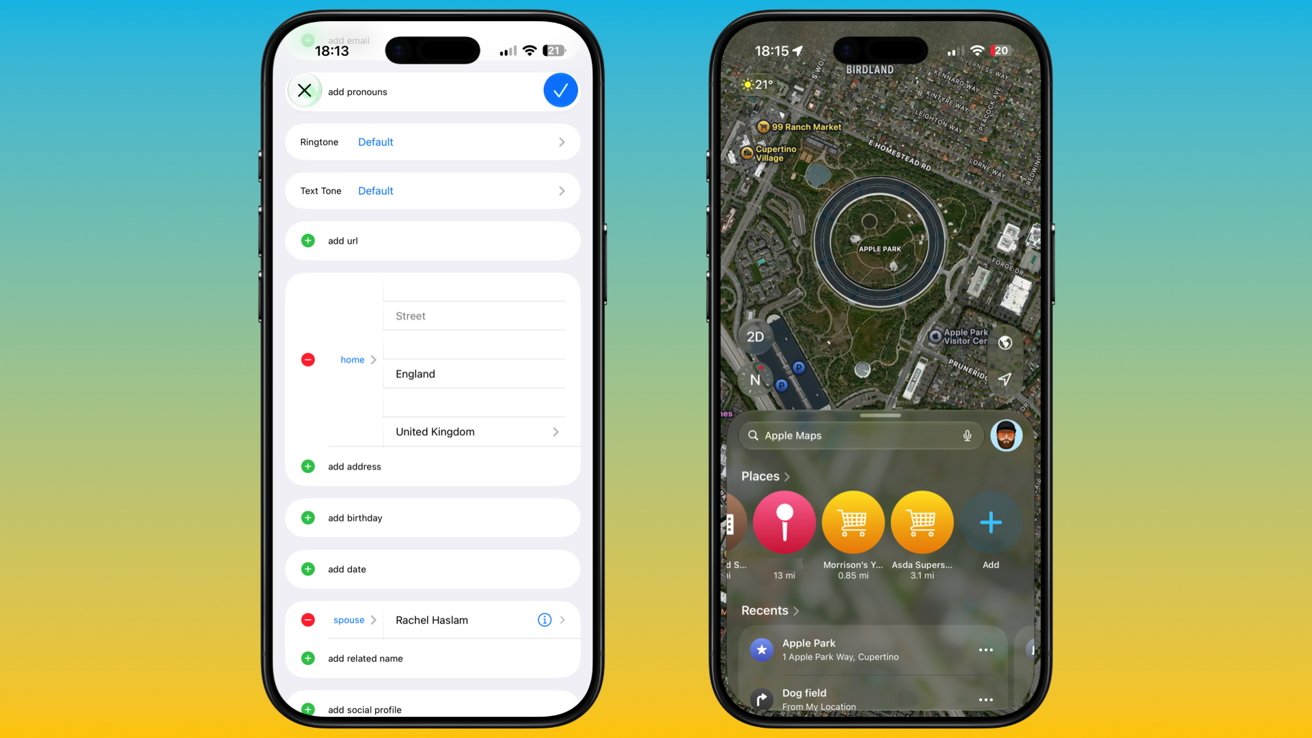
Two smartphones side by side; left shows a settings-style screen with lists and colored icons, right displays a satellite map with a circular route around a park and location markers

Remember to update your pinned location in Apple Maps after changing your home address.

If you move home, it’s this address that you need to change. And thankfully, it’s easy to do.

Advertisement
  1. Open the Contacts app on your iPhone and tap My Card at the top of the screen.
  2. Tap Edit in the top-right corner of the screen and then scroll down to the address portion of your contact card.
  3. Tap the address fields and enter your new details.
  4. Tap the checkmark in the top-right corner of the screen to save your new address.

That’s all there is to it, your iPhone now has your new address. However, if you have your home set up as a pinned location in Maps, you’ll also need to go a step further.

Unfortunately, Maps won’t automatically update the pin to reflect your new address. Pinned addresses also can’t be edited, so you’ll have to delete the pin and add a new pin all over again.

Source link

Advertisement
Continue Reading

Tech

It’s Frighteningly Easy to Jailbreak Some Frontier AI Models

Published

on

I recently got to watch what happens when you jailbreak some of the world’s most powerful artificial intelligence models.

Don’t worry—this AI manipulation wasn’t used to hack anyone or build a nuclear bomb. I simply got to see firsthand how vulnerable some frontier models are to ditching their safety guardrails.

FAR.AI, an AI safety nonprofit based in California, built a tool that takes a range of problematic prompts and generates more than a thousand different versions in an attempt to identify functioning jailbreaks. I saw some models generate a detailed plan for launching a cyberattack on an imaginary hydroelectric dam, among other things. Often, it involved trying dozens of prompts, with models rejecting many of them out of hand.

I chatted with FAR.AI in advance of a new report, which saw the group test the safety guardrails of models from four popular US companies: Anthropic’s Claude Opus 4.8 and Fable 5; OpenAI’s GPT 5.5 and 5.6; Google’s Gemini 3.1 Pro; and Grok 4.3 and 4.5, from Elon Musk’s newly combined SpaceXAI. It auto-generated prompts designed to trick the models into doing potentially harmful things, like generating software exploits and providing details for developing chemical or biological weapons.

Advertisement

The report found that Grok was most vulnerable to jailbreaks, with 448 jailbreaks found, followed by Gemini, with 249 found, while Claude, Fable, and GPT were impervious to the attacks. However, that doesn’t mean those models are immune to more sophisticated jailbreaks, which may involve interacting with a model in more complex ways, according to FAR.AI and other experts.

The report also calculated the cost of getting models to misbehave by using another AI model to automatically generate different jailbreaks. The results are dirt cheap, all things considered—$58 to jailbreak Grok and $278 to jailbreak Gemini.

“AI models right now are less regulated than restaurants,” says Adam Gleave, the CEO of FAR.AI and an expert on AI safety and alignment.

Gleave says that the findings demonstrate the need for externally imposed standards and regulations. “Talk of relying on voluntary commitments, that AI companies are going to be able to self-regulate, is nonsense,” he says.

Advertisement

But Gleave also believes that the findings show that models can be systematically tested for safety. “There’s an optimistic angle here,” he says. “Defense and safety really are possible.”

Rohin Shah, the director of AGI safety and alignment at Google DeepMind, says the results of the report “should not be interpreted as a comprehensive assessment of Gemini’s safety and security,” because not all jailbreaks are equally severe.

“We are constantly working to improve our safeguards,” Shah says. “We conduct extensive red teaming and evaluations across severe misuse risks and apply multiple layers of protection throughout development and deployment.”

“These findings reflect the sustained investment we’ve made in our safeguards,” Anthropic spokesperson Michael Aciman tells WIRED. “We continue to evolve our safety systems as these attacks become more sophisticated.”

Advertisement

“Jailbreaks are an ongoing challenge across the industry, and we continuously strengthen our safeguards as attack techniques evolve. We rigorously test our models against new threats and use those findings to improve our protections,” OpenAI spokesperson Gaby Raila said in a statement to WIRED.

SpaceXAI did not respond to WIRED’s request for comment.

Recently passed state laws in California and New York require frontier AI developers to publish safety reports, and soon, an Illinois law will require those companies to have their safety practices evaluated by third-party auditors. But the federal government hasn’t yet passed any specific safety requirements, and chaos has ensued as the industry—and officials—try to figure it out.

Source link

Advertisement
Continue Reading

Tech

AI Companies Are Recruiting Electricians and Carpenters By the Thousands

Published

on

An anonymous reader quotes a New York Times report on how AI companies are pouring money into training and recruiting electricians, carpenters, and other skilled tradespeople to build data centers: There is no parallel in American history for the boom underway in the construction of data centers, fueled by companies with functionally unlimited cash that are racing to supply skyrocketing demand for their A.I. models. The explosion has offset flagging activity in other sectors, like office construction, which never recovered after the pandemic. Housing has been depressed by high interest rates, and offshore wind felled by political opposition. Still, competition for labor — never mind land and materials — is starting to weigh on other parts of the industry.

“There’s no question the resources are very limited, so decisions to build one thing kind of drag from another,” said Mario Iacobacci, who runs the construction and infrastructure advisory practice at Oxford Economics. Developers are paying a premium for workers, especially in the rural areas where they are building data centers. According to an analysis by Indeed, the job listings website, hourly installation and maintenance jobs at data centers pay 42 percent more than similar jobs in other fields. Behind that inflated pay is a bidding war. In markets with a lot of data center construction, like Dallas and Northern Virginia, workers can jump ship for bonuses or higher per diem rates. The competition has driven contractors to staffing services like Aerotek.

“It is creating a labor tension that is really delicate,” said Marty Schager, Aerotek’s director of data center market development. “You’ve got a passive job-seeker community out there right now that I think is looking to potentially capture opportunity with this once-in-a-generation data center gold rush.” […] The question looms over the apprentices who will become journeymen as the build-out reaches fever pitch. Fully trained electricians could shift to nuclear plants, apartment buildings or pharmaceutical factories. But it’s hard to imagine anything on the scale of what’s underway.
“The best-case scenario would be you train all these skilled workers up and right when the data centers start to become less popular is we’d have a housing boom,” said Jeff Strohl, director of Georgetown University’s Center on Education and the Workforce. “That’s probably not likely.”

“If we have an influx of workers at this point with the data centers being built, what happens when they’re done? Where do those workers go?” he said. “How many people does it take to run a data center after taking up all this property and all this land that could have been used for something else?”

Advertisement

Source link

Continue Reading

Tech

Microsoft is openly competing with OpenAI, Anthropic more than ever

Published

on

Microsoft is in a unique position as AI overtakes the tech industry. It’s one of the world’s largest cloud providers and software-as-a-service companies, while also holding valuable stakes in the two biggest AI labs, OpenAI and Anthropic.

Those incentives are starting to clash as Microsoft posts blockbuster financial results. The company just reported an extremely profitable quarter with $90 billion in revenue and net income of $35.8 billion. For the fiscal year, which ended June 30, Microsoft reported $331.8 billion in revenue with a net income of $133.7 billion for the year.

And CEO Satya Nadella is not about to let the trajectory of Anthropic and OpenAI — which are expanding into applications and agentic infrastructure that could ultimately let them own customer relationships — derail that kind of cash.

Nadella has been preaching to enterprises to use multiple models and to stop relying on the frontier AI labs for the agentic harness/app layer.

Advertisement

Doing so is dangerous, he’s been saying, because it requires companies to share too many of their internal secrets with model makers of dubious trustworthiness. He knows his customers. Enterprise IT fears both data leaks and being locked into a vendor.

Now he has openly told Wall Street analysts during the company’s quarterly conference call Wednesday that this is an opportunity for Microsoft to sell customers its own homegrown models, alongside agents, AI security and more, while promising lower costs.

In other words, he’s pitching Microsoft as an alternative to many of the upscale services that OpenAI and Anthropic are developing for their own growth.

When UBS analyst Karl Keirstead specifically asked Nadella to weigh in on the open vs. closed-sourced debate roiling the AI industry, and how Microsoft will benefit from it, Nadella came out swinging.

Advertisement

“The goal is to have the firm be in control of their own destiny,” the CEO said of enterprises. “We are very, very clear about the architectural sort of design of the platform, which is you got to keep your harness separate from the model … that means any model at any given time is swappable.”

Microsoft, of course, sells a menu of harnesses (aka AI agents), too, under the Copilot name, including its coding agent GitHub Copilot. Coding agents are where much of the AI dollars are being spent today.

And he used the high-profile incident from last week as proof of his warnings.

“If you look even at the Hugging Face incident, the biggest thing that we should take away from that is you can’t sort of depend on any one model,” Nadella said. “You will maybe need multiple models to even remediate some challenges that get caused by one model. Like that’s the way to think about it, right? Which is you can’t be subject to a refusal of one model.”

Advertisement

The incident involved an unreleased model from OpenAI breaking out of its sandbox and successfully mounting a full-scale hack on Hugging Face, all in pursuit of besting a benchmark. Trying to understand what happened, Hugging Face at first tried to use a private frontier model (which it hasn’t named) that refused to help it. So it turned to the Chinese open-source model Z.ai GLM 5.2 to analyze logs and defend its infrastructure. The incident has so shocked the industry that even Sam Altman is now saying that maybe AI development should slow down a bit.

Nadella also made clear that Microsoft is happily selling its own homegrown models, the MAI family, on its own homegrown AI chips, Maya, and pitching them as cheaper alternatives.

“Every customer wants the right model for each task based on quality, latency, cost, and compliance. We offer the broadest model catalog in the cloud with over 11,000 models, including the leads from OpenAI, Anthropic, Mistral, xAI, as well as our own MAI family,” he said.

He added: “We’re also accelerating our own model development. We announced more than a dozen new models across image, voice, transcription, coding, security, including our first reasoning model, MAI thinking one, all with cost-efficient inference at the core for the enterprise use cases. We are co-designing these models with our silicon, and we are seeing 40% better performance per watt when running MAI models on Maya 200.”

Advertisement

As for Mythos? Nadella pointed to Microsoft’s new Mythos competitor announced earlier this week, MAI Cyber One Flash. It “achieves better performance than the much larger Mythos model, but at half the cost when combined with our multi-agent security harness,” he said.

Sure, the Microsoft CEO says that enterprises should use the frontier models that OpenAI and Anthropic offer in their mix. But his bigger message is: don’t trust them enough to rely on them.

When you purchase through links in our articles, we may earn a small commission. This doesn’t affect our editorial independence.

Source link

Advertisement
Continue Reading

Tech

Irish co-founded crop science start-up Wild Bio acquires F1 Seed

Published

on

Wild Bio, founded in 2021 by Dr Ross Hendron and Irish man Prof Steve Kelly, specialises in crop genetics by researching genetic solutions that developed through evolution.

University of Oxford spin-out Wild Bioscience, which develops improved crop varieties using AI and precision breeding, has acquired wheat breeding business F1 Seed for an undisclosed amount.

By acquiring F1 Seed, Wild Bio aims to become a “fully integrated, end-to-end UK seed company”, forming a single business able to design, breed and deliver new wheat varieties to growers.

Wild Bio, founded in 2021 by Dr Ross Hendron and Irish man Prof Steve Kelly, specialises in crop genetics by researching genetic solutions that developed through evolution to improve crops in the past, and then using these discoveries to design simple fixes for modern crops.

Advertisement

The start-up does this by building unique plant biology datasets and applying AI and machine learning tools to find “signatures” for how evolution has improved plants. The Wild Bio platform can then target specific “nature-tested” traits and activate them in crops such as wheat.

With this acquisition, Wild Bio will be able to utilise F1 Seed’s wheat breeding capabilities and access its diverse germplasm – genetic resources such as seeds, tissues and DNA sequences – pipeline, which has been developed for more than a decade.

Wild Bio’s goal is to deliver conventionally bred, optimised wheat varieties directly to UK farmers by 2027, followed by the first precision-bred lines in field trials by 2028.

F1 Seed already has six wheat varieties on the UK market, primarily focused on animal feed and distilling, and plans to launch three more later this year. Of the 82 new wheat varieties entering official UK national trials this year, 12pc – 10 entries – come directly from F1 Seed’s pipeline, according to a press release on the acquisition.

Advertisement

“This is the most exciting news for wheat growers since Cambridge University established the Plant Breeding Institute in 1912,” said Bill Angus, founder and director of F1 Seed. “That organisation established the blueprint for integrating new traits into cereals.

“Now over a century later, armed with an array of novel traits, we are well placed to move wheat breeding into a new and exciting era. Deploying traits has been the lifeblood of wheat breeding – now we have the opportunity to accelerate this in UK germplasm.”

Wild Bio said the acquisition comes as the UK’s farming industry hits a tipping point, as wheat yields have remained flat for three decades, while input costs have risen and the climate crisis has introduced “unprecedented volatility”.

In fact, a report from last November found that one-third of surveyed UK farmers made no profit in the previous year, with more than half considering leaving the industry.

Advertisement

With the record-breaking heatwaves and drought seen in recent years affecting wheat yields significantly, Wild Bio said it will be able to help UK farmers by providing seeds designed specifically for the country’s conditions.

“Wheat is Britain’s biggest crop and feeds a fifth of humanity. But on a changing planet, growing it is only getting harder,” said Hendron, who is also Wild Bio’s CEO. “That’s the challenge we exist to meet.

“As a new independent seed business that brings breeding and gene editing together, we can focus on the traits that growers genuinely need and design towards them with precision. Bill and his team have built something remarkable; pairing their strengths with our evolutionary platform gives us the full stack of capabilities we need to develop the varieties that will bend the yield curve upwards again.”

Last October, Wild Bio raised $60m in a Series A round led by the Ellison Institute of Technology, founded by Oracle’s Larry Ellison. The company’s acquisition of F1 Seed was largely financed by this funding, according to Wild Bio.

Advertisement

Don’t miss out on the knowledge you need to succeed. Sign up for the Daily Brief, Silicon Republic’s digest of need-to-know sci-tech news.

Source link

Advertisement
Continue Reading

Tech

Global AI Digital Divide Shapes Who Builds AI

Published

on

Artificial intelligence is rapidly becoming part of everyday infrastructure–in some places. It helps write emails and software code, filters job applications, powers recommendation systems, and is increasingly being integrated into education, health care, finance, and public administration. Industry leaders talk about “AI for everyone,” while governments rush to publish national AI strategies and build sovereign compute.

Yet over the past decade, working on digital inclusion and digital literacy projects in regions from Europe to sub-Saharan Africa and Southeast Asia, I’ve seen the same pattern repeat: Each new wave of “transformative” technology lands on a landscape already stratified by connectivity, skills, and institutional capacity. The current AI wave is no exception. If anything, it amplifies those underlying fractures.

Still, some countries are exploring ways of participating in AI development without directly replicating the frontier-model race dominated by the United States and China. Recent developments in South Africa and Indonesia illustrate both the possibilities and challenges. The stakes extend far beyond access to AI. Countries that remain primarily consumers rather than creators of AI risk losing opportunities to build local innovation ecosystems, strengthen public-sector capacity, and ensure that their own languages, cultures, and societal priorities are reflected in AI systems. In this sense, the AI divide is also becoming a divide in economic opportunity and technological influence.

AI compute is clustering in a few places

Recent analyses from Stanford University’s 2026 AI Index report that the United States alone hosts more than 5,000 data centers, over 10 times as many as any other single country. Because AI workloads are increasingly performed on cloud platforms rather than local infrastructure, this concentration of compute also becomes a concentration of dependency. According to World Bank data, in 2023 the United States accounted for roughly 87 percent of global exports of cloud computing and data-storage services.

Advertisement

For most countries, this means that AI development is not just technologically but commercially and geopolitically outsourced and out of their control. The result is an AI ecosystem where a small number of states and firms host the computational engines that power globally deployed systems.

Systems trained, standardized, and governed within a narrow set of institutional and linguistic environments may struggle to serve a genuinely global public.

Skills and AI literacy are deeply stratified

Even where connectivity and cloud access exist, not everyone is equally positioned to make use of them. Across the Organisation for Economic Co-operation and Development (OECD) countries, only around 40 percent of adults possess more than basic digital problem-solving skills, while advanced computational and AI-related competences remain concentrated among highly educated workers and technology-intensive sectors.

At the same time, governments are racing to integrate AI into education, often starting at higher levels of schooling. UNESCO has reported growing efforts worldwide to integrate AI into education, while support for AI literacy in primary and lower secondary education, as well as ethical training for educators, remains uneven.

Advertisement

Those with robust schooling, advanced digital skills, and stable connectivity are best positioned to treat AI as a tool to extend their capabilities. Recent OECD survey data show that participation in AI-related training remains strongly stratified by educational attainment: 36 percent of respondents with tertiary education reported undertaking AI-related training in the previous year, compared with just 18 percent of those with upper-secondary education. Those on the wrong side of the divide are more likely to experience AI as an opaque system acting upon them, from algorithmic welfare systems such as the Dutch childcare benefits scandal to AI-assisted hiring tools such as Amazon’s discontinued AI recruiting system, rather than as a technology they can actively interrogate or shape.

Investment and governance: Who gets a seat at the table?

The core agenda-setting power often remains with a narrow set of industry actors and a small group of technologically advanced states. Most other countries remain in a perpetual catch-up posture, adapting imported models, standards, and templates for “trustworthy AI” to their own contexts, and may have limited local capacity to assess trade-offs or propose alternatives.

In countries such as Indonesia and South Africa, communities generate data at massive scale yet still have little voice in how AI systems are designed, governed, or deployed. Their languages are underrepresented in training data; their institutions are under-resourced in regulatory forums; their experiences rarely feature in benchmark datasets. For many countries in the global South, participation in AI still occurs largely through adapting imported systems rather than shaping how those systems are designed, governed, or deployed.

In South Africa, the Department of Communications and Digital Technologies released a draft national AI policy in April 2026, proposing new oversight institutions. The department withdrew the draft days later after a journalist discovered that at least six of its academic citations did not exist, apparently AI-generated hallucinations. The minister called it “an unacceptable lapse.“ The episode sharply illustrates the gap between AI governance ambition and the institutional capacity needed to implement it, though the new AI panel the country has since constituted has a chance to use South Africa’s unique leverage.

Advertisement

Indonesia presents a case of deliberate, if constrained, public-sector agency. The National Research and Innovation Agency (BRIN) which now leads AI implementation under the national strategy, has built practical AI tools aimed at underserved communities rather than frontier capabilities, including an app that uses satellite data and machine learning to help artisanal fishermen locate schools of fish, multilingual language models trained on Indonesian and local languages such as Javanese and Sundanese, and AI chatbots deployed in government services. In August 2025, the Ministry of Communication and Digital Affairs released a national AI road map with a target of training 100,000 AI-skilled workers annually.

The choice is not simply between “AI superpower” and “passive recipient.”

Regional cooperation may also become increasingly important. In 2024 African ministers adopted a Continental AI Strategy and African Digital Compact. Participants in the April 2025 Global AI Summit on Africa in Kigali explored how regional coordination, local-language AI models, public universities, and open-source ecosystems might reduce long-term dependence on externally developed AI systems.

A different way to think about the AI divide

None of this means that people should slow or abandon AI, nor that cloud concentration or venture capital are inherently bad. Instead, when we talk about an “AI revolution,” we should also ask who can shape it and who can merely adapt to it.

Advertisement

Digital-divide debates once focused on devices and connectivity, later expanding toward skills and outcomes. But the current AI wave adds another layer: disparities in who can meaningfully participate in deciding what AI is for, which problems it is meant to solve, and which social priorities it ultimately serves.

For engineers and policymakers, this raises difficult but necessary questions. Are they designing AI systems and infrastructures that broaden, rather than narrow, participation in shaping technological change? When governments roll out national AI strategies or integrate AI into public services, whose constraints, languages, and institutional realities are they including?

Many observers frame the current AI moment as a competition. But technological competition is never only about speed. It is also about who can influence the direction of change.

AI is already spreading globally. The deeper question is whether the technologists and policymakers responsible for it will ensure that meaningful participation in shaping that future will spread as well.

Advertisement

From Your Site Articles

Related Articles Around the Web

Source link

Advertisement
Continue Reading

Tech

She Launched the First AI Research Institute at an HBCU

Published

on

Artificial intelligence is reshaping the skills employers expect from new graduates. In response, universities are scrambling to launch new courses, research centers, and industry partnerships that prepare students for today’s workforce. But building a cutting-edge AI curriculum demands funding and access to industry networks, resources that remain unevenly distributed across higher education.

At North Carolina Central University, Siobahn Day Grady is trying to change that equation.

In January 2025, Grady, an associate professor in the NCCU School of Library and Information Sciences, launched the first AI research institute at a historically Black college or university, or HBCU. The Institute for Artificial Intelligence and Emerging Research (IAIER) aims in part to help students and faculty across the university develop the skills needed to navigate a labor market increasingly transformed by AI.

“There used to be a time where people could say, ‘I don’t do tech,’ or ‘That’s not for me,’” Grady says. “But we’re in a stage now where you do need digital skills. Now it’s evolving into AI literacy.”

Advertisement

The approach reflects a broader shift in how many universities are thinking about AI education. AI skills are no longer confined to computer science and engineering departments—and at NCCU, they can’t be. The university does not yet have a dedicated computer science program, though it is developing one alongside a new AI minor.

The challenge of providing these resources is especially acute for historically Black institutions. Although HBCUs account for roughly 3 percent of four-year institutions in the United States, they receive less than 1 percent of federal research and development funding, according to a 2025 report by the Center for American Progress and the Thurgood Marshall College Fund. The same report found that 17 of the 43 federal agencies that distributed research funding to universities in 2023 awarded no funding to HBCUs.

Yet less than two years since its launch, IAIER has emerged as a powerhouse for interdisciplinary AI education. Backed by a US $1 million Google.org grant, the institute has engaged more than 2,800 students, faculty members, and community residents through research initiatives and training. Now the challenge is sustaining that momentum to keep up with rising demand.

“We have a guiding principle that we lead with on our campus,” Grady says. “AI is for everyone.”

Advertisement

Why one research group wasn’t enough

The mission to expand AI literacy grew out of Grady’s lifelong curiosity about technology. “I was born during a time [when] the internet did not exist,” she says. “Ever since the internet came to be, it’s changed our entire world.”

Grady was particularly drawn to the questions tech raises about privacy, identity, and human behavior. After receiving her bachelor’s degree in computer science and master’s degrees in AI and information science, Grady pursued a Ph.D. in computer science at the North Carolina Agricultural and Technical State University to dig into those questions.

Her dissertation focused on authorship attribution in social media, using machine learning and natural-language processing to determine whether a person’s writing style could reveal their identity. “I’ve always been intrigued by how much data we give for free,” Grady says. That work introduced her to the power of AI systems to detect patterns hidden within large datasets.

“We have a guiding principle that we lead with on our campus: AI is for everyone.”

Advertisement

After completing her doctorate in 2018, Grady joined NCCU as an assistant professor in the School of Library and Information Sciences. There, she researched machine learning applications for health care and autonomous vehicles. In 2020, she launched the Laboratory for Artificial Intelligence and Emerging Research at NCCU, giving students opportunities to participate in hands-on projects and explore AI beyond the classroom.

Then in 2024, an opportunity emerged to apply for a Google grant, and Grady began thinking beyond a single research group. Rather than building another faculty lab, she envisioned an institute that could serve the entire university during the AI boom. “We wanted to capitalize on the moment and make sure we don’t get left behind,” Grady says.

Since receiving the $1 million grant, Grady and her team have built a university-wide AI initiative, launched new academic programs, organized conferences, secured external support, and created research opportunities.

“We’ve really operated like a startup,” Grady says.

Advertisement

AI beyond computer science

As part of the institute’s goal of integrating AI education across disciplines, all NCCU freshmen are required to complete an introductory AI course, designed in partnership with IBM, to build foundational prompting skills. The institute has also worked with faculty development teams to help instructors integrate AI into their teaching.

Research is another part of the strategy. IAIER has awarded seed grants of up to $10,000 to faculty members exploring AI applications across departments. The first cohort funded 11 projects spanning social work, digital archiving, health care, and information science. One project, for instance, is creating an AI lab where students in social work courses can practice client interactions through simulations.

“It’s really interesting to see the lens that our researchers take in trying to solve complex problems and also bring our students along with them,” Grady says.

The institute’s growth has been fueled by a mix of workforce training, interdisciplinary research, and, especially important, industry engagement. “Industry is where the advancements are really moving at that very fast rate,” Grady says, “not necessarily higher ed.”

Advertisement

To bridge that gap, IAIER hosts events that connect students and faculty with researchers, employers, and technology leaders. It has held sessions with companies including Deloitte, FICO, and Anthropic. Partnerships with Google and IBM let students gain recognized certificates and credentials. And last year, the institute hosted the first OpenAI Academy Summit held at an HBCU, drawing 444 participants from more than 40 institutions.

Sustaining the vision

The institute’s rapid growth has created a new challenge: continuing its momentum.

“Funding right now is the biggest barrier for [IAIER] to remain sustainable,” Grady says. As interest in the institute continues to grow, demand for its programs is beginning to outpace its capacity. “People just want more,” she says.

The bottleneck reflects a broader tension across higher education. AI is evolving quickly, while developing new academic programs, training faculty, and building research capacity takes time. The uncertainty is compounded by a shifting political landscape. As a whole, U.S. universities are grappling with proposed cuts to federal research spending and increased scrutiny of diversity-focused initiatives under the Trump administration. However, in September 2025, the administration also announced a $500 million one-time investment in HBCUs and higher-ed institutions chartered by Native American tribal governments.

Advertisement

Meanwhile, NCCU has continued to attract new investment. Last September, in a collaboration with Howard University and two other institutions, IAIER received a nearly $500,000 award through a National Science Foundation research coordination network program to help define emerging AI jobs, identify in-demand skills, and inform future credentials and curricula. That work will continue this fall when IAIER opens its first dedicated physical space on campus, Grady says.

Over the next several years, Grady plans to expand academic programming, launch the university’s computer science major and its AI minor, increase faculty research opportunities, and integrate AI more deeply across campus operations. She also plans to deepen the institute’s collaborations with industry partners.

Beyond program expansion, Grady sees the institute’s long-term success as linked to building a model other universities can adapt. “We’re creating a framework that can help not only HBCUs,” she says, “but also help any university looking to do similar work.”

From Your Site Articles

Advertisement

Related Articles Around the Web

Source link

Continue Reading

Tech

Verizon scores $1 billion Google deal to connect its data centers to dark fiber – but is this only the beginning?

Published

on


  • Verizon signs $1 billion dark fiber data center connectivity deal with Google
  • The telecoms company plans to use its fiber assets to connect AI data centers across the US
  • Fiber network growth is replacing copper lines and activating previously unused dark fiber lines

Verizon has completed a $1 billion deal with Google to provide data center connectivity using pre-existing dark fiber infrastructure. The move appears to be the first of several arrangements to leverage dark fiber and the desire for AI data centers to collaborate on compute tasks.

CEO Dan Schulman highlighted how copper is being ripped out of central offices to replace the outdated cabling with modern fiber to meet AI demand in workplaces. Verizon previously announced its AI Connect initiative, which aims to support AI infrastructure growth, and the Google deal appears to be the first step in that initiative.

Source link

Advertisement
Continue Reading

Trending

Copyright © 2025