Connect with us
DAPA Banner
DAPA Coin
DAPA
COIN PAYMENT ASSET
PRIVACY · BLOCKDAG · HOMOMORPHIC ENCRYPTION · RUST
ElGamal Encrypted MINE DAPA
🚫 GENESIS SOLD OUT
DAPAPAY COMING

Tech

VC Bros Claimed They Backed Trump To Protect AI. Trump Is Shutting Down AI. It Was Always About Access & Power

Published

on

from the but-he-returns-their-calls! dept

Back in July of 2024, when two of the biggest big shots in venture capital, Marc Andreessen and Ben Horowitz, explained why they had decided to go all in to back Donald Trump’s campaign for re-election, they talked up a good game about how they would support any candidate who supported their “little tech” agenda. This always rang hollow — Andreessen has been on the board of Meta for years, which is the most anti-little tech company around. They also whined about the Biden administration tech policies, in particular around AI, cryptocurrency, and antitrust. But the most telling part of the full podcast had nothing to do with tech policy at all. Marc and Ben spent a bunch of time positively offended that Joe Biden and some (only some) of his agency heads wouldn’t meet with them:

We have been spending a tremendous amount of time with Senators, Congress people on both sides of the aisle. Mark mentioned we met with President Trump. We did meet with White House officials, including Jeff Zients the chief of staff, and Jake Sullivan the National Security advisor, Gina Raimondo the Commerce Secretary and so forth. We have not met with President Biden. We attempted and failed.

….

We tried to meet with Gary Gensler — he’s the chair of the SEC, he’s running this campaign against crypto. We’re the largest crypto investors or largest blockchain investors in the world, and we’ve requested meetings with him at least a half a dozen times. I even was able to get in contact with his office mate at MIT, who said ‘surely Gary will meet with you, it’s so important that he meets with you’… and he couldn’t get us the meeting.

Meanwhile, they seemed to love the fact that Donald Trump would have dinner with them, and Trump family members would vacation with them. Here’s Marc:

Advertisement

Ben and I had dinner with the former president 10 days ago at Bedminster, his golf club in New Jersey, and had a three-hour dinner. And so, you know, we were quite literally just with him… you know, he’s a very complicated guy, people have a lot of opinions, but when you know somebody like that — you know the family — it really hits hard

And here’s Ben:

Marc and I have both gotten to know the family, particularly Jared and Ivanka and their kids — Arabella, Joseph and Theo. And in fact, like, Ivanka and the kids were just at my house. We went to see David Copperfield, all that.

The real complaint was never about policy. It was always about embracing the fascism of it all, in which they (Marc & Ben, not the wider tech industry) would get to write the rules in a way that helped them personally, even if it fucked over actual innovation. Indeed, they seemed tickled that after they had dinner with Donald Trump, he rewrote part of his campaign policy platform. These total political novices were so overwhelmed that they could get one side to listen at all that they figured it was obviously the side to back. They seem positively giddy that Trump was willing to make changes to his platform based on their conversations.

There was also a longer discussion regarding how Marc and Ben contrast what they think (misleadingly) was Biden’s policy on AI vs. what Trump’s policy would be. My favorite bit is where Marc says they “confirmed” with Trump what his AI policy would be, as if the guy doesn’t have a decades-long history of promising one thing to whoever is in front of him and then doing something entirely different.

Ben: Let’s talk about Trump’s proposal. We actually discussed this with him when we had dinner

Marc: Yeah, we discussed all these topics and confirmed all this. So: Chapter Three, “Build the Greatest Economy in History.” Bullet five, “Champion Innovation.” Item two, “Artificial Intelligence”:

Advertisement

“We will repeal the dangerous executive order that hinders AI innovation and imposes radical ideas on the development of this technology. In its place, we will support AI development rooted in free speech and human flourishing.”

Ben: That sounds like a good plan to me!

When we met with him, I thought his comment was really insightful and good. It’s funny — I would contrast the Biden administration’s approach, particularly in the inner core of the White House, with Trump’s approach. The White House has a very complicated model of things. They think they know a lot — they know that startups aren’t going to be important, that only a few companies will be able to field big models. They know all these things that we don’t know, and we don’t. They’ve never heard of distillation, apparently, or how AI is actually working in practice. It’s a very complex view of the world.

Trump’s view was very simple. What he said to us is, “Look, AI is very scary, but we absolutely have to win — because if we don’t win and China wins, that’s a very bad world.” And I think that’s actually a more correct view. That’s basically true. When things start happening that do need regulation, then we should regulate them. But to anticipate it would be kind of like saying, “Oh, the automobile is coming out, and we think somebody’s going to make an automobile that drives 500 miles an hour nobody can control, so we’re going to just outlaw cars now.” That’s a little bit this approach to AI — “Well, we think in the future there’s going to be a sentient model.” Now, nobody has built anything anywhere that’s on the way to sentience. And so doing that — what we have are these great things that can tutor kids, so “No, you can’t tutor kids, because maybe somebody will come up with an idea that will make AGI, and so we have to cut off the tutors.” It’s that kind of thinking, which is quite scary, I would say.

That final bit is quite telling as well. Biden’s plan was too complex. Trump’s plan was simple. Perhaps that’s because he’s a simpleton who has no understanding of actual policy tradeoffs. Biden’s team definitely made some decisions I strongly disagreed with regarding tech policy, but the “complexity” they whine about is because the issues here are, legitimately, complex.

Advertisement

So, um, given that the Trump administration has basically put in place a much dumber and much worse version of what Marc & Ben said Biden was doing… clearly they’re out there admitting they were wrong, right?

In just the last few weeks we not only had the US government force Anthropic to turn off Fable 5 and Mythos 5 models (even as the NSA itself was finding them useful!), it also made OpenAI limit the release of GPT 5.6. Meanwhile there are reports that the Trump administration is furious that Meta has been the one US frontier model provider that won’t let them pre-vet its AI models and decide which ones can and can’t be released.

So, two years ago Marc & Ben were yucking it up about how the Trump admin would stop trying to hold back and regulate big models, which they (falsely) claimed the Biden admin was doing. And now that the Trump admin is doing exactly that… it’s crickets from Marc and Ben.

Apparently their real concerns had nothing to do with such policies after all. Marc and Ben won’t tell you that directly, of course. But someone in their general orbit already has.

Advertisement

A little while ago the Bulwark’s Tim Miller did an interview with Jason Calacanis, a Silicon Valley entrepreneur/investor/gadfly, discussing a variety of issues regarding the tech industry. I only came across this because Karl Bode’s discussion regarding the SpaceX IPO mentioned it, to point out some delusional thinking about how Starlink works. But the rest of the interview is actually a lot of Calacanis saying the quiet part out loud regarding how Silicon Valley bros view all this fascism and corruption: positively, because they think they can handle fascism and corruption.

Miller pushes Calacanis on some points regarding why the Silicon Valley VC bros still support Trump’s fascism when it’s so obviously against things like open innovation and the free market, and Jason (almost gleefully) mocks Tim for just not getting it. He happily admits that the tech bros don’t have any actual principles at all. They just understand transactions, and Trump remains transactional.

Jason lays it all out as Tim points out that if a President Kamala Harris did a tiny bit of what President Trump is doing right now, the VC bros would be losing their minds, and Jason says none of that matters, because the VC bros understand that as long as everything is corrupt and “coin-operated” then they understand the game. Their biggest fear is that they’re just not that important, and policy might get made with no one caring what they thought:

Tim Miller: I want to give you a counterfactual. Kamala Harris did win. Okay. She gets in there and she puts an illegal tax on the Silicon Valley companies unilaterally. It doesn’t go through Congress. Puts a tax on them. It’s not legal, but she just does it. She says, “It’s an emergency. I’ve decided I have the right to do a, you know, whatever — windfall profits tax on all these companies. I’m going to do that.” And then she garnishes money from the CEOs. She makes them come to her and beg her for absolution to get around it. Sometimes she grants it, sometimes she doesn’t — kind of based on whim, kind of based on whether Doug is friends with the person, kind of based on whether they’ve given money to her. And then the Supreme Court comes back and says, “No, actually you’ve got to give the money back to the companies.” And she says, “No, actually I don’t want to. I’m not going to do that. In fact, I’m going to threaten them, and maybe I might actually take a percentage.” Donald Trump just suggested he might take a percentage of the company for the government. If Kamala Harris had said that, you and all your Silicon Valley buddies and the Wall Street Journal would be losing their minds, and it would [be] communism.

Jason Calacanis: So you’re making this analogy to tariffs?

Advertisement

Tim: This is what Trump is doing — with tariffs, and with taking a percentage of Intel, and he’s suggesting he’s going to take a percentage of AI companies. He tariffed them illegally. He made them come in and beg for their lunch. That’s left-wing autocratic politics is what he’s doing.

Jason: Yeah. I can educate you as to why they don’t have a problem with it and why you do. You are looking at it from a moral perspective, and from a logic perspective of like, “Well, if you were okay with one side doing it and not okay with the other side doing it, this doesn’t make intellectual sense to you.” Totally understand where Tim Miller is coming from. This intellectually does not make sense. Let me tell you on a business level what this means.

The tariffs, when they’re under 15%, when they actually hit, are easily absorbed on one side or the other — the folks who are selling items, or the folks who are providing those. They each make a bit of a concession, and maybe you raise the cost of something a little bit, but it’s not as dramatic as the left feels it is. It was chaotic, but when it actually hit the ground, it made no difference to these businesses. So, a lot of hand-wringing for not a lot of impact.

And you find it offensive, reasonably so, that people have to go bend the knee and bring a gold bar and wait in line. And South Park did a whole sendup of it — that you have to bend the knee and make your donation. That’s what business people like. They like transactions. You may not like it. You may think it’s crummy. Business people love to have a coin-operating situation.

Advertisement

Tim: I guess. But this whole Biden thing is crazy. It’s like — he didn’t even raise taxes on them. Trump has raised tax. You can tell me that fine, the tariff thing is inconsequential. Okay, fine. But the last federal corporate tax hike was in ’93. Like, they haven’t — they’ve only gotten cuts, from Obama, from Biden. They haven’t faced a corporate tax hike in 30 years or more. So who — why, who cares? Why are they so upset about the Biden situation?

Jason: Because Biden didn’t return their calls.

Tim: So the tariff isn’t a big deal. The phone call is. That’s fine. All right.

Jason: No, it actually is. You’re brushing that off. And this is where you have a blind spot, Tim. Respectfully, you have a blind spot. If you can get in the room with the person, if you can get in the room with the administration, and then you can shape policy and you can say, “Hey, here’s what we’re trying to accomplish, and hey, can you help us with this, and this regulation doesn’t make sense?” — that actually is a preferable situation to not getting your phone call returned. And if [that’s] what you have to pay for it — I’m not saying this is my belief; you have me on here to explain Silicon Valley and the business side, I’m explaining it to you — they much prefer bending the knee, having to show up for the Melania documentary. Tim Cook’s like, “I gotta show up for a documentary. That sucks. I gotta bring a gold bar. I’ll do whatever it takes to keep selling iPhones.”

Advertisement

It’s possible this is correct, but that’s basically the definition of Mussolini’s brand of corporate fascism, when the business elites team up with an autocratic ruler to better control the entirety of society, not for the benefit of society or the public good, but for their own.

Early on in the second Trump administration, I wrote an article titled Fascism for First Time Founders, about how this tends to end very badly for the business leaders who embrace it. I stand by that article, and think it’s even more relevant today than it was then. Fascist regimes don’t tend to last long, and the business leaders who embrace fascism in pursuit of becoming all-powerful oligarchs tend not to come to happy endings, no matter how wealthy it makes them for a short period of time, or which leaders are willing to return their calls.

You’d think that some of these “visionary” business leaders could look beyond the current administration and get a sense of where this story is heading. Apparently, that’s too much to ask.

Dean Ball, a policy analyst on AI who was placed in the White House by Silicon Valley folks to write Trump’s original AI policy (which was published to great fanfare and then totally ignored) has written an article about how the Trump AI policy is a total mess right now, where it’s based on whims where literally no one knows what’s allowed (the situation Marc & Ben falsely claimed would happen under Biden).

Advertisement
  1. When President Trump signed it earlier this month, I argued that the Executive Order on Cyber and AI, which claimed to establish a voluntary testing program for frontier AI models, was really establishing a de facto involuntary licensing/preapproval regime for frontier models. This analysis has proven correct. First the administration revoked public access to Fable, Anthropic’s latest frontier model, because of security fears. Now, it appears that OpenAI’s GPT 5.6 is being limited to only a small set of US companies at the request of the US government.
  2. One major problem with this, as implemented, is that nobody knows what the requirements are to get licensed.
  3. When I say “nobody” I mean it literally: the administration itself does not seem to know what safety standards or best practices a company would have to observe for them to be comfortable with the broad release of a model that matches or exceeds Mythos in capability.
  4. This means that, every time a lab asks if they can release their model to the general public, the answer from the government will be “no.” This will be true until there is some sort of safety standard or specification that gives the government a sense that the models are safe.

Ball doesn’t attribute any of this to a deliberate authoritarian agenda, but rather argues that the AI has just gotten so good that the doomers’ fears are finally coming true. That’s the charitable read. The simpler explanation is right there in the Calacanis interview: these VC bros thought they could control Trump and are still over the moon he returns their calls, even as he does all the things they claimed would destroy the industry.

But he returns their calls. For now, at least.

The main issue is that we have a power mad president, surrounded by yes-men and sycophants pushing him to grab more power. And you have the Silicon Valley elites who have the president’s ear egging him on… because he’ll return their calls and because, as Jason said, they understand a coin-operated president.

Even if it’s worse for innovation. Even if it’s worse for society. But it might be better for their bank accounts (for a while) and their egos to be a part of making the AI trains run on time. Until they don’t. Because situations like this are woefully unstable, and at some point, Trump and the MAGA crew won’t actually be in charge any more.

Marc and Ben claimed what they feared most in 2024 was a presidential administration that would shut down the most powerful AI models, regulating math, and hand-picking a few winners and losers. And that’s why they supported Trump. Now that Trump has gone way further than Biden even suggested he’d go in limiting powerful AI models, there’s been no public indication I can find that Marc and Ben regret their choice as president. After all, he’s still coin-operated and he still returns their calls.

Advertisement

Jason explained it perfectly. They bend the knee, they get in the room, they bring the gold bar. That it doesn’t lead to innovation policy that helps tech (little or big) doesn’t really matter. Trump returns their phone calls. They get to feel big. They still get richer. The point was always about access. They got it.

That’s the corporatist fascism they always wanted anyway. Business elites teaming up with an autocratic ruler not to figure out what’s best for the public or for innovation. But for power and control. They get to decide who gets what innovation. What models are allowed. Who can innovate.

The problem with Biden, apparently, wasn’t so much that he wanted to put some safety guardrails on AI. It was that he wouldn’t let the VC bros sit with him while deciding who the winners and losers would be. But here we have it. Business elites and an autocratic ruler picking winners and losers. History is pretty consistent about where this all ends up.

The VC bros said it was about policy. It wasn’t. But no one should ever accept Marc Andreessen and Ben Horowitz pretending they speak for “little tech” or innovation ever again. Not after this.

Advertisement

Filed Under: ai policy, ben horowitz, corruption, donald trump, fascism, jason calacanis, joe biden, marc andreessen, transactions

Companies: a16z, anthropic, openai

Source link

Advertisement
Continue Reading
Click to comment

You must be logged in to post a comment Login

Leave a Reply

Tech

Remembering How Microsoft’s Fake Windows Error Ended In a $280 Million Secret Settlement

Published

on

Slashdot reader joshuark summarizes this walk down memory lane from the tech site MakeUseOf:
Facing real competition from Digital Research’s DR DOS, Microsoft secretly embedded a sabotaging mechanism known as “AARD code” into beta versions of Windows 3.1 to prevent it from running on Digital Research’s competing DR DOS operating system.
This code triggered fake, alarming error messages to convince developers that DR DOS was unstable… Although Microsoft disabled the feature in the final retail release, the California-based firm Caldera, Inc., which had acquired DR DOS assets, sued Microsoft for anti-competitive practices.
Microsoft settled the lawsuit out of court in 2000 for $280 million, a figure that remained sealed until it was unsealed in 2009.

Source link

Continue Reading

Tech

How Airspeed Sensors Work | Hackaday

Published

on

When you’re driving your car, you’re probably regularly looking at the speedometer to make sure you comply with the local speed limits. The method by which it works is simple enough: the rotation of the wheels is sent mechanically via a cable to a dial on the dash, or an electronic sensor counts the rotations of the drivetrain and an electronically-controlled needle or display shows the speed.

But what about if you were in an aircraft, and the wheels had nothing to do with how fast you were going? How would you even begin to measure speed? There are two ways: there’s a convenient solution to this problem rooted in simple fluid mechanics, and a far-more-complex modern solution. Today, we’ll explore how planes and helicopters are able to figure out how fast they’re going, by the old ways and the new.

Classical Methods

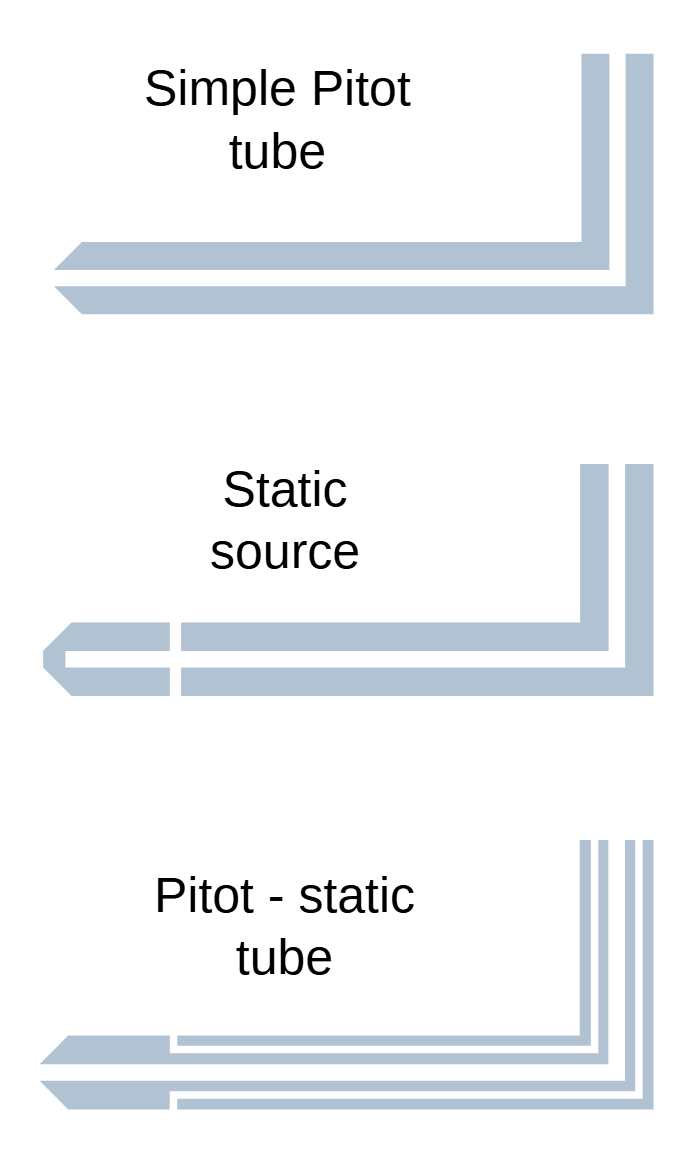
Measuring airspeed can be achieved by measuring stagnation pressure with a pitot tube, and comparing this to static pressure. This can be done at different points on the aircraft, or a pitot-static tube can be used, which measures both stagnation pressure and static pressure in a single probe. Credit: Chaos386, CC BY-SA 3.0

A key thing most aviators want to know is how fast their aircraft is going. Specifically, it’s nice to know how fast it’s moving relative to the airstream around it, which is referred to as airspeed. This is important, because it’s the aircraft’s velocity relative to the flow, such as wind, that determines the performance of the airfoils, how much lift is generated, and whether or not the aircraft is approaching a stall condition where it might fall out of the sky.

Bernoulli’s equation, rearranged to find airspeed (u), by subtracting static pressure from stagnation pressure, multiplying it by 2, dividing by fluid density, and taking the square root of that result.

Measuring airspeed is most commonly achieved with the use of a device called a Pitot tube. The pitot tube is a tube with a hole in one end that points directly into the airflow in the direction of travel of the aircraft.

As air flows in, it reaches a dead end and the flow slows to a stop, or stagnates, since it has nowhere to go. This allows a pressure sensor or a manometer or other device to measure the stagnation pressure at this point. The stagnation pressure measurement is related to the flowspeed of the incoming air since the kinetic energy of the flow is converted to pressure as the flow comes to a halt.

A secondary tube, pointing perpendicular to the airflow, is then used to measure the static pressure of the surrounding air, without the ram effect of the air being forced in by the aircraft’s forward motion. Then, it’s possible to calculate the velocity of the aircraft relative to the airstream by plugging the stagnation pressure and static pressure into a rearranged Bernoulli’s equation.  If the pitot tube and static tube are hooked up to electronic sensors, the airspeed can be calculated electronically, and fed to a display or digital gauge.

Advertisement
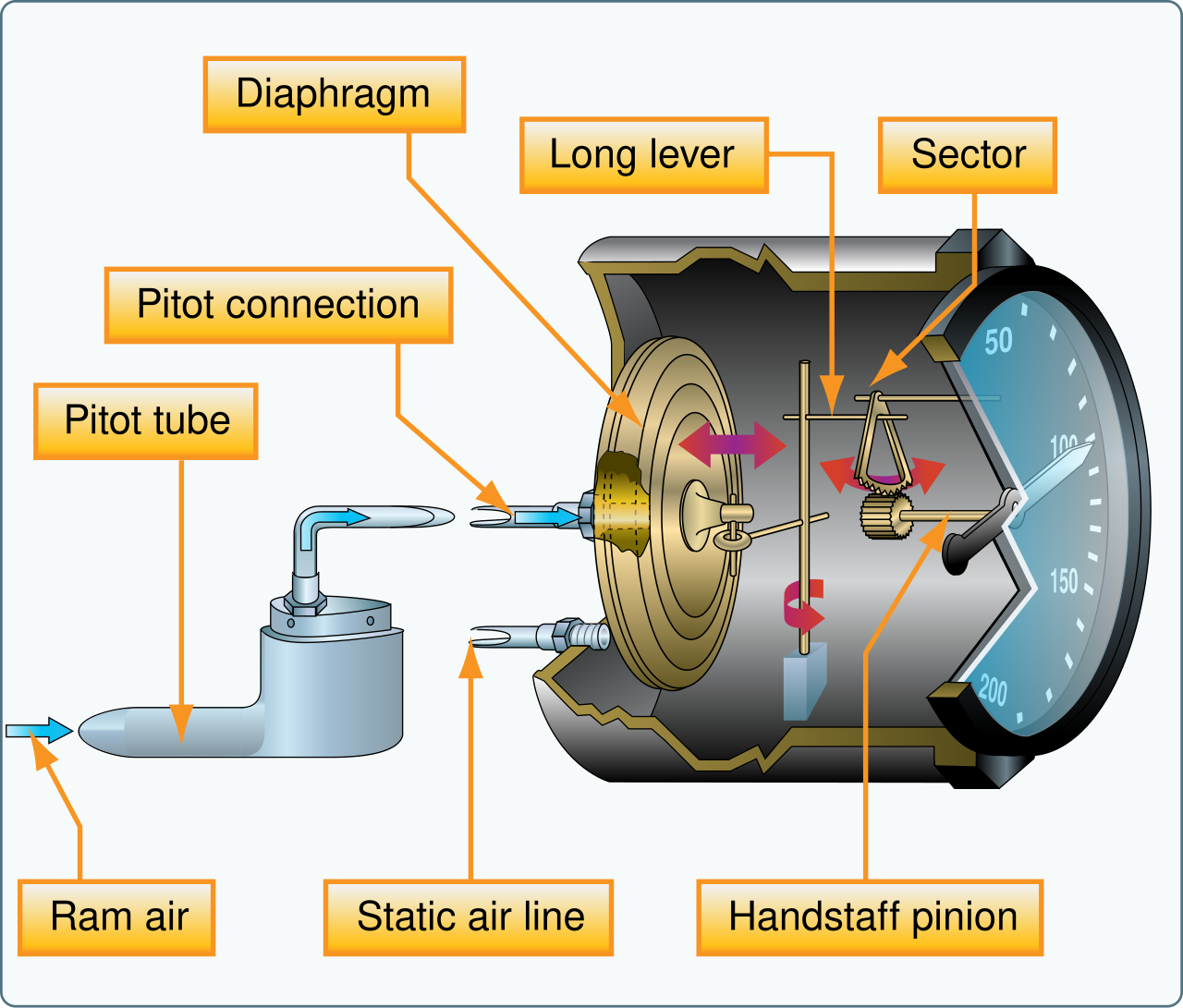
A classic airspeed indicator has the pitot tube and static tube feeding right into the gauge in the cockpit. The pressure differential causes the diaphragm to expand as the airspeed increases, which mvoes a mechanism causing the needle to move on the gauge. Credit: FAA, public domain

Alternatively, it’s possible to effectively do this “calculation” mechanically. In earlier days, static and stagnation pressure captured by each tube would be fed to a gauge. Inside, the stagnation pressure would be fed to a diaphragm which moved due to the difference relative to the static pressure which is fed into the gauge body, and the movement of the diaphragm would, via a simple mechanism, shift the needle on the gauge.

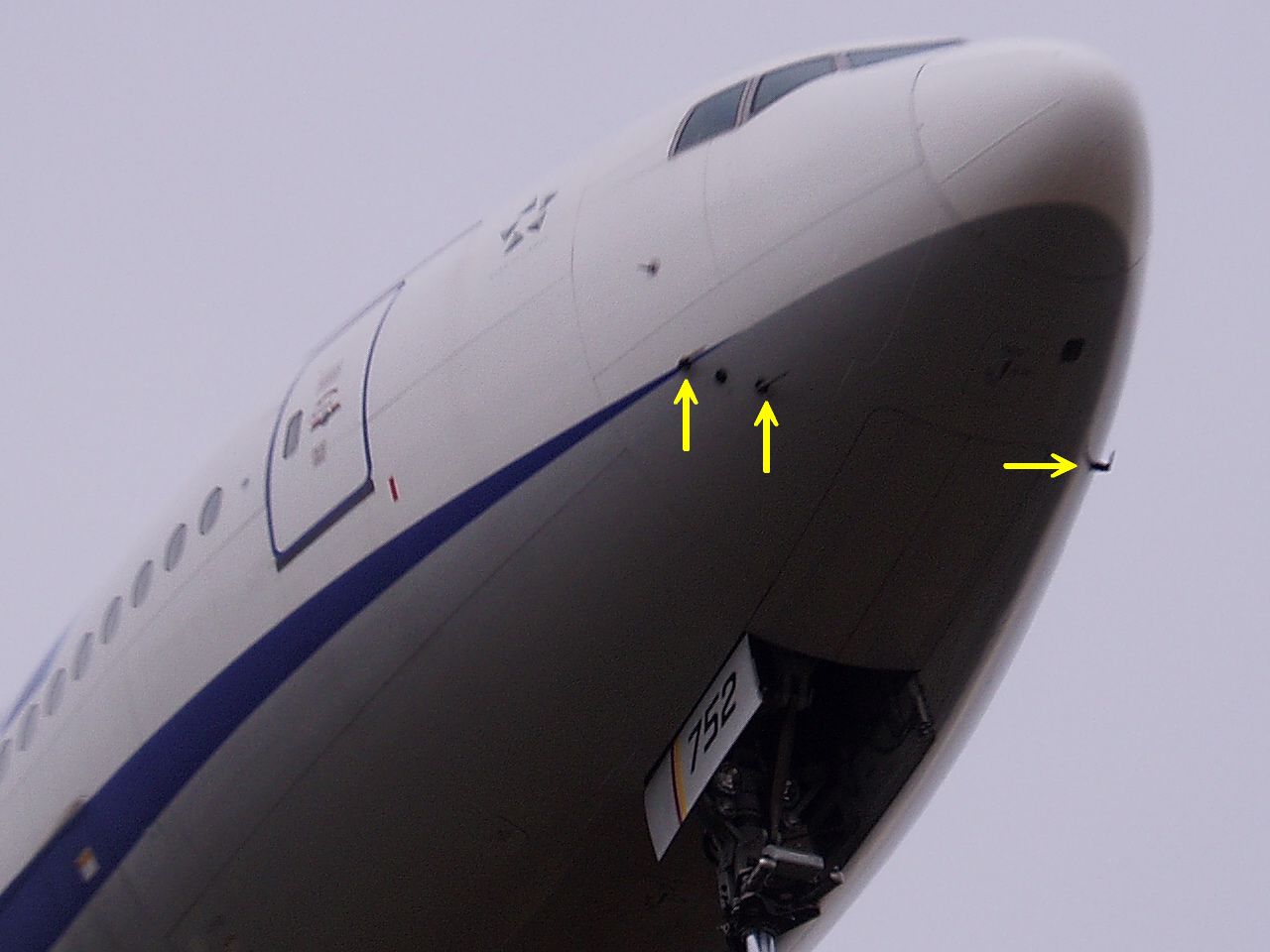
A small General Aviation aircraft might mount a single pitot tube on the aircraft, feeding the air speed instrument in the cockpit. Commercial aircraft might mount two or more for safety’s sake, in case one becomes inoperable, while large airliners may have four or even more to provide a high level of redundancy and error checking. Heaters are commonly included on pitot tubes to ensure they can be kept free of ice, which can otherwise completely block a tube and make it impossible to obtain an airspeed reading.

Pitot tubes sticking out in the airstream underneath a Boeing 777-381. Credit: Cassiopeia sweet, public domain

For pilots, not knowing how fast (or slow) the aircraft is going can be highly dangerous, as it can lead to entering unstable flight regimes such as stall. Thus, it’s imperative that the pitot tubes remain unobstructed and functional for safe flight. Many aircraft accidents have occurred because of blocked or malfunctioning pitot tubes or airspeed instruments.

The New Way

Of course, you could fuss about with pitot tubes and pressure sensors and deicing measures, but that’s all very fiddly and old hat. There is an entirely different way to figure out a plane’s speed, though it’s only been available for the last few decades. It’s as simple as throwing a GNSS receiver on the aircraft.

Yes, whether your particular poison is GPS, Baidou, GLONASS, or Galileo, any major satellite navigation system will be able to tell you the speed of your receiver. Simply measuring the change in the receiver’s position over time is enough to calculate out the speed, and any off-the-shelf receiver will present this information as standard. It’s generally not used as a primary indicator in aircraft, because it reports ground speed, not airspeed, the latter being more relevant for aviation purposes. Still, it can prove to be a useful sense check when traditional airspeed indicators are non-operative or reporting confusing data, and GNSS devices are widely used on many aircraft today.

Flying High

Many modern aircraft have so-called “glass cockpit” displays that include feeds from GNSS receivers, which can provide supplementary data such as satellite-based ground speed measurements. However, these readings are generally not used for the primary task of flying the aircraft. Credit: Bluedisk, CC BY-SA 3.0

If you’ve ever wondered how an aircraft measures its speed as it floats through the amorphous gas cloud we call an atmosphere, now you know. Even to this day, where electronics and computer wizardry control our fanciest aircraft, airspeed measurements are still done with the same simple physics, just with some fancier sensors for help. The fundamentals haven’t changed at all. Now you know, you can always dig deeper into the many other rich applications of Bernoulli’s equation and fluid mechanics in general. Happy learning.

Advertisement

Source link

Continue Reading

Tech

Meta limits Claude Code and Codex over copying fears

Published

on

Meta wants its own AI coding tools. To get there, it is telling its engineers to be careful with the rival tools they lean on today.

Meta has placed strict limits on how engineers in its applied AI division use Anthropic’s Claude Code and OpenAI’s Codex, The Information reported. The worry is inadvertent distillation. One internal memo even told some teams to pause tasks that used the outside tools. It warned that the rivals’ output could seep into Meta’s training data and trigger “serious escalations with partner companies”.

What distillation means here

Distillation is when one model learns from another model’s outputs. A company feeds a strong model’s answers into its own system, and the smaller model picks up the bigger one’s skills. The method is cheap, fast, and legally fraught.

That is the heart of Meta’s problem. The company is building its own coding tool, called MetaCode, to replace Claude Code and Codex. If its engineers rely on those rival tools while shaping the replacement, Meta could end up training on a competitor’s model by accident. That could breach the rivals’ terms of service and hand them a lawsuit.

Advertisement

The bind Meta is in

The situation is awkward. Meta still needs the best coding tools to move fast. For now, the best ones belong to Anthropic and OpenAI. So Meta is asking staff to keep using the very products it wants to leave behind, only with more caution. The rules sit inside its new applied AI engineering division, the unit Meta built to catch up in the model race.

The 💜 of EU tech

The latest rumblings from the EU tech scene, a story from our wise ol’ founder Boris, and some questionable AI art. It’s free, every week, in your inbox. Sign up now!

Cost is the other half of the story. Meta is trying to wean itself off expensive outside coding tools. It is not alone. Amazon is weighing cheaper alternatives after Anthropic raised its prices. The pressure to cut the AI bill is everywhere.

Advertisement

Anthropic keeps gaining leverage

This is the latest sign of Anthropic’s growing clout. Its Claude models have become a default for coders, which gives the company room to push. It recently struck a half-price deal to put Claude across California’s state agencies. It is also winning paying customers at pace.

The flip side is friction with the very firms that depend on it. Anthropic has already accused Alibaba of distilling Claude into a rival model. Meta clearly does not want to be next in line.

Squeezed on every side

Meta’s pinch is not only about Anthropic and OpenAI. Google has capped how much Meta can use its Gemini models for coding and chatbots, Engadget reported, citing a lack of capacity. So Meta faces limits from three rivals at once. It must build its own tools, and fast.

That is a strange place for a company of Meta’s size. It spends billions on AI talent and chips. Yet on coding tools, it still depends on the labs it is racing against. The new rules try to close that gap without tripping a legal wire.

Advertisement

Why it matters

The episode shows how the AI business is maturing. The model makers are no longer just selling access. They are guarding their outputs as prized training data, and they are watching who learns from them.

For Meta, the lesson is sharp. Owning the frontier means more than raw compute and big hires. It means controlling the tools your own engineers use every day. Until Meta’s in-house coding system is ready, it has to borrow from rivals while trying not to copy them. That is a tightrope, and the memos show Meta knows it.

Source link

Advertisement
Continue Reading

Tech

You Might Be Paying More For YouTube Premium If You Subscribed Through Apple

Published

on

Don’t get hit with the Apple tax.

Apple’s App Store is quietly a major source of the company’s revenue. Every time an iPhone user subscribes to a service through Apple’s billing platform, the Cupertino giant skims up to 30 percent off the top of each recurring charge. The practice has been so brazen that a court ruled Apple must allow third-party billing to be offered, then, last year, the same court found the company in contempt for violating that ruling when it charged developers a comparable fee to implement their own billing tools.

But app developers had already adjusted to Apple’s fee skimming long before the court case was decided. Rather than eat a 15-30 percent loss on subscription revenues, many developers simply offset those costs by charging customers more when they subscribe through the App Store. A service that might be $10 when you subscribe on the company’s website becomes $13 when you subscribe on the App Store. It’s a phenomenon that’s become known as the “Apple tax.”

YouTube Premium is a prime example. We’ve noted that some users can swap existing music subscriptions for YouTube Premium, but it’s a different story when subscribing through the App Store. Indeed, when we look at pricing for YouTube Premium, we can see Google charging an Apple Tax. When subscribed to through the YouTube website, the monthly subscription cost for an individual is $16. However, head to the App Store, and the price tag increases to $21 a month. That’s $5 leaving your wallet each month for no reason other than helping Google to cover Apple’s tolls, making it much harder to get your money’s worth from YouTube Premium.

Advertisement

Apple’s App Store is convenient for managing subscriptions, but it’s not worth paying extra for YouTube Premium

Some people prefer to bill their subscriptions through Apple’s App Store because of how predatory first-party billing can be. Once you give some companies your credit card information, it can be nearly impossible to get them out of your pocket. After digging around in settings menus to find the “cancel subscription” button, which appears deliberately hidden like Waldo, you’re made to go through three confirmation screens, presented with a special, one-time-only discount offer, and then made to fill out a survey explaining why you want to cancel. And that’s if you’re lucky. Some subscriptions from smaller outfits will make you send an email, or you might resort to replacing your credit card in order to stop the subscription from being charged.

There may be situations where paying an Apple tax on your subscriptions is worth a few extra dollars for the peace of mind that comes with the ability to cancel them in just a few taps on your smartphone. Apple would love to keep collecting its fees from your subscription, but the company also wants you to enjoy using your iPhone and is therefore not as straightforwardly incentivized to act like a gremlin with your credit card.

Even so, it’s worth saving money where you can. Thankfully, YouTube Premium makes it reasonably easy to cut off a subscription on its own billing platform. Canceling is a relatively straightforward process, and Google won’t give you much guff about your decision to stop giving it money. If you’re currently overpaying for YouTube Premium through the App Store, or if you’ve been considering signing up for the service, you’re better off doing so away from the tax collector at Apple’s walled garden gates.

Advertisement

Source link

Advertisement
Continue Reading

Tech

A hollow-core fiber cable just carried 51.3 Tb/s across 200 km

Published

on


Conducted jointly with China Telecom and optical equipment maker Dekoli, the test ran on the world’s longest cross-border commercial HCF cable. The result sets a new world record achieved without the signal boosters that long-haul fiber links typically depend on.
Read Entire Article
Source link

Continue Reading

Tech

Shark’s New Transformer Vacuum Breaks Down Into Three Different Vacuums

Published

on

I love cordless vacuums, and I don’t just say that because I’m one of CNET’s primary testers of the category. I say it because switching from corded vacuums to cordless vacuums was a big quality-of-life upgrade, thanks to the ease of use and maneuverability around my apartment. The downside is that cordless vacuums don’t usually match the suction power and cleaning capabilities of upright or canister models. 

Shark’s PowerDetect Transformer 3-in-1 is the company’s attempt to address this trade-off without forcing you to buy multiple vacuums.

“The upright vacuum has looked and worked the same way for decades,” said Petra Oman, vice president of marketing at SharkNinja, in a press statement. “We saw an opportunity to rethink the category by eliminating the bulky hose and creating a system that adapts to the way people actually clean. Transformer delivers the deep-cleaning performance consumers expect from an upright, with the flexibility and reach needed to clean everything from floors and carpets to stairs, furniture, ceilings and the car.”

Advertisement
Transformer 3-in-1 cleaning under couch

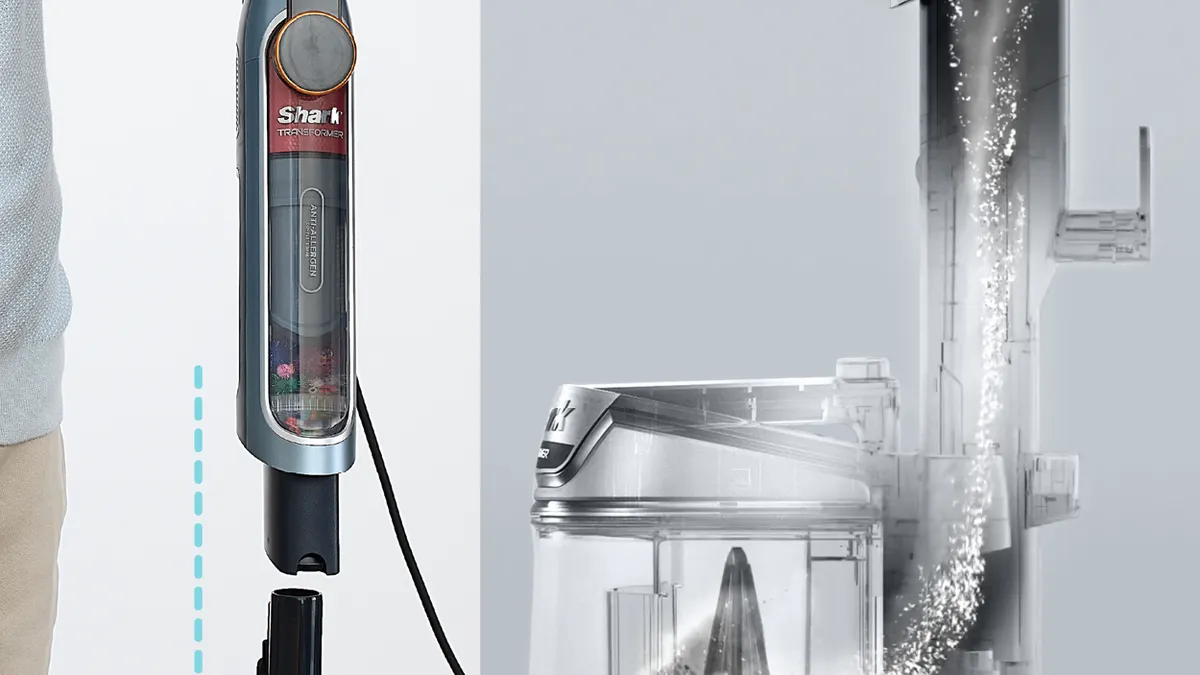
The main upright dustbin is detachable when you want to use it as a slimmer cordless vac. 

Shark

As the name suggests, the PowerDetect Transformer is three vacuums in one. It’s a full-size upright vacuum that’s intended for deep cleaning carpets and hardwood floors with the strongest suction. Shark says you can remove the main canister with one click, and it’ll turn into a slim stick vacuum for regular, lightweight cleaning, getting under furniture and into other tight spots. One more click turns it into a handheld vacuum, making it easier to clean stairs, upholstery, corners and cars. 

In terms of specs, the Transformer will have key features from Shark’s most popular models, including LED lighting to help you find debris and automatic detection of dirt levels, flooring types, edges and movement to automatically adjust suction and cleaning performance. It features anti-tangle brushrolls, odor-neutralizing tech like the Shark Stratos and HEPA filtration. It’ll also come with an auto-emptying system that empties the debris into the main dustbin when the handheld clicks back into place. 

Advertisement

I haven’t had a chance to go hands-on with this vacuum yet, and I’m not entirely sure how the system breaks down. I’ll be testing it both at home and at CNET’s Louisville lab. The most interesting question will be whether the PowerDetect Transformer can truly deliver the cleaning performance of an upright vacuum without compromising elsewhere. 

Shark Transformer cleaning across flooring types

The Transformer has all the key features we’ve liked from the most popular Shark models.

Shark

Price and availability 

The Shark PowerDetect Transformer 3-in-1 will be available on SharkNinja and TikTok Shop for $529. It’ll also come to Amazon, Walmart, Best Buy, Target, Costco and Sam’s Club. 

Advertisement

Source link

Continue Reading

Tech

Dbrand cancels Portal-inspired Steam Machine Companion Cube case after Valve legal threat, refunds buyers

Published

on


Dbrand admitted in a post that it never asked for a license from Valve to make the Companion Cube, a decision it expects to regret for a long time.
Read Entire Article
Source link

Continue Reading

Tech

PlayStation 6 bill of materials nears $1,000 as RAM shortages worsen

Published

on


Prominent leaker KeplerL2 recently claimed that the cost of manufacturing Sony’s upcoming PlayStation 6 console has increased considerably in recent months. Due to memory shortages, upcoming game consoles could cost twice as much as their predecessors did at launch.
Read Entire Article
Source link

Continue Reading

Tech

Panasonic to localise US data-centre battery production, CEO says

Published

on

The Japanese group plans to mass-produce data-centre battery cells in Kansas by fiscal 2028, redirecting a large slice of its AI infrastructure investment toward storage.

The companies that built batteries for electric cars are discovering a new and hungrier customer: the data centre.

Panasonic plans to localise production of data-centre battery cells in the United States, its energy unit’s chief executive has said, building the cells at a plant in Kansas rather than shipping them in, as the Japanese group chases a market that barely existed a few years ago.

Mass production at the Kansas site is scheduled for the financial year ending March 2029, which Panasonic counts as fiscal 2028.

Advertisement

The plant gives the company a domestic base to supply American data-centre operators directly, a meaningful advantage at a moment when tariffs, supply-chain anxiety, and the sheer speed of AI build-out have made onshore manufacturing a competitive asset rather than a cost to be minimised.

Advertisement

The money behind the move is substantial. Panasonic is directing about 350 billion yen, roughly $2.18 billion, of a previously announced 500 billion yen AI infrastructure investment over fiscal 2026 to 2028 to its Energy unit, the division that also supplies Tesla, with the remaining 150 billion yen going to its Industry segment.

The split tells you where the company thinks the growth is: the battery business that grew up around electric vehicles is being retooled to feed the server hall.

The ambition is sized accordingly. Panasonic Energy chief executive Kazuo Tadanobu described the unit’s 950 billion yen sales target for data-centre-related energy storage in fiscal 2028 as a “minimum commitment,” with the business aiming to push sales past 1 trillion yen.

For a target to be framed as a floor rather than a goal is a sign of how quickly the company expects demand to climb.

Advertisement

The logic is grounded in how modern data centres actually run. The facilities training and serving AI models draw enormous, spiky loads, and they cannot tolerate even a flicker of interruption, which makes large-scale battery storage essential for smoothing supply, bridging outages, and managing the gap between what the grid can deliver and what the racks demand at any given instant. As AI compute scales, the storage attached to it scales with it.

The cells these facilities need are also a different specification from the ones that go into cars, tuned for grid-style duty cycles rather than the range and weight constraints of a vehicle, which is part of why an established battery maker still has to build dedicated capacity rather than simply repurpose its existing lines.

That demand is already straining the systems around it. The build-out has pushed electricity grids to their limits, with operators from Denmark pausing new connections to China wrestling with how to match clean power to data-centre load, a backdrop that makes on-site storage less of a luxury than a requirement.

Batteries are becoming part of the basic plumbing of AI, not an optional extra bolted on at the end.

Advertisement

Panasonic is not moving into an empty field. Chinese battery giants including CATL are racing into the same data-centre storage market, and the competition runs alongside the broader contest over the silicon inside those facilities, where Chinese firms are pushing domestic alternatives to Nvidia at speed.

The energy layer of the AI stack is becoming as contested as the compute layer.

The US plant is one node in a wider network. Panasonic Energy also plans a third plant in Mexico, with mass production likewise targeted for fiscal 2028, giving it North American capacity on both sides of the border.

The company has not detailed the Kansas site’s output volumes or named the data-centre customers it expects to supply, leaving the commercial specifics to emerge as production approaches.

Advertisement

What is clear is the direction: a battery maker that bet its future on cars is now placing a second bet, on the machines learning to think.

Source link

Advertisement
Continue Reading

Tech

First Production Tesla Cybercab Without Pedals or Steering Wheel Begins Engineering Test Runs in Austin

Published

on

Production Cybercab No Steering Wheel Pedals Engineering Tests
Austin streets now host something that looks ordinary at first glance but represents a sharp break from everything that came before. Production Cybercab units have started engineering tests on public roads, and these vehicles carry no steering wheel and no pedals. Tesla just posted video of the tests on June 30. The footage and supporting details show the first examples built for actual use rather than pure development. Earlier cars sometimes carried temporary controls. These do not.

The Texas Department of Transportation confirmed that the production design has no driver-operated controls of any type. Inside one test model, cabin footage shows the safety monitor seated in the front position, leaving an empty space where a steering wheel and pedals would normally be. The monitor’s hands rest against their legs. No controls are within reach. The huge central screen displays the current Tesla navigation interface, which includes the route, speed, and autonomous status in a familiar simple arrangement. The automobile navigates through typical traffic, curves, and downtown streets without the driver’s input.


TZYFOQN Metal Model Cars 1 32 for Teslas Cybercab Alloy Car Model Boy Birthday Vehicle Gift…
  • Miniature models are not only vehicle replicas, but also spread the car model story and history and culture. Such as: track racing cars, sports cars…
  • The zinc alloy construction provides the body with precise contours and substantial weight; Plastic components offer flexibility and resilience…
  • The appearance of the classic car is highly restored, with special tread tires with strong grip, and the combination of retro and modern styling…

The cabin layout focuses on passengers, with two forward-facing seats in an open area created by the removal of any driving hardware. Large glass portions and a clean headliner contribute to a bright, airy atmosphere. Everything revolves around the ride rather than the act of driving. A single visible display provides both occupants with trip information and vehicle status.


Production Cybercabs are around 4.2 meters long and 1.8 meters wide, although they have usable inside space because designers were not required to package steering columns, pedal boxes, or instrument clusters. According to latest EPA data, the car has a battery capacity of roughly 48 kilowatt hours, a single front-mounted motor rated at around 219 horsepower, and a curb weight of approximately 3,113 pounds. Efficiency appears to be high, with estimates indicating 290 miles or more of real-world range in typical conditions.

Advertisement


Some models have a glossy metallic gold finish, which highlights the sleek body lines and futuristic lighting. The two-door form has distinct proportions that appear purposeful rather than dazzling. Doors are designed for quick access in a vehicle of this size. Tesla began producing these vehicles at Gigafactory Texas earlier this year. In February, the first production unit left the line. Volume manufacturing targets were set in April. The latest tests are the next step toward establishing that the entire hardware and software combination works on real roads with normal traffic.

There are presently 34 vehicles participating in the downtown Austin runs. During the validation process, everyone carries a safety monitor as usual procedure. The monitors observe and prepare for rare events that may necessitate human intervention, but they do not steer, brake, or accelerate whatsoever. What happens next depends on how these vehicles perform in the coming weeks and months, as well as the regulatory steps required for widespread unsupervised use. For the time being, seeing these control-free vehicles cruising through Austin traffic provides the clearest picture yet of what Tesla has built specifically for a driverless future.

Source link

Advertisement
Continue Reading

Trending

Copyright © 2025