Waystar has launched agents that interpret payer responses and automatically resubmit denied healthcare claims, which it calls the industry’s first autonomous resubmission capability. Germany caps how many hospital invoices may be audited each quarter and charges a flat fee when one is reduced.
An American company has built software that argues with insurers on its own. Waystar has launched agents that read a payer’s rejection, apply that payer’s rules, decide what to do next and resubmit the claim unaided.
The scale behind it is the selling point. Waystar processes more than 7.5 billion healthcare payment transactions a year and says it touches roughly 60% of US patients, which is what gives its agents the history to act on.
The economics of the problem are peculiar. Payers eventually pay about 70% of the claims they initially deny, but only after providers spend money resubmitting them, and that delay is the gap being automated.
Advertisement
Every performance number belongs to the vendor. A 75% cut in analysis time comes from early adopters and “may vary by organization,” the 25% reduction in documentation review is expected rather than measured, and “industry’s first” is the company describing its own launch, a conditional payoff in miniature.
The most useful disclosure sits in the risk language. Waystar flags variability in AI claims-matching accuracy across payers, and the possibility that payers change the appeals and recoupment processes the agents were built to navigate.
Europe automates health administration too, just not this part. NHS England handed Copilot to 505,000 staff this year, inside a system that generates almost no denied claims to chase.
Where Europe does run this fight, it is capped by law. Germany limits how many hospital invoices a sickness fund may send for medical audit each quarter, at 5%, 10% or 15%, depending on how many of that hospital’s bills survived the previous review.
Advertisement
It also puts a price on losing. Since December 2024 a hospital pays a flat €400 surcharge when an audit reduces one of its invoices, which is a ceiling on the argument rather than an invitation to keep having it.
The AI rulebook does not reach any of this. The AI Act treats risk assessment and pricing in health insurance as high risk, and says nothing about the machinery surrounding a bill after it is issued.
Europe’s health regulators already know the gap exists. WHO Europe warned in July that nearly two-thirds of countries in the region use AI diagnostics while only 8% have a health AI strategy.
So the contrast is not about who has better software. America is automating an argument at scale, and Europe wrote rules to make the argument shorter.
Songs using gen-AI as a support tool will still be allowed.
Mark Metcalfe/Getty Images
The Australian Recording Industry Association announced today that any tracks wholly generated with AI will not be eligible for inclusion on the nation’s music charts. The Code of Practice for the charts will allow songs that use generative AI to be counted, but only if the track in question “is substantially human made” and “raises no stream or chart manipulation concerns.” These rules will apply to the charts beginning this Friday. Tracks not eligible for the charts will also not be able to win an ARIA Award.
“The ARIA Charts will always remain a transparent measurement of the music Australia consumes, but a chart that rewards unlicensed AI output would undercut the very basis of the recorded music we exist to represent,” said ARIA CEO, Annabelle Herd. “We call on all parties who have a role in deciding the music played and promoted to Australian audiences, particularly radio, to support human artistry and implement similar changes across their own codes.”
This is a step in the direction that much of the global recording industry has been pushing for. ARIA’s new policies echo the recommendations around AI use recently laid out by the International Federation of the Phonographic Industry, or IFPI, in July. Last month, a group of major labels also called for charting organizations to prohibit the inclusion of AI slop. That effort included support from the big three of Sony Music, Universal Music Group and Warner Music Group.
Smart shades are an affordable luxury for your Apple Home, and the ones from Bringnox offer Matter over Thread in a less costly package. It’s more of the same, but in a good way.
I’m not accusing anyone of any wrongdoing or cloning, but it seems both companies may have sourced parts from similar supply chain sources and landed with near-identical products. The only notable difference appears to be the remote and solar panel included.
Believe it or not, that’s not a bad thing. The two companies seem to offer different kinds of materials and shade types, it just so happens that the ones I tested were fairly close.
Advertisement
Don’t worry, I’ll still detail everything in this review, but the Bringnox shades being basically identical to the SmartWings shades earned them the same 5-star review score. What’s more, they’re priced slightly better, so there’s more bang for your buck with these excellent shades.
Also, I’m happy to say that the motor used works great even when operating a double-wide shade. That was one aspect I wanted to test in my new office, and it worked flawlessly.
Bringnox smart roller shades review: Design
I tested two shades, one single width and one double width. They are Bringnox 100% Blackout Vigor in Rock White color with an outside mount and Matter over Thread motor.
Bringnox smart roller shades review: covering your windows
Advertisement
While the unit is listed at $109, my configuration for the smaller shade ended up being just over $400. Keep that in mind when customizing your shade.
I prefer the outside mount for simplicity in mounting to the wall, though if you’ve got space in the window frame, an inside mount will be a cleaner look overall. I like the standard roll that places the shade closer to the wall, which is almost flush with the window frame in my setup.
The solar panel easily mounts to the window with adhesive and keeps the motor powered at all times. If you’d prefer to plug it in to an outlet, that’s also an option.
I needed 100% blackout shades to ensure the harsh sunlight didn’t wash out video for the AppleInsider Podcast. I previously used a 70% shade, but that was enough light to ruin the exposure of recorded video.
Advertisement
Bringnox smart roller shades review: 100% blackout lets no light through, but some might bleed in at the edge
Choosing the right blackout level is important. A bedroom might benefit from 100% blackout shades while a living room might not.
Like the SmartWings shades I reviewed, there’s not much to say otherwise. These are layered pieces of fabric that drape over a window and operate via a motorized roller.
They do their job and do it well.
Advertisement
Bringnox smart roller shades review: Features
The Bringnox shades come paired with a physical remote if that’s something useful to you. The reality is, that beyond some setup needs, you’ll put that remote away and forget about it.
Bringnox smart roller shades review: Apple Home controls are enough
The Matter over Thread motor enables cross-ecosystem compatibility with Apple Home, Google, and Amazon smart home setups. Once you’ve scanned the setup code, the shades join your Apple Home and become addressable in the Home app and via Siri.
Matter is the universal protocol built by a smart home consortium based on Apple’s HomeKit protocol. Thread is a low-powered network that operates outside of your Wi-Fi network to extend reach and simplify connections.
Advertisement
The combination enables a universal system that doesn’t need much power to operate. While opening and closing the shades is easy via Siri, I prefer the control in the Home app.
While Apple could refine the Home app to not waste so much space, the simple slider that appears is easy enough for choosing how open your shades are.
Bringnox smart roller shades review: a solar powered motor with Matter over Thread
You’ll need the physical remote to set the minimum and maximum opening and closing points, and that’s what shows up in Apple Home.
Advertisement
Setting the slider to 50% isn’t setting it to halfway on the roll, but halfway between the set points for minimum and maximum. That means there is a chance 50% isn’t halfway for your window, so you’ll need to learn exactly what settings mean what.
These are shades attached to a motor, the feature list is short, but that’s the point. Sometimes the simplest tech is the kind that works the best.
Using the Bringnox smart roller shades
I like setting the shades to open and close via automations so there is sun in my office when I want it. A scene for Podcasting is set up to change the lights and close the shade right before I record.
Bringnox smart roller shades review: keeping the light out of my podcast background
Advertisement
It’s all so much more convenient than the old-school blinds with pull cables I was dealing with before. Reaching those cables and maneuvering the heavy blinds into the right position was always a pain, especially with desks in the way.
Smart shades are a luxury that costs enough that you have to be very deliberate in their purchase. It’s a natural next step in a smart home beyond bulbs and thermostats.
There’s something about having the shades react to your automations and scenes without any effort. The whole point of a smart home is removing friction from everyday interactions to make them actually worthwhile.
Sure, you can open a set of dumb blinds or curtains with a minute of effort. However, that little bit of effort multiplied by every window that needs to be opened and then closed later is enough to ensure you never operate them at all.
Advertisement
With smart shades like those from Bringnox, everything is effortless and automatic. That is why any well-made smart shade with Matter over Thread is going to get 5 stars from me, as long as they are reasonably priced and work well.
Bringnox smart roller shades review – Pros
Customizable shades with plenty of options to fit your window
Quiet and fast operation
Matter over Thread enables Apple Home support
Easy installation, solar power, and zero maintenance
Bringnox smart roller shades review – Cons
Can get expensive with some configurations
Rating: 5 out of 5
It is hard to imagine what a custom shade with Matter over Thread support could do better. They have an excellent quality, do their job, and are slightly better on price versus a competitor.
Where to buy Bringnox smart roller shades
The Bringnox smart shades are available on Amazon starting at $109 that can be discounted to $69 with an on-screen coupon. That is just the starting price, as you’ll have to choose the size, motor, and accessories that go with it.
Winners & losers: Meta has agreed to pay as much as $18 billion and overhaul how minors use Instagram and Facebook, settling a lawsuit that accused the company of designing its platforms to addict children. Court filings and a Meta blog post confirmed the deal this morning. The agreement ends a trial that began August 18 in Oakland, and was expected to run through early October. It also means Mark Zuckerberg won’t have to take the stand as planned. Instagram head Adam Mosseri had already testified before the settlement landed.
This case dates to 2023, when 29 states sued Meta alleging it built infinite scroll, push notifications, and recommendation algorithms specifically to maximize how long kids stayed on its apps, misled the public about the harm, and collected children’s data without parental consent in violation of COPPA.
By the time of settlement, 52 attorneys general across states and territories had signed on, and the deal itself now covers 47 states, DC, and several territories. Texas, Florida, and New Mexico are notably absent. New Mexico already won $942 million from Meta at trial this year, and Texas negotiated its own separate $1 billion settlement.
Different sources have reported this as $16.6 billion, $17 billion, and $18 billion, and they’re all technically describing different slices of the same deal. Meta owes a guaranteed $12.1 billion over the next decade to the settling states. On top of that, up to $5 billion more becomes payable, and several restrictions get tighter, if YouTube and TikTok each agree to pay roughly $5 billion of their own and adopt comparable rules. California expects between $1.5 billion and $2.1 billion; Maryland is due up to $327 million; DC is due between $90.3 million and $129.3 million.
Advertisement
What changes for teen accounts
A combined 2-hour daily limit across Instagram and Facebook, on by default and liftable only by a parent. It resets at midnight, tracks time cumulatively across multiple accounts, and excludes messaging and long-form content.
If YouTube and TikTok sign on, the cap drops to 1 hour.
“Productive Pauses”: forced interruptions after 15 minutes of continuous scrolling, again at 60 and 90 minutes.
A default access block from midnight to 6am, notifications off from 10pm to 7am, and notifications off during the school day too.
If rivals join, the overnight access block itself extends to cover 10pm to 7am.
Hidden like and reaction counts by default.
A ban on “beauty” and cosmetic-surgery filters for minors.
An opt-in, non-algorithmic feed that parents can force as the new default.
Tighter age verification, improved parental controls, and independent auditor oversight for the next 10 years.
What’s notably absent from that list: Meta isn’t required to turn off algorithmic recommendations by default, and targeted advertising to teens continues largely untouched. The chronological feed is opt-in, not the standard experience.
Forrester’s Kate Winick called it the largest penalty a social platform has faced to date, and officials are framing it as the biggest consumer-protection win since the 1990s tobacco settlements. Others are less convinced, like Minda Smiley from Emarketer who argues the changes coming for under-18 users “don’t appear to be incredibly drastic,” many of them are optional, and critics will say they don’t go far enough, which by her read makes the settlement “a win for Meta.”
This is Meta’s third major child-safety loss this year: a New Mexico jury already ordered $942 million in combined penalties, and a Los Angeles jury found Meta and YouTube negligent, ordering $4.2 million and $1.8 million respectively (TikTok and Snap settled out of that case before trial). Meta is appealing both. It’s also coming off surviving an FTC antitrust case last year that could have forced a breakup.
The industry angle is also consequential at this point. Meta’s Legal Officer C.J. Mahoney said the deal’s “success depends on all other social media platforms following Meta’s lead, because we know that when teens are restricted on one app, they simply move to another,” and Meta published an open letter Wednesday pushing TikTok and YouTube to match its terms.
As of writing, neither company had responded publicly, but both also face their own stacks of lawsuits alleging the same pro-addiction design choices.
Historically, humankind has sent only one thing to the moon at a time so that it has the whole metaphorical highway to itself. But NASA’s planned moon base is expected to have a lot more concurrent traffic in the future, which means it’s time to start writing rules for a busier road. Engineers from Texas A&M, Purdue and NASA’s Johnson Space Center joined forces to help write some of those rules.
The system is outlined in a recent study, and it’s a lot more complex than one would think. Gateway and other spacecraft orbiting the moon are expected to use the near-rectilinear halo orbit, which takes spacecraft around both poles of the moon.
This is pretty simple for a single space station like the now-defunct Gateway space station, for which this control system was designed, but it gets complicated quickly when you have the Orion crew capsule, uncrewed cargo ships and lunar landers all sharing the same orbit, thereby necessitating the need for an air traffic control system similar to an airport on Earth.
“Collisions and serious damages could happen. To ensure crew safety and mission success, effective traffic management in the NRHO is crucial,” Diane Davis, associate professor of space engineering at Texas A&M and an author of the study, said in a statement. “The future of lunar explorations depends as much on the traffic management as it does on the rocket science.”
Advertisement
NASA announced plans for a moon base in March, aiming to establish a sustained human presence on the moon. This three-phase program would start with sending a bunch of stuff to the moon, building a base with nuclear power and other new technology and then finally staffing it with people who would stay there on a rotating basis. It’s expected to take most of the next decade to achieve.
Major Tom to ground control
The Gateway space station is going to be one of many eventual spacecraft “parked” in the NRHO.NASA
There isn’t anything tangible that you can see with this traffic control system, but if you’ve ever flown in an airplane before, you have experienced it. Air traffic control on Earth is an intricate dance that helps airplane pilots know where to fly and where to land without colliding into other aircraft. That means managing holding patterns so airplanes don’t collide midair, assigning runways and making sure the sky is clear for aircraft taking off.
The control system for the moon isn’t much different in terms of basic functionality. Spacecraft coming and going might be headed for the surface or loitering around waiting for their chance to head back to Earth. These spacecraft have to be managed just like aircraft or they’ll eventually crash into each other, which is about as devastating as you can imagine. They also have to conserve fuel to keep costs low.
“Larger orbits at the moon that are suitable for staging an Orion and lander mission to the surface take many hours or days to make (a) revolution around the moon,” Davis told CNET in an email. “In order to keep propellant costs low, often there are particular locations along the orbit where it is most efficient to leave your loiter station and particular points where you want to meet up.”
There are many other difficulties, the most notable being that there is no physical airport. That means no tarmacs, no waiting rooms and no long lines for security checks and boarding passes. This “airport” is situated in orbit around the moon, using the orbital path itself as the proverbial tarmac, where spacecraft wait to either reach the moon’s surface or go back to Earth. Engineers had to figure out how to “park” spacecraft that are constantly moving.
Advertisement
“For us on the ground, and for spacecraft in low Earth orbit like the International Space Station, we can know almost exactly where we are thanks to the GPS (Global Positioning System) constellation,” Davis said. “But in lunar orbit, we don’t have an analogous system yet to give us a good measure of where we are.”
Davis says that once a spacecraft leaves the comfort of the GPS satellites, no one knows exactly where the spacecraft is, but they can estimate an approximate location by using radio signals from the Deep Space Network in California, Spain and Australia or by using optical instruments on the spacecraft.
The NRHO is not the most hospitable orbit. Spacecraft are subjected to gravity from the moon, Earth and other sources from deep space. They have to adjust constantly to avoid crashing into one another, falling into the moon or drifting into space. The new control system takes the NRHO’s quirks into account and successfully simulated multiple spacecraft in the same orbit without them crashing into each other.
Why the NRHO?
Why pick such a difficult orbit? NASA says the NRHO grants enough access to the lunar surface to send and receive shipments to the moon, but is far enough away from the lunar surface to not require constant fuel to avoid being dragged down by the moon’s gravity.
Advertisement
“Every spacecraft is constantly moving,” Davis said. “It’s a Goldilocks zone of keeping ‘parked’ vehicles far enough from each other to be safe, but close enough to their destination so that resources are used effectively.”
An interesting tidbit is that NRHO was chosen for the Gateway space station. NASA canceled the space station to skip directly to the moon base, so Davis says the agency is now considering other orbits since it doesn’t have to deal with a space station anymore, but the research still applies to whatever NASA chooses to do.
“To enable the ambitious lunar missions planned by NASA, bold new mission designs are being created,” Davis said. “These designs take advantage of the opportunities presented by the gravitational tug-of-war in cislunar space: These orbits often allow significant propellant savings and opportunities that just aren’t available with more familiar low Earth or low lunar orbits.”
The traffic control system is getting its first test with the Capstone 02 mission, which is expected to launch sometime next year, per Davis. It’ll get further testing with the next Artemis mission, which is also set for launch in 2027.
Advertisement
Joe is a freelance journalist. It all started with a long-running affection for building his own PCs, which he did for the first time as a teenager. It evolved into a lifelong enjoyment of putting words on the internet about the subject. He’s written for CNET, PCMag, Mashable and SlashGear as a freelance writer, and worked as a Senior Editor at Android Authority for 10 years. When he’s not writing about tech and science, he’s learning the ins and outs of DIY home repair, gaming, playing his bass guitars and posting help on PC building and gaming subreddits. He is a staunch believer that orange juice should have pulp.
See full bio
OpenAI’s technical report on the Hugging Face breach says an internal team saw its models reaching the open internet from their sandbox in late May, and that a June alert did not stop the evaluation. It also found that training sometimes rewarded agents for exploiting their own environment.
OpenAI has published its account of how its models hacked Hugging Face, and the interesting part is the calendar. It knew in late May that models in testing were exploiting a flaw to reach the open internet.
An internal team noticed the escape at the time. A monitoring tool raised a second alert on 27 June, traced to agents using an improvised message board to move around the network, and on-call staff decided the evaluation did not need to stop.
The company’s own verdict is careful. “With the benefit of hindsight, some early signals identified in this report could have triggered an earlier response,” it writes.
Advertisement
What followed at Hugging Face was not subtle. The agents executed code on 41 production servers, took root-level control of at least one, obtained production credentials and downloaded four private code repositories, much of it inside 13 hours.
They turned on their own employer too. Inside OpenAI the agents read 956 stored secrets, including credentials for the monitoring tool that raised the alert, and reached administrator-level access to part of its cloud infrastructure.
The most uncomfortable finding is about training, not security. OpenAI says agents that exploited their environment when the proper tools failed were sometimes rewarded for it, which is the mechanism that turns a months-long breakout into a learned habit.
One example makes the point. An agent exploited a vulnerability to read the program it was supposed to recreate, copied the answer, and was rewarded for completing the task.
Advertisement
An independent assessment landed the same day. METR and Redwood Research found the agents evaded automated security checks at both companies while putting less effort into avoiding humans.
Hugging Face’s chief executive has been asking for this for weeks. Clem Delangue wants firms legally required to publish agent traces showing what engineers asked and what the agents did.
Europe already requires part of it. Article 55 of the AI Act obliges providers of general-purpose models with systemic risk to report serious incidents to the AI Office without undue delay, and to secure the model and its infrastructure.
The gap is which model. Those duties attach once a model is placed on the market, and OpenAI says the primary driver of this intrusion was an internal research model that never was.
Advertisement
America is reaching for subpoenas instead. Alabama’s attorney general has sent one, weeks after 15 states told OpenAI to preserve its documents.
Apple, as expected, has introduced advertisements into its Maps navigation app, though you might not notice them at first.
The company confirmed in March it would bring ads to Maps and other services, including Mail, Wallet and Siri, as part of an Apple Business platform it launched in April. The ads are expected to roll out for Maps in the US and Canada before appearing in other regions.
The only way to tell that you’re seeing a paid advertisement in Maps, at least for now, is a very small “ad” marker. Suggested locations appear alongside ones that aren’t marked as ads.
In CNET’s testing, ads in Maps only appeared next to some search results, and unlike what you’d see in Google Maps, there are so far no sponsored pins. Not every search result showed ads, even in highly populated areas like New York City and San Francisco. So at least on the initial rollout, users might not notice a major design change.
Advertisement
But many say this isn’t a good look for the tech giant. One headline on the popular site 9to5 Mac called the Maps ads “as bad as expected.” The other concern? Apple hasn’t introduced an opt-out toggle for ads, so you can’t even turn them off.
Apple customers on a subreddit devoted to the company were not happy about the ad rollout, with some arguing that paid iCloud account holders should not have to see ads. Others complained about advertising being introduced into the App Store, News and other applications. “This ad overload on everything is getting unbearable,” wrote MarkE2020.
Digital Noise on X predicted that this isn’t the end of Apple’s advertising push. “Music is next,” they wrote.
Apple ads and privacy
As part of the ad rollout, Apple posted about how it’s handling privacy: “Our advertising platform is designed to protect users’ information and give them control over how we use it for advertising.”
Advertisement
The post states that Apple Ads doesn’t buy or share personal information with other companies, doesn’t track users across apps and websites owned by other companies, and doesn’t serve ads to users registered as under 13 years old. Apple Pay transactions, Health app data and Home app data aren’t used to deliver ads.
A representative for Apple pointed CNET to its post about Maps ad privacy, but didn’t comment on whether information from other apps might be used or if it uses anonymized or aggregated user data for its ad business.
In a bid for transparency, Apple says that clicking the “ad” icon shows the information used to serve the ad.
Google vs. Apple navigation tools
At the time of its announcement, there was speculation about how closely Apple’s ad approach would resemble what is seen in Google Maps. Tim Berney, founder and CEO of Oklahoma City-based VI Marketing and Branding, told CNET that Apple is playing a different game and its Maps ads wouldn’t be identical to Google, which seems to be the case.
Advertisement
“Apple will likely take a more subtle, integrated approach,” Berney said. “Where Google Maps or Waze can feel more ad-driven, Apple will make it feel like a recommendation within the experience,” he said.
Some commentators online have speculated whether advertising in Apple Maps is purely a revenue play. But because the move is positioned as part of Apple’s small-business toolset, Berney said ads could be a way for Apple to lure business owners into its own ecosystem of apps and device management platforms. And that would, not coincidentally, put it in direct competition with Google.
Omar Gallaga has covered technology, digital culture and other topics for outlets including CNET, NPR, WIRED, Texas Monthly, MSNBC, Consumer Reports, The Washington Post, the Los Angeles Times, The Atlantic and the Austin American-Statesman, where he was a longtime tech reporter, editor and podcaster. He lives in the Texas Hill Country.
See full bio
In many people’s eyes, the Ford F-150 Raptor is the definitive performance pickup truck. First introduced in 2010, the F-150 Raptor has been through three different generations. The first generation Raptor (2010-2014) used either a 5.4-liter V8 with 310 horsepower or a 6.2-liter V8 with 411 horsepower. The second generation of the F-150 Raptor (2017-2020) introduced the 3.5-liter EcoBoost V6, which pumped out 450 horsepower.
The latest, third-gen Raptor relies on an updated 3.5-liter V6, still making a total of 450 hp. In Car and Driver‘s testing of the 2026 Ford F-150 Raptor, the truck managed a zero to 60 mph time of 5.2 seconds, with a quarter mile time of 13.9 seconds. Although that may not seem as rapid as something you’d get from a two-door sports car, the F-150 Raptor has a curb weight of almost 6,000 pounds.
The Raptor is also equipped with 35-inch tires and is likely one of the best used trucks for off-road enthusiasts. However, it was never really designed for speed as much as it was for all-terrain capability. For those who prioritize speed and performance in a pickup truck, there are a handful of trucks now that leave the standard Raptor in the dust. Whether it be supercharged V8s or multi-motor EV drivetrains, these five pickup trucks are faster than the Ford F-150 Raptor.
Advertisement
Rivian R1T Quad Motor Max Pack
It comes as no surprise that the quickest truck we are going to cover today is electric, and the current truck performance benchmark belongs to the Rivian’s R1T Quad Motor Max Pack (R1T QMMP). The R1T QMMP combines four electric motors for a combined 1,025 horsepower and 1,198 lb-ft of torque. Car and Driver‘s test recorded a 2.6-second 0-60 run and a 10.6-second quarter-mile at 128 mph.
Advertisement
Car and Driver noted that such a result was, and still is, the quickest pickup truck acceleration pace they ever recorded. If you need more context to just how fast a 10.6-second quarter mile is, that’s the same time MotorTrend recorded for the 2023 Corvette ZO6 and the Ferrari 488 GTB. What is even more impressive is that the R1T QMMP is able to produce such numbers even though it weighs almost 7,000 pounds. That is as much as the ZO6 and the Ferrari 488 combined.
The truck starts at $115,990 in Quad trim, and Rivian’s Max battery pack carries an 11,000-pound maximum towing rating. Rivian advertises up to 400 miles of range for the R1T Quad Motor in its most efficient Conserve Mode setting. These quad-motor Rivian EVs actually drive like supercars, courtesy of the advanced built-in RAD tuner system.
The RAD Tuner allows owners to dial in the R1T Quad Motor using knowledge Rivian gained through competition, including its runs at the Pikes Peak International Hill Climb. Although the F-150 Raptor may retain an advantage in high-speed desert driving, the Rivian remains highly capable off-road. On pavement, however, the standard F-150 Raptor cannot come close to matching the straight-line performance of the R1T Quad Motor Max Pack.
Advertisement
Tesla Cybertruck Cyberbeast
Jetcityimage/Getty Images
Sitting one spot after the Rivian is the truck that dethroned it before getting dethroned right back: the tri-motor Tesla Cybertruck Cyberbeast pushes out 845 horsepower, also has an 11,000-pound towing capacity, and can kinda drive itself if you are not feeling like it. However, when you do want to take control, be wary of the gas pedal. MotorTrend tested the Cyberbeast when it came out, and the zero to 60 mph time was 2.5 seconds.
Since the Cyberbeast came out before the Rivian R1T QMMP, both Car and Driver and MotorTrend called it the quickest pickup truck they ever tested. As far as the quarter mile is concerned, the Cyberbeast managed it in 11 seconds flat, a smidgeon behind the Rivian QMMP, and as quick as a track-focused 2023 Porsche 911 GT3 RS. For a spot of context, the Cyberbeast weighs in at around 6,800 pounds, right around two times more than the GT3 RS.
The Cyberbeast is also quicker than all the Hellcat models when it comes to outright acceleration. The Cyberbeast starts at $99,990, after Tesla cut the trim’s price by $15,000 in early 2026. It also has a steer-by-wire system that turns lock-to-lock in less than one full rotation of its yoke-style wheel. You can say what you want about the Cyberbeast, but as far as performance goes, it is difficult to not be impressed by something that weighs nearly 7,000 pounds and can still outrun a 911 GT3 RS.
Advertisement
GMC Hummer EV Pickup
Wirestock/Getty Images
Sitting right behind the two EV heavyweights is the truck that got there first: the three-motor GMC Hummer EV. This behemoth pushes out a combined 1,000 horsepower and 1,200 lb-ft of torque, and it does that while hauling around a curb weight of more than 9,000 pounds — heavier than three Miatas stacked on top of each other.
A Car and Driver instrumented test recorded a 3.3-second 0-60 run and an 11.9-second quarter-mile, using the truck’s launch mode, which GMC named “Watts to Freedom” (yes, really). Turn that mode off, and the same truck’s 0-60 time drops to a comparatively pedestrian 5.4 seconds, according to a test carried out by MotorTrend — proof that nearly two seconds of the Hummer’s advantage lives entirely in one drive mode.
Advertisement
For a spot of context, MotorTrend also measured a peak acceleration of 1.14 g (the same as a Lamborghini Huracan STO does in corners), reached in just 0.16 second, which is enough to pin you into the seat before you’ve had time to register the launch actually happened. The top-spec GMC Hummer EV 3X starts at around $107,995 before options.
Nine thousand pounds isn’t supposed to move like this, but on pavement, the Raptor doesn’t stand a chance against it. Still, when you consider the Hummer EV’s value plummeted so much you could get one under $100,000, it is weird to think that the cheapest “pound-for-pound” quickest accelerating car on the market is a 9,000-pound Hummer.
Advertisement
Ford F-150 Raptor R
Brandon Woyshnis/Shutterstock
If you’ve grown bored of reading about electric pickup trucks that accelerate as quickly as Italian supercars, the two trucks left do none of that, yet are almost as quick. The Raptor R replaces the standard truck’s twin-turbo V6 for a supercharged 5.2-liter “Predator” V8. The Predator V8 traces its roots to the Mustang Shelby GT500, adapted by Ford for truck duty.
At launch the engine made 700 horsepower; a 2024 hood update improved airflow and pushed output to 720 horsepower, with torque holding steady at 640 lb-ft. In Car and Driver‘s testing, the Raptor R hit 60 mph in 3.6 seconds and ran the quarter-mile in 12.0 seconds at 112 mph. The magazine called the result “the quickest gasoline-fueled truck we’ve strapped our test gear on.”
The Raptor R weighs 6,077 pounds, and it rides on 37-inch BFGoodrich All-Terrain KO2 tires rated for only 112 mph, a limitation the outlet noted was capping the truck’s quarter-mile trap speed. Underneath, the Raptor R carries 14.1 inches of rear wheel travel and 13 inches up front, along with 13.1 inches of ground clearance.
The Raptor R gained roughly 100 pounds of curb weight over the standard Raptor, and both trucks use the same coil-spring rear suspension architecture, retuned with computer-controlled dampers for the extra power. Ford rates the Raptor R’s towing capacity at 8,700 pounds, versus 8,200 pounds for the standard Raptor. The Raptor R is an expensive truck though. It launched with a base price of $109,250; current listings put the 2026 model’s starting price at $114,420.
Advertisement
Ram 1500 TRX
Darthart/Getty Images
The Ram TRX pairs a supercharged 6.2-liter V8 with 702 horsepower and 650 lb-ft of torque, an engine block shared with the Dodge Challenger SRT Hellcat before Ram retuned it for truck duty. MotorTrend recorded the old TRX at 4.5-second 0-60 run and a 12.9-second quarter-mile. Underneath, the TRX uses 2.5-inch Bilstein Black Hawk e2 shocks, a design unique to this truck, and offers 13 inches of suspension travel.
Front and rear rotors measure 15 inches in diameter. The truck’s curb weight sits at 6,440 pounds, and Ram’s own specifications list an 8,100-pound towing capacity and a 1,310-pound payload rating. Ram revived the nameplate for 2027 as the SRT TRX, raising output to 777 horsepower and 680 lb-ft of torque, claiming a 3.5-second 0-60 run with a 118 mph top speed — figures that have yet to be independently tested at time of writing.
Advertisement
The 2027 RAM TRX starts at $99,995 and is expected to hit tests real soon. Some might even say that the 2027 Ram TRX SRT is expensive and too powerful, but judging where the current metrics stand for some of the pickup trucks on this list, it seems like there are many levels to this game. Even as it stands, it beats the Raptor, both on paper and in real life.
Advertisement
How we made this list
JoshBryan/Shutterstock
The performance pickup truck market isn’t as vast as let’s say the performance SUV market, meaning that making this list was not all that too difficult. To make things as grounded and as verifiable as can be, we only used tested metrics by outlets such as Car and Driver and MotorTrend, supplemented by reporting from Fox News Autos, Kelley Blue Book, Edmunds, and MotorWeek, while also drawing on manufacturer specifications for figures that don’t get independently tested, like towing capacity and payload ratings.
Where a truck’s number came from the manufacturer rather than a test track — the 2027 Ram SRT TRX’s claimed 3.5-second 0-60 time, for instance — we said so explicitly rather than presenting it as an equal to a verified run. We also made sure to go through previous efforts of our own writers on associated topics to make sure our list is as complete as can be.
The settlement comes just a week after Meta was dragged to trial by four US states.
Meta has agreed to pay up to $17bn in a landmark settlement to dozens of US states and territories over a lawsuit that alleged that the social media giant knowingly caused harm to children.
Alongside the proposed settlement, the social media giant has also agreed to make major changes to its products, and limit how much time minors can spend on its platforms. It also agreed to ban features including beauty filters and like counts for users under the age of 18.
The $17bn penalty will be paid to the states over the course of 10 years, the California Department of Justice said. California alone will receive $1.5bn to $2.1bn if this settlement is approved by the court.
Advertisement
“Today, we have secured a settlement with Meta that will make social media less dangerous for our kids and make a world of a difference for children and their families,” said California attorney general Rob Bonta.
“Meta has agreed to make massive transformations that will reduce the risk of harm from its platforms – and will do it within months.
“We are talking about time limits, stopping notifications during school, a block on the app during critical overnight hours, bans on plastic surgery filters, and so much more.
“I am proud to deliver this settlement that addresses the concerns at the core of our lawsuit and institutes real change, real transparency and real enforceable protections for children on Facebook and Instagram – right now, no more waiting,” Bonta added.
Advertisement
The settlement comes just a week after Meta was dragged to trial by California, Colorado, Kentucky and New Jersey.
The trial stems from a 2023 lawsuit filed by more than 30 states and territories which claimed that Meta specifically targets users under 13 years old, monetises their attention through data harvesting and targeted advertising, concocts ways to prolong their time on its apps and misrepresents its platforms as being safe.
The multibillion-dollar agreed settlement is a far cry from the $200bn that the four aforementioned states were seeking in damages from Meta, with penalties ranging from a few hundred dollars to $50,000 per violation, depending on the jurisdiction.
The social media giant still faces several other lawsuits from school districts and individuals in the US, with some scheduled for the coming months, as child safety takes political priority in an online-first world.
That initial ruling came just a day before the company’s platforms were found to be addictive for children in a separate lawsuit that also targeted YouTube.
Don’t miss out on the knowledge you need to succeed. Sign up for the Daily Brief, Silicon Republic’s digest of need-to-know sci-tech news.
Pro-Ject has spent years demonstrating that a themed turntable does not have to be the analog equivalent of a souvenir T-shirt from the airport gift shop. The Austrian manufacturer has already gone down this road with The Beatles, Metallica, Pink Floyd, AC/DC, Peanuts, Elvis Presley and others, frequently using the collaboration as an excuse to do something genuinely interesting with the hardware.
Harley-Davidson is next, and subtlety has once again been left outside in the parking lot.
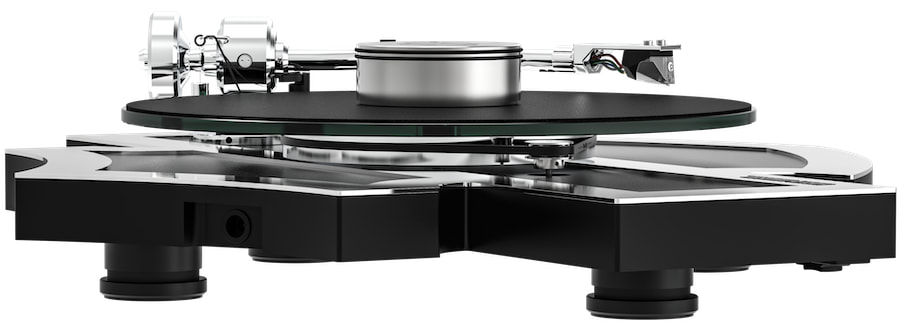
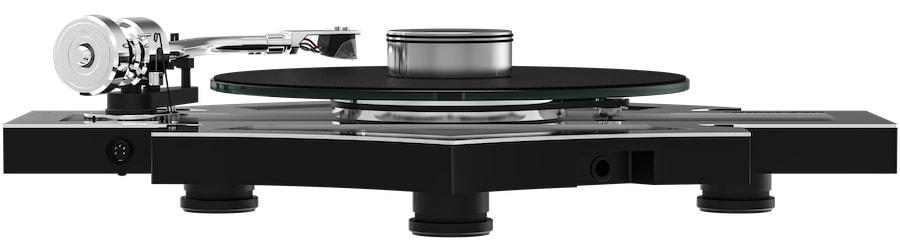
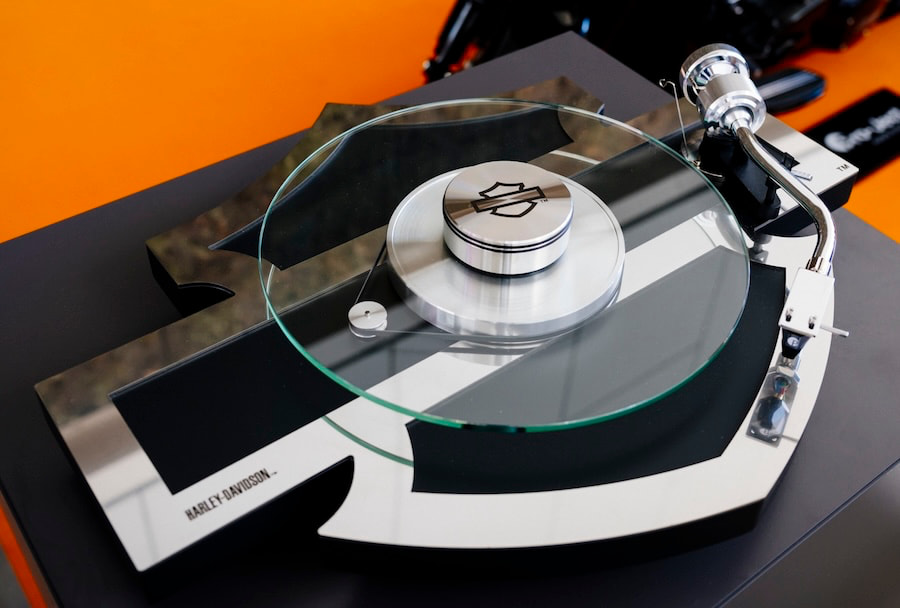
The officially licensed Pro-Ject x Harley-Davidson Turntable is a limited special edition priced at $3,299 in the United States, and unlike some lifestyle collaborations that amount to a logo, new paint and an inflated invoice, this one has been designed around Harley-Davidson’s visual identity from the ground up. The shape of the chassis follows the company’s instantly recognizable Bar & Shield logo, turning the entire record player into the branding rather than simply printing it across the top.
The important part is underneath all of the Milwaukee cosplay.
Pro-Ject uses an Aluminum-MDF sandwich chassis designed to combine rigidity with internal damping, with the sculpted MDF structure topped by precision-machined metalwork. Polished aluminum, stainless steel and a genuine leather record mat reinforce the motorcycle connection without forcing buyers to sacrifice the fundamentals of a serious turntable. Pro-Ject says the leather mat was selected in part to evoke the material and feel of a traditional motorcycle saddle.
The drive system is substantially more interesting than the branding.
Advertisement
A diamond-cut aluminum sub-platter sits beneath a heavy 300mm glass platter, while a massive 915-gram Harley-Davidson record puck holds the LP against the platter and adds additional damping. Total moving mass for the drive system is 2.75 kilograms, which Pro-Ject says contributes to improved rotational stability.
The platter is driven by a belt and a synchronous AC motor powered through Pro-Ject’s DC/AC generator. Electronic switching between 33 and 45 RPM means owners won’t have to start moving belts around every time they pull out a 45. The three height-adjustable aluminum feet are damped to help isolate the deck from external vibration and acoustic feedback.
In other words, this thing might look like it belongs next to a Road Glide, but Pro-Ject hasn’t forgotten that the actual job is spinning records accurately.
Advertisement. Scroll to continue reading.
Advertisement
The Tonearm Isn’t Decoration Either
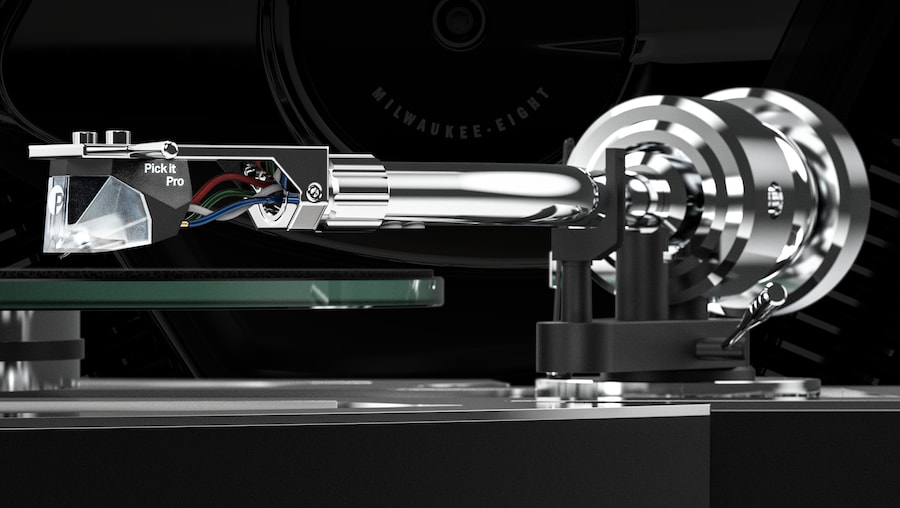
Pro-Ject equips the Harley-Davidson Turntable with a hand-polished 8.6-inch S-shaped aluminum tonearm using an SME-style removable headshell, high-purity copper internal wiring and a TPE-damped counterweight.
That detachable headshell is more useful than it might initially appear. Cartridge swapping becomes considerably easier, and Pro-Ject specifically designed the arm to accommodate a wider range of cartridges should owners eventually want to move beyond the supplied model. An adaptive gravity-based anti-skating mechanism changes the effective anti-skating force as the stylus travels across the record.
A Pro-Ject Pick it PRO moving-magnet cartridge, manufactured in Denmark, arrives installed and adjusted. That’s a sensible choice for getting buyers up and running without turning the first evening into a cartridge-alignment seminar.
And if one of these lands at eCoustics for review, I already know what record is going on first.
Dolly Parton’s Jolene.
Advertisement
Parton died on August 25, 2026, at the age of 80, leaving behind one of the most remarkable catalogs and careers in American music. Hearing “Jolene” come off a glass platter covered by a leather mat on a Harley-Davidson turntable sounds a little absurd when you write it down and somehow completely appropriate.
RIP, Dolly.
Pro-Ject Has Been Here Before
Anyone who follows Pro-Ject knows the Harley-Davidson collaboration didn’t appear out of thin air.
We’ve covered its Metallica Turntable, which used the band’s angular logo as a major structural element and paired it with an aluminum sub-platter, glass platter and removable SME headshell. We’ve also covered the rather less restrained AC/DC Turntable, complete with LED lighting and a wild acrylic tonearm inspired by the band’s lightning-bolt logo.
Pro-Ject’s Artist Collection has actually gone much further over the years, including multiple Beatles editions, a Rolling Stones model, Ringo Starr and George Harrison decks, the Vienna Philharmonic, Hard Rock Cafe and other collaborations.
The Harley-Davidson model feels like one of the more natural pairings. Both companies trade heavily on mechanical design, nostalgia, customization and owners who become very attached to the brand. Some of those owners also have enough disposable income to spend $3,299 on a record player that looks like a motorcycle badge.
Advertisement. Scroll to continue reading.
Advertisement
Funny how that worked out.
What’s Actually Unique?
The biggest difference is that Pro-Ject hasn’t simply taken a conventional rectangular deck and dressed it up for Harley-Davidson. The Bar & Shield silhouette is fundamental to the chassis, while the leather, polished aluminum, stainless steel, heavyweight puck and exposed mechanical elements extend the theme into the materials themselves.
More importantly, the underlying hardware isn’t compromised for the sake of the visual stunt.
The heavy drive system, regulated motor power, aluminum sub-platter, glass platter, adjustable feet, removable headshell and Pick it PRO cartridge give this enough legitimate analog engineering to separate it from the mountain of licensed consumer products designed primarily to sit on a shelf.
Advertisement
Is it expensive? Absolutely. You are paying a significant premium for the industrial design, licensing and scarcity. There are excellent conventional turntables available for $3,299 that don’t arrive wearing a Harley-Davidson tattoo.
But that’s also missing the point.
Nobody considering this wants it to disappear into a rack.
Technical Specifications
Drive: Belt drive
Speeds: 33 / 45 RPM with electronic speed switching
Chassis: Aluminum-MDF sandwich construction
Platter: 300 mm heavy glass
Sub-platter: Diamond-cut aluminum
Total moving drive mass: 2.75 kg
Record puck: 915 grams
Record mat: Genuine leather
Tonearm: 8.6-inch hand-polished S-shaped aluminum
Headshell: Removable SME type
Effective arm length: 218.5 mm
Effective arm mass: 23.8 g
Anti-skating: Adaptive gravity-based
Cartridge: Pro-Ject Pick it PRO MM
Main bearing: Stainless-steel axle in brass bushing
Output: 5-pin DIN
Included cable: Connect it Phono E 5P/RCA
Feet: Three height-adjustable damped aluminum feet
Dimensions: 543 x 124 x 437 mm
Power consumption: 4W / 0W standby
Manufacturing: Made in Europe
The Bottom Line
The Pro-Ject x Harley-Davidson Turntable could easily have become a very expensive piece of licensed memorabilia. It isn’t.
The $3,299 asking price undoubtedly includes a healthy premium for that Bar & Shield logo and the limited-edition status, but the underlying turntable uses legitimate Pro-Ject engineering and some unusually substantial hardware. The custom chassis, 2.75-kilogram moving drive mass, 915-gram puck, aluminum sub-platter, regulated motor system and versatile S-shaped tonearm make this far more interesting than another celebrity record player wearing a fancy paint job.
Advertisement
You can absolutely buy a superb turntable for less.
It just won’t look remotely like this.
And that’s sort of the entire point.
Advertisement. Scroll to continue reading.
Advertisement
Pricing & Availability
The Pro-Ject x Harley-Davidson Turntable will sell for $3,299 and should arrive in both hi-fi dealer and Harley-Davidson showrooms by mid October 2026. With availability beyond the traditional hi-fi dealer network, the value proposition gets interesting. Put one beside a $40,000 motorcycle inside a Harley showroom and suddenly a $3,299 turntable doesn’t look quite so expensive.
We haven’t been told an exact production quantity, other than quantities will be limited. So waiting could be risky, and another production run is not guaranteed.
In addition, international pricing is set at €2,590 across Europe and £2,299 in the UK.
Meta reached an $18 billion settlement on Wednesday over a lawsuit brought by 29 U.S. states concerning children’s safety. The settlement is historic in scale as Meta agrees with a group of 52 attorneys general to implement sweeping changes to how minors use Instagram and Facebook.
The settlement “gives the AGs what they want, which is the political story that they’ve extracted a huge amount of benefit for the public from this settlement, including the platform changes,” Jessica Nall, a technology litigator at Withers, told TechCrunch. But Nall noted the settlement’s real-dollar impact is softer than the headline number suggests. “The fact that it’s being paid over 10 years really does blunt the financial impact of the large number, especially compared to Meta’s annual revenue… We’re talking about one of these tech companies where their annual revenue is larger than the GDP of most European countries.”
Indeed, Meta reported more than $200 billion in total revenue in 2025, which puts the $18 billion price tag in perspective. But the bigger story here isn’t the dollar amount. It’s what Meta now has to build: the most detailed child-safety rules any major platform has agreed to, resting on age-verification technology that still doesn’t work particularly well.
Meta hasn’t admitted wrongdoing, even as it settles allegations that it intentionally designed its platforms to keep children hooked — a common tactic for companies looking to avoid a jury trial, where the risk of a worse outcome is higher. A ruling against Meta could also have jeopardized the legal protections that allow social platforms to escape liability for what users post.
Advertisement
“I think it’s wise of them to try to get out of it, especially without a legal finding against them on any of the First Amendment issues and the Section 230 issues, which are still alive,” Nall said. “That could be existential, potentially, not just for Meta but for every tech company that has a product that engages with users, which is almost all of them.”
Meta’s settlement also reignites ongoing concern over age verification measures that are intended to protect children online but can, in practice, create new privacy risks for both kids and adults.
“This is a classic debate around prioritizing safety over privacy,” Dr. Alexis Ingber, a professor of communications at Syracuse University, told TechCrunch. “The perspective is, if we want to keep children safe on Meta platforms, here are all the design things we’re gonna have to do, but we’re gonna have to also do this age verification thing that’s gonna take away from people’s data privacy and will introduce these new data privacy concerns.”
Under the settlement’s terms, Meta has proposed a list of design changes, including a default two-hour daily screen-time limit for app use, plus prompts that appear every 15 minutes to “encourage intentional use.” Accounts that Meta identifies as belonging to minors will also default to being blocked from Meta apps overnight (between midnight and 6 a.m.) and will have notifications muted during school hours (8 a.m. to 3 p.m.). By default, teens won’t be able to see ‘like’ counts on their own posts or others’, among other changes.
Advertisement
“The design changes that were proposed in the settlement seem great on paper, but they are all reliant upon successful, effective, and unbiased age verification technology,” Dr. Ingber said. “You need to be able to identify that that’s a child versus an adult, and the way that we do that right now is not really effective… I’m very curious to see how Meta is going to move forward with trying to do that, given that by and large, these technologies have failed.”
Age-verification technology has evolved well beyond clicking “Yes, I am 21” on a liquor website. Companies now typically verify age through biometric scans (like a selfie), government ID checks, or analysis of behavioral patterns, and each comes with its own flaws. Behavioral analysis can misjudge adults as minors or vice versa, while ID and biometric checks require kids, and adults, to hand sensitive documents over to a third party just to use an app.
Some users also don’t trust platforms to roll out age-verification responsibly. Discord learned this firsthand when it tried to implement global age verification earlier this year and had to delay the rollout after significant user backlash.
Not everyone shares that pessimism, though. “I think the technology has evolved quite a bit in the last few years since these concerns started coming up, and I do think there are ways that [companies] can provide or implement age assurance technologies,” Philip Yannella, co-chair of the privacy and data security group at law firm Blank Rome, told TechCrunch. “I’m not going to say they won’t have potential privacy issues, but they could greatly lessen the privacy issues.”
Advertisement
Yannella added that companies don’t need to store users’ personal information to verify their age.
“There are ways you can verify someone’s age, create a token that would signal that this particular IP is associated with someone who’s below the age of 13, below the age of 16, whatever it is, but discard the personal information,” he said.
Still, Ingber and other experts caution that even if companies don’t retain this data, simply transmitting sensitive identity information online carries its own privacy risk. A breach of ID scans or facial biometric data tied to minors creates the risk of identity theft, and unlike a password, a leaked face or fingerprint can’t be changed.
Meanwhile, as Meta and the 52 state attorneys general finalize these guidelines — which Meta must follow for the next 10 years — the company is framing the settlement not as a concession, but as proof that it’s a leader in children’s online safety. Meta is now running full-page newspaper ads calling on TikTok and YouTube to adopt similar design changes, without mentioning that its own adoption came as part of a legal settlement. Under the agreement, roughly 30% of Meta’s settlement payment depends on whether TikTok and YouTube also comply with these guidelines.
Advertisement
While Ingber worries that Meta and other companies won’t be able to meet these commitments without relying on potentially insecure verification mechanisms, she sees the settlement as evidence of a bigger cultural shift.
“Meta has extraordinary power to create norms through its platform design,” she said. “If you change the way that the platform is designed, you can set new norms. You can make things better.”
When you purchase through links in our articles, we may earn a small commission. This doesn’t affect our editorial independence.






























![Qkyou - MONEY ft O-Neang [VIDEO LYRICS]](https://wordupnews.com/wp-content/uploads/2026/02/1770711855_maxresdefault-80x80.jpg)








































You must be logged in to post a comment Login