







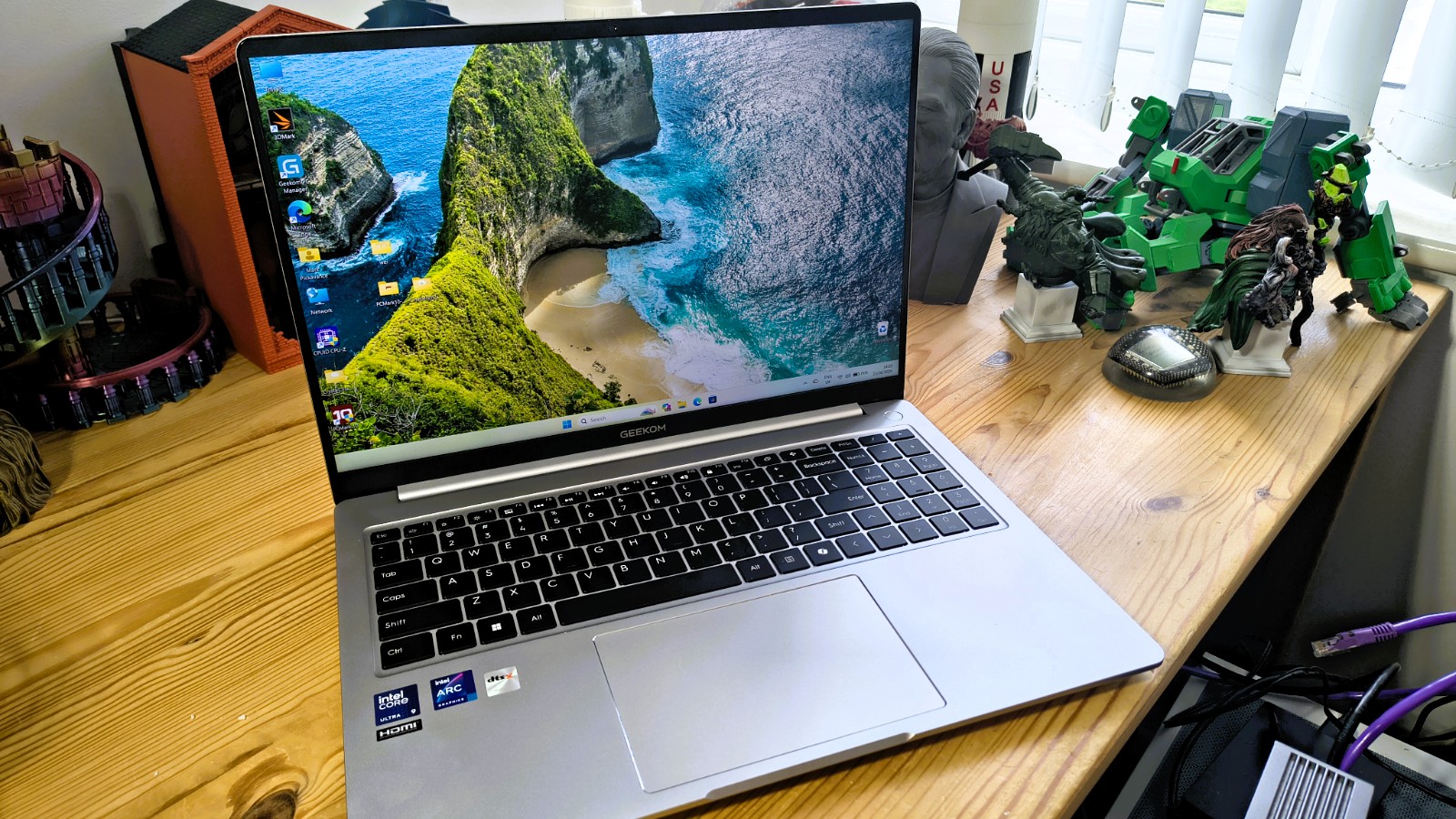
Geekom GeekBook X16 Pro: 30-second review
Before we all get confused, and I well might be, Geekom is selling the GeekBook X16 Pro laptop series in the USA, but it most likely isn’t the model that they supplied me for review purposes.
According to Geekom’s own website, the retail hardware comes with either a Core Ultra 9 185H or a Core Ultra 5 125H CPU, both mobile chips from Intel’s 100 series stable.
These machines come with 32GB of LPDDR5X memory and 2TB of SSD storage, sport Arc graphics and AI Boost.
That’s a decent amount of power for a laptop, and to keep the 16-inch 2560 x 1600 resolution IPS panel running through a working day, it has a 77Wh battery inside.
My review hardware had the same Core Ultra 9 platform and screen, less RAM and storage, but more battery capacity. Apparently, this design went through some late changes, and considering how heavy the review machine was, many of these were positive changes.
The cost savings Geekom made to offer this laptop at the modest asking price of around $1350 mean there is only one USB4 port, the webcam is only 2MP, and the keyboard and touchpad aren’t the best quality.
How much those things impact you will depend on how you are likely to use it, but this laptop isn’t built to the level of a $2000 machine from Acer, Dell, HP or Lenovo.
That said, the underlying platform is solid, even if you can’t expand the memory, and with a USB 4.0 port, it can be attached to a Dock if you need more ports or more than two displays.
Geekom includes a basic USB-C Dock in the box, so those who need a wired LAN port won’t need a full Dock or adapter.
This isn’t the best business laptop I’ve tested, but it’s far from the worst, and demonstrates that you can get relatively recent platforms in these form factors if you are prepared to compromise on some aspects.
Geekom GeekBook X16 Pro: Price and availability

- How much does it cost? From $999
- When is it out? Available now in the USA
- Where can you get it? Direct from Geekom or online retailers
Geekom built its name on mini PCs, and the GeekBook X16 Pro is one of its first proper laptops. It launched primarily in the United States, where pricing has swung widely between around $949 and $1,599 depending on configuration and whatever promotion happens to be running that week.
At the time of writing, it can be bought directly from Geekom or via online retailers like Amazon.com and Best Buy.
The review unit supplied pairs the Intel Core Ultra 9 185H with 16GB of RAM and a 1TB drive. This does not match either of Geekom’s advertised configurations, which list the Ultra 9 185H alongside 32GB of RAM and 2TB of storage, or the Ultra 5 125H with 32GB and 1TB.
In the US, the Ultra 9 model with 32GB of RAM and 2TB of storage costs $1,349 directly from the maker, the same price at which it can be bought from Amazon.com. The Ultra 5 option with the same 32GB and 1TB of RAM is $999.
The price on Best Buy for the Ultra 9 model is the same $1,349, but curiously, Newegg is asking $2,086.99 for the same hardware.
As Geekom is not a brand with the kudos of other laptop makers, it would seem reasonable to assume that it would undercut the better names. And, it does in general.
But that’s mostly because the big names have moved on to either Ultra 200 or 300 class processors, and therefore, what they’re offering is more powerful.
As an example, the Dell 16 Plus sells for $1429.99 in the USA. It comes with 16GB of LPDDR5X RAM and 1TB of storage. But critically, it has an Ultra 7 256V processor and that comes with ARC graphics. Admittedly, boosting that to 32GB of RAM will jump it to $1,899.99, but you do get a touch screen with that model.
If the Geekom X16 Pro were closer to $1000 for maybe a Core Ultra 7 class CPU, it might be a better value, but from a corporate viewpoint, it needs to be a better deal to push an Intel platform that is already a couple of generations back.
Geekom GeekBook X16 Pro: Specs
|
Item |
Spec |
|
Hardware: |
Geekom GeekBook X16 Pro NM16DM (review hardware) |
|
CPU: |
Intel® Core Ultra 9 Processor 185H (16 Cores, 22 Threads, 5.1 GHz) |
|
GPU: |
Intel Arc GPU |
|
NPU: |
Intel AI Boost (35 TOPS CPU+NPU+GPU) |
|
RAM: |
16GB LPDDRX5 (no upgrades) |
|
Storage: |
512GB M.2 PCIe 4.0 SSD + M.2 2230 free slot |
|
Screen: |
16.0-inch IPS LCD, 2560 × 1600 (16:10) |
|
Ports: |
1x USB4, 1x USB-C 3.2 Gen 2 (10Gbps) , 2 × USB-A 3.2 Gen 1 (5Gbps), 1x HDMI 1.4, Audio Combo Jack |
|
Camera: |
2MP (1080p) Windows Hello compliant |
|
Networking: |
Wi-Fi 6E, Bluetooth 5.4 |
|
Dimensions: |
353 mm × 249 mm × 6.9 mm |
|
Weight: |
1.750kg |
|
OS: |
Windows 11 Pro (pre-installed) |
|
Battery: |
99.99Wh Battery |
|
Power supply: |
100W (20V 5A) |
Geekom GeekBook X16 Pro: Design

- Magnesium-aluminium chassis
- Diverges from the retail model
- Ports aren’t labelled
Let’s start by saying that the GeekBook X16 Pro sent to me deviated from the specifications presented for the retail model in several significant ways.
Firstly, it has 16GB of RAM, whereas all retail SKUs have 32GB, and it has 1TB of storage, which isn’t available on the model with the Core Ultra 9 processor.
The biggest difference with my hardware was that it wasn’t the same weight as the retail model is quoted to be, and the reason is undoubtedly that it had a 99.98Whr battery, not the 77Whr that Geekom mentions in the specification.
The specs also mention a MicroSD card slot, but that wasn’t on the review machine.
It’s my assumption, and I can be wrong, that the rest of this equipment is roughly the same as the retail version, but there are no guarantees here.
Geekom has machined the GeekBook X16 Pro from a single piece of magnesium alloy, and that heritage shows in the finish. The Titanium Gray coating feels warm rather than cold to the touch, and there is no flex anywhere across the lid or the keyboard deck. While not the highest quality finish, it doesn’t feel cheap either.
Where the design pitch starts to wobble is the weight. Geekom lists the X16 Pro at 1.27kg, a figure that would make it one of the lightest 16-inch laptops around. The review unit weighs a whopping 1.75kg on the scales, nearly half a kilogram heavier than advertised, and that difference is obvious the moment you lift it one-handed. A laptop sold on featherweight portability should not feel like this in the hand.
This weight discrepancy, I’m confident, is down to the battery that Geekom used in the review hardware. Which is much larger than the one that is on the official spec sheet.

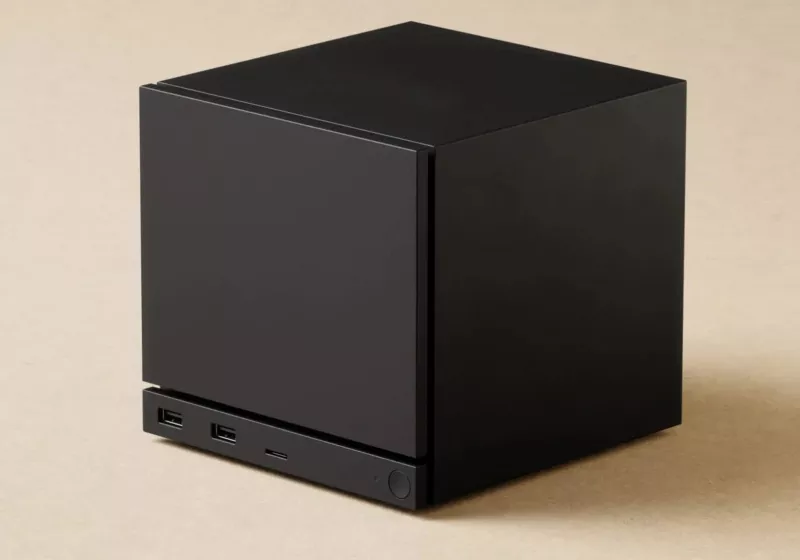
Port selection is generous for something this slim, with two USB-C connections, two USB-A, a full-size HDMI, and a headphone jack.
The frustration is that none of them is labelled with a speed. One USB-C runs at USB4 and the other only at USB 3.2, and there is no visual way to tell which is which, short of plugging something in and checking. For a laptop aimed at people who might use a fast external drive or a high-bandwidth dock, that is a genuine oversight from Geekom, and worth calling out plainly rather than glossing over.
The keyboard includes a full number pad, which is a genuine convenience on a 16-inch chassis and something plenty of rivals leave out. Typing feel is a little on the spongy side rather than crisp, so anyone coming from a firmer keyboard may need a short adjustment period.
The keyboard is workable, but I’m less convinced by the trackpad. It does the job for general navigation and gestures, but it does not feel as refined as the rest of the machine, and precision clicking is not its strong suit.
Those buying a 16-inch laptop clearly want a good display, and the IPS panel on this machine offers 2.5K resolution, a 16:10 aspect ratio, and a 120Hz refresh rate. That extra vertical space suits spreadsheets, documents and code far better than a standard 16:9 screen, and scrolling feels smooth thanks to the higher refresh rate.
Geekom quotes 100 per cent sRGB coverage, which is close enough for everyday creative work without needing a colour-calibrated reference screen.

Since many business machines get small upgrades during their working life, I like to take the backs off laptops to see what is possible on that front.
Removing the underside requires removing nine screws with a T5 screwdriver, but once they’re out, it’s relatively easy to detach. Inside, the battery can be replaced, and there is an unoccupied M.2 2230 slot. While the 2230 drive is an easy upgrade, the primary slot is 2280, so I’d probably recommend cloning the supplied drive to a larger one using that slot first.
The capacities of M.2 2230 aren’t great right now.
Also, these days, all memory comes pre-soldered, so the RAM in this system is the maximum it will ever have, even if the processors used on it can address 96GB.
Overall, this is one of those designs that is somewhat bland and lacks any sort of signature feature, but for many customers, that’s exactly what they want.

Geekom GeekBook X16 Pro: Hardware
- Intel Core Ultra 9 185H
- Modest AI capability
- Wasted PCIe lanes
The Intel Core Ultra 9 185H is the flagship chip from Intel’s first Core Ultra family, known internally as Meteor Lake. It packs sixteen cores across three types: six performance cores, eight efficiency cores and two low-power efficiency cores, giving it real flexibility between raw speed and battery-sensitive multitasking. Turbo clocks reach 5.1 GHz, and in daily use, that translates into a chip that handles heavy browser sessions, office work, and moderate creative tasks without complaint. Cinebench multicore scores sit comfortably above a thousand points, proof that the hybrid layout genuinely pays off rather than existing purely as a marketing slide.
Graphics duties fall to an integrated Arc GPU built from eight Xe cores, clocked up to 2.35GHz. This was the point where Meteor Lake felt like a proper step forward. Games at modest settings run smoothly, video timelines scrub without stutter, and general graphical work feels far removed from the older Iris chips it replaced. It will never trouble a discrete GPU, but for a laptop chip doing double duty as a workstation and a light gaming machine, it earns its keep.
Then there is the NPU, which Intel calls AI Boost on this silicon. On its own, the dedicated neural engine delivers around 11 TOPS. Add contributions from the CPU and GPU, and Intel quotes a platform total of 35 TOPS. That was a genuinely new capability when Meteor Lake launched, letting local AI tasks like background blur, transcription and some generative features run without leaning on the cloud.
The trouble is that time moves fast in Silicon. Microsoft set the bar for its Copilot Plus program at 40 TOPS from the NPU alone, and the 185H simply does not reach it.
Intel’s 200 series chips, split between Lunar Lake and Arrow Lake depending on the segment, push NPU performance well past 40 TOPS on the Lunar Lake side. The newer 300 series, built on Panther Lake, goes further still, pairing a stronger NPU with a genuine jump in graphics performance too.

So is the 185H still worth having? Yes, with a clear head about what it is. It remains a strong general-purpose chip for everyday work, and its Arc graphics still beat plenty of rivals from its own generation. What it is not is a true Copilot Plus chip, and anyone chasing the latest on device AI features should look at the newer series instead. Judged simply as a capable, well-rounded laptop processor for typical work, there is still very little to complain about here. It has aged into a dependable middle child rather than a has-been, useful for exactly the sort of laptop you might have in front of you now.
Where this design isn’t well-served is that the Core Ultra 9 supports 28 PCI lanes (PCI 5.0 and 4.0), and the ports provided use hardly any of them. Given how much unused PCIe bandwidth was available, why is only one USB-C port USB4 spec? This chipset does support Thunderbolt, and if this were a Mini PC at this price point, I’d be expecting that, but only one USB4 port is poor considering the small army of unused PCIe lanes.
When I look at the number of mini PCs and laptops using this Meteor Lake silicon, I’m inclined to conclude that Intel made far too many of these wafers and now has unused bins clogging the channel they use to move 200- and 300-series chips.
If that’s an accurate analysis, then we’re likely to see more machines like the X16 Pro, where Intel attempts to flog them off before they’re four generations back.

Geekom GeekBook X16 Pro: Performance
|
Laptops |
|
Geekom GeekBook X16 Pro |
Acer Swift Edge 14 AI |
|
CPU |
|
Intel Core Ultra 9 185H |
Intel Core Ultra 7 258V |
|
Cores/Threads |
|
16C 22T |
8C 8T |
|
TPD |
|
45W |
17W-37W |
|
RAM |
|
16GB LPDDR5X |
32GB LPDDR5X |
|
SSD |
|
512 GB KINGSTON OM8TAP4512K1 |
1TB Kingston OM8PGP4102Q |
|
Graphics |
|
Intel Arc Graphics |
Intel Arc 140V |
|
NPU |
|
Intel AI Boost (11 TOPS) |
Intel NPU (47 TOPS) |
|
3DMark |
WildLife |
18,030 |
20,983 |
|
|
FireStrike |
7177 |
8003 |
|
|
TimeSpy |
3815 |
4065 |
|
|
Steel Nomad.L |
2638 |
2989 |
|
CineBench24 |
Single |
94 |
120 |
|
|
Multi |
631 |
389 |
|
|
Ratio |
6.70 |
3.24 |
|
GeekBench 6 |
Single |
2337 |
2757 |
|
|
Multi |
12104 |
11148 |
|
|
OpenCL |
33402 |
29692 |
|
|
Vulkan |
35602 |
33890 |
|
CrystalDIsk |
Read MB/s |
5979 |
4805 |
|
|
Write MB/s |
3756 |
3905 |
|
PCMark 10 |
Office |
8133 |
8206 |
|
|
Battery |
23h 21m |
18h 28m |
|
Battery |
Whr |
77 |
65 |
|
|
PSU |
100W |
100W |
|
WEI |
Score |
8.2 |
8.8 |
Before I talk about this comparison, I need to address the elephant reclining on the sofa using this laptop, and that’s the lack of continuity between the review hardware I tested and the retail GeekBook X16 Pro options. While the amount of RAM and the SSD model might well have altered some of these numbers, the one big difference is that the review hardware had a battery with 99.99Whr of capacity, whereas the retail hardware only has 77Whr.
In testing, this machine lasted 23 hours and 21 minutes, and if that is adjusted pro rata to the 77Whr battery size, a projected running time of approximately 1079 minutes, or roughly 17 hours, 59 minutes. If I assume that the retail machine has 32GB of RAM, double that of the review hardware, then that extra overhead in keeping the memory alive would bring the running time down to 17 hours, which is exactly what Geekom is quoting.
That’s a decent amount of time, and should cover even a long working day for those who live to work.
The other benchmarks presented here, I’m less concerned, might be different from a retail GeekBook, since the platform is unlikely to be different to what I tested.
My comparison machine, the Acer Swift Edge 14 AI, is a smaller display option, but it uses a newer 200 series processor, the Intel Core Ultra 7 258V.
As is evident, the improvements Intel made between Meteor Lake and Luna Lake weren’t subtle, and the Core i7 on the Acer performs better pretty much across the board. It’s dramatically better on single-core exercise, even if in some situations the GPU utilisation is slightly better on the older chip.

And, for those wondering about 300 series silicon, like the Intel Core Ultra 7 355 on the Samsung Galaxy Book6 Enterprise Edition, I recently covered, it performs even better.
There is no ‘golden age’ of mobile processors to discover, and the newest ones are genuinely better in almost every respect.
What isn’t covered in these benchmarks is AI, and that’s lucky for the GeekBook, because it would get slapped by any 200 or 300 series processor, even a Core Ultra 5 variant.
Overall, if you are looking for a workmanlike system with decent battery life and adequate performance for office tasks, the GeekBook X16 Pro ticks enough boxes. But it’s not a machine for power users or creatives, unsurprisingly.
For those interested in the screen, I gave it a full analysis using the Datacolor Spyder X2 Ultra, and it was better than I’d anticipated for a side-lit IPS screen.
The gamut representation was 98% sRGB and 78% AdobeRGB and P3, which is fine. The brightness is capped at just over 300 nits, and the contrast is at about 1060:1.
The weaknesses of this panel are a mediocre tone response and poor white point accuracy.
But the usual challenges of luminance and colour uniformity aren’t a big issue here.
Overall, the screen is better than I’ve seen on some big-name brands, even if it can’t compete with the AMLOED displays that some products rock.

Geekom GeekBook X16 Pro: Final verdict
Since the review hardware patently wasn’t the one I was sent, I feel justified in being somewhat coy about endorsing it unreservedly.
What I’m hoping customers of Geekom are getting is roughly the same chassis, screen and platform, but with more memory, more storage and 23% less battery. And, it’s much lighter than the one I got, which is difficult to hold in one hand when it’s open.
If that’s the case, this is an interesting option for those wanting a reasonably punchy machine without burning through the budget entirely on the latest processor platforms.
The only thing I’d like to see from this brand is more attention to detail, especially in respect of labelling ports. This would have been less of an issue if both USB-C ports had been USB4, and there are few valid excuses I’d take for why they aren’t.
Those points aside, and with a trackpad that might have been better, there are many positive aspects of this design that, only a few years ago, might have been described as a flagship model.
It isn’t cheap, but with rising memory and storage costs, hardware at this price might look like more of a bargain in a couple of years. And, compared with 200 and 300 series machines, it’s on the budget-friendly side of the line.
Where I’d be careful with this hardware is deploying it to a student, because it’s difficult to assess how much abuse it can take, and it’s not easy to fit in a smaller backpack.
But with prices on the rise, a machine with this silicon, screen, memory and storage for less than $1500 isn’t a bad deal, and it can only get better in the coming months.
Should you buy a Geekom GeekBook X16 Pro?
|
Value |
Not a wonderful deal, but affordable |
3.5/5 |
|
Design |
Unexciting design slightly hampered by a cheap touchpad |
3.5/5 |
|
Hardware |
Intel 100 series, but only one USB4 port |
3.5/5 |
|
Performance |
Decent performance unless you use AI |
4/5 |
|
Overall |
Based system that was built to a price |
4/5 |


























































You must be logged in to post a comment Login