There are plenty of rules and regulations boaters are expected to know when they launch a boat into the water for the first time. Some of those rules, like the all-important 1/3 rule, are largely unwritten, while others are clearly indicated in boating literature. Then, there are also signs and signals that boaters may come across when they are out and about that are meant to reaffirm certain rules or warn boaters of potential hazards in the water.
Many of those water-stationed indicators are color-coded to make it easier for boaters to determine their meaning. For instance, if you come across a buoy in the water that is black with a band of red paint, you need to be keenly aware of your surroundings moving forward, as it indicates that there is an isolated danger in the immediate area. To be clear, that buoy doesn’t indicate that you need to stop or turn your boat around. Rather, it signals that there’s some unseen impediment below the surface, and you need to proceed with a little extra caution.
A buoy indicating isolated danger will typically be moored directly on or above the unseen hazard and will be utilized in areas where the surrounding waters have otherwise been deemed safely passable. As for what that hazard might be, the buoy could be moored over anything from a large rock formation or reef to a sunken ship. In some cases, the buoy may be equipped with a red light on top.
Advertisement
What other types of buoys should boaters know?
There are several other types of buoys designed to help keep boaters either informed or out of harm’s way. If information is what you seek on the water, white buoys with orange shapes tend to be the ones that most directly convey it to boaters. There are caveats to the informational buoys, however, with different shapes implying different things. A square signals general information that might be of interest, like marina locations or traffic pattern changes. These usually feature words. A circle, on the other hand, indicates a control buoy and can convey anything from speed limits to hazardous waters. There are actually two types of diamond signs, one with a cross inside that indicates you are prohibited from passing through, and one without that indicates serious hazards lay ahead.
Advertisement
Elsewhere, a simple yellow buoy signals boaters should proceed with caution, while a small white buoy with an orange top indicates a mooring station, which is totally different from docking. If you see a buoy fixed with a red flag with a white diagonal stripe, it means that there are divers in the water, so you need to keep clear and reduce your speed. Buoys indicating designated swimming areas are typically white and strung together like light bulbs. A buoy with a horizontal white and red livery is a Fairway buoy and indicates safe waters ahead. Finally, Cardinal Buoys have different variations of yellow and black paint that designate hazardous waters exist beyond, and that safe waters lay either North, South, East, or West from them.
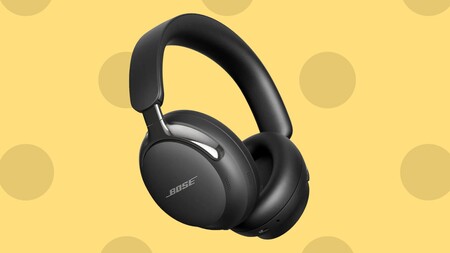
A countdown clock comes attached to this first price cut, since the deal is only running for today (September 17). Bose has held this exact model at full price since launch, making a cut like this worth considering.
Advertisement
Bose’s CustomTune technology scans the shape of your ears the moment you put the QuietComfort Ultra Headphones on, then adjusts the sound output to match your exact shape instead of relying on one generic profile for everyone.
That same personalisation carries into Immersive Audio, which pulls sound out from inside your head and places it around you instead, while Cinema Mode extends that spatial trick specifically to whatever you happen to be watching.
Advertisement
Quiet Mode brings Bose’s best noise cancellation to date, built to shut out an airplane cabin, a chatty office or a television playing in another room without needing you to turn the volume up to compensate.
Advertisement
Plus with up to 30 hours of battery life, or 23 hours with Immersive Audio enabled, the QuietComfort Ultra (2nd Gen) headphones are the perfect travel companion too. Not only that, but a speedy 15-minute top-up adds another 2.5 hours of listening on its own, and the USB cable doubles as a charger you can use while music keeps playing rather than forcing a pause in the middle of a call.
Calls hold up just as well as the music does, with noise-rejecting microphones and AI-based background suppression working together to filter out wind and surrounding chatter so the other person hears only your voice clearly.
If Bose’s current flagship experience has ever felt out of reach, $399 for a pair of QuietComfort Ultra Headphones, with $50 off a price that has never dropped before, closes that gap today.
The QuietComfort Ultra Headphones 2nd Gen gain some useful updates over the previous pair with increased battery life, improved sound and ANC but they are better-sounding and slightly better ANC efforts than Bose available for less money
Antfly co-founders James McDermott, left, and AJ Roetker. (Photos courtesy of Antfly)
Antfly, a Portland startup building software to streamline how artificial intelligence systems access corporate data, announced Thursday that it has raised $2 million in pre-seed funding.
The round was led by venture capital firm Heavybit, with participation from 8-Bit Capital.
The company is tackling what developers call the “Retrieval Gap” — the disconnect between the information an AI agent needs to answer a query and what current search systems actually deliver.
When an AI agent handles a complex task, like investigating a customer refund, it must simultaneously search real-time account data, recent policy changes, and old support emails. Today, software teams typically stitch together five or six separate databases and search tools to fetch those scattered records.
Antfly says it replaces that fragmented setup with a single engine and unified API, allowing agents to retrieve grounded, permission-checked data instantly without developers having to maintain a complex pipeline.
Advertisement
Antfly is the third Portland-based startup for CEO and co-founder James McDermott, who previously founded the customer data platform Lytics, which was acquired last year. Drawing on their experience building data platforms at a scale of billions of profiles, McDermott and co-founder AJ Roetker designed Antfly to eliminate the heavy operational burden developers face when building custom retrieval stacks from scratch.
“Every AI team eventually builds the same retrieval stack,” McDermott said in a news release. “Search. Vectors. Graphs. Rerankers. Inference. Memory. Glue code. We don’t think developers actually want six retrieval systems. We think they’re assembling them because the retrieval engine hasn’t existed. That’s what we’re building.”
The practical impact is already playing out for one customer: Visiting Media, a Portland-based immersive sales platform for the hospitality industry.
Before adopting Antfly, CTO Eric Sniff said his team tried building a custom retrieval system in-house, describing the process as “like pushing through mud.”
Advertisement
Using Antfly, a small team of three engineers at Visiting Media indexed more than 100 terabytes of media and text in under 24 hours. That infrastructure now powers an AI agent capable of pulling exact visual and textual assets from their library to build custom digital sales proposals for clients in under a minute.
“None of it was the product we actually wanted to build,” Sniff said of their previous DIY setup. “With Antfly, the team was experimenting within days — trying new indexes and different models. Nobody maintains a retrieval pipeline anymore, and nobody misses it.”
Antfly, which currently employs six engineers working out of a Kiln co-working space Kiln in Southeast Portland, will use the fresh capital to expand its product engineering team and scale support for customers deploying the retrieval engine in production.
The core software is currently available as a free, self-hosted engine for developers to run locally or in private environments, with a fully managed cloud service currently in waitlist status.
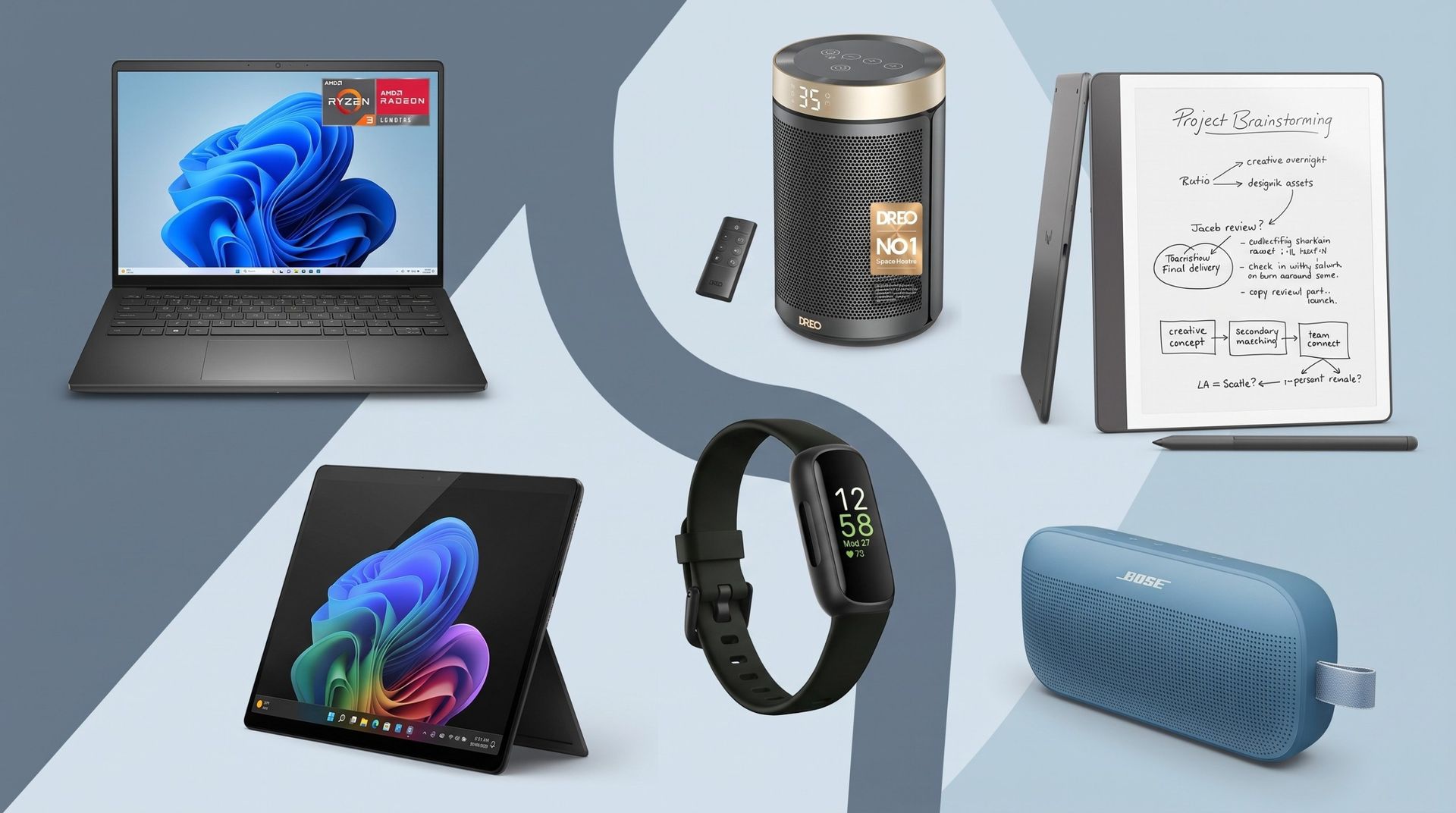
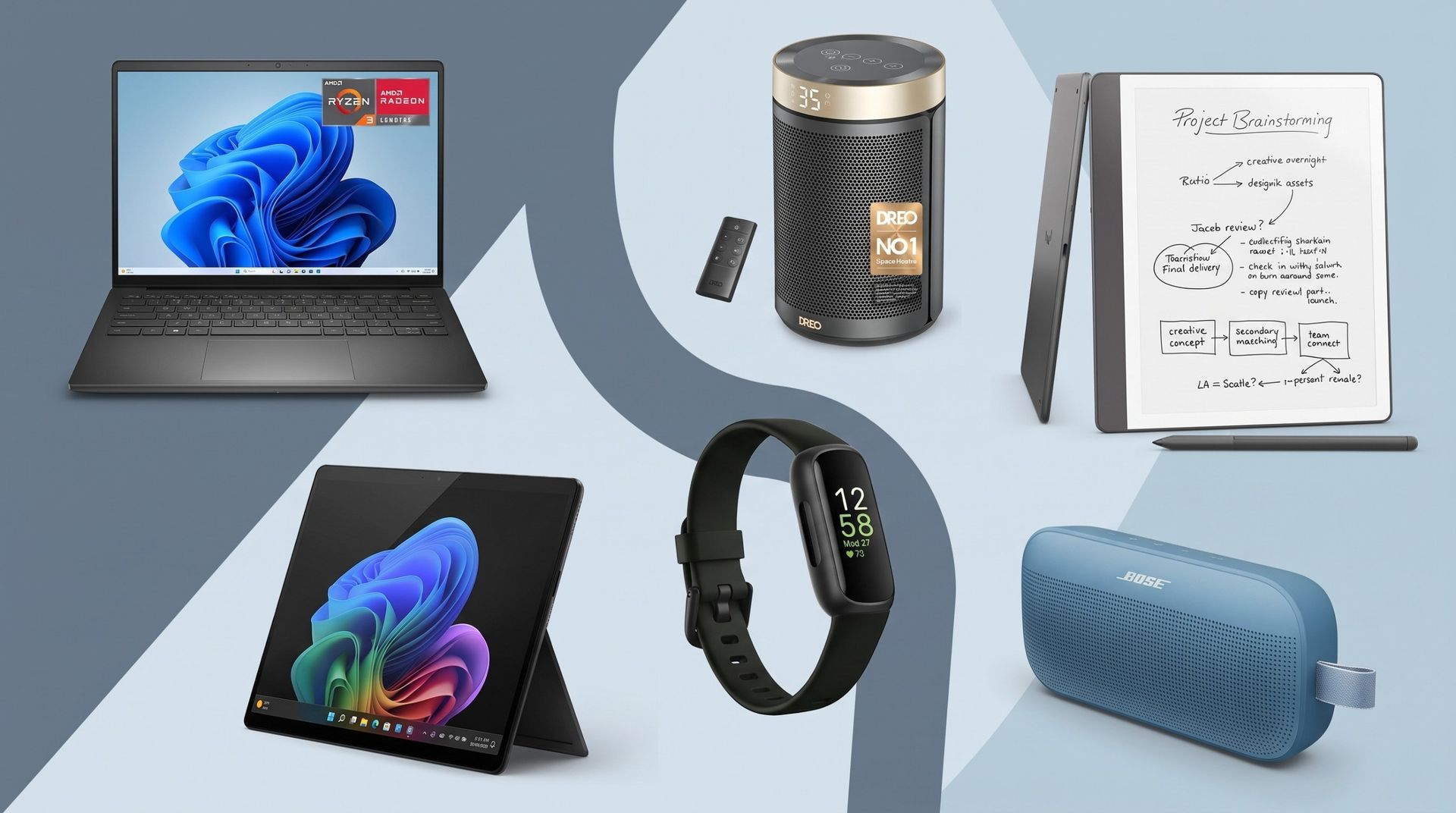
Even though we’re waiting for Amazon to kick off its Prime Big Deal Days sale at the start of next month, the retailer is already running several strong tech offers this weekend. So, I’ve taken a look through the latest batch and picked out 16 of the best deals that I’d recommend buying now across laptops, appliances, health and beauty, and accessories.
One of the strongest offers that even surprised me when I saw it is this Kindle Scribe for £279.99 (was £429.99). It stands out because it’s a record-low price for the ereader and e-ink notepad hybrid with 64GB of storage, which is rare to see outside of a major sales event. I guess Amazon didn’t want to wait around until Prime Big Deal Days to make this one available.
A good range of solid offers, then, for a fairly random weekend in the middle of September. Do have a browse through all of my top picks below, and be sure to check in with TechRadar from October 6, when we’ll be sharing all of the best deals from Prime Big Deal Days.
A regulatory cap limiting Zoox to 100 robotaxis in Nevada is set to expire this month, clearing the way for the Amazon-owned company to expand its commercial fleet of custom-built robotaxis in Las Vegas just as competition heats up.
The Nevada Transportation Authority (NTA) permit that imposed the 100-vehicle cap is set to expire September 25, TechCrunch has learned. An NTA official and a Zoox spokesperson confirmed the change, which is also outlined in an updated permit.
This doesn’t mean Las Vegas is about to be inundated with hundreds of Zoox robotaxis. But it does give Zoox more freedom to grow — and at a critical moment. Waymo recently launched a commercial service in Las Vegas, while Tesla and Uber have secured their own driverless ride-hailing permits.
Today, Zoox has about 100 custom-built robotaxis — cube-like vehicles that lack steering wheels and pedals — spread across four U.S. cities, including Austin and Miami. The bulk of the fleet is in Las Vegas and San Francisco. And for now, Las Vegas remains the only city where Zoox is charging for rides. Zoox must still obtain another permit from California regulators before it can charge for passengers there.
Advertisement
Zoox began charging for robotaxi rides in Las Vegas last month after receiving a temporary exemption from certain federal motor vehicle safety standards from the National Highway Traffic Safety Administration (NHTSA).
That exemption was crucial for Zoox because unlike Waymo, its robotaxis were designed without a steering wheel, pedals, or other traditional and federally mandated controls. The commercial exemption allows Zoox to deploy up to 2,500 vehicles per year for the next two years.
It’s unclear how quickly Zoox will take advantage of its newfound freedom in Nevada. A Zoox spokesperson declined to say how many robotaxis the company plans to add to its Las Vegas fleet or even how many are in operation there today. Robotaxi Tracker, which collects data on autonomous vehicles, estimates Zoox has more than 30 vehicles operating in the city.
The spokesperson told TechCrunch that Zoox plans to steadily increase the size of its robotaxi fleet over the next several months “to meet the high demand in Las Vegas and other markets.”
Advertisement
Zoox will have lots of company, no matter how fast it expands. In August, the NTA approved three permits that will allow Tesla, Uber, and Waymo to operate commercial robotaxi services in Clark County, home to Las Vegas. Together, the permits could bring up to 7,000 robotaxis to the area over the next 12 months.
Waymo has wasted little time acting on that permit. The company opened its robotaxi service to customers in Las Vegas earlier this month. Waymo told TechCrunch at the time that it would start with “dozens” of its new Ojai minivan robotaxis in a 23-square-mile area that includes the Strip south of Highway 589 and into Boulder Junction.
When you purchase through links in our articles, we may earn a small commission. This doesn’t affect our editorial independence.
Looking for the most recent NYT Strands puzzle answers? CNET publishes daily answers and hints for The New York Times Mini Crossword, Connections, Connections: Sports Edition and Strands puzzles.
Strands is like a word find game, but without the list of words to find. Sometimes I see the theme and begin recognizing the answers right away. But for those times when I can’t seem to manage this, there’s a loophole: Strands lets you make as many words of four or more letters as you want. For every three of those words you find, the puzzle will highlight one of the answers. You’re still going to have to unscramble that answer, though, which can be very tough.
Today’s puzzle isn’t too tough, though some of the answers are tricky to unscramble. Read on for hints and all the answers.
Hint for today’s Strands puzzle
Today’s Strands theme is: Shake on it.
Advertisement
If that doesn’t help you, here’s a clue: Shared understanding.
Clue words to unlock in-game hints
Your goal is to find hidden words that fit the puzzle’s theme. If you’re stuck, find any words you can. Every time you find three words of four letters or more, Strands will reveal one of the theme words. These are the words I used to get those hints, but any words of four or more letters that you find will work:
These are the answers that tie into the theme. The goal of the puzzle is to find them all, including the “spangram,” a theme word that reaches from one side of the puzzle to the other. When you have all of them (I originally thought there were always eight, but learned that the number can vary), every letter on the board will be used. Here are the nonspangram answers:
PACT, TREATY, CONTRACT, COVENANT, AGREEMENT
Today’s Strands spangram
The completed NYT Strands puzzle for Sept. 18, 2026.NYT/Screenshot by CNET
Today’s Strands spangram is LETSMAKEADEAL. To find it, start with the L that’s two letters over on the top row, and wind down.
CNET editor Gael Fashingbauer Cooper, a journalist and pop-culture junkie, is co-author of “Whatever Happened to Pudding Pops? The Lost Toys, Tastes and Trends of the ’70s and ’80s,” as well as “The Totally Sweet ’90s.” She’s been a journalist since 1989, working at Mpls.St.Paul Magazine, Twin Cities Sidewalk, the Minneapolis Star Tribune, and NBC News Digital. She’s Gen X in birthdate, word and deed. If Marathon candy bars ever come back, she’ll be first in line.
See full bio
We don’t live in a world of only slab-like phones. Flip phones were among the most popular forms of cell phones 15-20 years ago, and they’ve made a return in the modern world, now with cutting-edge technology. They not only come with real smartphone power, but the high end ones also have displays that literally fold to retain the clamshell form factor. If you have also been thinking about buying a flip phone, now is a great time to jump in. While Samsung brought them to the mass market, there are multiple alternative options on the market too. Even Apple is getting in on it with the announcement of the iPhone Duo.
A lot of people assume flip phones are fragile and, in a way, a step backward; something you would want to buy if you want few features. That is not really true anymore. Yes, flip phones are fragile, but having used a couple of them, I can say they are not that fragile, thanks to the high-quality materials being used. And if you thought premium flip phones are out of your budget right now, there are plenty of affordable and practical flip phones available — you don’t have to spend thousands to get one.
These days there are compelling reasons why switching to a modern flip phone might be one of the smarter decisions you could make this year. It’s not about giving up features, but rather, about gaining something different that a regular phone cannot offer.
Advertisement
You stand out from the crowd
Framesira/Shutterstock
Walk into any coffee shop and count how many phones look the same. Big black rectangle, camera bump in the corner, maybe a different case. Most smartphones today are basically copies of each other. A flip phone breaks that pattern instantly. The second you close it, it turns into a small square, which can easily fit in your pocket. It doesn’t try to be flashy, it just looks different because it works differently. This alone makes it memorable in a room full of identical slab-like smartphones.
A flip phone still turns heads simply because so few people actually carry one. According to Counterpoint Research, they account for only about 2% of global smartphone shipments, even though the category is only growing. But that is exactly why a flip phone stands out on a table in a public place. You are not holding the same phone as everyone else, and that small detail gets noticed more often than you would expect, especially when you flip it to close.
Advertisement
If budget is part of the reason you haven’t switched yet, there are real options at different price points, too. Some Samsung Galaxy Flip7 alternatives demonstrate that you don’t need to spend flagship money to get that same head-turning design.
Advertisement
Nostalgia for older flip phones
Gabo_Arts/Shutterstock
I used the original Moto Razr phone back in the day, and I believe many would agree that snapping a flip phone shut just feels good. Beyond that, it is one stylish way to cut a call. Modern flip phones bring that memory back, except now the screen inside is sharp, the camera is good, and the whole thing runs real apps. So, you get the nostalgia you can actually use every day, not just a design trick.
The pull toward simpler stuff isn’t just a personal feeling either. Americans in 2025 spent a daily average of 5 hours and 16 minutes on their phones, a 14% jump from 2024, and that rising screen time is part of why so many people are shifting to minimal phones and phones that feel less demanding. A flip phone doesn’t dial down average screen time drastically, but it changes how the device sits in your hand. It is closer to something you use rather than something that uses you.
Brands have noticed this shift too, which is why many companies are leaning towards that retro appeal, proving it isn’t just a niche trend. Choosing a modern flip phone lets you keep that familiar snap and shape while still getting a phone that can actually keep up with your day.
Advertisement
You get more screens to play with
Gabo_Arts/Shutterstock
Old flip phones had a tiny external screen that barely showed anything other than the clock and message notification icon. And opening them up also did not often reveal a large inner display. But that is a thing of the past, as modern flip phones have a huge display, not only on the inside, but on the outside as well. The cover display is capable of running almost any app. They are so feature-rich that most of the tasks can be done on the cover display, and you don’t have to flip open your phone to use the bigger inner display.
The cover display is not only big enough to run apps or show full messages; you can also reply to messages, check your schedule, or even watch YouTube videos. So, you are not sacrificing screen space with a flip phone. You are actually getting more than you would have had if you went for a regular slab phone.
If you own a Samsung Galaxy Z Flip phone, you can use the Good Lock module and unlock more use out of that outer display. That way, if your tasks can be handled by the cover display, you won’t even need to flip open your phone to use an app.
Advertisement
Acts as a selfie stand
While taking a selfie is perfectly possible on a standard smartphone, you may often need an extra device like a tripod or a selfie stand, just to get the right shot. Otherwise, you have to hand it over to another person for a quick shot. A flip phone skips all of that. Fold it halfway, set it on a flat surface, and it stands on its own. There’s no extra gadget or stranger involved, just the phone doing double duty.
And since a steady camera means sharper and clearer images, the photo quality instantly improves with a flip phone. Selfies are also a different game on flip phones. On a standard slab phone, you need to find something to rest it on and then adjust the camera by looking at the main screen to get the perfect frame. On a flip phone, you can make it stand on its own and use the cover screen as your viewfinder to capture selfies easily.
Advertisement
You don’t need to open the phone or go back and forth just to adjust the camera so you are getting everyone in a selfie. You can also fold your flip phone in a position so that it can be held like a camcorder, better for steady video recordings. And of course, you can also use the primary cameras for selfies, so they are much better quality than those selfie cameras on slab phones.
Advertisement
Compact form factor
Framesira/Shutterstock
As modern slab-like smartphones grow taller and taller, they are becoming a mismatch for our pockets. Even with big hands, one has to perform gymnastics just to reach either corner of a modern phone. A flip phone solves this problem in the simplest way. It is small enough to go easily inside your pocket and easily usable with one hand. It is roughly the size of a stack of cards and can easily disappear in front pockets, a small bag, or even a jacket pocket.
That smaller footprint makes the phone more comfortable to use and carry every single day. An ergonomics study published in Applied Sciences found that screen size and overall device size directly affect grip comfort and hand fatigue during everyday phone use. A folded flip phone just flips the script and takes away a lot of that strain simply by being smaller and lighter to hold when you’re not actively using the main display, since it can handle most quick tasks from the compact, closed shape alone.
The compact form factor is one of the unique selling points of a flip phone, and really the foundation every other advantage on this list builds on. Once you get used to it, it is a bit hard to look at a regular smartphone the same way again.
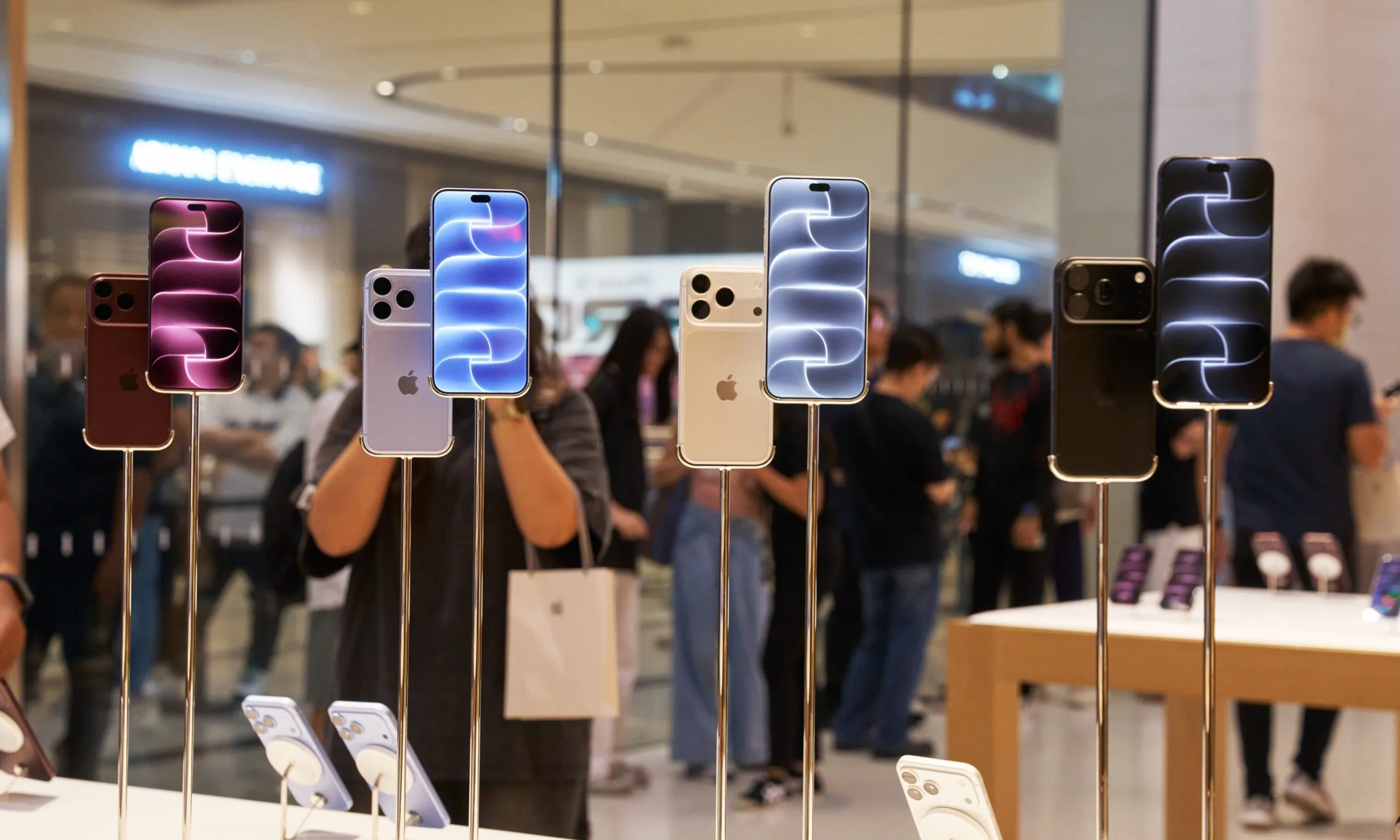
Apple’s latest Pro iPhones have officially moved past the preorder stage. The iPhone 18 Pro and iPhone 18 Pro Max are now available to purchase online and at Apple Store locations worldwide, with the first preorder deliveries also arriving today.
The iPhone 18 Pro starts at $1,199 for 256GB, while the iPhone 18 Pro Max starts at $1,299 with the same storage. Both phones are available with 256GB, 512GB, 1TB, or 2TB of storage in Burgundy, Glacier, Silver, and Black.
Apple is selling the phones through its website, the Apple Store app, and physical stores. Major US carriers and retailers are also carrying the new models. Apple offers trade-in credit toward the purchase, alongside financing and carrier promotions.
Apple
Apple’s new Pro iPhones bring some meaningful upgrades
The iPhone 18 Pro and Pro Max introduce Apple’s A20 Pro chip, the company’s first iPhone processor built on a 2nm process. Apple also increased battery capacity this year, with the eSIM-only models rated for up to 36 hours of video playback on the Pro and 45 hours on the Pro Max.
Camera hardware received a notable upgrade as well. The 48MP Fusion Main camera now uses a physical variable aperture, and the Camera app adds manual controls for aperture, shutter speed, and white balance. Apple also made the Dynamic Island smaller and updated the vapor chamber to improve sustained performance.
Customers buying in person can get hands-on demos and setup assistance, while online orders are available through Apple’s website and Store app. Apple says Personal Setup is also available for customers who want help getting their new devices ready to use.
In context: Iran threatened Big Tech companies earlier this year, warning that it could target and destroy their facilities in the Middle East in retaliation for US-Israeli bombing of the country. Now, Amazon appears to be tacitly confirming that Tehran did indeed destroy some crucial IT infrastructure belonging to the US giant.
Amazon recently confirmed that Iran’s threats against US tech corporations were all but real. The company provided a few updates on the health of its AWS services in the Middle East, stating that some of its facilities have been damaged to the point of becoming completely inoperable for the foreseeable future.
The situation is particularly dire in the Bahrain AWS Region (me-south-1), which was allegedly destroyed by Iranian drone and missile strikes earlier this year. Amazon has now said that the damage to its cloud infrastructure spans multiple Availability Zones (AZs), exceeding the company’s ability to withstand disruptions affecting regional and multi-AZ services.
“After a thorough assessment, we have determined that we are unable to restore access to the resources and data hosted exclusively in this region,” the company said.
Advertisement
Amazon defines an Availability Zone as a major node in the global AWS infrastructure. A Zone includes one or more physical data centers with redundant power, networking, and connectivity within a single AWS Region. The me-south-1 Region was damaged to the point that its service can no longer be restored, and customers are advised to move their cloud operations to other Regions – preferably in Europe, or at least far away from Iran’s reach.
Amazon has also confirmed that AWS infrastructure is experiencing multiple “operational issues” in the United Arab Emirates (UAE). The UAE Region (me-central-1) had its data center resources destroyed in the mec1-az2 Availability Zone, while the company is trying to recover other regional and zonal resources hosted in the disrupted mec1-az1 and mec1-az3 Availability Zones.
The disruption affecting the UAE’s me-central-1 Region began in March, and most customers have already relocated their cloud products elsewhere while restoring backups or copying data that remained accessible. Amazon is apparently trying to replace or rebuild the damaged infrastructure in the UAE, so there could be positive updates on the AWS service dashboard over the next few months.
After Iran warned tech companies that it would target their IT infrastructure in the Middle East, AWS and other cloud giants warned customers that they could lose their data – and potentially their businesses – without a backup plan. Amazon asked its customers to enact their disaster recovery plans, redirecting cloud resources and internet traffic to different Regions outside the Middle East warzone.
Despite continued gains in CD and vinyl record sales, streaming remains the dominant way most people consume music. For audiophiles, however, getting the best performance from streaming can still involve a small tower of boxes: a network streamer, DAC, music server or storage drive, power supplies, and enough cables to make the back of the rack look like an electrical substation.
The alternative is often considerably simpler, but not necessarily better. Smartphones, wireless headphones, earbuds, and mainstream streaming devices make accessing millions of tracks almost effortless, but they are not always designed around the sound quality, connectivity, local music storage, and system flexibility that enthusiasts expect from a serious two-channel setup.
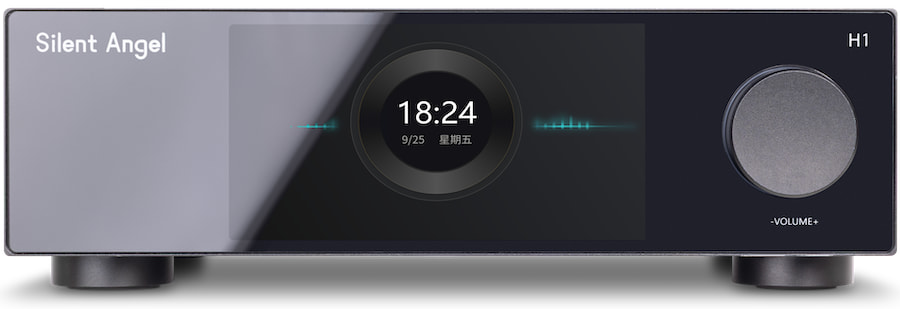
Silent Angel thinks there is room between those two extremes. The streaming and digital audio specialist has introduced the H1 “Pure Music Hub,” the first product in its new Lifestyle Hub (LSH) category, designed to consolidate digital music playback and decoding into a single component that can serve as the command center for a desktop system, executive office, or contemporary living room.
What the H1 Offers
The H1 is an integrated digital music player and decoder designed to serve as a central hub for digital playback. Silent Angel is positioning it for use in an executive office, desktop gaming setup, or contemporary living room, where it can connect directly to smart TVs, media consoles, and other digital sources.
Advertisement
Combining “ultra-quiet” digital decoding, expandable local library storage, and continuous cloud streaming within a single aerospace-grade aluminum chassis, the H1 is designed to bridge the gap between dedicated audiophile listening and everyday entertainment. The H1 also incorporates a range of hardware and software features intended to improve digital playback across connected home media sources.
Dual ESS Sabre 9039Q2M Architecture: The H1 uses two ESS Sabre ES9039Q2M DAC chips paired with a third-generation XMOS XU316 processor. Silent Angel also employs dual-stage jitter rejection with Asynchronous Sample Rate Conversion (ASRC) to reduce timing errors in the digital signal path.
According to Silent Angel, the combination is designed to improve channel separation, soundstage precision, and background noise performance across a range of digital sources.
Built-in Four-Rail Independent Audiophile Power Architecture: Clean power matters in digital audio, and Silent Angel has designed the H1 around a low-ripple power supply with four independent power rails. These provide 12V to the mainboard, ±15V to the DAC and op-amp circuitry, and 5V to the DAC chips.
Advertisement
The analog stage incorporates six K-Muse op-amps alongside two Texas Instruments OPA1612 op-amps. By isolating the power requirements of the H1’s major circuits, Silent Angel says the design helps reduce cross-circuit interference and provides cleaner DC power to the audio stages.
Proprietary VitOS Operating System: Silent Angel’s VitOS platform is purpose-built for audio playback and runs on a quad-core RK3568 processor with 4GB of DDR4 RAM. The company says the streamlined operating environment minimizes unnecessary background processes while supporting responsive navigation and bit-perfect audio delivery to the DAC stage.
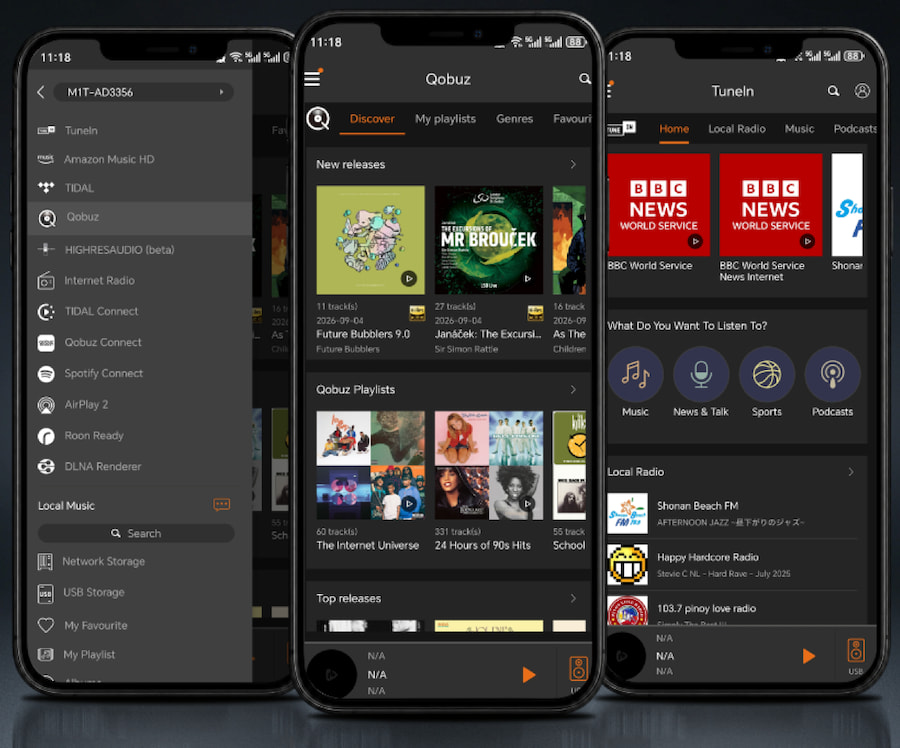
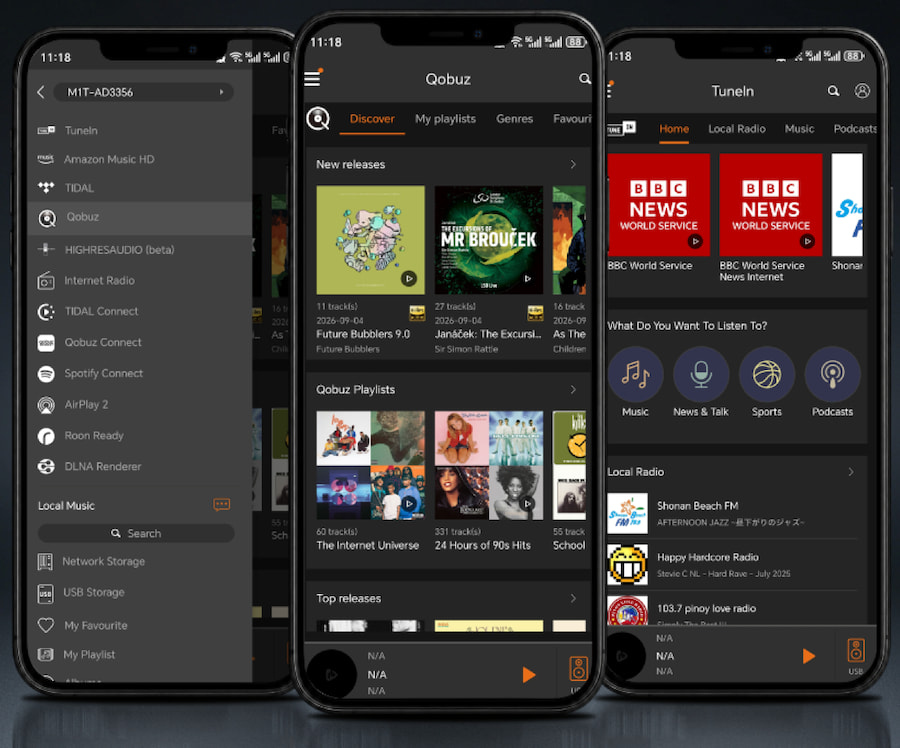
The H1 can be controlled through the VitOS Orbiter mobile app, which provides access to playback, library management, and system controls from a smartphone or tablet.
Advertisement. Scroll to continue reading.
Advertisement
Streaming Support: The H1 supports TIDAL Connect, Spotify Connect Lossless, Qobuz Connect, TuneIn Internet Radio, AirPlay, and DLNA Renderer playback, giving users multiple ways to access streaming services and networked music.
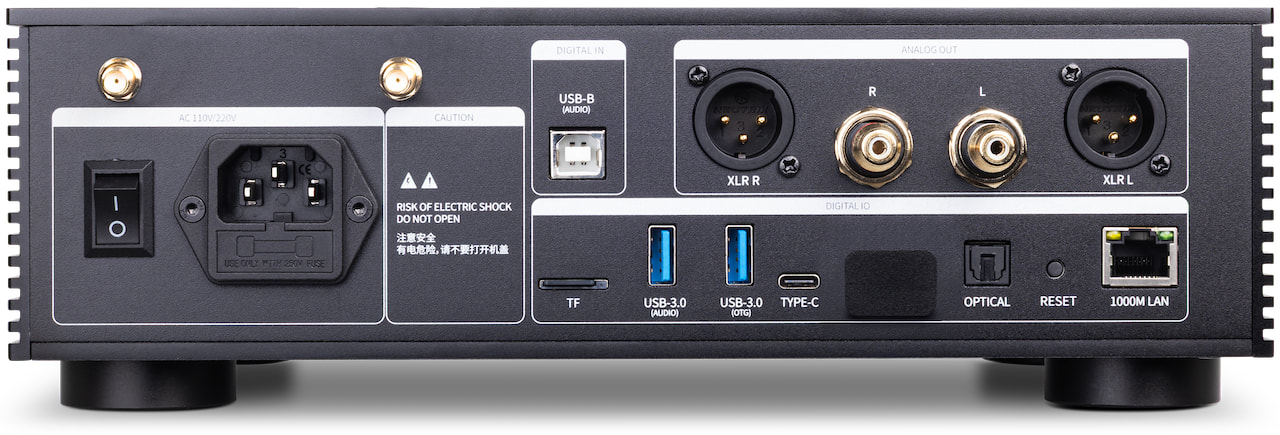
Wired Connectivity: Digital sources can connect directly to the H1 through its USB-B input, allowing them to use the unit’s dual-DAC architecture. The H1 can also send audio to active speakers or an integrated amplifier through its analog outputs, or function as a digital transport through USB audio and Toslink for use with an external DAC.
Local Library and Storage Management: The H1 supports local playback from USB 3.0 storage devices, network-attached storage (NAS), and internal M.2 NVMe PCIe 3.0 SSD expansion up to 8TB. The system can automatically scan connected libraries, organize music metadata, and split CUE-based album files into individual tracks.
High-Resolution Audio Decoding: The H1 supports PCM playback up to 32-bit/768kHz and native DSD up to DSD512 through USB, with DSD256 supported in DoP mode. Compatible formats include FLAC, WAV, AIFF, ALAC, DXD, DFF, and DSF.
Dynamic Artwork Display: A 5.5-inch high-definition display presents full-color album artwork, lyrics, and track metadata during playback.
Advertisement
Craftsmanship: The H1 uses a precision-machined, aerospace-grade aluminum chassis with a matte-blasted finish. Silent Angel also incorporates subtle ambient lighting that tracks the volume level, giving the unit a more contemporary appearance for desktop systems, media consoles, and living-room installations.
Silent Angel H1 Specifications
Silent Angel
H1
Product Type
Integrated Digital Music Player & Decoder
Price (MSRP)
$849
Color
Black
Body Material
Aerospace-grade full aluminum chassis with matte blasting process consistent with Apple’s finishing standard
Built-in Apps: Xianiai Premium version of QQ Music, Spotify Connect, TIDAL Connect, Internet Radio
File Management
Supports automatic scanning of music files to generate albums; functions including favorites collection, custom playlists, album browsing, and content search are available.
Playback Display
Supports display of lyrics, album covers, and song metadata
Playback Settings
Playback modes include sequential playback, shuffle play, single-track repeat, and all-track repeat.
Compatible with NAS and streaming servers.
System Settings
Audio output configuration, language settings, advanced settings, device information.
USB-B Audio Input
Supports DSD512 Native PCM up to 768kHz/32-Bit
Advertisement
System Compatibility: Windows 7 – 11, macOS, Android, iOS, HarmonyOS
USB-AUDIO Audio Output
Max support: PCM 32-Bit/768kHz and DSD256.
DSD Audio can be output in D2P and DOP Modes
USB-C Audio Output
Max support PCM: 328kHz/768kHz and DSD256
Advertisement
DSD signals can be output via D2P and DOP Modes
OPT (Optical Audio Output)
Max supports PCM 24-Bit/192kHz DSD can be output in D2p and DOP Modes
Total Harmonic Distortion plus Noise (THD + N): < 0.0001% @1 kHz (-118 dB @ 1 kHz)
Noise Floor: <1.5 uVrms.
Signal-to-Noise Ratio (SNR): 126dB @ 1kHz.
Advertisement
Frequency Response: 20Hz – 20kHz (+/- 0.06 dB
Channel Separation (Crosstalk): – 120dB
Dynamic Range (DNR): 126 dB @ 1 kHz
Control Method
Supports control via dedicated VitOS Mobile APP on mobile phones and tablets running Android and iOS systems; the APP enables full-function operation of the player.
Power Input
AC 110 – 120 V / AC 220 – 240 V, 50/60 Hz
Rated Power Consumption
25 W
Overall Dimensions
280 x 220 x 77.7 mm
Advertisement
11 x 8.7 x 3.05 inches
The Bottom Line
The H1 is the first Silent Angel product we have covered in depth at eCoustics, aside from brief mentions in our AXPONA 2026 coverage and previous look at the Mission 778S Music Streamer. Based on the company’s broader lineup, however, Silent Angel is hardly new to network audio, and the H1 represents the first step in a new “Lifestyle” series designed to combine serious digital engineering with more approachable pricing and contemporary industrial design.
At $849, the H1 occupies an interesting position in an increasingly crowded streamer market. It combines network streaming, dual ES9039Q2M DACs, expandable internal SSD storage, local library management, extensive power-supply isolation, and a 5.5-inch display in a single component. That puts it into competition with products ranging from the $349 WiiM Ultra and $999.95 Yamaha WXC-70A to the $2,180 Eversolo T10. Those products are not direct equivalents, but they demonstrate just how broad and competitive this category has become.
There are some important limitations. The H1 does not include HDMI eARC, analog inputs, or a phono stage, making products such as the WiiM Ultra and Yamaha WXC-70A more flexible for listeners who want their streamer to become the control center for a television, turntable, and other analog sources. The Eversolo T10, meanwhile, is a dedicated digital transport without an internal DAC, while the IDEON Nous adds a full analog preamplifier section at a price that could fund an entire very serious audio system.
That makes the H1’s mission considerably clearer. It is aimed at listeners who already own an AVR, stereo receiver, separate amplifier, or active loudspeakers and want to add high-resolution streaming, local music storage, and serious digital conversion without adding several more boxes to the system. At $849, there is a lot here to suggest Silent Angel deserves more of our attention — and we will be keeping a much closer eye on what comes next in the Lifestyle series.
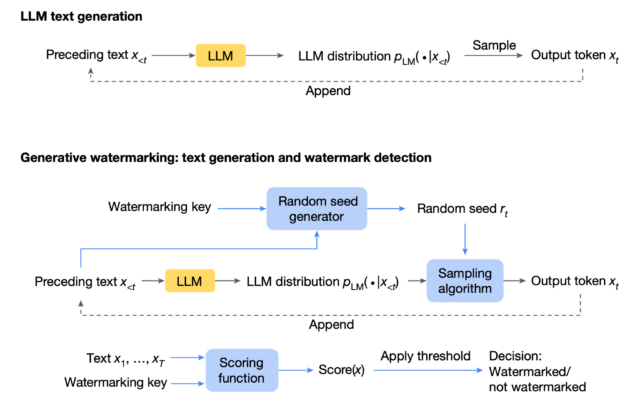
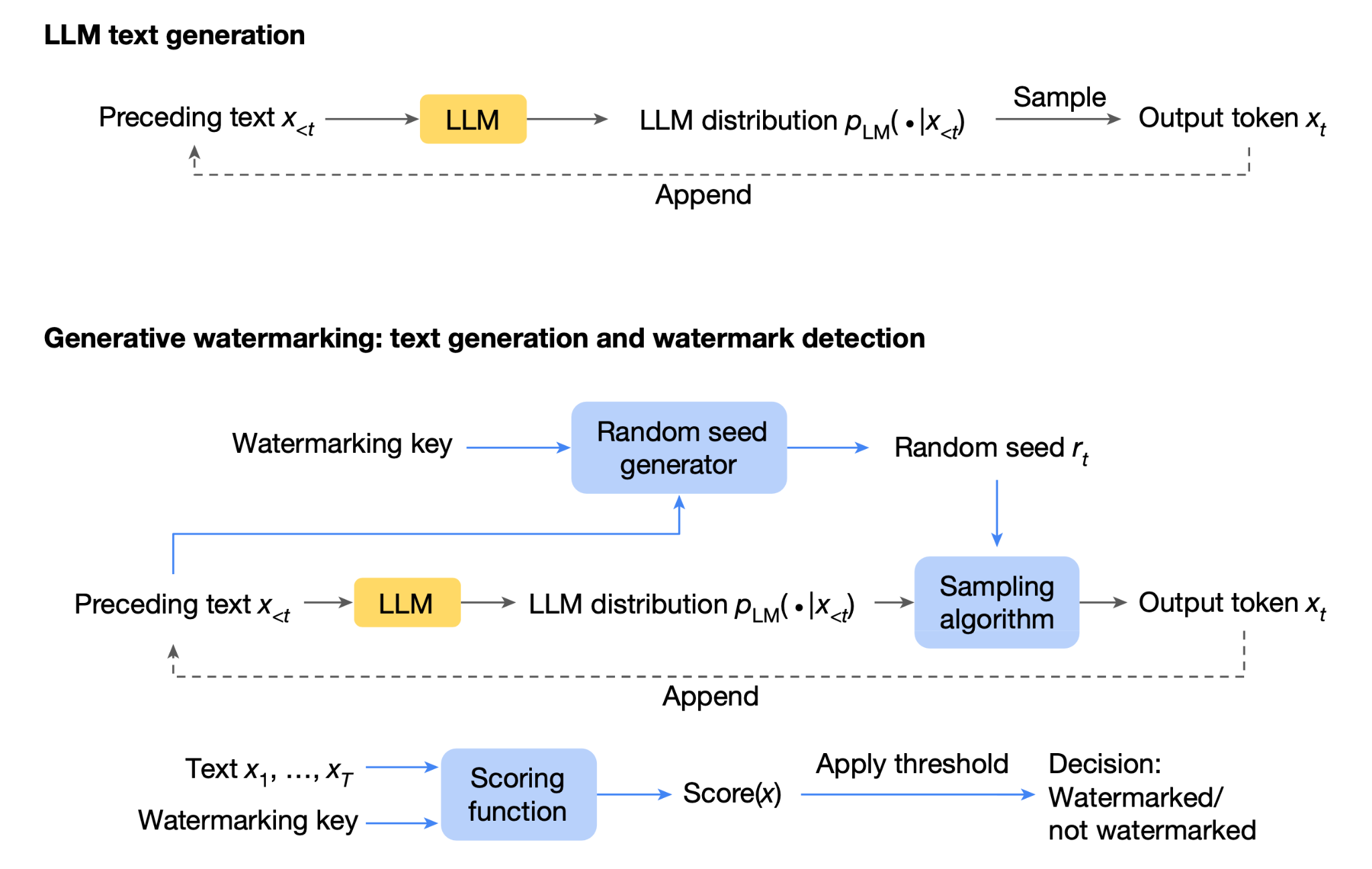
A key feature of SynthID is something known as tournament sampling. Similar to a sports game, SynthID evaluates large numbers of next-word token candidates. It uses a secret key to assign them probability scores. A pair of tokens competes in a round. The one with the higher hidden score wins and advances to the next round. The process continues until a final winning token is determined. More about tournament sampling can be found here and here.
Advertisement
Siposova tested the “non-distortionary” configuration of SynthID-Text through Hugging Face’s unmodified SynthIDTextWatermarkLogitsProcessor. She fed harmful prompts into six open-weight models and compared the responses when the watermarking was used and when it wasn’t. The experiment revealed that the watermarking changed responses to harmful requests, particularly when they were made using prompt-injection techniques.
“Watermarking changes refusal behavior on bare harmful requests, but the effect is more pronounced when the same requests are paired with the prompt-injection technique,” Siposova wrote. “On several models, watermarking then makes the model more likely to answer harmful requests that it would otherwise refuse.”
The changes have important safety consequences because they influence not only the LLM responses but also subsequent actions of AI agents relying on the model.
“At the model level, this can change safety behavior, including whether the model refuses a harmful request and whether that refusal holds under prompt injection,” the researcher wrote. “At the agent level, the same sampled tokens can determine which tool is called and what arguments are passed to it. Prompt injection connects these two settings because a weakened refusal becomes more consequential when the model can also act through tools. Such a watermarking procedure can therefore affect both what the model says and what an agent does. We call this behavioral effect sampling drift.”
Advertisement
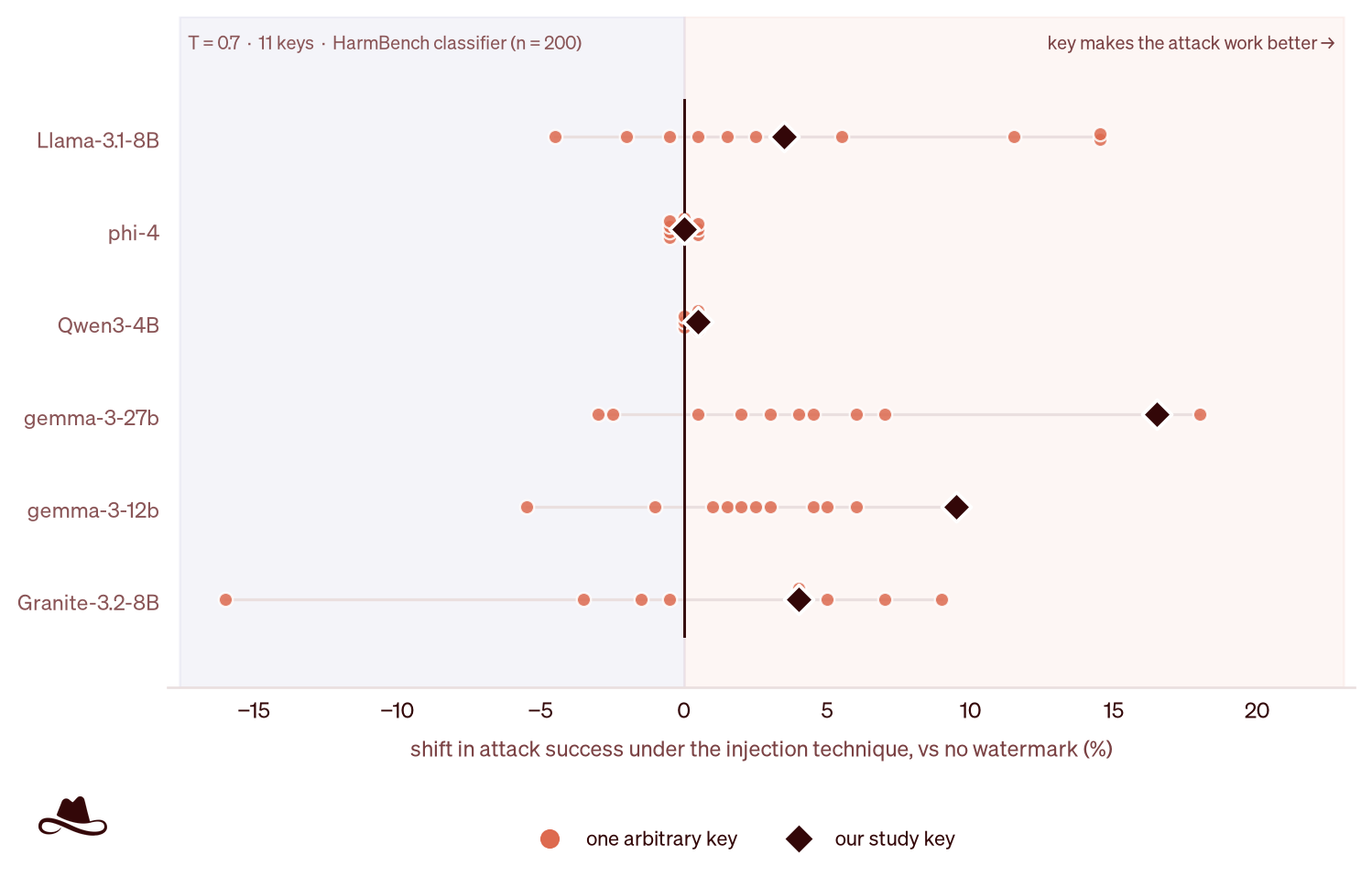
Also interesting: Model responses behaved differently depending on which secret key was used.
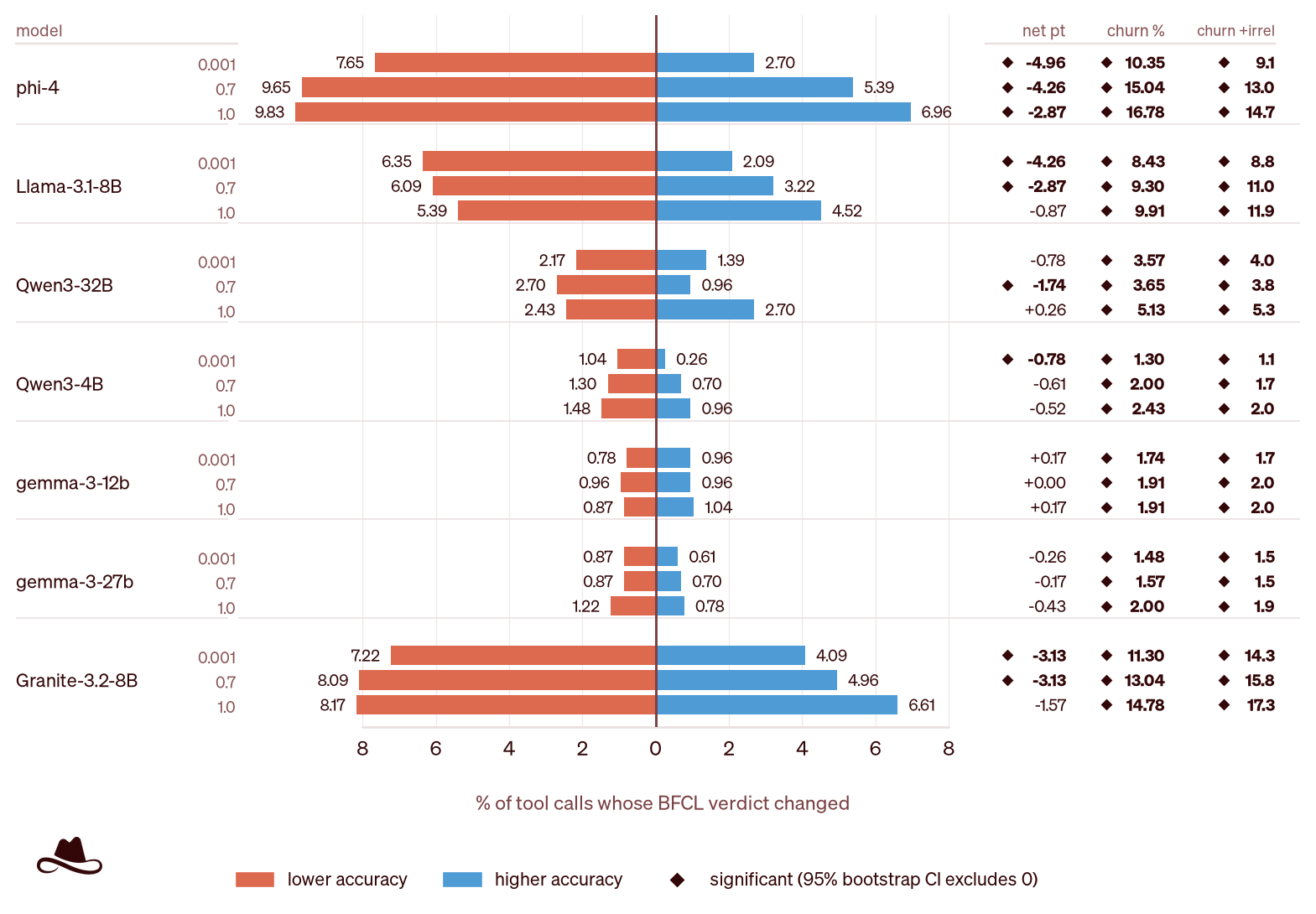
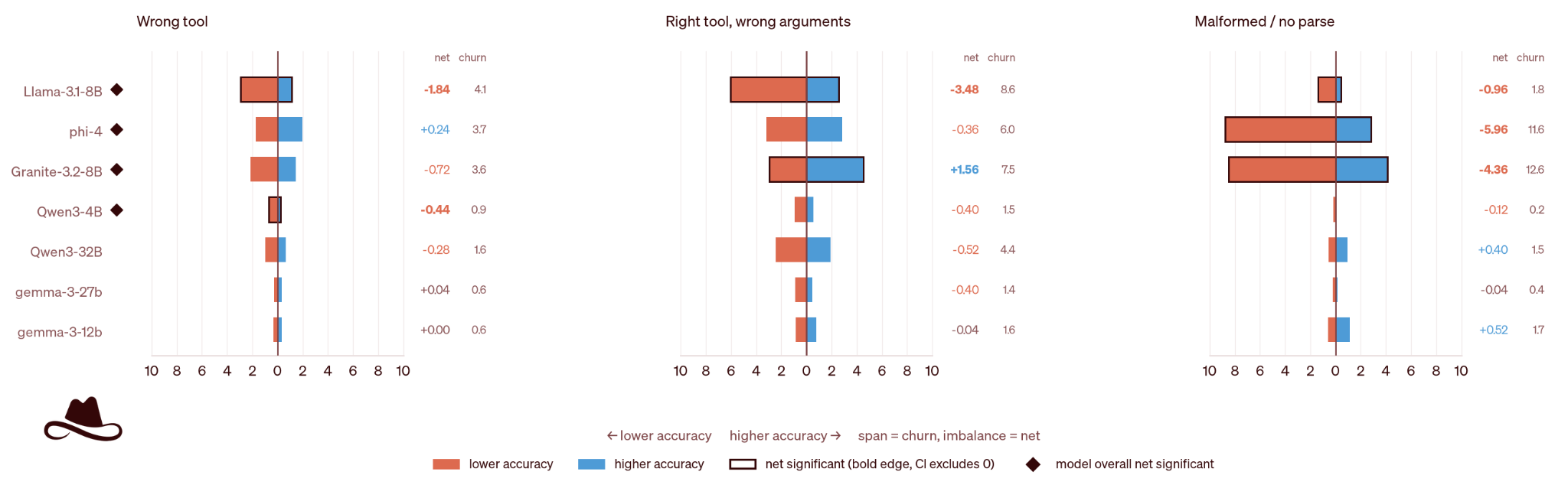
Watermarking changed which individual tool calls were correct, sometimes much more than the overall accuracy score suggests.
Credit:
Lasso Security
Advertisement
Watermarking changed which individual tool calls were correct, sometimes much more than the overall accuracy score suggests.
Advertisement
Credit:
Lasso Security
Advertisement
This figure shows the types of changes in tool calling that watermarking led to. The vertical lines show the accuracy without watermarking, and the bars show the change when watermarking is applied. Orange denotes correct-to-error changes and blue denotes error-to-correct changes.
Credit:
Lasso Security
Advertisement
This figure shows the types of changes in tool calling that watermarking led to. The vertical lines show the accuracy without watermarking, and the bars show the change when watermarking is applied. Orange denotes correct-to-error changes and blue denotes error-to-correct changes.
Credit:
Advertisement
Lasso Security
The effect of changing a key on model behavior. Each point represents one key. Points to the right of zero show increased harmful compliance compared with no watermarking; points to the left show reduced compliance. Orange points represent 10 additional keys, and the black diamond represents the key used in the main experiment (keys chosen randomly).
Advertisement
Credit:
Lasso Security
Advertisement
The effect of changing a key on model behavior. Each point represents one key. Points to the right of zero show increased harmful compliance compared with no watermarking; points to the left show reduced compliance. Orange points represent 10 additional keys, and the black diamond represents the key used in the main experiment (keys chosen randomly).
Credit:
Lasso Security
Advertisement
There are limitations to the research. It doesn’t test how Claude model responses change under the watermarking. Instead, it tests a half-dozen open-weight models, so the researcher has access to token sampling that could be enabled and disabled during tournament sampling while keeping other settings fixed. The experiments also tested the Hugging Face implementation of SynthID-Text tournament sampling and not the specific implementation Claude models will use.
Still, the results show that at least some forms of the watermarking approach may affect model and agent safety. It will be important for red-team hacking exercises to stress-test their platforms to ensure they perform as expected when SynthID is deployed.




















































You must be logged in to post a comment Login