Connect with us

Tech

What is the release date for Lioness season 3 episode 3 on Paramount+?

Published

on

Things have already taken a near-fatal turn in Lioness season 3, which is something I didn’t expect to happen so soon. Indeed, last week, we saw two unnamed Russian agents posing as police officers turn up at Joe’s door and demand to enter her home, only for them to be killed in the process.

The entire team is called out to investigate, but when a group of “watchers” are spotted on a nearby roof, the Lionesses wonder if it’s a trap… if they’re here, they’re not looking elsewhere.

Source link

Continue Reading
Click to comment

You must be logged in to post a comment Login

Leave a Reply

Tech

The top picks tested and ranked

Published

on

Photo printers can be an essential addition to any workflow, with a lot more versatility than the average printer. However, there’s a lot to know about these photo-first devices, but when you shop with our tried and tested buying advice, you can’t go wrong. Here are the best photo printers to buy right now.

Although we’re big fans of all that photo printers can do, it should be said from the outset that if you’re only interested in printing out occasional documents to be signed or posted, then you’re better off with one of the best printers available. Standard printers tend to be cheaper at the point of purchase, and even cost less in the long run as you won’t need to use quite as much ink.

Where photo printers really come into their own is for anyone who works in a creative industry and would prefer the convenience of being able to print things out at any time of day, rather than having to be reliant on a nearby printing service. Because of their ability to recreate colours more accurately than standard printers, photo printers are perfect for professional photographers and graphic designers.

Photo printers also have the capacity to print things out in sizes beyond the standard A4 template. This is ideal if you have an A3 poster that you need to print out in time for a show, or you want to have a compact A5 photo that can then be framed afterwards. There’s no shortage of reasons as to why photo printers are a worthy investment, but we take the time to test each one that appears at our offices so that you get paired up with the right one.

Advertisement

In order to make the buying process as simple as possible, all the photo printers on this list have been highlighted for their best feature, whether it be pure value for money or smartphone connectivity, so you can start whittling down your options quickly. For those who might be tempted by a camera upgrade alongside their new photo printer, our guides to the best cameras and the best camera phones have you covered.

Best Photo Printer at a glance

Advertisement

SQUIRREL_ANCHOR_LIST

Learn more about how we test printers

Every printer we review goes through a series of uniform checks designed to gauge key things including print quality, speed and cost. These include first-time setup, changing respective cartridges, and measuring key things such as print speed and quality with a range of different paper types, including plain and photo.

Advertisement

We’ll also compare the features with other printers at the same price point to see if you’re getting good value for your money. We’ve also calculated how much it would cost to replace the cartridge or refill the ink in order to see how much the printer will cost you in the long term.

  • Very good photo print quality

  • Less cost and hassle thanks to bottled ink

  • Surprisingly compact

  • Underwhelming plain paper printing

  • Expensive to buy

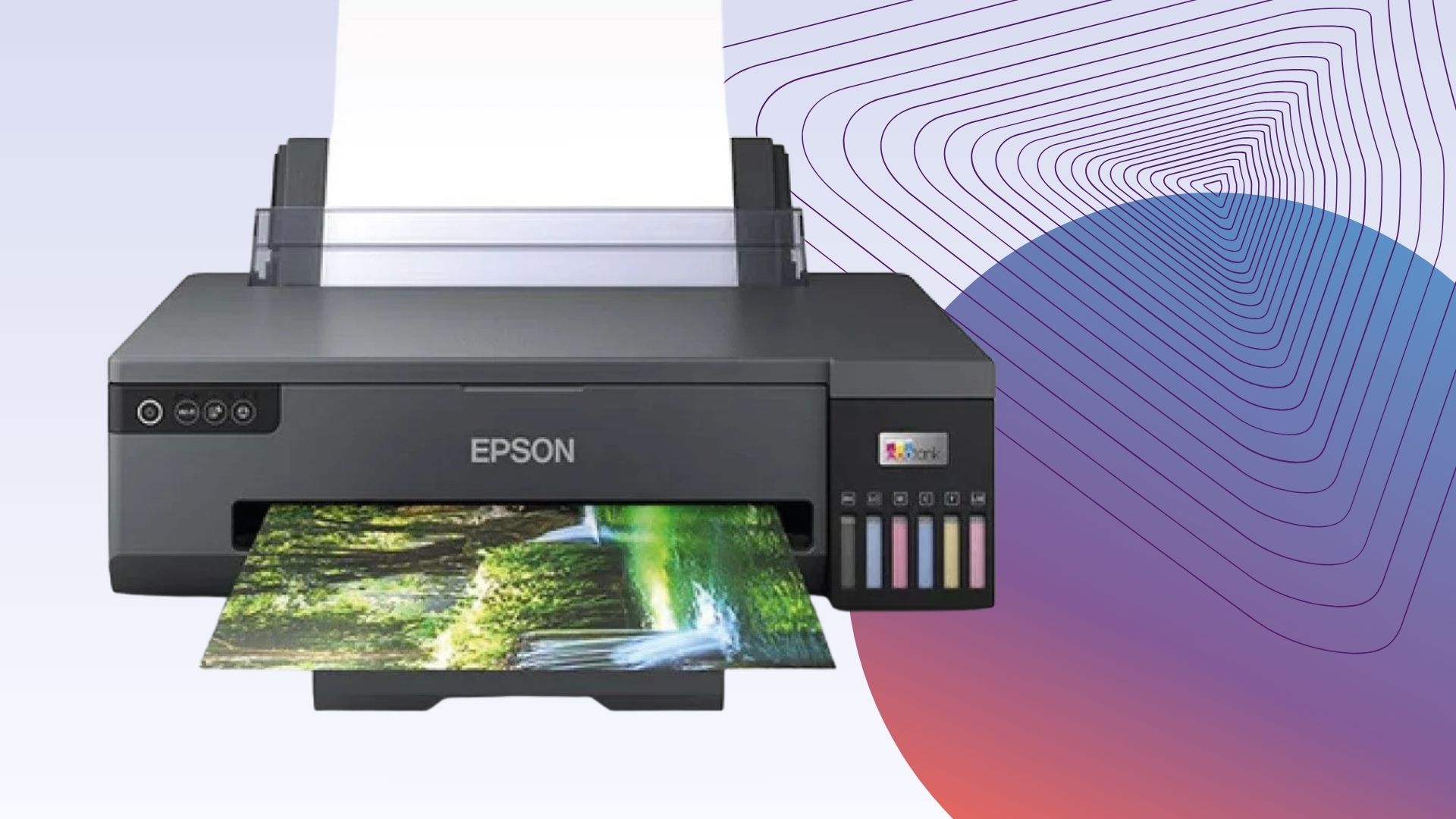
The Epson EcoTank ET-18100 is the ultimate option for those looking for great photo prints, particularly those amateur photographers who want to print photos to their heart’s content.

Advertisement

With the EcoTank ET-18100, you’ll be getting an A3+ capable, six-ink photo printer that opens up the world of photo printing to you through low running costs and super convenient refillable tanks. It’s the big bottles the ink comes in and the refillable tanks that make this such an easy and cost-effective purchase. As such, you can make up for the slightly expensive starting price if you’re going to use this printer a ton.

The results speak for themselves too, producing top-notch photo print quality. Admittedly, the prints aren’t professional tier – look to our next recommendation for that – but for those after great home photo printing, it’s more than good enough. Overally, we found the printer quality to be delightful and it dishes out the prints in speedy fashion too. What’s more, despite its strong capabilities, it is still a surprisingly compact printer too.

Advertisement
  • Compact and businesslike

  • Fast mono printing

  • Good value to own

  • Slow colour printing

  • Sub-par plain paper print quality

Although it might be noticeably late to the party, Brother’s first ink tank printer doesn’t suffer from any major first-generation woes, instead being a great photo printer in its own right and one that’s well worth considering if you’re someone who works from home. While there are more powerful options on this list, it’s the Brother DCP-T580DW we recommend for professionals who work exclusively from home.

One of the reasons why the Brother DCP-T580DW is so well-suited to home office working is because of how compact it is. Unlike a lot of photo printers which, by their very nature, can end up taking over an entire desk or table, the DCP-T580DW can easily sit alongside your monitor so you won’t feel as if you’re sacrificing essential space just to have it.

Advertisement

Of course, because this is an ink tank printer, the real allure is in having much cheaper running costs which, on top of the reasonable asking price of £250/$299, can save you a ton of money in the long run. Unlike the ink cartridge system of old which relies on proprietary containers that are expensive to buy and to build, ink tanks can be easily topped up via much cheaper ink bottles. 

When it comes to the actual printing process, the DCP-T580DW can get the job done incredibly well. Photos have a warm and inviting quality to them, which is perfect for any memories you might want to frame and hang about your home, and there’s impressive speed at play when printing plain documents. We were able to print 10 double-sided pages in just three minutes.

Because this is a smaller printer, we don’t recommend buying the Brother DCP-T580DW for large-scale projects, and there’s definitely a case to be made that other printers can put out better quality documents, but for a compact printer that more or less does it all, the DCP-T580DW is a great pick for home workers.

Advertisement
  • Exceptional photo prints up to A3+

  • Eight-ink print engine for less grain in colour photos

  • Grey inks for neutral black and white prints

  • Expensive to run

  • Not great for plain paper

Are you looking for professional grade photo printing at home? The Canon PIXMA Pro-200 is the choice for you.

Advertisement

Very few printers live up to the quality on offer from the PIXMA Pro-200, the secret? The Canon PIXMA Pro-200 is powered by an eight-ink print engine rather than your more traditional four or six options. The results are stunning, banishing grain from your photo printers up to A3+. The grey ink options make for impressive black and white photo prints too, if monochrome is your vibe.

This photo printer is laser-focused on being for professionals, and that’s why professionals will love it. As such, you’ll need plenty of desk space but, nevertheless, it’s a subtle and straightforwardly designed printer. Printing can be quite expensive if you aren’t printing those larger A3 prints so, again, this is professionals who need its remarkable photo print quality. You’ll have no shame selling your best snaps when using Canon’s high quality photo paper and this printer together.

Again, it’s the quality that sings here, it’s better than what you’d get from your typical lab and it comes back to you in a far speedier manner too – allowing you to hone what you like from your own printer in an efficient way.

Advertisement
  • Low running costs

  • Strong photo quality

  • Decent plain paper prints

  • Expensive to buy

  • Slow, especially on plain paper

  • No auto double-sided printing

The Canon PIXMA G550 isn’t the best value photo printer available, but we decided to include it on this list since it still offers affordable long-term running costs if you plan on printing out photos on a frequent basis.

Advertisement

This model utilises refillable bottles as opposed to cartridges, which immediately makes refills more cost effective. To boot, the G550’s bottles will last for either 3700 black pages or 8000 colour pages. It’s capable of 3800 10x15cm colour photos, giving you a cost per page of just 1.7p, which is some of the lowest we’ve ever seen. This is especially thanks to replacement bottles costing just £11.

As well as offering great value for money, the G550 delivers great quality printouts. This printer offers a six-ink setup, with an extra red and grey ink option, which helped to provide smooth shade transition in coloured printouts, as well as a neutral and exceptionally detailed greyscale print. While some of our colour samples may not be up to standard against other six-inkers, there’s a noticeable difference compared to more standard four-ink printers. Admittedly, it may not be the fastest printer in the world, with a print time of nearly seven minutes to print a single borderless A4 photo, but at least the results are good.

This is a remarkably simple printer, especially given it’s a single function device so you can’t copy or scan images. That being said, it does have a display alongside offering convenient control over key features with some actual buttons. The fact it’s a six-ink printer is also handy given the extra oomph it gives to photos, as well as the fact the ink is refillable, saving waste and also saving you money with much lower printing costs than more standard cartridge-based inkjets.

Advertisement
  • Squat and smart design

  • Excellent photo and scan quality

  • Huge touchscreen controls

  • Quite expensive to buy and run

  • Some minor usability issues

As you can see in this list, the best photo printer options aren’t exactly cheap. If your budget can’t stretch that far, then it’s worth considering the Canon PIXMA TS8750 instead.

Advertisement

Available for as little as £150, this cartridge-based, multi-function printer really impressed us when it came to the quality of its photo prints. This is largely thanks to the six-ink setup, which ensures accurate and bold colours, as well as realistic skin tones. Its use of both black and grey ink also allows this printer to excel with dark imagery, adding plenty of detail to the deepest of shadows.

What’s more the Canon PIXMA TS8750 features an SD card slot which allows you to print your photos directly rather than using a PC as a go-between. You can even use the printer’s screen to display thumbnails, making it easier to locate the photos you want to print.

There is a big caveat with the cheap upfront cost of this printer though, as its running costs are expensive due to its use of cartridges instead of ink bottles. If you plan on printing a lot of photos, it may end up being a costly printer over its lifespan, but the Canon PIXMA TS8750 remains a great option for those who want a low upfront cost and don’t plan on printing photos too often.

Advertisement

FAQs

Which printer is best for printing photos?

For our money, the Canon Pixma G650 is the best overall photo printer you can buy, with high quality printouts, especially on glossy paper, as well as a convenient featureset and low running costs.

Is Epson EcoTank good for photos?
Advertisement

For what it’s worth, we’d say yes, especially given we’ve listed an Epson EcoTank (the ET-2750) above as a potential option for those wanting a versatile photo printer. Although it really does depend on the specific model.

Is laser or inkjet better for photos?

Inkjet printers are arguably better for printing photos, given that laser printers are traditionally more associated with large-scale text work, and for commercial image printing operations such as brochures and flyers.

Advertisement

Test Data

  Epson EcoTank ET-18100 Brother DCP-T580DW Canon PIXMA Pro-200 Canon PIXMA G550 Canon PIXMA TS8750 Instax Square Link
Energy consumption 13 Watts 25 Watts
Printing A4 mono speed (single page) 24 sec 10 sec 37 sec 31 sec 16 sec
Printing A4 mono speed (5 pages) 53 sec 26 sec 127 sec 101 sec 59 sec
Printing A4 mono speed (20 pages) 121 sec 109 sec 321 sec 401 sec 194 sec
Printing A4 colour speed (single page) 21 sec 17 sec 56 sec 35 sec 26 sec
Printing A4 colour speed (5 pages) 55 sec 65 sec 177 sec 101 sec 73 sec
Printing A4 colour speed (20 pages) 109 sec 252 sec 372 sec 485 sec 282 sec
Scanning speed test (single page) 10 sec 20 sec

Advertisement

Full Specs

  Epson EcoTank ET-18100 Review Brother DCP-T580DW Review Canon PIXMA Pro-200 Review Canon PIXMA G550 Review Canon PIXMA TS8750 Review Instax Square Link Review
Manufacturer Epson Brother Canon Canon Canon Fujifilm
Quiet Mark Accredited No No No No No
Size (Dimensions) 523 x 369 x 150 MM 390 x 343 x 149 MM 639 x 379 x 200 MM 445 x 340 x 136 MM 372 x 345 x 142 MM 105 x 37.5 x 127.5 MM
Weight 8 KG 6.5 KG 14.1 G 5.1 KG 6.6 KG 236 G
ASIN B0BZ93GFQB B08LW5R6K6 B093QFHMHH B0CHFT8W97 B0BGY6S7WS
Release Date 2023 2025 2020 2021 2023 2022
First Reviewed Date 30/05/2023 27/05/2025 06/06/2023 12/07/2022 29/11/2023
Model Number C11CK38401BY DCP-T580DW 4280C008AA 4621C008 6152C008
Model Variants TS8751 (white)
Ports USB USB USB, 10/100 Ethernet USB USB USB-C
Connectivity 802.11b/g/n Wi-Fi 802.11a/b/g/n Wi-Fi 802.11b/g/n wireless 802.11b/g/n/a wireless networking, PictBridge Wi-Fi SD Card, 802.11b/g/n/a/ac wireless Bluetooth 4.2
Printer Speed 12 sec
Ink Cartridge support Epson EcoTank 107 ink BTD180BK black ink (7,500 pages), BTD180C cyan ink, BTD180M magenta ink, BTD180Y yellow ink (5,000 pages each) CLI-65 black, cyan, magenta, yellow, grey, light grey, light cyan, light magenta GI-53 BK, C, M, Y, R, GY PGI-530PGBK black ink, CLI531 BK (black), GY (grey), C (cyan), M (magenta) and Y (yellow) inks. FUJIFILM INSTAX SQUARE Instant Film
Printer Type Colour Colour Colour Colour Colour Colour
Scanner? Yes Yes
Ink Type Bottle Bottle Cartridge Bottle Cartridge Cartridge
UK RRP £650 £250 £430 £175 £144 £129.99
USA RRP Unavailable $549 Unavailable $369
EU RRP €777 €514 €213 €262
CA RRP Unavailable CA$752 Unavailable CA$336
AUD RRP Unavailable Unavailable Unavailable Unavailable

Source link

Advertisement
Continue Reading

Tech

AI code-testing startup Blacksmith’s valuation jumps almost 10x in less than a year

Published

on

As AI makes coding dramatically faster, the next big challenge in software development is testing and validating all that code. Blacksmith has raised a new $45 million round to capitalize on that shift.

The Series B, led by Peak XV Partners, values Blacksmith at $550 million, up from the $60 million valuation it was assigned when it raised a $10 million Series A less than a year ago. Existing investors GV and Y Combinator also participated, bringing the startup’s total funding to $58.5 million.

Founded in 2024, Blacksmith helps companies build, test, and verify software before it reaches production. The startup now serves more than 5,000 customers, including Mercury, Supabase, Clerk, Ashby, and Expensify, up from more than 700 customers less than a year ago, co-founder and CEO Aditya Jayaprakash said in an exclusive interview.

The rise of AI coding tools such as Cursor, OpenAI’s Codex, and Anthropic’s Claude Code has made it significantly easier for software teams to generate code, but the quality of AI-generated code is not a given.

Advertisement

“Validating code is still a bottleneck, and it’s an even bigger bottleneck because people are writing even more,” Jayaprakash said.

Blacksmith started as a cloud provider for continuous integration (CI) workloads, helping companies run the software builds and tests needed to validate code before it reaches production. The startup has since broadened its platform with Codesmith, an AI coding agent that can automatically fix failed code checks.

Jayaprakash said Blacksmith reached a $10 million annualized revenue run rate with just 10 employees and has since grown its workforce to about 30 and grown revenue to “tens of millions of dollars.” He declined to provide a specific updated ARR figure, though did say some of its largest customers now spend more than $1 million a year on the platform.

While that appears to be solid and fast progress, Blacksmith is operating in a crowded market. Its key competitors include GitHub Actions, Cursor Automations, validation capabilities baked into Codex and Claude Code, numerous other startups, and AI code-testing services offered by Amazon Web Services, Microsoft Azure, and Google Cloud.

Advertisement

Jayaprakash said his startup is competing on the speed of testing code as well as affordability.

Looking ahead, Jayaprakash said that Blacksmith plans to expand into a broader suite of coding tools, aiming to help developers write, validate, and merge software faster.

When you purchase through links in our articles, we may earn a small commission. This doesn’t affect our editorial independence.

Source link

Advertisement
Continue Reading

Tech

Sweden’s Lovable valued at $13.3bn with Scaleup Europe Fund backing

Published

on

Lovable now aims to expand on its product and infrastructure, and wants to hire across offices globally.

AI vibe-coding start-up Lovable has tapped fresh funding from Scaleup Europe Fund and China’s Tencent in a round that values the Swedish company at $13.3bn.

The $400m Series C round was led by Menlo Ventures and co-led by the $5bn EQT-run EU fund. The raise doubles Lovable’s $6.6bn valuation from last December after a $330m Series B raise, also led by Menlo.

With big backers from across the world, including Balderton Capital, Europe’s Carmignac, World Innovation Lab, Accel, HubSpot and Salesforce, Lovable now aims to expand on its product, infrastructure and team as it looks to challenge the likes of ChatGPT and Claude.

Advertisement

Lovable enables users to build apps and websites using AI. Since its launch in late 2024, users have created more than 60m projects using its tools, the company said. In recent months, it has integrated payment functionalities and other features into its tools to help users monetise building using Lovable.

“As millions of people build with Lovable, the system gets better at understanding which choices lead to stronger outcomes,” it said.

The AI start-up said it will grow its global team – spread across Stockholm, London, Boston, San Francisco and New York – to roughly 450 people. Hiring will be focused around machine learning, product, infrastructure, and security roles.

EU’s Scaleup Europe Fund – the largest of its kind in Europe – is helping EU-based companies across a range of strategic sectors, including AI, quantum, clean energy, space-tech, biotech and medical innovation tap high growth capital and support in a bid to better compete with US and China in emerging technologies.

Advertisement

Finnish space intelligence start-up Iceye was the first to officially tap support from the Fund earlier this month, with reports also placing it behind the Bavarian space-tech The Exploration Company and Paris-based Mistral AI.

Don’t miss out on the knowledge you need to succeed. Sign up for the Daily Brief, Silicon Republic’s digest of need-to-know sci-tech news.

Source link

Advertisement
Continue Reading

Tech

Quantinuum and Oracle to blend quantum and cloud in new partnership

Published

on

The multi-year partnership will explore how hybrid quantum-AI infrastructure could address some of the globe’s most pressing challenges.

Quantum computing company Quantinuum and Technology platform Oracle have announced a multi-year partnership that aims to blend quantum computing and cloud infrastructure. 

Under the partnership, Quantinuum and Oracle plan to support enterprise, the AI lab, academic and research applications spanning drug discovery, materials science, financial modelling and large-scale optimisation. 

Quantinuum’s advanced quantum computer Helios will be deployed in a US-based OCI AI data centre to enable hybrid quantum-AI workloads as an OCI service. Oracle consumers will have access enabling them to combine quantum computing with ​Oracle’s graphics-processing and high-performance computing services.

Advertisement

“We believe the next phase of enterprise computing will be shaped by bringing quantum, AI and high-performance computing together,” said Dr. Rajeeb Hazra, the president and CEO of Quantinuum. 

Hazra added, “Deploying Helios inside OCI gives Quantinuum and Oracle an opportunity to create a unique deeply integrated environment for hybrid workloads, explore enterprise use cases with customers, and accelerate commercial adoption.”

The partnership intends to explore how hybrid quantum-AI infrastructure might impact some of the most computationally intensive challenges facing enterprises, while also broadening access for universities and research institutions looking to advance scientific discovery and education. 

According to Quantinuum, the deal is a shared vision that the future of enterprise-based computing will be developed at the intersection of AI, classical supercomputing and quantum computing. 

Advertisement

Commenting on the announcement, Mahesh Thiagarajan, the executive vice-president of Oracle Cloud Infrastructure said, “AI has changed what organisations can imagine and we believe quantum computing can expand what they’re able to solve.

“By bringing Quantinuum’s Helios to Oracle Cloud Infrastructure, we want to give developers a practical and secure way to explore how quantum computing could complement their existing AI and HPC workloads on Oracle Cloud Infrastructure while improving compute efficiency and energy use.”

In late July, Zuriq, a quantum computing company based out of Switzerland, announced a seed funding round of $25.5m. The round, which was led by Quantonation, with participation from Forward.one, Extantia, Firgun Ventures and additional previous round investors, also raised a $4.2m pre-seed round in 2025.

Don’t miss out on the knowledge you need to succeed. Sign up for the Daily Brief, Silicon Republic’s digest of need-to-know sci-tech news.

Advertisement

Source link

Continue Reading

Tech

Spotify Will Label 'AI Persona' Profiles, Exclude Their Music From Recommendations

Published

on

Spotify will begin labeling AI-generated artist identities with “AI Persona” badges and exclude their music from editorial, algorithmic, and personalized recommendations unless users explicitly follow them. The company says the designation applies to whether an artist profile represents a real person, not whether AI was used to make the music, and will allow appeals for mislabeling. TechCrunch reports: While Spotify will allow artists to identify themselves as AI Personas, the company says it won’t rely on self-disclosure alone. It will also review artist profiles and identify those where the artist’s name and imagery appear to represent photorealistic AI-generated identities. Spotify said it will begin its review with profiles that have met pre-defined audience thresholds to ensure the more listened-to artists are covered first.

Once labeled, the AI Persona badges will appear on the artist’s profile in the banner and the About section, in Search, and on track rows across playlists. By default, Spotify won’t include AI Personas in its editorial or algorithmic recommendations, nor will it add AI Personas’ music to users’ personalized recommendations — unless they happen to follow an AI Persona. Only users can choose to follow an artist, so it’s an explicit signal that the user wants to hear more music from that person or group. Spotify wrote in its announcement that, “while we believe all artists have creative choice in determining how they present themselves, Spotify’s programming is focused on elevating music from authentic artists building careers in music.”

“Although there’s a broad spectrum in how artists use AI as a creative tool, the question of whether a profile represents an actual human is one where Spotify can help make a clear determination. This badge is about the artist’s public identity, not about how the music was made,” the company said.

Read more of this story at Slashdot.

Advertisement

Source link

Continue Reading

Tech

Alice & Bob partner on European doctoral network for quantum error correction

Published

on

The partnership will work to train researchers across quantum error correction, filling a gap in the current workforce

Quantum computing company Alice & Bob has today (12 August) announced a partnership with QuBriC, Europe’s first Marie Skłodowska-Curie Actions Doctoral Network dedicated to quantum error correction.

QuBriC brings together 16 universities and seven quantum companies across Europe, including ETH Zürich, TU Delft, UCL, INRIA, Riverlane and IQM, to recruit and train 15 doctoral researchers. 

Backed by €4.6m in funding, to be delivered over four years through Horizon Europe’s MSCA programme, the network aims to develop researchers capable of tackling one of quantum computing’s biggest technical challenges, quantum error correction.

Advertisement

For 30 years, the MSCA programme has advanced research and innovation, supporting more than 150,000 researchers, 23 of whom are Nobel Prize winners. 

As an industry partner Alice & Bob will further develop the network’s research and training endeavours, while QuBriC will provide access to a pipeline of highly specialised talent and an academic network closely aligned on fault-tolerant quantum computing.

Commenting on the announcement, Christophe Vuillot, a principal research scientist at Alice & Bob, said, “QuBriC brings together leading universities, research institutes and quantum companies to train researchers and bridge these gaps, combining expertise from quantum information, coding theory and hardware engineering. 

“This next generation of researchers will be essential to accelerating the path to useful, fault-tolerant quantum computers.”

Advertisement

Globally there has been a significant push to invest in quantum capabilities and technologies. Recently, quantum computing company Quantinuum and Technology platform Oracle announced a multi-year partnership that aims to blend quantum computing and cloud infrastructure. 

In July, Zuriq, a quantum computing company based out of Switzerland, announced a seed funding round of $25.5m and Multiverse Computing, based in San Sebastián, Spain, announced a $570m Series C funding round. 

Also in July, the Irish Government published the Quantum 2030 Implementation Plan, which explores how the country intends to deliver on the targets and ambitions set out in the Quantum 2030 Strategy. 

Don’t miss out on the knowledge you need to succeed. Sign up for the Daily Brief, Silicon Republic’s digest of need-to-know sci-tech news.

Advertisement

Source link

Continue Reading

Tech

Swarms of Tiny Robots Remove Microplastics From Soil and Water

Published

on

alternative_right shares a report from Phys.org: Scientists from the Czech Republic have created microscopic cleanup robots that successfully removed microplastics from both soil and aquatic environments in the lab. Details of their work are published in the journal npg Asia Materials. To build the robots, researchers started with microscopic MXene particles made of ultrathin, stacked layers. The material has a large surface area and surface chemistry that help it attract and hold plastic. They then coated the particles with magnetic nickel nanoparticles so rotating magnetic fields could drive the tiny robots.

Then came the testing phase. The team placed swarms of these microbots into water and soil samples contaminated with plastic. The externally generated magnetic fields made the robots spin and tumble through the liquid and squeeze through tiny water-filled gaps in the soil. “In soil environments, the microrobots can navigate through water-permeated soil microenvironments, actively disrupt microplastic entrapment within soil matrices, and extract them,” the study authors commented in their paper. As they moved, their sticky surfaces collided with microplastics, binding to them and dragging them along. The researchers then used a magnet to pull the microrobots, along with their trapped plastic cargo, out of the samples.

They performed well. In water, they removed about 94% of test polystyrene particles and 89% of PET (polyethylene terephthalate) in around an hour. In the model soil, they removed about 81% of the polystyrene and 72% of PET. This outperformed the same MXene material used without magnetic motion, which relied on passive adsorption rather than actively moving through soil and water.

Read more of this story at Slashdot.

Advertisement

Source link

Continue Reading

Tech

Ego 1300 Electric Mower Review: Tame Your Lawn Without Gas

Published

on

My old 21-inch gas mower was a Toro that a friend of mine found for free at the side of the road. He gave it to me, I replaced the carburetor, and it fired right up. Score! It ran fine for over a year. And mowing 5 acres with a small gas mower at an hourly rate made my son a relatively wealthy 11-year-old. But then it died again. And again. And at some point, small engine repair isn’t fun anymore.

While I was spending weekends cleaning carbs, tracking down air filters, and not mowing, the grass was growing. In northern Wisconsin, grass grows so fast I’m pretty sure you can see it happening if you take the time. A wet June ensured that by the time the Ego arrived for testing, the grass was well out of control, up to 10 inches in the lower, wetter areas of the property.

I figured it would make a good torture test for the Ego, but I’d still need to go in afterward to hack it back with my string trimmer. To my surprise, the Ego 1300 plowed right through almost all of it in a single pass.

Advertisement

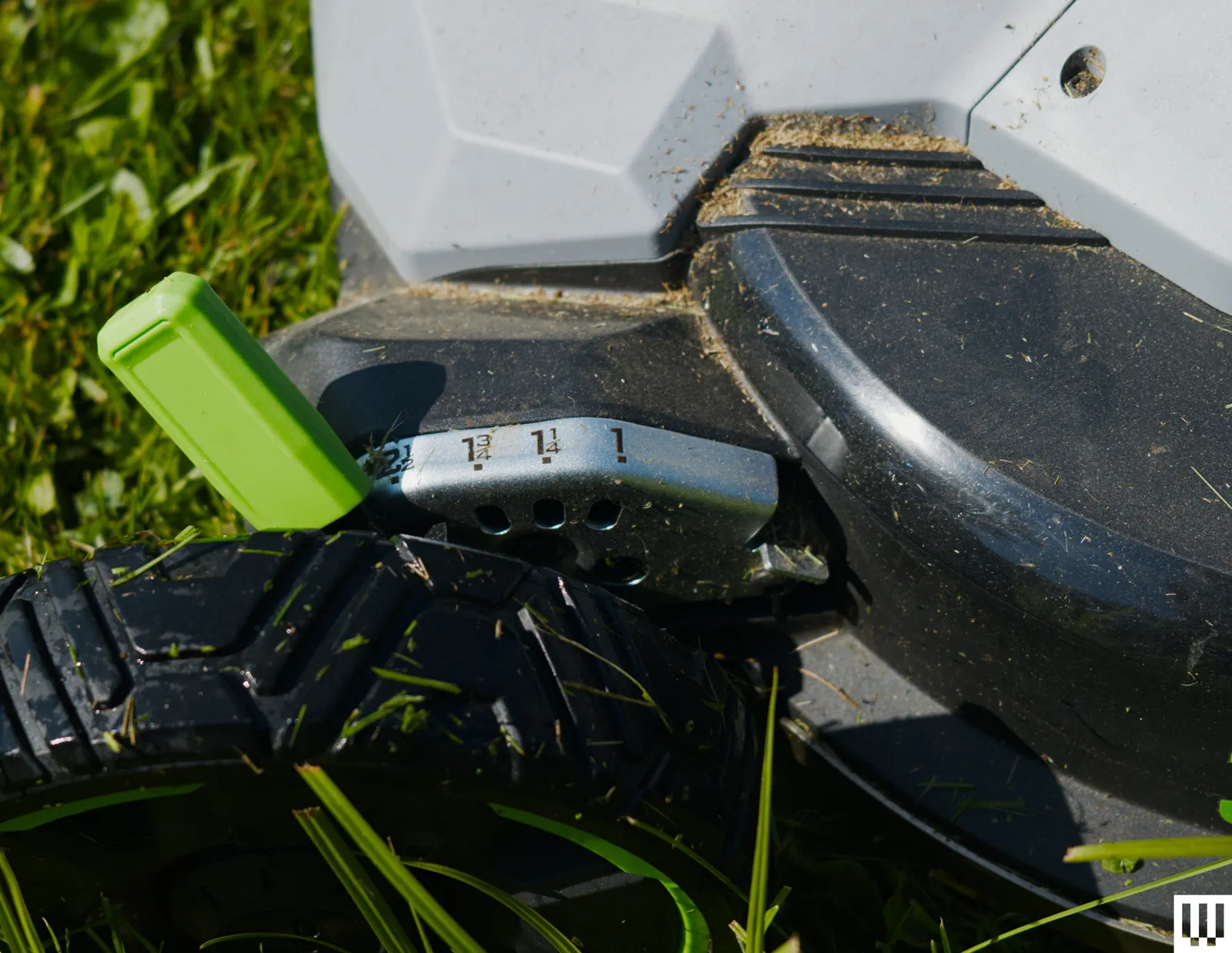
For the first pass, I set the height to 4.5 inches, which is easy to do using the height adjustment lever. Unlike an alarming number of mower makers, Ego’s height adjustment system is a thing of beauty. The height markings aren’t arbitrary letters or symbols that require you to consult a manual to translate to inches. On the Ego, the height adjustment is plainly printed in inches. Imagine that. This lets you know that if you set it to 4.5 inches, your grass will be 4.5 inches high when you’re done.

Image may contain Grass Plant Lawn Car Transportation and Vehicle

Photograph: Scott Gilbertson

Starting at 4.5 inches and running in Turbo mode allowed the Ego, in a single pass, to cut just about anything I pointed it toward. There is one patch of grass, below an active seeping spring, that was long enough and wet enough that I had to make two passes to get a nice even cut. After that initial mow, I then went back over it a few days later at 3 inches to finally get the height back to what I could call normal. The second mow was, dare I say, incredibly easy. Even the lowest self-propelled speed was generally fast enough for me, though I did crank it up to about the middle to get up the steeper slopes (and then turned it off entirely going downhill).

Source link

Advertisement
Continue Reading

Tech

Apple fails to delay filing new App Store fees to court

Published

on

Apple is being forced to detail fees it wants to charge for outbound links in its continuing legal fight with Epic, and now it’s only got 24 hours to file them.

The ever-ongoing legal battle between Apple and Epic Games over what Apple should charge apps within the App Store has hit a snag for the iPhone maker. In the current phase, the two are fighting in the U.S. District Court for the Northern District of California over new fee proposal.

According to X posts by Epic Games founder and CEO Tim Sweeney on Tuesday, Apple attempted to delay a filing of proposed fees to the court. To Sweeney’s glee, that stay was denied.

As a consequence, Apple’s legal team now has just 24 hours to file the proposal with the court. After that Epic will have 60 days to analyze the proposal and make its own filing with the court.

Sweeney continued with a second post to X about the legal activity, asking if Apple will “honestly document their costs for human reviewer time and seek to recoup them?” Alternately, he proposes Apple may “fabricate outlandish new notions of cost previously unknown to mankind.”

As it stands, Epic and commentators have another 24-hour wait before finding that out.

How Apple got here

Apple and Epic have been in a lengthy battle that started with “Fortnite” letting players make in-app purchases using a third-party payment processor, against App Store rules. Epic also made demands that included allowing alternate app storefronts in iOS, and a change in the commission structure.

Advertisement

Apple did come out of the lawsuit pretty well, succeeding in many areas but failing to fend off changes to anti-steering measures, namely preventing developers from sending users to other processors to pay. Apple was ordered to make changes.

Epic convinced a court in April 2025 that Apple didn’t follow the spirit of the law, which led to more legal activity.

The latest action is midway through a schedule to discuss changes in App Store fees for outbound links, which goes back to May 2026.

Apple was given 45 days to file a “proffer,” or a good-faith offer of evidence and testimony to the court, with a 10-day timer to hand Epic non-privileged documents about the decision-making process after that. Five days later, Apple was to meet with Epic to discuss the privilege log and decide what documents warrant further review by a third party.

Advertisement

Today’s stay denial is at this point in the process.

Afterwards, Epic has 60 days to file its own response to the court, in a 30-page document. Apple would then have another 30 days to file a reply.

A Fortnite foible

While Sweeney’s tweets are chiefly about the lawsuit, there was an odd element about “Fortnite” and the Mac. In response to a question about what the decision means for the game on macOS, Sweeney said “We are rapidly approaching an endgame that will determine that one way or another.”

Currently, “Fortnite” is unavailable on macOS, but it seems to be less about being blocked and more Epic refusing to use the platform for its premier game.

Advertisement

At the time of the initial legal fight, Epic’s developer accounts were frozen out by Apple. However, in March 2024, Epic confirmed that Apple would reinstate its account in the EU.

Though celebratory in tone for the prospect of getting the game out on iOS, Epic didn’t discuss macOS at all.

As it stands, there doesn’t seem to be anything standing in Epic’s way from releasing “Fortnite” on macOS at all.

It has its own Epic Games Store on macOS, which can be used to make purchases completely outside of Apple’s App Store system. Also, developers can send Mac apps for notarization and still be distributed outside of the App Store itself, which Epic surely could handle with its reinstated developer account.

Advertisement

Source link

Continue Reading

Tech

Parents’ Stress Leads to More Screen Time for Kids, Study Finds

Published

on

Parents who are stressed out are more likely to rely on screens and devices to keep their kids busy or calm — and less likely to enforce screen time limits. That’s the takeaway from a new screen time study from Florida International University’s Center for Children and Families. Researchers said the effects were more than a child acting out. 

Screen time is one way to keep kids busy, especially when school’s out. The time spent on tablets and laptops can be a break for parents to complete tasks or take a break. But readjusting to early mornings, class time and homework can be a big shift for both parents and kids when school is back in session. 

Jeff Temple, a professor and psychologist with UTHealth Houston, who was not affiliated with the FIU study, agrees. “For many families, screens become one of many tools that help everyone get through the day – and that’s mostly OK,” he told CNET. “The challenge comes when the structure of summer doesn’t transition back to the structure of the school year.” 

Screen time isn’t a parenting failure, but experts have concerns and recommendations to help families strike a healthy balance for the back-to-school season. 

Advertisement

Screen time is determined by parents’ stress

FIU’s study evaluated 822 caregivers of children ages 4 to 8 through online surveys on the child’s behaviors, parenting stress and screen time strategies. The findings show that parents opt for more screen time when a child’s behavior seems difficult and how much time is usually less enforced. 

Shayl Griffith, an assistant professor in FIU’s Department of Counseling, Recreation and School Psychology and senior author of the study, said in a news release that parents shouldn’t be afraid to ask for help. The study’s recommendation is to focus on screen time and media that are “meaningful, engaging and appropriate for their child’s age.” 

“When caregivers have the resources they need, they are better able to set consistent boundaries and engage with their children in ways that promote healthy development,” Griffith said.

The fine line between digital media discipline and disruption

Youth screen time is a growing concern. In January, the American Academy of Pediatrics published findings on correlations between digital media use and age-related development to help determine screen time rules for your child and monitor behavior.  

Advertisement

Toddlers and kindergarteners who use digital media for high-quality educational content can benefit from good social behaviors and language — especially when a caregiver is viewing the screen and interacting with the child. However, young children who use tablets for hours, but the AAP says too much screen time is linked to angry outbursts.

School-aged children, ages 6 to 12, can benefit from thoughtful educational digital media in moderation, the AAP study found. But again, there are risks. Too much media use can lead to lower academic achievement, attention control and cognition. Some media can be problematic for kids, like apps encouraging purchases, those focused on gaming with not much educational value and content that is dangerous or risky. And there’s a big callout included in the list: school devices that give access to “distracting video games, videos and other platforms.”

Managing stress, school and screen time is tricky

With summer wrapping up and school approaching, the big question is: How should stressed parents think about screen time? School may be the solution. 

“School can help provide a reprieve for families who do not have access to childcare in the summertime months and serve as a helpful jumping-off point to re-evaluate digital media habits, given the change in routine already,” said Dr. Tiffany Munzer, a professor of pediatrics at the University of Michigan Medical School. It can also mean more time for in-person interactions, which is important for social connection, Munzer added. 

Advertisement

However, making the switch from summer to back-to-school season can be challenging. And adjusting screen time while managing life stresses may not be easy. Munzer recommends making incremental changes. For example, if your child loves watching do-it-yourself videos, find a way to recreate what they’re seeing, Munzer said. Or if digital media is a way to calm kids, look for alternative activities such as reading or walking, Munzer added.

Jason Nagata, an associate professor of pediatrics at the University of California, San Francisco, said the back-to-school season is a good time to revisit family screen time rules and routines. 

“Rather than simply trying to return to an old set of rules, families can consider what makes sense for the child’s current age, developmental stage, school schedule and use of devices for schoolwork and communication,” said Nagata. “A family media plan should be dynamic; it may reasonably look different during the school year than during summer or holidays, and on weekdays compared with weekends.”

The AAP recommends creating a Family Media Plan based on your family’s needs. The plan is an agreement that lets you prioritize healthy, safe and consistent screen time boundaries. That includes creating a list of approved media kids can choose from, a schedule of screen-free time, how to choose good media content and outlets for your family. 

Advertisement

Experts also recommend the AAP’s 5 C’s of Media Use, tailored to your child’s age. The five C’s are Child, Content, Calm, Crowing Out and Communication. They can help you set and communicate screen time guidelines based on your child, their emotions, the content and how it affects them. That may not help the stress that parents face, but it could help regulate your child’s screen time without guilt.

Nagata encourages parents to pay attention to their children’s time and relationship with screen time. Look out for warning signs like difficulty cutting back on screen time despite trying, becoming preoccupied with social media or a phone, experiencing conflict because of screen use and using screens to escape problems. And pay attention to see if screen use is interfering with sleep, school relationships or other activities so you can make more adjustments sooner. 

Source link

Continue Reading

Trending

Copyright © 2025