Connect with us
DAPA Banner
DAPA Coin
DAPA
COIN PAYMENT ASSET
PRIVACY · BLOCKDAG · HOMOMORPHIC ENCRYPTION · RUST
ElGamal Encrypted MINE DAPA
🚫 GENESIS SOLD OUT
DAPAPAY COMING

Tech

Which Classic Mopar Was Called The ‘Gentleman’s Muscle Car’ & What Made It So Special?

Published

on


Mopar’s mid-1960s to early 1970s run of muscle cars easily goes down as one of the greatest eras ever for an American performance car maker. The Dodge and Plymouth brands of this period sold some of the most iconic muscle cars ever made, with model names every bit as recognized as the cars they adorned. Filling showrooms at this time were the Charger, the Challenger, the Cuda, the Super Bee, and the Demon, just to name a few.

While certainly not obscure or forgotten, the Plymouth GTX is a model from this period that sometimes gets overlooked when compared to its siblings. In the mid-’60s, as the muscle car movement was taking off, the mid-sized GTX would help lay the groundwork for the Mopar muscle cars that would follow it. The GTX also developed an image as a “gentleman’s muscle car” or “gentleman’s hot rod” through Mopar’s marketing and its higher price — and more well-appointed nature — compared to other mid-sized muscle cars of the time.

While there are other late ’60s and early ’70s American performance cars that could also lay claim to the “gentleman’s muscle car” label, the Plymouth GTX’s blend of upscale luxury and drag-strip-ready performance certainly made it stand out among its Mopar muscle car contemporaries. Today, this also makes the GTX a very desirable piece of muscle car history for collectors.

Advertisement

Mopar muscle with a dash of luxury

While the definition of what exactly is or isn’t a muscle car is loose, the Chrysler Corporation had been building high-performance, V8-powered automobiles since the mid 1950s, and it really began ramping up those efforts in the early and mid 1960s. By 1967, muscle car fever had begun to sweep the industry, with automakers rolling out a stream of specially-marketed and packaged, mid-size models powered by large cubic-inch engines.

The GTX debuted for the 1967 model year as Plymouth’s mid-sized muscle offering. Based on the Belvedere, the GTX came with big block power as standard, offering buyers a choice between the base 440 cubic-inch Super Commando V8 and the legendary 426 Street Hemi. Beyond its power plant, the GTX came well-equipped inside and was adorned with hood scoops to help it stand out in the growing segment of mid-sized muscle offerings.

Advertisement

It was in 1968, though, when the GTX really began to separate itself as Plymouth’s more upscale muscle car offering. That’s because this is the same year the legendary Plymouth Road Runner debuted. Based on the same mid-sized Belvedere body style, the Road Runner was all about stripped-down, budget-friendly big-block performance. This meant that GTX was now Plymouth’s better-equipped, more upscale take on the mid-sized muscle car, available with engines like the aforementioned 426 Hemi or the potent 440 Six Pack. 

Advertisement

The GTX wasn’t the only upscale muscle car

While there wasn’t any specific or official branding of the GTX as the “gentleman’s muscle car,” it was marketed as part of the “executive branch” of Plymouth’s so-called Rapid Transit System muscle car lineup alongside the full-size Sport Fury GT. However, just because it was positioned upmarket didn’t mean the GTX lacked the fun of other Mopar muscle cars. It still had the same bright color options and wild optional features like the Air Grabber hood scoop. The GTX existed as a standalone model until 1971, by which point the muscle car era itself was already beginning to fade out. 

Because there’s no official “gentleman’s muscle car” title, there are several other muscle-era models that could also be deserving of the label. These included the well-equipped Oldsmobile 442, the early 1970s Pontiac Grand Prix, and the related Chevrolet Monte Carlo, all of which were General Motors offerings. The latter two, in particular, matched big cubic-inch muscle car engines with elements of the emerging personal luxury car segment. 

Luxury muscle wasn’t solely the domain of mid-sized offerings, though, and there were also full-size offerings that blended muscle car and luxury features. These include the aforementioned Plymouth Sport Fury GT and the rare Chrysler 300 Hurst Edition, both of which added some muscle car spice to spacious and upscale full-size coupes. 

Advertisement


Source link

Continue Reading
Click to comment

You must be logged in to post a comment Login

Leave a Reply

Tech

How LEDs Are Making Light Pollution Worse

Published

on

In the chill of a London spring night, under overcast skies, iconic Trafalgar Square opens around me. Admiral Nelson rises on his pedestal, the National Gallery rests behind, the church of St Martin-in-the-Fields sits nearby. From the 13th century, the site served as the Royal Mews for hawks and then horses. By 1844, it was a public space at the heart of one of the biggest cities in the world.

Despite the square’s presence through that grand sweep of history, it’s not why I’m here. My interest is far more specific: I want to find out what happens to spaces like this when artificial light, specifically from light-emitting diodes (LEDs), intrudes. My companion tonight is Simon Thorp, a local lighting designer, who crouches in the shadows near Nelson’s spire, light meter in hand. “Two lux,” he reports, “and it’s very comfortable here.” Two lux is 10 to 20 times the illuminance of a full moon. We can see each other clearly, and a nearby sign assures us that closed-circuit television (CCTV) is in operation for safety’s sake.

A light designer uses a luxmeter to measure the light intensity emitted by a street lamp.

Light designer Simon Thorp uses a luxmeter to measure the intensity of light emitted by a street lamp in St. James’s Park, London.

Advertisement

Luigi Avantaggiato

Trafalgar Square captures the relationship between lighting and darkness that exists in almost every city, suburb, small town, and village around the world. The lighting here is a mishmash of old technologies and new, of shadow and glare, the ornamental gas lamps fronting the National Gallery all but washed out by the LEDs inside modern versions of traditional “brass and glass” fixtures a few meters away—21st-century technology housed in 19th-century designs.

The ugly truth of artificial lighting today is that in parts of London, as in many cities around the world, lighting levels are excessive, with unshielded illumination blasting in all directions. And the irony is that too much light invites danger: It creates shadows, impedes our vision, and gives the illusion, without the reality, of safety. Thorp notes that modern CCTV cameras are “pretty great” even at low-light levels, while harsh light makes it hard for both human eyes and digital sensors to see.

Advertisement

“The more bad light we add, the more bad light we think we need,” says Thorp. “We can’t see because of the light we’ve added. And it makes areas that were perfectly okay seem darker.”

Among the costs of this excess, the most alarming may be its toll on human health (and that of other animals) by disrupting circadian rhythms, impeding the production of melatonin, and contributing to sleep disorders that are tied to every major modern disease. New research shows that increased exposure to blue light from LEDs is having “substantial biological impacts” such as suppression of the sleep hormone melatonin and an increased risk for obesity, certain cancers, and type 2 diabetes.

A panoramic view from the Eiffel Tower looks down on the illuminated Champ de Mars gardens [center] leading toward the École Militaire, with the tall silhouette of the Tour Montparnasse visible on the Paris skyline.

Luigi Avantaggiato

Advertisement

I have come to London and Paris—which led the way in the expansion of public street lighting in the 19th century—because they embody both the current enormity of the problem as well as a future certain to be lit by trillions of chips: controllable, tunable, and energy-efficient LEDs.

Living with artificial light at night

The standard justification for nighttime illumination is public safety. Lighting experts’ term for the phenomenon is “artificial light at night.” While people won’t often admit it, the desire for light at night seems to stem from a primal fear of the dark. Darkness is where the bad guys hide. And if dark is bad and light is good, then more light can only be better.

This assumption has guided our use of nighttime light for hundreds of years. And yet, high-lumen output doesn’t necessarily correlate to a reduction in crime, research has found. In other words, if we relied on the data as much as we do our primal anxieties and paused those anxieties long enough to learn how light and darkness interact, our nights would almost certainly be lighted differently—especially now that we have the extraordinary technology that is the light-emitting diode.

A 19th-century gas lamp [white square] manufactured by William Sugg & Co. next to a pedestrian path in Trafalgar Square, along with the architectural floodlighting on the neoclassical facade of the National Gallery, showcase the interplay between modern and historic lighting systems.

Advertisement

Luigi Avantaggiato

The first visible red light-emitting diode was invented by Nick Holonyak in 1962, but LED lighting technology took several decades to develop, before exploding in recent years. Just a decade ago, LED streetlamps were rare. By 2019, more than half of U.S. streetlights were LEDs, and that number is predicted to top 90 percent by 2030. Similar uptake has occurred around the world, even in developing countries, where inexpensive Chinese-made LED fixtures are increasingly common.

This rapid global migration to LEDs represents a shift in the fundamental physics of how we illuminate our world. From oil lamps and candles to gas lamps, early examples of artificial light at night relied on a burning wick, an incredibly inefficient way to create light. An incandescent bulb is effectively a heater that happens to produce light as a by-product, so it squanders nearly all of its energy as heat.

By contrast, LEDs use semiconductors to convert electricity into light. Through this process of electroluminescence, LEDs use up to 90 percent less energy than incandescent bulbs do, which has enabled municipalities to realize an immediate energy savings of 50 percent or more. This fact alone has fueled the technology’s worldwide adoption.

Advertisement

But LEDs aren’t just more efficient and less expensive. The use of solid-state technology gives the lights an extraordinary life-span, often measured in decades rather than years. This significantly lowers the maintenance costs, as city workers spend far fewer hours replacing broken or burned-out lights. Even more striking, by manipulating the properties of the semiconductor material, engineers can dictate the precise color and intensity of the output, something that gives LEDs incredible versatility. For a lighting designer like Thorp, LEDs offer countless possibilities.

Digital control for smarter lighting

Wandering from Trafalgar Square along the edge of St. James’s Park, Thorp and I find ourselves near Westminster Bridge, one of nine city bridges that in 2021 were part of the Illuminated River project, meant to make the Thames more beautiful at night. Each bridge now features a new LED lighting scheme that moves and changes color and intensity to create a coordinated work of art. But Thorp is frustrated that the project did nothing to correct the often glary lighting on the riverbanks. “Why don’t you pay the money to correct all of this bad lighting instead of adding new lighting?” he says. LED technology, he points out, has the potential to fix that problem.

The Illuminated River artwork for Blackfriars Bridge uses a color scheme that closely complements the red pillar supports that remain from the original Blackfriars Railway Bridge.

Luigi Avantaggiato

Advertisement

In fact, this may be the most meaningful potential of LEDs: the ability for a community to control when, where, at what levels, and in which colors its lights shine. A public space like Trafalgar Square could be lit more brightly during rush hour, then dimmed as the night progresses, the lights not only connected to one another but to the surrounding streetlights and commercial lights. Anywhere in the world, LED streetlights could be programmed to rise and fall in brightness depending on the time of night or time of year. They could even be turned off during bird migrations, to reduce the number of birds that are disoriented by the lights and ultimately killed in collisions with reflective and illuminated windows.

Up to now, LED public lighting has largely not been part of any comprehensive plan to curtail and control nighttime illumination. Most LED installations have simply replaced older, inefficient “dumb” electric lighting with newer “dumb” LEDs and thus made light pollution worse. The main reason? Because LED lighting is cheaper, we tend to use more of it—a literally shining example of the Jevons paradox. Even as awareness of light pollution grows, we aren’t yet taking advantage of LED technology’s full potential.

The good news is that we could start tonight. At DarkSky International, the world’s foremost organization fighting light pollution, CEO and executive director Ruskin Hartley tells me the organization has five principles for responsible outdoor lighting: It should be useful, targeted, low level, controlled, and warm-colored. “They’re enabled because of the capabilities of LEDs,” Hartley says.

The technology to control LEDs will be part of the solution. In the olden days of the analog era, a streetlight was either on or off. To change a lighting schedule, you had to physically rewire a circuit. Today, the Digital Addressable Lighting Interface (DALI) protocol turns each luminaire into part of a network, with its own digital address and a driver that reports to a central server. With DALI, the lighting is managed through software rather than physical switches.

Advertisement

Unfortunately, most LED streetlights have been deployed without this technology because it costs more. But Paul Drosihn, general manager of the DALI Alliance, says that using such controls makes the LEDs much easier to maintain. Before the new digital protocol, it took an average of nearly three visits to identify, diagnose, and repair a defective luminaire. “Now it’s one,” Drosihn says. “Saving the cost of sending two guys on a cherry picker to replace those [lights] is immeasurable. What I just described to you is pretty much all the utilities need to know.”

The intricate cast-iron understructure of Westminster Bridge glows in vibrant green and teal light as part of the Illuminated River public art project, a color palette selected to echo the green benches of the nearby House of Commons.

Luigi Avantaggiato

What’s more, DALI allows the tuning of the lights’ spectrum so that they become warmer and less disruptive as the night progresses. Digitally connected, full-spectrum luminaires allow cities to transform the nocturnal experience—saving money, increasing health and safety, and creating a warmer and more appealing atmosphere at night.

Advertisement

This digital intelligence is equally transformative for the “bleed lighting” that spills from building interiors, Drosihn says. “You don’t think of night lighting as coming from inside buildings, but it does,” he says. “Particularly in the States, you drive through any major city and all the lights are on, on every floor of every high-rise, even if no one is home.”

Already, the use of digital controls for interior lighting has become commonplace in some European cities, Drosihn says. By integrating DALI with occupancy sensors and building-management systems that monitor HVAC, electrical systems, and security networks, a skyscraper can become a dynamic participant in the urban environment—dropping a floor’s interior lights to zero the moment the last person leaves. As a result, electronic controls combined with LEDs can act like a dimmer switch for a city’s entire skyline.

White light blights the night

With all the possibilities from LED technology, why are our nights too often lit with harsh and clinical light, casting glare and creating shadows, disrupting human and ecological health, erasing the stars from our skies? The answer starts with the color of LEDs. At first glance, an LED streetlight looks like a collection of small white bulbs, but it’s not. To produce a light we perceive as white, most manufacturers coat a blue semiconductor core with a yellow phosphor material that absorbs a portion of that high-energy blue light. The problem is that this “white” light is still heavily blue, which is exactly the color no species has evolved to expect at night.

Three lanterns glow white in the night.

A historic three-lantern cast-iron street lamp along the pedestrian walkway of Westminster Bridge casts a glow against the night sky.

Advertisement

Luigi Avantaggiato

And because blue light is the second most energetic part of the visible spectrum (violet is the most), it doesn’t just illuminate our streets and invade our homes. Blue light also scatters in the atmosphere more easily than any other color, which helps to create the hazy, illuminated fog known as sky glow over every city of any size.

“Cooler” colored LEDs in the 4,000- to 6,500-kelvin range offer the most lumens at the lowest cost, so most early adopters installed these blue-rich white lights. The good news is that LED technology has continued to advance, and a growing number of communities are choosing warmer-colored streetlights that have less blue. (Phoenix, for example, converted 100,000 streetlamps to 2,700 K LEDs in 2020.) And, of course, light pollution isn’t just a result of LEDs. Older lighting technology also adds to the glare—bright white metal-halide lights, especially—and cities are loath to replace something that isn’t yet broken.

Advertisement

But our main failure isn’t a technical one. It’s that we have yet to revise our thinking about lighting at night. We use LED technology just as we did the old sources of light. As a result, we have largely offset the gains that were promised in terms of reducing energy consumption and carbon emissions by making light pollution worse, and have so far let an incredible opportunity go unrealized.

Can the City of Light do it right?

Across the Channel in Paris, the failure to realize the potential of LEDs feels even more palpable. Unlike London, which suffered heavily from German bombs, the lovely 19th-century Paris that Baron Haussmann created largely escaped destruction in World War II. To nearly 50 million annual tourists, the beautiful uniformity of the architecture is instantly recognizable. But the City of Light’s nocturnal atmosphere is also part of the draw, and extensive attention has been given to relighting its buildings and monuments. When I wander into the Cour Carrée in the Louvre, for example, I’m stunned by rows of amber LEDs that together create a warm glow along the palace facades. When I see the Eiffel Tower, first from a distance walking along the Seine and then up close, I find myself staring as I would at a campfire, the structure’s metalwork amber-lit with more than 336 high-pressure sodium bulbs.

The Eiffel Tower glows with warm golden illumination at night.

The Eiffel Tower’s signature golden illumination was inaugurated in 1985. The 336 high-pressure sodium projectors are installed directly inside the monument’s structure.

Advertisement

Luigi Avantaggiato; Lighting designer for the golden lights of the Eiffel Tower: Pierre Bideau

Still, the city’s night lighting is far from perfect. With millions of residents, thousands of stores and restaurants, and 300,000 streetlights, the city overall is among the world’s brightest. Even at the base of the Tower, bright white LED lamps illuminate the African émigrés selling cheap berets and Tour de France trinkets. And the city has been replacing its old sodium streetlights with new LEDs, swapping the warm yellow tones for which the city has long been known for bright white lamps no one wants to look at.

Street vendors display souvenirs at the foot of the Eiffel Tower. Their merchandise is lit by harsh white LED systems, which starkly contrast with the warm golden sodium-vapor light illuminating the tower above.

Luigi Avantaggiato

Advertisement

Nonetheless, the potential is here. In 2019, France introduced a nationwide law to reduce levels of light pollution, setting rules about both public lighting (preventing light from being projected above the horizontal) and private lighting such as stores, which are required to turn off their exterior and shop window lights after 1 a.m. In addition, an increasing number of French communities dim or turn off municipal lights after midnight to save energy and reduce carbon emissions. Although light pollution worldwide continues to increase by nearly 10 percent per year, France has managed to reduce its overall level. Chloé Beaudet, a researcher at Université Paris-Saclay, documented local light-reduction measures and found people generally agreed with the notion of dimming or turning off the lights, mainly for energy savings and ecological concerns.

A researcher stands on the Pont de l'Archev\u00each\u00e9 (Archbishop's Bridge) observing the Notre-Dame cathedral at night.

Researcher Chloé Beaudet looks toward the Notre-Dame cathedral from the nearby Pont de l’Archevêché (Archbishop’s Bridge).

Luigi Avantaggiato

Advertisement

“What I find is that people living in urban areas, they accept this kind of policy,” she tells me. “They’re like, okay, I don’t really use public space at night as a pedestrian, so what’s the point of having lights on?” For her, a key takeaway is that one lighting level does not fit all areas. “I think there is really a need for policy that is differentiated according to the neighborhood.”

The west facade of the Notre-Dame cathedral glows at night following restoration, with warm white architectural LED lighting illuminating the three monumental portals, rose window, and twin towers.

The west facade of the Notre-Dame cathedral glows at night following its restoration, with architectural LED lighting illuminating the three monumental portals, rose window, and twin towers in a warm white light that preserves the medieval limestone details.

Luigi Avantaggiato

Advertisement

In another positive development, the country has been minimizing artificial light to create ecological corridors designed to protect nocturnal species such as birds, bats, and insects. These corridors are connected and dark, mitigating the disruption to the 30 percent of vertebrates and more than 60 percent of invertebrates that are nocturnal. Even for city dwellers, this trame noire (“dark infrastructure”) helps to raise awareness of why controlling light pollution is important for life on Earth. Nationwide laws to control light pollution, the ability to light different parts of a city differently, dark corridors to protect biodiversity—these are exactly the kind of changes made possible with LEDs.

The iconic I.M. Pei Pyramid glows softly at the center of the Cour Napoléon at the Louvre Museum, its warm LED illumination flowing through the geometric glass-and-metal structure with a symmetrical framing of the surrounding historic pavilions against the night sky.

Luigi Avantaggiato

That’s not all. Almost until 1920, astronomers at the Paris Observatory were still gazing at the Milky Way. That’s impossible nowadays, but it could happen again. Despite the bright white LED streetlights now lining so many Paris streets, networks of LEDs using controls could lower lighting levels enough each night, so that the Milky Way could once again be visible over the French capital. And in the process, Paris could become the City of Light in ways that would set an example for other parts of the world.

Advertisement

New lighting demands new thinking

“I think we should aspire to have cities that see the stars,” Simon Thorp says when I mention this view of Paris. “You just need everything to be coordinated.”

Nearing the end of our London walk, having turned from the river and back up toward the Strand, Thorp brings me down narrow Carting Lane behind the Savoy Hotel, to where a gas fixture tops a thick lamppost, an original from 1870. A small plaque reads, “The last remaining sewer gas destructor lamp in the city of Westminster.” Thorp explains that the thick pole hides a tube that allowed methane from the sewers to get burned off at the mantle. “An early example of renewable energy,” he jokes.

The fire-orange flame is pleasing to the eye. But even here, on a narrow lane with no vehicle traffic, in a touristy area of the city, the flame is overwhelmed by a nearby, unshielded LED security light. Thorp shakes his head. “It’s stunning that someone could put in a light like that and think, ‘Great, nice job.’”

Two tourists observe the faint flame of the historic Webb Patent Sewer Gas Lamp on Carting Lane, with bright white LED lighting from modern fixtures nearby.

Tourists gaze at the Webb Patent Sewer Gas Lamp, London’s last remaining Victorian sewer-ventilating street light, which illuminates the rain-slicked pavement of Carting Lane just off the Strand. Invented in the late 19th century by Joseph Webb to burn off methane from the subterranean network, the lamp operates 24 hours a day.

Advertisement

Luigi Avantaggiato

Here is the crux of contemporary artificial lighting at night. We know how to light well, and LEDs give us the ability to do so. But while our technology is 21st century, too often our thinking about light and darkness, safety and security, is stuck in the past. We could be doing so much more with this technology than we are. We could relight our nights in ways that would not only reduce energy and maintenance costs but also bring a slew of benefits, including healthier nights for humans, safer skies for nocturnal creatures, and a restoration of the stars.

In 2026, the tale of these two cities and their artificial light at night is that of a brilliant technology that we’ve engineered but haven’t yet learned to master. In short, we have yet to change the way we think about artificial light at night and to use it more thoughtfully and carefully—as we might, as one hopes we will.

Advertisement

From Your Site Articles

Related Articles Around the Web

Source link

Advertisement
Continue Reading

Tech

An AI SOC Evaluation Guide for Security Leaders

Published

on

Prophet header

The market for AI in the SOC has moved faster than the methods for evaluating it.

Just last year, Gartner placed AI SOC Agents at the Innovation Trigger stage with single-digit adoption. 

As of a few weeks ago, Gartner’s “Hype Cycle for Security Operations, 2026” put them at the Peak of Inflated Expectations.
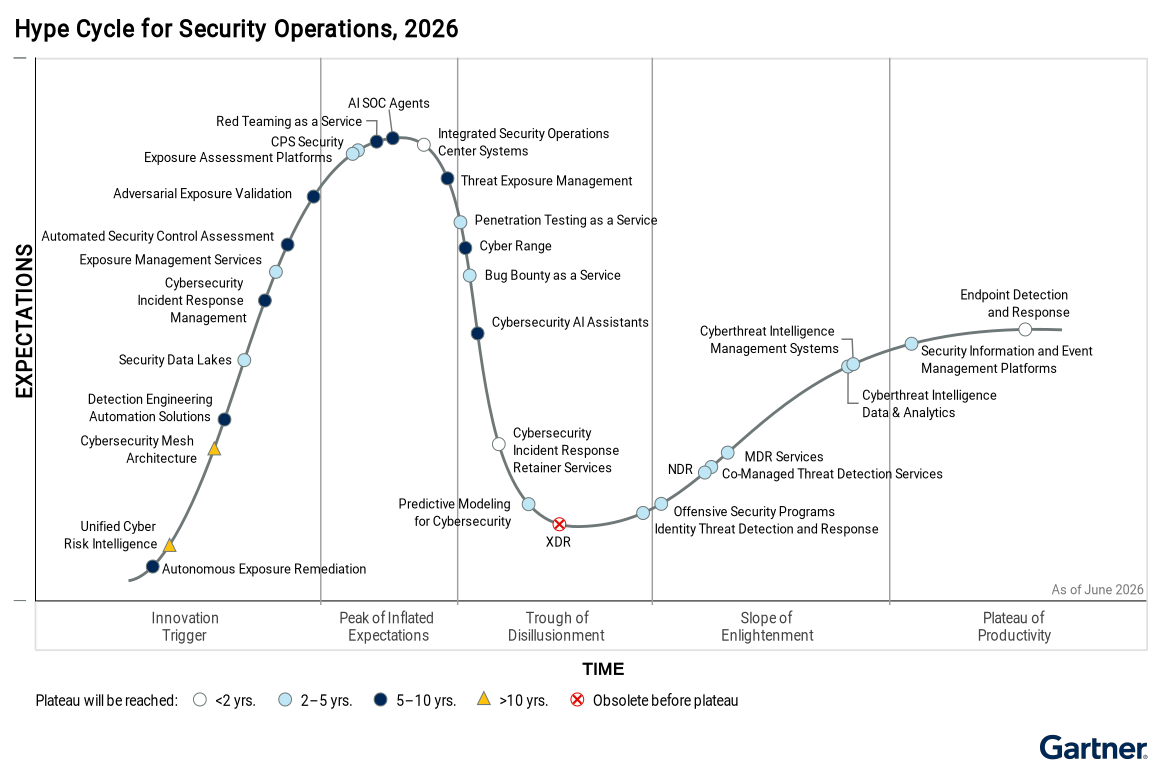
Hype cycle for security operations

Most AI SOC vendors have a demo that feels like science fiction. Clean alerts go in, and accurate verdicts come out in seconds. It is a compelling pitch.

Advertisement

Accuracy often degrades, though, once these tools leave the curated demo and meet real production conditions. The technology shows promise, and some teams report meaningful gains, but for many organizations the gap between proof of concept and operational reality is still wide.

The guide behind this article puts a number on it: between 80% and 95% of enterprise AI projects fail in production.

To help security leaders close that gap, Prophet Security, a leading agentic AI SOC platform recognized in Rising in Cyber 2026, worked with former Gartner analysts Oliver Rochford and Prateek Bhajanka on a practical, vendor-agnostic guide for evaluating AI in the SOC.

You can download a copy here.

Advertisement

What are you actually evaluating?

A useful question to ask early: Are you acquiring a tool, a capability, or a new way of organizing security work? Be clear on what you expect a proof of concept to prove before you start one.

From Bayesian spam filters to SOAR, automation is nothing new to SecOps. GenAI and large language models are different in scope and reach, applied to everything from detection engineering to evidence gathering and autonomous alert triage, investigation, and response.

That breadth is why alignment between a product’s operating model and your team matters more than it used to, and why it belongs at the center of your evaluation.

This Gartner report provides cybersecurity leaders with key questions and a pragmatic way to evaluate AI SOC solutions, ensuring they actually improve Threat Detection, Investigation, and Response (TDIR) program efficiency and operational outcomes.

Advertisement

Download Now

1. Can the AI produce reliable verdicts in your environment?

Start with the most important question: can the AI produce accurate verdicts across the scenarios and attack surfaces your SOC actually faces?

The key insight is counterintuitive. Verdict quality does not improve gradually as you feed the model more data. Below a threshold, no amount of fine-tuning or prompt engineering compensates; above it, the model produces reliable verdicts without additional tuning.

The data that pushes quality over that line is usually identity, asset, and organizational context, the information that lets the AI tell an attacker apart from a legitimate administrator.

That has a direct consequence for how you test. A phishing alert can be triaged from email metadata and a reputation lookup. Investigating privilege escalation or lateral movement requires identity data, asset inventories, behavioral baselines, and organizational structure.

Advertisement

If your proof of concept only covers cases where basic detection and telemetry suffice, you are testing the easy scenario and learning nothing about the hard one.

context sufficiency

2. Does the operating model fit how your team works?

Misalignment between a product’s operating model and the team using it is one of the most common reasons AI SOC deployments underperform.

A one-person operation leans on AI to do work no one else can, so breadth and cost displacement dominate. A larger team needs AI to amplify human effectiveness, which calls for parallel testing, override telemetry, and deliberate role redesign. The right evaluation is the one built for the team you actually have.

The most revealing test here is human-AI parity: run the system in parallel with your analysts for a couple of weeks, capture baselines before the AI is introduced, and treat analyst overrides as first-class data rather than noise. 

Advertisement

A warning sign is an evaluation where analysts end up ratifying the AI’s conclusions instead of independently reaching their own.

That points to the subtler risk in this category: every AI SOC platform makes a chain of decisions upstream of the analyst: what to ingest, what to suppress, how to prioritize, what context to assemble, and how to frame the investigation. 

The further upstream a decision sits, the less visible it is and the harder it is to reverse. If the AI silently frames every investigation, your human in the loop becomes a rubber stamp. 
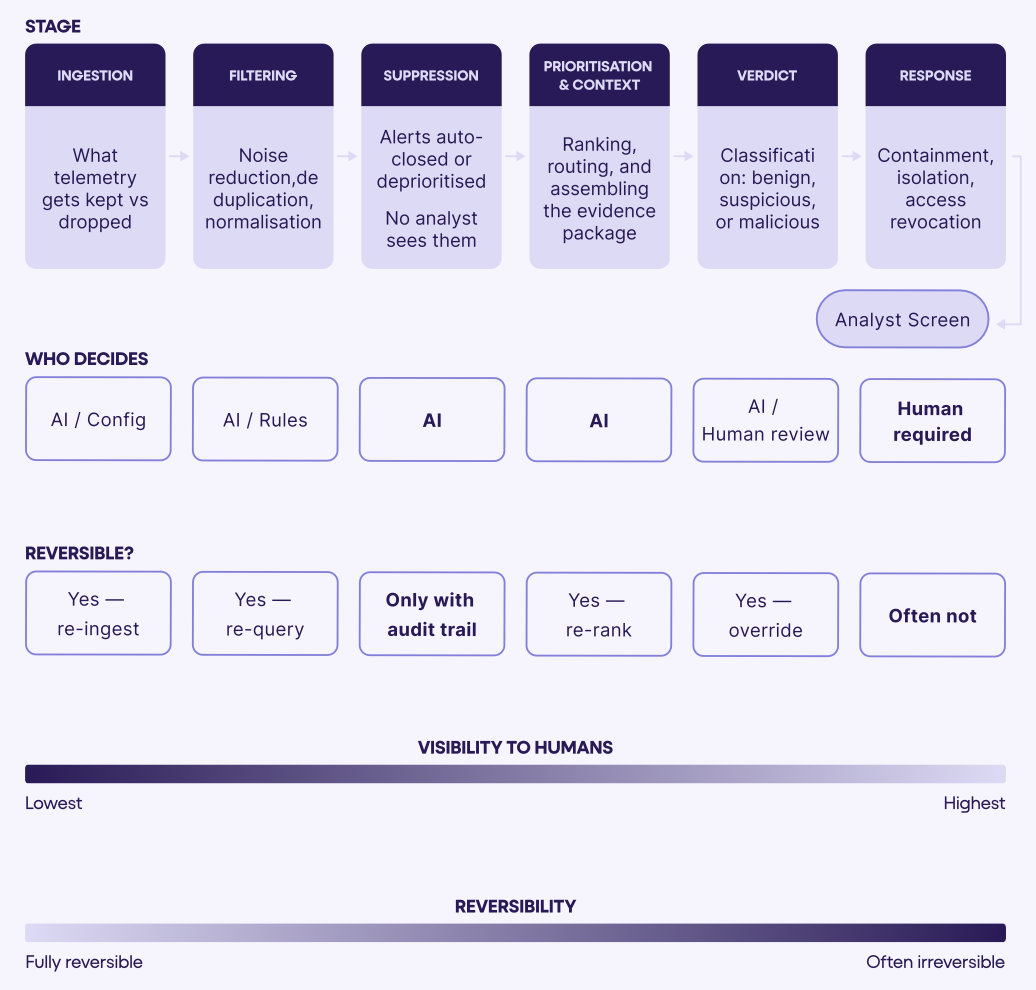
Evaluation stages

This is why explainability and investigation depth matter. Analysts can only trust and audit verdicts when they can see the reasoning behind them.

Advertisement

3. Will the AI stay reliable over time?

A product that works on day one can quietly degrade. This part of the framework tests for durability, and it is the part a two-week proof of concept tends to skip, because it cannot be observed in that window.

The guide flags several areas worth pressure-testing: adversarial robustness, model drift and degradation, adaptability as your environment changes, and lock-in. 

There is always a balance between what a vendor can deliver today, what they envision for the future, and their track record of executing on both. This is where customer references earn their keep, so you can distinguish puffery from reality.

4. What do practitioners wish they had known prior?

The final part of the guide draws on practitioners who have run AI in the SOC in production.

Advertisement

The workforce shift is real, and it arrives faster than expected. 

One enterprise CISO found that roles built around phishing triage and DMARC verification were automated within weeks, before the team had planned what those analysts would do next. The fix is to design the new roles (e.g. detection engineering, threat hunting, red teaming, and AI oversight) before deployment rather than in reaction to it. 

The biggest gains came from expanded scope rather than raw speed. 

They did not come from triaging existing alerts faster; they came from investigating things analysts would never have looked at.

Advertisement

One team resurrected detection rules it had shelved as impractical, correlating HR data, authentication logs, and asset records across locations to catch credential sharing, the kind of work no human would pursue at scale for a low-severity finding. AI makes it feasible. 

It also changes detection engineering economics: experimental detections become viable when AI absorbs the false-positive overhead that used to cost full-time analysts.

“Inconclusive” is a valid answer in its own right. A system that always returns a binary verdict and never says “I don’t know” is masking uncertainty rather than resolving it. Look for tri-state classification (i.e. benign, suspicious, and malicious) with deterministic escalation rules for high-impact decisions.

The bigger picture

A technology at the Peak of Inflated Expectations is nothing to fear. Practitioners just need to manage expectations about what is vendor puffery and what the technology can realistically do in production. 

Advertisement

Validate, ask for references, check case studies, and run your own evaluation. Both the former Gartner analysts and Prophet Security acknowledge that every organization’s needs differ. Some need a service, some need a product, some need a bit of both. There is no one-size-fits-all answer. 

The guide’s throughline is a human-AI hybrid model, one in which probabilistic AI handles triage and investigation while deterministic safeguards and humans in and on the loop govern containment, escalation, and irreversible actions.

Prophet Security is an agentic AI SOC platform that autonomously investigates every alert with transparent, evidence-backed reasoning and escalates the decisions that need a human.

It built its AI SOC analyst around the same principles the guide describes: every verdict shows the queries the AI ran and the evidence it weighed, so analysts can review a complete investigation rather than accept a score on faith, while humans stay in control of high-impact actions.

Advertisement

For the complete four-part framework in this piece, including the scenario-by-scenario context maps, the red-flag checklists, and the full evaluation checklist you can take into a proof of concept, The Hype-Free CISO’s Guide to Testing an AI SOC Solution is available to download.

Get the guide here to access the complete framework, checklists, and questions to ask vendors at each stage.

Sponsored and written by Prophet Security.

Advertisement

Source link

Continue Reading

Tech

A Beginner’s Guide to Growing Mushrooms at Home (2026)

Published

on

Mushroom hunting is cool and fun, but you know what’s not cool and fun? Having slugs or other mushroom hunters discover your secret spot. Or, worst of all, accidentally collecting the wrong kind of mushroom that could make you quite sick—or worse.

Ideally, you’d be able to grow your favorite kind of mushrooms safely in your own home or yard, whether that’s shiitakes, morels, or lion’s manes, just like you would vegetables. But like many gardening-adjacent pursuits, it’s not that simple. Mushrooms, like all fungi, need just three things to grow: spores, a food source, and a humid environment.

However, because mushrooms are incredibly sensitive to light, heat, and contamination, it doesn’t take much to create a prohibitive growing environment. And then there’s the question of whether it’s possible to simulate the critical symbiotic relationships that many mushrooms, especially more coveted ones like porcinis and chanterelles, must maintain with tree roots to thrive.

I am far from a mycology expert, but during the past year, I, a busy full-time-working parent, have engaged in five different attempts to grow mushrooms in my house and backyard: shiitakes on an inoculated log, oysters on a cardboard-enclosed fruiting block, wine caps in spawn buried in bark chips in my garden, oysters from grain spawn in a bucket, and oysters and lion’s manes in a monotub setup.

Advertisement

I laughed, I cried, I made an epic mess of chopped straw in my bathroom, and only two of the five methods succeeded. If you, too, are mushroom-curious and looking to grow your own, here’s what I did—and, in some cases, wish I had done differently.

Also, be sure to check out our guides to mushroom supplements (the functional kind), mushroom gummies, indoor gardening systems, and mushroom gifts.

Which Will Prevail?

Method 1: Mushroom Log

Williams Sonoma Mushroom Log Kit

Read more

Method 2: Spray-and-Grow Box

Back to the Roots Organic Mini Mushroom Growing Kit

Advertisement

Read more

Method 3: Spawn in the Garden

North Spore Organic Wine Cap Mushroom Sawdust Spawn

Read more

Method 4: Fruiting Blocks in a Monotub

North Spore Boomr Bin Automated Mushroom Monotub

Read more

Method 1: Mushroom Log

Image may contain: Plant, Tree, Home Damage, and Termite Damage

Williams Sonoma

Mushroom Log Kit

There’s nothing more natural, simple, and affordable than a mushroom log. Many mushroom logs available for purchase are meant exclusively for outdoor use, as they’re just plain old logs with sealed holes full of colonized mushroom spawn. But this 12-inch-tall option from Williams Sonoma is meant for indoor display (though you can also place it outside if you’d prefer), with smooth waxed ends and a rustic metal tag printed with its creation date.

Advertisement

Soak it for 24 hours and—theoretically—you’ll have mushrooms pinning in about 30 days. Even though oyster mushrooms are the easiest variety to grow, for reasons known only to me at the time, I chose a shiitake log, which came with a piece of paper identifying it as a “younger log.” This means the spawn was still in the process of colonizing and should fruit seven to nine months from the date stamped on its tag, which was December 2025. I soaked the log in mid-May and again in early July, but I’m still waiting to see any pins. Williams Sonoma says the log is guaranteed to fruit, so it continues to sit on my dining room table, in a saucer full of water, tented with a plastic produce bag. Some green mold has started to appear on the top, but I remain optimistic, even though this is not my first shiitake mushroom log failure (I tried to grow one from a different brand some years ago, outside under a bush).

Source link

Continue Reading

Tech

Hackers stole ‘significant’ amount of data from tech firm relied on by thousands of US hospitals and pharmacies

Published

on

U.K.-based healthcare billing software maker Craneware is responding to a cyberattack in which hackers stole a “significant volume” of customer data from its systems, the company said on Monday.

The company said the hackers appear to have been expelled from its systems, but its investigation into the breach is ongoing, according to a statement filed with the London Stock Exchange.

Craneware’s flagship accounting and billing software is used by thousands of clinics, hospitals, and pharmacies across the United States. The company did not say exactly what kinds of data were taken in the breach, only noting that a “percentage” of employee data, customer data, and partner records had been exfiltrated.

The company, whose software helps healthcare providers bill patients for services, handles large amounts of medical records and patient data on behalf of its customers. When it bought Florida-based pharmacy software maker Sentry in 2021, Craneware said it gained access to the company’s 147 million patient records that had been collected over two decades.

Advertisement

Craneware CEO Keith Neilson did not immediately respond to TechCrunch’s questions about the incident, or if the hackers have contacted the company with any demands, such as a ransom. 

It’s not yet clear if the company’s systems can receive email amid the ongoing cyberattack.

While details of the hack are still under investigation, this is the latest data breach in recent months where hackers have targeted tech companies that supply tech and services to the U.S. healthcare sector. By compromising software that many healthcare providers use to analyze and understand their billing processes, hackers can access vast amounts of patient medical and health-related data, and extort the companies with threats of publicly releasing the information.

Craneware is the latest health tech giant to be breached in the past year.

Advertisement

In March, healthcare revenue tech firm TriZetto confirmed hackers stole more than 3.4 million people’s personal and health data from its systems during an earlier cyberattack. That very month, medical data storage giant CareCloud reported a breach of one of its stores of patients’ electronic health records, but has not yet said how much data was taken. 

Last July, medical billing company Episource began notifying at least 5.4 million people that their information had been stolen by hackers.

The largest ever breach of U.S. medical and healthcare data occurred in 2024, when a Russian-speaking ransomware gang hacked UnitedHealth-owned Change Healthcare. The hackers stole the medical and patient records of at least 192 million people, which the company conceded affected a “substantial proportion of people in America.”

When you purchase through links in our articles, we may earn a small commission. This doesn’t affect our editorial independence.

Advertisement

Source link

Continue Reading

Tech

Watch Flock Safety CEO Garrett Langley discuss the future of surveillance at TechCrunch Disrupt 2026

Published

on

The debate over where the line should be drawn between privacy and public safety has only intensified in the AI era. And Flock Safety, a company that has seen both an influx of investment and an intense public backlash, sits right at the center of that debate. 

That’s why at TechCrunch Disrupt 2026, we’re bringing Flock’s founder and CEO Garrett Langley to the stage to speak about those very issues. Disrupt has always had its fair share of hard-hitting conversations, and you should expect no less from this session. 

And Langley’s discussion of AI, surveillance, and the future of public safety is just one of the many compelling conversations happening at Disrupt this year, which will take place October 13-15 at San Francisco’s Moscone Center. You can dive into the programming we’ve announced so far here, or take advantage of lower, early ticket prices right here

How Flock Safety, and Langley, got to Disrupt 2026 

Atlanta-based Flock Safety isn’t Langley’s first experience within the startup space. In past roles, he worked on the car subscription service Clutch and the platform Experience, where he oversaw several teams, including engineering and design prior to its sale to Cox Enterprises for $200 million in 2014.  

Advertisement

Flock started in 2017, with Langley partnering with co-founders Matt Feury and Paige Todd, going through Y Combinator before experiencing significant success selling its surveillance technology to businesses and law enforcement agencies. You may associate the company with license place recognition, though it has more general surveillance use cameras and has been developing drone first responders following its acquisition of Aerodome

The company’s most recent fundraise last year, a $275 million round, placed Flock at a $7.5 billion valuation, which was a sharp increase from the prior year’s $4.8 billion valuation. Altogether, the outfit has secured $950 million in total funding since inception. 

Flock’s business success has been paired with pushback from privacy advocates like the ACLU and members of the general public, with some people going so far as destroying Flock’s surveillance cameras as it continues to offer its cameras and databases to U.S. Immigration and Customs Enforcement in particular. Among the biggest apparent setbacks for Flock, Amazon’s Ring recently ended a partnership with the company, and the LAPD let its deal with Flock lapse this month.  

Langley will discuss the company’s approach to the increasingly interwoven nature of AI and the surveillance industry in a discussion that’s certain to prove illuminating to Flock’s supporters and its critics. 

Advertisement

To watch the discussion in person and join the other 10,000 founders, investors, tech enthusiasts, and innovators who will be flocking to San Francisco for TechCrunch Disrupt 2026 on October 13-15 for a wide array of workshops, speaker talks, after-parties, and networking, snag a ticket at the best price you’ll be seeing for the rest of the year right here

When you purchase through links in our articles, we may earn a small commission. This doesn’t affect our editorial independence.

Source link

Advertisement
Continue Reading

Tech

Hollywood Sci-fi Studio Lot Now Pitched As Site To Make Real Space-age Weapons

Published

on

James Cameron filmed his Avatar sequels there. Marvel filmed Thor, Iron Man 2, and The Avengers. Manhattan Beach Studios in Los Angeles even handled Star Wars’ series like Obi-Wan Kenobi and The Mandalorian, which Bloomberg points out is about “a heavily armed bounty hunter in a galaxy far, far away.”

“Now lenders who are selling the property’s $240 million mortgage are promoting the site to potential buyers as a hub for making real space-age weapons.”

“The project is strategically positioned within Los Angeles’ prominent aerospace and innovation corridor, anchored by industry leaders such as Northrop Grumman, Raytheon Technologies and SpaceX,” said Cushman & Wakefield, which has the listing. “A supply-demand imbalance has emerged, driven by the growing concentration of advanced manufacturing users and a limited supply of viable space,” the real estate brokerage said in a presentation. Bids are due July 28.

The marketing pitch reflects Southern California’s shifting economic landscape as the movie business slumps and weapons makers seek to cash in on surging Pentagon spending… The defense boom is spurring the revival of a regional industry that once churned out World War II bombers, supersonic Cold War planes and Apollo command and service modules before shrinking after the fall of the Soviet Union… In the Los Angeles area, aerospace and defense-related tenants have accounted for 11% of new industrial real estate leases since the start of 2025, up from an annual average 2% during the preceding decade, according to a report this month by brokerage Newmark Group Inc.
Los Angeles “has always gone through transformations,” Stephen Cheung, president of the Los Angeles County Economic Development Corp., told Bloomberg. “This is one of those.”

Advertisement

Source link

Continue Reading

Tech

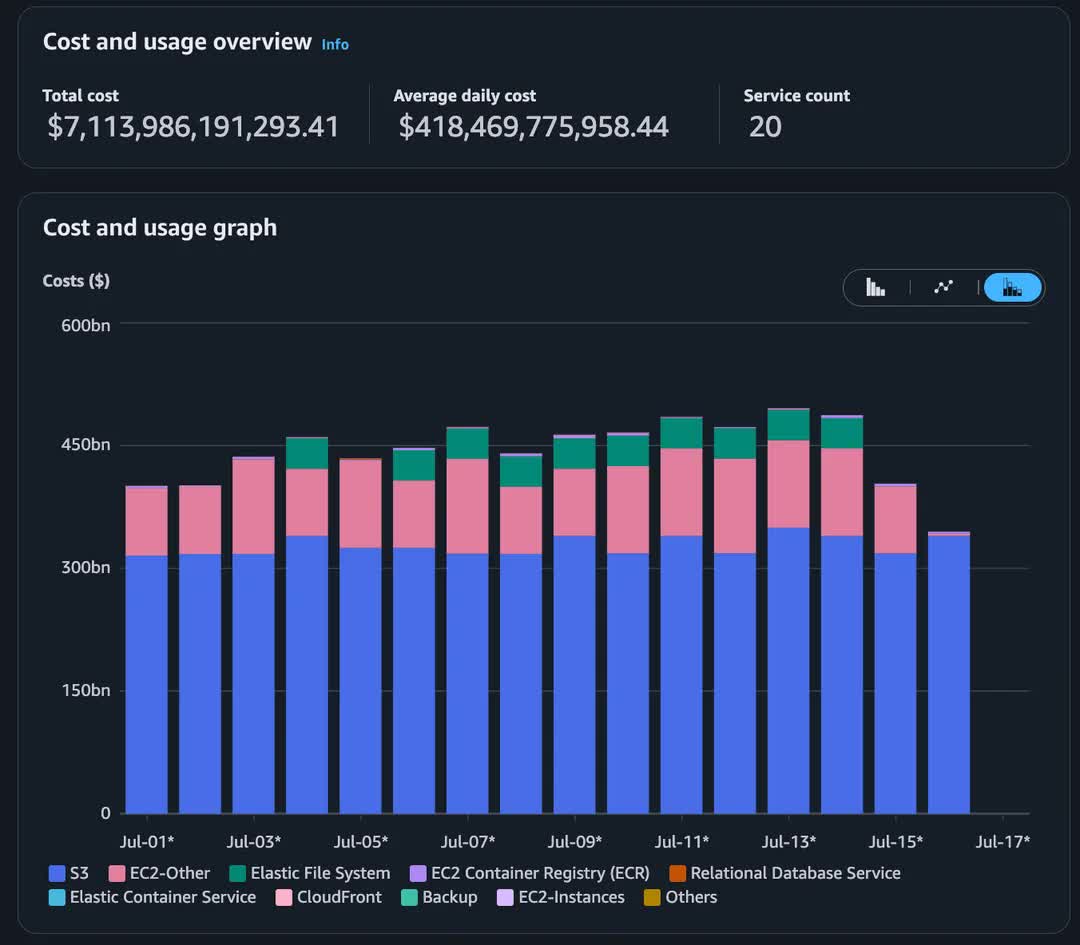
AWS billing goes haywire, hits customers with bills as high as $7.8 trillion

Published

on

WTF?! Amazon has a reputation for squeezing customers for all they’ve got, but increasing billing prices from a couple of cents to $1.5 trillion really shows how Jeff Bezos got so rich. Thankfully, though, this was just an error by Amazon Web Services, but it still caused one customer’s soul to leave their body, in their own words.

Bill Radjewski, who runs CollegeFootballData.com, received the sort of email most of us would rather not receive last week: an AWS alert informing him that he had accrued $1.5 billion in usage fees. Should he manage to win several lotteries and somehow pay it, he was still expected to face a $3 billion bill on August 1.

During the six years he’d been with AWS, his account had never exceeded $0.02 – most months his bill was just $0.01.

However, those figures were rookie numbers compared to what Dan Harvey, the head of marketing at the Hampshire-based Learning Through Landscapes, was billed.

Advertisement

Harvey told the Guardian that after his previous month’s AWS bill came to 43 cents, he was especially surprised to find a bill for $7.8 billion. “I had to have a real dig around with our tech support team, while I was in full panic mode, trying to find what was going on in our account,” he said.

There was also a student in Delhi whose regular monthly AWS bill of $1.28 increased to $10.9 billion.

Another user, Bharath, saw their bill rise an impressively large 745,728,201,771% from the previous month to $1.5 trillion. “I just saw $1.5tn on my AWS bill and my soul left my body,” they wrote.

Advertisement

But the record seems to belong to the user who racked up a $7.1 trillion bill in service fees since July 1, which is more than double Amazon’s market cap.

Amazon said that after 30 minutes of investigating, it determined that the root cause was “an issue with unit pricing within the estimated billing computation subsystem.” The company provided no further details but paused the bill estimation system.

AWS later said it was “rolling back a recent change to the billing computation subsystem” and attempting to restore the last known good version of its estimated billing calculations.

It appears that the issue wasn’t an easy fix. A few hours after that initial message, AWS wrote that “Our efforts to backfill corrected estimated cost and usage data are still underway. We are progressing slower than anticipated.”

Advertisement

While most people obviously knew this was an error on Amazon’s part, some have pointed out that this could really have alarmed customers and may have even caused health issues. “Good morning to everyone enjoying their heart attacks,” wrote X user Gerred

Even Amazon tried to make light of the situation, though it’s easy to imagine that not everyone was laughing about it . The company wrote on X, “Typo alert: Some customers saw quadrillion-dollar AWS billing estimates today. Slight miscalculation on our end (very slight ). We’re fixing it now. No action needed on your end. Sorry for the confusion. Real question: what will you do with those trillions instead?”

Source link

Advertisement
Continue Reading

Tech

Windows Server Update Services buckle under Microsoft’s metadata mountain

Published

on

SYSTEMS

Redmond has stabilized new installations, but existing deployments remain stuck in sync purgatory

Microsoft’s aging Windows Server Update Services (WSUS) has hit “severe degradation,” leaving some organizations facing painfully slow synchronizations or timeouts when fetching updates.

According to Microsoft, “a buildup of publishing metadata” has meant that “organizations might experience increased synchronization times or sync operation timeouts on WSUS servers.”

Advertisement

We’re told the problem isn’t related to the recent Patch Tuesday update, but Microsoft noted “heightened impact observed starting July 13, 2026.”

Administrators use WSUS to deploy and manage the distribution of updates and features in an enterprise environment. It was deprecated some time ago, but remains a supported part of Windows and, as such, receives fixes and security updates, even though there will be no new features.

Microsoft’s advice in October 2024 was to move to an alternative, such as one of its cloud-based options. However, administrators tend to opt for an “if it ain’t broke” approach and the service was still flagged as supported and suitable for production deployments.

However, failed synchronization could delay organizations’ ability to test and deploy patches, leaving systems exposed for longer.

Advertisement

Microsoft has not yet published a workaround for affected servers. For new and rebuilt installations, it deployed a mitigation on July 18 that restored normal synchronization, noting: “This mitigation prevents newly installed or rebuilt WSUS servers from encountering this issue.”

For existing affected WSUS servers, though, “Microsoft is working on mitigation steps to help customers safely remove the affected metadata from their environments. We will provide more information when this guidance is available.”

Microsoft’s affected platform list spans pretty much every desktop and server operating system still supported by WSUS, from the newest and shiniest Windows 11 26H1 all the way back to Windows 10 1607 and Windows Server 2012.

There isn’t much administrators can do at this stage other than wait and see, since the problem appears to be on Microsoft’s end. At present, it could be categorized as a headache, and perhaps a symptom of Microsoft’s inattention to the service.

Advertisement

However, should it linger and begin having a more severe impact on an enterprise’s patch cycle, action will be required. ®

Source link

Continue Reading

Tech

Brendan Carr Is Illegally Dismantling U.S. Media Consolidation Law

Published

on

from the laws-are-just-suggestions dept

Brendan Carr and the Trump FCC are finalizing plans to illegally eliminate what’s left of the country’s already barely functional media consolidation limits; a specific gift to Trump-friendly right wing broadcasters that are hoping to monopolize what’s left of local U.S. broadcast news so they can more efficiently spread propaganda and kiss the president’s ass.

Current laws (remember those?) prohibit any single local broadcast news company from serving more than 39 percent of all TV households in the US. The original (good) idea was that this helped protect opinion diversity and competition in the local broadcast news space. Republicans don’t like that, because they want to replace all journalism with right-wing and oligarch friendly propaganda.

Brendan Carr last March had already made it clear he viewed the law as optional when he granted Nexstar Media Group a waiver for its $6.2 billion acquisition of Tegna. That deal would let the company reach more than half of all U.S. households with what passes as “local news.” Now he’s trying to replace a congressionally-approved law with a “case by case review” dictated by Republican whims:

“Carr now plans to repeal the 39 percent limit and replace it with a “case-by-case review” of each proposed merger, the chairman announced today in an op-ed published on Breitbart. The change would make it easier for the FCC to pick and choose which station groups get to surpass the limit. Under Carr, this would likely benefit news companies that provide favorable coverage for President Trump.”

This is, to be clear, illegal. Something the FCC’s lone Democrat, Anna Gomez, made clear in her own statement:

Advertisement

“This unlawful effort to hand control of the public airwaves to billionaire buddies of this
administration will destroy local newsrooms, silence community reporting, and drive-up
costs for the American families who depend on local stations for news and emergency
alerts. A free and diverse media landscape depends on real limits on how much of the public
airwaves any one company can control, and this FCC is now poised to allow local
broadcasters to sell those airwaves off to the highest bidder. Congress set the 39 percent
national ownership cap in federal law, and only Congress has the authority to raise or
eliminate it. The Commission cannot waive away that limit simply because these corporate
behemoths want to get out from under it.”

Clearly there will be lawsuits, though they’re likely to drag on until long after Nexstar and Tegna have merged, with future regulators being very unlikely to unwind the transaction. I’d then expect to see Sinclair Broadcasting to merge with the remaining company, creating a monopoly over local broadcast TV.

While people are quick to insist that “who cares, nobody watches this stuff,” they don’t seem to realize that somewhere around 80 million households still watch local broadcast TV channels via antenna, cable TV, streaming providers, or satellite.

As I’ve frequently discussed, most of these local broadcasters deliver a sloppy combination of lazy infotainment and right-wing agitprop, as that viral video about Sinclair Broadcasting made clear a few years back:

Advertisement

Carr’s very unsubtle goal here is to turn the entirety of U.S. local broadcast television into propaganda arms of the U.S. right wing. That’s not an opinion or hyperbole, and he’s well on his way already. It might help if there was a functional opposition party that had made meaningful media reforms a centerpiece of their political platform anytime in the last quarter century.

And this is, of course, just local broadcast TV. We’ve also got Carr’s FCC helping Larry Ellison do the same thing to CBS and CNN. Ellison’s also steadily doing the same thing to TikTok while Elon Musk does the same thing to what used to be Twitter. If you stand back, tilt you head, and squint just right, you might begin to notice a consistent theme.

Filed Under: brendan carr, broadcast tv, corruption, disinformation, fcc, journalism, local news, media consolidation, propaganda, republican

Advertisement

Source link

Continue Reading

Tech

Could Reticulum Power A Post-Internet Network?

Published

on

These days, it is easy to think you always have access to the Internet. But some wonder if — in spite of its ARPANET, nuclear-war-planning heritage — you can actually count on it to be there when things go pear-shaped. [The Tech Prepper], as you might imagine, is quite concerned with that last question, and is flogging Reticulum over high-frequency radio as a post-internet network in a video embedded below.

Reticulum is a cryptographic network stack, fully decentralized and amazing from a cyberpunk/hacker/survivalist perspective. Unfortunately for [The Tech Prepper], until the you-know-what hits the ventilation unit and the FCC and its counterparts in other countries are too busy to be concerned with such trifles, encrypted signals are banned on ham radio bands just about everywhere. That’s why his demo is using a dummy load on the Mercury HF modem instead of an antenna: the feds don’t care if the signal doesn’t leave the building. The video shows how to replicate the setup using his EmComm Tools suite on Ubuntu.

Perhaps more interesting is his vision of a Post-Internet network, be it in a disaster scenario, as he envisions, or simply because we get sick of what the internet has become. The idea of easily hooking an open-source radio modem to a PC running modem73, open-source SDR software, has a certain appeal. Reticulum isn’t your only option there: modem73 will let you run a BBS in the clear — that is, unencrypted and legal to transmit — and let’s face it, wasn’t life online more fun in BBS days?

Advertisement

This isn’t the first time we’ve seen the Reticulum network stack, but last time it was operating at considerably shorter ranges over LoRA. 

Advertisement

Source link

Continue Reading

Trending

Copyright © 2025