AI goes beyond digital interfaces like ChatGPT and Claude and it’s now showing up in physical productivity-boosting devices. One of the most useful examples I’ve found is the AI voice recorder. A device slightly larger than a credit card, an AI voice recorder captures, transcribes, and analyzes conversations in real time. It acts as your own personal automatic note taker.
As a freelance writer and entrepreneur who has countless interviews, webinars, client conversations, and Zoom meetings each week, I’ve personally tried two AI voice recorders: the Comulytic Note Pro and the iFlyTek AI Recorder S6. And there are several other similar devices out there at varying price points. Each device is smaller than an iPhone 17 Pro Max.
The Comulytic actually came with a magnetic case to fit onto my phone. That way, it’s within reach and ready to record the moment I answer a call. It sends its recordings and transcripts to a cloud storage system, which I can access via an app. The iFlyTek AI Recorder S6 is a little larger and reminds me of the digital voice recorder I used in college 20 years ago. It’s slim, rectangular, and a little smaller than my palm. Unlike the Comulytic, this one has a screen where I can see the transcription, AI-generated summaries, and other features. It can also record videos. The Comulytic and iFlyTek AI voice recorders have changed the way I do meetings and classes. Here’s how.
Advertisement
I can engage in the conversation, not note-taking
Alli Hill/SlashGear
Science says that handwriting notes is better for your brain compared to typing, which is why I still enjoy note-taking the old-fashioned way. However, in my line of work, where I’m spending most of my day writing and typing and talking, doing things the old-fashioned way can be downright painful at times, regardless of whether you’ve got one of the best and most reliable mechanical keyboards. I get cramps in my hands and wrists, even with proper form and daily stretching. And if I’m trying to take notes while in a client meeting or online session, I’m not able to give one or the other my full attention. Even with pages of notes, I still feel like I missed part of the discussion.
Using AI voice recorders to do some of the lifting has made my work easier, physically and mentally. Instead of dashing to take notes and pick out all the important details, I can be present in the conversation. When my wrists and hands are aching after a day of writing, I’m more selective about the notes I take. But using an AI voice recorder, I can focus on what’s being said instead of how I’m capturing the information for later. It removes a lot of risk on my end because I know I will have all of the most salient pieces of information without having to pick and choose in the moment. Clients have to repeat themselves less, which saves us both time.
Advertisement
I receive an action-ready to-do list after the meeting
Alli Hill/SlashGear
At the end of a meeting, I review my notes and figure out what needs to happen next, usually in the form of research, deliverables, or other tasks. My next steps are only as good as the notes I took, and again, if I miss a key detail or otherwise couldn’t fully immerse myself in our conversation, the rest of the process suffers.
Both of my AI voice recorders analyze the conversations and present me with action steps, summaries, and follow-up items. I know exactly what needs to happen next based on the meeting. And it’s in a digital form in the same place where I’m already doing my work. As a rule, I always end client meetings by repeating a summary and takeaways so that the client has the opportunity to clarify anything we spoke about or what our next steps are. I still do this, and AI picks it up and runs with it. I’ve discovered that taking notes doesn’t have to compete with active listening. Conversations feel more natural since I’m not constantly staring at my keyboard or notepad. I love that my new process removes a layer of mental clutter and allows me to contribute in a more meaningful way.
Advertisement
I get clear, word-for-word transcriptions
One of the most valuable features of an AI voice recorder for me is seeing what was said. This goes beyond basic call recording, which, truthfully, I loathe. I don’t want to listen to a 30-minute phone conversation to find one key piece of information. When I have a digital transcript, I can use CTRL + F to search for keywords and find exactly what I need in seconds. Transcripts are a major time-saver for me, and AI voice recorders create them without a separate tool.
Advertisement
With the Comulytic, transcription is free and happens in real time. The iFlyTek does transcription too, but has a limit of up to 300 minutes per month. Beyond that, I need a paid subscription. With both devices, I can go back and look at notes from past calls and have searchable documents. It seems like a small convenience, but transcripts have become incredibly valuable to me over the years. Details that seem insignificant during a meeting might be important days or weeks later when I’m in a different phase of a project. I don’t have to hunt through notebooks or the pile of sticky notes on my desk. All of my records are centralized in one place (well, two since I use two devices for different purposes). Plus, I save money by not having to upload recordings into separate software or transcription apps that convert audio to text.
Advertisement
I can take notes on calls or meetings when I’m on the move
Alli Hill/SlashGear
When I’m not writing about tech or working with clients, I’m a travel freelance writer exploring mountain towns and hiking trails and unique attractions. And when I’m traveling, sometimes I still need to take client meetings. I used to lug around my laptop and pop into a coffee shop or cafe when I needed to take calls. The best note-taking apps were handy enough, but now I have an easy, one-touch way to record conversations without needing them. It takes notes on my behalf no matter where I am.
One of the biggest benefits is that these devices work offline. I don’t have to be connected to Wi-Fi because each device has internal storage, and when I regain internet access, the content will sync to my account automatically. Even when I’m not speaking with clients or stakeholders, this makes AI voice recorders useful for capturing my own thoughts. Some of my best ideas come when I’m walking in the park or hiking to see a waterfall. Sometimes I meet people unexpectedly and want to get their story on the spot. I have come to appreciate how much flexibility an AI voice recorder provides. I don’t have to plan my workflow around the availability of a laptop or internet connection.
Advertisement
Not everyone is on board with AI voice recorders, and here’s why
APJO/Shutterstock
As much as I appreciate AI voice recorders, I understand why some people are hesitant to embrace them. AI isn’t perfect, so there’s a risk of contextual misunderstanding. For example, AI might analyze your conversation and give an inaccurate summary or oddball to-do’s. Hopefully you’ll be able to spot this if you were immersed in the conversation, and it’s an easy fix. I haven’t experienced it (yet).
Some people are also put off by the idea of having AI listen to their conversations. Questions naturally arise about where the content is stored, who can access it, and whether the content is truly private. No one wants sensitive business information or client records on display, especially if it involves intellectual property. I believe transparency is essential. If I’m recording a meeting with AI, I let clients know. Most people appreciate being informed beforehand.
A few weeks ago on a bike ride “inspiration struck” for Dave Eggers, reports SFGate…
Without a pen and paper handy, he was stuck texting the idea to himself. The problem? Eggers doesn’t own a smartphone. “It takes 20 minutes to write a sentence,” Eggers said… It’s a funny predicament for Eggers, given that he’s arguably the city’s biggest proponent of the written word… Now age 56, Eggers’ latest book is called “Contrapposto“…
On writing days, Eggers bikes to his sailboat docked near the Golden Gate Bridge. He writes using a hefty 1998 Mac that has never been connected to the internet. On the boat, he keeps “banker’s hours,” working 9 to 5 without any meetings or interruptions except for the occasional wildlife visit. “You’re there with the cormorants and the occasional porpoise and sea lions and seals, and when you want to take a break, you walk around and you’re in the thick of it, one of the most beautiful spots on Earth,” he said. “Especially coming from the Midwest, it never gets old.”
Given Eggers’ decidedly low-tech existence, it’s not surprising that the current state of San Francisco gives him pause, but there’s a streak of hope that underlies his concerns. He abhors the growing surveillance technology that’s gripping the city, refusing to get into Ubers that use recording devices, but he feels a well-written ballot measure about Flock cameras could potentially save our dwindling privacy. ChatGPT’s effects on the art of writing are demoralizing, but he welcomes that teachers are re-embracing pencil and paper, with cursive making a big comeback. The wave of artificial intelligence ads blanketing bus stops imploring companies to stop hiring humans are so over the top, they’d sound cliché if he were to include them in one of his dystopian tech industry novels like “The Circle” or “The Every,” but tech philanthropy has helped many of his projects flourish.
Advertisement
Case in point, Art + Water, a new art space scheduled to open next year on Pier 29 funded largely by art world donations… Co-founded with the artist JD Beltran, the space is slated to operate as an old-school apprenticeship system, hosting 10 artists in residence mentoring 20 students, all free of charge… The ultimate goal is to break down the financial barriers that keep students from pursuing art.
Thanks to Slashdot reader destinyland for sharing the article.
Slashdot reader BrianFagioli writes: Shutterstock has unveiled what it calls a “human-led, AI-powered” creative platform that combines its massive library of [human] contributor-created content with AI image and video generation, AI editing, conversational search, prompt enhancement, and automated model selection tools. The company says the goal is to help creators move from idea to finished work faster [in a single application] while maintaining commercial licensing protections and contributor royalty payments… While Shutterstock repeatedly emphasizes human creativity, much of the platform’s future appears centered on AI-generated and AI-modified content. An article at Nerds.xyz suggests Shutterstock’s AI tools let users “transform existing content into something new,” while noting Shutterstock’s repeated references to human creativity “almost feel defensive.”
But it points out other companies including Adobe and Canva “and countless startups are all racing to integrate AI into creative workflows.”
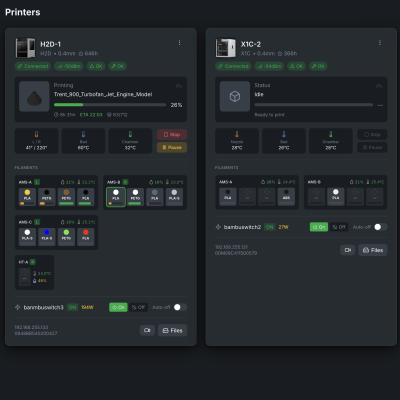
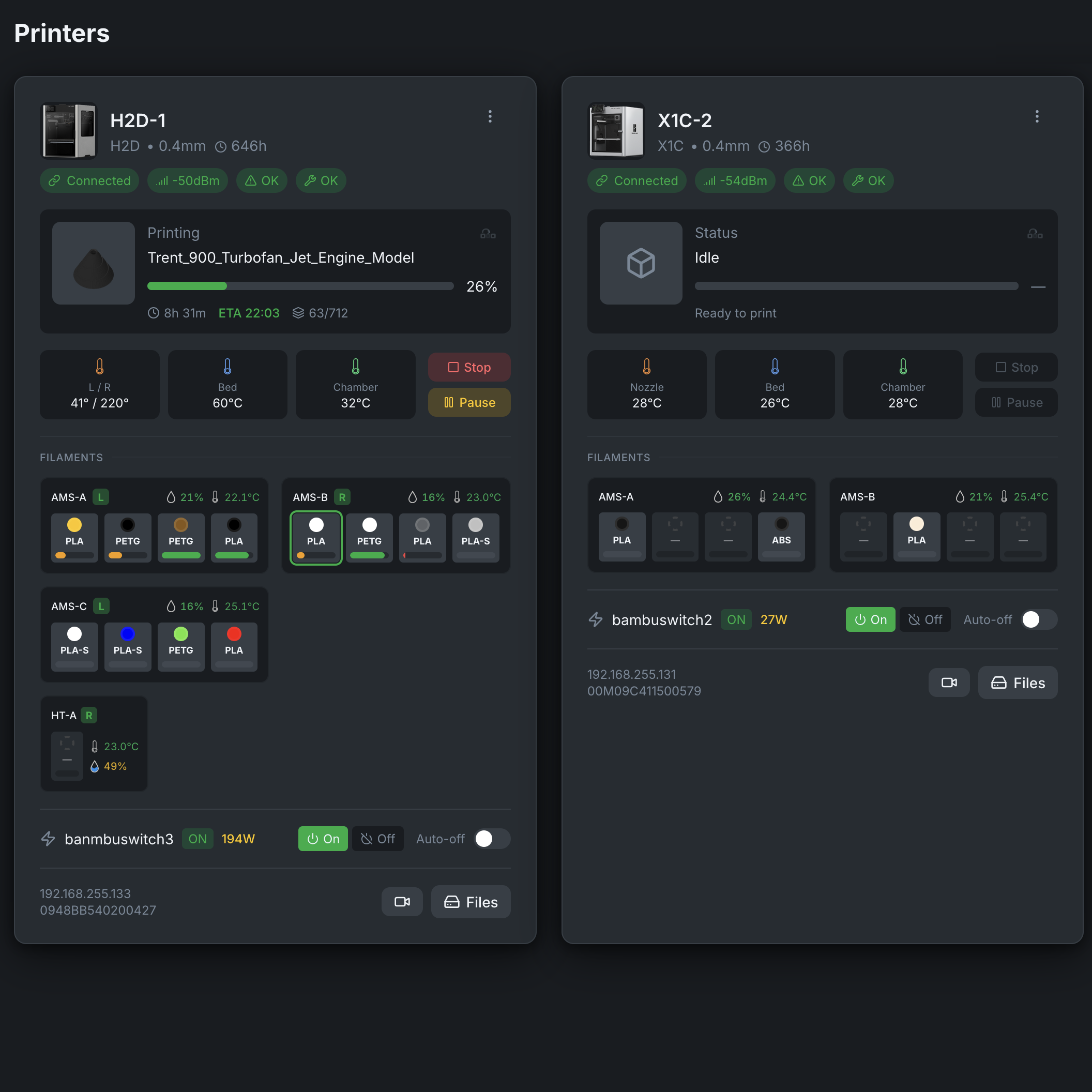
If you have a Bambu Labs printer and aren’t keen to send your files to Bambu’s servers with each print job, then check out Bambuddy, an open-source, self-hosted, cloud-free central command that offers a local alternative for managing Bambu Labs printers. It acts as a replacement for the official cloud services, allowing you to slice, print, and monitor with full local control and zero reliance on Bambu Labs’ servers.
Bambuddy offers full control over one to forty printers.
To use it, one installs Bambuddy, then puts their printer(s) into LAN-only mode. Doing this disables cloud functionality, including remote access. Then one enables Developer Mode, which allows external software to control printer functions via a machine API. Once that’s done, the printers can be added to Bambuddy.
Bambuddy then acts as a full-featured control panel and management center for anywhere from one to forty printers. It runs on Linux, macOS, or Windows, and a Raspberry Pi is a common install target.
Bambu Labs makes indisputably high-quality printers, and using their software and official app is certainly convenient. But the fact that every print job goes through Bambu’s servers, and a software architecture that frustrates home-grown solutions? Not so much. Add AGPLv3 violations and some heavy-handed legal behavior to the mix, and it’s easy to understand the motivation for an alternative to the factory software.
Bambuddy has a huge number of features — including an integrated slicer and proxy mode for remote access — and it may look a little intimidating at first. Fortunately, the project’s website offers a live sandbox demo with simulated printers, which should be right up the alley of those who prefer to learn by clicking around in a consequence-free environment.
Meta has begun dismantling its $2 billion acquisition of Manus, completing an operational separation from the Chinese-founded AI startup and halting data sharing between the two companies. This is the most concrete step yet toward complying with a divestiture order Beijing issued roughly two months ago on national security grounds.
Meta has cut Manus off from its internal systems, Bloomberg reported, preventing employees from using Manus tools for internal projects as the two companies move toward a full separation.
Meanwhile, according to May reports, the co-founders of Manus have held preliminary discussions about raising approximately $1 billion from outside investors to reclaim the startup from Meta, a move that could pave the way for a Chinese joint venture structure and an eventual listing in Hong Kong, a venue that has seen a surge in AI listings this year for Chinese AI startups like MiniMax and Zhipu.
What was supposed to be a landmark exit for Chinese AI is quickly unraveling. The move underscores Beijing’s determination to retain control over strategically sensitive technology, regardless of a company’s offshore incorporation.
Advertisement
In addition to the forced divestiture, Chinese authorities have since expanded travel restrictions to researchers and executives at private firms, requiring government approval before heading abroad. China is also tightening its grip on foreign capital, with reports indicating that top AI firms, including Moonshot AI, StepFun, and ByteDance, will need government sign-off before accepting U.S. investment, adding another layer to Beijing’s sweeping effort to control its AI sector.
Even as Meta moves to sever ties with Manus, the agentic AI startup has continued to ship new features, rolling out integrations with Similarweb and Shopify.
Manus drew widespread attention with a viral agent demo relocated its staff to Singapore in mid-2025 before announcing a $2 billion acquisition by Meta in December. Chinese regulators moved to scrutinize the transaction earlier this year, citing potential violations of technology export controls and foreign investment rules.
Manus investors, including California-based venture firm Benchmark, have already received their proceeds from the acquisition, while Asian backers, including Tencent, HSG, and ZhenFund, have indicated they will cooperate with the unwinding process, according to the WSJ.
Advertisement
Manus’ Chinese origins with parent company Butterfly Effect drew scrutiny on both sides of the Pacific, with Senator John Cornynquestioning whether American capital should flow to a Chinese-linked firm.
Meta and Manus did not immediately respond to a request for comment outside regular business hours.
When you purchase through links in our articles, we may earn a small commission. This doesn’t affect our editorial independence.
Washington state Gov. Bob Ferguson on Tuesday announced that banning cellphone use in kindergarten through 12th grade throughout the school day will be one of his top priorities when lawmakers convene in January.
“More than half of states across the country are moving in one direction, and one direction only. They’re passing laws to keep cell phones out of classrooms,” Ferguson said. “Washington state is not one of them, and that must change in the next legislative session.”
Despite mounting concern, Washington has moved cautiously on the issue. Legislators passed a law in March requiring the Office of the Superintendent of Public Instruction to study district phone policies, review research and gather student input for an analysis due at the end of 2027.
Ferguson is urging faster action, seeking all-day bans on the devices in public schools by the start of the 2027-28 academic year. Superintendent of Public Instruction Chris Reykdal also supports a ban and is proposing a similar policy.
A study published in January from the University of Washington School of Medicine and others found that U.S. adolescents ages 13-18 spend more than one hour per day on phones during school hours, with “addictive” social media apps accounting for the largest share of use. Newly released documents reveal strategies employed by social media companies that aim to increase student use of the apps.
Advertisement
At the same time, the impact of phone restrictions are less clear. Recent research found that test scores did not improve at schools where cellphones were put away all day, but teachers observed fewer distractions and students reported a greater sense of personal well-being, per the New York Times.
Support among teachers is strong. At the Washington Education Association’s annual meeting in April, nearly 1,000 educators passed a resolution almost unanimously to ban cellphones during school.
“We support a statewide ‘away for the day’ cellphone policy, so that students can focus on learning, growing, and reaching their full potential,” said Larry Delaney, president of the WEA. “We owe it to our students to make this happen.”
The push comes as local districts are already acting. Last month, Seattle Public Schools instituted a district-wide policy requiring K-8 students to put phones away for the entire school day. High schoolers must store them during instruction time but have access during lunch and passing periods. Exemptions exist for health and educational needs.
Advertisement
Tuesday’s announcement was made at Robert Eagle Staff Middle School, one of the first in the district to institute an all-day phone ban. The speakers included Zoe Taggart, a seventh grader at the school.
Taggart said that while she sometimes misses her phone, the benefits to students are clear. “We spend more time talking to each other, building friendships and relationships in the present day,” she said. “Instead of texting someone who’s right down the hall, we actually go down and find them and have a real conversation.”
The Phone-Free Schools State Report Card, which rates school cellphone policies nationwide, gives Washington and three other states a failing grade for lacking statewide regulations.
Four states have earned “A” grades for requiring phones to be fully inaccessible during the entire school day, or “bell-to-bell.” Twenty states plus Washington, D.C., have “B” grades for all-day restrictions, though in those cases devices are stored in lockers or backpacks, keeping them potentially within reach.
Amazon’s Jassy reportedly told the government that researchers used Fable 5 for cyberattack info. That triggered the order to shut down Fable 5 and Mythos 5.
Amazon CEO Andy Jassy was reportedly the source of security concerns that led the US government to force Anthropic to shut down Fable 5 and Mythos 5 for every customer on Friday. The Wall Street Journal reported that Jassy told Treasury Secretary Scott Bessent and other officials that Amazon researchers used Fable 5 to obtain information that could be used in cyberattacks. The government then imposed an export control ban on both models.
The revelation adds an uncomfortable dimension to the story. Amazon is one of Anthropic’s largest investors, having put in billions and receiving a $100 billion cloud spending commitment in return. The company that bankrolls Anthropic’s infrastructure is also the one that told the government its models are dangerous.
An Amazon spokesperson said it is “not uncommon for governments to seek our counsel on potential security risks” but declined to share details of the discussions. The spokesperson also pointed to an AWS status update confirming that Amazon’s own cloud platform was affected by the model shutdown.
Advertisement
David Sacks, Trump’s former AI czar who now co-chairs the President’s Council of Advisors on Science and Technology, offered a different account. He said “a highly credible trusted partner of both Anthropic and the USG came forward with a jailbreak.” Sacks added: “The Admin asked Dario to fix the jailbreak or de-deploy the model. Dario refused.”
Anthropic’s version is different. The company said it reviewed the jailbreak technique and found it surfaced “a small number of previously known, minor vulnerabilities.” It called the government’s response disproportionate and said the capabilities causing concern are already available in other publicly accessible models. The shutdown affected every customer globally because Anthropic cannot filter foreign nationals from US users in real time.
The sequence matters for the AI industry. Amazon invested billions in Anthropic. Anthropic built models on AWS. Amazon’s CEO told the government those models pose security risks. The government used export controls to force them offline. AWS was then affected by the shutdown. It is an ouroboros of corporate dependency and regulatory blowback.
For Anthropic, the immediate question is how quickly it can restore access. For the broader industry, the precedent is what matters. If a major cloud provider can trigger an export control action against its own portfolio company by raising concerns with the Treasury Secretary, the competitive dynamics of the AI market just gained a new weapon. Mythos is used by banks and government agencies for vulnerability discovery. Every one of those customers lost access because of a dispute between Anthropic’s biggest investor and the government its CEO has been lobbying for more regulatory power.
For all the things that Formula 1 has changed over the years, from the powertrains, drivers, and safety equipment, some aspects always stay the same. One of the most vital of these is communication. Bear in mind that, unlike in video games, drivers don’t have convenient heads-up displays telling them what position they’re in, where their opponents are in relation to them, and other vital pieces of information. That’s the job of the race team in the pits, which usually relay such information over the radio. But what if the radio fails, it’s difficult to understand, or any number of other scenarios occur? Then it’s time to go old school.
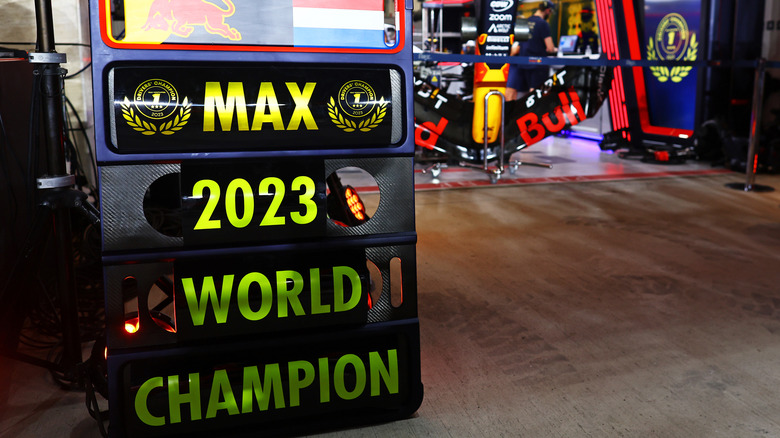
Enter the traditional pit board: A large, easy-to-read board filled with numbers and letters. There’s no specific set language, but everything is concise and carries specific meanings — it’s designed to be read as the driver passes the start-finish line at racing speeds, after all. It’s never going to be as involved as actual radio calls or presenting the information on a steering wheel display, of course. But it’s a system that will never break down due to electronic or mechanical failure, which is why it’s still just as valid today as it was yesteryear.
F1 teams use pit boards to eke out every last possible advantage in a championship race and to avoid losing time and position. When points are on the line, a team doesn’t want to be forced to retire because of something like a radio failure. Auto racing is a brutal and unpredictable sport; that’s why these redundancies exist. Much like an aircraft flying on one engine, it may not be the most efficient, but using pit boards to communicate can still get you across the finish line.
Advertisement
What do Formula 1 pit boards say?
Gold & Goose Photography/Getty Images
This is the biggest question for onlookers especially newbies just getting into F1, and the simplest answer is that it depends. Pit boards are designed to convey information, pure and simple — what that information precisely says varies depending on the team and what needs to be said. Generally, a pit board contains one or more of several points: Driver position, gap between cars, pit orders, sector cautions and other safety information, and general one or two-word commands can all be conveyed on a pit board.
There’s no real accepted “style,” per se. How many letters are used, what color the font is, what information is placed where on the board — it all varies. But you’ll often find that it’s usually based on common sense; you won’t place “BOX,” shorthand for “come in for a pit stop,” in the middle of two driver positions, for instance. Ultimately, it’s a form of coaching, and like the coaches themselves, there’s no set “right” or “wrong” way to convey the information as long as it’s clearly conveyed.
Advertisement
Let’s use an example. Imagine you’re leading on lap 10 and Verstappen is behind you by a little over 2 seconds. The pit board may say something like, “P1 – VER +2.1 – L10”, meaning you’re in Position 1, Verstappen is 2.1 seconds behind, and it’s Lap 10. Again, there’s no set language — different boards will have different formats. Sometimes they will spell out words like “LAP” or someone’s top message will be someone else’s bottom message. Because it has to be read at speed, presumably the order is committed to memory so it’s quickly legible at a glance. As a driver, it could potentially mess you up if your board’s format suddenly switches.
As for the traditional pit board, it still has its uses outside of the radio or electronic equipment being broken. Sometimes it’s used because of personal preference or to keep from distracting the drivers. Bear in mind that top-level motorsport is incredibly demanding on drivers’ concentration, especially when racing in packs, which results in many compilations of drivers angrily shouting into their radios mid-race (much to our amusement). But let’s be honest — how many of us miss important pieces of information when we’re in high-stress environments? Something like a pit board might be more useful, even if just to repeat this sort of information.
In its purest sense, the pit board is a low-tech solution to the modern problem of information overload. With today’s F1 cars being faster than ever, coupled with the rising prevalence of automation and software on the racetrack, the sport has arguably become just as much a technical showcase as it is about the drivers’ skills. A pit board is a simple and effective method of getting information across to drivers without having to use words or other distractions, a point no less valid today, which is why it’s been crucial to motorsport since the dawn of the discipline.
Jon Scholes, president and CEO of the Downtown Seattle Association, cuts the ceremonial ribbon on an IKE Smart City digital kiosk at First Avenue and Pike Street in Seattle on Tuesday, alongside current and former officials from the city, DSA and Orange Barrel Media. (GeekWire Photo / Kurt Schlosser)
The iconic neon sign at the Pike Place Market in Seattle manages to attract a lot of attention, but a glowing new structure across the street will likely turn a few curious heads, too.
The first of dozens of IKE Smart City digital wayfinding kiosks planned for downtown and around Seattle was unveiled on Tuesday at the busy intersection of First Avenue and Pike Street. It’s the realization of a years-long effort to bring the information many people access on smartphones straight to giant interactive screens at street level.
“Seattle is a tech town, and we finally have a 21st-first century modern wayfinding system,” said Jon Scholes, president and CEO of the Downtown Seattle Association, the organization that spearheaded the effort to get the kiosks approved and installed.
The IKE Smart City kiosk sits across First Avenue from Pike Place Market — a major tourist destination in Seattle. (GeekWire Photo / Kurt Schlosser)
The devices are a product of Columbus, Ohio-based advertising company Orange Barrel Media, which is partnering with DSA on the experience. IKE devices are already deployed in more than 25 cities nationwide.
A total of 50 kiosks are planned for Seattle in two phases. The first 30 will be installed in the downtown Metropolitan Improvement District footprint, with 20 more to follow in business improvement areas including Ballard, SoDo, the University District and West Seattle.
The first four downtown units include Tuesday’s unveiling as well as another that’s operational at Fourth Avenue and Pine Street. Units at Second Avenue and Stewart Street and Third Avenue and Virginia Street are next.
Advertisement
Each unit stands just over 8 feet tall and 3 feet wide, with a 12½-square-foot touchscreen that functions like a giant smartphone — letting users scroll through maps, nearby restaurant listings, transit routes and city apps. The kiosks are ADA-compliant and connect to the Seamless Seattle program for real-time multimodal navigation directly from each location.
Beyond wayfinding, each kiosk serves as a free public Wi-Fi hotspot, lists nearby businesses at no charge, and includes a 911 emergency call button. At least 25% of annual screen time is reserved for non-commercial content promoting events, nonprofits and civic initiatives. An ongoing digital public art program, curated with local and national artists, is also part of the offering.
The kiosks are loaded with a suite of apps designed to help people navigate the city and assorted services. (GeekWire Photo / Kurt Schlosser)
The kiosks will not include video cameras for surveillance. They do include a selfie camera that is part of a “Photo Booth” application, where users can interact and snap pictures to send to themselves. But IKE says photos are not stored on the kiosks or retained by the company.
The devices and effort to install them ultimately prevailed over those who expressed concern during Seattle Design Commission meetings about visual clutter in the city’s landscape, oversaturation of advertising, and light pollution.
The devices are maintained by Orange Barrel and come at no cost to the city or to DSA, and are sustained entirely through advertising revenue. DSA anticipates the kiosks will generate approximately $1.1 million per year, money the organization says it will reinvest into downtown programming.
Advertisement
Scholes said it’s a “long-term investment,” with a permit between Orange Barrel and the city that’s good “for about 20 years.”
“We believe that great downtowns make it easy for you to discover what’s happening, to take part in events, to take part in arts and cultural gatherings and attractions,” Scholes said before cutting a ceremonial ribbon cutting alongside Orange Barrel officials, and current and former City of Seattle officials.
Jessica Burton, development director at Orange Barrel Media, gives a demo of the IKE Smart City kiosk. (GeekWire Photo / Kurt Schlosser)
Former Seattle City Council President Sara Nelson was in attendance to celebrate — and interact with — the devices she had long championed.
“This is the city at your fingertips,” Nelson told GeekWire. “Not only is there important information for emergencies, but it also supports our small business community — it is a focal point, it’s a gathering spot, and that is what we need more of downtown.”
The rollout of the kiosks has been in the works for more than a year. The Seattle City Council gave final approval in June 2025 by a 6-2 vote, and former Mayor Bruce Harrell — a supporter of the project — signed the legislation.
Advertisement
DSA had hoped to have more up and running before the start of the FIFA World Cup next week and the onslaught of expected visitors to the city. The remaining 28 planned for downtown will be installed over the next several months, Scholes said.
The IKE Smart City kiosk is located next to a public plaza on Pike Street at First Avenue in downtown Seattle. (GeekWire Photo / Kurt Schlosser)
A new NYT Connections puzzle appears at midnight each day for your time zone – which means that some people are always playing ‘today’s game’ while others are playing ‘yesterday’s’. If you’re looking for Saturday’s puzzle instead then click here: NYT Connections hints and answers for Saturday, June 13 (game #1098).
Good morning! Let’s play Connections, the NYT’s clever word game that challenges you to group answers in various categories. It can be tough, so read on if you need Connections hints.
What should you do once you’ve finished? Why, play some more word games of course. I’ve also got daily Strands hints and answers and Quordle hints and answers articles if you need help for those too, while Marc’s Wordle today page covers the original viral word game.
Advertisement
SPOILER WARNING: Information about NYT Connections today is below, so don’t read on if you don’t want to know the answers.
Latest Videos From
NYT Connections today (game #1099) – today’s words
(Image credit: New York Times)
Today’s NYT Connections words are…
GRINDSTONE
MOTHER
CATERPILLAR
CREAM PIE
MASSACHUSETTS
TEA PARTY
GYROSCOPE
GLOBE
POCKET WATCH
SELTZER BOTTLE
MILLIAMPERE
ROULETTE WHEEL
BANANA PEEL
MASTER OF ARTS
RABBIT HOLE
RUBBER CHICKEN
NYT Connections today (game #1099) – hint #1 – group hints
What are some clues for today’s NYT Connections groups?
Advertisement
YELLOW: Visual gags
GREEN: Turning things
BLUE: Lewis Carroll props
PURPLE: Linked by two letters
Need more clues?
We’re firmly in spoiler territory now, but read on if you want to know what the four theme answers are for today’s NYT Connections puzzles…
Sign up for breaking news, reviews, opinion, top tech deals, and more.
Advertisement
NYT Connections today (game #1099) – hint #2 – group answers
What are the answers for today’s NYT Connections groups?
YELLOW: CLASSIC SLAPSTICK PROPS
GREEN: THINGS THAT SPIN
BLUE: FEATURED IN “ALICE’S ADVENTURES IN WONDERLAND”
PURPLE: WHAT “MA” MIGHT REFER TO
Right, the answers are below, so DO NOT SCROLL ANY FURTHER IF YOU DON’T WANT TO SEE THEM.
Advertisement
NYT Connections today (game #1099) – the answers
(Image credit: New York Times)
The answers to today’s Connections, game #1099, are…
GREEN: THINGS THAT SPIN GLOBE, GRINDSTONE, GYROSCOPE, ROULETTE WHEEL
BLUE: FEATURED IN “ALICE’S ADVENTURES IN WONDERLAND” CATERPILLAR, POCKET WATCH, RABBIT HOLE, TEA PARTY
PURPLE: WHAT “MA” MIGHT REFER TO MASSACHUSETTS, MASTER OF ARTS, MILLIAMPERE, MOTHER
My rating: Hard
My score: 2 mistakes
Seeing TEA PARTY and MASSACHUSETTS beside each other my first thought was Boston; I added GLOBE because the Boston Globe newspaper sounded like a possibility and took a chance on CREAM PIE. I pressed “submit” fully expecting to get a purple first — alas, it was completely wrong.
At this point I thought of the most common appearance of a CREAM PIE — as a practical joke — and managed to compile the four CLASSIC SLAPSTICK PROPS.
As it often does, getting the first group unlocked the others — although it did take me two attempts to get THINGS THAT SPIN as I had POCKET WATCH instead of GRINDSTONE.
Advertisement
Yesterday’s NYT Connections answers (Saturday, June 13, game #1098)
YELLOW: SEEN AT A TEA SERVICE SAUCER, SPOON, TEACUP, TONGS
GREEN: ENDURING SONG CLASSIC, HIT, OLDIE, STANDARD
BLUE: USED IN MOVIE PRACTICAL EFFECTS MAKEUP, MINIATURE, PROSTHETIC, PUPPET
PURPLE: WORDS BEFORE “STORY” IN MOVIE TITLES CHRISTMAS, NEVERENDING, TOY, WEST SIDE
What is NYT Connections?
NYT Connections is one of several increasingly popular word games made by the New York Times. It challenges you to find groups of four items that share something in common, and each group has a different difficulty level: green is easy, yellow a little harder, blue often quite tough and purple usually very difficult.
On the plus side, you don’t technically need to solve the final one, as you’ll be able to answer that one by a process of elimination. What’s more, you can make up to four mistakes, which gives you a little bit of breathing room.
It’s a little more involved than something like Wordle, however, and there are plenty of opportunities for the game to trip you up with tricks. For instance, watch out for homophones and other word games that could disguise the answers.
It’s playable for free via the NYT Games site on desktop or mobile.
The model is open for the public to view as part of the Heart exhibition in RCSI’s Humanarium.
Researchers at RCSI University of Medicine and Health Sciences hope to better understand diseases in the mitral heart valve with an artificial model that mimics the valve’s complex mechanisms.
The heart’s mitral valve opens and closes around 100,000 times each day, making its mechanical properties key to healthy heart function.
When the valve does not work properly, blood can leak backwards through the heart in a condition called ‘mitral regurgitation’. This condition affects millions worldwide, with that number growing alongside global life expectancy.
Advertisement
“Advancing our understanding of mitral valve function is dependent on developing synthetic alternatives that capture the valve’s complex mechanical behaviour, which is achieved in this study,” explained Dr Claire Conway, a lecturer in RCSI’s department of anatomy and regenerative medicine, and one of the authors of the new study published in Acta Biomaterialia.
The study was funded through an RCSI Star Lectureship and the Research Ireland Frontiers for the Future Programme, and carried out by the RCSI Tissue Engineering Research Group.
Generally, synthetic mitral valves lack multi-directional mechanical properties and are unable to withstand the blood pressure and flow of a human heart, the researchers said.
This new model makes a marked change by being the “first of its kind” to incorporate the mechanical properties of real heart valve tissue, while also operating under realistic heart pressures and flow conditions, they explained.
Advertisement
The model also allows control over the tension and thickness of the parts that allow the valve to open and close effectively.
“This model captures native anatomy and the fabrication is precise and repeatable,” said Conway. “Physical and digital tests of the valve revealed it successfully functioned under physiological flow and physiological pressure, representing a significant advance in the field.”
Dr Sina Javadpour, first author of the study and a postdoctoral fellow at Trinity College Dublin, said: “This model gives us precise control over key features of the mitral valve while still reproducing the way it functions in the heart.
“That makes it a powerful tool for studying valve disease and testing new repair strategies in a controlled laboratory environment.”
Advertisement
The model is open for the public to view as part of the Heart exhibition in Humanarium at RCSI.
Don’t miss out on the knowledge you need to succeed. Sign up for the Daily Brief, Silicon Republic’s digest of need-to-know sci-tech news.


























































You must be logged in to post a comment Login