

Monday morning, the Roman Catholic Church made its biggest foray yet into the discourse on artificial intelligence and the role it should play in human life as the technology develops.
Tech
Why Pope Leo XIV is speaking up about artificial intelligence and humanity


In the first encyclical of his papacy, titled Magnifica humanitas (Latin for “magnificent humanity”), Pope Leo XIV argued that AI is not intrinsically immoral, but that its adoption needed to be slowed in order to build moral guardrails, to establish better social safety nets for those displaced by economic and labor disruptions, and to create democratic processes that will ensure the public remains in control of these developments, rather than a small subset of tech oligarchs. The document also contended that the “intelligence” in artificial intelligence was a misnomer: Intelligence is something only human persons possess, and technology will never be human.
- The first encyclical, or official teaching letter, of Leo XIV’s papacy, dropped Monday.
- It centers the uniqueness of humanity, the dignity of work, and the challenges that artificial intelligence poses to the world order and humans’ relationships with each other and God.
- The Catholic Church has a long tradition of reasserting authority in the modern era, starting with the current pope’s namesake, Leo XIII, who confronted the rise of the Industrial Revolution and changing global economies.
- There are deeper spiritual and material reasons the pope, and the church, are so concerned with AI now.
Encyclicals are official teaching documents of the Catholic Church: letters issued by popes to bishops after consultation with theologians, historians, and experts on pressing matters that affect humanity or the church, with the expectation that all people, faithful or secular, can learn from them and help shape their consciences and lives. Magnifica humanitas is Leo’s first encyclical since becoming pope last year, and its release now underscores the focus the new pope is putting on AI and technology. Notably, Leo also used the occasion to make a historic formal apology for the Church’s previous defense and justification of slavery — a reminder that the Catholic Church has not always been on the right side of social ills.
Though popes are traditionally not present during the release of these documents, which first began in the 18th century, Leo XIV was in attendance at its presentation, and delivered his own comments — something Vatican observers indicated reflected his desire to make sure the Church’s stance was properly understood. The Chicago-born pontiff spoke in English and was joined by AI experts and industry leaders, including Anthropic co-founder Chris Olah, who consulted on the document.
So how should the public process and think about this new document? It’s helpful to first understand the context in which the Church is speaking up about this at all.
Why the Catholic Church cares so much about AI’s development
Magnifica humanitas is dropping more than a week after Pope Leo XIV actually signed it on May 15. The timing matters.
That day marked 135 years since the release of Rerum Novarum, the seminal work of Pope Leo XIII, the current pope’s namesake, who was leading the church during the late stages of the Industrial Revolution. As they are today, the faithful, and the clergy, were facing a rapidly changing world. And the Church, the world’s leading moral authority at the time, had yet to establish its place in it.
That 19th-century document made philosophical arguments about the relationship between labor and capital, warning about the perils of communism. But it also redefined the church’s relationship to the modern world, with the papacy reasserting itself as both a source of power and a moral authority in an era of rapid change. The encyclical set a template for how a 2,000-year-old institution could still remain relevant in a modern age.
In presenting this encyclical, Pope Leo XIV made this parallel clear. He sees the rise of artificial intelligence as the defining global challenge of the day, and of his pontificate: “Like the earlier Leo, I feel entrusted to look upon another huge transformation with eyes of faith, with lucidity of reason, with openness to mystery and with cries of the poor and the earth resounding in my heart,” the pope said while presenting his encyclical.
The newer encyclical builds off his predecessor’s tradition, and the various arguments popes have made about the importance of preserving the dignity of the human person and valuing modern technology only so long as it benefits everyone, not just its creators or the rich.
In 2015, Pope Francis, for example, wrote about “the technocratic paradigm” that has taken root in modern capitalism: the sense that technological progress is unstoppable, that it will demand unlimited concessions from nature and from people, and that the world had no choice but to submit to change.
“Leo is concerned that we don’t just submit to inevitability on questions of AI, but ask critical questions and push back in ways that are necessary before it’s too late to push back, before damage is done that can’t easily be undone,” Dan Rober, an associate professor of Catholic Studies at Sacred Heart University, told me.
That role of questioning, pausing, and coming to consensus has defined the Catholic Church’s leadership and operation for the last two papacies: the notion of synodality, or teaching and making decisions based on consensus. Before AI and the technologists who have created it become the sole determinants of how politics, the economy, and society operates, the Church is asserting itself as a counterweight — even as it includes some of those leaders in the process.
“Pope Leo is trying to clearly walk in those footsteps, and I think he’s very concerned, as are a lot of people, about the possible implications, particularly for job markets and for people’s lifestyles being sustainable day to day with the rise of AI systems that may render a certain significant amount of jobs able to be automated very rapidly,” Rober said.
This kind of reflection has become standard procedure for the Vatican. Since at least the turn of the century, the Church has found itself increasingly weighing in on the crises of the day, albeit often a bit too late.
As the Catholic writer Christopher Hale has noted, “Francis took up the climate fight with Laudato Si in 2015, after decades of scientific consensus had been ignored. Benedict XVI took up the global economic order with Caritas in Veritate in 2009, after the financial system had already collapsed. Both documents arrived in the long shadow of the crises they addressed.”
In Magnifica humanitas, Pope Leo XIV may be seeking to intervene early in the development or takeover of a new technology this time, and show that the Church wants to both work with Silicon Valley and assert itself as a powerful defender of modern values, as it has done in its defense of the liberal international order and aspects of humanism, like human autonomy and reason.
In the background, there’s also a more sci-fi element: the notion that AI could end up coming between the Church and the people — serving as a filter or layer between regular people and God, and perhaps even usurping the role of the Church itself. The Catholic Church, famously, is concerned with the proper interpretation of scripture, Biblical truths, ethics, and God. Bloody wars waged and hard-fought reformations turned on this central question of who and how one can commune with God. Now, AI enters as another middleman.
“That’s closely related to the question of people using AI as a therapist,” Rober told me. “You could see a way in which AI becomes its own kind of religion, and certainly the way a lot of the Silicon Valley founders talk about it, it does have religious overtones to it. You listen to the Google founders talk about the singularity, and that sounds a lot like religion.”
It’s in this context that this document, and its specific teachings, lands.
What the Church is teaching about AI
Magnifica Humanitas is not the Vatican’s first examination of the role of AI in modern life.
Just last year, in the twilight of Pope Francis’s pontificate, the Vatican released a teaching note, Antiqua et nova, that laid the groundwork for Leo’s encyclical. That 2025 document established that the Church is not opposed to the development of AI: technological progress and scientific discoveries are part of the natural way that humans are meant to honor God, his creation of humanity in his image, and the natural outpouring of God’s gift of reason and rationality.
But it also established a distinction between human intelligence and machines that analyze data and perform processes. It insisted that artificial intelligence, like all technology, should serve humanity, not the other way around. And it emphasized the risk that new technology poses to the ability to, right to, and dignity of work, especially for the least well off in society.
In the encyclical, Leo uses the biblical parable of the Tower of Babel — a warning about human hubris — to make this case: “We must, then, avoid the ‘Babel syndrome,’ namely the idolatry of profit that sacrifices the weak,” he writes. “The risk of dehumanization — of building a future that excludes God and reduces the other to a means — is an ancient and ever-new temptation that today takes on a technical guise.”
This builds off of a long tradition of focusing on not just the dignity of work and workers, but also more recent concerns that modern capitalism facilitates a “throwaway culture” that views people and things as, at best, cogs in the service of a greater machine.
“He wants to talk about the idea that our humanity is meaningful in and of itself and that work is part of that, even if AI systems are able to allow for more leisure and even if something like universal basic income were to be made available, people need to find to have work of some kind to have meaning in their lives,” Rober said.
The encyclical’s teachings can be broken up into three broad categories: regulations on how AI is developed and how individuals adopt it, the responses required to handle the economic effects of AI, and limits on AI’s usage in war.
The practical recommendations and concerns Leo outlines include:
- The need for a “more active” democratic process for people to decide how AI will develop, “that is capable of slowing things down when everything is accelerating, and of protecting the opportunities for communities still to be able to participate and ask questions.”
- Regulation of how companies collect and use personal data, which “should not be treated as something to be sold off or entrusted to a select few.”
- Better education of adults, teachers, and young people for using AI in their daily lives, specifically to avoid sexual exploitation, blackmail, grooming, and disinformation.
- Environmental regulations, given AI infrastructure’s impact on the natural world.
- A duty for governments to protect access to, and the dignity of, work, to provide job training and professional help to workers affected by AI disruptions, and to redistribute the wealth and value created by AI to those it displaces.
- Flexibility from labor unions and organizations to “be open to new types of employment and the corresponding needs of workers, in order to represent and defend them.”
- New rules of war and accountability for AI usage in combat, given that “just war” theory is being made obsolete by the growing automation of warfare. “When a decision to strike becomes automated or opaque, the risk of abdicating responsibility increases,” the encyclical says. “For this reason, the chain of responsibility must be identifiable and verifiable; those who design, train, authorize and employ technology must be held accountable for their decisions.”
- A new international compact on how AI should be used to avoid “the technological arms race and ensure robust protection for civilians and the infrastructures necessary for their survival.”
From an eagle-eye view, the document is fairly wonky and detailed: concerned with very practical matters and specific recommendations that could have come from academia, or a secular background — underscoring just how much Leo may hope it can provide guidance for leaders and individuals, as opposed to remaining siloed to the intellectual class. So as this technology continues to develop, the pope and the church want to help shape it. They want the faithful to be reminded that whatever AI offers is not reality, not personhood, and not God. It is a tool that should not dominate or determine the lives of its users. And it should not replace the role of the Church in teaching morality and ethics.
For the greater secular world, the Church wants to remind the public that they should have a say in how AI shapes their world; they should not allow business and tech leaders to define the terms of existence through their machines; and that they have a powerful ally in the Roman Catholic Church in the effort to preserve human dignity in the face of unprecedented technological change.

Continue Reading


This article is crossposted from IEEE Spectrum’s careers newsletter. Sign up now to get insider tips, expert advice, and practical strategies, written in partnership with tech career development company Parsity and delivered to your inbox for free!
I’ve changed jobs more times than I ever imagined I would. In the past 12 years, I’ve worked at seven different organizations. Some of those moves were forced by layoffs. Others were deliberate bets on my own trajectory.
Job hopping, done strategically, is one of the fastest ways to accelerate your compensation and reinvent your professional identity. Engineers who understand when to move and when to stay tend to out-earn and out-rank their peers who simply wait for internal recognition.
Unfortunately, most engineers either job hop too much or not enough, and both mistakes are expensive. Here are the pros and cons of job hopping as an engineer, and when to make a leap.
Pro: It’s the fastest way to grow your salary
Internal raises and external offers operate on completely different logic, and most engineers don’t fully appreciate this until they make their first move.
Within a company, compensation is anchored to your existing salary and capped by organizational pay bands. A strong performance review might get you 5 to 8 percent.
An external offer is a clean slate. The company is bidding for your market value, not adjusting from your current baseline.
My first deliberate job hop doubled my salary in a single year. A later move, at the same job title, pushed my compensation floor to a level that I never would have reached by staying put. Neither outcome was available internally. The math simply does not work in your favor when you stay.
Pro: It lets you reinvent yourself
Every new company is a chance to walk in as a slightly updated version of yourself: the version that learned something from the last place. The version that does not carry the baggage of whatever decision you made two years ago that all your coworkers still remember.
Especially when you’re early in your career, this matters. You get to reframe your experience, take on a different scope, and establish a new reputation from scratch. That kind of reset is difficult to manufacture inside the same organization.
Con: You don’t see the long-term outcome of your work
This is the part nobody talks about, and it took me years to fully appreciate it.
When I joined one company, I built a component library for a website from scratch. Starting projects from scratch is exciting, and the initial implementation held up well for the early use cases. But as the organization scaled, the limitations of my original design became apparent.
I stayed long enough to address them rather than handing that problem to someone else. That experience taught me more about software architecture than any new project ever had.
Engineers who move every 18 months only ever experience the exciting part of building something. They never experience the part where their original decisions stop working. They just repeat the exciting part on a loop, never realizing the debt they are leaving behind.
Con: You cannot job hop your way to a promotion
Above a certain level, things can change significantly.
A new employer can evaluate your past performance through interviews, portfolios, and references. What they cannot do is evaluate your future potential the way a manager who has watched you grow over two or three years can. If you arrive as a senior engineer, you will almost certainly be hired as one.
The promotions that actually changed my career trajectory—from senior to staff engineer, then engineering manager—all happened at one organization over four years. Those transitions required someone to observe my growth over time and make a bet on where I was headed next. That kind of credibility cannot be transferred on a resume.
So when should you actually leave?
The threshold I use is straightforward. If I have produced at least one measurable, clearly definable outcome at an organization, I have a reasonable basis for leaving. Impact, not tenure, is my unit of measure.
I personally think that moving deliberately while early in your career will build a strong compensation baseline.
Then become selective.
Find an environment where real growth is available and stay long enough to build the credibility that job hopping cannot manufacture. Neither constant movement nor blind loyalty is the answer. The question worth asking at every stage is simple: Have I produced something meaningful here yet? If the answer is no, stay. If yes, it might be time to decide what’s next.
—Brian
What if robots didn’t just help us with physical tasks? USC Professor Maja Matarić helped define the era of socially assistive robotics, designed to provide personalized therapy and care through social interactions. Despite her influence in the field now, the award-winning roboticist didn’t see herself as an engineer at first.
Steve Jobs is best known as the co-founder and CEO of Apple. But the 12 years he spent away from the company taught him the lessons necessary for his success. A new book tells the forgotten story of Jobs’ “wilderness” years and what he learned while at NeXT Computer. IEEE Spectrum spoke to the book’s author about Apple’s most iconic CEO and the company’s future as it prepares for new leadership under John Ternus.
Cybersecurity consultants have never been more in demand, with data breaches and attacks costing organizations more than US $10 trillion annually to repair. To help you find the skills you need to stand out in the cybersecurity job market, the IEEE Computer Society offers a “What Makes a Great Cybersecurity Consultant” guide. It includes advice from experts, a list of certifications to pursue, and information on key cybersecurity conferences.
From Your Site Articles
Related Articles Around the Web
Security software company Ivanti has released patches to address two critical vulnerabilities in its Sentry secure mobile gateway solution, including a maximum-severity flaw that enables remote attackers to execute code with root privileges.
Formerly known as MobileIron Sentry, Ivanti Sentry is a security gateway appliance that secures traffic between back-end corporate systems and remote mobile devices.
Tracked as CVE-2026-10520, the maximum-severity vulnerability stems from an OS command injection weakness. The second Sentry security flaw patched on Tuesday (tracked as CVE-2026-10523) is a critical authentication bypass that can be exploited remotely by unauthenticated attackers to create rogue administrative accounts and gain full administrative access.

Ivanti patched both security issues on Tuesday with the release of Sentry versions R10.5.2, R10.6.2, and R10.7.1.
Luckily, the company said it has no evidence that the two vulnerabilities are being exploited in the wild and advised admins to upgrade their systems to protect against potential attacks.
“We are not aware of any customers being exploited by these vulnerabilities at the time of disclosure,” Ivanti said. “Currently, there is no known public exploitation of this vulnerability that could be used to provide a list of indicators of compromise.”
In recent years, Ivanti vulnerabilities have often been targeted in attacks because they provide an easy way for cybercriminals to breach targets’ enterprise networks and steal sensitive corporate and customer data.
For instance, most recently, the Cybersecurity and Infrastructure Security Agency (CISA) ordered U.S. federal agencies in May to patch their Ivanti devices after the company warned customers to immediately patch a high-severity remote code execution vulnerability in Endpoint Manager Mobile (EPMM) that was exploited in zero-day attacks.
Multiple other Ivanti zero-days have been exploited in recent years to breach a wide range of targets, including government agencies worldwide, including two other critical EPMM vulnerabilities addressed by Ivanti in January after being exploited as zero-days in attacks against a “very limited number of customers.”
In total, CISA has tagged 34 vulnerabilities across various SolarWinds products as actively exploited in attacks over the past several years, with 12 of them also used in ransomware attacks.
Ivanti’s IT asset management solutions are used by over 40,000 clients worldwide and are supported by a network of over 7,000 partners and over 3,000 employees.

Security teams log 54% of successful attacks and alert on just 14%. The rest move through your environment unseen.
The Picus whitepaper shows how breach and attack simulation tests your SIEM and EDR rules so threats stop slipping by detection.
Tech
Final Fantasy Resonance Rebuilds a Mobile Classic into the Franchise’s First HD-2D Console Game


Square Enix surprised players during the June 9 Nintendo Direct with the reveal of Final Fantasy Resonance, the first entry in the long-running series to use the HD-2D art style. The game launches worldwide on October 22, 2026, for PlayStation 5, Xbox Series X and S, Nintendo Switch, Nintendo Switch 2, and PC through Steam and the Microsoft Store.
The normal version is priced at $49.99. If you’re ready to pay a little more, you can get the Digital Deluxe Edition for $59.99, which includes a bunch of useful in-game goodies. If you want to go all-in, the Collector’s Edition ($209.99) includes the base game, digital goodies, a physical artbook, the soundtrack, and a unique Final Fantasy Trading Card Game card.The plot revolves around Rain, a Grandshelt knight, his adoptive brother Lasswell, and the mysterious Fina as they work to defend the world’s crystals from Veritas of the Dark. Their adventure takes them all over the Lapis world, via villages, optional dungeons, and shrines that unlock additional Visions and some extremely cool memory cutscenes, all set in a big open overworld region that you may explore for free.

Nintendo Switch 2: Choose Your Game Bundle
- Kick off the fun with a Nintendo Switch 2 system, your choice of a select digital game, and a savings* of up to $29.99!
- Includes choice of either the Mario Kart World, Donkey Kong Bananza, or Pokémon Pokopia digital game download
- One system, three play modes: TV, Tabletop, and Handheld
The story is based on the first major arc of the mobile game Final Fantasy Brave Exvius. Lancarse and Synthese have essentially recreated the entire thing from the ground up, rather than simply throwing it on a console and calling it good. The end result is a full-fledged console RPG that fits well into the series. When you need to travel, you can do so on foot, chocobo, or airship, and there are numerous destinations to visit across multiple continents.

You’ll solve dungeon puzzles and complete side missions to help fill out the world. The transition from the mobile version’s node-based map to full-fledged open world movement gives the game a nice big Final Fantasy vibe without losing sight of the fundamental crystal conflict plot.

Combat centers on a group of four, with a helpful timeline indicating when each character’s next move will happen. Do something big or make the right move, and you can move one of your characters’ turns a bit later down the line, so timing is essential. Each character has a Vision to use, which is a form of ghost fighter with strength from several Final Fantasy games, and these things level up on their own. The verified Visions include Warrior of Light, Terra, Cloud, Zidane, Shantotto, and Y’shtola, among others.

Enemies have a stagger meter that fills up faster when you strike them where it counts. A fully staggered foe takes more damage and gives the party extra turns. When every enemy on the field staggers at once, the equipped Visions trigger a coordinated Resonance Attack shown in a short CG sequence. Fina can also call Espers for powerful summon moves, while Limit Bursts deliver big individual damage once the meter fills.
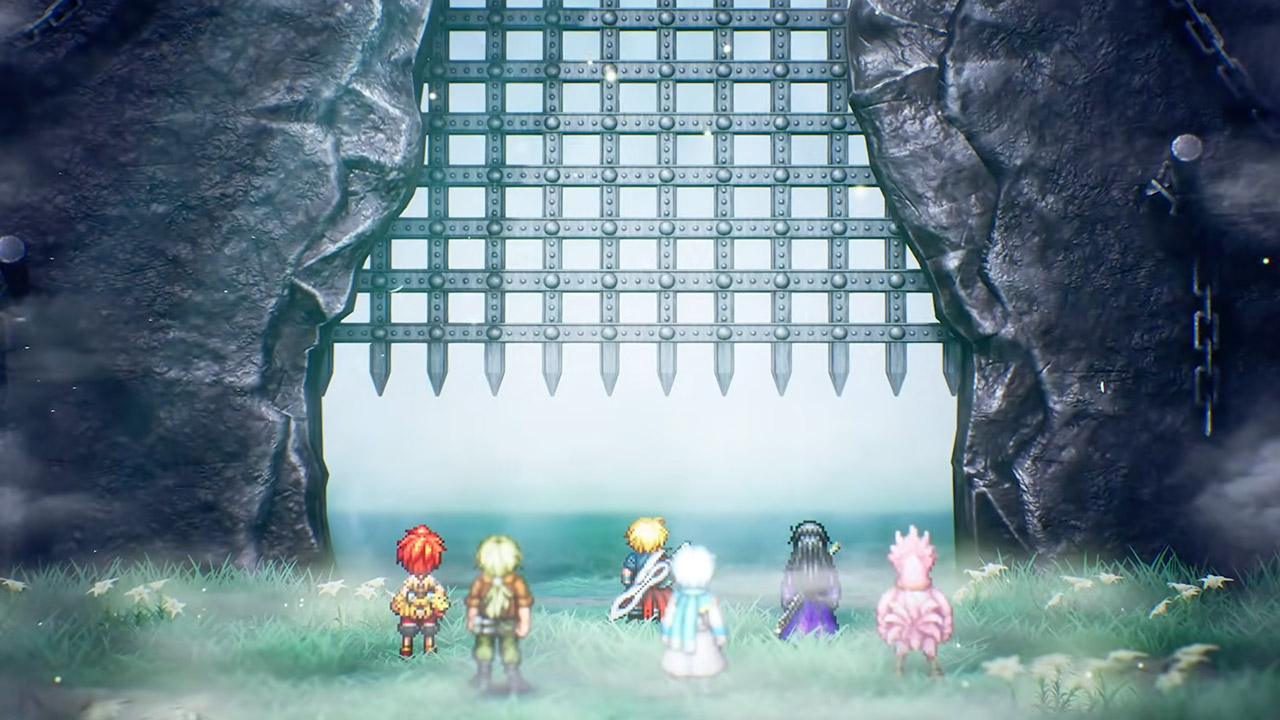
The game also looks amazing, with realistic pixel sprites set against rich, layered backdrops that create a beautiful blend of old and new. Places feel deep and real, with proper lighting and shadow placement, and the overall experience makes you feel as if you’re actually there. The music has several familiar tracks from Brave Exvius as well as 33 brand new compositions created particularly for this game.
[Source]
Tech
I‘ve had some awesome mobile mice in my time, but I can’t wait to travel with the Logitech Mobi Fold
- Logitech unveils a brand new folding mouse
- The Mobil Fold is small and durable
- It promises more than a month of battery life
I’ve had all manner of computer mice over the years, but by far my favorite is a travel mouse. They come in so many different shapes, sizes, and configurations. I fondly remember a promotional USB travel mouse, perhaps no bigger than my thumb, that featured a spring-loaded retractable cable. When that died after multiple road trips, I switched to a Microsoft Surface Arc Bluetooth travel mouse. It was darn near perfect. In travel mode, it was flat, and when you wanted to use it, you bent it to a perfect, palm-hugging curve. That one died after years of business travel.
So you can imagine my excitement when Logitech showed me its new Mobi Fold ($79.99 / $119.99CAD/€79.99 / £69.99). As the name suggests, it is a truly foldable Bluetooth travel mouse.
Image 1 of 3


The company claims that while roughly 76% of us own mice, only 26% take them on the road. The palm-sized Mobi Fold is small enough to slip into almost any pocket and join you in your wanderlust.
Latest Videos From

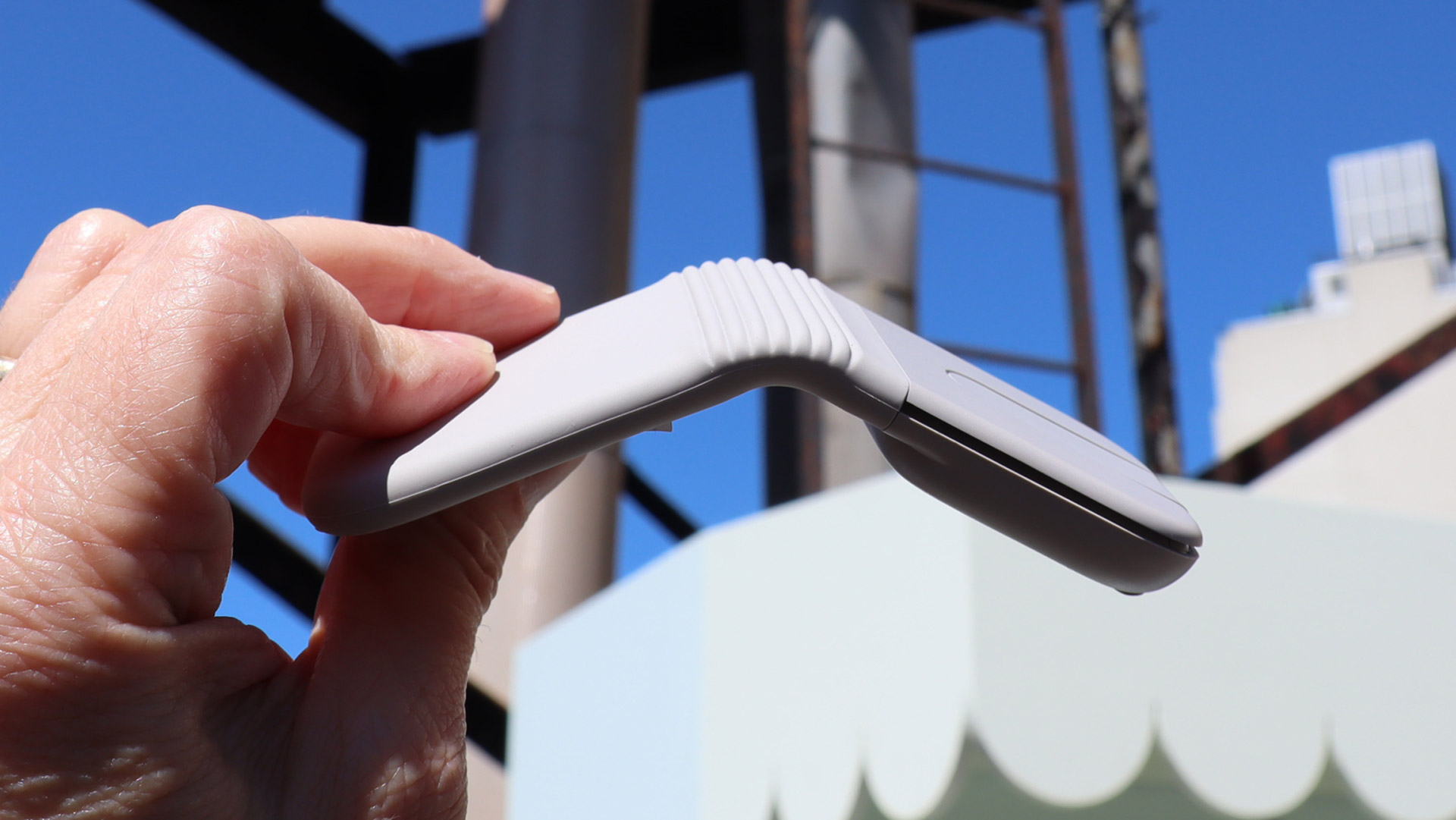
When folded, the Logitech Mobile Fold resembles in size and shape a screenless Samsung Galaxy Z Flip. It unfolds to a roughly 60-degree curve that neatly fits under your palm. It has a pair of silent clickers — all the better to not annoy your fellow passengers — and between them is a wide touch-sensitive button that you can use to scroll through on-screen content quickly or a line at a time.
Image 1 of 4


The body is covered in a soft rubber material that feels good against your skin, and Logitech claims that Mobi Fold is durable and ready to accompany you on the road for up to 15 years.
In the near-term, battery life is rated for 33 days on a charge, but if you’re in a pinch, a minute of charge can net you 22 hours of operation. You also don’t have to worry about the battery running down when the mouse is folded up in your backpack or pocket. It automatically powers on when unfolded and shuts off when folded up.
Image 1 of 3


If you regularly switch between, say, a desktop, laptop, and tablet, you’ll be pleased with the Mobi Fold’s quick-switch capabilities for up to three devices. There’s also the Logitech Plus companion app that you can use to customize buttons to open certain apps, take screenshots, copy and paste, and perform other operations.
I got a chance to try the mouse with a few different systems and apps. It doesn’t need a special surface or mouse pad to work, and I found it comfortable and responsive. I folded and unfolded it repeatedly and noticed that the fold feels firm, not flimsy. There’s enough tension that you won’t worry about the two halves flopping about.
Yes, I even accidentally dropped the ultra-portable mouse, and it survived without issue.
Mobi Fold comes in four colors: Graphite, Off-white, Lilac, and Sand, and should start shipping this week.

Follow TechRadar on Google News and add us as a preferred source to get our expert news, reviews, and opinion in your feeds.

After Independence Day, director Roland Emmerich and producer Dean Devlin could have easily kept feeding the multiplex more flag-waving alien carnage. Instead, with Robert Rodat’s Saving Private Ryan pedigree tempering the “U-S-A!” machinery, The Patriot became something more grounded, darker, and far better researched than anyone had reason to expect. It is still historical fiction with Hollywood fingerprints all over it, but compared to the glorious cheese fountain of ID4, this is a far more serious and satisfying story about American grit, personal loss, and the ugly cost of revolution.
Mel Gibson’s Benjamin Martin is not based on one specific individual but a composite of militia who fought so bravely to win our freedom from Great Britain some two-and-a-half centuries ago. As a veteran of the French and Indian War, specifically “the wilderness campaign,” he’s not only witnessed but perpetrated unspeakable horrors and is reluctant to see his people thrust into another bloody conflict. But when the war comes for him and his family, this expert in guerilla warfare answers the call and helps turn the tide. Beyond the relatively minor indignities such as the Tea Act Monopoly, the Stamp Act and the Writs of Assistance, we’re shown the atrocities visited upon the colonists by the British forces, a brutality born of arrogance, and it’s hard not to be invested in the struggle by the climactic battle.

A quick glance over my left shoulder at the shelf marked M through Z tells me that, damn, I must really like this movie. I’ve owned The Patriot on five different five-inch discs (see photo), and that was before Sony dropped its new and improved SteelBook 4K edition, once again serving up both the R-rated theatrical cut and the longer unrated version. On the 2018 UHD disc release, just the theatrical cut was in Atmos and 4K, but only in HDR10, with the unrated version in 1080p/5.1. This SteelBook set now offers both cuts each on its own BD-100 platter, in 4K, Dolby Vision and Dolby Atmos, with breathtaking cover artwork by Paul Shipper.
Say what you like about ol’ Mad Max here, but he is one intense thespian, and his closeups convey his grief, his conviction, and the inner demons that fuel Martin’s resolve. Not every shot is razor-sharp, but nonetheless it looks like we’re watching the Revolutionary War, the roll-up and the aftermath through an immaculate window. A light, consistent layer of film grain accentuates the 2.39:1 image, and the high dynamic range delivers consummate detail in the many period-authentic low-light scenes, illuminated by candles, fireplaces or campfires. Even the glisten of a brocaded epaulet is preserved. Whether through the use of filters, magic hour scheduling or post-production wizardry, Caleb Deschanel’s Oscar-nominated cinematography has an enticing golden glow, and the colors are significantly upgraded from the 2018 4K, with only the slightest perceptible drop in picture and sound quality at the inserts within the unrated cut.

Subtle LFE for hoofbeats and fireworks early in the story lull us into false resignation, until the realities of warfare are fully unleashed. Showoff scenes don’t come much better than Gabriel’s rescue–this is the one I routinely use to test speakers, in particular my surrounds and sub–conveniently located at the start of Chapter 5 on the theatrical version, 36:42 into the film. Our vantage point shifts frequently amid the chaos but the hard placement of off-camera voices keeps us in the middle of the action, with frequent booming gunshots all around. (I plan to watch it again after this review publishes, just because.) The whiz and impact of cannonballs are also outstanding. The active overhead channels bring a wonderful sense of spaciousness throughout, and dialogue scenes that proved challenging on past editions are now crystal-clear. The Patriot boasts a John Wiliams score, lesser-known despite its Oscar nomination, and it amplifies the excitement exponentially.
The extras are all ported from past editions, some dating back almost 26 years, spread across the two platters. The theatrical version carries an enjoyable Emmerich/Devlin audio commentary in addition to brisk featurettes about the production and the historical fact. Interestingly, the comprehensive deleted scenes section–13 minutes total with optional commentary–is located on the unrated disc, even though most of that footage has been integrated back into the movie to create the longer cut. Also on this disc are vignettes devoted to the visual effects and concept art.

The timing of the new The Patriot 4K SteelBook is curious, too late for Memorial Day and too early for The Fourth, but take it from me: This one would make a terrific Father’s Day gift. (Father’s Day feature incoming, but this one deserved its own review.) With top scores for the movie, audio and video, this one gets our highest recommendation.
Movie Details
- STUDIO: Sony Pictures Home Entertainment
- FORMAT: Ultra HD 4K Blu-ray (June 9, 2026)
- THEATRICAL RELEASE YEAR: 2000
- ASPECT RATIO: 2.39:1
- HDR FORMATS: Dolby Vision, HDR10
- AUDIO FORMAT: Dolby Atmos with TrueHD 7.1 core
- LENGTH: 165/175 mins.
- MPAA RATING: R/Unrated
- DIRECTOR: Roland Emmerich
- STARRING: Mel Gibson, Heath Ledger, Jason Isaacs, Chris Cooper, Tchéky Karyo, Joely Richardson
Our Ratings
★★★★★★★★★★ Movie
★★★★★★★★★★ Picture
★★★★★★★★★★ Sound
★★★★★★★★★★ Extras
Where to buy:
Related Reading:
Tech
Report warns ‘potentially lethal’ knock-off phone chargers sold on Amazon Haul, B&Q and eBay can electrocute and even explode

- Which? discovers ‘potentially lethal’ phone chargers are being sold by major retailers
- Cheap chargers pose serious risks of fire, electric shock and more
- Consumer group demands stricter government regulation
British consumer watchdog Which? has revealed many of the third-party phone chargers available to consumers could present “potentially lethal” risks – and they’re often hidden in plain sight.
Nine of the 15 chargers tested by Which? posed serious electric shock risks, while eight also presented potential fire or explosion hazards, but more worryingly, many were available from popular and trustworthy high-street and online retailers like Amazon, B&Q and Debenhams.
The timeliness is also of note, because the findings come seven whole years after Which? first warned about dangerous counterfeit and low-quality chargers, suggesting the problem remains widespread despite repeated warnings.
Latest Videos From
These are the reasons cheap chargers can fail basic safety tests
According to the report, many of the chargers tested failed basic testing because the internal electrical components were positioned too close together, insulation was inadequate, high-voltage stress tests caused failures and plug pins did not meet British Standards requirements.
The most prevalent concern, then, was that the defective products could cause electrical arcing, where electricity jumps between components, leading to electric component failures in the best-off cases, but electric shocks, overheating, fire and explosions in the most severe cases.
Among the examples given by the group was a counterfeit Apple USC-C 35W Power Adaptor sold for £11.99 – a not-at-all similar mock of Apple’s £59 charger. The researchers discovered arcing noises after just 10 seconds, and upon further investigation, found modelling clay inside the charger.
They believe it was added to make the device heavier, making it feel more ‘premium’. A second, separate model, sold via Debenhams, also included modelling clay within.
Besides suspiciously cheap chargers from Amazon (£2.99 and £3.99), eBay (£2.10 and £2.80) and AliExpress (£1.30 and £5.69), Which? also found that a more expensive £10.99 charger sold via B&Q was subject to fire, electric shock and explosion risks.
And even the chargers that passed safety tests, including models sold via Temu and Shein, weren’t fully legitimate. They still lacked the required markings and importer details, making them illegal in the UK.
“Badly designed electricals like these can have life-altering – even fatal – consequences,” Head of Consumer Protection Policy Sue Davies commented.

Which? calls for greater enforcement over online marketplaces
Which? argues that marketplace operators have now become a major route through which unsafe and illegal imports can reach UK consumers, because they often act as intermediaries for third-party sellers.
However, despite the implementation of the UK’s Product Regulation and Metrology Act in July 2025, the consumer group says implementation has been slow. Under the law, the government can place obligations on online marketplaces.
Which? is therefore advocating for stronger enforcement powers and greater accountability for third-party seller listings.
“By making online marketplaces legally responsible for unsafe products, the government can set a world-leading standard for product safety in the digital age,” Davies added.
As for consumers, they’re being advised to buy from recognized brands and be wary of very cheap big-brand chargers. UK citizens should also look for the CE or UKCA marks and importer details.
Looking ahead, Which? has presented UK Department of Business and Trade Minister Kate Dearden a petition, with 150,000 signatories, calling for the government to regulate online marketplaces and fine them for breaches.
Follow TechRadar on Google News and add us as a preferred source to get our expert news, reviews, and opinion in your feeds.
Tech
Rivian R2 First Drive Reveals Strong Performance and Genuine Off-Road Skills at an Attainable Price


Rivian engineers took everything they learned from the larger R1 models and applied it to a vehicle sized for more people and more driveways. The result is the R2, a two-row electric SUV that starts well below sixty thousand dollars for loaded early versions and dips into the mid-forties for simpler single-motor models arriving next year. That pricing alone sets it apart from bigger adventure-focused rivals while still delivering real capability.
The body looks just like you’d expect from a car with a specific function, with no unnecessary frills and a nice, boxy form that declares its intent without being too huge for its own good. At 186 inches long, it’s around the size of a Honda CR-V in terms of footprint, but its stretched-out wheelbase makes it feel a little longer. The ground clearance is 9.6 inches, and the approach and departure angles are adequate for off-road adventures.
Sale

LEGO Speed Champions Mercedes-AMG G 63 & SL 63 Building Toys – Kids Pretend Play Toy Cars for Boys…
- 2 Mercedes toy cars for kids – LEGO Speed Champions Mercedes-AMG G 63 & Mercedes-AMG SL 63 vehicle playset for boys and girls ages 10 and up and…
- 2 driver minifigures – Each buildable vehicle toy comes with a driver minifigure wearing a Mercedes outfit so kids can role-play fast-paced races
- Authentic Mercedes design – Each collectible car model features design details from the real life versions, including front grilles, hoods, wheels…
Stepping inside, you get the idea that the cabin is a huge open space with useful touches all over. The back seats provide ample leg and headroom and are exceptionally comfortable even on extended trips. The materials used are an excellent mix of nice everyday goods and some very smart eco-friendly choices, such as birch trim created from repurposed birch and a headliner built from ocean-rescued plastic. There are also spacious door pockets for holding water bottles, and the rear liftgate glass lowers to make loading heavier items easier.
The controls are one of the car’s most noticeable elements. There is a large, wide touchscreen that handles all of the normal features like as navigation, media, and vehicle settings, and it responds rapidly. You also get two huge halo dials on the steering wheel that allow you to change the climate, radio, drive modes, mirrors, and other settings with a few twists, pushes, pulls, or tilts. This strategy immediately became popular among reviewers, who considered it more user-friendly than scrolling menus while driving. One thing they needed was smartphone mirroring, but the native apps fulfill the most of your demands, and the interface is constantly updated with new features.
Under the hood, there’s an 88-kilowatt-hour battery and some extremely efficient motors. The top dual-motor Performance model generates 656 horsepower and accelerates to 60 mph in 3.6 seconds flat. Acceleration is powerful and immediate, but never uncomfortable. With 350 horsepower, the single-motor rear-wheel-drive car is a great option for people seeking for something a little more efficient. If you’re curious about how far you’ll get on a charge, the car’s range can reach 345 miles on the most efficient settings, thanks to its extraordinarily light weight (about 5,000 pounds) and sophisticated aerodynamic architecture that decreases the drag coefficient to 0.3.
Charging is quite speedy, with up to 230 kilowatts charging the battery from 10% to 80% in around 29 minutes under optimum conditions. You can also do bidirectional charging of up to 11 kilowatts, which allows you to power tools or even transmit electricity back to your home when the power goes out. Production of these things has already begun at Rivian’s plant in Normal, Illinois, with the intention of delivering the higher trims to clients this summer first.
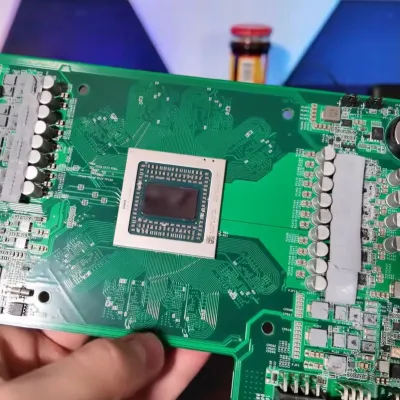
The custom APU at the core of Sony’s PlayStation 5 hasn’t just been quietly powering these game consoles, but also made their way onto cryptomining cards around 2023 which are called the BC-250. The APUs on these boards differ from the one found in the PS5 most notably by having two out of eight CPU cores disabled, along with many compute units (CUs) of the iGPU. Now apparently it seems that you can re-enable these CUs per instructions by [duggasco] if you’re feeling adventurous.
As stated in the project’s README, BC-250 boards come with only 24 out of 40 CUs enabled, but this is not a permanent (e-fuse) thing. Instead you can write to two hardware registers during the GPU driver initialization, something which can be added to for example the Linux kernel module parameters.
Since many of these APUs likely had cores and CUs disabled due to them failing QA during PS5 APU manufacturing, there’s a good chance that some of the CUs truly are bad. Yet as we saw with the AMD Phenom II X3 with a supposedly bad fourth core back in the day, sometimes demand for the ‘defective’ part is high enough that good parts get mixed in as well.
Thus people like [Lowest Logan] decided to give it a shot, demonstrating the use of the patch with Bazzite Linux on a BC-250 system. After a reboot the system does indeed list 40 CUs as being enabled, and running Furmark shows a big boost in performance without any glitches or fire. There is of course thermal throttling, but that is due to the default cooling solution not being designed for running it at full blast.
Incidentally the real PS5 has only 36 active CUs, so this technically makes these unlocked APUs more powerful. With the water cooling solution demonstrated by [Lowest Logan] the thermal throttling is also resolved, showing that you can get a pretty nice gaming system out of these old cryptomining boards if you happen to win the silicon lottery.

Even the most well-intentioned edtech can fall short if it does not meet students where they are. After several years studying the usability of edtech for teachers, the research team at ISTE+ASCD turned its attention to students — examining how the technical and pedagogical design of digital tools shapes their learning experiences.
In partnership with In Tandem and Sesame Workshop, researchers spoke with high school students across the United States to understand how they actually use edtech in real learning contexts. The findings identify five areas that matter most to students and offer guidance for educators and product designers seeking tools that are intuitive, meaningful and engaging.

A full framework and guidance for edtech buyers and product providers will be released in 2026.
This article was sponsored by ISTE+ASCD and produced by the Solutions Studio team.
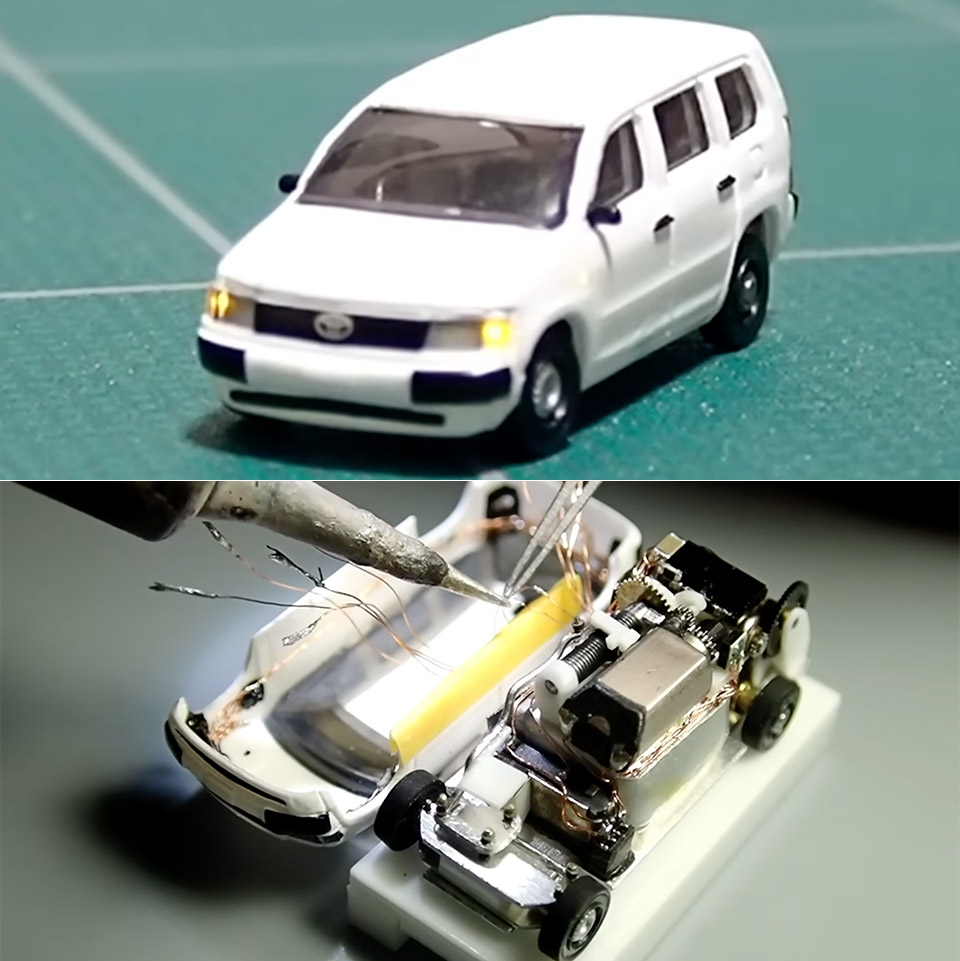
Diorama111 released a fresh build just days ago that shows what happens when extreme miniaturization meets real remote control hardware. He started with an ordinary KATO 1/150 scale Toyota ProBox, the kind of plastic model that sits on N-gauge train layouts or display shelves. Most builders stop at painting and weathering. He kept going until the little van could roll under its own power, steer on command, and light up properly in both directions.
The finished model is only a few centimeters long, but at true scale, it is roughly 150th the size of a real Toyota ProBox. The exterior still looks like it just came off the production line, but everything inside had to be modified just to fit. This entailed designing new parts, modifying old ones, or just building them from scratch to allow for movement and electronics to fit within. Power is supplied by a tiny lithium-polymer cell measuring 9 by 9 by 4 millimeters. It sits on top of a custom control board and provides power to the complete arrangement. The duration is purposefully brief, just long enough to test it on a tabletop or in a diorama before it needs to be recharged quickly via the underside connectors.
A DC motor in the back propels the vehicle, and watch gears are used to slow it down significantly, allowing it to move at a suitable rate for its size. A brass-bushed axle is used to reduce friction, resulting in smooth acceleration and excellent control at low speeds. As a result, when observed from above, it looks to be moving steadily rather than bouncing about haphazardly.
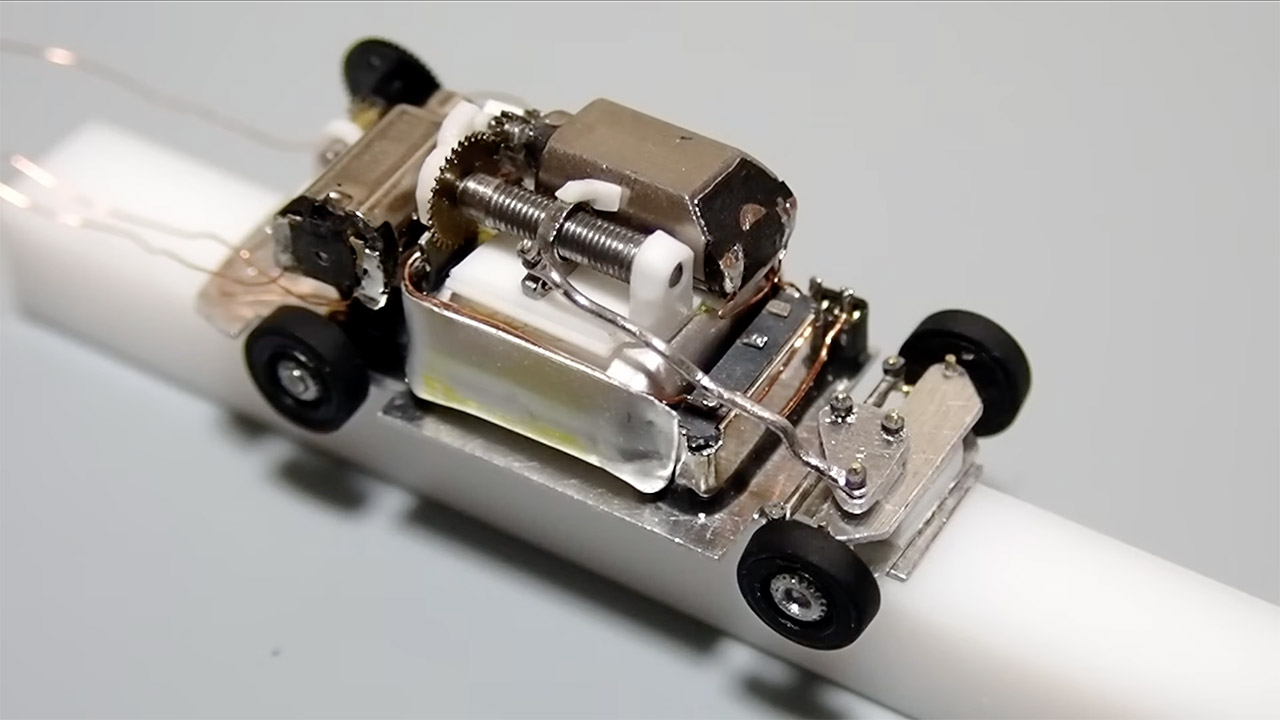
Steering was a challenge because the conventional solution would not have worked. So a second DC motor was added to drive a lead screw, and a rod-and-linkage system was adapted to convert linear motion into front wheel spin. Two photoreflector sensors continuously monitor the motor shaft and screw, providing feedback to the controller so that it knows exactly where the wheels are and can give true proportional steering rather than just on/off. This all fits into the compact chassis, leaving room for the battery and receiver.
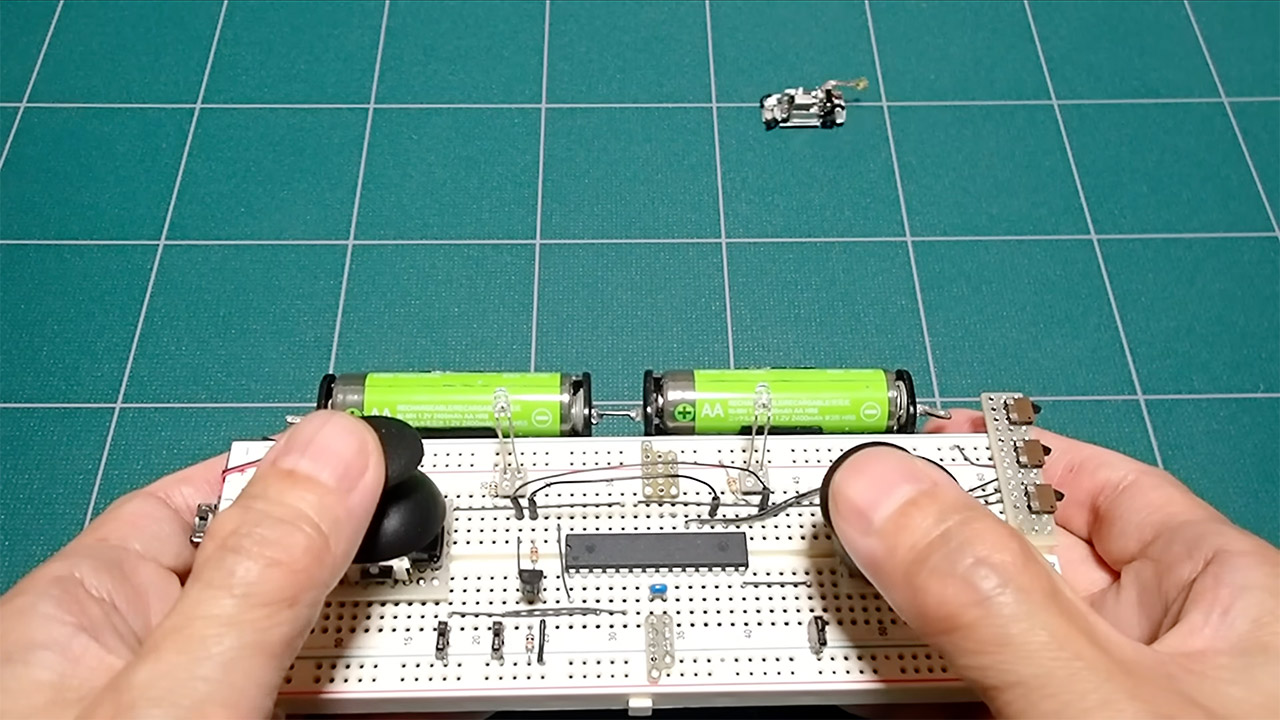
The radio signal is sent via infrared because a small surface-mount IR receiver module is contained within the body. The matching handheld transmitter contains two analog joysticks that provide you independent control over the throttle and steering. It appears delicate enough to execute figure-eights, smooth turns, and faultless parking on a cutting mat. Lighting only adds to the illusion, with a few tiny surface-mount LEDs concealed beneath the headlight and taillight lenses. A hair-thin magnet wire runs through the roof and body, transferring power without adding mass. The headlights turn on as you go forward. When you change into reverse, the rear lights brighten. Direction sensing guarantees that the lights function in the same way as a full-size car does.

Building this micro car required a great deal of patience because each stage required extreme focus. The interior was removed to provide way for the construction process, and each mechanical part had to be precisely positioned and tested before being altered repeatedly until everything fit together neatly while still leaving room for the batteries and cables. The underside of the chassis contains terminals for charging the battery and reprogramming the controller, making it possible to do so without disassembling anything.
[Source]

Tech34 seconds ago
Strategic Job Hopping Without Stalling Growth

NewsBeat3 minutes ago
Second thug jailed after man attacked with bottle and machete outside tower block
Crypto World5 minutes ago
Dogecoin Whales Buy the Dip as DOGE Hit 14-Month Low

Crypto World1 month ago
HarrisX Poll Found 52% of Registered Voters Support the CLARITY Act

Crypto World4 weeks ago
BloFin War of Whales 2026 Grand Prix opens registration for $5M trading championship

Crypto World3 weeks ago
Blockchain.com files with SEC for U.S. IPO

News Videos8 minutes ago
Bitcoin Live Trading: Panic Selling Hits Crypto! Is the Biggest Reversal About to Begin? EP2020

News Videos21 minutes ago
Asmongold Makes $10 Million But Never Spends Money on THIS

News Videos34 minutes ago
How to Withdraw in Col Financial Philippines #colfinancial #stockmarket
-

 Fashion5 days ago
Weekend Open Thread: Evereve – Corporette.com
-
 Crypto World5 days ago
Jensen Huang Approves Samsung, SK Hynix, and Micron for NVIDIA (NVDA) HBM4 Memory Supply
-

 Crypto World2 days ago
Anatomy of the June crypto crash: Fed, Iran, Saylor
-
 Entertainment3 days ago
The Best Mystery Series of All Time Is Surging on Streaming 30 Years After It Ended
-

 NewsBeat2 days ago
Alexander Zverev wins the French Open to finally earn a 1st Grand Slam title
-

 Tech4 days ago
Suspicious Polyfill login prompts pop up on Toshiba, Muji websites
-
 Crypto World4 days ago
Senator Cynthia Lummis Calls CLARITY Act the Most Consequential Financial Legislation of This Generation
-

 Tech5 days ago
Microsoft launches MXC, an OS-level sandbox for AI agents, with OpenAI and Nvidia already on board
-

 Tech3 days ago
Microsoft unveils seven homegrown AI models in new bid for ‘long term self-sufficiency’
-
 Business3 days ago
The Pain Points Taking a Fragile Tech Rally Down a Notch
-
Crypto World5 days ago
LBank Surpasses 25 Million Users Worldwide as AFA Partnership Continues to Drive Global Growth
-

 Business5 days ago
(VIDEO) Justin Bieber Delivers Surprise Happy Birthday Serenade to Diners at Los Angeles Mexican Restaurant
-

 Crypto World3 days ago
Trump’s AI Ownership Plan Could Benefit Anthropic at OpenAI’s Expense
-
 Sports16 hours ago
Bangladesh beat Australia after 20 years in ODIs, register only their second win over six-time world champions | Cricket News
-

 Tech5 days ago
Meta steals a tactic from Tesla and builds data centers in tents
-

 Tech4 days ago
Von der Leyen’s AI envoy pick draws conflict-of-interest fire
-
 Crypto World2 days ago
Eli Lilly (LLY) Stock Surges 4% Following Breakthrough Sleep Apnea Trial Results
-

 Tech5 days ago
RCS Messages Between iPhone and Android Get End-to-End Encryption With iOS 26.5
-

 Tech4 days ago
Hackers now exploit SolarWinds Serv-U flaw to crash servers
-

 Tech2 days ago
Notion restores access to Anthropic after service disruption
You must be logged in to post a comment Login