TUCSON, Ariz. — Pima County Sheriff Chris Nanos is under growing scrutiny and faces potential political consequences as the disappearance of 84-year-old Nancy Guthrie approaches 100 days with no major breakthroughs, no arrests and mounting criticism over the pace and coordination of the investigation. The case, which has drawn national attention due to Nancy’s daughter Savannah Guthrie’s prominent role on NBC’s “Today” show, remains one of the most high-profile missing persons investigations in recent Arizona history.
Savannah Guthrie & Nancy Guthrie
Nanos, who has served as sheriff since 2019, has seen his handling of the case become a focal point of public frustration. Local officials and some community leaders have quietly questioned whether leadership changes could be on the horizon if the investigation does not yield significant progress soon. While no formal calls for resignation have been made by elected officials, sources close to county government say Nanos is feeling increased internal and external pressure as the milestone approaches.
Nancy Guthrie vanished from her Catalina Foothills home on February 1, 2026. Security footage captured a masked individual near her door around the time of her disappearance. Blood evidence, a disabled Ring camera, propped-open doors and signs of a struggle led authorities to classify the incident as an abduction rather than a voluntary departure. Despite thousands of tips, extensive searches and advanced forensic testing, no suspect has been publicly named and no proof of life has emerged.
Savannah Guthrie has balanced public pleas for information with her professional duties. In recent appearances on the “Today” show, she has worn yellow — a color of hope — while urging viewers to remain vigilant. The family has offered a $1 million reward for information leading to Nancy’s safe return or the arrest of those responsible.
Investigation Faces Criticism
The case has occasionally exposed tensions between local and federal agencies. FBI Director Kash Patel publicly criticized early coordination, claiming the bureau was initially kept out for several days. Sheriff Nanos has pushed back, insisting collaboration has improved and that the investigation remains a top priority. Hundreds of law enforcement personnel have been involved at various stages, but the lack of tangible results after nearly 100 days has fueled public dissatisfaction.
Advertisement
Advanced DNA testing on a rootless hair sample and potential glove DNA recovered from the home is ongoing at the FBI lab in Quantico. Genetic genealogy analysis offers hope for a breakthrough, but results have not yet yielded a suspect. Behavioral profilers have suggested the perpetrator may have sought fame or had some personal connection to the victim. Multiple ransom-style notes received by media outlets have been deemed likely hoaxes, further complicating the probe.
The unrelated discovery of ancient human bones near the home earlier this week briefly raised false hopes before forensic analysis ruled them out. The incident highlighted the challenges of searching Arizona’s desert terrain, where old remains frequently surface.
Political Pressure on Sheriff Nanos
Nanos, a Democrat elected in 2018 and re-elected in 2024, has built his reputation on community policing and transparency. However, the prolonged Nancy Guthrie case has become a political liability as local elections loom. Some Republican opponents have begun quietly positioning themselves to challenge him, citing the case as evidence of leadership shortcomings. Community activists have also voiced concerns about resource allocation and communication with the public.
A source familiar with county politics said, “The sheriff is feeling the heat. One hundred days without answers in such a high-profile case is not a good look.” Nanos has defended his department’s efforts, emphasizing the complexity of the investigation and the dedication of his team. “We are working tirelessly,” he said in a recent briefing. “Every lead is being pursued. We will not stop until we have answers for the Guthrie family.”
Advertisement
Family’s Resilience and Public Support
Savannah Guthrie has shown remarkable composure amid the ordeal. She briefly stepped away from the “Today” show earlier this week due to emotional strain but returned the following day. The family continues to balance public advocacy with private grief, with five children between them navigating the uncertainty.
Elizabeth Smart, the abduction survivor who was held captive for nine months in 2002, has publicly expressed hope that Nancy could still be alive. “I absolutely believe Nancy could still be alive,” Smart said recently. She has offered private support to the Guthrie family and continues advocating for improved missing persons protocols.
The Catalina Foothills neighborhood remains on edge, with yellow ribbons symbolizing hope displayed prominently. Neighbors and the broader Tucson community have participated in searches and vigils. National media coverage has kept the case visible while the family urges focus on verified facts rather than speculation.
What Comes Next
As the case nears the 100-day mark, authorities have renewed their appeal for tips. Forensic experts say advanced DNA techniques, including genetic genealogy, remain the strongest hope for resolution. The involvement of elite labs and profilers underscores the case’s priority.
Advertisement
Sheriff Nanos has vowed to continue dedicating resources to the investigation. “This case is not going away,” he said. “We owe it to Nancy and her family to keep pushing.” Whether his job security becomes tied to a breakthrough remains to be seen, but the pressure is clearly mounting as the days pass without resolution.
The disappearance of Nancy Guthrie has highlighted vulnerabilities even in protected communities and the enduring power of hope in the face of uncertainty. Whether the case ends in a joyful reunion or brings closure through other means, it has already left an indelible mark on those following the story — a testament to one family’s resilience and a community’s determination to bring answers home.
As the investigation enters its fourth month, the Guthrie family and law enforcement refuse to give up. For now, the search continues, supported by a survivor’s empathy, a family’s strength, and a sheriff fighting to keep his department’s reputation intact while racing against time.
The ASEAN Future Forum 2026 opened in Hanoi on June 9, themed “Shaping Our Future Together.” Launched by Vietnam in 2023, the forum unites ASEAN leaders, businesses, and academics to address regional challenges including AI, energy security, and strategic autonomy, advancing ASEAN Community Vision 2045.
Key Points
• The ASEAN Future Forum (AFF) 2026 opened in Hanoi on June 9 under the theme “Shaping Our Future Together: Peace, Prosperity and People-Centered,” attended by Vietnam’s Prime Minister Le Minh Hung and leaders from Laos, Cambodia, Thailand, and Timor-Leste, along with the ASEAN Secretary-General.
• Launched by Vietnam at the 2023 ASEAN Summit, the AFF has grown into a key strategic dialogue platform, with ideas from previous editions reflected in official ASEAN Summit documents, reinforcing Vietnam’s proactive role in advancing regional cooperation.
• AFF 2026 features broader participation than previous editions, including political parties, local authorities, and business and academic communities, with discussions covering AI, energy security, conflict prevention, and implementation of the ASEAN Community Vision 2045.
Advertisement
The ASEAN Future Forum 2026: Launch and Leadership
The ASEAN Future Forum (AFF) 2026 officially opened in Hanoi on June 9, under the theme “Shaping Our Future Together: Peace, Prosperity and People-Centered.” The event was attended by senior regional leaders, including the Prime Ministers of Vietnam, Laos, Cambodia, Thailand, and Timor-Leste, alongside Vietnam’s Foreign Minister and the ASEAN Secretary-General. First introduced by Vietnam at the 43rd ASEAN Summit in 2023, the AFF was designed as a multi-stakeholder platform to complement existing ASEAN mechanisms and support long-term policy thinking for the ASEAN Community.
Vietnam’s Vision: Dialogue, Inclusion, and Regional Resilience
In his opening remarks, Foreign Minister Le Hoai Trung emphasized Vietnam’s commitment to creating an open, forward-looking space for dialogue among ASEAN members and international partners. The forum brings together policymakers, academics, businesses, and citizens to contribute ideas toward a stronger, more resilient ASEAN. Previous editions in 2024 and 2025 generated innovative yet practical proposals, many of which have been reflected in official ASEAN Summit documents. Vietnam hopes the forum will strengthen diplomacy and mutual understanding amid growing geopolitical tensions and strategic competition across the region.
AFF 2026: Expanding Scope and Shaping the Future Agenda
AFF 2026 features a broader and more inclusive format than previous editions, with discussions covering critical issues such as unity, strategic autonomy, conflict prevention, energy security, artificial intelligence, and financial technology. For the first time, the forum will host meetings involving political parties, local authorities, and business and academic representatives from across Southeast Asia. These expanded dialogues are expected to generate fresh perspectives and actionable solutions to support the ASEAN Community Vision 2045, helping the bloc adapt effectively to both emerging regional challenges and shifting global dynamics.
Small-town India is emerging as the next big driver of retail growth, prompting a wave of regional companies to line up initial public offerings (IPOs) to fund expansion. A clutch of retailers focused on Tier II and Tier III markets including Sangeetha Mobiles, Poorvi Mobiles, Sathya Agencies, SS Retail, More Retail and RSB Retail India are together planning to raise over 7,000 crore through primary market.
Among these, Sathya Agencies, SS Retail, Marri Retail and RSB Retail have already filed their draft red herring prospectuses (DRHPs), while others like Ratnadeep Retail, More Retail (planning 2,000 crore IPO) , Chennai-based Poorvika Mobiles, Bangaluru-headquartered Sangeetha Gadgets, Pai International Electronics and Big C Mobiles are preparing to tap the primary market. These companies are planning an IPO of above 500 crore each.
Emails sent to these companies did not elicit any response.
At the heart of this momentum is a structural shift in consumption beyond metros. “Emerging Bharat is no longer a niche theme; it is becoming one of the most durable growth engines for Indian retail,” said Bhavesh Shah, head of investment banking at Equirus Capital.
Advertisement
Rising disposable incomes, formalisation of the economy, better digital connectivity, UPI-led payments adoption, aspirational spending shaped by social media, and improved access to branded products are all accelerating consumption in Tier II and Tier III cities.
Foreign investors have purchased nearly 10,000 crore of Indian bonds over the past four trading sessions following the government’s decision to fully exempt taxes on gains from eligible debt investments and the central bank decision to expand the investable universe, data published by CCIL showed. Bond yields have cooled in tandem.
This marks a significant reversal from the stance taken by foreign investors that had been pulling out from India’s debt and equity markets in the recent months. Since the start of the US-Israel war on Iran, FPIs have net sold over 10,119 crore of debt.
Foreign investors have injected nearly ₹10,000 crore into Indian bonds in four sessions, reversing recent outflows. This surge follows tax exemptions on eligible debt gains and expanded investment options. Bond yields have subsequently declined, signaling a positive shift in investor sentiment towards India’s debt market.
On an average, the daily selling ranged around 1,000 crores, with only sporadic bouts of buying. Measures announced by the government and Reserve Bank of India (RBI) have helped reverse the sentiments encouraging foreign investors to bet on India’s debt market.
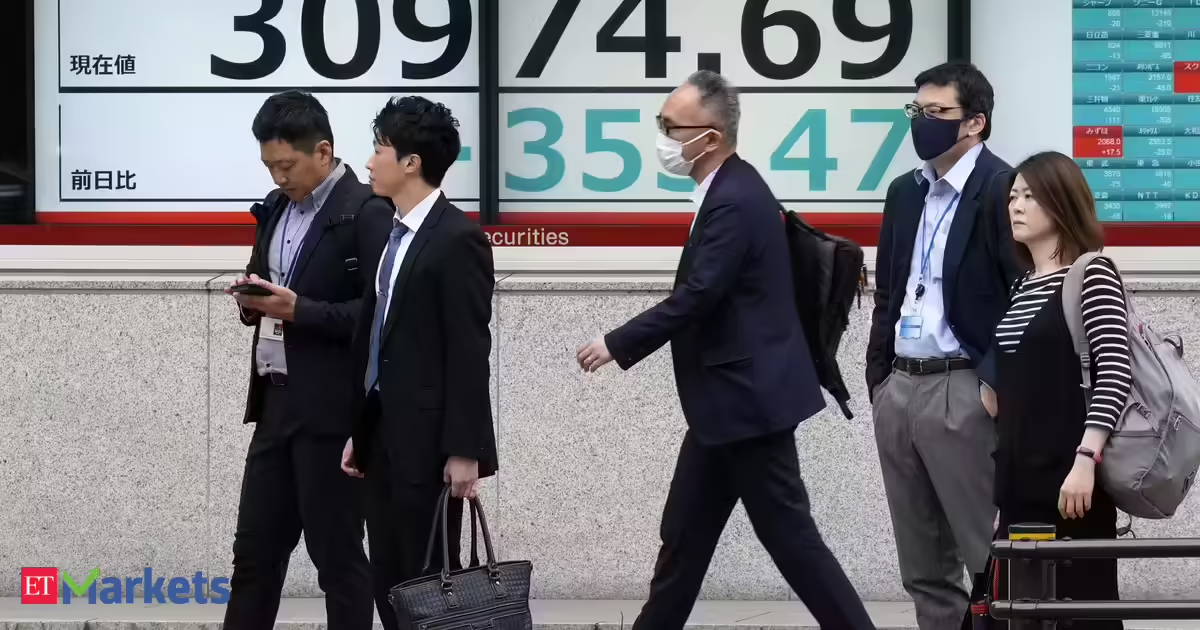
Asian stocks dropped as a selloff in technology shares resumed and tensions in the Middle East escalated after US forces struck Iran. Crude oil advanced.
The MSCI Asia Pacific Index fell 0.5% as selling in technology stocks resumed after a rebound on Tuesday. The Kospi Index in South Korea, a bellwether for artificial intelligence investments, dropped 1.7%. The Nikkei in Japan also declined.
Contracts for the S&P 500 and the Nasdaq 100 indexes were little changed after the Wall Street benchmarks had a volatile session on Tuesday, with chip stocks coming under pressure. The Nasdaq 100 fell 1.1% as investors continued rotating out of tech shares that have driven much of this year’s rally.
Weighing on the sentiment, Brent crude rose 0.8% to $92.15 a barrel after US forces hit Iran following the downing of an American helicopter. The dollar, the haven of choice since the Middle East conflict started, strengthened against all its Group-of-10 peers as the attacks threatened the fragile ceasefire as well as efforts to secure a deal to reopen the Strait of Hormuz.
Advertisement
Increasing volatility is testing a market that has surged to record highs on optimism about easing geopolitical tensions and the artificial intelligence buildout. With strong US jobs data damping expectations for Federal Reserve rate cuts, investors now face a key test on Wednesday with the release of US inflation data, which may offer fresh clues on whether policymakers will keep rates higher for longer.
Live Events
“Exuberance has been building for months, pushing stocks to one record after the next,” said John Cunnison, chief investment officer at Baker Boyer Bank. “So anything perceived to be negative for equities — from higher inflation to even the potential for rate hikes — will knock the market off its footing after a historic run.” The retreat in technology shares on Wall Street coincided with a broadening rally across the rest of the market, as nine of the S&P 500’s 11 sectors advanced Tuesday. Defensive corners led the gains, with real estate climbing 2.1%, health care rising 1.3% and utilities adding 1.1%. Tech and energy were the lone decliners.The rotation offered a contrast to a rally that has been increasingly concentrated in a handful of technology giants.
“As much as we love to see tech’s leadership, it would be constructive to see this rally broaden out to other sectors,” said Bret Kenwell at eToro. “When leadership is concentrated in one corner of tech, the market’s foundation gets a little wobblier.”
In other corners of the market, the yen hovered near its weakest level since April, keeping traders on alert for possible intervention by Japanese authorities to support the currency. Gold dropped 1% to about $4,220 an ounce.
Attention now turns to Wednesday’s US inflation report. While oil has retreated from multiyear highs reached in April, strong US jobs data last week has increased bets that the Fed will need to raise interest rates.
Advertisement
Economists surveyed by Bloomberg expect annual CPI inflation to accelerate to 4.2% in May from 3.8% a month earlier. Core inflation, which excludes food and energy, is projected to edge up to 2.9% from 2.8%.
“The combination of stronger payrolls and uncomfortably elevated inflation has left markets penciling in higher odds of the Fed having to tighten policy,” said Gennadiy Goldberg, head of US rates strategy at TD Securities. “This has continued to leave yields elevated, though risk-off moves in equities appear to be helping to backstop yields.”
Broadridge Financial Solutions, Inc. (BR) RBC Capital Markets Global Financial Technology Conference 2026 June 9, 2026 1:45 PM EDT
Company Participants
Douglas DeSchutter – President of Investor Communication Solutions & Executive Officer
Conference Call Participants
Advertisement
Daniel Perlin – RBC Capital Markets, Research Division
Presentation
Daniel Perlin RBC Capital Markets, Research Division
Advertisement
Here we go. Well, thanks, everyone, for joining us. I’m happy you made it back from lunch. I know we’re the second one post lunch, but it always is appreciated when you can have a good meal and come back. My name is Dan Perlin. I head up the fintech practice here at RBC and I’m delighted to continue to have great companies in the second half of the day. Broadridge is who we’re hosting now. And from the company, we have Doug DeSchutter, who is the President of Investor Communications Solutions, which is arguably probably the most talked about part of the business these days.
Question-and-Answer Session
Advertisement
Daniel Perlin RBC Capital Markets, Research Division
And so I thought what would be great to kick it all off at a very high level, Doug, is just to talk about what ICS does in the context of Broadridge overall.
Douglas DeSchutter President of Investor Communication Solutions & Executive Officer
Advertisement
Great. Dan, thanks for having us. Thanks for having me here. It’s great to be here today and, hopefully, answer any questions that you have. This is — look, there’s a lot of change going on right now. Change has traditionally been very good for Broadridge and — because we’ve been in a unique position to be able to drive innovation at scale for our clients and the industry as a whole. When you think about Broadridge, so Broadridge is a leading technology and financial infrastructure provider to the financial services. We have $4.8 billion in LTM recurring revenue. And we operate at the intersection of capital markets, wealth




















































You must be logged in to post a comment Login