The issue centers on a zero-day exploit called “YellowKey,” published earlier this month by a security researcher known as Chaotic Eclipse, also known online as Nightmare-Eclipse. The proof of concept demonstrates a method for accessing BitLocker-encrypted drives on Windows 11 using a USB device. Read Entire Article Source link
You’d be hard pressed to find a tiny rectangle more versatile than the humble Raspberry Pi single-board computer. Since its inception in Cambridge in 2012, the Raspberry Pi has served as a springboard to an endless rabbit hole of DIY and maker projects. And while the Pi may have lost a bit of its edge over the years, to the point that we’d actually recommend a cheap mini-PC for certain Raspberry Pi projects, that doesn’t mean you can’t or shouldn’t use one.
There’s long been a central theme connecting a number of Raspberry Pi projects, and that’s how to employ them in a way that can save you a little bit of cash. The scope of this guide will lay out four self-hosted projects to replace your cloud storage, music streaming, Plex streaming, and one to help track price changes –- all in the name of saving money over the long term.
It’s worth noting that you’re going to be ahead of the game if you already own a Raspberry Pi that you can use. Maybe you have an old one sitting around that you’re not currently using or you just don’t want a mini-PC. Maybe you just love Raspberry Pi boards -– all fair. If not, consider picking up a used model to save some cash; just about any current Raspberry Pi model will work for these projects.
Advertisement
Use Jellyfin as a Plex alternative
Plex has humble roots as a freeware port of XBMC (which would later go on to become Kodi). It quickly became the de facto self-hosted anti-Netflix: A way for users to break free of another monthly subscription and take control over their media library. You can say Plex has come full circle, as many of its users have begun looking for an alternative as the core Plex service has become unrecognizable. The slow intrusion of ads, pay walling once-free features, and rising subscription and license costs have alienated many of Plex’s power users. On the topic of costs, the platform is once again raising the price of its lifetime pass later this year –- an eye-watering $750 that is practically begging users to go elsewhere or submit to its monthly pricing.
Advertisement
Enter Jellyfin. This free and open source media platform is a fork of the Emby 3.5.2 codebase, and functions as a self-hosted and self-contained server. Jellyfin has a number of clients in addition to its official desktop version that you can run on a Raspberry Pi, enabling support for iOS, Android, Roku, webOS, Tizen, and others. Jellyfin also boasts a vibrant third-party development community, where you can find several supported plug-ins that add increased functionality. An example is FinAmp for music streaming on a Jellyfin server, meaning a you can use the platform as an alternative to Spotify or PlexAmp.
Between Jellyfin and its plug-ins, basic features that Plex locks behind a paywall –- like transcoding and remote access –- are covered. Jellyfin plus Tailscale is a popular combo for secure, remote access to a Jellyfin server, and another reason that Jellyfin is among a growing number of free apps that beat the expensive alternatives.
Advertisement
Use Navidrome to stream your own music
The rise of music streaming has given way to a number of ethical questions like what it really means to not own the media you’re listening to and how streaming impacts artists financially. None of these questions have an easy answer, and that says nothing of the dubious artist payment practices of companies like Spotify and others, or the deluge of AI-generated music that has infested streaming platforms. In the same way that Jellyfin serves as a money-saving alternative to Plex or services like Netflix, Navidrome can function as a self-hosted alternative to the big music streamers.
The open source music server is built on top of the Subsonic media streaming API, which means you can use any number of Subsonic compatible front end apps and players for a Navidrome server. Navidrome works out of the box behind a reverse proxy, which is recommended for accessing the server outside of your LAN, but using a gated VPN connection adds another layer of security –- again, Tailscale is a popular choice here, as is self-hosted WireGuard.
The catch here is that you need your own music collection, but that’s kind of the point. Whether it’s converting your existing CDs to FLAC or MP3 formats, or using a Spotify Premium alternative like Bandcamp or Qubuz to buy digital tracks, having your own music library on your Raspberry Pi means you’re not beholden to corporate whims or licensing agreements that could see your favorite music evaporate from a streaming service.
Advertisement
Self-host your own cloud storage with DietPi and NextCloud
Using a Raspberry Pi to escape third-party, proprietary cloud ecosystems such as Google and Dropbox still remains only one of the most popular Pi projects. However, it’s also one of the most popular ways to save money with a Raspberry Pi. It’s a project that’s been done to death, so to speak, but for good reason –- it works. Aside from eliminating another subscription, you also gain control over your data and privacy, which is an important aspect of the data sovereignty discussion.
Advertisement
Categorically, NextCloud is the most popular choice for creating your own cloud storage. There are a number of ways you can configure NextCloud, but a hidden trick is to run DietPi, which is a lightweight Debian-based Linux distro for the Raspberry Pi. The best part about this is once you flash DietPi to your installation media, there are several apps that are already pre-configured for you, including NextCloud. DietPi can also install Syncthing for you, which is another popular and free tool for self-hosted cloud storage.
Advertisement
Track price changes with ChangeDetection.io
One of the best ways to save money is to spend less upfront by shopping smarter. There are a number of simple price checking tools you can use to keep an eye on things, or even Python scripts for the programmers among you. But ChangeDetection.io works particularly well on Raspberry Pi boards, and it can be used to track prices, re-stocks, and web page monitoring. Even better, it can be integrated into popular services like Discord and Slack via webhook to receive notifications, and it can also be paired with other projects on this list like Jellyfin and NextCloud.
ChangeDetection.io is a free open-source project that you can self-host on local hardware but also as a subscription service that will monitor URLs for you, though that runs counter to this guide. The easiest way to install the service is by setting up Docker, and then clone the github repository with something like Docker Compose. Beyond that, it’s then a matter of setting up filters, monitoring settings, and where notifications need to be sent.
Advertisement
What you stand to save in the long run with these Raspberry Pi projects
Ourvibes Studio/Getty Images
Though self-hosting your own services takes some time and commitment, one of the best benefits is you are insulating yourself from subscription creep. This can become a serious problem; one CNET survey from 2025 found that the average adult spends as much as $1,080 per year on subscription services. And by self-hosting, you’re forced to be more judicious about what you actually need, as that same survey found that many adults are spending $200 or more on services they’re not using or forgot to cancel. Outside of saving money on recurring subscription fees, being able to track prices with a tool like ChangeDetectio.io goes a long way in making more discerning buying decisions. Those savings can definitely compound over time, depending on your shopping habits.
We can do some quick napkin math based on some popular subscriptions. Netflix is still the most popular video streaming service, and it costs a minimum of $107.88/year for the cheapest, ad-supported plan as of this writing. Tack on a couple more video streaming services, as most households have more than one, and that cost more than triples right there. Spotify’s cheapest premium (Individual) plan currently costs roughly $156 a year, and a popular cloud storage service like Google Drive will cost you $20-$100 annually, depending on how much storage you need. In this very basic example, you’d be saving between $284 and $364 every year by replacing your subscription services with open-source ones running on a Raspberry Pi.
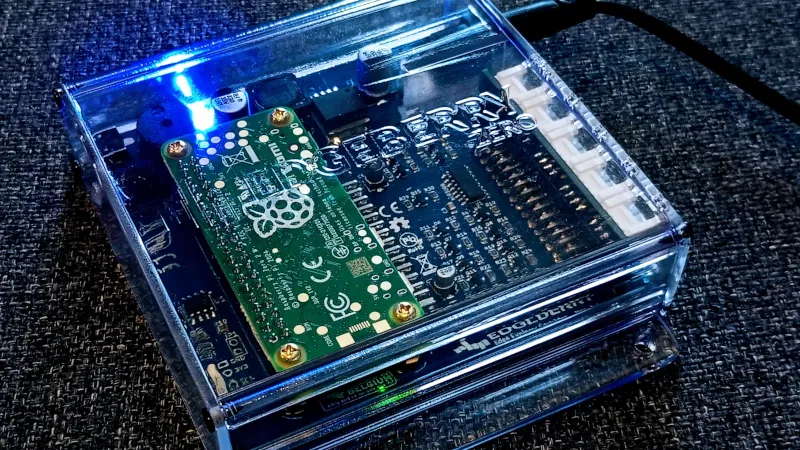
By now we’re all used to single board computers such as the Raspberry Pi Zero, but it’s likely we’ve all been frustrated at times by the number of support components required to use one. This becomes ever more annoying out in the field away from a handy HDMI, USB desktop, and power supply.
The Edgeberry Zero is an attempt to tackle this by mating a Raspberry Pi Zero with a PCB holding a robust power supply and interface connector, all together in a case. better still it comes with Edgeberry Hub, a software management interface.
It appears to be a commercially available product, but it’s Open Source Hardware Association (OSHWA) certified and everything is available in a GitHub repository. Looking at it from a Hackaday perspective it’s hardly the first power supply support board we’ve seen for a Pi, but its approach of making its own expansion module format is an interesting choice. To us they are reminiscent of Game Boy cartridges in the way they slide into a slot in the case.
Advertisement
We like the general idea behind the Edgeberry Zero, but whether it offers enough differentiation from packaging up a Zero with cables and duct tape is up to you.
Enterprise teams keep watching the same thing happen. An AI agent demos beautifully, goes to production, and stalls: it runs for a short stretch, then needs a human to top up its context and check its output, and the promised efficiency drains into supervision. The agent did the work; you did the watching. It’s one reason so many agent pilots never turn into production systems.
The pitch on the other side of that wall is the one every team wants to believe: an agent that runs a long job on its own, overnight if it has to, and leaves a person to validate only the last 10%. Whether that is achievable turns on a problem the orchestration conversation mostly skips. When AI firm Chroma tested 18 leading models, every one lost accuracy as its input grew, a property of how attention works, not a gap a stronger model closes. An agent fed more and more of your business as it runs does not get steadier. It gets shakier.
This is the layer beneath the orchestration race. Routing, durable execution and observability all assume each agent is already competent enough to coordinate in the first place. The deeper question is how long an agent can run before a human has to step in, and that comes down to where your company’s knowledge lives relative to the model. Both standard fixes leave a human in the loop.
Why teaching a model your business keeps you in the loop
Frontier models keep getting more capable, and the gap does not close, because it is not a capability problem. It is about where your knowledge sits relative to the model, and enterprises have had two ways to place it there.
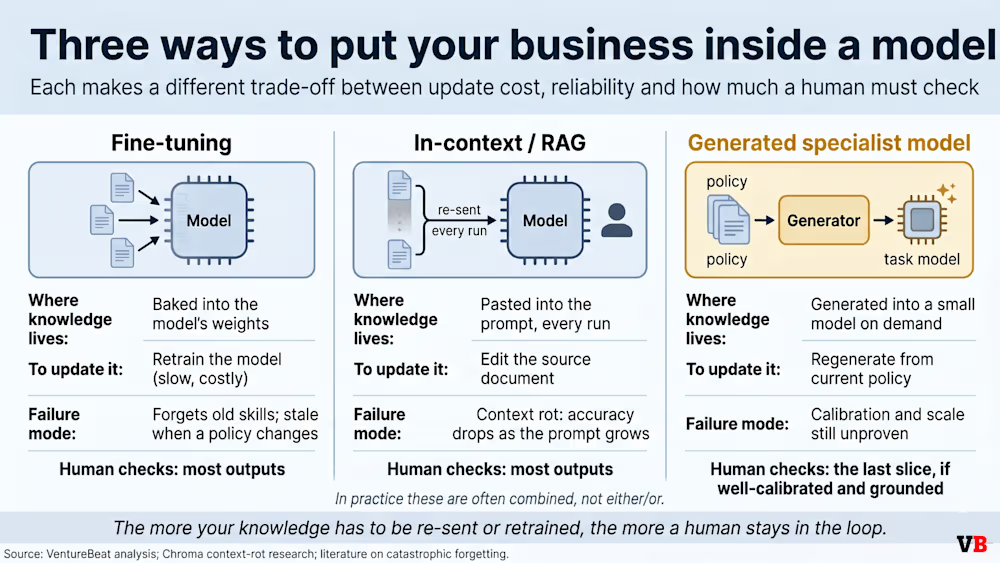
The first is fine-tuning, which bakes knowledge into the weights. It remains subject to catastrophic forgetting, a problem identified in the 1980s and still unresolved in 2026: teaching a model something new tends to erode what it already knew. Teams work around it by isolating each task in its own fine-tuned model or adapter, which produces a sprawling estate of models that raises cost and governance overhead. And a fine-tuned model is a snapshot, stale the day a policy changes, when the expensive, slow retraining cycle starts over.
Advertisement
The second is in-context learning, which skips retraining by placing the relevant policies in the prompt at run time. This is where context rot bites. Retrieval narrows what goes into the prompt, but a retrieval miss looks identical to a confident answer, and both cost and latency climb with every token added.
The two failures rhyme. With fine-tuning, the model can be confidently working from last quarter’s policy. With in-context learning, it can be confidently working from a detail it lost in the middle of a long prompt. Either way the output looks equally assured, so you cannot tell which parts are wrong without checking all of them. That is why the human never gets to leave. Some teams often run both at once, fine-tuning the stable knowledge and retrieving the rest. That softens each failure but removes neither: on any given output you still cannot be sure the model is both current and working from the right context, so you still check it.
A third path: generate the specialist model on demand
A third approach is moving from research into early product. Instead of retraining one model or stuffing its prompt, a generator builds a small, task-specific model on demand from your policies, at inference time. The generator is a hypernetwork: a network whose output is the weights of another network.
The idea was named in 2016; applying it to produce specialist language models from text or documents is recent and active. Sakana AI’s Text-to-LoRA, presented at ICML 2025, generates a model adapter from a plain-language description in a single pass, and a 2026 system called SHINE calls hypernetwork adaptation a promising new frontier, precisely because it sidesteps both the retraining cost of fine-tuning and the context limits of prompting.
Advertisement
The point of generating adapters rather than training and storing them is to collapse a sprawling library of per-task LoRAs into one network that can produce them on demand, including for tasks it has not seen.
The elegant part is how this closes the loop on the problem above: the per-task adapter teams hand-build to dodge catastrophic forgetting is the same object a hypernetwork produces automatically. The model zoo stops being a governance headache and becomes a generated output.
The case for going small underneath all this was put most directly in a 2025 paper by Nvidia researchers: for the narrow, repetitive tasks that fill agent workflows, small models are capable enough and 10 to 30 times cheaper to run than frontier generalists. Nace.AI, a Palo Alto company that raised a $21.5 million seed round in May, is the clearest commercial instance. Its core technology, a generator it calls a MetaModel, produces parameter adaptations for a model at inference time from a company’s policies, pointed at regulated work: audit, compliance, risk assessment. The company says its agents handle the bulk of a workflow while human experts validate the result, a split it markets as 90/10.
How the three approaches compare
Fine-tuning
In-context / RAG
Advertisement
Hypernetwork-generated model
Where business knowledge lives
In the model’s weights
In the prompt, re-supplied each run
Advertisement
In on-demand generated weights
Cost to update on a policy change
High: retrain
Low: edit the source
Advertisement
Low: regenerate
Staleness
High: a snapshot
Low
Advertisement
Low: regenerated from current policy
Per-call cost and latency
Low
High, grows with context
Advertisement
Low at run time
Dominant failure mode
Forgetting; model-zoo sprawl
Context rot; silent retrieval misses
Advertisement
Generator quality; calibration
Who owns the improving asset
Whoever trains the model
Whoever holds the data store
Advertisement
Depends where generator and feedback live
Why a hypernetwork-built model raises the autonomy ceiling
A model that is narrow, current and small has a smaller surface on which to be wrong. Fewer errors, confined to a known domain, mean fewer outputs an agent has to escalate to a person, which is the real basis for any high-autonomy claim. It is also where a number like 90/10 comes from: not a dial set in advance, but an outcome of how little the system needs to hand back. Reported autonomy shares are best read as measurements of an architecture, not as settings.
Two design choices decide whether that autonomy is trustworthy or merely fast. The first is grounding: tying every output to its source so a reviewer can verify rather than redo. Research models built for exactly this, such as HalluGuard, label each claim as supported or not and cite the passage they relied on. Nace ships its agents with grounding models and reasoning traces for the same reason. A 10% review only means something if the human can confirm provenance in seconds.
The second is the feedback loop, and it forces a question every buyer should ask: when your experts validate the output, whose model improves, and where does it live? That decides whether the compounding asset belongs to the vendor or to you. Arrangements differ. Nace, for instance, uses an external network of certified experts for some engagements and, for direct enterprise deployments, the customer’s own staff, with the resulting model kept inside the customer’s cloud. Each choice routes the learning, and the ownership, somewhere different.
Where the third path breaks
The approach is still early, and a few questions will decide how far it goes. Calibration is the linchpin: the value rests on the model knowing when it is unsure. And it is genuinely unsettled, recent work generating these adapters found they do not automatically improve calibration over ordinary fine-tuning, with gains appearing only under specific constraints.
Advertisement
The quality of the generated model also depends heavily on the policy data it is built from, which puts a premium on data curation. And scale is the open research frontier, the hypernetworks shown in published work so far have been small. This is where Nace’s own work gets interesting: in our interview, the company said it has scaled its generator well beyond those published sizes and derived a scaling law for how performance grows, results it has begun to share publicly and is now putting through peer review. If it holds up, it would help answer one of the central open questions in the field, and it is the paper worth watching.
The EU AI Act’s Article 14 now names this automation bias. The lesson is not about any one vendor: a high autonomy share concentrates human attention into a thin, late slice of the work, so the value of that review depends entirely on whether the human can check provenance fast, which loops back to grounding.
What to build, and what to ask before you buy
The honest takeaway: what holds your agents back is usually not orchestration or model size, but whether the model knows your business well enough to be left alone, and the right fix depends on the job. To automate a long, repetitive, high-volume process end to end, run most of your internal audit overnight and have your own experts check the final slice, a hypernetwork generated model is the approach most likely to do it cheaply and run long enough to matter. For a short task that finishes in a few steps and never needed to run unattended, the gap between this and a well-prompted frontier model shrinks to almost nothing, and is not worth the integration cost.
Advertisement
When a vendor pitches autonomous or specialist agents, four questions cut through it.
Where does the business knowledge live: in the weights, the prompt, or generated on demand?
What does each output come with, so a reviewer can verify it instead of redoing it?
What decides which work gets escalated to a human?
And whose model improves from that feedback, and where does it run?
The answers, not the headline ratio, tell you what you are buying.
The hypernetwork approach is the most credible attempt yet at making a small model know a specific business without forgetting it and without re-explaining it on every run. It is also the least proven, and the parts that matter most, calibration and scale, are still in peer review. For the right job, pilot it now. For the wrong one, the integration cost buys you little that a well-prompted frontier model wouldn’t.
Looking for the most recent regular Connections answers? Click here for today’s Connections hints, as well as our daily answers and hints for The New York Times Mini Crossword, Wordle and Strands puzzles.
Today’s Connections: Sports Edition has some fun categories, though the green group was a stumper for me. If you’re struggling with the puzzle but still want to solve it, read on for hints and the answers.
Connections: Sports Edition is published by The Athletic, the subscription-based sports journalism site owned by The Times. It doesn’t appear in the NYT Games app, but it does in The Athletic’s own app. Or you can play it for free online.
Hints for today’s Connections: Sports Edition groups
Here are four hints for the groupings in today’s Connections: Sports Edition puzzle, ranked from the easiest yellow group to the tough (and sometimes bizarre) purple group.
Yellow group hint: Big Apple baseball.
Advertisement
Green group hint: Bike race clothing.
Blue group hint: Not the Big 10, but…
Purple group hint: Cowboys wear them.
Answers for today’s Connections: Sports Edition groups
According to TrendForce, a global market research and intelligence firm headquartered in Taipei, Taiwan, TCL CSOT, the display manufacturing arm of tech giant TCL, is aggressively promoting its IJP (Ink Jet Printed) OLED display technology as a means of entering the OLED monitor and notebook panel supply chain. The company’s existing Gen 5.5 IJP OLED production line has already reached volume production and has successfully commercialized OLED display panels for the medical industry, while validation programs for branded monitor and notebook products are currently underway. The company’s progress could potentially challenge the long-standing dominance of Korean panel makers LG Display and Samsung Display in the OLED industry.
TCL purchased the IJP OLED patents and actual manufacturing equipment from Japanese firm JOLED in 2023, after previously investing in that company. TCL CSOT moved the equipment to China in order to build its Gen 5.5 IJP OLED plant which became operational in late 2024.
TrendForce reports that TCL CSOT is initially testing market demand with a 27-inch UHD (Ultra High Definition) IJP OLED monitor produced on its Gen 5.5 line, targeting the professional monitor segment.
According to TrendForce, IJP OLED offers superior power efficiency in high-end business and creator-focused displays when compared with existing QD-OLED and WOLED technologies, making it increasingly attractive to brand vendors. The IJP method of manufacturing OLED screens also offers dramatically lower manufacturing costs, which could allow TCL to undercut its competition and gain market share quickly.
Advertisement
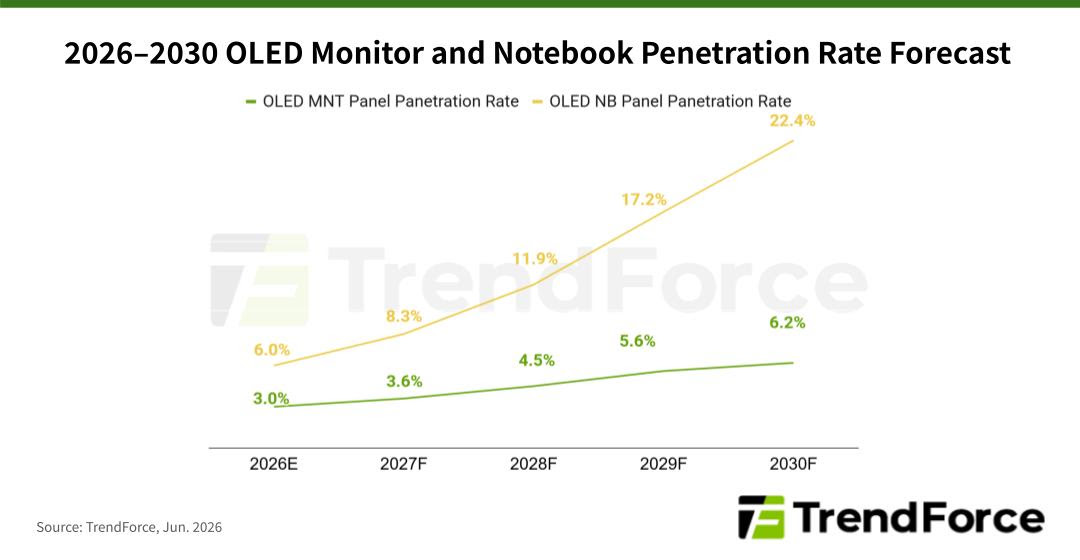
TrendForce predicts a substantial increase in OLED market share in monitor and notebook/laptop screens, thanks to a recent push toward IJP OLED by TCL CSOT. Chart copyright TrendForce – all rights reserved. Used with permission.
Monitor brands from China, Taiwan, and South Korea are reportedly evaluating IJP OLED panels to use in their computer monitors, and TCL CSOT is expected to begin mass production of IJP OLED monitor panels in the third quarter of 2026.
The OLED monitor panel market is currently dominated by Samsung Display and LG Display. Current costs associated with OLED screen manufacturing compared to the more common LCD-based panels has limited OLED’s penetration within the computer monitor market to approximately 3% in 2026. However, according to TrendForce with TCL CSOT investing heavily in its upcoming Gen 8.6 OLED fabrication plant, TrendForce expects OLED monitor penetration to double to 6.2% of the market by the end of this decade, and continue expanding thereafter.
Meanwhile, according to TrendForce, the manufacture of OLED screens for notebooks/laptops is becoming increasingly diversified. In addition to Samsung Display, TCL CSOT, BOE, and Visionox have all committed resources to Gen 8.6 OLED notebook panel production. As a result, adoption of OLED screens in laptops and notebook computers is expected to accelerate rapidly, with penetration projected to reach 22.4% by 2030.
Inkjet Printing vs. Vacuum Evaporation – Which is Better?
IJP OLED uses large scale inkjet printers with soluble organic materials to print red, green and blue sub-pixels directly onto a substrate or “motherglass.” This promises lower production costs and far less material waste compared to the traditional vacuum evaporation methods used for W-OLED and QD-OLED panel manufacturing. Also, since IJP creates individual red, green and blue subpixels, the process avoids the need for color filters used on W-OLED displays and the need for Quantum Dot layers on QD-OLED displays. But current IJP OLED manufacturing facilities are limited in panel size and the current production IJP panels themselves are limited in overall brightness, which has kept the tech out of the consumer television business… for now.
TCL touts the benefits of IJP OLED over traditional OLED displays.
The wildcard in this whole market is TCL CSOT’s Gen 8.6 OLED plant in Guangzhou, China, which is scheduled to begin production of IJP OLED panels in the third or fourth quarter of 2026. The new plant is expected to have the capability of manufacturing IJP OLED screens in much larger screen sizes than the current Gen 5.5 production line.
While initial production of the new plant will concentrate on smaller IJP OLED screens for the notebook and monitor market, the company could potentially begin churning out consumer TV-sized OLED screens in 65 and 77-inch screen sizes as early as next year (2027). Whether they actually pursue this path will depend on how things go with the smaller screen business and whether they can ramp up production and yield quickly enough to be able to reach competitive pricing on these larger screens after recovering the substantial R&D investment required in order to build the plant.
Advertisement
The Bottom Line
TV enthusiasts (like yours truly) love OLED TV for its perfect black levels and outstanding contrast. But the latest flagship TVs from the major TV brands (except LG) all feature LCD display panels, with improved backlighting units that use Mini LED backlighting or RGB backlighting to create bright bold images with wide color gamut reproduction.
Advertisement. Scroll to continue reading.
While LG, Samsung and Sony continue to offer OLED TV models, the performance gap between LCD and OLED is definitely closing with each new model year as major manufacturers like Samsung and TCL pour billions of dollars into LCD display research, marketing and manufacturing. And with the inefficiencies inherent in current OLED panel manufacturing, it’s unclear how long the tech will be supported as OLED manufacturing costs remain high relative to LCD TV manufacturing.
The promise of cheaper OLED panels is something that could extend the life of the tech, and allow OLED TVs to compete with LCD TVs, even at budget-friendly price points.
Advertisement
With TCL and Sony entering a joint venture for TV manufacturing called BRAVIA, Inc., which is scheduled to begin its operations in April, 2027, and the new Gen 8.6 IJP OLED plant ramping up wide scale panel production at around the same time, we have to wonder whether things might just work out well for the future of OLED TV tech in general, and Sony/BRAVIA OLED TVs in particular.
BRAVIA 10, anyone?
The full report on TCL CSOT entering the notebook and monitor screen market with its IJP OLED screens is available directly from TrendForce on its Report Page,
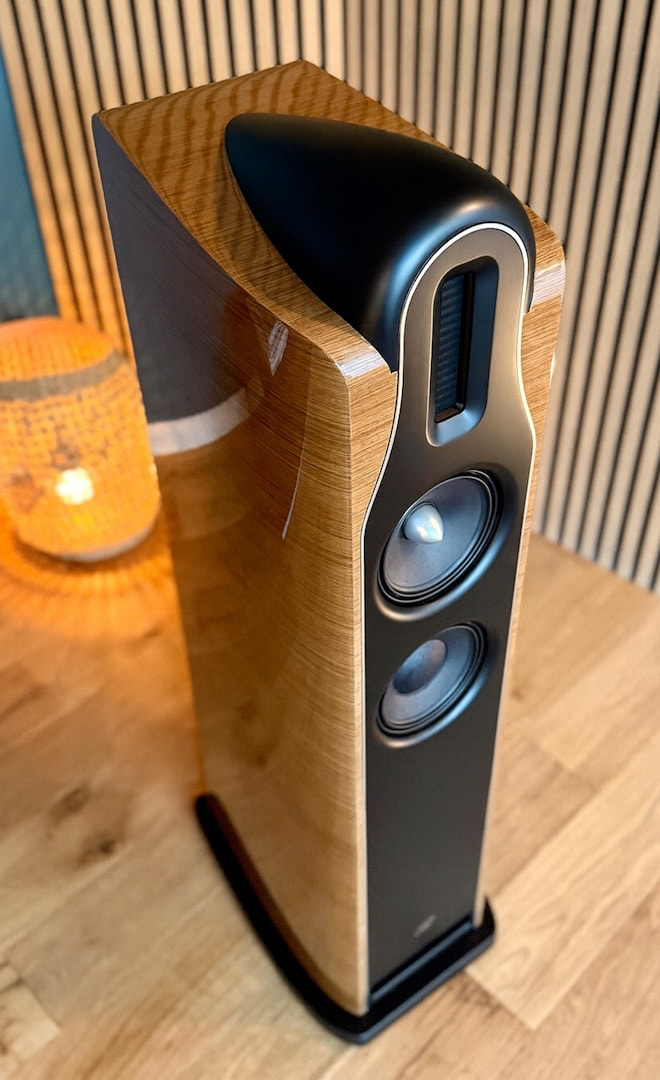
Jean-Marie Reynaud has officially placed the AURALIS at the top of its loudspeaker range, and the new French flagship arrives with a clear message: musical scale does not have to come from a cabinet that looks as though it was designed to store military hardware.
Scheduled to launch in fall 2026 at €18,000 per pair, the AURALIS is the most ambitious loudspeaker yet from the Charente-based manufacturer. It combines a 2.5-way architecture, JMR’s proprietary tuned triangular transmission line, a large 120 mm AST tweeter, hand-wired crossovers, and a cabinet designed to deliver bass authority, tonal accuracy, image stability, and long-term listening satisfaction; this is not a speaker designed to impress for ten minutes in a dealer showroom before the listener starts looking for the exit.
I have some history with the brand, although not nearly as much as I would like.
Back in the 1990s in Toronto, a local hi-fi store in the East End carried Jean-Marie Reynaud loudspeakers, and I was able to spend time with most of the lineup. They were partnered with Audiomat electronics, another French brand with a very different approach to the usual North American power-and-machismo routine, along with some very serious Nottingham Analogue Studio turntables and Benz Micro cartridges.
Advertisement
The JMR speakers were never huge sounding in the conventional sense. They did not try to pin you against the back wall with bass fireworks or make every cymbal strike feel like it had been sharpened by a sommelier with anger-management issues. What they did exceptionally well was inner detail, clarity, tonal finesse, imaging, and treble that had air and delicacy without becoming etched or fatiguing.
They also looked different. Not weird for the sake of weird, which remains one of high-end audio’s more persistent crimes, but unmistakably French in the best possible way: thoughtful, elegant, slightly idiosyncratic, and very much their own thing.
Once I left Canada, JMR drifted off my radar. The brand was never as visible in the United States as Focal, Bowers & Wilkins, KEF, or Sonus faber, and that was probably America’s loss. But JMR is still here, still building loudspeakers in France, and AURALIS looks like the company’s most serious statement yet.
The French, for all of their gifts, have never been overly concerned with explaining themselves to everyone else. AURALIS feels very much in that spirit, and I would encourage U.S. and Canadian listeners to seek out a JMR dealer and hear these for themselves. This is a brand worth rediscovering.
Advertisement
A New Flagship Above the Orféo Grande
Jean-Marie Reynaud AURALIS Loudspeaker
AURALIS now sits at the top of the JMR range, above the Orféo Grande, joining a lineup that includes the Lunna MKII, Euterpe Jubilé, Cantabile Jubilé, Abscisse Jubilé, Orféo Jubilé, Orféo Grande, and the compact Voce Grande.
The new floorstander measures 115 cm high, 30 cm wide, and 42 cm deep, or 45.3 x 11.8 x 16.5 inches. Each speaker weighs 45 kg, or 99.2 pounds. That is serious mass, but it is not one of those absurdly oversized high-end monuments that require reinforced flooring, a forklift, and a second mortgage before the first needle drop.
JMR recommends a listening room between 20 and 60 square meters, or roughly 215 to 645 square feet. The speakers should be positioned between 2 and 4 meters apart, or approximately 6.5 to 13 feet center-to-center, with a minimum listening distance of 3 meters, or just under 10 feet. JMR also recommends at least 80 cm, or 31.5 inches, of clearance behind the speakers.
Advertisement. Scroll to continue reading.
The front-firing port should make AURALIS more flexible than many rear-ported alternatives, but this is still a 99-pound French flagship with real bass energy. Trying to wedge a pair into a Manhattan one-bedroom beside a radiator, a dying ficus, and a framed photo of your ex-wife remains an act of cultural vandalism.
Advertisement
AURALIS Uses JMR’s Tuned Triangular Transmission Line
Jean-Marie Reynaud AURALIS Loudspeaker (rear view)
At the heart of the AURALIS is JMR’s tuned triangular transmission line, a proprietary acoustic loading system that has become one of the company’s most recognizable design signatures.
The goal is not simply to produce more bass. JMR says the tuned triangular transmission line progressively harnesses the rear energy of the drivers to create low frequencies that are spacious, articulate, naturally controlled, and properly integrated with the rest of the spectrum.
That matters because impressive bass and convincing bass are not always the same thing. JMR is aiming for a low end that can follow the music rather than simply announcing its presence every time a bass drum enters the room.
The cabinet itself uses HDF panels ranging from 25 mm to 40 mm thick, or roughly 1.0 to 1.6 inches, depending on where reinforcement is required. JMR uses minimal internal acoustic damping to preserve dynamics, liveliness, and a sense of freedom, while applying viscoelastic compounds at strategic points to control unwanted vibration.
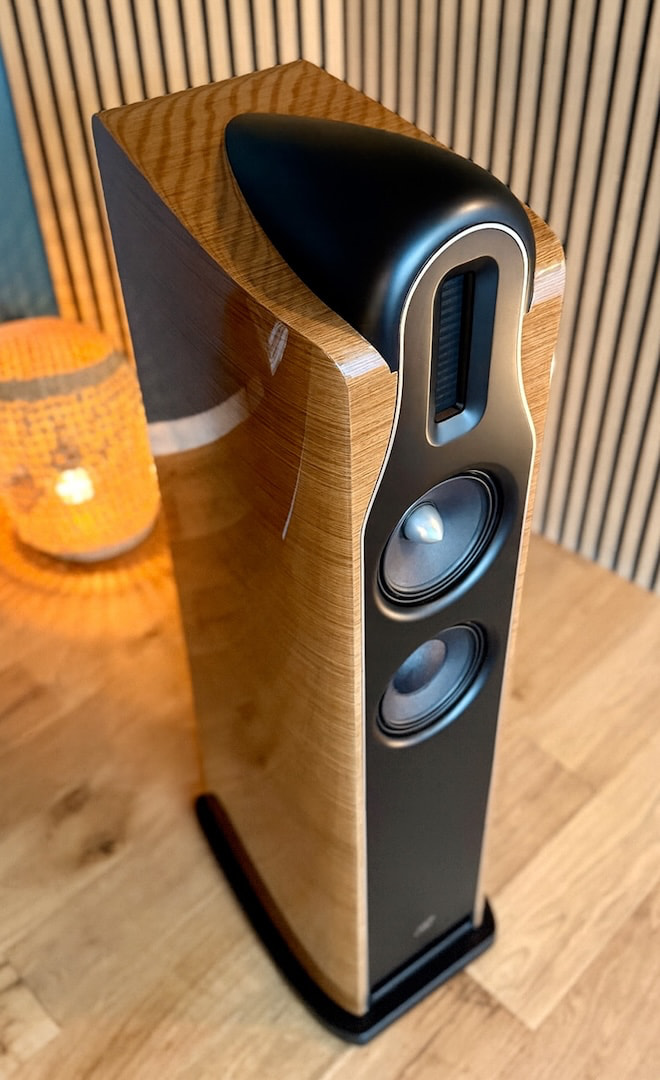
The upper tweeter pod is made from epoxy resin, chosen for its inertness and mechanical stability. It also gives AURALIS a more sculptural silhouette than the usual rectangular tower with a tweeter bolted on top as though someone remembered it five minutes before the design meeting ended.
Advertisement
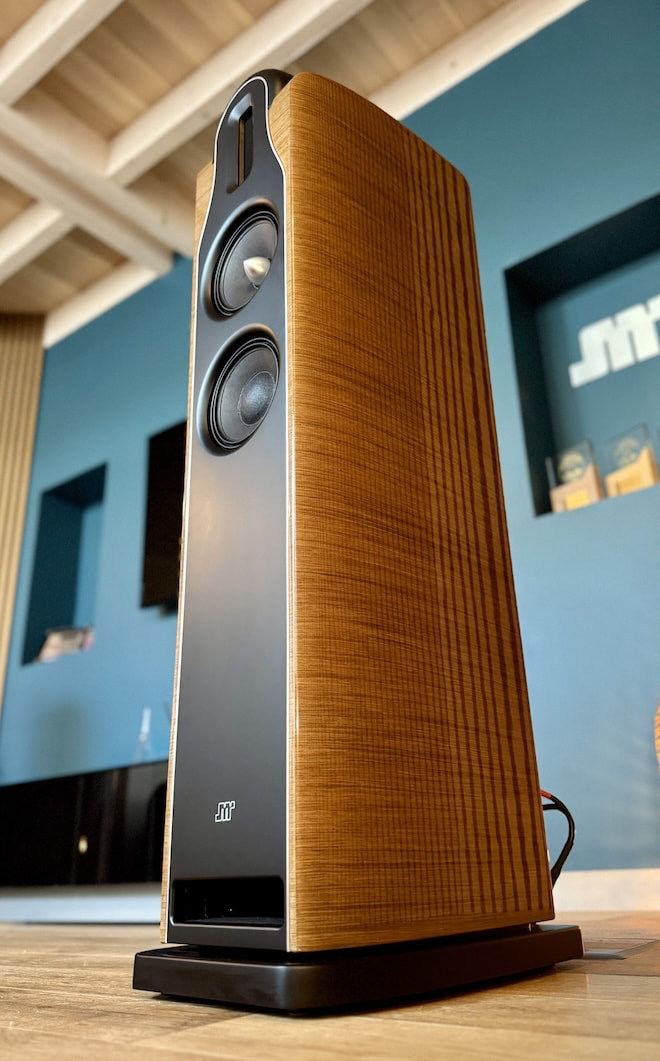
AURALIS also uses a dedicated decoupled base with no direct mechanical coupling between the cabinet and the floor. Rather than relying on conventional spikes, JMR uses a polymer isolation element refined through listening tests, paired with Teflon pads.
2.5 Way Architecture With a Large AST Tweeter
The AURALIS is a 2.5-way loudspeaker built around two new midbass drivers and a 120 mm AST tweeter.
The two midbass drivers operate together up to 220 Hz, effectively increasing radiating surface area and giving the speaker more energy and ease through the bass region. The upper midbass driver continues higher before handing off to the AST tweeter at 1.8 kHz.
That is a notably low crossover point for a tweeter and one of the more important technical aspects of the design. JMR uses a symmetrical 12 dB-per-octave filter at 1.8 kHz to take advantage of the AST tweeter’s speed, low distortion, dynamic capability, and broad natural presentation through the upper midrange and treble.
This is exactly where a loudspeaker either becomes convincing or starts sounding like a collection of expensive parts arguing in public. Vocals, piano, strings, brass, guitar harmonics, and the emotional wreckage of every audiophile all live in this region. There are therapists in Westchester who have financed fishing boats off this crowd.
Advertisement
Hand-Wired Crossover With Serious Parts Selection
JMR has long treated crossover design as part of the loudspeaker’s voice rather than a generic component board hidden in the bottom of the cabinet. The AURALIS continues that philosophy with a fully hand-wired crossover built without a printed circuit board.
Advertisement. Scroll to continue reading.
The network uses a deliberately limited number of components to minimize losses, phase rotation, and audible distortion. The 2.5-way topology employs 6 dB and 12 dB-per-octave slopes, with the two midbass drivers working together to 220 Hz and the AST tweeter taking over at 1.8 kHz.
JMR specifies pure copper foil inductors wound on beechwood formers, ClarityCap PUR capacitors, and Path Audio resistors for tweeter attenuation.
Advertisement
The Path Audio resistors use a third grounding terminal and a copper tube intended to provide electromagnetic shielding, heat dissipation, and drainage of parasitic charges. That is the sort of detail that will either delight or irritate the people who believe every resistor sounds identical. Both sides will probably write 2,000 words about it online.
Specifications and Amplifier Matching
JMR rates the AURALIS at 89 dB/W/m sensitivity at 2.83V, with impedance compatible with amplifiers rated for 4 to 8 ohms. Minimum impedance is listed as 4.3 ohms.
The claimed frequency response is 30 Hz to 28 kHz within ±6 dB. Power handling is rated at 250 watts continuous and 400 watts peak, with recommended amplifier power between 40 and 300 watts. Claimed distortion is below 0.2 percent at an 85 dB listening level.
JMR says the AURALIS is compatible with both tube and solid-state amplification and that its impedance curve does not present particular setup challenges. That does not mean AURALIS should be paired with whatever integrated amplifier was rescued from the guest room after a remodel, a divorce, or an unfortunate encounter with a soundbar. Less will not be more here.
Advertisement
The Audiomat system I used to get to know JMR in the 1990s was already in the $20,000 range, including an integrated amplifier, CD transport, phono stage, and DAC. These speakers may not demand brute-force amplification, but they will reward a front end with real resolution, tonal color, and authority.
Woodscore XO Finish and Made in Charente Construction
Visually, AURALIS introduces JMR’s Woodscore XO finish, which combines a seven-layer high-gloss polished treatment with real walnut veneer in a cognac tone, a black front baffle, and a solid machined-aluminum trim piece on the front sub-baffle.
The Woodscore XO finish gives AURALIS an elegant, architectural presence without overwhelming the room. Designed, assembled, quality-controlled, and fine-tuned in Charente, the speaker reflects JMR’s own approach to cabinet construction, acoustic loading, crossover design, and final voicing.
Jean-Marie Reynaud AURALIS Specifications
Design: 2.5-way floorstanding loudspeaker
Crossover Slopes: 6 dB / 12 dB / 12 dB per octave
Impedance: Compatible with 4 to 8 ohm amplifiers; 4.3-ohm minimum
Frequency Response: 30 Hz to 28 kHz, ±6 dB
Sensitivity: 89 dB/W/m at 2.83V
Distortion: Less than 0.2% at 85 dB
Power Handling: 250 watts continuous
Peak Power Handling: 400 watts
Recommended Amplifier Power: 40 to 300 watts
Speaker Terminals: Single-wire binding posts with a dedicated crossover ground terminal
Dimensions: 115 × 42 × 30 cm, or 45.3 × 16.5 × 11.8 inches
Height: 115 cm / 45.3 inches
Depth: 42 cm / 16.5 inches
Width: 30 cm / 11.8 inches
Weight: 45 kg / 99.2 pounds per speaker
Recommended Listening Area: 20 to 60 m² / approximately 215 to 645 square feet
The Bottom Line
The Jean-Marie Reynaud AURALIS is not another expensive floorstander built to impress for 10 minutes with brute bass, a shiny cabinet, and enough aluminum to repair a small bridge. Its appeal is more specific: JMR’s tuned triangular transmission line, large AST tweeter, hand-wired crossover, front-firing port, and Charente-built cabinet are all aimed at tonal accuracy, bass articulation, coherence, and long-term musical satisfaction.
At €18,000 per pair in Europe, AURALIS enters a serious category that includes the Sonus faber Olympica Nova V, Focal Sopra N°2, Bowers & Wilkins 804 D4 and 803 D4, and Wilson Audio Sabrina V, depending on local pricing. JMR has not announced U.S. or Canadian pricing yet, so the final comparison will depend on where it lands in North America.
For listeners who value inner detail, natural timbre, and finesse over a loudspeaker that behaves like it is auditioning for a Marvel soundtrack, AURALIS looks like one of the more distinctive new arrivals in the high-end category.
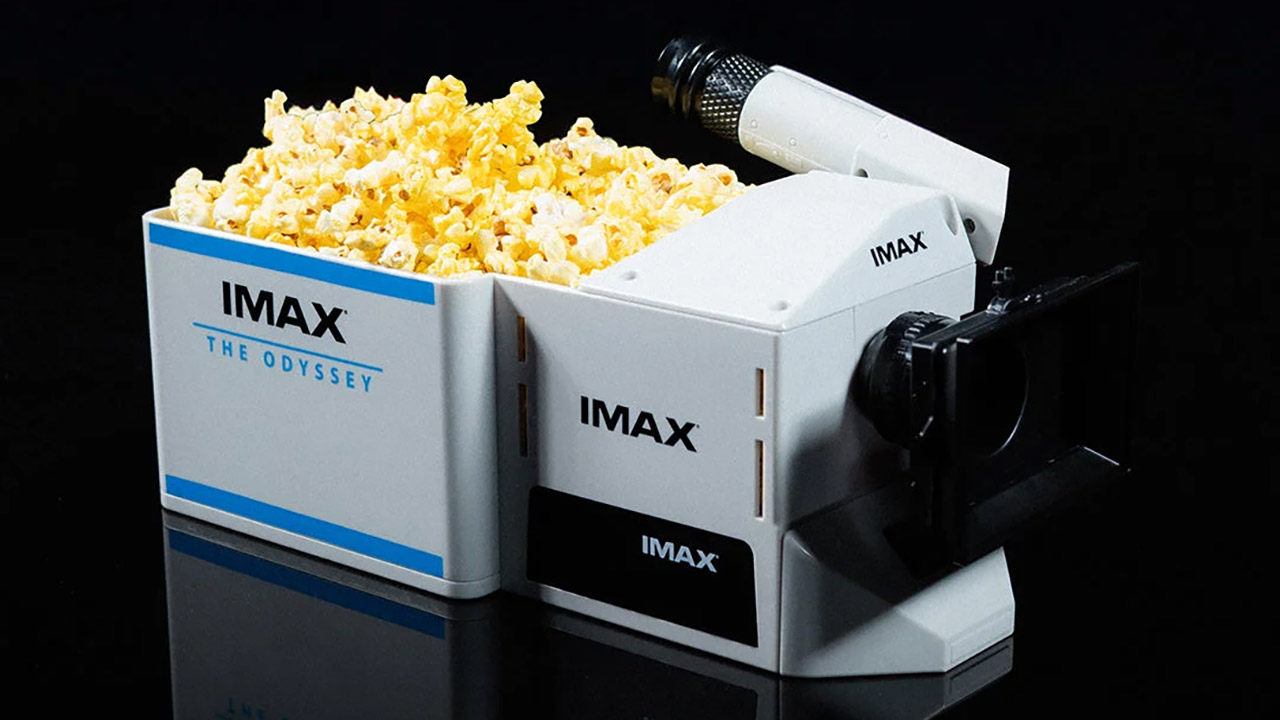
Christopher Nolan’s upcoming film has already sparked plenty of conversation, but one of the quickest sellouts tied to it did not involve tickets or posters. Instead, it was a limited-run popcorn container modeled directly after the large-format film camera Nolan has long praised as his go-to tool.
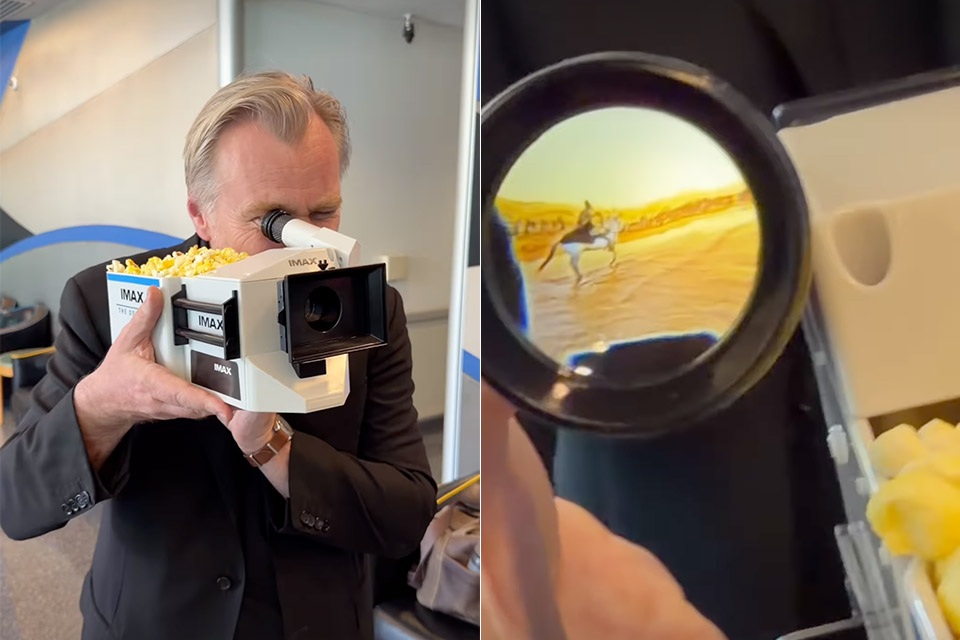
On June 18, the IMAX web store launched their limited edition item, which quickly sold out. This thing originally cost $50, but it’s currently available on resale sites for two or three times that price. What they came up with was far more than a conventional bucket with a logo on the side. Designers worked hard to build an object that resembles the real IMAX 15/65mm camera body that has been used behind the scenes in several of Nolan’s previous works, and it is now also the main camera in The Odyssey. The end result is somewhere between a cool keepsake and a rather functional prop.
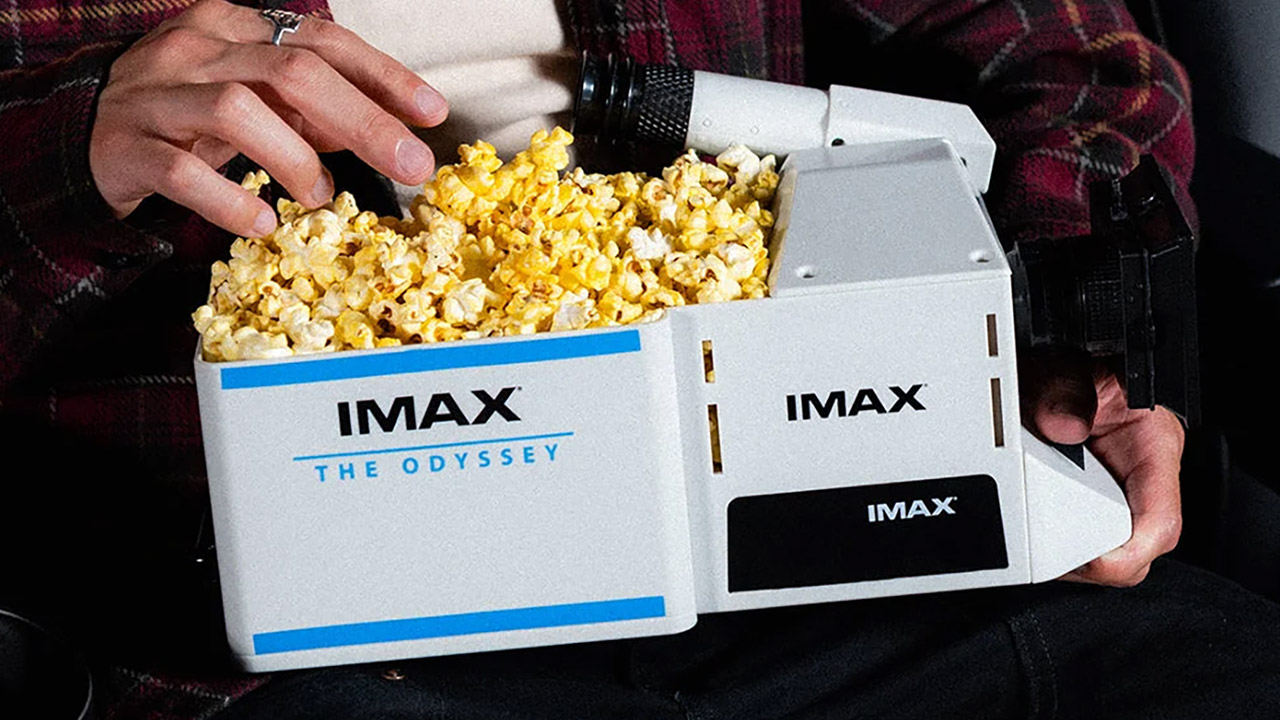
You have a large rectangular piece on the side that holds the popcorn and has clean “IMAX THE ODYSSEY” branding in blue and black on it. The camera body is then mounted on top, complete with lens barrel details, adjuster knobs, and a viewfinder, all of which are fairly accurate. Overall the object measures around 14 inches long, 6.25 inches wide and 5.3 inches tall, & the weight is around 1.26 pounds once you’ve removed the eyepiece.
The materials are rather simple, consisting of injection-molded polymers such as acrylic, polypropylene, and ABS, so it’s durable enough to withstand a few trips to the theater while yet being light enough to carry without being a nuisance. They add a small LED light and an LR1130 battery. When you turn on the light and look through the viewfinder, you’ll see a still image from The Odyssey in the unique 1.43:1 enlarged aspect ratio that IMAX uses on their largest displays.
The fact that the light has transformed that simple bucket into something more than simply a bowl; even if the lights are turned off and the trailers are playing, a quick look through the eyepiece gives you a tiny little sampling of the film’s scale before the main feature begins. Early photos show Nolan himself handing over a device to cinematographer Hoyte van Hoytema and demonstrating the viewfinder during advertising events. It has a decent capacity for popcorn.
IMAX describes the project as a tribute to both their groundbreaking film technology and the art of large-format filmmaking. Nolan has been gushing about their camera system as the “gold standard” for years, and The Odyssey is only the latest chapter in that collaboration. This is essentially a pocket-sized salute to the same equipment that will eventually project the film in its proper format on the biggest screens. [Source]
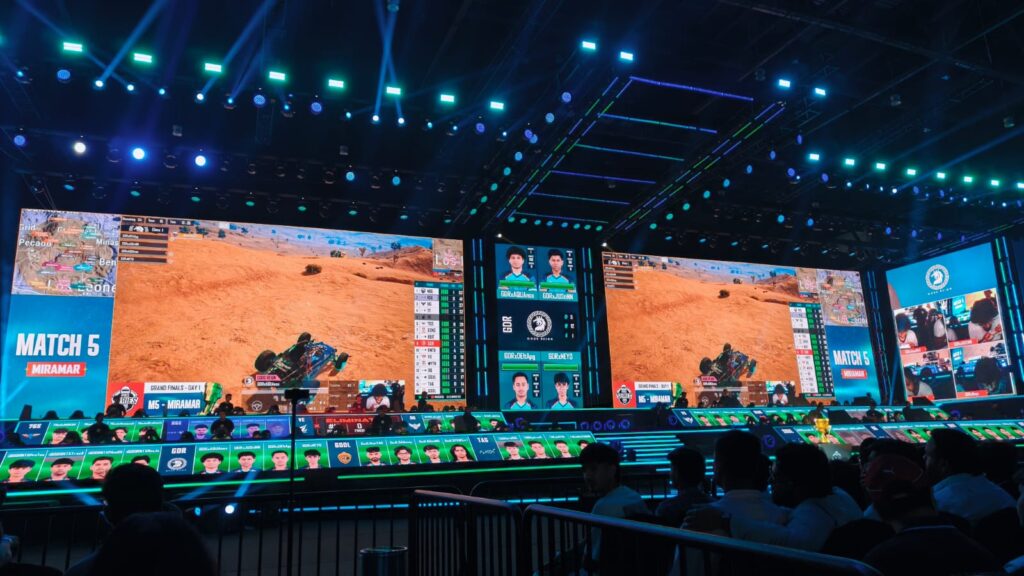
Day 1 of the BMPS 2026 Grand Finals is officially in the books, and what a day it was. From back-to-back chicken dinners by iQOO Reckoning Esports to Divine Gaming’s late surge to the top of the standings, the opening six matches had everything BGMI fans could ask for. While some fan favorites lived up to expectations, others will be heading into Day 2 with plenty of work left to do.
Reckoning Starts Strong With Back-to-Back Chicken Dinners
The opening match on Rondo immediately set the tone for the day. Team TAG endured a rough start after losing multiple players to Revenant XSpark and eventually became the first team eliminated from the Grand Finals. Meanwhile, iQOO SouL looked sharp early on, picking up multiple eliminations and showing signs of a strong opening. However, it was iQOO Reckoning Esports who stole the spotlight, closing out the match to secure the first chicken dinner of the Grand Finals.
The momentum continued into Match 2 on Erangel. While the early game remained relatively quiet, the action exploded during the final circles around Ferry Pier. Teams like GodLike, Divine Gaming, and Nebula Esports all looked dangerous throughout the match. The final battle came down to Nebula Esports, Genesis Esports, iQOO 8Bit, and Reckoning Esports. Despite Nebula’s strong positioning, 8Bit disrupted their plans, while Genesis Fury put together an impressive individual performance from a watchtower. In the end, Reckoning Esports emerged victorious again, securing back-to-back chicken dinners and establishing themselves as the early favorites.
Erangel Delivers Upsets and Surprises
The third match brought one of the biggest surprises of the day. After winning the first two games, Reckoning Esports became one of the earliest teams eliminated. Genesis and GodLike continued their strong performances throughout the mid-game, while teams like TAG and SouL once again struggled to convert opportunities into points. The final fight saw Gods Esports and iQOO Orangutan battle for the chicken dinner. Orangutan’s lone survivor attempted a clever smoke rotation to outplay the opposition, but the strategy fell short, allowing Gods Esports to claim the victory.
The fourth match finally delivered the military island zone that many fans had been waiting for. Unfortunately for iQOO 8Bit, their game ended before the first circle had even closed. The standout performer here was Nebula Esports. The team secured prime positioning near the center of the zone and successfully defended it against multiple challenges.
Advertisement
Vasista Esports tried to break through but were quickly shut down. As the match entered its closing stages, only Nebula, Orangutan, and Reckoning remained. With Nebula holding a full squad while their rivals were reduced to single players, the outcome felt inevitable. Nebula secured the chicken dinner and, more importantly, climbed into contention for the top spot overall.
Divine Gaming Turns Things Around in Miramar
If the first half belonged to Reckoning and Nebula, the Miramar matches belonged to Divine Gaming. The fifth match featured a relatively central circle, resulting in fewer risky rotations and more direct engagements. Vasista became the first team eliminated after losing a crucial fight against Revenant XSpark. GodLike once again showed flashes of brilliance, winning multiple engagements through well-timed grenades and coordinated pushes. However, they couldn’t sustain the momentum deep into the game. The final showdown came down to Genesis Esports and Divine Gaming. Despite Genesis holding the high ground, Divine managed to outplay them during a tense 3v3 battle and walked away with the chicken dinner.
The final match of the day saw another Miramar zone centered around the southwest side of El Azahar. Once again, TAG found themselves involved in multiple early-game fights, including a lengthy standoff with Gods Reign and Team Tamilas inside a church compound. While TAG picked up a few eliminations, they couldn’t capitalize on the momentum and were eventually eliminated while rotating into the safe zone. SouL’s struggles also continued. The team spent most of the match fighting from a disadvantaged position and eventually exited with just a single elimination. Genesis continued their impressive run by taking down both iQOO 8Bit and Orangutan in consecutive engagements. However, they were unable to convert that momentum into a chicken dinner.
The final battle featured Divine Gaming and Revenant XSpark. Unlike previous endgames, Divine entered the fight with all four players alive and full control of the circle. Revenant attempted to mount a challenge but simply couldn’t break through Divine’s setup. Divine Gaming secured the final chicken dinner of Day 1 and, with it, the overall lead in the standings.
If Day 1 was any indication, fans are in for another action-packed weekend of BGMI esports.
If there’s one thing that Donald Trump has shown over the years, it’s that he will get his most sycophantic MAGA loyalists to insist there are perfectly obvious reasons why whatever he’s about to do is absolutely necessary… and then Trump will do the opposite, and all those hangers-on will magically change their story within minutes.
The excellent reporter Laura Jedeed has been tracking all of the excuses Trump and his team have been giving for why we absolutely had to go to war with Iran, and the very top one: eliminate their ballistic missile capability. Next: eliminate their nuclear program entirely. There was also some talk of “regime change.”
When Trump went to war with Iran, I watched every speech anyone in the administration gave and made a chart of every reason given for going to war”Eliminate ballistic capability” was the #1 reason given: more even than preventing Iran from getting a nuclear weapon
Now that Trump has signed the surrender agreement at Versailles (the traditional place to sign a total surrender agreement), the scorecard looks like this: no eliminated missile program, no eliminated nuclear program, no regime change. Also: no actual deal.
Advertisement
What Trump signed is a one-page memorandum of understanding with a 60-day time limit. After that, another deal needs to happen — one that may or may not actually get signed. The thing being called a historic peace agreement is, in legal terms, a note on the back of a napkin that expires in two months.
With that established: here’s what he gave away to get it.
The US backed down on everything to get the Strait of Hormuz only partially opened, in a situation where Iran still seems likely to come out of this way stronger and way more powerful than before Trump started this illegal war. Remember, before this war, the Strait was open. So with this deal we only get partially back to where things were before the war, but with a huge draw down of US military stock, over a dozen dead US soldiers, and tons of unnecessary Iranian casualties, including a school full of young girls.
Iran retains their ballistic missiles and MAGA officials have to pretend that makes sense.
Advertisement
KAITLAN COLLINS: Are you okay with Iran having missiles?SEN. ROGER MARSHALL: I prefer that they not, but they have to defend themselvesCOLLINS: You think Iran needs to be able to defend itself?MARSHALL: I do, otherwise we turn this into a forever war
Also, remember how the Trump world insisted that Obama’s JCPOA was one of the worst deals of all time?
That’s Donald Trump tweeting in 2015 about the JCPOA:
The deal with Iran will go down as one of the most incompetent ever made. The U.S. lost on virtually every point. We just don’t win anymore!
The “deal” Trump just made is a complete capitulation, a loss on every point, and way, way, way worse than what was in the JCPOA, which, in retrospect, was a genuinely good deal — carefully negotiated by actual experts — and briefly a real win for peace in the Middle East before Trump tore it up.
Advertisement
And remember how MAGA spent years misleadingly talking up all the money that the US supposedly “gave” Iran with the JCPOA? Or the deal Biden did to extend a Trump-era policy to unfreeze some of Iran’s frozen assets, which even Donald Trump Jr. falsely claimed was Biden “giving” Iran money?
“We don’t have to give them anything. But some people may want to invest. Like, what are you going to do to say ‘you can never ever invest in a country,’ I mean, it’s pretty tough.”
So: MAGA spent years insisting that financial flows to Iran — even unfreezing Iran’s own assets — would fund its military and get soldiers killed. Trump just opened Iran to hundreds of billions in new investment while leaving both the missiles and the nuclear program intact. The threat, apparently, only counts when a Democrat is president.
Obviously, ending this war is a good thing. But it never should have happened in the first place. Trump launched it without congressional authorization, in clear violation of the War Powers Act — and once it started, Congress should have stopped it cold.
The final accounting: Trump tore up the JCPOA, which he called “one of the most incompetent deals ever made.” He started an illegal war. He drew down US military stockpiles, lost over a dozen American soldiers, and killed Iranian civilians — including a school full of young girls. And he came away with a memorandum of understanding that expires in 60 days, leaving Iran with everything it had before the war started, plus full knowledge of exactly how hard Trump will push before he folds.
Advertisement
Trump’s own verdict on the JCPOA was: “The U.S. lost on virtually every point.” He was describing this deal.
Two sides desperately needing a victory meet at the FIFA World Cup 2026 as Turkey face Paraguay, and you can live stream the game around the world for free.
Turkey are reeling from a shock 2-0 defeat by Australia in their opening Group D match, as the pre-tournament dark horses were left to rue some sloppy defensive play and a lack of cutting edge. Head coach Vincenzo Montella will look to rectify that against Paraguay in what already looks like a must-win game, with co-hosts USA still to come. It won’t be ideal for Montella that Turkey’s first two group matches are 1,500km apart, and the appropriately nicknamed Little Airplane will hope the journey from Vancouver to San Francisco does not take too much toll on his players. He also needs Real Madrid playmaker Arda Guler to step up.
Paraguay face a much shorter trip to San Francisco, from Los Angeles, where they were thrashed 4-1 by co-hosts the USA. That performance was most unlike a team built on defensive diligence – in fact, it was the first time since June 2024 that they had conceded four goals in a match. Head coach Gustavo Alfaro will demand the Albirroja tighten up against a talented Turkey side, otherwise the prospect of an early exit from their first World Cup in 16 years, when they reached the last eight, will become increasingly likely.
Advertisement
It’s must-win for both teams.
So, read on as we show you exactly how to watch Turkey vs Paraguay for free in the FIFA World Cup 2026.
How to watch Turkey vs Paraguay for free
Turkey vs Paraguay is available to watch for free in multiple countries, including the UK, Australia, Brazil, Belgium, Ireland, Netherlands, Switzerland and Turkey.
Advertisement
Abroad? Can’t access your free stream? Unblock your free World Cup stream with Norton VPN — more on that below.
Use a VPN to watch Turkey vs Paraguay live streams
It’s the World Cup, and if you’re traveling, you might discover your usual Turkey vs Paraguay stream is suddenly unavailable due to geo-restrictions.
Don’t worry, that’s exactly where a VPN can help. A virtual private network lets you connect to servers around the world so you can securely access your usual World Cup coverage as if you were back home.
Midfielders: Salih Özcan (Borussia Dortmund), Orkun Kökçü (Beşiktaş), Hakan Çalhanoğlu (Inter Milan), İsmail Yüksek (Fenerbahçe), Kaan Ayhan (Galatasaray).
Advertisement
Forwards: Kerem Aktürkoğlu (Fenerbahçe), Arda Güler (Real Madrid), Deniz Gül (Porto), Kenan Yıldız (Juventus), İrfan Can Kahveci (Kasımpaşa), Yunus Akgün (Galatasaray), Barış Alper Yılmaz (Galatasaray), Oğuz Aydın (Fenerbahçe), Can Uzun (Eintracht Frankfurt).
Forwards: Miguel Almiron (Atlanta United), Gabriel Avalos (Independiente), Alex Arce (Independiente Rivadavia), Julio Enciso (Strasbourg), Isidro Pitta (Bragantino), Antonio Sanabria (Cremonese), Ramon Sosa (Palmeiras).
Swipe to scroll horizontally
Group D Table
Position
Team
Advertisement
GD
Points
1
USA
Advertisement
3
3
2
Australia
Advertisement
2
3
3
Turkey
Advertisement
-2
0
4
Paraguay
Advertisement
-3
0
Can I watch Turkey vs Paraguay on my mobile?
Of course, most broadcasters have streaming services that you can access through mobile apps or via your phone’s browser.
You can also stay up-to-date with all of the key World Cup moments on the official social media channels on X/Twitter (@FIFAWorldCup), Instagram (@FIFAWorldCup), TikTok (@FIFAWorldCup) and YouTube (@FIFA).
Advertisement
We test and review VPN services in the context of legal recreational uses. For example: 1. Accessing a service from another country (subject to the terms and conditions of that service). 2. Protecting your online security and strengthening your online privacy when abroad. We do not support or condone the illegal or malicious use of VPN services. Consuming pirated content that is paid-for is neither endorsed nor approved by Future Publishing.














































You must be logged in to post a comment Login