from the a-little-constitutionalism,-as-a-treat dept
Shortly before the Supreme Court inflicted enormous damage on the Voting Rights Act, the Reconstruction Amendments of the Constitution, any pretense of constitutionally guaranteed Equal Protection, the civil rights movement, its credibility, and our democracy writ large with its Alito-penned decision in Louisiana v. Callais, it released a separate decision in First Women’s Choice Resource Centers v. Davenport.
In terms of overall substance, this latter case was one where an anti-choice plaintiff got a win, which perhaps is why there was little trouble in the Court reaching a unanimous result in its favor. But it is just a procedural win, allowing its case to go forward, rather than a judicial validation of its actual viewpoint. (“This case presents a narrow question. We are not asked to decide the merits of First Choice’s federal lawsuit, only whether it may proceed.” [p. 5]). And, more importantly, it is a strong First Amendment win, with language that will be useful in later cases, including ones where more liberal positions have been impacted by government overreach. (“We have recognized […] that associational rights carry special significance for political, social, religious, and other minorities. With the freedom to associate, minorities can ‘show their numerical strength,’ influence policy, and ‘stimulate competition’ in the marketplace of ideas. But take that freedom away and ‘dissident expression’ stands particularly vulnerable to marginalization or outright ‘suppression by the majority,’ leaving all of society poorer for it.” [p. 7]). And it will be useful in cases in federal and state courts all over the country, where it is binding precedent, and not just at the Supreme Court, which can blow with the wind depending on whose case is before it.
In other words, it is a decision that is likely to matter, and in a way that is good news for the First Amendment and the rights it protects, particularly with respect to associative freedom, the anonymity such expressive relationships depend on, and the standing needed to be able to challenge government intrusions on either, including by way of subpoenas.
In this case the plaintiff, First Women’s Choice Resource Centers, Inc., is what is sometimes referred to as a crisis pregnancy center. Despite the plaintiff’s name invoking “choice” such places are not about informing pregnant women about the full range of choices available to them. They instead steer them towards avenues that do not include the medical care needed to potentially terminate their pregnancy. The issue however is not that those running these centers don’t wish to support abortion but that they may be deceptively ensnaring vulnerable women who think they are getting more comprehensive advice about their choices than the limited information these centers offer, which has led some states, like New Jersey, to investigate whether they are indeed duping people.
Advertisement
But in this case New Jersey—the defendant in this case—as part of its investigation tried to subpoena the plaintiff for names of its donors (“Effectively, that demand required First Choice to provide personal information about donors who gave through two other websites, through the group’s various social media pages, by mail, in person, or by any other means.” [p. 2-3]). The stated rationale for seeking this data was to ensure that no donor had similarly been deceived as to the services the plaintiff delivered. [p. 3]. The plaintiff’s attempt to avoid the subpoena led to litigation in both state and federal courts, with the state seeking to enforce the subpoena in the former and the plaintiff bringing a civil rights lawsuit in the latter, alleging that the subpoena violated its First Amendment rights.
A federal law—42 U. S. C. §1983—authorizes suits against any person who, under color of state law, deprives another of his federal constitutional rights. First Choice filed a complaint under that statute, arguing, among other things, that the Attorney General’s demand for information about its donors violated its First Amendment rights. Specifically, First Choice observed that the First Amendment “prohibits the government from discouraging people from associating with others” “in pursuit of many political, social, economic, educational, religious, and cultural ends.” And, First Choice alleged, the Attorney General’s subpoena had just that impermissible effect. For its donors, the group represented, “anonymity is of paramount importance,” and its inability to guarantee that anonymity in the face of the Attorney General’s demands injured the group by discouraging donors from associating with it. [p. 3-4]
The federal district court dismissed the suit, largely on the grounds that because the state litigation had not yet resulted in the subpoena being enforced the plaintiff hadn’t suffered an injury it could sue over, [p. 4-5], and the Third Circuit upheld the dismissal. [p. 5]. With this decision, however, the Supreme Court has now allowed the federal lawsuit to go forward, finding that the plaintiff indeed has the standing to challenge how the subpoena affects its First Amendment rights.
“Standing” has to do with whether a party is eligible to bring a certain lawsuit. Courts can only hear legitimate “cases and controversies,” [p. 5], and standing helps ensure that the litigation put before it meets that criteria by ensuring that the parties bringing it are entitled to. [p. 5-6]. They are only entitled to if they have an “injury in fact,” caused by the defendant, and the litigation is capable of redressing it. [p.5].
This case focused on whether the injury-in-fact element was satisfied. [p. 6]. It can only be satisfied when the litigation involves “an injury that is concrete, particularized, and actual or imminent.” [p. 6]. And here the Court found that there was such an “actual and ongoing” injury, caused by the subpoena itself. [p. 6]. In fact, even though the state litigation had not yet resulted in the subpoena being enforced made no difference; it was the very existence of the subpoena that was so chilling to the plaintiff’s First Amendment rights. (“Even if a subpoena targeting First Amendment activity is never enforced in court, [it] will give its targets a very good reason to clam up [and] give the target organization’s members and supporters a very good reason to abandon the cause.” [p. 12]).
Advertisement
The reason is that the plaintiff is allowed to hold its anti-abortion views. And others who share those views are allowed to associate with the plaintiff, including by giving it support. But if those others had to fear the government showing up at their door to discuss their views, they would be reluctant to continue their association with the plaintiff. And that reluctance would result in harm to the plaintiff, now unable to associate with others as freely as they should have been able to and would have been able to if the subpoena had not given rise to the fear that their donors’ identities would be discoverable by the government.
Finally, consider First Choice’s two unrebutted declarations. In the first, several donors represented that “[e]ach of us would have been less likely to donate to First Choice if we had known information about the donation might be disclosed” to the Attorney General. The donors added that they submitted their declaration anonymously because they feared what they called the Attorney General’s “record of hostility toward pro-life groups.” I the second declaration, First Choice’s executive director stated that the Attorney General’s demand threatened to “weaken [the group’s] ability to recruit new donors . . . as prospective partners would be hesitant to risk the revelation of their personal information through government investigation.” All this is more than enough to establish injury in fact under our precedents. An injury in fact does not arise only when a defendant causes a tangible harm to a plaintiff, like a physical injury or monetary loss. It can also arise when a defendant burdens a plaintiff ’s constitutional rights. […] All this occurs not just when a demand is enforced, but when it is made and for as long as it remains outstanding. [p. 11-12]
As the Court reminded, associative freedom is protected by the First Amendment.
The First Amendment guarantees all Americans the rights to speak, worship, publish, assemble, and petition their government freely. Each of these rights, this Court has “‘long understood,’” necessarily carries with it “‘a corresponding right to associate with others.’” […] Appreciating all this, we have held that government actions tending to “curtai[l] the freedom to associate” warrant “the closest scrutiny” under the First Amendment. […] We have also held that “compelled disclosure of affiliation with groups engaged in advocacy” can “constitute a[n] effective . . . restraint on freedom of association.” [p. 6-7]
As is the anonymity that expression, including associative expression, often requires.
[In NAACP v. Alabama we observed] the “vital relationship” between “privacy in one’s associations” and the “freedom to associate.” Strip away the ability of individuals to work together free from governmental oversight and intrusion, and the freedom to associate may become no freedom at all—individuals deterred, groups diminished, and their protected advocacy suppressed. [p. 8]
[…]
Since NAACP v. Alabama, we have faced many cases along similar lines. In them, one state authority or another has demanded private donor or member information. And in one case after another we have subjected those demands to heightened First Amendment scrutiny. Throughout, we have emphasized the critical role “‘privacy in . . . associatio[n]’” plays “‘in preserving political and cultural diversity and in shielding dissident expression from suppression.’” We have acknowledged, too, that demands for private donor information “inevitabl[y]” carry with them a “deterrent effect on the exercise of First Amendment rights.” [p. 9]
Yet here was a subpoena now threatening both.
Advertisement
Each of these strands tightens the braid into one conclusion. From its allegations and declarations, and given our many and longstanding precedents in the area and reasonable inferences about third party behavior, First Choice has established that the Attorney General’s demand for private donor information injures the group’s First Amendment associational rights. [p. 13]
It is conceivably possible that on remand the lower courts might find the rationale behind the subpoena “’sufficient to justify the deterrent effect’ associated with the disclosure demand, [p. 8], and narrowly-tailored enough, [p. 10], such that there was in fact no actual intrusion on the plaintiff’s First Amendment rights stemming from its issuance. This decision by the Supreme Court does not resolve the question; it only determined that the question could be brought before the courts. But the same analysis that allowed the Supreme Court to identify a likely constitutional injury, enough for the plaintiff to be able to bring the case before the courts to seek a remedy, may yet be employed to find there indeed was an injury that requires redressing—here, by quashing the subpoena.
But regardless of what ultimately happens to the plaintiff’s case, this decision by the Supreme Court has broader implications. First, it doubles-down on prior precedent protecting freedom of association and the anonymity it depends on, and second—and perhaps more practically—it directly ties these First Amendment interests to the discovery instruments propounded by government actors, often too casually, seeking to unmask people. It makes clear that the intermediaries receiving these unmasking demands have their own cognizable First Amendment rights in being able to preserve the anonymity of those who associate with them, with the standing to challenge when those rights are trampled. And although this case addressed organizations and their donors, it is but a small analytical step to apply the same or similar reasoning to Internet platforms seeking to protect the identities of their users from seeking to unmask anonymous speakers, especially in concert with McIntyre v. Ohio Elections Commission, regarding the First Amendment protection for anonymous speech, and Moody v. NetChoice, regarding the First Amendment’s protection of platforms’ editorial and associative discretion. Per this decision, those unmasking attempts can amount to a constitutional injury to the platforms themselves, which they now have compelling new precedent to use to fight them.
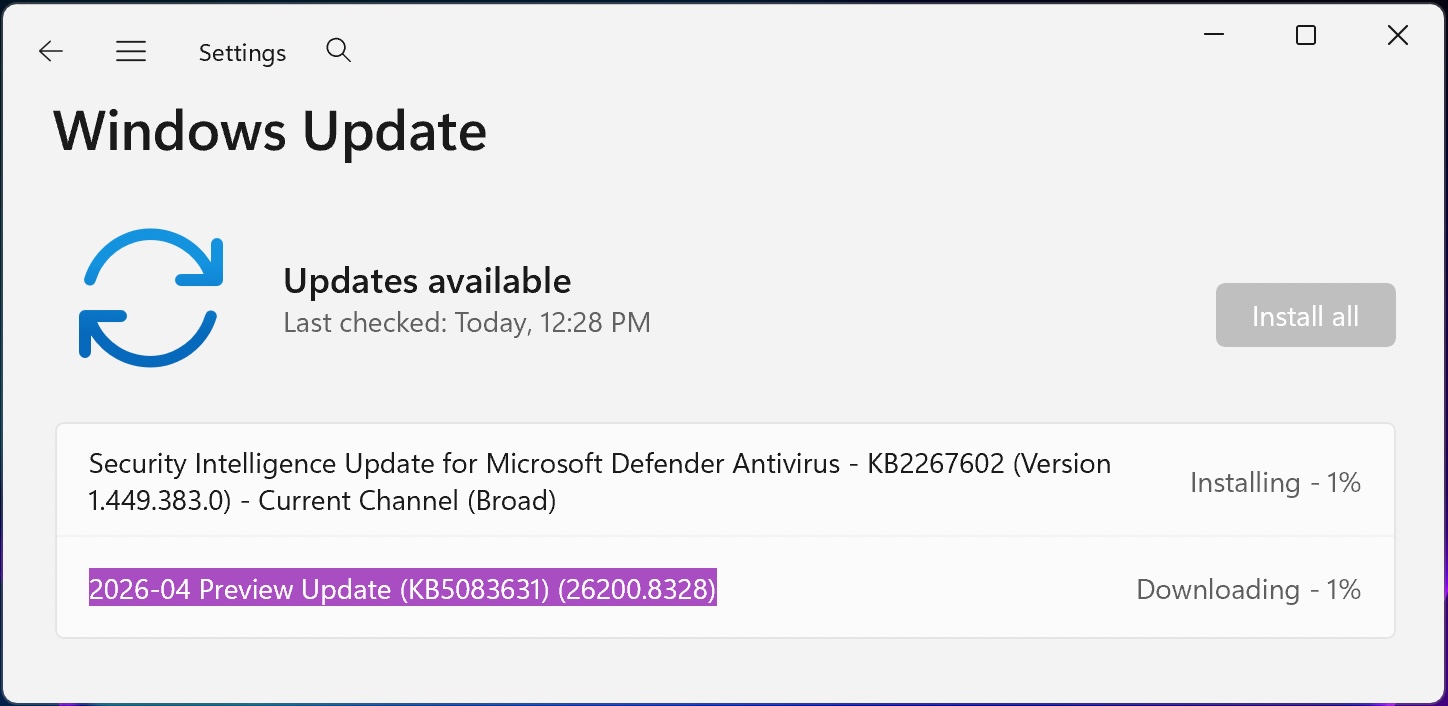
Microsoft has released the KB5083631 optional cumulative update for Windows 11, which includes 34 changes, such as a new Xbox mode for Windows PCs, enhanced security and performance for batch files, and performance improvements for launching startup apps.
KB5083631 is a preview update that lets admins test Windows bug fixes, improvements, and new features, before they’re generally available during next month’s Patch Tuesday release. However, unlike cumulative updates, monthly optional updates do not include security fixes and only roll out quality improvements.
With the April 2026 optional update, Microsoft has improved the performance of launching apps listed under Settings > Apps > Startup when the device starts.
It also added a new Xbox mode for Windows 11 PCs (e.g., laptops, desktops, and tablets), which provides a full‑screen interface that puts games front and center while minimizing background distractions. Users can enter Xbox mode from the Xbox app, Game Bar settings, or by using the Windows logo key + F11 keyboard shortcut.
Advertisement
Additionally, this month’s preview update introduces improved security and performance for batch files and CMD scripts, a change that first rolled out in February to Windows 11 Insiders in the Beta and Dev channels.
“Starting with this release, administrators can enable a more secure processing mode for batch files. This mode prevents batch files from changing during execution,” Microsoft explained.
You can install KB5083631 by opening Windows Settings, clicking on Windows Update, and then on ‘Check for Updates.’ However, since this is an optional update, you will need to click the ‘Download and install’ link if you don’t want to install it manually from the Microsoft Update Catalog.
KB5083631 preview update (BleepingComputer)
KB5083631 update highlights
Once installed, this optional non-security update will update Windows 11 24H2 and 25H2 devices to builds 26100.8328 and 26200.8328, respectively.
The April 2026 preview update comes with dozens of other changes, some of the more important ones highlighted below:
Advertisement
You can now experience haptic feedback on supported input devices when performing certain actions, such as aligning objects in PowerPoint, snapping, or resizing windows. Haptic feedback can be managed in Settings > Bluetooth & devices > Mouse, Touchpad, or Pen > Haptic signals.
[Secure Boot] With this update, Windows quality updates include additional high-confidence device-targeting data, increasing the coverage of devices eligible to receive new Secure Boot certificates automatically. Devices receive the new certificates only after demonstrating sufficient successful update signals, thereby maintaining a controlled, phased rollout. For more information, see Windows Secure Boot certificate expiration and CA updates.
[Authentication (Kerberos)] This update improves Kerberos authentication for Remote Desktop sessions that use Remote Credential Guard, addressing error 0xc000009a.
[Windows Security] This update improves event logging related to CVE‑2024‑30098 by including the name of the affected application. This change makes it easier to identify applications that rely on smart card certificates and may need updates following recent security changes.
This update removes a white flash that could appear when opening This PC or while resizing the Details pane in dark mode.
This update improves the reliability of relevant explorer.exe processes so they stop after File Explorer windows are closed.
Microsoft also noted that updated Secure Boot certificates are rolling out to replace the original 2011 certificates that will expire in late June 2026. In January, Microsoft first revealed plans to refresh expiring Secure Boot certificates on eligible Windows 11 systems, after warning admins in November to update the security certificates before they expire.
It also added that some Windows Server 2025 devices with “an unrecommended BitLocker Group Policy configuration” will boot into BitLocker recovery and require users to enter the BitLocker recovery key on the first restart after deploying the KB5083631 update.
AI chained four zero-days into one exploit that bypassed both renderer and OS sandboxes. A wave of new exploits is coming.
At the Autonomous Validation Summit (May 12 & 14), see how autonomous, context-rich validation finds what’s exploitable, proves controls hold, and closes the remediation loop.
Broadcasting rights for soccer are split by territory, competition, and broadcaster — which means the service you need in London is completely different from the one you need in Los Angeles or Lagos. This guide cuts through that complexity. It covers the best official, legal streaming services for soccer in 2026, region by region, with accurate rights information drawn from official broadcaster and league sources.
Quick Take: Start Here
Best global free option:FIFA+ — free on any device, no subscription needed
USA (Premier League): Peacock (NBC) — all 380 matches
USA (Champions League): Paramount+
UK (World Cup 2026): BBC iPlayer + ITVX — all 104 games, free
Australia: Stan Sport (UCL + EPL) | SBS on Demand (World Cup, free)
MENA: beIN Sports / TOD app
Germany/Austria (La Liga): DAZN
Before diving into each region: rights deals expire, change, and get renegotiated. Always verify current availability on the official broadcaster’s website or use the Premier League’s official broadcasters directory to confirm the rights holder in your country. This guide reflects confirmed deals as of May 2026.
Free Options Worth Knowing First
Where You Can Watch Soccer for Free (Legally)
FIFA+: Free global platform from FIFA. Streams select live international matches, full match replays, highlights, and original documentaries. No subscription required — just download the app on iOS, Android, or smart TV.
BBC iPlayer + ITVX (UK): All 104 FIFA World Cup 2026 matches broadcast free on these platforms. No cost beyond a TV licence.
SBS on Demand (Australia): All 104 World Cup 2026 matches available free to stream.
YouTube (select clubs and leagues): Official club and league channels post full-match replays for certain lower-tier competitions and international friendlies. Content varies by rights deal.
United States
The US soccer streaming market is fragmented but well-covered. No single subscription gives you everything, but the major competitions are each cleanly assigned to one platform. Here’s how it breaks down for 2025–26:
Competition
Platform
Type
Notes
Premier League
Peacock / NBC / USA Network
Paid (Peacock Premium)
All 380 matches available; exclusive matches on Peacock; select games on NBC broadcast
UEFA Champions League
Paramount+
Paid subscription
Full coverage including knockouts and final
La Liga
ESPN+ / Fubo
Paid subscription
ESPN+ holds La Liga rights for the US market
Serie A
Paramount+
Paid subscription
Bundled with Champions League coverage
FIFA World Cup 2026
Fox / Telemundo
Free (broadcast TV) + streaming via Fox One app
All 104 matches; Telemundo covers Spanish-language broadcasts
MLS
Apple TV+ (MLS Season Pass)
Paid add-on
Every MLS match streamed globally via Apple TV+
Peacock carries the full 380-match Premier League season, making it the essential subscription for EPL fans in the US. If you also follow the Champions League and Serie A, adding Paramount+ covers both — these two subscriptions handle the majority of elite European club soccer in one setup.
The one caveat worth knowing: some Premier League matches air exclusively on the USA Network (cable channel), and their live stream is not included in the Peacock subscription — only replays are available. If you’re a cord-cutter, Fubo or YouTube TV bundles give you the USA Network live. You can also read our guide on how to watch football without a cable TV subscription for a full breakdown of cord-cutting options.
United Kingdom
The UK has the most competitive and densely covered soccer streaming market in the world — with the trade-off being that you often need multiple subscriptions to follow all the major competitions. The good news for 2026: the World Cup is completely free.
Advertisement
Competition
Platform
Type
Notes
Premier League
Sky Sports / TNT Sports / Amazon Prime Video
Paid
Rights split across three providers; Sky Sports holds majority of live matches
Rights shared between the two platforms for 2025–26
FIFA World Cup 2026
BBC iPlayer + ITVX
Free
All 104 matches streamed free; no subscription required
EFL Championship / League One
Sky Sports
Paid
Domestic pyramid coverage included in Sky Sports bundle
The FIFA World Cup 2026 will be broadcast free in the UK across BBC iPlayer and ITVX, covering all 104 matches — the most comprehensive free-to-air World Cup coverage available anywhere. For club football, Sky Sports remains the flagship subscription, but the cost of following all competitions can add up quickly when TNT Sports and Amazon Prime Video are also required for Champions League coverage.
Australia
Australia punches well above its weight for soccer streaming coverage, with two platforms covering the vast majority of elite football — one paid, one entirely free for the World Cup.
Competition
Platform
Type
Notes
Premier League
Stan Sport
Paid add-on to Stan
Every Premier League match live and on-demand
UEFA Champions League
Stan Sport
Paid add-on to Stan
Full UCL coverage including knockout rounds and final
FIFA World Cup 2026
SBS on Demand
Free
All 104 matches available free to stream; no account required
beIN Sports is the dominant — and in many cases, exclusive — provider of elite soccer in the MENA region. Its TOD streaming app extends that coverage to any internet-connected device.
Advertisement
Competition
Platform
Type
Notes
Premier League
beIN Sports / TOD app
Paid subscription
All 380 EPL matches live; exclusive rights through 2027–28 across 24 MENA territories
UEFA Champions League
beIN Sports / TOD app
Paid subscription
Exclusive UCL broadcast rights across 33 MENA + Asia markets until end of 2026–27
La Liga / Serie A
beIN Sports / TOD app
Paid subscription
Bundled into beIN’s comprehensive European football package
FIFA World Cup 2026
Varies by country
Paid / free-to-air (varies)
Check your national broadcaster for free-to-air agreements
Broadcasting rights in continental Europe are complex — each country has its own rights structure, and in most cases at least one major platform per country holds a dominant position. The table below covers the major markets:
Country
Competition
Platform
Notes
Germany
La Liga
DAZN
Rights extended for 5 years through 2029–30; also covers Austria and Switzerland
Germany
Champions League
DAZN / Amazon Prime Video
Split rights deal; DAZN covers majority
Spain
Champions League
Movistar+
Primary rights holder for Spanish market
Italy
Serie A
DAZN Italy
Exclusive domestic Serie A rights; Sky Italia carries select matches
France
Champions League
CANAL+
Primary UCL rights holder for France through current UEFA agreement
France
Ligue 1
DAZN France / beIN Sports France
Shared rights between platforms
DAZN is the closest thing to a pan-European soccer streaming platform, with rights across Germany, Austria, Switzerland, Italy, Spain, and France for various competitions. Coverage varies significantly by country, so always verify on your national version of the DAZN website before subscribing. For La Liga specifically, DAZN extended its rights deal in Germany and Austria for five years and added Switzerland — making it the confirmed home of Spanish top-flight soccer in the German-speaking market through at least 2029–30.
Canada
Canada’s soccer streaming landscape has simplified in recent years. DAZN Canada holds a dominant position for European club football, making it the main subscription for Canadian fans.
Advertisement
Competition
Platform
Type
Notes
Premier League
DAZN Canada
Paid subscription
Primary EPL broadcaster in Canada
UEFA Champions League
DAZN Canada
Paid subscription
Full UCL coverage
La Liga / Serie A
DAZN Canada
Paid subscription
Bundled into DAZN Canada’s European football offering
FIFA World Cup 2026
CTV / TSN / RDS
Free (CTV) + Paid (TSN)
As a host nation, Canada has broad free-to-air coverage; verify current schedule on CTV
Canadian Premier League
OneSoccer
Paid subscription
Dedicated domestic league streaming platform
What’s Coming: UEFA’s Own Streaming Service
The fragmented rights landscape described above may change significantly in the coming years. As of March 2026, UEFA is actively considering launching its own direct-to-consumer streaming service for the Champions League, with a trial reportedly planned from 2027 — initially targeting large Asian markets where existing broadcast deals are weaker. If launched, this would allow fans to subscribe directly to UEFA for Champions League coverage, bypassing national broadcasters. This is worth monitoring if you follow the UCL closely, as it could simplify (or complicate) your subscription setup depending on how existing rights deals are structured at renewal. For companion apps for live scores and stats alongside your stream, we cover those separately.
Key Takeaways
No single service covers everything globally. Rights are sold by territory and competition — expect to use 1–3 services depending on your region.
Start with FIFA+ for free. It’s the best no-cost baseline for international football, replays, and highlights — available everywhere.
World Cup 2026 is broadly free: UK (BBC/ITVX), Australia (SBS on Demand), USA (Fox broadcast), and Canada (CTV) all carry matches free-to-air.
USA: Peacock (EPL) + Paramount+ (UCL/Serie A) covers the core European competitions.
UK: Sky Sports + TNT Sports + Amazon Prime Video covers the Premier League and Champions League — but the cost adds up.
Australia: Stan Sport is the most efficient single subscription for European club football.
MENA: beIN Sports / TOD covers virtually everything in the region through 2027–28.
Verify before subscribing. Rights deals shift at season boundaries — always check the official league or broadcaster website for current-season accuracy.
Frequently Asked Questions
Is there one streaming service that covers all soccer competitions globally?
No. Broadcast rights are sold territory by territory and competition by competition, so no single platform has global rights to everything. The closest thing to a free global baseline is FIFA+, which offers live international matches, replays, and highlights worldwide at no cost. For club competitions, you’ll need a region-specific subscription.
Can I watch the 2026 FIFA World Cup for free?What is the cheapest way to watch the Premier League in the USA?
A Peacock Premium subscription is the most cost-efficient option for US-based Premier League fans, giving access to all 380 matches. Some matches also air free on NBC broadcast TV. Check the Peacock Premier League guide for the current subscription price and schedule.
What does FIFA+ offer for free?
FIFA+ streams select live international and lower-tier matches, full match replays of certain competitions, highlights packages, and original documentaries — all at no cost. It’s available as an app on iOS, Android, Apple TV, and smart TVs. It does not carry Premier League, Champions League, or domestic top-flight matches, which remain with national rights holders.
Which streaming service has Champions League in the USA?
Paramount+ holds the Champions League rights in the United States, including the group stage, knockout rounds, and final. It’s bundled alongside Serie A coverage on the platform.
Advertisement
How do I watch La Liga outside Spain?
Rights vary heavily by country. In the US, ESPN+ carries La Liga. In the UK, rights are shared between Premier Sports and Disney+. In Germany, Austria, and Switzerland, DAZN holds the rights. Check the official La Liga broadcasters page for your specific territory.
Is DAZN available everywhere?
No. DAZN operates in specific markets including Germany, Austria, Switzerland, Italy, Spain, France, Canada, Japan, and others — but is not available globally. Its soccer rights also vary by country; a DAZN subscription in Germany does not carry the same competitions as one in Italy. Always check DAZN’s local site for what’s covered in your territory.
Will UEFA launch its own streaming service?
As of March 2026, UEFA is reportedly planning a direct-to-consumer streaming trial for the Champions League from 2027, initially targeting Asian markets. This would allow fans to subscribe directly to UEFA rather than through national broadcasters. No confirmed launch date or pricing has been announced. Monitor UEFA’s official communications for updates as rights deals come up for renewal.
Xiaomi phones are a little tough to judge. After all, these guys do everything, from making phones to laptops and sometimes even record-breaking electric SUVs. The Xiaomi 17 is a bit like the quiet kid that never gets noticed, simply because its bigger brother, the 17 Ultra, is on a streak of collecting all the best smartphone camera awards. But here’s the thing: most people won’t ever splurge that much money on a non-Samsung or Apple Ultra flagship. The main sales driver will always be the base model, and that’s the question I had in mind. Can the Xiaomi 17 go head-to-head with the OPPO Find X9 and the vivo X300, especially since it’s more expensive than both? You can thank AI for that.
To answer this very question, I got the Xiaomi 17 for review and took it with me on a work trip to Phuket, Thailand. Here, I used the phone to capture about 500 photos in the summer heat, with temperatures soaring to 40 degrees, and constant GPS navigation to put the Snapdragon 8 Elite Gen 5 SoC through its paces. Spoiler alert, I really do love this phone, but there are a few quirks, too. Here’s why.
Xiaomi 17 Review
Hisan Kidwai
Advertisement
Summary
The Xiaomi 17 brings a lot of things to the table. You get the best-in-class performance that’s miles ahead of the competition. A design that’s understated yet premium. Battery life that can easily last two full days, and cameras that, instead of being same same but different, induce a character to each and every photo that makes them more memorable. Of course, it’s not perfect. I’d like the camera bugs fixed and ultrawide performance improved, but overall, the Xiaomi 17 gets my recommendation.
Advertisement
Design & Hardware
If Apple were ever going to make an Android phone, then they’d probably design something like the Xiaomi 17. I wouldn’t describe the build as flashy, but it’s super elegant and reminiscent of past Xiaomi flagships. I talked about this in my X300 Pro review, as creating a brand identity to compete against Samsung and Apple is super important, and Xiaomi has listened. While I was using it daily, many of my friends and family asked me what Xiaomi phone I was using—note the wording: “Xiaomi phone,” meaning they knew it was a particular brand, and that’s important. The Chinese smartphone maker said they thought of every curve, and I’ll just say it straight: the 17 is the best-feeling compact phone I’ve held this year.
The corners are crafted to perfection, the width is spot on, and even the way the aluminum frame blends into the glass without an abrupt edge makes carrying the phone a very enjoyable experience. Beyond that, the back glass is frosted to prevent the phone from slipping off glass surfaces, and the side frame doesn’t let go of its color inside a case.
Speaking of color, you get plenty of options, but my favorite is definitely the blue variant, as it has that breezy summer vibe. The buttons are tactile and positioned where your hand would naturally rest.
Moving to the camera module, Xiaomi has taken the iPhone route of individual stove-top camera cutouts. There are four of them (one houses the flash), and aside from the fact that dust is difficult to get out from between, I do quite like them. The ultrasonic fingerprint scanner is positioned at a comfy place where your thumb would naturally rest. I used it on the beach with wet hands, and it worked perfectly fine. Besides, the phone is IP69-rated for dust and water resistance, meaning it should technically withstand a swim. Did I dare take it inside the water on the beach? Absolutely not, because the IP rating is only for fresh water, and seawater can cause irreversible damage.
Display
I’ve said this before that all flagship displays are essentially the same, and that holds true for the Xiaomi 17, too. The phone features a 6.3-inch 1220 x 2656 OLED display, with an adaptive 120Hz refresh rate. This time, Xiaomi has trimmed the bezels even more for a more premium look, and I’m a fan. The panel is exceptionally color-accurate and vibrant for content consumption, as evidenced by my 3-hour run of The Pitt season 2 on the flight to Thailand. Even the HDR performance is exceptional.
Xiaomi claims a peak brightness number of 3,500 nits. Sadly, I don’t have a light meter to put the claim to the test, but from my experience using the panel in the 12 noon sun at Phi Phi Island, it’s plenty bright for outdoor use. The texts were legible, and I could use the phone for GPS navigation without squinting.
When it comes to durability, I usually don’t like to test that part myself and instead rely on user reports. However, I accidentally dropped the Xiaomi 17 on a concrete floor. The result was surprisingly good. I dropped it, without a case, from a tripod at chest height, meaning that, while the phone was in the air, all sorts of scary thoughts came to mind, including how much this repair was going to cost me. Thankfully, the phone escaped with only minor damage to the frame.
Advertisement
Performance & Software
Performance is what makes or breaks the smartphone experience, and it’s no surprise to anyone that the Xiaomi 17 delivers top-of-the-line performance. The Snapdragon 8 Elite Gen 5 is the best Android processor in the market, and it’s coupled with 12GB of LPDDR5X RAM and up to 512GB of UFS 4.1 internal storage. The results? The Xiaomi 17 is an absolute joy to use. It flies through the UI like nothing, and there’s ample headroom for literally any task. That being said, the phone runs on HyperOS 3, which, for the uninitiated, is a very altered version of Android that resembles more like iOS.
I don’t have a problem with the look, especially since HyperOS is one of the smoothest Android skins, with silky animations and a lot of customization. My issue is that, unlike other Chinese skins that allow you to tone down the iOS-ness, Xiaomi doesn’t.
For example, the notification shade is divided into two sections: the quick control and the panel. I don’t like that, but when I went digging in the settings to find a way to merge them, there wasn’t. Also, the back gesture is enabled in the keyboard, so when I tried deleting long text, it would often send me back instead.
There are a few silver linings I wish others would copy from HyperOS, one major one being the lockscreen customizations. There are so many options, and every one of them looks gorgeous. As this is 2026, there’s a host of AI features, such as object eraser, image upscaling, and inpainting. I tried them all, and they work exactly as you’d expect. The company also promises about six years of major software updates and security patches. This is better than vivo’s five years.
Benchmarks & Gaming
As this is a review, I also ran a series of benchmarks to test the Snapdragon 8 Elite Gen 5’s limits. The phone scored 3,415 in Geekbench’s single-core test and 10,008 in the multi-core test. These are insane numbers, especially when compared with the likes of the vivo X300 Pro and the Find X9, which score about 20%-30% lower in multi-core tests. The story remained similar on AnTuTu, where the Xiaomi 17 handsomely beat its Chinese rivals, scoring 3,423,349.
As expected, this performance translates extremely well in gaming. I’m a former PUBG (BGMI) eSports player, and my results were exceptional. The phone maintained 120 FPS gameplay even at high settings without a hint of stutter. I also like Xiaomi’s thermal management, which kept the phone from overheating during both gaming and photo capture in Thailand’s hot summer.
Battery Life & Charging
After all the chatter about the small form factor, you may expect the Xiaomi 17 to compromise on the battery life, just as other Apple and Samsung phones do. Well, you can’t be more wrong, as the Xiaomi 17 packs an even bigger battery, 6,330mAh to be precise, than the 17 Ultra. And the results are just fantastic. On the morning of my Thailand flight, I unplugged the phone at 5 am. I then continued using the phone for the rest of the day, including the three hours of The Pitt on the flight and map navigation when reaching Phuket airport. I ended the day with 20% remaining, and at 3 am the next morning, I had 20% remaining. For a more typical person, you’d be looking more at two days of usage without a hitch.
When it was finally time to charge, Xiaomi, unlike Samsung, bundles a 100W fast charger in the box that charges the phone from 20% to 80% in just 30 minutes. You also get 50W of reverse wireless charging, though that requires a specific charger.
Advertisement
Cameras
If a phone doesn’t fold in half or has dual screens, the only way to differentiate itself is through the cameras. They are the main reason why people lean towards a certain brand, and recently, both OPPO and vivo have been killing it. However, I think there’s room for a third king: the Xiaomi 17. Like others, it also houses a triple-sensor array, led by the 50MP LightFusion 950 sensor, a 50MP JN1 60mm telephoto, and another 50MP OV50M ultrawide lens. Colors are handled by Leica, and that’s the main strength of the Xiaomi 17. The photos it takes, with the different Leica filters, have a certain character you won’t find anywhere else. Every phone takes similar photos these days, and it’s these color profiles that matter the most.
Still, if you’re not a fan of poking around with the cameras, the default Leica Authentic profile produces colors that are very close to natural, with highlights and shadows handled extremely well. The details are crisp and plenty, the HDR performance is mostly spot on, and the contrast is slightly on the boosted side, which is what I like. Beyond the default camera profile, there are a myriad of filters, such as Negative, Positive, Sepia, Natural, Vibrant, and Blue. Each has a different style of capturing the colors and subject, and I really did find myself going through each and every one of them to decide which actually serves the scene the best. And the results speak for themselves. Every photo tells a different story, and that’s the Xiaomi 17’s biggest strength.
The telephoto lens is 2.5x, and I’d say the same about it, too. It serves as the main portrait camera, and the images deliver stellar detail, with excellent foreground separation and improved natural skin tones without the infamous beautification. Xiaomi doesn’t rely much on AI processing, so zooming past 5x-6x will result in blurry photos. Keep that in mind. The ultrawide hasn’t changed from the previous generation, so it still doesn’t have autofocus for macro photography. While it works great when the light is ample, I saw a significant drop in quality at night.
Speaking of the night, both the main and telephoto sensors benefit from Xiaomi’s mature image processing, which retains detail in shadows without making the image muddy or introducing noise. Videos, which can be shot at up to 8K, carry similar details in all lighting conditions, and I’m a fan. Sadly, it’s not all perfect. In Thailand’s heat, some of the videos I captured were choppy, even when I was in the hotel. This problem then carried over to India, where the first few seconds of every video would stutter. I’ve communicated this issue with the Xiaomi team, so a fix could be imminent. Overall, I love the Xiaomi 17’s cameras.
Verdict
Sure, the ₹89,999 price tag of the Xiaomi 17 might feel a bit much, considering it’s more than the vivo and OPPO competition. But the Xiaomi 17 brings a lot of things to the table. You get the best-in-class performance that’s miles ahead of the competition. A design that’s understated yet premium. Battery life that can easily last two full days, and cameras that, instead of being same same but different, induce a character to each and every photo that makes them more memorable. Of course, it’s not perfect. I’d like the camera bugs fixed and ultrawide performance improved, but overall, the Xiaomi 17 gets my recommendation.
Microsoft has updated a Windows 11 in-box app removal policy introduced in October to include a dynamic list that lets IT admins choose which preinstalled Store apps to uninstall.
The updated RemoveDefaultMicrosoftStorePackages policy enables admins to remove any preinstalled MSIX/APPX app by referencing its Package Family Name (PFN) using Group Policy Object (GPO) or a custom OMA-URI for mobile device management (MDM).
“IT admins, you can now simplify Microsoft Store app management with dynamic removal on more devices across your enterprise. Use policy to remove any preinstalled MSIX/APPX app by referencing its Package Family Name (PFN),” Microsoft said on Thursday.
To get this new feature, admins must ensure that their devices have at least the April 2026 Windows non-security update deployed. Windows Insiders can get it after installing the March 13, 2026, builds in the Dev and Beta channels.
Advertisement
To make it work using Group Policy, admins have to:
Microsoft has also extended support for the RemoveDefaultMicrosoftStorePackages policy to systems running Enterprise and Education editions of Windows 11 24H2. Microsoft introduced the policy in October 2025, but it was only made available on devices running Windows 11 25H2 or later.
“The updated app removal policy is now extended to Windows 11, version 24H2 Enterprise and Education editions. Originally, you could only use this feature on devices running Windows 11, version 25H2 or newer,” Microsoft added. “If your organization has standardized on the 2024 release, you can benefit from policy-driven app management without a full OS version upgrade.”
The complete list of supported apps and detailed guidance on applying the policy to a single device via the Local Group Policy Editor or to multiple Active Directory-joined devices are available here.
Advertisement
While the Intune entry for this policy does not include the dynamic list option, Microsoft has said it will become available in the coming months.
“When this feature becomes generally available in Intune, search for ‘Remove Default Microsoft Store packages’ in the settings picker to locate it,” it noted.
AI chained four zero-days into one exploit that bypassed both renderer and OS sandboxes. A wave of new exploits is coming.
At the Autonomous Validation Summit (May 12 & 14), see how autonomous, context-rich validation finds what’s exploitable, proves controls hold, and closes the remediation loop.
Valve’s Steam Machine was supposed to be an affordable gaming PC for the living room. Rising memory and storage prices have turned that dream into a pricing nightmare.
Capture emotions and tell stories through photography with the Photography Master Class Bundle. Transform your skills with six diverse courses, including Portrait Photography, DSLR Photography, Wedding Photography, Off Camera Flash photography, and more. Whether you’re a beginner or experienced, this bundle offers a wealth of knowledge and techniques to enhance your craft. It’s on sale for $40.
Note: The Techdirt Deals Store is powered and curated by StackSocial. A portion of all sales from Techdirt Deals helps support Techdirt. The products featured do not reflect endorsements by our editorial team.
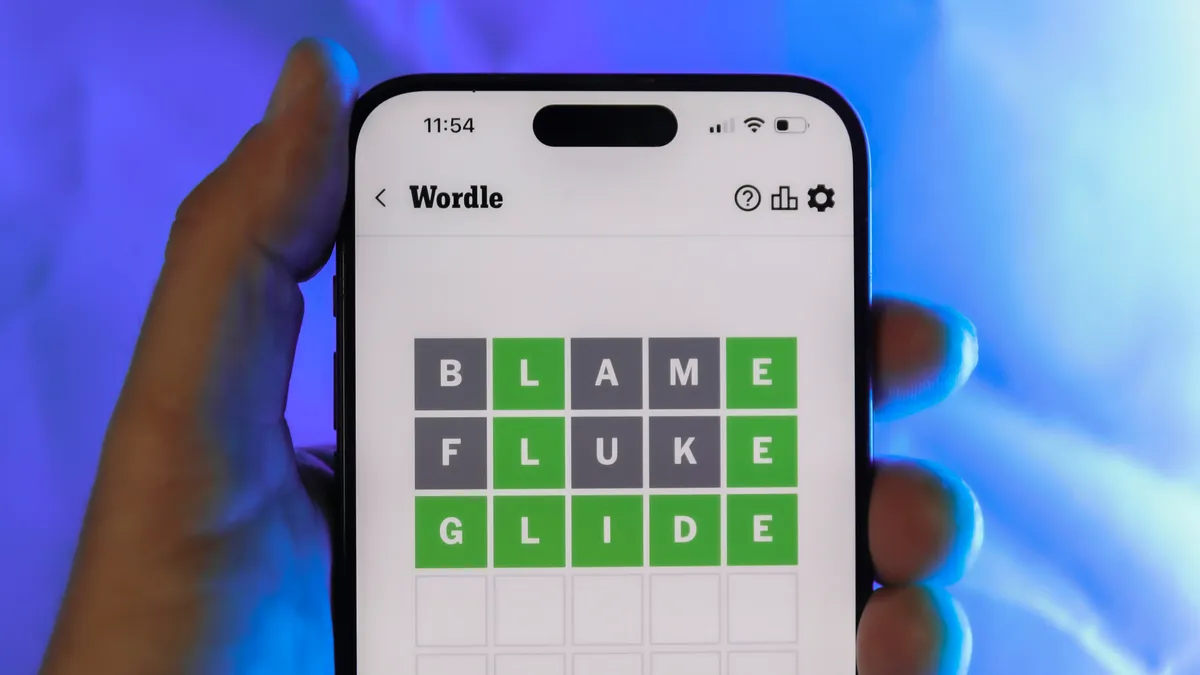
Looking for the most recent Wordle answer? Click here for today’s Wordle hints, as well as our daily answers and hints for The New York Times Mini Crossword, Connections, Connections: Sports Edition and Strands puzzles.
Riding a properly fitting bike can not only be the difference between comfort and discomfort (which is perhaps the most major factor in how much you want to ride). It can also mean the difference between whether or not you injure yourself, as spending huge amounts of time on a bike that is too big or too small for you can lead to a variety of maladies.
Whether you’re riding all the time or just getting into cycling, there are a few tips you can follow to make sure you’re buying the right sized bike and dialing it to your body in a way that will give you endless pain-free hours in the saddle. Because a bike that fits you well shouldn’t hurt at all.
If you’re experiencing pain, discomfort, or numbness anywhere, your bike fit is off. Of course, the pain and numbness in your butt after a 60-, 70-, or 100-mile ride is unavoidable and has nothing to do with fit. But riding a bike any distance shouldn’t result in pain or discomfort in your joints, neck, back, or anywhere else.
If you’re intending to spend a ton time in the saddle and/or dropping serious coin on a new bike, the best option is always to get a professional bike fit, which is a process where an expert fitter will analyze your body type, your riding style, even your ambitions, and dial your bike incrementally, that it perfectly fits you. My colleague Joe Ray can offer advice on getting a professional fit.
Advertisement
It’s also important to note that the rules for finding the best fit are different based on what style of bike you want, what your transportation needs are, and how much you intend to ride. If you want a drop-bar bike such as a road or gravel bike, a mountain bike, or a hybrid bike, the handlebar setup will affect other factors like the frame size and saddle height. Also, as men and women tend to be built differently, the design of bike frames and their components should be taken into account. Some brands such as Liv or Juliana are designed specifically for women, who tend to have narrower shoulders and shorter torsos relative to their legs than men.
Size Matters
It’s easy to wander deep into the weeds, but there are some basic things you can do to ensure you’re riding a properly fitting bike. Following these tips should help you make the most important decisions.
Start with the biggest thing! That is, your frame. There is no bigger single part of a bike than its frame. It’s also one of the only parts of a bike that is not adjustable. Your frame will always be the same shape and size, and there’s no changing that. So you want to start with the proper frame before anything else.
Most manufacturers size their frames using the small, medium, and large paradigm (with some brands offering XXS through XXL) or using measurements in centimeters. Typically, off-road bikes come in S, M, L, whereas road bikes use centimeters.
Advertisement
A good place to start is by researching a height chart. Considering not all bikes are built equally—not everyone’s “large” frame is the same size, for example—it’s especially helpful if you can find a chart from the brand you intend to buy.
Here’s a good example from the mega-brand Specialized. If I, at 76 inches, were interested in an Aethos model, I’d probably want to get a 61 cm frame.
If you can’t find a chart for the bike you’re interested in, you can just as easily find the bike itself at a local shop and swing your leg over a few different sizes. The general rule of thumb is that you should be able to fully stand over a bike with both feet flat on the ground with about 1 inch of clearance between your body and the bike’s top tube. Smaller bikes and bikes with compact designs have sloping top tubes; with those, you want to look for around two inches of space.
The size mismatch is hard to overlook. GameStop carries a market value of around $12 billion; eBay sits closer to $46 billion. Despite that gap, GameStop has already been quietly building a stake in eBay ahead of a potential bid – a signal that Cohen is willing to swing big… Read Entire Article Source link
Watch World Championship final live streams to see whether Shaun Murphy can lift the crown for the second time or if Wu Yize canfollow to in the footsteps of last year’s champion Zhao Xintong.
Twenty-one years after lifting the world title for the first time, Murphy will have the opportunity to once again win snooker’s grandest prize. The 43-year-old has finished as runner-up the last three times he has made the final but has been in excellent form throughout his run to the showpiece match.
He overcame John Higgins 17-15 in a high-quality semi-final, reeling off three century breaks in the final session as he recovered from a 13-11 deficit. He’ll now aim to overcome first-time finalist Wu who showed incredible resolve to come though an epic semi-final against Mark Allen.
Advertisement
The 22-year-old trailed 16-14 but won three frames on the bounce with breaks of 67, 52 and 71 to triumph 17-16. Having already beaten Peifan Lei, Mark Selby and Hossein Vafaei, he has proven that he can cope with the pressure of playing at the Crucible and will not be overawed by the occasion.
Read on to find out where to watch 2026 World Championship final live streams online from anywhere.
Can I watch 2026 World Snooker Championship Final for free?
Yes. The BBC is hosting live coverage of the 2026 snooker world championship final in in the UK, with live action shared between the BBC One and Two, plus the BBC Sport website.
That means you’ll be able to watch the snooker online live and on catch up on the BBC iPlayer streaming service – completely free to watch on laptops, mobile and TV streaming devices for anybody with a valid TV license.
Advertisement
If you’re away from the UK when the game is on, remember you can use a VPN to access the stream as if you were back home. More on that below.
Use a VPN to watch any 2026 World Snooker Championship Final stream
How to watch 2026 World Snooker Championship Final streams in the US
Snooker fans in the US will need a subscription to WST Play in order to watch the World Snooker Championship Final 2026 between Shaun Murphy and Wu Yize.
Advertisement
It costs £7 per month or £70 per year, which is roughly US$9.50 and US$95.
If you’re traveling in the States but wanting to watch your home snooker world championships coverage, you’ll need to download a VPN.
How to watch World Snooker Championship Final 2026 live streams in the UK
(Image credit: Future)
2026 World Snooker Championship final live streams between Shaun Murphy and Wu Yize.will be shown by BBC iPlayer and TNT Sports in the UK.
Advertisement
As we’ve already mentioned, BBC iPlayer and the state broadcaster’s TV channels offer a free service, but there’s a paid option, too from TNT Spoers.
Subscriptions can be accessed by a adding the sports package to your EE, BT or Sky broadband deal costs £16 per month. Or for on-the-move streaming, fans can pay from £25.99/month for HBO Max, which includes TNT Sports.
How to watch 2026 World Snooker Championship Final live streams in Australia
In Australia, snooker fans will need a subscription to WST Play in order to watch the World Snooker Championship Final 2026.
It costs £7 per month or £70 per year, which is roughly AU$13.30 and AU$132.88.
If you’re traveling away from home but wanting to watch your regular world championships snooker coverage, you’ll need to download a VPN.
Advertisement
How to watch 2026 World Snooker Championship Final live streams in Canada
(Image credit: Other)
It’s a similar situation in Canada, where snooker fans will need a subscription to WST Play in order to watch the 2026 world championship final.
It costs £7 per month or £70 per year, which is roughly CAN$13 and CAN$130.
If you’re traveling away from home but wanting to watch Shaun Murphy vs Wu Yize., you’ll need to download a VPN.
Advertisement
Rest of World Streams
Click to see RoW streams ▼
If you’re in China it looks like you can stream the World Snooker Championship Final 2026 for free on WeChat. Here’s a full rundown of where to watch the action around the world…
China CCTV5 Huya.com Migu CBSA-WPBSA Academy WeChat Channel CBSA-WPBSA Academy Douyin
Hong Kong China Now TV
Advertisement
Malaysia & Brunei Astro Supersport
Taiwan Sportcast
Thailand True Sport
Philippines TAP Sports
Advertisement
Mainland Europe HBO Max
All other territories Subscribe to WST Play for live streams and on-demand replays of the latest UK Championship matches.
We test and review VPN services in the context of legal recreational uses. For example: 1. Accessing a service from another country (subject to the terms and conditions of that service). 2. Protecting your online security and strengthening your online privacy when abroad. We do not support or condone the illegal or malicious use of VPN services. Consuming pirated content that is paid-for is neither endorsed nor approved by Future Publishing.


























![J MONEY - NA NHA NOME [VIDEO OFICIAL]](https://wordupnews.com/wp-content/uploads/2026/05/1777799968_maxresdefault-80x80.jpg)




































You must be logged in to post a comment Login