

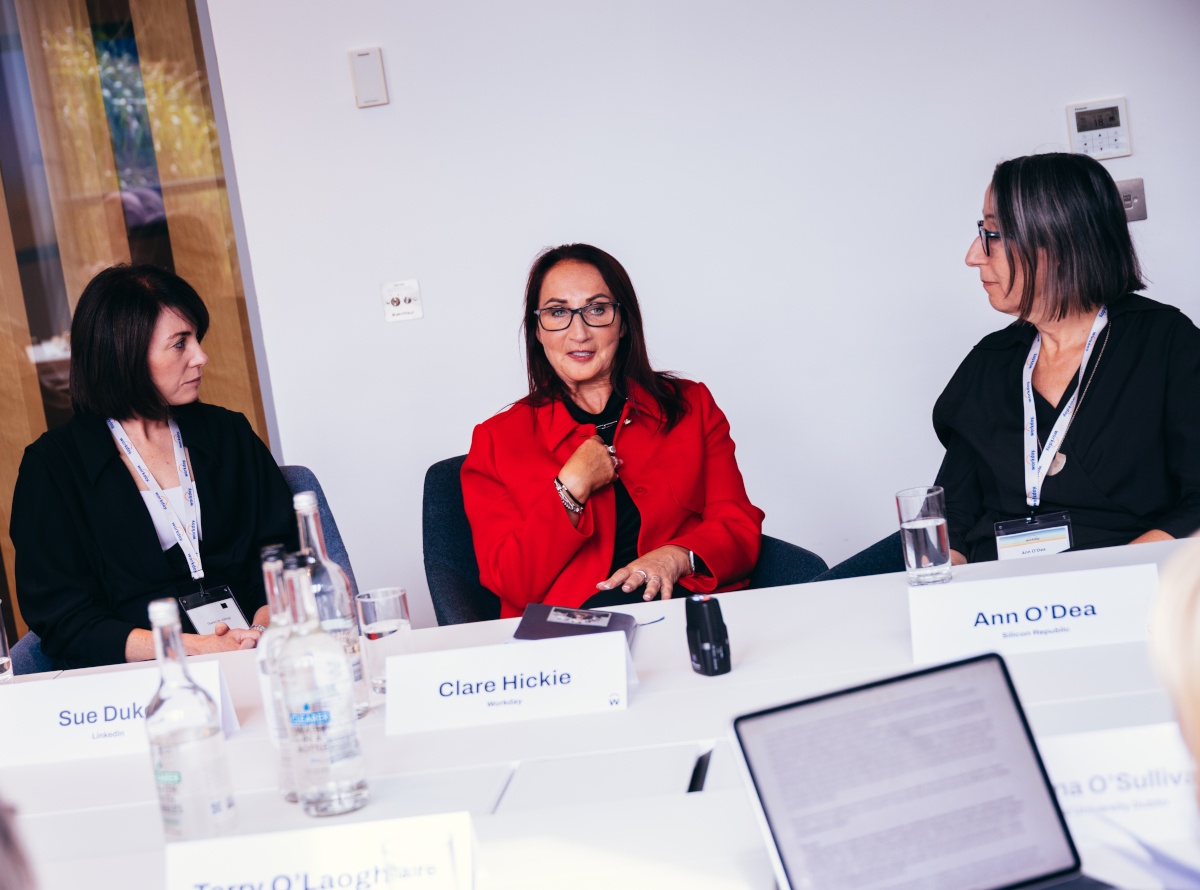

At a Workday-hosted roundtable in Dublin, four industry leaders – and guests – traded views on AI adoption, the reskilling race and why women are still locked out of AI’s best-paid jobs.
Earlier this month, I chaired a roundtable of women in technology hosted by Workday in Dublin, with an impressive panel of women leaders and an accomplished array of guests. We had around 90 minutes to share useful insights on AI before lunch, and what followed was one of the more thoughtful conversations I’ve chaired on the subject – less hype, more real-life application and human challenges.
The panel was made up of Claire Hickie, EMEA CTO at Workday; Terry O’Laoghaire, COO of technology infrastructure at State Street; Dympna O’Sullivan, VP of research and innovation at TU Dublin; and Sue Duke, LinkedIn’s managing director for EMEA and LatAm and its VP of global public policy.
Around the table were guests from Enterprise Ireland, IBM, Connecting Women in Technology (CWIT) among others, and their contributions added significantly to the dialogue.
The adoption curve
O’Laoghaire set the tone on adoption. State Street, she pointed out, is “responsible for trillions of the world’s financial assets”, so caution is not optional. “We have to be secure, we have to do this with governance and control,” she said, describing a roll-out where every employee now has Copilot but agents have not yet gone to the full workforce.
Rather than having push back, she was surprised at the appetite among staff . “I think they’re ready and eager,” she said of her own staff, “chomping at the bit” for more, even as a very real fear about job security sits alongside that enthusiasm.
“It’s more about jobs changing than a fear,” she said. “But that fear exists. You have to move people past the fear before they can be open to learning a new skill, before they feel safe doing that. So there’s an important psychological safety piece there.”
Duke, drawing on LinkedIn’s global workforce data, addressed that fear directly. The overriding question she gets asked, she said, is whether AI is displacing jobs. “What we see in the data is there isn’t job displacement,” she told the table. The real shift, she argued, is in what skills are in demand, not how many jobs exist.
Hickie made the same point from inside her own company, Workday. “People often forget that we’re employees too,” she said, describing an “everyday AI” programme Workday launched for its own staff nearly two years ago.
“What that did very early was to get us as individuals really adjusted and used to AI.”
Her favourite proof of how far that’s come? She now raises only one support ticket a year, and this year’s was on a personal tax query, she joked, adding that the reply came back in under 30 seconds. “I was like, oh, bring it on,” she said.
O’Sullivan offered the view from higher education. While on an operational level, the team is employing AI very effectively, the more challenging element of course is with the student body. TU Dublin now runs a five-point traffic-light system for AI use in student assessment, she says, from no AI through to full AI use.
The bigger question, though, has moved past academic integrity. “What are we actually trying to teach and what are we actually trying to assess?” she asked. “We don’t have it figured out yet.” Something that is echoed in conversations I have been having with other academic institutions in recent days.
Skills are the new currency, but the pipeline is broken
Duke put a number on how fast the ground is shifting: LinkedIn estimates the skills needed for most roles will have changed by 70pc by 2030. She grouped what’s needed into three buckets: hard technical AI skills, still held by only around one in 100 workers in developed markets; AI literacy, now a baseline expectation even in non-technical senior roles; and human soft skills, which she said are harder to build and increasingly what separates good leaders from the rest.
Sabrina Staunton, strategy lead at Connecting Women in Technology, raised the sharpest concern about where that leaves junior talent. She’s seeing developers today who are using AI and are “not willing to fail”, which makes it harder for them to build the critical thinking skills the job actually needs. “How do you become a senior engineer if you don’t have a junior engineer?” she asked, a question that landed hard around the table.
It’s a concern echoed by O’Sullivan, who drew a distinction between friction in the workplace and friction in the classroom. “Friction is friction” in operations, she said, “but I think in education, friction is the actual learning”.
“Learning is supposed to be difficult, supposed to be challenging. That’s how we all learn – by getting it wrong and then coming back to it. That’s where the real learning happens.” Strip too much difficulty out of how students learn, she suggested, and you risk stripping out the learning itself.
O’Laoghaire made the same case for the workplace. Even in infrastructure, a field she said is often assumed to be dying out, the skills are simply evolving rather than disappearing. “Instead of a physical data centre, we have a software-defined data centre. You still need to know what it is.”
Much of her team, she said, have moved from being makers to checkers. “But if you’re a checker, you still need to know how it works.” None of that happens, she added, unless companies actually protect the time given to it.
“We expect you to spend time upskilling, we’re going to provide it. It’s very hard to do that if you’re not given the room in your day job to do it, and know you’ll be rewarded for that time.”
O’Sullivan’s own worry showed up in the latest CAO numbers. Demand for computer science courses has fallen, driven, she believes, by anxiety among students and their parents about AI replacing coding jobs. Her counter to that was straightforward. “Technology has always been a net job creator, and skills like systems thinking, data governance and cybersecurity are becoming more important, not less, even as raw software engineering shrinks as a share of the job.”
The triple penalty for women
While the majority of the conversation tackled adoption of AI in the workplace, and in education, we inevitably came around to the dearth of women in senior AI roles.
Duke cited research LinkedIn had published just weeks earlier. Women, she said, make up only one in eight of AI leadership roles at AI companies. That figure comes from LinkedIn’s new report, ‘The Triple Penalty: Mapping the Gender Gap in the AI Economy’, which found women hold just 13pc of executive AI roles worldwide, the product of three gaps that compound each other – a leadership gap, an AI-role gap and an AI-company gap. The pattern holds in all but a handful of the 27 countries studied.
One figure from that same report puts it in even sharper relief: women make up 19.1pc of CEOs at traditional companies, but that share drops to 13.9pc at AI-native firms. In other words, the closer a company gets to the centre of the AI economy, the harder it gets for a woman to run it.
Duke called the overall picture “a good news, bad news story for women”. The bad news is that women remain underrepresented in exactly the technical roles now seen as prerequisites for senior jobs.
The good news? Soft-skills requirements for C-suite roles have risen sharply, and career paths to the top have become far less linear over the past five years, which favours women, who are 55pc more likely to take a career break. “A linear tick, tick, tick, tick is not working for women,” she said. “But we have got to recognise and valorise different skills and different career paths.”
Lauren Morrissey, Workday’s EMEA accessibility manager, extended that concern to the wider issue of diversity, and in particular disability. Almost 96pc of websites, she said, still have significant accessibility barriers, and AI risks widening that gap rather than closing it, unless disabled people’s needs are built in from the start. “But we’re moving too fast to even recognise it,” she argued.
AI’s trust problem
Possibly the most serious moment of the morning came when one of our guests put a tough question to the panel. With graduates already wary of the sector and a slowing hiring market feeding that anxiety, what is industry actually doing about AI’s toxic public image? “AI has become almost like the super villain,” she said. “It’s ending the world, it’s taking the jobs.”
“There’s no question that AI has a massive reputational problem,” Duke said, pointing to genuine safety incidents, the scale and speed at which harmful content can now spread, and a generation that feels the environmental cost of AI more acutely than any before it.
It was widely agreed at the table that there is a ‘black and white’ view out there among young people at the moment, where they either love or hate AI, and the latter camp dismiss the potential benefits. All the leaders present conceded that the industry has not done a great job of communicating the gap between data and perception, and that there’s much work left to do on this.
It was a sober note to end a panel discussion on, but an honest one. If there was a single line that stayed with me as we wrapped, it came from Hickie, almost as an aside. She became a grandmother two years ago, she told us, and her granddaughter is never far from her mind when this subject comes up.
“I just don’t know what her world is going to be,” she said. “But I do think it’s in the hands of technologists. It’s in the hands of leaders. And it’s in the hands of every decision-maker, and every person who has some level of influence at a human level today, to be able to frame that.”
It was an apt reflection of the entire morning’s conversation. The technology is moving on at pace and on its own terms, but who gets to shape it, and who gets left out of shaping it, is still very much a human choice.
Don’t miss out on the knowledge you need to succeed. Sign up for the Daily Brief, Silicon Republic’s digest of need-to-know sci-tech news.








































































You must be logged in to post a comment Login