




Connect with us
DAPA Banner
DAPA Coin
DAPA
COIN PAYMENT ASSET
PRIVACY · BLOCKDAG · HOMOMORPHIC ENCRYPTION · RUST
ElGamal Encrypted MINE DAPA
🚫 GENESIS SOLD OUT
DAPAPAY COMING

Tech

Your AI Glossary: 54 Terms Everyone Should Know

Published

on

AI is moving at a breakneck pace, and frankly, it’s hard to keep up. Sure, it’s cool to have a chatbot that acts like it has a Ph.D. in everything, but the reality is a lot messier. You can’t turn around without running into ChatGPT, Gemini or Meta AI. We’re drowning in a sea of AI slop, fretting about data centers and watching job markets shift in real time.

AI Atlas

If it all feels like too much, that could be because the vocabulary of artificial intelligence is evolving as fast as the code and the dizzying array of products. And if you want to do more than just stare at a blinking cursor, you’ve got to speak the language. You can’t exactly navigate a 2026 job interview (or even a casual happy hour) if you’re stumped by LLM, hallucination or claw.

We’re past the “gee-whiz” phase of AI and into the era where it’s basically the new plumbing of the internet. If you’re tired of just nodding along when the talk gets techie, it’s time for a crash course. We’ve rounded up the essential terms you actually need to know so you can stop guessing and start sounding like you know exactly where the future is headed.

Advertisement

This glossary is regularly updated. 


agent, agentic: AI that executes a task, often autonomously, is an agent, while agentic is the umbrella term for that software category. An AI agent may engage disparate systems to perform that work — for instance, reading your grocery list in a notes app and then placing an order, and paying for it, using other apps.

AI ethics: Principles aimed at preventing AI from harming humans, achieved through means like determining how AI systems should collect data or deal with bias. 

AI psychosis: A phenomenon in which individuals become overly fixated, enamored or self-aggrandized by AI chatbots, leading to delusions of grandeur, deep emotional connections and a break from reality. It is not a clinical diagnosis. 

Advertisement

AI safety: An interdisciplinary field that’s concerned with the long-term impacts of AI and how it could progress suddenly to a super intelligence that could be hostile to humans. 

algorithm: A series of instructions that allow a computer program to analyze data in a particular way, such as recognizing patterns, and then in turn accomplish a task such as sorting results or making recommendations.

alignment: Tweaking an AI to better produce the desired outcome. This can refer to anything from moderating content to maintaining positive interactions with humans. 

anthropomorphism: When humans attribute humanlike characteristics to inanimate objects. In AI, this can include believing that a chatbot has emotions or is sentient, and engaging with it as a friend or therapist. 

Advertisement

artificial general intelligence, or AGI: A concept that envisions a more advanced version of AI than we know today, one that can perform tasks much better than humans while also improving its own capabilities. Beyond that, hypothetically, lies superintelligence.

artificial intelligence, or AI: The use of technology to simulate human intelligence, either in computer programs or robotics. A field in computer science that aims to build systems that can perform human tasks.

bias: Errors resulting from an LLM’s training data, such as falsely attributing characteristics to certain groups based on stereotypes.

chatbot: An AI program that draws on an LLM to communicate with humans by simulating human conversation in response to text or verbal prompts. 

Advertisement

claw: A type of AI agent that is autonomous and empowered by users to “claw” through files and other software on their computers, including web browsers, to accomplish tasks. 

cognitive computing: Another term for artificial intelligence.

data augmentation: Remixing existing data or adding a more diverse set of data to train an AI. 

dataset: A collection of digital information used to train, test and validate an AI model.

Advertisement

deep learning: A method of AI, and a subfield of machine learning, that uses multiple parameters to recognize complex patterns in pictures, sound and text. The process is inspired by the human brain and uses artificial neural networks to create patterns.

diffusion: A method of machine learning that takes an existing piece of data, like a photo, and adds random noise. Diffusion models train their networks to re-engineer or recover that photo.

emergent behavior: When an AI model exhibits unintended abilities. 

end-to-end learning, or E2E: A deep learning process in which a model is instructed to perform a task from start to finish. It’s not trained to accomplish a task sequentially but instead learns from the inputs and solves it all at once. 

Advertisement

foom: Also known as fast takeoff or hard takeoff. The concept that if someone builds an AGI it might already be too late to save humanity.

generative adversarial networks, or GANs: A generative AI model composed of two neural networks to generate new data: a generator and a discriminator. The generator creates new content, and the discriminator checks to see if it’s authentic.

generative AI: A content-generating technology that uses AI to create text, video, computer code or images. The AI is fed large amounts of training data, from which it finds patterns to generate its own novel responses, which can sometimes be similar to the source material.

guardrails: Policies and restrictions placed on AI models to ensure that data is handled responsibly and that the model doesn’t create disturbing content. 

Advertisement

hallucination: An error or a misleading statement in a response from a generative AI program, typically stated with confidence as if correct. It can be as simple as a misstated date reference or as sweeping as the wholesale and elaborate invention of events that never happened or people who never existed.

inference: The process AI models use to generate text, images and other content about new data, by inferring from their training data. 

large language model, or LLM: An AI model trained on mass amounts of text data to understand patterns and probabilities of language use and to generate novel content, from essays and email to computer code and images, that mimics what humans have written or created.

latency: The time delay from when an AI system receives an input or prompt to when it produces an output.

Advertisement

machine learning: An aspect of AI that allows computers to learn and make better predictive outcomes without explicit programming. Can be coupled with training sets to generate new content. 

multimodal AI: A type of AI that can process multiple types of inputs, including text, images, videos and speech. 

natural language processing: The use of machine learning and deep learning to give computers the ability to understand human language, via learning algorithms, statistical models and linguistic rules.

neural network: A computational model that resembles the human brain’s structure and is meant to recognize patterns in data. A neural network consists of interconnected nodes, or neurons, that can recognize patterns and learn over time. 

Advertisement

open weights: When a company releases an open weights model, the final weights — how the model interprets information from its training data, including biases — are made publicly available. Open weights models are typically available for download to be run locally on your device. 

overfitting: An error in machine learning where it functions too closely to the training data and may only be able to identify specific examples in said data, but not new data. 

paperclips: The Paperclip Maximiser theory, coined by philosopher Nick Boström, is a hypothetical scenario in which an AI system produces as many paperclips as possible, converting all machinery and consuming all materials, even those that could be beneficial to humans, to achieve its goal. The unintended consequence is that this AI system may destroy humanity in its goal to make paperclips.

parameters: Numerical values that give LLMs structure and behavior, enabling them to make predictions.

Advertisement

prompt: The suggestion or question you enter into an AI chatbot to get a response. 

prompt chaining: The ability of AI to use information from previous interactions to color future responses. 

prompt engineering: The process of writing prompts for AIs to achieve a desired outcome. It requires detailed instructions, combining chain-of-thought prompting and other techniques, including highly specific text. 

prompt injection: When bad actors use malicious instructions to trick an AI into doing something it wasn’t supposed to do. That is often accomplished by hiding those instructions on a webpage or document but it can also be done in direct AI chats. As AI agents roam the web, the risk grows that they will be hijacked to do things like gain access to confidential data. 

Advertisement

quantization: The process by which an LLM is made smaller and more efficient (and also somewhat less accurate) by lowering its precision. A good way to think about this is to compare a 16-megapixel image to an 8-megapixel image. Both are clear and visible, but the higher-resolution image will have more detail when you zoom in.

slop: Low-quality AI-generated content, including text, images and video. It’s often produced at high volume to garner views with little labor or effort, saturating search results and social media to capture ad revenue, displacing the work of actual publishers and creators and compounding the internet’s misinformation problems. 

stochastic parrot: An analogy illustrating that LLMs lack a true understanding of language or the world, regardless of how convincing the output sounds. The phrase refers to how a parrot can mimic human words without knowing the meaning behind them. 

style transfer: The ability to adapt the style of one image to the content of another, allowing an AI to interpret the visual attributes of one image and use it on another. For example, taking the self-portrait of Rembrandt and re-creating it in the style of Picasso.

Advertisement

sycophancy: A tendency for AIs to over-agree with users to align with their views. Many AI models tend to avoid disagreeing with users even if their rationale is flawed. 

synthetic data: Data created by generative AI that isn’t from the real-world sources, but rather from its own processed data. It’s used to train mathematical, machine learning and deep learning models. 

temperature: Parameters set to control the randomness of a language model’s output. A higher temperature means the model takes more risks. 

tokens: Small bits of written text that AI language models process to formulate their responses to your prompts. A token is roughly equivalent to four characters in English (so a small word, or one portion of a larger word).

Advertisement

training data: The datasets used to help AI models learn, including text, images, code or data.

transformer model: A neural network architecture and deep learning model that learns context by tracking relationships in data, like in sentences or parts of images. So, instead of analyzing a sentence one word at a time, it can look at the whole sentence and understand the context.

Turing test: A method for gauging whether a computer has human-like intelligence, proposed by mathematician Alan Turing in 1950, when rudimentary electronic computers had been around for only a few years. A person would send typed questions to two unseen respondents, one human and the other a machine. If the machine’s text responses were indistinguishable from the human’s, then it passed the Turing test.

unsupervised learning: A form of machine learning where labeled training data isn’t provided to the model and instead the model must identify patterns in data by itself. 

Advertisement

vibe coding: The  practice of creating computer code by giving a prompt in plain language to an AI chatbot, rather than a human handcrafting each line of code.

weak AI, aka narrow AI: AI that’s focused on a particular task and can’t learn beyond its skill set. Most of today’s AI is weak AI. 

zero-shot learning: A test in which a model must complete a task without being given the requisite training data. An example would be recognizing a lion while only being trained on tigers. 

Advertisement

Source link

Continue Reading
Click to comment

You must be logged in to post a comment Login

Leave a Reply

Tech

The Strange Reason SR-71 Blackbird Parts Made In Summer Were So Prone To Fail

Published

on


Of the many impressive aircraft developed for the United States military, Lockheed’s SR-71 Blackbird is probably the most well-known. The high-altitude reconnaissance jet has set numerous world records for speed, and many of the SR-71’s records have yet to be broken. The SR-71 is unlike pretty much every aircraft ever operated by the U.S. Air Force, and it had strict build requirements that enabled its altitude and speed achievements.

Among its many unique requirements, the SR-71 cannot use standard jet fuel, and it was built out of highly expensive titanium, much of which was procured from the Soviet Union by the CIA. Working with titanium was challenging, leading to another interesting quirk of the aircraft’s design: many of the SR-71’s parts were prone to fail, but only when they were manufactured during the summer. At the time of its initial construction, the use of titanium was relatively new, so finding out what caused the problem took some time to figure out.

Advertisement

Winter-built parts functioned seemingly indefinitely, and the unusual reason for this early issue in the SR-71’s development was something few could have imagined: water. It turns out that water mucked up the wing panels that were welded during the summer, and it had everything to do with the chlorine content of the water used during manufacturing. Lockheed solved the problem after spending some time trying to determine its cause, and it’s something Lockheed’s engineers couldn’t have imagined being a problem in the construction of one of the most secretive and advanced aircraft ever built.

Advertisement

The problem chlorinated water posed to the SR-71

Titanium isn’t an easy metal to work with, and it is highly sensitive to contaminants capable of corroding it. Wing panels needed to be welded into place, but the water used to wash the panels after an acid treatment caused the summer problem because of chlorine. The SR-71 was assembled by Skunk Works out of the Burbank Airport in California. The Burbank Water treatment plant added chlorine to the water during the summer to prevent algae blooms. Because algae prospers in warm environments, chlorine wasn’t required during the winter.

As a result, the parts welded during the summer degraded within six to seven weeks. Conversely, the parts that were worked on during the winter didn’t have this problem. The fix was relatively easy, requiring the workers to switch to using distilled water devoid of chlorine or other contaminants for the post-acid treatment. Another contaminant caused similar issues, but it wasn’t found on the parts — it had to do with the tools.

Skunk Works’ personnel working on the problem found that cadmium-plated wrenches left enough residue that weakened the bolts, causing them to fail. Cadmium, like chlorine, degrades titanium, so they replaced the tools. All of these issues resulted in a great deal of titanium and expensive tools tossed in the trash, elevating costs and delaying the production of the SR-71 Blackbird. Ultimately, it all worked out; the aircraft took to the skies, where it was most often used to spy on the very nation that unknowingly supplied much of the metal that went into its construction.

Advertisement


Source link

Advertisement
Continue Reading

Tech

Spotify Confirms Streaming Fraud After Kalshi Trader Cries Foul

Published

on

Top Kalshi trader Caleb Davies usually speaks to the press about how prediction markets help him rake in money. The Minneapolis-based IT worker estimates he’s made $1.2 million overall across different prediction platforms, with $414,000 in winnings from Kalshi’s culture markets alone. He especially enjoys wagering on music charts, because he carefully analyzes Spotify data to pick winners. “Every single morning, I’m going in, downloading the data, and updating my projections,” he tells WIRED.

This summer, though, he’s become increasingly agitated about what he claims is an obvious, bot-fueled effort to manipulate Spotify-related markets. He recently began compiling and publishing evidence for his theory, eventually becoming so convinced that he contacted Spotify, Kalshi, and Polymarket with his concerns.

This week, the situation hit a boiling point when the song “Earrings” by Malcolm Todd surged to number one on a Spotify chart. In a series of X posts, Davies outlined his suspected culprit: “botting,” or scammers who purchase bots to juice streaming numbers. Davies argued that prediction market traders were botting the charts to influence the outcome of related events contracts. Todd’s song was such an underdog that it wasn’t even listed as an option on Polymarket: “Looking at the dataset of Sunday to Monday changes, it was a 11.24 sigma event, or a roughly 1 in 77 octillion chance of happening randomly,” Davies wrote.

It turns out that he was on to something. Spotify confirmed to WIRED that it investigated suspected manipulation incidents Davies flagged and found evidence of artificial streaming. “All streaming services face ever-changing stream manipulation. Spotify has best-in-class detection and mitigation practices for manipulated streams, and we don’t pay out associated royalties,” spokesperson Laura Batey says. (The company didn’t offer any explanation for the manipulation, however, so Davies’ theory that it was directly tied to a scheme to manipulate prediction markets remains just that.)

Advertisement

Spotify ultimately adjusted its charts to account for the discrepancy, culling over 500,000 artificial streams, which bumped Todd’s song from first to fourth. The process was not immediate, though, and Kalshi had already resolved the market to award traders who selected Todd’s song.

“We’re in touch with Spotify and are actively investigating this matter,” Kalshi spokesperson Elisabeth Diana tells WIRED. Those conversations did prompt a more immediate change: At the Swedish streaming giant’s request, Kalshi removed Spotify’s logo from its markets that relate to the company, and adjusted language that initially suggested Spotify had verified chart results.

When Davies first reached out to Kalshi with concerns, the company’s head of enforcement Robert DeNault told the trader that only Spotify would be able to definitively confirm whether it had been botted, and noted that there could be non-suspicious reasons for the uptick. DeNault also floated a theory that Kalshi traders could be merely copying what peers were doing on Polymarket.

“Nobody from Polymarket profited from the fraud. That’s what undermines Kalshi’s argument, because they didn’t have a Malcom Todd bracket,” Davies tells WIRED.

Advertisement

Polymarket refutes this theory as well. “It’s actually not plausible since we didn’t even have Malcolm Todd as an option on this Spotify market,” said spokesperson Annabel Walsh. The company confirmed it’s reviewing the broader streaming manipulation situation, but hasn’t identified any immediate manipulation thus far.

No one has spoken with the people or group of people behind the streaming manipulation, so their motivations remain unclear. (Todd did not respond to requests for comment, but there’s nothing to suggest he’s anything more than an innocent bystander.)

Source link

Advertisement
Continue Reading

Tech

Asus ProArt PZ14 review | TechRadar

Published

on

Why you can trust TechRadar


We spend hours testing every product or service we review, so you can be sure you’re buying the best. Find out more about how we test.

ASUS ProArt PZ14: 30-second review

The Asus ProArt PZ14 arrives as one of the most impressive pieces of hardware to come through the test setup this year. At 9mm thick and weighing in at an impressive 0.79kg, it’s closer in scale to an iPad Pro than a conventional laptop, but with a 14-inch 3K OLED display, and the optional removable keyboard and Asus Pen 3.0, all powered by a Snapdragon X2 Elite processor, it proved to handle every Adobe Creative Suite application without issue.

Lightroom Classic, Photoshop, Premiere Pro, After Effects, and DaVinci Resolve all ran well, with no compatibility or performance issues that I have experienced when running ARM machines in the past. Microsoft Office ran as well as ever, and it was only when testing some of the games at the end of the test that those compatibility issues did appear. Some games, such as Indiana Jones and the Great Circle, were a no-go, while Hogwarts Legacy, suffered some graphics breakup, but beyond that, the performance was generally balanced.

Advertisement

Source link

Continue Reading

Tech

Smooth AI criminal drives ‘first’ end-to-end agentic ransomware attack

Published

on

Security

Don’t count on the LLM to return your data – even if you pay up

They’re not bad; they’re just prompted that way. Sysdig threat hunters documented what they say is the first-ever documented agentic ransomware infection with an LLM – not a human – driving the entire extortion operation, from gaining initial access to compromising a production database server and destroying data.

The security shop’s research team named the agentic intruder JadePuffer and said it gained initial access to an internet-facing Langflow instance by exploiting CVE-2025-3248, and then ran a fully automated attack.

Advertisement

“The most striking characteristic, however, was the LLM’s behavior,” Sysdig director of threat research Michael Clark said in a blog about the agentic ransomware and extortion operation. 

JadePuffer’s “self-narrating” payloads “contained natural language reasoning, target prioritization, and the kind of detailed annotations that human operators don’t often write but LLM-generated code produces reflexively,” Clark added. “The operation also adapted in real time, retrying failed steps within refined parameters. In one sequence, it went from a failed login to a working fix in 31 seconds.”

After exploiting CVE-2025-3248, a missing authentication vulnerability in Langflow that allows remote, unauthenticated attackers to execute arbitrary Python on the host, the AI agent began scanning for and collecting secrets, including LLM provider API keys, cloud credentials “with explicit coverage of Chinese providers” including Alibaba, Aliyun, Tencent, and Huawei, while also scanning for AWS, Azure and Google Cloud Platform, cryptocurrency wallets, and database credentials. 

The AI also installed a crontab entry on the Langflow server to maintain persistence and call back to the attacker’s infrastructure every 30 minutes.

Advertisement

JadePuffer’s intended target was a separate internet-exposed production server running a MySQL database and an Alibaba Nacos configuration service, we’re told. Nacos is an open-source service-discovery and dynamic configuration platform developed by Alibaba and used in the cloud provider’s microservices applications.

The agent connected to the server’s exposed MySQL port using root credentials, although Sysdig doesn’t know how the attacker obtained them. These credentials weren’t stolen from the victim’s environment.

JadePuffer then attacked Nacos via multiple vectors including an authorization bypass flaw (CVE-2021-29441) and forging a valid JSON web token (JWT) using Nacos’s default signing key. Additionally, using its root database access, the LLM injected a backdoor administrator into the Nacos backing database.

It ultimately encrypted all 1,342 Nacos service configuration items using MySQL’s built-in AES encryption function, and created an extortion demand, ransom note, Bitcoin payment address, and a Proton Mail contact:

Advertisement

“YOUR DATA HAS BEEN ENCRYPTED. All NACOS configurations, REDACTED customer data, and REDACTED PII have been encrypted with AES-256.”, “3J98t1WpEZ73CNmQviecrnyiWrnqRhWNLy”, “e78393397[@]proton[.]me”

However, according to the threat hunters, the victim can’t recover the encrypted data, even if they paid the ransom demand, because the agent escalated “from row-level deletion to dropping entire database schemas, narrating its own targeting rationale,” without backing up any of the encrypted data.  

There are a couple of things that security teams and vulnerability managers should do immediately to avoid being ransomed by this AI agent. First up: patch Langflow to a release that fixes CVE-2025-3248, and do not expose code-execution/validation endpoints to the internet.

Also, don’t ever expose Nacos to the open internet, change its default token.secret.key, and upgrade to a release that forces a custom key.

Advertisement

The threat hunters also recommend against running any AI orchestration servers with provider API keys or cloud credentials in their environment.

While the AI agent didn’t use any especially sophisticated or unique techniques in this attack, the fact that an LLM “strung them together into a complete ransomware operation against neglected internet-facing infrastructure,” is notable, according to Clark. “The skill floor for running ransomware has dropped to whatever it costs to run an agent, and if that agent is running on stolen credentials through LLMjacking, the cost to an attacker is close to zero.”®

Source link

Advertisement
Continue Reading

Tech

An EInk, ESP32-based Game Boy

Published

on

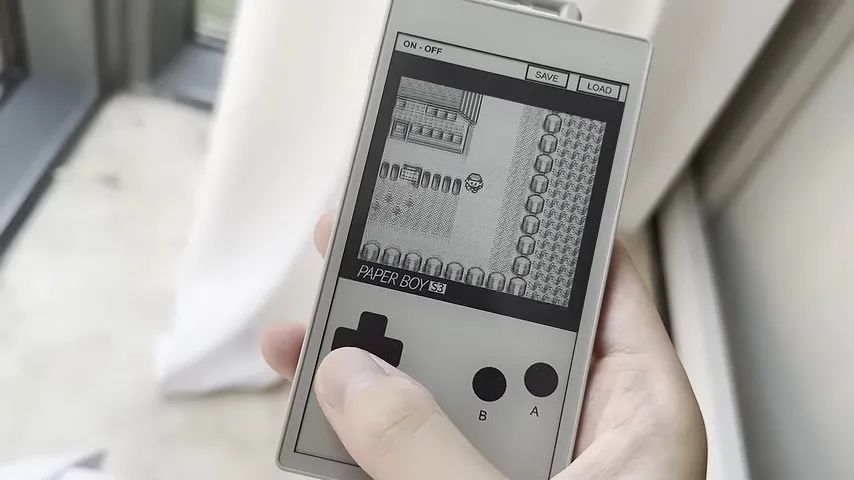
This is one of those projects that was both inspired and made possible by the absolute embarrassment of dev boards available to the modern hacker. In this case, the dev board was the M5Stack PaperS3, which as the name implies combines an ESP32-S3 with an e-ink panel. [Wenting Zhang] picked one up and was immediately inspired to try and make an e-ink Game Boy.

The M5Stack PaperS3 made this project possible by exposing the display with row/column control — parallel, some would call it, as opposed to the usual serial interface of SPI. That allowed [Wenting] to work some of the same e-ink magic he perfected on his Modos monitors to allow partial refresh at up to 60 Hz. That the ESP32-S3 is capable of emulating a Game Boy while driving the screen should surprise no one, since it can emulate an MSX while outputting VGA or even Windows 95 on a 386. In this case, he’s basing the actual Game Boy emulation on Crank Boy.

Of course the e-ink screen on the M5Stack is far larger and has a much higher resolution than what the Game Boy shipped with, which lets him implement touch controls and scale the image up 3X so he can fake a couple of shades of grayscale while actually outputting black and white. Even better, if he was actually playing this thing on the regular, once the high-refresh portion of the screen starts to wear out, he can flip the orientation and keep gaming on the virtually-unrefreshed control portion of the screen — doubling the lifetime of the system, something many of you raised as a concern when we last looked at a his e-ink monitor project.

Advertisement

The only real shortcoming of this hack is the sound. With one-bit beeps coming out of the M5Stack buzzer, it’s got nothing on Nintendo’s hardware. Of course, that’s partially down to using the hardware as-is. With the addition of an I2S sound chip like the one used in the MOD player project we featured recently, you’d just need to squeeze out enough processor cycles to make this sound as good as it looks.

Advertisement

Source link

Continue Reading

Tech

Man Arrested For Playing Darth Vader’s Theme Music At National Guard Troops Scores Settlement

Published

on

from the maybe-don’t-compound-your-evilness-with-stupidity dept

Some readers might look at this headline and think there’s something off about it. And I’ll grant you that. There are several ways music can be played: to, for, not at all. Sometimes though, the only way to describe the playing of music is “at.”

One of Trump’s many vindictive “surges” targeting cities and states run by Democratic party members occurred in Washington DC. Not content to flood the streets with tons of federal officers, the administration decided these forces needed backup from the National Guard. Of course, Trump claimed the crime problem in DC was so bad it could only be dealt with by a surge that blended choice bits from “police state” and “martial law” into an unpalatable whole.

DC residents were less than thrilled. One resident — Sam O’Hara — made his displeasure known by doing the thing in the headline: playing music at National Guard troops.

Here’s how that mild act of protest was described in his lawsuit against the city by his ACLU legal reps:

Advertisement

 Given the roughly 200-year-old tradition of civilian law enforcement in the United States, Mr. O’Hara was deeply concerned about the normalization of troops patrolling D.C. neighborhoods. And so, he began protesting the Guard members’ presence by walking several feet behind them when he saw them in the community. Using his phone and sometimes a small speaker, he played The Imperial March as he walked, keeping the music at a volume that was audible but not blaring. Mr. O’Hara recorded the encounters and posted the videos on his TikTok account, where millions of people have viewed them.

And here’s how it looked, from O’Hara’s POV:

I really hate to begin a sentence with “if you’re not familiar with The Imperial March.” And so I haven’t, via the clever use of punctuation. Just in case the presiding judge was unfamiliar, the lawsuit included a brief explainer:

In the Star Wars franchise, The Imperial March is the music that plays when Darth Vader or other dark forces enter a scene or succeed in their dastardly plans.

One of the National Guard troops objected to being Bluetoothed in public. Sgt. Devon Beck threatened to call the cops if O’Hara didn’t stop. Then he did exactly that. The DC Metro PD immediately fell down on the job, arresting O’Hara for crimes he couldn’t have possibly committed. He was not “harassing” the troops, as one of the officers claimed. Nor was he impeding their movement. Nor was he preventing people from entering a nearby store, as Officer Campbell alleged. He was standing to the side of it.

Advertisement

Officer Campbell wasn’t done being stupid quite yet.

In response to Mr. O’Hara’s statements that he was engaged in protest, Officer Campbell said, “That’s not a protest. You better define protest. This isn’t a protest. You are not protesting.”

You are wrong, Officer Campbell. Demonstrably wrong, which is a play on words or something… So enjoy that, readers. I’m taking English and grammar for a rough ride in this post, to borrow a bit of law enforcement vernacular. My apologies in arrears.

Anyway, O’Hara gets the last laugh, some money, and the unfortunate confirmation of the implication he made musically. And, while his original salvo targeted National Guard interlopers, it was the Metro PD officers who accosted/arrested him that truly proved the point.

The District of Columbia has reached a settlement agreement for an undisclosed amount of money with a resident who claims police illegally detained him for following an Ohio National Guard patrol while playing Darth Vader’s theme song from “Star Wars” on his phone — an act of protest against the Trump administration’s federal law-enforcement surge in the nation’s capital.

No one is saying how much the settlement is, but it seems like it’s big enough to mean something.

Advertisement

In an email on Friday, an ACLU spokesperson referred to the settlement’s financial terms as “a significant amount” that O’Hara “is pleased with” but said they aren’t disclosing the dollar figure to protect his privacy.

It also may not be O’Hara’s settlement check from the government. There’s still the matter of the National Guard troop who decided to call the police because he personally didn’t care for O’Hara’s playlist. Beck is still defending himself against the lawsuit, but I have no idea what kind of defense this is:

Attorneys for the Guard member, Sgt. Devon Beck, has asked a judge to dismiss O’Hara’s claims against him.

“He was there because that was his assigned duty,” Beck’s lawyers wrote. “This was not an accidental encounter or a one-time disagreement on a public sidewalk.”

So… Beck isn’t responsible for his direct (or contributory) rights violations because he didn’t ask to be deployed to Washington DC? It probably doesn’t matter. Members of the military are rarely sued by US citizens for rights violations because, well, until very recently they were never asked to patrol US neighborhoods or provide support for law enforcement. There are likely layers of immunity that haven’t even been probed yet, but even if the courts decide the troops were acting as federal officers, it’s almost impossible to successfully sue federal officers. If the government agrees to a settlement, it will because it’s afraid its lawyers might fuck things up so badly adverse precedent might be set.

But for now, some justice has been done. O’Hara gets his money. The Metro PD gets a lesson in why it’s rarely a good idea to provide backup to federal forces and, more hopefully, learns something about how to handle people engaged in protected speech.

Advertisement

Filed Under: 1st amendment, dc metro police, evil empire, free speech, mass deportation, michael perloff, mpd, national guard, trump administration, washington dc

Source link

Advertisement
Continue Reading

Tech

The Best Places To Catch The Blue Angels Before The Summer Ends

Published

on


If you’ve ever wanted to see fighter pilots performing at their superhuman best, then you should get to a Blue Angels air show. The Blue Angels are the US Navy’s elite demonstration team and operate a busy schedule across the U.S. Whether you’re lucky enough to have seen them before or you’re planning to catch them for the first time, making the effort to see one of their displays won’t leave you disappointed. 

A Blue Angels show is a breathtaking display of teamwork, skill, aerial choreography, and immense courage. The team flies the Navy’s frontline carrier-based fighter — the F/A-18 Super Hornet – and  they can be made combat-ready within 72 hours if needed, so you really are seeing the real deal in action. It’s a jet that’s also considered one of the best fighters ever made by Boeing

This summer, the Blue Angels will be performing across the USA, with shows like the Great State of Maine Air Show in Brunswick, the Pensacola Beach Air Show on Florida’s Gulf Coast, Seattle’s Boeing Seafair Air Show, and the Thunder Over Louisiana Air Show among the highlights of a busy schedule. So, if the thought of watching the Blue Angels performing such maneuvers as the Opposing Knife Edge, the Diamond Aileron Roll, and the Sneak Pass, here’s a handy guide to where you can watch the Blue Angels this summer. 

Advertisement

The best places to catch the Blue Angels in July and August

Among the highlights of July’s Blue Angels air shows is the Great State of Maine Air Show in Brunswick. This takes place on the 11th and 12 of July at the Brunswick Executive Airport, and the Blue Angels are scheduled to perform on both days. Tickets are available online only and can be purchased from the Great Maine Air Show website. 

Next is the Pensacola Air Show, which takes place on Saturday, July 18. This is the Blue Angels “home” show, so it’s got to be worth catching if you get the chance. There is no admission fee for this one, and the best views are from Casino Beach. You can find out more from the Visit Pensacola website. 

Advertisement

Moving on to August, the Boeing Seafair Air Show in Seattle runs from Friday, July 31, to Sunday, August 2. The event’s website lists the Blue Angels performing all three days at 3:30pm local time, with two practice runs on July 30th — though the latter are not set in stone. However, according to the Blue Angels website, the team is only performing on the Saturday and Sunday, so count on the weekend performances. Full details of the show can be found on the Boeing Seafair website. For fans of other military jets, you can also catch the F-35B, one of the most advanced fighter jets in the world here. 

Rounding off August highlights, we have the Thunder Over Louisiana Air Show, which takes place on Friday, August 28, to Sunday, August 30, 2026, at Chennault International Airport, Lake Charles, Louisiana. If you fancy saying goodbye to August in style, then you can buy tickets for this event online from the Thunder Over Louisiana website. 

Advertisement

Other Blue Angel summer shows

As for some other performances this summer, the Joint Base Elmendorf-Richardson in Alaska is hosting the appropriately named Arctic Thunder Open House on Saturday, August 8, and Sunday, August 9, 2026. You can also catch them at the Oregon International Air Show, which takes place at McMinnville Airport from Friday, August 14, to Sunday, August 16, 2026. 

September highlights have got to include the Cleveland National Air Show. This event takes place over Labor Day Weekend from Saturday, September 5, to Monday, September 7, 2026. and is a Labor Day weekend tradition in Cleveland. The shows take place at Burke Lakefront Airport in downtown Cleveland, and tickets can be purchased from the Cleveland National Air Show website. 

Finally, as fall approaches and the days shorten, you can still catch the Blue Angels one more time at the MCAS Miramar Air Show at the Marine Corps Air Station Miramar, San Diego, California. Running from Friday, September 25, to Sunday, September 27, 2026, this one technically happens in the fall, but in sunny San Diego, you’ll still be feeling that summertime weather. Full details can be found on the Miramar Air Show website. Of course, this is not an exhaustive list, so you can catch the full slate of shows at the Blue Angels website.

Advertisement


Source link

Advertisement
Continue Reading

Tech

Meta Is Charging a Subscription for Smart Glasses Features

Published

on

Meta is introducing a subscription for expanded access to advanced smart-glasses features. According to Wired, “[U]sers will need the Meta One Premium Plan to unlock expanded access to some features for their smart glasses, whether it’s the Ray-Ban, Oakley, or Meta-branded version.” They’ll still be usable with a subscription, but “certain features will be limited,” the report says. From the report: Specifically, a feature called Conversation Focus, which boosts the audio of the person you’re speaking with so you can hear them better in loud environments. You’ll get three hours per month without a subscription, but if you want to use it more often, then you’ll need to pay up. Though even then, you’re still capped at 15 hours. Subscribing also nets you “Premium Device Support,” where you’ll get faster access to what Meta says are “human experts” trained on the smart glasses’ features, should any problems arise. Guess humans are better at some things after all.

A Meta spokesperson tells WIRED that this is “not an AI rate limit.” Rate limits are common on other AI platforms — users get free access to a feature until they hit a certain cap, then they’ll need to subscribe to use it more until the limit resets at the end of the month. However, the Conversation Focus feature runs on-device, meaning it doesn’t need to head to Meta’s servers for AI processing. There’s no real-time way to monitor how many hours you’ve used Conversation Focus, but you’ll receive a notification when you get near the limit.

“The subscription supports that ongoing work and gives power users expanded access along with premium device support,” the spokesperson says. “We’re going to start testing new optional subscription plans that offer more premium features and advanced capabilities for those who want to unlock more from our apps and AI glasses.”

Source link

Advertisement
Continue Reading

Tech

Apple orders 10 million of the iPhone Fold for launch

Published

on

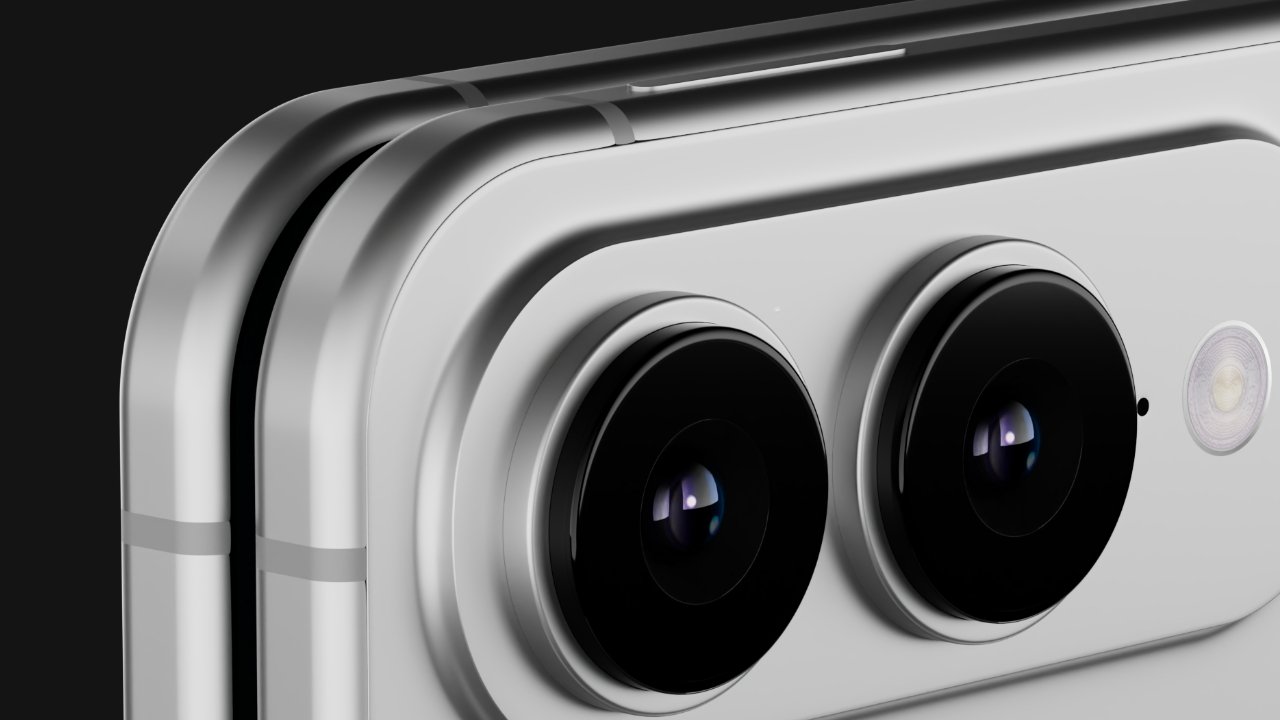
A new report claims that Apple expects to sell 10 million of the iPhone Fold in 2026 and into early 2027, considerably up from most previous estimates.

Nothing varies quite like the rumors that the iPhone Fold is or is not going to be launched in September, but the number Apple will make comes close. In April 2026, for example, Nikkei Asia and most other analysts believed that Apple was ordering 7 million to 8 million for the year.

At the same time leaker Digital Chat Station claimed it was 11 million.

Now Nikkei Asia has met the leaker halfway, and says that Apple is ordering ten million of the iPhone Fold for the rest of 2026. In total, across the whole of the year and all of its iPhone models, Apple expects to produce over 220 million devices.

Advertisement

That compares to late 2025, when it was estimated that Apple’s sales for the year would be around 247 million iPhones. In September 2025, it was reported that Apple was looking for options to speed up production of the iPhone Fold, and that it was predicting a 10% increase in all iPhone sales across 2026

The new report follows estimates that the iPhone Fold will account for 29% of all folding display orders in 2026. That compares to Samsung’s estimated 31%, and Huawei’s 24%.

If the report’s figure of 10 million iPhone Fold devices being produced in 2026 is correct, it bolsters claims that Apple has resolved the claimed manufacturing problems regarding the device’s hinge and circuit board.

Given that the figure is specifically for Apple’s 2026 orders for iPhones, it suggests the iPhone Fold will be launched in September, with shipments not delayed into 2027 as previously rumored. That’s not certain, however, and it remains possible that Apple could announce it in September, but not ship it until later.

Advertisement

Generally, Apple orders around 30 million of its Pro iPhone models for the weeks after launch. It’s not yet clear what the order volume will be, with the folding iPhone in the mix.

The global chip shortage may alter these figures. But generally Apple aims to order 20 million of the various non-Pro models to sell in September. This is likely not on the table for 2026, as the present rumors suggest the non-Pro iPhone 18 will be launched in the spring of 2027.

In May 2026, it was rumored that Apple was changing these ratios for the iPhone 17 range because of both demand, and possible delays for the iPhone 18. Those delays may be due to the expectation that Apple is to move its next non-Pro iPhone launches from September 2026 to spring 2027.

However, regardless of this, the new report also claims that Apple has asked suppliers to reserve an unknown number of iPhone 17 components. That suggests that Apple is looking to mitigate against shortages as much as possible.

Advertisement

Source link

Continue Reading

Tech

Q Acoustics Q SUB100 Review: A Powerful 10-Inch Subwoofer for Music and Home Theater You Can Afford

Published

on

Q Acoustics has spent the past three years methodically rebuilding its loudspeaker lineup, and the new Q SUB100 subwoofer is the long overdue final piece of that puzzle. The 5000 series raised the company’s game in the affordable high end category, while the newer 3000c series brought genuine refinement to the budget end of the market. The excellent 3020c proved that a compact standmount can still deliver real musical substance without forcing a yard sale of older hi-fi purchases or a sternly worded note from the HOA.

Please, Mrs. Cohen, do not make me pace the patio in a Speedo while listening to Aphex Twin outdoors; the neighbourhood has already endured enough.

The Q Acoustics M40 also earned our Editor’s Choice Award as one of the better wireless speaker systems available, and it remains an appealing foundation for a compact 2.1 system in rooms where space is at a premium. Add a capable subwoofer, however, and that modest-looking system can become something far more complete for music, movies, television, and late-night sessions; right until the neighbours respond by banging on the wall like Keith Moon has risen from the dead and taken up residence next door. Keep your bass handy for the Entwistle comeback.

That missing low-frequency component has been the one obvious hole in the Q Acoustics catalog. The new Q SUB Series finally addresses it with three active subwoofers: the 8-inch Q SUB80 ($1,099), 10-inch Q SUB100 ($1,199), and flagship 12-inch Q SUB120 ($1,399).

Advertisement

The Q SUB100 is likely to be the sweet spot of the range. Its 10-inch driver, compact sealed enclosure, and 300-watt amplification promise enough authority for medium-sized rooms and properly assembled 2.1 or home-theater systems, without requiring the floor space, financial commitment, or structural reinforcement associated with a larger subwoofer.

It is the model most likely to appeal to Q Acoustics owners who want deeper, more convincing bass but have no desire to turn the living room into a local World Cup watch party, complete with 14 people shouting at the referee and one bloke treating every corner kick like the Normandy landings.

Specifications & Technology

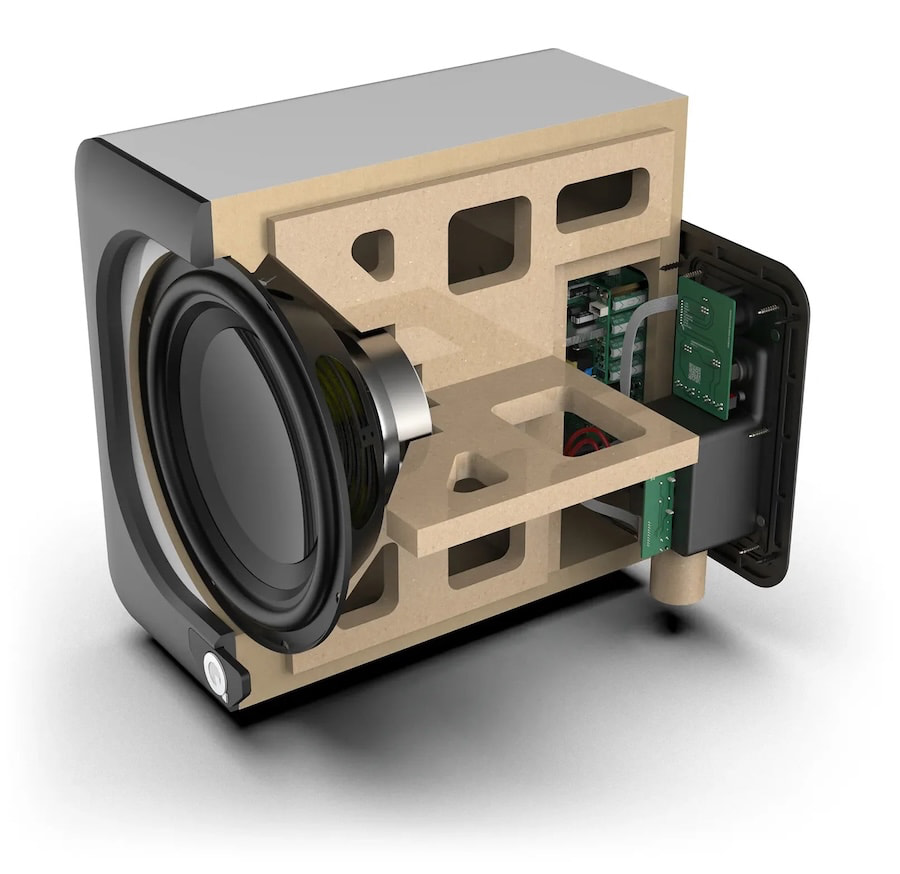
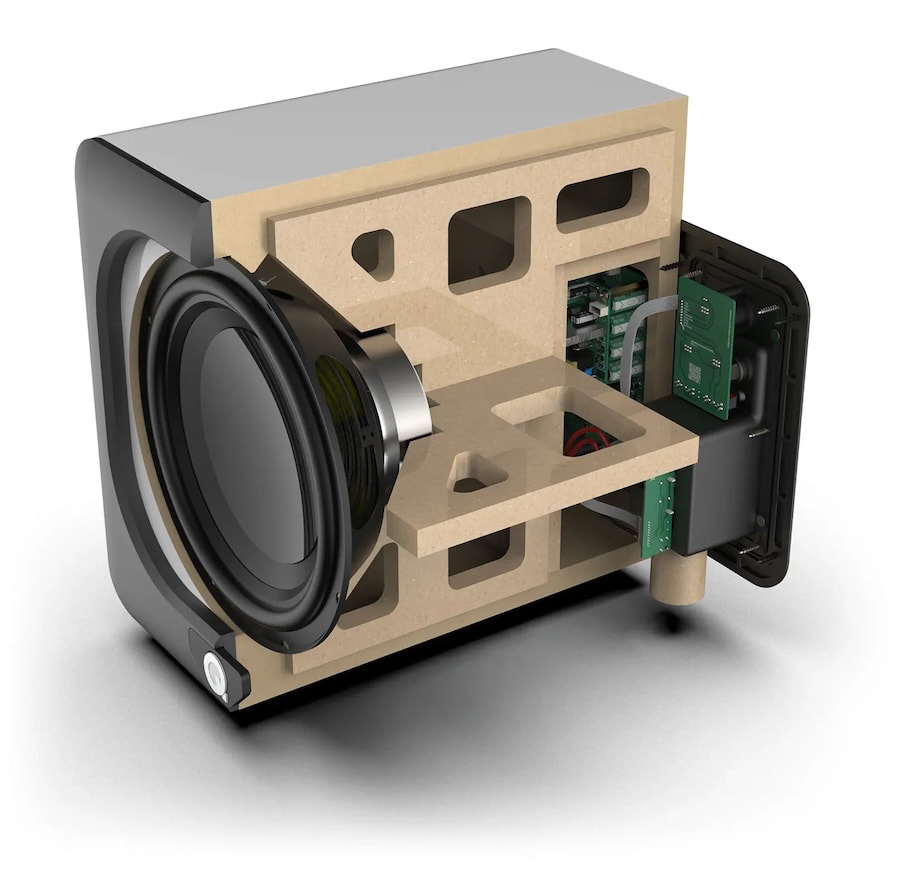
The Q Acoustics Q SUB100 uses a sealed, or “infinite baffle,” enclosure rather than a ported cabinet. That matters because a properly executed sealed design generally favors tighter, more controlled bass, while giving the onboard DSP a more predictable platform from which to work. It is also a more forgiving approach for real rooms, where subwoofers often end up near a wall or corner out of necessity.

q-acoustics-q-sub100-cutaway

The Q SUB100’s 23.5-litre cabinet is constructed from 18mm high-density MDF, with a 36mm double-thickness front baffle to keep the enclosure from adding its own low-frequency commentary. Internal dart bracing further stiffens the structure and helps reduce cabinet “ballooning” under pressure. Q Acoustics has also paid attention to the less glamorous details: airtight amplifier mounting, a tightly secured 15mm MDF grille, and adjustable locking spikes with protective cups for leveling on hard floors.

Advertisement

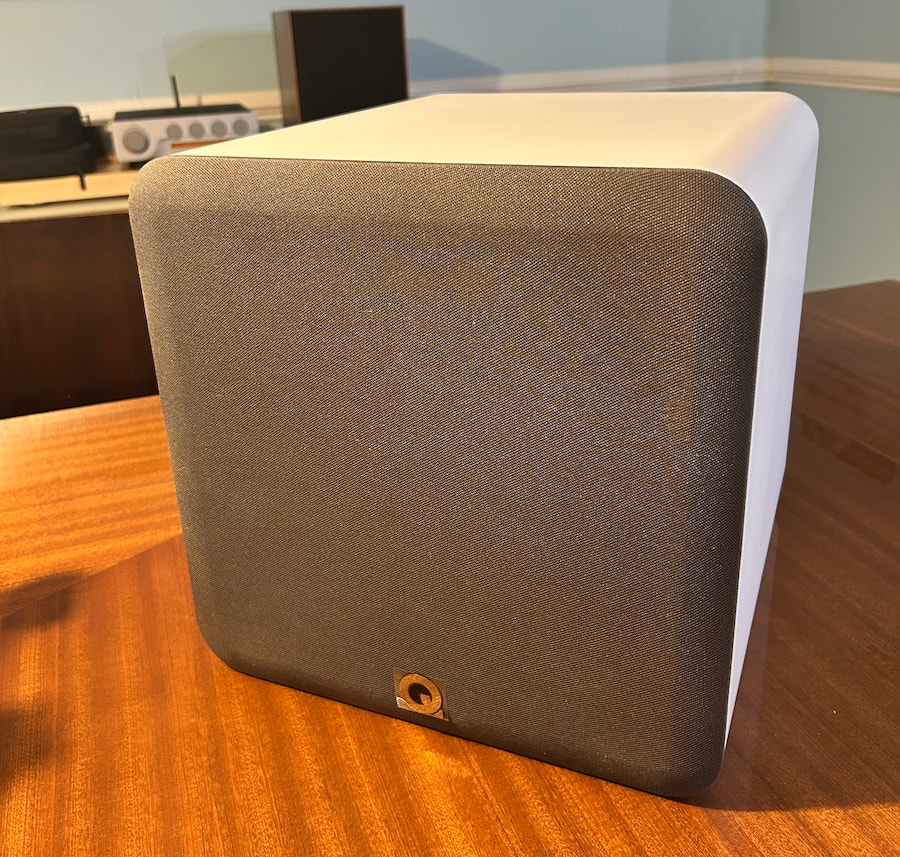
The Q SUB100 is available in Satin Black or Satin White, both of which suit its understated, clean-lined cabinet design and make it easier to integrate into a living room without looking like a misplaced PA speaker.

At 13.7 x 13.7 x 15 inches and 36.8 pounds, the Q SUB100 is not tiny, but it remains manageable enough for medium-sized rooms where a 12-inch subwoofer might start looking like a misplaced piece of airport infrastructure. Not looking at you Wilson Audio or McIntosh. Maybe just a little

A 10-Inch Driver Built for Control

The Q SUB100 employs a 254mm (10-inch) driver with a heavy-duty steel chassis, paper cone, and rubber surround. Paper remains an entirely sensible material for a subwoofer cone when properly engineered, combining low mass with the rigidity and damping needed for controlled, articulate bass.

Advertisement. Scroll to continue reading.
Advertisement
q-acoustics-q-sub100-white-with-grille

A 38mm voice coil and aluminium demodulation ring are part of the design, with the latter intended to reduce distortion caused by changes in inductance as the driver moves through its travel. The goal is not simply more bass, but cleaner bass when the driver is working hard.

Q Acoustics rates the Q SUB100 down to 32Hz at -6dB, with a maximum SPL of 111dB at one metre. Those numbers suggest genuine low-frequency authority for music, television, and home theater in appropriately sized rooms, without promising that a compact 10-inch cabinet will recreate the seismic activity of Shore traffic driving through your living room.

DSP, Serious Power, and Easier System Integration

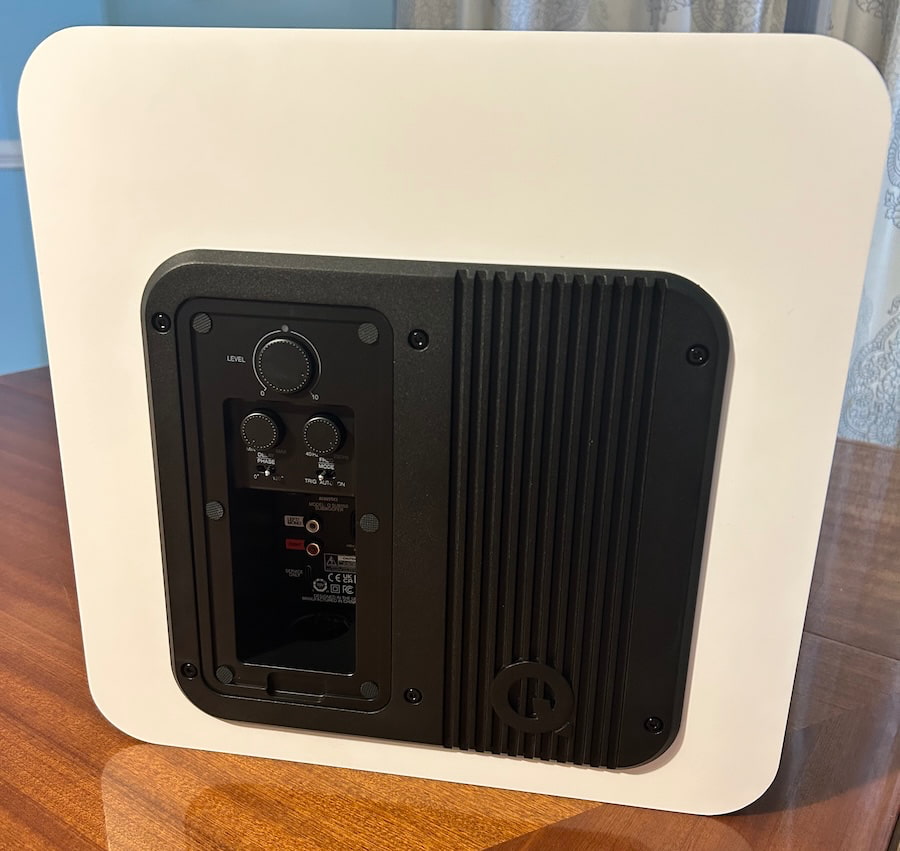
The Q SUB100’s custom amplifier module delivers 250 watts of continuous power and up to 500 watts peak. It uses four digital amplifier stages in a parallel bridge-tied load configuration, a design intended to reduce output impedance, improve driver control, and limit heat dissipation. Q Acoustics specifies total harmonic distortion at 0.09% at rated power.

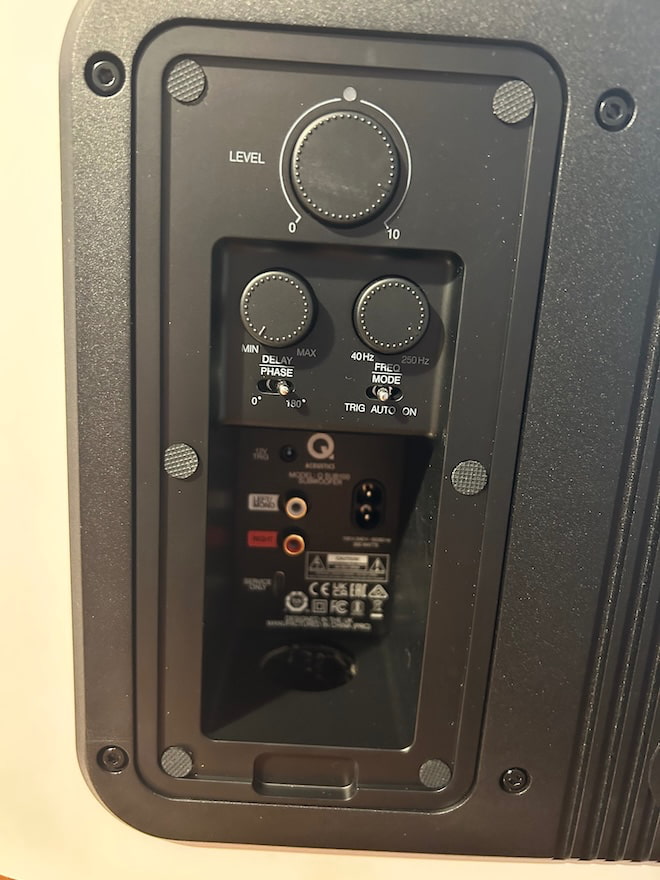
The DSP handles more than basic housekeeping. Along with helping shape the sealed enclosure’s response, it offers fine delay adjustment and a phase inversion switch to help the Q SUB100 integrate more cleanly with the main speakers. Its adjustable low-pass filter spans 40Hz to 250Hz, allowing it to work with everything from compact standmounts to active wireless speakers and home theater systems. Q Acoustics has also included source detection that identifies whether the incoming signal is stereo or mono and automatically adjusts gain accordingly.

q-acoustics-q-sub100-white-rear

What’s Missing: Room Correction, Wireless, and App Control

For all of the useful engineering inside the Q SUB100, there are a few omissions worth noting. The big one is automated room correction. Q Acoustics gives users DSP, phase inversion, fine delay adjustment, and a wide 40Hz to 250Hz low-pass filter range, but there is no supplied microphone-based calibration system to measure the room and smooth out bass peaks. In fairness, most subwoofers at this level still depend on the user, AVR, streaming amplifier, or external room correction platform to handle that job. Bass remains rude like that. Dirac to the rescue.

Advertisement

There is also no built-in wireless connectivity, which means the Q SUB100 still needs to be connected the old-fashioned way. That is hardly a tragedy, especially for users building a 2.1 or home theater system, but anyone hoping to hide the subwoofer across the room without running a cable will need to plan accordingly.

The other missing piece is deeper app-based control. A subwoofer with this much DSP potential would benefit from a proper control app with preset storage, parametric EQ, room-position presets, and easier fine tuning from the listening seat. Having to crouch behind a subwoofer while adjusting bass is one of those hi-fi rituals that makes non-audio people wonder if we have joined a small but expensive cult that enjoys arguing online about measurements and pretending that we have friends.

q-acoustics-q-sub100-white-rear-inputs

The Q SUB100 also omits high-level, or speaker-level, inputs of the type used by many of REL’s music-first subwoofers. REL’s approach uses a Neutrik Speakon connection tapped from the amplifier’s left and right speaker terminals, feeding the subwoofer the same signal received by the main speakers while placing virtually no additional load on the amplifier. REL argues that this preserves more of the system’s tonal character and timing cues, which is why the connection remains popular with two-channel listeners using integrated amplifiers without a dedicated subwoofer output.

Setup and Listening: Toronto, Two Subwoofers, and the First Complaint

My education in proper subwoofer setup began in the early 1990s, shortly after college, in my first apartment: a pre-war building in midtown Toronto with a 16 x 19 x 9-foot living room that was not acoustically disastrous, which already put it ahead of most rental properties and several respected listening rooms. The system was built around NHT’s original SuperZero mini-monitors and a pair of passive SW2 subwoofers driven by NHT’s MA-1 amplifier — the arrangement marketed as the SW2P powered subwoofer system.

I was also friends with Corey Greenberg, then of Stereophile, who sent me a pair of his homemade “Aunt Corey” high-pass filters. Inserted into the system, they kept the bottom octaves away from the tiny two-way NHTs and let the subwoofers handle the heavy lifting. That was not some occult audiophile ritual involving quartz blocks and a magical clock; it was simple, sensible bass management.

Advertisement

The difference was immediate. The SuperZeros sounded more open, the soundstage grew appreciably larger, and the system gained the weight and balance that my largely non-audiophile music collection required. Two subwoofers felt like the intelligent choice for a young man beginning his audiophile journey and already convinced that accurate bass mattered as much as a convincing midrange.

The flaw in this otherwise splendid plan was that bass does not respect property lines. It leaked into the flat next door, for which I still owe an apology to the former Minister of Justice, and annoyed the elderly gentleman downstairs, who had little patience for electronic music, new wave, or 11 p.m. sessions of 2112. Learning how to position, level-match, and properly integrate a subwoofer became less an audio hobby than an essential survival skill.

Advertisement. Scroll to continue reading.

Jump ahead to 2026, and while subwoofers have remained part of my home theater systems for years, an aging REL T Series model has been my only regular partner for two-channel listening. It has survived moves from Toronto to New Jersey, down to Florida, and back to New Jersey again, which is more relocation experience than most touring bands and considerably more than I ever intended to inflict on a subwoofer.

Advertisement

That is about to change. Two of REL’s latest subwoofers, including one of the new Planar on-wall models, are scheduled to arrive for review in August. The timing is rather good, as I am moving into a new home office with enough flexibility to experiment properly with a smaller subwoofer positioned discreetly along a wall or mounted to it, without turning the room into a shrine to black boxes, power cords, and making it a target for Tyrion the Westie.

The Q SUB100 is also the sort of subwoofer that makes sense in that context. Its compact sealed cabinet should be easier to accommodate than a larger ported design, but the real question is whether it can provide the scale, weight, and integration that make a two-channel system sound more complete without announcing its existence every time the kick drum arrives.

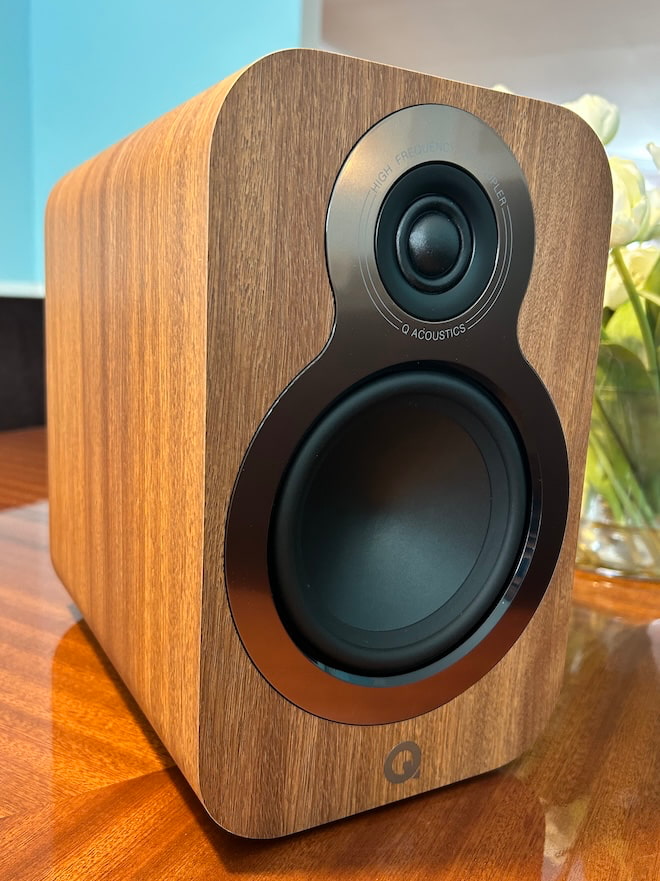
Listening with the Q Acoustics 5040, M40, and 3020c

Q Acoustics 3020c bookshelf speaker angle
Q Acoustics 3020c

The Q SUB100 is not lightweight, and I put a small amount of Blu Tack beneath its feet and cup before placing it on the hardwood floor. My 16 x 13 x 9-foot den offers enough space to position a subwoofer two to three feet from the wall and clear of the corners, which matters. Experience has taught me that corner placement can overload this room rather quickly, especially with a subwoofer of this size.

The room also opens into the front foyer at one end and the kitchen at the other, adding a few more variables to the bass equation. Rooms, as ever, refuse to read the manual.

Before replacing my Magnepan LRS with the Q Acoustics speakers that I use daily, I spent some time moving the Q SUB100 forward and back in small increments until the balance finally locked in. The sweet spot was 24 inches from the wall behind it to the rear of the cabinet, and roughly 30 inches from the nearest sidewall.

Advertisement

That placement delivered the best balance of impact, speed, and integration with the main speakers. I went back and forth between the 5040, M40, and 3020c to find the most convincing blend; not because I enjoy moving a 37-pound subwoofer around the room for sport, but because subwoofer placement remains one of those things that either clicks or stubbornly refuses to.

Crossover settings were not identical across the three Q Acoustics systems. I settled on 80Hz with both the 3020c and 5040, which gave the Q SUB100 enough room to add real foundation without drawing attention to itself or thickening the midbass.

Q Acoustics M40 Active Micro Tower Speakers in Walnut with Turntable
Q Acoustics M40

The M40 worked best with a lower 60Hz setting. Its dual 5-inch drivers already produce more bass weight than their compact micro tower proportions suggest, so crossing over any higher began to add more overlap than the system needed in my room. At 60Hz, the M40 retained its own quick, satisfying bass character, while the Q SUB100 handled the lowest octaves with greater authority and no obvious handoff between the speakers and subwoofer.

That is not a universal prescription. Room dimensions, placement, and the distance from the nearest wall still get the final vote, because bass remains the one part of hi-fi most likely to ignore both specifications and common decency.

Advertisement

The M40 offers a dedicated subwoofer input on the rear of its primary speaker, and there were moments when the move from 2.0 to 2.1 made the system considerably more engaging. That said, the M40 is not remotely lightweight in the bass department for a compact active speaker, and the Q SUB100 never felt as though it was trying to correct a deficiency. It simply gave the system more scale, weight, and low-end confidence when the recording called for it.

The tonal match with all three Q Acoustics models was exceptionally seamless. That matters because the newer 5040 and 3020c do bass differently from the older 3000 series: leaner, faster, and more clearly defined, with better control and less midbass warmth doing the heavy lifting. The Q SUB100 complemented that character rather than smothering it, adding impact and extension without turning the presentation into a thick mess.

Advertisement. Scroll to continue reading.

From a cost perspective, the M40 and Q SUB100 feel like a slight mismatch; they strike me as products aimed at somewhat different buyers. The smaller and less expensive Q SUB80 is probably the more natural partner for Q Acoustics’ active wireless speaker, particularly in a compact room where the M40’s own surprising bass output already carries much of the load.

Advertisement

The 3020c is more affordable than the M40, but its likely owner is not necessarily the same customer. Paired with the Q SUB100, the 3020c sounds far more authoritative, gaining scale and low-frequency weight without losing the clarity and imaging that make it such a strong compact standmount. The 5040 benefits in a different way. Its wall-to-wall soundstage remains intact, but the system takes on the authority of a more powerful mid-level floorstander.

The subwoofer does not suddenly blow the soundstage through the walls, which would be awkward to explain to the insurance company and family, but it gives both speakers a greater sense of physical presence while allowing the midbass and upper bass to retain their impressive clarity, detail, and resolution.

Listening to Nick Cave’s “Avalanche” and “Comancheria” from Hell or High Water, a great film, the Q SUB100 added real weight to Cave’s piano. You could feel the instrument’s low register, while its natural decay remained intact. Just as importantly, his gravelly voice was never overwhelmed by the added bass below 80Hz.

The same held true with Jason Isbell, Bryan Ferry, and Roxy Music. Percussion and synthesizer lines hit with greater force, but there was no loss of definition or separation. The presentation sounded properly full range in the room rather than merely louder and thicker.

Advertisement

Electronic music had considerably more presence and definition. Deadmau5, Aphex Twin, The Orb, Kraftwerk, and Boards of Canada all benefited from the Q SUB100’s ability to deliver greater low end weight without blurring the rhythmic pulse or layering of the recordings. Synth lines reached some interesting club levels, briefly taking me back to Washington, D.C. in the 1990s, when I was a college student and certain establishments, along with certain nocturnal activities, are best left unnamed.

Talking Heads and Peter Gabriel were equally revealing. The bass lines hit harder, percussion gained more physical presence, and the system still retained the clarity that makes these recordings worth revisiting. I did not even bother reading my text messages from upstairs. Nothing you could say to the Rabbi.

Switching to movies and television, I have become slightly obsessed with The PittA Knight of the Seven Kingdoms, and the latest season of Fauda. It is remarkable how much some shows leave on the table without a properly integrated subwoofer. The impact of weapons landing against a knight’s chest, charging horses, gunshots, frantic runs through hospital corridors, machine gun bursts, and cars racing down narrow streets all gained convincing weight and physical force.

The Q SUB100 did not turn every scene into a multiplex trailer mixed by someone with unresolved childhood issues. It simply filled in the low frequency information that smaller speakers cannot fully reproduce, making each sequence feel more immediate, tense, and involving.

Advertisement
q-acoustics-q-sub100-white-angle

The Bottom Line

Subwoofers are strange products. They have to reproduce the lowest octaves already present in the music or soundtrack without making a mess of everything else. Some do that far better than others. The Q SUB100 fills a major need within Q Acoustics’ own speaker lineup, and it does so very well.

Its sealed cabinet, useful DSP controls, compact footprint, and substantial 10-inch driver make it an especially effective match for the 3020c and 5040, adding scale, impact, and low frequency extension without clouding their excellent imaging or midbass clarity. It also works well in a home theater or television system, where its 250 watts of continuous power and 32Hz extension add genuine weight to action sequences without calling attention to themselves.

What it does not offer is equally clear: no automated room correction, app based EQ, wireless connectivity, or REL style high level input. Those omissions will matter to listeners with older two channel amplifiers, difficult rooms, or a strong preference for adjusting everything from the sofa.

Advertisement. Scroll to continue reading.
Advertisement

The Q SUB100 is for Q Acoustics owners who want a serious, well controlled subwoofer for music, television, and movies, but do not need a larger 12-inch cabinet or a more elaborate calibration ecosystem. It is not inexpensive, but it sounds like a proper component rather than an obligatory black cube purchased to make explosions louder.

You might want to put your text messages on silent mode before using it. The people around you may become rather animated once the walls begin contributing to the conversation.

Pros:

  • Deep, controlled bass with strong definition and convincing impact
  • Seamless tonal match with the Q Acoustics 3020c, 5040, and M40
  • Sealed cabinet offers easier placement than many ported alternatives
  • Excellent blend of speed, scale, and low frequency weight for music
  • Adds real authority to movies, television, and gaming without muddying dialogue
  • Solid construction, useful DSP controls, and adjustable crossover settings
  • Compact enough for medium sized rooms without looking like a small appliance

Cons:

  • No high level speaker inputs for REL style two channel integration
  • No app control, parametric EQ, or automated room correction
  • No built in wireless option
  • Heavy enough to make repeated placement experiments less charming
  • Q SUB80 may be the more sensible match for the less expensive M40
  • Premium price places it above many buyers’ expected subwoofer budget

Our Ratings

★★★★★★★★★★ Bass Quality

★★★★★★★★★★ Build Quality

★★★★★★★★★★ Features

Advertisement

★★★★★★★★★★ Value

Where to buy:

Source link

Advertisement
Continue Reading

Trending

Copyright © 2025