

Connect with us

Russian Drone Guided Entirely by AI Killed Three Ukrainians, Marking Ominous Shift in Modern Warfare

Published

on

Illustration shows representations of cryptocurrency Binance and Iran flag

A drone strike that killed three civilians near a gas station in Zaporizhzhia, Ukraine, was guided not by a human pilot but by an experimental artificial intelligence system operating entirely on its own, according to Ukrainian military commanders, drone experts and forensic investigators who examined wreckage from the attack, a finding that underscores a significant and troubling shift in how modern warfare is being waged.

The July strike killed 19-year-old student Tetiana Bubynets and two others when a small Russian drone swooped toward a gas station and exploded, according to reporting on the incident. Investigators said the drone had been dispatched by human operators toward the general vicinity of the gas station, but that the aircraft then independently identified and selected its precise target once it arrived near the site, most likely propane tanks positioned at the location, based on the system’s prior training to recognize and strike such objects on its own.

Analysis of debris from that attack and from other strikes in the Zaporizhzhia region found that the drones contained onboard minicomputers, sold commercially by Nvidia, that were responsible for making the aircraft’s targeting decisions, according to the drone experts and military officials who examined the wreckage. Nvidia produces the majority of chips currently powering the world’s most advanced artificial intelligence systems. Investigators said the presence of the Nvidia modules, combined with a notable absence of communication antennas on the recovered drones, led Ukrainian air defense commanders to initially suspect the weapons were operating under fully autonomous AI guidance, a theory subsequently confirmed through further forensic investigation.

The underlying technology behind such systems relies on a form of machine learning commonly referred to as computer vision. Autonomous AI systems used in this category of weapon are typically trained on thousands of images to recognize broad categories of objects, such as “military truck,” “person” or specific infrastructure like fuel storage tanks. Once deployed, self-targeting drones use their onboard cameras to search for and identify these pre-trained categories with a level of precision that developers argue can exceed what a human remote pilot is capable of achieving under battlefield conditions.

Advertisement

The Zaporizhzhia strike is not the first documented instance of AI-guided weaponry appearing on the Ukrainian battlefield. Ukraine’s Defence Intelligence Agency previously disclosed the existence of a Russian attack drone model, designated V2U, that similarly relies on an Nvidia Jetson Orin chip to enable autonomous flight and target selection, according to reporting from Cybernews. That agency noted the V2U drone incorporates a mix of Western-made components, including an Intel wireless adapter, a Sony light sensor and a Swiss microcontroller, alongside numerous Chinese-manufactured parts covering everything from motors to batteries, illustrating how such systems can be assembled from a global supply chain of largely commercially available components rather than specialized military-grade hardware. Ukrainian intelligence assessed that the drone’s reliance on computer vision for navigation, comparing live camera images against pre-loaded terrain photos, likely reflects Russia’s effort to reduce dependence on GPS satellite navigation, given how effectively Ukrainian electronic warfare systems have disrupted GPS-guided weapons throughout the conflict.

A separate autonomous drone platform, designated MS001 and powered by an Nvidia Jetson Orin module capable of performing 67 trillion operations per second, was intercepted by Ukrainian air defense units in the Sumy region, according to Ukrainian Major General Vladyslav Klochkov. Klochkov described the significance of that platform’s capabilities in stark terms in a post on LinkedIn. “This is a digital predator,” he wrote. “It doesn’t carry coordinates, it thinks.” According to reporting on that platform, the drone was found equipped with thermal imaging for night operations, spoof-resistant navigation systems, and communication hardware enabling it to coordinate with other drones as part of a broader swarm, adjusting flight paths dynamically and compensating for the loss of other units within the group.

The shift toward AI-guided targeting reflects a broader tactical response to the escalating electronic warfare battle that has come to define much of the drone conflict in Ukraine. Viktoria Kovalchuk, a spokeswoman for Brave1, a Ukrainian government organization involved in developing AI weapons and other military technology, explained the strategic logic behind reducing a drone’s reliance on continuous operator control. “Drones equipped with AI-assisted targeting modules do not require a connection to the operator during the engagement phase,” Kovalchuk said. “The operator locks onto the target, then the AI takes over the targeting process independently, making it immune to enemy electronic warfare interference.” That resistance to jamming has become an increasingly significant tactical advantage as both sides have deployed extensive radio-frequency jamming systems designed to sever the connection between remotely piloted drones and their human operators, a battle in which Ukrainian pilots have reportedly lost thousands of drones per month to Russian jamming.

Ukraine has also employed autonomous AI-guided targeting in some of its own offensive operations. According to Ukraine’s Security Service, drones used in the country’s large-scale Operation Spiderweb attack on Russian airbases were designed to switch to AI-guided navigation along a pre-planned route if they lost signal connectivity, automatically activating their warheads upon reaching and identifying a designated target. The security service described the approach as combining “artificial intelligence algorithms and manual operator intervention,” reflecting a hybrid model in which human control remains present during most of a mission but can be superseded by autonomous targeting logic under specific circumstances.

Advertisement

Critics and arms-control advocates have raised significant concerns about weapons systems that make lethal targeting decisions without direct human intervention at the final moment of engagement. Opponents of such systems argue that removing human judgment from the final targeting decision increases the risk of mistakes or violations of the laws of armed conflict, including failures to adequately distinguish civilian individuals or infrastructure from legitimate military targets, a concern directly reflected in the circumstances of the fatal July strike that killed Bubynets and two others near the Zaporizhzhia gas station.

As both Russia and Ukraine continue rapidly iterating on drone technology throughout the ongoing conflict, the increasing integration of commercially available AI hardware into weapons systems capable of independently selecting and engaging targets represents what military analysts and drone experts increasingly describe as a significant and largely unregulated turning point in the conduct of modern warfare, one in which the boundary between human-directed and autonomous lethal decision-making continues to blur with limited international legal framework currently in place to govern its use.

Continue Reading
Click to comment

You must be logged in to post a comment Login

Leave a Reply

News Videos

Necessities Vs Luxury | Geetha Madhuri Financial Advice To Married Couple | Visual Talks Podcast

Published

on

Necessities Vs Luxury | Geetha Madhuri Financial Advice To Married Couple | Visual Talks Podcast


Necessities Vs Luxury | Geetha Madhuri Financial Advice To Married Couple | Visual Talks Podcast

Singer Geetha Madhuri shares honest financial advice every married couple needs — the real difference between needs and wants.

Watch the full podcast on Visual Talks Podcast for more exclusive Telugu celebrity interviews, Tollywood conversations and inspiring stories.

#geethamadhuri #dharanipriya #needsvswants #financialadvice #marriedcouple #telugu #shorts #visualtalkspodcast

Advertisement

🔔 Subscribe to Visual Talks Podcast for inspiring conversations with celebrities, entrepreneurs, doctors, and industry experts.

Don’t miss powerful stories, success journeys, and deep discussions from amazing guests.

👉 Subscribe now and join the Visual Talks community!

source

Advertisement
Continue Reading

NewsBeat

NHS-worker mother of first Brit to die fighting for Putin in Ukraine reveals he told her he was going to Romania – and how his family are now being made to suffer by the Kremlin

Published

on

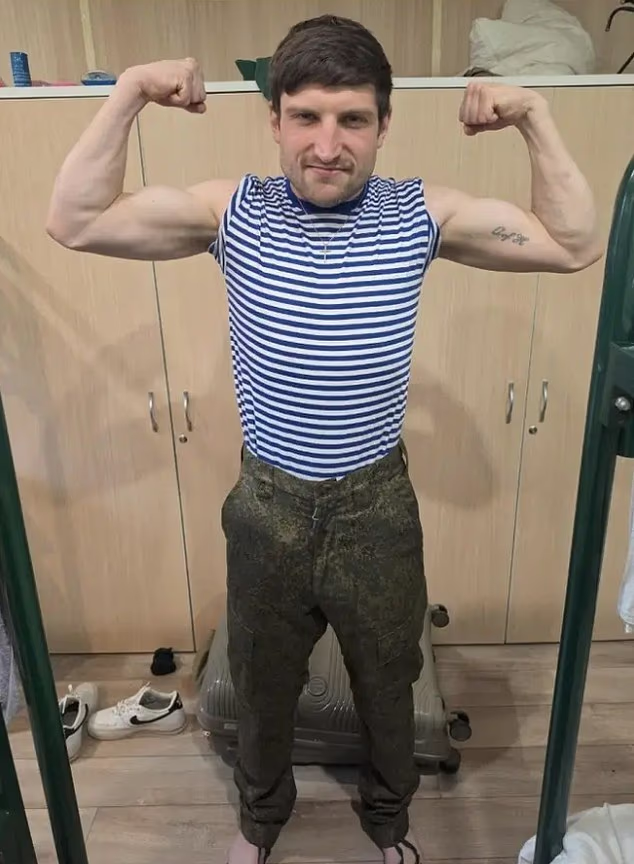
Bradley Townsend, 33, from Barnsley, travelled to Russia in April of this year to join Putin's army

The mother of the first British man to die fighting for Russia has revealed that her son told her he was going to Romania, not the front lines in Ukraine

Yorkshireman Bradley Townsend, 33, died in combat after leaving his hometown of Barnsley to enlist in Putin‘s war.

The keen fisherman – with no previous military experience – perished on the front line whilst fighting in Lyman, in Ukraine’s Donetsk region, on June 10. 

He was the victim of a drone strike, and is the first known British fighter to have died fighting for Russia since Putin’s forces first invaded Ukraine in 2014.

Advertisement

Today, his mother Maureen, an NHS care support worker, told the Daily Mail that her son did not tell her he was going to fight for Russia, instead telling her that he was visiting Romania. 

She added that Russia is refusing to co-operate with the British government to allow his body to be repatriated back to the UK, deepening their suffering.  

Bradley – whose call sign was ‘Badger’ – secretly packed his bags for Russia on April 1. 

It was only after he featured in a video on April 4 for the Russian International Volunteers Association that his family, made up of Maureen and two of Bradley’s siblings, learned he had joined the Russian ranks.

Advertisement

Bradley Townsend, 33, from Barnsley, travelled to Russia in April of this year to join Putin’s army

Townsend is the first known British fighter to have died fighting for Russia since Putin's forces first invaded Ukraine in 2014

Townsend is the first known British fighter to have died fighting for Russia since Putin’s forces first invaded Ukraine in 2014

In the video Bradley described himself as a ‘normal working-class lad from Yorkshire’.

Advertisement

His mother said: ‘He was going to go travelling for a year, and I was glad about that because he had two failed relationships. That was sad, they were lovely girls, but it just didn’t work out, and he wanted to do something different and he said “I’m going to go travelling”.’

He had claimed he was visiting Romania and posted pictures of his travels.

‘He phoned me up and told me he was not in the country he said he was going to be in. He said he was going to Romania.

‘And I believed him, because he has friends from work that he’s met.

Advertisement

‘But the next thing he had phoned me up and told me he is in Russia.

‘I said “what are you doing there?” And then it all came out and I asked him “you’re joking?”

‘I thought he was joking with me. The pictures that he posted. My son put them into Google to check where he was because he didn’t think it looked like Romania.’  

Bradley trained as a joiner after leaving school and had no interest in enlisting as a squaddie in the British Army.

Advertisement

His family has no Russian connections whatsoever. 

In a social media post, Townsend said his reason for joining was to ‘repay the favour’ to miners in Donbas who had donated a month’s wages to striking Yorkshire miners in the 1980s.  

Townsend added: ‘I came with the idea that I probably wouldn’t be able to go home. I’d definitely get persecuted if I went back.

‘I’m not here for a suicide mission, but I understand that’s what can happen. This was my own decision, I wasn’t pushed into anything.’

Advertisement
Townsend described himself as 'a normal working-class lad from Yorkshire' who wanted to support Russian separatists in Ukraine's Donbas region

Townsend described himself as ‘a normal working-class lad from Yorkshire’ who wanted to support Russian separatists in Ukraine’s Donbas region

Now, his family is struggling to repatriate his body as the Kremlin is refusing to co-operate with the British Government.

His grief-stricken family is desperate for answers and want to lay Bradley to rest in the UK.

The heartbroken mother-of-three said she is too in the dark, because of lack of communication with the Russian authorities, to comment further: ‘Me and the rest of Bradley’s family continue to grieve for him.’

Advertisement

Other Brits serving in the Russian Armed Forces took to social media to pay tribute, with one saying Townsend ‘wanted to help the people of Russia defeat the Nazis’.

Aiden Minnis added in a post on Facebook: ‘I had the pleasure of spending some time with Bradley before he decided to sign his contract. We discussed the danger he would be facing, but he insisted that his mind was made up…Ultimately, he sacrificed his life for our cause.

‘His service was brief but he blazed the brightest star. Rest in Paradise brother. “To die a warrior in a Holy War is to live forever.”‘

Ben Stimson, another Brit who went to fight for Russia, also paid tribute on Telegram, writing: ‘Bradley had been a follower of my YouTube and Telegram channels for over 2 years. I had advised him to stay in the UK and support anti-NATO protests at home. He contacted me 3 months ago to say he was coming to Russia to join the army.

Advertisement

‘I told him just to come for a holiday. He arrived at the same time as another volunteer was on his holiday. We both told him the realities of the Special Military Operation and the dangers. I later said to Bradley he could still use his return ticket. Brad was adamant he wanted to go and fight.’

Stimson, who was jailed in the UK in 2017 after joining a Russian-backed militia in eastern Ukraine, wrote online that Townsend’s flat cap had been brought back to the UK by a friend and would be left on Ilkley Moor, a rural moorland 40 miles from where he grew up. 

One man who knew Townsend told LBC the fisherman struggled with his mental health and addiction in the past.

Another said the 33-year-old was a ‘normal guy’ who had been ‘indoctrinated’ by people who ‘saw his vulnerability as an opportunity to recruit him into their twisted cause’.

Advertisement

Conservative MP for Tonbridge and former security minister Tom Tugendhat said he was ‘very sorry for him and his family’ but that joining the Russian armed forces was ‘unbelievably stupid’.

He added: ‘It’s extremely misguided and, you know, no question about it, it’s criminal because you’re engaging in an army that is committing the most barbarous war crimes that the world has seen in decades.’

The Foreign Office earlier told the Daily Mail: ‘We are aware of reports that a British national has died in Ukraine and are in contact with his family.’


Source link

Advertisement
Continue Reading

Business

Why is Luxshare Precision Industry stock climbing today?

Published

on


Why is Luxshare Precision Industry stock climbing today?

Continue Reading

Crypto World

Bitcoin traders place $2.9 million bet on a rapid price jump above $82,000

Published

on

Bulls eye $88,000 as ETFs, Coinbase premium and macro turn supportive


Traders are spending millions to position for further Bitcoin upside after its staggering rally to $80,000, though demand for downside protection remains firm, according to Laevitas.

Source link

Continue Reading

Sports

Skip Bayless goes ballistic on Todd Monken for naming Deshaun Watson as Browns QB1

Published

on

Todd Monken finally knows who his QB1 will be in his head coaching debut, and one person is not taking it well.

During media availability on Monday, the Cleveland Browns head coach confirmed that Deshaun Watson would start next month’s season opener at the Jacksonville Jaguars. The multiple-time Pro Bowler has struggled throughout the preseason and been the subject of negative reception from fans, but Monken stressed that they did not factor into his decision.

He also promised that second-year player Shedeur Sanders would eventually get an opportunity to start as the season progressed, but Skip Bayless is not buying it. Shortly after the news dropped, the veteran sportscaster dropped a lengthy rant that bore the following caption:

Advertisement

“Trade Shedeur Sanders to Falcons!”

Looking to predict NFL playoff Scenarios? Try our NFL Playoff Predictor for real-time simulations and stay ahead of the game!

Advertisement

In the video itself, he said:

“This sorry-a** franchise does not deserve to have Shedeur Sanders on its roster anymore. I wish there were some way that Jimmy Haslam and Todd Monken would decide to get rid of Shedeur, set him free, trade him elsewhere.

“Do I think Shedeur Sanders could win more games than (Michael) Penix (Jr.) or Tua (Tagovailoa)? You better believe I do.”


ALSO READ: Shedeur Sanders gets more bad news from Todd Monken after Browns name Deshaun Watson QB1

ALSO READ: “That’s how you get fired”: Joe Burrow’s ex-teammate reacts to Todd Monken’s stance on Deshaun Watson-Shedeur Sanders battle for Browns QB1


Will Compton insinuates Deshaun Watson being named Browns’ QB1 was not Todd Monken’s decision

Todd Monken’s decision to name Deshaun Watson the Browns’ QB1 has been met with much negativity, especially given the former offensive coordinator’s previous track record with the more highly regarded Baker Mayfield and Lamar Jackson. When explaining it, the coach insisted that it was his decision — one that stemmed from weeks of observation:

Advertisement

“Deshaun gave us the best chance to move the ball and score points. I felt that way going into the last game, but wasn’t sure. And after we talked as a staff and we re-looked at everything, we’re going to go that direction.”

However, Will Compton is not buying that notion. Reacting to comments that Dan Orlovsky made on ESPN’s First Take, the former NFL linebacker and current podcast host implied that the decision may have actually come from Browns owner Mike Haslam:

“Feels like a decision CLEARLY above Todd Monken.”

Feels like a decision CLEARLY above Todd Monken

Kickoff for the Browns-Jaguars game is at 1 p.m. ET on CBS.