Children’s commissioner for England Dame Rachel de Souza and Department for Education scientific adviser Prof Russell Viner have reviewed the latest evidence, finding that long periods of time spent on screens alone can affect children’s sleep and physical activity, which are key to their development.
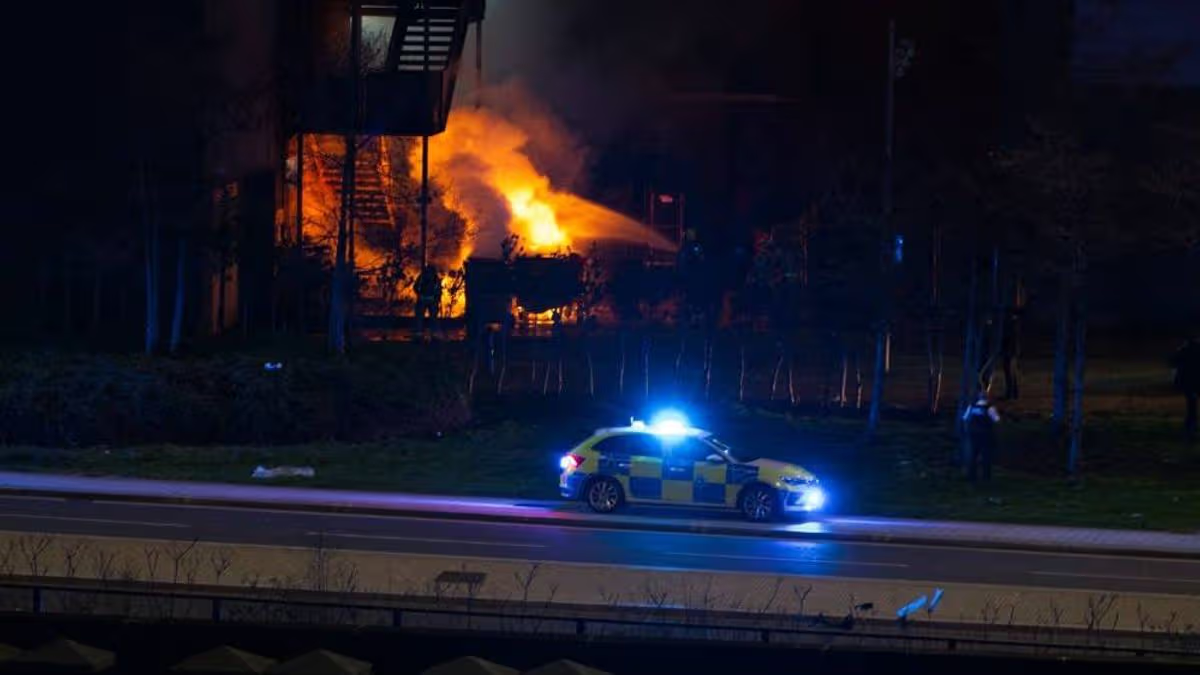
Four fire engines, ambulances and police rushed to the Radisson Blu Hotel on Old Hall Street after a fire broke out behind the building on March 26
Wesley Holmes Liverpool Echo reporter and Peter Hennessy UK & World News Editor
02:01, 27 Mar 2026
A fire at the rear of a city centre hotel resulted in plumes of smoke billowing into the air. The blaze erupted behind the Radisson Blu Hotel on Old Hall Street this evening, 26 March.
Guests and staff at the Radisson Blu poured onto the street as fire alarms were triggered, congregating outside as emergency services rushed to the scene. Four fire engines, police cars, numerous ambulances and rapid response vehicles, as well as two NHS Incident Response Units, arrived at the street around 8.30pm, reports the Liverpool Echo..
Advertisement
The back of the hotel was cordoned off as firefighters tackled the blaze, which seemed to have ignited in a wheelie bin near a set of stairs.
Ensure our latest headlines always appear at the top of your Google Search by making us a Preferred Source. Click here to activate or add us as Preferred Source.
One female Radisson Blu guest, clad only in a short-sleeved T-shirt and leggings, said: “The smoke somehow got inside and the alarms were all going off. They tried to turn it off but they couldn’t get it off, so everybody’s out here now in the cold.
“I think we’ve been out now more than an hour. I don’t know what they are doing.”
Advertisement
“I was sleeping when I heard the alarm. I didn’t take my phone, my jacket, even my socks. I was just running all the way down.”
Other guests returned to the hotel after spending time in the city centre, only to discover the street swarming with police and paramedics. One man said: “As we came around it was a bit of a shock. We could smell something burning in the air.”
Photographs taken at the scene depicted flames and smoke emanating from the rear of the hotel. Additional images showed firefighters amidst a number of fire-damaged wheelie bins, situated behind the hotel off King Edward Street.
Advertisement
One end of Old Hall Street, at the junction of Leeds Street, King Edward Street and Great Howard Street, was cordoned off by police. Brook Street near HM Passport Office was also obstructed by fire engines responding to the incident.
All ambulances had departed the scene by approximately 9.20pm. Radisson Blu guests and staff were permitted to re-enter the hotel at around 9.30pm, and Old Hall Street was reopened to traffic.
Two police cars and several fire engines remained on site. Merseyside Fire and Rescue Service was contacted for comment.
The United Nations’ Security Council will hold a closed-door meeting Friday to discuss US-Israeli attacks on civilian infrastructure in Iran, two UN diplomats told the Associated Press.
Rachel Dobkin27 March 2026 02:17
Advertisement
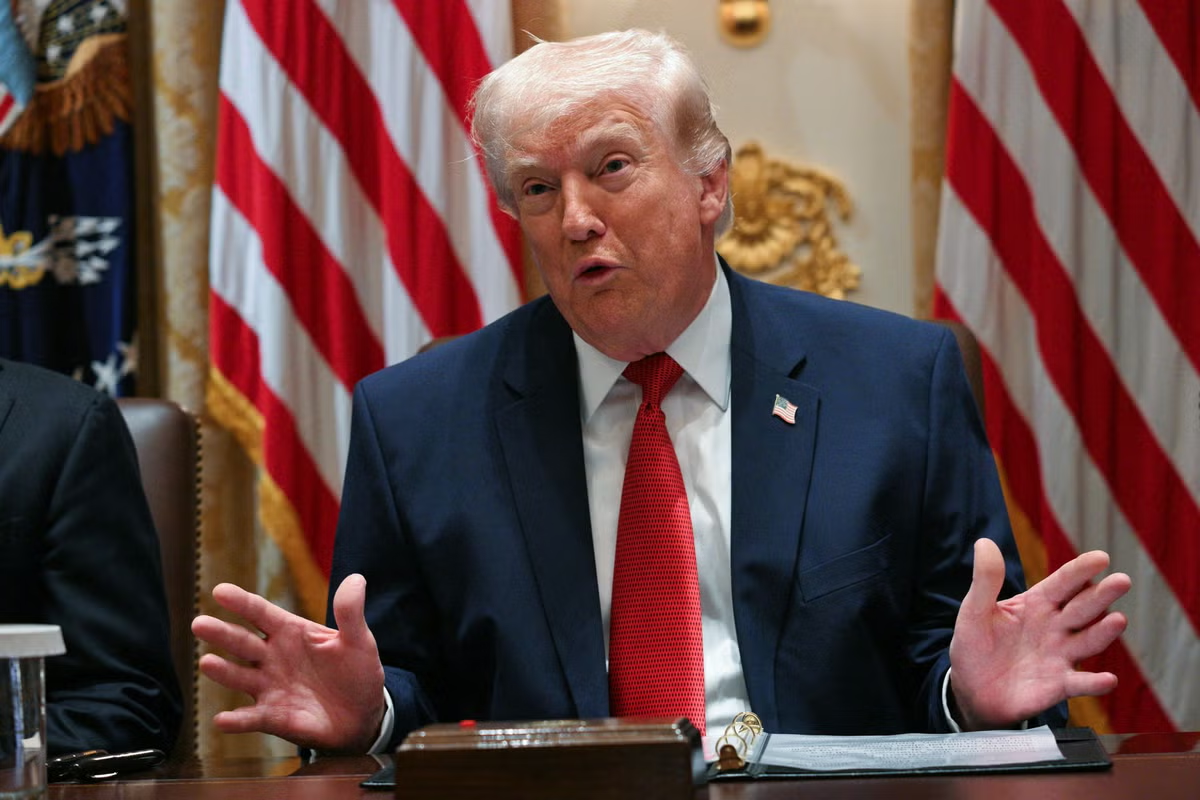
Trump claimed Biden’s secretary of state supported his attacks on Iran. Antony Blinken says that didn’t happen
“I’ve heard that today Blinken made a statement that he should have done it. Thanks a lot Blinken, I appreciate it”, Trump said. “But he came out with the statement that they should have done it, they made a mistake”.
Blinken took to X Thursday, writing that Trump “cited me as supporting his attack on Iran and expressing regret we didn’t do it during the Biden Administration. Except I didn’t”.
Rachel Dobkin27 March 2026 02:00
Advertisement
No press conference with Pete Hegseth scheduled this week
There will be no press conference with US Defense Secretary Pete Hegseth and General Dan Caine, the chairman of the Joint Chiefs of Staff, this week, the Pentagon said, per The New York Times.
Admiral Brad Cooper, the leader of U.S. Central Command, did give a video update Wednesday, in which he said American forces have hit more than 10,000 military targets since the Iran war began more than three weeks ago.
Rachel Dobkin27 March 2026 01:45
Advertisement
In pictures: A woman holds a portrait of Iran’s late Supreme Leader during a protest outside Iran’s embassy in Beirut, Lebanon
In pictures: A woman holds a portrait of Iran’s late Supreme Leader during a protest outside Iran’s embassy in Beirut, Lebanon
Protesters outside Iran’s embassy in Beirut, Lebanon (AP)
Bryony Gooch27 March 2026 01:30
‘It’s Orwellian’: The information war being waged to keep the ‘Dubai dream’ alive
It was the influencer capital of the world, a photogenic playground for the young, glamorous and wealthy. But as Iranian missiles fall on Dubai, the largest and most ostentatiously luxe city in the United Arab Emirates, the facade seems about to crack.
Advertisement
The city once touted as one of the safest places in the world is no longer a peaceful haven. And the UAE government has rushed to try and control the narrative, prompting a huge crackdown on anyone sharing photos of missile attacks and their aftermath. Instead, content creators have been posting uncannily similar photos and videos full of praise, parroting buzzwords about the city’s strong, stable leaders.
How can influencers continue to portray the “Dubai dream” online, when the whole world knows that the city has been mired in conflict? And what about the ordinary people who are being detained for sharing photos and videos that go against the official line?
Katie Rosseinsky has the story…
Bryony Gooch27 March 2026 01:00
Advertisement
Trump considers sending another 10,000 troops to Middle East: report
US President Donald Trump is considering sending another 10,000 troops to the Middle East amid the Iran war, The Wall Street Journal reported Thursday night local time, citing US defense officials.
The potential deployment would probably include infantry and armored vehicles, according to the publication.
The Independent has reached out to the Pentagon for comment.
Advertisement
The US has already sent thousands of Marines and paratroopers to the region to help with the war effort.
Rachel Dobkin27 March 2026 00:45
JD Vance meeting with Qatar’s prime minister: report
US Vice President JD Vance is currently meeting with Qatar’s Prime Minister Sheikh Mohammed bin Abdulrahman Al Thani, NewsNation White House Correspondent Libbey Dean has reported, citing an unnamed source.
Advertisement
“A range of foreign policy issues are expected to come up, including Iran and Gaza — with talks focused on defense cooperation, protecting energy infrastructure, and collaborating on freedom of navigation, per source”, Dean wrote on X Thursday night.
Rachel Dobkin27 March 2026 00:30
UK faces biggest hit to growth from Iran war of all major economies, OECD warns as inflation set to surge
Bryony Gooch27 March 2026 00:00
Advertisement
Pentagon prepares for massive ‘final blow’ of Iran war
The Pentagon is developing military options for a “final blow” in Iran that could include the use of ground forces and a massive bombing campaign, two US officials and two sources with knowledge told Axios.
The news outlet reported four potential “final blow” options Trump could choose from:
Invading or blockading Kharg Island, Iran’s main oil export hub.
Invading Larak, an island that helps Iran solidify its control of the Strait of Hormuz. The strategic outpost hosts Iranian bunkers, attack craft that can blow up cargo ships and radars that monitor movements in the strait.
Seizing the strategic island of Abu Musa and two smaller islands, which lie near the western entrance to the strait and are controlled by Iran but also claimed by the UAE.
Blocking or seizing ships that are exporting Iranian oil on the eastern side of the Hormuz Strait.
Bryony Gooch26 March 2026 23:01
Advertisement
Trump lashes out at Nato again and claims alliance has done ‘absolutely nothing’ to help in Iran
Despite reports of negotiations between the US and the Iranian regime, the Strait of Hormuz remains effectively closed to most oil tankers, with only a small number of vessels being allowed to pass. The result is a loss of roughly 11 million barrels per day (mbd) of oil and petroleum liquids to the global market. This represents just over 10% of global supply.
At first glance, a 10% disruption may not sound catastrophic. But in oil markets, even a 10% imbalance between supply and demand can have very large economic effects.
To understand the scale of the disruption, it is useful to compare it with the height of the COVID pandemic in 2020. During global lockdowns, empty roads, grounded aircraft and deserted bus and railway stations became normal as travel and economic activity collapsed. At that time, global oil demand fell by about 8mbd, the largest demand shock in history.
Today’s situation is the opposite. Instead of a collapse in demand, the world is experiencing a large supply shock. But the impact on everyday life could end up looking similar: reduced travel, higher transport costs, slower economic activity and pressure on household budgets.
Advertisement
The reason is that both oil supply and oil demand are very inflexible in the short term. People still need to drive to work, goods still need to be transported and aircraft still need fuel. When supply falls suddenly, prices must rise significantly to force demand down.
For now, the release of emergency oil stocks is helping to cushion the initial impact, particularly in developed economies. Members of the International Energy Agency (IEA) are required to hold emergency stocks equivalent to at least 90 days of oil consumption, and several countries also maintain strategic petroleum reserves.
Countries such as the US, China and Japan can therefore offset supply disruptions for a limited period. However, these reserves are not a long-term solution. If the conflict continues for months rather than weeks, stockpiles will be depleted.
Advertisement
The situation is much more serious for developing countries. Many countries in Asia, Africa and South America hold very limited commercial reserves and are much more vulnerable to supply disruptions and price spikes. For these economies, elevated oil prices quickly translate into higher food prices, inflation and economic instability.
The first shortages would probably appear not in petrol, but in diesel and jet fuel. Gulf oil producers are major exporters of middle distillates, and their crude oil grades produce large quantities of diesel and jet fuel when refined.
Jet fuel could be one of the first commodities to be hit. Benjamin_Barbe/Shutterstock
Diesel is particularly important because it fuels trucks, ships, construction equipment and agricultural machinery. So a diesel shortage affects food supply, construction, mining and global trade – not just transport. Petrol shortages would follow as crude oil supply tightens further, and eventually shortages would spread across all petroleum products.
Advertisement
Oil is not just used for transport fuel. It is also a key input into petrochemicals for the production of plastics, fertilisers, chemicals, synthetic materials and many industrial processes. This means the effects of a major oil supply disruption spread across the entire economy.
Shortages or price increases could affect everything from food production and packaging to electronics, construction materials and clothing. The economic effects of an oil shock are therefore much broader than simply higher petrol prices.
Protectionism could make everything worse
One of the biggest risks during a supply crisis is export restrictions and protectionism. Governments often try to protect domestic consumers by freezing prices and banning exports of fuel or crude oil, but this usually makes the global shortage worse.
Government price freezes only discourage production and supply, and encourage consumers to keep burning fuel. Protectionism is even worse. There are already signs of this happening – some countries (China, for example) are restricting exports of petroleum products such as diesel and jet fuel. When countries hoard fuel, global markets become tighter and prices rise even further.
Advertisement
The biggest risk would be if the US restricted oil exports in order to protect domestic consumers. The US is now the world’s largest oil producer, producing more than 20mbd of oil and petroleum liquids. But it is also one of the world’s largest consumers. However, it still exports significant volumes, particularly to Europe.
The US has banned oil exports before. In 1975, following the Arab oil embargo (when in 1973 Arab states refused to supply oil to countries, including the US, that had supported Israel in the Yom Kippur war), the US banned exports of crude oil. The ban was lifted only in 2015. If such a ban were introduced today, it would be likely to cause major supply shortages and price increases, especially in Europe.
If the Strait of Hormuz remains closed for a prolonged period, or if the conflict escalates further, global losses of exports from the Persian Gulf could approach the 20mbd of oil and petroleum products.
Under these circumstances, the economic and social effects could be severe. Transport could become more expensive and less frequent, air travel would be severely curtailed, inflation would rise and economic growth would slow significantly. In extreme scenarios, the disruption to daily economic life could resemble the COVID period (and probably worse). But this time it would be caused by a shortage of energy.
Advertisement
For now, markets are relying on emergency stock releases and hopes of a geopolitical de-escalation. But if not, the world economy could face an unprecedented energy shock, with far-reaching and unpredictable consequences.
The British heavyweight phenom steps up for what should be the toughest test of his professional career to date as he continues on his rapid ascent to boxing superstardom.
Now fully recovered from a bicep tear suffered while sparring, the big-hitting southpaw, 21, is ready to deliver another emphatic statement in what he has called the “final piece of the puzzle” before eyeing huge fights and world title opportunities.
He ruthlessly dispatched of Mike Balogun in two rounds in Glasgow before that as part of a nine-fight streak of early stoppages that also included vanquishing the likes of Demsey McKean and Mariusz Wach.
Itauma is expected to face a trickier challenge against Franklin, the tough and durable American heavyweight who has never previously been stopped in his 26-fight career.
Advertisement
The 32-year-old is 24-2 overall, with his only losses to date coming in consecutive outings in London in 2023.
Moses Itauma stopped Dillian Whyte inside the first round in his last fight
Getty Images
He has only fought three times since then, outpointing Isaac Munoz Gutierrez and two-time Olympic bronze medalist Ivan Dychko, either side of stopping Devin Vargas.
Advertisement
Itauma vs Franklin fight date and venue
Moses Itauma vs Jermaine Franklin takes place on Saturday March 28, 2026 at the Co-op Live arena in Manchester, England.
Itauma vs Franklin fight time and ring walks
Saturday’s undercard begins at 5pm GMT (1pm ET and 10am PT), with the main event expected to get underway around 11pm (7pm ET and 4pm PT).
Advertisement
How to watch Itauma vs Franklin
TV channel and live stream: The Magnificent 7 show is being broadcast live and exclusive in the UK via DAZN.
It is part of the regular DAZN subscription and not through their pay-per-view service.
Live blog: Follow the action as it happens with Standard Sport’s live blog on fight night.
Advertisement
Itauma vs Franklin undercard
Moses Itauma vs Jermaine Franklin
Nathan Heaney vs Gerome Warburton
Ezra Taylor vs Willy Hutchinson
Advertisement
Shakiel Thompson vs Brad Pauls
Liam Davies vs Francesco Grandelli
Alex Murphy vs Josh Holmes
Michael Gomez Jr vs Jordan Flynn
Advertisement
Nelson Birchall vs Ryan Griffiths
John Joe Carrigan vs Danny Costello
Billy Deniz vs Grant Dennis
Aadam Hamed vs Michael Mooney
Advertisement
Itauma vs Franklin prediction
On paper at least, this should be the most difficult night of Itauma’s explosive career so far.
However, that is certainly not saying much. Aside from early dominant six-round points wins over Kostiantyn Dovbyshchenko and Kevin Nicolas Espindola, he has delivered devastatingly swift knockouts of every opponent he has faced to date.
There is a reason why the likes of the returning Fury want nothing whatsoever to do with fighting Itauma, who has racked up only 26 rounds in 13 pro bouts.
Advertisement
Anthony Joshua was made to work hard by Jermaine Franklin back in 2023
Getty Images
He has only gone past the second round twice, the last of those was nine fights ago in 2023.
Franklin is a tough and durable customer who has never been stopped and acquitted himself well against both Whyte and Joshua, but is about to face a very different prospect altogether.
He might be make to work slightly harder for it, but we’re still anticipating another formidable stoppage from Itauma comfortably in the first half of the fight.
Advertisement
Having said that, some crucial rounds under the belt would be no bad thing if it was to go on longer.
Itauma to win by knockout.
Itauma vs Franklin latest odds
Itauma to win on points or by decision: 10/3
Advertisement
Itauma to win by knockout, technical knockout or disqualification: 3/10
Franklin to win on points or by decision: 25/1
Franklin to win by knockout, technical knockout or disqualification: 14/1
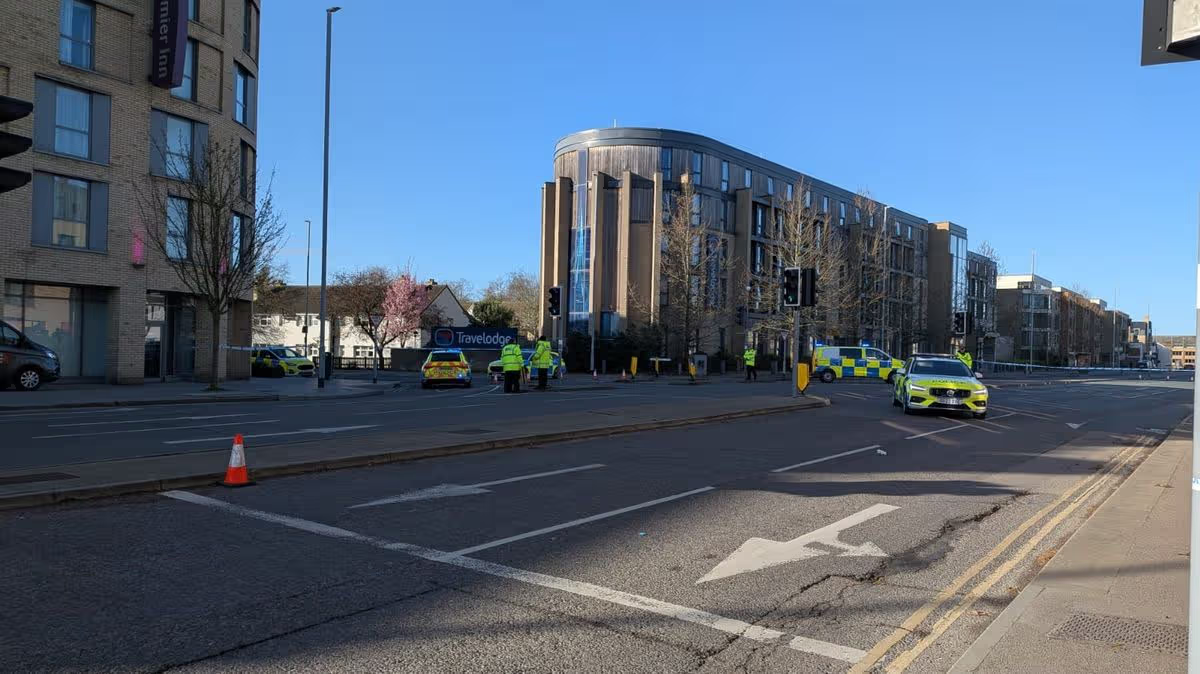
The rider of the e-bike, a 31-year-old man from Cambridge, suffered life-threatening injuries and was taken to Addenbrooke’s Hospital. He remains there in a critical condition.
The man’s passenger, a 34-year-old woman from Cambridge, suffered serious injuries and was taken to the same hospital. She is in a serious, but stable condition.
The driver of the Seat Leon failed to stop at the scene. A police spokesperson said: “However, at just before 2am, three people were arrested on suspicion of perverting the course of justice – a 19-year-old man from Luton and two 21-year-old men from High Wycombe, Buckinghamshire – and are in custody at Parkside Police Station in Cambridge.
“An investigation has been launched and officers are keen to hear from anyone who may have witnessed either vehicle before the collision, anyone with relevant dash cam footage, or anyone with any information.”
Advertisement
Anyone with information should call police on 101 and quote Operation Azazel or incident 7 of March 26.
The conflict in Iran and the disruption to the strait of Hormuz are already starting to affect UK farmers. The closure of this vital shipping route threatens supplies of two essential agricultural necessities: fuel and fertiliser.
The immediate impact on farmers has been a sharp increase in the cost of red diesel – the rebated fuel widely used in agriculture – which has already risen by approximately 60%, far outpacing increases seen at retail fuel pumps for car owners.
Concerns for farmers include the cost of fertiliser, particularly nitrogen. As the key nutrient driving growth in two key crop groups grown extensively in the UK, cereals and oilseeds, nitrogen is essential for achieving high yields. A wheat crop may require over 200kg per hectare during the growing season, depending on soil conditions, weather, and yield expectations.
The UK imports around 60% of its nitrogen fertiliser. Although much of this supply does not originate directly from the Middle East, global market dynamics mean prices are highly sensitive to disruptions. Around one-third of the global fertiliser trade passes through the strait of Hormuz, contributing to price increases of approximately £50 per tonne, compared to early 2025, and is expected to rise more if the conflict continues.
Advertisement
UK fertiliser traders are finding prices are changing so fast that they can’t update their daily lists. The NFU president Tom Bradshaw has raised concerns about farmers not being given a confirmed price until stocks are delivered.
While most farmers buy fertiliser in bulk ahead of the growing season, the longer-term outlook is already a concern.
Much will depend on the duration of Middle Eastern tensions and whether the strait reopens in time for fertiliser purchasing decisions this autumn, ready for next year’s crops.
Unlike the 2022 fuel price shock following the invasion of Ukraine – which was partially offset by higher commodity prices – current market conditions offer little expectation of improved crop prices.
Advertisement
Difficult calculations
Farmers are, therefore, being forced into difficult calculations: weighing the cost of nitrogen against likely crop prices, reassessing how to balance the crop’s agrochemical inputs, including fertiliser, and awaiting clarity on the future of Environmental Land Management Schemes (Elms). Elms are government schemes in England aimed at supporting farmers to make environmentally beneficial changes to their land.
Even before the current conflict started, industry bodies such as the National Farmers’ Union had raised concerns about the viability of arable farming under sustained cost pressures.
The government has also acknowledged these challenges, commissioning the Competition and Markets Authority (CMA) to investigate supply issues affecting fertiliser and agricultural fuel. The CMA has said it will monitor price rises caused by the current international conditions. In response to the crisis, the UK government has just announced proposals to support more varied types of fertiliser.
Advertisement
All these factors raise broader concerns for the UK, where food self-sufficiency stands at around 62% – a potentially precarious position in an increasingly uncertain global landscape.
Farming landscape
UK crops are currently looking generally robust, after a strong autumn with ideal conditions for sowing winter crops and a favourable start to spring. Early signs point to a promising 2026 harvest.
But optimism is tempered by ongoing economic pressure. Farm gate prices (the price if a customer bought direct from a farmer) remain stubbornly low, as UK farmers compete with imports produced under lower environmental and regulatory standards
Simultaneously, the transition away from legacy EU support payments has left a significant income gap. Replacement schemes under the Environmental Land Management Schemes were paused in 2025 and are only expected to resume later this year, creating further uncertainty.
Advertisement
The Department for Environment, Food and Rural Affairs (Defra) latest figures forecast average arable farm income fell to £17,000 in the year to February 2026 – the lowest level since 2004–05. The drop reflects a mix of difficult seasonal conditions and global oversupply in key crops such as cereals and oilseeds. Dairy farm income was much higher at £224,000 for the same period.
Fertiliser shortages are set to hit farmers around the world.
The industry is rapidly embracing innovation and the government is backing farmers with measures to strengthen fertiliser supply resilience. Together with rising costs, these shifts have helped drive a 50% reduction in nitrogen use over the past four decades.
Precision agriculture (which uses technology to refine decisions) has boosted efficiency further, enabling farmers to tailor fertiliser use to the needs of specific fields.
Advertisement
There are other potential innovations that could help. Tesco for example, is working with farmers and manufacturers to develop lower-carbon fertilisers made from food waste, algae, poultry manure, and industrial by-products.
Global fertiliser markets may be volatile, but in the short term shoppers are unlikely to see that uncertainty reflected in everyday food prices. A 2022 Sustain report, found that farmers often receive less than 1% of the profit from supermarket sales, meaning their tiny share leaves little room for fertiliser costs to influence the final price on the shelf. For now, any rise or fall in the price of bread, flour, cakes or biscuits is far more likely to come from supermarket pricing tactics or broader supply‑chain pressures than from shifts in global fertiliser markets.
That’s not to say fertiliser costs never filter through – a prolonged conflict could still nudge prices up for shoppers. Crops respond dramatically to fertiliser levels, so even modest reductions in nitrogen use can produce disproportionately large declines in yield. All that could translate into thousands of tonnes of lost crops, which would make food more expensive in the future.
A man was arrested after assaulting a woman during a concert (Picture: Getty Images/iStockphoto)
A 26-year-old man has been arrested after allegedly sexually assaulting a woman in the middle of the crowd during a show at London’s O2 Arena.
The woman, whose identity is being protected, was with friends in the standing area of rapper Gunna’s concert on Wednesday, March 25.
In a video posted on social media, a man can be seen approaching her from behind as she sang along, seemingly unaware of him.
She said her ‘whole experience’ at the show had been ‘ruined’, sharing she spent the whole day crying because she keeps ‘reliving’ the incident.
Advertisement
Security and officers at the major music venue were alerted to the assault and took a man into custody at the scene.
A spokesperson for the Metropolitan Police told Metro: ‘A man has been arrested following a sexual assault in south London.
The incident was reported during Gunna’s O2 Arena gig on Wednesday (Picture: Simone Joyner/Getty Images for ABA)
‘At around 20:20hrs Wednesday, 25 March, police were called to the O2 Arena in Greenwich by venue management. A woman, aged in her 20s, was approached from behind by a man, who sexually assaulted her.
‘Officers were already at the venue, and swiftly arrested a 26-year-old man who had been apprehended by venue staff. He was taken into custody, suspect has not yet been bailed.’
The spokesperson added that the woman was ‘receiving support from specially-trained officers’.
Advertisement
‘The Met is prioritising the safety of women and girls across London,’ they said. ‘Officers continue to work closely with venues to provide awareness training for staff, and we have expanded specialist teams across domestic abuse, stalking and sexual violence to ensure a dedicated response.’
Meanwhile, the O2 Arena told us this was an ‘isolated incident’, which had been ‘promptly’ attended by the venue security and police.
Gunna will play one more show in London later this month (Picture: Simone Joyner/Getty Images for ABA)
In a statement, the venue added: ‘The matter is now being handled by the Metropolitan Police. Our priority is always the safety and wellbeing of our guests and we are assisting with their enquiries.’
Gunna has not addressed the incident publicly, with his tour continuing in Manchester tonight before heading to Amsterdam for two shows.
He’ll return to the O2 Arena for one final concert on March 31, marking the end of his Wun World Tour.
Advertisement
The rapper rose to fame in 2018 with his mixtape Drip Season 3, releasing his debut studio album the following year.
In 2020, Gunna was nominated for best rap or sung performance at the Grammys and released his latest album The Last Wun in August 2025.
Metro has reached out to Gunna’s team for comment.
Got a story?
Advertisement
If you’ve got a celebrity story, video or pictures get in touch with the Metro.co.uk entertainment team by emailing us celebtips@metro.co.uk, calling 020 3615 2145 or by visiting our Submit Stuff page – we’d love to hear from you.
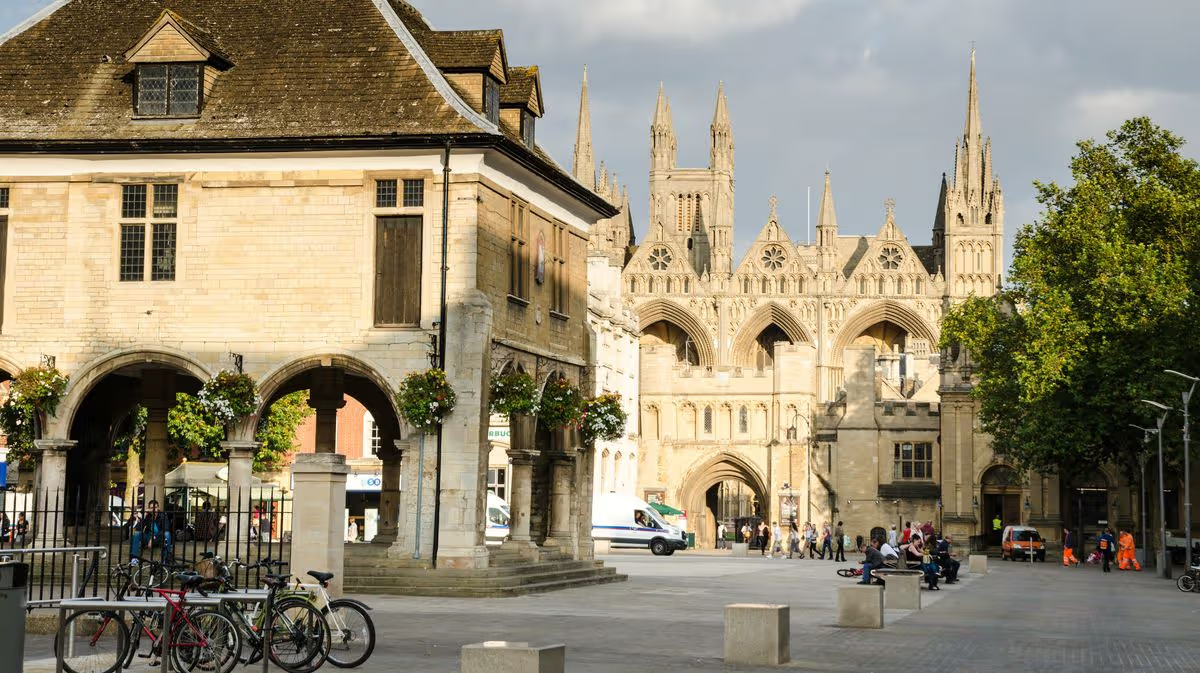
It’s hoped public toilets would make the city centre more appealing and accessible for people
Public toilets are set to make a return to the city centre – but they may not be on Cathedral Square. The long-standing issue of access to public conveniences was raised at Peterborough City Council’s monthly Cabinet meeting on March 24 by Councillor Mohammed Jamil.
Advertisement
The Cabinet Member for Finance & Corporate Governance asked to seek reassurance around toilet provision following Cllr Mohammed Farooq’s presentation outlining plans to establish a Peterborough City Centre Growth Board.
Cllr Jamil said: “One of the things we’re often criticised for is that the previous administration took away all the public toilets [in the city centre]. Can you just reassure me that there are plans to bring those back because people need these facilities?”
Adrian Chapman, Executive Director for Place and Economy said: “Cllr Farooq mentioned the Pride of Place impact fund… and one of the biggest impacts we think needs to be made is in toilet provision.”
Mr Chapman suggested new public toilets would join enhancements to Cathedral Square and the Guildhall in helping to make the city centre a more appealing place for both residents and visitors to enjoy.
Advertisement
“I’m not suggesting toilets will sit on Cathedral Square,” he added, “but I think we can combine all of that into one single project.”
Cabinet Member for Housing and Regulatory Services, Cllr Christian Hogg said: “How long do you think it will be before we see something happening with… toilet facilities in our town centre?”
Adrian Davey, the council’s Interim Service Director of Regeneration & Growth said: “The Pride of Place [fund]… is a quick, immediate programme to make differences now.”
Cllr Hogg pressed Mr Davey on the actual length of time it will take to see new toilet provision made available, voicing concerns that some other local development projects are likely to take a decade or more to complete.
Advertisement
He asked: “Are we having to wait 15 years for a toilet? Do we have to keep our legs crossed for that long?”
Adrian Chapman reassured cabinet members that more detailed information about city centre regeneration will be made available in the coming days.
Ferryhill Town Council recruited the new councillors following a recent campaign and invited all three to a special council meeting on March 11.
At the meeting, they each gave a five-minute presentation about their background, experience and reasons for wanting to serve on the council.
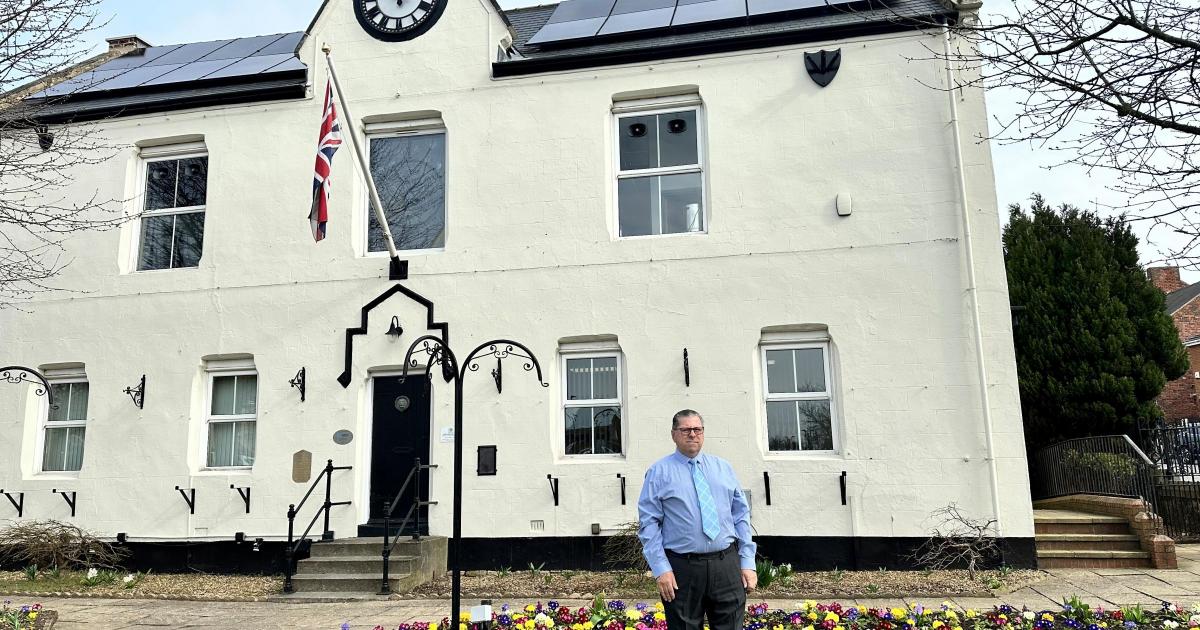
Councillor Keith Lloyd (Image: Supplied)
Cllr Anthony Hewitt said: “I have met some really wonderful people since moving to Ferryhill.
“How welcoming and kind they have been and how many people work so hard to help the community.
Advertisement
“So I decided it was time that I stood up and did my part in trying to make Ferryhill a better place to live for all its residents.”
Cllr Keith Lloyd said: “I am very happy to join the Ferryhill Town Council as a Councillor for the Broom ward.
“I have lived in Ferryhill for 72 years, and think it is time to give something back to this community.”
The third new member, Cllr Liam Fellows, was not available to have his photograph taken; however, he shared his reasons for returning to the council.
Advertisement
Cllr Fellows said: “I was really sad to see so many vacancies on the Town Council following the local elections last May and that they hadn’t managed to be filled since.
“I really enjoyed my time on Ferryhill Town Council previously so thought I’d once again offer my service.”
He said he is committed to improving council facilities, services for residents and communication with the public.
Cllr Fellows said: “I’m passionate about improving the Councils facilities, what it provides for residents in the town and how the council communicates with the community.
Advertisement
“Hopefully working with the rest of the council and officers, we can strive to make these improvements.”
Anyone interested in learning more about becoming a town councillor can contact Leeanne Owens, the Town Clerk, for further information.
















































You must be logged in to post a comment Login