Connect with us
DAPA Banner
DAPA Coin
DAPA
COIN PAYMENT ASSET
PRIVACY · BLOCKDAG · HOMOMORPHIC ENCRYPTION · RUST
ElGamal Encrypted MINE DAPA
🚫 GENESIS SOLD OUT
DAPAPAY COMING

Tech

Meta’s next smart glasses sound like a treat for humans stuck with prescription lenses

Published

on

For the billions of people who rely on corrective glasses every day (including me), smart glasses have always been a slightly awkward conversation. Sure, you can already pick up Ray-Ban Meta frames with your prescription built in, but it looks like Meta has something better in store for us. 

According to a Bloomberg report, Meta is working on two new AI glasses designed specifically for prescription wearers rather than treating them as an add-on afterthought. The models could arrive in rectangular and rounded frame styles. Unlike current offerings, they will be sold through conventional prescription eyewear retailers. 

Will the new prescription-friendly glasses look any different?

This could be the first time the Meta and Ray-Ban collaboration has directly aimed its vision-corrected crown at the primary audience. However, that is the extent of the information the outlet provides. There’s no word on how the frames might differ physically from the current models. 

However, if I were to speculate, it could have something to do with the lens housing, thickness, and the weight of the glasses. 

Beyond the hardware, I feel, what would truly make the purported AI glasses prescription-friendly is the ability to talk to any neighbourhood optician and have them work on it. That kind of accessibility could really make the glasses prescription-friendly. 

Advertisement

What else do we know about Meta’s upcoming smart glasses?

The Verge separately flagged FCC listings for the purported glasses internally codenamed “Scriber” and “Blazer.” Both are listed as production units, which typically signals a launch isn’t quite far off. A detail that stands out is that Blazer might come in a larger size than Scriber. 

Both models should also support Wi-Fi 6 UNII-4 band, something that the current Ray-Ban smart glasses lack. It would open the door to faster data transfer, and perhaps to livestreaming. Anyways, no display is expected on either model. 

What’s clear, however, is that Meta is eyeing prescription wearers as the biggest untapped market for its smart glasses.

Source link

Advertisement
Continue Reading
Click to comment

You must be logged in to post a comment Login

Leave a Reply

Tech

We Asked the ‘Future of Truth’ Author to Explain How He Used AI. It Didn’t Go Well

Published

on

Earlier this month, WIRED published an excerpt from Steve Rosenbaum’s buzzy new book, The Future of Truth, which looks at how artificial intelligence warps people’s sense of reality. Shortly thereafter, The New York Times reported that the book contained over a half-dozen made-up or misattributed quotes. In a statement, Rosenbaum, who has a master’s degree in “truth” from New York University, admitted that he had accidentally included “a handful” of “improperly attributed or synthetic” quotes. In an ironic twist, the veracity of a book about how AI impacts truth was now under intense scrutiny because of how its author had used AI.

After the Times story broke, WIRED took another look at our 1,450-word excerpt. The fact-checking team had reviewed it prior to publication, and we reconfirmed that its quotes and facts were accurate. But WIRED’s generative AI editorial policy prohibits the publication of AI-generated and AI-edited writing, and a reader email calling out the excerpt as being “blatantly AI-written” raised further questions about the extent to which Rosenbaum had used AI tools. In The Future of Truth’s acknowledgement section, Rosenbaum writes that ChatGPT, Claude, NaturalReaders, ProWritingAid, and Grammarly had helped “refine and polish the presentation of [his] ideas.” What, exactly, did that mean?

WIRED ran the excerpt through several AI-detection services, including Pangram, GPTZero, and ZeroGPT. Each service suggested that it was either likely AI-generated, or AI-generated with high confidence. But AI-detection tools are fallible, and can return inaccurate readings. So WIRED’s head of research emailed Rosenbaum directly to ask if and how he had used AI to write the excerpt.

He wrote back: “Like many writers working today, I used AI tools during parts of the research and editorial development process for the book, including source discovery, brainstorming, structural feedback, and language refinement.” But, he stressed, “the ideas, reporting, arguments, and final authorship are mine, and the WIRED excerpt was not generated by AI and then simply published as-is.” He urged WIRED’s editors to exercise caution trusting AI detection tools, noting that false positives can occur.

Advertisement

At this point, WIRED’s senior editors asked me to look into the episode, because I’ve covered AI slop in its various forms since 2024. My first step was to run the entire text of the book through Pangram’s detection tool. (While all AI-detection tools have limitations, and can show false-positives, Pangram is the current gold standard.) It came back that the book appeared to be 53 percent AI-generated, with an additional 9 percent registering as likely AI-assisted.

I called Rosenbaum and asked for a more detailed description of how he’d used AI to write the book, and whether he disputed Pangram’s results. (BenBella Books, whose imprint published The Future of Truth, did not return requests for comment. Simon & Schuster, which distributes BenBella’s books in the United States, declined to comment.)

Rosenbaum would not weigh in on the accuracy of Pangram’s results. In fact, he didn’t want to talk about them at all. “I don’t participate in that conversation,” he said. “It’s like saying, do you beat your wife? It’s one of those accusations that there’s no response to.”

He offered, instead, to broadly explain his editorial process. He says that at the beginning of the writing process, he used AI tools as search engines, helping him surface information for the more research-heavy sections of the book. To demonstrate how he might do this, he asked ChatGPT to describe me, then read the results out loud. The AI search more or less accurately described some of my prior stories, including work on AI-generated “zombie media sites.”

Advertisement

Source link

Continue Reading

Tech

Nintendo quietly launched a new game that’s just like WarioWare, and you can try it for free

Published

on


  • Nintendo has released a new mobile game
  • It’s called Pictonico! and it’s a minigame collection similar to the WarioWare titles
  • The game is free to start and available for both iOS and Android devices

Nintendo has launched a new mobile game out of the blue, and it’s pretty similar to the WarioWare series.

The game is called Pictonico! and it’s a minigame collection that uses photos of people from your phone’s gallery in up to 80 rather amusing minigames. These range from chomping on dragging on someone’s mouth to force them to devour fruit to plucking their nose hairs.

Source link

Continue Reading

Tech

iPhone leaks, Apple Vision Pro gaming, and the Ferrari Luce

Published

on

You thought the Apple Vision Pro was expensive, but now you could choose between buying 180 of the headset, or one Ferrari Luce designed by Jony Ive. Or you could just enjoy the good, the bad, and the sometimes silly iPhone rumors that came out this week, on the AppleInsider Podcast.

It is the run-up to WWDC and it’s also not really that long until the launch of the iPhone 18 range, so as always we’re now bombarded with rumors and leaks. Some of them are actually likely, though, and some of them look rather good.

Here’s how to sort out the good leaks from the poor or even the downright silly. Plus forget leaks, there’s news for gamers on Apple Vision Pro and it’s something you can play right now.

That’s not something you can say for the Jony Ive-designed Ferrari Luce car. It’s the talk of the week, for its design, for how the Pope was shown one, and for its price.

Advertisement

But even if you happen to have a spare $640,000, you can’t buy Ferrari’s first-ever electric vehicle yet. It will be out sometime by the end of the year, so you’ll have to wait a while before you can go from 0 to speeding ticket in 2 seconds.

BONUS: Subscribe via Patreon or Apple Podcasts to hear AppleInsider+, the extended edition. This time, we’re a pixel away from WWDC, so this is what we’re crossing our fingers for with iOS 27, iPadOS 27, and watchOS 27.

More AppleInsider podcasts

Tune in to our Smart Home Insider podcast covering the latest news, products, apps, and everything HomeKit related. Subscribe in Apple Podcasts, Overcast, or just search for HomeKit Insider wherever you get your podcasts.

Podcast artwork from Basic Apple Guy. Download the free wallpaper pack here.

Advertisement

Those interested in sponsoring the show can reach out to us at: [email protected].

Subscribe to AppleInsider on:

Keep up with everything Apple in the weekly AppleInsider Podcast. Just say, “Hey, Siri,” to your HomePod mini and ask for these podcasts, and our latest HomeKit Insider episode too. If you want an ad-free main AppleInsider Podcast experience, you can support the AppleInsider podcast by subscribing for $5 per month through Apple’s Podcasts app, or via Patreon if you prefer any other podcast player.

Advertisement

Source link

Continue Reading

Tech

The best Mac-friendly monitors in Samsung’s lineup fix Apple flaws

Published

on

A new wave of Samsung monitors is targeting Mac users with OLED panels, Thunderbolt 5 connectivity, and workstation features that Apple still doesn’t offer in its own display lineup.

Samsung’s new lineup includes the 40-inch ViewFinity S8 S85TH, the 32-inch Odyssey OLED G8, and the 27-inch Odyssey OLED G8. The company built the displays for productivity and gaming, while adding features that fit naturally into MacBook, Mac mini, and Mac Studio setups.

Together, the monitors target capabilities Apple still doesn’t offer across its own display lineup.

Apple’s desktop display lineup remains limited to the Studio Display and Pro Display XDR. Apple doesn’t sell an OLED desktop monitor, an ultrawide display, or a monitor with integrated KVM switching and Thunderbolt 5 docking. Samsung’s latest displays target each of those categories.

Advertisement

ViewFinity S8 combines a large workspace with Thunderbolt 5

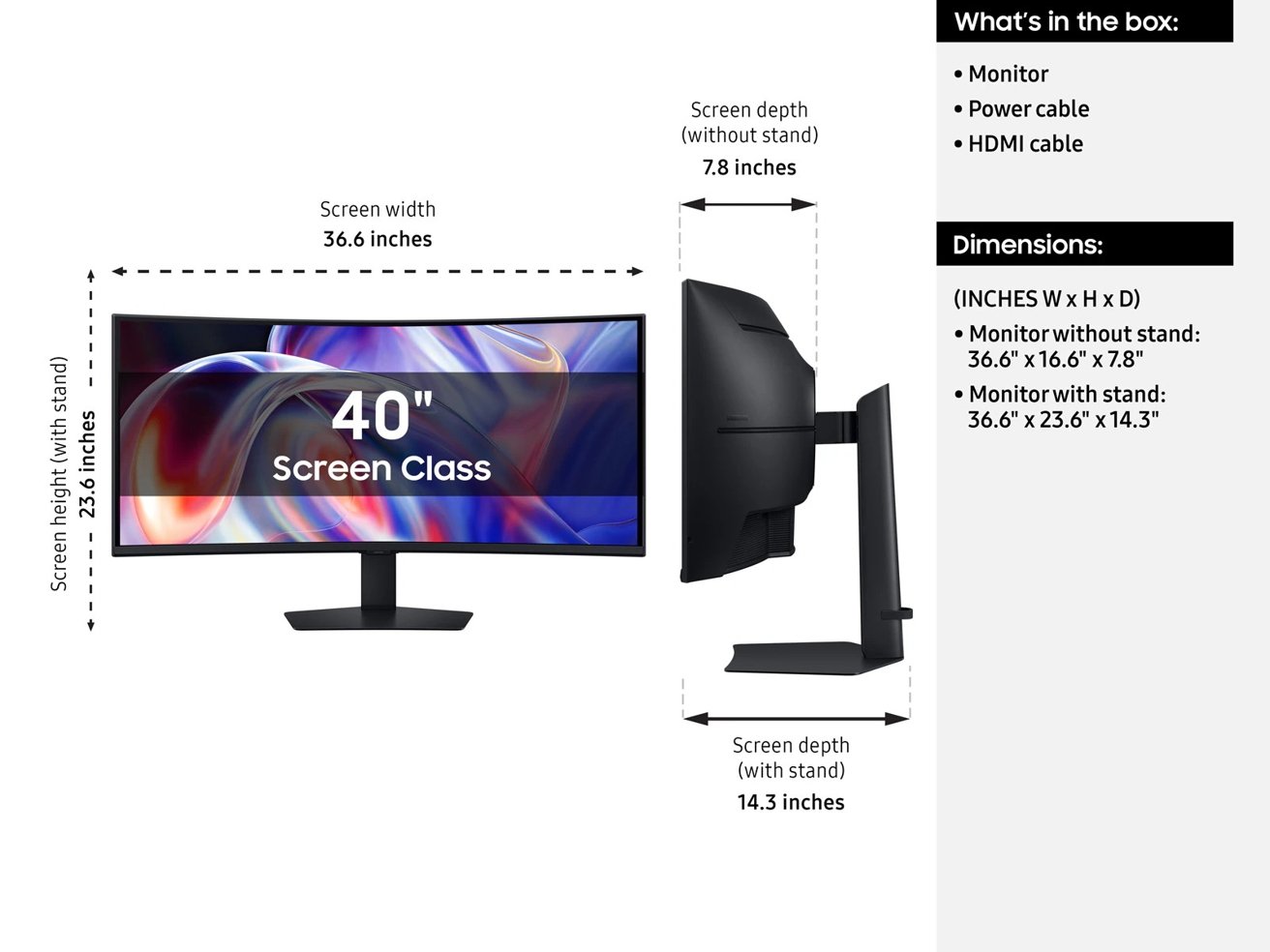
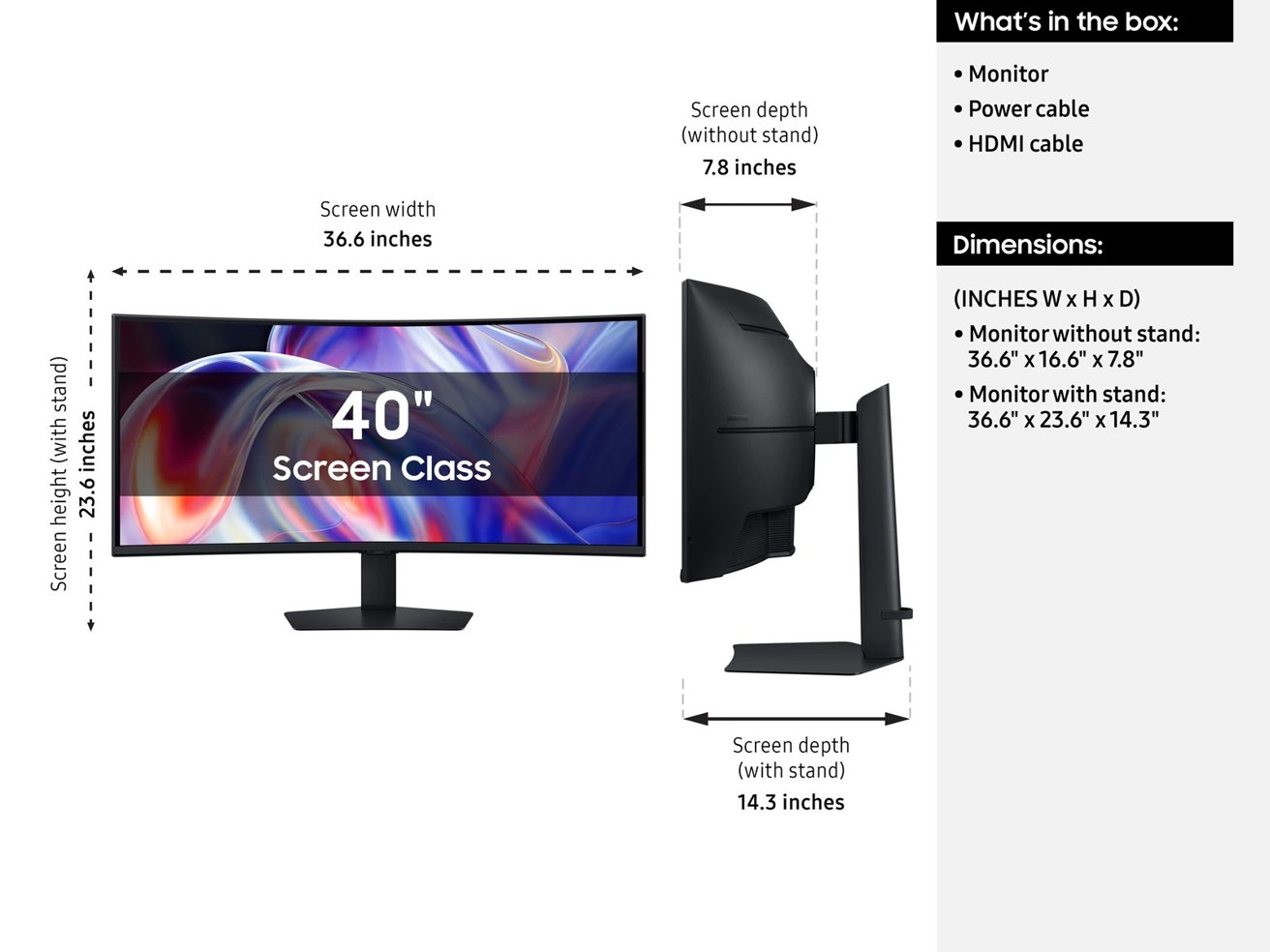
The 40-inch ViewFinity S8 S85TH is built around a curved 5K2K WUHD panel with a 144Hz refresh rate. The extra horizontal resolution creates room for multiple apps and documents without relying on a second display.

Thunderbolt 5 sits at the center of the design. The connection supports up to 80Gbps data transfers and up to 140W charging through a single cable, allowing a MacBook Pro to handle power, video, and data simultaneously.

40-inch widescreen curved monitor on stand, shown front and side, with measurements for width, height, and depth, plus text listing box contents and overall product dimensions40 Inch ViewFinity S8 S85TH 5K2K Curved Monitor (2026)

Samsung built docking features directly into the monitor instead of relying on separate accessories. The display includes Ethernet, USB-C, USB-A, HDMI, and DisplayPort connections, along with built-in speakers.

A built-in KVM switch also lets users control multiple computers with a single keyboard and mouse. For Mac users building a desktop workspace around a notebook, the display can replace a dock, Ethernet adapter, and KVM switch while providing more screen space than Apple’s Studio Display.

Samsung prices the 40-inch ViewFinity S8 S85TH at $1,399.99.

Advertisement

32-inch Odyssey OLED G8 pairs OLED image quality with creator-focused features

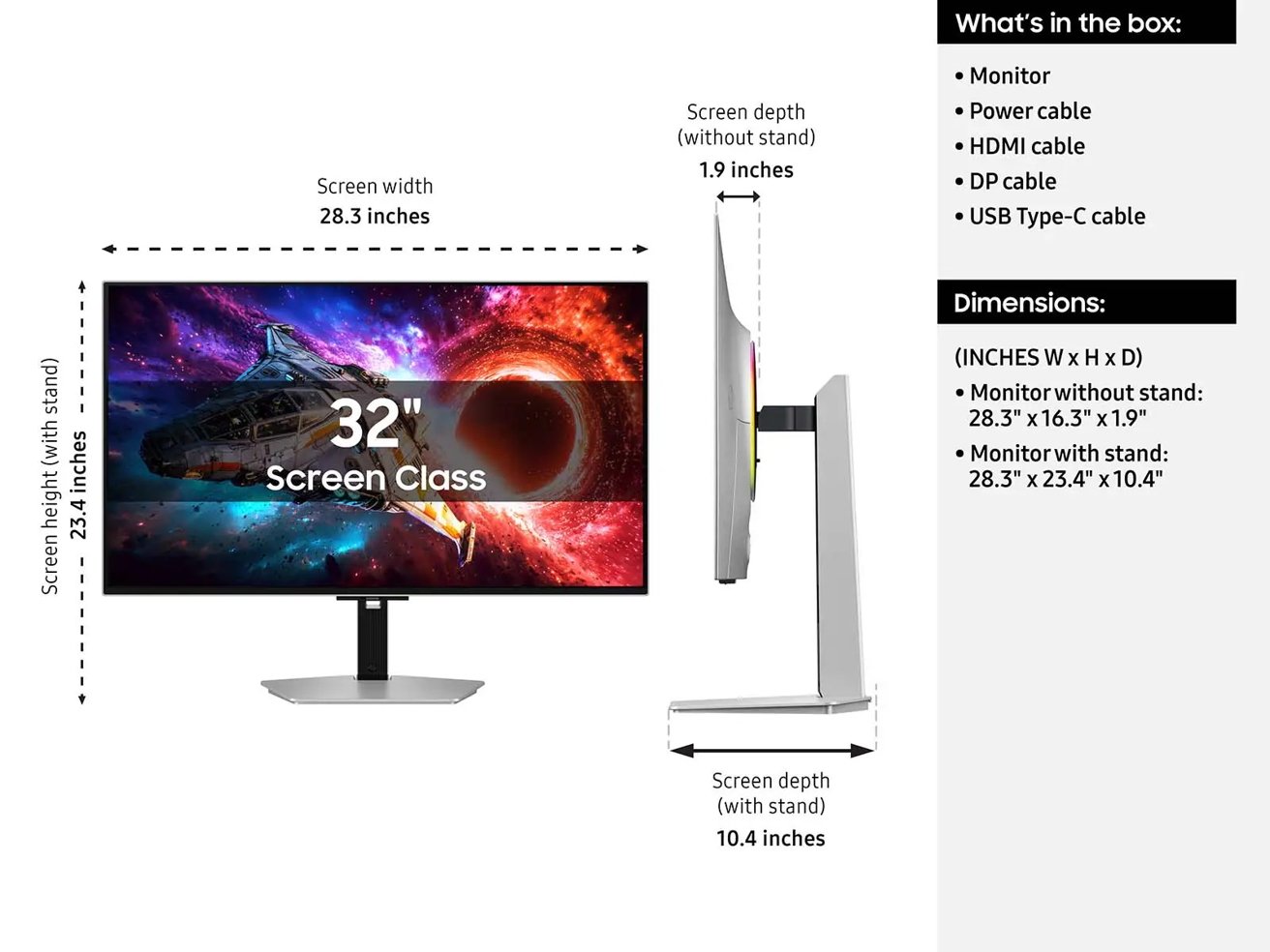
The 32-inch Odyssey OLED G8 combines a 4K QD-OLED panel with a 240Hz refresh rate, a 0.03ms response time, USB-C charging up to 98W, and DisplayPort 2.1 connectivity. The specification sheet reads like a gaming display, but several features extend well beyond gaming.

Pantone validation gives the monitor support for more than 2,100 Pantone colors and 110 SkinTone shades. VESA DisplayHDR True Black 500 certification and peak HDR brightness of up to 1,000 nits push the display beyond gaming.

32-inch computer monitor with thin bezel, space-themed screen, shown front and side. Dimensions and depth labeled, plus list of included items: cables, stand, and monitor.32 Inch Odyssey OLED G8 G80SH 4K Gaming Monitor (2026)

The combination makes the monitor a viable option for photo editing, design work, and video production.

Apple doesn’t offer an OLED desktop monitor. The Odyssey OLED G8 brings OLED contrast and per-pixel lighting control to a category Apple still serves exclusively with LCD displays, while adding refresh rates far beyond Apple’s monitors.

Samsung also includes a glare-reduction coating and support for AMD FreeSync Premium Pro and NVIDIA G-Sync Compatible technologies. The 32-inch Odyssey OLED G8 is priced at $1,299.99.

Advertisement

27-inch Odyssey OLED G8 brings OLED technology to a familiar size

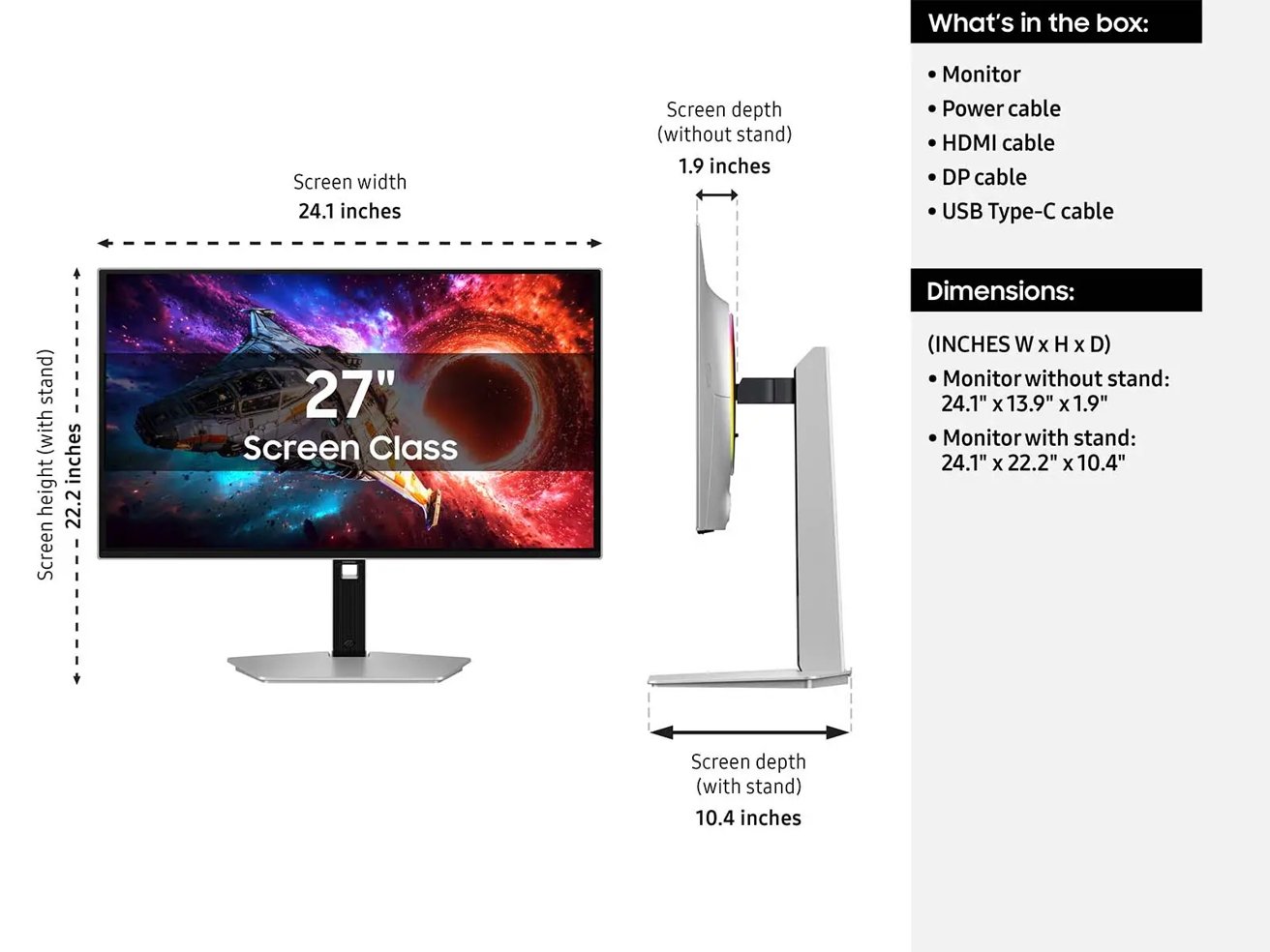
The 27-inch Odyssey OLED G8 brings many of the same technologies as the larger model to a size familiar to Studio Display users. Samsung pairs a 4K QD-OLED panel with its Glare Free coating and OLED Safeguard+ protection features.

The display’s 166 pixels-per-inch density helps it stand out from many gaming-focused competitors. Its higher pixel density also produces a sharper image that’s better suited for productivity and creative work.

27-inch computer monitor showing colorful space scene, front and side views with labeled dimensions, plus text listing included cables, stand depth, and overall monitor width, height, and depth.27 Inch Odyssey OLED G8 G80SH 4K Gaming Monitor (2026)

The 27-inch size also fits naturally into workspaces already designed around Apple’s displays. Users interested in OLED technology without moving to an ultrawide or larger-format monitor may find the smaller Odyssey OLED G8 easier to integrate into an existing setup.

Like the 32-inch model, the display combines OLED image quality with a 240Hz refresh rate and modern laptop connectivity. Samsung prices the 27-inch Odyssey OLED G8 at $1,099.99.

Advertisement

Source link

Continue Reading

Tech

Investigating how hormones affect brain health

Published

on

UL’s Prof George Barreto discusses his research and how it could help form new treatments for treating and protecting the brain.

Prof George Barreto is a professor in cell biology/immunology at the University of Limerick (UL), and a neuroscientist.

Outside the lab, Barreto is the assistant dean for equality, diversity and inclusion (EDI) in UL’s Faculty of Science and Engineering.

“And I teach,” he tells SiliconRepublic.com. “I run some courses for our undergraduate and master’s students, mostly on how the body works, how medicines work (pharmacology) and how cells behave (cell biology).

Advertisement

“So my job is really a mix of three things – running my research lab, teaching the next generation of scientists and helping build a better academic culture.”

Here, Barreto tells us more about his work.

Can you tell us about your current research?

My lab studies how the hormones in our bodies, the ones we usually link to being male or female, affect the brain, and how that differs between men and women. We pay special attention to a tiny part of every cell that acts like its battery or power plant. These are called mitochondria, and these little batteries do not just give our cells energy. They also help decide whether our cells stay healthy or die.

Our hormones have a big influence on how well these powerhouses work in the brain. A key point is that those hormone levels naturally drop as we get older. I believe that is possibly one of the main reasons why diseases like Alzheimer’s are more common in women than in men.

Advertisement

So, our lab works on a few connected questions. Why does the ageing brain go from being resilient to being vulnerable? How do hormones keep brain cells healthy, and why does that protection fade with age? How does a head injury throw the body’s hormones out of balance and cause harmful inflammation in the brain?

And finally, I think the part I find most hopeful, can we take drugs that already exist (and are FDA-approved) and use them in a new way to protect the brain?

What drew you to this area/subject?

It came from a question I just could not let go of – why are women hit harder by Alzheimer’s and similar diseases, and why does that risk seem to change around the time of menopause? For a long time, medical research either ignored the differences between men and women or treated them as a minor detail. The more I looked, the more I felt this was not a small detail at all, it was right at the heart of the problem.

And then there are the brain’s support cells, the astrocytes. They have fascinated me since my very first steps in research, back in Brazil and later in Madrid, and now in Ireland, and honestly, they still do.

Advertisement

People used to dismiss them as the glue that just holds the brain together, but I came to see them as real decision-makers. They have a big say in whether the brain heals after damage or not. Once I put that together with hormones, which fade so differently in men and women, and with those tiny batteries that hold the power of life and death over a cell, I finally felt I had a way to actually explain these differences, instead of just pointing at them.

Why is this research important?

I think there are two reasons. The first is very simple – as people live longer, more of us will face diseases like dementia, and women carry more of that burden. If we can really understand why the loss of hormones makes the female brain more vulnerable, we can start to design treatments that fit a person’s biology, rather than treating everyone the same way, which is mostly what we still do today.

The second reason is more about the bigger picture. When those little cell batteries start to fail, it is not a problem unique to one disease. We see it in ageing, in brain injury, in inflammation, in dementia. So, if we can find ways for hormones to keep those batteries running, we have found something that could help in many situations at once.

That is exactly why we focus on drugs that already exist and are already known to be safe. Taking an approved drug and giving it a new purpose is a much faster, cheaper way to reach patients than developing one from scratch. And for people who are suffering now, speed matters.

Advertisement
What has been the most surprising insight/discovery in your research?

The biggest surprise has been just how much sex matters, right down to a single cell.

We tend to assume a drug does roughly the same thing in everyone. But when we studied a hormone-based drug called tibolone, we found it acted differently in cells taken from females than in cells taken from males.

The cells responded in their own distinct ways, and the drug even restored their natural cleaning-up ability differently depending on whether they were male or female. The idea that a cell sitting in a dish still ‘knows’ whether it is male or female and reacts to the very same drug differently because of it is striking, and it is still something a lot of people do not fully understand.

What surprised me even more was that this difference goes right down to those tiny batteries (mitochondria) inside the cell that I mentioned earlier.

Advertisement

We discovered that, in the brain’s support cells (astrocytes), mitochondria from females were tougher and coped far better than the ones from males when we exposed them to high levels of saturated fat, the kind of stress the body goes through in obesity.

In other words, the female brain cells’ energy systems were simply more resilient under that pressure. That was a real eye-opener for me, because it suggests these male/female differences are not just small details, but they are built deep into how a cell powers itself and protects itself. And it reinforces why we cannot keep designing treatments as if one size fits all.

What are your thoughts on Ireland’s research landscape? What improvements would you suggest?

I think Ireland is at a really interesting turning point. In 2024, the Government brought its two main research funding bodies together into one, now called Research Ireland, which now funds work across every subject, from science and engineering to the arts and social sciences. I see that as a good move. Before, some subjects were not properly included in the funding system, which put Ireland a step behind other countries. For me, whose work crosses several fields at once, a system that genuinely supports that kind of crosstalk between different areas is very much welcome!

There is real ambition behind it too. Ireland plans to invest in its universities and wants to support thousands of new PhD students and researchers who are early in their careers. And for such a small country, what strikes me most is the talent and the genuinely close links between academia, industry and pharma. That combination is honestly quite unique in the world, and it is part of what made me want to build my lab here.

Advertisement

That said, there are a few things I would push on. First, I would love to see steadier, more predictable money for fundamental research. Applied work matters enormously, but the truly big breakthroughs so often start as curiosity-driven science with no obvious (and long-term impact) commercial angle. My own tibolone work began exactly like that.

Second, we have to look after our younger researchers, the PhD students, the postdocs, the research assistants and the new group leaders. The ambition to train thousands of them is wonderful, but only if we then value them and build real ways to keep them here, instead of losing them abroad.

Third, our infrastructure. Modern biomedical research needs advanced imaging, computing power, data science and shared facilities, and that needs continued investment.

And fourth, and this one is close to my heart given my EDI role, I would like to see equality, diversity and inclusion treated as part of research excellence, not as a box-ticking exercise on the side. For me, they are the same thing. Broader participation, inclusive teams, and fair structures simply produce better science.

Advertisement

My own field is the proof. Ignoring the differences between men and women held the science back for decades. This is not acceptable.

Finally, I think Ireland is perfectly placed to connect academia, healthcare, industry, policy and communities. For areas like dementia, women’s health and menopause, the real progress will come from people working across those boundaries. Ireland is small enough that you can actually get those people into a room quickly, and ambitious enough to lead the world if we support those connections properly.

Don’t miss out on the knowledge you need to succeed. Sign up for the Daily Brief, Silicon Republic’s digest of need-to-know sci-tech news.

Advertisement

Source link

Continue Reading

Tech

WWDC 2026 is shaping up to be all about on-device AI

Published

on

Apple’s big yearly software event looks set to focus a lot on on-device AI, with reports suggesting the company’s in-house chip architecture will give it a key advantage over rivals.

WWDC 2026 kicks off on 9 June, with iOS 27 for iPhone and software updates for iPad, Mac, Apple Watch, and Apple Vision Pro all expected to be previewed at the event, and AI is widely anticipated to be integrated into pretty much every new feature Apple introduces.

The shift toward on-device processing addresses a core limitation of most AI implementations, where queries travel to remote data centres and back before a result reaches the user, introducing latency that depends entirely on network quality and connection speed.

Apple’s silicon lineup, which powers everything from the iPhone through to the Mac, carries enough processing headroom to handle AI inference locally, cutting out that round trip entirely and keeping the workload on the device itself.

Advertisement

Privacy and cost implications

That architectural difference carries particular weight on the privacy front, since on-device processing means user data never leaves the hardware, removing the exposure point that cloud-based AI systems create when queries pass through third-party infrastructure.

Advertisement

Running AI on-device also removes the per-query cost of data centre processing, a significant consideration as Apple scales Apple Intelligence features across hundreds of millions of active devices worldwide.

According to The Information, Apple is working with a version of Google’s Gemini model as a reference point for training a smaller, locally-capable model, and the company is also reportedly evaluating acquisitions of firms with expertise in models optimised for on-device deployment.

Advertisement

Whatever Apple announces on 9 June, the features themselves will not reach users immediately; software updates across all platforms are expected to follow the standard testing cycle ahead of a likely September release.

Source link

Advertisement
Continue Reading

Tech

An answer to the datacenter energy crisis

Published

on

Partner Content This
year, the global build-out of datacenters has become impossible to
ignore, with the debate spilling into national media, local
newspapers, and community council meetings alike. From Arkansas to
Southern California, Nevada, Pennsylvania, West Virginia, and most
recently Box Elder, Utah, communities are weighing the economic
promise of datacenter expansion against mounting concerns over
energy, infrastructure, and residential impact. The same dynamic is
playing out in the UK, where OpenAI’s “Stargate UK” project
has been partly shelved
amid energy consumption concerns and regulatory pressure.

Drop media element here …

Advertisement

A typical new hyperscale datacenter can face grid-connection
bottlenecks of up to seven
years
in certain markets, well before the necessary
transmission, substations, generation capacity, and transformers are
in place. McKinsey, meanwhile, estimates that global datacenter
spending could reach $7
trillion by 2030
– a figure comparable to the size of a
top-12 global economy.

AI intelligence at scale now dominates enterprise strategy and
global politics because the promise of the technology is matched only
by the infrastructure required to deliver it. Energy consumption is
unavoidable in this new world, and the bet enterprise leaders are
making is that the value AI creates will outstrip the cost of the
power feeding it. That trade-off has produced a new equation for
executives: intelligence
per watt
.

Advertisement

Is your agentic ambition constrained by energy?

AI-driven datacenters already account for
roughly 1.5 percent of global electricity consumption, and the IEA
expects that demand to more
than double
by 2030, approaching three percent of global
electricity use. That’s more than many major industrial sectors,
including agriculture.

The pressure will compound over the next three years, with IDC
projecting onebillion
agents running 217 billion daily actions
by 2029. From
Seattle to Barnsley in the UK, the race to build more datacenters
close to energy sources is now a daily occurrence.

If the right datacenter, grid, and power infrastructure for the
first billion agents takes up to seven years to build, supporting
two, three, or even eight billion agents implies timelines the
industry has yet to cost. The mismatch between enterprise intent and
energy capacity is widening.

For enterprise leaders, this is a defining moment of decision.
With 95
percent
of global enterprises intending to become their
own AI and data platforms in less than 780 days, AI, data, and energy
can no longer be treated as separate priorities; they are now
interconnected parts of a single platform strategy. The harder
question is how executives can pursue those AI ambitions while
managing energy efficiently at agentic scale.

Advertisement

BFSI might be showing us the way forward

Banking, financial services, and insurance
(BFSI) enterprises have traditionally invested more heavily in
technology than any other major sector. McKinsey estimates banking IT
spending typically runs at between
six and 12 percent of revenue
, compared with 3.75 percent
to five percent for the next-highest sector.

The pressure to deliver new technology value, particularly through
AI and agentic systems, is creating an operating language shared by
CIOs, CTOs, and business leaders alike. AI and data are increasingly
framed as the new competitive moat, yet the energy costs associated
with maintaining that moat introduce a fresh dynamic into technology
decision-making.

The 13
percent of global enterprises
winning with AI and agentic
systems are more likely to build their data strategies around
control, efficiency, and sustainability. The common pattern is
repatriation: pulling AI and data out of single-hyperscaler silos and
into their own control planes, where they can govern and manage
information across clouds, on-premises environments, and systems they
own.

The pattern recurs among agentic AI leaders across EMEA, North
America, Singapore, and Japan. The principle is straightforward:
bring AI to the data, because the two must work together across the
front lines and back offices of the business rather than operating as
separate concerns.

Advertisement

That logic explains why BFSI leaders such as Wells Fargo,
Mastercard, HSBC, JPMorgan Chase, Bank of America, Citigroup, Goldman
Sachs, BNP Paribas, ING, Crédit Agricole, UBS, and NatWest have made
public carbon-neutrality commitments alongside ambitious plans to
become their own sovereign AI and data platforms.

AI and data sovereignty in Postgres wins on OpEx, environment, and
ROI

Agents operate at the data layer, which
means energy must be managed at the same layer, since this is where
much of the work happens. The alternative is the equivalent of
turning on the heat while leaving every window open in the middle of
winter. Only by controlling the data layer, agents, and broader data
estate can enterprises build the foundation for managing energy
consumption.

Energy efficiency has to begin where enterprise operations already
run, which is why PostgreSQL®, the world’s most widely used database
among developers, is well suited to the challenge. EDB
Postgres AI
is built specifically to address the
energy-intensive nature of modern datacenters by improving database
and AI efficiency at the point where workloads execute.

By shrinking core usage requirements and tightening data-intensive
agentic operations such as search, retrieval, and vector indexing,
EDB Postgres AI can cut datacenter energy consumption by up to 81
percent and reduce emissions by as
much as 87 percent
.

Advertisement

The ambition to become an AI and data platform carries one
foundational requirement: AI and data sovereignty. Organizations that
adopt this model not only achieve 5x
ROI and deploy 2x more AI and agentic AI systems
; they
also gain more control, greater efficiency, and a smarter way to
design and operate datacenters for the agentic era.

The formula for success is sovereignty in Postgres — the most
practical path to achieving more intelligence per watt.

Contributed by EDB.

Source link

Advertisement
Continue Reading

Tech

Windows BitLocker exploit sparks messy feud between Microsoft and the researcher who exposed it

Published

on


The issue centers on a zero-day exploit called “YellowKey,” published earlier this month by a security researcher known as Chaotic Eclipse, also known online as Nightmare-Eclipse. The proof of concept demonstrates a method for accessing BitLocker-encrypted drives on Windows 11 using a USB device.
Read Entire Article
Source link

Continue Reading

Tech

An Atic Atac Minimap For The ZX Spectrum

Published

on

The use of modern microcontrollers as add-on peripherals for 1980s home computers has delivered significant benefits and capabilities unimaginable in the days when those machines were new. A great example come from [Happy Little Diodes], who’s using a Pi Pico based peripheral for a Sinclair ZX Spectrum to provide something that looks far more modern, a hardware minimap for the iconic Spectrum game, Atic Atac.

The ZX expansion port provides all the bus signals from the Z80 microprocessor, and the peripheral uses a latch to capture Spectrum memory writes. Because the game’s operation is well known it can easily watch out for updates to the in-memory variable that contains the game room ID. It’s then a case of drawing the map with the player centered on the room the are in, for a much more 21st century game interface component.

Having been around when both the ZX and this game were new, we like this add-on, a lot. We can imagine it could relatively easily support other games, too.

Advertisement

Haven’t got a Spectrum? Never fear, you can make yourself one!

Advertisement

Source link

Continue Reading

Tech

Autodesk buys MaintainX for $3.6bn to push from design into operations

Published

on

Autodesk has spent four decades selling the software that engineers and architects use to design buildings, factories and machines. With its latest acquisition, it is buying its way into what happens after those things are built.

The company has agreed to acquire MaintainX, a maintenance and operations platform, for about $3.6 billion in cash.

The deal, announced on 28 May, is an all-cash transaction Autodesk plans to fund with cash on hand and new debt. Closing is targeted for as early as 3 August, subject to regulatory and customary conditions.

Alongside the headline price, Autodesk said it would issue $150 million in restricted stock to MaintainX employees, the standard retention sweetener that signals the buyer wants the team, not just the product.

Advertisement

MaintainX is the kind of company that is invisible until something breaks. Founded in San Francisco in 2018 and led by chief executive Chris Turlica, it makes mobile-first maintenance software, a modern take on the computerised maintenance management systems, or CMMS, that factories and facilities use to track work orders, assets and repairs.

Advertisement

More than 500,000 frontline workers use it, and the company was last valued at around $2.5 billion privately, on annual recurring revenue reported near $115 million.

At roughly $3.6 billion, Autodesk is paying a clear premium to that last private mark, which is the going rate when a strategic buyer wants a category leader rather than a turnaround.

The number also looks large against MaintainX’s revenue, the kind of multiple that only makes sense if the buyer is pricing the strategic fit rather than the current financials.

That fit is the whole rationale. Autodesk frames its strategy as converging “design, make and operate,” the idea that data should flow continuously from the moment something is designed to the years it spends in service. It has the design and the make; operations was the gap.

Advertisement

MaintainX slots into a new division Autodesk is calling Autodesk Operations Solutions, giving it a foothold in the daily work of the maintenance teams who keep its customers’ physical assets alive.

There is an AI logic underneath the org chart. Maintenance data, every work order, every breakdown, every part replaced, is exactly the kind of structured operational record that trains useful predictive models, and Autodesk has been pushing its own generative-AI design tools.

Owning the operate layer gives it a data stream it did not have, at a moment when every enterprise-software company is racing to turn its workflows into AI features.

For MaintainX, a $3.6bn cash exit is a clean outcome for its backers and a fast one for a company not yet a decade old.

Advertisement

For Autodesk, the harder work begins after August: integrating a mobile-first frontline product into a design-software giant, and proving that “design, make and operate” is a platform customers will buy as one thing rather than a slide that explains an acquisition.

Source link

Advertisement
Continue Reading

Trending

Copyright © 2025