

Crypto World
Oil Rose 3% to Open the Week: Here’s What Moved the Market on Monday


Oil prices jumped more than 3% on Monday, pushing Brent crude above $116 a barrel. West Texas Intermediate (WTI), the US benchmark, climbed to roughly $102 per barrel.
The latest rise comes as the US-Israel war on Iran entered its fifth week with no signs of abating.
Oil Extends Its War-Fueled Rally
Several escalatory developments over the weekend fueled the surge. President Donald Trump told the Financial Times he could possibly seize Kharg Island, the terminal that handles roughly 90% of Iran’s crude exports.
Follow us on X to get the latest news as it happens
The US president struck a mixed tone on diplomacy with Iran, saying he was “pretty sure” of making a deal with Iran but conceding that talks could still collapse.
Meanwhile, Iran’s parliament speaker warned that Tehran would “set them on fire” when American forces arrived and promised consequences for US-allied nations in the region.
The oil price surge is far from over, according to market analysts, who warn that the prolonged closure of the Strait of Hormuz could drive crude even higher.
“A scenario in which the Strait remains closed for an additional month would be consistent with oil prices rising towards $150/bbl and constraints on industrial consumers of energy supply,” Bruce Kasman, global head of economics at JPMorgan, said.
According to Bloomberg, US officials and Wall Street analysts have also begun discussing the possibility of crude reaching $200 per barrel.
Subscribe to our YouTube channel to watch leaders and journalists provide expert insights
Asian Stocks Tumble, Crypto Feels the Pressure
The energy shock rippled across Asia. Google Finance data showed that Japan’s Nikkei 225 fell over 4.5%, while South Korea’s KOSPI dropped more than 4.3% as import-dependent economies repriced risk.
The volatility has spread to crypto markets, with asset prices dipping early in the morning before rebounding.
“The market briefly crashed just now — ETH dropped below $1,940 and BTC fell below $65,000,” Lookonchain reported.
Oil above $100 per barrel continues to pressure risk assets by fueling inflation expectations and delaying anticipated Federal Reserve rate cuts.
The post Oil Rose 3% to Open the Week: Here’s What Moved the Market on Monday appeared first on BeInCrypto.



CertiK has reported that crypto losses from hacks and exploits have fallen to $68.3 million in May, nearly 90% lower than the roughly $650 million stolen in April.
Summary
- Crypto losses fell to $68.3 million in May, nearly 90% lower than the roughly $650 million recorded in April, according to CertiK.
- Verus Protocol and THORChain suffered the two largest exploits of the month, with combined losses exceeding $21 million.
- CertiK reported a rise in AI-assisted malware activity as attackers targeted code repositories and AI coding tools.
According to blockchain security firm CertiK, May became the third month of 2026 to record less than $100 million in crypto-related losses after attackers stole $68.3 million through exploits, scams, and security breaches.
The figure comes after a difficult April, when losses surged to around $650 million. CertiK noted that, excluding the $1.5 billion Bybit hack in February 2025, April recorded the highest monthly losses since March 2022. A $291 million exploit targeting Kelp DAO accounted for the largest incident that month.
While losses declined sharply in May, several major attacks still affected the sector. Data from CertiK shows that an exploit targeting Verus Protocol’s cross-chain bridge on May 18 resulted in $11.5 million in losses, making it the largest incident of the month. An attack on THORChain followed with roughly $10.1 million stolen from the protocol.
A breakdown of the data shows that code vulnerabilities remained the most expensive attack vector. CertiK reported that flaws in protocol code accounted for approximately $45 million in losses, representing about 66% of the month’s total. Wallet and private key compromises ranked second, with attackers stealing $13.7 million through those incidents.
Cross-chain infrastructure continued to attract significant attention from attackers. According to CertiK, cross-chain bridge exploits caused $28.6 million in losses during May, or roughly 42% of the monthly total, placing them ahead of decentralized finance protocols among the most targeted sectors.
Data from DeFiLlama recorded 29 security incidents during the month, including seven cases involving compromised private keys.
Among the most recent attacks were exploits affecting Alephium Bridge and Gravity Bridge on May 30. Data shows that the incidents led to losses of approximately $815,000 and $5.4 million, respectively, after attackers gained access to private keys.
AI-powered attacks add to security concerns
Even as total losses declined, security researchers continue to warn about changes in attacker tactics.
In April, CertiK senior blockchain investigator Natalie Newson warned that threat actors were increasingly combining social engineering, phishing campaigns, supply-chain compromises, and cross-chain vulnerabilities to execute large-scale attacks. Newson also warned that artificial intelligence tools were making cybercrime operations more sophisticated and easier to scale.
CertiK’s latest findings suggest that trend is continuing. The company reported that AI-assisted malware activity increased in May, with attackers targeting both crypto developers and AI developers by compromising code repositories and manipulating AI coding assistants.
Newson previously said that tools capable of creating realistic deepfakes, autonomous attack agents, and software that can identify vulnerabilities and generate exploit code are becoming more accessible.
According to CertiK, such capabilities are adding new risks at a time when attackers are already exploiting weaknesses in cross-chain systems and private key management.
In the meantime, CertiK has advised users to remain cautious of phishing attempts, verify the authenticity of websites and smart contracts, and consider using cold wallets to reduce exposure of private keys during everyday operations.

Artificial intelligence is rapidly changing the way music is created, produced and distributed. What once required a studio, a team of professionals and months of work can now be tested, refined and released in a much shorter time through AI-assisted creative tools.
A new example of this shift is Lunayah, a virtual music project that has released its second single, “New Beginning”, now available across major streaming platforms.
The track follows Lunayah’s first release, “Money Magnet,” but marks a more mature and emotional direction for the project. While the debut focused on abundance and affirmation-based music, “New Beginning” explores personal transformation, self-discipline, freedom and the process of becoming a stronger version of oneself.
A Virtual Artist Built Around AI, Music and Identity
Lunayah is not presented as a traditional artist, but as a virtual music identity created through a combination of human direction, digital storytelling and AI-assisted production. The project was developed by Vincenzo Stefanini, entrepreneur and founder of Web3 Digital, a Dubai-based digital agency focused on branding, online growth and emerging technologies.
The idea behind Lunayah is to explore how artificial intelligence can support the creation of a complete music project, from concept and lyrics to visual identity, storytelling and distribution.
“AI didn’t replace creativity. It amplified it,” Stefanini said. “New Beginning is not just a song. It represents a personal transformation.”
“New Beginning” and the Sound of Reinvention
“New Beginning” is built as an energetic pop-dance track with a motivational message. The song speaks about breaking old routines, rebuilding discipline, taking control and moving toward a new phase of life.
Rather than being a sad or nostalgic song, the track carries a sense of momentum. It is about leaving behind limiting patterns while keeping the lessons of the past and using them as fuel for growth.
The chorus is designed around a clear emotional message: the moment has arrived to stop playing small, take back control and build something bigger.
This makes the track especially relevant within the growing self-improvement and motivational music space, where listeners use songs not only for entertainment, but also for energy, focus and emotional reinforcement.
AI as a Creative Accelerator
The release highlights a broader trend: AI is lowering the barrier to entry for music production. Independent creators, entrepreneurs and digital brands can now test concepts that would previously have required significantly more time, budget and technical resources.
At the same time, the project keeps human input at the center. The concept, message, direction, final selection and branding decisions remain human-led, while AI tools help accelerate execution.
“Technology is changing music, but human emotion still remains at the center,” Stefanini added. “This project started as an experiment, but quickly evolved into something much bigger.”
Available Now
“New Beginning” is now available through the official Lunayah project page at lunayah.com.
Listeners can also access the release directly through:
As AI continues to reshape creative industries, projects like Lunayah show how virtual artists, digital storytelling and AI-assisted music production may become a growing part of the future music landscape.
Hyperliquid’s native cryptocurrency, HYPE, has become one of the strongest performers in the crypto markets over the past few weeks. Just today, it exploded to a fresh all-time high above $73.
The move comes amid a broader wave of institutional interest, strong ETF inflows, and continued momentum in the platform’s position as a leading on-chain derivatives ecosystem.
HYPE Hits New Record After 20% Weekly Rally
HYPE has extended its impressive uptrend over the last 24 hours, climbing more than 5% and pushing above $73 to mark a new all-time high at the time of this writing.

The latest move caps a very powerful five-day rally for the cryptocurrency. HYPE had already been gaining traction last week (and the weeks before that) as buyers defended higher lows and pushed the token through several key resistance zones.
Over the past seven days, it has increased by more than 20%, while its 30-day gains have reached more than 75%.
This has pushed HYPE into the top 10 by market cap, allowing it to surpass the likes of DOGE.
ETF Inflows and Grayscale Buzz Fuel the Rally
Beyond improving fundamentals and overall trading volume, another major reason for the rally appears to be the growing demand for HYPE-linked exchange-traded products.
According to data from SoSoValue, US spot HYPE ETFs recorded more than $9 million in one-day net inflows on May 29th, bringing total net assets above $135 million.

Grayscale has also added another layer to the bullish narrative. The asset manager is reportedly in talks with Hyper Holdings Global LP for a seed investment of approximately 2 million HYPE tokens, which are currently worth well over $140 million, for its proposed Grayscale Hyperliquid Staking ETF.
The fund itself is expected to trade on Nasdaq under the ticker HYPG, which further strengthens expectations that institutional access to HYPE could continue growing.
The post Hyperliquid’s HYPE Price Soars to New ATH Above $73: Here’s Why appeared first on CryptoPotato.


A new feature shipped in Sui’s v1.72 release exposed an edge case in the Layer-1 blockchain’s gas-charging logic that halted mainnet three separate times across May 28 and May 29, with each fix either triggering or exposing the next failure, the Sui Foundation said in a post-mortem published Sunday.
The first outage began at roughly 7 a.m. PT on Thursday and lasted close to seven hours.
According to the foundation, it stemmed from a rare issue in how the network charged gas for transactions paying with a mix of the new address-balance feature and traditional coin objects. The bug caused validators to crash with an underflow error when a transaction was canceled for insufficient funds, but the gas-smashing routine still tried to spend those same funds.
Think of a coin object as a digital banknote. A user’s SUI balance isn’t a single number — it’s a stack of distinct “notes,” each with its own ID, that can be moved or combined. The wallet might hold three coin objects worth 60, 30, and 10 SUI rather than a single 100-SUI balance. To pay for something, the network combines the notes it needs.
Validators are computers (and the operators behind them) that run the network by processing transactions, voting on which ones are valid, and keeping the chain alive.
The core team brought the network back up around 1:30 p.m. PT with what it called an “interim fix” that addressed the most common version of the bug but carried “a known issue with a low probability of causing a halt.” The team accepted that risk to restore the mainnet quickly while a more robust fix was developed.
The known risk materialized the next morning. A second outage began around 5 a.m. PT on Friday, when a transaction triggered a masked variant of the same bug, in which the insufficient-funds error was overridden by another cancellation reason, bypassing the interim patch. The core team finished a more robust fix, and validators adopted it by about 9:40 a.m. PT.
The third halt was a knock-on from the second. When validators restarted to install the robust fix, validator participation in the protocol that bootstraps the network’s on-chain randomness fell below the required threshold, and randomness disabled itself as designed.
(On-chain randomness is a protocol the network uses to produce a number nobody can predict or fake, even though every validator has to agree on the same value. Apps that depend on chance — lotteries, certain games, random NFT mints — can’t run without it.)
A latent bug then failed to persist that disabled state to disk, leaving validators unaware on the next restart that randomness had been turned off. The next epoch change stalled for close to six hours as randomness-dependent transactions piled up in a paused queue.
No user funds were at risk during any of the outages, and no committed transactions were reverted, the foundation said.
SUI dropped roughly 8% during the cascade to a low of $0.90 and was trading near $0.90 on Monday, leaving the token down about 19% on the week, per CoinDesk data.
The events represent Sui’s third major reliability incident since its 2023 mainnet launch, following a two-hour transaction scheduling bug in November 2024 and a six-hour consensus divergence in January 2026.


The most expensive DeFi attack of 2026 began with KelpDAO’s restaked ether (rsETH) bridge, not a bug in Aave’s code. That, the lending protocol argues in an official postmortem published this week, is precisely why the industry needs to rethink how it measures risk.
Aave said it is launching a review of every asset listed on V3 and rewriting its listing standards after April’s $230 restaked ETH exploit exposed a new class of DeFi risk.
The protocol’s postmortem traced the attack not to a flaw in Aave’s smart contracts but to a LayerZero bridge verification failure, where a single verifier approved a forged cross-chain message that released 116,500 unbacked rsETH.
Going forward, Aave says collateral assessments will weigh bridges, oracle dependencies, custodians and operational security alongside the financial and smart-contract risks it has traditionally screened for.
KelpDAO is a “restaking” service, which lets users take their ether that is already locked into Ethereum to earn staking rewards and reuse it as collateral to earn additional yield from other protocols. The token rsETH represents a user’s claim on that restaked ether. To move rsETH between blockchains, KelpDAO uses LayerZero, a piece of infrastructure called a cross-chain bridge that passes messages between networks so a token issued on one chain can show up on another.
Bridges rely on a set of independent verifiers who confirm each message is real before the receiving chain releases the equivalent tokens.
In April’s attack, just one of those verifiers approved a fake message, which let the attacker mint 116,500 rsETH on the receiving chain with no actual ether backing it.
Those tokens were then deposited into Aave, a lending protocol where users borrow against collateral they post, and used to take out loans Aave could not recover once the rsETH was revealed as worthless. Aave’s own code worked exactly as designed. The collateral it accepted turned out to be fake because the bridge that delivered it had been compromised.
While LayerZero acknowledged earlier this month that it “made a mistake” by allowing its own verification system to secure high-value assets in a one-of-one configuration, Aave’s postmortem goes further by using the incident to justify a broader overhaul of DeFi risk management.
The protocol argues that traditional reviews focused on volatility, liquidity and smart contract audits failed to capture the risks created by bridges, verification networks and other infrastructure that sits outside application code.
Beyond smart contract audits and financial risk analysis, Aave said it will now evaluate bridge infrastructure, oracle dependencies, third-party contracts, custodial arrangements, operational security practices, and secondary-market liquidity before approving or expanding collateral listings.
The protocol is also building new automated defenses designed to react faster when collateral assets show signs of distress. Among the proposals outlined in the postmortem is a system that would automatically reduce an asset’s loan-to-value ratio to zero once predefined risk thresholds are breached, removing its borrowing power before losses can spread through the broader market.
Since the exploit, Aave says its risk managers have already executed roughly 295 parameter changes across V3 markets, including 168 supply-cap reductions and 66 borrow-cap reductions aimed at limiting exposure to individual assets.
As DeFi protocols become more interconnected, Aave’s postmortem suggests the industry may need to scrutinize not only the assets it lists, but also the infrastructure those assets depend on

TLDR:
- SEC says only 3% of $12.3M was traded, while the rest was funded for personal use and Ponzi payouts.
- Operator allegedly marketed fake AI crypto bots with claims of automated high-frequency returns.
- About 150 investors were affected through misleading performance reports and fabricated statements.
- Case signals tighter scrutiny on AI-branded crypto products and retail fundraising practices.
U.S. regulators have taken action against a Texas operator accused of misleading investors through artificial intelligence trading claims tied to crypto assets, as court filings reveal alleged misuse of funds, fabricated performance data, and widespread retail investor exposure across multiple jurisdictions.
AI Trading Narrative and Investor Fund Breakdown
The SEC alleges that the operator promoted these tools as proprietary bots capable of scanning exchanges and executing high-frequency arbitrage strategies. Investors entered the program expecting algorithm-driven returns supported by consistent and verifiable trading activity.
Investigators found that the system did not operate as described and lacked a transparent execution infrastructure.
Instead, the operator allegedly used promotional material and fabricated performance reports to sustain investor inflows. The structure attracted around 150 investors and accumulated approximately $12.3 million during its run.
The regulator reports that only about 3% of the funds entered actual crypto trading markets. A significant portion moved toward personal expenses, while another portion financed payments to earlier investors. These payments created a cycle that mimicked steady returns without underlying trading profits.
Authorities say the operator distributed about $6.2 million for personal use across various expenditures. Another $5.5 million reportedly went to investor payouts designed to maintain confidence in the system.
Fake account statements and misleading communications reinforced the perception of stable performance over time.
Promotional claims included promises of high returns within short periods, sometimes exceeding 40% to 100%. The filings state that these promises lacked supporting documentation or audited trading records.
Investigators continue to examine transaction histories using blockchain analysis and banking records to map fund movement patterns.
Regulatory Pressure and Market Reaction to AI Crypto Schemes
Regulators have increased scrutiny on investment products that rely on artificial intelligence branding in crypto markets. They now focus on whether firms can prove actual algorithmic trading activity behind marketing claims.
This approach reflects growing concern over misleading narratives targeting retail investors in digital asset spaces.
The enforcement action shows how authorities trace funds through exchanges, wallets, and traditional banking channels.
Investigators rely on blockchain analytics tools to reconstruct how investor capital moves across different layers. These methods help identify discrepancies between advertised trading performance and actual fund usage patterns.
Market participants reacted cautiously after news of the case emerged across trading communities. The development prompted renewed attention on risk exposure tied to AI-themed crypto investment platforms.
Regulated exchanges such as Coinbase and Kraken often benefit from differentiation during enforcement cycles due to compliance frameworks.
The case also pushed global regulators to review disclosure standards for automated trading claims. Agencies across jurisdictions now share intelligence on similar schemes through financial crime coordination networks.
Authorities aim to improve transparency requirements and prevent misuse of AI narratives in fundraising operations.
Investor sentiment remains sensitive as enforcement actions continue to shape expectations around crypto marketing practices.
The sector now faces stronger pressure to validate trading systems before presenting performance-based claims to the public.

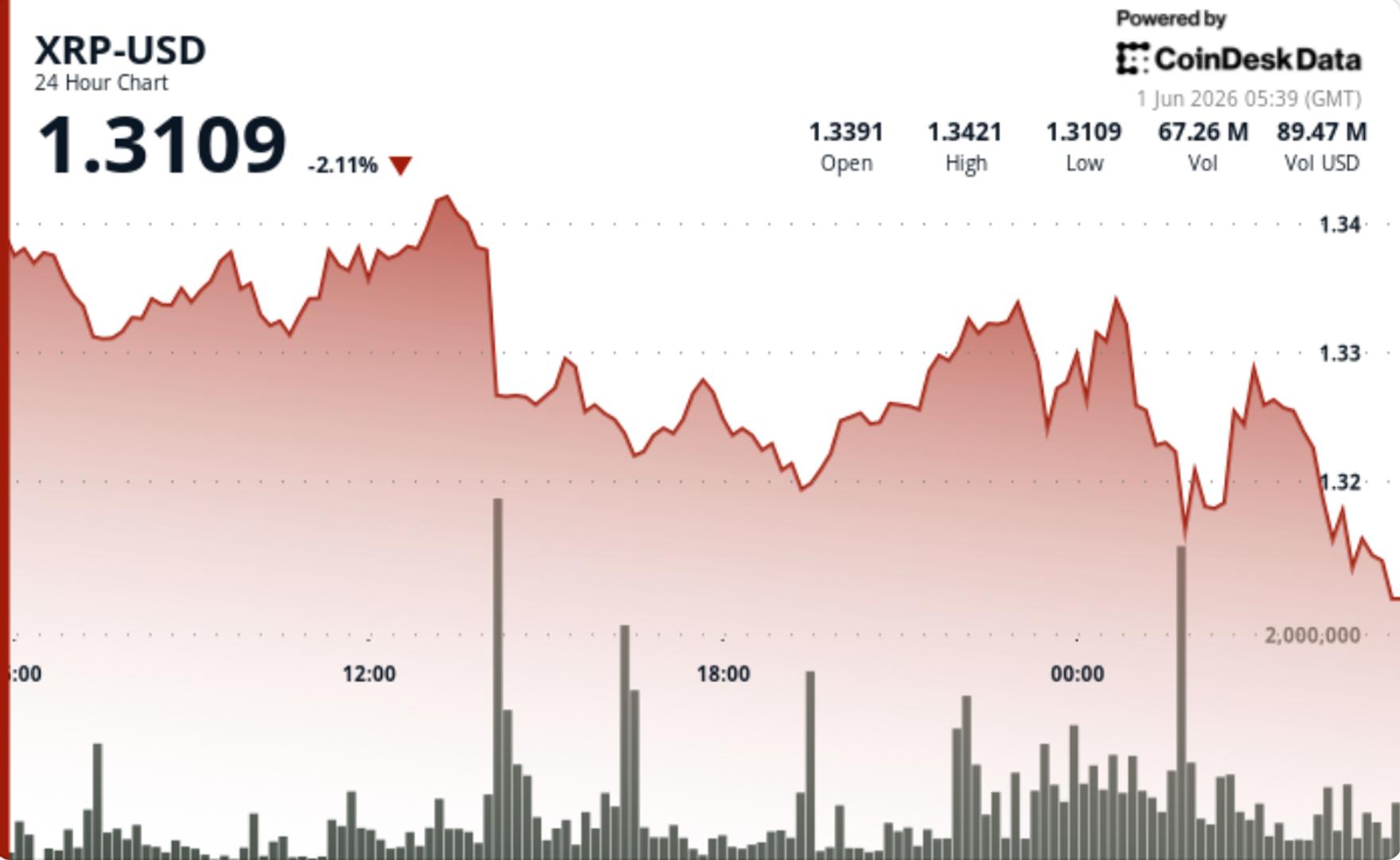
XRP slid to its weakest level in more than three months as heavy selling overpowered signs of exchange outflows, leaving the market stuck between two competing signals. Tokens moving off exchanges usually point to accumulation, but price action is saying sellers still have control whenever XRP tries to recover.
News Background
• More than 25 million XRP left exchanges after a large inflow earlier in the week, suggesting some investors used the drop to move tokens into longer-term storage.
• Spot XRP ETFs recorded fresh inflows, bringing cumulative flows to about $1.42 billion, though that demand has not yet been enough to reverse the downtrend.
• Leverage was heavily flushed during May, with most high-risk long positions already liquidated as XRP bounced from the $1.28 area.
Price Action Summary
• XRP dropped from $1.3384 to $1.3208, hitting a 15-week low during the session.
• The key breakdown came on 55.03 million in volume, which pushed price through support near $1.3320.
• Selling later extended toward $1.314 before a modest bounce brought XRP back toward $1.32.
Technical Analysis
• The key issue is that accumulation signals are not yet showing up in price. Exchange outflows are constructive, but XRP continues to get sold into recovery attempts.
• The breakdown below $1.3320 keeps the short-term structure weak, with $1.34 now acting as the first level buyers need to reclaim.
• A large short-liquidation cluster sits between $1.34 and $1.40, meaning a sharp move higher is possible if XRP can break back into that range.
• Until then, the tape remains defensive, with sellers still controlling the lower highs.
What traders should watch
• $1.31 is the immediate support. Losing it would put $1.28 and then $1.20 back in play.
• $1.34 is the first recovery level. A reclaim could trigger momentum toward $1.37 and $1.40.
• The setup is unstable because exchange outflows point one way while price action points the other. One side will have to give.
TLDR:
- Coinbase now supports direct INR deposits and withdrawals in India through IMPS with no deposit fees.
- Indian traders can access spot markets and perpetual futures contracts on major crypto assets via Coinbase.
- Coinbase is registered with FIU-IND and fully compliant with Indian tax laws for long-term operations.
- Over $1 million has been invested by Coinbase into India’s builder community through Base grants and hackathons.
Coinbase has officially launched direct Indian Rupee (INR) support in India, enabling users to deposit and withdraw funds via IMPS.
The platform now offers spot trading and perpetual futures contracts on major crypto assets. Coinbase is registered with FIU-IND and fully compliant with Indian tax laws.
This move marks a major step in the exchange’s long-term commitment to one of the world’s fastest-growing crypto markets.
Coinbase Opens Full INR Trading Access for Indian Users
Indian customers can now deposit and withdraw INR directly through IMPS, removing the need for P2P rails or third-party intermediaries.
The process is straightforward — users fund their accounts from a bank, trade, and withdraw back to the same account.
Coinbase has built dedicated local INR order books to provide liquidity specifically for Indian traders. At the same time, users retain access to the platform’s global exchange infrastructure.
Spot trading is available across a range of crypto assets, alongside perpetual futures contracts covering major markets.
For traders seeking professional-grade tools, Coinbase Advanced offers APIs built to institutional standards and WebSocket order book streaming.
TradingView charting is also integrated for those who prefer a technical, discretionary approach. A full suite of order types supports both casual and high-frequency trading strategies.
On fees, taker charges on Coinbase Advanced are competitive when compared against local Indian platforms. There are no deposit fees on INR transfers, which reduces the upfront cost for new users.
Beyond headline fees, execution quality plays a role in total trading costs. As Coinbase noted, “Deep global liquidity tends to mean tighter spreads and lower slippage compared to thinner local order books, which affects total cost of trading in ways that aren’t always visible upfront.”
Coinbase’s FIU-IND registration places the exchange under the compliance framework for virtual digital asset service providers in India.
This gives Indian users a regulated environment consistent with local law. The exchange also complies fully with Indian taxation requirements, reinforcing its long-term presence in the market.
Coinbase’s Prior Investment Lays the Ground in India
Coinbase’s entry into Indian retail trading did not happen overnight. The exchange previously invested in CoinDCX, one of India’s leading crypto platforms, signaling early strategic interest.
Through its Ethereum Layer 2 network Base, Coinbase has directed over $1 million into the Indian builder community. That funding covered hackathons, direct grants, and fellowships across the country.
More than 4,000 builders in India have developed projects on Base, with around 150 growing into active startups. Coinbase has also sponsored Indian students and founders to the Network School in Malaysia.
Teams have been flown to New York and San Francisco for demo days and pitch events. As the company stated, “India has long been one of the most important markets in crypto: in terms of developer talent, trading activity, and the broader adoption of blockchain technology.”
Coinbase is listed on NASDAQ under the ticker $COIN and is a member of the S&P 500. The exchange publishes audited quarterly financials and serves as a custody partner for BlackRock.
It holds the majority of customer crypto in cold storage and maintains dedicated crime insurance. Regular security audits further support its standing as a trusted institutional-grade platform.

Jensen Huang, chief executive officer of Nvidia Corp., speaks at the Nvidia GTC conference on the sidelines of Computex 2026 in Taipei, Taiwan, on Monday, June 1, 2026.
Bloomberg | Bloomberg | Getty Images
Nvidia has selected Chinese humanoid robot maker Unitree for the first robotics system the U.S. chipmaker is selling to researchers from Stanford to ETH Zurich, the company announced Monday.
The system combines Unitree’s nearly 6-foot-tall H2 humanoid robot with Nvidia’s Jetson Thor hardware, which includes the company’s advanced Blackwell GPU for on-device artificial intelligence capabilities.
Nvidia’s humanoid-focused AI models, known as Isaac GR00T, and simulation systems are part of the new robot testing package, according to a press release. The robot also uses mechanical hands made by Singapore-based Sharpa. PitchBook lists Qiming Venture Partners among the startup’s backers.
Nvidia CEO Jensen Huang has predicted that “physical AI” could become a market worth tens of trillions of dollars. He told investors last month he expects rapid growth in the robotics segment over the next five years.
“Today, we’re announcing the Nvidia Isaac Root, a reference humanoid robot, all fully integrated, 25 degrees of freedom on that on each hand made by Sharpa, 31 degrees of freedom on the robot, six feet 150 pounds, just like me,” Huang said Monday in a keynote speech in Taipei.
Visitors check out a Unitree H2 humanoid during its public debut at a robots show in Hangzhou in east China’s Zhejiang province Tuesday, Oct. 21, 2025.
Feature China | Future Publishing | Getty Images
“This platform runs the new Thor, and our entire software stack, data generation stack, data simulation stack, the runtime, all integrated into a robot that is designed for everyone to use,” he added.
“We built this for higher education and university researchers, because for them to build this is insanely hard to do.”
The new system also expands Nvidia presence in robotics software development, building on the chipmaker’s edge in AI computing through its widely used CUDA software platform.
Unitree’s global market
The news comes as Unitree seeks to raise 4.2 billion yuan ($620 million) through a listing on Shanghai’s STAR board. The exchange is scheduled to review the IPO application on Monday.
Unitree disclosed more than 40% of its revenue already comes from markets outside China.
The H2 Plus, an upgraded version of Unitree’s H2 humanoid robot, will be available in October, and “anyone can buy it,” said Rev Lebaredian, vice president of physical AI simulation at Nvidia.
It’s a move “taking frontier humanoid research out of the hands of only the world’s largest tech companies and AI unicorns, and putting it in reach of every lab,” he said.
At least four research institutions already plan to use the H2 Plus humanoid, the press release said.
They include Seattle-based Ai2, ETH Zurich in Switzerland, the Stanford Robotics Center and UC San Diego’s Advanced Robotics and Controls Laboratory.
No China-based research arms were listed.



A record 10-session, $2.97 billion outflow streak from spot bitcoin ETFs and a fresh rally in oil prices on stalling U.S.-Iran ceasefire talks have kept bitcoin and the wider crypto market under pressure even as Wall Street’s AI trade pushed global equities to new records in Asian trading Monday.
The MSCI All Country World Index gained 0.2% on Monday and Asian equities advanced 1.1% to an all-time high, with bellwether tech indexes in South Korea, Taiwan and Japan all setting records, Bloomberg reported.
Nasdaq 100 futures rose 0.6% after Nvidia said it would enter the Windows laptop market in direct competition with Intel and AMD, and SoftBank Group jumped as much as 11% on its OpenAI and Arm holdings, putting the Japanese conglomerate on track to become the country’s most valuable listed company.
The mood was complicated by oil. Brent crude climbed above $93 a barrel as efforts to reopen the Strait of Hormuz showed little progress and Middle East tensions stayed elevated, sending Treasuries lower across the curve.
Crypto failed to track the equity rally. Bitcoin fell 4.6% over the past seven days to $73,397, ether (ETH) lost the same 4.6% to $1,996, solana (SOL) 3.7% to $81.89 and TRON’s TRX 3.7%, according to CoinDesk data. slipped 1.6%.
Spot bitcoin ETFs in the U.S. logged a tenth consecutive day of outflows on Friday, with $2.97 billion drained between May 15 and May 29, per SoSoValue data. The streak broke the previous record of eight consecutive outflow sessions set in early 2025, and was headlined by a $733 million single-day exit on May 27, the largest since January.
Total net assets across U.S. spot bitcoin ETFs fell from $104.29 billion on May 15 to $94.17 billion by Friday. Ether ETFs are running an even longer 14-session outflow streak, with roughly $2.6 billion drained from net assets over the same window.
Hyperliquid’s HYPE was the lone outlier in the top 10 by market value.
The token gained 18.7% over the past seven days to $73.17 and the U.S. spot HYPE ETF, which launched May 12, has logged inflows in every single trading session since, lifting cumulative net assets above $122 million by Friday.
Crude’s bounce above $93 and the stalled Iran deal mean the macro lift crypto was waiting on is no longer obviously coming. The ETF flows that powered last year’s rally have gone the other way for ten straight sessions.

How to judge insurance policy (money back)? #LLAShorts 83

Emmerdale star confirms ‘sexual awakening’ for Laurel – but has one fear | Soaps

Pumpfields regeneration: 7,000 new homes proposed for Liverpool city centre


-

 NewsBeat5 days ago
Israel says it has killed new Hamas military leader in Gaza City airstrikes
-

 Tech5 days ago
NASA taps Blue Origin to deliver lunar rovers for Moon Base initiative
-

 Politics7 days ago
Bridgerton Season 5: Cast, Release Date And Everything We Know So Far
-

 Sports6 days ago
2026 NBA Finals schedule, odds: Knicks await Thunder or Spurs after winning East
-

 News Videos5 days ago
XRP *JUST* SUCCEEDED!!!! CLARITY ACT EXPOSED!!! (SHE EXPOSED IT)
-

 News Videos3 days ago
This is BROKEN! INSANE 5x MONEY CAR WASH WEEK! The NEW GTA Online UPDATE Today! (GTA5 New Update)
-
Crypto World5 days ago
Micron Crosses $1 Trillion Market Cap as AI Demand Reshapes Memory Sector
-

 Business5 days ago
Selena Gomez Reportedly Upset Over Benny Blanco’s Comments on Her ‘Terrible’ Diet
-
 NewsBeat6 days ago
Hottest May day ever as London hits 34.8C in 2C leap from previous records
-

 Business7 days ago
BTS Sells Out Four Las Vegas Shows at Allegiant Stadium for ARIRANG World Tour
-
 Tech6 days ago
China assigns ID codes to 28,000+ humanoid robots
-

 Business6 days ago
Nikkei 225 Surges Past 65,000 for First Time as Iran Peace Hopes Fuel Record Rally
-

 Tech7 days ago
Microsoft’s quiet Claude Code retreat and the real cost of enterprise AI
-

 Tech3 days ago
Waymo dominates autonomous vehicle registrations as Tesla trails behind
-

 NewsBeat7 days ago
Crowds find riverside shade in York as temperatures soar
-
 Entertainment6 days ago
‘Breaking Bad’ Star’s Easy-to-Binge 6-Part Crime Series Spin-Off Is Finally Heading to Free Streaming
-
Tech5 days ago
The Samsung pay deal is the moment Korean unions changed register
-

 Tech7 days ago
Westone Audio and Etymotic Acquired by Fidelity Collective in Major IEM Market Move
-

 Tech5 days ago
Millions of AI agents imperiled by critical vulnerability in open source package
-
Crypto World5 days ago
SpaceX’s $2 Trillion IPO: Why Tech Giants Nvidia (NVDA), Apple (AAPL), and Microsoft (MSFT) May Face Pressure
You must be logged in to post a comment Login